Location :
Orlando, FL, USA
Location :
Orlando, FL, USA +1 (407) 714-1616
 info@biz4group.com


















Imagine a digital system that doesn’t wait for instructions but instead, understands your business goals, learns from real-time feedback, and takes independent actions to get the job done.
Read More

Are you running a print shop where great work goes out every day, but new leads barely come in? You are not alone. Recent data shows that nearly 80% of marketers using automation report an increase in leads, proving that automation directly impacts pipeline growth. Yet most print shop owners never reach that stage.
That is where AI marketing automation system development for printing business becomes a turning point. It turns your marketing from reactive to consistent, without adding more to your already full plate.
Many owners quietly admit, “We are running a printing business without a marketing team and need an AI system to automate lead generation and content marketing.” This is exactly why AI marketing software development for printing companies is gaining traction. It gives you a structured way to capture and nurture leads while you focus on production.
The challenge grows when you try to rely on scattered tools. One for emails, another for CRM, and something else for social media. Nothing talks to each other. That is where AI-powered marketing tool development for print shops steps in. It connects everything into one working system that runs in the background, keeping your pipeline active even during peak production weeks.
At its core, it is about control. You stop guessing where your next job will come from. You build a system that works every day. That is why many owners now explore how printing businesses can use AI to automate lead generation and content marketing and finally create predictable growth without hiring a full marketing team.
Let’s begin by understanding the basics.
Up to 70% of inquiries go cold without follow-ups. Why read further while potential revenue slips away today?
Call Biz4Group NowRunning a print shop today often means juggling production deadlines and marketing at the same time. That balance rarely works.
So, what exactly is an AI marketing automation system, and how does it help you generate consistent leads without building a full team?
At its simplest, it is a connected system that captures leads, nurtures them, and converts them into paying customers using automation and AI-driven decision making. It works quietly in the background while you focus on running your operations.
If you have ever asked, “How printing companies can generate leads automatically using AI marketing systems”, this section gives you a clear answer.
An AI marketing automation system is a structured setup of tools, workflows, and data pipelines that handle your marketing activities without manual intervention. Instead of sending emails one by one or manually following up on quotes, the system does it for you based on triggers and customer behavior.
Here is how it looks in practice:
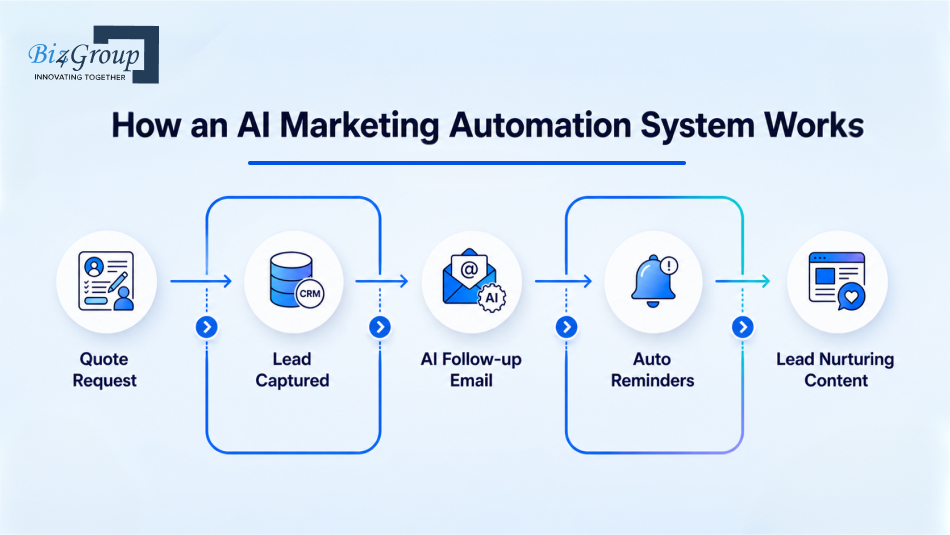
This is where AI marketing software development for printing companies becomes essential. Generic tools rarely support print-specific workflows like quote approvals, artwork revisions, or repeat orders.
To make all of this work smoothly, businesses rely on strong backend AI integration that connects CRM, website, and communication channels into one system.
Understanding the mechanics helps you trust the system. It is not complicated once you break it down.
This is where your pipeline begins.
Every inquiry is captured automatically. No lead gets missed.
Once captured, the data moves into a CRM.
This creates a single source of truth for your business.
This is where intelligence comes in.
It learns from patterns and improves over time.
This is the execution layer powered by AI automation.
Everything runs based on predefined workflows.
Your communication happens across channels:
The system ensures consistent touchpoints without manual effort.
Each part of the system plays a role. When combined, they create a reliable lead generation engine.
|
Component |
What It Does |
Why It Matters for Print Shops |
|---|---|---|
|
Lead Capture System |
Collects inquiries from website and campaigns |
Prevents missed quote opportunities |
|
CRM |
Stores and organizes lead data |
Tracks repeat clients and order history |
|
AI Content Engine |
Generates emails, blogs, and outreach |
Saves time on content creation |
|
Automation Workflows |
Executes follow-ups and nurturing |
Ensures no lead is forgotten |
|
Analytics Dashboard |
Tracks performance and conversions |
Helps you make better decisions |
This combination forms the foundation of development of marketing automation platform for printing companies that actually works in real business scenarios.
This is where most print businesses get stuck. They use tools, but they do not build a system.
Here is the difference:
|
Tools |
System |
|---|---|
|
Work independently |
Fully connected ecosystem |
|
Require manual effort |
Runs automatically |
|
Limited visibility |
Complete pipeline tracking |
|
Short-term usage |
Long-term scalability |
For example:
That is why businesses investing in AI-powered marketing tool development for print shops focus on integration, not just acquisition of tools.
Printing businesses operate differently from typical online businesses.
A disconnected setup cannot handle this complexity. A well-built system helps you integrate AI into your printing workflow without disrupting operations.
It also complements broader advancements in AI in printing industry, where automation is already improving production, scheduling, and quality control.
If you want a simple takeaway:
This section focused on what the system is and how it works. In the next section, we will clarify what this system does not do so you can make informed decisions without unrealistic expectations.
Also read: AI print estimating software development guide
Before you invest in any system, you need clarity. Many print shop owners hesitate because they have seen overhyped tools that promise instant results and deliver very little.
If you have ever thought, “We are a small printing company and want to build an AI-driven marketing system to replace manual marketing efforts”, this section will help you set the right expectations.
Below is a clear comparison that removes confusion and builds trust.
|
What It Is |
What It Is Not |
|---|---|
|
A structured system that automates lead capture, follow-ups, and nurturing |
A magic switch that generates leads overnight without setup |
|
A long-term solution designed to build consistent pipelines |
A quick fix for immediate revenue spikes |
|
A combination of workflows, CRM, and AI working together |
A single tool like ChatGPT or email software |
|
A system that improves over time using data and behavior tracking |
A one-time setup that never needs adjustments |
|
A support system that reduces manual workload |
A complete replacement for business decision-making |
|
A scalable solution built using enterprise AI solutions for growth |
A basic plug-and-play tool with no customization |
|
A tailored system aligned with your print workflow and operations |
A generic software copied from other industries |
|
A foundation that can evolve into a full AI product for your business |
A static system that cannot adapt to new needs |
Many business owners ask, “what is the best way for printing companies to generate consistent B2B leads without hiring a marketing team”, and expect a one-click solution.
That expectation often leads to disappointment.
The reality is simple:
Think of it this way.
You are not buying software. You are building a system that replaces repetitive marketing work.
That system:
But it still depends on:
Now that you know what this system does and what it does not do, you can approach it with realistic expectations. In the next section, we will break down why printing businesses struggle with marketing in the first place and how AI directly solves those challenges.
Businesses that set the right expectations early avoid 30–50% wasted spend on tools that never deliver. Ready to build it right the first time?
Build Smart with Biz4GroupMarketing in a printing business rarely fails because of lack of intent. It fails because of lack of time, structure, and consistency.
If you have ever said, “we are struggling to generate consistent leads for our print shop and want to implement AI marketing automation solutions”, you are describing a very common situation.
Before looking at solutions, it helps to understand the root problems.
Most printing businesses operate in a production-first environment. Marketing always takes a back seat.
Here are the biggest roadblocks.
You are managing jobs, machines, staff, and deadlines.
Marketing becomes optional instead of essential.
This is one of the most expensive problems. A customer requests a quote, you respond once. No follow-up happens. That lead disappears.
Revenue depends on seasonal demand, repeat customers, and word-of-mouth.
There is no predictable pipeline.
You might already be using tools like email platforms, basic CRM, and social media. But nothing is connected. There is no system.
Hiring a team is expensive. Learning marketing yourself takes time you do not have.
That is why many owners ask, “I am running a printing business and don’t have a marketing team, so I need an AI system to generate leads automatically.”
Now let us connect each problem with a practical solution.
|
Problem |
AI-Driven Solution |
Result |
|---|---|---|
|
No time for marketing |
Automated workflows handle outreach |
Consistent activity without manual effort |
|
Lost quotes |
Automated follow-ups and reminders |
Higher conversion rates |
|
Inconsistent leads |
Always-on lead capture and nurturing |
Predictable pipeline |
|
Disconnected tools |
Centralized system with integrations |
Better visibility and control |
|
Lack of expertise |
Pre-built workflows and AI assistance |
Faster execution with less learning curve |
This is where printing business marketing automation software development integrating AI becomes valuable. It connects your operations with your marketing efforts.
Once implemented correctly, the system begins to show measurable improvements.
You might wonder if this will disrupt your current operations.
It does not. It enhances them.
For example:
This aligns closely with innovations like AI prepress automation software, where efficiency is already improving production stages.
Not necessarily. But building a reliable system requires planning and execution. Many businesses choose to hire AI developers to:
This avoids trial-and-error and speeds up results.
In the next section, we will break down the core features that make this system work consistently inside a printing business.
Also read: Real-world AI use cases in the printing industry
Now that you understand how the system works and where it fits, let’s break it down into tangible capabilities.
This section answers a critical question many business owners ask, “What features should an AI marketing system include for a printing business to actually generate leads?”
Below is a clear breakdown of the core features that define AI marketing automation system development for printing business and how each one contributes to growth.
|
Feature |
What It Is |
What It Does |
|---|---|---|
|
Smart Lead Capture Engine |
Dynamic forms, landing pages, and chat-based inputs |
Captures every inquiry without manual tracking and feeds it into your system instantly |
|
AI-Powered Content Engine |
AI-generated blogs, emails, and outreach messages |
Keeps your business visible and active across channels without constant writing effort |
|
CRM with Behavioral Tracking |
Central system that logs interactions and user activity |
Helps you understand customer intent and prioritize high-value leads |
|
Automated Workflow Builder |
Rule-based automation sequences powered by triggers |
Executes follow-ups, reminders, and outreach without human intervention |
|
Multi-Channel Communication System |
Integrated email, SMS, and LinkedIn messaging |
Ensures consistent engagement across multiple platforms |
|
Quote and Inquiry Management System |
Structured handling of quote requests and responses |
Organizes incoming leads and improves response efficiency |
|
Lead Scoring and Qualification |
AI-driven ranking of leads based on behavior and data |
Focuses your attention on leads most likely to convert |
|
Campaign Automation Dashboard |
Centralized interface to manage campaigns and performance |
Gives full visibility into what is working and what needs improvement |
|
Integration Layer |
Connects CRM, website, marketing tools, and backend systems |
Enables smooth AI integration across your entire business ecosystem |
|
Personalization Engine |
AI customizes messages based on user behavior and history |
Increases engagement and conversion rates |
|
Analytics and Reporting Module |
Tracks performance metrics like open rates and conversions |
Helps you make data-driven decisions and refine strategies |
|
Scalability Framework |
Architecture that grows with your business needs |
Supports expansion without rebuilding your system |
|
Custom Workflow Design |
Tailored automation flows built for print-specific processes |
Aligns marketing with your actual business operations |
|
AI Decision Engine |
Uses data to determine next best action for each lead |
Optimizes timing and messaging for better results |
|
System Automation Core |
Backbone powered by advanced AI automation logic |
Ensures the entire system runs continuously without manual input |
Individually, these features solve small problems. Together, they create a system that replaces fragmented efforts with a unified approach.
This is the difference between using tools and investing in AI marketing software development for printing companies that actually delivers outcomes.
Many businesses reach a point where they realize, “we are facing challenges in marketing our printing services and need an AI automation system to improve visibility and sales.”
The features above are what turn that need into a working solution.
Think of these features as layers.
When built correctly, this becomes a long-term growth engine rather than a short-term marketing effort.
In the next section, we will walk through the actual process of how this system operates step by step inside a printing business.
Also read: How to build AI print broker software?
Print businesses using structured automation report up to 2x higher lead engagement. Imagine this running in your workflow.
Book a Strategy Call Today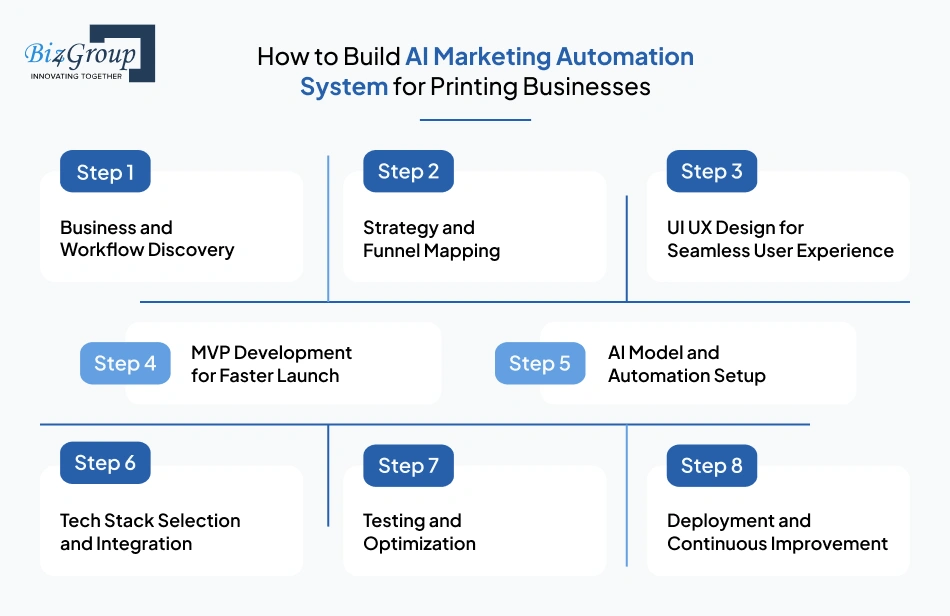
By now, you know what the system does and what features it includes. The next question... how does this actually get built inside a real printing business?
Many owners ask, “We run a small print shop and want to build a complete AI marketing automation system that handles lead generation, follow-ups, and content without hiring a team. Where do we even start?”
The answer lies in a structured process. Not random tools. Not trial and error. A step-by-step approach that builds a working system.
Below is a clear breakdown of how develop AI marketing automation software for printing business happens in real scenarios.
Every system starts with understanding your business.
This step ensures the system aligns with your real operations, not a generic template.
Once the business is understood, the next step is mapping your funnel.
This creates the blueprint for how printing businesses can use AI to automate lead generation and content marketing effectively.
Your system is only as good as how users interact with it. This includes:
A strong UI/UX design ensures higher conversions, better user engagement, and reduced friction in the buying journey.
Also read: Top 15 UI/UX design companies in USA
Instead of building everything at once, smart businesses start with a focused version. An MVP includes:
This approach allows you to test and improve quickly. Using structured MVP development helps reduce upfront cost, validate the system early, and minimize risk.
Also read: Top 12+ MVP development companies in USA
Now the intelligence layer is built. This includes:
This is where AI-powered marketing tool development for print shops becomes operational.
The right technology stack determines how scalable and reliable your system will be.
Below is a typical stack used in printing business marketing automation software development integrating AI.
|
Layer |
Technologies |
Purpose |
|---|---|---|
|
Frontend |
React, Next.js |
User interface and dashboards |
|
Backend |
Node.js, Python |
Core system logic and APIs |
|
CRM |
HubSpot, Salesforce |
Lead management and tracking |
|
Automation |
Zapier, n8n |
Workflow automation |
|
AI Layer |
OpenAI APIs, custom models |
Content generation and decision making |
|
Database |
PostgreSQL, MongoDB |
Data storage and management |
|
Communication |
SendGrid, Twilio |
Email and SMS delivery |
This step ensures all parts of the system work together smoothly.
Before full deployment, the system is tested in real scenarios.
Continuous optimization ensures better performance over time.
Once everything is validated, the system goes live. But the process does not stop here.
This is how you build AI marketing automation system for printing business that grows with your company.
Building this system is not about adding more tools. It is about creating a structured, scalable engine that works every day. When done correctly, it replaces manual effort with predictable outcomes.
In the next section, we will break down the cost of building this system and what you can realistically expect to invest.
Also read: AI print production scheduling & floor optimization software development guide
Let’s address the question every print shop owner asks early... “How much will this actually cost me?”
Many decision makers rightly question “I run a printing business and want to build a complete AI marketing system for lead generation and content automation. What is the realistic cost and what do I get at each level?” This section will give you a clear answer.
The cost of AI marketing automation system development for printing business typically ranges between $20,000 - $250,000+ depending on complexity, integrations, and level of customization.
To simplify this, here is how investment levels usually break down.
|
Level |
What You Get |
Estimated Cost |
|---|---|---|
|
MVP Level AI Marketing Automation Software |
Basic lead capture, CRM integration, simple automation workflows |
$20,000 - $50,000 |
|
Advanced Level AI Marketing Automation Software |
Multi-channel automation, AI content engine, lead scoring, integrations |
$50,000 - $120,000 |
|
Enterprise AI Marketing Automation Software Level |
Fully customized system, deep integrations, advanced AI models, scalability |
$120,000 - $250,000+ |
This range reflects development of marketing automation platform for printing companies tailored to real business needs.
On average, these factors account for nearly 70% - 85% of the total development cost, making them the primary drivers of your investment.
Every system is different. The final cost depends on several moving parts.
Below are the primary drivers that impact your investment.
|
Cost Driver |
What It Includes |
Estimated Impact |
|---|---|---|
|
System Complexity |
Number of workflows, automation layers, and logic |
$10,000 - $60,000 |
|
Custom Feature Development |
Quote systems, dashboards, personalization engines |
$15,000 - $70,000 |
|
AI Capabilities |
Content generation, lead scoring, predictive analytics |
$10,000 - $50,000 |
|
CRM Integration |
Connecting with HubSpot, Salesforce, or custom CRM |
$5,000 - $25,000 |
|
Third-Party Integrations |
Email, SMS, payment gateways, APIs |
$5,000 - $30,000 |
|
UI And Dashboard Design |
User interface and experience optimization |
$5,000 - $20,000 |
|
Data Infrastructure |
Databases, pipelines, and storage systems |
$5,000 - $25,000 |
|
Scalability Requirements |
Handling high traffic and large datasets |
$10,000 - $40,000 |
These factors directly influence printing business marketing automation software development integrating AI and determine whether your system stays basic or evolves into a scalable platform.
On average, hidden costs add an extra 15% - 25% to your total investment if not planned in advance.
Many businesses underestimate these. Planning ahead avoids surprises later.
These are essential considerations when you develop AI marketing automation software for printing business with long-term scalability in mind.
With the right approach, businesses typically reduce unnecessary spending by 20% - 40% while still achieving strong outcomes.
You do not need to overspend to get results. Smart planning makes a big difference.
These strategies help you control costs while still building a powerful system.
Cost is important, but it should be viewed as an investment rather than an expense. A well-built system reduces manual effort, improves conversions, and creates predictable growth. Over time, it pays for itself through increased revenue and efficiency.
In the next section, we will look at the return on investment and what results you can realistically expect after implementing this system.
Also read: How much does it cost to integrate AI in printing business?
Many print shops recover costs in 3–6 months by converting 20–40% more leads. What would that mean for your monthly revenue?
Let's Talk NumbersAt this stage, the real question is not cost. It is return.
Will this system actually generate more revenue than it costs?
If you are thinking, “what is the best way for printing companies to generate consistent B2B leads without hiring a marketing team”, ROI is where the answer becomes clear.
A well-built AI marketing automation system development for printing business delivers returns through three key areas.
|
Area |
What Improves |
Business Impact |
|---|---|---|
|
Lead Conversion |
Faster follow-ups and nurturing |
More quotes converted into orders |
|
Time Efficiency |
Reduced manual work |
10 - 20 hours saved per week |
|
Marketing Consistency |
Always-on campaigns and outreach |
Stable and predictable lead flow |
These improvements are the direct outcome of how printing businesses can use AI to automate lead generation and content marketing effectively.
You do not need inflated promises. Here are practical, achievable outcomes.
|
Metric |
Before System |
After AI System |
|---|---|---|
|
Lead Response Time |
12 - 48 hours |
Instant or within minutes |
|
Follow-Up Rate |
20% - 30% |
80% - 100% automated |
|
Lead Conversion Rate |
5% - 10% |
15% - 30% |
|
Monthly Leads |
Inconsistent |
Predictable growth |
|
Cost Per Lead |
High and unstable |
Reduced by 20% - 50% |
These numbers reflect what happens when you build AI marketing automation system for printing business with the right structure.
Let’s simplify it.
|
Scenario |
Without System |
With AI System |
|---|---|---|
|
Monthly Leads |
40 |
70 |
|
Conversion Rate |
10% |
20% |
|
New Customers |
4 |
14 |
|
Avg Order Value |
$500 |
$500 |
|
Monthly Revenue |
$2,000 |
$7,000 |
That is a 3x+ revenue impact without increasing workload.
Most printing businesses recover their investment within:
|
System Level |
Payback Period |
|---|---|
|
MVP |
3 - 6 months |
|
Advanced |
6 - 12 months |
|
Enterprise |
12 - 18 months |
This makes AI marketing software development for printing companies a high-return investment when implemented correctly.
Unlike ads that stop when spending stops, this system keeps working.
This is why many owners say, “we are running a printing business without a marketing team and need an AI system to automate lead generation and content marketing.” Because once the system is in place, results become consistent rather than unpredictable.
ROI is not about a single campaign. It is about building a system that delivers results every day. When done right, this becomes one of the most reliable growth drivers for your business.
In the next section, we will look at the challenges you may face while implementing this system and how to overcome them effectively.
Building a system sounds great on paper. Execution is where most printing businesses get stuck.
If you are thinking, “we want to build AI marketing automation system for printing business but are unsure about risks, technical challenges, and whether it will actually work for our setup”, this section will give you clarity.
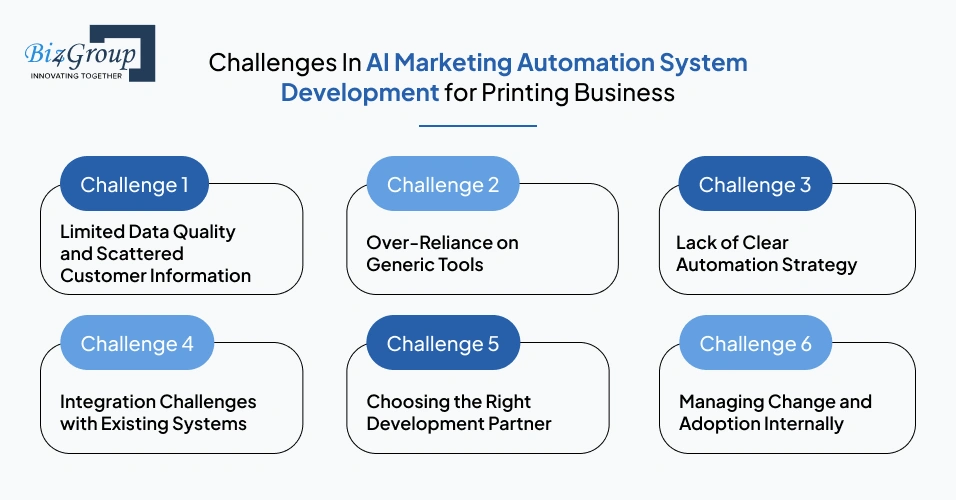
Below are the most common challenges and how to solve them effectively.
Many print shops store customer data across emails, spreadsheets, and disconnected tools. This makes automation unreliable because the system depends on structured data. Without clean data, even the best AI marketing software development for printing companies cannot deliver accurate results.
How To Solve This
Many businesses try to patch together multiple tools. This leads to broken workflows and limited scalability. Generic platforms rarely support AI-powered marketing tool development for print shops in a meaningful way.
How To Solve This
Automation without strategy leads to noise instead of results. Messages get sent, but they do not convert. This is a common issue when businesses rush into development of marketing automation platform for printing companies without planning.
How To Solve This
Most print businesses already use some form of CRM, MIS, or ERP. Connecting these with a new system can be complex. Poor integration leads to data gaps and broken automation.
How To Solve This
Also read: AI printing MIS automation software development guide
Selecting the wrong team can lead to delays, budget overruns, and underperforming systems. Many business owners search for top developers who can create AI marketing automation platforms for printing companies without marketing teams and struggle to evaluate options.
How To Solve This
Also read: Top 12 AI printing software development companies in USA
Even the best system fails if your team does not use it properly. Resistance to change or lack of understanding can slow adoption.
How To Solve This
Challenges are part of the process. What matters is how you approach them. With the right planning, tools, and expertise, these obstacles become manageable steps rather than roadblocks.
In the next section, we will help you decide whether to build your own system or choose an existing solution based on your business needs.
Even losing 5–10 leads a month can cost $2,000–$10,000 in revenue. One call can show you exactly where it's happening.
Talk to Biz4Group's ExpertsAt some point, every print shop owner faces this decision. Do you build a custom system or buy existing tools and try to make them work?
If you are thinking, “we are a small printing company and want to build an AI-driven marketing system to replace manual marketing efforts but are unsure whether to build or buy”, this section will help you decide clearly.
Below is a side-by-side comparison based on real business needs.
|
Factor |
Build AI Marketing Automation System |
Buy Existing Tools |
|---|---|---|
|
Customization |
Fully tailored to your print workflows and processes |
Limited to predefined features and templates |
|
Integration |
Seamless integration with CRM, MIS, and internal systems |
Often requires workarounds and manual syncing |
|
Scalability |
Designed to grow with your business |
May require switching tools as you scale |
|
Cost Structure |
Higher upfront, lower long-term cost |
Lower upfront, recurring monthly fees |
|
Ownership |
Full control over system and data |
Dependent on third-party platforms |
|
Flexibility |
Can adapt to new services, markets, and strategies |
Restricted by platform limitations |
|
Performance |
Optimized for your specific use cases |
Generalized performance across industries |
|
Maintenance |
Requires ongoing support and updates |
Managed by the tool provider |
|
Time To Launch |
Longer initial setup |
Faster to start but limited in depth |
Buying tools gives you speed. Building a system gives you control.
For most printing businesses aiming for consistent lead generation and scalability, building becomes the stronger long-term choice.
This aligns with what many owners are actively searching for, “what is the best way for printing companies to generate consistent B2B leads without hiring a marketing team?”
The answer often lies in creating a system that fits your business, not forcing your business to fit a tool.
At this stage, the next logical step is understanding who has the expertise to design and implement such systems effectively.
The most intelligent question now, “Which company can help build AI marketing automation systems for printing businesses that actually generate consistent leads and integrate with existing workflows?”
By this point, you understand the system, the cost, the ROI, and the challenges. The final piece is execution.
If you are thinking, “we need a reliable partner who understands both AI and the printing industry to build a complete marketing automation system that actually generates leads”, you are looking for a team that can translate your business into a working system.
Biz4Group LLC is a US-based AI development company that specializes in building custom, scalable, and production-ready systems for businesses that want real outcomes, not experiments.
We do not offer pre-built templates or generic solutions. Every system is engineered around your workflows, your customers, and your growth goals.
Our experience spans across:
What sets us apart is how we approach development.
We do not start with tools. We start with your business model.
We analyze how your leads come in, how your quotes are handled, how your customers behave, and where opportunities are being missed. Then we design a system that connects every part of that journey into a single, efficient flow.
This is what makes AI marketing automation system development for printing business actually work.
Choosing a development partner is not about who can build software. It is about who can build the right system. Printing businesses trust Biz4Group because we:
Most importantly, we build systems that are practical.
Not over-engineered. Not over-complicated. Built to run reliably in real business environments.
So, if you are serious about building a system that generates leads, nurtures customers, and supports your operations, connect with our experts.
Building a steady pipeline for a printing business has never been about effort alone. It has always been about systems. When marketing depends on manual follow-ups, inconsistent posting, and scattered tools, results remain unpredictable. A structured approach changes that. With AI marketing automation system development for printing business, you move from chasing leads to managing a system that brings them in, nurtures them, and converts them consistently.
The real advantage comes from alignment. When your marketing, customer data, and workflows operate together, you gain visibility and control. This answers what many business owners are actively searching for, “how can small print shops automate LinkedIn, email, and content marketing using AI systems while keeping costs under control”. The answer is not more tools. It is a well-built system designed around how your business actually runs.
This is where working with the right partner makes a measurable difference. Biz4Group LLC stands out as a trusted software development company in the USA that understands both AI systems and printing workflows. Instead of offering generic solutions, the focus stays on building systems that deliver real outcomes, from lead generation to long-term scalability.
If you are ready to stop guessing and start building a predictable growth engine, now is the time to act. Start a conversation with experts who know how to turn your printing business into a system that works every day.
No. Even with a small number of inquiries, the system improves how each lead is handled. It ensures faster responses, better engagement, and higher chances of conversion. Over time, this creates compounding growth without requiring high initial traffic.
Yes. The system can be tailored for specific segments such as packaging, signage, or trade printing. Each workflow is designed around your service type, customer journey, and order complexity, making it highly adaptable across different print business models.
Most platforms take several months to fully develop and deploy. Biz4Group, however, can deliver a functional MVP in 2 - 4 weeks by using reusable components that reduce both development time and cost. This allows businesses to start seeing results faster while continuing to scale the system.
Not necessarily. In many cases, your current tools can be integrated into the system. The goal is to connect and optimize what you already use rather than replace everything. This approach reduces disruption and improves efficiency.
Yes. In fact, it works exceptionally well for B2B models where decision cycles are longer and follow-ups are critical. The system maintains consistent communication, which helps build trust and improves conversion over time.
Security depends on how the system is built. A well-developed system includes data encryption, secure APIs, and controlled access levels. This ensures that customer data remains protected while still being accessible for automation and analysis.
Yes. The system includes dashboards that show key metrics such as lead activity, engagement rates, and conversions. This allows you to measure performance and make informed decisions without relying on assumptions.

with Biz4Group today!
Our website require some cookies to function properly. Read our privacy policy to know more.