 Location :
Orlando, FL, USA
Location :
Orlando, FL, USA +1 (407) 714-1616
 info@biz4group.com

- AI Transformation for CEOs demands clear leadership decisions, the right operating model, cultural alignment, ROI discipline, and governance that scales with impact.
- A clear AI adoption roadmap for CEOs helps enterprises move from intent to execution without overwhelming teams or budgets.
- AI transformation planning and ROI for CEOs depends on phased investment, meaningful metrics, and cost controls that protect long-term value.
- AI strategy and governance for CEOs ensures trust, compliance, and control as AI systems influence customers, employees, and critical business outcomes.
- Challenges CEOs face during AI transformation includes addressing scaling, talent alignment, and trust issues early.
- Biz4Group LLC helps enterprise leaders turn AI ambition into production-ready systems through proven execution, scalable architecture, and long-term partnership.
Have you ever sat in a leadership meeting and felt that quiet pressure to say something meaningful about AI, even when the path forward feels unclear? Many leaders feel that tension today. AI transformation for CEOs has become a defining expectation, yet most conversations stay stuck between vision decks and disconnected pilots.
Across boardrooms, the question has shifted from whether AI matters to how it reshapes the company from the inside. Building an AI first organization means rethinking how decisions are made, how teams work, and how value is created at scale. It challenges habits that once worked well. It also forces leaders to confront tradeoffs between speed, control, and long-term advantage.
New global study reveals 71% of enterprises are using AI, but only 30% are ready to unlock its true potential. That disconnect explains why many leadership teams feel stuck despite rising investments. An effective AI transformation strategy for CEOs bridges that gap by tying AI initiatives directly to business outcomes.
Another question quietly shapes every executive discussion. How long does AI transformation take in large organizations and when does it start paying off? There is no universal timeline, but there are proven patterns. This guide is built to help you recognize them, avoid costly detours, and lead with confidence toward measurable results.
What Building an AI First Organization Really Mean?
Before diving into roadmaps and frameworks, it helps to clear one misconception. Many companies believe they are on the path already. Dashboards look smarter. Automation feels faster. AI tools appear in daily workflows. Yet very few organizations operate as truly AI first enterprises.
An AI first organization treats intelligence as core infrastructure. Decisions, prioritization, and execution are shaped by data and predictive insight, not hindsight reporting. AI influences how work flows, not how reports are generated.
That difference matters more than most leaders expect.
AI First vs Digitally Mature Organizations

Many enterprises confuse digital maturity with AI maturity. They are related, but not the same.
|
Area |
Digitally Mature Organization |
AI First Organization |
|
Decision making |
Based on historical reports |
Guided by real-time and predictive insights |
|
Automation |
Rule-based workflows |
Context aware and adaptive systems |
|
Role of data |
Used for visibility |
Used for action |
|
AI usage |
Tools and pilots |
Embedded into core operations |
|
Leadership focus |
Efficiency |
Competitive advantage |
This distinction explains why some companies move faster without adding headcount, while others stall despite heavy investment.
Why CEOs Struggle to Define AI First Clearly
A common pattern shows up in executive discussions.
- AI is treated as a technology upgrade
- Ownership sits with IT or innovation teams
- Success is measured by pilot completion
This structure creates activity, not transformation.
As Satya Nadella, CEO of Microsoft, once said, “Every company is a software company. You have to start thinking and operating like a digital company.” That statement has aged well in the era of enterprise AI.
The implication for CEOs is direct. Building an AI first organization starts with operating model choices, not tools.
What Being AI First Looks Like in Practice
In AI first enterprises, certain behaviors become visible early.
- Leaders ask predictive questions, not descriptive ones
- Teams trust systems that recommend actions
- AI outcomes tie directly to revenue, cost, or risk
- Scaling matters more than experimentation
For example, Netflix's recommendation systems influence content investment, user retention, and production decisions. AI sits at the center of how the business grows, not on the sidelines of analytics.
AI transformation for CEOs requires a mindset shift that many underestimate.
You are not sponsoring AI.
You are reshaping how the organization thinks, decides, and executes.
This reframing sets the foundation for everything that follows, from strategy alignment to operating model redesign.
Think You’re AI-First or Just AI-Aware?
Nearly 70% of enterprises say they use AI, yet only a fraction see real business impact. Where does your organization actually stand?
Talk to Biz4Group’s ExpertsWhy AI Transformation for CEOs Has Become a Board Level Mandate?
A few years ago, AI sat comfortably inside innovation decks and future roadmaps. Today, it shows up in earnings calls, board discussions, and investor questions. That shift did not happen quietly.
AI transformation for CEOs has moved into the spotlight because the cost of standing still has become measurable.
What Changed in the Market
Several forces are converging at once.
- Faster competitors using AI to compress decision cycles
- Rising labor and operational costs forcing efficiency gains
- Customer expectations shaped by personalization and speed
- Investors looking for defensible, scalable growth
According to PwC, AI could contribute up to $15.7 trillion to the global economy by 2030, with productivity gains making up a significant share of that value. Boards understand what that scale implies for winners and laggards.
The tone of board conversations has changed. Earlier questions sounded like “Are we exploring AI?”, “Do we have pilots running?”, or “Which tools are we testing?”
Today, the questions sound sharper:
- Where is AI improving margins?
- How is AI reducing risk?
- Which decisions are automated or augmented by intelligence?
This shift explains why AI transformation in modern enterprises can no longer sit with isolated teams. Boards expect CEOs to connect AI investments with enterprise outcomes.
Well-known US companies have already crossed this threshold.
At Amazon, AI influences demand forecasting, pricing, logistics, and customer experience at scale. Andy Jassy has emphasized that AI underpins how Amazon operates, not how it experiments.
The Risk CEOs Rarely Quantify
The largest risk today is not failed AI projects. It is delayed transformation.
- Competitors lock in efficiency advantages
- Talent gravitates toward AI mature organizations
- Data compounds value for early movers
This mandate naturally places responsibility with the CEO. AI cuts across departments, budgets, data ownership, and risk. No other role has the authority to align these pieces at scale. When AI decisions stall, it is rarely due to technology limits. It is usually a leadership alignment issue.
A simple comparison boards already make:
|
Question |
Traditional View |
Current Board Expectation |
|
AI investment |
Optional innovation |
Strategic necessity |
|
Ownership |
IT or digital teams |
CEO and executive leadership |
|
Timeline |
Long term exploration |
Phased but urgent execution |
|
Success metric |
Pilot completion |
Measurable business impact |
This shift sets the stage for the next critical discussion. If AI transformation sits with the CEO, what does that role actually look like in practice?
AI Adoption Roadmap for CEOs Leading Enterprise AI Transformation
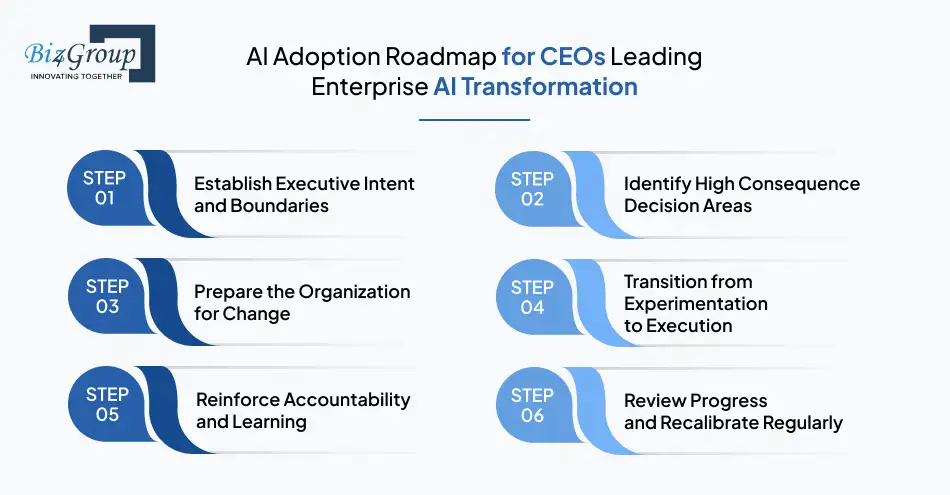
Once AI becomes a board level mandate, the next challenge is sequencing. Many initiatives fail because leaders move too fast in the wrong order or too slowly where urgency matters. An AI adoption roadmap for CEOs brings structure to that uncertainty.
Step 1: Establish Executive Intent and Boundaries
AI transformation begins with clarity. CEOs must define what AI should and should not influence. This includes identifying decision areas where AI adds value and setting boundaries where human judgment remains primary.
Clear intent prevents confusion later. Teams align faster when they understand where AI fits into the organization’s future.
Step 2: Identify High Consequence Decision Areas
Rather than spreading AI across the enterprise, effective leaders focus on decisions that carry meaningful impact. These decisions often relate to cost control, resource allocation, customer experience, or risk exposure.
Step 3: Prepare the Organization for Change
Before systems change, expectations must change. CEOs communicate why AI is being introduced, how it supports teams, and what success looks like. This step reduces friction and builds early trust.
Preparation at this stage lowers resistance later when AI becomes part of daily operations.
Step 4: Transition from Experimentation to Execution
At this point, leaders shift language and funding. AI moves from being explored to being relied upon. Success is no longer measured by pilots, but by adoption in real workflows.
This transition marks the difference between interest and commitment.
Step 5: Reinforce Accountability and Learning
As AI influences decisions, leaders reinforce accountability. Teams are encouraged to question outputs, improve systems, and share learnings across functions.
This creates a culture where AI evolves alongside the business rather than becoming static.
Step 6: Review Progress and Recalibrate Regularly
AI transformation is not linear. Markets shift. Data changes. Assumptions age. CEOs schedule periodic reviews to reassess priorities, risks, and performance.
These reviews keep AI aligned with business reality over time.
This executive AI transformation framework keeps leadership focused on sequencing rather than speed. It prevents overload, aligns teams, and prepares the organization for deeper operational change.
With a clear roadmap in place, organizations are ready to focus on execution. That brings us to the next critical element, building an AI ready operating model that supports enterprise scale transformation.
Still Guessing the Right Order for AI Transformation?
Most AI initiatives fail because leaders move fast in the wrong sequence.
Schedule a Strategy Call TodayBuilding an AI Ready Operating Model for Enterprise AI Transformation Leadership
Most organizations do not fail at AI because of technology. They fail because the operating model never changes. Workflows stay the same. Decision rights remain unclear. Ownership is fragmented. AI lives on top of old structures that were never designed for intelligence at scale.
An AI-ready operating model solves this problem at its root. It determines how AI fits into day-to-day execution, not how impressive it looks during demos.
Why Organizations Remain Stuck in Pilot Mode
AI pilots often show promise early. Then momentum fades. Common reasons include:
- No clear business owner for AI outcomes
- AI outputs treated as optional recommendations
- Data scattered across teams and systems
- Models built without integration into workflows
According to reports, only about 20% of AI initiatives make it from pilot to production. The rest 80 never make it due to organizational and operational gaps.
This pattern explains why AI transformation in modern enterprises demands structural change, not more experimentation.
Core Components of an AI Ready Operating Model
An effective operating model focuses on how intelligence flows through the organization. Key elements include:
Clear ownership
- Each AI capability has a business owner
- Outcomes tie to measurable KPIs
- Accountability sits outside pure IT functions
Workflow integration
- AI insights trigger actions, not reports
- Systems embed AI where decisions happen
- Manual handoffs are reduced or removed
Data as a shared asset
- Data access aligns with business priorities
- Governance enables usage without friction
- Feedback loops improve model performance
Scalable architecture
- Designed for growth, not proof of concept
- Cost controls built into the system
- Independent scaling of AI components
These non-negotiables separate organizations that scale AI from those that remain stuck.
New Roles That Emerge During AI Transformation
As AI moves into operations, responsibilities shift.
|
Role |
Primary Responsibility |
|
AI product owner |
Aligns AI outputs with business outcomes |
|
Data steward |
Ensures data quality and governance |
|
Model operations lead |
Oversees performance and lifecycle |
|
AI risk and compliance lead |
Manages ethical and regulatory exposure |
These roles clarify decision rights and reduce friction as AI adoption expands.
Where Most Operating Models Break Down
Several mistakes appear repeatedly.
- AI initiatives launched without workflow redesign
- Success measured by usage instead of impact
- Central teams overloaded with execution responsibility
- Business units excluded from design decisions
These gaps slow adoption and weaken trust in AI systems.
Reed Hastings once said, "Companies rarely die from moving too fast, and they frequently die from moving too slowly." That mindset applies strongly to AI operating models. Speed without structure fails. Structure without speed crashes.
Project Spotlight: A Practical Example of an AI Ready Operating Model in Action
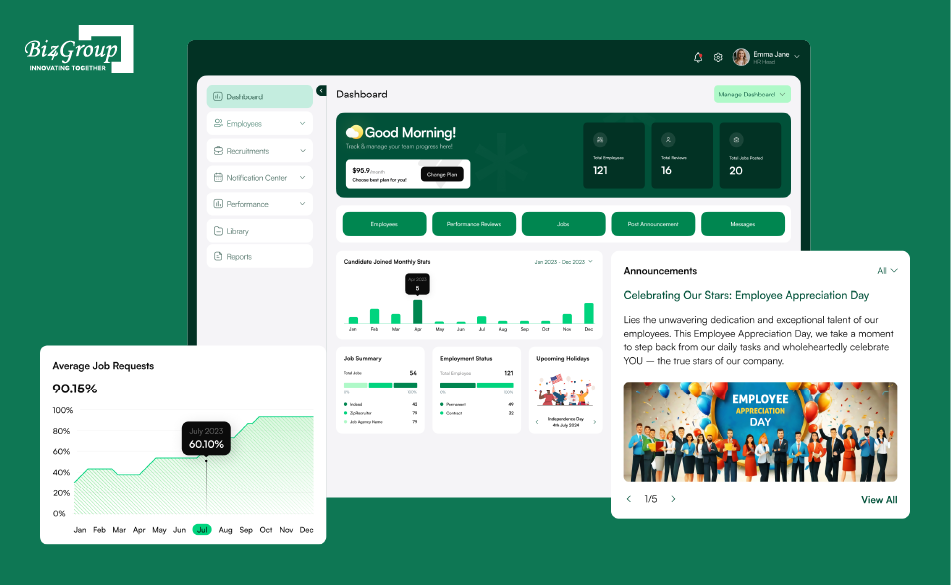
This AI-powered HRMS reflects how AI can be embedded directly into core business operations rather than layered on top.
Key highlights that matter for enterprise transformation:
- AI built into everyday HR workflows
- Resume parsing, onboarding, and performance reviews powered by intelligence
- An AI assistant that answers policy and payroll questions in real time
- Automation designed to reduce dependency on manual HR processes
What makes this project relevant as an operating model example:
- AI components scale independently from the core system
- Token usage optimized through fine-tuned AI models and caching
- Event driven architecture supports real time updates across platforms
- Security and privacy designed into AI interactions
This approach shows how Biz4Group builds AI systems that operate at scale, control costs, and integrate seamlessly into enterprise workflows.
A Simple Operating Model Comparison
|
Aspect |
Traditional Model |
AI Ready Operating Model |
|
Decision flow |
Human led |
Human plus AI |
|
AI usage |
Optional insights |
Embedded actions |
|
Ownership |
Centralized |
Distributed with accountability |
|
Scalability |
Limited |
Designed for growth |
An AI ready operating model lays the foundation for long-term transformation. Without it, culture, investment, and governance efforts struggle to gain traction.
AI Driven Digital Transformation for Executives Without Breaking Teams or Trust
Technology changes faster than people. That simple truth explains why many AI initiatives come to a halt even after the operating model is redesigned. AI driven digital transformation for executives depends on trust, clarity, and leadership consistency.
1. Why Employees Resist AI Even When It Works
Resistance rarely comes from fear of technology. It comes from uncertainty.
Employees worry about:
- Loss of relevance
- Reduced decision authority
- Being measured by systems they do not control
When these concerns remain unspoken, adoption slows. Teams comply outwardly but disengage internally.
2. The Trust Gap Most Leaders Underestimate
Trust breaks when AI appears suddenly and without context.
Common triggers include:
- AI decisions without explanations
- Metrics changing without warning
- Automation introduced before reskilling
Building an AI first organization requires transparency around why AI exists, how it supports teams, and where human judgment remains essential.
3. How Leaders Can Normalize AI Without Fear
Successful organizations follow a few cultural principles.
First, they position AI as support, not surveillance.
Second, they explain outcomes in plain business language.
Third, they allow teams to question and improve AI systems.
This approach reframes AI as a collaborator rather than a threat.
4. The Role of Leadership Behavior in Adoption
Culture responds more to behavior than messaging.
When executives:
- Reference AI insights during reviews
- Ask how AI informed decisions
- Reward teams for effective AI usage
Adoption accelerates naturally. This reinforces a core lesson of AI transformation for CEOs. Culture follows attention.
5. Upskilling Without Overwhelming Teams
AI adoption does not require everyone to become technical.
Effective programs focus on:
- Understanding AI outputs
- Knowing when to challenge recommendations
- Applying insights to real decisions
Small, role-based learning builds confidence faster than broad training initiatives.
Creating an AI-driven culture prepares organizations for the next critical challenge. Funding AI wisely, measuring ROI clearly, and sustaining momentum over time. Let’s talk about that next.
Will Your Teams Embrace AI or Quietly Resist It?
AI adoption fails when trust breaks. The right approach turns uncertainty into confidence.
Transform with Biz4GroupAI Transformation Planning and ROI for CEOs
AI excitement fades quickly when budgets rise faster than results. This is where many leadership teams lose confidence. AI transformation planning and ROI for CEOs demands discipline, not optimism.
Strong outcomes come from treating AI as a long-term capability with phased investment.
Why AI Budgets Spiral Without Returns
Several patterns show up repeatedly.
- Funding too many pilots at once
- Measuring success through usage instead of impact
- Treating AI spend as experimental for too long
- Scaling infrastructure before proving value
According to a Harvard Business Review analysis, many AI programs struggle because leaders underestimate operational and integration costs, not model development.
This reality makes ROI planning essential.
A Phased Approach to AI Investment
CEOs who manage cost effectively follow a staged model.
|
Phase |
Investment Focus |
Primary Goal |
|
Foundation |
Data readiness and architecture |
Enable reliable AI usage |
|
Validation |
Limited scope production use |
Prove measurable value |
|
Expansion |
Workflow integration |
Scale impact across teams |
|
Optimization |
Cost control and performance tuning |
Sustain ROI over time |
This structure keeps spending aligned with learning and outcomes.
What CEOs Should Measure Instead of Vanity Metrics
Traditional metrics fail to capture AI value. Replace them with measures tied to business reality.
|
Poor Metric |
Better Executive Metric |
|
Model accuracy alone |
Revenue lift or cost reduction |
|
Number of AI tools |
Adoption within core workflows |
|
Pilot completion |
Time saved per decision |
|
Usage frequency |
Risk reduction or error avoidance |
This shift strengthens financial accountability.
Controlling Costs Without Slowing Momentum
Cost control does not mean slowing innovation. It means:
- Fine tuning models for repetitive tasks
- Caching frequent queries
- Scaling AI components independently
- Reviewing vendor dependency regularly
These practices protect margins while preserving speed. When teams see tangible value, resistance drops. Clear ROI builds trust across departments, strengthens board confidence, and supports sustained funding.
AI transformation planning and ROI for CEOs creates the financial backbone for long term success. Next, we will examine managing risk, governance, and compliance in AI programs, and how leaders balance speed with control in enterprise environments.
AI Strategy and Governance for CEOs in Enterprise Environments
As AI adoption expands, one concern rises faster than cost or performance. Control. Enterprises move carefully for good reason. Data privacy, regulatory exposure, and reputational risk sit squarely on the CEO’s desk.
AI strategy and governance for CEOs exists to protect trust while enabling progress.
Why Governance Matters More as AI Scales
Early AI pilots often feel safe. Limited data. Limited exposure. Limited impact.
That changes quickly at scale.
- AI decisions affect customers and employees
- Errors propagate faster than human mistakes
- Regulators scrutinize automated decision making
- Vendors influence long term data and model control
Without governance, speed becomes liability.
Core Risks CEOs Must Address Early
Most enterprise risks fall into a few categories.
- Data privacy risk: Sensitive data exposed through training or inference
- Model risk: Inconsistent or biased outputs impacting decisions
- Operational risk: AI systems failing during peak usage
- Vendor dependency risk: Lock-in to platforms that limit flexibility
These risks compound as AI adoption grows.
What Responsible AI Governance Looks Like in Practice
Strong governance does not slow teams. It gives them guardrails. Effective frameworks include:
- Clear approval paths for AI use cases
- Human oversight for high impact decisions
- Regular model performance reviews
- Documentation of data sources and assumptions
These practices support responsible innovation.
A Practical Governance Checklist for Executives
- Is sensitive data anonymized before model usage?
- Do teams understand when human review is required?
- Are AI vendors evaluated for long term flexibility?
- Is there visibility into model performance and cost?
Clear answers here prevent surprises later.
Managing risk, governance, and compliance creates stability. It also reveals where organizations stumble most often.
Next, we will examine the challenges, risks, and common mistakes CEOs face during AI transformation, along with practical ways to avoid them.
Is Your AI Moving Faster Than Your Controls?
As AI scales, so do risk and exposure. Strong governance keeps innovation moving without costly surprises later.
Strengthen My AI GovernanceChallenges CEOs Face During AI Transformation and How to Overcome Them
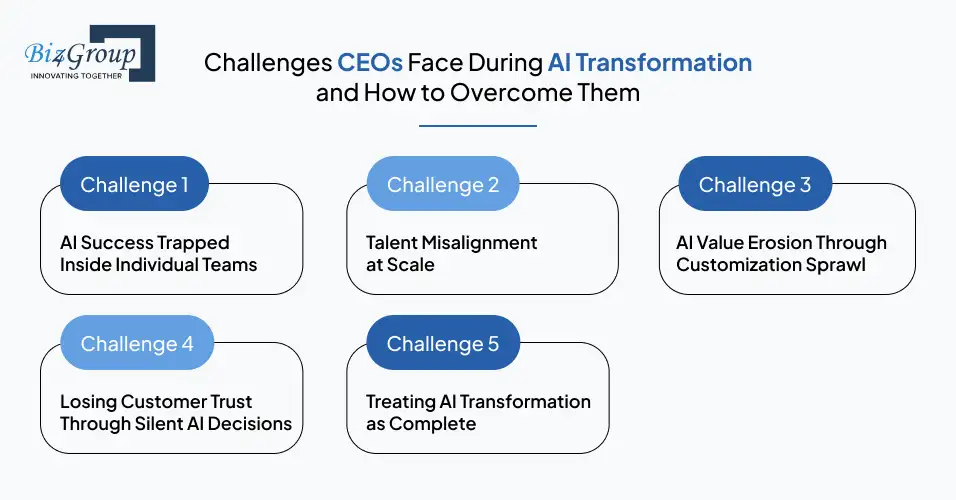
Even well-funded and well-intentioned AI programs can drift off course. The reasons are often subtle. They emerge after early success, not before it. This section focuses on challenges that surface later in AI transformation for CEOs and quietly undermine long term impact.
Challenge 1: AI Success Trapped Inside Individual Teams
Some organizations see strong AI outcomes within isolated departments. Sales performs better. HR becomes more efficient. Operations move faster. Yet the enterprise impact remains limited because successes never cross team boundaries.
CEOs address this by formalizing cross functional reuse. When one team proves value, leaders sponsor replication instead of reinvention. This shifts AI from localized improvement to enterprise leverage.
Challenge 2: Talent Misalignment at Scale
As AI systems mature, skill requirements change. Teams built for experimentation struggle with operational maintenance. Business users lack confidence interpreting AI outputs. Friction grows quietly.
The solution involves role clarity rather than hiring sprees. CEOs realign responsibilities so builders, operators, and decision makers each have defined ownership. This stabilizes execution without disrupting teams.
Challenge 3: AI Value Erosion Through Customization Sprawl
Over time, AI systems become over customized to satisfy edge cases. Maintenance costs rise. Performance becomes inconsistent. Innovation slows.
Leaders counter this by enforcing architectural discipline. Core AI capabilities remain standardized while customization stays limited and intentional. This balance protects scalability and cost control.
Challenge 4: Losing Customer Trust Through Silent AI Decisions
Customers notice when AI affects outcomes without explanation. Pricing changes feel arbitrary. Service decisions appear opaque. Trust erodes even when accuracy improves.
The solution centers on transparency. CEOs encourage teams to explain AI influenced outcomes clearly and consistently. This preserves trust while maintaining efficiency.
Challenge 5: Treating AI Transformation as Complete
One of the most dangerous assumptions is believing AI transformation reaches an endpoint. Markets shift. Models age. Data changes.
CEOs who succeed treat AI as a living capability. They plan for renewal, not completion. This mindset keeps organizations adaptive instead of complacent.
These challenges reveal a pattern. AI transformation for enterprise leadership does not fail loudly. It weakens quietly when discipline fades.
Why You Should Reach Out to Biz4Group LLC for AI Transformation Consulting for Executives in the USA
Biz4Group LLC is a US-based software development and AI consulting company that works closely with entrepreneurs, CEOs, and enterprise leaders who want results. Our focus has always been clear. We build production ready software systems that operate at scale and create measurable business value.
What sets Biz4Group LLC apart is not our familiarity with AI tools. It is our ability to translate executive intent into working systems that teams actually use. We understand how decisions are made inside growing and complex organizations. That understanding shapes how we design AI platforms, workflows, and offer AI integration services.
Our work spans AI development, data driven systems, and AI automation for businesses across industries. With over 20 years of experience, Biz4Group LLC operates as a long-term execution partner. We help leadership teams think through architecture, scalability, cost control, and governance while our AI developers deliver systems that perform reliably under real world conditions. This combination of strategic thinking and execution depth is where many AI initiatives succeed or fail.
Why Businesses Across the Globe Choose Biz4Group LLC
- Proven experience building enterprise grade AI platforms
- Strong understanding of CEO and board level priorities
- Focus on scalable architecture and long-term ROI
- Deep expertise in integrating AI into real workflows
- Transparent communication and execution discipline
- Ability to reduce operational complexity without slowing innovation
Over time, AI transformation becomes less about experimentation and more about reliability. That transition requires partners who think beyond launch dates and feature lists. It requires teams who understand what happens after adoption, after scale, and after early success.
We are that team. We're here to bring AI transformation in your organization the right way.
Let’s discuss your AI copilot vision and turn it into a system your clinicians trust.
Get in touch.Final Thoughts on AI Transformation for CEOs
AI transformation has reached a point where clarity matters more than ambition. CEOs are no longer judged on whether they acknowledge AI, but on how effectively they turn it into a working advantage. The organizations pulling ahead are the ones that embed intelligence into daily operations, decision making, and execution rather than treating AI as a side initiative.
This guide has shown a clear pattern. AI transformation for CEOs succeeds when structure, culture, investment discipline, and governance move together. When any one of these lags, momentum slows. When they align, AI becomes a reliable engine for growth, efficiency, and resilience across the enterprise.
This is where Biz4Group LLC plays a critical role. As a US based AI and software development partner, Biz4Group LLC helps leadership teams move from intent to execution with confidence. Our experience building scalable AI products allows CEOs to focus on outcomes while trusting that systems are designed to perform, adapt, and scale over time.
The future belongs to organizations that act decisively and execute responsibly. If you are ready to lead AI transformation with clarity and control, now is the time to take the next step.
Connect with Biz4Group LLC and start building AI systems that deliver measurable impact.
FAQs
How do CEOs evaluate whether their organization is truly ready for AI transformation?
AI readiness goes beyond data and tools. CEOs should assess leadership alignment, decision ownership, change appetite, and the organization’s ability to act on insights. If AI outputs exist but do not influence real decisions, readiness is lower than it appears.
Should CEOs pause AI initiatives during economic uncertainty?
Pausing AI entirely often creates long term disadvantage. Many enterprises adjust scope instead of stopping. Focusing on efficiency, automation, and cost control use cases helps protect margins while continuing progress.
How involved should board members be in AI transformation decisions?
Boards do not manage execution, but they increasingly expect visibility. CEOs should brief boards on AI priorities, risk posture, and measurable outcomes. This keeps trust high and avoids reactive oversight later.
What signals indicate an AI initiative should be stopped or redesigned?
Warning signs include unclear ownership, rising costs without impact, declining user trust, and manual workarounds reappearing. Stopping early and redesigning saves more value than pushing forward without clarity.
How do enterprises avoid overreliance on external AI platforms?
Avoiding dependency starts with architecture choices. Enterprises maintain flexibility by separating core business logic from AI providers, using modular designs, and planning for vendor changes early rather than after scale.
Can AI transformation improve decision speed without increasing risk?
Yes, when guardrails are built correctly. AI can accelerate decisions by narrowing options and highlighting risk factors, while final authority remains human for high impact outcomes. Speed and control can coexist with the right design.
