Location :
Orlando, FL, USA
Location :
Orlando, FL, USA +1 (407) 714-1616
 info@biz4group.com


















Imagine a digital system that doesn’t wait for instructions but instead, understands your business goals, learns from real-time feedback, and takes independent actions to get the job done.
Read More

AI wellness apps are transforming how businesses deliver personalized experiences across fitness, mental health, nutrition, stress management, and preventive wellness. As demand for intelligent health solutions grows, understanding the AI wellness app development cost becomes one of the first strategic questions for founders, healthcare innovators, startups, enterprises, and product leaders planning their next digital product.
The cost of building an AI wellness app typically ranges between $50,000 and $400,000+, depending on feature complexity, AI capabilities, data requirements, integrations, compliance needs, and long term scalability goals. However, one question businesses increasingly ask is: how much should an entrepreneur budget for building an AI wellness app with personalized recommendations and tracking features?
Consider a wellness platform that monitors user stress levels and provides personalized interventions. Adding AI stress detection and emotional wellness monitoring features can significantly influence the cost of creating an AI wellness app because these systems require advanced machine learning models, behavioral analysis engines, and biometric integrations. Modern wellness applications typically use data sources such as heart rate variability, sleep patterns, activity levels, wearable sensor inputs, voice patterns, screen behavior, journaling patterns, and engagement history to power AI stress detection algorithms and personalized wellness recommendations.
For example, an AI powered wellness platform offering personalized emotional monitoring, wearable connectivity, behavioral analytics, and intelligent recommendations requires additional investment in AI training, infrastructure, privacy controls, and real time processing capabilities.
This guide breaks down the complete cost of building an AI wellness app, helping decision makers estimate budgets accurately, prioritize features strategically, and build scalable AI driven wellness solutions with confidence.
With consumer demand for personalized health and wellness experiences growing faster than ever, AI wellness apps have moved from novelty to necessity. Businesses that invest now in AI-driven wellness solutions can leverage data-powered personalization, predictive insights, and real-time user engagement to outperform competitors and create deeply intuitive user experiences.
The global wellness apps market is projected to be worth around USD 12.87 billion in 2025 and could expand to about USD 45.65 billion by 2034, growing steadily year after year as users seek digital tools for stress management, fitness tracking, sleep improvement, mindfulness, and more.
At the same time, the broader AI in fitness and wellness market was valued at approximately USD 9.8 billion in 2024 and is expected to reach USD 46.1 billion by 2034, reflecting strong adoption of machine learning and predictive health features in consumer wellness tools.

Demand is also fueled by rising consumer awareness of mental health and wellbeing, with more than 20,000 mental health and wellness apps available worldwide, many integrating AI for personalized guidance and support.
For business leaders planning their technology roadmaps, identifying AI wellness app development costs early and understanding market potential can help set realistic budgets, allocate resources efficiently, and launch solutions that resonate with users who now expect intelligent and adaptive wellness experiences.
Understanding development costs early is one of the most important decisions businesses make before launching an AI wellness platform. Estimating AI wellness app costs correctly helps founders control budgets, prioritize features strategically, and build sustainable products capable of long term growth.
One of the biggest reasons to evaluate costs early is return on investment. Many entrepreneurs ask: what is the realistic return on investment for entrepreneurs who invest in building an AI wellness app platform in 2026? The answer depends heavily on feature selection, monetization strategy, market positioning, retention rates, and scalability planning.
AI wellness apps generate revenue through subscriptions, premium memberships, enterprise licensing, in app purchases, coaching services, and wellness partnerships. Successfully launched wellness applications can generate annual revenues ranging from hundreds of thousands of dollars to multi-million dollar recurring revenue models when supported by strong retention and personalized experiences.
Cost planning also prevents overspending during critical development phases. Wellness applications frequently require AI model training, wearable integrations, behavioral analytics systems, compliance frameworks, cloud infrastructure, and security implementations that can significantly affect budgets if not planned carefully.
Many AI driven products struggle because teams attempt to build complex systems too early without validating user demand. A phased approach creates better financial efficiency and improves product success rates.
Recommended cost planning stages include:
Businesses that evaluate costs strategically reduce financial risk, improve product market fit, and create AI wellness platforms designed for long term profitability and sustainable growth.
Also Read: MVP vs. MMP in AI Product Development: Which Gets You to Market Faster?
Understand the exact AI wellness app development cost based on your features, AI needs, and business goals.
Get Your Cost Estimate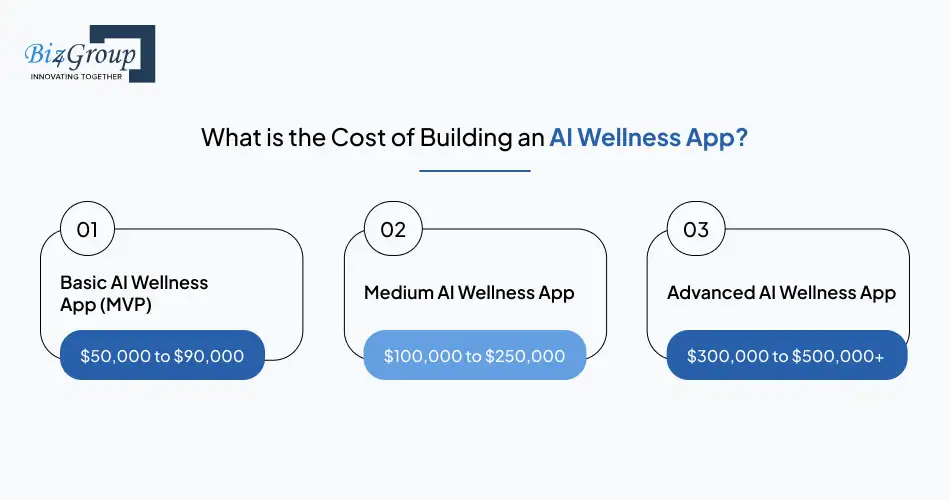
The cost to build an AI wellness app from scratch depends on factors such as feature complexity, AI capabilities, personalization requirements, integrations, and scalability goals. Businesses planning AI wellness products often ask: I want to build an AI wellness app similar to popular mental health and fitness apps and need an expert guide that tells me exactly how much development costs and how long it takes to build.
The short answer is that AI wellness app development costs typically range from $50,000 to $500,000+, depending on the product scope, AI sophistication, infrastructure requirements, and long term growth plans.
To estimate the cost of creating an AI wellness app accurately, it is helpful to understand the major development tiers businesses typically choose based on their budget, target audience, and expected functionality.
|
App Type |
Estimated Cost |
Timeline |
What You Get |
|---|---|---|---|
|
Basic AI Wellness App (MVP) |
$50,000 to $90,000 |
2 to 5 weeks |
User profiles, basic wellness tracking, rule-based recommendations, limited AI integration, MVP level design |
|
Medium AI Wellness App |
$100,000 to $250,000 |
5 to 10 weeks |
Personalized wellness plans, AI driven insights, chatbot support, data analytics, improved UI and scalability |
|
Advanced AI Wellness App |
$300,000 to $400,000+ |
11 to 14 weeks |
Advanced machine learning models, real time personalization, predictive analytics, high security compliance, multi-platform support |
The timeline and budget increase as personalization capabilities, AI complexity, data requirements, and integration needs grow. Businesses focused on faster validation typically begin with smaller AI wellness solutions and gradually expand functionality based on user behavior and market demand.
Understanding these pricing tiers helps founders, healthcare innovators, enterprises, and product teams create realistic budgets, prioritize development phases strategically, and build scalable AI wellness applications aligned with long term business goals.
When businesses begin planning an AI wellness solution, one of the first questions they ask is, how much will it cost to build an AI wellness app? The answer depends on several variables, including the type of wellness app, AI capabilities, data requirements, and system integrations. On average, AI wellness app development costs typically fall between $50,000 and $400,000, based on the complexity and scale of the product.
To simplify early planning and budgeting, an AI wellness app development cost estimator can provide an instant, high level quote based on selected features and technical requirements. This helps businesses quickly understand the AI wellness app cost before moving into detailed consultations.
AI Wellness App Development Cost Estimator Formula:
Estimated Cost = Base Wellness App Cost + (AI Feature Cost × Complexity Factor) + Integration Cost + UI/UX Design Cost + Data Management Cost
Where:
Example Cost Breakdown:
Suppose a business plans to build an AI driven mental wellness app with personalization and wearable integration:
Estimated Cost = ($60,000 + $40,000) × 1.3 + $20,000 + $25,000 + $15,000 = $190,000
Why Add an AI Wellness App Cost Estimator?
Including a “Get a Quick Quote” estimator on your website helps users instantly visualize AI wellness app development costs. It improves transparency, supports faster decision making, and increases engagement by allowing users to see how features affect the average cost.
An estimator can be built using simple sliders or dropdowns that let users select wellness app type, AI capabilities, integrations, and deployment preferences. With rising interest in AI wellness solutions, offering a cost estimator positions your business as trustworthy and helps users move forward with clarity and confidence.
Get a custom cost estimate and take the first step toward building your AI wellness app with confidence.
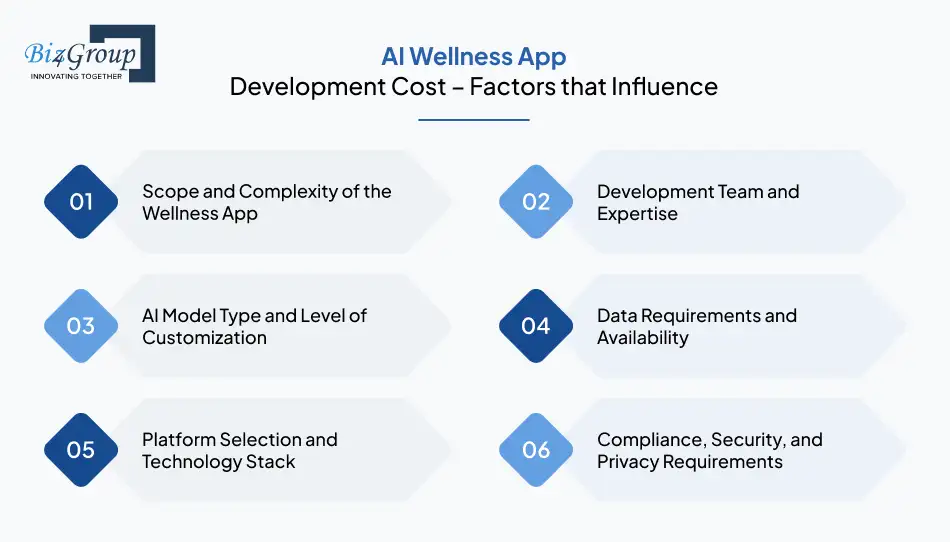
The AI wellness app development cost can vary widely depending on multiple technical, operational, and business factors. Understanding these cost drivers helps businesses accurately estimate the cost to develop an AI wellness app, plan budgets wisely, and align features with long term ROI goals.
Below are the key factors that directly impact the overall cost of creating an AI wellness app.
The scope and complexity of an AI wellness app play a major role in determining the overall development budget. A simple wellness app with basic AI driven recommendations, limited user journeys, and static content requires fewer development hours and lower AI integration effort. On the other hand, a feature rich AI wellness platform with real time health tracking, behavioral analytics, personalized wellness plans, and multiuser dashboards significantly increase the cost of AI wellness app development.
As the number of features, workflows, and user personas grows, so does the need for advanced backend logic, AI training cycles, and scalable infrastructure. Apps that include wearable integrations, real time monitoring, and adaptive AI models typically push the development cost toward the higher end of the spectrum.
Estimated Cost Impact: $10,000 to $100,000+
The cost to build an AI wellness app is heavily influenced by the development team you choose. Hiring a team with strong expertise in AI, healthcare technology, and wellness app development ensures better outcomes but also increases costs. A specialized team usually includes AI engineers, data scientists, mobile app developers, UI UX designers, QA engineers, and project managers.
Geographic location also affects AI wellness app development costs. Offshore teams may offer lower hourly rates, while experienced onshore or nearshore teams often provide faster delivery and higher compliance expertise. The deeper the AI and wellness domain knowledge required, the higher the overall development budget of the AI wellness app.
Estimated Cost Impact: $15,000 to $120,000+
The type of AI models used, and the level of customization required significantly influence the AI wellness app cost. Using pre-trained AI models for tasks like recommendation engines or sentiment analysis reduces development time and lowers costs. However, building custom AI models tailored to specific wellness use cases, such as mental health prediction or personalized fitness planning, requires extensive data preparation and training.
Highly customized AI solutions involve iterative model testing, fine tuning, and performance optimization. These processes increase both initial development costs and long-term maintenance expenses. The more intelligent and personalized the AI wellness app becomes, the higher the cost to develop and sustain it.
Estimated Cost Impact: $10,000 to $90,000+
Data is the foundation of any AI powered wellness app and managing it adds a substantial cost layer. If relevant, clean, and labeled wellness data is already available, development becomes more cost efficient. However, when data needs to be collected, cleaned, annotated, or purchased from third party providers, the AI wellness app development cost rises quickly.
Wellness apps that rely on behavioral, biometric, or mental health data also require ongoing data management, storage, and retraining pipelines. These data-related efforts directly impact the cost of creating an AI wellness app and often extend beyond initial development into long term operational expenses.
Estimated Cost Impact: $5,000 to $80,000+
The choice of platform and technology stack directly affects the AI app development cost for AI wellness app. Building a single platform like iOS or Android is generally more affordable than developing a cross platform or multi-platform solution. However, businesses targeting broader audiences often choose cross platform frameworks, which can increase upfront costs but reduce long term maintenance expenses.
Advanced technology stacks that support AI scalability, cloud hosting, real time analytics, and third-party integrations also contribute to higher AI wellness app development costs. Decisions around cloud services, databases, APIs, and AI frameworks must align with both performance goals and budget constraints.
Estimated Cost Impact: $5,000 to $60,000+
Compliance and security are critical cost drivers for AI wellness apps, especially those handling sensitive health and wellness data. Regulations related to data privacy and security require additional development effort, documentation, and testing. Implementing secure authentication, encrypted data storage, and compliance ready architectures increases the overall development budget.
Apps targeting global users must also address region-specific compliance standards, which further raises costs. Neglecting these requirements can lead to expensive rework later, making early investment in compliance a smart move despite the higher initial AI wellness app development cost.
Estimated Cost Impact: $5,000 to $50,000+
Here’s an overview table for AI Wellness App Development Cost Breakdown by Factors
|
Cost Factor |
Estimated Cost Range |
|---|---|
|
Scope and Complexity |
$10,000 to $100,000+ |
|
Development Team and Expertise |
$15,000 to $120,000+ |
|
AI Model Type and Customization |
$10,000 to $90,000+ |
|
Data Requirements and Availability |
$5,000 to $80,000+ |
|
Platform and Technology Stack |
$5,000 to $60,000+ |
|
Compliance, Security, and Privacy |
$5,000 to $50,000+ |
Carefully evaluating these factors allows businesses to estimate an average cost to build an AI wellness app more accurately and make informed decisions that balance innovation, performance, and budget efficiency.
Also Read: Top AI Fitness App Development Companies in USA
Not sure if your development budget is realistic? Let our experts help you estimate the true cost to build an AI wellness app.
Talk to an AI Expert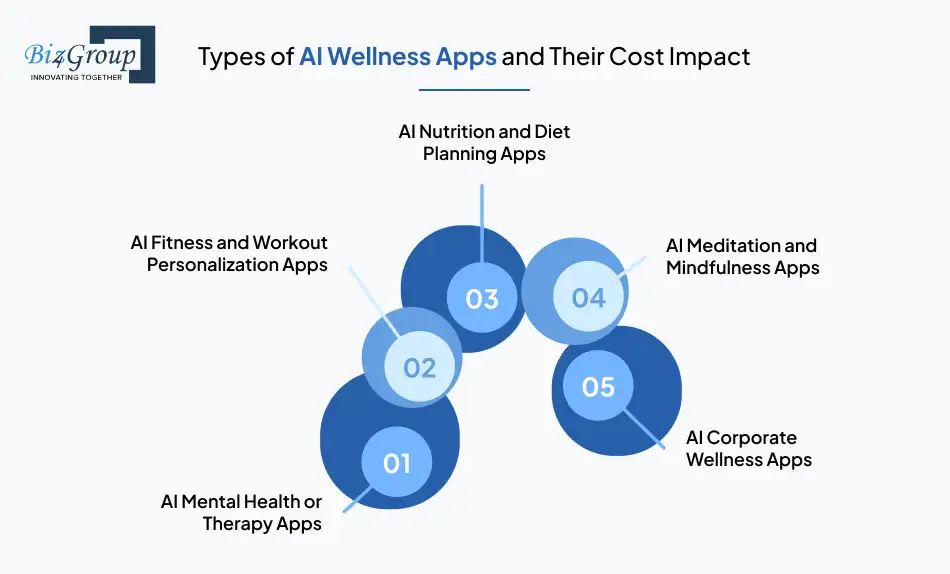
AI wellness apps are developed to address different aspects of physical, mental, and emotional well-being, and each category comes with its own technical requirements and development challenges.
The type of AI wellness app you choose directly affects the development approach, level of AI integration, data handling needs, and overall project scope.
Below is a detailed breakdown of major AI wellness app types and how each impacts development costs.
AI mental health or therapy apps focus on supporting emotional well-being through features such as AI chatbots, mood tracking, sentiment analysis, and personalized coping strategies. These apps often require advanced natural language processing models to understand user input and respond appropriately. In many cases, they also include journaling tools, mental health assessments, and therapist's matching capabilities.
Due to the sensitive nature of mental health data, these apps demand higher security standards, extensive testing, and robust AI accuracy. As a result, they typically fall into a higher cost bracket.
Estimated Cost Impact: $120,000 to $500,000+
AI fitness and workout personalization apps use data driven insights to create customized exercise routines based on user goals, activity levels, and performance history. These apps may integrate with wearables, fitness trackers, or motion sensors to deliver real time recommendations and progress tracking.
The need for wearable integrations, performance analytics, and adaptive workout engines increases development complexity and cost, especially when real time feedback is involved.
Estimated Cost Impact: $80,000 to $300,000+
Also Read: How to Build an AI Fitness App Like Fitbod?
AI nutrition and diet planning apps help users manage dietary habits by offering personalized meal plans, calorie tracking, and nutrition insights. AI models analyze user preferences, health goals, and dietary restrictions to deliver tailored recommendations.
Development costs rise with the size of food databases, depth of personalization, and accuracy of recommendation algorithms. Apps supporting health condition specific diets require additional logic and validation.
Estimated Cost Impact: $70,000 to $250,000+
AI meditation and mindfulness apps are designed to reduce stress, improve sleep quality, and promote emotional balance. AI is commonly used to personalize meditation sessions, recommend mindfulness content, and track mood patterns over time.
These apps are generally less complex to build, but advanced personalization features such as voice analysis or adaptive content engines can increase development effort.
Estimated Cost Impact: $50,000 to $180,000+
AI corporate wellness apps are built for organizations looking to support employee wellness at scale. These platforms often include multiuser dashboards, analytics tools, and AI-driven insights for tracking engagement and wellness trends across teams.
The need for enterprise grade scalability, data security, and customization for different organizations significantly increases development complexity and cost.
Estimated Cost Impact: $150,000 to $500,000+
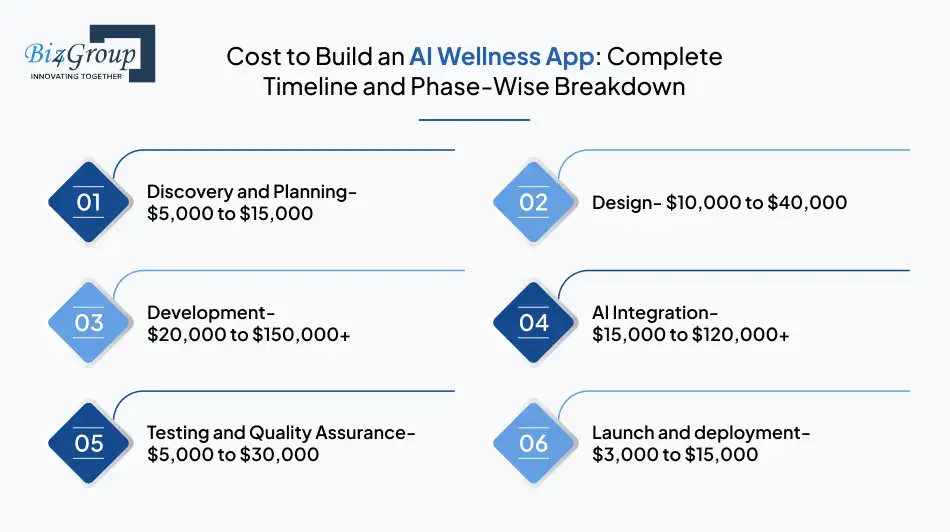
Building an AI wellness app is a structured process that unfolds across multiple stages, each contributing to the total development cost and timeline. Breaking the project into clear phases helps businesses manage budgets, reduce risk, and maintain focus on delivering value at every step.
Below is a phase-wise breakdown explaining how time and cost are distributed throughout the AI wellness app development lifecycle.
The discovery and planning phase focuses on defining the vision of the AI wellness app and aligning it with business objectives. This stage ensures that the app solves a real wellness problem while remaining technically and financially feasible. Clear planning at this stage prevents scope creep and costly revisions later.
Key Activities:
The design phase translates ideas into a visual and functional blueprint. A strong user experience is especially critical for wellness apps, as trust, simplicity, and engagement directly affect user retention. This phase shapes how users interact with AI-driven features.
Key Activities:
This is where the core functionality of the AI wellness app is built. Backend systems, databases, APIs, and front-end interfaces are developed to support scalability and performance. The complexity of features directly impacts development cost and duration.
Key Activities:
AI integration is a specialized phase focused on embedding intelligence into the app. Depending on the level of customization, this may involve integrating pre trained models or developing custom machine learning solutions tailored to wellness use cases.
Key Activities:
Testing ensures the AI wellness app functions reliably across devices, platforms, and user scenarios. This phase is critical for identifying bugs, improving performance, and ensuring data accuracy and security.
Key Activities:
The launch and deployment phase prepares the AI wellness app for public release. This stage ensures that the app is stable, compliant, and optimized for real-world usage while setting up systems for ongoing monitoring.
Key Activities:
This phase-wise breakdown provides a clear view of how the cost to build an AI wellness app is distributed, helping businesses plan timelines effectively and allocate resources with greater confidence.
Reduce the cost of creating an AI wellness app with a phased strategy and proven AI development approach.
Schedule a Free Consultation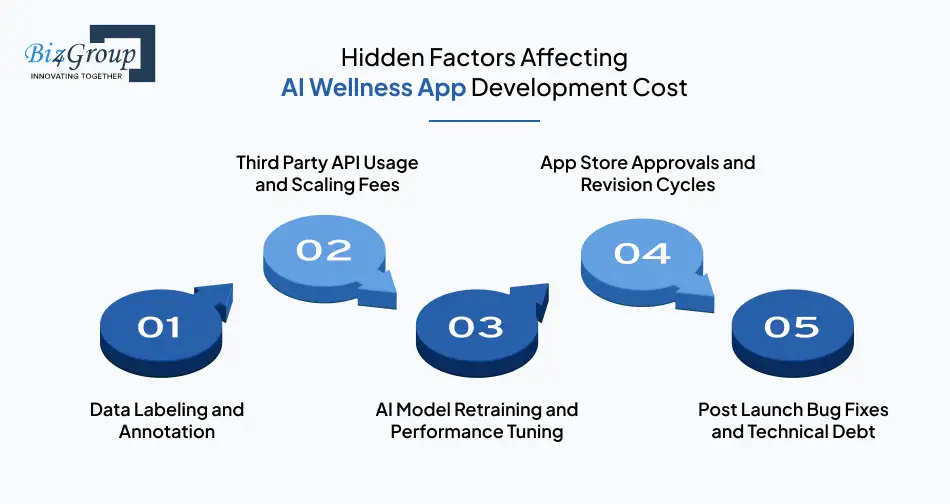
Beyond visible development expenses, several less obvious factors can quietly increase the overall AI wellness app cost. These elements often appear during scaling, optimization, or post launch phases, making them critical to account for during budget planning.
|
Hidden Cost Factor |
How It Impacts Cost |
Estimated Cost Impact |
|---|---|---|
|
Data Labeling and Annotation |
Manual or semi automated labeling of wellness data to improve AI accuracy and training quality |
$5,000 to $50,000+ |
|
Third Party API Usage and Scaling Fees |
Ongoing costs from AI services, wearable integrations, analytics tools, and cloud APIs as user volume grows |
$3,000 to $40,000+ annually |
|
AI Model Retraining and Performance Tuning |
Continuous optimization to maintain personalization accuracy and adapt to user behavior changes |
$5,000 to $60,000+ per year |
|
App Store Approvals and Revision Cycles |
Multiple submission rounds, compliance updates, and platform specific adjustments |
$2,000 to $15,000 |
|
Post Launch Bug Fixes and Technical Debt |
Fixing real world issues, refactoring code, and improving system performance over time |
$5,000 to $50,000+ annually |
By presenting these hidden costs upfront, businesses can create a more realistic AI wellness app development budget and avoid unexpected financial strain after launch.
One of the biggest questions businesses ask before investing is whether they should choose custom AI wellness app development or buy an existing platform. This decision directly affects the AI wellness app development cost, launch timeline, personalization capabilities, and long-term scalability.
Many founders ask: Should I build or buy an AI wellness app if I want personalized features, lower development costs, and faster market entry? The answer depends on your business goals, budget, customization requirements, and growth strategy.
When comparing the cost to build an AI wellness app from scratch versus buying a white label solution, businesses must evaluate both short term investment and long-term ROI.
|
Factor |
Custom AI Wellness App Development |
Buy / White Label Wellness Platform |
|---|---|---|
|
Initial Investment |
Higher upfront cost |
Lower upfront cost |
|
Estimated Cost |
$50,000 to $500,000+ |
$5,000 to $100,000+ |
|
Development Timeline |
4 to 16+ months |
Few weeks to few months |
|
Customization |
High flexibility |
Limited customization |
|
AI Personalization |
Fully customizable AI models |
Usually limited capabilities |
|
Scalability |
Built for long term growth |
Platform limitations may appear |
|
Ownership |
Full ownership of code and IP |
Platform dependency |
|
Compliance Flexibility |
Custom security and compliance controls |
Depends on provider capabilities |
Custom development is usually the better option when businesses need:
Buying or licensing existing solutions may be a better option when businesses want:
For businesses focused on differentiation, advanced personalization, and long term growth, custom AI wellness app development typically delivers stronger returns despite higher initial investment. Businesses prioritizing speed and lower budgets often start with existing platforms before transitioning toward custom solutions as user demand increases.
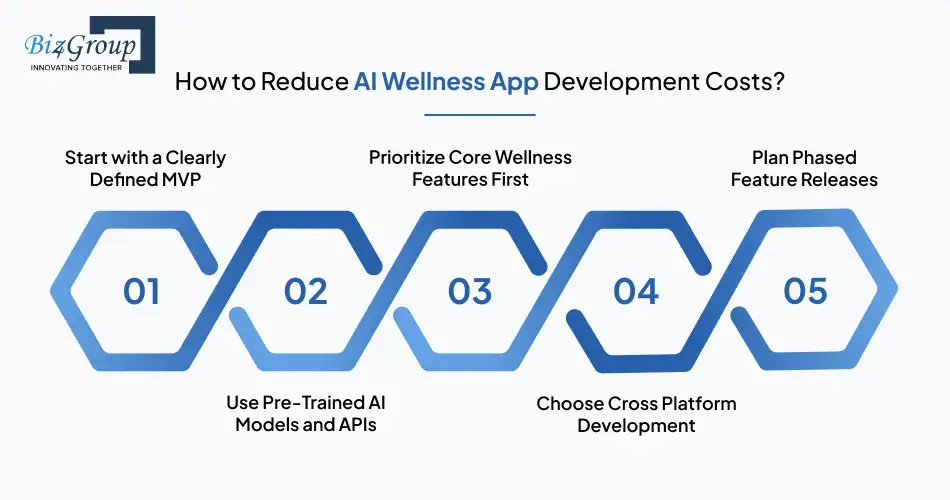
Reducing AI wellness app development costs is about making smart choices at every stage of the product lifecycle. By optimizing scope, technology, and release strategy, businesses can significantly lower the cost to develop an AI wellness app without sacrificing performance or scalability.
Building an MVP limits development to essential wellness features and core AI functionality, helping teams avoid unnecessary upfront investment. It also allows faster market entry and early user validation.
Estimated Cost Savings: $30,000 to $80,000
This approach ensures resources are spent only on features that directly support business and user goals.
Also Read: Top MVP Development Companies to Launch Your Startup
Pre-trained AI models and APIs reduce the need for extensive data collection and model training. This shortens development timelines and lowers engineering costs.
Estimated Cost Savings: $20,000 to $70,000
It also enables quicker experimentation and easier scaling as the app grows.
Focusing on a single core wellness problem keeps the app simple and development efforts concentrated. This minimizes complexity and reduces the chances of costly redesigns.
Estimated Cost Savings: $15,000 to $50,000
A streamlined feature set improves clarity for both developers and end users.
Cross platform development allows one codebase to power multiple platforms, significantly reducing build and maintenance efforts. This leads to faster delivery and lower long-term costs.
Estimated Cost Savings: $25,000 to $60,000
It also simplifies updates and feature rollouts across devices.
Phased releases spread development costs over time and allow decisions to be guided by real user feedback. This helps avoid investing in features that do not deliver value.
Estimated Cost Savings: $20,000 to $65,000
Gradual expansion ensures better budget control and sustainable growth.
Applying these cost optimization strategies together can significantly reduce the average cost to build an AI wellness app while maintaining quality, flexibility, and long-term scalability.
As a trusted AI wellness app development company in USA, Biz4Group LLC helps startups, enterprises, and healthcare innovators build intelligent wellness solutions without exceeding budget expectations. Our approach to AI wellness app development is strategic, transparent, and focused on long term value. We work as trusted advisors, supporting clients through every stage of the journey, from ideation and planning to AI model selection, system architecture, development, deployment, and continuous optimization.
Our team combines deep technical expertise with real world business understanding, which allows us to make informed decisions that directly reduce AI wellness app development costs. Instead of overengineering solutions, we focus on aligning features with business goals, user needs, and measurable outcomes. This ensures that every investment contributes to performance, scalability, and ROI.
Being a leading AI development company, Biz4Group places strong emphasis on cost optimization throughout the development lifecycle. We leverage agile development methodologies, reusable components, pre-trained AI models, scalable cloud infrastructure, and wellness-specific accelerators to minimize unnecessary expenses. This structured approach helps reduce the cost of creating an AI wellness app while maintaining high standards for security, performance, and future scalability.
Beyond development, we provide ongoing support through AI model monitoring, retraining, performance optimization, and feature enhancements. This ensures your AI wellness app remains compliant, secure, and competitive as user needs and technologies evolve.
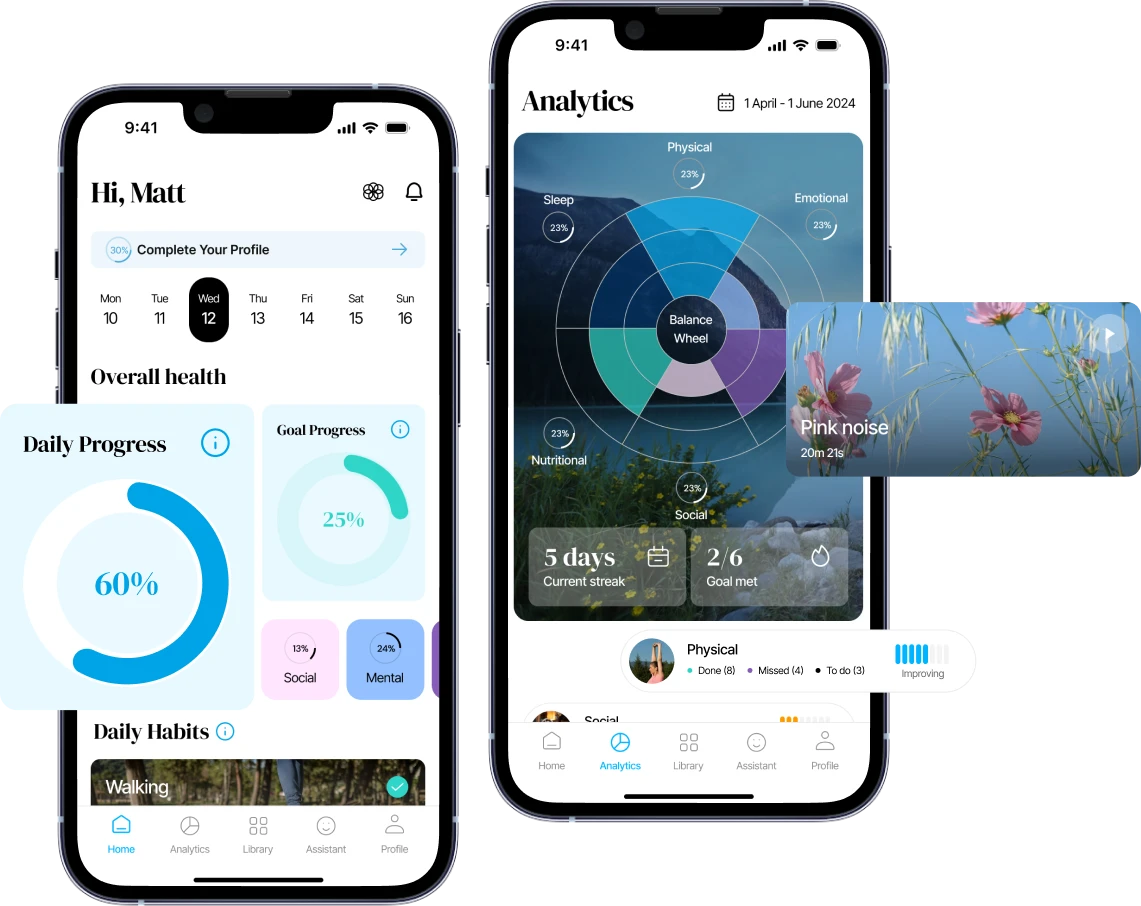
This advanced AI wellness platform focuses on improving physical, mental, spiritual, social, nutritional, and sleep health. Biz4Group optimized the AI wellness app development cost by adopting smart technical and architectural decisions.
Key cost optimization strategies included using pre trained large language models for personalized wellness insights, reusing UI components and functional modules, and building a scalable cloud native architecture. These choices reduced development time and infrastructure costs while enabling advanced goal tracking and behavior-based recommendations.
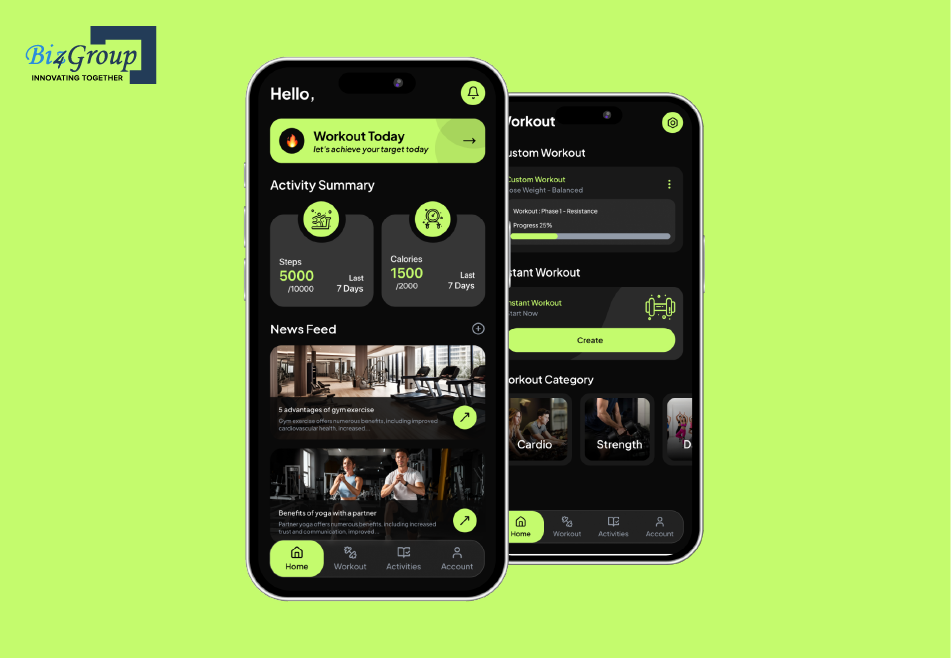
This AI driven workout platform leverages Vision Language Models for body composition analysis and muscle tracking. Biz4Group helped control the AI wellness app cost by focusing on efficiency and reuse.
Cost optimization was achieved by implementing quantized AI models to reduce compute requirements, using serverless pipelines to minimize infrastructure expenses, and reusing proven algorithmic components from earlier fitness projects. This approach delivered a powerful and accurate AI workout app while staying well within budget.
By combining technical innovation with cost conscious decision making, Biz4Group LLC enables businesses to build scalable, intelligent AI wellness apps that deliver value without unnecessary financial risk.
From MVP to scalable platform, we help you build an AI wellness app within budget and timeline.
Book an AppointmentBuilding an AI wellness app is a strategic investment that requires careful planning, the right technology choices, and a clear understanding of development costs. From defining the app’s scope to selecting AI models and ensuring data security, every decision plays a role in shaping the final budget and long-term success of the product.
As discussed throughout this guide, the cost to develop an AI wellness app can vary widely based on features, AI complexity, platform selection, and compliance requirements. Businesses that approach development with a phased strategy and cost optimization mindset are better positioned to reduce risk and maximize return on investment.
With growing demand for personalized wellness solutions, now is the right time to invest in AI driven wellness apps that deliver meaningful user experiences and measurable outcomes.
If you are planning to build or scale an AI wellness app, book an appointment with our experts today to discuss your idea, estimate costs accurately, and turn your vision into a successful product.
The development timeline depends on the app’s scope and AI complexity. A basic MVP can take a few months, while a fully featured AI wellness platform with advanced personalization may require close to a year from planning to launch.
Yes, AI wellness apps typically require continuous investment for cloud hosting, AI model updates, performance monitoring, security upgrades, and feature improvements to stay relevant and reliable.
Some AI wellness apps can function using non-sensitive data such as activity patterns or preferences. However, apps focused on mental health or personalized insights often need deeper data access, which must be handled securely.
This depends on business goals and budget. Existing AI services reduce cost and speed up development, while custom AI models offer greater control and accuracy for specialized wellness use cases.
AI wellness apps can scale efficiently when built on cloud native architecture. Proper infrastructure planning ensures that performance remains stable even as user demand increases.
The minimum budget typically depends on the feature set and level of AI integration. A basic AI wellness app MVP can be launched with a lower investment, while advanced personalization and analytics increase the overall development cost.
Businesses can estimate costs by defining core features, selecting the type of AI capabilities needed, and using an AI wellness app development cost estimator or consulting with an experienced development partner early in the planning stage.

with Biz4Group today!
Our website require some cookies to function properly. Read our privacy policy to know more.