 Location :
Orlando, FL, USA
Location :
Orlando, FL, USA +1 (407) 714-1616
 info@biz4group.com

- Build AI legal billing automation software to prevent write-downs and enforce client billing rules before submission.
- AI legal billing software development uses predictive validation and structured workflows to strengthen realization control.
- Firms that develop AI legal billing automation systems improve approval speed and reduce compliance disputes.
- The cost to develop AI legal billing automation software typically ranges from $30,000–$200,000+, based on scope, integrations, and intelligence depth.
- Enterprise deployments require secure architecture, role-based governance, and scalable cross-office billing oversight.
- At Biz4Group LLC, we design structured automation that helps enterprise firms protect revenue and scale confidently.
How much revenue does your firm lose each year due to billing inaccuracies you cannot see?
Legal billing directly impacts cash flow, partner confidence, and client trust. When entries are inconsistent or approvals get delayed, revenue control weakens. Many firms now plan to build legal billing software with AI automation to bring discipline into time capture, invoice validation, and compliance monitoring.
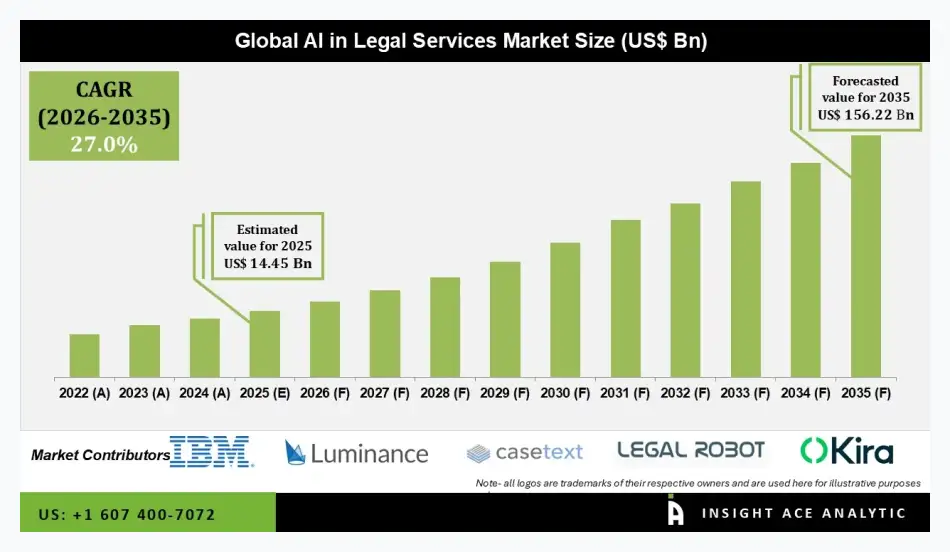
The AI in legal services market was valued at USD 14.45 billion in 2025 and is expected to reach USD 156.22 billion by 2035 at a 27.0% CAGR. North America is projected to hold the largest share due to its dense network of law firms and legal technology innovators. This signals strong momentum for firms ready to modernize financial operations.
When you develop AI legal billing automation systems, the focus stays practical and outcome driven:
- Capture accurate billable hours without manual corrections
- Flag policy violations before invoices reach clients
- Reduce approval cycles and revenue delays
- Strengthen audit readiness with structured records
Designing such systems requires a collaboration with a custom software development company that understands legal billing logic and governance controls. This guide explains how to make AI legal billing automation software with compliance features while improving revenue tracking and financial transparency across your firm.
What Is AI Legal Billing Software and How Does an AI Powered Legal Billing Automation System Work?
If the words “legal billing” make you think of delayed approvals, disputed invoices, and uncomfortable client conversations, you are not alone. Billing is where revenue, compliance, and client trust meet. When gaps appear here, the impact spreads across the firm faster than expected.
So, what are we actually talking about when we say AI legal billing software?
AI legal billing software is an intelligent system designed to manage, review, and validate every billing entry before it turns into an invoice. It studies how your firm bills, understands client specific rules, and checks each time entry in real time. Instead of waiting for finance teams to catch errors later, it evaluates accuracy at the source. Many firms build AI legal billing automation software to reduce write offs and create AI legal billing management platform environments that bring structure and predictability into financial operations.
Now let’s look at how intelligence actually shapes billing decisions.
Role of AI in Legal Billing Software
- Context Based Review: The system compares new time entries with past billing behavior, matter type, and client guidelines to identify inconsistencies before invoices are drafted.
- Narrative Understanding: Using generative AI, it reads billing descriptions, detects vague wording, and aligns entries with approved service categories and contractual limits.
- Policy Driven Validation: Client billing rules are converted into automated checkpoints that verify rate limits, caps, and restricted activities during entry submission.
- Risk Prediction: The engine studies prior invoice outcomes and flags entries that resemble patterns linked to disputes or delayed payments.
How Does an AI Powered Legal Billing Automation System Work
|
Stage |
What Happens |
AI's Role |
|---|---|---|
|
Data Capture |
Time logs and matter details enter the system |
Cleans, structures, and prepares data for evaluation |
|
Rule Encoding |
Client and firm billing policies are uploaded |
Translates policies into validation logic |
|
Entry Analysis |
Each billing line is examined |
Checks hours, narratives, and rates against encoded rules |
|
Risk Scoring |
Invoice draft is assembled |
Assigns approval probability using historical patterns |
|
Workflow Routing |
Invoice moves through review layers |
Prioritizes higher risk entries for closer review |
|
Feedback Learning |
Final approvals or edits are recorded |
Updates internal AI model to improve future decisions |
Core Components That Make It Work
- Data Processing Layer: Organizes structured and unstructured billing inputs, standardizes records, and ensures every entry is ready for automated validation.
- Learning and Decision Engine: Trained on historical billing and payment data, this component detects anomalies and strengthens prediction accuracy over time.
- Rule Management Module: Converts client agreements and firm billing policies into programmable validation checkpoints applied during entry and invoice review.
- Workflow Orchestration Layer: Controls routing paths, approval hierarchies, and escalation triggers based on calculated risk indicators.
- Integration Framework: Connects time tracking and accounting systems so firms can build AI software that fits within existing operational infrastructure.
An AI powered legal billing system reads, evaluates, and learns from every entry, helping your firm protect revenue while maintaining billing accuracy and compliance control.
Still Let Revenue Slip Through
See how intelligent validation prevents silent write downs before submission
Talk to Our ExpertsWhy Law Firms and Legal Departments Should Invest in AI Legal Billing Software Development
Billing performance directly shapes profitability, partner compensation, and client relationships. When time capture gaps or policy violations go unnoticed, revenue leaks silently. That is why many firms now plan to build AI legal billing automation software to strengthen financial discipline and operational control.
Before we discuss strategy, look at how the market is moving.
Market Snapshot
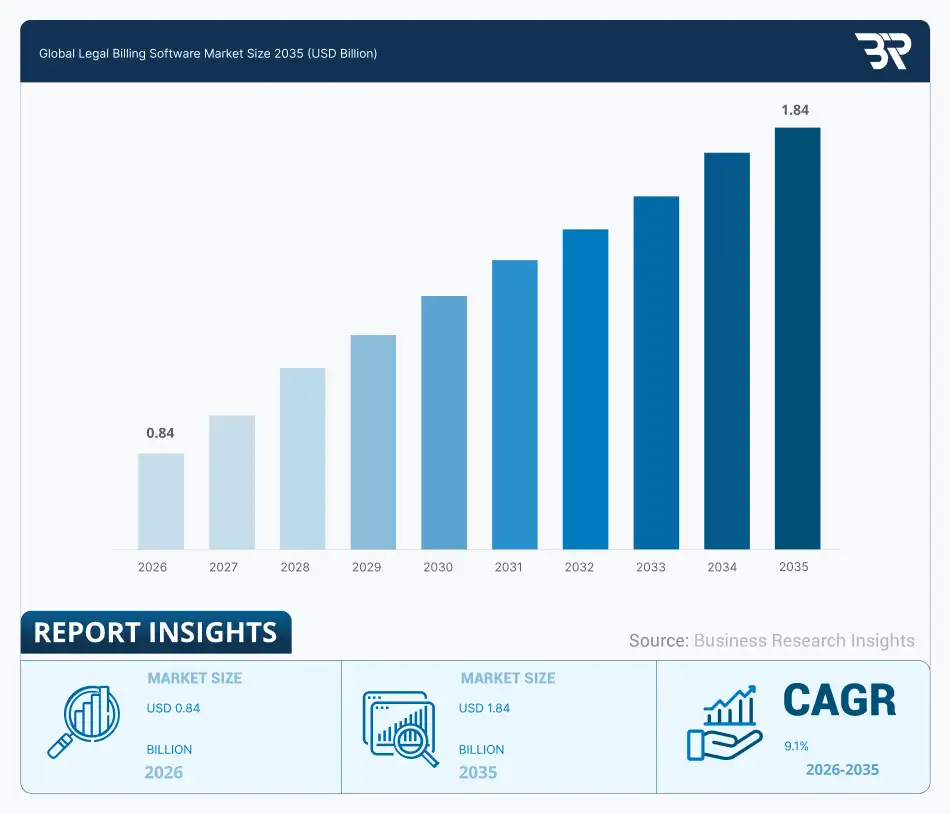
- The global legal billing software market is expected to reach USD 0.84 Billion in 2026 and grow to USD 1.84 Billion by 2035 at a CAGR of 9.1%.
- Over 61% of legal professionals report billing leakage reductions between 18% and 27% after adopting digital billing platforms.
- Adoption penetration exceeds 58% among firms with more than 25 attorneys, while small practices account for nearly 42% of total deployments.
- More than 66% of legal billing systems now include automated time capture features.
These numbers show measurable financial impact, not technology hype.
Now let’s focus on the real business reasons firms are investing.
1. Revenue Capture and Billing Realization
Lost billable hours and post invoice write downs directly reduce firm profitability. When entries are validated in real time, realization improves without increasing attorney effort.
- Time capture automation ensures billable work is recorded accurately at the source
- Time capture automation adoption stands at 63%, reducing manual entry errors by 29%
- Automated validation reduces revenue leakage before invoices are issued
- S. firms report billing realization rate improvements of 17% after implementing automated billing controls
This translates into measurable revenue protection across practice areas.
2. Faster Invoice Approvals and Stronger Cash Flow
Slow approval cycles delay collections and disrupt cash planning. Intelligent billing workflows shorten internal review time and reduce client pushbacks.
- Automated rule checks prevent compliance errors before submission
- Risk based routing prioritizes invoices requiring closer scrutiny
- S. firms report invoice approval cycle reductions of 21% after adopting structured billing platforms
Shorter approval timelines improve working capital predictability and financial stability.
3. Compliance With Client Billing Mandates
Corporate legal departments increasingly require strict e-billing and standardized code adherence. Non-compliant invoices face delays or rejection.
- 47% of U.S. corporate legal departments mandate e-billing compliance
- 52% enforce standardized billing codes
- Automated policy mapping ensures invoices align with client guidelines before submission
AI business process automation applies these rules consistently across matters and reduces compliance exposure.
4. Market Alignment and Competitive Positioning
Billing software adoption is now standard among mid to large firms. Operating without intelligent systems creates operational disadvantages.
- 79% of U.S. law firms with more than 10 attorneys actively use legal billing software
- Cloud based legal billing penetration exceeds 68%, driven by compliance and transparency requirements
Firms integrating billing intelligence within enterprise AI solutions strengthen reporting visibility and client transparency.
5. Scalability for Multi Attorney and Multi Office Operations
As firms grow, billing complexity increases across clients, practice groups, and offices. Manual oversight does not scale efficiently.
- Centralized AI integration connects time tracking and accounting systems
- Automated validation ensures consistent policy enforcement firm wide
- Structured systems support growth without proportionally increasing administrative staff
When firms create AI-powered legal billing software for attorneys, they enable controlled expansion and standardized financial governance.
Investing in intelligent billing systems is a strategic financial decision. Firms that act now can develop scalable AI legal billing management platforms that improve realization, accelerate collections, and support sustainable operational growth.
Essential Features to Build Automated Legal Billing Software
When you build AI legal billing automation software, features must solve real billing control problems, not just digitize invoices. The objective is tighter revenue protection, structured compliance enforcement, and predictable approval workflows across every matter your firm handles.
Below are the essential features your system should include.
|
Feature |
What It Is |
What It Does |
|---|---|---|
|
Intelligent Time Capture |
Automated tracking mechanism embedded within billing workflows |
Captures billable activity in real time, reduces missed hours, and minimizes manual time reconstruction at month end |
|
Billing Narrative Analysis |
AI driven review layer for time descriptions |
Examines task descriptions for clarity, detects vague wording, and aligns entries with approved service categories before invoice drafting |
|
Client Rule Enforcement Engine |
Configurable billing policy logic system |
Applies client specific rate caps, billing restrictions, and task based rules automatically during entry validation |
|
Invoice Draft Automation |
Structured invoice assembly framework |
Compiles validated time entries into organized invoice drafts with accurate totals, tax calculations, and billing references |
|
LEDES and E-Billing Compliance |
Structured electronic billing engine aligned with client standards |
Validates invoice format, task codes, rate structures, and mandatory fields before submission to reduce rejection risks |
|
Risk Scoring and Validation |
Behavioral billing analysis engine trained on historical invoice outcomes |
Assigns risk levels to billing entries and flags patterns linked to previous reductions or disputes |
|
Approval Workflow Automation |
Rule based routing and escalation framework |
Automatically routes low risk invoices for quick approval while escalating higher risk entries for deeper financial review |
|
Financial Analytics Dashboard |
Centralized revenue visibility interface |
Tracks realization rates, invoice aging, write offs, billing leakage patterns, and approval cycle performance in real time |
|
System Integration Layer |
Secure connectivity framework across firm systems |
Synchronizes time tracking, accounting, and matter management data to ensure billing decisions rely on complete information |
When law firms integrate AI into an app level billing system, intelligence must operate inside validation, scoring, and workflow layers rather than as a surface feature. Effective legal billing automation software development using AI focuses on measurable financial control. These features work together to reduce revenue leakage, strengthen compliance accuracy, and support sustainable operational growth.
Advanced Capabilities to Develop Scalable AI Driven Law Firm Billing Systems
After you build AI legal billing automation software with essential controls in place, growth brings deeper operational challenges. Enterprise clients expect tighter governance, faster approvals, and clearer forecasting. That is where advanced intelligence strengthens long-term scalability.
|
Advanced Capability |
What It Is |
What It Does |
|---|---|---|
|
Predictive Revenue Forecasting |
Data driven revenue estimation engine |
Uses predictive analysis on historical billing and payment cycles to forecast collections and highlight potential shortfalls before they affect cash flow |
|
Client Behavior Modeling |
Client specific billing intelligence layer |
Tracks approval timelines, reductions, and dispute triggers to tailor validation rules according to each client’s historical billing behavior |
|
Dynamic Rule Optimization |
Adaptive billing rule engine |
Refines validation checkpoints based on recurring invoice edits, improving first pass approval rates over time |
|
Margin Impact Monitoring |
Profitability tracking module |
Evaluates how discounts, blended rates, and billing caps affect matter level margins and alerts leadership when profitability declines |
|
Pre Bill Reduction Prediction |
Invoice risk anticipation system |
Analyzes draft invoices and flags entries likely to face write downs during partner review, protecting realization before submission |
|
Cross Matter Pattern Detection |
Firm wide billing comparison engine |
Identifies unusual billing patterns across similar matters to detect inefficiencies or compliance risks early |
|
Enterprise Governance Controls |
Centralized policy enforcement framework |
Standardizes billing rule execution across offices while maintaining client specific flexibility where required |
|
Intelligent Approval Load Balancing |
Workflow optimization mechanism |
Distributes invoice review tasks based on complexity and risk score to prevent bottlenecks and shorten approval cycles |
These advanced capabilities turn billing into a controlled revenue system rather than an administrative process. Strategic integration of advanced capabilities enables you to develop AI legal billing automation software for enterprise law firms that scales securely while protecting realization and financial discipline.
Let’s look at how real-world enterprise systems demonstrate structured governance scales beyond billing.
Portfolio Spotlight: TrialProofer
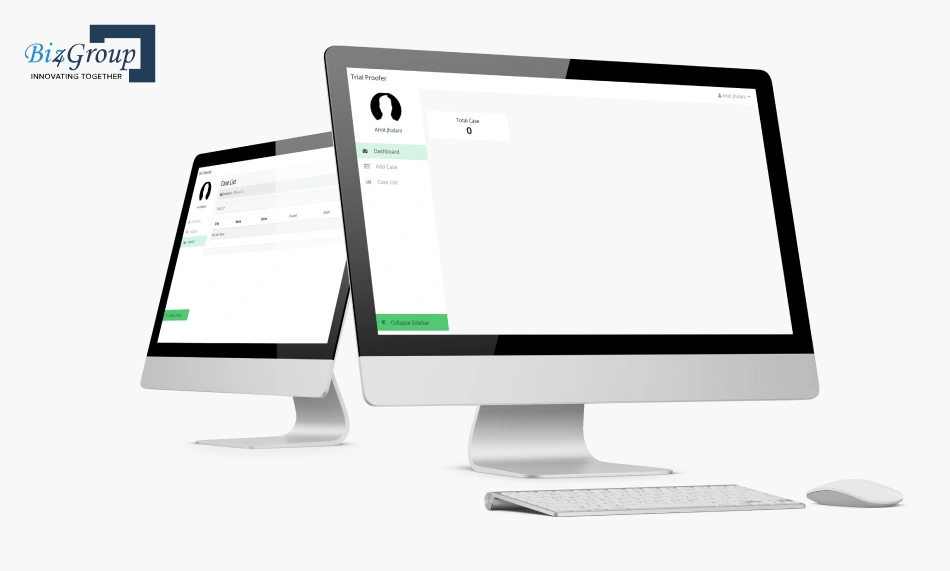
TrialProofer is a structured case management platform built to help litigation teams organize witness lists, proof elements, trial timelines, and document evidence inside one secure environment. It was designed to manage multi-layered legal workflows where deadlines, dependencies, and collaboration must stay synchronized. That same architectural discipline directly supports advanced billing systems that require predictive validation, governance controls, and cross-matter visibility at enterprise scale.
How to Build AI Legal Billing Automation Software Step by Step
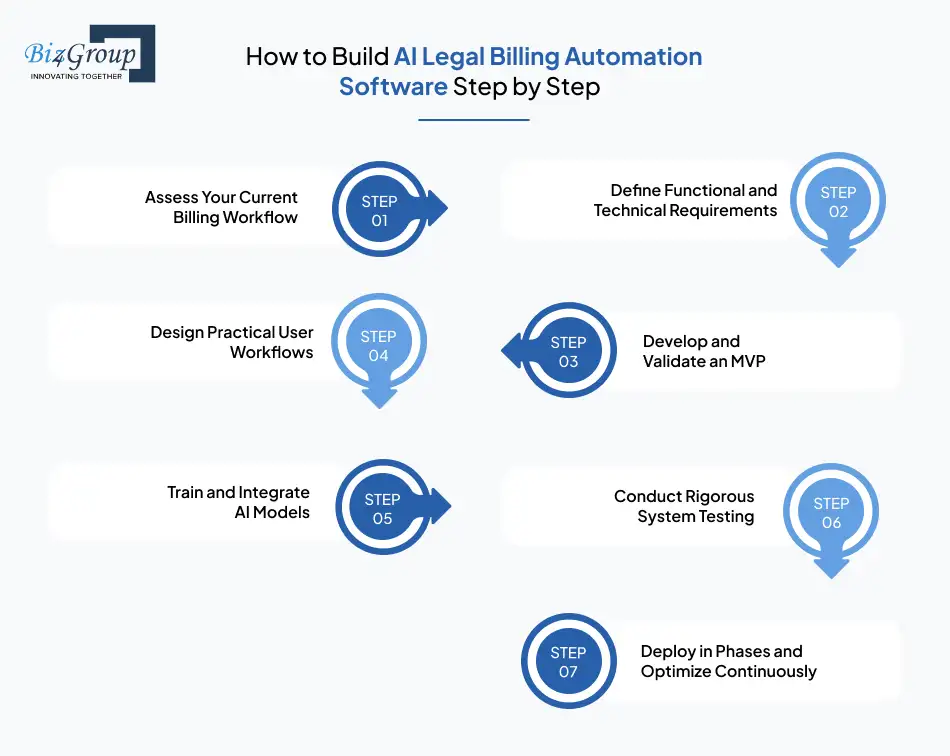
When you decide to build AI legal billing automation software, execution must follow a disciplined roadmap. Every stage should protect revenue, reduce billing disputes, and align system intelligence with real legal finance workflows without interrupting active matters.
Step 1: Assess Your Current Billing Workflow
- Map your entire billing lifecycle from time entry to final payment reconciliation.
- Identify where revenue leakage occurs, including missed time, manual edits, delayed approvals, and invoice rejections.
- Document client specific billing mandates such as LEDES formats and rate caps.
- Quantify realization rates, approval timelines, and dispute frequency.
- Interview partners and finance teams to understand operational friction points.
- Define measurable targets such as improving realization by a specific percentage or reducing approval time by weeks, not days.
Step 2: Define Functional and Technical Requirements
- Translate operational findings into structured system requirements.
- Define how time validation, narrative checks, and billing rule enforcement should function.
- Outline AI integration needs across time tracking, accounting, and matter systems.
- Establish reporting expectations for realization, write downs, and billing cycle visibility.
- Plan for scalability across offices and practice groups.
- This clarity is critical in AI legal billing software development for law firms because architecture decisions determine long term stability and financial governance.
Step 3: Develop and Validate an MVP
- Begin with focused MVP software development centered on intelligent time validation and automated invoice drafting.
- Limit initial scope to revenue protection features that directly impact realization.
- Opt for MVP development services to test rule enforcement under real billing scenarios.
- Allow finance teams to review outputs and flag inconsistencies early.
- Refine billing checkpoints and workflow logic before introducing predictive scoring.
- Confirm that invoice drafts meet client compliance standards before expanding system capabilities further.
Also Read: Top 12+ MVP Development Companies
Step 4: Design Practical User Workflows
- Build dashboards that clearly show approval status, billing risks, and realization metrics.
- Ensure partners can review flagged entries without navigating complex screens.
- Work with an experienced UI/UX design company to align workflows with actual billing behavior.
- Reduce clicks required for invoice approvals and edits.
- Present compliance alerts in a structured way that encourages corrective action instead of confusion.
- Prioritize clarity, usability, and efficiency to increase internal adoption rates across departments.
Also Read: Top UI/UX design companies in USA
Step 5: Train and Integrate AI Models
- Prepare historical billing datasets including approved invoices, write downs, and disputes.
- Clean and standardize data before model training begins.
- Train AI models using real invoice outcomes to strengthen anomaly detection and approval prediction.
- Validate model accuracy across multiple client billing structures.
- Integrate AI models directly into time entry workflows so validation occurs at submission, not after invoice rejection.
- Continuously retrain models as billing patterns evolve across matters and clients.
Step 6: Conduct Rigorous System Testing
- Simulate high volume billing cycles to test performance stability.
- Validate rule enforcement against complex client billing guidelines.
- Confirm invoice formatting accuracy across electronic billing standards.
- Evaluate user permissions and data access controls for security compliance.
- Partner with a software testing company to perform structured validation and stress testing.
- Resolve defects before full deployment to prevent billing disruption or revenue impact.
Step 7: Deploy in Phases and Optimize Continuously
- Launch initially within selected practice groups to monitor performance closely.
- Track realization rates, approval cycle duration, and dispute frequency weekly.
- Adjust validation thresholds and risk scoring logic based on live outcomes.
- Expand deployment once measurable financial improvement is confirmed.
- Establish governance reviews to maintain compliance discipline.
- Continue optimization to ensure the system scales alongside billing volume and organizational growth.
A structured execution roadmap reduces operational risk and protects revenue integrity. Law firms that follow disciplined implementation can build secure AI legal billing software for legal departments that strengthens compliance, improves realization, and scales confidently across enterprise environments.
Ready to Architect It Properly
Map your billing logic into scalable automation without operational chaos
Schedule a Strategy CallTechnology Stack Considerations for Custom AI Legal Billing Software Development
When you build AI legal billing automation software, your stack must support secure billing data, real time validation, and scalable performance. It should align with modern web/mobile application development standards while handling high invoice volume without slowing approvals.
Below is a realistic technology structure tailored specifically for AI enabled legal billing systems.
|
Architecture Layer |
Recommended Technology |
Purpose |
|---|---|---|
|
Frontend Application Layer |
React.js |
ReactJS development supports partner dashboards and finance views to deliver responsive billing reports, approval queues, and risk visibility across devices. |
|
Server Rendering & Routing Layer |
Next.js |
NextJS development improves page performance for heavy billing reports to ensure secure rendering of financial data and optimized load speed. |
|
Backend Service Layer |
Node.js with Express.js |
NodeJS development handles invoice routing logic, billing rule validation, and approval workflows to process high volume billing transactions reliably. |
|
AI Processing Layer |
Python with FastAPI |
Python development manages anomaly detection and billing pattern evaluation to process historical invoice data and support model execution efficiently. |
|
Data Storage Layer |
PostgreSQL |
Stores billing records, client guidelines, realization metrics, and approval history in structured relational tables for audit and reporting accuracy. |
|
Caching Layer |
Redis |
Speeds up repeated billing queries and approval status checks to maintain smooth performance during peak invoice cycles. |
|
Integration Layer |
RESTful Services |
Enables time tracking and accounting connectivity through structured API development so billing data remains synchronized across systems. |
|
Cloud & Security Layer |
AWS with IAM and encryption services |
Provides scalable hosting, encrypted storage, role-based access control, and secure deployment pipelines for financial data protection. |
A disciplined full stack selection prevents performance bottlenecks and security gaps. With careful architectural planning, you can build AI driven law firm billing systems that scale across offices, protect financial data, and support long term operational stability.
Also Read: Why to Choose the Full Stack Development for Modern Business
Here is how this architecture translates into a working legal platform.
Portfolio Spotlight: Court Calendar
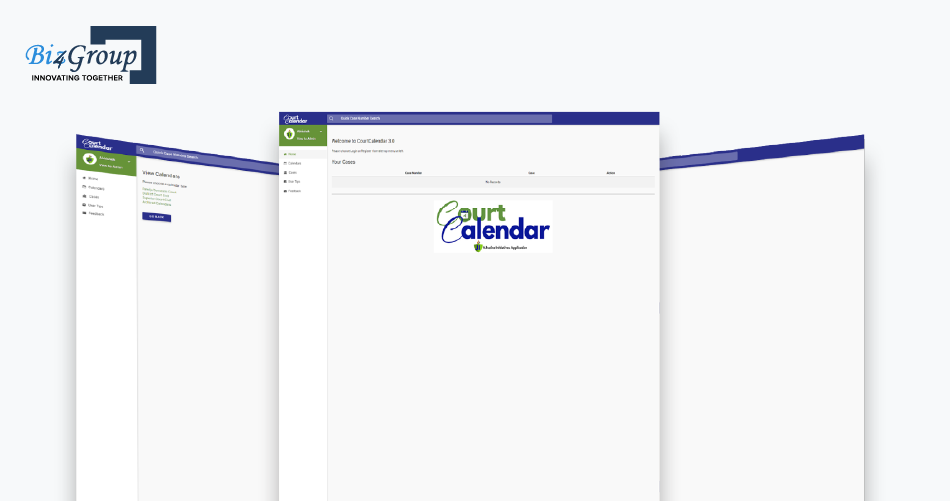
Court Calendar is a centralized judiciary scheduling platform built to help attorneys track hearings, manage case timelines, and receive real time status updates within a secure system. It required synchronized dashboards, role-based access control, and reliable data exchange across users. That same stack discipline supports AI billing systems that demand high availability, structured workflows, and secure financial data handling across multiple offices.
How to Build Secure AI Legal Billing Software with Compliance and Risk Controls
When you build AI legal billing automation software, security must be embedded into architecture, workflows, and data handling practices. Legal billing systems process sensitive financial records, so compliance controls and risk safeguards cannot be added later.
1. Role Based Access Control
Define clear user roles for partners, associates, and finance teams. Limit who can edit entries, override billing rules, or approve invoices. Structured permission layers reduce internal misuse risk and protect financial accuracy.
2. Data Encryption Standards
Encrypt billing data both during transfer and storage. Secure invoice records, rate agreements, and client billing rules using strong encryption protocols to prevent unauthorized access or external interception.
3. Client Billing Rule Enforcement
Convert client specific billing mandates into automated validation checkpoints. The system should block non-compliant rates, task codes, or formats before invoice submission, reducing rejection risk and compliance disputes.
4. Audit Trail Management
Maintain detailed logs of every billing edit, approval action, and rule override. Timestamped records strengthen accountability and simplify internal reviews, regulatory audits, or client level billing investigations.
5. Anomaly Detection Controls
Deploy monitoring mechanisms that flag unusual time entries, repeated overrides, or abnormal billing spikes. Early alerts reduce financial leakage and help compliance teams intervene before invoices are finalized.
6. AI Model Governance and Oversight
Control how billing intelligence models are updated and retrained. Restrict data access and maintain documentation of validation logic. Many firms engage AI consulting firms to formalize governance standards.
7. Continuous Compliance Validation
Run scheduled compliance checks against new client mandates and evolving billing policies. Periodic validation ensures rule enforcement remains accurate across matters and supports consistent financial governance.
Strong governance practices protect financial integrity and client trust. Firms that implement structured controls can build AI-powered legal invoicing software that safeguards sensitive billing data while maintaining operational reliability.
How Much Does It Cost to Develop AI Legal Billing Automation Software for Law Firms?
When you plan to build AI legal billing automation software, your investment depends on feature depth, compliance coverage, and system integrations. For most law firms, total development cost ranges between $30,000 and $200,000+.
Estimated Cost by Development Level
|
Development Level |
Scope |
Estimated Cost Range |
|---|---|---|
|
MVP Level AI Legal Billing Automation Software |
Core time validation, billing rule enforcement, invoice drafting, basic reporting dashboards |
$30,000 – $60,000 |
|
Mid-Level AI Legal Billing Automation Software |
Compliance mapping, risk scoring, workflow automation, LEDES support, analytics reporting |
$60,000 – $120,000 |
|
Advanced Level AI Legal Billing Automation Software |
Predictive billing intelligence, enterprise security controls, multi office governance, deep integrations |
$120,000 – $200,000+ |
Cost Drivers in AI Legal Time and Billing Software Development
- Scope of Automation: Expanding billing coverage across validation, approvals, and reporting increases engineering hours and configuration effort, especially when implementing AI automation tools within billing workflows.
- AI Model Sophistication: Advanced anomaly detection and prediction logic require structured data preparation, model tuning, and validation cycles, which significantly impact AI integration costs.
- System Integrations: Connecting time tracking, accounting, and matter systems through secure interfaces adds backend development and data mapping effort.
- Compliance Configuration: Supporting LEDES formats, client specific billing mandates, and audit logging controls extends development and quality assurance timelines.
- Security Infrastructure: Implementing encryption, role-based access control, and monitoring frameworks increases backend architecture complexity and hosting configuration requirements.
- Scalability Requirements: Designing infrastructure to support enterprise billing volume and multi office governance raises cloud hosting and optimization investment.
How to Optimize the Cost to Create AI Legal Billing Automation Software
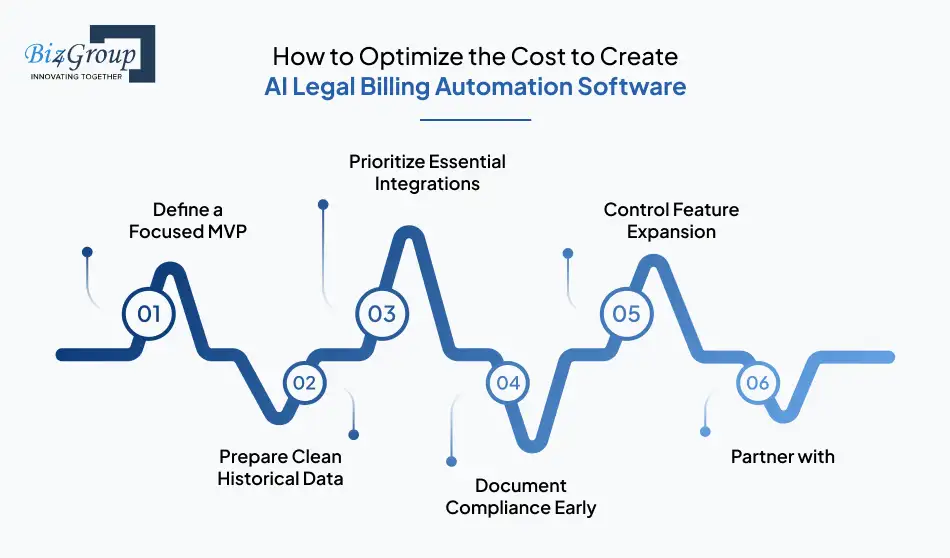
- Define a Focused MVP: Launch core billing validation features first before expanding into predictive scoring or advanced analytics layers.
- Prepare Clean Historical Data: Structured billing records reduce delays during model training and prevent rework in development stages.
- Prioritize Essential Integrations: Connect only mission critical systems initially and expand integration scope gradually in later phases.
- Document Compliance Early: Clarify client billing mandates at project start to prevent costly mid development changes.
- Control Feature Expansion: Avoid unnecessary customization during early releases and refine functionality based on measured outcomes.
- Partner with AI development company: Experienced teams minimize architectural errors, reduce rework, and manage implementation efficiently.
A structured budgeting approach protects financial outcomes and reduces execution risk. Strategic AI legal billing software development ensures your investment aligns with compliance demands, operational scale, and long-term revenue performance.
Also Read: How Much Does AI Software Development Costs?
Know the Real Investment Range
Get clarity on scope budget and enterprise scale requirements upfront
Get a Cost BreakdownCustom vs Off-the-Shelf AI Legal Billing Software
Many law firms struggle with one critical decision: adopt a ready-made billing platform or build a custom AI legal billing automation system tailored to internal workflows. The confusion usually centers around cost, control, scalability, and long-term flexibility.
|
Factors |
Off-the-Shelf AI Legal Billing Software |
Custom AI Legal Billing Software |
|---|---|---|
|
Implementation Speed |
Faster deployment with prebuilt features and fixed workflows |
Longer development timeline due to tailored architecture and validation logic |
|
Customization Level |
Limited configuration within predefined templates |
Full control over billing rules, approval logic, and compliance enforcement |
|
Client Specific Compliance |
May support standard LEDES formats but limited client rule flexibility |
Custom mapping of client mandates, rate caps, and task restrictions |
|
Integration Flexibility |
Integrates with common accounting systems only |
Designed to connect with firm specific time tracking, ERP, and reporting systems |
|
Scalability |
Suitable for small to mid-size firms with standard billing patterns |
Built to handle multi office governance and enterprise billing volume |
|
Cost Structure |
Lower upfront cost with recurring subscription fees |
Higher initial investment with long term ownership control |
|
Data Ownership |
Vendor managed hosting and infrastructure |
Full control over data storage, security policies, and access management |
|
Innovation Control |
Dependent on vendor roadmap for new features |
Ability to expand intelligence layers and predictive validation independently |
What Should You Go For?
If your billing workflows are simple and aligned with standard market practices, an off-the-shelf solution may work temporarily. However, firms with complex client mandates, multiple offices, or strict compliance requirements benefit more from tailored systems.
- A custom system allows you to define your own validation rules rather than adapting processes to software limitations.
- You gain control over data governance and approval logic.
- You can scale intelligence as billing volume grows.
- Most importantly, custom AI legal billing software development enables structured revenue protection aligned with your firm’s financial strategy.
Choosing the right approach depends on operational maturity and long-term growth goals. Firms aiming for stronger compliance control and scalable revenue oversight often find that tailored architecture delivers greater strategic value over time.
Key KPIs to Measure the Success of AI Legal Billing Management Platforms
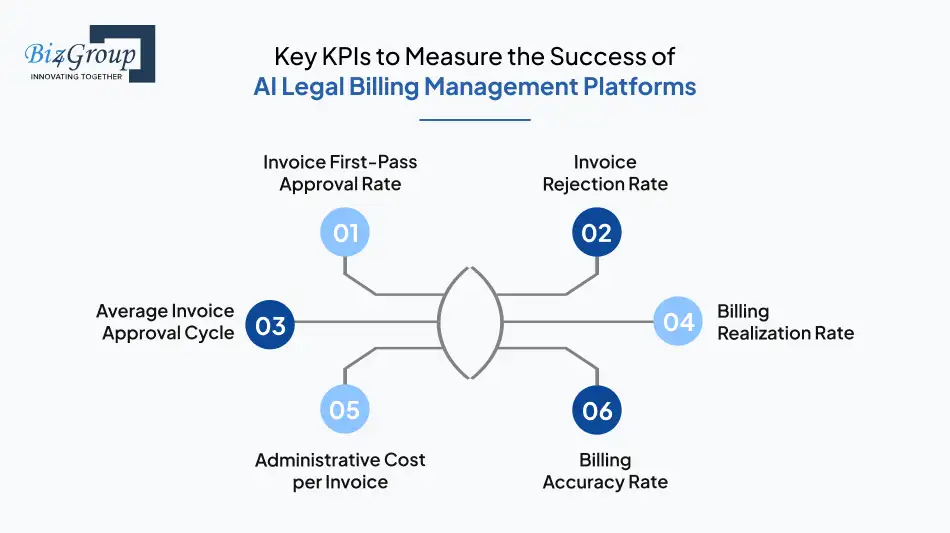
When you build AI legal billing automation software, success must be measured through financial and operational impact. Clear billing metrics help you understand whether automation is improving realization, reducing disputes, and strengthening overall revenue control.
1. Invoice First-Pass Approval Rate
- Measures the percentage of invoices approved without revision.
- Higher approval rates indicate accurate billing validation and stronger alignment with client-specific billing rules.
2. Invoice Rejection Rate
- Tracks how often invoices are returned due to compliance errors or formatting issues.
- A declining rejection rate signals improved rule enforcement and validation precision.
3. Average Invoice Approval Cycle
- Calculates the time between draft submission and final approval.
- Shorter cycles reflect streamlined routing and reduced administrative friction.
4. Billing Realization Rate
- Represents the percentage of billed hours collected without write downs.
- This directly measures how effectively automation protects revenue before client submission.
5. Administrative Cost per Invoice
- Evaluates operational expenses required to process each invoice.
- Effective automation lowers manual review effort and reduces finance overhead.
6. Billing Accuracy Rate
- Measures how correctly the system flags policy violations and inconsistencies.
- Higher accuracy demonstrates reliable AI legal billing product development and improved validation quality.
Gains typically come from reduced write downs, faster collections, and lower administrative costs. When KPI performance improves consistently, your AI legal billing automation software shifts from operational support to measurable revenue optimization.
Monetization Strategies for AI Legal Billing Software for Revenue Growth
If you plan to create AI based legal revenue management software, monetization must be built into the product strategy. Revenue should come from scalable pricing structures, recurring contracts, and value-based packaging designed for law firms of different sizes.
1. SaaS Subscription Model
Recurring subscription remains the most stable revenue engine for legal tech businesses.
- Monthly or annual plans
- Tiered pricing based on attorney count
- Feature gated access for advanced automation
- Enterprise pricing for large law firms
This model ensures predictable recurring income and supports long-term product expansion.
2. Usage Based Billing Model
Revenue scales with system usage rather than flat licensing.
- Per invoice processing fee
- Per user or per matter billing
- Volume based pricing tiers
- API usage charges for integrations
This structure aligns pricing with platform adoption and invoice throughput growth.
3. Enterprise Licensing & Multi-Year Contracts
Large firms prefer structured contracts with long-term commitments.
- 2–5 year agreements
- Custom pricing based on office locations
- Dedicated onboarding and support packages
- Advanced compliance modules bundled
Enterprise contracts stabilize cash flow and reduce churn risk.
4. Add-On Intelligence Modules
Core billing automation can be sold separately from advanced intelligence layers.
- Predictive billing analytics
- Compliance libraries for corporate clients
- Revenue forecasting dashboards
- Audit trail and governance upgrades
This enables companies to create AI legal billing automation tools for revenue growth while increasing average contract value.
5. White Label & Strategic Partnerships
Technology providers can license the platform to consulting firms or accounting service providers.
- Rebranded platform deployments
- Revenue sharing agreements
- Channel partner distribution models
- Regional expansion through partners
This expands market reach without building a large internal sales force.
Strong monetization design determines long-term sustainability. Companies that structure pricing intelligently and package automation strategically can build AI legal billing automation software that generates recurring revenue and scales across the legal services market.
Also Read: 65+ Software Ideas for Entrepreneurs and Small Businesses
Turn Billing into Revenue Engine
Design pricing models that scale predictably with adoption and growth
Build Your Monetization PlanCommon Mistakes When You Develop AI Legal Billing Automation Systems and How to Avoid Them
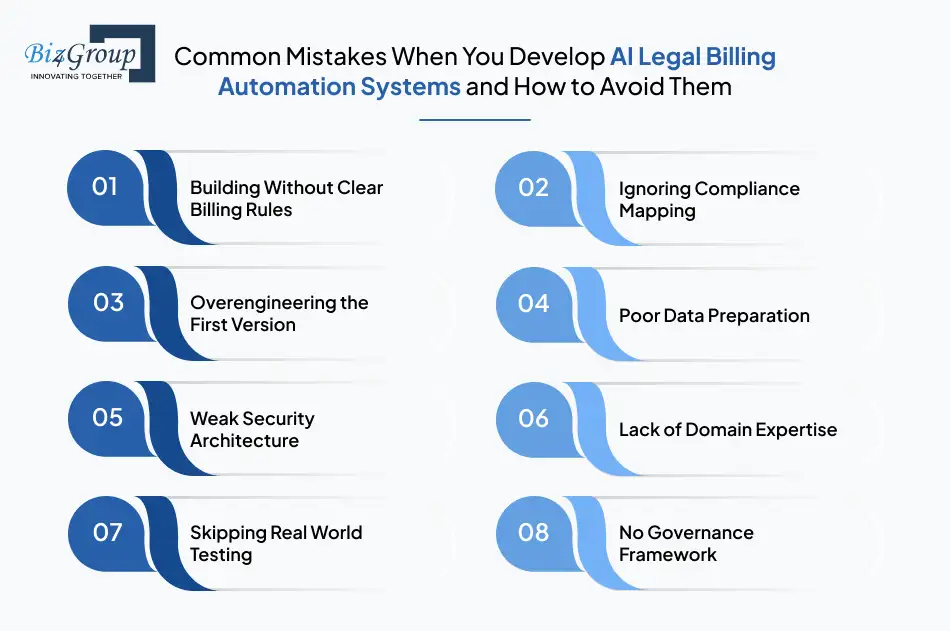
Building intelligent billing systems is not just a technical task. Most failures happen because compliance logic, data structure, or approval workflows are misunderstood during early planning. Small missteps in billing automation can directly impact revenue realization and client trust.
|
Mistake |
How to Avoid It |
|---|---|
|
Building Without Clear Billing Rules |
Document client mandates, rate structures, and approval hierarchies before development. Convert policies into structured validation logic early in the architecture stage. |
|
Ignoring Compliance Mapping |
Embed LEDES formats, task codes, and client specific restrictions into automated checkpoints from day one rather than adding them after deployment. |
|
Overengineering the First Version |
Start with core validation and invoice automation. Expand predictive features gradually based on real billing data and user feedback. |
|
Poor Data Preparation |
Clean historical billing data before model training. Structured data improves validation accuracy and reduces costly rework. |
|
Weak Security Architecture |
Implement encryption, access controls, and audit logs during initial system design instead of retrofitting security controls later. |
|
Lack of Domain Expertise |
Work with professionals who understand legal billing workflows. Many law firms hire AI developers without ensuring they grasp compliance driven billing logic. |
|
Skipping Real World Testing |
Test invoices against real client scenarios before full rollout. Simulated billing cases reveal rule gaps and workflow failures early. |
|
No Governance Framework |
Establish model oversight, update controls, and performance monitoring to prevent billing errors as automation scales. |
Avoiding these mistakes protects both revenue and credibility. Teams that plan carefully, validate compliance early, and prioritize structured execution can build AI legal billing automation software that delivers reliable financial control and long-term operational stability.
Why Businesses Across the USA Choose Biz4Group LLC for AI Legal Billing Software Development
At Biz4Group LLC, we build intelligent digital systems that solve real operational problems. As a legal software development company, we work closely with startups and enterprises that want structured, scalable billing automation aligned with compliance demands.
1. Enterprise-Focused Legal Technology Expertise
Our experience spans regulated industries where financial precision matters. Whether delivering platforms in fintech development or building compliance sensitive healthcare solutions, we understand how AI automation must operate within strict governance boundaries. That experience directly shapes how we approach legal billing automation software development using AI.
2. Structured Legal Billing Intelligence Approach
When firms approach us, they are not simply looking for invoice automation. They want systems that protect realization rates, enforce client mandates, and strengthen financial transparency. Thus, we design AI billing engines that reflect how legal teams actually work, from time capture to final approval.
3. Proven AI Delivery Across Regulated Domains
Our portfolio reflects structured AI implementation across complex domains. That cross-industry exposure helps us translate compliance logic into reliable billing validation workflows for law firms.
4. Collaborative and Transparent Development Model
We follow a collaborative model. You are involved in workflow mapping, rule definition, and validation checkpoints. That transparency ensures that the final system reflects operational reality rather than technical assumptions.
4. Scalable Architecture for Long-Term Revenue Governance
Building legal billing automation requires discipline in architecture, governance, and long-term scalability. Biz4Group LLC focuses on helping firms build AI legal billing automation software that strengthens financial control without compromising compliance integrity.
If your goal is structured revenue protection and intelligent billing oversight, talk to us we are ready to build it with you.
Want Enterprise Grade Execution
Build structured automation with compliance discipline and financial control
Start Your AI Billing ProjectWrapping Up
AI legal billing automation reshapes how firms manage realization, compliance, and approval discipline. It reduces write downs before invoices leave the system and strengthens financial visibility across matters. Firms that invest early in structured automation set the benchmark for operational control in the years ahead.
The journey from concept to deployment can feel layered. Governance mapping, data structure, and validation logic require careful planning. Yet the outcome justifies the effort. A well-engineered system improves approval stability, limits disputes, and protects revenue at scale. In enterprise environments, disciplined automation directly supports predictable cash flow.
At Biz4Group, we translate complex billing workflows into secure and scalable systems. As an AI product development company, we help law firms build AI legal billing automation software aligned with compliance and growth.
FAQs
1. What does it actually take to build AI legal billing automation software for an enterprise law firm?
To build AI legal billing automation software at enterprise scale, you need structured billing rules, clean historical data, compliance mapping, and secure system architecture. It is not just model training. Success depends on translating client mandates, approval hierarchies, and realization controls into enforceable validation logic inside the platform.
2. How long does AI legal billing software development for law firms typically take?
AI legal billing software development for law firms usually takes 3 to 9 months depending on scope. An MVP with core validation and invoice automation may take 12–16 weeks. Enterprise deployments with predictive controls and multi-office governance require phased implementation.
3. What is the cost to develop AI legal billing automation systems?
The cost to develop AI legal billing automation systems typically ranges from $30,000 to $200,000+. MVP builds fall on the lower end, while enterprise-grade platforms with predictive intelligence, compliance engines, and complex integrations require higher investment.
4. How can firms build secure AI legal billing software for legal departments with strict compliance requirements?
Security must be designed at the architecture level. To build secure AI legal billing software for legal departments, firms need encryption, role-based access control, detailed audit logs, and automated compliance validation tied directly to client billing mandates.
5. What is the difference between custom AI legal billing software development and off-the-shelf platforms?
Custom AI legal billing software development allows firms to encode their exact billing rules, client restrictions, and approval workflows. Off-the-shelf tools offer standard automation but limited flexibility for enterprise-specific governance and predictive revenue controls.
6. How can legal tech founders create AI legal billing automation tools for revenue growth?
Founders who create AI legal billing automation tools for revenue growth should focus on measurable financial outcomes. Predictive write-down prevention, realization tracking, and compliance enforcement are stronger value drivers than generic invoice automation features.
