 Location :
Orlando, FL, USA
Location :
Orlando, FL, USA +1 (407) 714-1616
 info@biz4group.com

- Build an AI receptionist avatar for hospitality to automate guest interactions, reduce front desk workload, and deliver consistent, 24/7 service across hotels and resorts.
- AI receptionist avatar development for hospitality covers key use cases like hotel check-in, multilingual support, virtual concierge, and upselling without replacing human staff.
- Successful implementations rely on AI digital human development for hospitality, combining conversational AI, voice, facial animation, and deep hotel system integrations.
- The cost to develop an AI receptionist avatar for hospitality typically ranges from $20,000 to $200,000+, depending on features, integrations, and scale.
- Partner with Biz4Group, the best company to develop AI receptionist avatars for hospitality ensures scalability, security, and enterprise-ready performance for modern hospitality businesses.
Have you noticed how guest expectations keep rising while front desk teams feel more stretched every year?
In 2025, this pressure is no longer anecdotal. According to a report, AI adoption across hospitality continues to accelerate as hotels look for ways to improve guest experience without increasing staffing costs.
At the same time, a report stated that over 78 percent of hotel groups already use AI solutions, and nearly 90 percent plan to expand AI usage by the end of 2025.
You are likely feeling this reality every day.
- Guests want instant answers at check-in.
- They expect 24/7 availability and multilingual support.
- They want the same level of service, no matter the time or location.
That is why more hospitality leaders are choosing to build an AI receptionist avatar for hospitality instead of relying only on traditional front desk models.
A modern AI receptionist avatar is designed to support your staff, not replace them. It takes care of repetitive guest interactions, reduces wait times, and helps maintain consistent service across properties. When developed with the right AI development company, these solutions become part of scalable enterprise AI solutions that grow alongside your hospitality business.
If you are evaluating how to develop AI receptionist avatars for hotels, this guide will help you understand what works, what to avoid, and how to move forward with hospitality AI receptionist avatar development confidently.
What Is an AI Receptionist Avatar in Hospitality and Why Hotels Need It Today
Let's start with a simple question.
When a guest walks into your hotel, do they want to wait in line or get instant help?
An AI receptionist avatar is designed to deliver that instant experience. It is a digital front desk presence that looks, speaks, and interacts like a real receptionist while running on intelligent systems that understand guest intent, language, and context.
In practical terms, AI receptionist avatar development for hospitality blends conversational AI, voice interaction, and a visual digital human. You can think of it as an avatar for business that welcomes guests, answers questions, supports check-in, and assists with common requests around the clock.
Many hotels already use kiosks or text-based tools, such as a hospitality chatbot. These solutions help, but they often struggle when conversations become more dynamic. Guests ask follow-up questions, switch topics, or expect a more natural exchange.
That is where building an AI receptionist avatar for hospitality strategies stands out.
These systems behave more like trained staff members. They understand intent, respond conversationally, and operate as intelligent assistants similar to AI agents in customer service rather than rigid scripts.
Why AI Receptionist Avatars Matter for Hospitality Businesses Today
Hotels and resorts are adopting hospitality AI receptionist avatar development because it directly addresses daily operational pain points.
- Rising guest expectations: Travelers now expect instant, personalized, and multilingual assistance at every touchpoint.
- Front desk workload pressure: Repetitive questions and manual tasks pull staff away from high-value guest interactions.
- Staffing challenges: Hiring, training, and retention remain ongoing challenges across the hospitality industry.
- Consistency across properties: Brands that develop AI receptionist avatars for hotels and resorts can deliver the same service quality across locations and shifts.
- 24/7 availability without burnout: AI avatars stay available without overtime costs or fatigue.
When you develop digital receptionist avatars for hospitality businesses, you are not replacing human warmth. You are extending it. Guests get immediate assistance, while your staff gains more time to focus on moments that truly require a human touch.
In the next section, we will explore where AI receptionist avatars create the most impact across hotel operations and real guest journeys.
Still running your front desk the 2015 way?
With over 78% of hotels already using AI and nearly 90% planning to expand adoption, waiting is quickly becoming the riskiest move. If you are exploring how to build an AI receptionist avatar for hospitality, now is the right time to validate what makes sense for your business.
Talk to our AI hospitality expertsWhere AI Receptionist Avatars Create the Most Impact in Hospitality?
You might be asking yourself a practical question.
Where does an AI receptionist avatar actually fit into real hotel operations?
The answer becomes clear when you look at where your front desk feels the most pressure. That is exactly where building an AI receptionist avatar for hospitality initiatives deliver the fastest value.
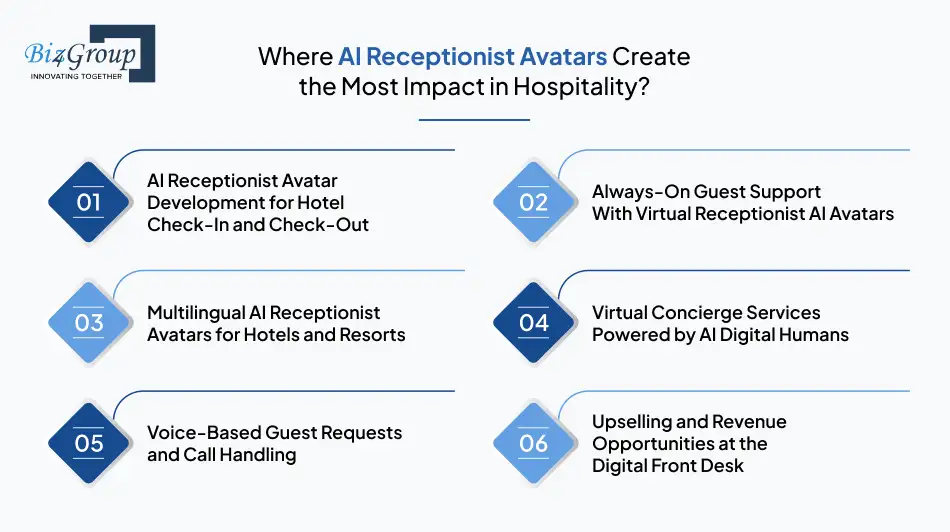
Below are the most effective use cases of AI receptionist avatar development for hospitality, explained with simple, real-world examples so you can clearly visualize the impact.
1. AI Receptionist Avatar Development for Hotel Check-In and Check-Out
Peak-hour check-in is one of the biggest stress points for hotels. When you develop AI receptionist avatars for hotels, these avatars can welcome guests, verify reservations, explain check-in steps, and assist with digital keys or room access.
Example
A guest arrives during a busy evening rush. Instead of standing in line, they interact with an AI receptionist avatar at a front desk kiosk. The avatar confirms the booking, explains amenities, and completes check-in within minutes while human staff focus on VIP or complex requests.
This is one of the clearest wins of AI receptionist avatar development for hotel check-in.
2. Always-On Guest Support With Virtual Receptionist AI Avatars
Guests do not stop needing help after business hours. A virtual receptionist AI avatar for hospitality handles common questions at any time, reducing calls and walk-ups that interrupt staff.
Example
At 1 a.m., a guest wants to know breakfast hours and parking details. The AI receptionist avatar responds instantly through a lobby screen or in-room device without waking night staff.
Many hotels enable this using intelligent hospitality AI agents that manage guest requests autonomously.
3. Multilingual AI Receptionist Avatars for Hotels and Resorts
International travelers expect service in their preferred language. When you create multilingual AI receptionist avatars for hotels, language barriers disappear without adding multilingual staff.
Example
A guest from overseas approaches the front desk. The AI receptionist avatar automatically switches to their language, explains hotel policies, and answers questions smoothly.
This capability is a major reason global brands develop AI receptionist avatars for hotels and resorts.
4. Virtual Concierge Services Powered by AI Digital Humans
Guests often ask the same concierge questions repeatedly. AI receptionist avatars can act as digital concierges, offering personalized local recommendations and service guidance.
Example
A couple asks for nearby dining options. The AI receptionist avatar suggests restaurants, provides directions, and shares booking options based on time and guest preferences.
This expands beyond basic automation and aligns with advanced AI voice agent use cases.
5. Voice-Based Guest Requests and Call Handling
Many guest interactions still happen over the phone. Hotels investing in AI receptionist avatars with voice and facial animation for hotel check-in often pair them with voice systems for consistency across channels.
Example
A guest calls asking about spa availability. The AI receptionist avatar, connected to a voice interface, checks availability and confirms the booking without transferring the call.
This experience is commonly enabled through AI voice agent development for hotels.
6. Upselling and Revenue Opportunities at the Digital Front Desk
AI receptionist avatars can support revenue growth without aggressive selling. They surface relevant offers at the right moment.
Example
During check-in, the AI receptionist avatar suggests a room upgrade or breakfast package. The guest accepts in seconds, increasing revenue without slowing the process.
This is especially valuable for brands that build AI digital receptionist avatars for modern hospitality businesses focused on scale and consistency.
Across all these scenarios, one thing stands out. Hotels using custom AI receptionist avatar development for hospitality are not chasing trends. They are reducing front desk workload, improving service consistency, and delivering better guest experiences at scale.
Features That Define High-Performing AI Receptionist Avatars for Hospitality
Not all AI receptionist avatars are built the same. Some look impressive in demos but fall apart in real hotel environments. Others quietly handle thousands of guest interactions every month without friction.
If you are planning to build an AI receptionist avatar for hospitality, the difference comes down to features. The table below breaks down the must-have features for AI receptionist avatar development for hospitality, along with what each feature actually means for your hotel operations.
|
Feature |
What It Does in Practice |
Why It Matters for Hospitality |
|
Conversational Intelligence |
Understands guest intent, follow-up questions, and natural language |
Prevents robotic interactions and enables human-like conversations powered by a conversational AI agent |
|
Voice Interaction |
Allows guests to speak naturally instead of typing |
Essential for lobby kiosks, phone handling, and accessibility |
|
Facial Animation and Digital Human UI |
Displays realistic facial expressions and lip sync |
Builds trust and comfort during hotel check-in and guest assistance |
|
Multilingual Support |
Communicates in multiple languages automatically |
Critical for hotels that create multilingual AI receptionist avatars for hotels serving global travelers |
|
Context Awareness |
Remembers conversation history and guest intent |
Avoids repeated questions and improves service continuity |
|
Hotel System Integration |
Connects with PMS, CRM, booking, and service systems |
Enables real actions like reservation lookup and service requests |
|
Autonomous Task Handling |
Completes routine tasks without staff involvement |
Powered by an intelligent AI agent that reduces front desk workload |
|
Escalation to Human Staff |
Transfers conversations when needed |
Ensures guests always get help for complex or sensitive issues |
|
Multi-Channel Support |
Works across kiosk, voice, mobile, and web |
Delivers consistent experience when you develop AI receptionist avatars for hotels and resorts |
|
Analytics and Reporting |
Tracks interactions, drop-offs, and guest behavior |
Helps measure ROI and improve guest experience over time |
|
Multi-Agent Coordination |
Different AI components work together seamlessly |
Achieved using a multi agent AI system for complex hospitality workflows |
|
Customization and Branding |
Matches hotel tone, visuals, and service style |
Important for custom AI receptionist avatar development for hospitality |
Why These Features Matter Together
Individually, each feature adds value. Together, they enable hotels to build AI digital receptionist avatars for modern hospitality businesses that operate reliably in real-world conditions.
This is also what separates:
- Basic kiosks from intelligent digital receptionists
- Static chatbots from full AI digital human development for hospitality
- Short-term pilots from scalable, enterprise-ready deployments
Steps to Build an AI Receptionist Avatar for Hospitality
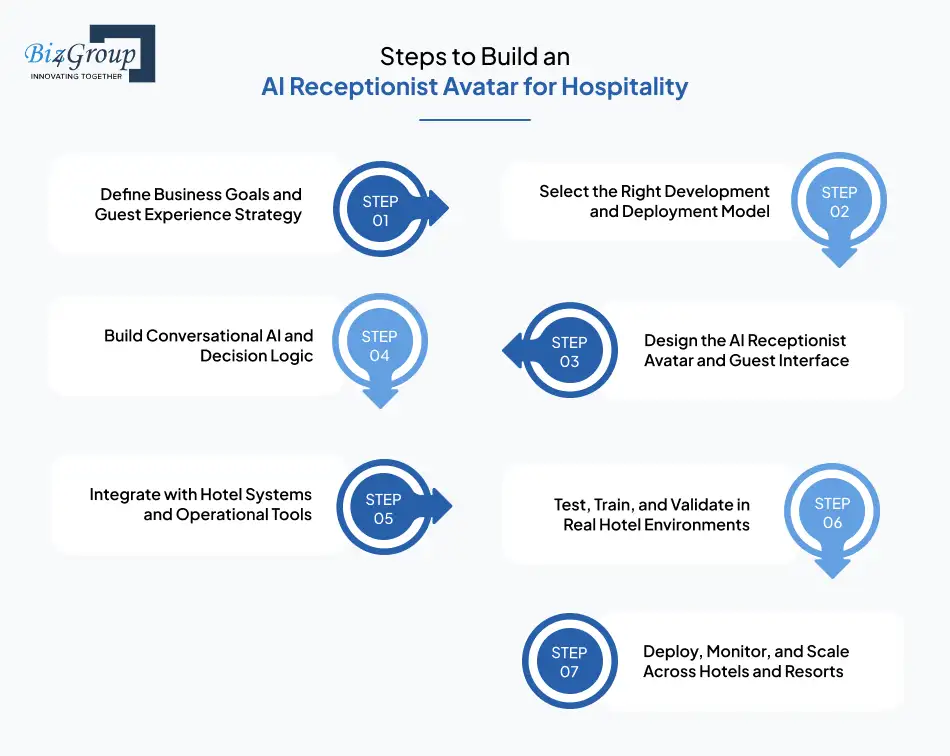
Building a reliable AI receptionist avatar is not a one-off development task. It is a structured journey that blends guest experience design, intelligent automation, and system-level integration. When done correctly, AI receptionist's avatar development for hospitality results in a solution that feels natural to guests and dependable for hotel operations.
Below is a clear, practical breakdown showing how hospitality brands build an AI receptionist avatar for hospitality, whether they plan to develop AI receptionist avatars for hotels, resorts, or multi-property chains.
Step 1: Define Business Goals and Guest Experience Strategy
Before any technology decisions, you need clarity on what the AI receptionist avatar should achieve for your hospitality business. This step ensures the solution aligns with real guest and operational needs, not assumptions.
- Identify high-volume front desk interactions
- Define success metrics like reduced wait times or faster check-in
- Align goals with hospitality AI receptionist avatar development outcomes
Step 2: Select the Right Development and Deployment Model
Not every hotel needs a full enterprise rollout on day one. Many brands start small and scale once value is proven, especially when they develop digital receptionist avatars for hospitality businesses.
- Decide between custom build, platform-based, or hybrid approach
- Define MVP scope and expansion roadmap
- Plan timelines using structured MVP development
Step 3: Design the AI Receptionist Avatar and Guest Interface
Visual presence and interaction design directly influence guest trust and adoption. The avatar should reflect your brand while remaining simple and intuitive for all guests.
- Design avatar appearance and personality
- Map front desk and concierge interaction flows
- Apply hospitality-focused principles through professional UI/UX design
Step 4: Build Conversational AI and Decision Logic
This step transforms the avatar into a working digital receptionist. The system learns how to understand guest intent, respond naturally, and perform tasks without human intervention.
- Train conversational flows for hotel-specific scenarios
- Implement logic for escalation and exception handling
- Enable autonomous task execution for AI digital human development for hospitality using an AI product development company
Step 5: Integrate with Hotel Systems and Operational Tools
To deliver real value, the AI receptionist avatar must connect with your existing hospitality ecosystem. Integrations allow it to move beyond conversations into real actions.
- Integrate PMS, CRM, booking, and service platforms
- Ensure secure and compliant data exchange
- Support seamless operations through reliable AI integration services
Step 6: Test, Train, and Validate in Real Hotel Environments
Live testing is where theory meets reality. Guest interactions uncover edge cases that scripted tests often miss, especially during peak hours.
- Run internal and guest-facing test scenarios
- Collect feedback from staff and guests
- Refine conversations, logic, and accuracy by gradually launching an AI avatar pilot project before full-scale deployment
Step 7: Deploy, Monitor, and Scale Across Hotels and Resorts
After validation, the AI receptionist avatar can be rolled out with confidence. Continuous monitoring ensures it adapts as guest behavior and expectations evolve.
- Deploy across kiosks, mobile apps, and voice channels
- Monitor resolution rates, guest satisfaction, and workload reduction
- Scale using continuous optimization supported by proven AI automation services
By following these steps, hospitality brands can confidently develop AI receptionist avatars for hotels and resorts, control costs, and deliver consistent service at scale.
Curious how fast you could launch this?
A clear roadmap makes AI receptionist avatar development for hospitality simpler than most teams expect.
Get your development planTechnology Stack Behind AI Receptionist Avatar Development for Hospitality
When hospitality leaders ask how complex it is to build an AI receptionist avatar for hospitality, the answer usually depends on the technology stack behind it. A production-ready system is made up of multiple layers that work together seamlessly.
Below is a practical breakdown of the tech stack used in AI receptionist avatar development for hospitality, showing the tools and frameworks commonly used at each layer.
|
Technology Layer |
Tools and Technologies Used |
Role in Hospitality AI Receptionist Avatar Development |
|
Frontend and Experience Layer |
React, Next.js, Unity, Unreal Engine, WebGL |
Powers lobby kiosks, web interfaces, and immersive front desk screens used to create virtual receptionist avatars for hotel front desks |
|
UI and Interaction Design |
Figma, Adobe XD, usability testing frameworks |
Ensures intuitive guest interactions and brand-aligned experiences when hotels develop digital receptionist avatars for hospitality businesses |
|
Voice Interface Layer |
Whisper, Google Speech-to-Text, Amazon Polly |
Enables voice-based conversations for AI receptionist avatars with voice and facial animation for hotel check-in |
|
Conversational AI Layer |
GPT-based models, dialog managers, intent classifiers |
Drives natural language understanding for AI receptionist avatar development for hospitality |
|
Agentic AI and Decision Layer |
Task planners, reasoning engines, memory modules |
Allows avatars to make decisions and handle workflows autonomously using advanced agentic AI development |
|
Backend Application Layer |
Handles business logic, session management, and orchestration for hotels that develop AI receptionist avatars for hotels and resorts |
|
|
Automation and Workflow Layer |
RPA tools, event-driven systems, queues |
Automates repetitive front desk tasks using scalable AI automation services |
|
Integration Layer |
PMS APIs, CRM connectors, payment gateways |
Connects avatars with hotel systems through reliable AI integration services |
|
Mobile and Cross-Platform Apps |
Extends receptionist avatars to mobile apps with support from an AI app development company |
|
|
Data and Analytics Layer |
Elasticsearch, Power BI, custom dashboards |
Tracks usage, resolution rates, and ROI for hospitality AI receptionist avatar development |
|
Cloud and Infrastructure Layer |
AWS, Azure, Kubernetes, Docker |
Supports scalability for enterprise AI receptionist avatar platforms for hotel chains |
|
Security and Compliance Layer |
OAuth, encryption, access controls |
Protects guest data and ensures enterprise-grade compliance |
Why This Layered Stack Matters
A well-structured tech stack ensures that custom AI receptionist avatar development for hospitality is:
- Scalable across properties
- Stable during peak guest traffic
- Secure with sensitive guest data
- Flexible enough to evolve with future AI capabilities
This is what separates short-term demos from enterprise digital human solutions for hospitality businesses that operate reliably in real-world environments.
Also Read: React JS Development Services
Cost Breakdown of AI Receptionist Avatar Development for Hospitality
If you are planning to build an AI receptionist avatar for hospitality, one of your first questions is likely about cost. That is completely fair.
In most real-world scenarios, the cost to develop an AI receptionist avatar for hospitality typically ranges between $20,000 and $200,000+. Actual costs depend on scope, integration, customization, and long-term support.
The key point to remember is this. Hospitality AI receptionist avatar development costs differ from one business to another, depending on operational complexity and goals. Below, we break down where the investment actually goes and how to plan it smartly.
Feature-Based Cost Breakdown for AI Receptionist Avatar Development for Hospitality
|
Feature Area |
What's Included |
Estimated Cost Range |
|
Core Conversational AI |
Intent recognition, dialog flow, fallback handling |
$5,000 to $20,000 |
|
Voice Interaction and Speech Processing |
Speech-to-text, text-to-speech, call handling |
$4,000 to $18,000 |
|
Digital Human and Avatar Design |
3D avatar, facial animation, lip-sync |
$6,000 to $30,000 |
|
Multilingual Capabilities |
Language models, localization, testing |
$3,000 to $15,000 |
|
Hotel System Integrations |
PMS, CRM, booking and service systems |
$5,000 to $25,000 |
|
AI Agent and Workflow Automation |
Task execution, routing, escalation logic |
$4,000 to $20,000 |
|
Frontend Interfaces |
Kiosks, web apps, mobile interfaces |
$3,000 to $15,000 |
|
Analytics and Reporting |
Dashboards, usage tracking, optimization |
$2,000 to $10,000 |
|
Security and Compliance |
Authentication, encryption, access control |
$2,000 to $8,000 |
This table gives you a high-level view into why custom AI receptionist avatar development for hospitality can span a wide range of investment.
Key Factors That Affect AI Receptionist Avatar Development Cost for Hospitality
Several variables influence how much it costs to develop AI receptionist avatars for hotels and resorts.
- Level of avatar realism: Lifelike animation, facial expressions, and responsiveness increase costs.
- Depth of system integration: Complex PMS or legacy systems require extra integration effort.
- Multilingual support requirements: Adding multiple languages increases training and testing efforts.
- Number of properties and users: Scaling across hotel chains impacts infrastructure and licensing costs.
- Use of third-party avatar tools: Integrating with top AI avatar generator platforms can reduce build time but may add licensing costs.
- Customization vs off-the-shelf use: Full customization demands more development time than adapting existing solutions.
Hidden Costs in Hospitality AI Receptionist Avatar Development
It's easy to focus only on development estimates and miss the ongoing costs. Some of the hidden items include:
- AI model tuning and retraining as guest language evolves
- Cloud hosting and API usage fees for voice and language services
- Conversation refinement, especially in early months
- Routine system updates when hotel workflows change
- Support and monitoring during peak seasons
These are not deal breakers, but they deserve attention in your planning.
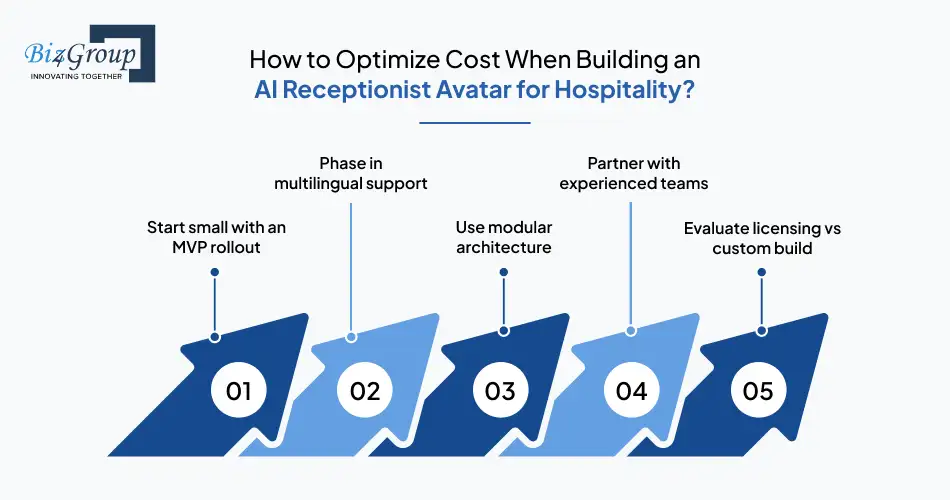
How to Optimize Cost When Building an AI Receptionist Avatar for Hospitality?
Smart planning can significantly reduce costs without sacrificing quality.
- Start small with an MVP rollout, focus on core use cases such as check-in and guest FAQs
- Phase in multilingual support rather than building all languages at once
- Use modular architecture so components can be reused or replaced
- Partner with experienced teams familiar with hospitality AI receptionist avatar development
- Evaluate licensing vs custom build, especially if integrating with top AI avatar generator platforms offers speed without long-term constraints
For additional context on typical pricing for avatar creation, see this resource on the cost to develop a custom AI avatar.
When evaluated correctly, the investment to build AI digital receptionist avatars for modern hospitality businesses is often offset by improved guest satisfaction, reduced staff workload, and measurable operational savings.
Wondering if the investment pays off?
We help you assess whether a $20,000 to $200,000+ AI receptionist avatar makes sense for your hotel.
Get a cost and ROI estimateChallenges in AI Receptionist Avatar Development for Hospitality and How to Solve Them
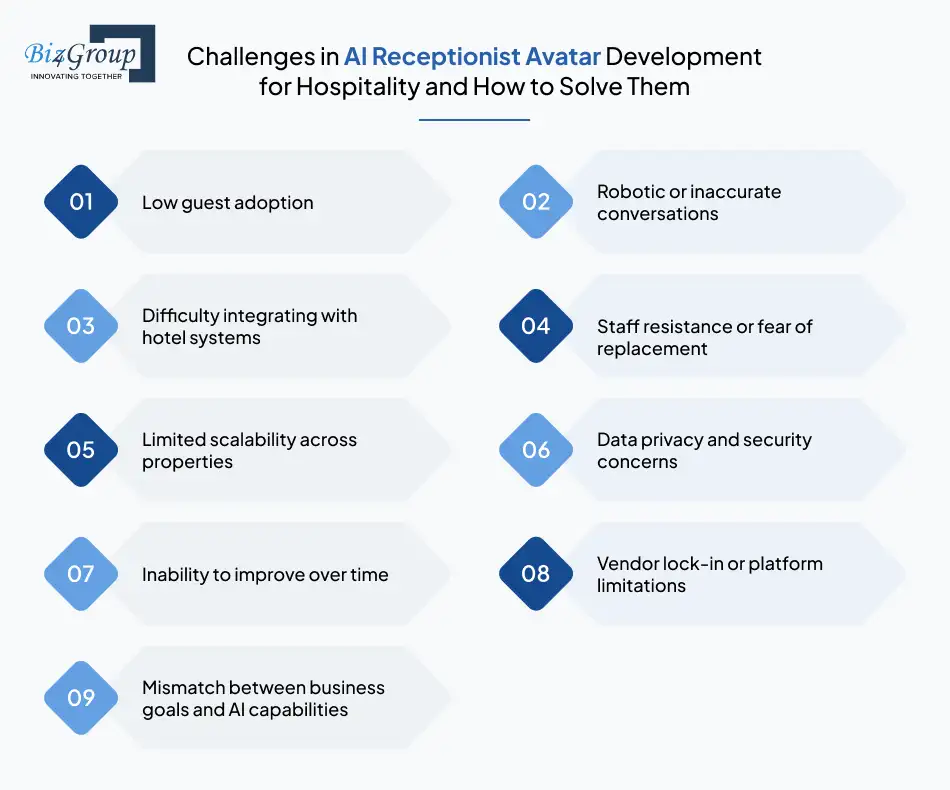
Building and deploying an AI receptionist avatar sounds exciting, but hospitality leaders are right to think about risks upfront. Most challenges are not technical blockers. They are planning, execution, and adoption issues that can be solved with the right approach.
Below is a clear table outlining the most common challenges in AI receptionist avatar development for hospitality, along with practical solutions used by hotels that successfully develop AI receptionist avatars for hotels and resorts.
|
Challenge |
Why It Happens |
How Hospitality Businesses Solve It |
|
Low guest adoption |
Guests are unfamiliar with AI avatars or unsure how to interact |
Design intuitive flows, clear on-screen guidance, and friendly avatar personalities supported by strong UI foundations and fallback logic |
|
Robotic or inaccurate conversations |
Poor training data or limited conversational scope |
Improve dialog quality using proven conversational patterns and backup flows often built with support from an experienced AI chatbot development company |
|
Difficulty integrating with hotel systems |
Legacy PMS or fragmented software stack |
Use custom connectors and middleware designed by a reliable Custom software development company |
|
Staff resistance or fear of replacement |
Lack of clarity on how AI supports human roles |
Position the avatar as a support tool and train staff on escalation workflows and collaboration |
|
Limited scalability across properties |
Solutions built for one location only |
Design modular architecture aligned with AI-based hospitality software development practices for multi-property expansion |
|
Data privacy and security concerns |
Guest data sensitivity and compliance requirements |
Apply enterprise-grade security, access controls, and compliance standards from day one |
|
Inability to improve over time |
No in-house expertise to tune and optimize AI |
Maintain long-term optimization by choosing to hire AI developers or a managed AI partner |
|
Vendor lock-in or platform limitations |
Over-reliance on rigid third-party tools |
Evaluate vendors carefully and benchmark against insights from top AI avatar development companies in USA to avoid long-term constraints |
|
Mismatch between business goals and AI capabilities |
Technology-first approach without strategy |
Start with clear KPIs and partner with an experienced AI avatar development company that understands hospitality workflows |
Why Addressing These Challenges Early Matters
Most failures in hospitality AI receptionist avatar development do not come from bad technology. They come from rushed planning, poor integration, or unclear ownership.
Hotels that succeed do three things consistently:
- Treat AI receptionist avatars as part of long-term digital strategy
- Involve operations and front desk teams early
- Choose partners with hospitality-specific experience
By proactively addressing these challenges, you set yourself up to build AI digital receptionist avatars for modern hospitality businesses that guests trust and teams actually want to use.
The Future of AI Receptionist Avatars in Hospitality
The hospitality front desk is entering a new phase. What began as simple automation is becoming an intelligent, guest-facing experience layer. Hotels that build an AI receptionist avatar for hospitality today are positioning themselves for long-term efficiency, consistency, and competitive advantage.
Here is how the future of AI receptionist avatar development for hospitality is unfolding.
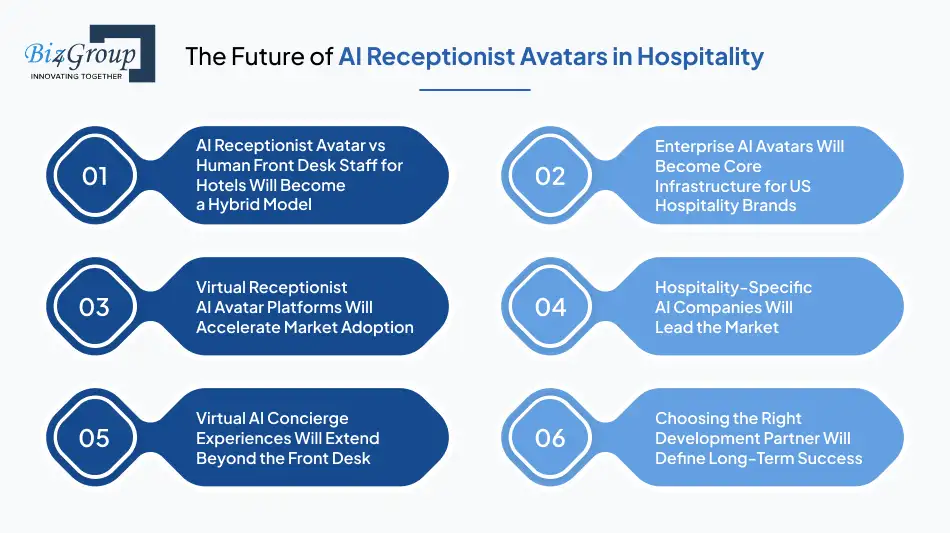
1. AI Receptionist Avatar vs Human Front Desk Staff for Hotels Will Become a Hybrid Model
The future is not about choosing between people and technology. Hotels are settling into a hybrid model where AI handles repetitive interactions, and human staff focus on empathy, problem-solving, and premium service moments. As this balance matures, the discussion around AI receptionist avatar vs human front desk staff for hotels will shift from replacement concerns to productivity, consistency, and staff enablement.
2. Enterprise AI Avatars Will Become Core Infrastructure for US Hospitality Brands
Large hotel groups are moving beyond pilots and investing in enterprise AI avatars for USA hospitality businesses that deliver consistent guest experiences across multiple locations. This evolution aligns closely with broader AI-based hospitality software development, where digital humans are treated as long-term operational infrastructure rather than short-term experiments.
3. Virtual Receptionist AI Avatar Platforms Will Accelerate Market Adoption
As tools mature, more brands will adopt virtual receptionist AI avatar platforms for hospitality to reduce time to deployment while maintaining customization. This shift is especially important for AI avatar solutions for hospitality startups, allowing them to compete on guest experience without building complex systems from scratch.
4. Hospitality-Specific AI Companies Will Lead the Market
Generic AI vendors often fail to understand hotel operations. The future belongs to AI receptionist avatar hospitality companies USA that specialize in hospitality workflows, guest behavior, and system integrations. Decision makers increasingly compare vendors by reviewing top companies offering AI receptionist or virtual AI avatars services for hotels hospitality US, prioritizing domain expertise over generic AI capabilities.
5. Virtual AI Concierge Experiences Will Extend Beyond the Front Desk
AI receptionist avatars are evolving into full virtual receptionist USA AI avatar hospitality concierge systems that support guests throughout the entire stay. From lobby kiosks to mobile apps and in-room tablets, these avatars create a continuous service layer that feels personal while remaining scalable across properties.
6. Choosing the Right Development Partner Will Define Long-Term Success
As the ecosystem grows, selecting the best company to develop AI receptionist avatars for hospitality will matter more than choosing individual tools. Hotels increasingly partner with a specialized AI avatar development company and benchmark options using insights from top AI avatar development companies in USA to avoid vendor lock-in and future limitations.
The future of hospitality is already taking shape. Brands that act now are learning faster, scaling smarter, and delivering more consistent guest experiences.
By investing strategically, you can build AI digital receptionist avatars for modern hospitality businesses that support staff, delight guests, and grow with your operations.
Why Is Biz4Group the Best Partner in the USA to Build Your AI Receptionist Avatar Solution?
Choosing the right partner to build an AI receptionist avatar for hospitality is as critical as the technology itself. Your vendor must understand hospitality workflows, conversational UX design, backend integrations, and scalable architecture.
Biz4Group has a proven track record of delivering sophisticated AI avatar solutions across industries. Their expertise goes beyond simple prototypes. They create engaging, intelligent digital experiences that deliver real results.
Below are a few standout projects that showcase Biz4Group's deep experience with AI avatars and related technologies, even if they were built outside of hospitality.
1. NextLPC – AI-Powered Avatar Tutors for eLearning
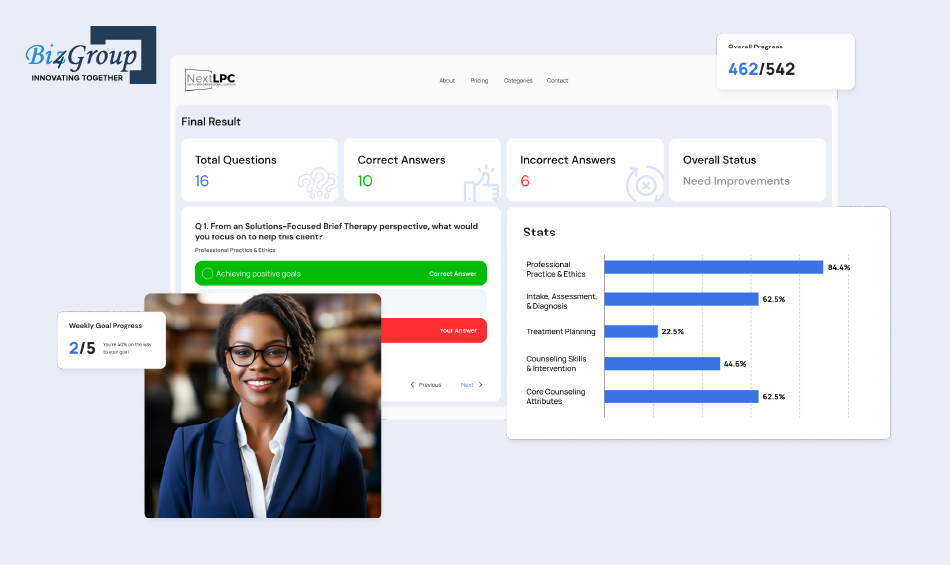
Biz4Group developed a cutting-edge avatar-based learning platform that uses advanced AI avatars to assist students through psychotherapy case studies and assessments. These avatars behave and respond with human-like interaction, demonstrating Biz4Group's ability to build lifelike digital personas for guided conversations.
Project Overview
NextLPC is an AI-driven eLearning platform where virtual AI avatars play the role of therapy tutors. These avatars help students analyze case studies, interact through realistic sessions, and receive feedback based on performance.
Project Highlights
- AI avatars guide students through interactive sessions with dynamic responses.
- Centralized progress dashboard tracks performance and learning outcomes.
- Voice assistance lowers language barriers for learners.
This work highlights Biz4Group's strength in AI avatar solutions that feel natural and conversational, a capability that directly translates to AI receptionist avatar development for hospitality where guest interaction quality is paramount.
2. AI Wizard – Avatar-Based AI Companion

In the AI Wizard project, Biz4Group built an avatar-based intelligent companion capable of voice and video communication, real-time facial expressions, and emotion-aware interaction.
Project Overview
AI Wizard is an avatar companion designed to engage users in meaningful conversation, offering real-time empathy, answers, and guidance. The avatar mimics facial expressions and gestures and supports deep conversational interaction using advanced speech recognition and language models.
Project Highlights
- Real-time avatar-based voice and video calls.
- Customizable avatar options using user photos.
- Natural conversational flow powered by ChatGPT and Whisper models.
This project displays Biz4Group's ability to craft expressive, interactive AI avatars and their understanding of how visual and voice components elevate digital human experiences, skills directly applicable to virtual receptionist AI avatar platforms for hospitality.
3. Dr. Truman – AI-Powered Health & Wellness Avatar
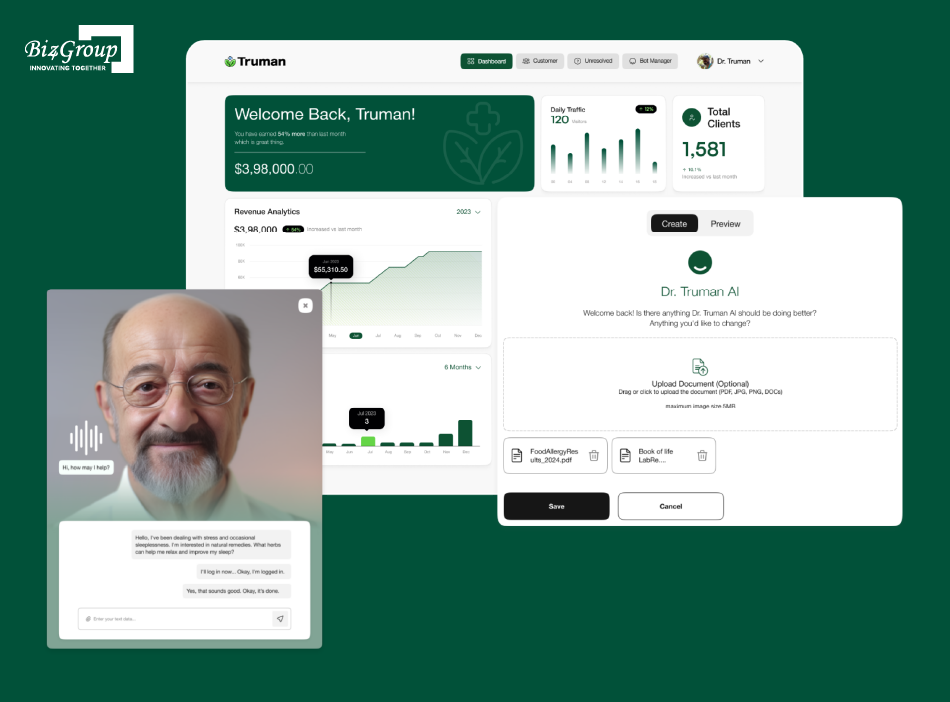
Biz4Group built an AI wellness application centered around a dynamic AI-powered avatar that interacts with users for personalized guidance and recommendations.
Project Overview
For the Truman platform, Biz4Group created an AI avatar that engages users in personalized health guidance, integrates eCommerce capabilities, and tracks individual health history within a seamless app experience.
Project Highlights
- AI-driven avatar offering personalized health advice and supplement suggestions.
- Integrated shopping experience from consultation to purchase.
- Document upload and health history tracking for personalized follow-ups.
This project illustrates how Biz4Group can deliver end-to-end AI avatar systems that combine conversational intelligence, backend workflows, and real-world transactions, exactly the type of capability needed to develop AI receptionist avatars for hotels and resorts.
What These Projects Signal for Hospitality AI Work
While these examples were not built specifically for front desk automation, they show the core competence required for AI receptionist avatar development for hospitality:
- Deep experience building lifelike, expressive avatars that guests engage with naturally.
- Strong backend integration skills that connect digital personas to real systems.
- Proven ability to blend conversational AI with voice, visuals, and dynamic user flows.
When you choose the best company to develop AI receptionist avatars for hospitality, you want a partner who can apply these capabilities directly to your guest experience goals.
Biz4Group's portfolio of diverse AI avatar projects demonstrates exactly that level of expertise and adaptability, making them a strong partner for hospitality brands in the USA.
Ready to build something guests actually enjoy using?
Work with the best company to develop AI receptionist avatars for hospitality in the USA.
Start your project with Biz4GroupConclusion: Turning AI Receptionist Avatars into a Competitive Advantage
Hospitality is no longer judged only by rooms and amenities. It is judged by how fast, personal, and consistent your guest experience feels from the very first interaction.
When you build an AI receptionist avatar for hospitality, you are not adding another tool to your stack. You are creating a digital front desk that works around the clock, speaks your guests' language, and scales across properties without adding operational strain. From check-in automation to concierge support, AI receptionist avatar development for hospitality has moved from innovation to expectation.
The difference between success and frustration comes down to execution.
This is where Biz4Group stands out. As a US-based technology leader with deep experience in AI, digital humans, and enterprise platforms, Biz4Group brings the strategic, design, and engineering expertise needed to deliver production-ready solutions. Our work across AI avatars, intelligent agents, and enterprise systems positions us as the best company to develop AI receptionist avatars for hospitality for brands that care about reliability, scalability, and real ROI.
We understand that hotels need more than a demo. They need:
- Secure and scalable platforms
- Seamless system integrations
- Lifelike avatars guests actually enjoy using
- Long-term support as expectations evolve
Our experience in AI digital human development for hospitality businesses allows us to design solutions where a virtual receptionist AI avatar hospitality model enhances service without disrupting your operations. Whether you are a single property or a multi-location brand exploring enterprise digital human solutions for hospitality businesses, we build with growth in mind.
If you are ready to move beyond ideas and start building something guests will remember, the next step is simple.
FAQ
1. What is an AI receptionist avatar and how does it work in hospitality?
An AI receptionist avatar is a digital human designed to manage guest interactions at hotel front desks through voice, visuals, and conversational AI. In AI receptionist avatar development for hospitality, the avatar understands guest intent, answers questions, assists with check-in, and connects with hotel systems in real time. Unlike basic chatbots, these avatars deliver a more human-like and engaging experience for guests.
2. Why should hotels build an AI receptionist avatar instead of using a chatbot or kiosk?
Many hotels already use chatbots or kiosks, but they often feel limited and impersonal. When you build an AI receptionist avatar for hospitality, you create a visual, conversational front desk presence that guests find easier to interact with. Hotels that develop digital receptionist avatars for hospitality businesses benefit from higher engagement, faster service, and better consistency across properties.
3. What are the most common use cases of AI receptionist avatars in hotels and resorts?
Hotels typically develop AI receptionist avatars for hotels and resorts to support check-in, check-out, FAQs, multilingual guest support, concierge services, and upselling. One of the most common implementations is AI receptionist avatar development for hotel check-in, where avatars reduce wait times and ease front desk congestion during peak hours.
4. Can AI receptionist avatars replace human front desk staff in hotels?
No, and that is not the goal. The future is a hybrid model where AI handles repetitive interactions and staff focus on complex or emotional guest needs. The discussion around AI receptionist avatar vs human front desk staff for hotels is really about productivity and service quality, not replacement. Hotels using this approach see better staff satisfaction and smoother operations.
5. How much does it cost to build an AI receptionist avatar for hospitality businesses?
The cost to build an AI receptionist avatar for hospitality typically ranges from $20,000 to $200,000+. Pricing depends on avatar realism, voice and facial animation, multilingual capabilities, system integrations, and whether you choose custom or platform-based development. Large brands investing in enterprise digital human solutions for hospitality businesses usually fall toward the higher end of this range.
6. Are AI receptionist avatars secure and compliant with guest data privacy?
Yes, when built correctly. Professional custom AI receptionist avatar development for hospitality includes secure integrations, encrypted data handling, and role-based access controls. This is especially important for hotels deploying enterprise AI avatars for USA hospitality businesses, where compliance and guest trust are critical.
7. How do I choose the best company to develop AI receptionist avatars for hospitality in the USA?
You should look for experience in hospitality workflows, digital human design, and enterprise integrations. The best company to develop AI receptionist avatars for hospitality will demonstrate real projects, scalable architecture, and long-term support. Many buyers also evaluate top companies offering AI receptionist or virtual AI avatars services for hotels hospitality US to compare domain expertise before making a decision.
