Location :
Orlando, FL, USA
Location :
Orlando, FL, USA +1 (407) 714-1616
 info@biz4group.com


















Imagine a digital system that doesn’t wait for instructions but instead, understands your business goals, learns from real-time feedback, and takes independent actions to get the job done.
Read More

How long does it take to launch an AI avatar pilot project?
Real timeline for building a small AI avatar prototype?
Can I test an AI avatar idea in under a month?
What’s the fastest way to run an AI avatar pilot without full dev?
Time + steps needed to get an AI avatar pilot live for users?
If you find yourself asking these exact questions, you are not alone. Every CTO, product lead, and innovation owner exploring AI avatars hits the same wall at the very start. You want clarity on your time to Launch an AI Avatar Pilot Project, not guesswork. And more importantly, you want to know whether this fits into your quarter, your roadmap, and your team capacity. So let us get straight to the point and talk about what really influences how soon you can get an avatar pilot in front of users.
The truth is that most companies underestimate how long AI initiatives take.
It is no surprise that many organizations work with top AI avatar development companies in USA to streamline the process and avoid preventable delays. By the time you reach the end of this guide, you will have a clear and practical view of the AI avatar pilot project timeline, what affects it, and how to plan your own pilot with confidence.
Get a roadmap aligned to your time to Launch an AI Avatar Pilot Project and start building smarter from day one.
Start My AI Avatar PilotBefore you estimate your time to Launch an AI Avatar Pilot Project, you first need clarity on the core steps that shape your delivery window. Understanding these stages gives you control, confidence, and the ability to plan your pilot without surprises. Here is what the process looks like.
This step influences your AI avatar implementation timeline because clarity eliminates unnecessary rework and keeps everyone aligned. Teams often collaborate with AI consulting services to validate feasibility and ensure the scope supports fast execution.
Your scripts, FAQs, workflows, and documents directly impact the timeline for developing and launching an AI avatar pilot. When inputs are organized and approved, development moves faster and early testing becomes smoother for your engineering team.
This involves combining dialogue, visuals, logic, and light integrations. Many teams rely on partners offering AI integration services or specialists who can build visual AI agent features quickly to keep momentum strong.
Readiness Checklist to Ensure Your AI Avatar Pilot Can Start Quickly
Before you estimate your delivery window, it helps to understand how businesses can plan an AI avatar pilot from start to finish in a structured and predictable way. This checklist highlights the essentials that keep your timeline tight and development smooth.
When these elements are in place, your pilot moves forward with far fewer delays and far more predictability. A well prepared foundation is the single most reliable way to keep your AI avatar pilot running on schedule from the earliest idea to final delivery.
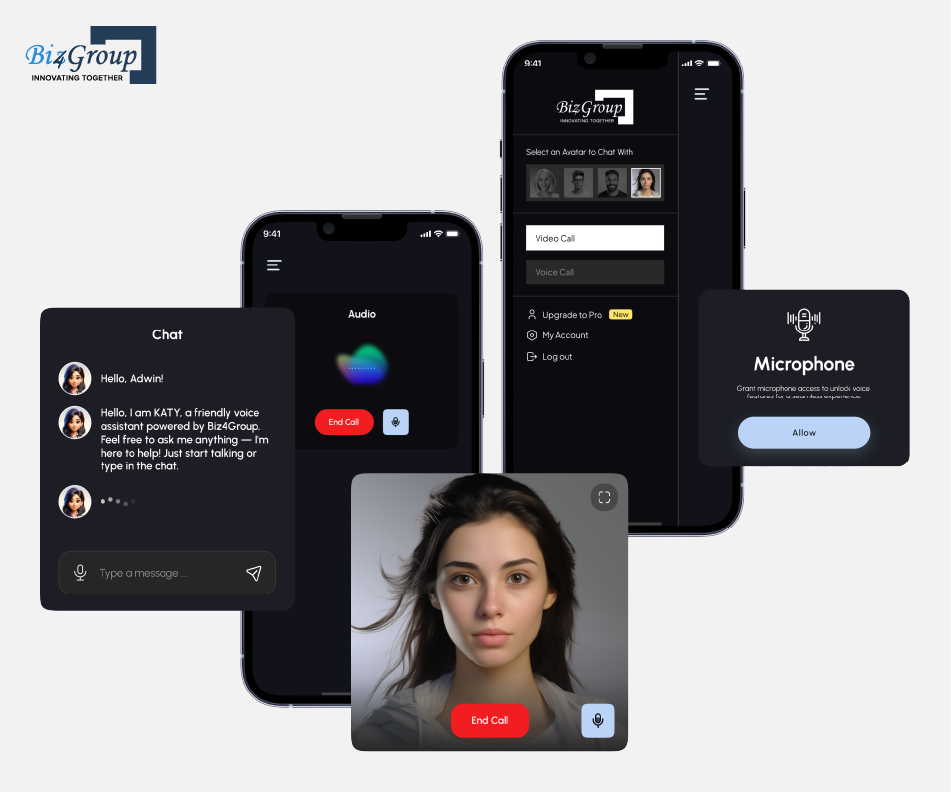
AI Wizard is one of Biz4Group’s showcased builds, designed as an avatar-based AI companion that interacts through voice and video, offering humanlike responsiveness and emotional intelligence. It blends conversational AI, real-time engagement, and an expressive digital persona to give users a more natural way to connect with information and support.
While AI Wizard was built for companionship at scale, the development approach mirrors what most real estate teams need when launching an avatar pilot. The structured flow from defining interactions to building the visual persona to enabling live conversations directly reflects the same checkpoints your real estate pilot must hit to stay on timeline. It is a practical example showing how an end-to-end AI avatar experience can be delivered efficiently when the scope is clear and the user journey is well understood.
See what it takes to streamline your AI avatar pilot project timeline and accelerate delivery without sacrificing quality.
Kick Off My Pilot Timeline ReviewHere is a quick example showing how a real estate firm reached its time to launch an AI Avatar Pilot Project by following a structured week-by-week process laid out by Biz4Group. This simple breakdown highlights how fast a focused use case can move from planning to launch.
|
Week |
Focus Area |
What Happened |
Estimated Hours |
|---|---|---|---|
|
Week 1 |
Scope and Design |
Aligned property FAQs, lead flows, avatar style, and content approval |
20–25 hours |
|
Week 2 |
MVP Build (Part 1) |
Built core interactions, added basic responses, connected property data |
25–30 hours |
|
Week 3 |
MVP Build (Part 2) + Testing |
Expanded interactions, added improvements, ran initial tests |
20–25 hours |
|
Week 4 |
Final Testing and Pilot Launch |
Refined responses, fixed edge cases, deployed pilot, monitored performance |
10–15 hours |
Total Estimated Hours: 75–95 hours
This lightweight example shows how Biz4Group helped a real estate team move through a predictable AI avatar implementation timeline by keeping scope focused, inputs ready, and approvals quick. The result was a working pilot delivered within the expected two-to-ten-week window.
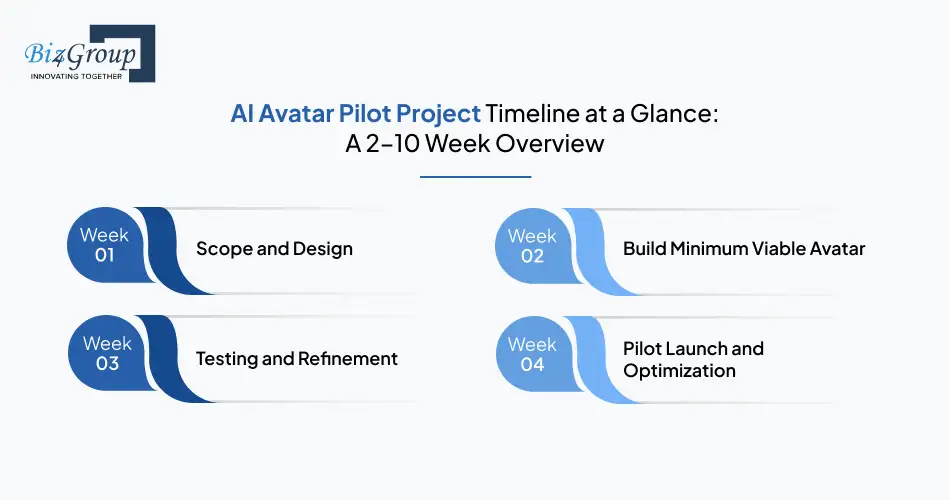
Before you budget time or resources, you need a clear picture of your time to Launch an AI Avatar Pilot Project so planning becomes predictable instead of guesswork. Below is a simple week by week breakdown that shows how quickly your pilot can realistically take shape:
This stage defines the typical duration of AI avatar pilot development and deployment because alignment on goals, scripts, flows, and visuals determines how smoothly later phases move. Many teams consult an AI chatbot development company here to speed up scoping and technical validation.
Your engineering and product teams collaborate to assemble the first working version of the avatar. The answer to how long does AI avatar testing and implementation take, often starts here, especially if you hire AI developers to handle logic flows, interactions, and early integrations.
These weeks focus on fixing friction points, tuning responses, refining visuals, and validating consistency across user journeys. Clean feedback cycles and quick decision making help ensure the avatar performs reliably before the pilot goes live.
Once the avatar is stable, it moves into real user environments where performance is monitored closely. Teams analyze behavior, address final adjustments, and optimize flow quality to ensure the pilot delivers measurable outcomes and reliable user experience.
|
Phase |
Estimated Duration |
What Happens |
|---|---|---|
|
Week 1 |
Scoping and Design |
Define goals, content, user flows, and avatar behavior |
|
Week 2 |
Build Minimum Viable Avatar |
Develop core interactions, visuals, and early integrations |
|
Week 3 |
Testing and Refinement |
Fix issues, refine responses, improve stability |
|
Week 4 |
Pilot Launch and Optimization |
Deploy to real users, monitor, tune, and finalize pilot quality |
Seeing the full timeline in one view makes planning and delivery far more predictable. With strong preparation and cross functional support, Launching AI avatar pilots within a two to ten week window becomes a realistic target that aligns with both strategic goals and execution capacity.
Cut delays, avoid bottlenecks, and shrink your timeline for developing and launching an AI avatar pilot with expert guidance.
Start My MVP Build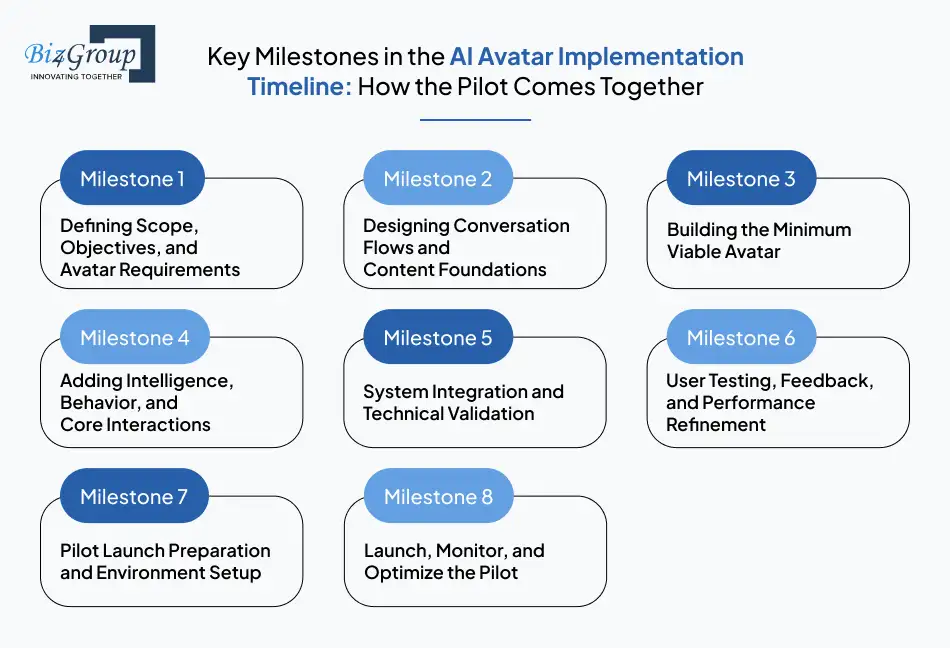
To make confident decisions about your time to Launch an AI Avatar Pilot Project, you need a clear view of the major milestones that shape your delivery window. Each phase affects speed, quality, and predictability, so here is a detailed breakdown of how the pilot truly comes together.
A strong start sets the pace for your entire AI avatar pilot project timeline because misalignment here creates delays downstream. This milestone clarifies your goals, user journeys, voice and visual style, success metrics, and approval path to stay organized and move faster.
This phase directly influences your AI avatar implementation timeline because your scripts, FAQs, dialog patterns, and tone define how interactive your avatar becomes. Clean content reduces revisions and keeps development tight. Teams often integrate AI into an app early to pre test interface behavior.
During this milestone, your team assembles an initial working version by combining logic, visuals, and early integrations. This is where the timeline for developing and launching an AI avatar pilot becomes visible, as bottlenecks often surface here. Specialized partners support rapid creation using AI model development expertise.
This step strengthens avatar responsiveness, accuracy, and knowledge depth. It also heavily impacts the typical duration of AI avatar pilot development and deployment, especially when adding cognitive features. Many teams accelerate this stage by working with engineers experienced in generative AI agents for advanced interaction handling.
Integrations influence momentum more than most teams expect. If you’re wondering how long does AI avatar testing and implementation take to complete, it depends on how to link the avatar to APIs, CRMs, knowledge bases, or internal systems affects. Working with specialists in business app development using AI ensures smoother compatibility.
This period focuses on stress testing the avatar under real user conditions. It is essential because issues discovered late create significant delays. Many organizations collaborate with a software development company in Florida to run structured testing cycles and maintain consistent improvements.
Before going live, you prepare deployment environments, finalize permissions, conduct security checks, and ensure monitoring systems are working. Proper planning here reflects how businesses can plan an AI avatar pilot from start to finish without surprises. Teams often lean on product development services for reliable rollout.
This milestone brings everything together. Once the avatar is live, performance monitoring and rapid tuning ensure stability and user adoption. Iterative improvements tighten your results and help you build a personal avatar chatbot that matches user expectations and business goals.
When these milestones are understood and sequenced thoughtfully, your project stays predictable, controlled, and aligned with real outcomes. This structured approach helps you navigate every stage with confidence, protects your timeline, and ensures your AI avatar pilot arrives on time and ready to perform.
Cut delays, avoid bottlenecks, and shrink your timeline for developing and launching an AI avatar pilot with expert guidance.
Start My MVP Build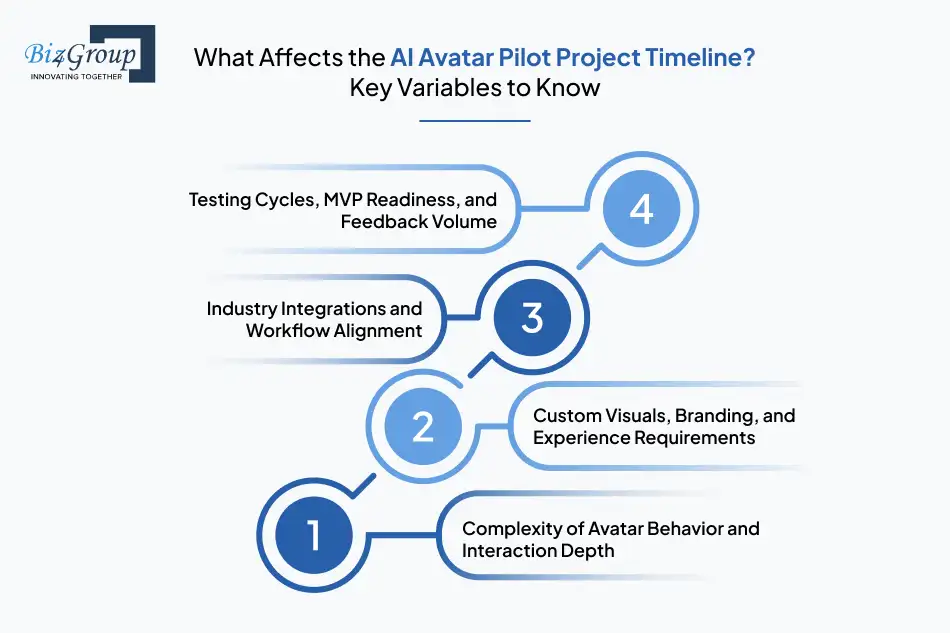
Accurately estimating your time to Launch an AI Avatar Pilot Project requires understanding the factors that determine how quickly your team can move. These variables influence everything from planning speed to technical complexity, so here are the drivers that decide how fast your pilot becomes a working reality.
For those asking what is the typical timeline for developing and launching an AI avatar pilot?, the answer depends largely on how intelligent and interactive the avatar needs to be. Higher engagement depth requires more design, refinement, and testing, often supported by structured AI automation services.
So how long does it take to build a custom AI avatar from concept to launch?, well, the timeline expands with advanced visuals, expressive behavior, or personalized branding. Increasing creative layers requires more iteration and coordination between design and engineering to maintain momentum and quality.
Across sectors, the phases and timeline to implement AI avatars in real estate or business depend on how many systems the avatar interacts with. Integrations, compliance checks, and workflow mapping influence speed, especially when coordination requires help from a specialized software development company in Florida.
Teams concerned about the typical duration and key checkpoints for AI avatar MVP delivery? should expect that testing frequency, user feedback, and required stability benchmarks all influence the final delivery date. The more detailed the validation process, the longer the pilot preparation typically takes.
Once these variables are clear, you can plan with confidence and set realistic timelines that your team can support. Strong alignment, smooth integrations, and a disciplined testing strategy make it far easier to deliver your AI avatar pilot on schedule and ready for real user engagement.
See how disciplined execution shortens the typical duration of AI avatar pilot development and deployment for teams like yours.
Optimize My Pilot TimelineTo stay on track with your time to Launch an AI Avatar Pilot Project, you need a partner that moves with clarity, structure, and technical depth. Biz4Group supports your team with a streamlined approach that keeps each stage predictable while reducing unnecessary delays across planning, development, and refinement.
By combining disciplined project management with hands on technical expertise, Biz4Group helps remove the friction points that typically slow down avatar pilots. This gives your organization a faster, cleaner path from concept to functional deployment, with each phase supported by the structure your timeline depends on.
Avoid timeline slip, refine your workflow, and validate what it takes to go from concept to launch in record time.
Start My Avatar Pilot ConsultationAll in all, your real time to Launch an AI Avatar Pilot Project comes down to preparation, alignment, and disciplined execution. When goals are sharp and inputs are ready, the two to ten week window is not just realistic but fully achievable. The organizations that move fastest are the ones that treat this timeline as a strategic roadmap, not a guess.
Your entire effort ultimately hinges on how well you manage the AI avatar pilot project timeline, maintain cross functional clarity, and keep development moving without unnecessary friction. Partnering with an experienced custom software development company helps you stay on course and launch with confidence.
You need a finalized use case, approved scripts or FAQs, access to required systems, testing availability, and stakeholder alignment. Clear inputs prevent rework and help your team move through development, testing, and launch phases without slowdowns.
Most teams need light but consistent involvement. Expect to provide approvals, content inputs, test feedback, and integration access. Limited but timely participation from product, engineering, and operations can significantly shorten the overall delivery timeline.
Yes. Pilots are often designed to scale. You can add more intents, integrations, languages, or avatar styles without rebuilding from scratch. Expansion typically follows shorter cycles because the core structure is already in place.
Look for stalled approvals, unclear content, slow feedback loops, or integration blockers. If early phases drag longer than expected, later phases will compound delays. Regular checkpoints help teams identify issues before they affect launch.
The transition involves performance reviews, security validation, reliability checks, analytics setup, and fine tuning. While the pilot timeline is shorter, production readiness may require additional steps based on infrastructure and compliance needs.
Yes. Common risks include scope creep, unclear requirements, slow content readiness, complex integrations, and underestimated testing time. Identifying these early helps prevent unexpected timeline extensions and keeps the project on track.

with Biz4Group today!
Our website require some cookies to function properly. Read our privacy policy to know more.