 Location :
Orlando, FL, USA
Location :
Orlando, FL, USA +1 (407) 714-1616
 info@biz4group.com

- Build an AI receptionist for a trades business to answer every call, reduce missed opportunities, and manage scheduling without adding front-desk overhead.
- AI receptionist development for trades businesses relies on conversational AI, intent detection, and system integrations to handle calls, bookings, and routing efficiently.
- Key features include 24/7 call answering, automated scheduling, call qualification, smart routing, human fallback, and performance analytics.
- The cost to develop AI receptionist software for trades usually ranges from $20,000 to $150,000+, based on customization, integrations, scalability, and long-term support.
- Choosing the best AI development company to develop AI receptionist for trades business, such as Biz4Group LLC, ensures reliable execution, secure integrations, and scalable results.
Have you ever felt like you’re running at full speed but still missing calls? Or losing valuable leads because your team can’t answer every phone inquiry? If so, you’re not alone.
Right now, the virtual receptionist market is booming, with the overall market size reaching an estimated $3.85 billion in 2024 and projected to grow toward $9 billion by 2033. This reflects rapid adoption of AI receptionist solutions across industries.
At the same time, 78 percent of organizations say they’re using AI in their operations in 2025, and many are applying it to customer engagement and support functions where missed calls mean missed revenue.
That trend matters for trades businesses too.
You deal with unpredictable schedules, urgent requests, and customers who expect quick answers. When calls go unanswered, jobs slip away. That is why many companies are now looking beyond manual call handling and adopting AI for business automation as a practical way to keep operations moving without adding more administrative overhead.
In this guide, we’ll help you understand how to build an AI receptionist for a trades business in a way that actually works on the ground. We’ll walk through what these systems do, how they fit into real trade workflows, and where they create measurable impact.
If you have been thinking about AI receptionist development for trades businesses as a way to reduce missed calls, streamline scheduling, and improve customer experience, you are in the right place.
Let’s start by breaking down what an AI receptionist really is and why it has become such a valuable capability for trades businesses today.
What It Really Means to Build an AI Receptionist for a Trades Business
Let’s clear something up first.
An AI receptionist is not a glorified voicemail system.
It is not a rigid phone tree.
And it is definitely not a one size fits all answering service.
When you build an AI receptionist for a trades business, you are creating an intelligent, voice driven system that can answer calls, understand intent, ask the right follow up questions, and take action based on how your business actually operates.
In simple terms, an AI receptionist acts as the first point of contact for your trades business. It answers inbound calls, engages customers in natural conversations, captures job details, and routes or schedules requests without human involvement unless it is truly needed.
This is a focused application of AI in customer service, designed specifically for businesses that rely on timely responses, accurate information capture, and efficient scheduling to win and retain customers.
Why is this so important in today’s world?
Customer expectations have changed. People no longer tolerate unanswered calls or long wait times. At the same time, trades businesses are dealing with tighter margins, labor shortages, and rising call volumes.
That is exactly where AI receptionist development for trades businesses becomes a strategic move rather than a nice to have.
When you develop AI receptionist software for trade operations, it helps you:
- Answer every call, even during peak hours or after business hours
- Handle multiple conversations at the same time without putting callers on hold
- Capture consistent and structured information from every inquiry
- Reduce dependency on manual call handling
- Scale operations without adding front desk staff
Unlike traditional virtual receptionists, modern AI systems are powered by AI agents in customer service. These agents do not rely on fixed scripts. They understand context, adapt to the conversation, and respond based on what the caller actually needs.
This allows the AI receptionist to clearly differentiate between:
- Someone looking to book a service
- Someone calling with general questions
- Someone dealing with an urgent issue that needs priority handling
That is why more companies are choosing to build AI powered receptionist for service businesses as a core part of their operations. It strengthens the customer experience while giving your internal team more room to focus on actual work.
Next, let us walk through how this system works behind the scenes, from the moment the phone rings to the moment action is taken.
How many calls did you miss last week?
Studies show businesses miss up to 30 percent of inbound calls, and most customers never call back. If you are planning to build an AI receptionist for a trades business, now is the time to stop losing work before it even starts.
Talk to Our AI ExpertsFrom Ring to Resolution: How AI Receptionist Software Works for Trades and Field Service Businesses
If you are considering AI receptionist application development for field service businesses, you need to clearly understand how the system actually works in real life. Not at a marketing level, but at an operational one.
When you build AI powered receptionist for service businesses, the goal is simple. Every call should move forward without confusion, delays, or dropped context. Below is how that happens step by step.
1. Call Intake and Voice Understanding
The process begins the moment a customer calls your trades business. The AI receptionist answers instantly and starts listening. This layer is powered by a conversational AI agent that converts spoken language into structured data while maintaining natural conversation flow.
What happens here:
- Incoming calls are answered without wait time
- Speech is converted into text with high accuracy
- The system understands natural language, not rigid commands
2. Intent Detection and Context Awareness
Once the caller speaks, the system focuses on understanding intent. Is the person looking to book a service, ask a question, or report something urgent? This is a critical part of AI receptionist development for trades businesses, because trade related calls vary widely in urgency and purpose.
What happens here:
- The AI identifies the reason behind the call
- Urgency and service type are detected early
- Context is maintained throughout the conversation
3. Dynamic Conversation Flow
After intent is identified, the AI receptionist guides the conversation forward. It asks only what is necessary and adapts based on responses. This prevents long, frustrating call experiences and keeps things efficient.
What happens here:
- Follow up questions are asked logically
- Caller responses shape the next steps
- Conversations feel structured but natural
4. Decision Making and Automated Actions
Once enough information is collected, the system decides what to do next. This is where the receptionist becomes operational, not just conversational. A dedicated AI agent executes actions based on predefined rules and business logic.
What happens here:
- Appointments are scheduled automatically
- Requests are routed to the right team
- Priority issues are escalated without delay
5. Human Handoff When It Matters
No system should force automation when a human is needed. A well-designed AI receptionist knows when to step aside. This is especially important when you build AI virtual receptionist for field service operations that handle complex or sensitive situations.
What happens here:
- Calls are transferred with full context
- Customers do not repeat themselves
- Human teams stay informed and in control
6. Learning, Reporting, and Optimization
Every interaction improves the system. Calls are logged, outcomes are tracked, and patterns are analyzed. This is how businesses develop scalable AI receptionist platforms for service businesses that get better over time.
What happens here:
- Call data feeds analytics dashboards
- Common issues and missed opportunities are identified
- Conversation flows are refined continuously
This is the working backbone behind trades business AI receptionist software development. It is not about answering calls faster. It is about making every interaction productive.
Real World Impact: Practical Use Cases of AI Receptionist Solutions for Trades Companies
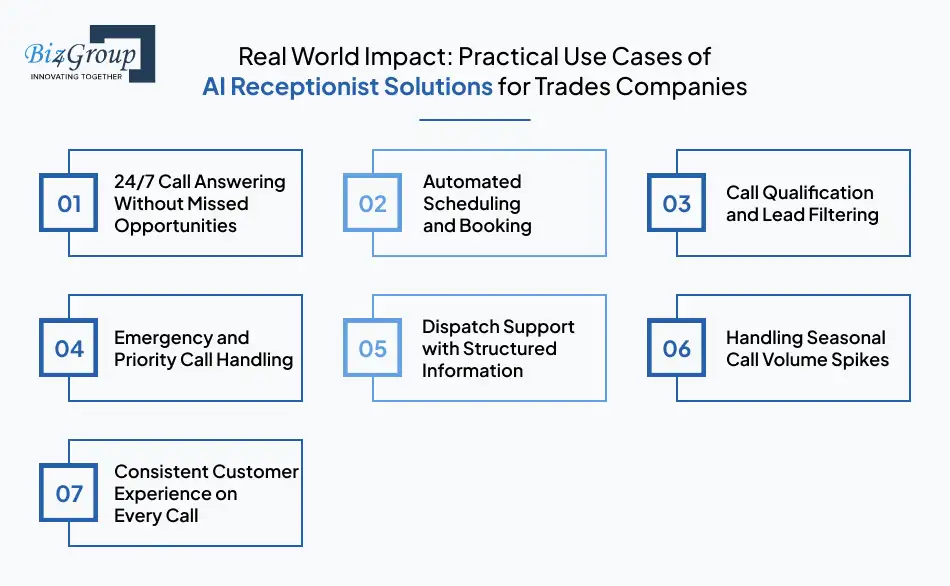
Below are the most common and high impact ways trades businesses use AI receptionists today. Each use case explains what problem it solves, followed by a clear, easy to spot example so you can quickly relate it to your own operation.
1. 24/7 Call Answering Without Missed Opportunities
Trades businesses cannot control when customers call. Jobs come in early mornings, late evenings, and during weekends when teams are unavailable. When you build an AI receptionist for a trades business, every inbound call is answered instantly. The system captures caller details, understands the request, and logs it for action instead of letting it fall into voicemail.
Example:
A customer calls on a Sunday afternoon to request a service. The AI receptionist answers, collects job details, and schedules a follow up for Monday morning without human involvement. This directly supports efforts to make AI receptionist solutions to reduce missed calls in trades.
2. Automated Scheduling and Booking
Manual scheduling creates delays, errors, and unnecessary back and forth between customers and office staff. With AI receptionist development for trades businesses, scheduling rules are built into the system. The AI checks availability confirms service type, and books appointments in real time.
Example:
A caller requests a service visit. The AI offers available time slots, confirms the booking, and sends confirmation details without requiring an office assistant. This is a core benefit of creating AI receptionist systems for trades scheduling and bookings.
3. Call Qualification and Lead Filtering
Not every call is a revenue opportunity. Some are outside your service area or unrelated to your offerings. When you develop automated receptionist tools for trades, the AI qualifies each call before passing it to your team. It asks structured questions to confirm relevance and urgency.
Example:
A caller requests a service your business does not provide. The AI politely informs them and ends the call, saving your team time. This keeps your staff focused on real work instead of sorting through noise.
4. Emergency and Priority Call Handling
Some situations cannot wait. Others can. An AI receptionist can detect urgency based on language and responses, then route the call accordingly. This ensures critical issues get immediate attention.
Example:
A caller reports an urgent situation. The AI recognizes urgency and instantly routes the call to an on-call team member instead of scheduling it later. This is especially important when you build AI virtual receptionist for field service operations where response time matters.
5. Dispatch Support with Structured Information
Dispatch teams often struggle with incomplete or unclear job details. With AI receptionist workflows, every call is converted into structured data before it reaches dispatch. This improves clarity and speeds up internal coordination.
Example:
A dispatcher receives a job request that already includes service type, location, and urgency, allowing faster assignment without follow up calls. Many businesses enhance this further by combining receptionist workflows with broader AI automation services.
6. Handling Seasonal Call Volume Spikes
Seasonal demand can overwhelm front desk teams and lead to lost revenue. When you develop scalable AI receptionist platforms for service businesses, call handling scales automatically with demand. No extra hiring is required.
Example:
During peak season, the AI receptionist handles dozens of simultaneous calls while your team continues working in the field.
7. Consistent Customer Experience on Every Call
Different staff members answer calls differently. That inconsistency affects customer trust. AI receptionists follow the same logic and tone every time, ensuring predictable and professional interactions.
Example:
Every caller hears the same greeting, receives accurate information, and follows a clear process regardless of when they call. This consistency reflects proven results seen with AI chatbot integration in various industries, now applied to voice driven trade operations.
These use cases show why more companies choose to create AI receptionist solutions for trades companies as a core operational layer.
What Actually Matters: Must-Have Features When You Build AI Powered Receptionist for Service Businesses
When you build an AI receptionist for a trades business, features are not technical add-ons. They directly determine whether the system can handle real call volume, real customer expectations, and real operational pressure. A well-designed feature set is the foundation of successful AI receptionist development for trades businesses.
|
Feature |
What This Means for Your Business |
|---|---|
|
24/7 Call Answering |
The AI receptionist answers every inbound call at any time of day, including nights, weekends, and holidays. This ensures customers always reach your business and supports efforts to reduce missed opportunities across trade operations. |
|
Concurrent Call Handling |
Unlike human receptionists, the system can handle multiple calls at once. This is critical when you build virtual receptionist systems for trades that experience call spikes during busy hours or seasonal demand. |
|
Natural Voice Interaction |
Calls feel conversational rather than robotic. This improves trust and keeps callers engaged, which is essential when you build AI powered receptionist for service businesses that rely on phone interactions. |
|
Intent Detection |
The AI identifies why the caller is reaching out, such as booking a service, requesting information, or reporting an urgent issue. This capability is a core part of AI receptionist application development for field service businesses. |
|
Context Awareness |
The system remembers what the caller has already shared and uses that context to guide the conversation forward without repetition, improving efficiency and caller satisfaction. |
|
Adaptive Questioning |
Questions are asked dynamically based on previous answers. This allows businesses to develop automated receptionist tools for trades that gather accurate details without long or confusing calls. |
|
The AI books appointments based on business rules, service type, and availability. This is essential when you create AI receptionist systems for trades scheduling and bookings to reduce manual coordination. |
|
|
Calendar and Tool Sync |
Appointments stay synchronized with internal calendars and systems, helping businesses avoid conflicts while scaling operations with developing scalable AI receptionist platforms for service businesses. |
|
Call Qualification |
Calls are screened based on service relevance, location, and urgency. This allows teams to focus on qualified requests when they create AI receptionist solutions for trades companies. |
|
Urgency Identification |
The system detects high-priority situations early and ensures they are handled immediately. This is critical when you build AI virtual receptionist for field service operations where response time matters. |
|
Smart Routing |
Calls are routed automatically to the right department, technician, or escalation path, reducing internal delays and improving response efficiency. |
|
Human Fallback |
When automation is not appropriate, the AI transfers the call to a human with full context intact. This balance is key in custom AI receptionist development for contractors. |
|
Call Data Capture |
Each interaction is logged with structured data, enabling follow-ups, accountability, and reporting across AI receptionist development for trades businesses. |
|
Operational Insights |
Call trends, booking rates, and missed opportunities are visible through analytics, helping leadership make informed decisions. |
|
Scalability |
Call handling capacity increases as the business grows, allowing companies to scale without adding administrative staff. |
|
Custom Business Logic |
Workflows and responses reflect how your specific trade business operates, not generic templates. This is essential when you develop AI receptionist software for trade operations. |
|
Consistent Customer Experience |
Every caller receives the same professional tone, accurate information, and clear next steps, reinforcing trust and brand reliability. |
|
Data Security |
Customer data and call records are protected, supporting compliance and trust expectations for US-based service businesses. |
To implement these features effectively, both conversation quality and experience design matter. Teams experienced in AI chatbot development company focus on building natural, goal-driven conversations, while strong UI/UX design ensures callers always understand what is happening and what comes next.
Do These Features Match How Your Trades Business Actually Works?
If your answer is “mostly,” that is a sign you should not settle for generic tools. The right setup tailors features like scheduling, routing, and call qualification to your real workflows.
Build a Feature-Ready AI ReceptionistFrom Idea to Implementation: Steps to Develop an AI Receptionist for Trades Businesses
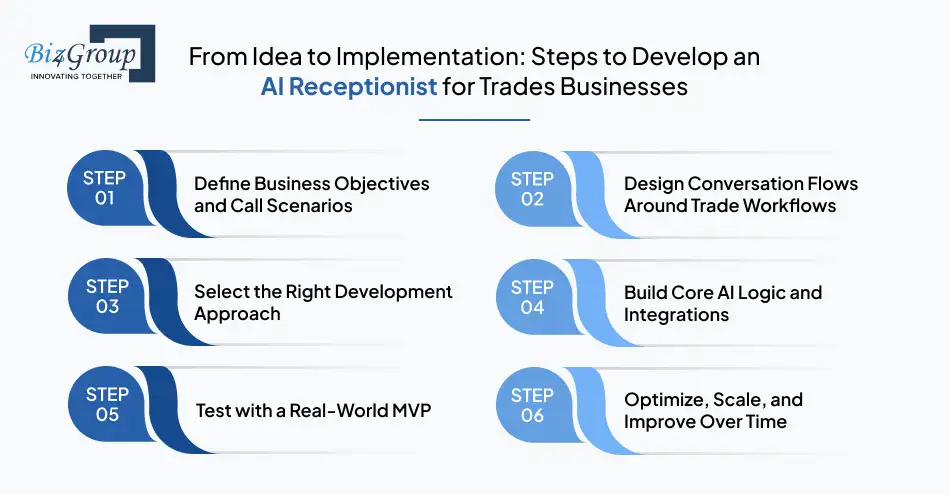
Building an AI receptionist is not a single development task. It is a structured process that balances business needs, customer experience, and technical execution. When done right, this approach helps you develop AI receptionist software for trades companies that actually reduces missed calls and supports daily operations.
Below is a proven step-by-step process used in AI receptionist development for trades businesses.
Step 1: Define Business Objectives and Call Scenarios
Before any development starts, you need clarity on what the AI receptionist should accomplish. Trades businesses receive different types of calls, and not all of them should be handled the same way. This step ensures you are building a system aligned with real operational needs, not assumptions.
Key actions:
- Identify common call reasons and outcomes
- Decide which calls should be automated or escalated
- Define success metrics like booking rate or call resolution
Step 2: Design Conversation Flows Around Trade Workflows
Once goals are clear, the next step is designing how conversations should flow. This is where customer experience and business logic meet. For AI receptionist application development for field service businesses, conversation design determines whether callers feel helped or frustrated.
Key actions:
- Map conversation paths for booking, inquiries, and urgent calls
- Define follow-up questions based on caller intent
- Plan human handoff scenarios to avoid over-automation
Step 3: Select the Right Development Approach
At this stage, you decide how the system will be built. This includes choosing between custom development, platform customization, or a hybrid approach. Many trades businesses work with an experienced AI app development company to balance flexibility with faster delivery.
Key actions:
- Evaluate customization vs speed trade-offs
- Assess integration requirements with existing systems
- Plan for long-term scalability
Step 4: Build Core AI Logic and Integrations
This is where development becomes tangible. Voice handling, intent recognition, scheduling logic, and routing rules are implemented and connected to internal tools. This step is critical in trades business AI receptionist software development, as poor integration often leads to system failure.
Key actions:
- Implement voice and language understanding models
- Integrate calendars, CRMs, or dispatch systems
- Configure routing and escalation logic
Step 5: Test with a Real-World MVP
Before a full rollout, the system should be tested with real calls. This reduces risk and reveals gaps that planning alone cannot catch. Many teams follow an iterative MVP development approach to validate performance quickly.
Key actions:
- Test intent detection accuracy
- Validate conversation flow clarity
- Confirm scheduling and routing reliability
Step 6: Optimize, Scale, and Improve Over Time
After launch, continuous improvement begins. Real call data provides insight into where the system performs well and where it needs refinement. This ongoing process is essential when you develop scalable AI receptionist platforms for service businesses that grow with demand.
Key actions:
- Analyze call outcomes and drop-offs
- Refine conversation logic and responses
- Scale capacity as call volume increases
Following these steps helps you build AI powered receptionist for service businesses that are reliable, flexible, and aligned with how trades businesses actually operate.
Behind the Scenes: Tech Stack Required to Build Virtual Receptionist Systems for Trades
When you build an AI receptionist for a trades business, the technology stack needs to support three things at the same time: natural conversations, reliable actions, and long-term scalability. This is not a single tool setup. It is a layered system where each part plays a specific role.
|
Layer |
Tools / Technologies |
Description |
|---|---|---|
|
Frontend (Admin & Control Layer) |
React, Next.js, Vue |
Used to build dashboards where teams manage call logs, configure conversation flows, review analytics, and monitor performance. While not caller-facing, this layer is essential for controlling AI receptionist development for trades businesses. |
|
Voice Interface Layer |
Telephony APIs, Voice gateways |
Handles inbound and outbound calls, greetings, transfers, and concurrent call handling so customers can interact naturally with the AI receptionist. |
|
Speech Processing Layer |
Speech-to-Text, Text-to-Speech engines |
Converts spoken language into text and AI responses back into voice, enabling natural conversations even in noisy, real-world trade environments. |
|
Conversation Intelligence Layer |
NLP models, intent classifiers |
Understands caller intent, urgency, and context instead of relying on rigid scripts. This layer is central to AI receptionist application development for field service businesses. |
|
Conversation Flow Engine |
Dialog managers, state machines |
Controls how conversations progress, which questions are asked, and how responses adapt based on caller input. |
|
Backend (Core Business Logic) |
Implements trade-specific rules such as service eligibility, escalation logic, and scheduling constraints. This layer enables custom AI receptionist development for contractors. |
|
|
Scheduling & Booking Layer |
Calendar APIs, booking engines |
Manages real-time availability, appointment booking, confirmations, and rescheduling when you create AI receptionist systems for trades scheduling and bookings. |
|
Automation & Decision Layer |
Rule engines, AI decision services |
Executes actions like booking jobs, routing calls, and escalating urgent requests, building AI virtual receptionist for field service operations. |
|
Integration Layer |
APIs, middleware, connectors |
Connects the AI receptionist with CRMs, dispatch tools, and internal systems. This layer often depends on specialized AI integration services to ensure reliable data flow. |
|
Data & Analytics Layer |
Databases, reporting tools |
Stores call transcripts, outcomes, and performance metrics that help teams optimize workflows and improve results. |
|
Cloud Infrastructure |
Cloud hosting, load balancers |
Provides scalability and uptime so businesses can develop scalable AI receptionist platforms for service businesses without infrastructure bottlenecks. |
|
Security & Compliance Layer |
Authentication, encryption, access control |
Protects customer data, call recordings, and system access, which is critical for trust and compliance. |
|
Enterprise Readiness Layer |
Monitoring, logging, failover systems |
Ensures reliability, observability, and governance as the AI receptionist becomes a core operational system, often aligned with enterprise AI solutions. |
This layered stack supports every requirement of AI receptionist development for trades businesses, from handling high call volumes to integrating with existing operations. It allows companies to build AI powered receptionist for service businesses that are reliable today and flexible enough to scale tomorrow.
Also Read: React JS Development Services
What Will It Cost: AI Receptionist Development Cost Breakdown for Trades Businesses
Before getting into the details, let’s address the question every decision-maker asks first.
If you are planning to build an AI receptionist for a trades business, the estimated cost typically ranges from $20,000 to $150,000+. That range exists for a reason. Cost varies widely based on feature depth, integrations, scalability needs, and whether you are building a basic system or a fully custom, enterprise-ready solution.
Think of this less as a fixed price and more as an investment range that depends on how far you want the system to go.
Feature-Wise Cost Breakdown for AI Receptionist Development for Trades Businesses
Below is a practical breakdown showing how costs usually stack up when you develop AI receptionist software for trade operations.
|
Feature Area |
What’s Included |
Estimated Cost Range |
|---|---|---|
|
Call Answering and Voice Handling |
Telephony setup, inbound and outbound call handling, concurrent calls, basic call routing, greetings, and transfers. This forms the foundation when you build an AI receptionist for a trades business. |
$5,000 – $15,000 |
|
Speech Recognition and Intent Detection |
Speech-to-text processing, natural language understanding, intent classification, and urgency detection tuned for trade-specific conversations. A core part of AI receptionist application development for field service businesses. |
$5,000 – $20,000 |
|
Conversation Flow and Logic Design |
Designing natural conversation paths, follow-up questioning, fallback handling, and escalation logic so callers are guided smoothly. |
$5,000 – $25,000 |
|
Scheduling and Booking System |
Real-time availability checks, appointment booking, confirmations, rescheduling, and rule-based constraints. Essential when you create AI receptionist systems for trades scheduling and bookings. |
$5,000 – $20,000 |
|
CRM and Operational Integrations |
Integration with CRMs, dispatch tools, job management systems, and internal workflows. One of the biggest cost drivers in trades business AI receptionist software development. |
$5,000 – $30,000 |
|
Analytics and Reporting |
Call logs, dashboards, booking metrics, conversion tracking, and performance insights used to optimize operations. |
$3,000 – $10,000 |
|
Scalability, Security, and Enterprise Readiness |
Load handling, cloud scaling, monitoring, failover, access control, and data protection. Required when you develop scalable AI receptionist platforms for service businesses. |
$5,000 – $30,000+ |
Key Factors That Affect AI Receptionist Development Cost for Trades Businesses
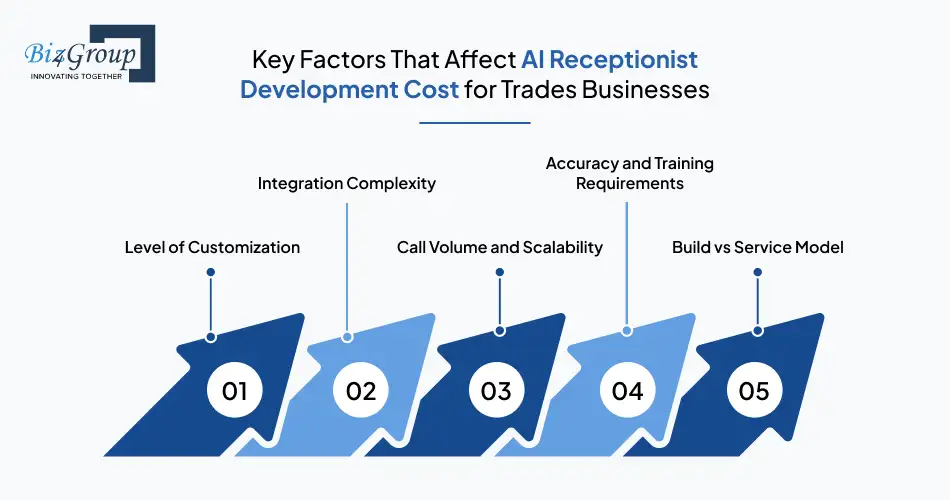
Several variables influence where your project falls within the $20,000 to $150,000+ range.
1. Level of Customization
A generic setup costs far less than custom AI receptionist development for contractors with trade-specific workflows, rules, and escalation logic.
2. Integration Complexity
The more internal systems you need to connect, the higher the cost. Deep integrations are often the biggest driver in trades business AI receptionist software development.
3. Call Volume and Scalability
Systems built to handle a few calls per hour cost less than those designed to scale across regions or peak seasons.
4. Accuracy and Training Requirements
Better intent recognition and fewer errors require more training data and tuning, which increases cost but improves long-term ROI.
5. Build vs Service Model
Some businesses reduce upfront cost by using AI as a Service (AIaaS), while others invest more upfront for full ownership and customization.
Hidden Costs to Watch Out for When You Build AI Powered Receptionist for Service Businesses
Many cost overruns come from areas businesses do not plan for early.
- Ongoing speech-to-text and telephony usage fees
- Cloud infrastructure and hosting costs
- Model retraining and conversation updates
- Maintenance and monitoring after launch
- Scaling costs during high call volume periods
Ignoring these can make an initially affordable build far more expensive over time.
Cost Optimization Strategies for AI Receptionist Development for Trades Businesses
You do not have to choose between quality and budget. Smart planning keeps costs under control.
- Start with a Focused Scope: Build only the features that solve immediate problems first. Advanced capabilities can be added later.
- Validate with a Phased Rollout: Launching a smaller version helps you test real-world performance before scaling.
- Choose the Right Team Model: Some companies' lower costs by working with experienced partners or by choosing to hire AI developers instead of building a large in-house team.
- Design for Reuse and Scalability: Reusable conversation logic and modular integrations reduce future development expenses.
The cost to build an AI receptionist for a trades business depends on how critical the system is to your operations. A basic receptionist may sit closer to $20,000, while a fully customized, scalable solution can exceed $150,000.
What matters most is aligning cost with business impact.
Wondering Where You Fit in the $20K to $150K+ Range?
The cost to develop AI receptionist software for trades depends on customization, integrations, and scale. A quick discussion can clarify what you actually need and what you can skip.
Get a Cost Breakdown for Your BusinessWhat Can Go Wrong: Challenges in AI Receptionist Software Development for Trades Businesses and How to Solve Them
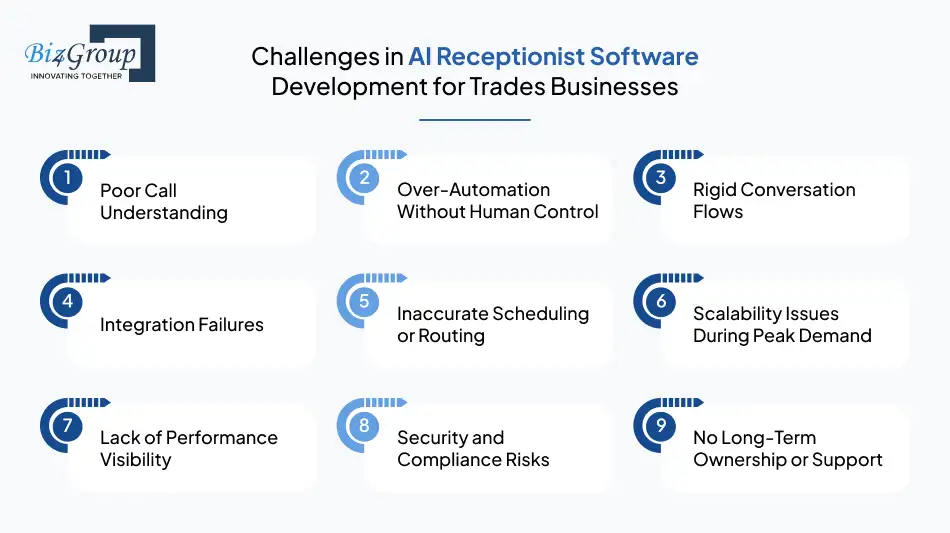
Building an AI receptionist is straightforward on paper. Making it work reliably in real trade environments is where most businesses struggle.
Below are the most common challenges companies face when they build an AI receptionist for a trades business, along with practical ways to address them before they impact operations, customer experience, or ROI.
|
Challenge |
Why It Happens |
How to Solve It |
|---|---|---|
|
Poor Call Understanding |
Generic models struggle with trade-specific language, varied phrasing, and noisy call environments. This leads to incorrect responses and frustrated callers. |
Use trade-focused training data and iterative tuning as part of AI receptionist development for trades businesses to improve accuracy over time. |
|
Over-Automation Without Human Control |
Systems are designed to automate everything, even when a human should step in, damaging trust and customer experience. |
Build escalation logic using agentic AI development principles so the AI knows when to act independently and when to defer to humans. |
|
Rigid Conversation Flows |
Static scripts fail when callers phrase requests differently or change direction mid-call. |
Design flexible conversation logic that adapts dynamically, which is essential when you build AI-powered receptionist for service businesses. |
|
Integration Failures |
Poorly planned integrations cause data gaps between the receptionist, scheduling tools, and internal systems. |
Prioritize integration planning early when you develop AI receptionist software for trade operations, especially CRMs and dispatch tools. |
|
Inaccurate Scheduling or Routing |
Weak business rules or missing constraints result in wrong bookings or misrouted calls. |
Implement rule-based logic tied to real operational workflows during custom AI receptionist development for contractors. |
|
Scalability Issues During Peak Demand |
Systems are tested only at low volume and fail during seasonal or regional call spikes. |
Design infrastructure to support growth when you develop scalable AI receptionist platforms for service businesses. |
|
Lack of Performance Visibility |
Without analytics, teams cannot see what is working or where calls are being lost. |
Include reporting and dashboards as a core part of trades business AI receptionist software development. |
|
Security and Compliance Risks |
Call recordings and customer data are not adequately protected. |
Apply strong access control, encryption, and monitoring from day one. |
|
No Long-Term Ownership or Support |
Businesses rely on fragmented teams or short-term vendors, leading to stalled improvements. |
Work with or plan for hiring a dedicated AI development team to ensure continuous optimization and support. |
Why Is Biz4Group LLC the Right Choice to Build an AI Receptionist for a Trades Business?
Choosing the right partner to build an AI receptionist for a trades business is not just a technical decision. It directly impacts how reliably your calls are handled, how smoothly your operations run, and how well the system scales as your business grows.
This is where Biz4Group LLC brings a clear advantage.
Proven Track Record in AI Receptionist Development for Trades Businesses
Biz4Group LLC has extensive experience delivering AI receptionist development for trades businesses that operate in real, high-pressure environments. Their work goes beyond prototypes and demos, focusing instead on systems that handle live calls, complex workflows, and real customer expectations.
As an established AI development company, Biz4Group has built AI-driven solutions that combine conversational intelligence, automation, and business logic into production-ready platforms.
Custom-First Approach for Trade Operations
Trades businesses do not follow identical workflows, which is why off-the-shelf solutions often fall short. Biz4Group approaches projects with a custom mindset, aligning every system to the client’s operational reality.
Their strength as a custom software development company allows them to:
- Design trade-specific call flows and escalation logic
- Build flexible scheduling and routing systems
- Support custom AI receptionist development for contractors with unique service models
This approach is critical when you develop AI receptionist software for trade operations that must adapt over time.
Strong Capabilities Across the Full AI Product Lifecycle
Building an AI receptionist is not a one-phase effort. It requires planning, development, testing, and long-term optimization. Biz4Group LLC supports the full lifecycle through its expertise as an AI product development company.
This ensures trades businesses can:
- Launch with confidence
- Iterate based on real call data
- Expand features without rebuilding from scratch
Skilled Teams and Long-Term Support
Successful trades business AI receptionist software development depends heavily on the team behind it. Biz4Group offers flexible engagement models, including options to hire AI developers who specialize in conversational AI, integrations, and scalable backend systems.
This ensures continuity, ownership, and consistent improvement after launch.
Why This Matters for Trades Businesses
When you work with a partner that understands both AI and service-driven operations, the outcome is not just automation. It is a dependable front-desk layer that reduces missed calls, improves response times, and fits naturally into daily workflows.
That is why businesses looking to create AI receptionist solutions for trades companies often prioritize partners like Biz4Group LLC, who focus on execution quality, scalability, and real-world performance.
Want an AI Receptionist That Works Beyond the Demo?
Choosing the right partner decides whether your AI receptionist becomes an asset or a headache. Biz4Group LLC builds production-ready AI receptionist solutions designed for real trade operations.
Contact Biz4Group to Get StartedFinal Thoughts!
Trades businesses do not lose work because they lack skill. They lose work because calls go unanswered; details get missed, or follow-ups fall through the cracks.
That is exactly why more leaders are choosing to build an AI receptionist for a trades business rather than stretching office staff or relying on outdated call handling setups. When designed correctly, an AI receptionist becomes a reliable front-desk layer that answers every call, captures the right information, and keeps operations moving without adding overhead.
Throughout this guide, we covered what an AI receptionist really is, how it works, where it delivers value, what it costs, and how to avoid common pitfalls. The takeaway is simple. AI receptionist development for trades businesses is no longer experimental. It is a practical, scalable solution for businesses that want to grow without chaos.
This is where execution matters.
With deep experience in AI-driven systems, custom software, and enterprise-grade platforms, Biz4Group LLC brings the technical depth and operational understanding required to deliver AI receptionist solutions that actually work in real-world trade environments. Not demos. Not concepts. Systems that perform under real call volume and real customer expectations.
If you are serious about reducing missed calls, improving response times, and building a front desk that scales with your business, the next step is not guessing. It is building it right.
And if your phone could talk back intelligently tomorrow, how many opportunities would you stop losing today?
FAQ
1. What does it mean to build an AI receptionist for a trades business?
To build an AI receptionist for a trades business means developing a voice-driven system that answers calls, understands customer intent, captures service details, schedules appointments, and routes requests automatically. Unlike basic virtual receptionists, this approach focuses on AI receptionist development for trades businesses where call volume, urgency, and scheduling accuracy directly affect revenue and customer satisfaction.
2. How much does it cost to develop AI receptionist software for trades companies?
The cost to develop AI receptionist software for trades companies typically ranges from $20,000 to $150,000 or more. A basic AI receptionist that handles call answering and simple scheduling may fall closer to the lower end. Advanced solutions with custom workflows, CRM integration, analytics, and scalability features push costs higher. The final cost depends on feature depth, integrations, call volume, and whether you build a custom or hybrid solution.
3. Can AI receptionist solutions integrate with existing trade business systems?
Yes. Modern trades business AI receptionist software development includes integration with scheduling tools, CRMs, dispatch systems, and internal workflows. These integrations allow the AI receptionist to check availability, book appointments, log calls, and pass structured information to your team. Integration capability is critical when you develop AI receptionist software for trade operations that rely on accurate data flow.
4. Do AI receptionist solutions really reduce missed calls in trades businesses?
Yes. One of the biggest reasons companies build AI receptionist solutions to reduce missed calls in trades is 24 by 7 availability. The AI answers every call instantly, including after hours and during peak demand, ensuring customer inquiries are captured and followed up. This leads to higher booking rates and fewer lost opportunities.
5. Will an AI receptionist replace office or front desk staff?
In most cases, no. AI receptionist development for trades businesses is designed to support teams, not replace them. The AI handles repetitive tasks like call answering, qualification, and scheduling, while complex or sensitive calls are escalated to humans. This balance improves efficiency without removing human oversight.
6. How long does it take to build an AI powered receptionist for service businesses?
Timelines vary based on complexity, but most projects to build AI powered receptionist for service businesses take between 8 and 20 weeks. Simpler implementations with limited integrations are faster, while custom AI receptionist development for contractors with complex workflows and scaling requirements takes longer. A phased or MVP approach can shorten initial launch time.
7. How do I choose the best AI development company to develop AI receptionist for trades business?
The best AI development company to develop AI receptionist for trades business is one that understands both conversational AI and real trade operations. Look for experience in AI receptionist application development for field service businesses, strong integration capabilities, and long-term support. Avoid vendors that rely only on templates and focus instead on teams that offer custom, scalable solutions aligned with how your business actually works.
