 Location :
Orlando, FL, USA
Location :
Orlando, FL, USA +1 (407) 714-1616
 info@biz4group.com
- AI driven veterinary clinical management software improves efficiency, accuracy, and workflow automation across modern veterinary clinics.
- Successful development starts with clear requirements, strong data planning, and an MVP, then expands into advanced AI features.
- Real use cases include AI powered diagnostics, automated reminders, smart scheduling, inventory forecasting, and multi-location consistency.
- Costs to develop AI veterinary clinical management software typically range from $20,000 to $150,000 and above, depending on scope.
- Partnering with Biz4Group helps you create veterinary practice management software with AI that is scalable, intuitive, and ready for long term growth.
Have you felt your clinic getting busier every month? More appointments, more paperwork, more tired staff, and somehow the same number of hours in a day. Most veterinary leaders we talk to share the same worry. If your team spends half the day updating records and chasing scheduling gaps, how long can that pace hold?
A major shift is already happening around you. In 2025, about 94 million U.S. households own a pet, which accounts for nearly 71 percent of all households.
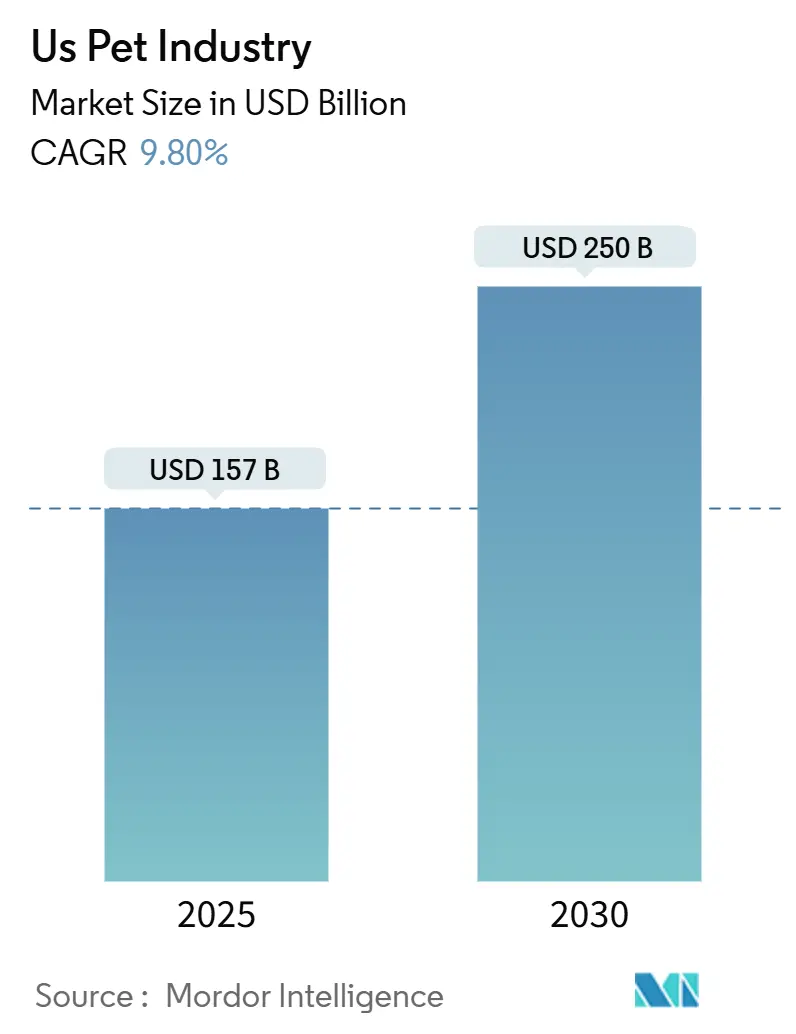
Total spending on pet care and services in the United States is projected to reach USD 157 billion in 2025, which signals rapid growth and higher expectations from pet owners.
So here is the real question. Can your clinic or your entire organization keep up without smarter tools? Or is it time to consider how developing AI driven veterinary clinical management software can lighten the heavy workload your team carries every day?
Some of the most forward-thinking veterinary networks are already partnering with a top software development company in USA to modernize the way their practices run. They want systems that handle repetitive tasks, keep medical records organized, support clinical decisions, and simplify the chaos without overwhelming the staff. When technology steps in at the right moments, your team gets more time to focus on actual patient care.
Throughout this guide, we walk beside you as you explore how to develop AI veterinary clinical management software, AI veterinary clinical management software development, and related capabilities can reshape the way your clinics operate. If you have ever wondered how much calmer and more efficient your days could feel with the right platform in place, you are in the perfect spot.
Ready to see why this shift is gaining momentum across the veterinary world? Let’s dive in.
Ready to build software that works as smart as your clinic
Pet care is evolving fast and 72% of clinics are planning AI adoption by 2025 (source: AVMA). Staying ahead matters, and choosing to develop AI veterinary clinical management software helps you get there before your competitors do.
Contact UsWhat AI Driven Veterinary Clinical Management Software Really Means and Why It Matters to Today's Fast Growing Vet Brands?
If you have ever wished your clinic systems worked together instead of feeling like separate islands, this is where AI driven veterinary clinical management software comes in. It brings scheduling, records, diagnostics, communication, inventory, billing, and reporting into one connected platform. On top of that, it adds intelligent support that helps your team work faster without carrying every task on their own.
When clinics choose to develop AI veterinary clinical management software, they are building a system that organizes information automatically, reduces repeated steps, and keeps patient data clear and accessible. Many organizations also want cleaner and smarter records, which is why they add features to develop AI animal health record system capabilities that make medical histories easier to manage.
You will often see fast growing veterinary companies partner with an AI development company to build a platform that stays reliable even as patient volume increases or new locations open. They want technology that levels their entire operation, not just one part of it.
Tools like an AI automation system for clinics fit right into this model by handling everyday tasks like reminders, inventory checks, and data entry so your staff can focus more on patient care.
Why this matters for modern veterinary brands
- Your team spends less time on repetitive admin work and more time on patient needs
- Information becomes easier to find, understand, and act on
- Workflows become smoother, especially during peak hours
- Multi location practices gain consistency across every site
- Staff experience less burnout because the software carries part of the load
- Insights from past cases and diagnostics become easier to use in real time
In simple terms, AI veterinary clinical management software development creates a smarter, more supportive environment for your clinic. It helps your team move with more confidence and gives you the structure you need to grow without adding unnecessary stress.
Next, let us look at how this type of system actually works behind the scenes.
How AI Veterinary Clinical Management Software Works Behind the Screens
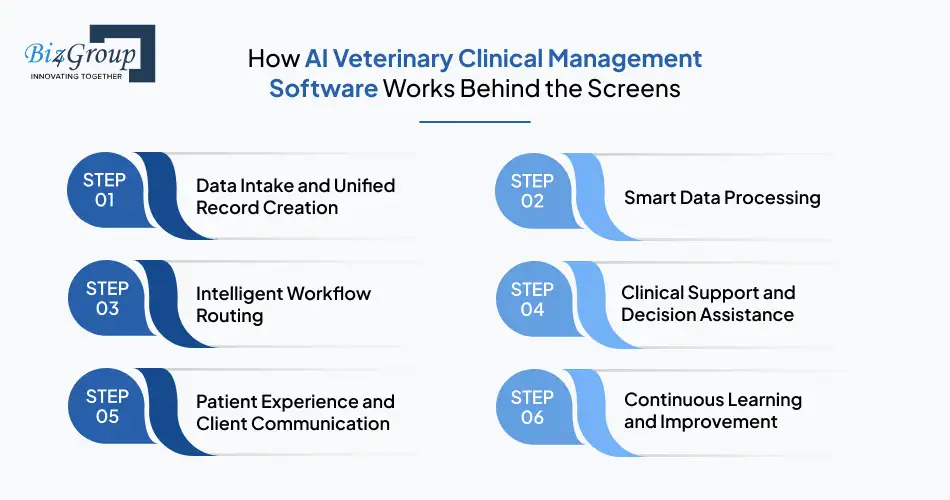
If you have ever wondered what actually happens inside an intelligent clinical platform, here is a simple way to picture it. Think of the system as a chain of connected steps, each helping your team move faster without extra effort. This is the foundation of veterinary clinical management software development with AI, and it helps clinics run with greater clarity and fewer interruptions.
Step 1. Data Intake and Unified Record Creation
Everything begins with clean, structured data. Your system collects information from multiple sources in one place, so nothing gets lost.
- Appointment schedules
- Patient medical history
- Lab and diagnostic results
- Imaging data
- Past treatments and prescriptions
Many organizations choose to develop AI animal health record system features to keep every detail accurate and easy to retrieve. This step also sets the foundation if you plan to create veterinary practice management software with AI.
Step 2. Smart Data Processing
Once data enters the platform, it is automatically organized. This replaces hours of manual sorting your staff deals with today.
- Duplicate entries are removed
- Missing data fields are flagged
- Notes are grouped logically
- Diagnostic results are matched correctly
- Long histories are made searchable
This stage relies heavily on strong AI integration services so the system can communicate with lab equipment, imaging devices, pharmacy tools, and third-party apps involved in AI veterinary software development services.
Step 3. Intelligent Workflow Routing
After the system understands the data, it routes tasks to the right place. This makes your daily operations feel smoother and more predictable.
- Appointment reminders go out automatically
- Follow up lists are created for your staff
- Inventory alerts trigger when stock is low
- Billing steps are prepared instantly
- Diagnostic data is forwarded to the right clinician
Many clinics benefit from an AI agent during this stage because it handles repetitive tasks that usually slow down your team. This is the core of how you make veterinary management software using AI that actually reduces workload.
Step 4. Clinical Support and Decision Assistance
This is where intelligence starts supporting your clinicians directly. The system turns raw data into useful insights so your team can act confidently.
- Long patient histories are summarized
- Concerning symptoms are highlighted
- Patterns from similar cases are surfaced
- Diagnostic clues are organized clearly
- Medication and treatment suggestions appear
- Imaging and lab data becomes easier to compare
These capabilities are essential when you create AI software for veterinary diagnostics or build AI driven veterinary clinic software that helps teams make informed decisions without losing time.
Step 5. Patient Experience and Client Communication
Now the software supports your communication with pet owners.
Clients receive updates without your staff sending dozens of manual messages.
- Visit summaries
- Medication instructions
- Next appointment reminders
- Follow up requests
- Status updates
- Telehealth communication
This step is especially valuable if you want to build AI based pet clinic appointment system tools that improve responsiveness and reduce no shows.
Step 6. Continuous Learning and Improvement
Every interaction helps the platform get smarter over time.
This is a major advantage of developing AI-driven veterinary clinical management software.
- Appointment patterns become easier to predict
- Inventory forecasting becomes more accurate
- Common diagnostics become easier to identify
- Treatment suggestions refine with more cases
- Communication timing becomes more precise
For clinics planning long term scalability, this creates a dependable operational foundation.
Real Clinic Use Cases That Prove Why Companies Want to Create Veterinary Practice Management Software with AI
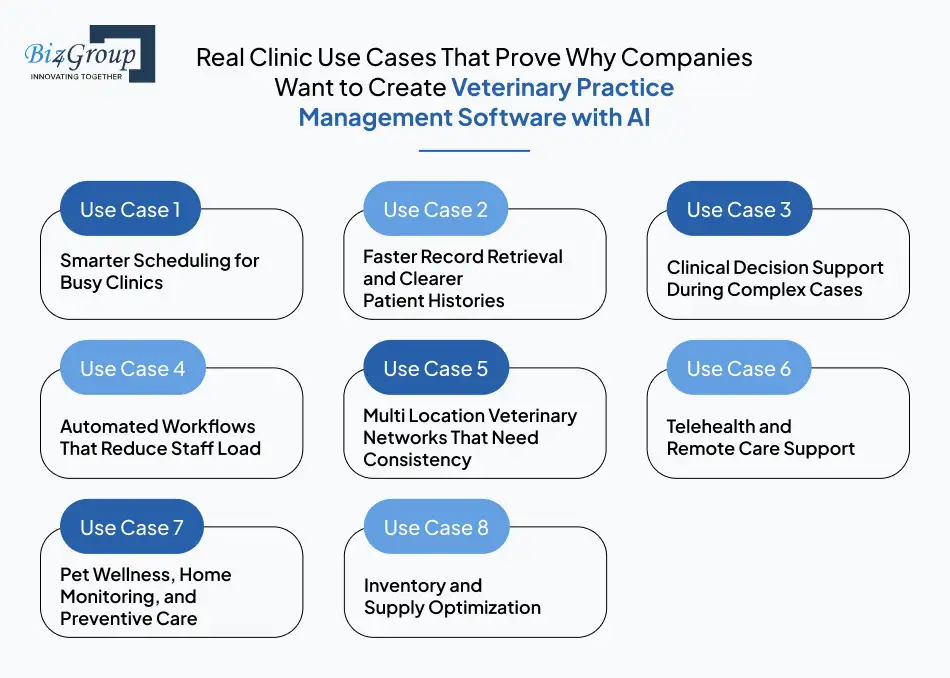
When you think about creating veterinary practice management software with AI, the first question that usually comes up is simple. What does this actually look like in real clinics? To make this clear, here are practical use cases explained with examples your readers can easily relate to. Each one shows how AI driven veterinary clinical management software supports daily tasks, improves patient care, and reduces the stress that slows teams down.
Use Case 1. Smarter Scheduling for Busy Clinics
Busy practices often deal with back-to-back appointments, last-minute cancellations, and clients who forget their visits. When your team tries to manage this manually, the schedule becomes chaotic.
How AI helps
- Identifies the best time slots based on case type and staff availability
- Reduces no shows through automated reminders
- Predicts visit length to prevent bottlenecks
- Balances urgent care without disrupting the day
Simple example
A general veterinary clinic in Austin sees a surge in appointments every Monday and Friday. AI analyzes past scheduling patterns, predicts peak hours, and adjusts staffing recommendations. It also sends follow-up reminders that reduce missed appointments. This is the kind of foundation clinic to build when they work toward an AI based pet clinic appointment system.
Use Case 2. Faster Record Retrieval and Clearer Patient Histories
Clinicians often lose time searching through long medical histories to find one detail. When records are scattered, the challenge grows.
How AI helps
- Summarizes long histories
- Flags critical notes
- Highlights recurring issues
- Groups information neatly
Simple example
A patient comes in with chronic skin problems. Instead of scrolling through pages of records, the clinician opens a smart summary created by the system. It highlights the first appearance of symptoms, previous treatments, and diagnostic steps already taken. This is why many clinics choose to develop AI animal health record system features.
Use Case 3. Clinical Decision Support During Complex Cases
Complex cases require comparing data from different sources. This can slow decisions down.
How AI helps
- Surfaces relevant diagnostic clues
- Highlights abnormal lab values
- Compares imaging data
- Organizes patterns from past cases
Simple example
A dog arrives showing signs like fatigue and weight loss. The clinician enters the symptoms, and the system highlights potential concerns like thyroid issues. It displays abnormal lab values, past case comparisons, and treatment insights. These capabilities are what you need when you create AI software for veterinary diagnostics.
Use Case 4. Automated Workflows That Reduce Staff Load
Your team often handles dozens of repetitive tasks that take attention away from patient care.
How AI helps
- Sends automated reminders
- Prepares billing steps
- Sorts lab results
- Updates inventory
- Routes tasks to the right staff member
Simple example
A clinic in Denver receives daily lab results. Instead of manually sorting them, the system automatically attaches each result to the correct patient's record and alerts the clinician. This is how you make veterinary management software using AI that truly lightens staff workload.
Use Case 5. Multi Location Veterinary Networks That Need Consistency
As organizations grow, keeping every location aligned becomes harder.
How AI helps
- Standardizes workflows
- Shares data between sites
- Unifies patient care processes
- Tracks real time performance
Simple example
A veterinary chain with multiple California locations notices varying follow up processes. Once they adopt AI, every site sends the same automated reminders and follows instructions, creating consistent patient experiences. This is one of the main reasons larger brands develop AI veterinary clinical management software instead of relying on outdated tools.
Use Case 6. Telehealth and Remote Care Support
Many providers offer virtual consultations, but reliable tools are required to make them smooth.
How AI helps
- Summarizes patient history instantly
- Supports real time decision making
- Organizes teleconsultation notes
- Automates follow up instructions
Simple example
A pet owner books a virtual visit for a cat with digestive issues. The system presents a quick summary of past visits, dietary notes, and diagnostic results so the clinician can make fast, accurate decisions. This type of support fits perfectly with growing trends like AI virtual pet app experiences that connect pet owners and clinics seamlessly.
Use Case 7. Pet Wellness, Home Monitoring, and Preventive Care
More pet owners use smart tools to monitor diet, activity, and behavior at home.
How AI helps
- Tracks daily wellness patterns
- Alerts clinics of concerning trends
- Integrates home monitoring data
- Supports preventive care plans
Simple example
A dog wearing a smart collar shows a gradual drop-in activity. The system alerts the clinic and combines this with recent appetite notes from an AI pet care app. The clinician notices a pattern and recommends an early checkup before symptoms worsen.
Use Case 8. Inventory and Supply Optimization
Running out of supplies interrupts care. Overstock wastes money.
How AI helps
- Predicts supply usage
- Alerts staff before stockouts
- Tracks seasonal demand
- Prevents over ordering
Simple example
A clinic sees many allergy cases each spring. The system predicts increased medication use and prompts the team to reorder in advance. This aligns with the larger goal of AI driven veterinary clinical management software to keep operations steady and predictable.
Want these AI powered results inside your clinic
If you see your daily challenges in these examples, it might be time to create veterinary practice management software with AI that finally works the way your team needs.
Let's TalkThe Most Valuable Features to Include When You Invest in AI Veterinary Software Development Services
Choosing the right features is one of the most important steps when you develop AI veterinary clinical management software. Your platform will only perform as well as the tools it includes, so this section focuses on the features that make a real difference in daily clinic operations. The goal is simple. You want a system that cuts manual work, gives clinicians instant clarity, supports smooth communication, and keeps your entire workflow organized from end to end. The table below breaks down the essential capabilities and shows exactly how each one improves real life clinical efficiency.
|
Feature Category |
What It Includes |
Why It Matters |
Example in Daily Clinic Life |
|---|---|---|---|
|
Intelligent scheduling, automated reminders, predicted visit duration |
Reduces bottlenecks and lowers no shows |
The system suggests appointment slots based on pet condition and clinician availability to support a build AI based pet clinic appointment system |
|
|
AI Powered Medical Records and Summaries |
Summarized histories, flagged critical notes, structured SOAP notes |
Helps clinicians work faster and avoid missed details |
A long medical record becomes a clean summary when using develop AI animal health record system capabilities |
|
Diagnostic Support and Clinical Intelligence |
Symptom analysis, flagged abnormalities, pattern recognition |
Supports clinicians during complex cases |
AI highlights unusual lab values and surfaces similar past cases to help create AI software for veterinary diagnostics |
|
Automated Administrative Workflows |
Auto follow ups, billing drafts, lab sorting, task routing |
Reduces repetitive tasks and prevents workflow delays |
A batch of lab results is automatically routed to the correct patient file using AI automation services |
|
Client Messaging and Virtual Assistants |
Automated replies, triage support, appointment confirmations |
Improves communication and reduces front desk load |
A conversational assistant built by an AI chatbot development company handle's routine client questions |
|
Pet Owner Portals and Engagement Tools |
Visit summaries, vaccine reminders, telehealth support |
Builds trust and increases client satisfaction |
Pet owners view treatment plans and updates without calling the clinic |
|
Inventory and Supply Optimization |
Stock tracking, demand forecasting, reorder alerts |
Prevents shortages and avoids waste |
Allergy season inventory gets stocked at the right time through predictive insights |
|
Workflow Coordination for Multi Location Practices |
Synchronized SOPs, unified reminders, shared performance dashboards |
Ensures consistent care across all locations |
A multi-site network uses one standardized follow up workflow |
|
Role Based Dashboards |
Technician dashboard, doctor dashboard, manager analytics |
Gives each team member exactly what they need |
Technicians see tasks and vitals while managers review KPIs |
|
Intelligent Task Management |
Automated assignments, workflow logic, micro action handling |
Keeps daily operations moving smoothly |
Small routine tasks are handled by an intelligent assistant created through agentic AI development |
|
Telehealth and Remote Care Tools |
Virtual visit support, messaging, record access |
Expands care beyond the clinic |
A vet reviews summarized history before a virtual consult |
|
Scalable Integrations and Data Handling |
Third party integrations, cloud scaling, mobile optimization |
Let's clinics grow without switching systems |
Smooth integration during AI veterinary clinical management software development keeps all tools connected |
|
Payment and Billing Automation |
Auto invoice creation, payment reminders, smart bundling |
Improves revenue flow and reduces manual entry |
Bills are generated instantly after a visit |
|
Customizable UI and User Experience |
Personalized workflows, simplified navigation |
Helps clinics tailor the software to their daily routines |
Teams adjust dashboards to match their own workflow preferences |
When these features work in one connected system, your clinic gains a platform that feels organized, intuitive, and supportive of real growth. This is the kind of foundation you aim for when you develop AI veterinary clinical management software built around your team’s actual workflow. Now that the feature set is clear, let us walk through how to successfully build and launch a platform that fits your clinic’s goals.
How to Successfully Develop and Launch AI Driven Veterinary Clinical Software?
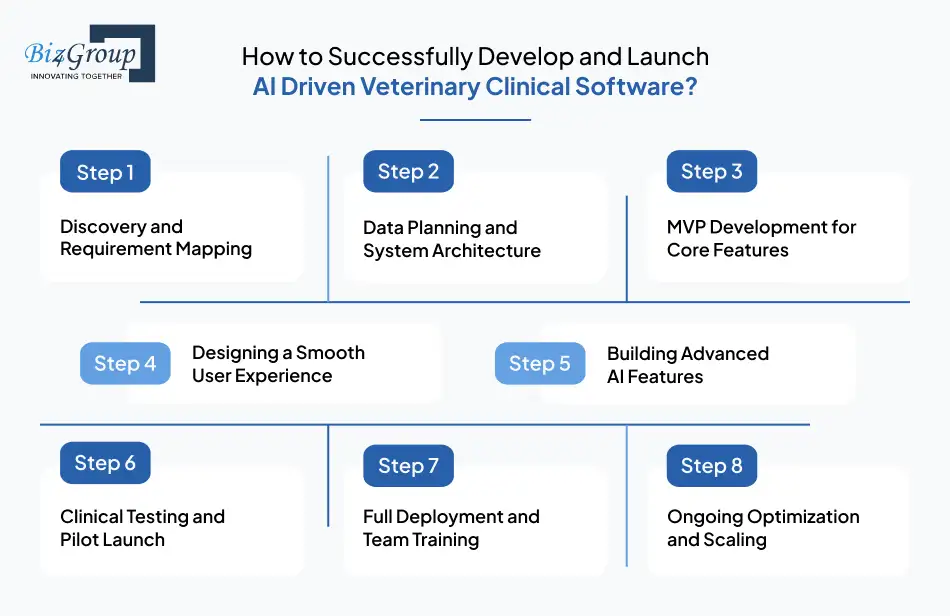
Creating an intelligent platform works best when you follow a clear plan. Whether you want to upgrade existing tools or develop AI veterinary clinical management software from the ground up, a structured roadmap helps you stay focused and build something your team can truly rely on.
Step 1. Discovery and Requirement Mapping
You start by identifying what your clinic needs most. This step helps you understand the gaps in your current workflow and what your system should fix first. It also guides what you want to include when you create veterinary practice management software with AI.
- Talk with clinicians, technicians, and administrative staff
- List the tasks that take the most time each day
- Prioritize features for your first version
- Define goals for speed, accuracy, and smoother workflows
Step 2. Data Planning and System Architecture
A strong data foundation is essential. If you plan to develop AI animal health record system features or add diagnostic intelligence later, your structure must be clean and consistent from the start.
- Map how records, labs, imaging, and notes will be stored
- Set rules for privacy, access, and backups
- Identify third party tools you need to integrate
- Build an architecture that supports long term AI veterinary clinical management software development
Step 3. MVP Development for Core Features
An MVP lets you launch early and refine based on real clinic feedback. Start with the essentials your team relies on every day before adding deeper intelligence.
- Build core scheduling, billing, and EHR tools
- Add simple automation where it makes the biggest impact
- Keep screens clean and easy to understand
- Work with MVP development experts for faster delivery
Step 4. Designing a Smooth User Experience
Strong design helps your team feel comfortable with the system from day one. A good experience makes a noticeable difference when you build AI driven veterinary clinic software for busy environments.
- Create intuitive layouts for different roles
- Reduce unnecessary clicks and screen changes
- Make sure the system works on mobile and tablets
- Collaborate with UI/UX design specialists for a polished interface
Step 5. Building Advanced AI Features
Once your foundation is stable, you add intelligence. This is where the platform becomes more supportive and reduces manual work.
- Introduce automated summaries, reminders, and task routing
- Add tools that help clinicians interpret records faster
- Train models using clean data and clear labeling
- Partner with a Custom software development company to make veterinary management software using AI that handles real world complexity
- Add intelligent modules that support diagnostics when you create AI software for veterinary diagnostics
Step 6. Clinical Testing and Pilot Launch
Real clinic testing ensures that your system works the way your team needs it to. It is the best way to validate your decisions before rolling it out everywhere.
- Test in a small group or single location
- Validate the accuracy of AI suggestions
- Gather feedback on speed and usability
- Fix issues before full deployment
Step 7. Full Deployment and Team Training
A successful launch depends on how comfortable your team feels with the new system. Good training helps everyone adjust smoothly.
- Offer training sessions for each role
- Provide simple reference guides
- Support staff as they transition to new workflows
- Track early use and answer questions promptly
Step 8. Ongoing Optimization and Scaling
Your platform should improve as your clinic grows. This step helps you refine, expand, and prepare your system for multi-location use.
- Review ongoing feedback and enhance features
- Add new workflows and automation as needs evolve
- Update models as more data becomes available
- Scale confidently as part of long-term AI veterinary clinical management software development
Choosing the Best Tech Stack to Build AI Based Pet Clinic Appointment Systems That Scale
Your tech stack plays a key role in how well your platform performs and how easily it grows over time. When you build AI driven veterinary clinic software, these technology choices help your system stay secure, fast, and dependable across every step of your workflow.
|
Layer |
Recommended Options |
How It Supports AI Driven Clinic Software |
|---|---|---|
|
Frontend Framework |
React, Vue, Angular |
Helps your staff navigate schedules, records, and dashboards quickly when you create veterinary practice management software with AI |
|
Backend Framework |
Supports scheduling engines, billing, clinical workflows, and automation tasks |
|
|
Mobile Development |
Kotlin for Android, Swift for iOS, Flutter for cross platform |
Essential for mobile visits and telehealth when you build AI driven veterinary clinic software |
|
Databases |
PostgreSQL, MongoDB, MySQL |
Supports clean data management for develop AI animal health record system capabilities |
|
Cloud Platforms |
AWS, Google Cloud, Azure |
Keeps your system stable across single or multi location clinics |
|
AI and ML Frameworks |
TensorFlow, PyTorch, Scikit Learn |
Powers intelligent features when you create AI software for veterinary diagnostics |
|
DevOps and CI Tools |
Docker, Kubernetes, GitHub Actions |
Ensures fast, reliable updates and deployments |
|
APIs and Integrations |
REST APIs, GraphQL, custom SDKs |
Required when you make veterinary management software using AI that connects to labs, imaging, and payment tools |
|
Cloud Functions and Microservices |
AWS Lambda, Google Cloud Functions |
Supports automation like reminders, summaries, and workflow routing |
|
AI Based Communication Tools |
NLP engines, intent recognition models |
Enables smarter messaging and triage when working with an AI app development company |
|
App Integration Tools |
Webhooks, modular libraries |
Useful when you want to integrate AI into an app without changing your entire system |
|
Development Utilities |
Git, Postman, JIRA |
Helps teams collaborate effectively as they build AI software for advanced clinical platforms |
A strong tech stack helps your veterinary platform stay fast, flexible, and dependable as you grow. Each layer supports a different part of your workflow, from smooth frontend interactions to reliable backend processing and future ready AI features. When these components work together, you get a system that can scale confidently and support the full vision of developing AI veterinary clinical management software projects.
Also Read: React JS Development Services
Understanding the Real Cost to Make AI Veterinary Workflow Automation Tools
If you are planning to make AI veterinary workflow automation tools or fully develop AI veterinary clinical management software, it helps to start with a clear cost picture. Most clinics and veterinary networks can expect a range of $20,000 to $150,000+, depending on complexity, integrations, and the level of intelligence they want the system to handle. Your final budget may differ based on features, data requirements, and long-term scaling needs, but this range offers a reliable starting point.
Below is a complete cost breakdown with feature wise estimates, factors that influence your budget, hidden costs many teams overlook, and ways to optimize spending without sacrificing quality.
Cost Breakdown for AI Veterinary Clinical Management Software Development
|
Feature or Module |
Description |
Estimated Cost Range |
|---|---|---|
|
Core Scheduling and Appointment Tools |
Calendar system, reminders, staff availability, pet owner notifications |
$3,000 to $12,000 |
|
AI Based Appointment Optimization |
Smart slot prediction, no show reduction, appointment length estimation |
$5,000 to $18,000 |
|
EHR and Medical Record Management |
Standardized records, visit tracking, lab data organization |
$6,000 to $20,000 |
|
AI Enhanced Record Summaries |
Auto SOAP notes, past visit summaries, treatment history insights |
$4,000 to $15,000 |
|
Diagnostic Assistance Tools |
Symptom analysis, flagged abnormalities, basic predictive tools |
$6,000 to $25,000 |
|
Advanced Diagnostics and Imaging Intelligence |
Pattern recognition, imaging support modules |
$10,000 to $35,000 |
|
Client Communication and Messaging |
Automated follow ups, reminders, chat tools |
$3,000 to $10,000 |
|
AI Powered Virtual Assistant |
Triage support, common response automation |
$6,000 to $20,000 |
|
Inventory and Supply Automation |
Predictive restocking, usage forecasting |
$3,500 to $12,000 |
|
Billing and Payments System |
Auto invoice creation, reminders, bundled services |
$4,000 to $15,000 |
|
Multi Location Workflow Support |
Unified SOPs, shared dashboards, centralized reporting |
$8,000 to $25,000 |
|
Telehealth Module |
Virtual care, mobile access, integrated summaries |
$5,000 to $18,000 |
|
Integrations (Labs, Imaging, Pharmacy Tools) |
API development, data mapping, two-way sync |
$4,000 to $25,000 depending on complexity |
|
Admin Dashboards and Analytics |
KPIs, daily reports, performance insights |
$3,000 to $12,000 |
|
AI Driven Automation Tools |
Smart routing, task triggers, workflow intelligence |
$6,000 to $22,000 |
Factors That Affect the Cost of AI Veterinary Clinical Management Software Development
Several elements influence your final cost when you develop AI veterinary clinical management software or build AI driven veterinary clinic software tailored to your operations.
1. Scope and Feature Depth
More features lead to higher development time and cost.
- Basic EHR vs advanced AI summaries
- Simple scheduling vs predictive scheduling
- Standard messaging vs automated triage
2. Intelligence Level
Adding AI models increases development cost.
- Diagnostics support
- Summary generation
- Pattern recognition
- Automated routing
3. Integration Requirements
Some systems require deeper technical connections.
- Lab devices
- Imaging machines
- Pharmacy tools
- Third party apps
4. Data Quality and Structure
If your clinic uses several old systems, preparing data for AI adds extra work.
5. Multi Location Complexity
Serving multiple clinics means more permissions, roles, and data flow management.
Hidden Costs Most Teams Forget to Plan For
These costs are often missed when clinics plan to make veterinary management software using AI or expand existing systems.
1. Data Cleaning and Migration
Moving records from old systems can take weeks if data is inconsistent.
2. Ongoing Model Training
AI models improve with consistent training and updated datasets.
3. Compliance and Security
Safeguards, audits, and encryption add extra development time.
4. Third Party Licensing
Payment gateways, SMS providers, and integrations sometimes add monthly fees.
5. Post Launch Support
Bug fixes, refinements, and new features require ongoing attention.
Cost Optimization Tips When You Develop AI Veterinary Clinical Management Software
Smart planning can significantly reduce development costs without sacrificing quality.
1. Start with an MVP
Launch only essential features first and refine using real clinic feedback.
2. Reuse Existing Components
Use pre built modules where possible to reduce development time.
3. Outsource Specialized Roles
Hiring niche experts internally is costly. You can hire AI developers as needed.
4. Partner with Experienced Teams
Working with an AI product development company provides proven frameworks, templates, and reusable components.
5. Avoid Overbuilding
Let real clinic usage guide which features to expand later.
When you understand the cost ranges, influencing factors, and hidden expenses, planning becomes much easier. Building or scaling your system becomes a predictable investment rather than a surprise. As you map out your journey to develop AI veterinary clinical management software, a clear budgeting strategy helps you create a platform that supports your clinicians, improves patient care, and grows with your organization.
Curious what your ideal AI veterinary platform would cost
Whether you start small or build big, we help you plan smart, optimize spending, and make veterinary management software using AI that fits your budget without sacrificing quality.
Get Your QuotesThe Biggest Challenges in AI Veterinary Clinical Management Software Development and How Leading Teams Solve Them
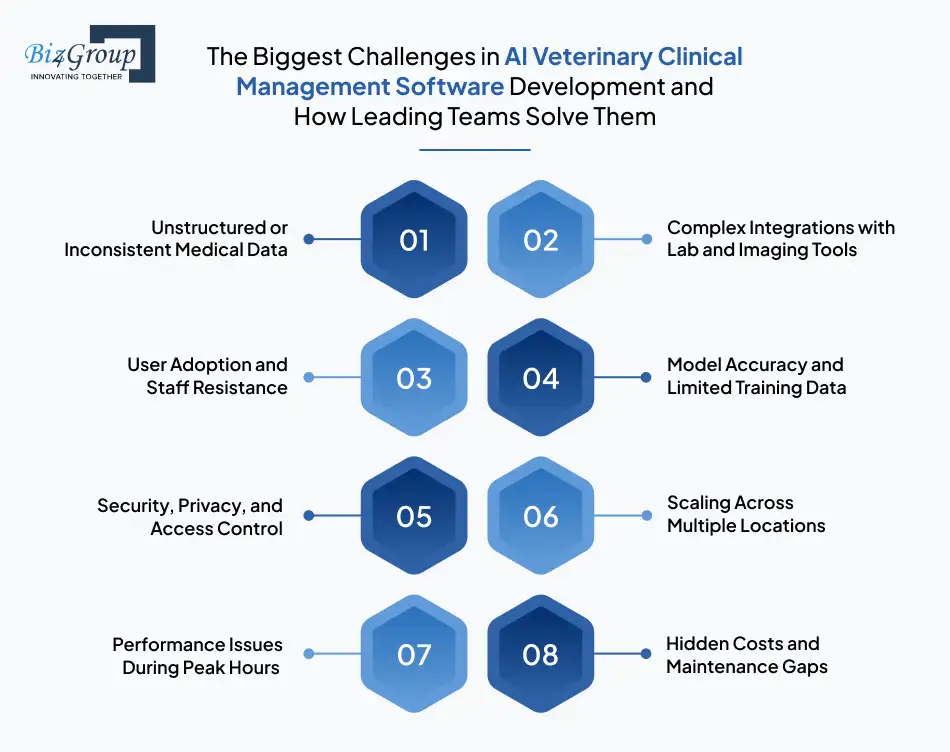
Even well-planned projects encounter obstacles. When you develop AI veterinary clinical management software, understanding these challenges early helps you stay ahead of issues and build a stronger, more reliable platform. The table below outlines the most common challenges along with practical solutions used by high performing teams.
|
Challenge |
Why It Happens |
How to Solve It |
|---|---|---|
|
Unstructured or Inconsistent Medical Data |
Clinics often rely on paper records, older systems, and inconsistent formats, making it difficult to train accurate models for creating AI software for veterinary diagnostics. |
Standardize fields early, clean data before migration, and set naming rules. This becomes easier when you plan to develop AI animal health record system features. |
|
Complex Integrations with Lab and Imaging Tools |
Many lab devices and imaging systems use outdated formats or limited APIs. |
Build custom mapping layers, use middleware, and partner with experts in enterprise AI solutions to handle multi-system connectivity. |
|
User Adoption and Staff Resistance |
Teams fear that new tools may slow down or add extra work. This is common when you create veterinary practice management software with AI. |
Offer clear training, deliver simple workflows, and roll out features gradually so staff can adjust comfortably. |
|
Model Accuracy and Limited Training Data |
Some clinics do not have enough clean historical data, limiting diagnostic or prediction accuracy. |
Start with foundational automation and expand AI tools slowly. Supplement model training with structured datasets designed for AI veterinary clinical management software development. |
|
Security, Privacy, and Access Control |
Veterinary data includes sensitive client and pet information that requires strong safeguards. |
Use encryption, access permissions, audit logs, and follow best practices supported by business app development using AI. |
|
Scaling Across Multiple Locations |
Each location may have different workflows, staffing patterns, and operating habits. |
Build flexible rules, centralized dashboards, and scalable architecture to support multi location build AI driven veterinary clinic software deployments. |
|
Performance Issues During Peak Hours |
Heavy workloads such as lab syncing, EHR updates, and appointment surges can overload the system. |
Adopt microservices, load balancing, and cloud scaling methods to keep everything stable during busy times. |
|
Hidden Costs and Maintenance Gaps |
Continuous updates, model tuning, bug fixes, and ongoing support can become costly if not planned. |
Establish a long-term maintenance roadmap and collaborate with proven teams from the top custom AI software development companies in USA to ensure predictable support. |
Knowing these challenges ahead of time helps you plan smarter and avoid costly setbacks. With the right approach, the right partner, and a clear roadmap, you can move forward confidently and build the kind of AI veterinary clinical management software development project that supports your clinic today and scales with you tomorrow.
How Partnering with Biz4Group Helps You Build Successful AI Driven Veterinary Clinical Management Software?
Choosing the right partner is one of the biggest factors in successfully bringing your platform to life. When you develop AI veterinary clinical management software, you need a team that understands AI, healthcare workflows, and scalable engineering. Biz4Group brings all three together.
The company has delivered 700+ digital solutions across healthcare, pet care, enterprise automation, and diagnostics, making them a strong choice for clinics and organizations looking to build reliable, intelligent systems. Biz4Group also holds a 4.9 star rating on Clutch, backed by long-term partnerships and highly reviewed enterprise projects.
Here are why teams trust Biz4Group:
Proven AI and Automation Expertise
Biz4Group has deep experience in workflow intelligence, predictive analytics, and automation. Their team helps you create veterinary practice management software with AI that works naturally inside real clinic workflows.
Strong Product and Engineering Quality
From planning to launch, Biz4Group handles everything including architecture, integrations, cloud setup, and testing. Their engineering team is known for building stable, scalable platforms that support long-term growth.
UI and User Experience That Clinicians Appreciate
Clean, intuitive layouts designed by specialists ensure your team can use the system with minimal training.
Recognized Industry Leadership
Biz4Group is consistently ranked among the top custom AI software development companies in USA and is widely trusted for enterprise grade builds.
Deep AI Development Capabilities
As a leading AI development company in USA, Biz4Group helps clinics use AI for diagnostics, records, automation, and workflow support in a safe, scalable way.
Partnering with Biz4Group gives you a team that understands how to turn complex clinical workflows into a dependable, intelligent platform your organization can grow with.
Ready to build with a partner who knows how to deliver
If you are serious about innovation, Biz4Group is ready to bring your idea to life with proven AI veterinary clinical management software development expertise.
Schedule a Free CallConclusion: Building the Future of Veterinary Care with AI Driven Clinical Software
The shift toward intelligent veterinary systems is no longer optional. Clinics that choose to develop AI veterinary clinical management software gain smoother workflows, clearer data, and faster decision support that directly improve patient care. It is a practical upgrade that helps your team work with more confidence and far less friction.
Working with Biz4Group gives you a partner that understands how to blend AI, product design, and clinical workflow logic into a platform that performs in real-world conditions. Their experience in building modern healthcare and pet care solutions ensures your system is scalable, intuitive, and built for long term growth without unnecessary complexity.
If you are ready to modernize your operations and lead your market with smarter technology, Biz4Group can help you bring that vision to life.
Let’s build a platform that keeps your clinic ahead long before the rest catches up.
FAQ
1. What is AI veterinary clinical management software and how does it improve daily clinic operations
AI veterinary clinical management software goes beyond traditional systems by helping your team work faster and with more accuracy. When you develop AI veterinary clinical management software, you get tools for smart scheduling, automated reminders, intelligent record summaries, and guided diagnostics that reduce manual work and improve patient care.
2. What features should I prioritize when planning to create veterinary practice management software with AI
Most clinics start with core features like scheduling, billing, EHR and client communication. From there, AI can enhance your platform through automated SOAP summaries, predictive appointment tools, smart task routing, and diagnostic support. These additions make it easier to create veterinary practice management software with AI that fits real workflow needs.
3. Is AI powered software useful for small or single location veterinary clinics
Yes. Even smaller practices benefit from automated scheduling, record summarization, and communication tools. When you make veterinary management software using AI, you remove a large amount of repetitive work and make it easier for limited staff to manage higher patient loads without losing efficiency.
4. How long does it take to launch an MVP version of AI driven veterinary software
A basic version with core scheduling, EHR, billing, and simple AI automation can often be built within 2 to 3 weeks depending on scope. After the MVP is live, you can add advanced tools such as diagnostics and workflow intelligence. This phased approach keeps your AI veterinary clinical management software development process predictable and cost effective.
5. What is the cost to develop AI veterinary clinical management software
The cost depends on the size of your platform, the number of features, and the level of intelligence you want to include. Most projects range from $20,000 to $150,000 and above. If you plan to build AI driven veterinary clinic software with advanced diagnostics, multi-location support, or automation, the price increases accordingly. Starting with a focused MVP helps control both cost and development time.
6. What are the hidden costs I should expect when building AI powered veterinary software
Hidden costs often include data cleaning, migration, integrations with labs or pharmacy systems, ongoing model updates, and maintenance. These typically appear as you develop AI veterinary clinical management software and introduce more advanced modules. Planning early avoids unexpected expenses.
7. How do I ensure my staff will adopt the new AI software without pushback
Adoption improves when the platform is easy to use, designed around real workflows, and supported with proper onboarding. Focus on a clean interface, minimal clicks, mobile compatibility, and clear training sessions. These elements help your team feel confident using newly built AI veterinary clinical management software in their daily routine.
