 Location :
Orlando, FL, USA
Location :
Orlando, FL, USA +1 (407) 714-1616
 info@biz4group.com

- Build custom healthcare software like ChronicCareIQ to manage chronic care programs with better coordination, engagement, and scalable digital workflows.
- Custom healthcare software development like ChronicCareIQ enables remote patient monitoring, personalized care plans, and outcome tracking.
- Organizations that develop chronic care management software like ChronicCareIQ gain flexibility, data ownership, and smoother integrations with existing healthcare systems.
- A well-planned platform supports healthcare application development for long term care like ChronicCareIQ, with security, compliance, and performance built in from day one.
- Costs range from $30,000-$200,000+, but smart planning and phased delivery help develop scalable chronic care software like ChronicCareIQ without budget surprises.
- Biz4Group LLC helps healthcare organizations design and deliver custom chronic care software solutions for providers and enterprises like ChronicCareIQ with proven expertise and a results driven approach.
A large portion of the U.S. population lives with chronic conditions that require ongoing care and coordination. Nearly 60% of American adults have at least one major chronic disease, such as heart disease, diabetes, or hypertension. That burden drives demand for better systems to manage lasting care and improve outcomes.
Healthcare leaders looking to build custom healthcare software like ChronicCareIQ are taking note of this challenge. ChronicCareIQ-style platforms aim to streamline chronic care management and make care coordination more efficient.
With more patients requiring continuous monitoring and personalized care pathways, these platforms are becoming vital tools across clinics, hospitals, and care networks.
For organizations planning custom healthcare software development like ChronicCareIQ, the goal is to enable connected care that improves patient satisfaction while reducing operational friction. These platforms play a role in clinical efficiency and financial performance rather than merely managing data.
Businesses considering how to develop chronic care management software like ChronicCareIQ look for clarity on what works, what doesn’t, and what will truly move the needle for their patients.
With that in mind, let us explore what ChronicCareIQ does, how it functions, and why building such a custom chronic care platform matters today.
Understanding Healthcare Software Development for Chronic Care Programs Like ChronicCareIQ
Chronic care programs demand consistency, coordination, and engagement. That is where platforms like ChronicCareIQ come into the picture. Before deciding to build one, it is important to understand what such software actually represents in real world healthcare operations.
What ChronicCareIQ Represents in Practice
At its core, ChronicCareIQ is designed to support organizations that manage patients over extended periods. It brings patient data, care workflows, and monitoring tools into a single system.
Instead of juggling disconnected tools, care teams get a unified view of each patient’s journey.
From a product standpoint, it functions as a purpose-built healthcare software product that connects patients, providers, and administrators around chronic care goals. The focus stays on continuity of care rather than episodic treatment.
How Platforms Like ChronicCareIQ Work
Most platforms in this category follow a layered approach:
- A patient layer for profiles, care plans, vitals, and engagement
- A care team layer for coordination, task tracking, and communication
- An analytics layer for reporting, outcomes, and compliance support
This structure allows healthcare organizations to create healthcare software for chronic disease management like ChronicCareIQ that scales without disrupting daily workflows.
Core Components That Make the Platform Effective
The strongest implementations usually include:
- Patient dashboards that support long term tracking
- Care coordination tools aligned with clinical workflows
- Monitoring capabilities connected to remote data sources
- Reporting modules for outcomes and compliance
Many providers extend these systems with custom AI healthcare software to add predictive insights, alerts, or automation where manual effort slows teams down. When paired with chronic disease management software with AI, care teams can respond earlier and more effectively to patient risks.
Business Model and Where It Excels
Platforms like ChronicCareIQ typically follow subscription based or per patient pricing models. This aligns well with value-based care and reimbursement programs. Their biggest strength lies in structured care coordination and centralized patient oversight.
However, limitations appear when customization is restricted. Fixed workflows, limited integrations, and rigid reporting often push organizations toward building a custom chronic care platform that fits their exact operational needs.
Understanding these strengths and gaps sets the foundation for deciding why now is the right time to build custom healthcare software like ChronicCareIQ, which we explore next.
Why Build Custom Healthcare Software Like ChronicCareIQ Today?
Healthcare has entered a phase where reactive care is no longer enough. Chronic disease management drives cost pressures and staffing challenges. In a report from the Centers for Disease Control and Prevention, nearly 90% of U.S. healthcare expenditures are linked to chronic disease care.
Developing the right tools to support chronic care can change how care teams operate day-to-day. When organizations decide to build custom healthcare software like ChronicCareIQ, they are building a foundation for improved care outcomes and safer, coordinated clinical processes.
Three Main Business Reasons to Act Now
- Rising Patient Volume
Chronic diseases remain one of the largest drivers of clinical workload. Systems that support patient tracking, monitoring, and management reduce friction in care delivery.
- Pressure to Improve Outcomes
Healthcare leaders are increasingly measured on outcomes. Timely interventions, adherence tracking, and care coordination directly influence clinical results.
- Financial Performance Tied to Value Based Care
Payers and providers alike are moving toward value-based care models. Platforms that support long term engagement and care coordination help organizations qualify for incentive programs.
When organizations decide to custom healthcare software development like ChronicCareIQ, they make a strategic decision to improve performance across clinical and financial dimensions.
Real Business Pain Points Addressed
These platforms help solve:
- Fragmented patient data
- Manual care coordination
- Limited visibility into patient progress
- Difficulty tracking long term outcomes
Clinical teams gain workflows tailored to their specific care pathways rather than adapting to off the shelf tools.
When you build remote patient monitoring software like ChronicCareIQ, you gain a system designed around your unique care needs. This helps reduce operational cost, improve quality, and create better patient experiences.
The next section will break down the most important features such a platform must include.
Chronic Care Costs Are Rising. Is Your Tech Ready?
With nearly 90% of healthcare spend tied to chronic conditions, waiting means falling behind.
Contact Biz4Group TodayEssential Features to Build Custom Healthcare Software Like ChronicCareIQ
A successful chronic care platform is defined by how well it supports everyday clinical realities. Features must reduce manual effort, improve visibility, and keep patients engaged over months or years. When organizations build custom healthcare software like ChronicCareIQ, feature decisions directly shape adoption, outcomes, and return on investment.
Below are the core features that consistently separate effective platforms from those that struggle to scale.
1. Patient Profiles and Long-Term Care Plans
Chronic care depends on continuity. Patient profiles must store medical history, care plans, vitals, medications, and engagement data in one place. Care teams need quick access to this information to make informed decisions during every interaction.
Platforms that integrate AI patient management software capabilities allow providers to manage large patient populations without losing personalization. A connected AI patient portal further empowers patients to review plans, track progress, and stay engaged between visits.
2. Remote Patient Monitoring and Health Tracking
Patients expect care teams to stay informed beyond clinic walls. Continuous tracking of vitals and symptoms enables early intervention and reduces avoidable hospital visits.
Organizations aiming to build remote patient monitoring software like ChronicCareIQ often integrate device data, alerts, and dashboards into a single workflow. Many extend this with AI remote patient monitoring software and AI health tracking app functionality to improve accuracy and response times.
Project Spotlight: AI-Powered Athletic Health Solution

Dr. Ara demonstrates how advanced monitoring can be delivered without overwhelming users or clinicians.
- AI-based blood test analysis to identify health trends
- Personalized recommendations for diet, sleep, and performance
- Ongoing progress tracking through structured data
- Secure handling of sensitive health information
This approach shows how monitoring features can support engagement while remaining scalable and secure.
3. Care Coordination and Team Workflows
Chronic care involves multiple stakeholders. Physicians, nurses, care coordinators, and administrators all need visibility into patient progress. Without clear workflows, care delivery becomes fragmented.
Custom platforms designed to develop care coordination software for healthcare like ChronicCareIQ centralize task management, internal communication, and accountability. Integration with healthcare workforce management software helps align staffing with patient demand and care schedules.
4. Conversational Engagement and Guided Intake
Many patients struggle with complex forms or inconsistent follow ups. Conversational interfaces simplify data collection and encourage honest input.
Some organizations enhance engagement using an AI virtual healthcare assistant that guides patients through symptom updates or daily check ins. This approach increases response rates and improves data quality.
Project Spotlight: AI Chatbot for Personalized Supplement Recommendations
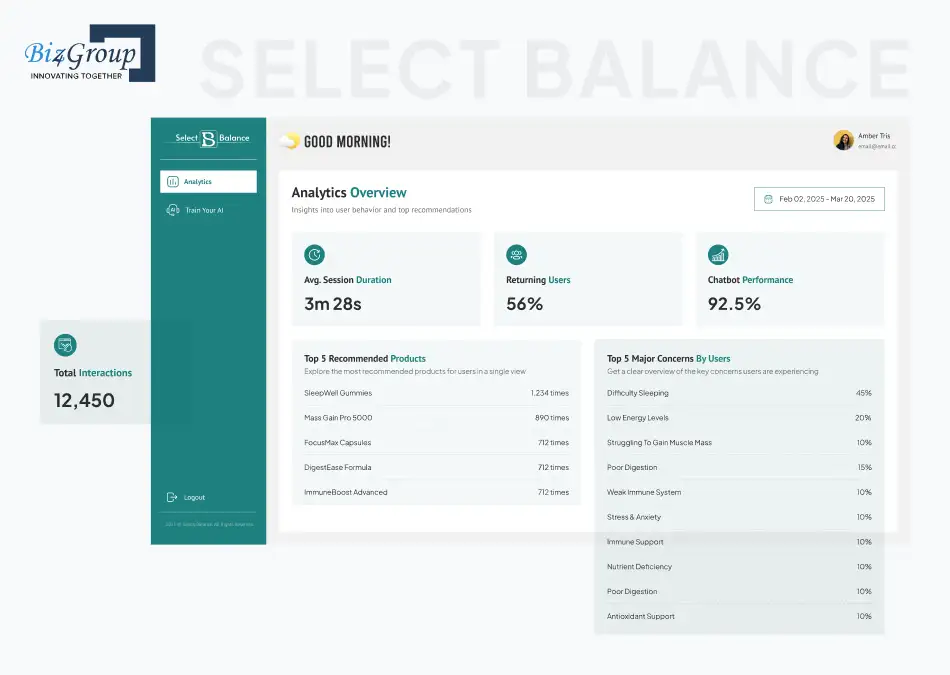
As a seasoned AI chatbot development company, Biz4Group LLC developed Select Balance, which highlights how conversational design can transform engagement.
- Guided health quizzes to capture patient context
- Natural language conversations for symptom input
- Real-time recommendations from a structured database
- Admin tools for continuous refinement without developer support
This model fits naturally into chronic care programs that depend on regular patient input.
5. Analytics, Reporting, and Outcome Tracking
Reporting must cover clinical outcomes, patient adherence, and operational performance. These insights support reimbursement programs and internal decision making.
6. Secure Administration and Compliance Controls
Chronic care platforms handle sensitive data over long periods. Administrative tools must enforce role-based access, audit trails, and data governance policies. These controls support regulatory compliance while protecting patient trust.
Choosing the right features is the first major step toward success. The next section walks through the step-by-step process to develop scalable chronic care software like ChronicCareIQ, from discovery to deployment.
Also read: AI hospital management software development guide
Step-by-Step Process to Build Custom Healthcare Software Like ChronicCareIQ
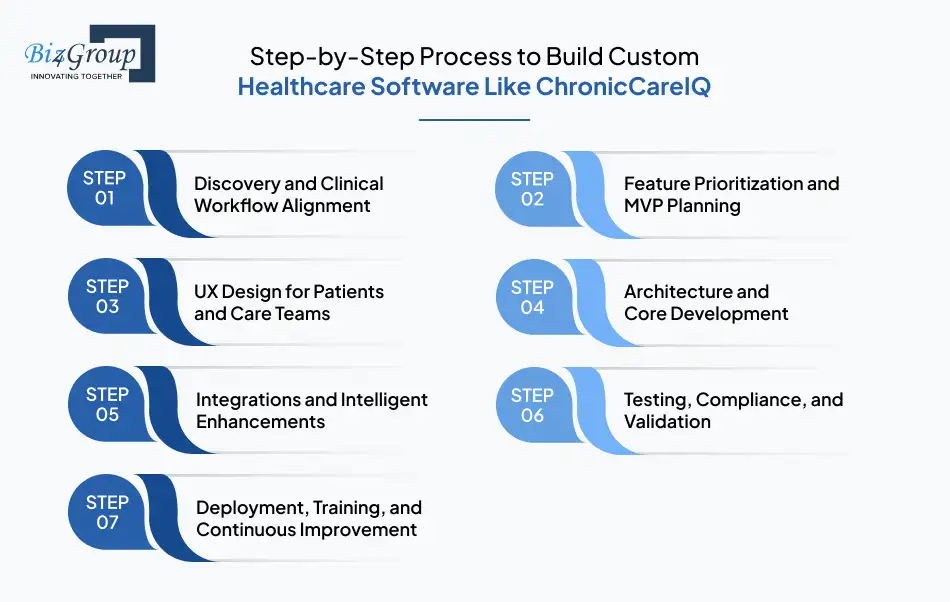
Building a chronic care platform demands a structured process that respects clinical workflows, regulatory needs, and scalability. Organizations that follow a clear development path reduce risk and move faster from concept to adoption.
Below is a proven step-by-step approach used to build custom healthcare software like ChronicCareIQ that delivers real operational value.
Step 1. Discovery and Clinical Workflow Alignment
Every successful platform starts with clarity. This phase focuses on understanding how care is delivered today and where gaps exist.
Teams collaborate with clinicians, administrators, and operations leaders to document workflows, patient journeys, and reporting needs. The goal is to ensure the software mirrors real clinical practices rather than forcing teams to adapt to technology.
Step 2. Feature Prioritization and MVP Planning
Not every feature needs to be built on day one. Prioritization helps teams focus on what drives early adoption and measurable outcomes.
Building an MVP typically includes patient management, care coordination, and basic monitoring features. Many organizations rely on it to validate assumptions before committing to a full-scale rollout. This stage balances speed with clinical safety.
Also read: Top 12+ MVP development companies in USA
Step 3. UX Design for Patients and Care Teams
Chronic care platforms serve multiple user groups. Patients need simplicity and clarity. Care teams need efficiency and speed.
A great UI/UX design company focuses on accessibility, clean interfaces, and intuitive navigation. It ensures that the experience supports engagement rather than creating friction. Good design improves adherence and reduces training effort.
Also read: Top 15 UI/UX design companies in USA
Step 4. Architecture and Core Development
Once designs are validated, development begins. Engineers build secure APIs, databases, and user interfaces aligned with healthcare standards.
This phase often includes integration with AI EMR/EHR software, scheduling systems, or billing platforms. Decisions made here influence scalability, performance, and maintenance costs. Teams offering web development services and healthcare focused engineering experience play a key role in delivering stable foundations.
Step 5. Integrations and Intelligent Enhancements
Chronic care software rarely operates in isolation. Integrations with hospital systems, pharmacies, and analytics tools are critical.
Many organizations enhance workflows using AI integration services to automate tasks, surface insights, or support decision making. This step transforms a basic system into a connected care platform.
Step 6. Testing, Compliance, and Validation
Before launch, platforms undergo rigorous testing. Functional testing ensures workflows behave as expected. Security testing protects sensitive data.
Healthcare teams also validate compliance requirements. This step builds trust with providers, patients, and regulatory bodies.
Step 7. Deployment, Training, and Continuous Improvement
Launching the platform is only the beginning. Teams train staff, monitor usage, and gather feedback.
Some organizations choose to outsource AI healthcare software development support for long-term maintenance and enhancements. Others expand functionality with automation features or integrations that automate pharmacy workflow using AI. Continuous improvement keeps the platform aligned with evolving care needs.
A structured process reduces uncertainty and ensures each phase builds toward a scalable outcome. With the development journey defined, the next step is selecting the right technology stack to support performance, security, and lasting growth.
You've Seen the Blueprint. Want It Built Right?
A clear process reduces risk, timelines, and costly mistakes. The difference lies in who executes it with precision.
Talk to Biz4Group's ExpertsRecommended Tech Stack to Develop Scalable Chronic Care Software Like ChronicCareIQ
Choosing the right technology stack plays a critical role in performance and security. Chronic care platforms handle sensitive data, frequent interactions, and integrations with multiple healthcare systems. Every layer of the stack must support reliability and compliance from day one.
The table below outlines a recommended technology stack to build custom healthcare software like ChronicCareIQ.
|
Technology Layer |
Recommended Technologies |
Purpose and Value |
|---|---|---|
|
Frontend |
React, Next.js, Angular |
Delivers fast, responsive interfaces for patients and care teams across devices |
|
Mobile Access |
React Native, Flutter |
Enables consistent mobile experiences for long term patient engagement |
|
Backend |
Node.js, Python with FastAPI |
Handles secure business logic, APIs, and real time data processing |
|
Database |
PostgreSQL, MySQL |
Stores structured patient data, care plans, and clinical records reliably |
|
Cloud Infrastructure |
AWS, Azure, Google Cloud |
Supports scalability, high availability, and secure hosting |
|
Data Security |
Encryption at rest and in transit, role-based access |
Protects sensitive healthcare data and enforces access control |
|
Integrations |
HL7, FHIR APIs |
Connects with external healthcare systems and devices |
|
Analytics |
Power BI, custom dashboards |
Tracks outcomes, adherence, and operational performance |
|
DevOps |
Docker, Kubernetes |
Ensures smooth deployments and scalable infrastructure management |
|
Monitoring |
Cloud monitoring and logging tools |
Maintains uptime, performance, and system health |
A well-planned stack ensures the platform can grow alongside patient volumes and evolving care models. With technology foundations in place, the next critical area to address is security and regulatory compliance, where healthcare platforms face their highest risks and responsibilities.
Security and Regulatory Compliance to Build Custom Chronic Care Platform Like ChronicCareIQ
When organizations build custom healthcare software like ChronicCareIQ, regulatory readiness must be embedded into the product from the very beginning. Treating compliance as an afterthought often leads to delays, risk exposure, and costly rework.
Below are the core security and compliance requirements that must be addressed when developing chronic care software at scale.
- HIPAA Compliance as a Baseline
Any platform handling protected health information must align with HIPAA rules around data privacy, access control, and breach prevention. Designing the system as a HIPAA compliant AI app ensures patient data remains protected across storage, processing, and transmission. - End-to-End Data Encryption
Sensitive healthcare data should be encrypted both at rest and in transit. This protects patient records from unauthorized access during data transfers and storage operations. - Role-Based Access Control
Physicians, care coordinators, administrators, and patients should only see information relevant to their role, reducing exposure and human error. - Audit Logs and Activity Tracking
Every interaction with patient data must be traceable. Audit logs support internal reviews, regulatory audits, and incident investigations while improving accountability. - Secure Cloud Infrastructure
Hosting environments must follow healthcare grade security standards, including secure storage, network isolation, and continuous monitoring for threats. - Compliance Ready Architecture for Scaling
As organizations develop scalable chronic care software like ChronicCareIQ, compliance controls should extend easily across new modules, locations, and patient populations without redesigning the system.
Strong security practices protect patient trust and organizational reputation. With compliance foundations in place, the next major consideration becomes cost. Understanding what it takes to build and scale a chronic care platform helps leaders plan budgets with confidence and clarity.
What It Costs to Develop Chronic Care Management Software Like ChronicCareIQ
Cost planning often determines whether a chronic care platform succeeds or stalls. On average, organizations looking to build custom healthcare software like ChronicCareIQ should expect an investment ranging between $30,000-$200,000+, depending on scope, complexity, and scale.
This range reflects differences between validating an idea quickly and building a full enterprise-grade system.
|
Platform Stage |
Typical Scope |
Average Cost Range |
|---|---|---|
|
MVP |
Core patient management, basic monitoring, admin access |
$30,000-$60,000 |
|
Advanced Platform |
Care coordination, analytics, integrations |
$60,000-$120,000 |
|
Enterprise Scale |
Multi-clinic support, automation, AI features |
$120,000-$200,000+ |
These numbers provide directional clarity. Actual costs depend on multiple variables, which we break down next.
Core Cost Drivers That Influence Budget
Every decision during development impacts cost. Below are the primary drivers that shape investment when organizations develop scalable chronic care software like ChronicCareIQ.
|
Cost Driver |
What It Includes |
Estimated Cost Impact |
|---|---|---|
|
Feature Complexity |
Monitoring, alerts, reporting depth |
$10,000-$40,000 |
|
UX and Interface Design |
Patient and provider dashboards |
$5,000-$20,000 |
|
Integrations |
Scheduling, billing, EHR systems |
$10,000-$35,000 |
|
Compliance and Security |
Access control, audits, encryption |
$8,000-$25,000 |
|
AI and Automation |
Alerts, predictions, workflow logic |
$15,000-$50,000 |
Hidden Costs Many Teams Overlook
Initial development is only part of the investment. Hidden costs surface over time and must be planned upfront.
- Maintenance and Updates
Ongoing improvements, security patches, and system upgrades typically cost 15%-25% of the initial build per year. - Compliance Audits and Updates
Regulatory changes and audit preparation may add $5,000-$15,000 annually, depending on scale. - Cloud Infrastructure and Monitoring
Hosting, backups, and performance monitoring can range between $200-$2,000 per month based on usage. - Team Scaling and Support
Expanding features or user capacity often requires additional development hours, adding $10,000-$30,000 over time.
Understanding cost structure helps leaders plan with confidence and avoid surprises. In the next section, we will explore how to maximize ROI after building custom healthcare software like ChronicCareIQ by optimizing operations, monetization strategies, and long-term scalability.
Also read: How much does it cost to develop AI medical scheduling software?
What Will It Cost You If You Delay?
Rising care costs and inefficiencies add up faster than platform investments. The real expense is doing nothing.
Get a Real Cost EstimateHow to Maximize ROI From Custom Chronic Care Platform Like ChronicCareIQ?
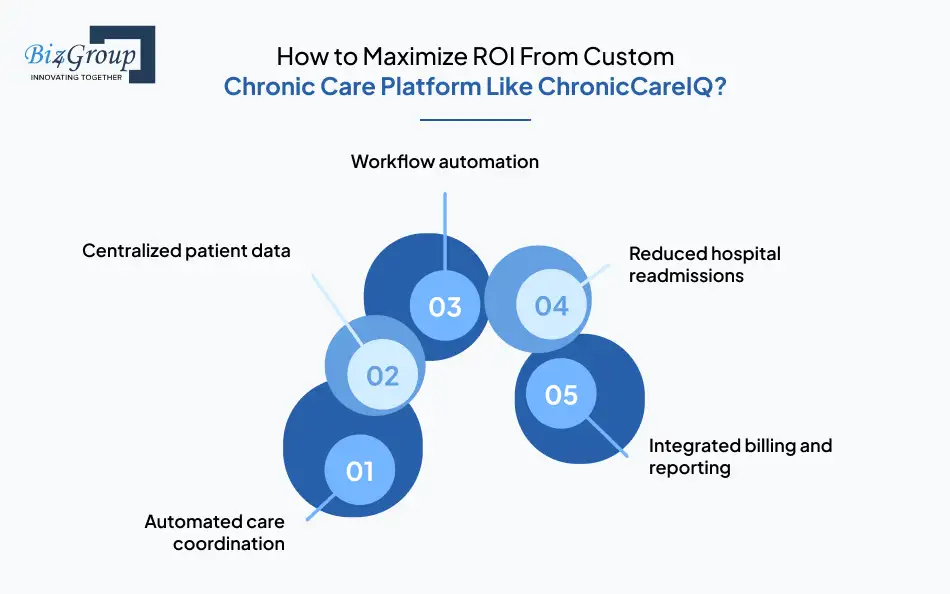
Building the platform is only the first milestone. Real value is created when the system reduces cost, improves efficiency, and opens new revenue streams. Healthcare leaders who approach ROI strategically recover their investment faster and create financial impact.
Optimizing Cost Across Operations
When organizations develop chronic care management software like ChronicCareIQ with efficiency in mind, operational savings often begin within the first year.
|
Cost Optimization Area |
How It Reduces Spend |
Estimated Impact |
|---|---|---|
|
Automated care coordination |
Fewer manual follow ups and handoffs |
20%-30% reduction in staff time |
|
Centralized patient data |
Less duplication and rework |
15%-25% operational savings |
|
Workflow automation |
Faster task completion |
25%-40% productivity gain |
|
Reduced hospital readmissions |
Early intervention and monitoring |
10%-20% cost avoidance |
|
Integrated billing and reporting |
Faster reimbursements |
15%-30% revenue cycle efficiency |
Monetizing Chronic Care Software Strategically
Once operational stability is achieved, monetization becomes the next growth lever. The right strategy depends on the organization’s care model and target audience.
- Subscription Based Care Programs
This model creates predictable revenue and improves patient retention. Many organizations report 20%-35% improvement in recurring revenue after implementation. - Value Based Care Incentives
Platforms that track outcomes and adherence help providers qualify for incentive programs. Improved reporting and coordination can increase reimbursement rates by 10%-25%. - Enterprise Licensing
Health systems and large provider networks often license chronic care platforms across multiple locations. This approach scales revenue without proportional cost increases. - Data Driven Insights and Reporting
Aggregated, compliant analytics support internal optimization and strategic planning. Organizations often realize 15%-20% efficiency gains by acting on these insights.
When built as a scalable AI product, chronic care platforms can evolve beyond internal tools into revenue generating assets.
Project Spotlight: AI Avatar for Personalized Wellness Guidance
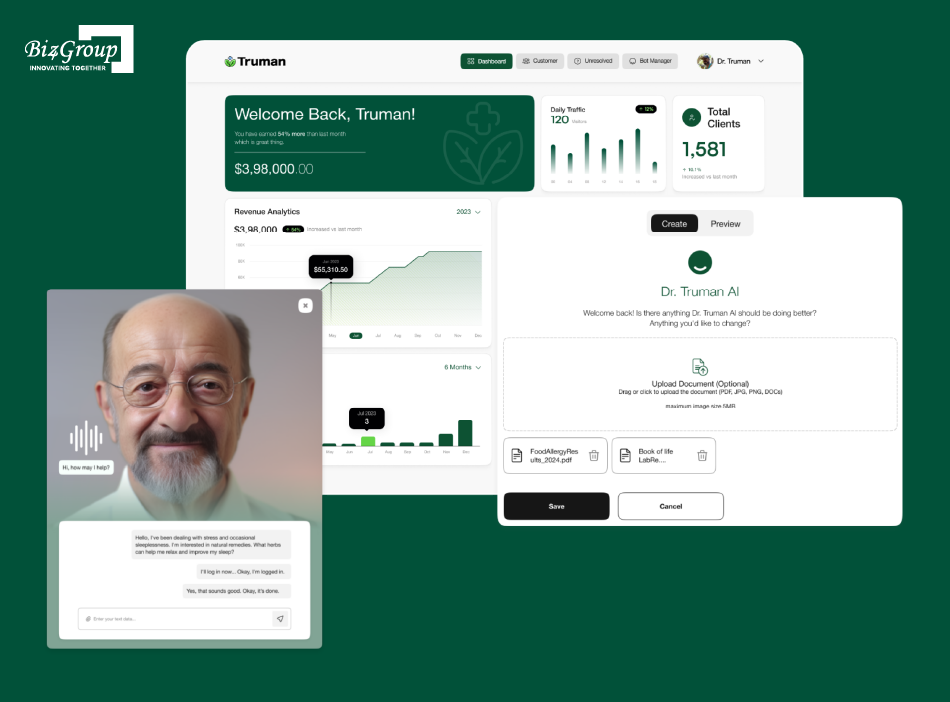
As a trusted AI avatar development company, Biz4Group LLC built the Truman project, which demonstrates how intelligent health platforms translate engagement into financial results.
- AI-powered avatar and chatbot delivering personalized health guidance
- Integrated wellness products and membership plans
- Secure health record uploads and personalized recommendations
Business impact achieved:
- 40% increase in user engagement
- 30% increase in product sales
- 20% reduction in operational costs
- 25% improvement in marketing conversions
This project highlights how combining personalization with automation drives both clinical engagement and revenue growth.
Maximizing ROI requires intentional design and continuous optimization. The next section explores a critical decision many organizations face. Whether to build or buy custom healthcare software like ChronicCareIQ, and how that choice impacts long term control, cost, and scalability.
Buy vs Build Remote Patient Monitoring Software Like ChronicCareIQ
Choosing between building and buying chronic care software is a strategic decision. It affects cost, control, and scalability. Healthcare leaders evaluating whether to build custom healthcare software like ChronicCareIQ must weigh immediate convenience against future adaptability.
|
Decision Factor |
Buy Off the Shelf Software |
Build Custom Healthcare Software Like ChronicCareIQ |
|---|---|---|
|
Initial Cost |
Lower upfront investment |
Higher upfront investment |
|
Customization |
Limited to vendor settings |
Fully tailored to care workflows |
|
Scalability |
Constrained by product roadmap |
Designed to scale with patient volume |
|
Compliance Control |
Dependent on vendor updates |
Compliance built into architecture |
|
Integrations |
Restricted or costly |
Seamless integration with existing systems |
|
Data Ownership |
Often shared or restricted |
Full ownership and control |
|
Feature Expansion |
Based on vendor priorities |
Driven by business needs |
|
Long Term Cost |
Ongoing license fees |
Lower cost over time |
|
Competitive Differentiation |
Minimal |
High |
Both paths serve different organizational goals. Understanding when each option fits helps avoid costly misalignment.
Buy when
You need a fast deployment, have standard care workflows, and are running a pilot or short-term program.
Build when
You want full control, deep customization, long term scalability, and alignment with complex chronic care models.
Hybrid when
You combine a core platform with custom modules to balance speed and flexibility.
With this decision clarified, the next section addresses the common challenges, risks, and mistakes organizations face when they build custom healthcare software like ChronicCareIQ, along with proven mitigation strategies.
Build Control or Rent Limitations?
Off-the-shelf tools cap growth. Custom platforms create leverage, ownership, and long-term advantage.
Book a Strategy Call TodayChallenges and Risks When You Build Custom Healthcare Software Like ChronicCareIQ
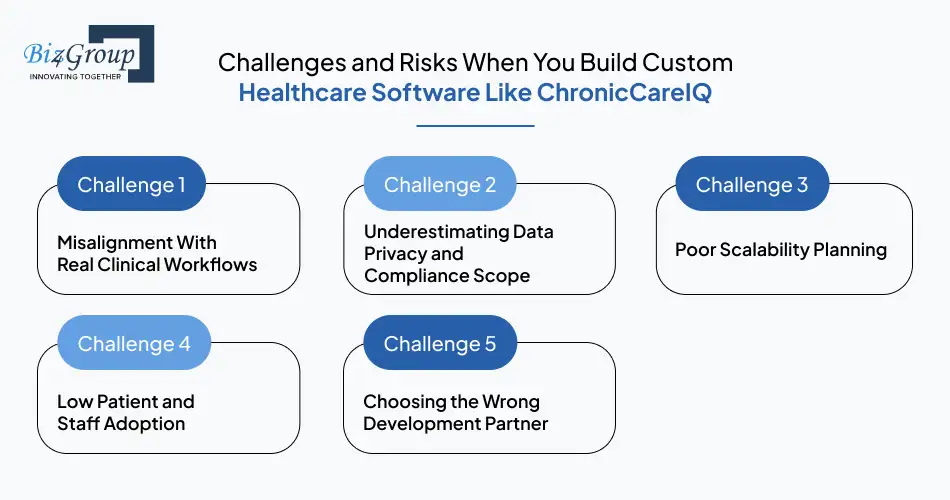
Building a chronic care platform brings clear advantages, but it also introduces challenges that can derail timelines, budgets, and adoption if left unaddressed. Organizations that plan for these risks early are far more likely to deliver software that supports long term care programs successfully.
Below are the most common challenges teams face when they develop chronic care management software like ChronicCareIQ, along with practical mitigation strategies.
Challenge 1. Misalignment With Real Clinical Workflows
Software that looks good on paper can fail in real clinical settings if it does not reflect how care teams actually work.
How to mitigate
- Conduct workflow mapping sessions with clinicians before development begins
- Validate features using real patient scenarios
- Involve care coordinators during early testing cycles
Challenge 2. Underestimating Data Privacy and Compliance Scope
Chronic care platforms store sensitive data over long periods. Inadequate planning around compliance increases legal and operational risk.
How to mitigate
- Embed compliance requirements into system architecture
- Apply role-based access controls from the start
- Perform regular security reviews as features evolve
Challenge 3. Poor Scalability Planning
Platforms built for small patient groups often struggle when usage increases. Performance issues can erode trust quickly.
How to mitigate
- Design the system to support growing patient volumes
- Use modular architecture to expand features gradually
- Stress test performance before full rollout
Challenge 4. Low Patient and Staff Adoption
Even well-built systems fail if users avoid them. Complex interfaces and training gaps slow adoption.
How to mitigate
- Prioritize simple and intuitive user experiences
- Offer guided onboarding for patients and staff
- Collect feedback early and iterate frequently
Challenge 5. Choosing the Wrong Development Partner
Lack of healthcare domain knowledge can result in rework, compliance gaps, and cost overruns.
How to mitigate
- Evaluate experience in healthcare application development
- Review past projects related to chronic care or long-term health
- Ensure the partner understands regulatory and clinical requirements
... or you could simply choose to partner with Biz4Group LLC.
Why is Biz4Group LLC the Best Company in the USA to Build Custom Healthcare Software Like ChronicCareIQ?
When healthcare leaders in the USA decide to build custom healthcare software like ChronicCareIQ, they look for a partner who understands clinical complexity, regulatory responsibility, and scalability. That is where Biz4Group LLC consistently stands out.
Biz4Group is a USA-based software development company that specializes in building complex, secure, and scalable healthcare AI solutions. Our work sits at the intersection of healthcare operations and advanced engineering. We help organizations move from fragmented care workflows to unified platforms designed for chronic care programs.
Healthcare organizations choose us because we combine deep technical expertise with practical execution. As a full-scale AI development company, our teams handle everything from strategy and UX to backend architecture and cloud deployment. When required, we layer in AI automation services, insights, and scalability across chronic care programs.
Why Businesses Choose Biz4Group LLC
- Proven experience building healthcare platforms that support long-term care models
- Strong understanding of USA healthcare compliance and data security expectations
- End-to-end capabilities from discovery to deployment and scaling
- Flexible engagement models, including the ability to hire AI developers for dedicated teams
- Advanced capabilities in generative AI and intelligent systems for future ready healthcare products
Choosing the right partner directly impacts adoption, compliance, and return on investment. Biz4Group LLC brings a track record of building healthcare platforms that perform under real world conditions, scale with patient demand, and align with evolving care models.
Make use of our expertise for your healthcare software. Get in touch and share your vision with us. Let’s talk.
Wrapping Up
Building a custom chronic care platform requires a clear understanding of clinical workflows, patient engagement needs, compliance responsibilities, and scalability. Organizations that choose to build custom healthcare software like ChronicCareIQ gain the flexibility to design care programs around real patient journeys rather than forcing teams to adapt to rigid tools.
From feature planning and technology selection to cost management and ROI optimization, every decision shapes how effectively chronic care programs perform over time. Custom platforms enable better coordination, smarter monitoring, and stronger patient relationships, all while supporting value-based care goals and operational efficiency.
This is where Biz4Group LLC plays a critical role. As a software development company with deep healthcare and AI expertise, Biz4Group helps organizations translate complex care requirements into secure, scalable, and future ready platforms. Our experience building chronic care, remote monitoring, and intelligent health solutions allows healthcare leaders to move forward with confidence.
If you are ready to turn your chronic care vision into a high impact digital platform, now is the time to act. Connect with Biz4Group and start building custom healthcare software like ChronicCareIQ that delivers measurable outcomes and long-term value.
FAQs
Can chronic care software support multiple specialties within the same platform?
Yes. Well-designed chronic care platforms can support cardiology, endocrinology, pulmonology, and other specialties through configurable care plans, role-based access, and modular workflows.
How customizable should reporting be in chronic care software?
Reporting should adapt to clinical, operational, and payer requirements. Custom dashboards allow care teams and administrators to track outcomes, adherence, and performance without relying on static reports.
What role does patient engagement play in chronic care platform success?
Engagement directly impacts outcomes. Platforms that encourage regular check ins, progress tracking, and clear communication tend to see higher adherence and lower dropout rates over time.
Can chronic care software integrate with wearable devices and third-party tools?
Yes. Most modern platforms are built to integrate with smart wearable technology, remote monitoring devices, and external systems using secure APIs and healthcare data standards.
How do updates and enhancements work after the platform is launched?
Post launch improvements are typically rolled out in phases. Usage data and feedback guide feature upgrades, performance tuning, and security enhancements without disrupting care delivery.
Is custom chronic care software suitable for small clinics or only large organizations?
Custom solutions can be designed for both. Smaller clinics often start with a focused scope and expand gradually, while larger organizations deploy enterprise wide from the beginning.
