Location :
Orlando, FL, USA
Location :
Orlando, FL, USA +1 (407) 714-1616
 info@biz4group.com


















Imagine a digital system that doesn’t wait for instructions but instead, understands your business goals, learns from real-time feedback, and takes independent actions to get the job done.
Read More

You have probably noticed how quickly legal work is changing. Research that once took hours now takes minutes. Drafting that used to drain an entire afternoon can be wrapped up before your next meeting. Even with these improvements, many legal teams still feel buried under repetitive tasks, compliance demands, and rising caseloads.
If you are here, you are likely asking a familiar question.
How do we develop agentic AI platform for legal services in a way that delivers real impact and not another short-lived tool?
Let’s ground this in what is happening right now.
A 2025 industry survey reported that AI could save around 240 hours per lawyer per year when applied correctly.
Another 2025 report highlighted that 79 percent of law firms have already begun integrating advanced AI into daily workflows including legal research and contract work.
These numbers show more than experimentation. They show that your competitors are moving.
If you are exploring how to develop agentic AI platform for legal services, you are not chasing a trend. You are preparing your team for the next operational leap. Firms no longer want another chatbot or a basic script-based tool. They want platforms that can think through multistep tasks, interpret documents, connect with their systems, and deliver consistent results. This is where working with a partner experienced in agentic AI development becomes a real advantage.
Here is what we want to help you achieve with this guide.
You will understand what it takes to build agentic AI system for law firms, how to scope your use cases, how to plan your data and workflows, and how to avoid the mistakes that slow down legal transformation projects. We will walk you through the decisions that matter and the capabilities that separate strong platforms from weak ones.
Think of this guide as the roadmap you wish someone had handed you on day one. By the time you reach the end, you will know how to outline your workflows, plan your architecture, choose your tools and budget responsibly for your build.
Ready to move forward?
If you have been planning to develop agentic AI platform for legal services, you may have already noticed how different this approach is from simple automation tools. In a legal environment, an agent is not just responding to prompts. It is completing real legal workflows that require reasoning, research, validation, and structured action.
So, what does agentic AI look like inside legal services?
Think of it as a digital team member that understands legal tasks and works through them step by step. It can analyze documents, gather information, compare clauses, identify risks, perform research, and follow instructions the same way a junior legal assistant would. When organizations bring in an advanced AI agent, they introduce a system that uses context, legal knowledge, and goal-oriented thinking to finish tasks without constant guidance.
In legal services, agentic AI becomes even more powerful because it adapts to specific rules, terminology, and compliance requirements. It helps teams enhance tasks like drafting, risk checking, summarizing, and reviewing. A well-designed system begins to recognize your firm’s style preferences and internal workflow patterns. This is where a modern legal AI agent creates measurable value.
To make this concept clearer, many organizations today are investing in agentic AI legal automation, especially as they prepare for future demands in research, drafting, compliance, and knowledge management. The shift toward agentic AI platform development for legal services shows that the industry is not just curious. It is ready.
Legal teams that want to develop agentic AI for legal services or build agentic AI system for law firms gain more than convenience. They gain speed, reliability, and the capacity to deliver higher quality legal work in less time.
This is why so many firms are shifting toward platforms that think, act, and adapt. As you move through this guide, you will see how to plan the features, workflows, and architecture that truly support modern legal operations.
Legal teams using AI automation report 45% faster research and 38% fewer drafting errors, according to McKinsey and Thomson Reuters. If you want results like this, now is the right moment to develop agentic AI platform for legal services that fits your workflows and goals.
Start Your Legal AI Strategy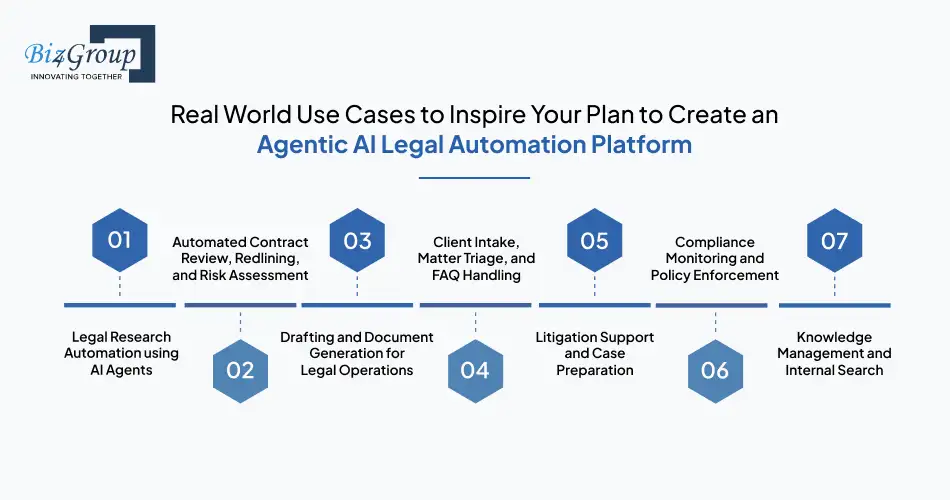
When you start mapping out how to develop agentic AI platform for legal services, it helps to see exactly how these systems perform in real situations. Instead of imagining what an agent could do, let’s look at how it actually works inside a legal team’s day-to-day operations.
Below are high impact use cases backed by practical examples. Each one shows how agent driven workflows solve problems your attorneys, paralegals, and legal ops teams face every day.
You will also see how these real scenarios connect to the expanding list of use cases for agentic AI across the industry.
If you have ever spent hours digging through case law, statutes, and regulatory updates, you know how heavy research workflows can get. A well-designed agent can take a legal question, collect data from trusted sources, validate it, and prepare a structured memo.
Example scenario:
A partner asks for a quick update on recent rulings involving non-compete agreements in a specific state.
Instead of assigning a junior associate, the research agent:
This type of research workflow becomes easier when teams adopt a dedicated AI legal research platform powered by agentic reasoning.
This saves time, improves accuracy, and frees your team to focus on strategy instead of searching.
Contract analysis is one of the most repetitive and time-consuming tasks legal teams' handle. When you create agentic AI legal automation platform workflows, your system can analyze an agreement, identify risky clauses, compare terms to your playbook, and prepare a redlined version.
Example scenario:
Your corporate legal team receives a vendor agreement with 40 pages of dense language.
An agent can:
Legal teams who build agentic AI system for law firms often start with contract review because the ROI is immediate and measurable.
Agentic AI can create drafts, summaries, or filings by following your internal templates and guidelines. This includes letters, NDAs, demand notices, board resolutions, and more.
Example scenario:
Your team needs a first draft of a non-disclosure agreement for a new vendor.
The agent:
With this workflow, your team no longer starts from a blank page. This is one of the biggest time savers in modern legal departments.
This is where conversational intelligence becomes valuable. When firms want to simplify intake or triage, they often adopt a legal AI chatbot or virtual intake tool that collects initial details and routes the matter to the right attorney.
Example scenario:
A client visits your site with a question about forming an LLC.
A conversational agent can:
All of this can even appear inside your main website if you use a modern AI website for law firms setup.
Agents can assist with early case assessment, timeline building, document grouping, evidence comparison, and even identifying inconsistencies across submissions.
Example scenario:
For a litigation matter, your agent:
This enhances accuracy and saves hours of manual sorting.
Compliance work is high risk and detail heavy. When you develop agentic AI for legal services, your platform can track regulations, monitor deadlines, and alert your team if requirements change.
Example scenario:
Your business needs to stay compliant with data privacy rules across multiple states.
An agent can:
This reduces risk and strengthens governance.
Internal legal knowledge is often scattered across shared drives, emails, documents, and past matters. Agentic AI organizes it into a unified, searchable knowledge base.
Example scenario:
An attorney needs to quickly find the last memo written about indemnification in SaaS contracts.
An agent:
For firms building a legal AI app or internal tool, knowledge retrieval becomes one of the most valuable agentic workflows.
These examples show why agentic systems outperform simple automation.
They think.
They plan.
They take action.
And they work exactly where legal teams need support the most.
If you are serious about building an intelligent platform that solves real operational problems, these use cases give you the foundation to start strong.
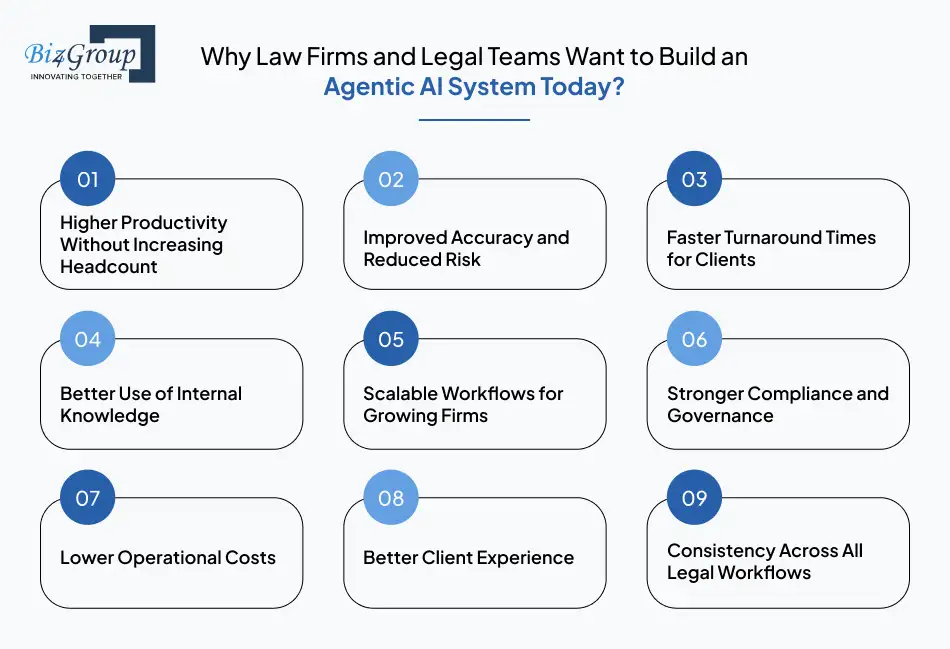
Once you start exploring how to develop agentic AI platform for legal services, the benefits become impossible to overlook. Legal teams deal with heavy workloads, strict deadlines, and high compliance demands. Agentic systems help close these gaps by supporting your daily operations with intelligent, repeatable workflows that scale.
Below are the benefits that matter most for law firms, legal tech companies, and corporate legal departments. Larger teams often strengthen these gains with modern enterprise AI solutions designed for long term growth.
When you develop agentic AI for legal services, routine work like research, drafting, and document review gets completed faster. Your attorneys and paralegals regain valuable hours every week. This advantage helps your team manage more matters without needing to increase your staff.
Building an intelligent system to make legal agent AI system with multi step reasoning capabilities reduces errors that come from fatigue or oversight. The agent cross checks documents, validates information, and flags risk early. This leads to stronger contract review, more reliable research, and fewer compliance surprises.
When you build agentic AI system for law firms, your team moves quicker because they are not stuck on repetitive work. Research summaries, redlining, intake notes, and document prep arrive sooner. Faster output leads to better client satisfaction and smoother matter progression.
Legal knowledge is often buried in drives and old matters. With agentic AI legal automation, your system centralizes information and retrieves it instantly. Attorneys no longer waste time searching for past templates or memos. The agent uses your historical data to support each decision.
If you plan to expand, using agentic systems to create autonomous AI legal assistants for corporate legal departments helps you scale without overwhelming your team. The agent handles repeatable tasks at volume, making it easier to manage growth across practice areas or new jurisdictions.
Compliance changes constantly. When organizations make agentic AI legal assistant for compliance, they receive automated alerts, updated policy insights, and clear recommendations. This reduces compliance risk and helps your team stay aligned with evolving regulatory standards.
Teams that create agentic AI legal automation platform workflows see fewer hours spent on manual review, document handling, and admin work. These efficiencies lead to significant cost savings over time. The financial impact grows as more workflows become automated.
Clients appreciate faster responses and consistent results. When you build agentic AI solutions for legal contract review and risk assessments, your team delivers reliable work more quickly. These builds trust and improve overall client satisfaction.
Using agentic systems to support agentic AI platform development for legal services ensures every document, clause, and workflow follows your standards. This uniformity strengthens brand quality, reduces internal rework, and improves the accuracy of every delivery.
When you plan to develop agentic AI platform for legal services, the real value comes from the features you choose. Strong agentic systems do more than respond to prompts. They understand legal context, follow multi step workflows, use tools effectively, and adapt to your firm’s unique processes.
Here are the essential features that help legal teams operate faster and more accurately when using an agent-driven platform.
|
Feature |
Explanation |
|---|---|
|
Multi Step Reasoning Engine |
This helps your system make legal agent AI system with multi step reasoning capabilities. It allows the agent to break tasks into logical steps and execute them in order. This keeps research, drafting, and contract review accurate and consistent. |
|
Secure Document Understanding and Extraction |
Your platform should analyze filings, briefs, contracts, and regulatory documents with precision. Features similar to an advanced AI legal document management software help extract obligations, clauses, risks, and key terms reliably. |
|
Advanced Retrieval and Knowledge Search |
Legal teams rely heavily on past work products. With agentic AI legal automation, your system retrieves memos, cases, templates, and emails instantly. This eliminates hours of manual searching and supports better decision making. |
|
Built in Compliance and Policy Guardrails |
When you develop agentic AI for legal services, compliance must be built into the platform. Agents check regulations, track updates, and align outputs with internal policies. This reduces exposure to risk and ensures consistent oversight. |
|
Conversational Interaction Layer |
A natural way for users to work with the system improves adoption. Adding an interface similar to a conversational AI agent makes it easy for attorneys to start workflows, ask questions, and guide the agent. |
|
Context Retention and Long-Term Memory |
The best systems learn from your drafting preferences, past decisions, matter history, and style guides. This leads to better output every time and supports long-term accuracy across all workflows. |
|
Automated Workflow and Task Orchestration |
To create autonomous AI legal assistants for corporate legal departments, your platform must execute tasks without manual triggers. It should handle intake, compliance checks, due diligence, research steps, or draft tasks independently. |
|
Seamless Integration with Legal Software Ecosystems |
Your platform should integrate with DMS tools, CLM platforms, research databases, and billing systems. This helps teams build agentic AI system for law firms that support their real-world environment without disruption. |
|
Document Drafting, Summaries, and Redlining |
Your agent must generate drafts, summaries, redlines, and structured reports based on your templates. This feature helps teams build agentic AI solutions for legal contract review and risk assessments that save hours of manual work. |
|
Human in the Loop Review Controls |
Attorneys need oversight and control. Human in the loop features allow your team to review suggestions, approve edits, adjust outputs, or correct errors easily. This keeps quality standards high. |
|
Audit Trails, Logging, and Activity Tracking |
Every action, edit, and decision made by the agent should be recorded. This supports governance when you develop agentic AI for legal services, especially in regulated practice areas. |
|
Conversational Intake and Client Support Tools |
Many teams benefit from intake features shaped by what an AI chatbot development company designs. This allows the agent to collect client data, answer questions, and route matters instantly. |
|
Scalable Architecture for High Volume Work |
As your caseload grows, your platform should scale easily. This lets teams create agentic AI legal automation platform workflows across multiple departments and practice groups. |
Choosing the right features sets the foundation for how effectively you can develop agentic AI platform for legal services that actually supports your team. When these capabilities work together, your system learns faster, delivers more consistent results, and helps your attorneys handle higher workloads with less stress. As you move forward, keep focusing on features that solve real problems for your firm. The more aligned your platform is with daily legal operations, the easier it becomes to scale and get long term value from your investment.
If these features sound like the missing link in your operations, it is time to bring intelligent automation into your daily legal workflows and create real momentum.
Build Your Agentic AI Roadmap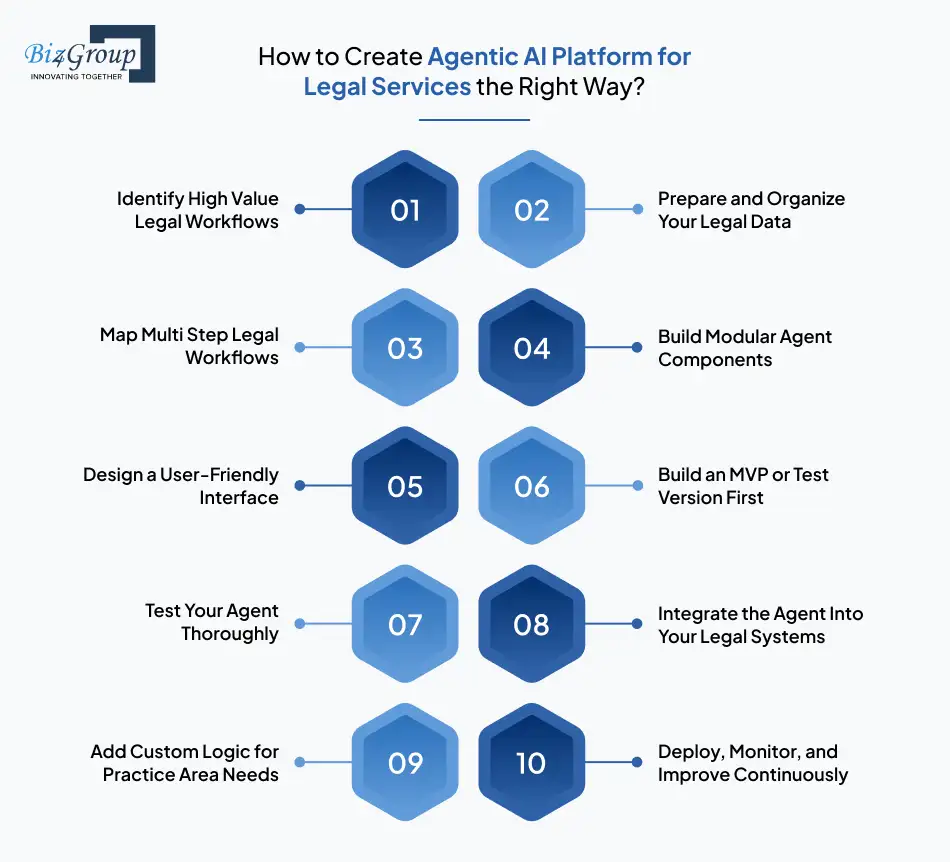
Building an intelligent platform takes more than plugging an LLM into your workflow. When you develop agentic AI platform for legal services, you need a structured roadmap that follows how real legal teams work. These steps help you move from idea to production with clarity, accuracy, and long-term reliability.
Start by pinpointing the tasks that drain your attorneys' time. These become the strongest starting points for agentic AI legal automation because they generate quick wins and measurable ROI. Good candidates include research, intake, contract review, and compliance.
Key actions:
Your platform depends on clean, accessible data. Organize documents, templates, emails, contracts, and knowledge assets so your agent can learn and reason effectively. Many teams streamline this phase using AI automation services.
Key actions:
Agentic AI relies on clearly defined steps. When you develop agentic AI for legal services, map every stage of the workflow including decision points, tools needed, and expected outputs. This ensures the agent behaves correctly in real legal scenarios.
Key actions:
A strong platform uses specialized modules for reasoning, drafting, searching, validation, and compliance. This modular approach helps you make legal agent AI system with multi step reasoning capabilities and expand over time without rebuilding the entire system.
Key actions:
The platform must feel simple for lawyers to use. Clean forms, natural prompts, and intuitive navigation make adoption smoother. This is where strong UI/UX design improves both usability and accuracy.
Key actions:
Start small with a limited solution. An MVP helps validate your ideas, gather feedback, and reduce risk. Many teams choose professional MVP development to create a reliable first version.
Key actions:
Legal AI platforms must meet higher accuracy standards. Test for reasoning quality, hallucinations, compliance alignment, and edge case performance. Running an agentic AI POC helps uncover risks early.
Key actions:
Your agent must work within your real environment. Connect it to your DMS, CLM, billing, CRM, and research platforms so your team can create agentic AI legal automation platform workflows without switching tools. A solid AI integration services setup helps here.
Key actions:
Corporate, litigation, IP, compliance, and contract teams all work differently. Custom components help you create autonomous AI legal assistants for corporate legal departments or specialty teams. A capable custom software development company supports these niche requirements.
Key actions:
Once launched, your system needs active monitoring. Track accuracy, speed, user adoption, and workflow bottlenecks. The most successful teams treat agentic AI as a living system that evolves with new rules and data.
Key actions:
Following a clear framework makes it easier to develop agentic AI platform for legal services that performs reliably from day one. When each stage is planned, tested, and refined, your platform becomes an intelligent partner that supports attorneys, strengthens workflows, and scales with your organization.
A reliable platform needs a solid technological foundation. Each layer supports how your agent thinks, retrieves information, interacts with users, and integrates with your legal environment. Here is a refined tech stack designed for teams planning to develop agentic AI platform for legal services.
|
Tech Layer |
Tools and Technologies |
Explanation |
|---|---|---|
|
Frontend Interface (UI Layer) |
React, Next.js, Angular, Tailwind CSS |
The UI is where attorneys interact with your platform. A clean, simple interface makes it easier to create agentic AI legal automation platform workflows that attorneys will actually use. Working with an AI product development company helps you deliver a polished and professional experience. |
|
Backend Services and APIs |
The backend handles workflow logic, agent routing, authentication, scheduling, and API communication. Strong backend engineering helps you build agentic AI system for law firms with reliable performance. |
|
|
Large Language Models (LLMs) |
GPT, Llama, Claude, Mistral |
These models provide reasoning and language capabilities. They power drafting, summarizing, and research tasks when you develop agentic AI for legal services that must interpret complex legal language. |
|
Vector Databases and Search Engines |
Pinecone, Weaviate, Milvus, Qdrant |
These store document embeddings and support fast retrieval. They allow the agent to pull facts, clauses, and case information from your internal knowledge base instead of relying on generic data. |
|
Knowledge Graphs and Legal Ontologies |
Neo4j, RDF Graph DB, Amazon Neptune |
These map legal relationships such as entities, timelines, and clause connections. They support deeper reasoning for teams that want to make autonomous AI platform for legal operations. |
|
Agent Frameworks and Orchestration Engines |
LangChain, LlamaIndex, CrewAI, OpenAI Assistants API |
These frameworks manage planning, decision making, and tool usage. They help your platform complete multistep workflows with consistency and accuracy. |
|
Tooling and Action Modules |
Clause extractors, redlining engines, OCR pipelines, drafting tools |
These modules perform specific legal functions. They are essential when developing workflows for agentic AI platform development for legal services across different practice areas. |
|
Document Processing Pipelines |
PDF parsers, OCR engines, AWS Textract, Google Document AI |
These tools convert PDFs, scans, and emails into structured data the agent can read. This improves accuracy during intake, contract analysis, and research. |
|
Integration Layer |
REST APIs, Webhooks, GraphQL, Custom connectors |
Integrations connect your agent to CLM tools, DMS platforms, research databases, billing systems, and CRM. A strong integration plan is where an AI development company becomes extremely valuable. |
|
Data Storage and Databases |
PostgreSQL, MongoDB, MySQL, S3 |
Stores documents, metadata, logs, templates, and extracted information. Reliable storage keeps your platform fast and secure. |
|
Authentication and Access Control |
OAuth, SSO, JWT, RBAC |
Ensures only authorized team members access sensitive data. This protects confidentiality across legal workflows. |
|
Security and Compliance Layer |
Encryption, secure SDLC, SOC2, HIPAA features |
Protects client data and ensures your platform aligns with industry and jurisdictional requirements. |
|
Monitoring and Observability |
Grafana, Prometheus, Elastic APM, Datadog |
Tracks accuracy, latency, failures, user activity, and system health. Monitoring is essential for scaling your platform. |
A strong tech stack ensures your system is secure, scalable, and dependable. When each component works together, your team can develop agentic AI platform for legal services that handles complex work, supports daily operations, and provides long term value.
Also Read: React JS Development Services
The cost to develop agentic AI platform for legal services typically ranges from $15,000 to $150,000+, depending on scope, integrations, security needs, and the number of workflows you want to automate. Every legal team is different, so your actual cost may vary based on complexity, data readiness, and required autonomy levels.
Below is a complete breakdown of feature costs, factors affecting price, hidden expenses, and cost optimization strategies you can use to plan your budget confidently.
|
Feature / Component |
Estimated Cost Range |
Explanation |
|---|---|---|
|
Multi Step Reasoning Engine |
$3,000 to $20,000 |
Powers the logic needed to make legal agent AI system with multi step reasoning capabilities. Costs increase when custom legal reasoning paths and deeper logic are required. |
|
Document Understanding and Extraction |
$5,000 to $25,000 |
Covers OCR, parsing, clause extraction, metadata tagging, and document structuring. Essential when you build agentic AI solutions for legal contract review and risk assessments. |
|
Legal Research Automation Tools |
$3,000 to $15,000 |
Includes RAG pipelines, research workflows, and case law retrieval logic for strong legal research automation using AI agents. |
|
Workflow Orchestration and Task Automation |
$4,000 to $25,000 |
Enables your platform to automate multi step tasks without manual involvement. Crucial when you create agentic AI legal automation platform capabilities. |
|
Integrations with CLM, DMS, CRM, Billing, Research Tools |
$2,500 to $30,000 |
Integration cost varies based on API complexity. Many teams optimize this by choosing to hire AI developers for faster integration. |
|
Compliance, Access Control, and Audit Trails |
$2,000 to $12,000 |
Supports confidentiality, governance structures, and legal security requirements. Higher standards raise the cost. |
|
Frontend UI and User Experience |
$2,500 to $20,000 |
Clean UI increases adoption. Cost scales with dashboards, user types, and customization needs. |
|
Backend Infrastructure and Hosting |
$1,000 to $8,000 |
Includes servers, storage, devops, and basic hosting resources. Cost grows with data volume and traffic. |
|
Testing, Validation, and Accuracy Checks |
$3,000 to $15,000 |
Ensures the system meets legal accuracy standards. Teams often evaluate similar builds using insights like the cost to develop legal AI agents. |
More workflows require more logic, testing, and integrations, which increases cost.
If your documents are unstructured or disorganized, preprocessing costs rise significantly. Clean data reduces the cost of agentic AI development for legal tech companies.
Fully autonomous agents cost more than guided or semi autonomous agents.
Connecting CLM, DMS, CRM, billing tools, or regulatory databases can meaningfully increase development costs.
Higher security requirements increase the cost of the development of agentic AI platform for legal services.
LLMs charge based on tokens processed per task. Heavy workloads generate higher monthly expenses.
If your data needs extensive cleaning or tagging, this increases initial cost.
As lawyers test the system, additional usability or accuracy adjustments will be needed.
Enterprise clients often require formal security assessments.
Keeping workflows updated with new regulations or contracts adds ongoing cost.
Building a small version first saves significant money. Many teams use agentic AI POC development to reduce early risk and cost.
This reduces your drafting and extraction workload and cuts development time.
Focus first on research, intake, contract review, and compliance tasks.
Modules allow you to expand the platform later without rebuilding from scratch.
Avoid automating edge case processes early. Focus on predictable workflows.
Having a clear understanding of the cost to develop agentic AI platform for legal services helps your team plan better and avoid surprises. Whether you invest $15,000 for a lightweight platform or $150,000+ for a fully autonomous system, the long-term payoff is faster work, stronger accuracy, and a new level of efficiency for your legal operations.
Whether you are planning a lean MVP or a full-scale platform, you can optimize cost and still develop agentic AI platform for legal services that delivers measurable efficiency and accuracy.
Get a Precise Cost EstimateWhen you develop agentic AI platform for legal services, the challenges are just as important to understand as the benefits. Legal workflows require accuracy, confidentiality, and consistent reasoning. Missteps in these areas can slow adoption or create unnecessary risk.
The table below outlines the most common challenges teams face while building agentic systems for law firms, corporate legal departments, and legal tech companies.
|
Challenge |
Risk Explanation |
Mitigation Strategy |
|---|---|---|
|
Accuracy and Hallucinations |
Agentic systems may generate incorrect outputs, misinterpret legal precedent, or produce unreliable summaries. These risks multiply when teams try to build agentic AI without proper validation layers or domain restrictions. |
Use retrieval grounded responses, strict validation, and human in the loop review. Add testing for ambiguous cases and require approval for critical tasks. |
|
Misinterpretation of Legal Context |
Legal terms and jurisdictional rules are nuanced. An agent might misunderstand a clause or misapply a rule, which affects trust and accuracy. This especially impacts agentic AI legal automation used for research and drafting. |
Train with domain specific datasets, add rule based guardrails, and create workflows that limit interpretation errors. |
|
Compliance and Confidentiality Gaps |
Sensitive client files, contracts, and regulatory documents require strict control. Misconfigured permissions or weak encryption can lead to compliance violations. |
Add encryption, RBAC, audit logs, and secure storage. Ensure your system meets SOC2 and industry specific expectations. |
|
Overreliance on Autonomy |
Teams sometimes assume the agent can self-correct. When you make autonomous AI platform for legal operations, incorrect automation can cause major issues if left unchecked. |
Insert checkpoints, create approval flows, and design tasks with clear escalation paths. |
|
Poor Integration with Legal Software |
If your platform cannot connect to DMS, CLM, CRM, billing, or research tools, adoption suffers. Manual switching between tools leads to errors and frustration. |
Plan integrations early. Use APIs, connectors, and test each tool within real workflows before rollout. |
|
Data Quality and Structure Issues |
Poorly structured documents, inconsistent formats, and missing metadata reduce accuracy. This affects systems built to develop agentic AI for legal services where document intelligence is key. |
Prioritize data cleanup. Add metadata, categorize documents, and build structured repositories. |
|
Weak Workflow Design |
When workflows lack clarity, the agent struggles with reasoning, branching, and decision making. This leads to incomplete tasks or inconsistent results. |
Map every workflow step by step. Add rules, edge case handling, and expected outcomes for each stage. |
|
Security Risks and Vulnerabilities |
Legal teams handle highly sensitive information. Weak security increases the risk of breaches or regulatory issues. |
Use encryption, secure SDLC, penetration testing, and IP whitelisting. Monitor the system for unusual behavior. |
|
High Operational Overhead |
Teams often underestimate maintenance, updates, accuracy checks, and new feature requests. This increases long term cost. |
Use modular architecture to reduce rebuilds. Automate monitoring and performance tracking. |
|
Low User Adoption |
If the system feels complicated or unreliable, attorneys will avoid it. This affects even the best agentic AI assistant builds. |
Focus on user friendly design, training, and quick win workflows. Collect feedback early to improve adoption. |
Challenges are unavoidable when you develop agentic AI platform for legal services, but they are manageable when you know what to expect. With strong data foundations, thoughtful workflow design, and attorney centered controls, your system becomes more accurate, more secure, and easier for legal teams to trust. Addressing these risks early leads to smoother deployment and long term success.

Building a dependable platform requires thoughtful planning long before development begins. These best practices help your team successfully develop agentic AI platform for legal services that attorneys trust, corporate legal departments rely on, and legal tech companies can scale with confidence.
When you develop agentic AI for legal services, begin with tasks that consistently slow your team down. Research, drafting, contract analysis, and compliance checks are ideal for early targets. Focusing on these workflows helps you create momentum and reinforces the value of your platform from the start.
Your agent learns from the documents, filings, case records, and templates you provide. Poorly labeled data will hurt performance, especially when building agentic AI platform development for legal services that depend on accurate retrieval. Structured, permission-based data ensures your system produces reliable and context-aware outputs.
Mapping each workflow step in advance is essential for teams trying to create agentic AI legal automation platform solutions. When you design the reasoning path, decision points, and expected outputs early, your agent behaves predictably. This avoids delays and reduces expensive rework.
A modular architecture makes it easier to evolve your platform as your needs change. Teams that plan to build agentic AI system for law firms or expand across practice areas benefit from components that can be swapped, upgraded, or extended without starting from scratch. This strengthens long term scalability.
Legal work requires precision, and your agent must support review, approval, and correction. These controls help you make legal agent AI system with multi step reasoning capabilities safer and more reliable. Attorneys stay in control, and the system becomes trusted rather than feared.
Testing is a non-negotiable part of the development of agentic AI platform for legal services. Real contract samples, past client matters, litigation documents, and compliance tasks reveal whether your agent understands context and reasoning. Continuous testing keeps accuracy high as your platform expands.
Your system should complement DMS platforms, CLM tools, research systems, and billing workflows. This is how teams effectively make autonomous AI platform for legal operations that attorneys actually use daily. Smooth integration boosts adoption and minimizes process disruption.
A user friendly interface increases attorney adoption and reduces training time. When your platform feels effortless to use, your team will rely on it for drafting, reviewing, and research. This UX investment pays off as more workflows shift into automation.
Introducing automation requires cultural buy in. Attorneys need clear guidance on when to use the agent, how to review outputs, and how to escalate issues. Training ensures your investment in agentic AI legal automation leads to long term adoption instead of early abandonment.
Experienced partners reduce risk and accelerate results, especially for teams planning to create autonomous AI legal assistants for corporate legal departments or large law firms. If you need qualified teams, resources like the best agentic AI development companies in USA offer strong guidance for choosing the right development partner.
Following the right best practices makes it easier to develop agentic AI platform for legal services that are accurate, scalable, and attorney approved. When you align smart planning, clean data, thoughtful workflow design, and strong user experience, your platform evolves into a reliable legal partner that enhances productivity across your entire organization.
If you want to develop agentic AI platform for legal services, it helps to partner with a team that already understands real legal workflows, compliance needs, and the complexity of building secure, scalable systems. Biz4Group has delivered several powerful legal tech solutions that align perfectly with the foundations of modern agentic AI legal automation.
Below are four legal technology projects that demonstrate Biz4Group’s capability to support advanced platforms, including agent-driven research, document automation, case management, and scheduling.
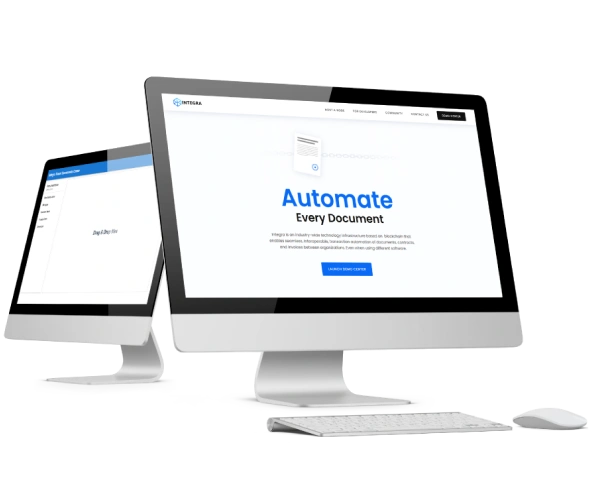
Integral Ledger is an enterprise blockchain-based legal document management solution built for organizations that handle sensitive contracts and compliance with heavy workflows.
This platform reflects the structural foundation needed when you create agentic AI legal automation platform that relies on reliable document intelligence.
Key strengths

Trial Proofer is a virtual law firm system that streamlines case supervision, document organization, evidence handling, and workflow automation.
This aligns directly with building an intelligent agentic system capable of multi-step reasoning and supporting litigation tasks.
Key strengths

Desc Legal is a client facing legal quoting and engagement platform that provides structured intake, contract initiation, and service selection.
This showcases Biz4Group’s ability to build intuitive, user-friendly platforms that support front end interaction, a crucial part of creating a modern agentic AI legal assistant.
Key strengths
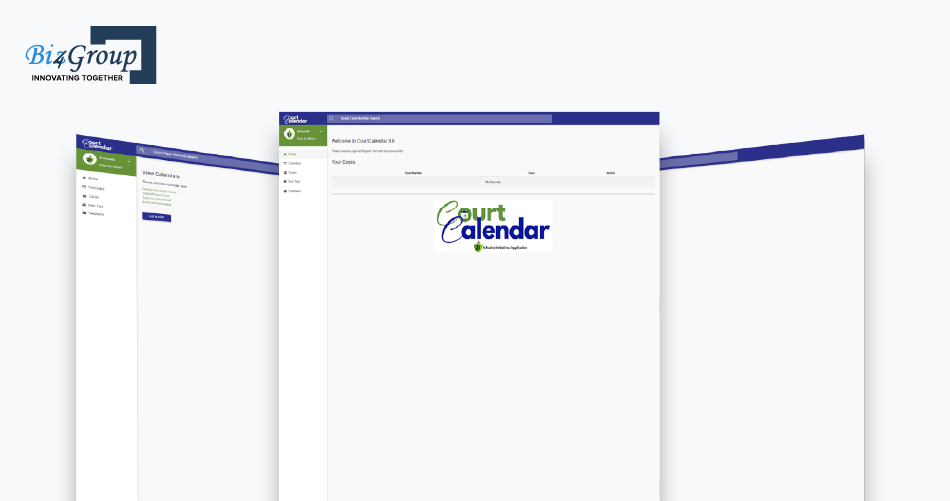
Court Calendar is a legal workflow and scheduling platform built to help attorneys manage hearings, trial schedules, matter timelines, and reminders.
This directly supports the kind of temporal reasoning and automated monitoring you need when you make autonomous AI platform for legal operations.
Key strengths
Each project demonstrates Biz4Group’s ability to:
From secure document systems to virtual law firm platforms, Biz4Group has already delivered the building blocks of modern legal automation. Partnering with them gives you a head start toward a reliable, scalable, and attorney friendly agentic AI solution.
Build With Biz4GroupLegal teams across the industry are experiencing a major shift as intelligent systems reshape how work gets done. Research that once required hours now takes minutes. Contract review that drained entire days can be automated with consistency and clarity. Compliance monitoring, client intake, scheduling, drafting, and internal knowledge retrieval are becoming faster, smarter, and far more dependable. When you develop agentic AI platform for legal services, you are not just adopting another tool. You are reengineering how your entire legal operation functions.
Agentic AI empowers attorneys to move faster, think strategically, and reduce manual workload across every stage of a matter. It improves accuracy, reduces risk, and enhances client service by automating the repetitive routines that slow teams down. Whether you want to create an agentic AI legal automation platform, build agentic AI system for law firms, or make an autonomous AI platform for legal operations, the path forward is clear. The firms that invest now will define the next decade of legal innovation.
Biz4Group has already demonstrated deep authority in legal technology by delivering secure, enterprise-ready platforms built for document intelligence, workflow automation, litigation support, scheduling, and client facing experiences. Their proven expertise helps organizations develop agentic AI for legal services with confidence, speed, and long-term scalability. With a strong foundation in AI engineering and real-world legal workflows, Biz4Group stands out as a trusted partner for anyone ready to modernize legal operations with intelligent automation.
Agentic AI refers to intelligent systems that can plan tasks, reason through information, and complete multi-step workflows on their own. When you develop agentic AI platform for legal services, you get a system that can draft documents, review contracts, run legal research, and follow structured workflows, not just generate text. This is far more capable than traditional automation tools that only perform single step actions.
High volume and repetitive tasks offer the fastest returns. These include contract review, clause extraction, legal research automation, compliance monitoring, client intake, scheduling, drafting, and internal knowledge search. These tasks align perfectly with agent driven workflows and help teams create agentic AI legal automation platform solutions that reduce workload immediately.
Legal teams handle sensitive client data, contracts, filings, and regulatory documents. When you build agentic AI system for law firms, you must address encryption, access controls, audit logs, and compliance with ethical and privacy requirements. A secure platform protects client confidentiality while ensuring your AI agent performs reliably.
An advanced agentic AI legal assistant can perform multi step reasoning, extract relevant information, summarize complex documents, and support legal research. However, when tasks involve interpretation, jurisdiction specific rules, litigation strategy, or high stakes of decisions, attorney supervision is essential. The goal is to augment your team, not replace professional judgment.
Depending on scope, integrations, and features, building a platform can cost anywhere from $15,000 to $150,000+. Costs vary based on the number of workflows, data quality, integrations, compliance requirements, and desired autonomy. Whether you want to make autonomous AI platform for legal operations or build a lightweight assistant, the budget depends on complexity. Factors like LLM usage, integration with CLM or DMS systems, and accuracy testing also influence investment.
If your team has internal engineering talent and deep workflow knowledge, an in-house build may work. Many organizations choose to partner with experienced experts in agentic AI development for legal tech companies because it accelerates success, reduces risk, and ensures compliance ready architecture. For fast deployment, vendor expertise usually delivers stronger results.
Even the best systems cannot replace attorney oversight. When you create agentic AI legal automation platform capabilities, you should expect limitations in nuanced interpretation, ethical decision making, unpredictable fact patterns, and evolving regulations. Human in the loop validation remains essential to ensure accuracy and protect client interests.

with Biz4Group today!
Our website require some cookies to function properly. Read our privacy policy to know more.