 Location :
Orlando, FL, USA
Location :
Orlando, FL, USA +1 (407) 714-1616
 info@biz4group.com

- Develop an AI copilot for doctors by focusing on clinical workflow support, physician adoption, and measurable business outcomes rather than standalone automation.
- AI copilot solutions for clinics and hospitals help reduce documentation burden, improve decision support, and scale care delivery without increasing staff.
- Building an AI copilot for doctors requires the right mix of essential features, advanced intelligence, and seamless EHR integration planned in phases.
- AI copilot development cost for healthcare organizations typically ranges from $30,000-$200,000+, influenced by scope, intelligence depth, and rollout scale.
- Custom AI copilot development for healthcare delivers ROI through recovered clinical time, lower administrative costs, and improved provider retention.
- Biz4Group LLC stands out as a USA-based partner that helps healthcare organizations design, build, and scale trusted AI copilots faster using proven frameworks and reusable components.
How to Develop an AI-Powered Copilot for Doctors: Features and Cost
Have you ever realized how much of a doctor’s day is actually spent caring for patients?
According to reports, physicians spend an average of 15.5 hours per week on paperwork and administration. That imbalance continues to strain care delivery and clinician morale across the U.S. healthcare system.
This is why healthcare leaders are exploring how to develop an AI copilot for doctors that supports clinicians without disrupting how they practice medicine.
Hospitals and clinics today face mounting pressure from staffing shortages, rising patient volumes, and increasing regulatory demands. AI copilot development for doctors has emerged as a practical response to these challenges, helping physicians surface insights faster, reduce cognitive load, and regain time for patient focused care.
What makes this shift compelling is that modern copilots are no longer experimental tools. Organizations are choosing to build AI clinical copilot solutions that integrate directly into clinical workflows, assist with documentation, summarize patient histories, and support clinical reasoning in real time. When designed thoughtfully, these systems feel like an extra set of trained hands rather than another layer of software.
For healthcare executives evaluating next steps, the conversation has moved beyond curiosity. The focus now is on feasibility, cost, risk, and return. This guide walks through the development of AI copilot for doctors from a business and execution perspective.
So, without further ado, let’s begin.
Understanding the Need of AI Copilot for Doctors
Before hospitals commit budgets or timelines, leadership teams need clarity on what they are actually building.
The development of AI copilot for doctors refers to designing a clinical support system that works alongside physicians during their daily routines. It assists with information processing, documentation, and decision support while keeping clinicians in control.
Unlike generic chat tools, an AI copilot operates within clinical context. It listens, reads, summarizes, and suggests based on real patient data, clinical guidelines, and workflow rules. The goal is support, not substitution.
What an AI Copilot for Doctors Does in Practice
At a high level, these systems act as a real-time clinical companion. They surface relevant information when needed and reduce the friction caused by fragmented systems.
Common capabilities include:
- Summarizing patient charts before or during consultations
- Assisting with clinical documentation and notes
- Highlighting risks, gaps, or follow-up needs
- Supporting care coordination across teams
This is why many organizations now prioritize AI copilot solutions for clinics and hospitals that integrate into existing environments instead of adding new standalone tools.
Core Components of an AI Copilot for Doctors
To understand scope and feasibility, it helps to break the copilot into core building blocks.
|
Component |
Purpose in Clinical Workflow |
|
Conversational Interface |
Allows doctors to interact using text or voice without disrupting care |
|
Clinical Context Engine |
Maintains awareness of patient history, labs, medications, and notes |
|
Knowledge Layer |
References medical guidelines, protocols, and internal policies |
|
Decision Support Logic |
Flags risks, trends, or suggested actions for review |
|
Integration Layer |
Connects with EHR, EMR, and hospital systems securely |
|
Audit and Oversight Controls |
Tracks usage, recommendations, and clinician feedback |
These components together enable organizations to build AI clinical copilot solutions that physicians actually adopt.
How an AI Copilot Works Behind the Scenes
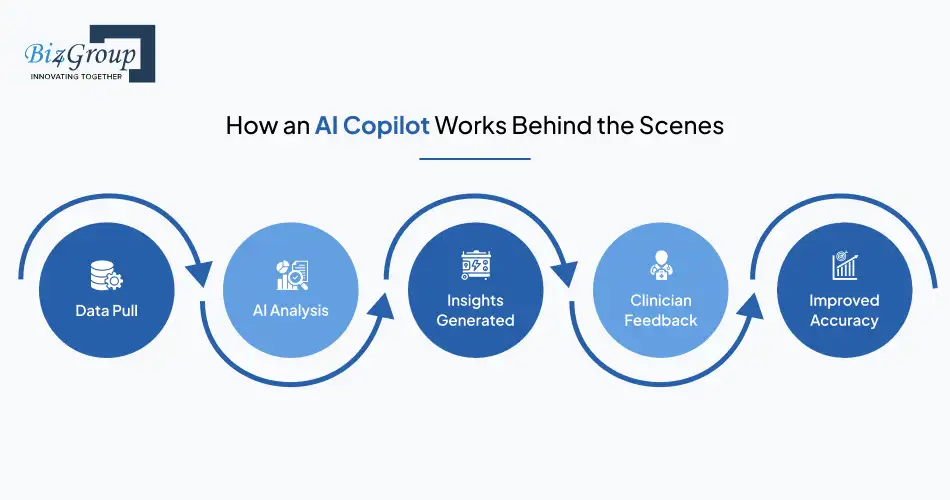
From an operational perspective, the workflow typically follows a predictable loop.
- Clinical data is pulled securely from connected systems such as EHRs
- The copilot analyzes structured and unstructured information in context
- Relevant insights or summaries are generated for physician review
- Clinician actions and feedback refine future responses over time
This closed loop approach ensures accuracy improves without removing human judgment.
For healthcare leaders, this clarity sets realistic expectations and frames the copilot as an extension of clinical intelligence.
Why Are Organizations Investing in AI Copilot Development for Doctors Today?
Healthcare leaders rarely adopt new technology without pressure. In the case of AI copilot development for doctors, the pressure is coming from multiple directions at once. Workforce strain, rising care complexity, and financial inefficiencies are converging, forcing organizations to rethink how clinical work gets done.
A widely cited study shows that 63% of physicians reported symptoms of burnout, driven largely by administrative burden and documentation overload. This environment makes it increasingly difficult to sustain care quality without additional clinical support.
Key Pain Points Driving Adoption
Before discussing benefits, it is important to understand the problems leaders are actively trying to solve.
- Excessive time spent on EHR documentation
- Fragmented patient data across systems
- Alert fatigue and cognitive overload
- Difficulty scaling care without adding staff
- Clinician dissatisfaction and retention risks
These challenges explain why many organizations now prioritize AI copilot solutions for clinics and hospitals that reduce friction inside existing workflows.
Market Momentum and Adoption Signals
AI copilots are no longer limited to pilots and innovation labs. Adoption is accelerating across healthcare systems.
|
Market Indicator |
What It Signals |
|
78% of healthcare organizations are using AI in some capacity |
AI has moved into operational use |
|
Clinical documentation and decision support lead AI investments |
Focus is on physician efficiency |
|
Budget allocation shifting from experimentation to deployment |
Leaders expect measurable ROI |
According to a McKinsey report, generative AI applications in healthcare could unlock up to $60 billion in annual productivity gains, much of it tied to clinical workflows and documentation.
Business Benefits Leaders Care About
When organizations develop AI copilot software for doctors, the value extends beyond clinical convenience.
- Reduced documentation time per physician
- Faster access to relevant patient insights
- Improved care consistency across teams
- Lower burnout related turnover costs
- Better utilization of existing staff
These benefits compound over time, especially in high volume settings.
Delaying investment carries its own risk. The organizations moving forward today view AI copilots as foundational infrastructure. Not a short-term efficiency tool, but a long-term clinical support layer that grows with their care models.
That strategic mindset sets the stage for building systems that physicians trust and patients benefit from.
Doctors Are Drowning in Clicks. Should You Wait or Act?
Physicians spend nearly 2 hours on admin work for every hour of care. AI copilots help win that time back before burnout costs you talent.
Build Smart with Biz4GroupCore Features Required to Create AI Doctor Copilot Systems Integrated with EHR
Every successful AI copilot starts with the right foundation. Before advanced intelligence or AI automation services come into play, healthcare organizations must focus on essential features that physicians rely on daily. These capabilities determine whether clinicians adopt the system or avoid it.
When teams build AI clinical copilot solutions, the goal at this stage is stability, trust, and workflow fit.
|
Core Feature |
What It Is |
What It Does |
|
Conversational Interface |
Text or voice-based interaction layer |
Allows doctors to ask questions, dictate notes, or request summaries during care |
|
Patient Data Summarization |
Context aware data aggregation |
Condenses medical history, labs, medications, and notes into usable insights |
|
Clinical Documentation Assistance |
AI supported note creation |
Helps generate structured clinical notes aligned with physician inputs |
|
EHR Integration |
Secure system connectivity |
Enables the copilot to pull and update patient data inside existing workflows |
|
Decision Support Prompts |
Rule and context-based suggestions |
Highlights risks, reminders, or care considerations for physician review |
|
Audit and Activity Logging |
Usage and recommendation tracking |
Maintains transparency and accountability for clinical oversight |
|
Role Based Access Control |
Permission and identity management |
Ensures only authorized users access sensitive patient information |
These essentials form the baseline to create AI doctor copilot systems integrated with EHR platforms. Without them, even the most advanced models struggle to deliver value in real clinical environments.
With the essentials in place, healthcare teams can confidently move toward more advanced intelligence that differentiates their clinical operations.
Also read: How to develop an AI companion like copilot?
Advanced Capabilities in Custom AI Copilot Development for Healthcare

Once the foundational features are stable, advanced capabilities are what turn a functional system into a true clinical copilot. This stage to develop AI powered copilot for physicians focuses on depth, context, and adaptability. These features help organizations move beyond efficiency gains and into sustained clinical and operational impact.
1. Context-Aware Conversational Intelligence
At this level, the copilot understands multi-step conversations rather than isolated prompts. It remembers prior context, connects patient history with current inputs, and adjusts responses based on clinical urgency. This allows doctors to interact naturally while the system keeps track of evolving situations across a visit or care episode.
Project Spotlight: AI Chatbot for Crisis-Aware Clinical Support
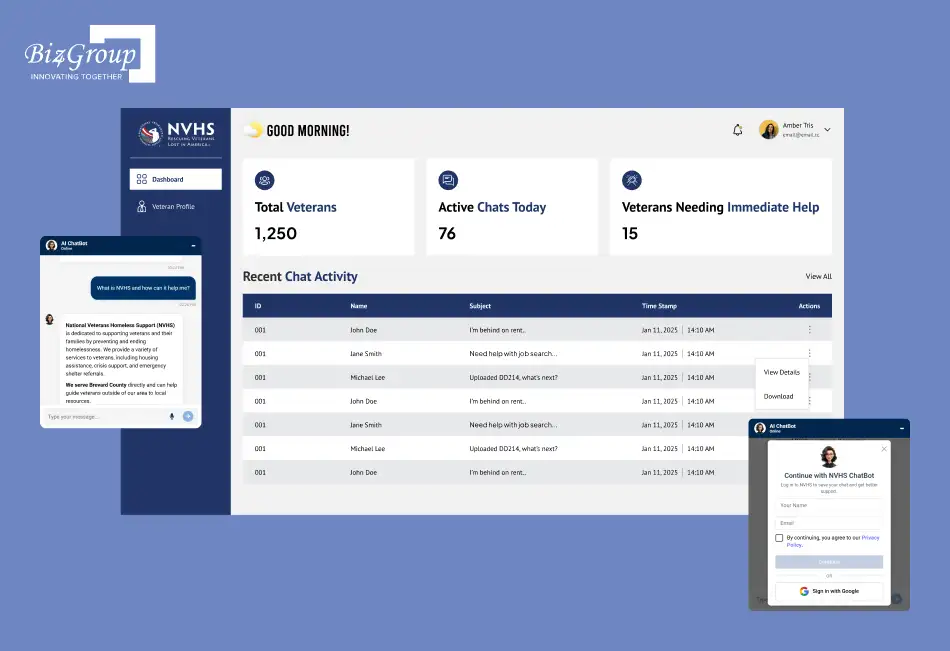
This capability closely mirrors how Biz4Group built a conversational system for high-risk populations, with the help of our exceptional AI chatbot development skills.
- Enabled multi-turn voice and text conversations
- Maintained context across sessions with secure login
- Detected crisis signals in real time and escalated appropriately
- Provided actionable guidance instead of generic responses
The same architecture principles apply when building an AI copilot for doctors who manage complex, time-sensitive cases.
2. Personalized Clinical Recommendation Logic
Advanced copilots adapt recommendations based on patient inputs, clinician behavior, and organizational protocols. Over time, the system learns which suggestions are relevant and which are ignored, improving signal quality. This level of personalization supports more accurate and confident decision making without overwhelming clinicians.
Project Spotlight: Personalized Health Recommendation Engine
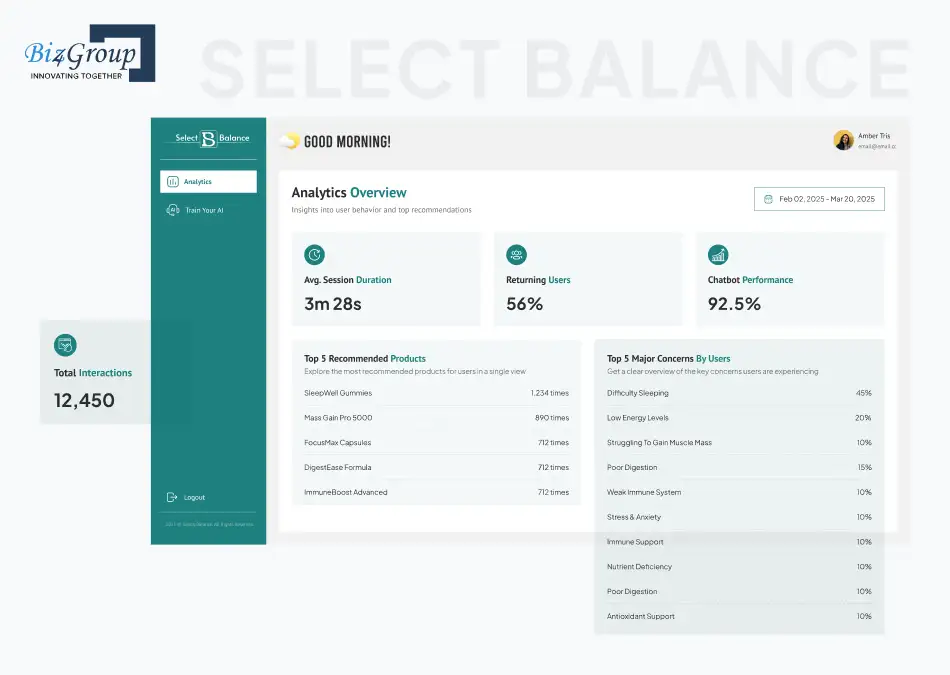
Biz4Group’s work on intelligent supplement recommendation system demonstrates this layer well.
- Interpreted conversational health inputs and guided follow-up questions
- Matched user responses to structured datasets in real time
- Delivered tailored recommendations aligned with individual needs
- Allowed administrators to update logic without developer dependency
These principles translate directly into create AI doctor assistant software that supports physicians with patient-specific insights.
3. Longitudinal Patient Intelligence and Monitoring
Advanced copilots track patterns over time rather than focusing on single encounters. They analyze trends in patient behavior, symptoms, or outcomes to support proactive care decisions. This is especially valuable in chronic care, geriatrics, and mental health settings. The system becomes more useful with time as historical context deepens.
Project Spotlight: Cognitive Monitoring and Emotional Context Tracking
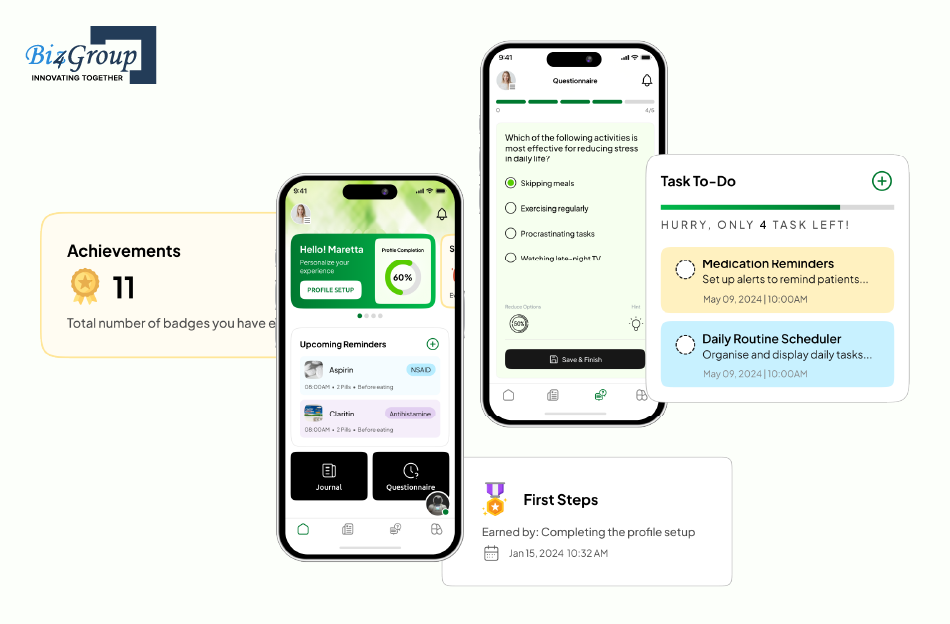
This AI solution for dementia patients highlights how longitudinal intelligence can be built responsibly.
- Stored patient-specific contextual data securely
- Analyzed journaling and interaction patterns over time
- Tracked cognitive performance changes using custom models
- Incorporated voice-based interaction for accessibility
These capabilities reflect how custom AI copilot development for healthcare can support ongoing clinical insight rather than episodic assistance.
4. Voice-First and Hands-Free Clinical Interaction
Advanced copilots support voice input in noisy, fast-paced environments. Physicians can dictate, query, and receive responses without interrupting patient care. Accuracy, latency, and contextual understanding are critical at this stage. This feature significantly improves adoption in real-world clinical settings.
5. Continuous Learning with Human Oversight
Mature copilots evolve through clinician feedback and controlled learning loops. Recommendations improve as models are fine-tuned based on real usage patterns, while governance layers ensure safety and accountability remain intact. This balance of learning and oversight defines successful custom AI copilot development for healthcare at scale.
Advanced features are where differentiation happens. Organizations that invest here move beyond experimentation and build clinical support systems that grow smarter, more trusted, and more valuable over time.
Advanced AI Is Useless If Doctors Won’t Use It
The real advantage comes from copilots built around clinical reality, not shiny features.
Book a Strategy Call TodayRecommended Technology Stack to Develop AI Copilot Software for Doctors at Scale
A well-planned technology stack determines how reliable, secure, and scalable an AI copilot becomes over time. In healthcare AI copilot software development, the stack must support real-time performance, strict compliance, and seamless interoperability with clinical systems.
|
Layer |
Recommended Tools and Frameworks |
Role and Integration Points |
|
Frontend Interface |
React.js, Next.js, Ionic |
Enables responsive clinical dashboards, voice enabled interfaces, and device compatibility |
|
Backend Services |
Handles business logic, authentication, workflow orchestration, and API routing |
|
|
AI and NLP Layer |
GPT-4 class LLMs, custom NLP models |
Processes clinical language, summarizes data, and generates contextual insights |
|
Data Storage |
PostgreSQL, secure object storage |
Stores patient context, interaction history, and audit logs with structured access |
|
EHR Integration |
HL7, FHIR APIs |
Connects the copilot to EHR and EMR systems for patient data exchange |
|
Identity and Access |
OAuth 2.0, role-based access control |
Manages clinician authentication and permission levels securely |
|
Voice Processing |
Speech-to-text and text-to-speech APIs |
Supports hands-free clinical interaction in real-world settings |
|
Monitoring and Analytics |
Custom dashboards, logging frameworks |
Tracks usage, performance, and clinician feedback |
|
Cloud Infrastructure |
AWS, HIPAA compliant hosting |
Ensures scalability, availability, and secure data handling |
By prioritizing interoperability and compliance from day one, organizations reduce technical debt and speed up adoption. A thoughtful stack also lowers long-term maintenance costs while keeping clinical data protected.
Step-by-Step Guide to Building an AI Copilot for Doctors
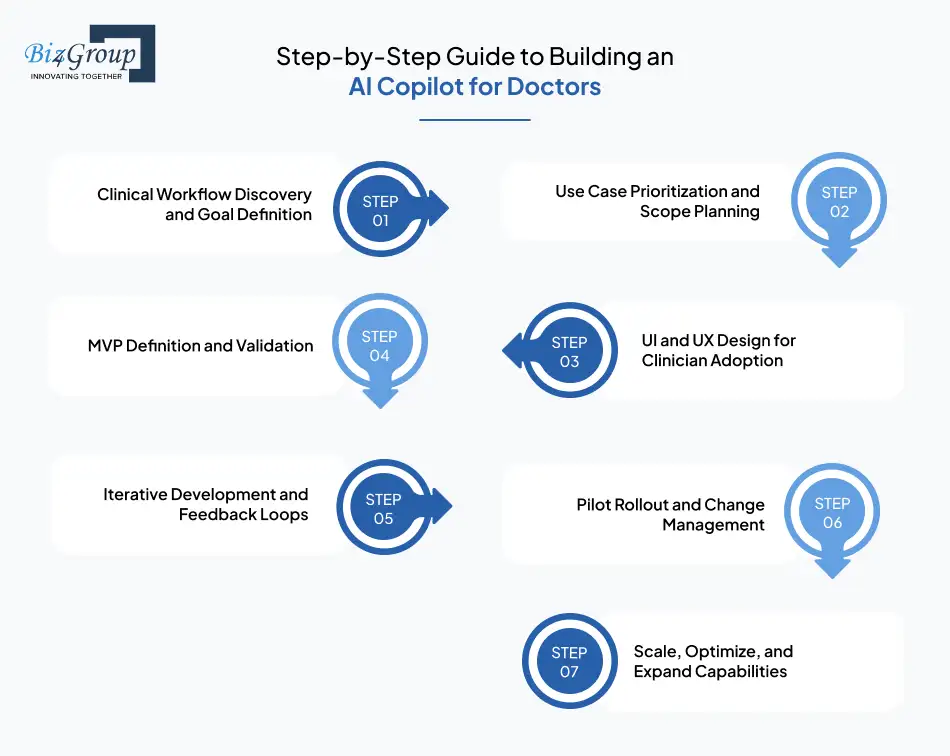
Successful execution matters more than ambition. Organizations that rush development often struggle with adoption, rework, or misaligned expectations. A structured, phased approach helps teams building an AI copilot for doctors stay focused on outcomes while reducing risk.
Below is a practical seven-step process used in custom AI copilot development services for hospitals, designed to balance clinical needs, usability, and business goals.
Step 1: Clinical Workflow Discovery and Goal Definition
Every initiative begins with understanding how doctors actually work. This step maps daily routines, documentation flows, and decision points. Clear goals are defined around what the copilot should assist with and what remains firmly under physician control.
This alignment prevents feature sprawl and sets realistic success metrics.
Step 2: Use Case Prioritization and Scope Planning
Not every clinical task needs automation on day one. Teams identify high-impact, low-disruption use cases such as documentation support or patient summaries. These priorities guide timeline and investment decisions.
Focused scope reduces friction during early adoption.
Step 3: UI and UX Design for Clinician Adoption
Design plays a decisive role in acceptance. Interfaces are shaped around speed, clarity, and minimal interaction. The goal is to support doctors during care, not slow them down with extra clicks. A thoughtful UI and UX design company helps in increasing trust and daily usage across departments.
Also read: Top 15 UI/UX design companies in USA
Step 4: MVP Definition and Validation
A minimum viable product is defined with only essential features. This allows organizations to test assumptions, gather clinician feedback, and validate value quickly. Early validation protects budgets and informs future expansion. This step anchors develop AI copilot software for doctors in real-world learning.
Also read: Top 12+ MVP development companies in USA
Step 5: Iterative Development and Feedback Loops
Once the MVP is live, continuous feedback from physicians drives refinement. Workflows are adjusted, responses improved, and edge cases addressed. Small iterations reduce disruption and build confidence.
This phase transforms initial concepts into usable clinical tools.
Step 6: Pilot Rollout and Change Management
Limited deployment across selected teams allows controlled learning. Training sessions, internal champions, and support channels help clinicians adapt comfortably. Resistance is addressed through transparency and responsiveness.
Effective change management improves long-term adoption.
Step 7: Scale, Optimize, and Expand Capabilities
After successful pilots, the copilot expands to additional departments and use cases. Insights from real usage guide enhancements and performance improvements. This step unlocks broader organizational impact.
It completes the journey of building an AI copilot for doctors that grows with clinical needs.
A step-by-step approach keeps complexity manageable and value measurable. Healthcare organizations that follow this structure move faster, avoid common pitfalls, and build systems clinicians rely on daily.
Also read: How to build an AI copilot for enterprises?
A Clear Plan Beats a Costly Experiment Every Time
A structured roadmap keeps timelines, budgets, and expectations under control.
Schedule a Free Call NowCompliance Framework for AI Copilot Solutions for Clinics and Hospitals
Security and compliance are foundational. When organizations invest in custom AI copilot development for healthcare, trust becomes the deciding factor for adoption, scale, and long-term viability.
Doctors will only rely on systems that protect patient data. Executives will only approve platforms that withstand regulatory scrutiny. This section outlines the non-negotiable compliance areas that must be addressed when developing an AI copilot for doctors.
Core Healthcare Compliance Standards to Address
- HIPAA Compliance: Safeguards for protected health information across storage, processing, and transmission; Administrative, physical, and technical protections enforced consistently; Business Associate Agreements with all vendors involved
- HITECH Act Requirements: Breach notification readiness; Strong data encryption and access controls; Auditable data handling practices
- State-Level Healthcare Regulations: Compliance with state-specific privacy and data residency rules; Additional patient consent and disclosure obligations where applicable
Data Security Measures Built into AI Copilot Platforms
- End-to-end encryption for data at rest and in transit
- Role-based access control aligned with clinical responsibilities
- Secure authentication mechanisms for clinicians and administrators
- Segmented environments to prevent cross-access between systems
- Continuous monitoring and intrusion detection
Responsible AI and Clinical Governance Controls
- Human-in-the-loop review for all recommendations
- Clear distinction between assistance and clinical judgment
- Versioned models with documented updates
- Bias monitoring and performance validation
- Transparent audit trails for every interaction
Compliance Readiness for Audits and Scale
- Maintain detailed access and activity logs
- Support audit exports and compliance reporting
- Design governance frameworks that scale across departments
Compliance directly influences how quickly clinicians trust a system. When security and governance are visible, documented, and enforced, adoption improves naturally. Strong compliance practices protect patients, clinicians, and organizations alike.
With governance in place, leaders can now evaluate investment levels and cost expectations with confidence.
Also read: HIPAA compliant AI app development guide for healthcare providers
Cost Breakdown of Development of AI Copilot for Doctors
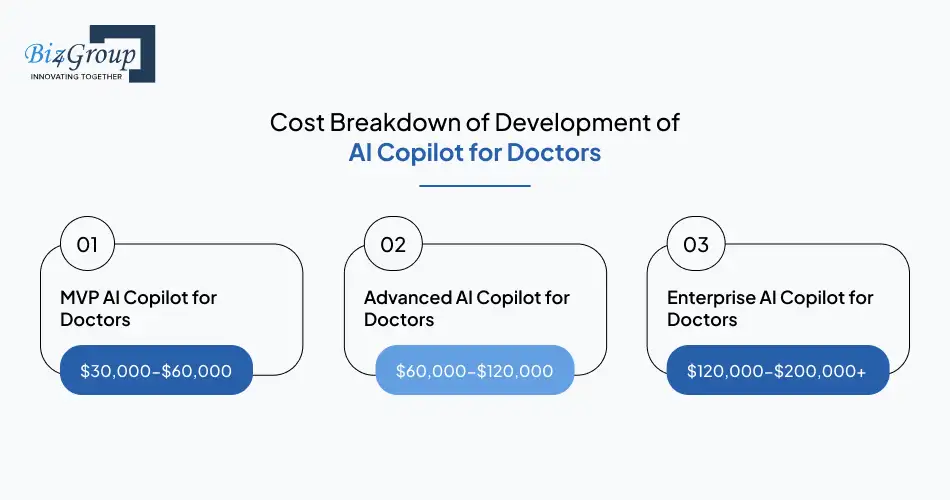
Cost is often the deciding factor when leaders evaluate whether to move forward. On average, the AI copilot development cost for healthcare organizations typically ranges between $30,000-$200,000+, depending on scope, intelligence depth, AI integration services, and rollout scale. This range reflects real-world projects that move from focused pilots to enterprise-grade clinical platforms.
Before breaking down individual cost drivers, it helps to understand how investment grows as capability expands.
Typical Cost Range from MVP to Full-Scale Deployment
|
Build Level |
What It Covers |
Average Investment Range |
|
MVP AI Copilot for Doctors |
Core features, limited workflows, basic UI |
$30,000-$60,000 |
|
Advanced AI Copilot for Doctors |
Context awareness, personalization, broader use cases |
$60,000-$120,000 |
|
Enterprise AI Copilot for Doctors |
Multi-department scale, governance layers, optimization |
$120,000-$200,000+ |
These ranges give leadership a planning baseline when deciding how to develop AI copilot software for doctors without overcommitting early.
Cost Drivers That Shape the Final Investment
Every AI copilot project is different, but the same cost drivers influence almost every build. Understanding these upfront helps teams plan budgets with fewer surprises.
|
Cost Driver |
What It Impacts |
Typical Cost Impact |
|
Scope of Use Cases |
Number of clinical workflows supported |
$10,000-$40,000 |
|
UI and UX Design Depth |
Simplicity and adoption readiness |
$5,000-$20,000 |
|
Level of Intelligence |
Context handling and personalization |
$15,000-$50,000 |
|
Integrations Required |
EHRs and internal systems |
$10,000-$40,000 |
|
Pilot and Feedback Cycles |
Iteration and refinement effort |
$5,000-$15,000 |
|
Scale and User Volume |
Performance and expansion readiness |
$10,000-$35,000 |
Each added layer increases value, but also increases responsibility. This is why many teams begin with an MVP before expanding.
Hidden Costs Healthcare Leaders Often Overlook
While feature and development costs are planned, hidden expenses can quietly inflate budgets if ignored. These costs appear after initial deployment and directly impact long-term ROI.
Ongoing Model Tuning and Optimization
Clinical language evolves, workflows shift, and edge cases emerge. Continuous tuning typically adds $1,500-$4,000 per month, depending on usage and complexity.
Clinician Training and Adoption Support
Even intuitive systems require onboarding. Training materials, workshops, and internal support efforts often cost $3,000-$10,000 annually.
Change Management and Internal Alignment
Time spent by clinical leaders, IT teams, and administrators has real cost. Organizations often allocate 5%-10% of the total project budget to manage adoption smoothly.
Monitoring and Performance Oversight
Tracking accuracy, usage, and system health requires dashboards and periodic reviews. This typically adds $2,000-$8,000 per year.
Cost transparency creates confidence. The smartest investments treat AI copilots as evolving clinical assets. Not one-time projects. Planning costs across stages ensures sustainability while protecting budgets.
$30,000-$200,000+ Is a Range. Your Number Should Be Precise
Know exactly what you need, what to skip, and how to avoid hidden costs before committing a dollar.
Get a Custom QuoteMeasuring ROI When You Develop AI Copilot Software for Doctors
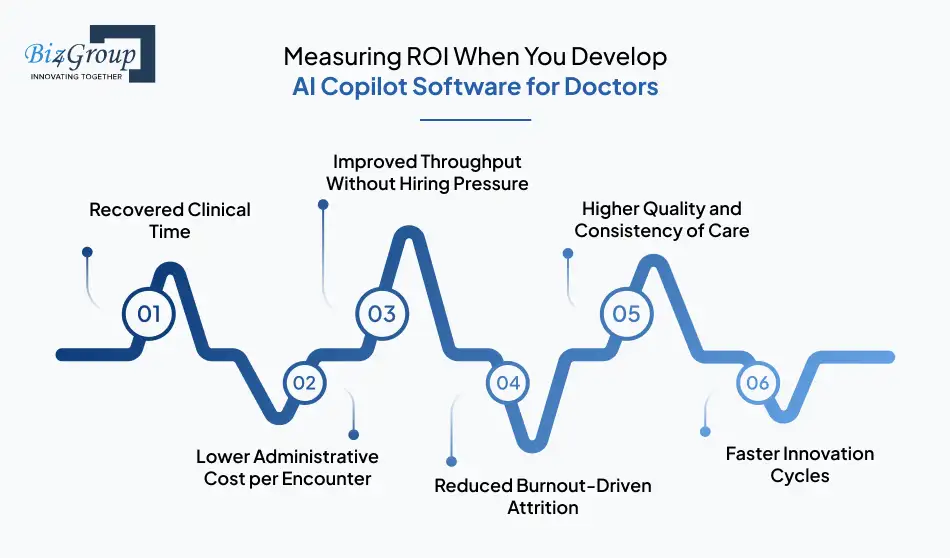
Return on investment is where strategic decisions are validated. When healthcare organizations develop AI copilot software for doctors, ROI is measured across time, cost, quality, and workforce stability. Unlike surface-level efficiency gains, these returns compound as adoption increases.
Below are the primary ROI areas leaders track once the copilot moves beyond pilot use.
Recovered Clinical Time
Doctors consistently report reduced documentation and navigation effort. Even a conservative recovery of 30-45 minutes per physician per day translates into meaningful capacity gains across departments. Over a year, this reclaimed time often outweighs the initial investment.
Lower Administrative Cost per Encounter
AI copilots streamline note creation, chart review, and follow-up documentation. This reduces reliance on manual administrative support and overtime hours. Many organizations see a 15%-25% reduction in indirect administrative costs tied to clinical workflows.
Improved Throughput Without Hiring Pressure
By supporting faster decision making and cleaner documentation, clinics and hospitals can handle higher patient volumes using existing staff. This creates revenue upside without proportional increases in headcount.
Reduced Burnout-Driven Attrition
Physician turnover carries a significant financial burden. AI copilots that reduce cognitive overload contribute to higher job satisfaction. Even preventing the loss of one experienced clinician can offset a large portion of the AI copilot development cost for healthcare organizations.
Higher Quality and Consistency of Care
Standardized summaries, reminders, and contextual prompts reduce variation in care delivery. Over time, this leads to fewer errors, better follow-up compliance, and stronger patient outcomes, which directly impact reimbursement and reputation.
Faster Innovation Cycles
Once the foundation is in place, adding new workflows or specialties becomes faster and less expensive. This flexibility allows organizations building an AI copilot for doctors to adapt quickly as care models evolve.
How Leaders Should Evaluate ROI Over Time
- Early phase focuses on time saved and adoption rates
- Mid phase tracks cost efficiency and throughput improvements
- Long term phase measures retention, quality metrics, and scalability
This layered evaluation provides a realistic picture of value creation.
The strongest ROI does not come from automation alone. It comes from enabling clinicians to practice at the top of their license while organizations operate with greater efficiency and resilience.
When planned correctly, the return from AI copilot solutions for clinics and hospitals extends well beyond cost savings and becomes a competitive advantage.
Challenges and Risks in AI Copilot Development for Doctors and How to Mitigate Them
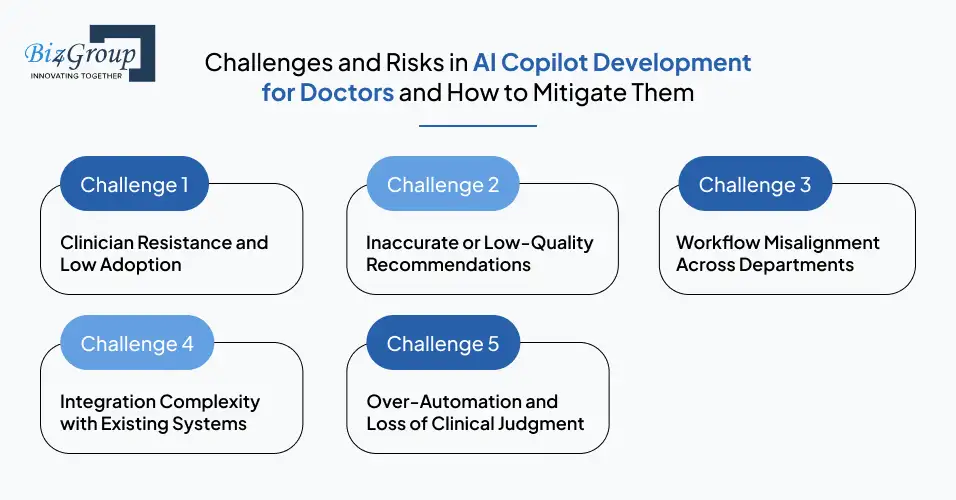
Every healthcare AI initiative carries risk if not planned carefully. Organizations building an AI copilot for doctors often face challenges that go beyond technology. These risks usually surface around adoption, accuracy, governance, and scale. Addressing them early protects investment and accelerates trust.
Challenge 1: Clinician Resistance and Low Adoption
Doctors are cautious with new systems, especially those introduced during care delivery. If the copilot disrupts workflows or feels intrusive, adoption drops quickly.
Mitigation Strategies
- Involve physicians early during discovery and design
- Focus UI and UX on speed and minimal interaction
- Start with assistive use cases rather than prescriptive ones
- Use pilot groups and internal champions to build trust
Challenge 2: Inaccurate or Low-Quality Recommendations
AI copilots depend on context and data quality. Poor inputs or generic responses can reduce confidence and increase clinical risk.
Mitigation Strategies
- Limit early recommendations to low-risk assistance
- Keep clinicians in full control of final decisions
- Implement continuous feedback loops for refinement
- Validate outputs regularly with clinical experts
Challenge 3: Workflow Misalignment Across Departments
What works for one specialty may not work for another. A one-size approach often fails in complex hospital environments.
Mitigation Strategies
- Map workflows separately for key departments
- Customize interaction patterns per specialty
- Roll out features in phases instead of all at once
- Measure usage and adjust based on real behavior
Challenge 4: Integration Complexity with Existing Systems
Disconnected systems create friction and manual workarounds. Poor integration limits value.
Mitigation Strategies
- Prioritize interoperability from the start
- Use standardized data exchange protocols
- Avoid replacing systems that clinicians already trust
- Test integrations thoroughly during pilot phases
Challenge 5: Over-Automation and Loss of Clinical Judgment
When copilots attempt to replace decision making, risk increases and trust declines.
Mitigation Strategies
- Design the copilot as an assistant, not an authority
- Clearly label suggestions and insights
- Maintain human oversight for all clinical decisions
- Establish governance rules around AI boundaries
Challenges are not signals to pause. They are signals to plan better. With the right mitigation strategies, create AI doctor assistant software that clinicians trust, leaders support, and patients benefit from over the long term.
AI Projects Fail Quietly. The Cost Shows Up Later
Adoption, trust, and workflow fit decide success. Get it right the first time with a partner who has seen the pitfalls.
Talk to Our ExpertsWhy Do Healthcare Organizations Across the USA Trust Biz4Group LLC to Develop an AI Copilot for Doctors?
Biz4Group LLC is a USA-based software development company built around one core belief. Technology should solve real business problems, not create new ones. For over two decades, we have partnered with entrepreneurs, healthcare organizations, and enterprises to design and build AI healthcare solutions that performs in real-world environments.
Our strength lies in execution. We translate complex clinical and operational challenges into enterprise AI solutions that doctors and healthcare teams actually use. From conversational AI agents and decision-support systems to patient-centric applications, our work reflects a deep understanding of healthcare workflows and data sensitivity.
What sets Biz4Group apart is our ability to combine strategic thinking with hands-on engineering. We do not approach AI copilot development for doctors as a one-size initiative. Every solution is planned around clinical context, business goals, and long-term scalability. Our teams work closely with healthcare leaders to ensure the copilot supports physicians without interrupting care delivery.
Why Businesses Choose Biz4Group LLC
Healthcare organizations choose Biz4Group because we bring clarity where complexity usually slows progress.
- Proven experience building secure, healthcare-focused AI platforms
- Strong background in conversational AI, personalization, and clinical context handling
- Product-first mindset that prioritizes usability and adoption
- Transparent communication and predictable delivery timelines
- Ability to scale solutions from MVP to enterprise rollout
Our portfolio reflects real outcomes, not experiments. Biz4Group LLC stays involved beyond launch, helping organizations refine, scale, and evolve their AI copilots as clinical needs change.
When healthcare organizations look for a partner to build systems that doctors rely on daily, credibility matters. Experience matters. Execution matters. As one of the top AI copilot development companies in USA, Biz4Group brings all three together.
If you are planning to develop an AI copilot for doctors and want a USA-based partner who understands healthcare at depth, this is the right time to start the conversation.
Let’s discuss your AI copilot vision and turn it into a system your clinicians trust.
Get in touch.Final Thoughts
Building an AI copilot for doctors has moved from being a forward-looking idea to a practical strategy for modern healthcare organizations. As clinical complexity increases and administrative demands continue to rise, copilots provide a way to support physicians without altering how care is delivered.
From essential features and advanced intelligence to cost planning, compliance, and ROI, developing an AI copilot requires clear intent and disciplined execution. Success depends on understanding clinical workflows, managing risk responsibly, and scaling capabilities in phases.
This is where Biz4Group LLC stands out. As an AI development company, Biz4Group brings deep experience in building healthcare-focused AI platforms that perform in real environments. Our teams understand how to translate clinical needs into usable systems, helping organizations develop AI copilots that doctors trust and leaders can confidently scale.
So, without any delay, partner with Biz4Group LLC and build an AI copilot that delivers real clinical impact, not promises.
FAQs
How long does it typically take to develop an AI copilot for doctors?
Most organizations can expect an AI copilot MVP to take 8-12 weeks, with full-scale versions extending to several months. Biz4Group can deliver an MVP in 2-3 weeks by using reusable healthcare AI components that significantly reduce both development time and cost.
Can small clinics benefit from AI copilot solutions, or are they only for large hospitals?
AI copilot solutions for clinics and hospitals are not limited to large systems. Smaller practices often see faster returns because focused workflows, lower user counts, and simpler integrations allow quicker adoption and measurable efficiency gains.
What clinical roles benefit the most from an AI copilot besides physicians?
Nurse practitioners, care coordinators, physician assistants, and clinical administrators often gain significant value. Copilots support team-based care by improving information flow, task handoffs, and documentation consistency across roles.
How customizable is AI copilot development for different medical specialties?
Customization is a core requirement in AI copilot development for doctors. Workflows, terminology, and priorities differ across specialties like cardiology, oncology, and primary care. Well-designed copilots are tailored at the specialty and even department level.
Does an AI copilot require large volumes of historical data to work effectively?
Not always. Many copilots start with limited data access and improve over time. While historical data enhances context and accuracy, strong early results are possible with focused use cases and controlled learning approaches.
Can an AI copilot be deployed across multiple facilities or locations?
Yes. Modern AI copilot solutions for clinics and hospitals are designed to scale across locations. Centralized governance combined with local workflow customization allows consistent performance without sacrificing flexibility.
