 Location :
Orlando, FL, USA
Location :
Orlando, FL, USA +1 (407) 714-1616
 info@biz4group.com

- Uncover the top AI development companies in Orlando, compare capabilities and choose reliable partners for 2026 projects.
- Orlando’s tech ecosystem continues to attract the best AI development companies in Orlando due to strong talent availability and industry diversity.
- Explore profiles of the top AI companies in Orlando with clear insights on their strengths, industries, and ideal business fit.
- Learn how to choose AI development companies in Orlando, considering their communication, pricing, scalability, and support.
- Red and green flags help founders and leaders avoid risky vendors and prioritize leading AI development agencies in Orlando with strong delivery practices.
- Biz4Group LLC stands out for its strategic approach, engineering depth, and ability to support startups and enterprises with long-term, high-impact digital solutions.
Be honest, how much time does your team spend just trying to get schedules right?
If you are juggling spreadsheets, texts, emails, and last-minute calls, you are not alone. Most healthcare organizations still rely on systems that were never built for real-world nurse scheduling.
And it shows.
- Have you noticed managers spending hours fixing avoidable conflicts?
- Nurses frustrated by missed swaps or unclear schedules?
- Leadership worried about compliance, coverage gaps, and burnout?
This is not a people problem. It is a system problem.
In 2025, healthcare leaders are under pressure to fix it fast. According to research, the global healthcare workforce management systems market is expected to reach USD 2.48 billion in 2025, driven by the need for better staffing visibility and operational control.
On top of that, the U.S. healthcare staffing and scheduling software market is projected to exceed USD 5.68 billion by 2034, as hospitals and staffing agencies invest in smarter scheduling tools.
So here is the real question - Do you keep forcing complex workflows into generic tools, or do you build something that actually fits how your organization works?
That is why more leaders are choosing to develop a nurse shift calendar application like My Shift Planner. Not because they want another app, but because they want control. Flexibility. And fewer surprises every week.
When organizations come to us as an AI development company, they usually say the same thing.
“We need scheduling to stop being a daily fire drill.”
Partnering with the right custom software development company allows you to design scheduling around your facilities, your staffing rules, and your growth plans. Not the other way around.
In this guide, we will break down exactly how to develop nurse scheduling apps like My Shift Planner, what makes them work, and how you can create a nurse shift calendar application that reduces chaos instead of adding to it.
Let’s start with the app that inspired so many of these conversations in the first place.
What Is My Shift Planner App and Why Healthcare Organizations Should Invest in Similar Solutions?
You may already be familiar with My Shift Planner. In fact, there’s a good chance some of your nurses are already using it.
At its core, My Shift Planner is a personal scheduling tool designed to help nurses organize shifts, rotations, and work patterns in a simple calendar view. For individual users, it solves a real problem. Visibility. Predictability. Fewer surprises.
And for solo use, it works well. But once you zoom out and look at healthcare operations as a whole, a bigger question comes up.
Is a personal scheduling app enough when you are managing multiple departments, facilities, and staffing rules?
Understanding the My Shift Planner Business Model
My Shift Planner follows a freemium model. Nurses can use the basic version at no cost, while premium features are unlocked through in-app upgrades. For teams and organizations, scheduling is managed through its companion platform, My Shift Manager.
This approach lowers adoption friction, but it also highlights a limitation. The app was never designed as a full nurse workforce scheduling software development like My Shift Planner solution for enterprises.
Here is how the business model breaks down.
My Shift Planner / MyShiftManager Business Model and Pricing
|
Component |
What It’s Used For |
Pricing |
|
My Shift Planner (Mobile App) |
Individual nurse shift tracking and calendar visibility |
Free |
|
My Shift Planner Pro (In-App Upgrade) |
Advanced planning and customization features |
Varies by app store |
|
MyShiftManager Monthly Plan |
Centralized team scheduling and sync with mobile app |
£75 per month + VAT |
|
MyShiftManager Annual Plan |
Same features with discounted annual billing |
£775 per year + VAT |
|
MyShiftManager Enterprise Plan |
Tailored setup for larger organizations |
Custom pricing |
This model works for small teams getting started. It helps organizations experiment with digital scheduling without a major upfront investment. However, as operations scale, cracks begin to show.
Why off-the-shelf nurse scheduling apps fall short
Healthcare scheduling is not just about placing names on a calendar.
You are balancing credentials, labor laws, overtime thresholds, shift preferences, and last-minute coverage needs. Personal apps struggle with this complexity because they are not built to develop nurse shift calendar software for healthcare organizations like My Shift Planner at scale.
That is why hospitals, clinics, and agencies eventually move toward broader healthcare workforce management software that connects scheduling with compliance, reporting, and workforce analytics. At this point, leadership usually faces a decision.
Do you keep stretching a tool beyond its limits? Or do you create nurse shift calendar applications that match how your organization actually operates?
Why healthcare organizations choose to build their own solution
When you decide to develop a nurse shift calendar application like My Shift Planner, you keep the user experience nurses like while adding the control healthcare leaders need.
- You define your own scheduling rules.
- You support multiple facilities and staffing models.
- You integrate directly with HR, payroll, and clinical systems.
This approach also opens the door to custom nurse shift planner app development like My Shift Planner, where features are shaped around your workflows instead of generic assumptions.
Most importantly, you stop treating scheduling as a standalone tool and start viewing it as part of a long-term healthcare software product development strategy.
My Shift Planner shows what is possible for individuals. A custom-built solution shows what is achievable for hospitals, clinics, and staffing agencies operating at scale.
Next, let’s talk about what decision makers care about most. The real, measurable benefits you gain when you build a nurse shift planner app like My Shift Planner but designed for enterprise healthcare from day one.
Still Scheduling the Hard Way?
By 2025, healthcare organizations are investing billions in smarter workforce systems to reduce burnout and staffing gaps. Manual scheduling is no longer keeping up, and you already feel it.
Talk to Our Healthcare Tech ExpertsThe Real ROI of Building a Nurse Shift Planner App Like My Shift Planner
You are not building software just to digitize schedules; you are doing it to fix operational gaps that cost time, money, and staff goodwill.
When healthcare leaders decide to develop a nurse shift calendar application like My Shift Planner, the return shows quickly and across multiple layers of the organization. Let’s break down where that value actually comes from.
1. Reduced Administrative Burden for Managers and Staff
Manual scheduling drains productivity. Managers spend hours every week resolving conflicts, updating calendars, and answering the same questions repeatedly. When you build a nurse shift planner app like My Shift Planner, those repetitive tasks move into automated workflows. Schedules update in real time, changes are visible instantly, and approvals follow predefined rules. That frees your leadership team to focus on care delivery instead of calendar cleanup.
2. Fewer Scheduling Conflicts and Last-Minute Gaps
Double bookings, missed shifts, and coverage gaps are rarely accidents. They are symptoms of limited visibility and slow communication. A custom nurse scheduling solution gives you a single source of truth for availability, credentials, and shift assignments. This makes it easier to create nurse shift planning apps to reduce scheduling conflicts, even when demand changes suddenly or staff availability shifts mid-week.
3. Improved Nurse Satisfaction and Retention
Nurses want clarity and fairness. When schedules feel unpredictable or biased, morale drops fast. With custom nurse shift planner app development like My Shift Planner, you can account for preferences, rotations, and workload balance in a transparent way. Nurses know where they stand, can request changes easily, and feel more in control of their time. That sense of control directly impacts retention in a competitive labor market.
4. Better Compliance and Risk Management
Healthcare scheduling is tied closely to compliance. Overtime limits, credential validity, rest periods, and labor laws all matter. Generic tools struggle to enforce these rules consistently. When you develop nurse shift calendar software for healthcare organizations like My Shift Planner, compliance becomes part of the system logic. Alerts, validations, and audit trails reduce human error and help you stay inspection-ready without extra effort.
5. Scalability Without Operational Chaos
Growth exposes weak systems. Adding new facilities or departments often breaks manual scheduling processes. A well-architected solution, supported by enterprise AI solutions, allows you to scale scheduling across locations without adding complexity. You can standardize policies where needed while still allowing flexibility at the unit level, which is critical for long-term expansion.
6. Stronger Workforce Planning and Forecasting
Scheduling data is more than logistics. It is insight. When you treat your app as an AI healthcare staffing app rather than just a calendar, you unlock patterns around absenteeism, overtime trends, and staffing shortages. That data supports smarter hiring decisions, better budget planning, and proactive staffing strategies instead of reactive fixes.
All of these benefits point to one conclusion. When done right, nurse scheduling software is not a cost center. It is an operational advantage.
Must-Have and Advanced Features When You Build a Nurse Shift Planner App Like My Shift Planner
When healthcare leaders decide to build a nurse shift planner app like My Shift Planner, feature depth becomes the difference between a scheduling tool and a true workforce system.
Basic apps help nurses view shifts.
Enterprise-ready apps help organizations run smoothly at scale.
Below is a complete feature framework you should expect when planning nurse shift calendar application development like My Shift Planner for hospitals, clinics, or staffing agencies.
Core Features That Drive Daily Adoption
|
Feature |
What It Does |
Why It Matters in Real Operations |
|
Smart Shift Calendar Interface |
Shows shifts across daily, weekly, and monthly views with role and unit visibility |
Reduces confusion and gives nurses immediate clarity without back-and-forth communication |
|
Availability & Preference Management |
Captures nurse availability, preferred shifts, and blackout periods |
Helps managers build fair schedules while improving engagement and retention |
|
Shift Swap & Coverage Requests |
Allows nurses to request swaps with built-in approval logic |
Critical to create nurse shift planning apps to reduce scheduling conflicts |
|
Automated Rule-Based Scheduling |
Applies labor laws, credential rules, rest periods, and overtime limits |
Eliminates manual errors and lowers compliance risk |
|
Real-Time Notifications & Alerts |
Sends instant updates for changes, approvals, or urgent coverage needs |
Keeps everyone aligned without relying on texts or emails |
|
Multi-Facility & Multi-Role Support |
Manages schedules across departments, locations, and job roles |
Essential when you build nurse scheduling calendar apps for hospitals and clinics like My Shift Planner |
|
Role-Based Access Control |
Defines permissions for nurses, supervisors, and admins |
Protects sensitive data and enforces accountability |
|
Workforce Reporting & Analytics |
Tracks utilization, overtime, absenteeism, and coverage trends |
Turns scheduling data into actionable insights |
|
User-Centered Interface Design |
Focuses on speed, clarity, and accessibility across devices |
Strong UI/UX design directly impacts adoption |
Advanced Features That Enable Scale and Automation
As operations grow, scheduling complexity increases. This is where advanced features become essential.
|
Advanced Feature |
How It Works |
Operational Impact |
|
AI-Driven Shift Optimization |
Uses historical data to recommend optimal staffing patterns |
Reduces understaffing and overtime costs |
|
Autonomous Scheduling Logic |
Smart workflows powered by AI automation services handle repetitive scheduling decisions |
Saves managers hours every week |
|
Intelligent Scheduling Engine |
An embedded AI agent analyzes availability, demand, and compliance rules |
Enables smarter, faster scheduling decisions |
|
Conversational Scheduling Assistant |
Nurses interact with the app via chat to request swaps, check schedules, or get updates |
Built using expertise from an AI chatbot development company |
|
Predictive Staffing Insights |
Forecasts shortages, absenteeism spikes, and overtime risks |
Similar intelligence found in an AI virtual healthcare assistant |
|
Agentic Decision-Making Workflows |
Scheduling adapts automatically based on real-time conditions using agentic AI development |
Moves scheduling from reactive to proactive |
|
System-to-System Integrations |
Connects seamlessly with HR, payroll, EHR, and credentialing systems |
Enabled through robust AI integration services |
|
Audit Trails & Compliance Logs |
Maintains a complete record of schedule changes and approvals |
Supports regulatory audits and internal reviews |
|
Enterprise Security & Data Governance |
Encrypts data and enforces strict access policies |
Required for large-scale healthcare deployments |
|
Future-Ready AI Architecture |
Supports continuous improvement and new automation models |
Aligned with the evolution of agentic AI in healthcare |
Why feature depth matters more than feature count
It’s easy to add features.
It’s harder to make them work together smoothly.
That’s why custom nurse shift planner app development like My Shift Planner starts with understanding workflows first, then layering intelligence where it actually reduces friction. When features are designed around real clinical operations, adoption becomes natural and long-term value follows.
From Idea to Launch: Steps to Develop a Nurse Shift Calendar Application Like My Shift Planner
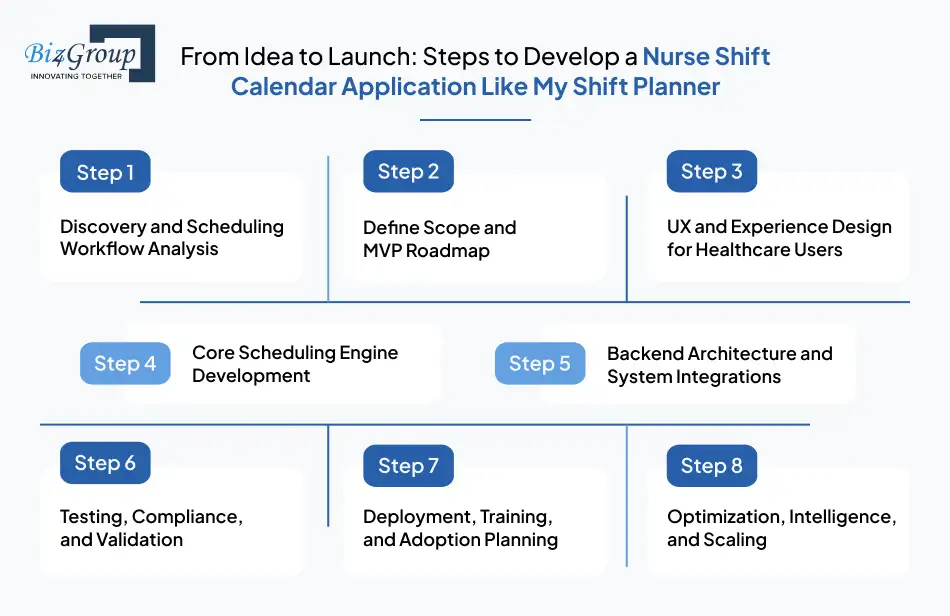
When you set out to develop a nurse shift calendar application like My Shift Planner, success depends less on speed and more on structure. Healthcare scheduling software touches real people, real compliance rules, and real operational risk.
Below is a proven, step-by-step approach used to develop nurse scheduling apps like My Shift Planner that actually scale in hospitals, clinics, and staffing agencies.
Step 1: Discovery and Scheduling Workflow Analysis
The first step in nurse shift calendar application development like My Shift Planner is understanding how scheduling truly works inside your organization. This includes not just policies, but the day-to-day realities managers and nurses deal with.
You uncover hidden bottlenecks early so they don’t resurface later as expensive fixes.
- Interview hospital administrators, nurse managers, and staffing coordinators
- Document scheduling rules, credentials, rotations, and exceptions
- Identify gaps that lead to conflicts and overtime
Step 2: Define Scope and MVP Roadmap
Trying to build everything at once often delays value. This stage focuses on deciding what your first release must include to solve core scheduling problems while leaving room to grow.
A structured MVP development approach helps validate usability before expanding into a full custom nurse shift planner app development like My Shift Planner initiative.
- Prioritize core scheduling, visibility, and approvals
- Define MVP success metrics tied to adoption
- Plan feature expansion in controlled phases
Step 3: UX and Experience Design for Healthcare Users
Nurse scheduling software must feel intuitive from day one. During this phase, workflows are designed to minimize clicks, reduce cognitive load, and fit naturally into clinical routines.
Strong UX is critical when you build nurse shift planner apps for hospitals and clinics like My Shift Planner, where time is always limited.
- Design nurse, manager, and admin user journeys
- Simplify shift views, swaps, and requests
- Validate designs with real healthcare users
Also Read: How Much Does UI/UX Design Cost – The Complete Guide
Step 4: Core Scheduling Engine Development
This is the technical heart of the product. Scheduling logic must balance availability, preferences, compliance, and last-minute changes without breaking down under pressure.
This step is essential to develop scalable nurse shift management software that performs reliably as usage grows.
- Build rule-based scheduling and conflict detection
- Implement automated shift swaps and approvals
- Enforce credential, overtime, and rest-period rules
Step 5: Backend Architecture and System Integrations
To develop nurse shift calendar software for healthcare organizations like My Shift Planner, the platform must integrate seamlessly with existing systems. Scheduling cannot operate in isolation.
This stage ensures your app fits into a broader healthcare technology ecosystem.
- Architect scalable backend services
- Integrate with HR, payroll, and credentialing systems
- Implement secure data access and role controls
Step 6: Testing, Compliance, and Validation
Healthcare scheduling errors carry real risk. This phase focuses on making sure the system behaves correctly in both normal and edge-case scenarios.
Rigorous testing protects both staff trust and organizational compliance.
- Perform functional and performance testing
- Validate audit trails and approval workflows
- Stress-test scheduling under peak demand
Step 7: Deployment, Training, and Adoption Planning
Even the best-built product fails without adoption. This step ensures teams understand the system and feel confident using it in daily operations.
Many organizations choose to hire AI developers with healthcare experience to support rollout and ongoing optimization.
- Roll out by department or facility
- Provide training for nurses and managers
- Monitor usage and address early feedback
Step 8: Optimization, Intelligence, and Scaling
After launch, real usage data becomes your most valuable asset. This phase focuses on improving performance, adding intelligence, and supporting growth.
This is how organizations build nurse scheduling calendar apps for staffing agencies like My Shift Planner and expand them across multiple clients and locations.
- Analyze scheduling trends and conflict patterns
- Optimize performance and automation
- Extend features for new facilities and staffing models
Together, these steps create a reliable roadmap to build a nurse shift planner app like My Shift Planner that delivers real operational value instead of surface-level functionality.
Wondering If Your App Idea Is Actually Build-Ready?
A clear development roadmap separates successful nurse scheduling platforms from stalled projects. The right planning today saves months of rework tomorrow.
Discuss Your App RoadmapTechnology Stack That Powers Scalable Nurse Shift Calendar Application Development Like My Shift Planner
When you develop a nurse shift calendar application like My Shift Planner, your tech stack decides whether the product feels fast and reliable or slow and fragile. This is not about chasing trendy tools. It is about choosing technology that supports healthcare complexity, real-time updates, and long-term growth.
Below is a practical, enterprise-ready tech stack commonly used to build nurse shift planner apps like My Shift Planner for hospitals, clinics, and staffing agencies.
|
Layer |
Technology Choices |
Why It Matters for Healthcare Scheduling |
|
Frontend (Web) |
React.js, Angular, Vue.js |
Delivers fast, responsive dashboards for managers and admins handling complex schedules |
|
Frontend (Mobile) |
Flutter, React Native |
Enables cross-platform nurse apps with consistent performance on iOS and Android |
|
Backend Framework |
Supports real-time scheduling logic and scalable API handling |
|
|
Database |
PostgreSQL, MySQL, MongoDB |
Manages shift data, availability, audit logs, and scheduling rules reliably |
|
Real-Time Updates |
WebSockets, Firebase, Socket.IO |
Keeps schedules synced instantly across users and devices |
|
AI & Scheduling Logic |
Python, TensorFlow, custom ML models |
Powers intelligent scheduling, forecasting, and conflict detection |
|
Cloud Infrastructure |
AWS, Azure, Google Cloud |
Supports scalability, high availability, and secure deployments |
|
Authentication & Security |
OAuth 2.0, JWT, Role-Based Access Control |
Protects sensitive staff data and enforces permission boundaries |
|
Compliance & Logging |
Encrypted storage, audit trails, access logs |
Supports healthcare compliance and operational transparency |
|
Integrations |
REST APIs, HL7/FHIR |
Connects scheduling with HR, payroll, and clinical systems |
|
Monitoring & DevOps |
CI/CD pipelines, Docker, Kubernetes |
Ensures stability, uptime, and smooth updates without disruption |
Why tech stack decisions should be product-driven, not tool-driven
Every technology choice impacts flexibility and cost over time. When organizations rush decisions, they often end up rebuilding core components later.
This is why teams often work with an experienced AI app development company that understands how scheduling logic, real-time systems, and healthcare compliance intersect. The goal is not just to make the app work today, but to keep it working as complexity grows.
Similarly, approaching scheduling as a long-term product rather than a one-off project is critical. A trusted AI product development company helps ensure your nurse shift planner can evolve with new facilities, staffing models, and AI capabilities without costly rewrites.
How this tech stack supports different healthcare use cases
This architecture works whether you want to:
- build a nurse shift planner app for hospitals and clinics like My Shift Planner with strict compliance needs
- build nurse scheduling calendar apps for staffing agencies like My Shift Planner that manage multiple clients
- develop scalable nurse shift management software that grows across regions and departments
The right stack gives you flexibility without sacrificing reliability.
Also Read: Next JS Development Company
Cost Breakdown to Develop a Nurse Shift Calendar Application Like My Shift Planner
Before we go deeper, let’s answer the question that is already on your mind.
How much does it actually cost to develop a nurse shift calendar application like My Shift Planner?
In most cases, the estimated cost ranges from $35,000 to $200,000+. The wide range exists for a reason. The final investment depends on feature depth, integrations, compliance needs, and how scalable you want the platform to be. A lightweight MVP sits on the lower end, while enterprise-grade nurse workforce scheduling software development like My Shift Planner pushes costs higher.
Now let’s break this down in a way that actually helps you plan.
Estimated Feature-Wise Cost Breakdown for Nurse Shift Calendar Application Development Like My Shift Planner
|
Feature Set |
What’s Included |
Estimated Cost Range |
|
Core Shift Calendar & Scheduling |
Calendar views, shift creation, assignments, availability |
$8,000 to $15,000 |
|
Shift Swap & Approval Workflows |
Requests, approvals, notifications |
$5,000 to $10,000 |
|
User Roles & Access Control |
Nurse, manager, admin permissions |
$3,000 to $6,000 |
|
Multi-Facility & Multi-Role Support |
Departments, locations, staffing models |
$6,000 to $12,000 |
|
Reporting & Workforce Analytics |
Utilization, overtime, conflict tracking |
$6,000 to $15,000 |
|
AI-Based Scheduling & Optimization |
Forecasting, recommendations, automation |
$10,000 to $30,000 |
|
System Integrations |
HR, payroll, credentialing systems |
$8,000 to $20,000 |
|
Security & Compliance Layer |
Encryption, audit logs, access tracking |
$5,000 to $12,000 |
|
Mobile App Development |
iOS and Android nurse-facing apps |
$10,000 to $25,000 |
|
Testing, QA, and Deployment |
Performance, compliance, rollout |
$4,000 to $10,000 |
Key Factors That Affect the Cost to Build a Nurse Shift Planner App Like My Shift Planner
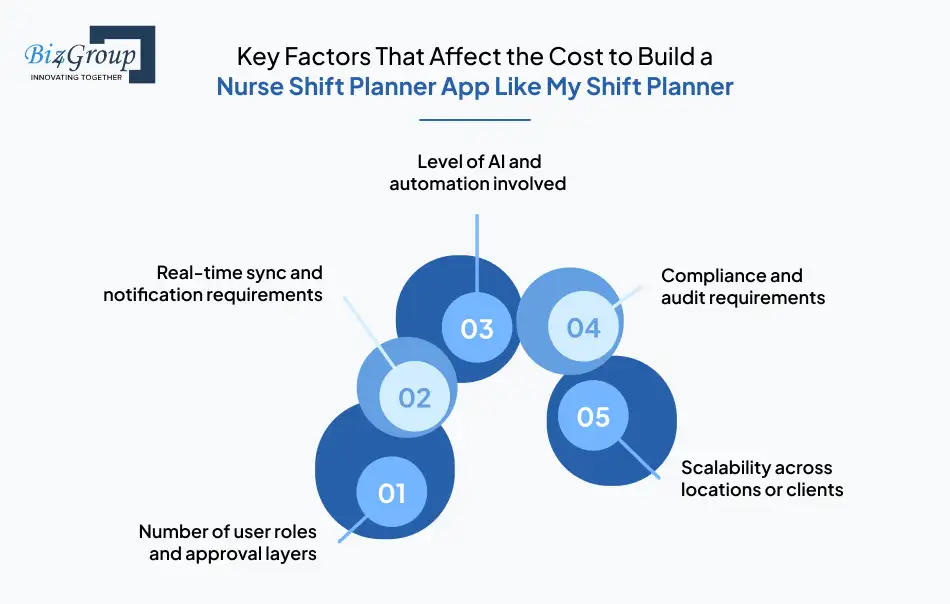
Cost is not just about features. It is about complexity.
The more rules, integrations, and intelligence your system needs, the higher the investment. Organizations that want AI-driven automation, predictive staffing, or multi-client support for agencies should expect higher costs than a basic scheduling solution.
Other major cost drivers include:
- Number of user roles and approval layers
- Real-time sync and notification requirements
- Level of AI and automation involved
- Compliance and audit requirements
- Scalability across locations or clients
This is why many leaders compare costs against similar platforms, such as enterprise AI hospital management software, to understand where scheduling fits within the broader digital ecosystem.
Hidden Costs Most Teams Overlook in Nurse Scheduling App Development
Many projects run over budget not because of poor development, but because of unplanned expenses.
Hidden costs often show up in areas like ongoing maintenance, infrastructure scaling, and post-launch feature enhancements. Training and onboarding can also add to costs, especially when rolling out across multiple facilities.
You also need to account for future compliance updates and evolving labor regulations. Ignoring these early leads to expensive refactoring later.
A helpful reference point when planning is the broader analysis of AI medical scheduling software development cost, which highlights how complexity compounds over time.
How to Optimize Cost Without Compromising Quality?
Smart cost optimization starts with focus.
Instead of building everything at once, many organizations choose to create nurse shift calendar applications in phases. Start with core scheduling and visibility, then layer in AI, analytics, and advanced automation once adoption is proven.
Other proven cost-saving strategies include:
- Launching with a well-defined MVP
- Reusing modular components for integrations
- Choosing scalable cloud infrastructure early
- Prioritizing automation where it replaces manual effort
When done right, these decisions help you develop scalable nurse shift management software without inflating your initial investment.
The real question is not how much it costs to build. It is how much manual scheduling, overtime errors, and staff dissatisfaction are already costing you.
When you build a nurse shift planner app like My Shift Planner with the right scope and strategy, the return often outweighs the upfront investment far sooner than expected.
Trying to Balance Budget and Features Without Overbuilding?
Most scheduling projects fail by either cutting too much or building too much. Smart cost planning helps you stay within budget while still delivering value.
Get a Cost BreakdownCommon Challenges in Developing a Nurse Shift Calendar Application Like My Shift Planner and How to Solve Them
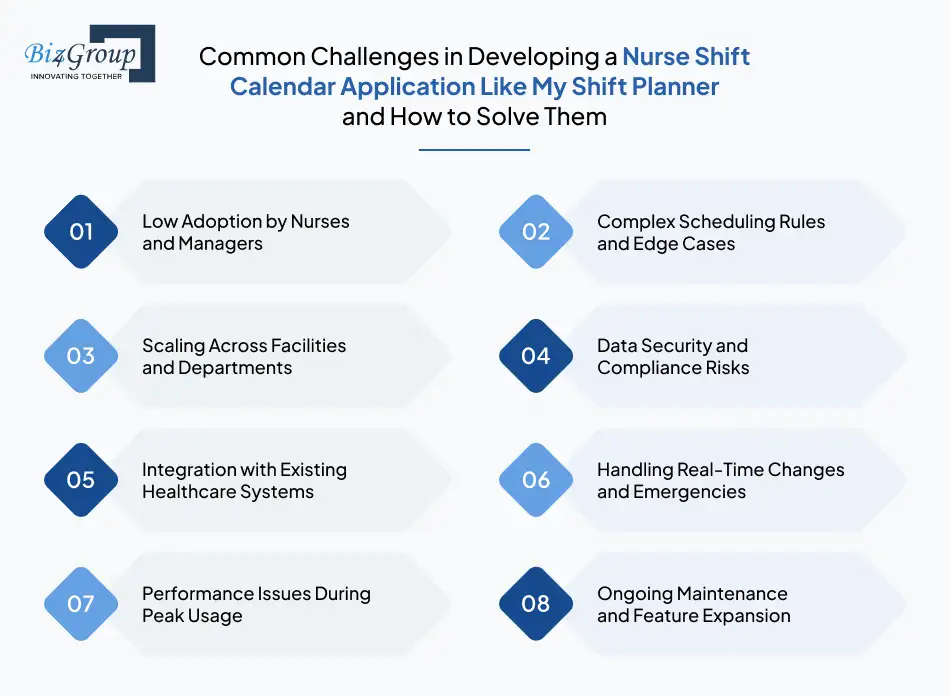
When you decide to develop a nurse shift calendar application like My Shift Planner, challenges are not a sign of failure. They are part of building software in one of the most complex industries out there.
The key difference between projects that struggle and those that succeed is simple.
Anticipation.
|
Challenge |
Why It Happens |
How to Solve It Effectively |
|
Low Adoption by Nurses and Managers |
Tools feel complex, slow, or disconnected from real workflows |
Design workflows around real scheduling behavior, test with nurses early, and prioritize usability over feature overload |
|
Complex Scheduling Rules and Edge Cases |
Healthcare scheduling involves credentials, labor laws, overtime, and rest periods |
Build a flexible rule-based engine that can evolve as policies change instead of hardcoding assumptions |
|
Scaling Across Facilities and Departments |
Systems designed for one location struggle when usage grows |
Architect the platform for multi-facility supports from day one to develop scalable nurse shift management software |
|
Data Security and Compliance Risks |
Scheduling data includes sensitive workforce information |
Follow best practices for HIPAA compliant AI app development for healthcare providers, including encryption and audit logs |
|
Integration with Existing Healthcare Systems |
Legacy HR, payroll, and EHR systems vary widely |
Use API-first architecture and phased integrations to avoid disrupting operations |
|
Handling Real-Time Changes and Emergencies |
Last-minute absences and patient surges break static schedules |
Use real-time updates and intelligent workflows similar to those found in an AI remote patient monitoring app |
|
Performance Issues During Peak Usage |
High concurrency during shift changes or emergencies |
Use cloud-based scaling and load testing to ensure consistent performance |
|
Ongoing Maintenance and Feature Expansion |
Regulations, staffing models, and expectations change |
Plan for continuous improvement and budget for post-launch enhancements |
Each challenge above directly impacts cost, adoption, and trust. Ignoring them often leads to rushed fixes, frustrated users, and stalled rollouts.
When you proactively address these risks, you create a platform that hospitals, clinics, and staffing agencies can rely on daily. That reliability is what separates basic tools from long-term nurse scheduling app solutions for hospitals and staffing agencies like My Shift Planner.
Why Biz4Group LLC Is the Leading Company to Develop a Nurse Shift Calendar Application Like My Shift Planner?
Choosing a partner to develop a nurse shift calendar application like My Shift Planner is not just a technical decision. It is an operational one. The wrong approach creates another tool your teams tolerate. The right one becomes infrastructure your organization depends on.
Biz4Group stands out because we build workforce platforms with real-world complexity in mind. Not demos. Not assumptions. Actual staffing environments where schedules change daily and reliability matters.
Our experience goes beyond healthcare theory. We have already designed and delivered enterprise-grade staffing systems that solve many of the same problems hospitals, clinics, and staffing agencies face today.
Product Spotlight: Biz4Staffing Solutions
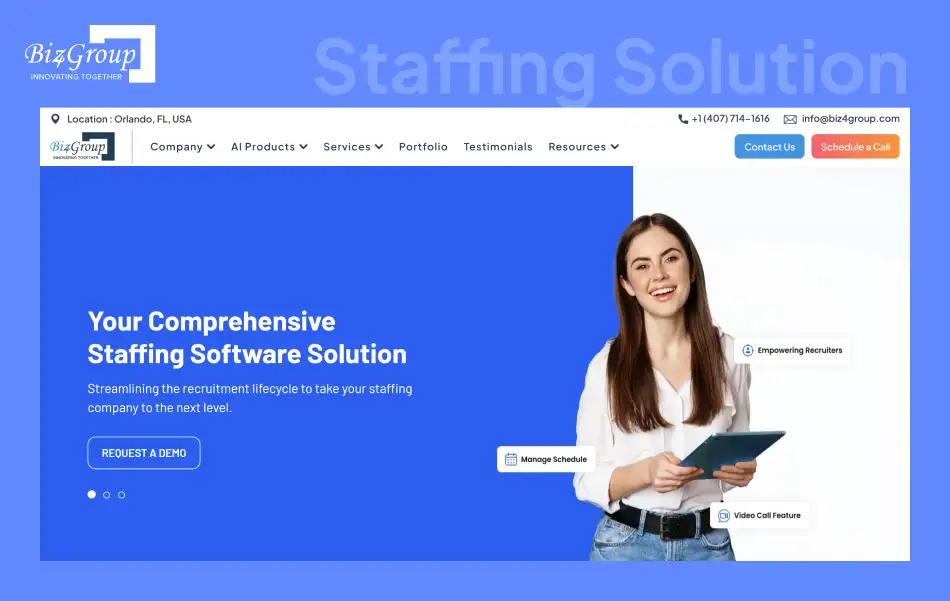
Biz4Staffing Solutions is a full-scale staffing software platform built by Biz4Group to streamline workforce operations for staffing agencies and enterprises.
This product is especially relevant when discussing how to build nurse scheduling calendar apps for hospitals and clinics like My Shift Planner, because it tackles the same operational challenges from a staffing-first perspective.
Biz4Staffing Solutions was designed to centralize workforce data, automate staffing workflows, and reduce the manual coordination that slows organizations down.
The platform focuses on three core outcomes:
- Visibility into workforce availability
- Automation of repetitive staffing processes
- Control over complex, multi-user workflows
These are the same foundations required to develop nurse shift calendar software for healthcare organizations like My Shift Planner, just applied across a broader staffing lifecycle.
Key Highlights of Biz4Staffing Solutions
- Centralized Staffing Operations
A unified system to manage workforce records, assignments, and operational workflows, eliminating fragmented tools and duplicated effort. - AI-Powered Workflow Automation
Automation reduces manual steps in staffing processes, helping teams respond faster to changes without increasing administrative load. - Intelligent Communication Management
Built-in communication flows ensure updates, assignments, and changes reach the right stakeholders without relying on scattered channels. - Highly Customizable Architecture
Designed to adapt to different business rules, workflows, and branding needs, which mirrors the flexibility required in custom nurse shift planner app development like My Shift Planner. - Scalable, Enterprise-Ready Infrastructure
Built to support growth, multiple clients, and increasing data volume without compromising performance or stability.
What Sets Biz4Group LLC Apart for Healthcare Scheduling Projects?
Healthcare leaders choose Biz4Group because we understand scheduling as a core operational function, not a surface-level feature.
Our approach combines:
- Proven experience building staffing and workforce platforms
- Deep understanding of automation, scalability, and system reliability
- A product-focused mindset that supports long-term evolution
- The ability to design scheduling solutions that fit real clinical workflows
When you partner with Biz4Group, you are not just commissioning software. You are working with a team that has already solved workforce coordination challenges in demanding environments.
Ready to Build Scheduling Software That Actually Gets Used?
You have seen what happens when scheduling tools do not match real workflows. Biz4Group builds workforce platforms designed for adoption, scale, and long-term reliability.
Contact Biz4Group TodayWrapping Up!
Nurse scheduling will never be simple. But it does not have to be chaotic.
As healthcare operations grow more complex, relying on generic tools or manual processes only widens the gap between planning and execution. That is why more organizations are choosing to develop a nurse shift calendar application like My Shift Planner instead of forcing their workflows into off-the-shelf software.
Throughout this guide, we have walked through what it really takes to build nurse scheduling apps like My Shift Planner. From understanding the business value and must-have features to navigating development steps, technology choices, cost considerations, and real-world challenges, one theme stays consistent. Success comes from building with intent, not shortcuts.
This is where Biz4Group brings lasting value.
With a proven track record in workforce platforms, AI-driven systems, and enterprise-grade software delivery, Biz4Group approaches nurse scheduling as operational infrastructure. Not an experiment. Not a template. We design systems that scale, adapt, and stay reliable under pressure, whether you are serving one facility or many.
When you partner with Biz4Group, you gain more than development expertise. You gain a team that understands healthcare workflows, staffing realities, and the importance of getting scheduled right the first time.
If your organization is ready to move past scheduling chaos and build something that truly works, the next step is straightforward.
Build smarter schedules. Build confidence. Build it right with Biz4Group.
FAQ
1. What does it mean to develop a nurse shift calendar application like My Shift Planner for hospitals and clinics?
To develop a nurse shift calendar application like My Shift Planner means building a custom scheduling solution designed specifically for healthcare workflows. Instead of using generic tools, you create software that supports nurse availability, shift rotations, compliance rules, and real-time updates. This approach allows hospitals and clinics to streamline scheduling, reduce conflicts, and improve workforce coordination across departments.
2. How much does it cost to develop nurse scheduling apps like My Shift Planner in 2025?
The cost to develop nurse scheduling apps like My Shift Planner typically ranges from $35,000 to $200,000+. The final cost depends on feature depth, integrations, AI capabilities, security requirements, and scalability. A basic solution for a single facility costs less, while enterprise-grade nurse workforce scheduling software development like My Shift Planner for multiple locations requires a higher investment.
3. What features should be included when I build a nurse shift planner app like My Shift Planner?
When you build a nurse shift planner app like My Shift Planner, core features should include shift calendars, availability management, shift swaps, approval workflows, notifications, and reporting. Advanced solutions also include AI-driven scheduling, predictive staffing insights, multi-facility support, and system integrations. These features help healthcare organizations manage complexity and scale scheduling operations reliably.
4. Can custom nurse shift calendar applications reduce scheduling conflicts and last-minute gaps?
Yes. Organizations that create nurse shift planning apps to reduce scheduling conflicts gain better visibility into staff availability and constraints. Automated conflict detection, rule-based scheduling, and real-time notifications help prevent double bookings, missed shifts, and coverage gaps. This is one of the main reasons healthcare leaders choose to develop nurse shift calendar software for healthcare organizations like My Shift Planner.
5. Is it possible to build nurse scheduling calendar apps for staffing agencies like My Shift Planner?
Absolutely. Many staffing agencies choose to build nurse scheduling calendar apps for staffing agencies like My Shift Planner to manage multiple clients, temporary assignments, and rapid schedule changes. These solutions often include multi-client support, role-based access, and automation to handle large volumes of scheduling requests efficiently.
6. How does developing scalable nurse shift management software support business growth?
When you develop scalable nurse shift management software, you ensure your scheduling system can grow alongside your organization. This includes support for multiple facilities, departments, and staffing models. Scalable systems reduce operational friction, maintain performance during peak demand, and allow healthcare organizations to expand without rebuilding their scheduling infrastructure.
7. How long does it take to create nurse shift calendar applications like My Shift Planner?
The timeline to create nurse shift calendar applications like My Shift Planner usually ranges from 3 to 6 months, depending on scope and complexity. Projects that include AI automation, advanced analytics, or enterprise integrations may take longer. A phased approach helps organizations launch faster while continuing to enhance features over time.
