 Location :
Orlando, FL, USA
Location :
Orlando, FL, USA +1 (407) 714-1616
 info@biz4group.com

 AI Summary Powered by Biz4AI
- Embedded insurance API development goes beyond connecting insurers. Success depends on aligning customer journeys, partner ecosystems, and platform capabilities from the beginning.
- A reliable platform starts with the right API architecture, practical integration strategy, and implementation decisions that support long-term business expansion.
- Technology stack, security, and compliance should work together to protect every insurance transaction while simplifying partner connectivity and platform management.
- The investment to create an embedded insurance API solution typically ranges from $10,000–$150,000+, based on platform scope, carrier integrations, and business requirements.
- Strong implementation comes from proven practices such as standardizing insurer data, introducing products gradually, and measuring commercial outcomes alongside platform performance.
- Biz4Group LLC helps businesses transform embedded insurance concepts into scalable API platforms with enterprise expertise, practical implementation guidance, and long-term technology support.
Why are businesses still losing customers at the final step of a digital purchase when the right protection could have been offered instantly?
The answer often lies in disconnected insurance experiences that force customers into separate journeys while businesses miss valuable revenue opportunities. At the same time, tightening reinsurance terms and rising loss ratios have widened the global P&C protection gap to $183 billion, making accessible insurance distribution more important than ever.
This is exactly why embedded insurance API development is becoming a priority for companies building digital products.
If you're planning to offer insurance within your app or platform, the goal isn't just adding another feature. It's creating a buying experience that feels natural, keeps customers engaged, and opens a new revenue opportunity. Growing demand for customer-centric digital experiences is already reshaping the market, with embedded insurance premiums projected to exceed $722 billion globally by 2030.
Before you move forward, you probably have practical questions which might sound like:
- We are developing a fintech app and need to integrate an embedded insurance API for our lending product. What is the typical architecture we should follow, and how long does it usually take?
- I am a solo founder building a proptech app and I do not have an insurance background. Can you explain in simple steps how embedded insurance APIs work and what I need to get started?
Well, this guide is built to answer these questions step by step, helping you understand the decisions, development process, and business considerations before you build an embedded insurance API platform.
Let's dive in.
What Is Embedded Insurance API?
An embedded insurance API is a set of software interfaces that allows businesses to offer insurance products directly within their websites, mobile apps, or digital platforms. Instead of redirecting customers to an insurance provider, the API connects your platform with insurers, so insurance quotes, policy purchases, and related services become part of the same customer journey.
To help you understand the concept better, let's break it into two parts:
- Embedded Insurance means offering insurance at the point where customers are already making a purchase or using a digital service. It becomes a natural part of the overall experience instead of a separate buying process.
- API (Application Programming Interface) acts as the communication layer that enables your platform and the insurance provider to exchange information securely and instantly without manual intervention.
When these two concepts come together, businesses can introduce relevant insurance products exactly when customers are ready to make a decision. The result is a smoother buying experience, faster policy distribution, new revenue opportunities, and higher customer engagement without building an insurance ecosystem from scratch.
Now let's look at the core difference between traditional insurance and embedded insurance API:
- Traditional Insurance: Customer visits an insurer separately → Compares policies → Purchases insurance
- Embedded Insurance API: Customer purchases a product or service → Insurance is offered within the same journey → Policy is purchased without leaving the platform
Who's Involved in an Embedded Insurance API Ecosystem
Before planning an embedded insurance API development, it's worth answering one practical question: who is responsible for what? Every participant has a specific role, and each exchange of information serves a clear purpose. Understanding this flow helps you identify responsibilities, avoid data gaps, and create a smoother customer experience from the first interaction to policy management.
1. Customer
- Starts the journey by purchasing a product or service and deciding whether to add insurance.
- Shares personal, product, and payment information required for the insurance purchase.
- Owns personal information such as name, contact details, and purchase preferences, while granting permission to use it during the transaction.
2. Merchant Platform
- Presents the insurance offer within its website or application.
- Collects customer details needed to request insurance options.
- Owns customer relationship and purchase information generated on its platform while sharing only the data required for insurance processing.
3. Embedded Insurance Platform
- Receives information from the merchant and coordinates the insurance request.
- Matches customer and product details with suitable insurance offerings.
- Manages request orchestration rather than customer ownership, processing only the information required to complete the transaction.
4. Insurance Provider
- Evaluates the submitted information and determines policy eligibility.
- Generates insurance quotes, issues policies, and manages policy records.
- Owns policy-related information, including coverage details, policy documents, renewals, and claims history.
5. Payment Provider
- Processes premium payments once the customer accepts an insurance plan.
- Confirms successful transactions before policy issuance.
- Owns payment processing records while handling sensitive financial information according to regulatory requirements.
6. Claims & Customer Support Teams
- Assist customers after the policy becomes active.
- Verify claims, policy updates, endorsements, and customer requests.
- Access only the information necessary to support policy servicing while maintaining policy ownership with the insurer.
How Data Flows Between Participants
Once every participant understands their role, the entire process becomes easier to follow. Take a look:
- The customer begins purchasing a product or service through the merchant platform.
- The merchant collects only the information required to request relevant insurance options.
- The embedded insurance API coordinates the request and forwards the necessary details to the insurance provider.
- The insurance provider evaluates the request and returns available policy options.
- The customer reviews the available coverage and confirms the purchase.
- The payment provider completes the premium transaction.
- The insurance provider issues the policy and shares the confirmation with the merchant platform.
- After activation, future requests such as policy updates, renewals, or claims continue through the same ecosystem, with each participant accessing only the information needed for its specific responsibility.
Every participant contributes to a single customer journey, but they do not own the same information. Keeping customer, transaction, payment, and policy data with the appropriate owner improves governance, simplifies compliance, and creates a more reliable embedded insurance experience.
Why Businesses Are Investing in Embedded Insurance API Development?
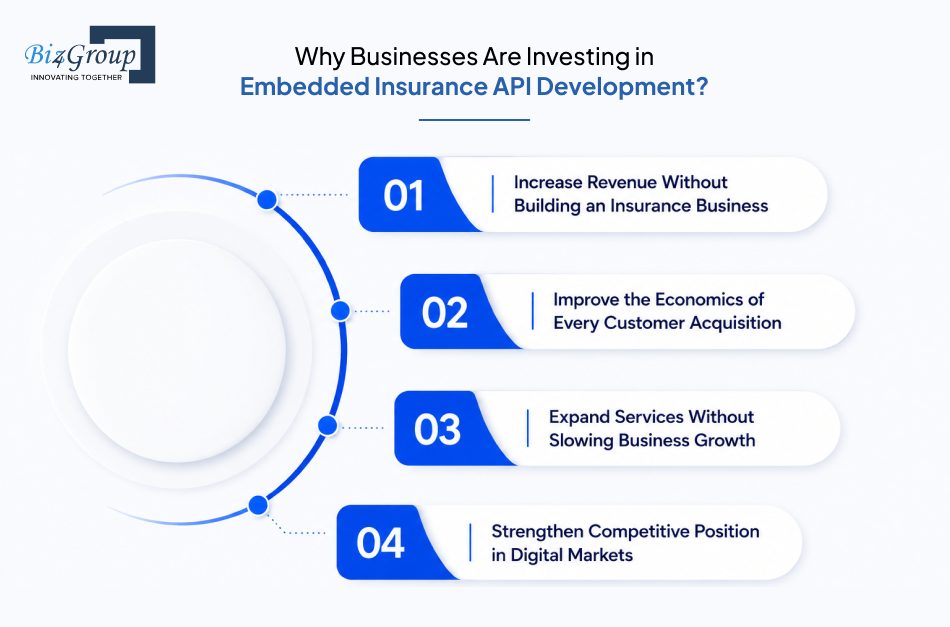
Businesses rarely approve technology investments because the technology is new. They invest when it helps improve revenue, increase the value of existing customers, enter new markets faster, or strengthen their competitive position.
The growing interest in embedded insurance API development follows the same pattern. Companies are investing because it creates measurable commercial outcomes that are difficult to achieve through traditional insurance distribution.
1. Increase Revenue Without Building an Insurance Business
One of the strongest reasons businesses are investing is the opportunity to generate additional revenue from transactions that already exist. Instead of introducing a new product line, hiring insurance specialists, or becoming an insurance carrier, businesses can expand the commercial value of their existing products by offering relevant insurance at the point of purchase.
This is becoming a significant revenue channel rather than a niche opportunity. McKinsey projects that by 2030, nearly 25% of all personal lines premiums could be purchased through embedded propositions, representing more than $700 billion in gross written premiums across the P&C market.
2. Improve the Economics of Every Customer Acquisition
Winning a customer is expensive. Naturally, businesses want every successful acquisition to generate more value instead of simply increasing customer volume. Developing embedded insurance technology solutions support the objective by creating another monetization opportunity within the same customer relationship, allowing businesses to improve revenue without proportionally increasing acquisition costs.
That commercial shift is also reflected in distribution trends. Online and API-led distribution represented 76.38% of the embedded insurance market in 2025 and is projected to grow at a 23.35% CAGR through 2031, indicating that businesses increasingly view digital distribution as the most commercially scalable model.
3. Expand Services Without Slowing Business Growth
Launching new business offerings often requires additional operational capabilities, regulatory expertise, and long development cycles. Embedded insurance API development allows businesses to broaden their customer offering through strategic partnerships instead of building every capability internally. This shortens expansion timelines while allowing companies to remain focused on their primary products and services.
4. Strengthen Competitive Position in Digital Markets
When competing businesses offer similar products, the overall customer experience often becomes the deciding factor. Companies are investing in embedded insurance because it increases the value customers receive from a single purchase, making their platforms more attractive without competing solely on pricing.
The opportunity continues to expand across industries. Electronics protection accounted for 44.74% of embedded insurance product lines, while IoT-driven micro auto insurance is projected to grow at a 33.87% CAGR through 2031. This demonstrates that embedded insurance is creating commercial opportunities across an increasingly diverse range of markets.
Businesses investing in embedded insurance API development are responding to one fundamental business reality: extracting more value from existing customer journeys is often more profitable than relying solely on acquiring new customers. That commercial objective is driving investment decisions across industries and sets the foundation for the architectural decisions discussed in the next section.
Still Planning to Keep Insurance Separate?
See how embedded insurance can create new revenue opportunities without disrupting your existing customer journey.
Let's Map Your Insurance StrategyUnderstanding the Three-Layer Architecture of an Embedded Insurance API Platform
A strong architecture does more than organize software; it determines how easily your platform can support new insurance partners, launch additional products, and handle future business growth. Before you build API-first embedded insurance platform capabilities, understand what each layer is responsible for. Once those responsibilities are clearly separated, expanding the platform becomes far more manageable.
Rather than viewing the architecture as three technical layers, think of it as three business responsibilities working together to deliver one seamless insurance experience.
1. Experience Layer — Turning Customer Actions into Insurance Opportunities
Every insurance journey starts here. This layer focuses on customer interactions and ensures insurance is presented at the right moment without interrupting the purchase experience. It is also where an API-first architecture for business agility delivers practical value by making it easier to introduce new insurance offerings while keeping the customer journey consistent.
Its primary responsibilities include:
- Displaying relevant insurance offers during the buying journey.
- Collecting customer, product, and purchase details.
- Capturing customer consent before policy purchase.
- Presenting policy options in a simple and understandable format.
- Displaying policy confirmations and related information.
Without this layer, customers would struggle to discover, understand, and purchase insurance naturally during their existing journey.
2. Business & API Layer — Managing Every Insurance Decision
Once customer information is available, the platform must decide what happens next. This layer evaluates requests, applies business rules, and ensures every insurance request follows the correct process before reaching the insurer. Its role is not simply to move information; it makes sure every decision is accurate and consistent.
This layer is responsible for:
- Validating customer and purchase information.
- Determining eligible insurance products.
- Applying pricing and policy rules.
- Coordinating policy issuance requests.
- Managing workflows across insurance partners.
Without this layer, every insurer would need separate business logic, making the platform difficult to maintain and even harder to scale.
3. Data & Service Layer — Maintaining the Information That Keeps the Platform Running
Every quote, policy, payment, and customer interaction generates information that remains valuable long after the purchase is complete. This layer protects that information and keeps it available for future business operations, customer support, reporting, renewals, and compliance activities.
Its responsibilities include:
- Managing customer records throughout the policy lifecycle.
- Maintaining policy and coverage information.
- Recording payment and transaction history.
- Supporting reporting, analytics, and audit requirements.
- Preserving business records needed for regulatory compliance.
Without this layer, policy information would become difficult to manage, reporting would lose accuracy, and long-term customer servicing would quickly become unreliable.
How the Three Layers Work Together
Each layer performs a different responsibility, but none of them operate independently.
- The Experience Layer captures customer interactions and purchase intent.
- The Business & API Layer evaluates requests and controls insurance decisions.
- The Data & Service Layer preserves the information needed before, during, and after policy issuance.
This separation of responsibilities gives businesses far more flexibility than a single, tightly connected system. Teams can improve customer experiences, introduce new insurance partners, or update business rules without redesigning the entire platform.
Which Integration Strategy Is Right for Your Embedded Insurance API?
Adding insurance to your digital platform is only one part of the journey. The bigger decision is how you connect with insurance partners as your business grows. The right integration strategy depends on your business goals, the number of insurance providers you plan to support, and the level of operational flexibility you need. Let's understand where each strategy fits when we develop embedded insurance API capabilities:
1. Direct Carrier Integration
Working directly with a single insurance carrier gives you greater control over the customer experience and business relationship. It works well when your insurance offering is centered around one trusted provider.
- Best suited for: Platforms partnering with one insurer or offering a limited range of insurance products.
- Business advantage: Greater control over pricing, branding, and customer experience.
- Things to consider: Expanding to additional insurers usually requires separate integrations and ongoing maintenance.
2. Aggregator-Based Integration
Instead of connecting with every insurer individually, this strategy connects your platform to an insurance aggregator that already manages multiple carrier relationships.
- Best suited for: Businesses planning to offer multiple insurance options without managing separate insurer integrations.
- Business advantage: Faster market entry and broader product availability through a single business relationship.
- Things to consider: Product flexibility and customization may depend on the aggregator's capabilities.
3. Middleware-Based Integration
Many insurers still operate with long-established internal systems. Middleware acts as a coordination layer that helps modern digital platforms communicate with those existing business systems without requiring a complete replacement.
- Best suited for: Enterprises connecting with insurers that rely on legacy infrastructure.
- Business advantage: Preserves existing investments while supporting new digital insurance experiences.
- Things to consider: Success depends on accurate data mapping and well-defined business processes.
4. Hybrid Integration Strategy
As partner ecosystems expand, relying on a single integration model rarely remains practical. Many enterprise platforms combine direct carrier relationships for strategic insurance products while using aggregators or middleware for broader market coverage.
- Best suited for: Large businesses serving multiple regions, products, or insurance partners.
- Business advantage: Balances flexibility, scalability, and long-term business growth.
- Things to consider: Governance becomes increasingly important as multiple integration models operate together.
Biz4Group Integration Strategy Matrix
|
Your Business Situation |
Recommended Integration Strategy |
|---|---|
|
Working with one insurance carrier |
Direct Carrier Integration |
|
Offering policies from multiple insurers quickly |
Aggregator-Based Integration |
|
Connecting with insurers using legacy systems |
Middleware-Based Integration |
|
Expanding across products, markets, and insurance partners |
Hybrid Integration Strategy |
Every integration strategy solves a different business challenge. The strongest platforms aren't built around the most complex integration model they're built around the one that supports current business goals while leaving room to grow.
API Design and Architecture Decisions for Building a Scalable Embedded Insurance Platform
Scalability isn't determined by the technologies you select; it starts with the decisions you make before writing the first line of code. The way your APIs are designed affects partner onboarding, future enhancements, maintenance effort, and long-term platform stability. Before you build embedded insurance API with REST APIs, GraphQL, and microservices, establish the design principles that will support your business as it grows.
Every decision below influences how your platform performs over time, so treat them as long-term business choices rather than short-term technical preferences.
1. Decide Who Your APIs Are Designed For
Every API serves a specific audience. An API built for insurance carriers may not meet the needs of merchant platforms or internal business teams. Defining the primary consumers first makes every design decision more consistent.
Focus on:
- Primary consumers: Identify whether insurers, merchants, partners, or internal teams will use the APIs.
- Information needs: Decide what each consumer actually needs instead of exposing every available data point.
- Consistency: Keep request and response formats predictable across all APIs to reduce partner onboarding time.
- Future growth: Leave room for additional partners without redesigning existing APIs.
2. Decide How Information Should Be Delivered
The way data is delivered directly affects performance, flexibility, and partner experience. Rather than starting with a technology, begin by understanding how consumers expect to receive information.
Consider these decisions:
- REST APIs: Well suited for standardized business operations such as quotes, policy issuance, and claims where consistent endpoints simplify integration.
- GraphQL: Better suited when different partners need different combinations of policy, customer, or product information from the same request.
- Response design: Return only meaningful information, so integrations remain simple and easier to maintain.
- Data consistency: Keep naming conventions and response structures uniform across every API.
3. Decide How Independently Business Services Should Operate
Not every function grows at the same pace. Quote requests may increase rapidly while policy servicing remains stable. Separating critical business capabilities allows individual services to evolve without affecting the entire platform.
Evaluate whether your platform should:
- Scale insurance quotes independently.
- Update policy services without interrupting payments.
- Expand claims processing separately from customer management.
- Introduce new insurance products without modifying unrelated services.
Microservices become valuable when business capabilities need to grow independently rather than together.
4. Decide How Your APIs Will Support Future Changes
Every embedded insurance platform changes over time. New insurers join, products expand, and regulations evolve. Planning for those changes early prevents unnecessary disruption later.
Important design decisions include:
- Introducing new API versions without affecting existing partners.
- Maintaining backward compatibility during feature updates.
- Defining clear standards for retiring outdated endpoints.
- Documenting changes so every integration remains predictable.
Biz4Group LLC API Design Decision Checklist
Before finalizing your API strategy, we suggest that you ask these questions:
- Who will consume this API?
- How frequently will business requirements change?
- Will multiple insurance partners be added over time?
- Do different partners require different levels of information?
- Which business capabilities should scale independently?
- How will future updates be introduced without disrupting existing integrations?
Answering these questions first leads to architecture decisions that remain practical as your platform evolves instead of becoming expensive to redesign later. This approach also strengthens insurtech API development projects by reducing technical debt before it becomes a business problem.
Great APIs Begin with Better Decisions
Turn architecture choices into a platform that stays flexible as partners, products, and business needs grow.
Discuss Your API BlueprintWhere Embedded Insurance APIs Are Used Across Digital Platforms
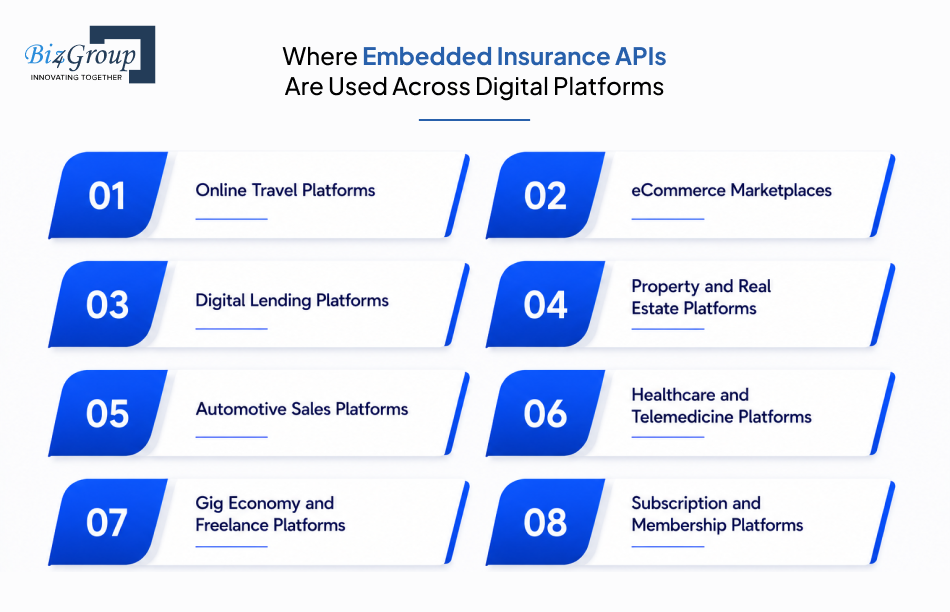
The value of embedded insurance isn't tied to a specific industry, rather it depends on the digital experience your platform delivers. Whenever customers make financial commitments, book services, or purchase high-value products, insurance becomes a natural extension of that journey. Businesses looking to make embedded insurance API for digital platforms successful should start by identifying where protection adds value instead of interrupting the customer experience.
The following examples show how different digital platforms use embedded insurance to solve specific business and customer needs.
1. Online Travel Platforms
Travel plans often involve uncertainties such as trip cancellations, medical emergencies, or lost baggage. Presenting travel insurance during the booking process allows customers to secure coverage without leaving the platform. At the same time, travel businesses create an additional revenue opportunity while improving booking confidence.
2. eCommerce Marketplaces
Many online purchases involve products that customers want to protect after checkout. Embedded insurance API development allows marketplaces to offer warranty extensions, accidental damage protection, or shipping coverage at the moment customers complete their purchase. The experience remains part of the same transaction instead of becoming a separate decision later.
Also Read: Guide to AI Insurance Marketplace Development
3. Digital Lending Platforms
Customers applying for personal loans, vehicle financing, or business credit often require insurance linked to the financed asset or loan agreement. Embedded insurance APIs enable lending platforms to include relevant protection within the application journey, reducing manual coordination while simplifying the borrowing experience.
4. Property and Real Estate Platforms
Buying or renting property usually involves multiple service providers and significant financial commitments. Property platforms can introduce home insurance, tenant insurance, or landlord coverage alongside property transactions, helping customers complete more of the process through one digital experience.
5. Automotive Sales Platforms
Vehicle purchases naturally create demand for motor insurance. Embedded insurance allows dealerships and online automotive marketplaces to present policy options during the buying process, giving customers the convenience of completing both the vehicle purchase and insurance selection together.
Also Read: AI Vehicle Damage Detection Software Development
6. Healthcare and Telemedicine Platforms
Patients using digital healthcare services may benefit from insurance products related to consultations, treatments, or ongoing care plans. Offering relevant coverage within the healthcare journey simplifies access to financial protection without adding unnecessary administrative steps.
Also Read: How to Develop an AI Health Insurance App
7. Gig Economy and Freelance Platforms
Independent workers frequently move between projects, clients, and locations. Embedded insurance helps gig platforms offer coverage such as personal accident, equipment, or liability insurance directly within worker onboarding or project management, making protection easier to access as work arrangements change.
8. Subscription and Membership Platforms
Subscription-based businesses often provide products or services that customers use continuously. Embedded insurance can be offered as an optional value-added service, helping businesses strengthen customer relationships while creating recurring insurance opportunities alongside existing subscriptions.
The strongest embedded insurance strategies don't begin with the insurance product they begin with the customer journey. Identifying the right touchpoint within each platform creates a more relevant buying experience, improves customer engagement, and turns insurance into a natural part of the overall digital service rather than an afterthought.
How to Develop an Embedded Insurance API: Step-by-Step Process
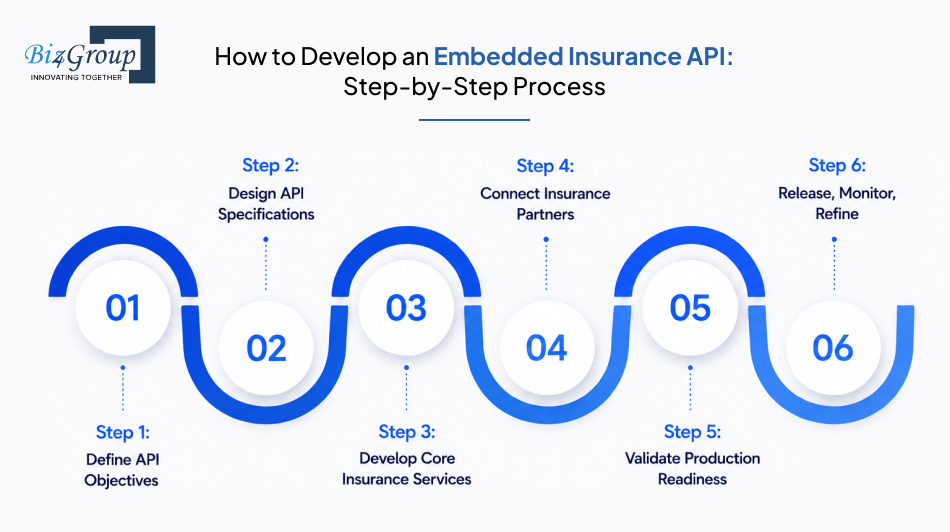
A successful embedded insurance platform comes from following the right implementation sequence rather than solving technical problems as they appear. Every stage prepares the next one, helping your team deliver reliable insurance services without unnecessary rework. Here's the development process most enterprise projects follow from planning through production.
Step 1: Define API Objectives
Every development effort should begin with a clear API specification. Decide what insurance products your platform will support, which customer actions will trigger insurance offers, and which business outcomes the APIs must deliver. This stage also establishes the functional scope before implementation begins.
Document the following:
- Insurance products and policy types.
- Customer journeys where insurance will be offered.
- Business rules for quotes and policy issuance.
- Regulatory and compliance requirements.
- Success criteria for the first release.
Step 2: Design API Specifications
Once the scope is finalized, convert business requirements into detailed API specifications. This stage defines how information moves between participants and how every service behaves before development starts.
Your API specification should include:
- API endpoints for quotes, policies, payments, and customer records.
- Request and response structures.
- Validation rules for every transaction.
- Error handling scenarios.
- API documentation for internal teams and external partners.
Step 3: Develop Core Insurance Services
This is where the actual implementation begins. Every service should be developed independently while following the API specifications prepared earlier. Keeping business services modular also makes future enhancements much easier during embedded insurance API development.
The first release typically includes:
- Quote generation services.
- Policy issuance services.
- Premium payment processing.
- Customer verification.
- Notification services for policy updates.
Step 4: Connect Insurance Partners
Core services become valuable only after they communicate with the external business ecosystem. This stage focuses on implementing every required connection while validating that information is exchanged accurately across participating systems.
Complete integrations for:
- Insurance carriers.
- Payment providers.
- Identity verification services.
- Policy administration systems.
- Customer relationship platforms.
Step 5: Validate Production Readiness
Before releasing the platform, verify that every business scenario performs as expected under real operating conditions. The objective is to confirm reliability, security, and business accuracy rather than simply checking whether the APIs respond.
Validate scenarios including:
- Quote generation accuracy.
- Successful policy issuance.
- Failed payment handling.
- Invalid customer information.
- Performance under expected traffic.
- Security and compliance verification.
Step 6: Release, Monitor, Refine
Deployment marks the beginning of continuous improvement. Monitor platform performance, collect operational insights, and introduce enhancements based on customer behavior, partner feedback, and evolving insurance requirements.
Track and improve:
- API availability.
- Transaction success rates.
- Response times.
- Partner service performance.
- New insurance product rollout.
- API version updates.
Embedded Insurance API Development Roadmap
|
Phase |
Primary Deliverable |
Outcome |
|---|---|---|
|
API Objectives |
Approved functional requirements |
Clear implementation scope |
|
API Specifications |
Complete API blueprint |
Development-ready design |
|
Core Services |
Working insurance APIs |
Functional business capabilities |
|
Partner Connectivity |
Integrated insurance ecosystem |
End-to-end business flow |
|
Production Validation |
Verified business scenarios |
Release-ready platform |
|
Continuous Improvement |
Performance insights and enhancements |
Scalable long-term operations |
A structured implementation process keeps every stage focused on a measurable outcome instead of isolated development tasks. Following this sequence gives your team a stronger foundation for delivering embedded insurance APIs that remain reliable, scalable, and easier to enhance as business needs evolve.
Recommended Technology Stack for Embedded Insurance API Development
The technologies you select should support the responsibilities of an embedded insurance API throughout its lifecycle from processing quote requests and issuing policies to securing customer data and connecting with insurance partners. While there is no universal technology stack, the recommendations below represent enterprise-proven tools commonly used when building embedded insurance API ecosystem solutions.
|
Technology Area |
Recommended Tools |
Purpose |
|---|---|---|
|
API Development |
Spring Boot, ASP.NET Core, NestJS, FastAPI |
Develop secure, scalable APIs that manage quotes, policies, customer information, and other insurance operations. |
|
API Gateway |
Kong, Apigee, AWS API Gateway, Azure API Management |
Control API traffic, secure partner access, manage rate limits, and simplify API management through a centralized gateway. |
|
API Communication |
REST APIs, GraphQL |
Exchange information between merchant platforms, insurers, and business partners using standardized communication methods. |
|
Authentication & Authorization |
OAuth 2.0, JWT, Auth0, Okta |
Verify user identities and ensure only authorized users and systems can access insurance services. |
|
Business Rules Engine |
Drools, Camunda DMN, OpenL Tablets |
Manage eligibility rules, underwriting logic, pricing conditions, and policy validation without changing application code. |
|
Partner Connectivity |
REST Connectors, Apache Kafka, RabbitMQ |
Connect with insurers and external business systems while supporting both synchronous and event-driven communication. |
|
Identity Verification |
Trulioo, Onfido, Persona |
Verify customer identities to support regulatory compliance and reduce fraudulent policy applications. |
|
Payment Processing |
Stripe, Adyen, Checkout.com, Braintree |
Process insurance premium payments securely before confirming policy issuance. |
|
Data Storage |
PostgreSQL, MongoDB |
Store customer profiles, policy information, transaction history, and insurance records securely. |
|
Caching |
Redis |
Improve API response times by temporarily storing frequently requested information such as quote results and product details. |
|
API Documentation |
OpenAPI (Swagger), Postman |
Generate clear API documentation that simplifies partner onboarding, testing, and ongoing maintenance. |
|
Notifications |
Twilio, SendGrid, Firebase Cloud Messaging |
Deliver policy confirmations, payment notifications, renewal reminders, and other customer communications across multiple channels. |
|
Monitoring & Observability |
Datadog, Prometheus, Grafana |
Monitor API performance, service availability, and operational health to identify issues quickly. |
|
Logging & Audit Trails |
ELK Stack (Elasticsearch, Logstash, Kibana), Splunk |
Record business events and system activity to support troubleshooting, compliance, and audit requirements. |
|
Security Protection |
Cloudflare, AWS WAF, HashiCorp Vault |
Protect APIs, encryption keys, and sensitive insurance data from unauthorized access and cyber threats. |
|
Cloud Infrastructure |
AWS, Microsoft Azure, Google Cloud Platform |
Provide reliable, scalable infrastructure capable of supporting enterprise-grade embedded insurance API workloads. |
The recommended technologies above are widely adopted across enterprise API ecosystems, but the final stack should always reflect your business goals, integration requirements, compliance obligations, expected transaction volume, and internal engineering expertise. Selecting tools based on platform responsibilities creates a stronger foundation for reliable integrations, secure policy services, and long-term scalability.
Security, Compliance & Regulatory Considerations for Embedded Insurance API Development
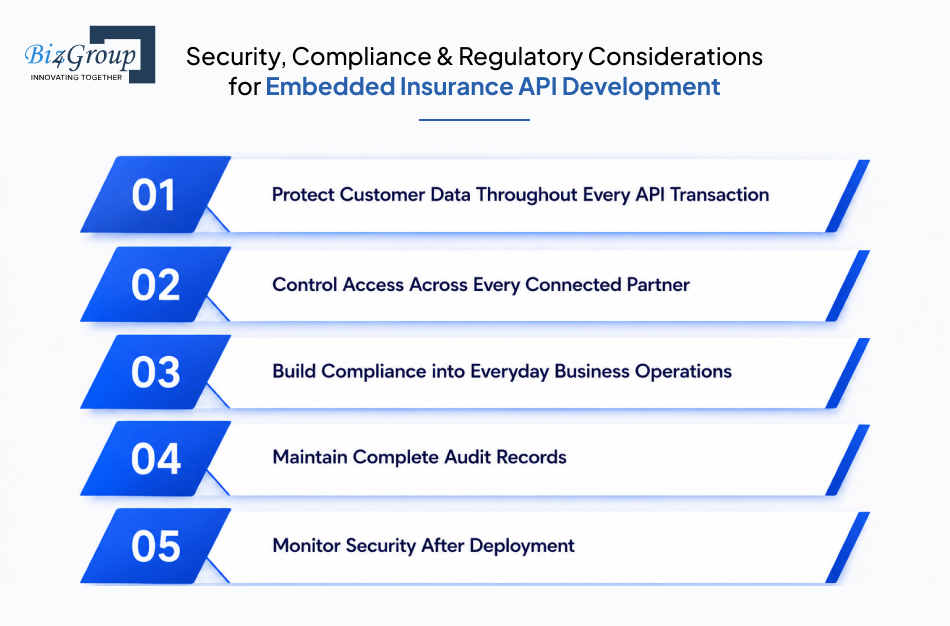
Every insurance transaction involves sensitive customer and policy information. Protecting that information requires more than adding security features at the end of the project. During digital insurance API development, security, compliance, and regulatory requirements should be addressed throughout the implementation process, so every API request and partner connection follows the same protection standards.
The considerations below highlight the areas that deserve attention before moving your platform into production.
1. Protect Customer Data Throughout Every API Transaction
Every API request should exchange only the information required to complete the insurance process. Limiting unnecessary data sharing reduces security risks while supporting privacy obligations across different markets.
Protect customer information by:
- Collecting only the data required for quotes and policy issuance.
- Encrypting sensitive information during transmission and storage.
- Masking confidential customer details wherever full visibility is unnecessary.
- Defining data retention policies before deployment.
2. Control Access Across Every Connected Partner
Embedded insurance platforms often communicate with insurers, payment providers, and identity verification services. Every connection should have clearly defined permissions so each participant accesses only the information required for its responsibilities.
Access controls should include:
- Strong user authentication.
- Role-based access permissions.
- Secure API credentials for external partners.
- Regular review of access privileges.
3. Build Compliance into Everyday Business Operations
Compliance becomes easier when business processes are designed around regulatory expectations instead of treating them as a final project task. Insurance regulations, privacy requirements, and customer consent should remain part of every transaction from the beginning.
Key compliance considerations include:
- Recording customer consent before policy purchase.
- Supporting regional privacy requirements such as GDPR and CCPA where applicable.
- Maintaining complete policy and transaction records.
- Applying consistent data governance practices across all participating systems.
4. Maintain Complete Audit Records
Insurance transactions often require organizations to demonstrate how information was collected, processed, and shared. Maintaining detailed audit records improves operational transparency while supporting regulatory reviews and internal governance.
Maintain records for:
- Customer consent activities.
- Policy issuance events.
- Payment confirmations.
- API requests and responses.
- Administrative changes affecting customer information.
5. Monitor Security After Deployment
Security continues after production deployment. Continuous monitoring helps identify unusual activity, integration failures, and operational risks before they affect customers or business partners. As API traffic grows, many organizations also adopt AI automation services to detect anomalies, prioritize security alerts, and respond to potential threats more efficiently.
Ongoing monitoring should focus on:
- Suspicious API traffic.
- Failed authentication attempts.
- Performance abnormalities.
- Integration failures with external partners.
- Security alerts requiring immediate response.
Also Read: 10 AI Automation Use Cases for Enterprises to Scale Faster
Strong security comes from making protection part of the development process rather than treating it as a final checkpoint. Addressing these considerations early helps embedded insurance APIs operate more reliably, simplifies compliance efforts, and builds greater confidence among customers, insurers, and business partners.
How Much Does It Cost to Build an Embedded Insurance API Platform?
Budget planning becomes much easier when you understand what you're paying for before development begins. The total investment depends on platform capabilities, insurance partner integrations, security requirements, and long-term scalability.
While every project has unique business goals, the overall cost for embedded insurance API development ranges between $10,000 to $150,000+. The table below outlines typical development costs based on the scope of the embedded insurance API platform and the capabilities included in each implementation.
|
Platform Scope |
Estimated Cost |
Typical Timeline |
|---|---|---|
|
Basic Embedded Insurance API Platform |
$10,000 – $30,000 |
2–4 Weeks |
|
Moderate Embedded Insurance API Platform |
$30,000 – $75,000 |
4–8 Weeks |
|
Advanced Embedded Insurance API Platform |
$75,000 – $150,000+ |
8–16+ Weeks |
What Does Each Cost Range Include?
The estimated cost grows as additional insurance capabilities, integrations, and operational requirements become part of the platform.
1. Basic Embedded Insurance API Platform
Suitable for businesses introducing a single insurance offering with limited integration requirements.
Includes:
- Single insurance carrier integration.
- Quote generation API.
- Basic policy issuance.
- Secure authentication.
- Standard API documentation.
- Essential monitoring and logging.
2. Moderate Embedded Insurance API Platform
Designed for businesses expanding insurance offerings across multiple products and business partners.
Includes:
- Multiple insurance products.
- Two or more carrier integrations.
- Premium payment processing.
- Customer identity verification.
- Policy management services.
- Enhanced monitoring and security controls.
3. Advanced Embedded Insurance API Platform
Designed for enterprise platforms supporting large transaction volumes and complex insurance ecosystems.
Includes:
- Multiple insurance carriers.
- Enterprise-grade API Gateway.
- Event-driven communication.
- Advanced security and compliance controls.
- High-availability cloud infrastructure.
- Analytics, monitoring, and audit capabilities.
Factors That Influence Development Cost
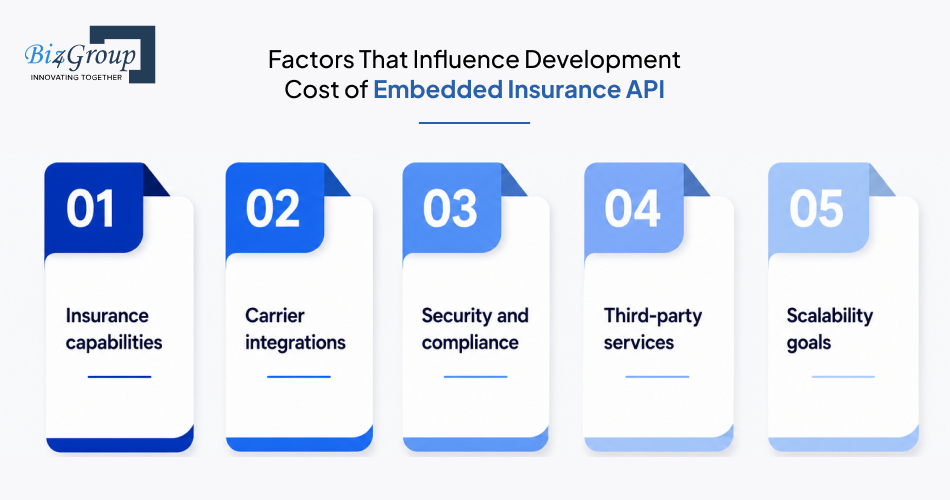
The final project budget depends on implementation requirements rather than the number of APIs alone. Businesses planning to create embedded insurance API solution should evaluate these factors before estimating development effort.
- Insurance capabilities: Quotes, policy issuance, renewals, endorsements, and claims each add implementation effort.
- Carrier integrations: Every additional insurance provider requires integration, validation, and ongoing maintenance.
- Security and compliance: Identity verification, encryption, audit trails, and regulatory requirements increase implementation scope.
- Third-party services: Payment gateways, notification platforms, and customer verification services contribute to overall development effort.
- Scalability goals: Supporting higher transaction volumes, multiple regions, and future partner expansion requires stronger infrastructure.
Ongoing Operational Costs
Launching the platform is only the first stage of the investment. Continuous operations help maintain platform reliability, security, and partner connectivity.
|
Operational Activity |
Estimated Monthly Cost |
|---|---|
|
Cloud Infrastructure |
$500 – $5,000 |
|
API Monitoring & Logging |
$200 – $2,000 |
|
Security Updates & Compliance |
$1,000 – $5,000 |
|
Platform Support & Enhancements |
$2,000 – $10,000 |
A realistic budget comes from matching platform capabilities with business objectives instead of estimating the number of APIs to be developed. Defining the right scope early helps prioritize investments, reduce unnecessary implementation costs, and create an embedded insurance platform that remains ready for future expansion.
Know Your Budget Before You Build
Get a realistic cost estimate based on your platform scope, integration needs, and business objectives.
Request My Cost EstimateBest Practices for Embedded Insurance API Development
Successful embedded insurance platforms are shaped by practical implementation decisions that improve customer adoption, simplify partner collaboration, and support long-term business growth. The recommendations below reflect proven practices followed across successful embedded insurance API development projects without repeating earlier technical considerations.
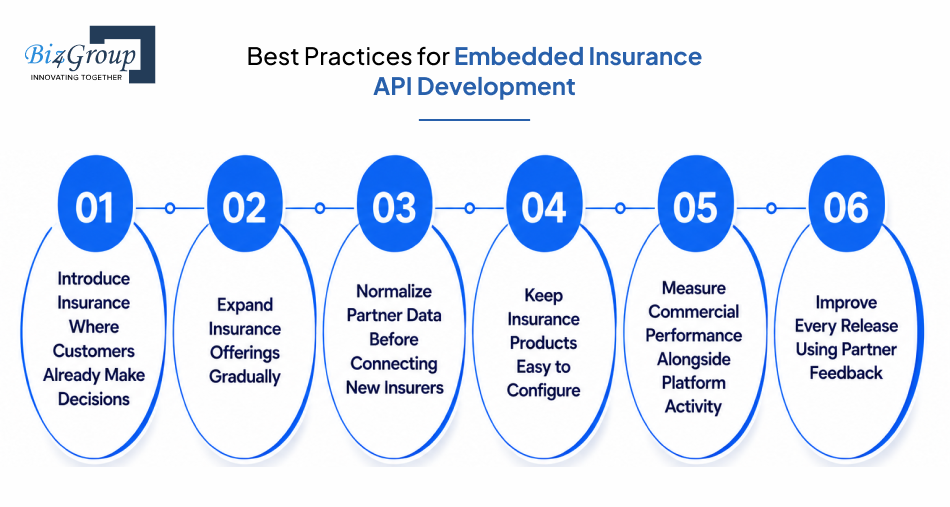
1. Introduce Insurance Where Customers Already Make Decisions
Present insurance during existing purchase or booking journeys instead of creating separate buying flows. Natural placement increases policy adoption, reduces purchase friction, and makes insurance feel like part of the overall customer experience.
2. Expand Insurance Offerings Gradually
Launch with one insurance product and a limited number of carrier partnerships before expanding your ecosystem. A phased rollout simplifies implementation, improves operational stability, and creates a stronger foundation for future product growth.
3. Normalize Partner Data Before Connecting New Insurers
Establish a consistent internal data model before integrating additional insurance providers. Standardized information reduces integration complexity, shortens onboarding time, and allows new partners to connect without disrupting existing business operations.
4. Keep Insurance Products Easy to Configure
Business teams should be able to introduce new coverage options, pricing rules, and policy updates without extensive redevelopment. Configurable insurance products reduce release cycles and help platforms respond quickly to changing market opportunities.
5. Measure Commercial Performance Alongside Platform Activity
Evaluate quote acceptance, policy conversions, partner participation, and customer engagement alongside operational metrics. Many organizations also adopt AI integration services to identify purchasing trends and uncover opportunities that improve embedded insurance performance.
6. Improve Every Release Using Partner Feedback
Review feedback from insurance carriers, merchants, and business stakeholders after each release instead of waiting for major platform updates. Continuous refinement strengthens partner relationships, improves operational efficiency, and supports sustainable platform growth.
Embedded insurance API development deliver long-term value through continuous refinement rather than one-time implementation. Applying these practices throughout the development lifecycle helps teams improve customer adoption, simplify partner expansion, and achieve stronger business outcomes as the ecosystem grows.
How to Choose the Right Embedded Insurance API Development Partner?
The success of your platform depends as much on the implementation partner as the technology itself. An experienced partner should understand insurance ecosystems, API integrations, regulatory expectations, and long-term platform scalability. Before starting your embedded insurance API development project, evaluate potential partners using the criteria below.
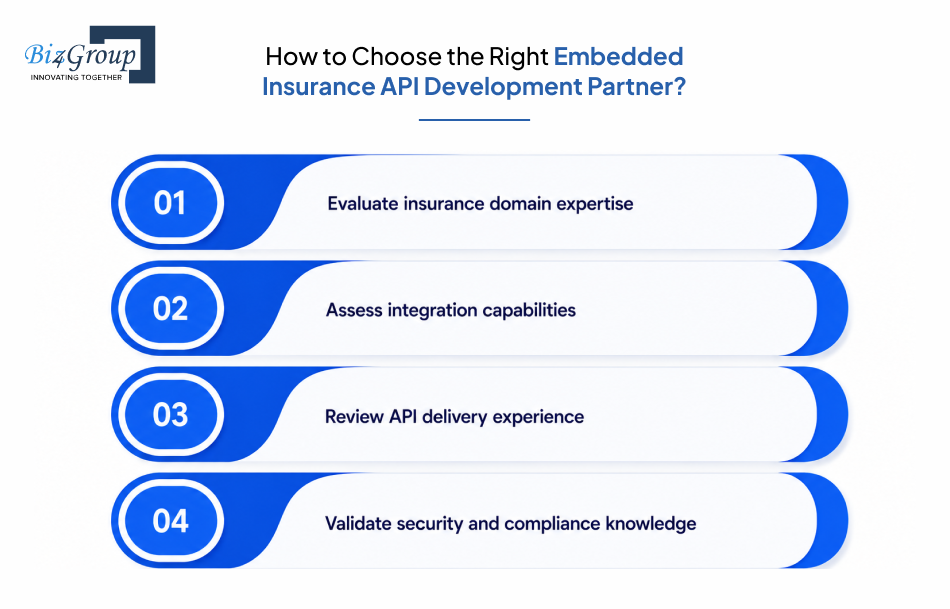
1. Evaluate Insurance Domain Expertise
Review whether the company has experience delivering insurance APIs, embedded finance solutions, or platforms involving carrier integrations rather than only general API projects.
2. Assess Integration Capabilities
Confirm the team can integrate multiple insurance carriers, payment providers, identity verification services, and other third-party business systems without increasing implementation complexity.
3. Review API Delivery Experience
Ask for examples of API-first platforms, documentation quality, integration workflows, and partner onboarding processes that demonstrate practical implementation experience.
4. Validate Security and Compliance Knowledge
Ensure the partner understands data privacy requirements, audit readiness, authentication standards, and regulatory expectations applicable to insurance APIs.
Look beyond initial delivery. A reliable partner should also provide platform enhancements, performance optimization, maintenance, and support as your insurance ecosystem grows.
How Biz4Group LLC Can Help
Finding the right partner becomes easier when technical expertise is supported by real implementation experience. Biz4Group LLC, a software development company in USA, has 20+ years of expertise delivering enterprise software, AI-powered platforms, and API-driven digital solutions. Instead of providing one-size-fits-all implementations, the team works closely with businesses to align technical decisions with commercial objectives.
Depending on your project requirements, Biz4Group can help with:
- Designing embedded insurance API platforms that support carrier onboarding, policy distribution, and long-term platform scalability based on your business requirements.
- Implementing reliable integrations with insurance carriers, payment gateways, identity verification providers, and other business systems that power embedded insurance experiences.
- Providing AI consulting services to identify practical opportunities for fraud detection, intelligent policy recommendations, customer insights, and operational optimization within embedded insurance platforms.
- Delivering an AI insurance automation solution that simplifies underwriting support, policy servicing, document processing, and repetitive insurance workflows while improving operational efficiency.
- Extending embedded insurance capabilities into digital commerce through eCommerce development solutions, allowing businesses to offer relevant insurance products seamlessly during the customer purchase journey.
The right development partner should strengthen both your technology strategy and your long-term business goals. Evaluating industry expertise, integration experience, and implementation capabilities before the project begins helps reduce delivery risks and creates a stronger foundation for a successful embedded insurance platform.
Conclusion
Embedded insurance works best when every decision supports the way your business operates, from carrier integrations and API design to security, scalability, and future expansion. That is exactly why embedded insurance API development deserves careful planning instead of rushing into implementation. Getting these decisions right early helps reduce unnecessary rework, simplifies partner onboarding, and creates a platform that is easier to manage as your insurance ecosystem grows.
Planning your platform is one thing. Turning that plan into a reliable implementation is another. Working with an experienced technology partner helps you move forward with greater clarity, fewer implementation challenges, and a roadmap that fits your business objectives.
At Biz4Group LLC, we work closely with businesses to design and develop embedded insurance API platforms that match real operational needs rather than generic implementation templates. So, if you have an embedded insurance idea in mind? Let's discuss your requirements and identify the right development approach for your platform.
FAQ’s
1. Can an embedded insurance API platform support multiple insurance carriers at the same time?
Yes. Most enterprise platforms are designed to connect with multiple insurance carriers through a single API layer. This allows businesses to offer different insurance products, compare carrier responses, and expand partnerships without rebuilding the entire platform whenever a new insurer is added.
2. What is the typical cost range for embedded insurance API development?
The cost of embedded insurance API development typically ranges from $10,000 to $150,000+, depending on platform scope, the number of carrier integrations, security requirements, compliance obligations, and the level of business automation required. Enterprise platforms with multiple insurer integrations and advanced workflows usually require a higher investment.
3. How long does it take to develop an embedded insurance API platform?
Development timelines generally range from 2 weeks to 16+ months. A basic implementation with limited integrations can be completed faster, while enterprise platforms supporting multiple insurers, complex policy workflows, regulatory compliance, and extensive testing require a longer implementation timeline.
4. Can an embedded insurance API be integrated with an existing digital platform without rebuilding it?
Yes. In most cases, embedded insurance APIs are designed to integrate with existing platforms through well-defined interfaces. Whether you operate a fintech platform, eCommerce marketplace, travel portal, or mobility solution, insurance capabilities can usually be added without replacing your existing application.
5. What should businesses prepare before starting an embedded insurance API project?
Before development begins, define your insurance products, identify carrier partners, document customer journeys where insurance will be offered, determine compliance requirements, and establish clear business objectives. Preparing these decisions early helps reduce implementation delays and improves overall project planning.
6. How can businesses expand an embedded insurance platform after the initial launch?
Most businesses expand gradually by adding new insurance products, onboarding additional carriers, supporting new customer channels, and introducing automation where it creates measurable value. Planning for future expansion during the initial implementation makes these enhancements easier and more cost-effective.
