 Location :
Orlando, FL, USA
Location :
Orlando, FL, USA +1 (407) 714-1616
 info@biz4group.com

- Insurance distribution is shifting toward decision-driven platforms, where AI reduces manual effort and improves how users discover and select policies.
- AI insurance marketplace development helps businesses centralize insurers, brokers, and users into one system that supports faster and more accurate policy decisions.
- Different marketplace models exist, but success depends on aligning the platform with real insurance workflows, not just building features or listings.
- The cost to build AI insurance marketplace platform typically ranges between $40,000 to $250,000+, depending on integrations, automation level, and execution scope.
- Businesses that develop AI powered insurance marketplace solution focus on improving onboarding, policy matching, and claims handling without adding operational complexity.
- Teams like Biz4Group LLC help translate marketplace ideas into working platforms that support real distribution, decision-making, and scalable insurance operations.
Insurance distribution still struggles with scattered systems, slow underwriting cycles, and limited personalization. Customers often move across multiple platforms before finding the right policy, while insurers deal with fragmented data and delayed decision-making. This gap between user expectation and operational efficiency widens.
An AI insurance marketplace changes this by bringing insurers, brokers, and customers into a single decision-driven environment. Instead of manual search and static listings, the platform guides users toward relevant policies while improving how insurers manage distribution and engagement.
The shift is already visible across the industry:
- The global insurance sector has seen an 87% year-on-year increase in artificial intelligence deployments, showing how quickly decision systems are becoming part of core operations.
- Around 40% of insurers are already seeing measurable business outcomes from AI, with 77% of those benefits linked to productivity gains and 5% to revenue growth.
This is why businesses are moving toward AI insurance marketplace development. It is no longer about building a digital presence, but about creating systems that support real-time decisions and structured policy distribution. For companies planning to build AI insurance marketplace for customer onboarding, the focus now shifts from concept to execution, where platforms rely on practical implementation supported by AI automation services.
This guide will help you understand how to approach that execution, from platform types to development, cost, and challenges ahead.
Understanding the Basics of AI Insurance Marketplace
Before making development decisions, it is important to understand how an AI insurance marketplace works in practice. Many businesses take a feature-first approach, which creates confusion later. A clear understanding helps define scope, identify where AI adds value, and align product decisions with real insurance workflows and operational requirements.
What is an AI Insurance Marketplace?
An AI insurance marketplace is a digital platform that connects insurers, brokers, and customers in one place, enabling users to discover, compare, and purchase policies through an intelligent system. Unlike traditional listing platforms, it uses AI to guide users toward relevant policy options based on their profile and needs.
At a practical level, the workflow follows a simple flow:
- Users enter details such as coverage needs or personal information
- The system processes inputs through its AI layer
- Multiple policy options are evaluated
- Relevant recommendations are presented for comparison and selection
This approach changes how policy selection happens. Instead of static filtering, the platform actively supports decision-making. For businesses planning to create AI insurance marketplace for policy comparison, this shift defines its real value. Let’s take a look at them.
Core Components That Power an AI Insurance Marketplace
AI insurance marketplace are systems that handle decision-making, not user interaction at its core. These components process data, evaluate risk, and guide outcomes across policy selection and claims. They work in the background and ensure the platform responds intelligently to every input.
- Recommendation Engine: The AI recommendation engine studies user inputs and behavior to surface policies that actually fit their needs. It reduces unnecessary options and guides users toward decisions that align with their coverage expectations.
- Risk Scoring Models: These models assess user profiles using past data and current inputs. They help the platform understand risk levels early, so only suitable policies are evaluated and presented during the selection process.
- Fraud Detection Models: AI insurance fraud detection models continuously monitor claims and transactions for unusual patterns. They help identify suspicious activities early, allowing the platform to flag, hold, or escalate cases before financial losses occur.
- Claims Decision Engine: Submitted claims are reviewed by claim decision engine, and it evaluates them against predefined rules and risk signals. This enables faster approvals for valid cases while directing complex claims for further review.
- Predictive Analytics Engine: It uses predictive analysis to understand future user needs and policy demand. It relies on a trained AI model to improve how decisions evolve with new data.
Now that you have understood the AI components, let’s look at how this changes traditional insurance platforms.
Traditional Insurance Platform vs AI Insurance Marketplace
|
Aspect |
Traditional Insurance Platform |
AI Insurance Marketplace |
|---|---|---|
|
Underwriting Flow |
Underwriting depends on manual review and fixed rule sets, which slows down approvals and limits flexibility |
Insurance underwriting is handled by AI through real-time data evaluation, allowing faster decisions based on actual user context |
|
Pricing Logic |
Pricing is predefined and rarely adjusts beyond basic parameters like age or location |
Pricing adapts dynamically based on risk signals, user inputs, and behavioral data at the time of request |
|
Policy Discovery |
Users manually browse and filter policies, often comparing options across multiple platforms |
The system evaluates available policies and narrows down options that match user intent and risk profile |
|
Decision Support |
Users rely on agents or their own judgment to finalize policies |
The platform actively guides decisions by structuring options based on relevance and likelihood of fit |
|
Data Usage |
Data is used mainly for record-keeping and basic validation |
Data is continuously processed to influence recommendations, risk evaluation, and decision outcomes |
|
Claims Handling |
Claims require manual validation steps, leading to delays and inconsistent processing |
Claims are pre-evaluated using risk signals, allowing faster approvals or targeted escalation when needed |
Understanding these fundamentals helps you look beyond surface-level functionality and see how an AI insurance marketplace actually operates as a decision-driven system. It brings clarity to where intelligence fits, how workflows evolve, and what truly defines platform performance in real scenarios.
With this foundation in place, the next step is to understand why insurance businesses are actively investing in building AI insurance marketplace platforms today.
Why Should Insurance Companies Invest in AI Insurance Marketplace Development?
Insurance distribution is shifting from access-driven models to decision-driven systems where speed and accuracy define outcomes. AI insurance marketplace development plays a central role in this shift, and the market signals clearly reflect where this direction is heading.
Market snapshot:
The push toward intelligent marketplaces is not based on assumptions. It is backed by measurable changes in how insurers are operating, scaling, and reducing inefficiencies across their workflows.
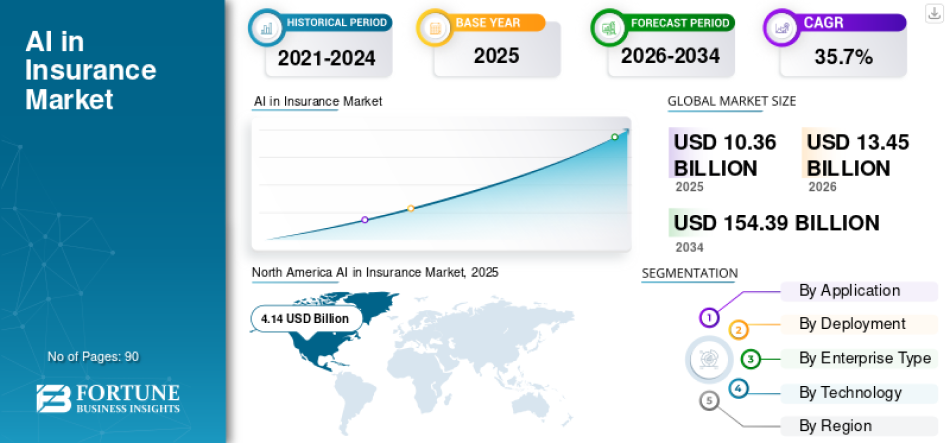
- The global market for AI in insurance is projected to grow from $13.45 billion in 2026 to over $150 billion by 2034, indicating strong long-term adoption across the insurance value chain.
- AI is already automating 50–60% of insurance claims, reducing handling costs by nearly 25–40% while improving turnaround time for claim resolution.
- AI automation is helping insurers reduce operational costs by around 15–20% while maintaining better accuracy across underwriting, claims, and policy evaluation processes.
Now that you’ve seen how the market is shifting, let’s look at what this actually means for your business and why investing in this direction makes sense.
1. Control Over Customer Acquisition
Owning the AI marketplace allows insurers to control how customers enter, engage, and renew policies over time. This reduces dependency on third parties and increases long-term customer value through repeat purchases and cross-policy opportunities.
2. Capture High-Intent Demand at Decision Stage
Marketplaces position insurers exactly where purchase decisions happen. Instead of competing only on awareness, they engage users during evaluation, increasing chances of closing high-intent customers and improving overall revenue quality.
3. Expand Revenue Across Multiple Distribution Channels
An AI marketplace allows insurers to distribute policies across digital channels, partners, and embedded ecosystems. This removes traditional distribution limits and creates multiple entry points for generating consistent and diversified revenue streams.
4. Faster Launch of New Insurance Products
Insurers can introduce new policies and pricing models directly through the marketplace without relying on intermediaries. This shortens launch cycles and allows quicker revenue generation from new offerings based on changing market demand.
If your goal is to stay relevant where customers actually make decisions, delaying AI insurance marketplace development only shifts that opportunity elsewhere. Start shaping how distribution works across your marketplace, as this is the moment for you to take control of how your insurance business grows today.
Turn Insurance Distribution into a Scalable Platform
Build a marketplace that reduces acquisition cost and improves policy conversion efficiency
Start My AI Marketplace StrategyTypes Of AI Insurance Marketplaces You Can Build
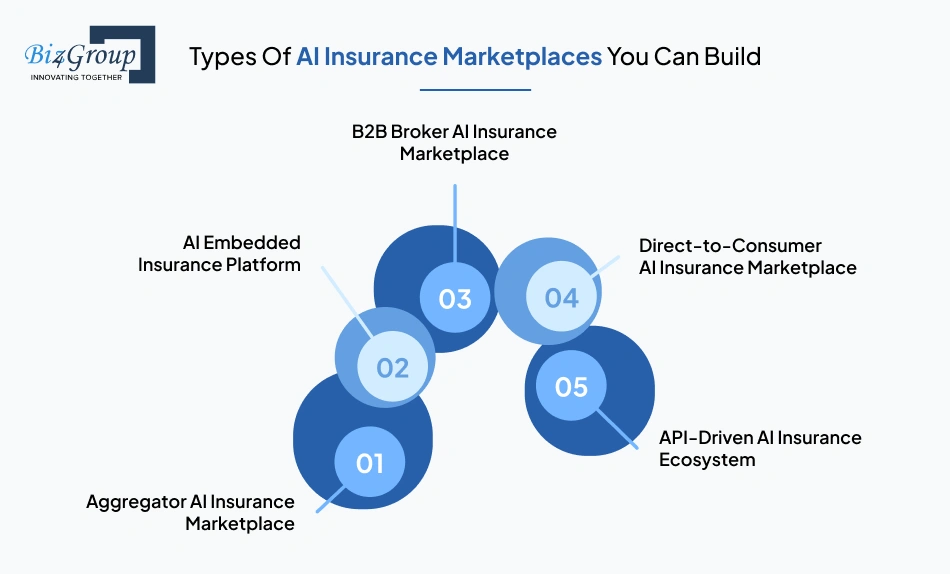
Different business goals require different marketplace models, and not every approach fits every organization. Understanding how each model operates helps you align your platform direction with distribution strategy, partnerships, and customer interaction patterns.
1. Aggregator AI Insurance Marketplace
Aggregator marketplaces bring multiple insurers onto a single platform where users can view and compare policy options in one place. This model works well when the focus is on simplifying discovery and improving access to multiple providers.
- Used by insurance aggregators, comparison platforms, and digital-first distributors
- Fits businesses aiming to centralize policy access and improve visibility across insurers
- Supports high user traffic where quick evaluation of multiple policies is required
This model is often preferred in developing an AI insurance platform for aggregators where scale and accessibility are key priorities.
2. AI Embedded Insurance Platform
AI Embedded insurance platforms integrate insurance offerings directly into another product or service experience. Instead of visiting a separate platform, users encounter insurance options within the flow of their primary interaction.
- Used by eCommerce platforms, travel companies, and fintech applications
- Fits scenarios where insurance is offered at the point of purchase or service usage
- Aligns with businesses aiming to make insurance a seamless part of existing journeys
In some implementations, generative AI helps tailor coverage suggestions based on user context within the platform.
3. B2B Broker AI Insurance Marketplace
B2B broker marketplaces are designed to support brokers and intermediaries by giving them structured access to multiple insurers through a single system. The focus is on enabling better decision-making across complex policy requirements.
- Used by brokers, agencies, and insurance intermediaries
- Fits businesses that manage multiple insurer relationships and client portfolios
- Supports structured workflows where brokers evaluate and present policy options to clients
This model is commonly adopted by organizations looking to build AI insurance marketplace for brokers and insurers with better control over distribution and evaluation.
4. Direct-to-Consumer AI Insurance Marketplace
Direct-to-consumer marketplaces allow insurance companies to interact with customers without relying on intermediaries. The platform acts as a direct channel for policy discovery and purchase.
- Used by insurance providers and InsurTech startups
- Fits businesses aiming to establish direct relationships with customers
- Supports digital-first experiences where users independently explore and select policies
This model gives companies more control over how policies are presented and how users engage with offerings.
5. API-Driven AI Insurance Ecosystem
API-driven ecosystems connect multiple systems, partners, and services through structured integrations. Instead of operating as a standalone platform, this model focuses on enabling insurance capabilities across different digital environments.
- Used by enterprises managing multiple platforms or partnerships
- Fits businesses that need flexible integration with external systems
- Supports environments where insurance services are distributed across channels
These ecosystems often rely on strong AI model development to ensure consistent decision-making across integrated systems.
Each marketplace type serves a different purpose, and the right choice depends on how your business plans to distribute, manage, and scale insurance offerings. Understanding these differences between the insurance marketplaces help decision makers align platform direction with real distribution needs and operational control.
Core Features Required for AI Insurance Marketplace Development
Before we move ahead with the development process of AI insurance marketplace, it is important to understand how core features translate into actual platform behavior.
Businesses that plan to develop AI-powered insurance marketplace solutions must focus on how each capability supports real user decisions, insurer control, and consistent operational flow across the system.
1. AI-Driven Policy Discovery Interface
Policy discovery is no longer about scrolling through long lists. The interface is designed to surface relevant options based on user intent and inputs, making the experience more focused and guided.
- Users are presented with structured policy options instead of browsing endlessly
- Inputs such as coverage needs and preferences shape what appears first
- The interface reduces noise by narrowing down choices early
2. Adaptive Policy Comparison Engine
Once users have a set of options, they need clarity to evaluate them. This feature allows users to compare policies in a structured way that highlights meaningful differences.
- Policies are displayed side by side with key details
- Coverage, pricing, exclusions, and benefits are clearly organized
- Users can adjust comparison criteria based on what matters most to them
3. Progressive Customer Profiling System
User data is not collected in one go. The platform gradually builds a profile based on how users interact, making the experience smoother and more relevant over time.
- Information is captured step by step during user interaction
- Long onboarding forms are avoided to reduce drop-offs
- User profiles evolve as more inputs and behaviors are recorded
4. Guided Policy Selection and Checkout Flow
Moving from decision to purchase requires a clear path. This feature ensures users can complete the process without confusion or unnecessary steps.
- Users move from shortlisted policies to final selection through a structured flow
- Documentation and approvals are simplified within the journey
- The process minimizes friction and keeps users on track until completion
5. Digital Claims Lifecycle Interface
The relationship with the user continues after purchase. This feature allows users to manage claims without relying on manual communication or follow-ups.
- Claims can be initiated directly within the platform
- Users can track progress across different stages
- Updates are visible without needing to contact support teams
6. Insurer Onboarding and Product Control Panel
Insurers need control over how their products appear and perform. This feature allows them to manage offerings in a structured and timely manner.
- Insurers can onboard and publish policies within the platform
- Pricing, coverage details, and availability can be updated when required
- Product listings remain current and aligned with business needs
7. Business Intelligence and Conversion Tracking Dashboard
To operate effectively, businesses need visibility into how the platform performs. This layer works closely with existing systems and often depends on well-planned AI integration services to ensure insights remain consistent across different workflows.
- Tracks user behavior and interaction patterns
- Monitors policy performance across different segments
- Highlights conversion trends and operational outcomes
8. Event-Triggered Notification and Engagement System
Consistent communication keeps users engaged throughout their journey. This feature ensures that important updates reach users at the right time.
- Users receive alerts related to policies, claims, and required actions
- Notifications are triggered based on user activity and system events
- Keeps users informed without manual intervention
These features define how the marketplace functions in real scenarios, shaping user journeys and business control at every stage. When planning how to make AI insurance marketplace for brokers and agents, clarity on these capabilities ensures the platform delivers consistent and usable outcomes.
Get the Right Features Built from Day One
Avoid rework by defining marketplace capabilities aligned with real insurance workflows
Define My Platform FeaturesTechnology Stack and System Architecture Required to Create AI Insurance Marketplace Platform
Clarity at the system level helps avoid gaps that often appear during implementation. It ensures that each part of the platform supports real workflows without unnecessary complexity. Before moving into execution, it is important to understand how technology supports each stage of the platform.
When businesses make AI insurance marketplace for claims and underwriting, this foundation ensures smoother operations, scalability, and system-level clarity.
|
Architecture Layer |
Recommended Technology |
Purpose |
|---|---|---|
|
Web Interface layer |
React.js, Angular, Vue.js |
Enables users to navigate policy discovery, comparison, and account actions through a responsive and structured web interface. |
|
Mobile Interface |
Flutter, React Native, Swift |
Supports on-the-go access through mobile app development, allowing users to manage policies, claims, and updates seamlessly across devices. |
|
Backend Application |
Handles core application logic, manages workflows, and processes user requests across different marketplace operations efficiently. |
|
|
AI/ML Processing |
TensorFlow, PyTorch, Scikit-learn, OpenAI API |
Processes inputs and generates outputs such as recommendations, risk evaluation, and contextual responses for decision support. |
|
Data Processing |
Apache Spark, Apache Kafka, Airflow |
Cleans, transforms, and streams incoming data to ensure consistency and readiness for platform operations and decision systems. |
|
Data Storage |
PostgreSQL, MongoDB, Amazon S3 |
Stores user data, policy information, and transaction records required for ongoing platform functionality and historical reference. |
|
API & Integration Layer |
REST APIs, GraphQL, gRPC |
Connects insurers, payment systems, and third-party services to enable real-time data exchange across the platform. |
|
Payment & Transaction |
Stripe, PayPal, Razorpay |
Handles secure payment processing, policy purchases, and transaction validation without interrupting user workflows. |
|
Authentication & Identity |
OAuth 2.0, JWT, Firebase Auth |
Manages secure user authentication, access control, and session handling across all platform interactions. |
|
Cloud Infrastructure |
AWS, Microsoft Azure, Google Cloud |
Provides scalable hosting, manages workloads, and ensures availability under varying user demand conditions. |
|
DevOps & Deployment Layer |
Docker, Kubernetes, Jenkins, CI/CD |
Supports continuous deployment, system updates, and resource scaling while maintaining platform stability. |
|
Monitoring & Logging Layer |
Prometheus, Grafana, ELK Stack |
Tracks performance, logs system activity, and helps identify issues to maintain reliability and uptime. |
A well-defined stack and architecture ensure the platform runs reliably under real conditions. When you create AI driven insurance marketplace for policy recommendations, strong full stack development keeps every layer aligned with performance and long-term scalability.
How to Build an AI Insurance Marketplace: A Step-By-Step Process from Execution to Deployment
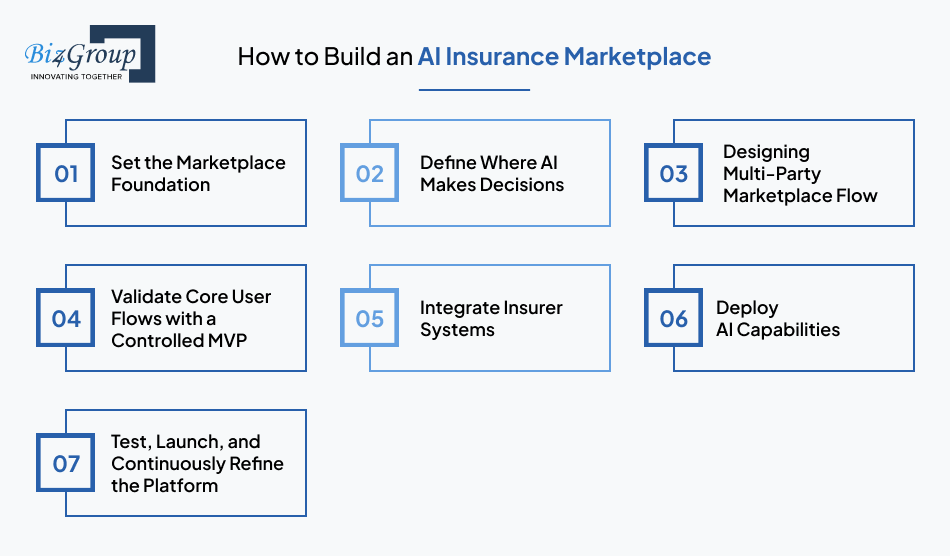
A structured execution approach ensures the platform moves from concept to real-world usability without gaps. Businesses following the steps to create AI insurance marketplace for digital insurance focus on aligning each stage with operational needs, scalability, and consistent decision flow across users and insurers.
1. Set the Marketplace Foundation
- Define Who the Platform Serves: Start by identifying the primary users. This could include end customers, brokers, insurers, or a mix of all three. Each group changes how the platform operates.
- Decide the Marketplace Structure: The structure determines how policies are distributed. An aggregator model focuses on comparison, while a broker-driven model supports advisory workflows. This decision impacts how interactions will be handled later.
- Clarify Revenue Direction Early: Revenue should be clear from the beginning. Whether it comes from commissions, subscriptions, or partnerships, it must align with how users and insurers interact within the platform.
- Define Operational Boundaries: Decide whether the platform will handle only discovery and purchase or extend into underwriting and claims. This directly affects scope and long-term effort.
2. Define Where AI Makes Decisions
- Map Where Decisions Actually Happen: Look at real insurance workflows and identify where decisions are made. This includes matching users with policies, evaluating risk, and handling claim outcomes.
- Limit AI to High-Impact Areas: Avoid spreading AI across the entire marketplace. Focus only on areas where it improves speed, accuracy, or user decision-making in a visible way.
- Define Expected Outcomes Clearly: Each AI use case should produce a clear output. For example, narrowing policy options or flagging risk levels. This avoids building logic that does not translate into usable results.
- Align AI with Business Goals: Select AI models based on the type of decision ensuring that AI supports actual business outcomes instead of isolated experimentation.
Also Read: Why AI Projects Fail in Companies That Lack AI Readiness?
3. Designing Multi-Party Marketplace Flow
- Define How Multiple Parties Will Interact: The platform must support interactions between users, insurers, and internal operations. This requires clear coordination without creating bottlenecks.
- Plan for Growth from the Start: Even at an early stage, the marketplace should be designed to handle increasing users and insurer participation without needing major restructuring later.
- Ensure Data Moves Without Friction: Data should flow consistently between different parts of the platform. Gaps in data handling often lead to delays or incorrect outputs during execution.
- Align User Journeys with System Flow: Working with a UI/UX design company helps structure user journeys so that platform flows remain clear, consistent, and easy to navigate across different interaction points.
Also Read: Top UI/UX Design Companies in USA
4. Validate Core User Flows with a Controlled MVP
- Focus Only on Core Marketplace Flows: The first version should include only essential journeys such as policy discovery, evaluation, and basic purchase handling.
- Validate Real User Interaction Early: Instead of assuming behavior, test how users interact with the platform. This reveals friction points that are not visible during planning.
- Avoid Overbuilding in Early Stage: The focus stays on validating how users move through the platform, not expanding scope too early. Working with MVP development services providers help release a usable version quickly to test real interaction gaps and fix them before scaling.
- Use Feedback to Refine Direction: Early insights help adjust workflows, simplify steps, and remove unnecessary complexity before scaling further.
Also Read: Top MVP Development Companies in USA
5. Integrate Insurer Systems
- Bring Real Policy Data into the Platform: Without insurer participation, the marketplace has no value. Integration ensures that actual policies, pricing, and availability are accessible.
- Handle Data Differences Across Insurers: Each insurer provides data in a different format. This needs to be aligned so that the platform can present consistent information.
- Maintain Data Accuracy Over Time: Policy details change frequently. The system must keep data updated to avoid incorrect recommendations or outdated information.
- Prepare Decision Support Systems: Clean and structure data at this stage to train AI models without reworking integrations or fixing inconsistencies.
6. Deploy AI Capabilities
- Introduce AI into Live User Journeys: AI should be applied where users are actively making decisions, not as a separate layer. This ensures it directly influences outcomes.
- Validate Performance in Real Conditions: AI should be tested with real user inputs and real data, not just controlled scenarios. This ensures reliability within the AI insurance marketplace.
- Align AI with Business Expectations: Gradually integrate AI models into workflows and monitor whether results match expected outcomes in terms of accuracy and usability.
7. Test, Launch, and Continuously Refine the Platform
- Test Across Real Scenarios: Validate how the platform behaves under different conditions, including multiple users, varied inputs, and operational load.
- Launch in Controlled Phases: Avoid full-scale release at once and start with a limited rollout to monitor behavior and reduce risk.
- Track Real Usage Patterns: Observe how users interact with the platform, where they drop off, and where decisions take longer.
- Continuously Improve Based on Data: Refinement does not stop after launch as ongoing updates ensure the platform evolves with real user behavior and operational needs.
Also Read: Software Testing Companies in USA
Execution only works when each step reflects how the platform will run in real conditions, not just how it is planned. AI insurance marketplace development works best when every stage is validated early and refined continuously through actual user interaction.
Move From Idea to Execution Without Delays
Structure your development approach to avoid missed timelines and costly rebuild cycles
Plan My Marketplace BuildCompliance and Regulatory Frameworks When You Make AI Insurance Marketplace
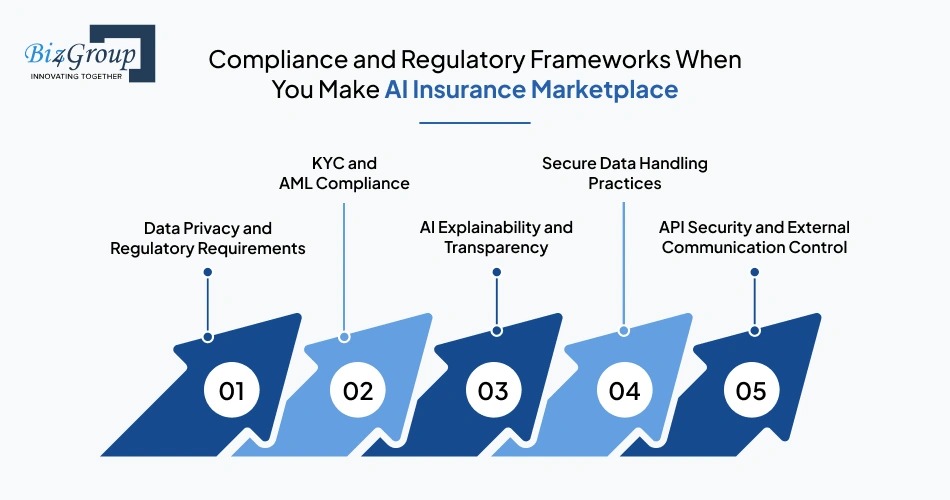
Once the platform starts handling real users, policies, and transactions, compliance becomes part of daily operations, not a checklist. When you develop AI insurance aggregator platform, regulatory decisions shape how data is handled, how users are verified, and how systems stay accountable. Let’s break down the key areas you need to address.
1. Data Privacy and Regulatory Requirements
Handling user data requires strict adherence to regulations such as GDPR and HIPAA where applicable. Personal and financial information must be stored and accessed in a controlled manner to prevent misuse. Clear data ownership policies also help define accountability across platform participants.
Also Read: HIPAA Compliant AI App Development for Healthcare Providers
2. KYC and AML Compliance
Identity verification and fraud prevention are essential in insurance workflows. The platform must validate user identities and monitor transactions to prevent misuse. Strong verification processes also reduce onboarding risks and ensure only legitimate users and entities participate in the marketplace.
3. AI Explainability and Transparency
Decisions influenced by AI must remain understandable to users and regulators. Platforms need to ensure outcomes can be interpreted clearly, especially in policy selection and claims. Insurance companies that hire AI developers with domain understanding can ensure these decisions remain transparent and aligned with regulatory expectations.
4. Secure Data Handling Practices
Data must remain protected throughout its lifecycle, from input to storage and access. Controlled access, encryption, and structured usage reduce risks associated with sensitive information. Consistent handling practices also prevent internal misuse and maintain reliability across different operational stages.
5. API Security and External Communication Control
When external systems are connected, data exchange must remain secure and controlled. This is where enterprise AI integration ensures communication stays consistent without exposing vulnerabilities. Clear validation and access rules also help maintain trust between insurers, partners, and the platform.
How Much Does It Cost to Develop AI Insurance Marketplace and What Factors Influence the Cost?
Now that the platform structure and workflows are clear, the next question that arises is what is cost to build an AI insurance marketplace platform?
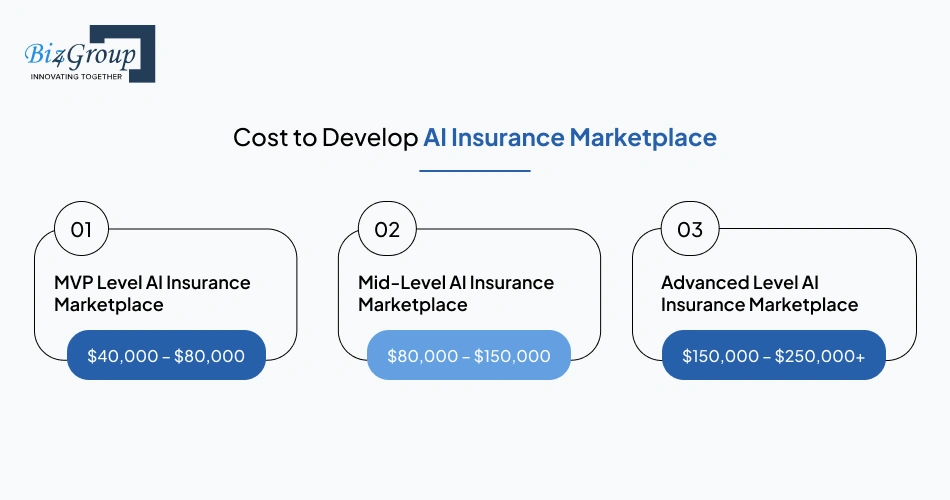
The cost clarity starts with understanding how scope translates into effort across the platform. For businesses creating AI insurance marketplace for brokers and customers, most projects fall within a $40,000 to $250,000 range depending on complexity.
|
Development Level |
Estimated Cost Range |
Scope |
|---|---|---|
|
MVP Level AI Insurance Marketplace |
$40,000 – $80,000 |
Covers core flows such as policy discovery, structured comparison, and basic purchase handling with limited integrations and simplified operational logic. |
|
Mid-Level AI Insurance Marketplace |
$80,000 – $150,000 |
Expands workflows, adds multiple insurer connections, improves data handling, and supports more refined user journeys across key platform interactions. |
|
Advanced Level AI Insurance Marketplace |
$150,000 – $250,000+ |
Supports full-scale operations across underwriting, claims, and multi-system coordination with higher scalability and deeper workflow control across the platform. |
Factors Influencing the Cost of AI Insurance Marketplace Development
- The way you define platform scope directly shapes effort. Expanding beyond basic discovery into underwriting and claims increases coordination complexity, typically shifting projects from MVP into mid-level or advanced ranges.
- Integration depth plays a major role in cost distribution. Connecting with a few insurers keeps effort controlled, while multi-insurer ecosystems increase AI integration costs due to validation, mapping, and ongoing synchronization requirements.
- Data readiness often gets underestimated. If structured data is already available, effort remains lower. When systems require cleanup or restructuring, AI insurance software cost increases due to additional preparation and validation
- Workflow variation across user types affects implementation Platforms designed for both brokers and direct users require more structured journeys, which increases development time without necessarily increasing infrastructure complexity.
- Scalability planning influences cost direction rather than adding fixed cost. Platforms expected to handle high traffic or multi-region usage require stronger system design, pushing projects toward the higher end of the overall range.
Cost decisions become easier when tied directly to how the platform will operate in real conditions. AI insurance marketplace development stays controlled when scope, integrations, and workflows are defined before execution begins.
Business Models to Generate Revenue from AI Insurance Marketplace
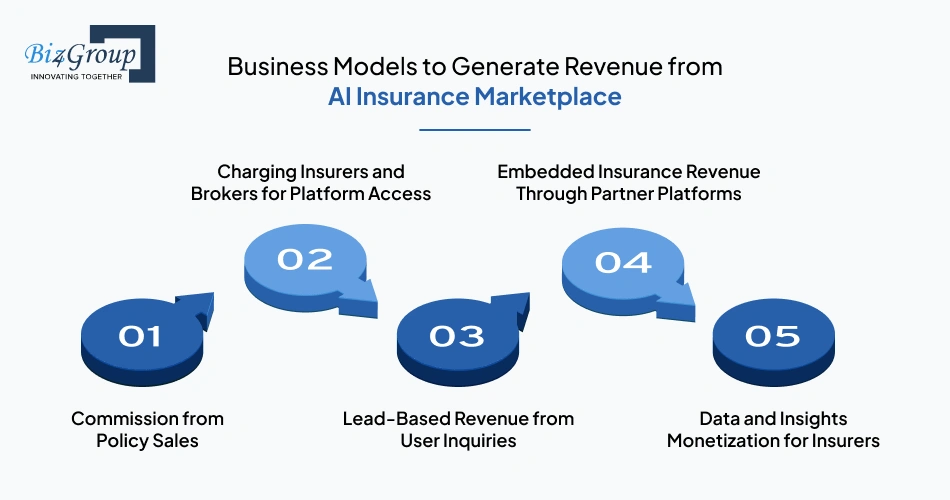
Once the platform starts attracting users and insurer participation, the focus shifts to monetization. In insurance marketplace development integrating AI, revenue comes from how policies are distributed, how access is structured, and how demand is converted.
Here are common business models that insurance company owners can adopt to generate revenue from AI insurance marketplace development:
1. Commission from Policy Sales
Most insurance marketplaces earn by taking a commission on every policy sold through the platform. Insurers pay for access to qualified customers and completed transactions.
Typical structure includes:
- 5%–15% commission on policy premiums depending on product type
- Higher commissions for high-value policies like health or commercial insurance
For example, if a platform sells 2,000 policies per month with an average premium of $300 and a 10% commission, it generates $60,000 monthly revenue.
2. Charging Insurers and Brokers for Platform Access
Insurance businesses can charge insurers or brokers to list and distribute their policies on the platform. This works when the platform consistently attracts qualified users.
Typical pricing includes:
- Monthly access fees ranging from $500–$5,000 per insurer
- Premium listing placements for higher visibility
A platform onboarding 20 insurers at $2,000 per month can generate $40,000 in recurring monthly revenue without relying on transactions alone.
3. Lead-Based Revenue from User Inquiries
Not every user completes a purchase instantly. Platforms owners can monetize user intent by selling qualified leads to insurers or brokers who handle conversions externally.
Typical structure includes:
- $10–$50 per qualified lead depending on policy type
- Higher pricing for high-intent or verified users
If a platform generates 3,000 qualified leads monthly at $20 per lead, it can earn $60,000 from lead distribution alone.
4. Embedded Insurance Revenue Through Partner Platforms
Insurance can be offered within platforms like travel booking, eCommerce, or fintech apps. Revenue is earned when users purchase policies within those partner ecosystems.
Typical structure includes:
- Revenue-sharing agreements between 10%–30% of premium value
- Earnings tied to partner platform transactions
For example, integrating insurance into a travel platform with 10,000 monthly bookings can generate consistent additional revenue without direct user acquisition costs.
5. Data and Insights Monetization for Insurers
As the platform grows, it collects valuable data on user behavior, demand patterns, and policy performance. This data can be packaged into insights for insurers.
Typical offerings include:
- Monthly analytics subscriptions ranging from $1,000–$10,000
- Custom reports for pricing, demand trends, and user segmentation
Insurers use this data to refine pricing and product strategies, creating a steady B2B revenue stream for the platform.
Revenue grows when the platform turns user activity into measurable outcomes for insurers. AI insurance marketplace development becomes sustainable when earnings come from transactions, access, and insights that directly support real insurance operations.
Design a Marketplace That Actually Generates Revenue
Align your platform model with scalable monetization instead of one-time transaction margins
Build My Revenue StrategyCommon Mistake to Avoid During AI Insurance Marketplace Development
Early decisions often shape long-term outcomes more than the technology itself. In AI insurance marketplace development for insurtech startups, small missteps in planning, data handling, and execution can create delays that are difficult to fix later. Here are the mistakes you should actively watch for during the development of AI insurance marketplace:
|
Mistake |
How to Avoid It |
|---|---|
|
Defining the platform without a clear business model |
Start with a clear view of who the platform serves and how revenue will be generated. This prevents building flows that do not support real insurance operations. |
|
Expanding scope too early without validation |
Focus on core workflows first and validate them with real users. Avoid adding underwriting or claims processes before basic interactions are stable. |
|
Integrating insurers without standardizing data |
Align policy formats and data structures before onboarding multiple insurers. This avoids inconsistencies that affect user decisions and system reliability. |
|
Treating AI as a feature instead of decision support |
Use AI only where decisions need to be improved, such as policy matching or risk evaluation. Avoid adding it in areas where it does not influence outcomes. |
|
Ignoring compliance during early stages |
Address regulatory requirements from the beginning. Delaying compliance often leads to rework, especially when handling sensitive user and financial data. |
|
Poor coordination between user flow and system logic |
Ensure that how users move through the platform aligns with how the system processes requests. Misalignment creates friction and incomplete journeys. |
|
Underestimating data readiness and quality |
Prepare and validate data before using it across workflows. Inconsistent or incomplete data leads to unreliable outputs in AI insurance software and weak decision support. |
|
Relying on generic implementation without domain alignment |
Work with teams offering AI consulting services who understand insurance workflows. This ensures that decisions and platform structure reflect real-world use cases. |
Avoiding these mistakes helps keep execution aligned with real insurance workflows. AI insurance marketplace development becomes more predictable when decisions are grounded in data readiness, clear scope, and structured implementation from the start.
What Will Change for AI Insurance Marketplaces in Future
Future shifts will not come from adding more features but from changing how decisions are made and delivered. AI insurance marketplace development will move toward systems that act faster, adapt continuously, and reduce manual dependency across workflows.
- Decision-making will shift toward autonomous systems where insurance AI agents handle user queries, policy selection, and claims interactions without human intervention.
- Voice-driven interactions will become standard, where a voice AI agent for insurance claim fraud will be able to validate claims through real-time conversations instead of manual documentation.
- Insurance marketplaces will move toward real-time underwriting, where policy approval happens instantly based on live data rather than delayed evaluations.
- Insurance offerings will become hyper-contextual, adjusting coverage dynamically based on user behavior, environment, and ongoing risk signals.
- Continuous learning systems will refine decisions automatically, improving accuracy without requiring manual updates or system reconfiguration.
Future platforms will rely less on manual processes and more on continuous decision systems. AI insurance marketplace development will evolve into self-adjusting ecosystems that respond instantly to user needs and changing risk conditions.
Build for Where Insurance Platforms Are Headed
Prepare your marketplace for evolving customer expectations and AI-driven decision ecosystems
Future-Proof My PlatformWhy Biz4Group LLC is Considered as The Best Company to Build AI Insurance Marketplace
When insurance companies and insurtech startups plan AI insurance marketplace development, one decision often shapes the entire outcome. The choice of the right technology partner determines how well the platform performs in real-world insurance workflows.
Biz4Group LLC works with businesses that want more than just a functional platform. As an experienced AI development company, we focus on building systems that align with how insurance operations actually run, from policy distribution to claims handling.
Beyond development, we focus on how the platform behaves under real conditions. Our team designs systems that handle dynamic data, support decision-making, and adapt as usage grows. This is where our experience with AI insurance automation solutions becomes critical in shaping platforms that remain usable and scalable over time.
Why Businesses Choose Biz4Group LLC
- Deep Experience in AI-Driven Insurance Systems: We build platforms that use AI to support real insurance decisions, not just automate surface-level interactions. This helps businesses move from static marketplaces to systems that actively guide users.
- Strong Focus on Marketplace Execution: Our work goes beyond development. We ensure the platform supports how insurers, brokers, and customers interact, making the system practical and aligned with real distribution models.
- Custom-Built Platforms Based on Business Goals: Every marketplace is designed around specific business objectives. This avoids generic builds and ensures the platform supports the intended revenue model and user flow.
- Scalable Systems Designed for Growth: We design platforms that handle increasing users, insurers, and transactions without requiring major restructuring. This allows businesses to expand without operational disruption.
- End-to-End Development Support: From initial planning to deployment and optimization, our team supports every stage of the journey. This ensures consistency in execution and reduces gaps between strategy and implementation.
This approach becomes even more clearer when you look at how projects delivered by us function in actual insurance environments
Portfolio Spotlight: Insurance AI- Transforming Insurance Training with AI
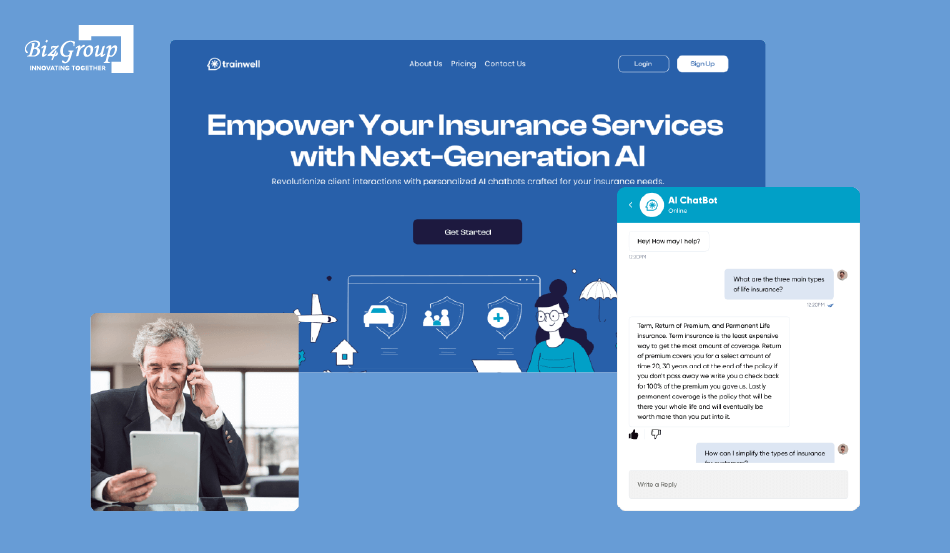
Insurance AI is an AI-powered assistant built for agent workflows. It allows teams to access policy details, handle queries, and respond to customer scenarios in real time. It reduces dependency on manual lookup and improves response accuracy during live interactions. This reflects how such systems are built to support real insurance operations, where faster decisions and reliable information directly impact customer experience and efficiency.
Thus, with these capabilities Biz4Group LLC focuses on turning AI insurance marketplace idea for insurance companies into a system that works in real insurance workflows. Now it’s your time. Let’s turn one such opportunity into a real, working platform for your business. Connect with us!
Conclusion
AI insurance marketplaces are not just improving distribution, they are changing how decisions are made across the insurance lifecycle. The real value lies in how these platforms bring structure to fragmented workflows and reduce the dependency on manual processes. This is where working with the right AI product development company becomes important, as execution determines whether the platform delivers real outcomes or remains underutilized.
For businesses, the focus is no longer on whether to invest, but on how to approach AI insurance marketplace development in a way that aligns with actual operations. The difference comes from building a system that supports real interactions between insurers, brokers, and customers without adding unnecessary complexity. Teams like Biz4Group LLC help bridge that gap by turning marketplace concepts into working platforms that perform in real environments.
If you are planning to move forward with your platform idea, this is the right time to take the next step. Schedule a call with us!
FAQ’s
1. How can we build an AI insurance marketplace for our company without disrupting existing operations?
Businesses usually integrate the marketplace in phases rather than replacing systems at once. This allows insurers and brokers to continue existing workflows while gradually shifting policy distribution and decision-making into the new platform.
2. What is the typical timeline to develop an AI insurance marketplace platform from idea to launch?
Most platforms take 4 to 9 months depending on scope. MVP-level marketplaces can be launched faster, while advanced platforms with multiple insurer integrations and decision systems require longer execution and validation cycles.
3. What is the cost to build AI insurance marketplace platform and what drives the variation?
The cost typically ranges between $40,000 to $250,000+, depending on platform complexity, integrations, and level of automation. Costs increase when the platform supports real-time decision workflows and multi-party participation.
4. Who can develop an AI insurance marketplace platform that aligns with real insurance workflows?
It requires a team that understands both insurance operations and platform development. The focus should be on building systems that handle policy distribution, risk evaluation, and claims interaction in a structured way.
5. How do insurers maintain control over pricing and policy changes in AI insurance marketplace?
Insurers manage this through a dedicated control layer where they can update pricing, coverage rules, and availability in real time. The marketplace reflects these changes instantly without requiring platform-level updates, ensuring insurers stay in control of their offerings.
6. How should businesses approach the development of AI insurance marketplace when multiple insurers and brokers are involved?
The focus should be on standardizing how policy data is structured before onboarding multiple participants. Without this, differences in pricing formats, coverage details, and rules create inconsistencies that affect user decisions and platform reliability.
