 Location :
Orlando, FL, USA
Location :
Orlando, FL, USA +1 (407) 714-1616
 info@biz4group.com

- Enterprise legal AI platform development Like Harvey.ai focuses on helping large law firms scale research, drafting, and knowledge work without disrupting existing workflows.
- Harvey.ai like enterprise legal AI platform development emphasize security, governance, and adoption over experimental features.
- Firms that build enterprise legal AI software solution similar to Harvey.ai usually start with narrow, high value workflows and expand gradually.
- A growing number of large law firms and corporate legal teams are actively investing in enterprise legal AI platforms as part of long term operations strategy.
- The typical cost for enterprise legal AI platform development Like Harvey.ai ranges from USD 30,000 to USD 250,000 depending on scope, and level of customization.
- Long term success depends less on technology choices and more on aligning AI with how legal teams actually work and make decisions at scale.
You are running a large law firm or enterprise legal team, deadlines never slow down, and clients expect faster answers with zero room for error. Somewhere between contract review, legal research, and drafting, productivity keeps leaking away. That is where enterprise legal AI platform development Like Harvey.ai starts to feel like a practical next step, raising some very real questions like:
- What is enterprise legal ai platform development like Harvey.AI?
- How to build an AI platform for law firms like Harvey.AI?
- What's the best AI legal assistant platform for enterprise use?
- Can enterprises build a Harvey.AI style legal system?
- What is the cost to develop enterprise legal AI platform like Harvey.AI?
The momentum behind legal AI has become far beyond theoretical:
- The global legal AI software market is projected to grow to USD 10.82 billion by 2030, reflecting a CAGR of 28.3 percent, according to Markets and Markets.
- At the same time, 65 percent of law firms and corporate legal departments already having an AI framework in place, as reported by Thomson Reuters.
For decision makers exploring the shift toward AI driven legal workflows, the focus is about scaling it. Large firms and enterprise legal teams are looking for ways to standardize research, reduce drafting cycles, and bring consistency across matters without adding headcount or risk.
There is also a quieter pressure most leaders feel but rarely say out loud. Clients expect AI assisted efficiency whether it is disclosed or not, younger attorneys expect modern tools, and partners want margins protected without sacrificing quality. This is often where conversations with a legal software development company begin – for enterprise legal AI platform development like Harvey.ai.
Achieving that usually means designing systems that reflect real enterprise legal workflows, security expectations, and compliance obligations. The interest in Harvey.ai like enterprise legal AI platform development continues to grow among legal businesses. But the real question becomes how to build platforms that legal teams trust enough to use every single day.
Do you Build or Buy? How an AI development company can help you build the platform? What is the tech stack for it? How do you monetize it?
This blog will answer all of your questions. So, let’s begin!
What is Harvey.ai and Why is it Popular?
Harvey.ai is an enterprise focused legal AI platform used by large law firms to assist with legal research, drafting, and internal knowledge access. It has become a common reference point for teams exploring enterprise legal AI platform development Like Harvey.ai in real world legal environments.
- Designed for real legal workflows used in large firms
- Handles large volumes of legal documents securely
- Focuses on accuracy and consistency rather than speed alone
- Uses controlled AI model development to support legal reasoning
- Fits into existing legal operations without major disruption
Harvey.ai gained attention because it feels usable and dependable. Legal leaders see it as a practical way to introduce AI into daily work without increasing risk or forcing teams to change how they already operate. Here are the top reasons why enterprise love it:
- Aligns well with broader enterprise AI planning
- Makes it easier to build legal AI agents around firm knowledge
- Applies generative AI carefully within legal boundaries
- Supports gradual adoption across teams
In short, for enterprise leaders planning to develop legal AI platform like Harvey.ai, there isn’t a better time than now.
How Enterprise Legal AI Platforms like Harvey.ai Work?
At a practical level, enterprise legal AI platform development Like Harvey.ai brings trusted legal knowledge and controlled intelligence into everyday workflows. The real value shows up quietly, in how smoothly the system supports attorneys during real work.
1. Legal knowledge intake and preparation
The platform starts by securely ingesting contracts, research, pleadings, and internal precedents from across the firm. These materials are structured so legal meaning, relationships, and context remain intact. This foundation determines whether the system delivers dependable insights or superficial responses.
2. Context driven reasoning layer
Once the knowledge base is ready, generative AI is applied within clearly defined legal boundaries. The system reasons only from approved sources instead of drawing from general knowledge. This is where many firms align legal platforms with broader enterprise AI solutions already in place.
3. Workflow alignment and delivery
Rather than forcing new tools, the platform connects into existing legal systems and routines. Through carefully planned AI integration services, insights surface where lawyers already work. Adoption improves when AI feels like part of the workflow instead of an added step.
|
Area |
What Happens |
Enterprise Impact |
|---|---|---|
|
Knowledge intake |
Legal content is organized securely |
Preserves accuracy and confidence |
|
AI reasoning |
Context based responses are generated |
Reduces manual effort |
|
Workflow fit |
AI aligns with daily tools |
Drives consistent usage |
Legal AI which is built this way becomes reliable infrastructure instead of a novelty. That is why teams looking to build enterprise legal AI software solution similar to Harvey.ai often move next into evaluating value, risk, and long term investment decisions.
Build Legal AI That Actually Gets Used
Turn enterprise legal workflows into a scalable system with enterprise legal AI platform development Like Harvey.ai.
Start My Legal AI PlatformWhy Invest in Legal AI Platform Software like Harvey.ai?
For enterprise legal teams, the question is no longer if AI fits into legal work. It is about timing and approach. Enterprise legal AI platform development Like Harvey.ai has become a practical way to address everyday pressures inside large firms.
1. Reducing Time Spent on Repeat Work
Legal teams often revisit the same research, clauses, and documents across matters. AI helps surface what already exists instead of starting from scratch each time. This is where leaders begin to see how legal workflow automation transforms legal operations in real terms.
2. Meeting Client Expectations More Consistently
Clients expect speed, clarity, and consistent quality across engagements. Platforms designed for legal AI software development for large firms like Harvey.ai help teams deliver reliable outputs without disrupting how they work today.
3. Scaling Expertise Without Adding Headcount
As workloads grow, adding more people does not always solve the problem. AI makes it possible to reuse firm knowledge across teams and offices. Many organizations choose to build AI software that reflects their strongest legal thinking.
When firms start planning how to create AI powered legal platform like Harvey.ai, attention naturally moves from efficiency alone to where these systems create the most impact. That thinking often leads directly into real world use cases.
Use Cases for Legal AI Software Development for Large Firms like Harvey.ai
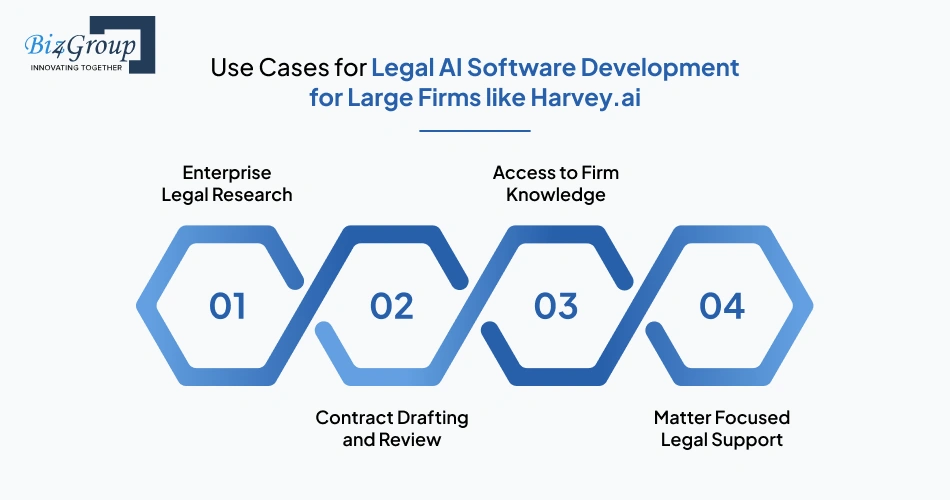
When firms look at enterprise legal AI platform development Like Harvey.ai, the real value shows up in day to day legal work. These platforms earn their place by quietly handling tasks that consume time, attention, and patience across large teams.
1. Enterprise Legal Research
Legal research at scale means navigating years of case law and internal material. AI helps narrow that search while keeping context intact. This is often the first area firms focus on when they build AI driven legal research and drafting platform like Harvey.ai.
- Example: Finding relevant precedents from past firm matters instead of starting from scratch.
2. Contract Drafting and Review
Drafting contracts involves repetition, precision, and constant checking. AI assists by organizing clauses and spotting gaps while lawyers stay in control. Many teams rely on generative AI here to speed up early drafts responsibly.
- Example: Reviewing commercial agreements for missing or inconsistent clauses.
3. Access to Firm Knowledge
Large firms hold valuable knowledge that is hard to access quickly. AI platforms make that information searchable across teams and offices. This is a common focus in custom enterprise legal AI development like Harvey.ai, often supported by AI legal document management software.
- Example: Reusing prior deal language approved by senior partners.
4. Matter Focused Legal Support
Instead of broad chat tools, enterprises create focused assistants tied to specific matters. These tools answer questions using approved data and clear boundaries. Teams often develop AI legal assistant platform for law firms like Harvey.ai using AI conversation app interfaces.
- Example: Asking questions about filings or timelines while preparing for hearings.
|
Use Case |
What It Helps With |
Enterprise Value |
|---|---|---|
|
Legal research |
Faster discovery of relevant material |
Better use of time |
|
Contract work |
More consistent drafting |
Lower risk |
|
Knowledge access |
Reuse of firm expertise |
Stronger leverage |
|
Legal assistance |
Focused matter support |
Controlled AI usage |
How Biz4Group Leverages the Power of AI in LegalTech

Trial Proofer is a legal automation platform built by Biz4Group to help firms manage deadlines, filings, and case progress digitally. It reflects how structured legal workflows can be supported through intelligent systems, a foundation that directly informs how enterprise teams approach scalable legal AI platforms built for consistency and control.
As the use cases expand across teams, expectations move beyond basic functionality. Now, let’s dive into the specific features enterprise legal teams need to support work at this scale.
Plan Before You Build
Get clarity on scope, cost, and architecture for Harvey.ai like enterprise legal AI platform development built for large firms.
Request a Legal AI RoadmapMust Have Features in Enterprise Legal AI Platform Development like Harvey.ai
When firms commit to enterprise legal AI platform development Like Harvey.ai, success depends less on novelty and more on fundamentals. The features below are what make these platforms usable, trusted, and scalable in real enterprise legal environments:
|
Core Feature |
Why It Matters for Large Firms |
|---|---|
|
Secure Document Ingestion |
Allows firms to upload and manage sensitive legal documents without compromising confidentiality |
|
Context Aware Legal Search |
Delivers relevant results based on matter specific context, not keyword matching alone |
|
Controlled AI Reasoning |
Ensures responses stay grounded in approved legal sources and firm knowledge |
|
Drafting Assistance |
Supports faster creation of legal drafts while keeping attorneys in control |
|
Knowledge Reuse |
Makes prior work product searchable and reusable across teams and offices |
|
Role Based Access Control |
Limits data access based on user roles, practice areas, and permissions |
|
Audit Trails and Logging |
Provides transparency into how outputs are generated and used |
|
Workflow Compatibility |
Fits into existing legal tools instead of forcing teams to change habits |
|
Enterprise Security Standards |
Meets data protection, compliance, and governance expectations |
|
Scalable Architecture |
Supports growth across matters, teams, and jurisdictions |
These core capabilities form the baseline needed to create enterprise grade legal AI system like Harvey.ai that legal teams actually rely on. Once this foundation is in place, it's time to consider advanced features that push efficiency and insight even further, often guided by thoughtful AI consulting services.
Advanced Features in Custom Enterprise Legal AI Development like Harvey.ai
Once the fundamentals are in place, advanced capabilities determine how far a platform can go. In enterprise legal AI platform development Like Harvey.ai, these features focus on deeper reasoning, tighter control, and confidence at enterprise scale.
1. Matter Specific AI Agents
Advanced platforms support AI agents that operate within a single matter or client context, using only approved documents and instructions. This prevents scope creep while improving relevance and trust. Many firms explore this direction as part of AI legal platform software development for enterprises like Harvey.ai.
2. Multi Document Legal Reasoning
Instead of responding to isolated prompts, the system can reason across contracts, filings, and internal knowledge. It connects obligations, risks, and dependencies across sources. This is often where teams choose to integrate AI into an app already used for complex legal analysis.
3. Built In Compliance Guardrails
Advanced platforms enforce data access rules, retention policies, and usage boundaries by design. This approach helps firms create secure and compliant legal AI platforms like Harvey.ai without relying on after the fact checks. Compliance becomes part of daily operation.
4. Workflow Level Automation
Beyond research and drafting, AI can quietly support reviews, approvals, and internal handoffs. With carefully applied AI automation services, repetitive steps fade into the background. Teams experience smoother workflows without process disruption.
5. Context Aware Conversational Interfaces
Advanced systems support structured conversations tied directly to firm data and matters. This often overlaps with legal AI chatbot development designed for enterprise use. The emphasis stays on clarity, precision, and control rather than novelty.
As these advanced features come into play, firms start thinking less about what AI can do and more about how it should be built. That brings us to the development planning and execution strategy.
From Legal Workflows to AI Infrastructure
Design and deploy a system that helps you build enterprise legal AI software solution similar to Harvey.ai at scale.
Explore Enterprise Legal AIHow to Create an AI Powered Legal Platform like Harvey.ai? Step by Step Process
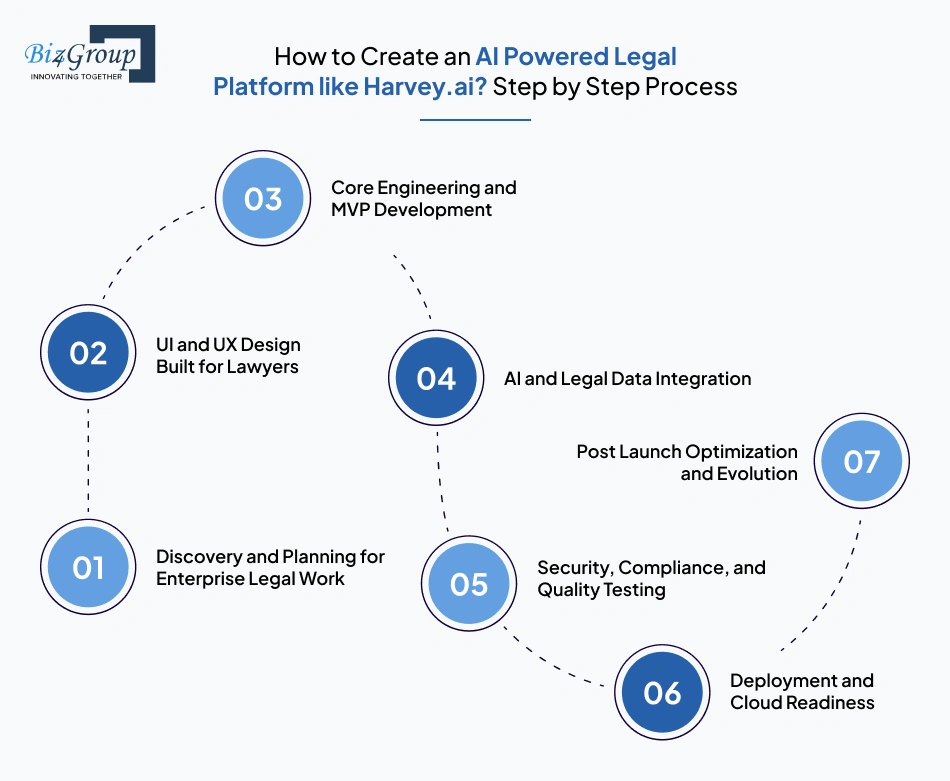
Building an enterprise legal AI platform is a strategic initiative, not a quick build. For firms considering enterprise legal AI platform development Like Harvey.ai, the process starts with clarity around legal workflows, risk boundaries, and how technology should support lawyers without changing how they practice.
1. Discovery and Planning for Enterprise Legal Work
This step focuses on understanding where AI can realistically help legal teams today. The aim is to uncover high effort tasks that are consistent across matters and suitable for automation without compromising judgment or confidentiality.
- Interview partners, associates, and legal operations leaders
- Identify research, drafting, and review bottlenecks
- Define success metrics tied to legal productivity
- Set clear boundaries around data access and usage
2. UI and UX Design Built for Lawyers
Adoption depends heavily on design. Lawyers expect tools that feel predictable, structured, and aligned with how they already work. The UI/UX design should support focus, not distract from legal reasoning.
- Design flows around research, drafting, and review tasks
- Test usability with both junior and senior attorneys
- Keep interactions simple and purposeful
- Prioritize consistency across devices and teams
Also Read: Top 15 UI/UX Design Companies in USA: 2026 Guide
3. Core Engineering and MVP Development
This stage turns strategy into something attorneys can actually use. A focused MVP helps firms validate value early while laying the groundwork to build a legal AI platform similar to Harvey.ai for large firms without unnecessary complexity.
- Start with legal research and drafting assistance
- Limit scope to repeatable, high impact workflows
- Design architecture that supports future growth
- Use MVP development services to validate early adoption
Also Read: Top 12+ MVP Development Companies to Launch Your Startup in 2026
4. AI and Legal Data Integration
This phase determines whether the platform feels reliable or risky. AI must work only with trusted, firm approved data to deliver outputs attorneys can stand behind.
- Integrate internal precedents and work product
- Train AI models for legal language and context
- Avoid over reliance on generic external data
- Maintain clear links between outputs and sources
At this stage, many firms begin shaping how to create AI powered legal platform like Harvey.ai for law firms that reflects their own standards and expertise.
5. Security, Compliance, and Quality Testing
Legal data carries inherent risk, so security cannot be an afterthought. This step ensures the platform meets enterprise expectations for confidentiality, traceability, and reliability.
- Apply role based access controls
- Maintain detailed audit logs
- Test performance under real legal workloads
- Validate compliance with firm policies
6. Deployment and Cloud Readiness
Legal workloads fluctuate based on cases, transactions, and deadlines. Deployment planning ensures the platform remains stable when usage spikes unexpectedly.
- Use scalable cloud infrastructure
- Enable smooth updates without downtime
- Monitor system performance continuously
- Prepare onboarding for legal teams
This is critical when teams aim to develop scalable legal AI platform for large law firms operating across practices and locations.
7. Post Launch Optimization and Evolution
Once live, the platform must evolve with legal practice. Continuous improvement ensures the system stays relevant and trusted as firm needs change.
- Gather feedback from attorneys regularly
- Refine models based on real usage
- Track adoption and efficiency gains
- Prioritize enhancements by business impact
Following this approach helps firms move forward with confidence and control, ultimately enabling them to create enterprise grade legal AI system like Harvey.ai that supports legal work at scale.
Ideal Tech Stack for Enterprise Legal AI Platform Development Like Harvey.ai
The technology stack behind a legal AI platform like Harvey.ai is not about chasing trends. It is about choosing tools that support security, scale, and reliability while fitting how large law firms actually operate day to day.
|
Label |
Preferred Technologies |
Why It Matters |
|---|---|---|
|
Frontend Framework |
ReactJS, VueJS |
Interfaces built with ReactJS development support complex legal workflows, while VueJS keeps document heavy screens responsive |
|
Server-Side Rendering & SEO |
NextJS, NuxtJS |
NextJS development improves load speed and structured routing for large legal document views |
|
Backend Framework |
NodeJS, Python |
NodeJS development handles real time requests and integrations, while Python development supports AI logic and legal data processing |
|
REST, GraphQL |
APIs act as the backbone that connects AI services, document systems, and firm tools cleanly and securely |
|
|
AI & Data Processing |
LLM frameworks, vector databases, NLP pipelines |
Enables reasoning across large volumes of legal text while preserving context |
|
Data Storage |
PostgreSQL, Elasticsearch, vector stores |
Supports structured case data and fast retrieval of unstructured legal documents |
|
Document Processing |
OCR engines, text extraction tools |
Converts contracts, filings, and scanned records into AI readable formats |
|
Security & Access Control |
OAuth, RBAC, encryption tools |
Protects sensitive client data and enforces firm wide access policies |
|
Compliance & Auditability |
Audit logs, activity tracking, policy engines |
Supports legal and regulatory requirements for traceability and accountability |
|
Integrations Layer |
REST APIs, enterprise connectors |
Allows AI to work within existing legal systems instead of replacing them |
|
Cloud Infrastructure |
AWS, Azure, container orchestration |
Scales reliably during peak legal activity and firm wide usage |
|
Monitoring & Observability |
Logging tools, performance monitoring |
Helps teams detect issues early and maintain platform reliability |
Calling out these layers explicitly helps enterprise teams evaluate readiness more clearly. With the technical foundation mapped, discussions naturally move toward cost, phasing, and enterprise rollout planning for enterprise legal AI platform development Like Harvey.ai.
Make Legal AI a Strategic Asset
Move beyond experiments and create AI powered legal platforms that fit real firm operations.
Talk to a Legal AI ExpertCost of Enterprise Legal AI Platform Development Like Harvey.ai
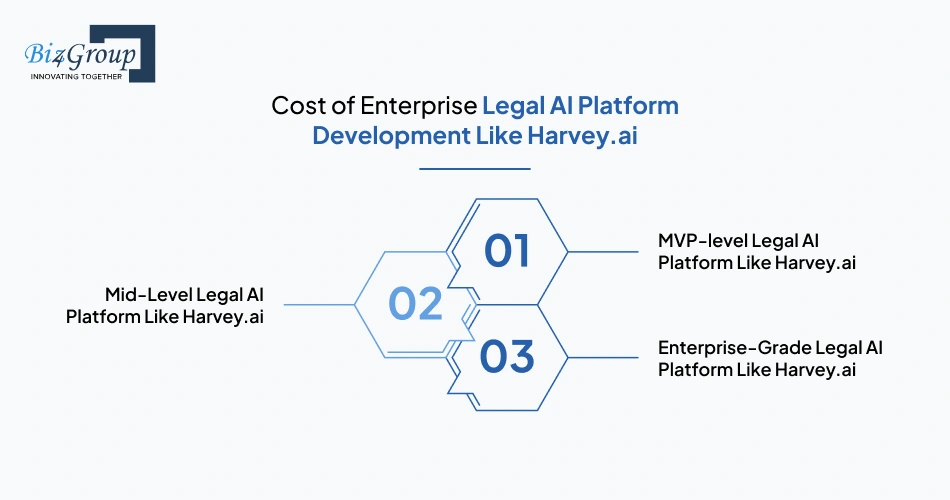
The cost of building a legal AI platform varies widely based on scope, security, and intelligence depth. For enterprise legal AI platform development Like Harvey.ai, most initiatives fall in the range of USD 30,000 to USD 250,000 plus, and this should be treated as a ballpark figure rather than a fixed price.
|
Build Level |
Estimated Cost Range |
What You Typically Get |
|---|---|---|
|
MVP-level Legal AI Platform Like Harvey.ai |
USD 30,000 to USD 60,000 |
Core research and drafting assistance, limited data sources, basic security, early validation carried out during MVP software development |
|
Mid-Level Legal AI Platform Like Harvey.ai |
USD 60,000 to USD 120,000 |
Expanded workflows, better reasoning accuracy, integrations with internal systems, stronger security |
|
Enterprise-Grade Legal AI Platform Like Harvey.ai |
USD 120,000 to USD 250,000 plus |
Advanced reasoning, compliance guardrails, audit logs, scalability across teams and practices |
Key cost drivers to consider
Several factors push costs up or down beyond the base ranges. Understanding these early helps avoid surprises later.
- Depth of legal data integration and document volume
- Level of security, compliance, and audit requirements
- Complexity of AI reasoning and customization
- Integration with existing enterprise legal systems
In many cases, organizations exploring AI legal platform software development for enterprises like Harvey.ai also factor in the ongoing cost to develop legal AI agent capabilities as the platform evolves.
Monetization Strategies for Enterprise Grade Legal AI Systems like Harvey.ai
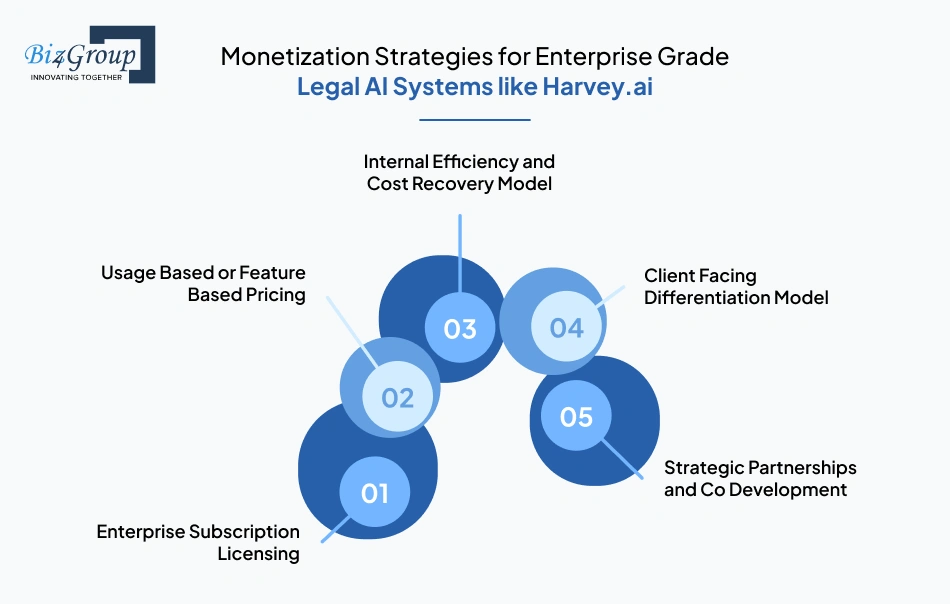
Once a platform is live, the focus shifts from building to sustaining value. For enterprise legal AI platform development Like Harvey.ai, monetization works best when it aligns with how large firms budget, adopt, and scale legal technology.
1. Enterprise Subscription Licensing
This model ties pricing to firm size, practice areas, or number of active users. It works well when the platform becomes part of daily legal work and delivers steady value across teams.
- Example: A large firm licenses the platform annually for litigation and corporate teams, expanding access as adoption grows across offices and practice groups.
2. Usage Based or Feature Based Pricing
Some organizations prefer flexibility, paying for advanced capabilities only when needed. This approach aligns spend with real usage instead of fixed access.
- Example: A firm pays a base fee, then adds premium drafting or analytics features during peak matter activity without long term commitments.
3. Internal Efficiency and Cost Recovery Model
When built for internal use, the platform generates value by replacing multiple tools and reducing manual effort. Revenue is realized through savings rather than direct billing, especially when firms aim to create secure and compliant legal AI platforms like Harvey.ai as long term infrastructure.
- Example: An enterprise consolidates research, drafting, and review workflows into one system as part of broader business app development using AI
4. Client Facing Differentiation Model
Some firms use AI to enhance client services rather than sell the platform itself. The technology supports faster delivery and more consistent outcomes.
- Example: A firm improves turnaround times using tools developed through AI lawyer app development, strengthening client relationships without changing pricing structures.
5. Strategic Partnerships and Co Development
Larger initiatives sometimes involve shared investment between firms and technology partners. This model supports long term growth and platform evolution.
- Example: A firm collaborates with top AI legal software development companies in USA to expand capabilities while sharing development costs and expertise.
How Biz4Group Helps Legal Workflows with AI

Compare Legal enables users to evaluate and select legal services through structured data comparison. This kind of decision focused platform highlights how legal intelligence can be productized, offering insight into how enterprise legal AI platforms can support client facing value without compromising internal workflows.
The right revenue approach depends on how the platform fits into firm strategy and client expectations. As organizations plan to create AI powered legal platform like Harvey.ai for law firms, attention naturally shifts toward governance, development discipline, and operational best practices.
Turn Legal Knowledge Into Infrastructure
Build systems that scale research and drafting through enterprise legal AI platform development Like Harvey.ai.
Build My Legal AI PlatformBest Development Practices for AI Legal Assistant Platforms for Law Firms like Harvey.ai
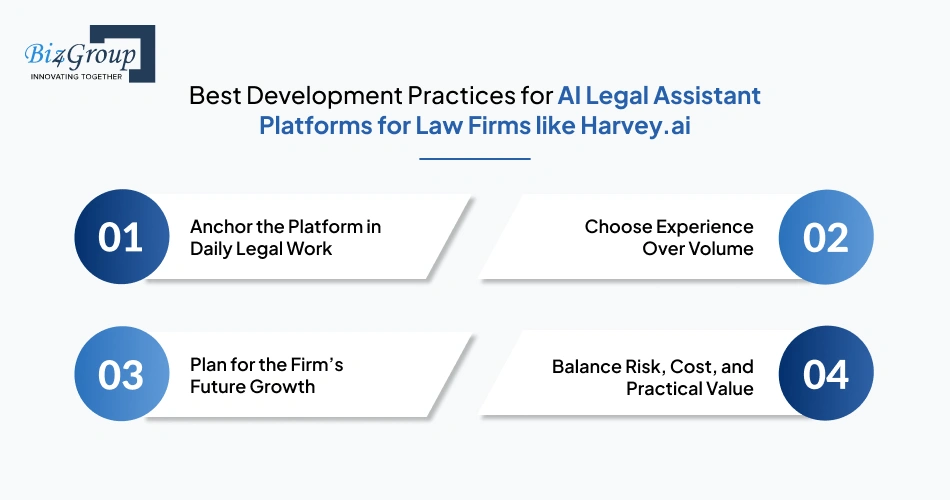
Building a legal AI platform is rarely about bold moves. It is about steady decisions that compound over time. In enterprise legal AI platform development Like Harvey.ai, a few grounded practices tend to make the difference between adoption and abandonment.
1. Anchor the Platform in Daily Legal Work
Successful platforms respect how lawyers already research, draft, and review. When the system supports those patterns without disruption, adoption happens naturally. This mindset is essential when teams aim to build a legal AI platform similar to Harvey.ai for large firms that feels familiar from day one.
2. Choose Experience Over Volume
Enterprise legal AI benefits from smaller, focused teams with the right background. Many firms quietly strengthen execution by choosing to hire AI developers who understand regulated environments rather than expanding teams too quickly.
3. Plan for the Firm's Future Growth
What works for one team or practice must scale across offices and matters. Early architectural choices should account for higher usage and larger data volumes. That foresight matters when organizations set out to develop scalable legal AI platform for large law firms with long term intent.
4. Balance Risk, Cost, and Practical Value
Legal teams care deeply about security, but budgets still matter. Decisions are easier when cost and risk are considered together instead of separately. Having clarity around items like the cost to develop AI lawyer app or future integrations such as attorney billing software helps teams stay realistic.
What Biz4Group has Achieved for Enterprise Legal AI Businesses

Court Calendar is a judiciary focused platform designed to reduce scheduling friction and case backlog for attorneys and courts. Its emphasis on coordination, accuracy, and reliability mirrors the operational expectations placed on enterprise legal AI systems that must function smoothly across teams and jurisdictions.
When these practices are followed consistently, teams are better positioned to create enterprise grade legal AI system like Harvey.ai that earns trust over time. Now, let's talk about the challenges that surface during real world implementation.
Top Challenges in Enterprise Legal AI Platform Development like Harvey.ai
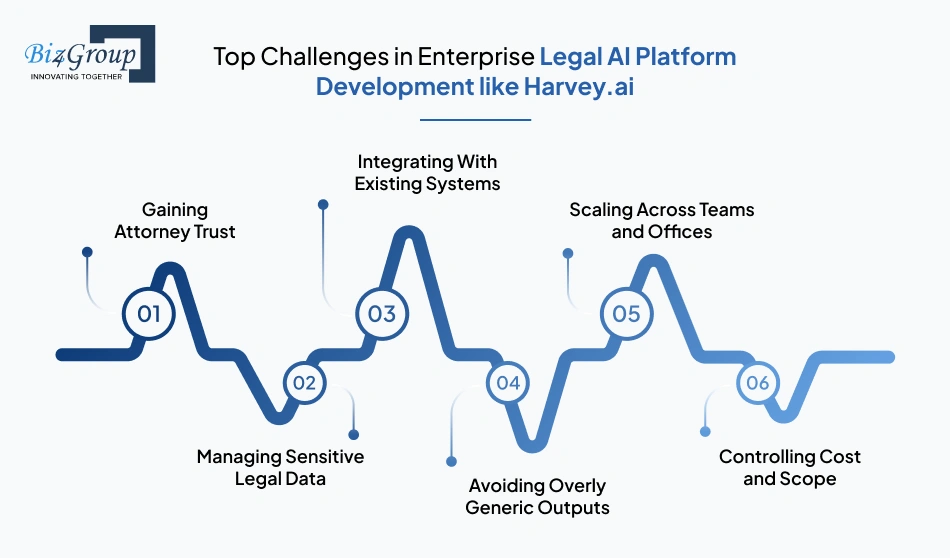
Every legal AI initiative faces friction once theory meets reality. In enterprise legal AI platform development Like Harvey.ai, these hurdles are less about technology itself and more about aligning AI with legal risk, workflows, and expectations, which leads us to the most common challenges teams encounter:
|
Top Challenges |
How to Solve Them |
|---|---|
|
Gaining Attorney Trust |
Start with narrow, high confidence use cases and show clear sourcing behind AI outputs so lawyers can verify results easily |
|
Managing Sensitive Legal Data |
Build strict access controls, audit logs, and encryption into the platform from the beginning |
|
Integrating With Existing Systems |
Design APIs that connect smoothly with document management and internal tools instead of replacing them |
|
Avoiding Overly Generic Outputs |
Train models on firm approved data and limit responses to trusted sources |
|
Scaling Across Teams and Offices |
Use modular architecture that supports gradual rollout and performance consistency |
|
Controlling Cost and Scope |
Define clear phases and avoid feature sprawl, especially when estimating items like the cost to build legal AI chatbot components |
Teams that address these challenges early are better positioned to move forward with confidence. As enterprise legal AI platform development like Harvey.ai matures inside organizations, attention naturally turns to what the future holds for legal AI at scale.
Bring Structure to Legal AI Adoption
Move forward with Harvey.ai like enterprise legal AI platform development designed for security, scale, and trust.
Start My Enterprise Legal AI JourneyWhat Lies Ahead for AI Powered Legal Platforms like Harvey.ai?
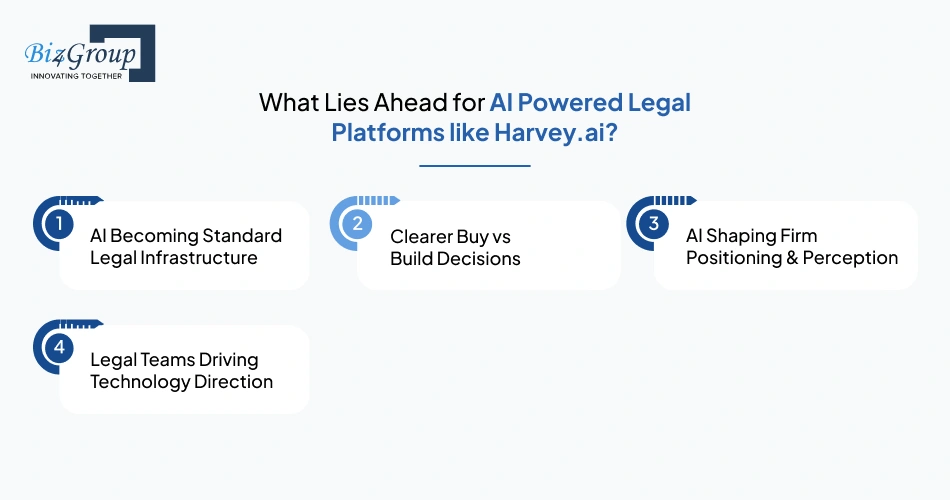
The future of legal AI is less about new capabilities and more about how firms make these platforms part of everyday legal operations. In enterprise legal AI platform development Like Harvey.ai, the next phase is shaped by adoption, ownership, and long term relevance.
1. AI Becoming Standard Legal Infrastructure
Legal AI platforms will move from innovation projects to standard internal systems. Firms will treat them like core research or document tools rather than experimental technology. This shift influences how leaders build enterprise legal AI software solution similar to Harvey.ai with long term ownership in mind.
2. Clearer Buy vs Build Decisions
As the market matures, firms will become more deliberate about whether to buy tools or build internally. Strategic clarity will matter more than speed. This is where many organizations rethink how they develop legal AI platform like Harvey.ai based on control and differentiation.
3. AI Shaping Firm Positioning and Perception
Firms will increasingly signal AI maturity through how they present capabilities to clients. The focus will be on outcomes, not tools. This often shows up in efforts to develop AI website for law firms that communicate confidence without revealing internal systems.
4. Legal Teams Driving Technology Direction
Future platforms will be shaped more directly by partners, legal ops, and practice leaders. Technology decisions will start with legal priorities rather than technical curiosity. This mirrors how firms adopt AI solutions only after business needs are clear.
As this shift continues, organizations thinking about Harvey.ai like enterprise legal AI platform development will focus on sustainability and strategic fit. That naturally leads to questions about who should lead development and how the right partner can make a difference.
Why Choose Biz4Group LLC for Enterprise Legal AI Platform Development like Harvey.ai?
Building a legal AI platform means understanding how legal work actually happens at scale. That is exactly where Biz4Group LLC’s experience in enterprise legal AI platform development Like Harvey.ai becomes relevant.
Platforms like Trial Proofer, Compare Legal, and Court Calendar were built to solve real legal problems, not theoretical ones. Scheduling bottlenecks, decision complexity, workflow coordination. Those lessons carry directly into how we approach legal AI app development for large firms that need reliability more than experimentation.
What this means for your team:
- We design around real legal workflows, not abstract AI use cases
- We understand where accuracy, traceability, and control truly matter
- We build systems meant to be used daily
- We think in terms of long-term ownership
If your goal is to build a legal AI platform that lawyers trust and actually rely on, the difference comes from working with a team that has already built and shipped legal platforms under real world constraints.
Design for Scale, Not Demos
Create a roadmap to build a legal AI platform similar to Harvey.ai for large firms with real operational depth.
Get My Legal AI PlanSumming Up Enterprise Legal AI Platform Development like Harvey.ai
At the end of the day, building a Harvey.ai style platform is hard because legal work is hard. The firms that get this right are not chasing AI for the sake of it. They are using it to remove friction from research, drafting, and decision making. With a capable AI app development company and disciplined product development services, the goal is simple: build something lawyers quietly rely on, not something they have to think about.
See what it would take to turn your legal workflows into an enterprise AI platform. Connect with our seasoned AI experts!
FAQs on AI Powered Legal Platforms like Harvey.ai
1. Can enterprise legal AI platforms be customized for specific practice areas?
Yes. Large firms often tailor platforms by practice area, jurisdiction, or matter type. This is common in custom enterprise legal AI development like Harvey.ai, where models and workflows are aligned with how different legal teams actually operate.
2. How long does it typically take to build an enterprise legal AI platform?
Timelines depend on scope, data readiness, and integrations. A focused build to develop scalable legal AI platform for large law firms can take a few months, while broader enterprise rollouts usually happen in phases to reduce risk.
3. Do enterprise legal AI platforms replace junior associates or legal staff?
No. These platforms are designed to support legal work, not replace people. Most firms use them to build AI driven legal research and drafting platform like Harvey.ai that reduces repetitive effort while keeping judgment with attorneys.
4. Can legal AI platforms integrate with existing enterprise systems?
Yes. Integration with document management, billing, and internal knowledge systems is expected at the enterprise level. This is a core requirement when teams build enterprise legal AI software solution similar to Harvey.ai for real operational use.
5. What should enterprises consider before rolling out legal AI firm wide?
Firms should evaluate data readiness, change management, and governance early. These considerations matter most when leaders plan to create enterprise grade legal AI system like Harvey.ai that attorneys trust and adopt consistently.
6. What is the typical cost to develop an enterprise legal AI platform?
Most enterprise builds fall between USD 30,000 and USD 250,000 depending on scope and complexity. Costs vary based on data volume, integrations, and compliance needs, especially for AI legal platform software development for enterprises like Harvey.ai.
