 Location :
Orlando, FL, USA
Location :
Orlando, FL, USA +1 (407) 714-1616
 info@biz4group.com

- Start with a real buyer demand, not just an idea. Strong AI print-on-demand opportunities come from gaps in personalization, niche relevance, or customer experience.
- Validate early before launching. Testing products, pricing, and demand first saves time, cost, and avoidable mistakes later.
- Build a clear AI POD business model in USA that aligns with real buyers, margins, and repeat purchase potential.
- Follow a structured path, if wondering how to start AI print-on-demand business in USA, covering suppliers, store setup, automation, and launch execution.
- Growth becomes easier when your AI print-on-demand business USA improves branding, personalization, and smarter marketing decisions consistently.
- You do not need to be technical. With the right partner like Biz4Group LLC, you can launch and scale with confidence.
What happens when a great business idea stalls before the first product goes live? Many founders reach that point with print-on-demand. They see demand, but feel stuck on niches, designs, pricing, and store setup. That uncertainty is real. In industry surveys, 42% of print businesses said they were still unsure where to begin with AI in day-to-day operations.
That gap creates an opportunity. A smart print-on-demand business with AI tools can help you move faster, test ideas earlier, and avoid spending heavily before demand is proven. For business asking, “we are planning to start a print-on-demand business in the USA using AI tools but need guidance on where to begin.” Then, the first step is building a simple system that combines product ideas, automated design support, and reliable fulfillment partners.
The market is also moving in this direction. 85% of respondents believe AI is critical to future competitiveness, while 83% see it as a source of new opportunities. Even production efficiency is changing, with AI helping reduce ink consumption by up to 25% through smarter drop placement.
That means early-stage founders can focus on what matters most:
- Finding niches people already buy from
- Launching products without large inventory risk
- Improving margins through smarter operations
- Building a brand instead of chasing random trends
If you’re someone wondering, I want to start a print-on-demand business in the USA using AI but don’t know how to begin. Let’s start by understanding the business model, market potential, and practical next steps and see how an AI development company in USA can help scale your print-on-demand business.
What Is an AI-Powered Print-on-Demand Business and Is It Still Profitable in 2026?
An AI-powered print-on-demand business lets you sell custom products only after a customer places an order. AI supports product ideation, artwork creation, trend spotting, pricing decisions, and store workflows. Instead of holding stock, you focus on brand growth while production and shipping are handled by fulfillment partners.
Is it a Profitable Investment?
Profitability depends less on product type and more on niche focus, pricing discipline, and repeat demand. Many founders researching how to start AI print-on-demand business in USA assume profits come from volume alone. In reality, stronger margins often come from smart positioning and efficient operations. Typical sellers earn between 20% and 40% net margins when costs are managed well.
The wider market signals long-term opportunity. As customized production demand rises, the global digital printing market is projected to reach $87.21 billion by 2030. That matters because POD businesses depend on fast, flexible digital printing systems.
AI is also improving what sellers can control daily. Better forecasting, automated mockups, and sharper product testing are part of how AI transforming printing industry is creating leaner business models. Growth in the AI-enabled 3D printing market, expected to reach $17.49 billion by 2030, reflects how automation is expanding across print production.
Profit often grows faster when you sell into premium or emerging categories such as:
- Personalized gifts
- Branded merchandise
- Home décor products
- Eco-conscious packaging products
- Event-based seasonal products
Even adjacent demand is rising, with the smart packaging market anticipated to hit $84.27 billion by 2035. For print-on-demand business USA founder, that opens room for niche expansion powered by better AI models and stronger customer targeting.
Why the USA Is One of the Best Markets for AI Print-on-Demand Businesses
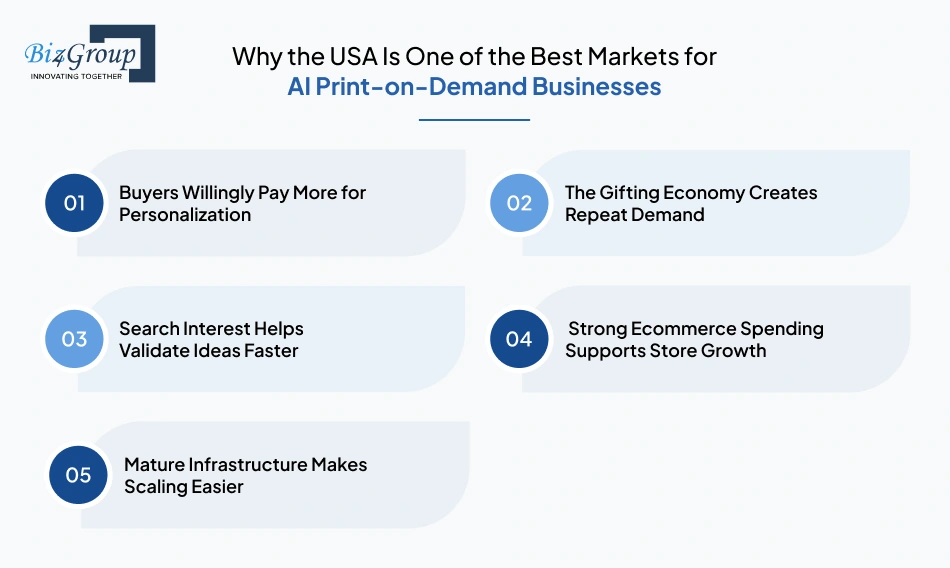
Some markets look attractive until you test real demand, shipping speed, or customer buying behavior. The USA continues to stand out because it combines strong online spending, personalization demand, and scalable commerce systems. If you are researching how to start AI print-on-demand business in USA, these signals matter.
1. Buyers Willingly Pay More for Personalization
Print-on-demand performs best where customers value products made for them. In the USA, custom products often carry emotional value, identity value, or gifting value. Research shows that 54% of consumers are willing to pay a premium for personalized products.
That creates room for:
- Custom apparel
- Name-based gifts
- Pet-themed items
- Hobby merchandise
- Event keepsakes
2. The Gifting Economy Creates Repeat Demand
Many POD stores grow through birthdays, weddings, holidays, and milestone moments. That makes gifting one of the strongest recurring revenue paths. The U.S. personalized gifting market is projected to reach $14.56 billion by 2030, showing continued buyer appetite.
This supports categories such as:
- Holiday collections
- Wedding favors
- Birthday products
- Anniversary gifts
- Family memory items
3. Search Interest Helps Validate Ideas Faster
A market with active search demand gives founders clearer signals on what people already want. “Print on demand” receives around 132,700 monthly global searches, with nearly 33,100 searches coming from the USA. That makes the country one of the strongest intent markets.
This can help with:
- Niche validation
- SEO traffic potential
- Trend discovery
- Product testing ideas
- Audience research
4. Strong Ecommerce Spending Supports Store Growth
Print-on-demand stores benefit where people already shop online often. The U.S. retail ecommerce sales for 2026 are expected to total $1.62 trillion, up 10.4% from 2025.
That gives founders access to:
- Frequent online buyers
- Repeat purchase behavior
- Mobile-first shoppers
- Faster checkout habits
- Larger reachable audiences
5. Mature Infrastructure Makes Scaling Easier
Growth becomes easier when suppliers, logistics, and fulfillment systems already exist. The global POD market was $10.78 billion in 2025 and is projected to reach $57.49 billion by 2033, growing at 23.6% CAGR. North America held 36% of POD revenue share in 2025.
Not only that, some of the largest print-on-demand companies like Printful, Printify, and Zazzle are headquartered in the USA. For founders exploring profitable AI print-on-demand business ideas for beginners in USA, this can mean:
- Faster supplier onboarding
- Reliable shipping networks
- Easier store integrations
- Smoother scaling systems
- Lower setup friction
Therefore, the USA offers strong demand, active buyers, proven infrastructure, and scalable opportunities. For new founders, it remains one of the most practical markets to launch and grow.
Ready to Enter the Right Market?
Turn market demand into a launch plan built for real buyers
Build My USA POD PlanWhat Are the Most Important Factors to Consider Before Starting an AI-Powered Print-on-Demand Business in the USA
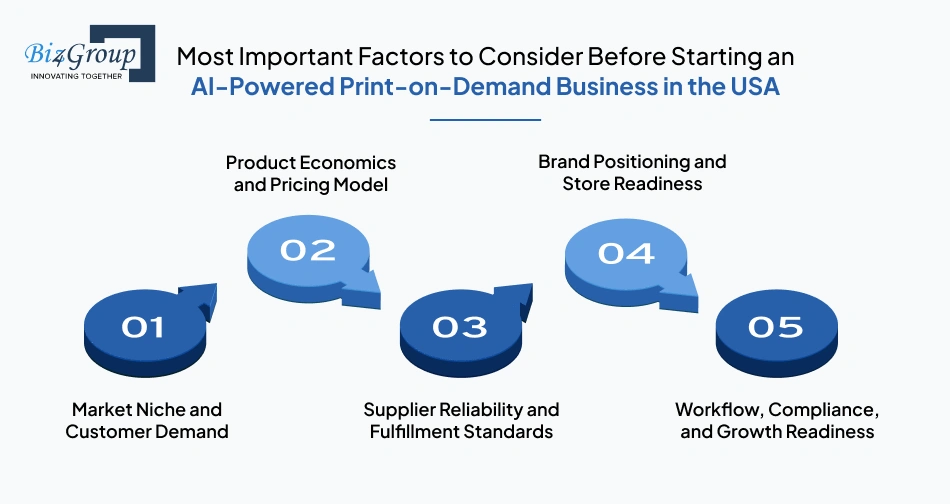
A strong idea can fail when early decisions are weak. Before investing time or money, focus on the factors that shape demand, margins, operations, and long-term stability. If you are researching how to start AI print-on-demand business in USA, start with these essentials first.
1. Market Niche and Customer Demand
The first decision is not the product. It is the audience you want to serve and whether that audience is ready to buy.
- Audience Fit: Define the type of customer you want to attract, their interests, and what matters to them when purchasing.
- Buying Intent: Prioritize niches where customers already spend money instead of categories with only casual interest.
- Trend Stability: Focus on niches with steady demand rather than short-lived hype cycles.
- Community Depth: Strong communities often create repeat purchases, referrals, and long-term brand value.
2. Product Economics and Pricing Model
Many new founders focus on sales first, but profitability usually depends on numbers understood before launch.
- Base Cost Review: Calculate printing fees, shipping charges, platform costs, and payment processing deductions clearly.
- Margin Planning: Set pricing that leaves room for profit after discounts, ad spend, and operating costs.
- Upsell Scope: Consider bundles or related products that can raise average order value.
- Return Impact: Include refunds, replacements, and damaged order costs in your planning.
3. Supplier Reliability and Fulfillment Standards
Your supplier becomes part of your customer experience, so quality and consistency matter from day one.
- Print Quality: Order test samples to review material quality, print sharpness, and product finish before selling.
- Shipping Speed: Fast and predictable delivery matters because U.S. customers often expect quick turnaround times.
- Inventory Range: Work with partners that offer enough product options so your catalog can grow smoothly.
- Support Response: Responsive supplier support helps solve order issues before they damage trust.
4. Brand Positioning and Store Readiness
Even good products struggle when branding feels weak or the store feels unfinished.
- Brand Identity: Use a clear brand voice, message, and style customers can remember easily.
- Store Trust Signals: Strong images, clear policies, and honest product details improve buyer confidence.
- Conversion Flow: Make browsing, product selection, and checkout simple and distraction-free.
- Setup Clarity: A smoother AI-powered print-on-demand store setup helps reduce delays and confusion early on.
5. Workflow, Compliance, and Growth Readiness
Long-term success depends on systems that can handle more orders without creating more chaos.
- Process Mapping: Understand how AI is integrated into printing workflows so design, approvals, and fulfillment stay organized.
- Rights Check: Confirm artwork ownership, usage rights, and trademark safety before publishing products.
- Operational Discipline: Use dependable processes instead of managing daily work reactively.
- Future Planning: A solid POD business model in USA should support expansion and reflect real AI use cases in printing industry where they genuinely add value.
Starting well is often about avoiding preventable mistakes. When your niche, numbers, suppliers, brand, and operations are clear, the path to launch becomes far more practical and controlled.
Which Are the Best Print-on-Demand Niches in USA for AI Sellers?
Some niches attract clicks but very few sales. Others have clear buyer intent, repeat demand, and room for fresh product ideas. That is where smart sellers focus first. If you need print-on-demand business ideas using AI-generated designs, start with niches where personalization already drives buying behavior.
1. Pet Products
Pet owners in the USA spend consistently on products that celebrate their animals. This niche works well for print-on-demand because buyers often want emotional and highly personal items. AI can also help create varied artwork styles for different breeds and personalities through:
- Custom pet portrait shirts
- Breed-specific mugs
- Pet memorial keepsakes
- Pet parent hoodies
- Personalized pet blankets
2. Family and Gifting Products
Gift-driven niches stay active because people buy throughout the year for birthdays, weddings, anniversaries, and milestones. AI print-on-demand business performs well here because buyers usually want products that feel personal rather than generic, such as:
- Birthday gift products
- Wedding party merchandise
- Anniversary keepsakes
- New parent gifts
- Family name décor items
3. Hobby and Passion Communities
People willingly spend on interests they strongly identify with. This makes hobby communities one of the strongest AI print-on-demand business categories. AI-generated concepts can help sellers create many design angles for sub-groups inside one niche through:
- Fitness apparel
- Fishing merchandise
- Gaming shirts
- Book lover mugs
- Gardening accessories
4. Local Pride and Regional Identity
Many U.S. buyers enjoy products linked to hometown pride, state identity, or local humor. This can be a strong route for a custom merchandise AI business in USA because niche targeting becomes easier with:
- City pride apparel
- State slogan shirts
- Local humor mugs
- Community event merchandise
- Regional décor products
5. Professional Identity Niches
Career-based niches work because people often buy products linked to pride, humor, or appreciation for their profession. These niches also perform well during gifting seasons for AI print on demand business owners
- Nurse appreciation gifts
- Teacher merchandise
- Realtor mugs
- Trade worker shirts
- Office humor products
6. Seasonal and Holiday Niches
Seasonal demand creates recurring sales windows every year. Sellers in an AI dropshipping print-on-demand business often use AI to refresh designs quickly before each season begins with:
- Christmas collections
- Halloween apparel
- Valentine gifts
- Mother’s Day products
- Summer travel merchandise
The best print-on-demand niche usually combines identity, emotion, and repeat buying demand. First-time founders and aspiring e-commerce entrepreneurs wondering how to start AI print-on-demand business in USA, begin with one focused niche, validate demand, then expand gradually.
Still Unsure Which Niche Wins?
Let data and strategy narrow profitable niches faster
Find My Best NicheWhat are the Practical Steps to Start a Successful and Scalable AI Print-on-Demand Business in USA
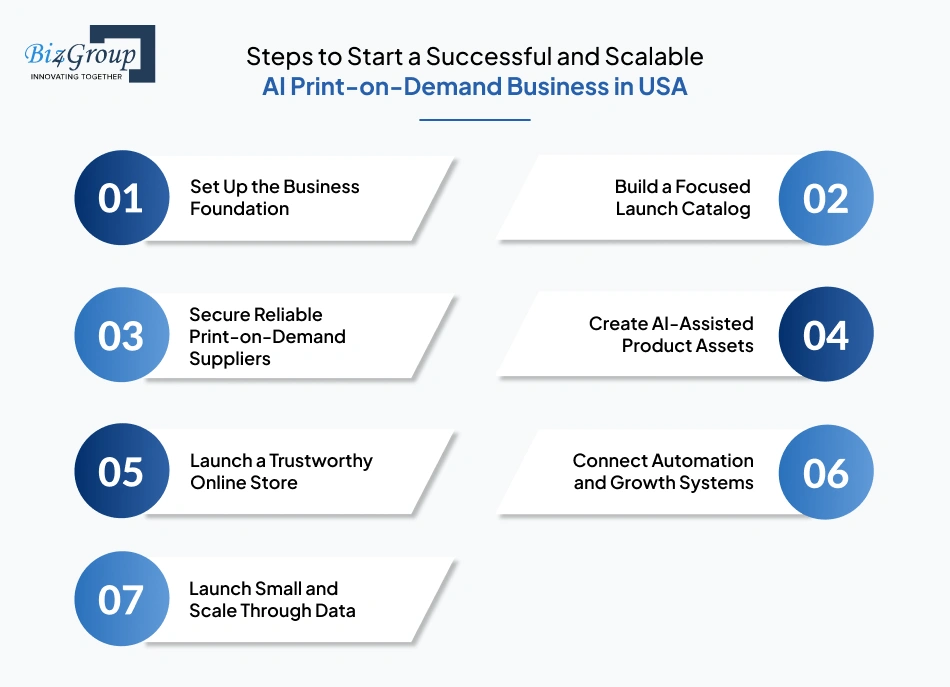
Many stores fail because the launch process is rushed or done out of order. Founders often ask how to start print-on-demand business using AI tools and automation when the real need is a clear execution roadmap. Strong businesses usually begin with practical steps that are easy to manage and ready to scale later to automate their business process.
Here, take a look:
1. Set Up the Business Foundation
- Decide whether you will operate as a solo brand, partnership, or registered company based on your growth plans.
- Open a dedicated business bank account so revenue, expenses, taxes, and ad spend stay organized from day one.
- Define a realistic launch budget covering store setup, samples, branding, tools, and early marketing costs.
- Choose your main selling route such as Shopify, marketplaces, or a combined channel strategy.
2. Build a Focused Launch Catalog
- Start with a limited catalog of products that are easy to customize and commonly purchased online.
- Keep early product selection focused so testing becomes easier and ad spend stays controlled.
- Use simple demand research to identify products with stable buyer interest instead of random ideas.
- Prepare clear product variations such as sizes, colors, and styles before launching.
3. Secure Reliable Print-on-Demand Suppliers
- Select suppliers with strong print quality, dependable fulfillment times, and shipping coverage across the USA.
- Order physical samples to check fabric quality, print sharpness, packaging, and overall customer experience.
- Review return handling, damaged order policies, and support response speed before committing.
- Keep a second supplier ready for peak seasons, delays, or unexpected stock issues.
4. Create AI-Assisted Product Assets
- Use AI tools to generate design concepts, pattern ideas, and multiple creative directions faster.
- Refine each design so it matches your audience rather than uploading raw outputs.
- Prepare realistic mockups that help customers understand size, placement, and product feel.
- Write product titles and descriptions that are clear, searchable, and easy to trust.
5. Launch a Trustworthy Online Store
- Build a fast store with clean navigation so visitors can browse and purchase without confusion.
- Add clear shipping timelines, return policies, contact details, and FAQs to reduce hesitation.
- Use high-quality product pages with strong visuals and consistent branding across the site.
- Many founders use a print-on-demand startup guide in USA checklist here to avoid missing critical setup tasks.
6. Connect Automation and Growth Systems
- Link store orders directly to suppliers, so fulfillment happens with less manual work.
- Set up automated emails for welcomes, abandoned carts, order updates, and repeat purchase campaigns.
- Install analytics tools to track traffic sources, conversion rates, top products, and profit trends.
- Growing brands often add custom workflows through AI automation services or broader AI solutions for enterprises when operations become more complex.
Also Read: 10 AI Automation Use Cases for Enterprises to Scale Faster
7. Launch Small and Scale Through Data
- Begin with a controlled number of products and a measured advertising budget.
- Track weekly performance using clicks, conversion rate, refunds, and repeat purchases.
- Remove weak products quickly and reinvest into winning designs or offers.
- Expand categories, suppliers, and marketing channels only after the first system is working consistently.
Successful AI POD brands rarely start big. They start in the right order, test carefully, and improve steadily. Founders researching how to start AI print-on-demand business in USA can use these steps to move from idea to scalable execution.
Need a Clear Launch Roadmap?
Move from idea to store with smarter execution steps
Map My Launch PathWhat Are the Best AI Tools for Print-on-Demand Businesses in 2026?
Strong print-on-demand brands rarely rely on one tool. They use a stack that helps with design, listings, store growth, customer support, and daily operations. The best results usually come from using the right AI design tools for print-on-demand business for the right task instead of chasing every new platform.
1. Canva AI
Canva AI is one of the easiest tools for POD founders who need fast design creation without advanced design skills. It helps create product graphics, ad creatives, social posts, mockups, and brand assets through templates and AI-assisted editing. Canva’s Magic Studio tools also support resizing and content generation for multiple channels.
This can help business owners by:
- Creating product visuals quickly
- Making social media creatives faster
- Keeping branding consistent
- Producing simple mockups for launch
- Reducing outsourcing costs
2. Midjourney
Midjourney is widely used for highly creative artwork and distinctive visual styles. It works well for apparel graphics, poster art, niche merchandise, and bold concept-led designs that need stronger originality than template-based tools. Many sellers use it when they want products that feel less generic.
This can help business owners by:
- Producing unique merchandise artwork
- Testing multiple art directions quickly
- Creating premium-looking designs
- Standing out in crowded niches
- Refreshing seasonal collections faster
3. ChatGPT
ChatGPT is useful beyond writing. POD businesses use it for product titles, descriptions, keyword ideas, customer replies, ad copy, email drafts, and research prompts. It can also help structure workflows and improve store messaging for better conversions.
This can help business owners by:
- Writing listings faster
- Improving SEO content
- Handling common support replies
- Creating ad copy variations
- Saving daily admin time
4. Kittl AI
Kittl AI is popular for typography-heavy merchandise, editable templates, vector-style graphics, and all-in-one POD design workflows. It is especially useful for shirts, mugs, posters, and products where text layout matters.
This can help business owners by:
- Creating slogan merchandise faster
- Editing designs without complex software
- Producing print-ready layouts
- Building repeatable templates
- Speeding up catalog expansion
5. Printify AI Tools
Printify combines POD fulfillment with design and product publishing tools. It helps sellers create products, connect stores, and route orders through suppliers. For many beginners, integrated workflows reduce setup friction.
This can help business owners by:
- Managing orders in one place
- Publishing products faster
- Connecting ecommerce stores easily
- Scaling product catalogs smoothly
- Simplifying supplier operations
6. Klaviyo AI
Klaviyo is a strong tool for email and SMS growth. Its AI features help generate campaigns, segmentation ideas, subject lines, and customer lifecycle flows. This matters because repeat buyers often drive POD profitability.
This can help business owners by:
- Recovering abandoned carts
- Driving repeat purchases
- Improving email performance
- Automating promotions
- Increasing customer lifetime value
7. Adobe Firefly
Adobe Firefly is useful for commercial-friendly asset creation, background editing, image expansion, and branded creative production. It fits sellers who need stronger control over marketing visuals and refined assets.
This can help business owners by:
- Refining product creatives
- Producing campaign visuals faster
- Editing backgrounds cleanly
- Maintaining brand quality
- Creating polished ad assets
The best AI stack depends on your growth stage. Start with tools for design, listings, and fulfillment first. Then add retention and analytics tools as orders increase.
How to Scale Print-on-Demand Business Using AI Marketing Tools
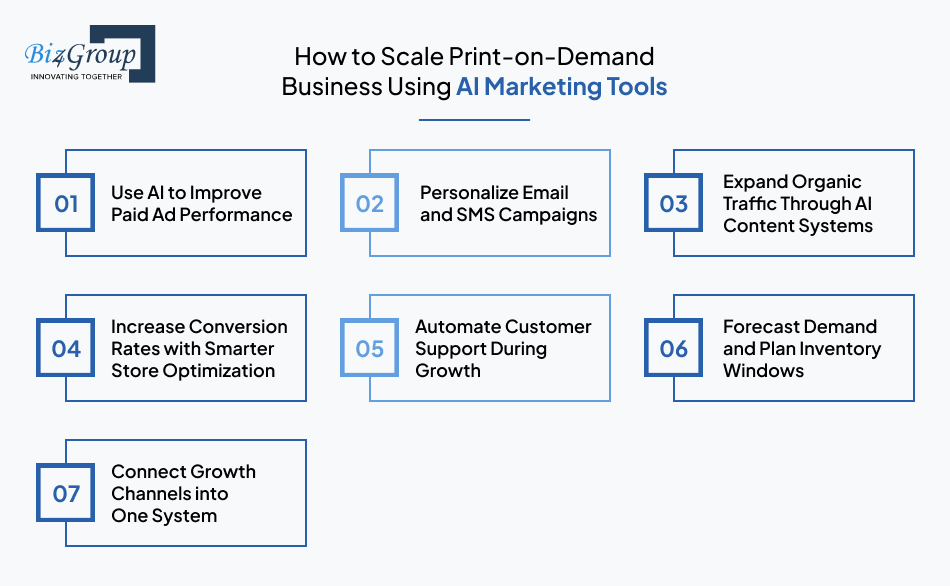
Many POD stores reach early sales, then growth slows because marketing stays manual, reactive, or too broad. Scaling usually needs smarter systems, better timing, and sharper customer targeting. Turning an AI print-on-demand idea into a business often depends on how efficiently growth channels are expanded.
1. Use AI to Improve Paid Ad Performance
Paid ads can scale faster when campaigns learn from real buyer behavior. AI tools help test creatives, audiences, budgets, and placements with less guesswork.
- Run multiple ad creatives at the same time and scale winning versions faster.
- Shift budget toward campaigns generating better conversions.
- Identify audiences with stronger purchase intent.
- Reduce waste from weak-performing ads.
2. Personalize Email and SMS Campaigns
Repeat customers often create the healthiest growth path for POD brands. AI can segment customers by behavior and send more relevant campaigns automatically.
- Recover abandoned carts with timely reminders.
- Send product recommendations based on previous purchases.
- Trigger reorder campaigns for repeat-friendly products.
- Improve open rates through smarter subject line testing.
3. Expand Organic Traffic Through AI Content Systems
Long-term scale becomes stronger when traffic does not rely only on ads. AI-supported content workflows help brands publish faster across search and social channels.
- Generate blog ideas around niche buyer interests.
- Create SEO-friendly product descriptions at scale.
- Repurpose content into short social posts.
- Maintain regular publishing without large teams.
4. Increase Conversion Rates with Smarter Store Optimization
More traffic matters less when visitors do not buy. AI tools can improve onsite performance by learning how users behave.
- Test product page layouts and calls to action.
- Recommend products based on browsing history.
- Surface best-sellers during high-intent visits.
- Reduce cart drop-off through better timing prompts.
5. Automate Customer Support During Growth
Growth often creates more questions, returns, and delivery requests. AI-powered support systems help stores scale service quality without growing overhead too fast.
- Answer common order questions instantly.
- Provide shipping updates automatically.
- Route complex issues to human staff quickly.
- Keep response times consistent during busy periods.
6. Forecast Demand and Plan Inventory Windows
Even POD businesses need better planning during holidays and campaigns. Predictive systems built through AI model development can help forecast spikes earlier.
- Prepare seasonal campaigns before demand rises.
- Promote products with higher likely demand.
- Reduce missed sales during peak periods.
- Coordinate supplier capacity more effectively.
Also Read: How to Train AI Models in 2025
7. Connect Growth Channels into One System
Scaling gets harder when ads, emails, analytics, and customer data stay disconnected. Many growing brands use tailored AI integration services and advanced AI automation tools to unify operations.
- Track customer journeys across channels.
- Measure profitable traffic sources clearly.
- Trigger cross-channel campaigns automatically.
- Make faster decisions using shared data.
Scaling a AI POD brand usually comes from better systems, not only bigger budgets. Businesses researching how to start AI print-on-demand business in USA should also plan how growth will be managed once first sales begin.
Growth Stuck at Same Level?
Use smarter systems that turn traffic into repeat revenue
Unlock My AI Growth EngineHow to Stand Out in a Crowded AI-Powered Print-on-Demand Market in USA
Many POD stores enter the market with similar products, similar visuals, and similar messaging. That makes price wars common and customer loyalty weak. Brands that rise higher usually become known for one clear value, faster execution, and a buying experience customers remember.
1. Own One Niche Instead of Selling to Everyone
Stores that try to sell to every type of buyer often become forgettable. Stronger businesses focus on one audience and serve that group better than general stores can. A pet lover brand, teacher gift store, or fitness community shop can build stronger trust and repeat demand because the message feels specific. In a crowded market, relevance often wins more than size.
2. Use AI to Release Better Products Faster
Speed can become a major advantage when competitors move slowly. AI helps sellers test fresh concepts, create multiple design directions, and launch timely collections around trends or seasons. That allows your brand to stay current while others keep repeating old products. In many successful AI eCommerce business ideas USA, faster product refresh cycles become a real edge.
3. Make Personalization a Core Selling Point
Customers often remember products that feel made for them. AI-powered customization can help stores offer names, dates, messages, style variations, or buyer-specific recommendations. This creates stronger emotional value and reduces the feeling of buying a generic item. Personalized buying experiences also increase the chance of referrals and repeat orders.
4. Create a Premium Brand Experience
Many POD stores lose buyers because the store feels rushed or low trust. Stronger brands stand out through polished visuals, clean product pages, clear policies, and consistent communication. Customers in the USA often expect a professional online experience before placing an order. Trust can become a stronger differentiator than product price.
5. Become the Most Useful Voice in Your Niche
Attention usually goes to brands that add value before asking for a sale. Publish helpful content, style inspiration, gift guides, trend commentary, or community-focused posts linked to your niche. This builds recognition and gives buyers more reasons to return. Over time, authority can become stronger than paid advertising.
6. Use Customer Data to Improve Faster Than Competitors
Many sellers guess what buyers want. Stronger operators study what products convert, what pages lose buyers, and what collections bring repeat orders. AI tools can help identify patterns faster and support better decisions. Brands that learn quickly often outperform larger stores that react slowly.
7. Turn Automation Into Better Customer Experience
An automated print-on-demand business in USA should feel smoother, not colder. Use automation for fast order updates, quicker support responses, reorder reminders, and post-purchase communication. Customers notice when a brand is responsive and organized. Efficient service can separate you from stores that look busy but feel unreliable.
Standing out rarely comes from selling another product with a new graphic. It usually comes from sharper positioning, faster execution, and better customer experience delivered consistently across every stage of growth.
Legal Risks POD Businesses Should Consider Before Selling AI-Generated Designs in the USA
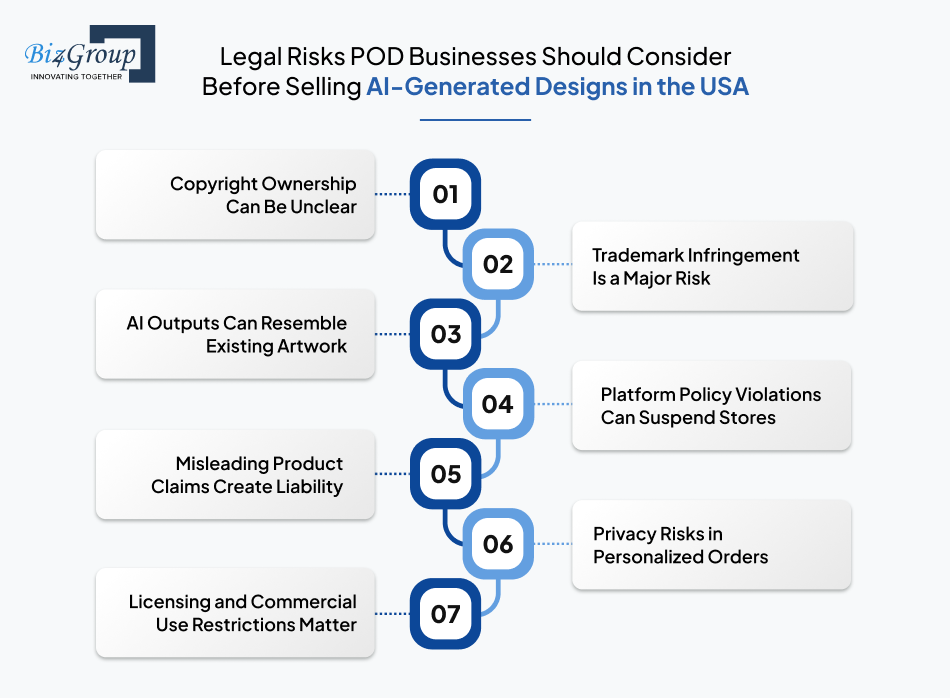
Selling AI-generated products can look simple from the outside. The legal side is often where many POD businesses face avoidable trouble. Before listing products in the USA, it is important to understand ownership rights, platform rules, and customer protection responsibilities.
1. Copyright Ownership Can Be Unclear
AI-generated designs may raise ownership questions depending on how the artwork was created and how much human input shaped the final result. Some outputs may not receive the same protection as fully human-created work. That can create disputes when others reuse similar designs or when you try to claim exclusive rights.
2. Trademark Infringement Is a Major Risk
Many sellers run into problems by using brand names, slogans, sports teams, celebrities, or phrases already protected by trademark law. Even when AI generates the design, liability can still fall on the seller listing the product. This risk often appears in trending niches and pop culture merchandise.
3. AI Outputs Can Resemble Existing Artwork
Generative AI tools may create visuals that unintentionally resemble copyrighted characters, logos, or artist styles. Selling designs that are too close to protected work can lead to takedowns, complaints, or legal claims. Reviewing outputs carefully before publishing is essential.
Also Read: Building Effective Generative AI Solutions
4. Platform Policy Violations Can Suspend Stores
Marketplaces and ecommerce platforms often have their own rules around intellectual property, misleading claims, harmful content, and prohibited products. A design that passes your internal review may still violate marketplace policy. Repeated violations can lead to listing removals or account suspension.
Also Read: Develop an AI Marketplace App for eCommerce Growth
5. Misleading Product Claims Create Liability
Product pages that exaggerate quality, delivery speed, material details, or customization outcomes can create legal and refund exposure. Buyers in the USA expect accurate listings and fair disclosures. Clear descriptions reduce complaints and chargeback risk.
6. Privacy Risks in Personalized Orders
Custom products often collect names, dates, photos, or messages from customers. Mishandling that data can create privacy concerns and damage trust. Businesses should store only necessary information and protect customer data responsibly.
7. Licensing and Commercial Use Restrictions Matter
Some AI tools, fonts, graphics packs, or templates may limit commercial resale use. Using assets without proper commercial rights can create disputes later. Terms of use should always be reviewed before product launch.
Legal problems often start with small shortcuts that seem harmless early on. Clear ownership checks, trademark screening, honest listings, and careful platform compliance can protect your POD business before issues become expensive.
Avoid Expensive Mistakes Early
Protect your store before legal issues slow momentum
Secure My AO POD BusinessWhy Many AI-Powered Print-on-Demand Business Founders Fail Before Making Their First Sale and How to Avoid It?
Many founders assume first sales come from simply uploading products and waiting for traffic. In reality, early failure usually comes from preventable mistakes made before launch. Understanding these gaps can save time, money, and momentum in an AI print-on-demand business.
|
Common Mistake |
Why It Hurts Before First Sale |
How to Avoid It |
|---|---|---|
|
Launching With No Clear Audience |
Generic stores rarely connect with buyers because messaging feels broad and forgettable. |
Define one clear customer group and make products speak directly to them. |
|
Uploading Weak or Generic Designs |
Buyers ignore products that look rushed, copied, or low effort. |
Review every design carefully and improve outputs before publishing. |
|
Poor Product Pages |
Unclear titles, weak images, and missing details reduce trust quickly. |
Use strong visuals, clear descriptions, and transparent policies. |
|
Wrong Pricing from Day One |
Prices that feel too high or too low can block conversions. |
Research market ranges and price with room for fees and profit. |
|
Ignoring Store Trust Signals |
Buyers hesitate when stores look unfinished or unreliable. |
Add contact details, FAQs, shipping timelines, and return policies. |
|
No Traffic Plan |
Products do not sell when nobody sees them. |
Prepare a simple traffic plan using content, ads, or community channels. |
|
Using Bad Suppliers |
Slow shipping or weak quality damages early reputation fast. |
Order samples first and verify supplier standards. |
|
Overloading the Store with Too Many Products |
Large messy catalogs confuse buyers and weaken focus. |
Launch with a smaller curated collection first. |
|
Not Testing Checkout Experience |
Hidden friction causes lost buyers before payment. |
Test browsing, cart, mobile flow, and checkout personally. |
|
Trying to Do Everything Alone |
Slow progress often follows scattered execution. |
Use expert help where needed, from AI developers support to stronger ecommerce development execution. |
First sales usually come from clean execution, not luck. Founders researching how to start AI print-on-demand business in USA should treat early mistakes seriously, because small issues before launch often become expensive delays later.
How Can Biz4Group LLC Help You Launch an AI-Powered Print-on-Demand Business in the USA?
Many founders have a strong idea but struggle to turn it into a workable business model. Others know the market opportunity but need help with technology, automation, cost planning, and execution. That is usually where the right development partner creates real momentum.
You may be thinking:
- we have an idea for an AI print-on-demand business and are looking for a US-based company that can help us validate and structure the business model
- I want to start an AI-powered print-on-demand store but need a company in the USA that can guide me on niche selection and strategy
- we are planning an AI print-on-demand startup and are searching for a company that can help with market validation and business strategy
- I want to turn my AI print-on-demand idea into a business but need guidance from a US company that specializes in early-stage startup planning
When those thoughts sound familiar, Biz4Group LLC can be the kind of partner worth speaking with. Here why you should work with us:
1. Business Validation Before Development
Many POD founders spend on tools before proving demand. We can help structure the business model, refine revenue paths, map customer segments, and validate where AI adds practical value before money is committed through our reliable AI consulting services.
2. Custom Store and Platform Development
Off-the-shelf setups work for some founders, but growth often needs more control. We build tailored ecommerce systems, custom workflows, and operational dashboards aligned with long-term business goals.
Well, here is the proof of our expertise:
a. Udder Color- Advanced Platform for Custom Artwork Printing
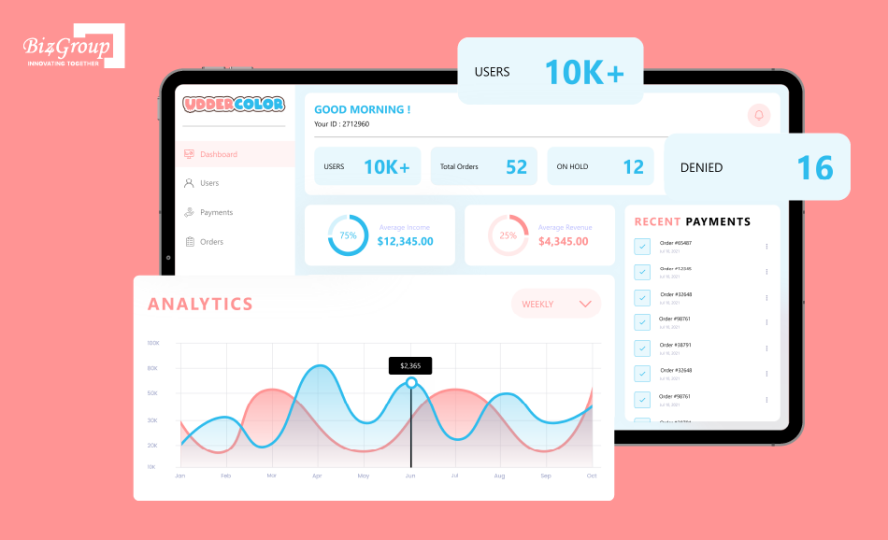
Udder Color is a custom artwork printing AI platform developed for a leading U.S. printing house to handle large daily order volumes through a modern web application. Customers can order printable heat transfers in different sizes and quantities, upload artwork, and receive shipments within 1 to 2 days.
Key Highlights:
- Order custom printable heat transfers in multiple sizes and quantities
- Artwork upload with automated and manual approval workflow
- Reviewer requests for image replacement or re-upload before production
- Secure payment authorization and membership discount support
- Order fulfillment with fast shipping and self-pickup option
b. Post Heritage- Custom eCommerce Store
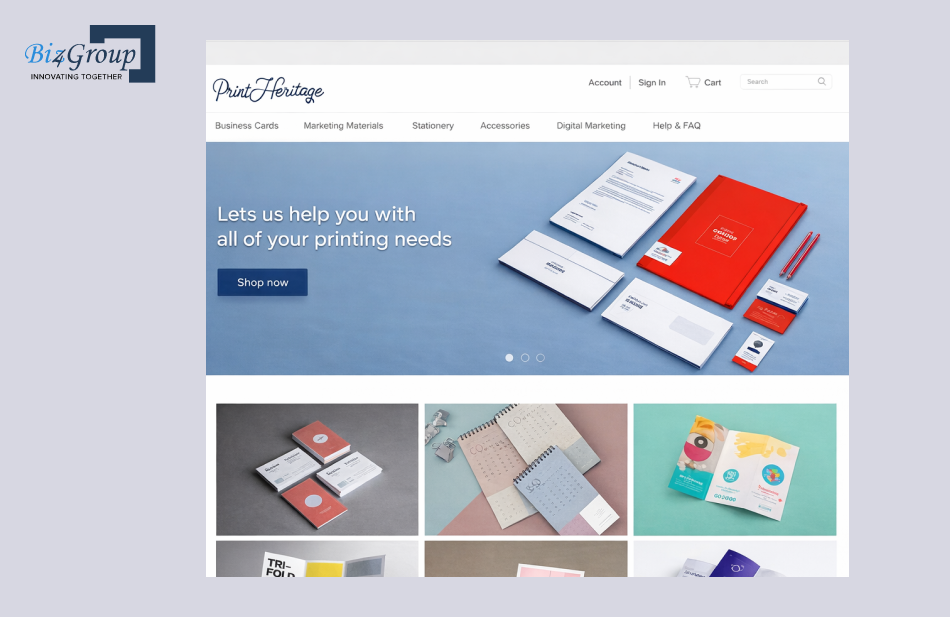
Post Heritage is an eCommerce AI platform created for ordering customized business cards, stationery, printed accessories, and marketing materials online. Users can personalize products by selecting size, design, shape, graphics, and quantity before checkout. The platform also allows saved templates for later orders and supports bulk purchases through integrated payment and shipping systems.
Key Highlights:
- Customize business cards, stationery, and printed accessories online
- Select shape, size, graphics, design, and quantity before ordering
- Save preferred templates and designs for future purchases
- Secure payments through Stripe integration
- Bulk shipping support through USPS and UPS integrations
Still not convinced here is what we can offer more
3. Smart AI Integration That Solves Real Problems
AI should improve operations, not create noise. From automated product recommendations to trend forecasting and customer support flows, we implement practical printing solutions powered by AI tied to measurable outcomes.
4. Cost Optimization Through Better Systems
Many founders underestimate wasted time, manual work, and tool overlap. We help review the cost to integrate AI in printing workflow and recommend leaner systems that reduce overhead while keeping growth capacity intact.
5. Operational Scale Without Chaos
As orders grow, manual processes start breaking. We streamline fulfillment logic, reporting systems, customer workflows, and supplier coordination through tailored AI printing management software development built for scale.
6. A U.S.-Based Partner with Business Focus
Technical delivery matters, but commercial thinking matters just as much. Biz4Group LLC works through a business lens, helping founders balance product vision, speed to market, operating efficiency, and sustainable growth.
The right partner does more than build AI software. It helps turn uncertainty into structure, manual work into systems, and early ideas into businesses prepared for real market growth.
Wrapping Up
Starting an AI-powered print-on-demand business is less about chasing trends and more about making smart early moves. Clear positioning, reliable fulfillment, thoughtful product ideas, real world AI use cases in printing industry and practical automation often decide who gains traction and who stays stuck. The opportunity is real, but strong execution matters more than excitement.
For founders researching how to start AI print-on-demand business in USA, the best path is usually to begin focused, validate demand early, and improve systems as orders grow. You do not need a massive catalog or complex setup on day one. You need a business model that can learn, adapt, and scale with confidence.
The brands that win are usually the ones that stay relevant, move consistently, and treat customer experience seriously. When you are ready to turn the idea into a working business, Biz4Group LLC can support that journey through practical AI product development services.
Ready to move forward? Talk to us.
FAQ’s
1. How can I start a profitable AI print-on-demand store with low investment in the USA?
Start with one focused niche, a small product catalog, and proven POD suppliers instead of spending heavily upfront. Use AI tools for design drafts, product copy, and market research to reduce early outsourcing costs while validating demand first.
2. Can I start a print-on-demand business with AI tools in the USA without design skills?
Yes. Many founders begin without formal design experience. AI design tools can help create concepts, mockups, and layouts. Strong results usually come from refining those outputs, understanding customer taste, and keeping your brand style consistent.
3. How do I understand printing, shipping, and fulfillment before starting an AI print-on-demand business in the USA?
Work with suppliers that clearly explain production times, shipping methods, return policies, and quality standards. Order samples before launch so you understand the real customer experience, packaging quality, and delivery speed.
4. How do I find winning niches for an AI print-on-demand business in the USA?
Look for audiences that already spend regularly and strongly identify with hobbies, professions, communities, or life moments. Use search trends, marketplace demand, and customer feedback to validate ideas before expanding.
5. How can I compete in the crowded AI print-on-demand business USA market?
Avoid trying to sell everything to everyone. Focus on one audience, offer stronger personalization, improve customer experience, and keep designs more relevant than generic mass-upload stores. Clear positioning often beats large catalogs.
6. What business model works best for an AI-powered print-on-demand store setup in the USA?
Most founders start with a niche-first direct-to-consumer model using their own storefront plus POD fulfillment partners. This gives better brand control, customer data access, and room to grow beyond marketplace-only selling later.
