 Location :
Orlando, FL, USA
Location :
Orlando, FL, USA +1 (407) 714-1616
 info@biz4group.com

- The cost to integrate AI in printing business typically ranges from $10,000 to $50,000, depending on project complexity and the specific use case.
- AI can improve printing operations by automating workflows, optimizing production scheduling, and enhancing print quality control.
- The AI integration cost for commercial printing companies varies based on system readiness, data quality, and whether the solution is prebuilt or custom.
- By gradually adopting AI tools, businesses can control initial expenses and scale their systems as operational needs grow.
- Biz4Group LLC is leading among top AI development companies in USA that helps printing companies optimize AI integration costs by offering tailored solutions, phased deployments, and clear cost breakdowns.
- AI automation integration cost for printing businesses decreases with cloud-based platforms, where scalability and flexibility improve cost-efficiency over time.
The cost to integrate AI in printing business usually falls between $10,000 and $50,000 for small to mid-sized projects. This range applies to focused implementations such as workflow automation, quality inspection, demand forecasting, or production scheduling support. The final cost depends on data quality, system complexity, and how deeply the AI solution connects with existing tools.
At a basic level, AI integration in a printing company includes three clear parts:
- Preparing and structuring historical production data
- Connecting AI systems with MIS, ERP, and workflow platforms
- Deploying, testing, and maintaining the solution
The AI integration cost for printing business increases when data is scattered, outdated, or not structured properly. It can also rise if older systems do not support modern integrations. Projects with a narrow and clearly defined goal usually stay closer to the lower end of the range.
In practical terms, most businesses adopt AI in printing gradually. They start with one operational problem instead of changing the whole production environment at once. This approach keeps the expenditure controlled and results measurable.
The overall printing industry AI integration cost depends on scope and technical readiness. Many printing companies work with an experienced AI development company to assess infrastructure, define requirements, and estimate budgets more accurately.
Understanding these fundamentals helps leaders plan realistically, reduce financial risk, and decide whether AI investment aligns with operational priorities. This guide will help you understand all those factors in depth, so you could make a smart decision for the growth of your printing business with AI.
How Printing Workflow AI Integration Cost Is Influenced by Existing Systems
The cost to integrate AI in printing business is mainly determined by how mature and connected your existing systems are. In reality, infrastructure readiness can shift total project cost by at least 20 to 40 percent.
Two printing companies implementing the same AI capability can face very different budgets. The difference is rarely the AI model itself, it is the effort that's required to connect AI into daily production workflows.
This AI Integration effort typically falls into three buckets:
- System connectivity
- Data condition
- Infrastructure limitations
Each of these factors directly affects engineering time, testing cycles, and long-term stability.
Role of MIS, ERP, and Workflow Systems in Integration Complexity
AI systems do not operate independently. They must pull and push data through MIS platforms, ERP tools, scheduling systems, and production tracking software.
When these systems provide clean APIs, use standardized databases, and allow real-time access, the integration becomes predictable. In such environments, integration work may represent 20 to 30 percent of the total project effort.
However, when systems rely on manual exports, isolated databases, or limited documentation, development complexity increases. Engineers must build custom connectors, validate mappings, and simulate production conditions. This can add $5,000 to $15,000 to the cost of AI implementation in printing business, depending on the number of systems involved.
In many cases, companies bring in specialized AI integration services to conduct a workflow audit before development begins. This step reduces rework and improves cost accuracy.
Data Readiness and Its Impact on AI Implementation Expenses
AI performance depends on historical data. In printing operations, historical data includes job specifications, reprint history, defect logs, production timing, and material usage.
If this data is inconsistent, duplicated, missing key fields, stored in multiple formats, preparation work becomes necessary before modeling can begin.
Data preparation often accounts for 25 to 40 percent of implementation effort. It is not optional. Without structured input, model outputs become unreliable.
The AI adoption cost in printing industry rises when businesses underestimate this phase. Cleaning several years of production history can require a lot of engineering time. On the other hand, companies with standardized recordkeeping reduce this cost substantially.
- Data maturity directly affects both budget and timeline.
- Legacy Infrastructure and Printing Industry AI Integration Cost
- Legacy infrastructure introduces friction.
Common cost drivers include:
- On-premise servers with restricted external access
- Outdated database architectures
- Limited real-time synchronization
When AI tools cannot connect directly, middleware or partial upgrades may be required. These adjustments can increase implementation costs by 15 to 30 percent.
Organizations pursuing enterprise AI solutions often evaluate infrastructure readiness before committing to deployment. In some cases, upgrading a single workflow component can bring down total integration cost over the long term.
The overall printing industry AI integration cost is therefore shaped less by AI capability and more by technical preparedness.
Unlock the Power of AI in Your Printing Business
Automate workflows, optimize quality, and reduce costs by leveraging AI.
Start My AI Integration TodayWhat Are the Core Components of AI Implementation in Printing Business?
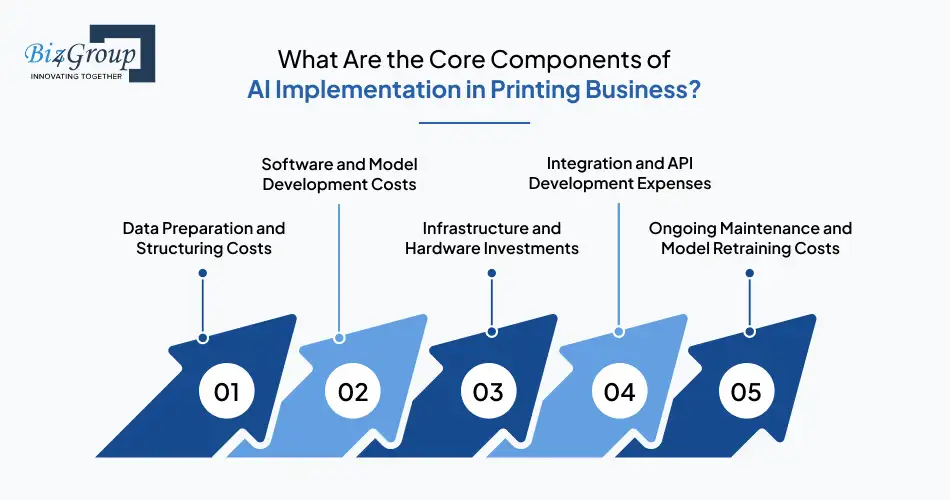
The cost to integrate AI in printing business is usually spread across five main components. For projects in the $10,000 to $50,000 range, most of the budget goes into preparing data and connecting AI to existing systems. The AI model itself is only one part of the total investment.
The table below shows the core cost areas and how they usually affect the budget.
|
Component |
What It Covers |
Typical Share of Budget |
What Increases Cost |
|---|---|---|---|
|
Data Preparation and Structuring Costs |
Cleaning job history, organizing production data, standardizing records |
20–40% |
Poor data quality, multiple data sources, inconsistent formats |
|
Software and Model Development Costs |
Building and training the AI model, testing outputs, performance tuning |
15–30% |
Complex requirements, custom logic, advanced AI model development |
|
Infrastructure and Hardware Investments |
Cloud hosting, server upgrades, storage, security setup |
10–25% |
On-premise systems, real-time processing needs |
|
Integration and API Development Expenses |
Connecting AI with MIS, ERP, and workflow systems |
20–35% |
Lack of APIs, legacy systems, multiple platform connections |
|
Ongoing Maintenance and Model Retraining Costs |
Monitoring, updates, retraining, technical support |
10–20% per year |
Changing workflows, growing data volume |
In most cases, total cost depends mainly on data quality and how easily AI can connect to existing systems. Companies with clean records and modern software usually stay near the lower end of the investment range. Businesses with scattered data or older systems spend more because extra work is needed before AI can operate correctly.
This is why the AI automation integration cost for printing companies differs from one business to another. The AI tool may be similar, but the surrounding systems determine how much effort is required to implement and maintain it.
Top Use Cases of AI Automation Integration Cost for Printing Companies
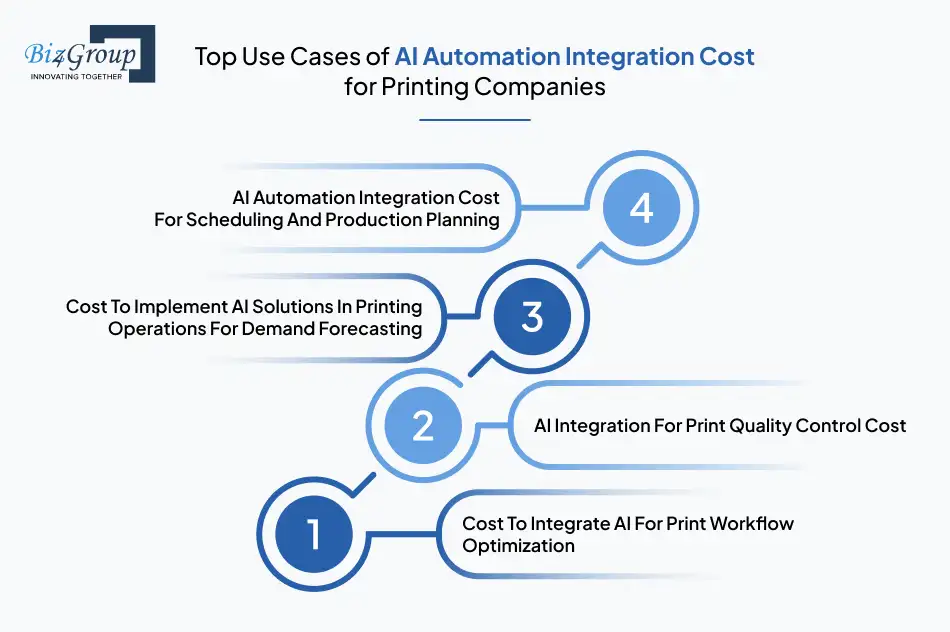
Different AI projects affect budget in different ways. The type of task being automated determines where the cost goes. Some projects require more data work. Others require stronger system integration or higher processing power.
In practical terms, workflow automation, quality control, demand forecasting, and scheduling each place different technical demands on the system. These differences shape overall printing business AI implementation expenses and explain why costs vary across use cases.
1. Cost To Integrate AI For Print Workflow Optimization
Workflow optimization projects usually cost between $10,000 and $25,000. These systems automate job routing, file checks, and approval steps. They improve speed and reduce manual errors. This use case generally keeps printing business AI implementation expenses controlled because it relies more on system integration than advanced modeling.
- Where Costs Increase: If workflow steps vary across departments, extra configuration is required. Standardized processes reduce setup time and lower cost.
2. AI Integration For Print Quality Control Cost
Quality control solutions often range from $20,000 to $50,000. These systems detect print defects, color variation, and alignment issues using production data and image inputs. The AI technology integration cost in printing increases here because image processing requires more computing power and testing.
- Where Costs Increase: Real-time inspection during live production raises infrastructure and validation costs.
3. Cost To Implement AI Solutions In Printing Operations For Demand Forecasting
Demand forecasting projects typically cost between $15,000 and $35,000. These systems analyze historical sales and production data to predict order volumes. The cost to implement AI solutions in printing operations for forecasting depends mostly on how clean and complete past data is.
- Where Costs Increase: If sales records are inconsistent or stored in multiple systems, extra time is spent in preparing the data.
4. AI Automation Integration Cost For Scheduling And Production Planning
Scheduling and production planning projects usually range from $12,000 to $30,000. These systems optimize machine use and reduce idle time. Many printing companies seek structured AI consulting services before starting, to ensure scheduling rules match real production limits.
- Where Costs Increase: When production data is not updated in real time, additional integration work is required.
|
Use Case |
Typical Cost Range |
Main Cost Driver |
Complexity Level |
|---|---|---|---|
|
Workflow Optimization |
$10,000–$25,000 |
System integration |
Low to Moderate |
|
Print Quality Control |
$20,000–$50,000 |
Image processing |
Moderate to High |
|
Demand Forecasting |
$15,000–$35,000 |
Data preparation |
Moderate |
|
Scheduling & Planning |
$12,000–$30,000 |
Real-time integration |
Low to Moderate |
Although the price ranges overlap, each use case shifts where the money is spent. Some businesses choose to hire AI developers internally for long-term capability. Others work with a custom software development company to move faster.
Understanding these differences helps leaders estimate cost more accurately and select a use case that fits both budget and operational goals.
Portfolio Spotlight
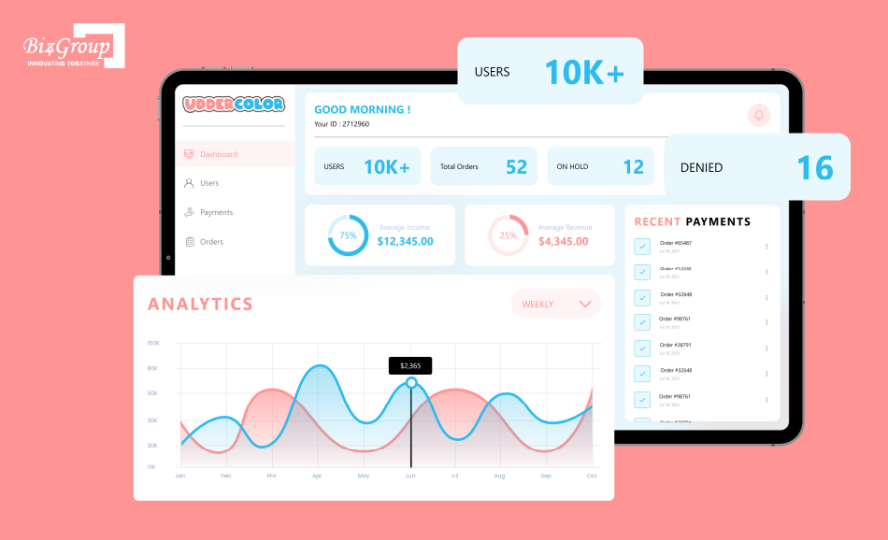
Udder Color is a custom artwork printing platform built by Biz4Group, that allows customers to upload designs, select print specifications, and order heat transfers in various quantities and sizes for direct shipment. The system streamlines order intake, artwork processing, and production coordination through automation. Platforms like this demonstrate how structured digital workflows reduce manual intervention, which directly influences the long-term cost structure of AI-driven printing operations.
Optimize Your Printing Operations with AI
Reduce manual errors and boost efficiency with the right AI solution tailored for your business.
Request a Custom AI SolutionWhat Hidden Expenses Increase the Cost to Integrate AI in Printing Business?
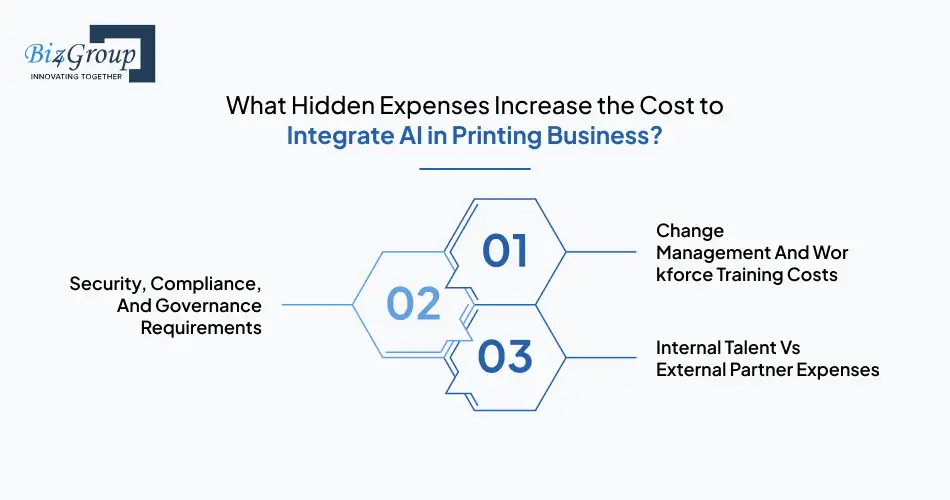
The cost to integrate AI in printing business often increases due to expenses that are not part of initial development estimates. These hidden costs can add 10 to 30 percent to the total project budget. They usually relate to training, security, and decisions about who manages the system long term.
Here’s all you need to know about such hidden costs:
1. Change Management And Workforce Training Costs
AI tools change daily workflows, reporting processes, and production decisions. Employees need structured training, updated documentation, and time to adapt to new systems. These adjustments can add a lot of dollars to the overall printing workflow AI integration cost, especially when there are multiple teams involved.
2. Security, Compliance, And Governance Requirements
AI systems handle production data, customer records, and operational metrics. This requires access controls, secure storage, and clear usage policies. When businesses expand into automation areas such as generative AI, governance and monitoring requirements increase overall implementation effort.
3. Internal Talent Vs External Partner Expenses
Companies must decide whether to manage AI internally or work with outside specialists. Hiring skilled professionals or partnering with teams that provide AI automation services adds direct cost but may reduce risk and speed up deployment. Internal management can lower vendor expenses but may require additional training and longer timelines.
Planning for these factors early protects the overall AI integration investment for printing business and reduces unexpected budget increases later in the project lifecycle.
Transform Your Printing Business with Smart Automation
Learn how AI can streamline your printing workflows while controlling costs.
Get My AI Integration Cost BreakdownIs AI Integration Worth It for Printing Business?
AI integration is worth it when the savings it creates are higher than the cost to integrate AI in printing business within a reasonable time. For most printing companies investing between $10,000 and $50,000, the goal is practical: reduce waste, improve speed, and increase production efficiency.
If automation reduces reprints, shortens turnaround time, or improves machine usage, the investment can recover itself within one to two years. The decision should be based on measurable operational results.
How Should Leaders Evaluate AI Integration Investment for Printing Business?
Business leaders should begin by reviewing the full AI integration cost breakdown for printing companies. This includes development, integration, training, and ongoing support costs. Then compare that investment to projected savings from:
- Reduced manual labor
- Lower material waste
- Fewer production errors
- Improved scheduling accuracy
Some printing companies also align automation efforts with broader upgrades such as business app development using AI, allowing improvements across quoting, reporting, and production tracking at the same time.
All in all, the evaluation should remain simple: total cost versus measurable annual savings.
Calculating ROI on AI Adoption Cost in Printing Industry
ROI can be calculated using a basic formula: Annual Savings ÷ Total Project Cost
For example:
- Project cost: $30,000
- Annual savings: $12,000
- ROI: 40 percent per year
This calculation helps leaders assess the AI automation integration cost for printing businesses using clear financial logic. Even moderate efficiency gains can justify the investment over time.
Expected Payback Period Across Project Types
Most focused AI projects in printing recover costs within 12 to 24 months. Workflow automation often pays back faster because labor savings appear quickly. Quality control and forecasting may take longer as benefits build gradually.
For example, the cost to integrate AI for print workflow optimization is often recovered sooner when manual steps are reduced. In many cases, companies that later choose to build AI software internally do so after seeing consistent early returns from smaller automation projects.
When savings are tracked regularly, the value of AI integration becomes measurable and predictable.
Future-Proof Your Printing Business with AI
Stay competitive and lower your operational costs with scalable AI solutions.
See How AI Can Benefit My Printing BusinessCost to Implement AI Solutions in Printing Operations: Build or Buy?
Printing companies choosing between building a custom solution or buying a prebuilt platform are actually deciding how they want to control cost, speed, and flexibility. The cost to integrate AI in printing business changes significantly depending on this choice, even when the use case is the same.
Buying brings down upfront effort but puts limits on customization. Building increases control but demands more development time and budget. The right option depends on how unique the workflow is and how much long-term ownership the company wants.
AI Integration Pricing for Printing Businesses by Approach
Prebuilt AI platforms usually involve factors like licensing fees and configuration costs. Custom solutions require dedicated development, testing, and integration work.
Typical cost patterns look like this:
- Prebuilt solution: Lower upfront cost, faster setup
- Custom development: Higher upfront cost, tailored workflow logic
- Hybrid approach: Platform base with added customization
The AI integration cost for commercial printing companies shoots up when production rules are complicated or when systems need high-level customization.
Companies that partner with a specialized software development company in Florida often choose custom builds to match exact operational needs, even though this increases initial spending.
Trade Offs Between Speed, Control, and Total Cost
The build-or-buy decision affects more than just cost, it also impacts overall timeline and long-term flexibility.
When leaders ask, what is the cost of AI implementation in printing industry, they should compare these practical differences:
|
Factor |
Buy (Prebuilt) |
Build (Custom) |
|---|---|---|
|
Deployment Speed |
Faster |
Slower |
|
Upfront Investment |
Lower |
Higher |
|
Customization |
Limited |
Full control |
|
Vendor Dependence |
Higher |
Lower |
|
Long-Term Flexibility |
Moderate |
High |
Some companies begin with a prebuilt tool and later decide to build an AI app once they understand their long-term automation needs.
When a Phased Rollout Reduces AI Implementation Expenses
A phased rollout spreads investment over time instead of committing the full budget in a single go. This approach allows printing companies to test results, measure savings, and adjust scope before expanding automation across the entire operation.
1. Start Small
Launching AI in one workflow limits integration scope and reduces early risk. This lowers the total cost to implement AI in printing operations during the initial phase.
2. Measure Before Expanding
Tracking savings from labor reduction or waste improvement prevents unnecessary expansion. Proven results justify additional investment required.
3. Scale Based on Data
Once early goals are met, AI can expand into forecasting or quality control. In some cases, businesses later choose to integrate AI into an app for unifying multiple processes under one system.
A phased rollout controls spending while allowing gradual automation growth. It reduces financial pressure and improves decision clarity.
How to Plan AI Integration Cost for Printing Business?
Planning AI spending is not about guessing a number. It is about clearly defining scope, separating one-time costs from recurring costs, and aligning investment with measurable operational gains. The cost to integrate AI in printing business becomes predictable when scope, data readiness, and rollout stages are defined well in advance.
A structured budgeting approach prevents cost expansion and improves financial control.
Practical AI Integration Cost Breakdown for Printing Companies
A practical plan begins by dividing the project into clear blocks of cost. Instead of treating AI as a single expense, leaders should allocate budget by function. Typical cost allocation areas include the following:
- Data preparation and cleanup: Includes organizing job history, correcting inconsistencies, and preparing structured datasets.
- Development and configuration: Covers model setup, workflow logic, and validation cycles.
- System integration: Connects AI tools to MIS, ERP, and production systems.
- Infrastructure and hosting: Includes cloud services or server adjustments if required.
- Ongoing support and retraining: Covers monitoring, updates, and performance tuning.
Reviewing detailed AI integration pricing for printing businesses guarantees that each of these categories is clearly estimated before approval. Some companies consult the top AI development companies in Florida to validate technical scope before committing budget.
When costs are broken down this way, budgeting becomes structured and predictable instead of reactive.
Capital vs Operating Budget Allocation
AI projects include both upfront investment and recurring expenses. Planning must be in place for both, to avoid underestimating the long-term impact.
|
Cost Type |
Capital Expense (One-Time) |
Operating Expense (Recurring) |
|---|---|---|
|
Development and Setup |
Yes |
No |
|
Infrastructure Upgrades |
Yes |
No |
|
Licensing Fees |
No |
Yes |
|
Cloud Hosting |
No |
Yes |
|
Maintenance and Support |
No |
Yes |
Capital expenses are typically higher during the first phase. Operating expenses continue throughout the system’s lifecycle. Some companies extend automation later through AI chatbot integration, treating such additions as operational upgrades instead of new capital projects.
Clear separation between CapEx and OpEx helps define the real budget that’s required to integrate AI in printing operations over time.
Decision Framework to Control AI Automation Integration Cost for Printing Businesses
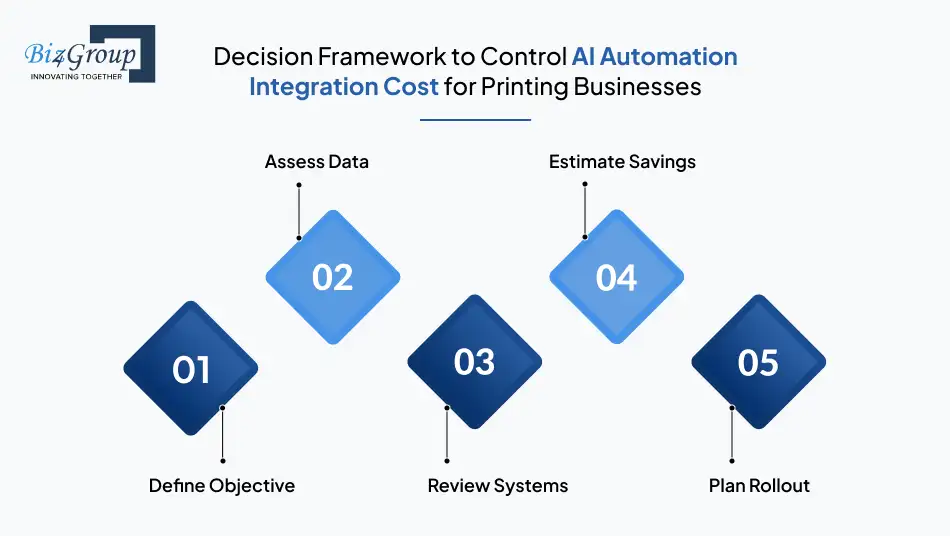
Controlling cost requires structured decision steps before development begins. Here's everything that you need to know:
|
Step |
Key Question |
Budget Impact |
|---|---|---|
|
Define Objective |
What specific problem will AI solve? |
Prevents scope expansion |
|
Assess Data |
Is historical data clean and usable? |
Reduces preparation cost |
|
Review Systems |
Are MIS and ERP integration-ready? |
Limits connector development |
|
Estimate Savings |
What measurable gains are expected? |
Supports ROI validation |
|
Plan Rollout |
Can deployment be phased? |
Controls upfront spending |
Before committing any amount of funds, business leaders should know whether is AI integration worth it for printing business based on projected operational savings and stability improvements. Some organizations later expand automation into tools like AI conversation apps, but only after validating initial financial impact.
Planning with defined scope, phased rollout, and measurable targets keeps AI investment controlled and aligned with the desired business outcomes.
Ready to Implement AI in Printing?
Learn the exact cost to integrate AI in printing business and how to get started with a phased rollout.
Get Your AI Strategy GuideControlling Printing Industry AI Integration Cost for Long Term Advantage
Long-term cost control is not about restricting automation. It is about managing expansion carefully and strategically. The cost to integrate AI in printing business stays stable over time when companies avoid large, unplanned rollouts and instead build capability step by step.
Sustained advantage comes from disciplined scaling, not one-time deployment.
Strategic Roadmap to Reduce AI Technology Integration Cost in Printing
A roadmap reduces cost by limiting unnecessary expansion. Instead of deploying across all departments at once, printing companies can follow a staged growth model:
Stage 1: Operational Automation
Focus on workflow routing and scheduling in the beginning. This limits integration depth and keeps early spending in control.
Stage 2: Quality and Inspection Systems
Introduce inspection only after operational data flows have become stable. This prevents the AI integration for print quality control cost from rising because of unstable inputs.
Stage 3: Forecasting and Optimization
Expand into predictive or advanced systems once historical data is reliable and sufficient in quantity.
Printing businesses that consult the top AI development companies in Florida, often gain clearer staging plans before committing capital.
A roadmap keeps each phase financially justified.
Sequencing Investments to Minimize Financial and Operational Risk
Investment sequencing is about order of impact. Instead of asking “what can we automate?” leaders should ask:
- Where is the fastest measurable return?
- Which system already has clean data?
- Which process causes the most daily inefficiency?
A practical sequencing model looks like this:
|
Priority Level |
Target Area |
Financial Impact Speed |
Risk Level |
|---|---|---|---|
|
High |
Workflow automation |
Fast |
Low |
|
Medium |
Scheduling optimization |
Moderate |
Low |
|
Moderate |
Quality control |
Gradual |
Medium |
|
Long-term |
Forecasting |
Gradual |
Medium |
This step-by-step approach explains how printing companies stay competitive using AI without committing large budgets upfront. Some businesses later extend automation into customer-facing tools through AI assistant app design, but only after internal production systems are stable.
Sequencing protects both cash flow and operational continuity.
Long Term Cost Trends Shaping AI Integration in the Printing Industry
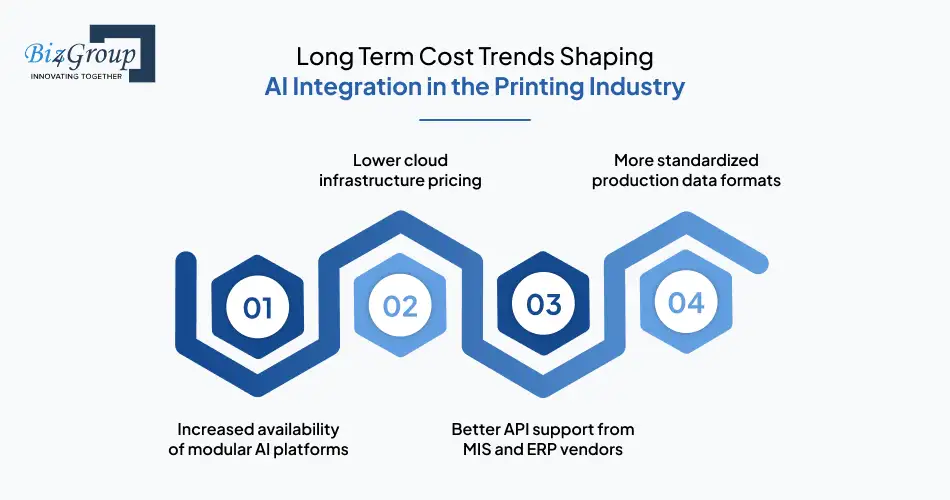
Over the next several years, integration costs are influenced by technology trends. The key long-term cost drivers include the following:
- Increased availability of modular AI platforms
- Lower cloud infrastructure pricing
- Better API support from MIS and ERP vendors
- More standardized production data formats
These trends gradually reduce integration effort and lower maintenance burden.
However, companies that delay AI adoption may face higher adjustment costs in the future. Early adopters often balance spending sooner because foundational systems are already prepared, and they have the early-mover advantage.
Accelerate Your AI Journey for Print Quality Control
Reduce errors, increase consistency, and lower costs by adopting AI for quality control.
Start Building My AI Solution for Print QualityHow Biz4Group LLC Helps in Optimizing AI Integration Cost for Printing Business?
Biz4Group LLC helps printing businesses manage the cost to integrate AI in printing business by creating solutions that fit your needs and budget. We focus on making AI integration cost-effective by starting with clear plans and implementing them step-by-step. Our goal is to reduce costs while improving your operations.
For example, our work with platforms like Udder Color shows how we can integrate AI into printing workflow to automate tasks, save time, and reduce errors. This keeps AI costs manageable and scalable as your business grows.
How We Help:
- Custom AI solutions tailored to your printing business needs
- Phased implementation to keep costs low and improve efficiency
- Expertise in AI product development to improve operations
- Proven track record of reducing AI integration pricing for printing businesses
From automating workflows to improving production accuracy, Biz4Group LLC ensures your AI investment provides value without exceeding your budget.
Wrapping Up
In the end, integrating AI into your printing business is all about making the right decisions today to optimize costs and boost efficiency. Whether you’re automating workflows or enhancing quality control, the cost to integrate AI in printing business can be managed strategically.
With the right approach, like leveraging an AI app development company or exploring innovative printing software solutions, you can stay ahead without burning a hole in your wallet. So, are you ready to take your printing business to the next level with AI? Contact us today for a consultation!
FAQs
1. What are the most common AI applications for printing businesses?
AI can be applied in many areas of printing businesses, including workflow automation, quality control, demand forecasting, and production scheduling. These applications help reduce manual errors, improve speed, and optimize resource allocation.
2. How long does it take to see a return on investment (ROI) from AI in a printing business?
The payback period for AI investments in printing businesses typically ranges from 12 to 24 months, depending on the scope of the project. Smaller, more targeted solutions like workflow automation tend to show returns faster than larger systems like quality control or forecasting.
3. What is the typical cost range to integrate AI in a printing business?
The cost to integrate AI in printing business generally falls between $10,000 and $50,000, depending on factors like project scope, system complexity, and data preparation requirements. Smaller implementations are on the lower end, while more complex, customized solutions tend to be more expensive.
4. What factors impact the cost of AI integration in printing businesses?
Key factors include data readiness, system integration complexity, customization requirements, and whether the business opts for a pre-built solution or a custom-built AI system. The more tailored the solution, the higher the integration cost.
5. What type of AI systems are best for small printing businesses?
Small printing businesses benefit most from AI systems that focus on automation and efficiency, like job routing, scheduling, and quality control. These systems often have lower setup costs and provide a quicker return on investment, helping smaller businesses stay competitive.
6. How do AI tools improve print quality control?
AI tools can automatically detect printing defects, color variations, and alignment issues during production, improving consistency and reducing waste. These systems use machine learning models to learn and identify patterns in production data, allowing for real-time adjustments and enhanced quality assurance.
