 Location :
Orlando, FL, USA
Location :
Orlando, FL, USA +1 (407) 714-1616
 info@biz4group.com

- Generative AI is transforming deal evaluation. Firms that integrate generative AI into real estate deal evaluation workflows gain faster insights and stronger decision clarity.
- The timing is critical. Market data keeps growing, and early generative AI workflow integration for real estate firms creates a competitive advantage.
- Key benefits include faster screening, accurate assumptions, cleaner data, stronger scenario modeling, and higher deal capacity.
- Real-world use cases prove the impact, from automated screening to underwriting support inside a full generative AI for real estate deal evaluation workflow.
- Biz4Group leads the implementation journey, providing strategic guidance, custom builds, and reliable execution for seamless AI adoption in real estate.
If your team is reviewing deals late into the evening, sorting through scattered reports, or rechecking numbers that should already be aligned, you are not alone. Many real estate professionals feel the same pressure. The market moves fast. The data moves even faster. The workflow does not always keep up.
The shift toward intelligent systems is already visible across the industry. More than 70 percent of real estate professionals now use at least one AI-driven tool as part of their daily routine.
On a broader scale, the global market for generative intelligence is projected to reach 66.6 billion dollars in 2025, which shows how quickly these capabilities are becoming standard in competitive businesses.
These shifts tell an important story. Real estate teams are leaning toward smarter tools that reduce manual work and improve accuracy. As the use of generative AI in real estate grows, more firms are rethinking how they evaluate deals, manage underwriting steps, and move opportunities through the pipeline.
You might be feeling that same push. Maybe you want a cleaner process. Maybe you are tired of inconsistent data. Or maybe you simply want to understand how to integrate generative AI into real estate deal evaluation workflows without slowing down your team. These are common concerns for investment groups, developers, REITs, and private equity teams that want to modernize without adding complexity.
In this guide, we will walk through what this shift actually looks like in practice. You will see how generative AI for real estate deal evaluation workflow improvement begins with small adjustments that remove bottlenecks and bring clarity to your decisions. Our goal is to make the path straightforward, practical, and grounded in the realities of a busy deal pipeline.
If you want faster reviews, cleaner insights, and fewer repetitive tasks, you are in the right place. Let’s get started.
Why Now? The Critical Need to Integrate Generative AI Into Real Estate Deal Evaluation Workflows
If your team is feeling the weight of faster deal cycles and rising expectations, you are not alone. Real estate workflows are under more pressure than ever. This is exactly why so many firms are choosing to integrate generative AI into real estate deal evaluation workflows right now instead of waiting for the market to force their hand.
The amount of information required for a single deal has expanded. Market shifts happen quickly. Tenant patterns change. Financing assumptions adjust in ways that alter returns almost instantly. When analysts try to manage all of this manually, bottlenecks appear and opportunities slip through the cracks.
Across the industry, a clear trend is emerging. Investment teams are adopting intelligent systems to strengthen early-stage screening and underwriting. Many firms are already using AI in real estate investment to summarize data, highlight risks, and support initial evaluations. These tools help reduce the hours spent on manual research and allow analysts to focus on what actually drives decisions.
At the same time, rising workload demands require a smarter approach. Teams are asked to evaluate more deals without expanding their headcount. This is one of the reasons leaders are paying closer attention to practical solutions such as use cases of AI for real estate that support cleaner workflows and faster insights.
Several signals show why this shift matters right now:
- Deal timelines keep shrinking while underwriting requirements grow more complex
- Investors expect immediate insights supported by reliable data
- Analysts are reviewing more deals than ever, often with the same resources
- Competitors are improving speed through generative AI integration for real estate deal evaluation workflow improvements
- Intelligent tools reduce repetitive tasks and free your team for deeper evaluation
If your goal is to stay competitive, improve accuracy, and maintain a stronger pipeline, the move toward workflow integration of generative AI in real estate is no longer optional. It creates space for faster decisions, cleaner insights, and a more efficient evaluation process.
Now that the urgency is clear, we can take a closer look at the benefits this shift brings to your deal evaluation workflow.
Ready to stop wrestling with slow deal workflows?
Your analysts deserve better tools than spreadsheets, late nights, and scattered data. Let's make your evaluation workflow work for you instead of against you.
Talk to Our TeamKey Benefits of Generative AI Integration for Real Estate Deal Evaluation Workflows
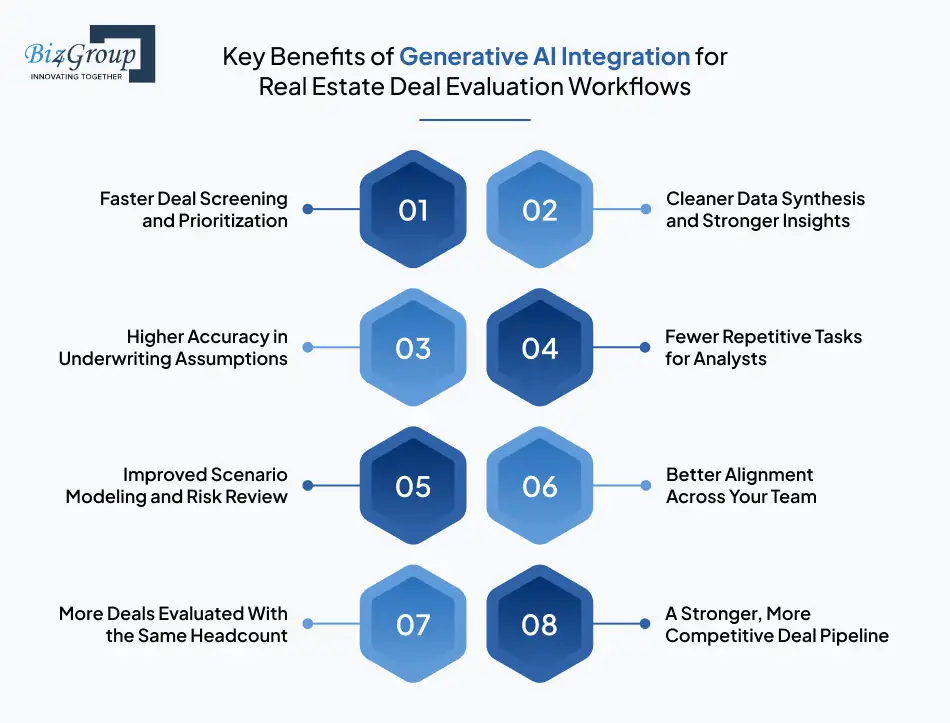
When you begin to integrate generative AI into real estate deal evaluation workflows, your team quickly feels the difference. The process becomes smoother, decisions get clearer, and repetitive manual work decreases. Below are the top benefits firms experience when improving their generative AI for real estate deal evaluation workflow.
1. Faster Deal Screening and Prioritization
Generative intelligence reviews property data and market indicators in minutes, which helps you spot strong opportunities early. This creates a more efficient real estate deal evaluation workflow integration using AI and removes the delays that come from slow manual screening. You gain a more predictable path from sourcing to underwriting.
2. Cleaner Data Synthesis and Stronger Insights
Instead of stitching together fragmented reports, your team receives organized summaries supported by AI-generated insights. This improves the quality of information flowing into your underwriting model and strengthens workflow integration of generative AI in real estate from the very first steps. Your analysts spend their time thinking instead of sorting.
3. Higher Accuracy in Underwriting Assumptions
Generative systems support more reliable assumptions by interpreting comps, expense patterns, and cash flow scenarios with consistency. These improvements enhance seamless generative AI integration for real estate deal evaluation, especially when powered by platforms like an AI real estate deal pipeline platform that automate early analysis.
4. Fewer Repetitive Tasks for Analysts
Analysts often lose hours rewriting summaries, drafting memos, and organizing deal files. Generative intelligence handles much of this repetitive work so your team can focus on deeper evaluations. This benefit is foundational to the best integration methods for generative AI in real estate deal evaluation workflow, because it frees up time without compromising accuracy.
5. Improved Scenario Modeling and Risk Review
Generative intelligence helps your team explore variations in rent, expenses, market shifts, and exit assumptions without manually rebuilding the model each time. This creates more reliable scenario planning and strengthens generative AI integration for real estate deal evaluation workflow improvements. These capabilities become even stronger when paired with tools like AI real estate valuation software.
6. Better Alignment Across Your Team
Everyone works from the same insights, summaries, and assumptions, which improves communication across acquisition, underwriting, and investment committees. This alignment supports cleaner decisions and strengthens generative AI workflow integration for real estate firms without adding complexity to your current stack.
7. More Deals Evaluated With the Same Headcount
With faster workflows and fewer bottlenecks, your existing team can evaluate more opportunities without reducing quality. This advantage becomes even more scalable when supported by customized tools from an AI app development company that fit the needs of your investment team.
8. A Stronger, More Competitive Deal Pipeline
When your team moves quickly, understands risks clearly, and builds consistent underwriting assumptions, your pipeline becomes more competitive. This is one of the most valuable outcomes of generative AI workflow integration for real estate because it elevates the entire evaluation process instead of only improving a single step.
High-Impact Use Cases of Generative AI for Real Estate Deal Evaluation Workflow
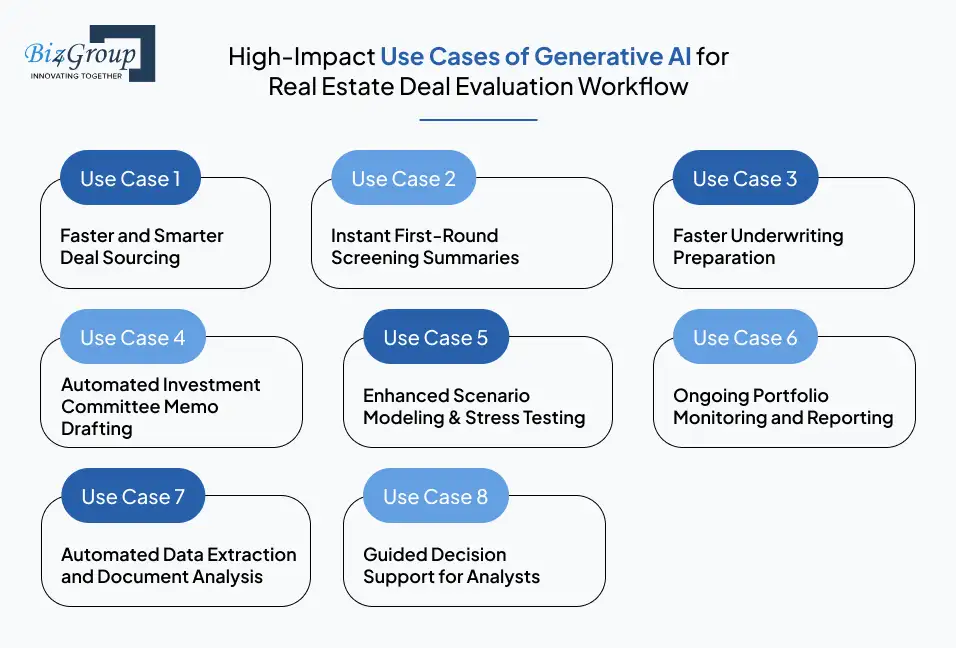
When you begin to integrate generative AI into real estate deal evaluation workflows, the real value comes from seeing exactly where it fits into your day-to-day process. Clear examples help your team picture how these improvements show up inside your deal pipeline, underwriting routine, and reporting tasks.
Below are the most impactful use cases, each explained with simple, relatable examples your audience can immediately understand. These examples also show how generative AI for real estate deal evaluation workflow improvements strengthen accuracy and speed across your entire operation.
Use Case 1: Faster and Smarter Deal Sourcing
Generative intelligence gathers market listings, zoning data, neighborhood insights, and comparable sales, then summarizes everything for you in a structured format. Instead of spending hours reviewing documents, your team starts with a clean snapshot of each opportunity.
Example:
Your acquisitions team receives fifteen off-market multifamily deals in a single week. Instead of manually sorting through PDFs and emails, your system extracts key info such as unit mix, historical occupancy, renovation potential, and cap rate trends. It then ranks deals based on your preferred criteria. This helps you focus only on the opportunities worth underwriting.
This is where firms often consider building an AI property deal analysis app to keep sourcing and evaluation tightly connected.
Use Case 2: Instant First-Round Screening Summaries
Before your analysts open a spreadsheet, generative intelligence can create summaries of the deal, highlight red flags, and surface early risks. This supports clean generative AI integration for real estate deal evaluation workflow improvements by reducing the time between initial review and decision.
Example:
You receive a retail property with inconsistent rent rolls and aging HVAC systems. The system immediately flags tenant rollover risk, deferred maintenance concerns, and market saturation indicators. Your analysts already know the pressure points before deep underwriting even begins.
Use Case 3: Faster Underwriting Preparation
Underwriting is often the most time-consuming part of evaluation. Generative intelligence helps by extracting financial patterns, interpreting comps, and organizing assumptions into clear formats. This strengthens real estate deal evaluation workflow integration using AI and reduces friction during modeling.
Example:
Your team prepares a model for a 200-unit Class B apartment. The system analyzes market rent growth, expense ratios, concession trends, and renovation premiums from recent comps. Analysts start with precise assumptions instead of collecting everything manually.
Teams developing internal tools may even lean on an AI real estate SaaS product to streamline ongoing underwriting tasks.
Use Case 4: Automated Investment Committee Memo Drafting
IC memos often take days to prepare. Generative intelligence drafts a clear narrative based on your underwriting model, property data, market positioning, and risks. This supports workflow integration of generative AI in real estate by shortening the last mile before approvals.
Example:
After underwriting a value-add industrial asset, your system generates a full IC memo including deal overview, renovation scope, rent strategy, sensitivity results, downside risks, and projected returns. Analysts then refine the memo instead of writing it from scratch.
This can be paired with conversational tools built by an AI chatbot development company to simplify internal Q&A before the meeting.
Use Case 5: Enhanced Scenario Modeling and Stress Testing
Generative intelligence can run multiple scenarios and explain the impact of rent changes, expense shifts, interest rate adjustments, and exit cap variations. These insights support seamless generative AI integration for real estate deal evaluation by giving your team a clearer view of risk.
Example:
You want to understand how a 50-basis-point rise in cap rates affects your returns on a mixed-use project. The system generates quick sensitivity outputs, explains the downside, and highlights which variables matter most. Your analysts can now test more scenarios without rebuilding the model.
Use Case 6: Ongoing Portfolio Monitoring and Reporting
After closing, generative intelligence continues supporting your evaluation workflow by monitoring financial performance, flagging deviations, and generating monthly or quarterly reports. This expands the value of generative AI workflow integration for real estate firms beyond acquisition.
Example:
Your system notices that a multifamily asset in Austin is showing higher turnover than expected. It summarizes the variance, identifies possible causes, and proposes actions like unit upgrades or targeted leasing incentives. This gives asset managers a proactive edge.
Organizations with more advanced structures sometimes build agent-driven tools through AI agent architectures to manage continuous monitoring.
Use Case 7: Automated Data Extraction and Document Analysis
Leases, offering memorandums, rent rolls, appraisals, inspection reports, and financial statements often come in inconsistent formats. Generative intelligence extracts key data quickly and supports best integration methods for generative AI in real estate deal evaluation workflow by removing hours of manual review.
Example:
You receive a 120-page offering memorandum. The system extracts operating history, debt terms, comparable properties, and lease summaries in minutes. Your analysts can move directly into evaluation instead of spending half a day sorting through pages.
Use Case 8: Guided Decision Support for Analysts
Generative intelligence supports your team with quick explanations, structured comparisons, and professional recommendations. This strengthens the human side of generative AI integration for real estate deal evaluation workflow without removing analyst judgment.
Example:
Your analyst compares two industrial deals with similar size and location. The system highlights which property has better rent growth potential, stronger tenant credit, and lower operational risk. Your team makes a faster, informed decision backed by data and analysis.
Teams wanting deeper decision support often move toward AI avatar for real estate business style tools for contextual conversations.
Steps to Integrate AI-Driven Analysis Into Property Investment Workflows
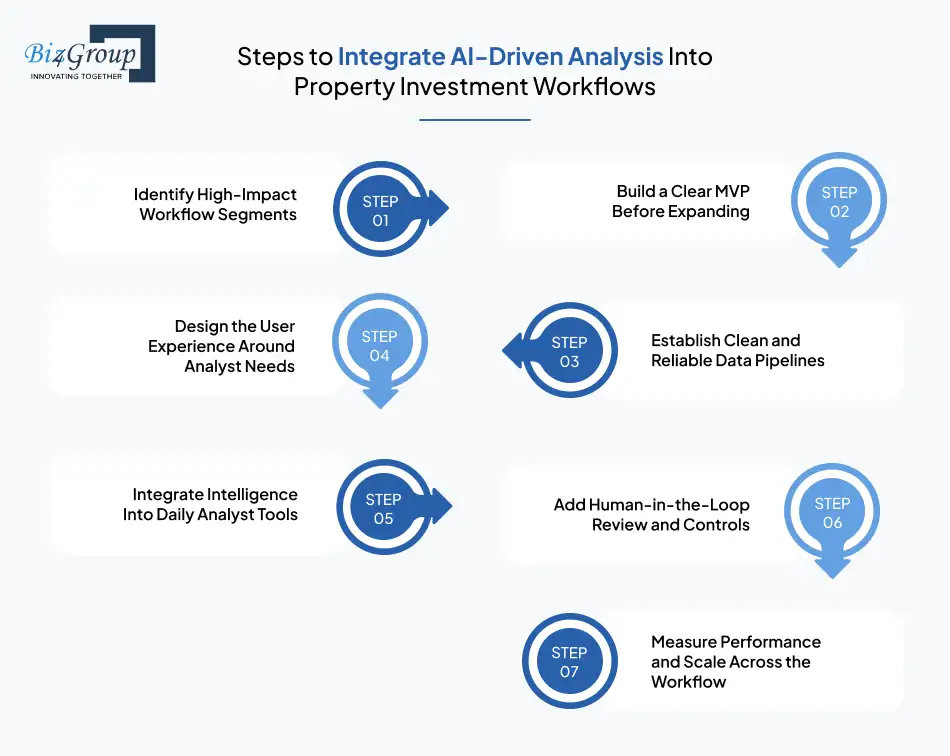
Bringing intelligence into your evaluation process becomes much easier when you follow a structured plan. These steps help you integrate generative AI into real estate deal evaluation workflows in a way that feels natural for your analysts and practical for day-to-day operations. Each step supports a smooth, scalable generative AI integration for real estate deal evaluation workflow that fits your current system rather than replacing it.
Step 1: Identify High-Impact Workflow Segments
Begin by spotting the parts of your evaluation routine that slow your team down. Deal screening, underwriting prep, and risk review usually offer the biggest opportunities for improvement. Targeting these areas first helps your team experience quick wins and builds momentum for deeper workflow integration of generative AI in real estate.
Focus on:
- Tasks that repeat daily or weekly
- Steps where analysts gather data manually
- Bottlenecks between screening and underwriting
- Areas with inconsistent assumptions
Step 2: Build a Clear MVP Before Expanding
Creating a focused initial version is the best way to move forward without overwhelming your team. A streamlined MVP development approach lets you test one use case, collect feedback, and refine quickly. This approach makes real estate deal evaluation workflow integration using AI more predictable and reduces risk during early implementation.
Focus on:
- One specific use case, such as screening summaries
- Fast deployment and quick analyst feedback
- Simple workflows that validate the concept
- Early measurement of time saved
Step 3: Establish Clean and Reliable Data Pipelines
Generative intelligence performs best when your data is clear, structured, and consistent. Setting up dependable pipelines for rent rolls, market comps, financials, and property documents ensures accurate insights and improves the stability of your generative AI workflow integration for real estate firms.
Focus on:
- Standard formats for key property data
- Connected internal and external data sources
- Structured tagging for financial and market metrics
- Fast access to clean inputs for analysts
Step 4: Design the User Experience Around Analyst Needs
Your team adopts new tools faster when they feel intuitive. Clear interfaces and smooth navigation make it easy for analysts to trust the system. This is where thoughtful UI/UX design becomes essential. A well-designed interface strengthens the overall seamless generative AI integration for real estate deal evaluation process.
Focus on:
- Simple dashboards with clear insights
- Familiar terminology for underwriting teams
- Easy access to assumptions and summaries
- Minimal learning curve
Step 5: Integrate Intelligence Into Daily Analyst Tools
Real progress happens when AI shows up inside the systems your team already uses. By embedding insights into your CRM, pipeline software, and underwriting models, you improve every stage of your generative AI for real estate deal evaluation workflow. Analysts get real-time support without changing tools.
Focus on:
- CRM and deal-pipeline connections
- Automated ingestion of rent rolls and financials
- API integrations with comp and market feeds
- Syncing insights with IC prep tools
Step 6: Add Human-in-the-Loop Review and Controls
Even with strong automation, analysts need to review and validate results. Human-in-the-loop steps protect accuracy, reduce risks, and align AI outputs with your underwriting standards. This makes best integration methods for generative AI in real estate deal evaluation workflow both safe and scalable.
Focus on:
- Validation steps before final recommendations
- Clear approval workflows
- Flags for unusual assumptions or patterns
- Audit trails for compliance
Step 7: Measure Performance and Scale Across the Workflow
Once your initial system works well, you can scale across screening, underwriting, IC prep, and portfolio monitoring. Tracking metrics helps you refine the process and expand confidently. This is where workflow integration of generative AI in real estate delivers long-term value.
Focus on:
- Evaluation cycle time
- Analyst hours saved
- Scenario accuracy and consistency
- Deal volume growth
Want to see your workflow finally flow?
If your team can get more done with fewer bottlenecks, smarter integration is the next move. Let's build an AI-powered process your analysts will actually enjoy using.
Start Your AI IntegrationChallenges in Workflow Integration of Generative AI in Real Estate and How to Solve Them
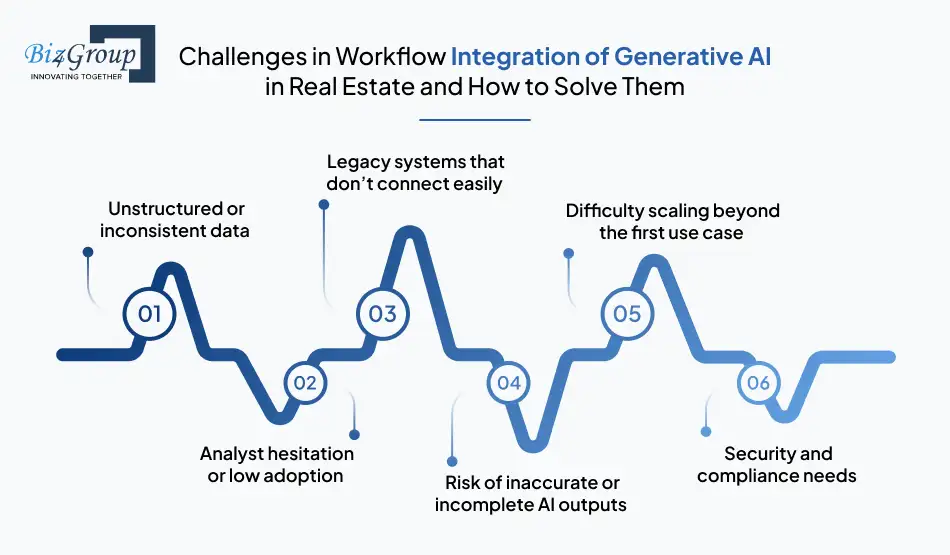
Even when you are ready to integrate generative AI into real estate deal evaluation workflows, the transition can feel complex. Most real estate teams run into similar hurdles during early adoption. The good news is that every challenge has a clear, practical solution, especially when supported by modern enterprise AI solutions that scale with your operations.
The table below outlines the most common issues and how your team can solve them without slowing down your evaluation pipeline.
| Challenge | Why It Slows Down Integration | Practical Solution to Fix It |
|---|---|---|
|
Unstructured or inconsistent data |
Documents such as rent rolls, OMs, and market reports arrive in different formats, which reduces accuracy in your generative AI for real estate deal evaluation workflow. |
Standardize formats, centralize documents, and automate extraction pipelines to strengthen workflow integration of generative AI in real estate. |
|
Analyst hesitation or low adoption |
Analysts may be unsure about trusting AI-generated insights during underwriting or deal screening. |
Introduce AI through smaller tasks, show real examples, and design intuitive workflows supported by thoughtful interfaces. Teams often partner with an AI development company when refining early adoption. |
|
Legacy systems that don’t connect easily |
Older software limits smooth integration and prevents insights from flowing into your daily tools. |
Use APIs, modular upgrades, and integration layers that support real estate deal evaluation workflow integration using AI. |
|
Risk of inaccurate or incomplete AI outputs |
Without proper controls, assumptions or summaries may need extra validation to match underwriting standards. |
Add human-in-the-loop verification, clear approval workflows, and scenario testing to reinforce generative AI integration for real estate deal evaluation workflow reliability. |
|
Difficulty scaling beyond the first use case |
Expanding from screening to underwriting, IC memos, and asset monitoring can feel overwhelming. |
Use modular development and continuous refinement to build the best integration methods for generative AI in real estate deal evaluation workflow. |
|
Security and compliance needs |
Sensitive financials and tenant information require strict security at every stage. |
Apply restricted access, encrypted data flows, and compliance monitoring for a secure generative AI workflow integration for real estate firms. |
Think of these challenges as stepping stones rather than roadblocks. When your team addresses each one intentionally, the entire workflow becomes easier to scale. Your analysts gain confidence, your evaluations gain consistency, and your generative AI for real estate deal evaluation workflow becomes more dependable across the board.
Measuring Success and Looking Ahead: The Future of Generative AI Workflow Integration in Real Estate
Once you integrate generative AI into real estate deal evaluation workflows, measurement becomes the key to long-term success. Clear metrics help you understand what is working, where to optimize, and how to scale your system into a complete intelligence layer for your investment operations. Real estate teams that track performance early see faster improvements in underwriting accuracy, deal flow speed, and overall analyst productivity.
Below are the most meaningful ways to measure success, followed by a forward-looking view of how generative AI workflow integration for real estate firms is evolving.
How to Measure the Impact of Generative AI on Your Workflow
These indicators give you a direct understanding of how well your generative AI for real estate deal evaluation workflow is performing.
Key Metrics to Track:
- Evaluation cycle time
Measure how quickly deals move from sourcing to underwriting after integration. Shorter cycles indicate stronger system adoption and cleaner workflows. - Analyst hours saved
Track reductions in manual research, memo drafting, and document review. These savings show how well your automation supports daily decision making. - Accuracy of underwriting assumptions
Compare pre-AI and post-AI performance. More consistent assumptions signal effective real estate deal evaluation workflow integration using AI. - Deal volume growth
Measure how many more opportunities your team can evaluate without adding headcount. This reflects capacity unlocked by automation. - Scenario clarity and risk visibility
Evaluate whether your team is identifying risks earlier and producing sharper scenario analysis.
These metrics help you determine whether your workflow has achieved seamless generative AI integration for real estate deal evaluation or needs further refinement.
Looking Ahead: What the Next Phase of AI Integration Will Bring
Generative intelligence is already reshaping deal evaluation, but the next wave will go even further. Real estate firms will move from single-use tools to fully connected systems built with flexible intelligence layers. Many teams will begin incorporating approaches inspired by agentic AI development to support decision making, scenario planning, and portfolio oversight.
Here are trends you can expect to see:
- More autonomous early-stage screening
Systems will pre-evaluate deals, highlight risks, and surface opportunities automatically. - Stronger integration with underwriting models
AI will support live updates and automated assumption adjustments. - Context-aware reporting
Dynamic insights will give asset managers real-time portfolio visibility. - Customized intelligence layers
Firms will build internal tools with support from experienced technology partners such as a custom software development company to match their investment strategy. - Higher adoption across acquisitions, underwriting, and asset management
Teams will operate from a single, intelligence-driven workflow rather than fragmented steps.
As these trends evolve, firms that invest early will build stronger evaluation pipelines, faster decision cycles, and more competitive portfolios.
Why Biz4Group Is the Best Choice for Generative AI Integration in Real Estate Deal Evaluation Workflows?
Choosing the right technology partner is just as important as choosing the right investment strategy. When you want to integrate generative AI into real estate deal evaluation workflows, you need a team that understands both the complexity of real estate and the precision required for AI-driven transformation. This is where Biz4Group stands out.
Our experience spans real estate, AI architecture, workflow automation, and intelligent product development. We build solutions that fit your team’s daily operations, not the other way around. Instead of giving you generic tools, we focus on systems that improve your generative AI for real estate deal evaluation workflow from day one.

One example that highlights our capabilities is our work is Facilitor, where we designed a complete digital experience for buyers, sellers, and agents. This project involved building a smart platform that used AI-driven insights to guide users through property options, streamline decision-making, and reduce communication gaps. It demonstrates how we approach real estate challenges with practical intelligence, clean user journeys, and scalable architecture.
This experience is the same foundation we bring when creating tools for screening deals, extracting insights, generating summaries, and supporting underwriting workflows. Whether your team needs clean data pipelines, intelligent document ingestion, or structured analysis layers, our approach ensures smooth workflow integration of generative AI in real estate.
Biz4Group also brings expertise across the full product lifecycle. From strategic planning to interface design to technical execution, our teams collaborate closely with you to ensure your AI system fits your internal processes. When your goal is seamless generative AI integration for real estate deal evaluation, having one partner who can design, build, and optimize the entire solution makes a real difference.
If your firm is ready to modernize how deals are evaluated, reviewed, and approved, our team is here to help you move quickly and confidently. The right intelligence, paired with the right implementation, creates a workflow your analysts will rely on every single day.
Ready to work with a team that knows the real estate grind?
Biz4Group has seen the challenges up close and knows exactly how to turn AI into a real advantage for your deal evaluation workflow. Let's build something impressive together.
Partner With Biz4GroupConclusion: Building a Smarter, Faster, More Confident Real Estate Deal Evaluation Workflow
Real estate teams that rely on slow or fragmented processes are already falling behind. When you integrate generative AI into real estate deal evaluation workflows, your organization gains a measurable advantage in speed, accuracy, and decision clarity. This shift improves how opportunities are screened, how underwriting assumptions are built, and how investment decisions are supported. It also creates a more resilient foundation for long-term growth as deal volume and data complexity continue to rise.
Biz4Group has developed a proven reputation for designing intelligent systems that modernize generative AI for real estate deal evaluation workflow performance. Our work combines deep technical expertise with industry understanding, helping firms streamline sourcing, improve underwriting accuracy, and strengthen their internal workflows through advanced automation. With experience delivering high-impact solutions across real estate, we build platforms that match your workflow rather than forcing your team to adapt to generic tools.
As an established leader in AI transformation, Biz4Group supports organizations with strategic consulting, structured implementation, and scalable engineering. From data architecture to user experience to platform intelligence, we bring the end-to-end capabilities needed for effective generative AI workflow integration for real estate firms. Our team also provides specialized support through services such as AI integration services and full-cycle product execution through our AI product development company.
Real estate organizations that take this step now will build smarter, faster, and more competitive deal pipelines.
FAQ
1. What does it mean to integrate generative AI into real estate deal evaluation workflows?
It means using intelligent systems to support the steps your team already follows when evaluating a property. When you integrate generative AI into real estate deal evaluation workflows, the system gathers data, analyzes documents, identifies patterns, and prepares structured insights. This helps your team move faster and reduces the manual work that slows down early-stage evaluation.
2. How does generative AI improve underwriting accuracy for real estate?
Generative intelligence interprets market trends, comp data, rent rolls, and historical performance with more consistency than manual review. It highlights early risks, suggests clearer assumptions, and supports deeper scenario analysis. These improvements strengthen your generative AI for real estate deal evaluation workflow and help analysts make better decisions with more reliable inputs.
3. Why is real estate deal evaluation workflow integration using AI becoming essential for competitive teams?
Deal volume is rising and market conditions shift quickly. When you complete real estate deal evaluation workflow integration using AI, your team gains the ability to screen opportunities faster, prioritize deals more accurately, and work with cleaner data. This creates a competitive advantage for firms handling many opportunities with limited analyst time.
4. Will generative AI replace my analysts or does it serve as a support tool?
Generative intelligence supports your experts rather than replacing them. It automates repetitive steps, summarizes information, and prepares structured insights. Human judgment remains essential. When you adopt thoughtful workflow integration of generative AI in real estate, analysts spend more time on strategy and less time on administrative work.
5. What measurable improvements can firms expect after generative AI integration for real estate deal evaluation workflow upgrades?
Firms usually experience faster screening cycles, reduced time spent on data collection, more consistent assumptions, and an increase in deals evaluated per analyst. These changes show that generative AI integration for real estate deal evaluation workflow improvements directly enhance productivity and deal quality.
6. What challenges should teams prepare for during seamless generative AI integration for real estate deal evaluation?
Common challenges include fragmented data, inconsistent document formats, legacy systems, and limited analyst adoption. You can overcome these by standardizing data inputs, adding validation steps, and creating a simple rollout plan. These steps ensure seamless generative AI integration for real estate deal evaluation without disrupting your current operations.
7. Is now the right time to invest in generative AI workflow integration for real estate firms?
Yes, this is an ideal moment to begin. Firms that adopt intelligent tools now gain a head start in evaluation speed, risk visibility, and investment accuracy. Early use of generative AI workflow integration for real estate firms creates scalable workflows that support higher deal volume and stronger competitive positioning.
