 Location :
Orlando, FL, USA
Location :
Orlando, FL, USA +1 (407) 714-1616
 info@biz4group.com

- MVP vs Full Scale Legal Tech Platform Development depends on validation readiness, not feature ambition or long-term vision alone.
- Legal tech MVP development helps teams test workflows early, gather real user feedback, and reduce adoption and compliance risks.
- MVPs typically cost $20,000–$50,000, while full scale platforms range from $50,000–$200,000+ depending on complexity and integrations.
- Core MVP features should prioritize security, role-based access, workflow usability, and audit visibility before advanced automation or analytics expansion.
- Scaling should begin only after consistent adoption, revenue validation, and stable compliance performance confirm strong product-market fit.
- Biz4Group LLC follows a structured legal tech product development strategy that validates MVPs first and scales platforms responsibly based on proven usage.
Launching a legal tech platform today is not just a technology decision. It is a balance between speed, cost control, and regulatory readiness from day one. Many businesses move forward without clarity on scope, which often leads to delayed launches and unnecessary spending.
In simple terms:
- An MVP is a focused version of a legal platform built with only the core features needed to validate real user demand.
- Full-scale development delivers a complete solution designed for long-term operations, advanced workflows, and broader adoption.
- Who should choose what: Early-stage startups and innovation teams usually benefit from MVP execution, while established firms with defined processes often invest directly in full platforms aligned with operational scale.
Legal tech products face unique challenges:
- High development costs
- Strict regulatory and compliance risks
- Long development cycles that delay market entry
Understanding MVP vs full scale legal tech platform development helps organizations reduce early risk while maintaining future scalability.
Teams evaluating legal software MVP vs full product development often begin with structured validation through MVP development services. They then expand architecture gradually as adoption grows, and when deeper AI integration becomes operationally necessary.
This guide breaks down cost, timelines, feature scope, scalability, and compliance readiness for you to support practical decision-making.
MVP vs Full Scale Legal Tech Platform at a Glance
Before moving deeper into strategy and execution, it helps to understand how both approaches differ at a practical level. The overview below simplifies MVP vs full scale legal tech platform development so you can quickly align product scope with business goals and risk tolerance.
1. Purpose
- MVP focuses on validating a legal idea with real users using essential workflows only.
- Full platforms support mature operations, large user bases, and long-term business expansion.
2. Time To Market
- Legal tech MVP development typically launches within a few months to test adoption quickly.
- Full scale legal tech platform development requires longer timelines due to broader system readiness and operational setup.
3. Investment Range
- MVP development keeps early investment controlled while proving product viability.
- Full platforms demand higher upfront budgets to support infrastructure, integrations, and scalability.
4. Feature Depth
- MVPs include only core case workflows, document handling, and essential user actions.
- Full platforms introduce automation layers, analytics, and deeper capabilities that often integrate AI into operational processes.
5. Compliance Readiness
- MVPs address baseline compliance needed for safe testing environments.
- Full platforms implement structured governance, audit trails, and regulatory alignment supported by AI automation across workflows.
6. Best Use Cases
- MVP suits startups, innovation teams, and firms validating new legal service models.
- Full platforms fit enterprises scaling proven products or modernizing existing legal operations.
Quick Summary Table
|
Aspect |
Legal Tech MVP |
Full Scale Legal Platform |
|---|---|---|
|
Purpose |
Validate idea and workflows |
Support long-term operations |
|
Time To Market |
Faster launch |
Longer development timeline |
|
Investment |
Controlled early cost |
Higher upfront investment |
|
Features |
Core functionality only |
Advanced and expanded capabilities |
|
Compliance |
Basic readiness |
Structured regulatory alignment |
|
Best Fit |
Startups and innovation teams |
Scaling firms and enterprises |
The right development path depends on product maturity, risk tolerance, and business goals, not feature ambition or technology preference alone.
What Is a Legal Tech MVP Platform?
A legal tech MVP platform is a functional but limited version of a legal software product built to validate real workflows with actual users while maintaining operational safety. It focuses on solving one clear legal problem instead of delivering a complete system. In the broader discussion around MVP vs full scale legal tech platform development, the MVP stage helps confirm demand before long-term investments begin.
Unlike a general software MVP, legal platforms cannot ignore regulatory responsibility during early releases. Even a limited product must handle sensitive client data securely, maintain controlled access, and support traceable actions. For example, a contract review MVP may launch with document upload and annotation features, but it still requires encrypted storage and role-based permissions from day one.
1. MVP For Legal SaaS Platforms
- Legal SaaS MVPs usually target a single workflow such as case intake, document management, or client communication.
- The goal is to validate usability and adoption without building a full practice management ecosystem.
- Many teams pursuing MVP development for legal tech startups focus on one measurable outcome, such as reducing manual document handling time.
2. MVP Vs Prototype Vs Proof of Concept
- A prototype demonstrates interface ideas.
- A proof-of-concept tests technical feasibility.
- An MVP is a usable product released to real users through structured MVP software development, where feedback directly shapes future expansion.
3. Security And Compliance Baseline for MVPs
- Legal MVPs must still respect privacy laws, secure authentication, audit visibility, and data protection standards.
- Teams that build a legal tech MVP without cutting corners treat compliance as a foundation rather than a later upgrade.
A legal tech MVP succeeds when validation and responsibility progress together. Understanding MVP development for legal tech startups helps teams test real value early while maintaining the trust and compliance legal products require from the start.
Still Validating or Already Overbuilding?
If your idea sounds clear, but scope keeps expanding, it's time to ground it in real workflows. Let's map what your MVP actually needs.
Talk To Our Legal Tech ExpertsWhat Are the Benefits of MVP Legal Tech Platform Development?
A legal tech MVP allows organizations to validate ideas in controlled stages while protecting investment and compliance readiness. Instead of committing to large builds early, teams gain measurable outcomes that guide smarter expansion decisions within a structured legal tech product development strategy.
1. Benefits For Startups
- Faster market validation: Launch core functionality quickly and confirm whether legal professionals actually adopt the solution. This reduces uncertainty and helps founders understand real demand before scaling development efforts.
- Lower initial development cost: Invest only in essential workflows before committing to full platform architecture. Early cost control allows startups to allocate resources toward improvement instead of rebuilding unused features.
- Early investor confidence: A working product demonstrates traction better than concepts or presentations. Investors gain visibility into product usability, adoption signals, and execution capability.
- Real user feedback: Lawyers and legal staff reveal usability gaps that founders often miss during planning. Direct feedback highlights workflow friction and helps refine practical feature priorities.
- Focused product direction: Feedback helps startups create legal technology platforms for growth based on proven needs rather than assumptions. Development decisions become evidence-driven instead of opinion-based.
2. Benefits For Law Firms
- Reduced compliance risk: Firms test new digital workflows without disrupting existing operational systems. Limited rollout ensures regulatory responsibilities remain controlled during experimentation.
- Practical workflow validation: Attorneys evaluate whether automation improves document handling, intake, or collaboration efficiency. This ensures technology supports legal practice instead of adding operational complexity.
- Controlled innovation adoption: Working with a top MVP development company helps firms modernize gradually while maintaining operational stability. Incremental adoption reduces resistance from teams adapting to new tools.
3. Benefits For Enterprise Legal Teams
- Safer internal experimentation: Enterprise teams validate new tools within limited environments before organization-wide rollout. This approach minimizes operational disruption while testing measurable improvements.
- Data-driven decision making: Usage insights guide scaling priorities instead of feature assumptions. Leadership gains clarity on where investment produces the strongest operational impact.
- Clear scaling roadmap: MVP learnings reduce uncertainty when transitioning toward broader platforms in the journey of MVP vs full scale legal tech platform development. Teams move forward with validated architecture and defined expansion priorities.
An MVP creates measurable progress without forcing a premature scale. It allows legal organizations to validate workflows, control risk, and move forward with confidence supported by real usage insights rather than assumptions.
Why Should You Build an MVP Before Scaling a Legal Tech Platform?
Scaling a legal tech product without validation often creates problems that appear only after launch. Legal platforms operate in regulated environments where mistakes are expensive to fix. An MVP allows organizations to test real workflows early and avoid building complex systems that users may not adopt. Understanding this stage is central to MVP vs full scale legal tech platform development, because scale only works when the foundation is proven.
What Risks Exist When You Build Full Scale Without Validation?
Full platform development assumes product market fit already exists. In legal technology, that assumption rarely holds true at the start.
- Features may not match how lawyers actually work.
- Workflows designed in theory fail during real case handling.
- Large investments are locked into architecture that becomes difficult to change.
For example, a firm building a full contract lifecycle platform may invest heavily in automation features, only to discover users need simpler approval workflows first. Fixing this later often requires rebuilding core modules.
Why Do Regulatory and Adoption Risks Matter Early?
Legal platforms handle sensitive data from day one. Even early misalignment can create compliance exposure or internal resistance.
- Contract management platforms must support secure access and audit visibility.
- Legal research tools must produce reliable outputs professionals trust.
- Compliance and risk management systems must align with internal governance rules.
If users do not trust the system, adoption slows regardless of technical quality. An MVP allows controlled testing while regulatory safeguards remain manageable.
How Does an MVP Reduce Long-Term Rework Cost?
Rework becomes expensive when it affects architecture instead of features. MVP releases expose gaps early when change is still affordable. A document automation platform, for instance, may reveal that lawyers prefer template flexibility over full automation logic. Adjusting direction at MVP stage prevents rebuilding workflows later.
Teams that learn how to validate legal tech idea before full investment make incremental decisions instead of large irreversible ones. This approach helps organizations create full-scale legal technology solutions based on proven usage patterns rather than assumptions, reducing redevelopment cycles and protecting long-term investment.
Scaling Fast or Scaling Smart Instead?
Most legal platforms fail during expansion, not launch. Validate adoption first and avoid rebuilding later with a structured roadmap.
Plan Your MVP StrategyWhat Core Features Should a Legal Tech MVP Include?
A legal tech MVP should focus on operational safety and usable workflows, not feature completeness. The goal is to launch a platform that legal professionals can trust and use immediately while leaving room for structured expansion later. Clear feature boundaries also help teams understand when to scale from MVP to full legal tech platform without rebuilding foundational systems.
Must-Have Features for A Legal Tech MVP
These features establish usability, security, and accountability from the first release.
|
Must-Have Features |
Why It Matters in MVP Stage |
|---|---|
|
User Authentication and Access Control |
Secure login ensures only authorized users access sensitive legal information. Basic identity verification protects client data from the start. |
|
Role-Based Permissions |
Lawyers, paralegals, and administrators require different access levels. Role separation prevents accidental data exposure and supports operational clarity. |
|
Secure Document Handling |
Documents must be safely uploaded, stored, and accessed. Encryption and controlled sharing create trust even during early product stages. |
|
Workflow Automation Basics |
Simple automation such as document routing or approval tracking reduces manual effort without introducing unnecessary complexity. |
|
Audit Trails and Logging |
Every action should be recorded. Activity tracking supports accountability and prepares the platform for future compliance requirements. |
These essentials create a stable base where teams can later introduce generative AI capabilities or begin structured AI model development once real usage data becomes available.
Features To Defer Until Later Stages
These capabilities add value but should follow validation, not precede it.
|
Features |
Why It Matters in MVP Stage |
|---|---|
|
Advanced AI Analytics |
Insights become meaningful only after sufficient usage data exists to train AI model behavior responsibly. |
|
Large-Scale Integrations |
Deep integrations with external legal systems increase complexity and are better added after workflow validation. |
|
Multi-Region Compliance Layers |
Expanding regulatory coverage makes sense once adoption grows across jurisdictions. |
Keeping the MVP focused prevents feature overload and helps law firms evaluate a legal tech MVP vs full product for law firms based on real operational outcomes rather than assumptions.
How Is a Legal Tech MVP Platform Developed? Step-by-Step
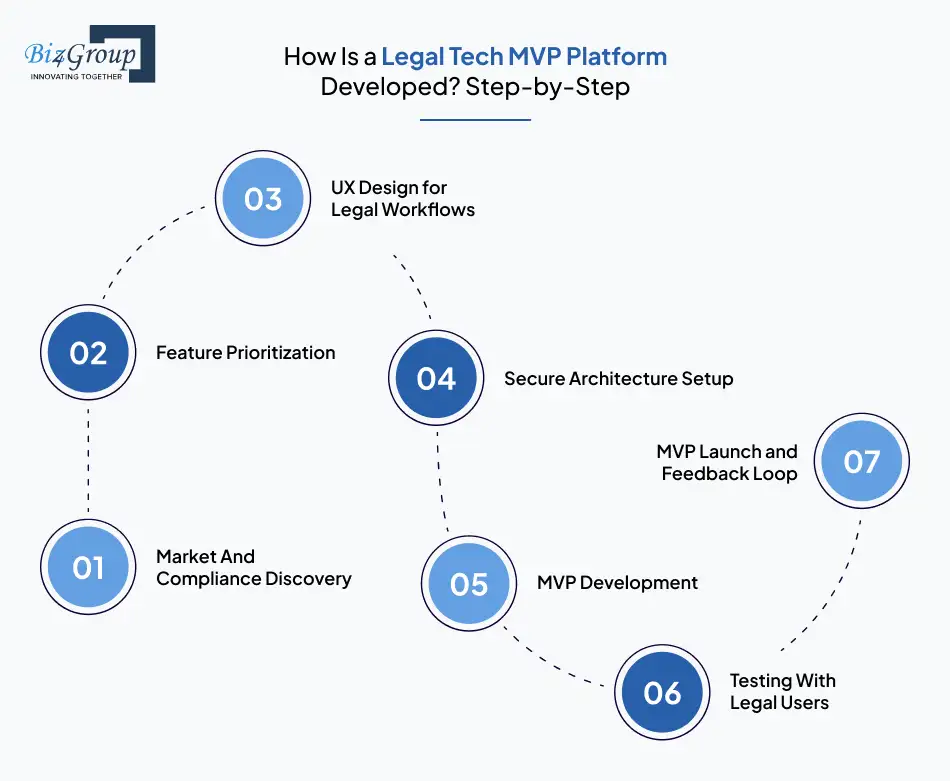
A legal tech MVP succeeds when development follows a structured path instead of rushing into coding. Each step reduces risk while ensuring the platform remains usable, secure, and aligned with real legal workflows. The process below reflects how teams build a legal tech MVP without cutting corners while maintaining clarity between validation and future scale.
1. Market And Compliance Discovery
The process begins by understanding the legal problem being solved and the regulatory environment surrounding it. Teams identify target users, workflow gaps, and data handling expectations. Early compliance mapping prevents redesign later during Legal tech MVP development.
2. Feature Prioritization
Only essential workflows move forward into the MVP scope. Features are ranked based on user impact, operational necessity, and implementation effort. This step prevents overbuilding and keeps development focused on validation goals.
3. UX Design for Legal Workflows
Legal professionals work differently from general software users. Interfaces must reflect familiar processes such as document review, approvals, and case tracking. Many teams collaborate with a specialized UI/UX design company to ensure workflows feel intuitive from the first release.
Also read: Top 15 UI/UX Design Companies in USA
4. Secure Architecture Setup
Before development begins, teams establish secure system foundations. Access control, data protection, and audit visibility are built into architecture rather than added later. This protects sensitive legal information during testing stages.
5. MVP Development
Developers build core functionality based on validated priorities. The focus remains on stability and usability instead of feature volume. Each release iteration supports faster learning rather than completeness.
6. Testing With Legal Users
Real lawyers and legal staff test the platform in controlled environments. Their feedback reveals workflow friction, usability issues, and missing operational steps that internal teams may overlook.
7. MVP Launch and Feedback Loop
The MVP launches to a limited user group. Usage patterns, feedback, and performance data guide improvement cycles. Insights gathered here shape future scaling decisions within MVP vs full scale legal tech platform development, ensuring expansion is based on evidence rather than assumptions.
Know The Steps But Need Direction?
Execution gaps appear between planning and delivery; translate your workflow into a practical development path that actually launches.
Start Your MVP Development DiscussionWhen Should You Scale from MVP To a Full Legal Tech Platform?
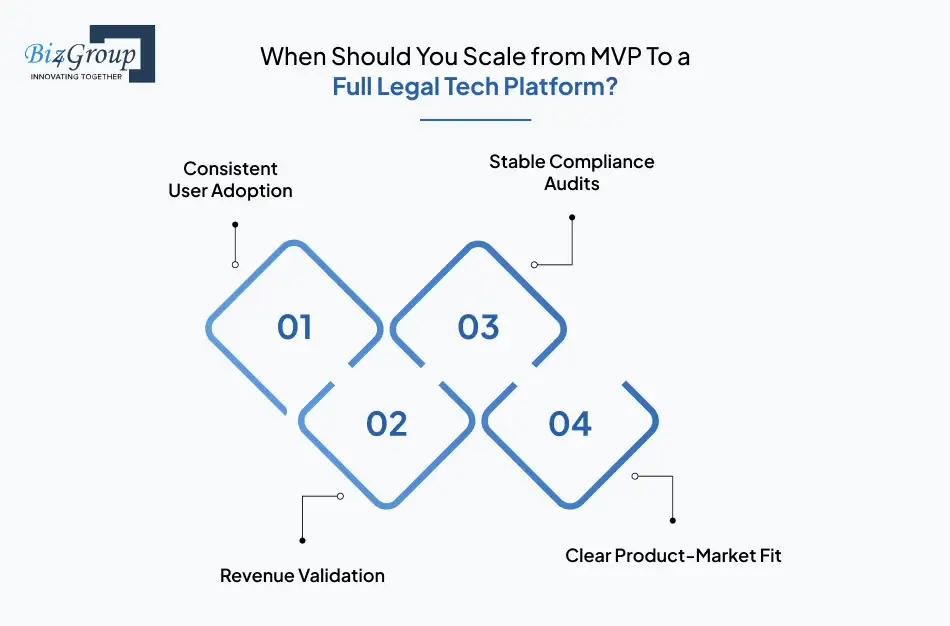
Scaling should happen only when the MVP proves consistent operational value. Expansion too early increases complexity and cost without improving adoption. The decision to scale is not based on feature ambition. It depends on measurable signals that show the product works reliably in real legal environments. Understanding when to scale from MVP to full legal tech platform helps organizations move forward with confidence instead of assumptions. Key scaling indicators to watch:
1. Consistent User Adoption
Regular usage is the strongest early signal. Lawyers and legal teams should return to the platform as part of daily workflows rather than occasional testing.
What to measure:
- Weekly active users remain stable or grow steadily
- Core workflows are completed without external workarounds
- Support requests shift from usability issues to feature requests
When users rely on the system consistently, the product has moved beyond experimentation.
2. Revenue Validation
Revenue confirms that the platform delivers business value, not just technical capability. Paying customers indicate willingness to adopt the solution long term.
What to measure:
- Subscription renewals or contract extensions
- Predictable monthly or annual revenue trends
- Expansion requests from existing clients
Law firms investing in a legal AI app or integrating a AI chatbot for internal workflows often signal readiness for broader platform capabilities once value becomes measurable.
3. Stable Compliance Audits
Legal platforms must demonstrate operational trust before scaling infrastructure. Early audits should show that security controls and activity tracking function reliably.
What to measure:
- Successful internal compliance reviews
- Clear audit logs without manual correction
- Controlled data access across user roles
Stable compliance performance reduces risk when onboarding larger organizations or expanding jurisdictions.
4. Clear Product-Market Fit
Product-market fit appears when users describe the platform as necessary rather than experimental. Demand begins to come from referrals instead of outbound outreach.
What to measure:
- Organic adoption or referrals increase
- Users request deeper automation or integrations
At this stage, the transition within MVP vs full scale legal tech platform development becomes practical. Scaling now builds on proven behavior, allowing organizations to expand architecture, integrations, and capabilities without rebuilding the foundation.
What Is Full Scale Legal Tech Platform Development?
Full scale legal tech platform development refers to building a production-ready system designed for long-term operation, large user volumes, and enterprise-level reliability. At this stage, the platform moves beyond validation and becomes a core operational system used daily by legal teams, firms, or enterprises.
Within MVP vs full scale legal tech platform development, this phase focuses on durability, scalability, and governance rather than experimentation.
1. Architectural Differences from an MVP
- A full platform requires architecture that supports growth without performance decline. Systems are structured to handle increasing users, expanding data volumes, and continuous feature expansion.
- Instead of a single focused workflow, the platform supports multiple interconnected processes such as case management, document collaboration, reporting, and integration.
- Infrastructure decisions prioritize stability, redundancy, and predictable performance under heavy usage.
2. Enterprise-Grade Compliance and Security
- At scale, compliance becomes an operational requirement rather than a baseline safeguard.
- Organizations must support detailed auditability, controlled data access, and regulatory alignment across departments or jurisdictions.
- Security expands to include monitoring, incident tracking, and structured permission
- Platforms often introduce capabilities like legal AI chatbot or legal AI agent to assist legal workflows while maintaining strict data handling controls and traceability.
Also Read: Top 10 AI Chatbot Development Companies for Legal Industry in USA
3. Performance Optimization
- Performance must remain consistent even as usage grows.
- Systems are optimized for faster document processing, reliable search results, and uninterrupted collaboration across teams.
- Load handling and response stability become continuous priorities rather than one-time improvements.
4. Advanced Compliance Requirements
- Scaling introduces broader regulatory responsibilities.
- Platforms must support retention policies, jurisdiction-specific rules, and standardized reporting processes required by enterprise clients and regulated industries.
5. System Integrations
- Full platforms connect with external systems such as billing tools, identity providers, document repositories, and enterprise software environments.
- Integrations reduce manual work and allow legal operations to function within existing organizational ecosystems.
6. Long-Term Maintenance and Evolution
- A full-scale platform requires ongoing monitoring, updates, and structured improvement cycles. Maintenance includes security updates, performance tuning, and feature expansion aligned with real operational needs.
- Organizations that create full scale legal technology solutions treat development as a continuous lifecycle rather than a completed project.
Full scale development turns a validated product into operational infrastructure. At this stage, success depends on reliability, governance, and adaptability, ensuring the platform supports long-term legal operations without constant structural redesign.
Ready To Move Beyond Validation Stage?
If adoption signals are clear, the next challenge is scaling without breaking architecture or compliance foundations. Let's plan that transition carefully.
Discuss Your Scaling RoadmapMVP vs Full Scale Legal Tech Platform Comparison
Understanding the structural differences between MVP and full scale platforms helps clarify how development decisions affect cost, timelines, and long-term risk. The comparison below simplifies MVP vs full scale legal tech platform development so you can align platform scope with business maturity and operational goals.
|
Factor |
Legal Tech MVP |
Full Scale Legal Tech Platform |
|---|---|---|
|
Development Time |
A short development cycle focused on launching usable core workflows quickly. |
Longer build timeline required to support scale, integrations, and operational stability. |
|
Cost |
Lower initial investment with controlled spending during validation stages. |
Higher upfront cost due to infrastructure, compliance expansion, and enterprise readiness. |
|
Feature Completeness |
Core features only, designed to test real legal workflows and user adoption. |
Comprehensive feature ecosystem supporting multiple legal operations and advanced capabilities. |
|
Compliance Readiness |
Baseline compliance safeguards suitable for controlled user environments. |
Advanced compliance coverage supporting audits, governance policies, and regulatory expansion. |
|
Security Depth |
Essential protections such as authentication, permissions, and secure data handling. |
Enterprise-grade security including monitoring, access governance, and risk management controls. |
|
Customization Flexibility |
Limited customization to maintain speed and avoid unnecessary complexity early. |
High flexibility allowing workflow tailoring across departments and organizational structures. |
|
Risk Exposure |
Lower financial and product risk due to phased validation and iterative learning. |
Higher early investment risk but reduced operational risk once adoption and scale stabilize. |
The right approach depends on validation readiness, not feature ambition. Organizations that match development scale with proven demand reduce risk while building a stronger foundation for long-term legal platform growth.
How Much Does MVP Vs Full Scale Legal Tech Platform Development Cost?
Development cost depends on scope, compliance needs, and system complexity rather than platform type alone. Understanding cost ranges helps you plan investment stages realistically while evaluating MVP vs full scale legal tech platform development decisions based on business readiness instead of assumptions.
|
Development Stage |
Estimated Cost Range |
What The Investment Covers |
|---|---|---|
|
Legal Tech MVP |
$20,000 – $50,000 |
Core workflows, secure document handling, authentication, basic automation, and controlled user testing. |
|
Full Scale Legal Tech Platform |
$50,000 – $200,000+ |
Scalable architecture, advanced compliance systems, integrations, performance optimization, and enterprise deployment readiness. |
These ranges reflect practical industry averages. Actual pricing shifts based on operational requirements rather than feature count alone.
Key Factors That Influence Development Cost
- Feature Complexity
- Simple workflows such as document upload or case intake cost less to build.
- Complex automation, analytics, or intelligent assistants increase development effort and testing time.
- Compliance Requirements
- Legal platforms must support privacy protection, audit logging, and access governance.
- Costs increase when platforms must meet regional regulations or enterprise audit standards. Compliance planning early prevents expensive redesign
- AI Integrations
- Connecting with billing systems, document repositories, identity providers, or external legal databases adds development effort.
- Each incorporation introduces testing and maintenance requirements that affect total AI integration cost.
- Team Size and Location
- Development pricing varies based on team structure and geographic location.
- Larger teams accelerate delivery but increase short-term costs. Distributed teams may reduce hourly rates but require stronger coordination practices.
Cost planning works best when investment follows validation milestones. Organizations asking should I build an MVP or full product for legal tech often reduce financial risk by starting small and expanding only after measurable adoption appears.
Budgeting Blind or Planning with Clarity?
Cost decisions become easier when scope matches business maturity. Let's estimate realistically before investment turns into technical debt.
Get A Cost ConsultationCost Optimization Strategies for Building Legal Tech Platforms That Scale
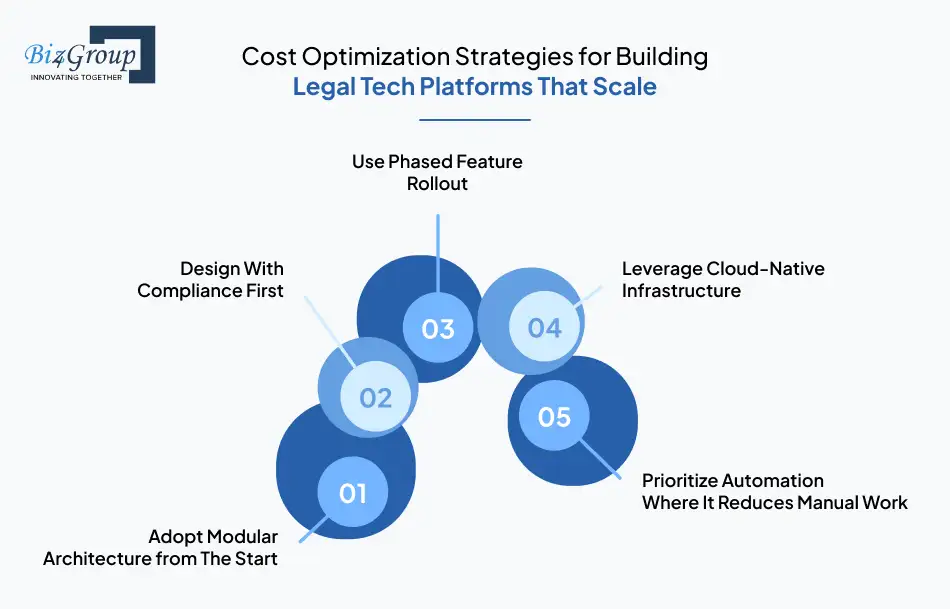
Scaling a legal tech platform does not require uncontrolled spending. Cost efficiency comes from making structural decisions early that prevent rebuilding, compliance gaps, and operational inefficiencies later. The strategies below focus on reducing long-term cost while maintaining reliability and regulatory safety across MVP vs full scale legal tech platform development stages.
1. Adopt Modular Architecture from The Start
- Build the platform in independent modules instead of one tightly connected system.
- Individual components can evolve without rewriting the entire platform.
This approach reduces redevelopment cost as features expand over time.
2. Design With Compliance First
- Treat compliance as a foundation rather than an add-on.
- Implement access controls, audit visibility, and data protection early, so scaling does not trigger expensive restructuring later.
Early compliance planning prevents hidden costs that appear during enterprise onboarding.
3. Use Phased Feature Rollout
- Release features in stages based on real usage signals.
- Start with essential workflows, then expand only when adoption justifies investment.
This keeps spending aligned with validated demand instead of assumptions seen in rushed builds.
4. Leverage Cloud-Native Infrastructure
- Cloud environments allow platforms to scale resources gradually instead of purchasing fixed infrastructure upfront.
- Teams pay for actual usage, which keeps operational costs predictable during growth phases.
5. Prioritize Automation Where It Reduces Manual Work
- Automating repetitive legal workflows lowers long-term operational expenses.
- Teams evaluating automation initiatives often assess the cost to build AI legal chatbot capabilities early.
This keeps investment decisions align with measurable operational savings rather than future assumptions.
Why Choose Biz4Group LLC for Legal Tech MVP and Full-Scale Development in the USA
Legal technology projects usually fail when development moves faster than understanding. What most organizations need is a partner that helps translate legal workflows into practical systems while keeping long-term scale in mind.
Biz4Group LLC operates as a legal software development company working alongside teams to align product decisions with real operational needs throughout MVP vs full scale legal tech platform development journeys.
A structured process guides how platforms evolve:
- Start with workflow clarity: We begin development by understanding how lawyers and legal teams actually work. This helps MVP development for legal tech startups validate adoption early while keeping the system ready for full scale legal tech platform development later.
- Building compliance into the foundation: Secure data handling, role-based access, and audit visibility are treated as essential system elements because legal platforms must meet regulatory expectations from the beginning.
- Introduction of innovation carefully: Through business app development using AI, we apply automation only where it improves daily operations. As adoption grows, capabilities like AI assistant designs are added gradually to avoid disruption.
- Scale based on proven usage: Real implementation outcomes are visible in the company’s portfolio. Let's take a quick look at how platforms mature through steady iteration guided by a consistent legal tech product development strategy.
Court Calendar: From Scheduling MVP To Operational Legal Platform
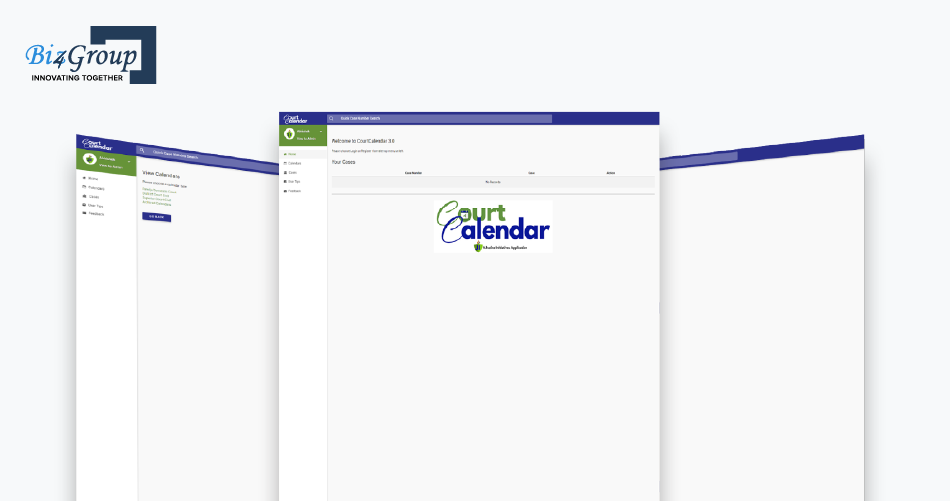
- Court Calendar was built to help U.S. attorneys manage hearings, track case activity, and coordinate court schedules through a centralized judiciary platform.
- The initial release focused on core scheduling workflows, secure document handling, and real-time case visibility to validate daily usability.
- As adoption grew, the platform expanded into broader case coordination and workload management, showing how a focused MVP can evolve into a scalable legal operations system aligned with real courtroom processes.
Trial Proofer: Validating A Virtual Law Firm Before Scaling Automation
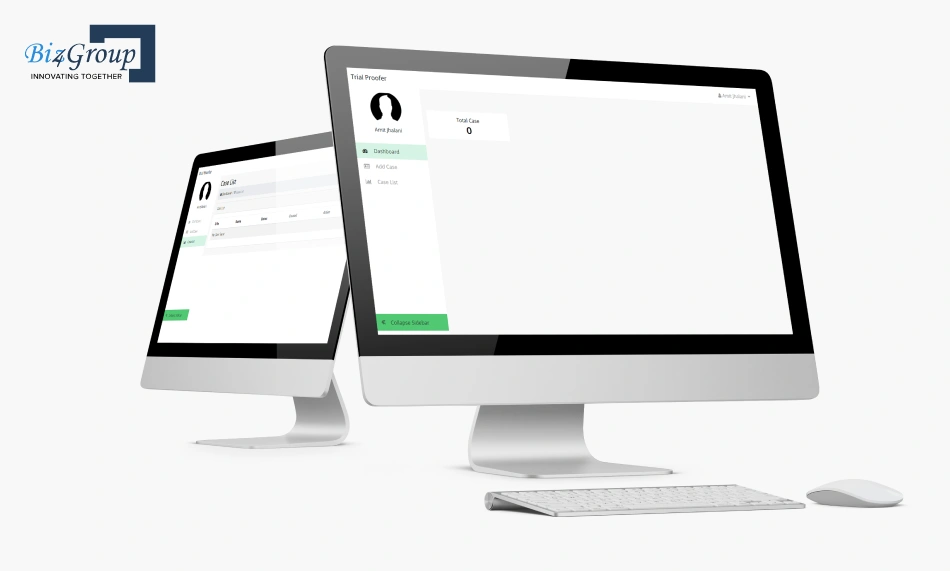
- Trial Proofer began as a virtual law firm automation platform designed to help clients track deadlines, manage case materials, and receive legal services remotely.
- The early version validated whether distributed legal workflows could function reliably online.
- After proving adoption, the platform expanded into structured case management, litigation preparation, and workflow automation capabilities.
- It demonstrates how validating core legal interactions first enables confident scaling into a full digital legal service environment.
These implementations reflect how Biz4Group LLC approaches legal technology development in practice. By validating workflows first and scaling only after proven adoption, the team helps organizations move confidently from MVP experimentation to reliable, full-scale legal platforms without unnecessary rebuilds or compliance risk.
Conclusion: MVP or Full Scale? How to Make the Right Decision
The right path depends less on ambition and more on readiness. Most organizations benefit from starting small, validating real workflows, and scaling only after adoption becomes consistent. Partnering early with an experienced AI development company helps shape realistic roadmaps and prevents costly missteps before large investments begin.
In MVP vs full scale legal tech platform development, the practical decision framework remains straightforward: validate first, scale second, and plan architecture with growth in mind from the beginning. Businesses that follow this approach create legal technology platforms for growth without facing avoidable redesign cycles later.
Legal tech products succeed when strategy guides development decisions instead of feature pressure. If you are planning your next Legal tech initiative, connect with us to discuss how a structured roadmap can support sustainable platform growth.
FAQ: Legal Tech MVP and Full-Scale Development
1. Is an MVP compliant with legal industry regulations?
Yes, a legal tech MVP must still follow core compliance requirements such as secure data handling, access control, and audit logging. MVPs are simplified in scope, not in responsibility. Compliance foundations are necessary even during early validation stages.
2. How long does Legal tech MVP development typically take?
Most legal tech MVPs take between three to six months depending on workflow complexity and compliance needs. The goal is to launch quickly while maintaining operational safety. Timelines focus on validation rather than feature completeness.
3. Can an MVP include AI features in legal technology platforms?
Yes, but AI features should solve a specific workflow problem instead of adding complexity. Early releases often include limited automation or intelligent assistance that can evolve later during full scale legal tech platform development.
4. When should law firms skip an MVP and move directly to full scale legal tech platform development?
Law firms may move directly to full scale builds when workflows are already proven, and requirements are clearly defined. This usually applies to organizations modernizing existing systems rather than launching new products.
5. What security standards should a legal software MVP follow?
An MVP should include encryption, role-based permissions, secure authentication, and activity logging. These safeguards help build a legal tech MVP without cutting corners while protecting sensitive client information.
6. How do you validate a legal tech MVP before full investment?
Validation happens through real user adoption, workflow completion rates, and feedback from legal professionals. Measuring actual usage helps teams understand how to validate legal tech idea before full investment decisions are made.
