Location :
Orlando, FL, USA
Location :
Orlando, FL, USA +1 (407) 714-1616
 info@biz4group.com


















Imagine a digital system that doesn’t wait for instructions but instead, understands your business goals, learns from real-time feedback, and takes independent actions to get the job done.
Read More
 AI Summary Powered by Biz4AI
Somewhere between a regulator publishing a new rule and your team actually following it, there's a gap. RegTech software development exists to close that gap, yet many financial institutions still rely on spreadsheets, emails, and manual approvals. In 2026, those delays aren't just slowing operations. They're creating regulatory, financial, and reputational risks that organizations can't afford to ignore.
The urgency is reflected in market investment. The global RegTech market is expected to reach $29.3 billion in 2026. With a projected CAGR of 21.1% through 2033, enterprises are accelerating investments in AI-powered compliance, regulatory reporting, and risk management. North America alone accounted for 40.8% of the global market in 2025, underscoring how rapidly financial institutions are modernizing their compliance operations.
Organizations now expect more than compliance automation. They need platforms that can adapt to evolving regulations while integrating seamlessly with existing banking and enterprise systems. The real challenge is building software that remains accurate, scalable, and easy to update as regulatory requirements continue to evolve.
From our experience delivering enterprise AI solutions, Biz4Group has observed that compliance failures are rarely caused by a lack of AI capabilities. They are more often the result of fragmented data, disconnected systems, and compliance rules embedded directly into application code. Addressing these challenges early helps organizations build platforms that are easier to maintain, scale, and adapt over time.
To make the right technology and investment decisions, it helps to first understand what modern RegTech software development actually involves.
RegTech software development is the process of building software that helps regulated organizations manage compliance through automation, AI, and configurable business rules. Instead of treating compliance as a series of manual reviews, modern RegTech solutions continuously monitor regulatory obligations, enforce policies, and generate audit-ready records across business operations.
This shift is driven by a reality that regulations evolve faster than most enterprise systems. Updating application code every time a reporting requirement changes is expensive, slow, and difficult to scale. Modern regulatory compliance software development addresses this by separating compliance logic from core business applications, allowing regulatory rules, workflows, and reporting requirements to evolve with minimal disruption.
Many organizations already use compliance management software. The difference lies in how the platform handles regulatory change.
Traditional systems are designed to digitize compliance processes. Modern RegTech platforms are designed to adapt to them. Here is a table that explores the difference.
|
Capability |
Traditional Compliance Software |
Modern RegTech Solutions |
|---|---|---|
|
Regulatory updates |
Manual configuration and code changes |
Configurable rules with AI-assisted regulatory intelligence |
|
Compliance monitoring |
Periodic reviews |
Continuous monitoring |
|
Risk detection |
Static rule engine |
Hybrid rule engine with AI-assisted analysis |
|
Regulatory reporting |
Manual preparation |
Automated, audit-ready reporting |
|
Integrations |
Limited |
API-first integration across enterprise systems |
|
Scalability |
Department-level |
Enterprise-wide |
This distinction often shapes technology decisions. Organizations building a new financial platform frequently ask whether they should develop a custom RegTech solution or integrate an existing compliance platform. The answer depends on factors such as regulatory scope, customization needs, implementation timelines, and long-term maintenance, topics we'll examine later in the article.
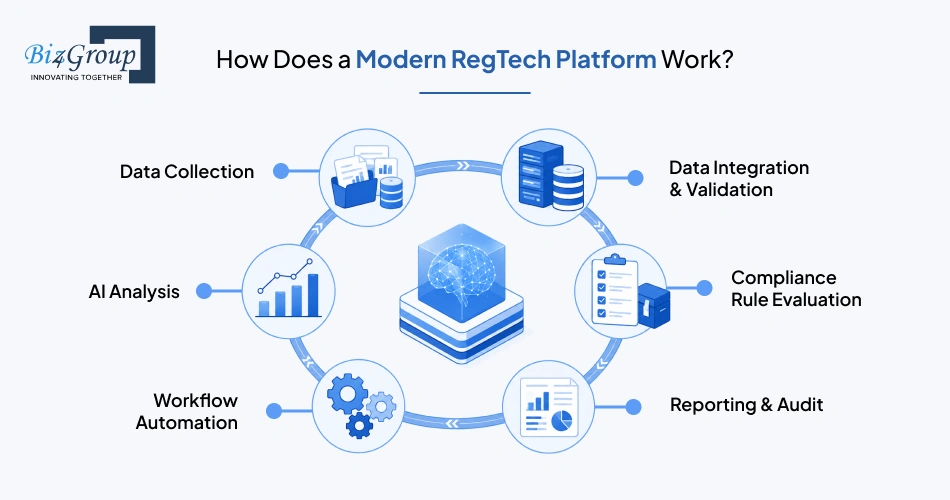
A production-grade RegTech platform is built as a collection of specialized services rather than a single application. Each layer performs a specific responsibility, making the platform easier to maintain as regulations, business processes, and AI capabilities evolve.
This layered architecture provides flexibility without compromising governance. Compliance teams can update regulatory rules independently, while engineering teams focus on maintaining the underlying platform. The same architecture also makes it easier to introduce AI capabilities over time instead of rebuilding the system whenever compliance requirements change.
The rapid growth of RegTech software development reflects the increasing complexity of regulatory obligations rather than the number of regulations alone. Organizations often need to comply with multiple frameworks simultaneously, each introducing its own reporting, documentation, security, and governance requirements.
|
Regulation |
Primary Focus |
Typical Compliance Requirements |
|---|---|---|
|
AML & KYC |
Financial crime prevention |
Customer verification, transaction monitoring, sanctions screening |
|
GDPR |
Data privacy |
Consent management, data governance, breach reporting |
|
PCI DSS |
Payment security |
Cardholder data protection and security controls |
|
SOX |
Financial governance |
Internal controls, financial reporting, audit readiness |
|
Healthcare data protection |
Access controls, audit logs, patient privacy |
|
|
DORA |
Digital operational resilience |
ICT risk management, operational resilience, incident reporting |
|
EU AI Act |
AI governance |
Risk management, transparency, model documentation, human oversight |
Meeting these requirements manually becomes increasingly difficult as organizations expand into new markets or introduce new digital products. This is one reason FinTech compliance automation and intelligent RegTech solutions have become strategic investments rather than operational upgrades.
The next step is understanding how organizations apply these capabilities in practice and where AI delivers measurable value across different compliance workflows.
Let's build a RegTech platform that spends less time checking boxes and more time creating business value
Let's Build It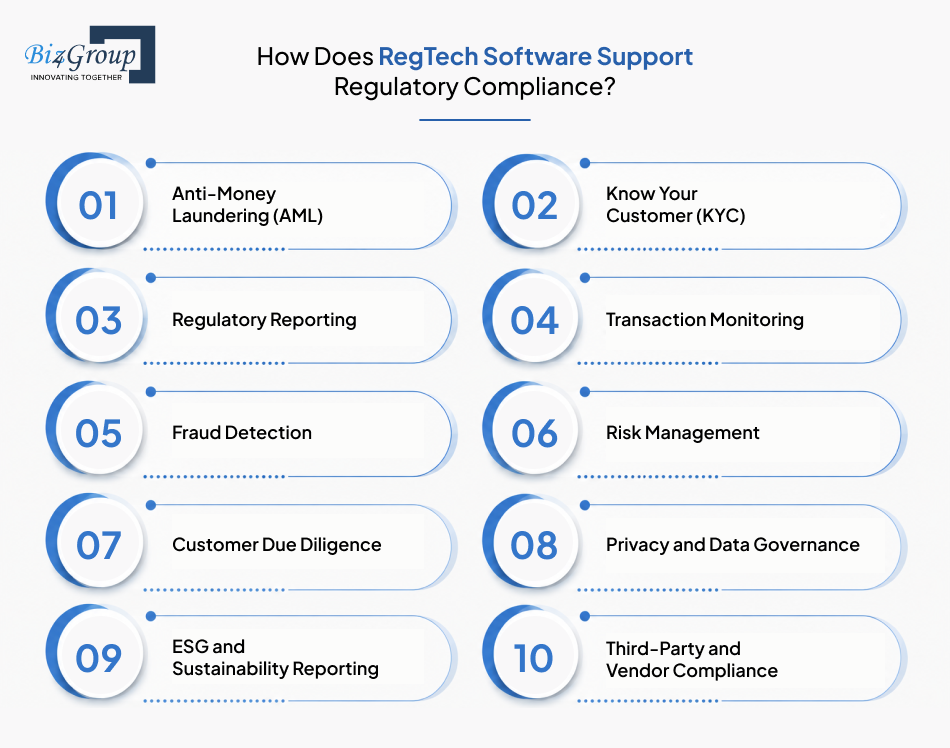
The value of RegTech solutions is measured by the compliance workflows they improve. While regulations differ across industries, the operational challenges are often the same: processing large volumes of data, responding to changing regulations, reducing manual reviews, and maintaining audit-ready records. Modern RegTech software development addresses these challenges by combining automation, AI, and configurable compliance workflows.
Anti-Money Laundering (AML) helps financial institutions identify, investigate, and report suspicious financial activities that could indicate money laundering, terrorist financing, or other financial crimes. Traditional AML systems rely heavily on predefined rules, often generating large volumes of alerts that require manual review.
AI improves AML by analyzing transaction patterns, customer behavior, and historical investigations to prioritize high-risk cases while reducing false positives.
Common capabilities
Common industries
Know Your Customer (KYC) verifies customer identity before providing financial services and continues monitoring customer risk throughout the relationship. An effective KYC process reduces fraud, supports AML compliance, and accelerates customer onboarding.
AI simplifies KYC by extracting information from identity documents, validating customer data across trusted sources, and identifying inconsistencies that require further review.
Common capabilities
Common industries
Regulatory reporting requires organizations to collect operational and financial data, validate it against regulatory requirements, and submit accurate reports within strict deadlines. Manual reporting often involves multiple departments, disconnected systems, and repeated validation efforts.
Modern regulatory compliance software development automates data collection, applies validation rules, and generates standardized reports with complete audit trails.
Common capabilities
Common industries
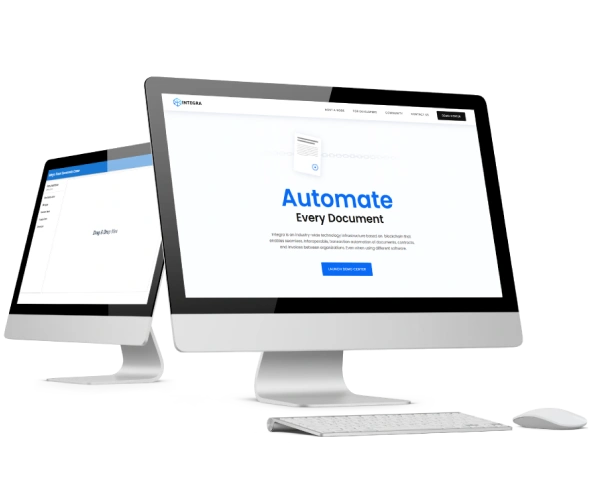
Biz4Group developed IntegralLedger, a blockchain-powered document management platform that enables organizations to securely store, verify, and exchange sensitive business documents while maintaining a tamper-proof record of every transaction. The platform strengthens trust, improves document traceability, and simplifies secure information sharing across multiple stakeholders.
Key capabilities:
Transaction monitoring continuously evaluates financial activity to identify unusual behavior that may indicate fraud, money laundering, or policy violations. Unlike periodic reviews, monitoring occurs in near real time, enabling compliance teams to investigate suspicious activity before risks escalate.
Modern platforms combine deterministic rules with AI models that identify behavioral anomalies, helping investigators focus on transactions that present the highest potential risk.
Common capabilities
Common industries
Fraud detection identifies activities that deviate from expected customer or transaction behavior. Financial fraud continues to evolve, making static rules alone insufficient for identifying sophisticated attack patterns.
AI strengthens fraud detection by recognizing relationships, behavioral changes, and emerging fraud techniques that traditional rule engines may overlook.
Common capabilities
Common industries
Risk management helps organizations identify, assess, and continuously monitor operational, financial, and regulatory risks before they result in compliance failures or financial losses.
Rather than relying on periodic assessments, modern RegTech platforms continuously evaluate risk indicators across customers, transactions, third-party relationships, and internal controls.
Common capabilities
Common industries

Customer Due Diligence (CDD) establishes the level of risk associated with each customer, while Enhanced Due Diligence (EDD) applies additional verification for high-risk individuals and organizations. These processes support AML programs by ensuring customer information remains accurate throughout the business relationship.
AI helps automate risk classification, identify ownership structures, and trigger additional verification when customer risk profiles change.
Common capabilities
Common industries
Privacy regulations require organizations to manage how personal information is collected, processed, stored, and shared. Compliance extends beyond security controls to include consent management, access governance, retention policies, and auditability.
RegTech platforms centralize these controls while maintaining complete records for regulatory inspections.
Common capabilities
Common industries
Biz4Group developed PDF Consultant AI, an AI-powered document intelligence platform that helps users interact with complex PDF documents through natural language. Instead of manually reviewing lengthy reports, users can ask questions, generate summaries, extract key insights, and quickly locate relevant information from one or multiple documents.

Key capabilities:
Environmental, Social, and Governance (ESG) reporting requires organizations to collect non-financial data from multiple business units and suppliers while complying with evolving disclosure standards.
RegTech platforms automate data collection, validate reporting metrics, and maintain evidence supporting sustainability disclosures.
Common capabilities
Common industries
Organizations increasingly rely on external vendors, cloud providers, and service partners, each introducing additional compliance obligations. Vendor assessments performed only during onboarding provide limited visibility as risks change over time.
RegTech platforms automate due diligence, continuously monitor third-party risks, and maintain evidence supporting vendor governance programs.
Common capabilities
Common industries
Organizations rarely implement all of these capabilities at once. Most begin with the workflows consuming the greatest operational effort, then expand the platform as regulatory requirements, business operations, and compliance maturity evolve.
With a clear understanding of its use cases, let's explore what makes RegTech software development a strategic investment for businesses.
Organizations invest in AI-powered RegTech solutions because they improve the speed, accuracy, and scalability of regulatory compliance. Routine tasks that once required significant manual effort can be automated, while compliance activities become easier to monitor and manage from a centralized platform. This allows businesses to reduce operational overhead, strengthen risk management, and keep pace with changing regulations without expanding compliance teams at the same rate.
|
Business Challenge |
How AI-Powered RegTech Solves It |
Business Impact |
|---|---|---|
|
Manual compliance workflows |
Automates repetitive activities such as customer verification, document validation, regulatory reporting, and evidence collection |
Reduces operational effort and allows compliance teams to focus on higher-risk investigations |
|
Frequent regulatory changes |
Uses configurable compliance rules and AI-assisted regulatory intelligence to update workflows without extensive application changes |
Accelerates regulatory implementation while reducing engineering effort |
|
High compliance risk |
Continuously monitors transactions, customer activity, and policy violations using rule engines and AI models |
Improves risk visibility and enables earlier detection of compliance issues |
|
Reporting inaccuracies |
Aggregates data from multiple systems, validates information, and generates standardized regulatory reports |
Improves reporting consistency and minimizes reconciliation errors |
|
Audit preparation |
Maintains centralized audit trails, decision history, policy changes, and compliance evidence |
Simplifies audits and reduces preparation time for regulatory inspections |
|
Fragmented enterprise systems |
Integrates banking platforms, payment systems, CRMs, ERPs, and external compliance services through APIs |
Creates a unified compliance workflow without replacing core business applications |
|
Business expansion |
Supports multiple jurisdictions, regulatory frameworks, and business units from a single compliance platform |
Enables organizations to scale operations without proportionally increasing compliance overhead |
|
Rising compliance costs |
Reduces manual reviews, repetitive administrative work, and duplicate compliance activities |
Improves long-term operational efficiency while maintaining regulatory oversight |
While many organizations begin with a specific objective such as automating regulatory reporting or improving AML operations, the greatest return typically comes from treating compliance as an integrated platform capability. Consolidating workflows, data, and governance into a single system creates a foundation that can accommodate new regulations, additional business lines, and future AI capabilities without requiring repeated platform redesigns.
AI-powered RegTech can do more than reduce risk. It can help your business move faster with confidence
Explore Your OptionsEvery RegTech platform should include features that help organizations manage compliance operations, enforce regulatory requirements, and maintain complete audit records. These capabilities form the operational foundation of RegTech software development and remain essential regardless of the industry or regulatory framework.
|
Core Feature |
What It Does |
Why It Matters |
|---|---|---|
|
Compliance Rule Engine |
Executes regulatory rules, business policies, and validation logic |
Keeps compliance decisions consistent and simplifies policy updates |
|
Automates approvals, reviews, escalations, and remediation tasks |
Reduces manual effort and standardizes compliance processes |
|
|
Case Management |
Tracks investigations, assigns ownership, and stores supporting evidence |
Improves collaboration and accountability during compliance reviews |
|
Regulatory Reporting |
Generates standardized reports using validated enterprise data |
Improves reporting accuracy and reduces preparation time |
|
Audit Trail |
Records user actions, approvals, policy changes, and system events |
Supports regulatory inspections and internal audits |
|
Document Management |
Stores policies, regulatory documents, contracts, and compliance evidence |
Centralizes records and simplifies document retrieval |
|
Role-Based Access Control (RBAC) |
Controls access based on user roles and responsibilities |
Strengthens security and supports governance requirements |
|
Compliance Dashboard |
Displays compliance status, investigations, risks, and key metrics |
Provides operational visibility for compliance and leadership teams |
|
Alerts & Notifications |
Notifies teams about policy violations, pending reviews, and regulatory deadlines |
Enables timely action on compliance events |
|
Integration Layer |
Connects banking systems, ERPs, CRMs, payment platforms, and third-party services |
Creates a unified compliance ecosystem without replacing existing systems |
These features work best as an integrated system rather than standalone modules. For example, a compliance rule should be able to trigger a workflow, create an investigation, capture supporting evidence, and automatically update audit records. Designing these capabilities to operate together reduces operational friction and simplifies future enhancements.
Advanced AI features extend the capabilities of a RegTech platform by improving regulatory intelligence, document analysis, risk detection, and decision support. Unlike core features that execute compliance workflows, these capabilities help organizations process larger volumes of information, respond to regulatory changes faster, and improve operational efficiency.
|
Advanced AI Feature |
What It Does |
Business Value |
|---|---|---|
|
Summarizes regulations, answers compliance questions, and drafts reports using enterprise knowledge |
Reduces research and documentation effort |
|
|
Retrieves current regulations and internal policies before generating responses |
Produces accurate, source-backed compliance guidance |
|
|
AI-Powered Regulatory Intelligence |
Monitors regulatory publications and identifies relevant changes |
Accelerates regulatory change management |
|
Extracts, classifies, and validates information from regulatory documents and identity records |
Speeds document-intensive compliance workflows |
|
|
Identifies unusual transactions, customer behavior, or operational activities |
Improves detection of emerging compliance risks |
|
|
Predictive Risk Scoring |
Estimates customer, transaction, or operational risk using historical and real-time data |
Helps investigators prioritize high-risk cases |
|
Knowledge Graphs |
Maps relationships between regulations, policies, controls, and business processes |
Simplifies regulatory impact analysis and traceability |
|
Explainable AI (XAI) |
Explains why an AI model generated a recommendation or risk score |
Builds transparency for auditors and regulators |
|
Evaluates transactions and business activities against compliance rules in real time |
Detects issues before they become regulatory violations |
|
|
Performs controlled tasks such as monitoring regulatory updates, collecting evidence, and preparing investigation summaries |
Reduces repetitive work while keeping human oversight intact |
Not every organization needs every AI capability. Teams modernizing existing compliance platforms often begin with document intelligence, anomaly detection, or regulatory intelligence before introducing more advanced capabilities such as RAG, AI agent, or predictive risk models. A phased approach reduces implementation risk while allowing AI capabilities to mature alongside compliance operations.
RegTech software development requires a technology stack that supports secure data processing, enterprise integrations, workflow automation, AI capabilities, and regulatory reporting. Each layer has a distinct responsibility. Together, they create a platform that can scale, integrate with enterprise systems, and adapt to evolving regulatory requirements.
The table below highlights the technology layers and their primary functions.
|
Technology Layer |
Recommended Technologies |
Why They're Used |
|---|---|---|
|
Frontend |
React, Angular, Next.js |
Build responsive compliance dashboards, investigation portals, and reporting interfaces using Next.js development and more |
|
Backend |
Java (Spring Boot), .NET, Node.js, Python (FastAPI) |
Develop scalable APIs, business logic, workflow orchestration, and compliance services using Node.js development, Python development and more |
|
Databases |
PostgreSQL, Microsoft SQL Server, MongoDB |
Store transactional data, compliance records, policies, and investigation history |
|
Search & Indexing |
Elasticsearch, OpenSearch |
Enable fast searches across regulations, policies, audit logs, and case records |
|
AI & Machine Learning |
Python, TensorFlow, PyTorch, Scikit-learn |
Support anomaly detection, document classification, risk scoring, and predictive analytics |
|
Large Language Models (LLMs) |
OpenAI, Anthropic Claude, Llama, Mistral |
Summarize regulations, assist investigations, generate reports, and answer compliance queries |
|
RAG Infrastructure |
LangChain, LlamaIndex, Vector Databases (Pinecone, Weaviate, pgvector) |
Retrieve current regulations and internal policies before generating AI responses |
|
Workflow & Business Rules |
Camunda, Temporal, Drools |
Manage approvals, investigations, escalations, and configurable compliance rules |
|
Messaging & Streaming |
Apache Kafka, RabbitMQ |
Process high-volume transactions and compliance events in near real time |
|
Cloud Infrastructure |
AWS, Microsoft Azure, Google Cloud |
Support secure deployment, scalability, disaster recovery, and managed compliance services |
|
Identity & Security |
OAuth 2.0, OpenID Connect, Azure AD, Okta |
Secure authentication, authorization, and enterprise identity management |
|
Monitoring & Observability |
Prometheus, Grafana, ELK Stack, OpenTelemetry |
Monitor system performance, compliance services, and operational health |
|
DevOps & CI/CD |
Docker, Kubernetes, GitHub Actions, GitLab CI |
Automate deployments, scaling, testing, and infrastructure management |
A production-ready RegTech platform depends on a well-integrated technology stack. Technologies should be selected for long-term scalability, governance, and maintainability rather than development convenience.
Now let's walk through the process of developing a RegTech platform from idea to deployment.
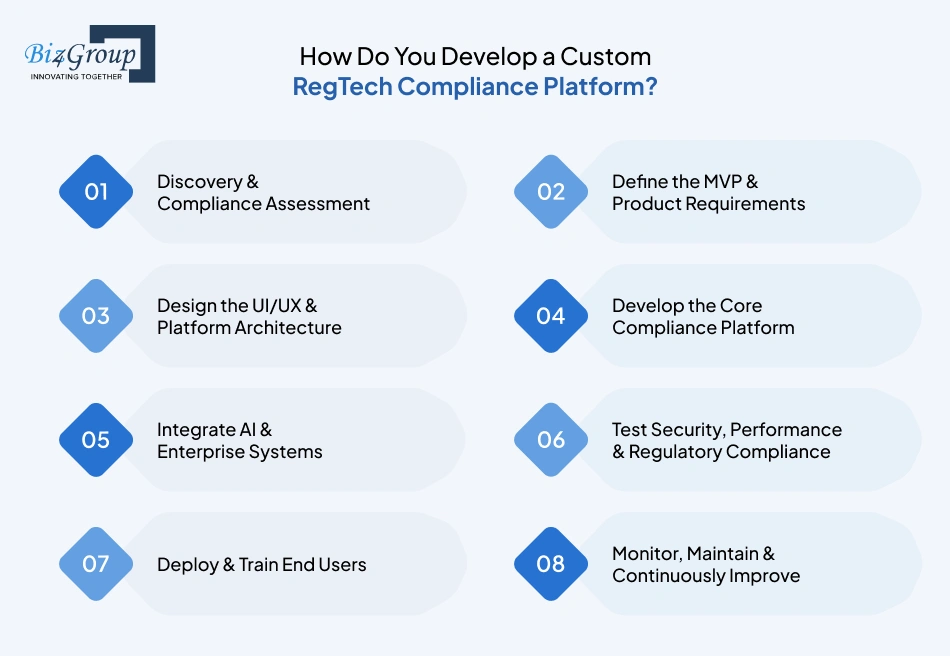
Developing a custom RegTech platform requires a structured process that aligns regulatory requirements with product goals, engineering decisions, and long-term maintainability. Skipping or compressing critical phases often results in costly redesigns, delayed regulatory approvals, and fragmented compliance workflows.
Every project starts by identifying the regulations the platform must support, the business processes affected, and the operational challenges it needs to solve. This phase establishes the project scope and prevents unnecessary development later.
Key activities include:
Outcome: A clear understanding of regulatory obligations, business priorities, and project scope.
The next step is defining what belongs in the first release. A focused MVP validates business value faster and reduces implementation risk while covering essential compliance requirements. Many organizations partner with experienced MVP development services at this stage to prioritize features, validate assumptions, and accelerate delivery.
For most financial platforms, the MVP typically includes:
Additional capabilities such as AI assistants, predictive analytics, or advanced investigations can be introduced in later releases.
Outcome: A prioritized product roadmap with clearly defined functional and compliance requirements.
Also Read: 12+ MVP Development Companies in USA
Compliance software is used by investigators, compliance officers, auditors, and operations teams. The interface should simplify complex workflows while minimizing the effort required to review alerts, investigate cases, and generate reports.
Simultaneously, the system architecture should support modular development, enterprise integrations, and future regulatory updates without requiring significant application changes. Professional UI/UX design company can help ensure the platform remains intuitive for compliance officers, investigators, and auditors.
Design activities include:
Outcome: A scalable platform blueprint that supports both user experience and long-term maintainability.
Also Read: Top 15 UI/UX Design Companies in USA
Once the foundation is defined, development begins with the capabilities required to operate daily compliance workflows. These features establish the operational backbone of the platform and provide a stable base for future enhancements.
Core development typically includes:
Outcome: A fully functional compliance platform capable of supporting essential regulatory operations.
After the core platform is stable, AI capabilities and enterprise systems are integrated to improve automation and decision support. This approach reduces implementation complexity because AI operates on established workflows and reliable data.
Typical integrations include:
Outcome: A connected compliance ecosystem with AI-powered automation and enterprise-wide data visibility.
Testing verifies that the platform performs reliably under production conditions while meeting regulatory and security requirements. Validation should cover software quality, compliance logic, and AI behavior before deployment.
Testing activities include:
Outcome: A production-ready platform that satisfies technical and regulatory expectations.
Deployment introduces the platform into the production environment and prepares operational teams to use it effectively. User adoption is particularly important because compliance workflows often span multiple departments.
Deployment activities include:
Outcome: A live platform supported by trained users and documented operational processes.
RegTech platforms require continuous updates as regulations, business processes, and enterprise systems evolve. Ongoing monitoring ensures the platform remains accurate, secure, and aligned with changing compliance requirements.
Continuous improvement includes:
Outcome: A compliance platform that remains effective as regulatory and business requirements evolve.
A successful RegTech software development project is measured by its ability to adapt. Platforms built with modular architecture, configurable compliance logic, and continuous monitoring require fewer engineering changes as regulations evolve and business operations expand.
Future-ready compliance starts with architecture, not paperwork
Connect With Our Team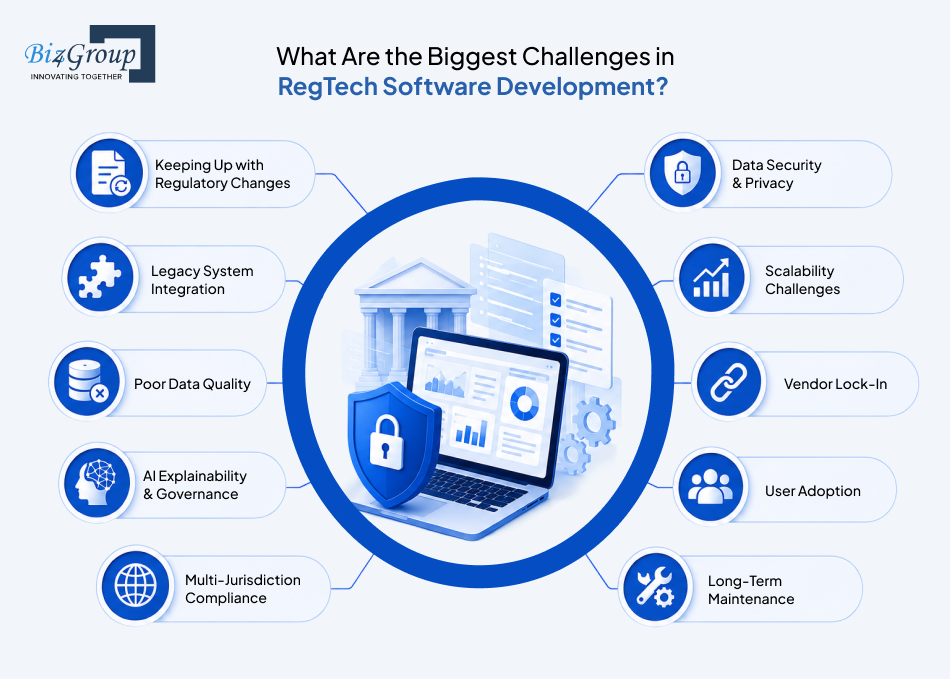
RegTech software development is as much about managing regulatory complexity as it is about building software. Even well-designed platforms can become difficult to maintain if they aren't built for evolving regulations, enterprise integrations, and AI governance. Understanding these challenges early helps organizations reduce implementation risk and avoid costly rework later.
|
Challenge |
How It Occurs |
How to Solve It |
|---|---|---|
|
Keeping Up with Regulatory Changes |
Regulations change frequently across jurisdictions, making hardcoded compliance rules outdated and expensive to maintain. |
Build configurable rule engines that separate compliance logic from application code, allowing rules to be updated without modifying core software. |
|
Legacy System Integration |
Compliance data is scattered across core banking systems, ERPs, CRMs, payment platforms, and third-party applications with inconsistent data formats. |
Use API-first architecture, middleware, and standardized data models to simplify integration and improve interoperability. |
|
Poor Data Quality |
Duplicate, incomplete, or inconsistent data leads to inaccurate risk assessments, reporting errors, and unreliable AI outputs. |
Implement data validation, governance policies, master data management, and continuous quality monitoring before processing compliance workflows. |
|
AI Explainability & Governance |
Black-box AI models make it difficult to justify automated decisions during audits or regulatory reviews. |
Use explainable AI (XAI), maintain human approval for high-risk decisions, and capture complete audit trails for every AI recommendation. |
|
Multi-Jurisdiction Compliance |
Organizations operating across regions must comply with overlapping regulations that often change independently. |
Develop reusable compliance workflows with configurable regulatory policies for each jurisdiction instead of creating separate applications. |
|
Data Security & Privacy |
RegTech platforms process sensitive financial, customer, and operational data that is frequently targeted by cyber threats. |
Apply encryption, role-based access control, zero-trust security, continuous monitoring, and regular security assessments. |
|
Scalability Challenges |
Transaction volumes, regulatory checks, and AI workloads increase as the business grows, affecting system performance. |
Adopt cloud-native, modular, and event-driven architectures that allow services to scale independently. |
|
Vendor Lock-In |
Relying heavily on a single cloud provider, AI vendor, or compliance platform limits flexibility and increases migration costs. |
Use open standards, containerized deployments, and loosely coupled integrations to maintain portability. |
|
User Adoption |
Complex interfaces and inefficient workflows reduce productivity and encourage teams to return to manual processes. |
Design intuitive dashboards, validate workflows with end users, and provide role-specific experiences for compliance teams. |
|
Long-Term Maintenance |
Regulatory updates, framework upgrades, API changes, and evolving AI models increase maintenance effort over time. |
Plan for continuous maintenance, automated testing, version-controlled compliance rules, and regular platform reviews from the beginning. |
Most implementation challenges can be addressed during the planning and architecture stages rather than after deployment. Building a modular, configurable, and integration-friendly platform reduces technical debt and makes it easier to adapt as regulations, technologies, and business requirements continue to evolve.
Investing in RegTech software development is a long-term business decision, not just a technology initiative. The choices made before development begins often have a greater impact on project success than the technologies selected later. Evaluating these considerations early helps reduce implementation risk, improve adoption, and maximize long-term ROI.
|
Recommendation |
Why It Matters |
|---|---|
|
Optimize compliance workflows before automating them |
AI and automation improve existing processes but won't fix inefficient or inconsistent compliance workflows. |
|
Treat compliance teams as product stakeholders |
Compliance officers, risk managers, and auditors should participate throughout development to ensure the platform supports real operational needs. |
|
Keep compliance rules configurable |
Separating regulatory rules from application code makes future updates faster, less expensive, and easier to manage. |
|
Prioritize integrations before advanced AI |
AI is only as effective as the quality and availability of enterprise data. Reliable integrations should come first. |
|
Plan for continuous regulatory updates |
Compliance isn't a one-time implementation. The platform should support ongoing regulatory changes without requiring major redevelopment. |
|
Measure business outcomes, not feature count |
Success should be measured by reduced manual effort, faster reporting, improved compliance accuracy, and lower operational risk rather than the number of implemented features. |
|
Budget for long-term ownership |
Development is only part of the investment. Infrastructure, AI services, maintenance, audits, and regulatory updates should be included in long-term planning. |
|
Choose a partner with both technical and domain expertise |
Experience in AI, enterprise software, and regulated industries reduces implementation risks and accelerates delivery. |
Organizations that achieve the highest return on their RegTech investment focus on building adaptable platforms rather than feature-heavy products. A clear product strategy, strong compliance collaboration, and scalable architecture typically deliver greater long-term value than simply adopting the latest technologies.
The cost of RegTech software development typically ranges from $30,000 for an MVP to over $500,000 for an enterprise-grade platform. The final investment depends on regulatory complexity, AI capabilities, enterprise integrations, security requirements, deployment architecture, and scalability. Estimating these variables early helps organizations allocate budgets more accurately and avoid expensive changes later in the project.
The table below compares RegTech development costs, timelines, and project suitability.
|
Project Type |
Timeline |
Estimated Cost (USD) |
Suitable For |
|---|---|---|---|
|
MVP Platform |
2-4 weeks |
$30,000-$70,000 |
Startups validating a RegTech product with essential compliance capabilities |
|
Mid-Market Platform |
4-6 weeks |
$80,000-$180,000 |
Growing FinTechs requiring multiple compliance workflows, reporting, and enterprise integrations |
|
Enterprise Platform |
6-8 weeks |
$200,000-$500,000+ |
Banks and regulated enterprises requiring AI, advanced security, multi-region compliance, and complex integrations |
These estimates generally include product design, development, quality assurance, and deployment. Third-party licensing, cloud infrastructure, and ongoing maintenance are typically budgeted separately.
Project size doesn't determine the budget on its own. Regulatory complexity, AI capabilities, enterprise integrations, and security requirements often have a much greater impact on the total development cost. Here's a breakdown of the key cost drivers in RegTech software development.
|
Cost Factor |
How It Affects Cost |
Estimated Cost Impact |
|---|---|---|
|
Regulatory Scope |
Supporting multiple regulations requires additional workflows, reporting logic, documentation, and testing. |
15-30% |
|
AI Capabilities |
RAG, intelligent document processing, predictive risk scoring, explainable AI, and AI agents increase engineering and validation effort. |
20-35% |
|
Enterprise Integrations |
Connecting banking systems, ERPs, CRMs, payment gateways, and third-party compliance providers requires custom integration work. |
15-25% |
|
Security & Compliance Controls |
Encryption, RBAC, MFA, audit logging, and regulatory security standards require additional implementation and testing. |
10-20% |
|
Cloud & Deployment Architecture |
Hybrid cloud, multi-region deployment, and high-availability infrastructure increase engineering and infrastructure costs. |
10-20% |
|
UI/UX Complexity |
Custom dashboards, investigation workspaces, and role-based interfaces require more design and frontend effort. |
5-15% |
|
Scalability Requirements |
High transaction volumes and distributed services require additional architecture and infrastructure planning. |
15-25% |
|
Testing & Regulatory Validation |
Functional, performance, security, compliance, and AI validation increase QA effort before production. |
10-15% |
Understanding these cost drivers during project planning helps prioritize investments and reduces costly redesigns later in the development lifecycle.
A RegTech platform involves more than upfront development costs. Recurring expenses such as cloud infrastructure, AI services, maintenance, and compliance updates should also be factored into the budget.
|
Hidden Cost |
Estimated Cost |
Why It Matters |
|---|---|---|
|
Third-Party APIs & Licensing |
$500-$10,000+/month |
Identity verification, sanctions screening, fraud detection, regulatory databases, and AI APIs typically involve recurring subscription or usage fees. |
|
Cloud Infrastructure |
$1,000-$20,000+/month |
Compute, storage, networking, monitoring, backups, and disaster recovery costs increase as transaction volumes grow. |
|
AI Inference & Model Operations |
$500-$15,000+/month |
LLM usage, vector databases, prompt orchestration, and model monitoring generate continuous operational costs. |
|
Regulatory Updates |
$10,000-$50,000/year |
Compliance rules, reporting templates, and regulatory workflows require continuous maintenance as regulations evolve. |
|
Security Audits & Certifications |
$15,000-$100,000+/year |
Penetration testing, vulnerability assessments, SOC 2, ISO 27001, PCI DSS audits, and other compliance certifications require periodic investment. |
|
Data Migration |
$10,000-$75,000 (one-time) |
Migrating historical compliance records from legacy systems often requires more effort than initially estimated. |
|
Maintenance & Support |
15-25% of initial development cost/year |
Platform upgrades, bug fixes, monitoring, dependency updates, and feature enhancements continue after launch. |
|
User Training & Change Management |
$5,000-$30,000 (initial rollout) |
Compliance teams require onboarding, documentation, and periodic training as workflows and regulations evolve. |
Accounting for these costs early provides a more realistic budget and helps avoid unexpected operational expenses after deployment.

Development costs can often be reduced without compromising compliance or scalability by making informed architectural and product decisions from the beginning.
Reducing development costs should focus on eliminating unnecessary complexity, not essential functionality. A well-scoped platform with a modular architecture typically delivers a lower total cost of ownership than one optimized only for the lowest initial development budget.
If regulations are becoming your biggest engineering bottleneck, it's time for a different approach
Book a Discovery CallThe right approach depends on your compliance requirements, internal engineering capabilities, timeline, and long-term business goals. While some organizations benefit from a custom RegTech solution, others can meet their needs with an existing platform or by partnering with a RegTech software development company. Evaluating the trade-offs helps you choose the approach that best aligns with your business strategy.
|
Approach |
Best Suited For |
Why Choose It |
|---|---|---|
|
Build |
Enterprises developing proprietary RegTech products |
Full ownership, maximum customization, and complete control over AI, security, and future enhancements. |
|
Buy |
Businesses with standard compliance requirements |
Faster deployment, lower upfront investment, and vendor-managed maintenance. |
|
Partner |
Organizations needing a custom solution with faster delivery |
Access to RegTech expertise, reduced development risk, and a quicker time to market without building a large in-house team. |
The best choice depends on your business priorities. If compliance is a strategic differentiator, building or partnering often delivers greater long-term value than adopting a one-size-fits-all platform.
With 20+ years of software development experience, Biz4Group, has delivered AI-driven platforms for industries where security, data accuracy, automation, and governance are business-critical. Our work on IntegralLedger and PDF Consultant AI have provided practical experience in building secure document ecosystems, AI decision-support systems, intelligent workflow automation, and enterprise-grade integrations, capabilities that directly support modern RegTech software development.
Why organizations work with Biz4Group:
The technologies may differ across industries, but the engineering challenges remain remarkably similar. Building secure, intelligent, and scalable software is the experience we bring to every RegTech project.
The future of RegTech software development will be defined by systems that adapt to regulatory change with minimal human intervention while maintaining transparency, governance, and accountability. Instead of adding more automation, the next generation of RegTech platforms will focus on making compliance proactive, predictive, and increasingly self-optimizing.
|
Future Trend |
What It Could Mean for Businesses |
|---|---|
|
Autonomous Regulatory Agents |
Agentic AI could interpret regulatory updates, recommend policy changes, prepare compliance reports, and automate evidence collection, leaving compliance teams to review and approve recommendations. |
|
Machine-Readable Regulations |
Regulators may publish regulations in structured, machine-readable formats alongside legal documents, allowing compliance platforms to ingest and implement new rules automatically. |
|
Digital Regulatory Twins |
Organizations could simulate the operational impact of new regulations before implementation, helping teams evaluate costs, risks, and compliance gaps without affecting production systems. |
|
Self-Adapting Compliance Platforms |
Compliance engines may automatically recommend workflow updates, policy changes, and risk controls as regulations evolve, significantly reducing manual configuration. |
|
Confidential AI for Compliance |
Privacy-enhancing technologies such as confidential computing and federated learning could enable AI to analyze sensitive financial data without exposing underlying customer information. |
|
Cross-Border Compliance Networks |
Financial institutions may securely exchange regulatory intelligence, sanctions updates, and fraud signals across trusted networks, improving global compliance collaboration. |
|
Continuous Regulatory APIs |
Regulators could move beyond periodic reporting by providing secure APIs for real-time compliance reporting, validation, and supervisory communication. |
|
Universal Digital Identity Ecosystems |
Reusable digital identities and verifiable credentials may reduce repetitive KYC verification, accelerate onboarding, and improve cross-institution identity trust. |
The future of RegTech isn't about replacing compliance professionals with AI. It's about giving them intelligent systems that can interpret regulations faster, surface risks earlier, and adapt continuously as regulatory expectations evolve.
The question is not whether organizations should modernize compliance anymore. It's how they can build a platform that continues to deliver value as regulations, technologies, and business models evolve. The most successful RegTech initiatives aren't defined by the number of AI features they include, but by their ability to adapt without requiring constant redevelopment.
Building that level of flexibility requires thoughtful product planning, modular architecture, reliable enterprise integrations, and AI that regulators and auditors can trust. Organizations that invest in these fundamentals today will be better positioned to respond to tomorrow's regulatory landscape with greater confidence and lower operational overhead.
At Biz4Group LLC, we combine AI expertise with enterprise software engineering to build custom RegTech platforms that automate compliance, simplify regulatory reporting, and scale with changing business requirements. From MVP strategy and architecture design to enterprise deployment and long-term support, we help organizations turn complex compliance challenges into sustainable digital solutions.
Planning your next RegTech initiative? Connect with the Biz4Group team to discuss your requirements, explore the right implementation strategy, and build a future-ready compliance platform tailored to your business.
If regulatory compliance is a core part of your product or competitive advantage, investing in custom RegTech software development offers greater flexibility, scalability, and long-term cost efficiency. If your compliance requirements are relatively standard, integrating an existing compliance platform can accelerate deployment and reduce initial investment.
AI-powered RegTech solutions automate data collection, document processing, compliance validation, report generation, and audit preparation. This reduces manual effort while improving reporting accuracy, provided AI decisions remain explainable and subject to human review.
An MVP should focus on essential capabilities such as customer onboarding (KYC), AML screening, sanctions checks, audit trails, workflow automation, and regulatory reporting. Additional AI features can be introduced as the platform and compliance requirements mature.
RegTech software is designed specifically to automate regulatory obligations using technologies such as AI, machine learning, and workflow automation. Traditional compliance management software primarily manages policies, documentation, and internal governance, often relying on manual processes and limited automation.
Modern RegTech software development commonly combines cloud computing, AI, machine learning, Large Language Models (LLMs), Retrieval-Augmented Generation (RAG), intelligent document processing, API-first architecture, event-driven systems, and enterprise integrations to automate compliance operations.
The most valuable AI capabilities include intelligent document processing, automated regulatory reporting, explainable AI, predictive risk scoring, anomaly detection, AI-powered compliance assistants, and Retrieval-Augmented Generation (RAG) for regulatory knowledge retrieval.
Instead of replacing existing systems all at once, organizations typically modernize through API-based integrations, modular microservices, phased migrations, and parallel deployments. This approach minimizes operational risk while allowing legacy systems and modern RegTech solutions to operate together during the transition.
AI-powered compliance automation helps organizations reduce manual effort, improve reporting accuracy, detect risks earlier, accelerate regulatory reporting, strengthen audit readiness, and scale compliance operations without proportional increases in operational costs.
A custom RegTech software development project typically costs $30,000-$70,000 for an MVP, $80,000-$180,000 for a mid-market solution, and $200,000-$500,000+ for an enterprise platform. Most MVPs are delivered in 2-4 weeks, while enterprise platforms generally require 6-8 weeks, depending on AI capabilities, integrations, and regulatory complexity.
Look for a RegTech software development company with proven experience in AI, enterprise software engineering, financial services, cloud-native architecture, and regulatory compliance. The ideal partner should also have expertise in enterprise integrations, explainable AI, security, and long-term platform support to ensure the solution can evolve alongside changing regulations.

Our website require some cookies to function properly. Read our privacy policy to know more.