Location :
Orlando, FL, USA
Location :
Orlando, FL, USA +1 (407) 714-1616
 info@biz4group.com


















Imagine a digital system that doesn’t wait for instructions but instead, understands your business goals, learns from real-time feedback, and takes independent actions to get the job done.
Read More

 AI Summary Powered by Biz4AI
Can your advisory team deliver the same level of personalized attention when your client base doubles next year?
That question is becoming harder to answer for wealth management firms. Clients expect faster responses, tailored recommendations, and proactive guidance, while advisors are expected to manage growing volumes of market data, research, compliance requirements, and reporting. This has brought the role of AI in wealth management into the spotlight. Firms are no longer exploring artificial intelligence out of curiosity. They are evaluating where it fits into their long-term business strategy and how it can strengthen client relationships without losing the human touch.
In PwC's Next in Asset and Wealth Management 2025 report, 45% of asset and wealth management leaders said AI is expected to create new revenue streams within the next 12 months. The same report explains that firms are investing in AI to improve client experiences, increase productivity, and build more resilient operating models.
So, how is AI transforming wealth management in practical terms? More importantly, how AI improves wealth management decision making without replacing the expertise clients value most? This guide answers those questions by looking at where the industry stands today, why traditional advisory models are evolving, and what leading firms are doing differently to stay ahead.
Along the way, you'll also see how predictive analytics in wealth management is helping advisors make better decisions, serve more clients, and grow with confidence.
Artificial intelligence has moved well beyond experimentation in the wealth management industry. Firms are increasingly investing in wealth management AI solutions to improve operational efficiency, support advisors, and prepare for rising client expectations. The latest industry research also shows that AI adoption is becoming part of long-term business strategy.
Here's what the latest data tells us.
|
Market Indicator |
Latest Industry Insight |
|---|---|
|
AI as a revenue driver |
45% of asset and wealth management leaders expect AI to create new revenue streams within the next 12 months, according to PwC's Next in Asset and Wealth Management report we mentioned earlier. This highlights how firms increasingly view AI as a growth investment rather than a cost-saving tool. |
|
Business transformation |
43% of firms believe AI will accelerate time to market while improving client experience, according to the same PwC 2025 report. AI is increasingly being adopted across research, operations, compliance, and client servicing. |
|
Industry outlook |
Deloitte's Tech Trends 2025 for Investment Management predicts that AI will become an integral part of day-to-day investment management operations, with small language models and AI agents supporting advisors across specialized workflows. |
|
Market pressure |
According to PwC's 2025 Asset & Wealth Management Revolution report, global assets under management are projected to grow from US$139 trillion to US$200 trillion by 2030. At the same time, firms continue to face shrinking margins, making technology investments increasingly important for sustainable growth. |
These trends explain why enterprise AI implementation in wealth management has become a priority across the industry. As firms manage larger client portfolios and growing volumes of financial data, integrating AI in wealth management is increasingly focused on building connected workflows. Questions such as how do financial institutions deploy AI in wealth management workflows have turned to active boardroom discussions.
Traditional wealth management was built for an industry with fewer data sources, slower market cycles, and more predictable client expectations. That model served the industry well for decades, but today's environment demands faster decision-making, deeper personalization, and the ability to serve more clients without compromising the quality of advice.
This change has accelerated interest in wealth management machine learning, prompting firms to rethink long-standing operating models before evaluating new technologies.
The amount of information advisors work with has grown dramatically over the last decade. Market movements, economic indicators, alternative investments, research reports, client communications, and regulatory updates all compete for attention every day.
While access to more data creates better opportunities, it also increases the time required to separate meaningful insights from noise. Many advisory firms found themselves information-rich but insight-poor, making it harder to respond quickly when market conditions changed.
Investors no longer compare their wealth manager only with another advisory firm. They compare every experience with the personalized digital services they already use in banking, retail, healthcare, and entertainment.
They expect recommendations that reflect changing life goals, communication that feels relevant, and reviews that happen when circumstances change instead of following a fixed calendar. Traditional advisory models, built around standardized workflows and periodic reviews, struggled to meet these rising expectations consistently.
Fee compression, growing compliance costs, and increasing competition from digital-first firms have forced wealth managers to deliver greater value while controlling operating expenses.
Expanding advisory teams alone is rarely enough to support sustainable growth. Firms need operating models that allow advisors to spend more time strengthening client relationships instead of handling repetitive operational work.
Many established firms continue to rely on multiple disconnected systems for portfolio management, CRM, reporting, financial planning, and document management. As data moves across separate platforms, advisors often spend valuable time reconciling information instead of acting on it.
Modern firms increasingly recognize that disconnected technology limits scalability. Creating connected digital ecosystems through AI integration services has become an important step toward improving operational consistency and preparing advisory businesses for future growth.
These industry pressures did not emerge overnight. Together, they created the conditions that pushed wealth management firms to rethink long-standing advisory models and explore new ways of delivering value.
The next question naturally becomes how that transformation is changing the industry today.
AI is reshaping wealth management by expanding what advisory firms can achieve. It enables continuous analysis, deeper personalization, and more informed decision-making across the client lifecycle. This explains how AI is transforming wealth management, with firms moving from static advisory models to more intelligent, responsive, and data-informed operations.
Instead of replacing the fundamentals of wealth management, AI strengthens them. Advisors continue to guide investment decisions and financial planning, while technology improves the speed, accuracy, and depth of the insights available to them.
|
Traditional Wealth Management |
AI-Powered Wealth Management |
|---|---|
|
Investment decisions rely heavily on historical analysis and manual research. |
Investment decisions are supported by real-time market intelligence and predictive insights. |
|
Financial plans are updated during scheduled reviews. |
Financial plans evolve continuously as client goals, market conditions, and life events change. |
|
Client recommendations often follow standardized models. |
Recommendations become more personalized using broader financial and behavioral data. |
|
Portfolio monitoring focuses on periodic performance reviews. |
Portfolios can be monitored continuously to identify risks and opportunities earlier. |
|
Business decisions are based largely on historical reporting. |
Firms gain forward-looking insights that support strategic planning and growth. |
|
Multiple systems operate independently, limiting visibility across the client journey. |
Connected platforms provide a unified view of clients, portfolios, and business performance. |
These changes are redefining how wealth management firms create value for both advisors and clients.
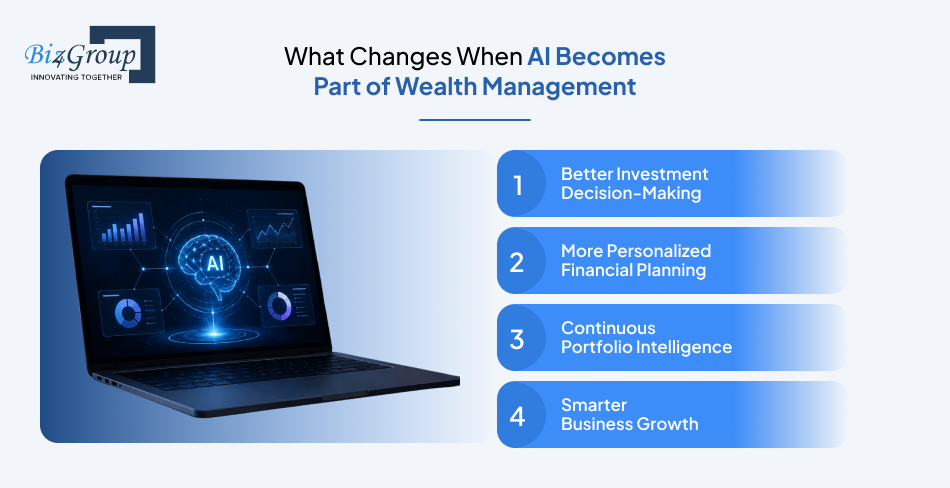
Markets generate enormous volumes of structured and unstructured data every day. AI helps wealth managers analyze research reports, market signals, economic indicators, and portfolio performance more efficiently, making it easier to identify patterns that deserve attention.
This directly addresses a common industry challenge of turning large volumes of information into meaningful investment decisions. It also answers a growing question among firms about how does AI in wealth management help managers make better investment decisions for clients.
Every client has unique financial goals, risk tolerance, investment preferences, and life events. Traditional segmentation often grouped clients into broad categories, making personalization difficult at scale.
Today, digital wealth advisory platforms supported by AI can analyze a broader range of financial and behavioral data to help advisors deliver recommendations that better reflect each client's individual circumstances.
Traditional portfolio management often depended on periodic reviews to assess performance and recommend adjustments.
Modern platforms now support AI-driven portfolio monitoring for wealth managers, allowing firms to identify changing market conditions, portfolio risks, and emerging opportunities much earlier. This enables more informed conversations with clients while improving overall portfolio oversight.
Growth in wealth management is no longer measured only by assets under management. Firms are also focused on delivering consistent client experiences while operating more efficiently.
This has increased interest in AI-powered marketing for wealth management, where firms use data-driven insights to better understand client needs, improve engagement strategies, and identify opportunities for long-term relationship growth. As organizations continue investing in AI wealth management software development, the focus is increasingly shifting toward platforms that strengthen both business performance and client experience.
The capabilities above represent only part of the industry's broader transformation. Organizations are applying these advancements in different ways depending on their size, operating model, and client base, which explains why AI adoption looks very different across the wealth management landscape.
Also read: Top 10 use cases of AI in wealth management
The right AI investment should improve revenue, productivity, and client retention
Calculate My AI ROIAI is changing the day-to-day responsibilities of financial advisors, but it is not replacing their role. Clients still want trusted professionals who understand their goals, explain complex financial decisions, and provide confidence during uncertain markets. What has changed is how advisors spend their time. Instead of being buried in administrative work and manual analysis, they can focus more on planning, relationships, and personalized guidance.
This is why many firms asking how can AI support wealth management executives in scaling their advisory business while maintaining high-touch client service are looking beyond automation and toward advisor enablement.
|
Traditional Responsibilities |
Today's Advisor Responsibilities |
|---|---|
|
Gathering information from multiple systems |
Interpreting insights and guiding client decisions |
|
Preparing reports manually |
Discussing financial strategies and long-term goals |
|
Spending hours on administrative work |
Building stronger client relationships |
|
Reviewing large volumes of research |
Validating recommendations with professional judgment |
|
Managing routine client follow-ups |
Providing proactive financial guidance during important life events |
The table above highlights an important point. Technology may accelerate analysis, but trust, empathy, and judgment remain human responsibilities.
One of the biggest concerns among advisory firms is balancing business growth with personalized service.
As firms onboard more clients, administrative responsibilities often grow faster than advisory capacity. Tasks like collecting financial information, preparing reports, updating records, and coordinating documentation consume valuable hours that could otherwise be spent with clients.
Modern AI automation services reduce much of this repetitive work. This gives advisors more time to understand family goals, discuss investment strategies, and provide ongoing financial guidance. The result is a client experience that feels more personal without requiring firms to proportionally increase operational overhead.
Every client expects advice that reflects their financial goals, family circumstances, tax considerations, and long-term aspirations.
Delivering that level of personalization manually becomes increasingly difficult as advisory businesses grow.
This is where hyper-personalized wealth management with AI is creating meaningful value. Advisors receive deeper insights into client preferences, financial behavior, and changing priorities, helping them prepare recommendations that are more relevant and timely.
This directly addresses one of the industry's biggest questions... "How can AI help wealth managers scale personalized advice without compromising client relationships?" The answer is not replacing advisors. It is giving them more time, better information, and stronger context before every client conversation.
Retaining clients has traditionally depended on regular reviews and strong personal relationships. Today, firms are placing greater emphasis on understanding client engagement throughout the year.
Using AI-driven client retention in wealth management, advisors can identify changes in communication patterns, portfolio activity, and financial milestones that may require proactive outreach. This helps firms stay connected with clients before concerns become reasons to leave.
Investment decisions are not driven by numbers alone.
Fear during market volatility, overconfidence in rising markets, and emotional reactions to financial news continue to influence investor behavior.
This is where AI for behavioral finance and investor psychology provides valuable context. By identifying patterns in investor behavior, advisors can better understand when clients may need reassurance, education, or a different communication approach.
The technology supports better conversations. The advisor continues to make the final recommendation.
Even as AI becomes more common across wealth management, clients consistently value qualities that technology cannot replace.
They expect advisors who can:
These expectations explain why the future of wealth management is centered on collaboration between advisors and technology rather than choosing one over the other.
Organizations investing in AI agent development for wealth management are increasingly designing systems that support advisor productivity instead of replacing advisor expertise. For firms planning broader modernization initiatives, partnering with an experienced AI agent development company, like Biz4Group, can help ensure technology complements existing advisory workflows while preserving the high-touch experience clients expect.
AI adoption in wealth management is primarily slowed by five factors. Poor data quality, regulatory and fiduciary obligations, integration with legacy systems, unclear business objectives, and limited AI expertise.
While interest in AI continues to grow, many firms find that these operational and organizational challenges are more difficult to solve than the technology itself. Addressing them requires a structured implementation strategy supported by strong governance, reliable data, and measurable business goals.
The table below outlines the most common adoption challenges and the practical approaches firms are taking to overcome them.
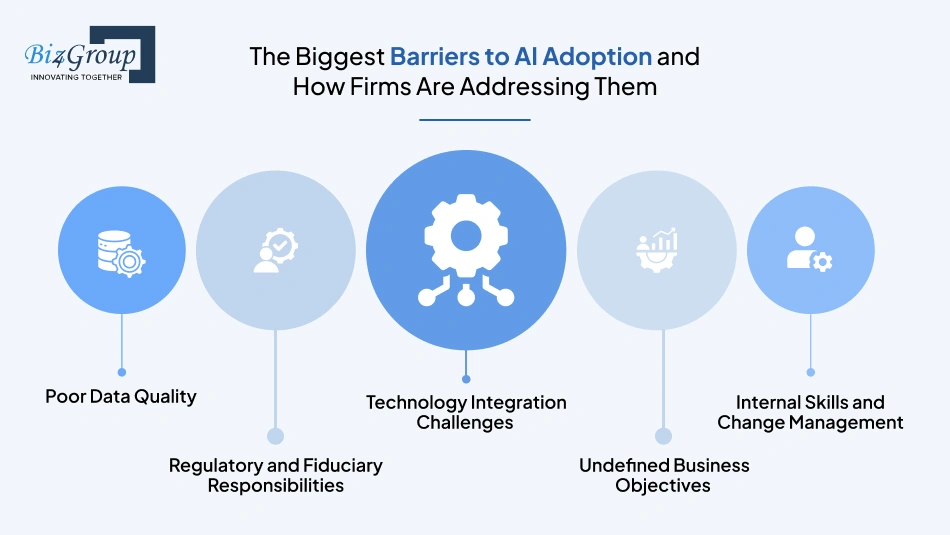
|
Challenge |
Why It Creates Problems |
How Leading Firms Respond |
|---|---|---|
|
Poor Data Quality |
AI models cannot generate reliable recommendations from incomplete, outdated, or inconsistent client information. Data gaps reduce confidence in both advisors and business leaders. |
Establish standardized data governance, clean historical records, and create a single source of truth before expanding AI initiatives. |
|
Regulatory and Fiduciary Responsibilities |
Financial advisors remain responsible for every recommendation, regardless of whether AI contributed to the analysis. Firms must demonstrate transparency and maintain proper documentation. |
Keep advisors involved in final decision-making, maintain audit trails, and implement governance frameworks that clearly define when and how AI can be used. |
|
Technology Integration Challenges |
AI often needs to work alongside CRMs, portfolio management platforms, planning software, reporting tools, and document management systems. Disconnected implementations reduce efficiency instead of improving it. |
Build AI around existing technology investments through scalable enterprise AI solutions that connect business systems rather than replacing them. |
|
Undefined Business Objectives |
Many organizations begin with AI because of industry pressure instead of identifying measurable business problems. This often leads to scattered projects with limited business value. |
Prioritize specific business outcomes such as improving advisor productivity, reducing report preparation time, or accelerating onboarding before expanding implementation. |
|
Internal Skills and Change Management |
Financial expertise does not automatically translate into AI implementation expertise. Teams may also hesitate to adopt unfamiliar technologies without proper guidance. |
Combine internal domain knowledge with experienced AI product development services providers while investing in advisor education and structured adoption plans. |
The common theme across these challenges is simple. AI projects succeed when business strategy drives technology decisions, not the other way around.
One area that receives less attention is AI governance.
As firms introduce AI into investment research, financial planning, and internal operations, leadership teams need clear policies around accountability, data usage, model validation, and human review. Without those guardrails, even technically successful implementations can introduce unnecessary business risk.
A practical governance framework should answer questions such as:
Answering these questions early reduces uncertainty later and creates greater confidence across advisory, compliance, and executive teams.
Another factor that slows adoption is budgeting.
Many firms underestimate the resources required for data preparation, integration, testing, security reviews, employee training, and ongoing optimization. As a result, projects often exceed initial expectations, even when the underlying technology performs well.
Rather than asking, "How much does an AI platform cost?", firms benefit more from asking:
Organizations evaluating these questions often explore the cost to develop an AI wealth management software before defining project scope, timelines, and long-term investment plans.
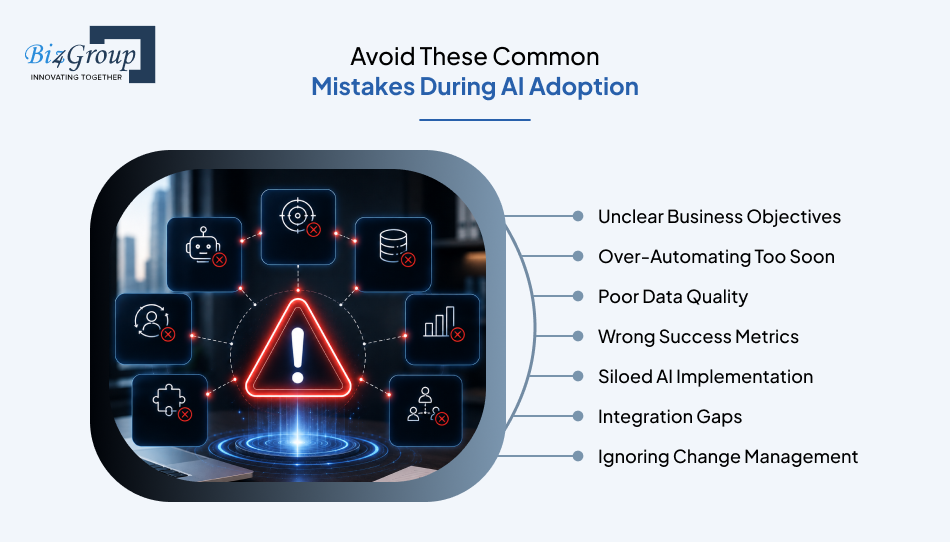
Many implementation setbacks are avoidable.
The following mistakes appear repeatedly across wealth management organizations beginning their AI journey.
Avoiding these mistakes helps organizations move from experimentation to sustainable adoption with fewer delays and lower implementation risk.
Successful firms rarely implement AI across every department at the same time.
Instead, they begin with a clearly defined business objective, measure outcomes, improve governance, and expand gradually as confidence grows. This approach reduces operational disruption while creating a stronger foundation for future innovation.
As the broader fintech in wealth management ecosystem continues to evolve, firms that combine responsible governance, measurable business goals, and well-planned implementation strategies are more likely to achieve lasting results than those pursuing technology without a clear roadmap.
Also read: Top 10 AI wealth management software development companies for financial advisors in USA
A quick conversation can help you identify the right starting point
Call an AI ExpertEvery wealth management firm has its own way of serving clients, managing portfolios, and delivering financial advice. That is why successful AI adoption rarely begins with technology alone. It begins with understanding existing workflows, identifying operational bottlenecks, and building solutions that advisors are willing to use every day.
This approach has shaped how Biz4Group LLC, a reliable AI development company, works with financial services organizations. Instead of forcing firms to adapt to generic software, the focus remains on building solutions around real advisory processes, client journeys, and business goals.
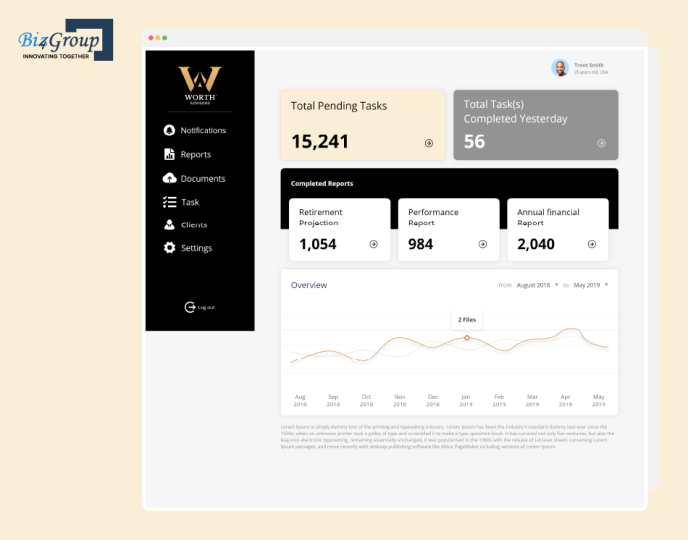
One example is Worth Advisors, a financial planning and client management platform built to simplify how advisors collect client information, prepare financial plans, and manage ongoing engagement.
|
Business Challenge |
Solution Delivered |
Business Outcome |
|---|---|---|
|
Collecting complete financial information from clients |
Built a guided onboarding experience with 14 structured questionnaires, secure document uploads, and built-in validation. |
68% faster client onboarding with fewer incomplete submissions. |
|
Preparing personalized financial plans |
Developed a modular reporting engine capable of generating five report types using up to 37 configurable report modules. |
2.4× faster report generation with consistent formatting. |
|
Working with disconnected financial data |
Integrated the platform with Redtail CRM and Intelliflo to synchronize client records, holdings, and portfolio performance. |
34% fewer data synchronization errors, reducing manual verification. |
|
Reducing operational effort |
Unified reporting, task management, notifications, and document handling within a single advisor workspace. |
55% less time spent on manual coordination and follow-ups. |
The impact was measurable across both advisor productivity and client experience. Guided questionnaires and built-in validation helped clients complete onboarding 68% faster, while automated workflows reduced manual follow-ups and coordination by 55%, giving advisors more time for financial planning. These improvements created a smoother experience for clients and a more efficient workflow for advisory teams.
The project's impact was best summarized by the client after months of working together.
"It's hard to believe it's been over 6 months, and we've accomplished so much. We ran into some intricacies and difficulties, but ultimately, the Biz4Group team have been troopers and helped us figure this out. We are creating a world-class solution!"
Charles Horton, Family Office Director, Worth Advisors
Projects like Worth Advisors demonstrate that successful AI initiatives are built around business outcomes, not technology trends. That philosophy continues to guide every engagement delivered by Biz4Group, whether it involves modernizing advisory platforms, developing intelligent financial products, or building custom solutions for regulated industries.
Businesses planning their next digital initiative often start by working with an experienced fintech software development company that understands both financial services and enterprise technology. As product requirements become clearer, many also choose to hire AI developers with hands-on experience building secure, scalable platforms for complex business environments.
A well-planned AI initiative starts with the right business problem. Everything else becomes much easier to solve.
The role of AI in wealth management has moved far beyond improving operational efficiency. It is helping firms make better use of data, strengthen financial planning, support informed investment decisions, and deliver more personalized experiences without losing the human connection that defines great advisory relationships. As client expectations continue to rise, firms that thoughtfully embrace artificial intelligence in wealth management will be better equipped to deliver consistent value while adapting to an increasingly digital financial landscape.
At the same time, successful AI adoption depends on more than selecting the latest technology. It requires clear business objectives, reliable data, responsible governance, and solutions that fit naturally into existing advisory workflows. Organizations exploring wealth management AI should focus on solving meaningful business challenges first, allowing technology to support advisors instead of adding unnecessary complexity. That approach creates stronger foundations for long-term growth and answers the broader question of how AI will change wealth management in the years ahead.
At Biz4Group LLC, we've seen firsthand how the right approach can turn complex advisory processes into intuitive digital experiences. From building platforms like Worth Advisors to developing secure AI-powered financial solutions for modern enterprises, our focus has always been on creating technology that delivers measurable business outcomes while keeping advisors and clients at the center of the experience.
If you're planning the next chapter of your wealth management business, now is the right time to start the conversation. The firms leading tomorrow's market are already building the capabilities they know they'll need today.
AI improves portfolio management by continuously analyzing market movements, economic indicators, portfolio performance, and client objectives. This helps advisors identify emerging risks and investment opportunities more quickly while keeping portfolios aligned with changing financial goals. Human advisors continue to make the final investment decisions, using AI-generated insights as decision support rather than automatic recommendations.
Yes. AI is no longer limited to large financial institutions with extensive technology budgets. Small and mid-sized firms can use AI to streamline research, simplify document processing, improve client communication, and organize financial planning workflows. Starting with one well-defined business objective often delivers better long-term results than attempting a large-scale implementation from the beginning.
High-net-worth clients typically require more personalized financial planning across investments, tax strategies, estate planning, retirement, and wealth preservation. AI helps advisors organize complex financial information, identify relevant planning opportunities, and prepare recommendations more efficiently, allowing more time for strategic discussions with clients.
An effective AI platform should integrate with existing business systems, maintain strong data security, support regulatory requirements, and fit naturally into advisor workflows. Firms should also evaluate scalability, customization, reporting capabilities, and the vendor's experience in building financial technology solutions before making an investment.
Success should be measured through business outcomes rather than technology usage alone. Firms often track improvements in advisor productivity, onboarding efficiency, report preparation time, client satisfaction, operational accuracy, and overall business performance to evaluate whether AI is delivering measurable value.
Yes. AI can process structured and unstructured financial information at a much larger scale than manual analysis. By identifying market patterns, economic signals, and portfolio trends earlier, it helps advisors recognize opportunities that deserve closer evaluation. Professional judgment remains essential before any investment recommendation is presented to clients.
Preparation begins with improving data quality, reviewing existing software infrastructure, and identifying processes that would benefit most from AI support. Firms should also establish governance policies, define measurable business objectives, and ensure internal teams are prepared before introducing AI into day-to-day operations.

Our website require some cookies to function properly. Read our privacy policy to know more.