 Location :
Orlando, FL, USA
Location :
Orlando, FL, USA +1 (407) 714-1616
 info@biz4group.com

 AI Summary Powered by Biz4AI
- Sports betting picks app development can turn an established Telegram or Discord community into a dedicated product for picks, subscribers, tipsters, and premium content.
- Telegram to app migration for communities works best when existing audiences, content, subscriptions, and community structures are mapped into the right app experiences.
- A Discord community monetization app can support subscription tiers, premium picks, tipster memberships, affiliate revenue, and other monetization models.
- A successful betting tipster app can bring together picks feeds, tipster profiles, performance history, premium content, push notifications, sports data, and community features.
- A typical sports betting picks app can cost around $20,000-$150,000+, depending on the product scope, integrations, platforms, and level of customization.
- Biz4Group LLC brings relevant experience across sports prediction and community-focused products, with projects such as PredictEX, Handshake, and All Chalk demonstrating its capabilities in sports data, predictions, interaction, and engagement.
What happens when your best betting picks are sitting inside someone else’s platform?
You may have thousands of followers on Telegram or Discord, a loyal group of paying subscribers, and a steady stream of sports picks. But your entire product experience still lives inside a third-party community. That is why sports betting picks app development is becoming an interesting next step for tipsters and community owners who want more control over their audience, content, subscriptions, and brand.
Telegram passed 1 billion monthly active users in 2025, while Time Magazine reported that Discord now has more than 200 million monthly active users. These platforms clearly have enormous reach. The question is what happens when a betting community needs a product built specifically around picks, subscribers, tipsters, alerts, and paid content.
That is where an owned app enters the picture.
If you have ever wondered, “How do I turn my Telegram betting picks group into an app?”, the answer involves much more than copying messages into a mobile interface. A proper Telegram to app migration for communities can turn scattered conversations into organized pick feeds, subscriber accounts, tipster profiles, performance history, push alerts, and paid access.
The same idea applies to Discord communities. A Discord community monetization app can give creators a dedicated product experience while keeping the community and content they have already built at the center.
This guide breaks down how that transition works, which features matter, how subscriptions can be structured, and how to build a subscription app for sports predictions without losing the audience that made the community valuable in the first place.
Why Are Betting Communities Moving to Sports Betting Picks Apps?
Betting communities are moving toward dedicated apps as their content, subscriber base, and business models become more complex. Telegram and Discord remain useful for community interaction, but a growing picks business can run into practical limits when everything depends on a chat feed.
The problems usually show up gradually.
A few hundred members may be easy to manage. Add several tipsters, multiple sports, premium subscribers, daily picks, results, and constant discussion, and finding one important pick can start feeling like detective work.
The Community Has Outgrown the Chat Feed
Telegram and Discord are built around conversations. Betting picks businesses often need information to be easier to scan, sort, and revisit.
A subscriber may want to find:
- Today's picks
- Picks from a specific tipster
- Previous results
- Premium selections
- Upcoming games
- Pick performance
- Subscription details
In a busy channel, these items can end up scattered across messages, threads, pinned posts, or separate groups.
That becomes especially noticeable when subscribers are checking picks quickly before a game starts.
A dedicated sports picks product can organize information around those specific actions. The subscriber sees the content in a format designed for picking, tracking, and returning to selections.
Growing Pick Volume Creates a Discovery Problem
More content sounds like a good problem to have. It can also create a messy feed.
Consider a community posting 20 picks across football, basketball, baseball, and soccer in one day. Add reactions, questions, announcements, promotional posts, and member conversations.
A pick posted at noon may be several screens deep by 2 PM.
That creates a simple usability issue.
Can a subscriber find the pick they need in a few seconds?
A dedicated picks feed can separate selections by sport, event, tipster, date, or status. Users can then move through the information without digging through a conversation history.
The same principle can support social features too. Products focused on social sports betting can bring predictions, schedules, leaderboards, reminders, and community interaction into a more structured experience.
Also read: How to develop a social sports betting community app?
Premium Content Gets Harder to Organize
A private Telegram channel or Discord role can work well when the offering is simple.
Pay → get access → receive picks.
The model becomes more complicated when a creator introduces different membership levels, multiple tipsters, premium reports, or sport-specific subscriptions.
For example:
|
Subscription Model |
What the Subscriber May Receive |
|---|---|
|
Free |
Public picks and community updates |
|
Basic |
Selected premium picks |
|
Pro |
Full premium picks and reports |
|
Tipster-specific |
Picks from one selected expert |
|
VIP |
Premium content plus exclusive community access |
Managing these options through separate channels or roles can become cumbersome for both subscribers and administrators.
A dedicated product can present each membership clearly, so users know what they have access to and what sits behind another subscription tier.
Pick History Becomes Valuable Over Time
A conversation feed is useful for delivering a pick. It is less convenient for building a clean historical record.
Imagine a subscriber asking:
“How did this tipster perform over the last 30 days?”
Finding the answer manually across hundreds of messages is not exactly a five-second task.
A structured pick database can make historical information easier to organize by:
- Tipster
- Sport
- League
- Date
- Pick type
- Result
- Performance period
This also gives subscribers a more consistent way to review past selections.
For a tipster business, that history can become part of the product experience instead of disappearing into an ever-growing chat archive.
Community Activity Does Not Equal Product Insight
A busy Discord server or Telegram channel can tell a creator that people are talking. It may not answer more specific product questions.
Which premium plan gets the most attention? Which tipsters attract subscribers? Where do users abandon registration? How often do subscribers return? Which alerts lead people back into the product?
These questions require product-level analytics.
An app can be designed to capture relevant events across the subscriber journey. That gives community owners clearer data for decisions around content, subscriptions, onboarding, and engagement.
The Shift Usually Starts with a Business Model
There is rarely one dramatic moment when a community owner says, “We need an app.” The trigger is often a combination of smaller problems.
More subscribers. More content. More tipsters. More subscription options. More things to manage.
At that point, the community has started behaving like a product business.
That is where a dedicated app can make sense. The next question is not whether Telegram or Discord should disappear. It is how their existing community model compares with an app built specifically for sports picks.
Telegram vs Discord vs an Owned Sports Betting Picks App
Telegram and Discord are both capable community platforms, while an owned app gives a betting picks business a product built around its own audience and content model. The right choice depends on what the community needs to accomplish.
The useful comparison is not “Which platform is better?” It is “What job does each platform perform for a betting picks business?”
|
Factor |
Telegram |
Discord |
Owned Sports Picks App |
|---|---|---|---|
|
Primary strength |
Fast broadcast and community communication |
Organized communities and interaction |
Purpose-built betting picks experience |
|
Audience access |
Telegram account |
Discord account |
App account |
|
Branding |
Channel and group branding |
Server and community branding |
Fully branded product experience |
|
Pick organization |
Channels, posts, pins |
Channels, threads, roles |
Dedicated feeds, filters, categories |
|
Tipster discovery |
Channels and messages |
Channels, profiles, roles |
Dedicated tipster profiles |
|
Pick history |
Message-based |
Message and thread-based |
Structured records |
|
Premium access |
Groups and channels |
Roles and paid access |
Subscription-controlled content |
|
Notifications |
Telegram alerts |
Discord notifications |
App-specific push alerts |
|
Community interaction |
Groups and channels |
Strong server-based interaction |
Custom community features |
|
Product analytics |
Platform-dependent |
Platform-dependent |
Custom event tracking |
|
Subscription journey |
Community-centered |
Community-centered |
Product-centered |
|
Product roadmap |
Follows platform capabilities |
Follows platform capabilities |
Controlled by the product owner |
The differences become clearer when we look at what each option is good at.
Telegram Works Well for Fast Distribution
Telegram is particularly useful when speed matters.
A tipster can publish a pick to a large audience, members can receive notifications, and the conversation can continue around the post.
It suits businesses where the core workflow looks something like this:
Create pick → broadcast → discuss → repeat.
For a growing operation, however, the channel can become the delivery mechanism without becoming the complete product.
Discord Works Well for Layered Communities
Discord takes a more structured approach to community interaction.
Servers can contain different channels, roles, permissions, and subscriber groups. Its monetization tools also allow eligible communities to offer paid subscription tiers and exclusive content.
That makes Discord useful when a betting community has several layers of interaction.
For example:
- Free discussion
- Premium picks
- Sport-specific channels
- Tipster communities
- Member discussions
- Announcements
- Private subscriber areas
Discord can therefore support a fairly sophisticated community model before a custom product becomes necessary.
An Owned App Changes the Product Model
An owned app takes a different route.
Instead of adapting betting content to a general-purpose community environment, the product can be designed around the subscriber's actual workflow.
A user might open the app and immediately see:
Today's Picks → Select Sport → Choose Tipster → Review Pick → Track Result
That journey can be expanded with subscription management, historical records, personalized feeds, alerts, and other product-specific experiences.
The distinction is important for sports betting picks app development. The goal is not to recreate every Telegram or Discord feature inside another interface. It is to decide which parts of the existing community model are worth turning into product functionality.
What Can Stay the Same?
Moving toward an app does not mean throwing away everything that already works.
The following can remain central to the business:
- Community identity
- Tipster relationships
- Existing sports coverage
- Pick methodology
- Brand voice
- Content formats
- Subscriber expectations
- Audience relationships
The product layer changes. The underlying business does not need to be reinvented.
What Changes After Moving to an App?
The biggest change is the way users interact with the content.
|
Existing Community Model |
App-Based Model |
|---|---|
|
User joins a channel or server |
User creates an account |
|
Pick appears in a conversation |
Pick appears in a structured feed |
|
Premium access uses groups or roles |
Premium access uses subscription entitlements |
|
Tipster content lives in posts |
Tipsters have dedicated profiles |
|
Results remain within conversations |
Results can be stored as structured records |
|
Notifications follow platform behavior |
Alerts can be designed around app events |
|
Community structure follows platform tools |
Product structure follows business requirements |
This is also where an app can support a more focused community-based subscription product. The experience can be designed around the actions that matter to paying members, instead of asking them to navigate a general-purpose communication platform.
For businesses considering a broader sports betting app development strategy, this distinction also helps define scope early.
A picks app does not need to become a full sportsbook with wagering, odds management, or a betting engine. It can remain focused on what the audience came for.
Good picks. Clear information. Useful alerts. A smoother subscriber experience.
And that brings us to the more difficult part.
How do you actually move an established Telegram or Discord community into that new environment without making subscribers feel like they have been handed a completely different product?
That is where the migration strategy begins.
How to Migrate a Telegram or Discord Betting Community to an App?
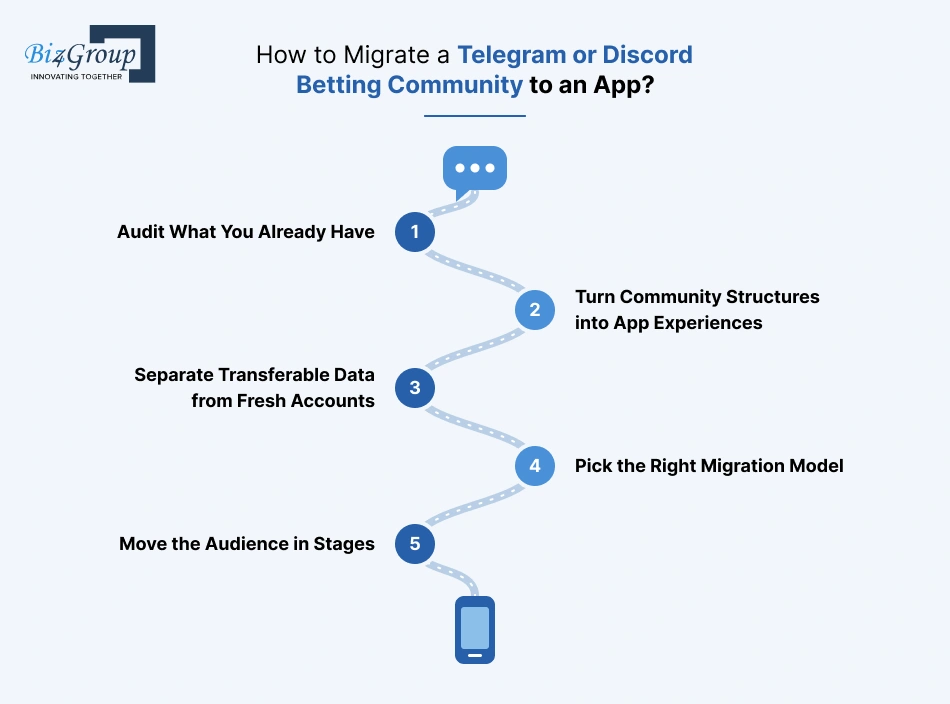
A successful migration starts by deciding what needs to move and what needs to be rebuilt. Users, content, subscriptions, historical picks, and community roles do not all follow the same migration path.
In fact, a Telegram or Discord community cannot be treated like a folder that gets dragged into a new app.
Here is a practical migration structure.
1. Audit What You Already Have
Start with the community, not the app.
Map out:
- Active and inactive members
- Free and paid groups
- Tipsters and administrators
- Sports and leagues covered
- Pick formats
- Historical records
- Subscription plans
- Community rules
- Existing content assets
This gives the development team a migration inventory before any product decisions are made.
2. Turn Community Structures into App Experiences
The next step is mapping familiar community elements to their new destinations.
|
Telegram or Discord |
App Equivalent |
|---|---|
|
VIP channel |
Premium subscription |
|
Pinned picks |
Pick library |
|
Tipster posts |
Tipster profile |
|
Announcements |
Push notifications |
|
Sport-specific channel |
Sport category |
|
Member discussion |
In-app community |
|
Roles |
Access permissions |
|
Pick archives |
Structured pick history |
This is where Telegram to app migration for communities becomes a product exercise instead of a simple data transfer.
3. Separate Transferable Data from Fresh Accounts
This is an important technical and privacy consideration. Do not assume every member, message, role, or subscription can be transferred directly.
Telegram provides official data export capabilities for messages and media, while its API documentation also outlines specific requirements around imported chat history. Discord has also tightened access requirements for server data in 2026, including additional protections around member information and message content.
So the migration plan may involve:
- Exporting eligible content
- Cleaning and restructuring historical picks
- Rebuilding subscriber records
- Asking users to create app accounts
- Re-establishing subscription access
- Obtaining fresh consent where required
That distinction is one reason experienced teams such as Biz4Group LLC approaches community migrations as product and data projects, not simple platform conversions.
4. Pick the Right Migration Model
There are three practical routes.
Full Migration The app becomes the primary destination, while Telegram or Discord is gradually phased down.
Hybrid Migration The app handles premium content and core product experiences while the existing community remains active for discussion.
App-First Distribution The app becomes the main product, while Telegram and Discord continue serving as acquisition and communication channels.
For many established communities, the hybrid route can provide a smoother transition because subscribers get time to build new habits without losing the community they already recognize.
A migration strategy can also be informed by the broader considerations involved in white-label to custom sports betting platform development, particularly when an existing product needs to evolve into a more customized platform.
5. Move the Audience in Stages
Now comes the part every community owner worries about... “How do I move my audience without losing them?”
Do not switch everything overnight.
A staged rollout can look like this:
- Announce the upcoming app
- Invite selected members into early access
- Test onboarding and subscriptions
- Introduce app-exclusive picks or features
- Keep Telegram or Discord active during the transition
- Move more premium activity into the app
- Track adoption before reducing reliance on the old community
A useful launch checklist should also account for the broader challenges in modern sports betting app development, especially around data, user experience, security, and platform requirements.
The goal is not to make subscribers feel like they have been relocated. It is to make the new app feel like the natural next home for a community they already value.
Your Community Is Ready. Is Your App?
Your Telegram or Discord audience already exists. Give them a product built around what they actually came for.
Plan My App MigrationWhat Features Does a Betting Tipster App Need?
A betting tipster app needs features that make picks easy to discover, understand, track, and access based on a user's subscription. The product should serve the tipster's workflow as well as the subscriber's daily routine.
|
Feature |
What It Does |
Why It Matters |
|---|---|---|
|
Picks Feed |
Displays current picks by sport, event, or tipster |
Gives subscribers one clear place to find selections |
|
Tipster Profiles |
Shows individual tipsters, specialties, and published picks |
Helps users discover and follow preferred experts |
|
Pick History & Performance |
Records previous selections and outcomes |
Makes historical performance easier to review |
|
Premium Picks |
Restricts selected picks to eligible subscribers |
Supports paid membership models |
|
Subscriber-Only Content |
Delivers exclusive reports, analysis, or updates |
Adds value to premium tiers |
|
Push Notifications |
Alerts users about new picks, updates, or important game events |
Helps subscribers act on time-sensitive content |
|
Community Interaction |
Enables comments, discussions, reactions, or direct interactions |
Keeps the social element of the original community alive |
|
Tipster/Admin Dashboard |
Lets authorized users publish picks and manage content |
Gives operators a central control point |
|
Sports Data Integration |
Brings schedules, scores, and relevant sports information into the product |
Keeps picks connected to current event data |
For betting tipster app development, the key is keeping these features connected. A subscriber should be able to discover a tipster, view a pick, check relevant information, receive an update, and review the result without bouncing between unrelated screens.
Handshake Shows What Community-First Sports Apps Can Do
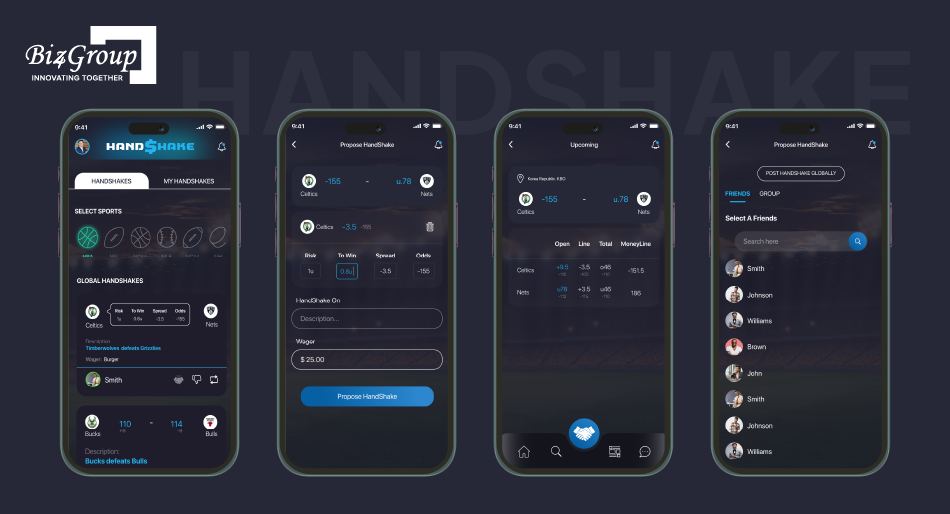
Handshake demonstrates Biz4Group's ability to combine real-time sports data with social interaction inside a single mobile experience. The platform was built around live game scores, upcoming schedules, push notifications, one-on-one and group chat, and friendly betting across sports including NFL, NBA, NHL, and PGA.
What makes the project particularly relevant here is the way those capabilities work together. Real-time sports information feeds the experience, while chat and notifications keep users connected to what is happening around the event. Biz4Group also developed reusable technical components and modules for the platform, helping support scalability and reduce development effort.
For a community owner exploring a sports betting picks app, that combination offers a useful reference point. The app does not have to feel like a repackaged chat channel. It can bring sports content, interaction, alerts, and user activity into one purpose-built experience.
What Technologies Are Needed to Build a Sports Betting Picks App?
A sports betting picks app needs a focused technology foundation for accounts, subscriptions, picks, sports data, payments, notifications, community activity, and analytics. The stack should support the product's actual workload without turning a picks platform into a full sportsbook architecture.
|
Technology Layer |
What It Handles |
Typical Options |
|---|---|---|
|
User & Subscription Management |
Accounts, profiles, membership access, and subscription status |
Firebase Auth, OAuth 2.0, JWT |
|
Picks & Content Management |
Picks, tipster content, results, categories, and publishing |
Node.js, Python, PostgreSQL, MongoDB |
|
Sports Data APIs |
Fixtures, scores, schedules, and relevant sports data |
Sportradar, Genius Sports, SportsDataIO |
|
Payment Integration |
Subscription payments and recurring billing |
Stripe, PayPal, Apple/Google payment systems |
|
Push Notifications |
Pick alerts, game reminders, and subscriber updates |
Firebase Cloud Messaging, OneSignal |
|
Community Layer |
Comments, discussions, messaging, and activity feeds |
WebSockets, Socket.IO, Firebase |
|
Analytics |
User behavior, subscription activity, content performance, and engagement |
Mixpanel, Amplitude, Google Analytics |
|
Cloud Infrastructure |
Hosting, databases, storage, scaling, and service availability |
AWS, Microsoft Azure, Google Cloud |
The exact combination can vary by product scope. For a paid community app builder for sports betting, the priority should be a modular setup that can support subscriptions and community activity today while leaving room for additional sports, tipsters, and users later.
Reliable data deserves particular attention. Sports data APIs sit at the center of many real-time experiences, and using multiple providers can help businesses address availability and data consistency requirements. Multiple sports data providers can also be evaluated based on coverage, latency, reliability, and the specific sports the app supports.
The architecture should serve the picks business.
No betting engine. No unnecessary sportsbook machinery. Just the systems needed to deliver a fast, structured, subscription-based sports picks experience.
Also read: Why enterprise sports data APIs like Sportradar matter more than features?
Are Sports Betting Picks Apps Legal? Compliance Rules to Know
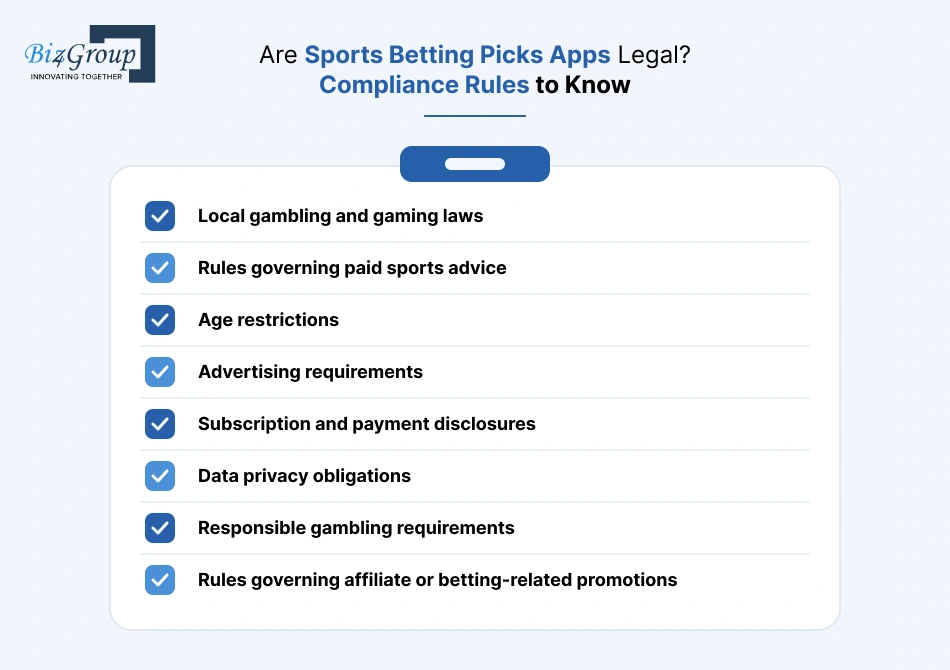
A paid sports betting picks app can be legal in one jurisdiction and restricted or prohibited in another. The key distinction is what the app actually does. Providing sports predictions and analysis is different from operating a platform that accepts wagers, and the applicable rules can change based on the jurisdiction, business model, and marketing practices.
For US businesses, this matters because sports betting regulation is largely handled at the state level. As of 2026, states differ on where and how online sports wagering can operate.
Also read: Sports betting regulations across US states
Sports Picks Are Not Automatically a Sportsbook
A sports betting picks app may sell access to predictions, analysis, tipster content, or other sports information without accepting wagers.
A sportsbook performs a different function by facilitating bets.
That distinction should be established before development begins. A product team working on compliance requirements for paid sports betting advice apps should review the intended functionality and target markets with qualified legal counsel before defining the final product scope.
Check Legality Market by Market
There is no universal rule that makes a paid betting picks app legal everywhere.
Before launching, review:
- Local gambling and gaming laws
- Rules governing paid sports advice
- Age restrictions
- Advertising requirements
- Subscription and payment disclosures
- Data privacy obligations
- Responsible gambling requirements
- Rules governing affiliate or betting-related promotions
Be Careful with Performance Claims
Marketing can create its own compliance exposure.
If an app promotes tipsters using claims about win rates, profits, historical performance, or expected results, those claims should be accurate and supportable. The FTC states that advertising claims must be truthful, non-deceptive, and backed by evidence.
That makes transparent pick records and clearly presented performance data especially important.
Biz4Group can factor these requirements into the product planning process, helping teams distinguish the product rules that need legal review from the technical requirements that need to be built into the app.
The Bottom Line
Before asking, “Can I build a subscription app for sports predictions?”, ask a more useful question... “Where will this app operate, and exactly what will it allow users to do?”
That answer determines which legal and compliance requirements need to be addressed before launch.
What Is the Development Process for a Sports Betting Picks App?
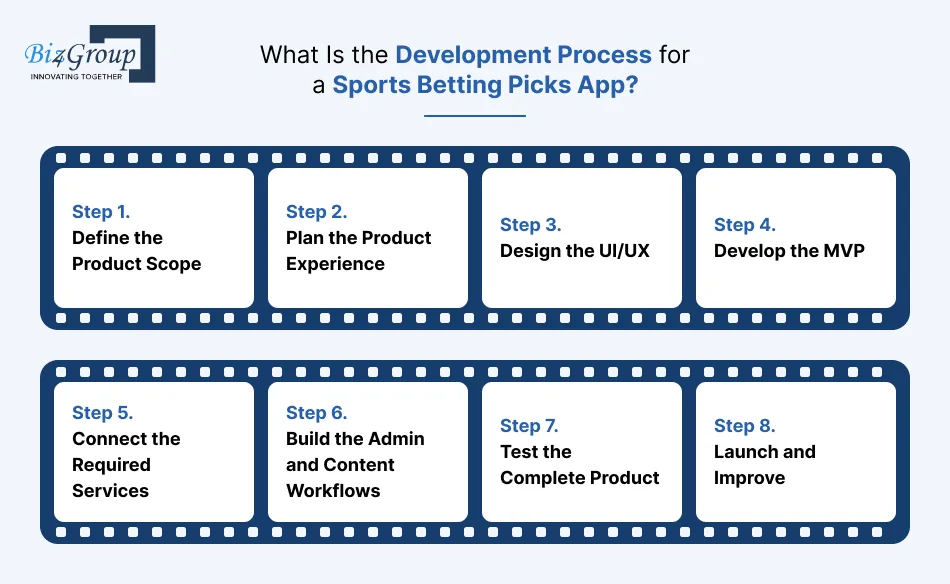
Building a sports betting picks app works best as a phased process. Each stage has a specific job, from defining the product scope to validating the MVP and preparing the release.
Step 1. Define the Product Scope
Start by documenting the product boundaries.
Clarify:
- Target users
- Supported sports
- Revenue model
- Core user journeys
- Admin requirements
- Launch platforms
- Initial release goals
A clear scope keeps sports betting picks app development focused and gives the team measurable milestones.
Step 2. Plan the Product Experience
Turn the requirements into user flows before development begins.
Map the journeys for:
Subscriber → Discover → Subscribe → View Picks → Receive Updates
Tipster → Create Pick → Publish → Monitor Results
Admin → Manage Users → Manage Content → Review Activity
This gives designers and developers a shared blueprint before implementation starts.
Step 3. Design the UI/UX
Now turn those flows into wireframes, prototypes, and the final interface.
The focus should be clarity and speed. Subscribers should understand where to find picks, manage their membership, and review relevant information without unnecessary navigation.
A specialized UI/UX design company can help translate the product requirements into a consistent mobile experience before engineering begins.
Also read: Top 15 UI/UX design companies in USA
Step 4. Develop the MVP
The sports betting picks app MVP should contain the smallest feature set capable of serving the initial audience.
A practical first release can include:
- User accounts
- Picks feed
- Tipster profiles
- Premium access
- Subscription management
- Pick history
- Push notifications
- Basic admin controls
The purpose of MVP development services is to get a functional product into real users' hands and establish what needs to be improved next.
Also read: Top 12+ MVP development companies in USA
Step 5. Connect the Required Services
With the MVP structure in place, connect the external services required by the product.
This can include:
- Sports data APIs
- Payment services
- Subscription billing
- Push notification services
- Analytics tools
- Authentication services
The exact integrations depend on the launch scope. Keeping them modular also makes future additions easier.
Step 6. Build the Admin and Content Workflows
The product needs a practical way for the business to operate it.
Configure workflows for:
- Publishing and editing picks
- Managing tipsters
- Controlling premium content
- Managing subscribers
- Reviewing performance data
- Handling content permissions
This gives the team a working back office without adding unnecessary sportsbook administration.
Step 7. Test the Complete Product
Test the product across the journeys that matter most.
Check:
- Registration and login
- Subscription access
- Pick publishing
- Notification delivery
- Data synchronization
- Account permissions
- Payment flows
- App performance
Testing should cover both the subscriber experience and the administrative side before launch.
Step 8. Launch and Improve
Release the product to the initial audience, monitor real usage, and prioritize improvements based on what users actually do.
The first version does not need to answer every possible request.
It needs to work reliably, serve its core audience, and give the business enough evidence to decide what comes next.
Also read: How to create a sports betting app?
How Much Does Sports Betting Picks App Development Cost?
A sports betting picks app can cost around $20,000-$150,000+, depending on the product scope, number of platforms, subscription model, integrations, and scale. A simple MVP sits toward the lower end, while a multi-tipster, multi-brand platform with advanced analytics and infrastructure can move well beyond $150,000.
Here is a practical starting point.
|
Product Level |
Typical Scope |
Estimated Cost |
|---|---|---|
|
MVP |
Core picks, accounts, subscriptions, notifications, basic admin |
$20,000-$40,000+ |
|
Advanced Level |
Multiple tipsters, community features, sports data, analytics, richer subscriptions |
$50,000-$90,000+ |
|
Enterprise Level |
Multi-brand platform, advanced analytics, high scale, custom workflows, extensive integrations |
$100,000-$150,000+ |
These are estimated development ranges, not fixed quotations. Actual pricing depends on the final product requirements.
What Drives Sports Betting Picks App Development Cost?
The biggest cost differences usually come from the product's scope. Two apps can both be called a sports picks app while requiring very different levels of development work.
|
Cost Driver |
What Affects the Cost |
Estimated Cost |
|---|---|---|
|
UI/UX Design |
User flows, wireframes, prototypes, custom interface design |
$3,000-$8,000 |
|
Mobile App Development |
iOS, Android, cross-platform development, device support |
$10,000-$30,000 |
|
Backend & Database |
User accounts, picks, content, subscriptions, permissions |
$8,000-$20,000 |
|
Subscription & Payment Integration |
Recurring billing, payment flows, access control |
$3,000-$8,000 |
|
Sports Data Integration |
API integration, data mapping, schedules, scores |
$4,000-$12,000 |
|
Community Features |
Comments, discussions, messaging, activity feeds |
$4,000-$12,000 |
|
Notifications & Analytics |
Push infrastructure, event tracking, reporting |
$3,000-$8,000 |
|
Admin Dashboard |
Content, tipster, subscriber, and platform management |
$4,000-$10,000 |
|
QA & Release Preparation |
Functional testing, device testing, bug fixing, release support |
$3,000-$8,000 |
These figures are estimates for individual components. A final project quote depends on which capabilities are included, how deeply they are customized, and whether they are delivered as part of an MVP or a larger product.
For context, the economics can look very different for a full wagering product. A picks platform does not need the same architecture as a sportsbook, which is why using a generic sports betting app development cost estimate for this product can produce an inflated or misleading budget.
Hidden Costs You Should Budget For
The development quote is only one part of the financial picture.
A sports picks business should also account for recurring and post-launch expenses that may not appear in the initial build estimate.
Sports data costs can range from roughly $500-$5,000+ per month, depending on coverage, provider, usage volume, and data requirements.
Cloud hosting and infrastructure may start around $100-$1,000+ per month for an early product. Costs can increase as traffic, storage, notification volume, and backend workloads grow.
Payment processing typically adds transaction-based fees. The exact amount depends on the payment provider, transaction value, location, and payment method.
App maintenance and updates can require around $2,000-$10,000+ annually for a smaller product, with larger platforms requiring a broader maintenance budget.
Third-party services can add another $500-$5,000+ annually depending on the tools used for analytics, authentication, messaging, monitoring, email, and other services.
Taken together, these expenses can add roughly $5,000-$30,000+ during the first year, depending heavily on usage and the services selected.
These are planning estimates, not actual vendor quotes. Third-party pricing can change by provider, geography, usage, and contract.
How You Can Optimize the Development Budget
- Start with an MVP. Keep the first release around $20,000-$40,000 by launching the core subscriber and tipster journeys first.
- Choose cross-platform development. A shared codebase can reduce the initial mobile development workload when iOS and Android are both required.
- Use established payment services. Building custom payment infrastructure can add unnecessary development work and maintenance.
- Prioritize essential sports data. Start with the sports and leagues your audience actually follows before expanding API coverage.
- Phase community features. A focused comments or discussion experience can come before more complex social functionality.
- Use modular architecture. Reusable components can make future tipsters, sports, subscription tiers, and product modules easier to add.
- Separate must-have from later-stage analytics. Advanced reporting can follow once the app has enough real usage data to make those dashboards worthwhile.
The goal is to make the first release financially sensible without boxing the product into a limited future.
For a community owner, the useful question is not “How cheaply can I build the app?” It is “What is the smallest product that can prove my audience will use and pay for it?”
That answer gives the development budget a much stronger starting point.
What Could Your Community Be Worth?
A $20K MVP and a $150K+ platform are very different bets. Let’s map the build against your revenue goals before you spend a cent.
Calculate My App ROIHow Can a Sports Betting Picks App Monetize a Telegram or Discord Audience?
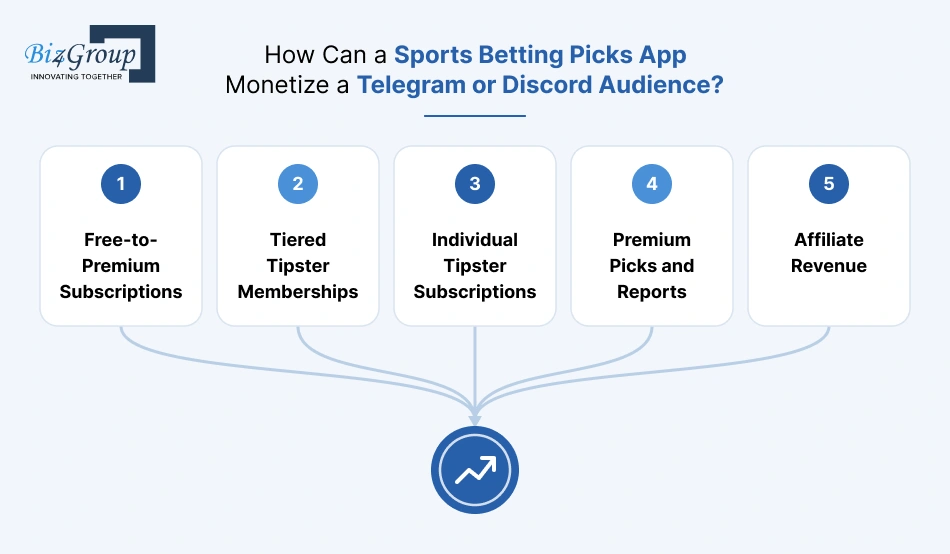
A sports betting picks app can monetize an existing community through subscriptions, premium content, tipster memberships, and affiliate partnerships. The advantage of moving these models into an app is that each revenue stream can be organized around a defined user journey.
Free-to-Premium Subscriptions
Give users a reason to enter for free, then place deeper content behind a paid membership.
A practical model could look like:
- Free for selected picks and community content
- Premium for daily or weekly premium picks
- VIP for advanced analysis and exclusive content
Subscription pricing can start around $10-$30/month, depending on the depth and frequency of the offering.
Tiered Tipster Memberships
Different tipsters can have their own subscription levels.
For example:
|
Model |
Example Offering |
Potential Pricing |
|---|---|---|
|
Basic |
Selected picks |
$10-$20/month |
|
Pro |
Full pick access |
$25-$50/month |
|
VIP |
Premium analysis and exclusive content |
$50-$100+/month |
This approach works particularly well when an app serves multiple tipsters under one platform.
Individual Tipster Subscriptions
Users can also subscribe to specific experts instead of buying access to everything.
This creates a more personalized model where a subscriber might pay $15/month for one tipster while another user chooses a $40/month specialist plan.
It can be particularly useful for a white label sports picks platform serving multiple independent betting-content brands.
Premium Picks and Reports
Not every paid product needs to be a recurring subscription. Creators can offer individual premium reports, special-event predictions, season packages, or limited-access picks.
Pricing could range from $5-$50+ per report or package, depending on the content and audience.
The important part is keeping the offer clear. Users should know exactly what they receive before paying.
Affiliate Revenue
An app can also generate revenue through relevant affiliate partnerships where legally permitted.
Potential models include:
- Referral commissions
- Sports content partnerships
- Betting-related affiliate programs
- Sponsored placements
Affiliate income varies widely by partner, market, and conversion model, so it should be treated as an additional revenue stream instead of the sole business model.
All Chalk Shows How Prediction Products Can Create Repeat Engagement
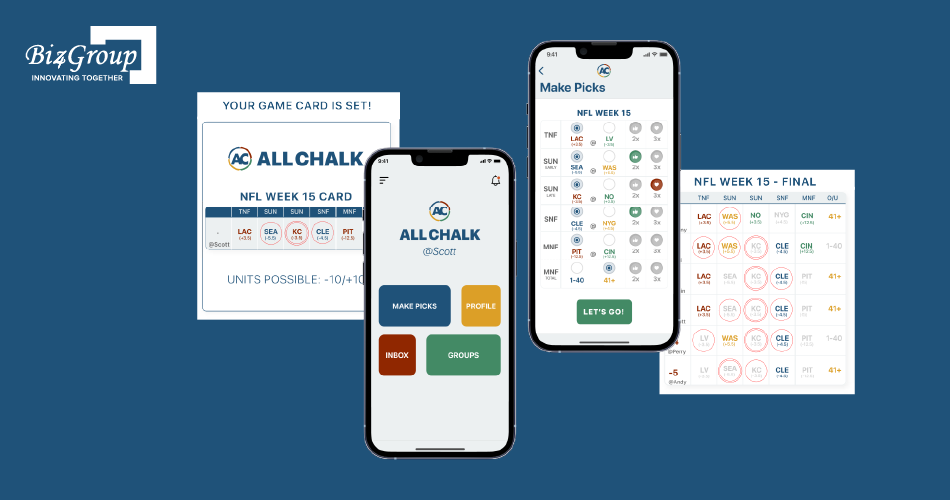
All Chalk, developed by Biz4Group, demonstrates how a sports prediction product can create recurring participation without requiring users to place real-money wagers.
The Pick'em platform combines weekly predictions with real-time leaderboards, upcoming game schedules, game reminders, and multi-sport coverage across NFL, NBA, NCAAFB, and MLB. Its leaderboard system tracks wins, losses, and net points, giving users a reason to return and check their standing.
The project also tackled real-time leaderboard activity during periods of high user participation, using PostgreSQL, Express.js, AWS, Ionic, and React.js to support the platform.
For a creator exploring Discord community monetization app models, the lesson is useful. Monetization does not have to rely on a single paid channel. The product itself can create recurring reasons for users to return, participate, and explore premium offerings.
For businesses considering multiple revenue streams, how AI sports betting apps make money provides additional context on subscription, affiliate, and other monetization structures.
How Do You Choose a Sports Betting Picks App Development Company?
Choose a development company based on its experience with sports products, real-time data, prediction workflows, user-facing experiences, and the specific business model you want to build. A strong portfolio is useful, but the more important question is whether the team has solved problems similar to yours.
Before signing a development contract, look for these signals.
|
What to Check |
Why It Matters |
|---|---|
|
Sports Industry Experience |
The team should understand sports data, prediction products, and sports-specific user behavior |
|
Relevant Portfolio |
Past work shows whether the company has handled comparable product requirements |
|
Real-Time Data Experience |
Useful when the app depends on live scores, schedules, predictions, or frequent updates |
|
Product Strategy |
The team should be able to translate a community business model into clear product requirements |
|
Scalable Architecture |
Important when the audience and content volume are expected to grow |
|
Post-Launch Support |
Sports products need ongoing maintenance as platforms, APIs, and user expectations change |
|
Clear Communication |
Transparent scope, milestones, and feedback cycles reduce surprises during development |
The distinction becomes especially important when searching for an app development company for betting picks communities. A general mobile development portfolio may show technical ability, but relevant sports experience gives you more evidence about the team's domain understanding.
PredictEX Shows Relevant Sports Prediction Expertise

PredictEX is a strong example of Biz4Group's experience with sports prediction products and real-time sports data.
Biz4Group, a sports betting app development company, developed the platform using official Sportradar data, building an AI prediction engine alongside a real-time data pipeline for scores, betting markets, and predictions. The platform was designed to support major sports leagues and a growing number of users, with an architecture built for continued expansion.
The project also produced measurable results. PredictEX increased repeat platform activity by 2.8x, and reduced live data latency by 78%.
That experience is relevant when evaluating a sports betting tipster app development company because the underlying challenge goes beyond creating mobile screens. Sports products depend on timely data, clear presentation, and infrastructure that can keep up with changing game information.
A practical final check is simple.
Ask the development company to show you the closest project it has built, explain what it actually delivered, and connect that experience to your product requirements.
That gives you something far more useful than a generic list of services when choosing a partner for sports betting picks app development.
Got Picks? Let’s Talk.
Your next subscriber could be scrolling through a chat right now. Give them a better place to find your picks.
Call Our Sports App ExpertsTo Summarize...
Telegram and Discord can be excellent places to build a betting picks community. But as the audience grows, managing picks, premium content, tipsters, subscriptions, and member experiences inside a general-purpose community platform can become harder. An owned app gives that audience a dedicated product built around how subscribers actually consume sports predictions.
A successful move does not mean abandoning the community that got you there. Sports betting picks app development can turn an established Telegram or Discord audience into a structured subscription product, with a clear path for content, tipsters, alerts, memberships, and future growth. The key is making the transition carefully and building around what your audience already values.
Biz4Group brings relevant experience across sports prediction, community, real-time data, and subscription-focused products. Projects such as PredictEX and Handshake demonstrate the team's ability to build sports experiences where data, interaction, and user engagement work together.
So, should you move your paid Telegram group to a native app? If your community is ready for its next chapter, let's build the app that gives your picks a home of their own.
Frequently Asked Questions
1. Can a sports picks app support multiple tipsters under one brand?
Yes. A single app can support multiple tipsters with individual profiles, content feeds, subscriber access, and performance pages. This model can also allow administrators to manage different contributors from one central system.
2. Can users have personalized sports picks in the same app?
Yes. Personalization can be based on selected sports, leagues, favorite tipsters, subscription levels, or user preferences. This can help reduce irrelevant content and make the app more useful for subscribers who follow specific betting categories.
3. Can a betting picks app support web and mobile users?
Yes. A product can be designed with mobile apps alongside a web interface. The choice depends on where the audience spends time and which functions need to be available across devices.
4. Can users cancel or change their subscription inside the app?
Yes. Subscription management can include plan upgrades, downgrades, cancellations, renewal information, and access status. The exact user flow depends on the payment and app distribution systems being used.
5. Can a betting picks app have separate experiences for subscribers and administrators?
Yes. Role-based access can create different interfaces and permissions for subscribers, tipsters, moderators, and administrators. This keeps operational functions separate from the customer-facing experience.
6. Can a sports picks app expand into other sports after launch?
Yes. A modular product can be structured so additional sports and leagues can be introduced as the audience grows. The expansion may require new data sources, content categories, filters, and sport-specific workflows depending on what is added.
