 Location :
Orlando, FL, USA
Location :
Orlando, FL, USA +1 (407) 714-1616
 info@biz4group.com

- Enterprise sports data APIs like SportRadar deliver reliability, accuracy, and scalability that feature rich but basic APIs cannot match during live, high traffic sports events.
- Enterprise sports data APIs like SportRadar vs basic sports APIs differ significantly in performance, compliance readiness, and long-term business impact.
- Sports data APIs like SportRadar for betting platforms enable accurate live odds, in-play wagering, and consistent user experiences.
- Scalable enterprise sports data APIs like SportRadar for fantasy sports platforms support large user bases without performance degradation.
- Sports analytics APIs like SportRadar for enterprises provide structured data for insights, predictions, and smarter decision making.
- Biz4Group LLC helps businesses design, integrate, and scale platforms powered by enterprise sports data APIs with proven execution across betting, media, and analytics solutions.
What would happen if your sports platform lost live match updates during a high-stakes game and your users abandoned your app in frustration? In a market where users expect instant updates, even a few seconds of delay can push them to uninstall and move on.
According to a recent sports technology market report, over 68% of users abandon sports and betting apps after repeated real-time data issues during live matches.
This is where enterprise sports data APIs like SportRadar start to matter far more than long feature lists. At an enterprise level, sports platforms depend on consistent, licensed, and real-time data to function smoothly across millions of users. When traffic spikes during big games, enterprise grade APIs continue delivering accurate updates while basic solutions struggle to keep up.
For operators running sportsbooks and wagering platforms, choosing the right sports data APIs like SportRadar for betting platforms has become a business decision. The global sports betting industry is projected to cross USD 221 billion in market growth by 2029, driven largely by mobile and real-time engagement.
Platforms that fail to deliver accurate live odds and updates lose users fast.
The same applies to media, fantasy sports, and analytics platforms that rely on real-time sports data APIs like SportRadar to keep users engaged minute by minute. The real question for growing sports businesses is no longer about who offers more features, but who delivers data you can trust when it matters most.
We’ll get into the details, but first off...
Why Read for 20 Minutes When You Can Get Answers on a Quick Call?
68% of users quit sports apps after repeated live data issues. Want to make sure yours is not one of them?
Get in TouchWhat Are Sports Data APIs and How Do Enterprise Sports Data APIs Like SportRadar Work?
Before discussing scale, reliability, or business impact, it helps to step back and understand what sports data APIs actually do and why enterprise versions exist in the first place.
At a basic level, sports data APIs act as the bridge between live sporting events and digital platforms. They collect data from games and deliver it in structured formats so apps, websites, and platforms can display scores, stats, odds, and insights in real-time.
That sounds simple on paper.
In practice, it rarely is.
What Data Do Sports Data APIs Provide?
Sports data APIs typically deliver a wide range of information, including:
- Live scores and match status
- Player and team statistics
- Game schedules and fixtures
- Historical performance data
- Odds and market movements for betting platforms
For casual apps or hobby projects, basic data feeds may be enough. For platforms handling real money, millions of users, or live broadcasts, the expectations are very different.
How Enterprise Sports Data APIs Like SportRadar Operate Differently
Enterprise sports data APIs like SportRadar are built to operate under pressure. They do not rely on scraped data or delayed updates. Instead, they pull information directly from official sources, stadium systems, and licensed league feeds.
Here is a simple comparison to clarify the difference.
|
Aspect |
Basic Sports APIs |
Enterprise Sports Data APIs |
|---|---|---|
|
Data source |
Aggregated or scraped |
Official and licensed |
|
Update speed |
Delayed or inconsistent |
Real-time and synchronized |
|
Scalability |
Limited |
Built for peak traffic |
|
Compliance support |
Minimal |
Market and league compliant |
|
Reliability during live events |
Unpredictable |
SLA backed performance |
This gap becomes obvious during high traffic moments like playoffs, finals, or rivalry games.
Why Real-time Delivery Matters More Than Ever
Live sports data is time sensitive by nature. A few seconds of delay can mean:
- Incorrect odds displayed to users
- Missed betting windows
- Inaccurate stats shown during broadcasts
- Loss of user confidence
Enterprise sports data APIs like SportRadar use real-time pipelines, event-driven architecture, and redundancy systems to make sure data reaches platforms instantly and consistently.
This level of reliability is the reason why leading sportsbooks, media networks, and analytics platforms avoid low cost alternatives once they start scaling.
Also read: How much does It cost to develop an AI sports betting app like Rithmm?
A Common Question from Founders and Product Leaders
If multiple APIs offer similar data, why pay for enterprise grade solutions?
Because data quality, speed, and reliability directly affect revenue, user retention, and regulatory risk. Features may look similar in demos. Performance under real world conditions rarely is.
This distinction becomes even more important when we look at the most common mistake businesses make while selecting sports data APIs, which we will cover in the next section.
Also read: Top 15 sports betting website development companies in USA
The Mistake of Choosing Sports Data APIs Based on Features Alone
On paper, many APIs look impressive.
Live scores. Player stats. Historical records. Odds feeds.
Everything appears similar during a demo.
That is where many decision makers make a costly mistake.
Feature comparisons often dominate procurement discussions. Yet feature lists rarely tell you how a platform behaves under regulatory pressure, during unexpected traffic surges, or when financial transactions depend on second level precision.
Let’s break down the most common pitfalls.
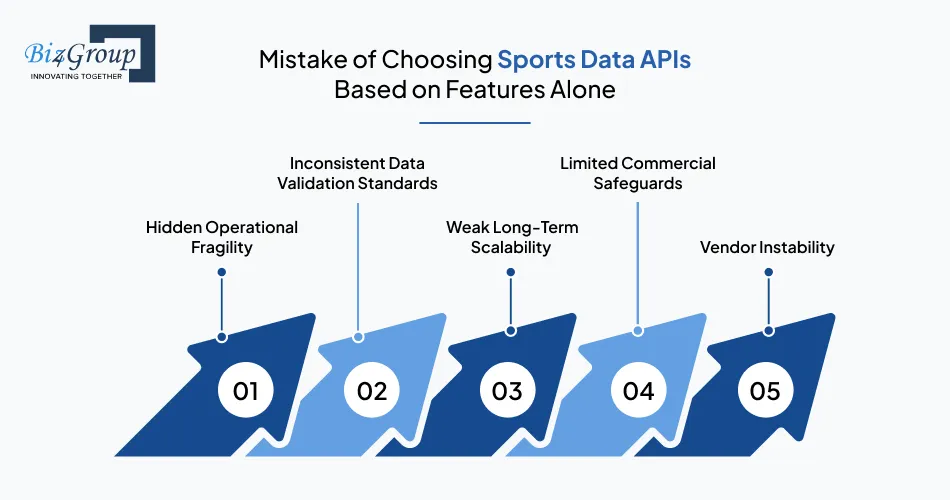
1. Hidden Operational Fragility
A feature rich API may lack enterprise grade monitoring, redundancy planning, or strict service level agreements.
Impact
- Unexpected outages during high revenue events
- Technical teams forced into emergency troubleshooting
- Loss of credibility with partners and stakeholders
2. Inconsistent Data Validation Standards
Basic APIs may not follow strict verification processes before releasing updates.
Impact
- Display of incorrect statistics or mismatched scores
- Customer complaints and refund disputes
- Increased regulatory scrutiny for betting businesses
3. Weak Long-Term Scalability
Features may look strong today, but infrastructure maturity determines future readiness.
Impact
- Platform slowdown as user base grows
- Expensive reintegration projects
- Delayed expansion into new sports or regions
4. Limited Commercial Safeguards
Enterprise sports data APIs like SportRadar often provide structured agreements, licensing clarity, and defined liability frameworks. Basic providers frequently do not.
Impact
- Legal exposure in regulated betting markets
- Contract disputes during critical incidents
- Financial penalties tied to data inaccuracies
5. Vendor Instability
Smaller or feature-driven API vendors may pivot, shut down, or change pricing structures abruptly.
Impact
- Business disruption
- Forced migration under time pressure
- Investor concern over infrastructure risk
A Quick Reality Check
When boards evaluate technology investments, they rarely ask how many fields an API offers. They ask:
- Can we rely on this partner for the next five years?
- Will this protect revenue during peak demand?
- Does this reduce operational and compliance risk?
That is why enterprise sports data APIs like SportRadar matter for betting businesses and media platforms far beyond their feature sets.
Still Choosing APIs by Feature Lists? That Is Risky!
Most platform failures start with the wrong data decision. One short call can save months of rework and lost revenue.
Book a Strategy Call TodayWhat Makes Enterprise Sports Data API Providers Like SportRadar Trusted at Scale?
Not all sports data providers operate at the same level, even when their offerings appear similar on the surface. Industry leaders earn their position through consistency, accountability, and the ability to perform when stakes are highest.
Enterprise sports data API providers like SportRadar have shaped how modern sports platforms are built by focusing on outcomes that matter to businesses, not surface level features.
Here is what separates industry standards from the rest.
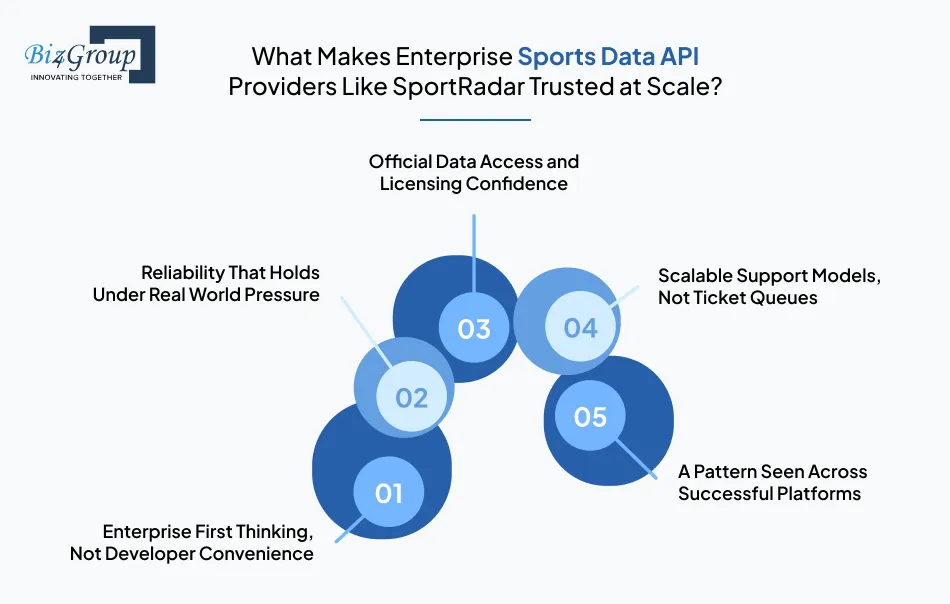
Enterprise First Thinking, Not Developer Convenience
Enterprise providers design their APIs for long-term platform stability rather than short-term integrations.
That means prioritizing:
- Predictable performance during peak events
- Data governance and audit readiness
- Clear ownership of data accuracy and delivery
Reliability That Holds Under Real World Pressure
Enterprise grade providers invest heavily in infrastructure resilience. Their systems are designed to handle millions of concurrent requests without degradation.
|
Reliability Factor |
Enterprise Providers |
Basic Providers |
|---|---|---|
|
Uptime commitment |
SLA backed |
Best effort |
|
Peak event handling |
Load tested |
Often untested |
|
Redundancy |
Multi region failover |
Limited or none |
|
Incident response |
Dedicated teams |
Reactive support |
This level of reliability directly impacts user experience and revenue. Many betting platforms fail not due to poor design, but because they underestimate how fragile real-time match accuracy can be.
Also read: Why most betting apps fail at real-time match accuracy (and how top apps fix it)?
Official Data Access and Licensing Confidence
Another defining factor is access.
Enterprise sports data API providers like SportRadar work closely with leagues, federations, and official data collectors. This ensures:
- Authorized data usage
- Reduced legal exposure
- Consistency across regions and markets
For betting and media companies, this clarity simplifies compliance discussions and speeds up market entry.
Scalable Support Models, Not Ticket Queues
When issues arise during live events, response time matters.
Enterprise providers offer:
- Dedicated account management
- Proactive monitoring
- Incident communication protocols
This transforms the provider relationship into a partnership rather than a vendor transaction.
A Pattern Seen Across Successful Platforms
Platforms that scale successfully tend to share one pattern. They invest early in dependable data foundations. They do not wait for outages, user churn, or regulatory warnings to upgrade.
That mindset is why enterprise sports data APIs like SportRadar continue to define the industry benchmark.
In the next section, we will translate these standards into direct business outcomes and measurable value.
Business Benefits of Enterprise Sports Data APIs Like SportRadar
When business leaders evaluate data infrastructure, the real question rarely revolves around how the data is delivered. The focus stays on outcomes.
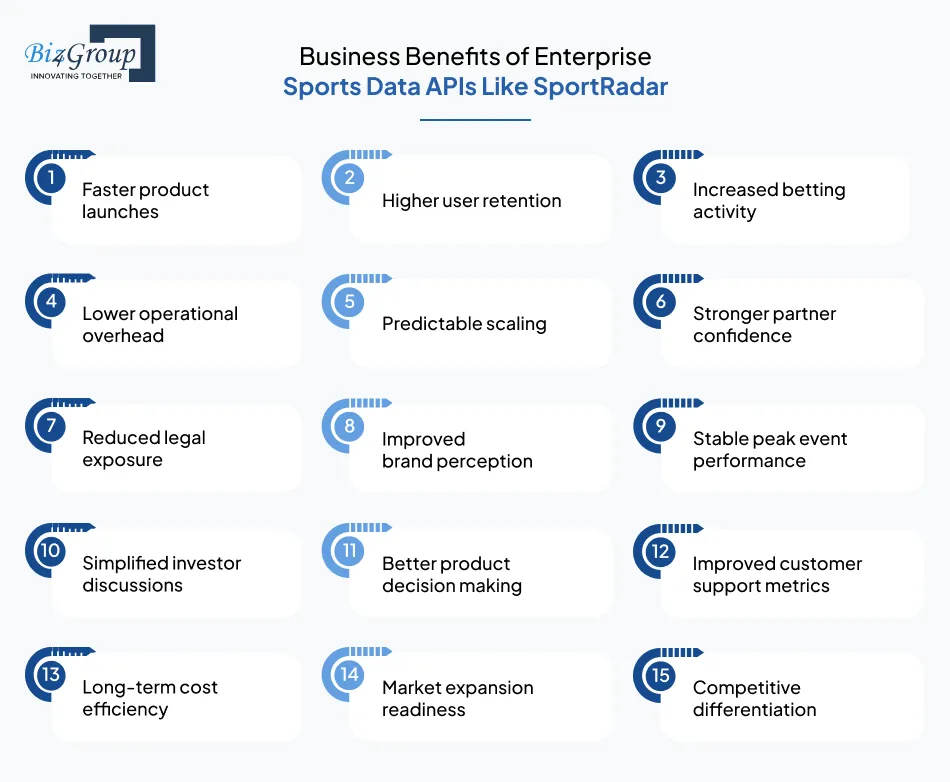
Enterprise sports data APIs like SportRadar deliver measurable business advantages that directly influence revenue, growth, and long-term stability. These benefits extend well beyond technical convenience and shape how sports platforms compete in crowded markets.
Below is a comprehensive view of the business value.
|
Business Benefit |
How It Impacts the Business |
|---|---|
|
Faster product launches |
Pre-validated data feeds reduce integration cycles and shorten time to market |
|
Higher user retention |
Consistent real-time updates keep users engaged throughout live events |
|
Increased betting activity |
Accurate live data encourages confident wagers and repeat usage |
|
Lower operational overhead |
Reduced need for manual monitoring and emergency fixes |
|
Predictable scaling |
Platforms expand to new sports or regions without architectural rework |
|
Stronger partner confidence |
Licensed data usage builds trust with leagues and commercial partners |
|
Reduced legal exposure |
Clear data rights help avoid compliance disputes |
|
Improved brand perception |
Reliable platforms earn reputations for professionalism and trust |
|
Stable peak event performance |
Revenue remains protected during high traffic games |
|
Simplified investor discussions |
Enterprise grade infrastructure signals maturity and readiness |
|
Better product decision making |
Reliable historical data supports meaningful analytics |
|
Improved customer support metrics |
Fewer data related complaints reduce support workload |
|
Long-term cost efficiency |
Lower risk of forced migrations or emergency replacements |
|
Market expansion readiness |
Data structures support multi region deployment |
|
Competitive differentiation |
Performance consistency becomes a brand advantage |
These outcomes explain why enterprise decision makers view sports data APIs as foundational business assets rather than interchangeable utilities.
In the next section, we will see how these benefits play out across real world use cases.
Also read: Top 14 sports betting software development companies in the USA
What Would Better Data Reliability Do to Your Revenue?
Platforms using enterprise grade sports data scale faster, retain users longer, and reduce operational fire drills.
Schedule a Quick Call with Biz4GroupUse Cases of Enterprise Sports Data APIs Like SportRadar Across Betting, Media, and Analytics Platforms
Enterprise sports data APIs like SportRadar power platforms that operate in high traffic, high stakes environments. The difference between an average sports app and a market leader often comes down to how data is structured, delivered, and monetized.
Below are the most relevant real world use cases.
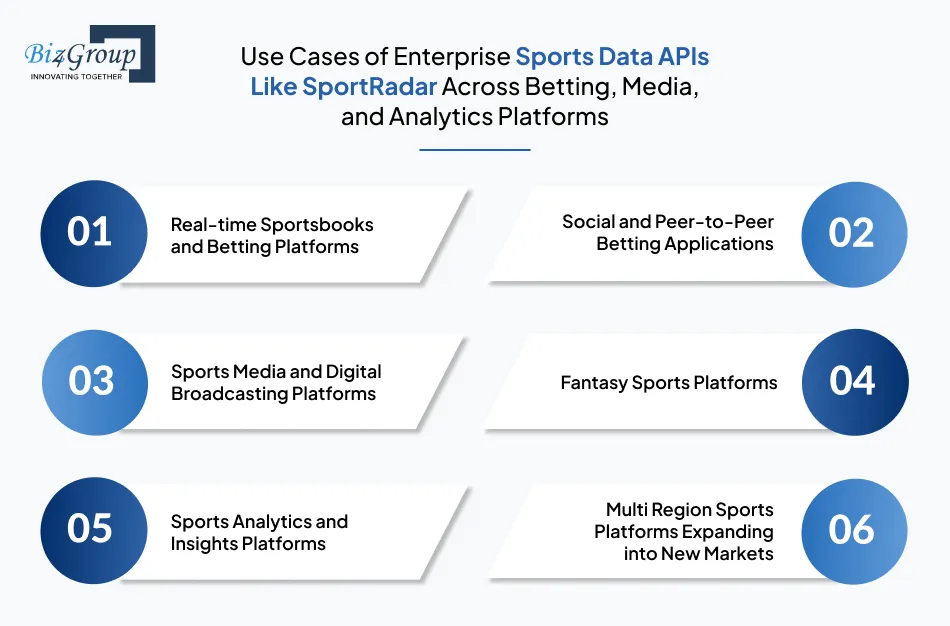
1. Real-time Sportsbooks and Betting Platforms
Sports data APIs like SportRadar for betting platforms enable live odds updates, in-play wagering, and dynamic pricing models. For sportsbooks, every second matters. Odds must adjust instantly as game conditions change.
Enterprise sports data APIs like SportRadar for real-time betting applications help operators maintain precision, reduce payout disputes, and protect revenue during peak events.
Portfolio Spotlight: Real-Time Sports Betting Platform for Major Global League Games
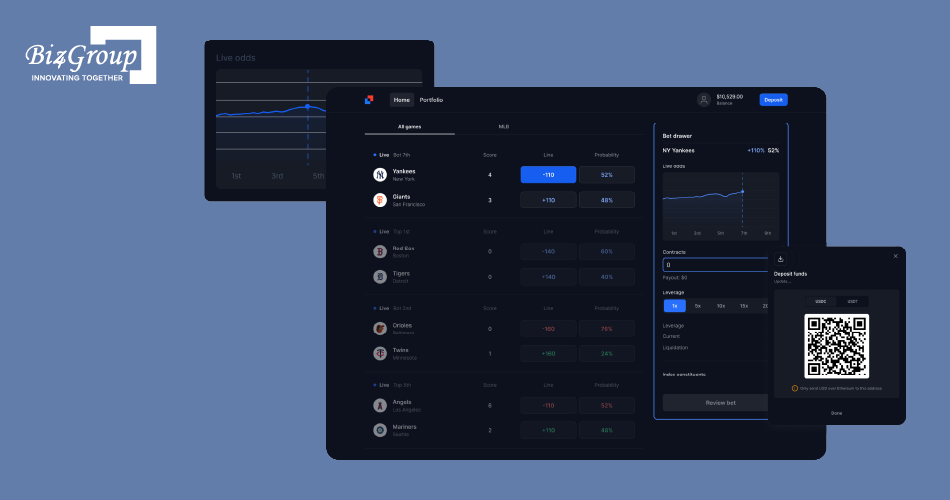
Biz4Group built a real-time global sports betting platform engineered for MLB, CFB, and NFL games.
We delivered:
- Real-time socket-based data integration
- Eight-layer scalable architecture for high traffic handling
- Dynamic market-based pricing engine
- Low latency synchronization across users
- Admin panel for operational control
The result was a betting platform built to sustain heavy usage without compromising speed or accuracy. It stands as a strong example of how enterprise sports data APIs like SportRadar for revenue driven sports platforms should be implemented in practice.
2. Social and Peer-to-Peer Betting Applications
Modern betting platforms are no longer transactional only. Social interaction drives engagement. Users expect instant score updates, real-time notifications, and seamless wager settlements.
Sports data APIs like SportRadar for betting platforms ensure live schedules, results, and alerts remain accurate within community driven betting environments.
Portfolio Spotlight: Ingenious Betting App for Sports Enthusiasts
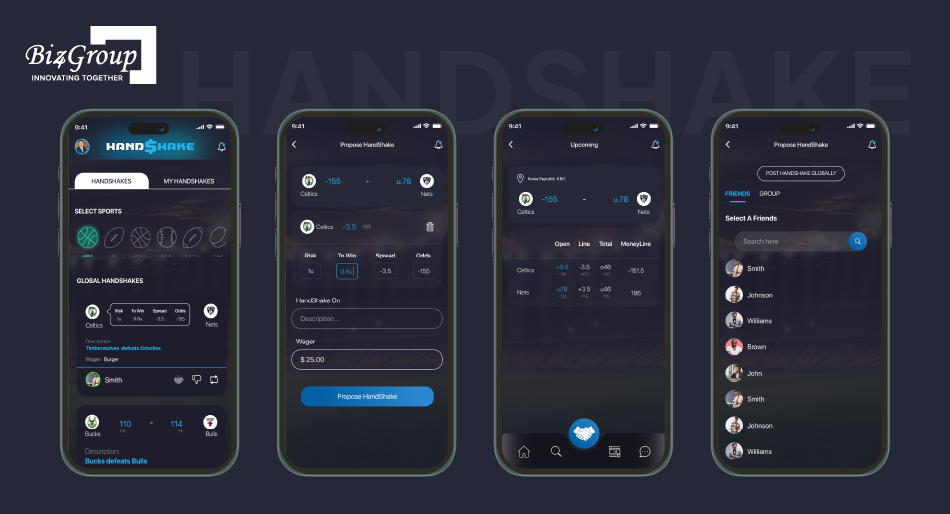
Biz4Group developed a social betting platform for sports enthusiasts who engage in friendly wagers across NFL, NBA, NHL, PGA, and more.
We engineered:
- Real-time live game score integration
- AI-powered betting suggestions
- Push notifications for instant match updates
- One-on-one and group betting functionality
- Admin control dashboards
This project demonstrates how enterprise sports data APIs like SportRadar create reliable foundations for interactive betting ecosystems.
Also read: How to create a sports betting app?
3. Sports Media and Digital Broadcasting Platforms
Sports data APIs like SportRadar for media companies support live score tickers, player stat overlays, and in-game commentary feeds.
For media platforms, accuracy directly influences credibility. Incorrect data can damage audience trust and brand reputation.
Enterprise sports data API solutions like SportRadar for sports media companies allow publishers to deliver synchronized, real-time content across web and mobile channels.
4. Fantasy Sports Platforms
Fantasy platforms require consistent statistical feeds, player performance metrics, and historical game data. Delays or inaccuracies can compromise scoring systems and league fairness.
Scalable enterprise sports data APIs like SportRadar for fantasy sports platforms support large user pools during major tournaments without system slowdowns.
Reliable data delivery ensures:
- Fair leaderboard calculations
- Real-time performance tracking
- Smooth user experience during draft and match windows
5. Sports Analytics and Insights Platforms
Analytics platforms depend heavily on structured, historical, and situational sports data. Enterprise sports analytics APIs like SportRadar for enterprises provide the depth required for predictive modeling and performance evaluation.
Portfolio Spotlight: Quick Start Bets
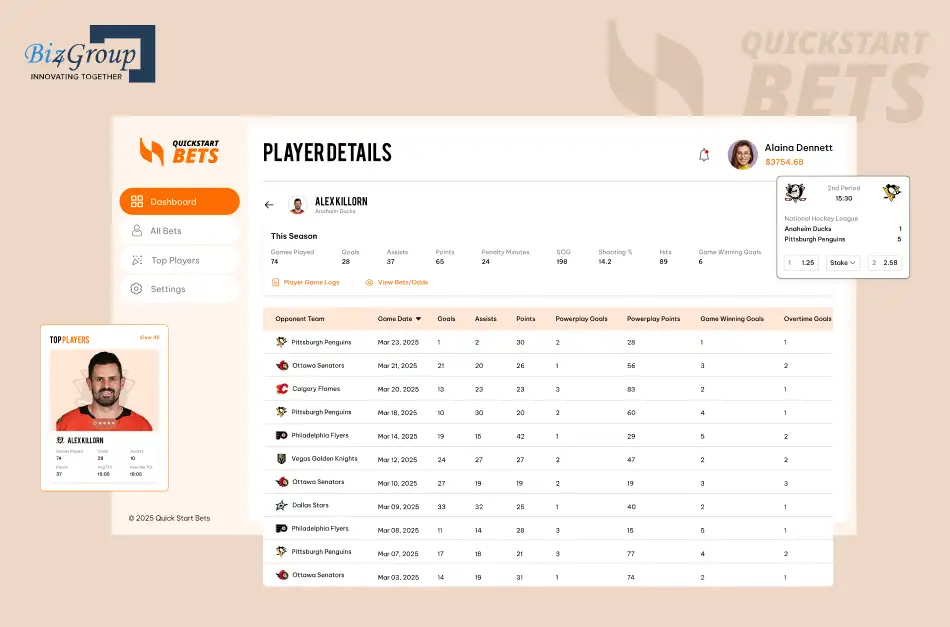
Quick Start Bets is a real-time NHL analytics platform focused on actionable insights and user engagement.
We implemented:
- Real-time odds updates
- Detailed player and team statistical dashboards
- Historical game logs integration
- Centralized tracking dashboard
- Optimized low latency performance
The platform empowers users with clear data visualization and meaningful insights. It highlights how sports statistics APIs like SportRadar for business applications can be transformed into high value analytics experiences.
6. Multi Region Sports Platforms Expanding into New Markets
When sports businesses scale into new leagues or regions, their data infrastructure must adapt without architectural breakdowns.
Enterprise sports data APIs like SportRadar offer structured expansion pathways, enabling:
- Multi-league integration
- Localization readiness
- Seamless performance during seasonal spikes
Platforms that plan for expansion from day one avoid costly re-engineering cycles later.
These use cases reveal a consistent theme. High performing sports platforms treat data as a strategic asset. Up next, we will talk about the challenges that you may face when implementing enterprise sports data APIs like SportRadar.
Also read: Top 12 AI sports betting app development companies in USA
These Platforms Are Live, Scalable, and Revenue Ready.
The difference is not ideas. It is execution backed by the right sports data architecture.
Build Smart with Biz4groupKey Challenges Businesses Face with Enterprise Sports Data API Providers Like SportRadar
Enterprise sports data APIs like SportRadar deliver stability and scale, but implementing and managing them requires strategic planning. High grade infrastructure demands equally thoughtful execution.
Below are the most common challenges businesses face, along with practical solutions.
Challenge 1: Complex Integration Architecture
Enterprise APIs often provide extensive datasets, multiple endpoints, and structured feeds. Without a clear integration plan, development teams may struggle with data mapping, synchronization logic, and performance tuning.
Solution
- Conduct a pre-integration architecture assessment
- Use modular microservices for data ingestion
- Establish structured data validation pipelines
- Partner with experienced AI integration specialists
Challenge 2: Higher Upfront Investment
Enterprise grade sports data APIs typically come at a premium cost compared to basic providers. Budget focused startups may hesitate at the initial pricing structure.
Solution
- Evaluate long-term cost of downtime and re-platforming
- Negotiate scalable pricing tiers based on growth
- Prioritize high revenue leagues during early phases
- Align infrastructure investment with revenue forecasts
Also read: How do AI sports betting apps like FanDuel make money?
Challenge 3: Vendor Dependency Risk
Relying heavily on a single enterprise provider may create operational concentration risk.
Solution
- Implement fallback or rely on multiple sports data providers
- Design abstraction layers within application architecture
- Maintain internal monitoring systems for data validation
- Review contract flexibility before long-term commitments
Insight: Some platforms mitigate this by combining enterprise providers such as SportRadar or Genius Sports with supplemental feeds like API-Sports for non-critical data layers.
Challenge 4: Data Normalization and Customization Challenges
Enterprise feeds may deliver raw or structured data formats that require adaptation for specific user interfaces, dashboards, or analytics models.
Solution
- Develop transformation middleware
- Standardize internal data schemas
- Create automated testing environments for data accuracy
- Involve product teams early during mapping processes
Challenge 5: Regulatory and Regional Complexity
Operating across multiple jurisdictions introduces compliance requirements tied to sports data usage, especially for betting platforms.
Solution
- Conduct jurisdiction specific compliance audits
- Document data usage agreements clearly
- Align platform workflows with licensing requirements
- Maintain transparent audit trails for regulatory reviews
Challenge 6: Scaling Internal Technical Teams
Enterprise sports data APIs like SportRadar require teams capable of handling performance optimization, monitoring, and incident management.
Solution
- Invest in DevOps and real-time monitoring systems
- Train internal teams on data lifecycle management
- Establish escalation frameworks for critical events
Addressing these challenges early ensures that enterprise sports data APIs like SportRadar become growth enablers rather than operational burdens.
Every Risk Has a Fix, If You Plan Early!
Most teams discover data issues during peak traffic. Smart teams fix them before launch.
Talk to Biz4Group's ExpertsHow to Choose Enterprise Sports Data APIs Like SportRadar for Your Business Goals?
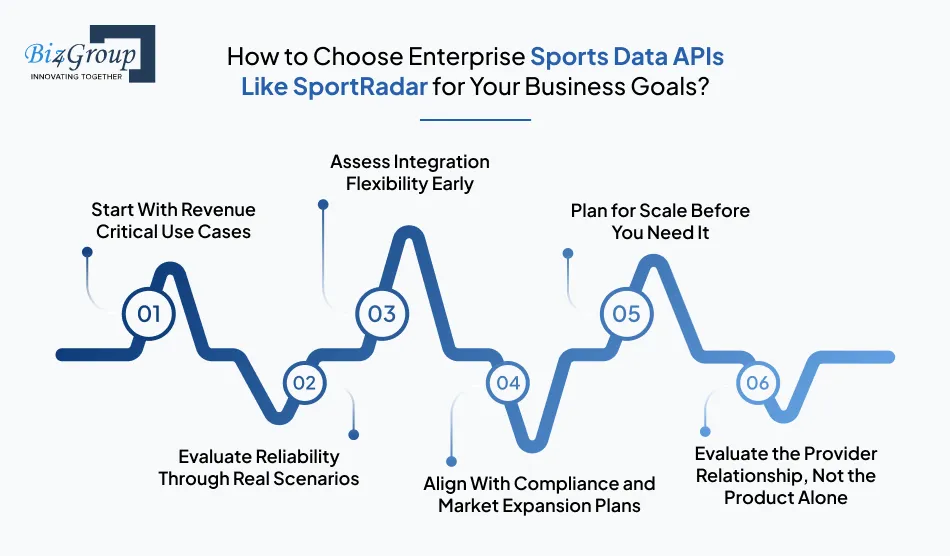
Selecting enterprise sports data APIs like SportRadar should never be reduced to pricing or feature discussion. The right choice aligns with where your business is today and where it plans to go next.
Below is a practical decision framework used by high performing sports platforms.
1. Start With Revenue Critical Use Cases
Every sports platform has data moments that directly affect revenue. Identify those first.
For betting platforms, this may include live odds updates and in-play markets.
For media platforms, it may involve real-time score tickers and player stats.
For analytics platforms, historical depth and consistency often matter most.
Enterprise sports data APIs like SportRadar perform best when mapped to revenue driving workflows rather than generic data consumption.
2. Evaluate Reliability Through Real Scenarios
Instead of reviewing documentation alone, assess how the API performs during high pressure moments.
Ask how the provider handles:
- Peak traffic during major games
- Unexpected data corrections
- Simultaneous multi league events
High reliability sports data APIs like SportRadar are built for these scenarios, not average usage days.
3. Assess Integration Flexibility Early
Enterprise sports data APIs often touch multiple parts of your platform. Frontend displays, backend services, analytics pipelines, and admin tools all rely on consistent data flow.
Sports data integration APIs like SportRadar should support:
- Modular ingestion models
- Custom data transformation
- Clean separation between raw and processed data
This flexibility reduces long-term technical debt.
4. Align With Compliance and Market Expansion Plans
If your platform plans to operate across regions or regulated markets, data licensing and compliance cannot be retrofitted later.
Enterprise sports data APIs like SportRadar provide clarity around data rights and regional usage, which simplifies expansion planning and regulatory discussions.
Also read: Sports betting regulations across US states
5. Plan for Scale Before You Need It
Growth often arrives faster than expected in sports platforms. Viral events, seasonal spikes, or new partnerships can multiply usage overnight.
Scalable enterprise sports data APIs like SportRadar allow platforms to grow without re-engineering core systems. That readiness protects momentum when opportunity strikes.
6. Evaluate the Provider Relationship, Not the Product Alone
Enterprise sports data API providers like SportRadar operate as long-term partners. Their roadmap alignment, support responsiveness, and incident communication matter as much as the API itself.
Strong partnerships reduce friction during inevitable challenges and accelerate innovation cycles.
Choosing enterprise sports data APIs like SportRadar becomes far simpler when the focus stays on business outcomes rather than technical checklists.
And we know exactly the right partner who can help you with it.
How Biz4Group LLC in the USA Helps Businesses Win with Enterprise Sports Data APIs?
Biz4Group LLC is an AI development company that helps entrepreneurs and enterprises turn complex sports technology ideas into scalable, revenue generating platforms. Our focus has always been clear. We build systems that perform under pressure, scale with demand, and support long-term business growth.
Over the years, we have worked closely with sports betting operators, analytics-driven startups, and digital sports platforms that rely on real-time data accuracy and performance. Our strength lies in bridging the gap between enterprise sports data APIs like SportRadar and real-world business applications that users trust and return to.
We do not approach sports data integration as a plug and play task. We treat it as a foundational business decision. This is why businesses looking for a reliable sports betting app development company often partner with Biz4Group when performance and scalability matter.
Why Businesses Choose Biz4Group LLC
- Proven experience building real-time sports betting and analytics platforms
- Deep understanding of enterprise sports data APIs like SportRadar
- Architecture designed for low latency and high traffic environments
- Strong focus on scalability and future readiness
- Clear communication and transparent delivery process
- USA-based leadership with global delivery capabilities
- Ability to integrate complex data systems without disrupting operations
- Long-term partnership mindset beyond initial deployment
What truly sets Biz4Group apart is execution. We have demonstrated our capability through our portfolio, built to handle real-time data flows, user engagement, and performance demands at scale. These are not prototypes or experiments. They are working platforms trusted by real users in competitive environments.
If you are evaluating enterprise sports data APIs like SportRadar and need expert guidance on architecture, integration, or end-to-end platform development, Biz4Group offers specialized sports betting API integration services designed for real world performance.
Let’s build something phenomenal together. Let’s talk.
Final Thoughts
Enterprise sports data APIs have become the backbone of modern sports platforms. As betting, media, fantasy sports, and analytics ecosystems grow more competitive, the difference between success and failure often comes down to data reliability, performance under pressure, and long-term scalability. Feature lists may look attractive, but they rarely reveal how a platform behaves during live events, peak traffic, or critical business moments. That is why enterprise sports data APIs like SportRadar matter far more than surface level capabilities.
Businesses that invest early in enterprise grade sports data infrastructure position themselves for sustained growth. They reduce operational risk, protect revenue streams, and build trust with users who expect accurate, real-time experiences.
This is where Biz4Group steps in as a trusted partner. As a USA based software development company, Biz4Group helps businesses design, integrate, and scale platforms powered by enterprise sports data APIs. With proven experience across real-time betting, social wagering, and analytics platforms, our team understands what it takes to build systems that perform when it matters most.
If you are planning to build or scale a sports platform and want to avoid costly mistakes, now is the time to act. Partner with Biz4Group and turn enterprise sports data into a competitive edge that drives growth, trust, and success.
FAQs
1. How long does it typically take to integrate enterprise sports data APIs into an existing platform?
Integration timelines vary based on architecture and use cases. For well-planned platforms, core integrations can be completed within weeks. Complex systems that require custom workflows, data transformation, or multi-provider strategies may take longer.
2. Can enterprise sports data APIs support multiple sports and leagues within one platform?
Yes. Most enterprise sports data APIs are designed for multi-sport and multi-league coverage. This allows platforms to expand offerings without reworking their data infrastructure each time a new league is added.
3. What role do enterprise sports data APIs play in user retention?
Accurate and timely data keeps users engaged during live events. Platforms that consistently deliver correct scores, stats, and updates build trust, which directly improves session duration, repeat usage, and retention.
4. Do enterprise sports data APIs support customization for unique product experiences?
Enterprise sports data APIs provide structured raw data that can be customized through middleware and application logic. This flexibility allows businesses to create unique dashboards, analytics views, and user experiences without being limited by the data provider.
5. How do enterprise sports data APIs handle data corrections during live events?
Enterprise providers typically have defined correction protocols. Updates are pushed in real-time with clear versioning, which helps platforms reconcile changes without disrupting user experience or transactional accuracy.
6. Is it possible to switch sports data providers after launch?
Yes, but switching providers can be complex if abstraction layers are not planned early. Businesses that design flexible data ingestion systems reduce dependency risks and make future transitions far smoother.
