Location :
Orlando, FL, USA
Location :
Orlando, FL, USA +1 (407) 714-1616
 info@biz4group.com

- To develop a social sports betting community app, you need a mix of real-time data, social engagement features, and AI-driven insights that keep users active and informed.
- Platforms that build social sports betting app development like Pikkit succeed by combining transparency, community interaction, and performance-based credibility systems.
- If you want to create social sports betting community platform like Pikkit, focus on core features like bet tracking, social feeds, leaderboards, and user profiles.
- The success of sports betting app development with social features like Pikkit depends heavily on scalable architecture, reliable APIs, and seamless real-time updates.
- To stand out while developing sports betting community application like Pikkit, advanced capabilities like AI predictions, personalization, and automation play a key role.
- Partnering with companies that develop social sports betting apps like Pikkit in USA, such as Biz4Group LLC, ensures strong execution, scalability, and long-term growth.
Have you noticed how today’s bettors care as much about who is making a pick as the pick itself? According to recent industry insights, user engagement in sports betting platforms has surged by over 30% due to social and community-driven features. This shift is pushing businesses to develop a social sports betting community app that blends wagering with interaction, trust, and shared insights.
The next wave of platforms goes beyond odds and bets. Founders now want to build social sports betting app like Pikkit, where users follow top bettors, share predictions, and build credibility over time. It is no longer about placing bets in isolation. It is about creating an ecosystem where data, opinions, and social proof influence decisions.
Many entrepreneurs are already asking a common question, “We want to develop a sports betting app with social and community features, which companies can help us build it?” Companies that understand that demand is real, but so are technical challenges. Real-time data sync, scalable architecture, and user engagement loops are not simple to execute.
This is where strategy matters. If you are planning to create social sports betting community platform like Pikkit, you need the right feature mix, tech foundation, and growth approach. This guide walks you through exactly how to do it.
What Makes a Social Sports Betting Community App Different from Traditional Sports Betting Platforms?
Before getting into features or tech, it helps to understand the shift. Many founders still think in terms of odds, bets, and payouts. The real change is happening in how users behave inside these platforms.
So what exactly separates a social betting app from a traditional one?
A traditional sportsbook focuses on transactions. Users open the app, place bets, and leave. Platforms like DraftKings or FanDuel have mastered scale, but interaction between users remains limited.
A social sports betting community app introduces a new layer. It turns betting into a shared experience where users follow others, learn from them, and build credibility over time.
Quick Comparison for Clarity
|
Factor |
Traditional Betting Apps |
Social Betting Community Apps |
|---|---|---|
|
Interaction |
Minimal |
High user engagement |
|
Decision Making |
Individual |
Community influenced |
|
Transparency |
Limited |
Public betting history |
|
Retention |
Low |
Habit-driven usage |
|
Content |
Odds focused |
User-generated insights |
If you plan to develop a community-based sports betting app like Pikkit, the focus moves from transactions to relationships. This drives higher retention and engagement.
What Is a Social Sports Betting Community App?
Now let’s simplify the concept.
A social sports betting app blends betting mechanics with social networking and real-time data. Users do not bet in isolation. They interact, observe, and refine their decisions based on community signals.
At a high level, the platform runs on three interconnected layers:
- Betting functionality
- Social interaction layer
- Real-time data engine
This combination answers a common question founders ask... What makes a sports betting app social and community driven?
It is the visibility of actions and the ability to learn from others.
How Does a Social Betting App Work in Practice?
Understanding the flow makes everything clearer. Here is how most successful platforms operate behind the scenes.
Step by Step Flow
- User onboarding and profile setup
Users create profiles that showcase betting performance, win rates, and history. - Data and sportsbook integration
The platform connects with APIs like Sportradar, Genius Sports, or sports.io. Some apps also sync with sportsbooks such as BetMGM to track real bets. - Publishing betting picks
Users share predictions which appear in a live feed. - Social engagement layer
Other users follow, react, comment, or replicate bets. - Real-time updates
Odds and results update instantly using socket-based systems. - Leaderboard and trust system
Rankings reward consistent performance and build credibility.
If you are exploring how to build a sports betting app with social feed and community engagement features, this layered workflow becomes your blueprint.
To ensure accuracy at scale, platforms rely heavily on multiple data sources. This is why top platforms depend on multiple sports data providers rather than a single feed.
Core Components That Power the Platform
Behind the user interface, several systems work together to deliver a seamless experience. Missing even one of these can impact performance or trust.
- Social Layer
This drives engagement.
- Follow system
- Activity feeds
- Comments and reactions
- Betting Intelligence Layer
This supports decision-making.
- Odds aggregation
- Bet tracking
- Performance analytics
- Real-Time Data Engine
This ensures responsiveness.
- Live scores
- Odds updates
- Event triggers
- Data Reliability Layer
This builds trust.
Many platforms fail due to inaccurate or delayed data. A closer look at real-time match accuracy challenges explains why latency becomes a critical issue in betting apps.
Enterprise-grade APIs like Sportradar are often preferred because they deliver consistent and low-latency data streams that scale with demand.
Also read: Why most betting apps fail at real-time match accuracy (and how top apps fix it)?
How Do Social Betting Apps Drive Retention?
At this point, the bigger question emerges... Why do users keep coming back?
Retention in social betting apps is not accidental. It is designed.
Key Engagement Drivers
- Social validation
Users gain recognition when their picks perform well - FOMO and trending bets
Popular picks attract attention and participation - Leaderboards and competition
Rankings create ongoing motivation - Personalized content feeds
Users see insights relevant to their behavior - Real-time notifications
Timely alerts keep users engaged throughout live games
Some platforms are now going a step further by incorporating AI-driven personalization. This allows apps to recommend bets, highlight trends, and improve engagement based on user behavior.
Advanced systems even use sports betting AI agents to automate insights and user interactions, making the experience more dynamic and personalized.
Why This Model Works
To wrap this up, the success of social betting apps comes down to one simple idea.
Trust and interaction.
Users trust what they can see. They engage with what feels human. When betting becomes transparent, interactive, and data-driven, retention improves naturally.
If you are planning to make a social betting community app like Pikkit with real-time sports data integration, getting these fundamentals right sets the foundation for everything that follows.
Still Building a Betting App Without a Community Layer?
Platforms with social features see up to 2x higher retention. The question is, are you building for transactions or engagement?
Build Smart with Biz4GroupWhy Build Social Sports Betting App Development Like Pikkit in Today’s Market Landscape?
The question many founders are asking right now is... Is this the right time to invest in a social sports betting platform?
Short answer: The timing is highly favorable.
What makes this moment interesting is not only market growth. It is the shift in how users engage with betting platforms. Data, community, and interaction are now shaping decisions more than ever before.
Market Growth and Social Adoption Trends
The sports betting market continues to expand at a strong pace, but what stands out is the rise of community-driven engagement within these platforms.
- The global sports betting market is expected to grow to $153.44 billion by 2030.
- The US market recorded over $150 billion in wagers in 2025, reflecting sustained adoption.
- Nearly 70% of younger bettors prefer platforms with social or interactive features, highlighting a behavioral change.
Here is how the shift looks when compared side by side.
|
Trend Area |
Market Insight |
Business Impact |
|---|---|---|
|
Market Size |
$125B+ global industry |
Strong revenue potential |
|
User Behavior |
Preference for social interaction |
Demand for community features |
|
Engagement |
Higher retention in social platforms |
Increased lifetime value |
|
Technology |
Rise of AI and real-time data |
Better personalization |
These trends directly support the decision to create social sports betting community platform like Pikkit rather than building a standalone betting product.
Why Businesses Are Moving Toward Social Betting Models
The turn towards social platforms is not random. It is driven by clear business advantages. Instead of isolated betting experiences, platforms now focus on interaction, visibility, and shared insights.
|
Benefit |
Why It Matters |
|---|---|
|
Higher Retention |
Users return for community, not only bets |
|
Trust and Transparency |
Public betting history builds credibility |
|
Organic Growth |
Social sharing brings new users |
|
Monetization Flexibility |
Subscriptions and premium insights become viable |
A growing number of founders exploring how to start an AI sports betting business in USA are prioritizing these engagement-driven models early in their product strategy.
Role of Technology in Enabling This Shift
The rise of social betting platforms is closely tied to advancements in technology.
Modern systems now support:
- Real-time odds and score updates
- Scalable cloud infrastructure
- AI-powered personalization
- Multi-source data integration
This is also why many platforms actively use AI for sports betting to refine predictions and personalize user feeds.
At the infrastructure level, access to reliable and scalable sports data plays a critical role in performance and valuation.
Also read: How enterprise-grade sports APIs power $10M+ betting app valuations
Project Spotlight: Real-Time Sports Betting Platform
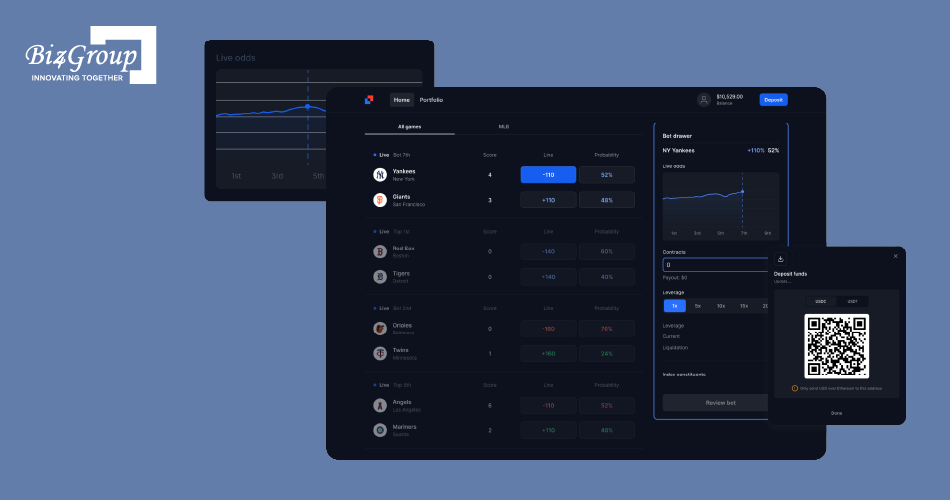
To understand how these concepts translate into execution, consider a real-time sports betting platform for major global league games built for a global audience.
This platform reflects what modern betting systems demand today. It was designed to handle live betting across major leagues while maintaining speed, accuracy, and scalability.
What the Platform Delivered
- Real-time game data through socket-based integration
- Seamless betting across MLB, CFB, and NFL
- Predictive insights for teams and players
- Dynamic pricing aligned with market conditions
How It Performed Under Scale
- Maintained consistent performance during peak traffic
- Delivered synchronized data to thousands of users simultaneously
- Ensured low latency across real-time updates
What This Demonstrates
For building a successful platform today:
- Real-time systems must be reliable
- Data must remain accurate under load
- Architecture must scale without friction
Many startups initially explore faster go-to-market approaches before transitioning to fully customized platforms as they scale.
Also read: Migrating from white label to custom sports betting software development
The opportunity is clear. The market is expanding, users are seeking more interactive experiences, and technology now supports complex, real-time ecosystems.
If you are planning to build social sports betting app development like Pikkit, entering the market with a community-first approach positions your product for stronger engagement and long-term growth.
What Makes Pikkit Like Social Sports Betting Community App Development Successful Among Users
Before building a similar platform, it helps to understand what actually works in the real world. Many founders ask, “What are the best apps similar to Pikkit and why are they growing so fast?”
The answer lies in a mix of product design, user psychology, and business strategy.
Pikkit has built a strong presence by turning betting into a transparent and interactive experience rather than a private activity.
Core Features That Power Its Growth
At the center of its success is a feature set that blends betting data with social interaction.
- Bet tracking across multiple sportsbooks
- Public user profiles with performance metrics
- Social feed displaying picks and insights
- Follow system to track top bettors
- Leaderboards based on accuracy and ROI
Here is a structured view.
|
Feature |
Purpose |
User Impact |
|---|---|---|
|
Bet Tracking |
Sync wagers across platforms |
Builds transparency |
|
Social Feed |
Share picks and opinions |
Drives engagement |
|
Profiles |
Display performance stats |
Establishes credibility |
|
Leaderboards |
Rank users |
Encourages competition |
|
Follow System |
Track expert bettors |
Improves decision making |
Each feature works together to create a system where users stay engaged even when they are not actively betting.
What Users Appreciate the Most
User feedback across platforms like Pikkit highlights consistent patterns. People are drawn to clarity and interaction. Here’s why users keep coming back.
- Ability to verify betting performance before following someone
- Real-time visibility into what others are betting
- Simple interface that makes tracking easy
- Community-driven insights rather than blind betting
A frequently asked question is how does Pikkit’s bet tracking and social feed work so effectively? It removes assumptions. Users can see real data, not claims.
Monetization Model Behind the Platform
Beyond engagement, revenue strategy plays a key role in long-term sustainability. Most social betting platforms follow a hybrid model.
|
Model |
How It Works |
|---|---|
|
Affiliate Revenue |
Earn from sportsbook referrals |
|
Premium Features |
Paid analytics or advanced stats |
|
Advertising |
Sponsored content and placements |
|
Data Insights |
Sell aggregated user behavior insights |
Some platforms are now expanding into more advanced models such as exchange-based systems and micro-interactions. For instance, the rise of AI-powered betting exchanges is enabling peer-to-peer betting ecosystems with dynamic pricing. Similarly, micro-betting experiences are gaining traction by allowing users to place rapid, event-based wagers during live games.
Where Pikkit Excels
Understanding strengths helps replicate success more effectively. These are the areas where Pikkit performs well.
- Strong emphasis on transparency through public betting history
- Clean and intuitive user experience
- Community-first approach that builds trust
- Seamless integration with multiple sportsbooks
These factors contribute to higher engagement and retention compared to standard betting platforms.
Where You Can Outdo Pikkit
No platform is perfect. Identifying gaps opens opportunities for differentiation. Here are the limitations you can capitalize on.
- Limited advanced analytics for serious bettors
- Dependence on external sportsbook integrations
- Scope for deeper AI-driven insights
- Opportunities to expand monetization models
This leads to another important query founders often ask, “How can we improve on existing platforms when creating a social sports betting app with follower system and betting history tracking?”
The answer lies in layering intelligence, personalization, and scalability on top of what already works.
What This Means for Your Product Strategy
If you are planning to developing sports betting community application like Pikkit, the takeaway is clear. Success does not come from adding more features. It comes from:
- Making data visible and trustworthy
- Encouraging interaction between users
- Designing systems that keep users engaged daily
For founders evaluating their next step, a common concern often comes up as, “I want to find a reliable company to build a sports betting community app with social features.”
The right partner should understand both the technical complexity and the behavioral dynamics behind these platforms.
Getting this balance right is what turns an idea into a product users return to consistently.
Want Users Who Stay, Not Scroll Away?
The real edge is not odds. It is trust, visibility, and social proof. That is exactly what top platforms are leveraging right now.
Book a Strategy Call TodayWhat Features Are Needed to Develop a Social Sports Betting Community App Like Pikkit
Once you understand what works in platforms like Pikkit, the next step is identifying what must be built from day one.
So what features does a social sports betting app need to compete in today’s market? The answer is not about adding everything. It is about building the right mix of social, data, and betting capabilities that work together seamlessly.
Here is a clear breakdown of essential features required to build social sports betting app development like Pikkit.
|
Feature |
What It Is |
What It Does |
|---|---|---|
|
User Profiles |
Public profiles with betting stats and history |
Builds credibility and allows users to evaluate others before following |
|
Bet Tracking |
Integration with sportsbooks to track wagers |
Provides transparency and real performance data |
|
Social Feed |
Timeline of user bets, picks, and insights |
Drives engagement and keeps users active daily |
|
Follow System |
Ability to follow other bettors |
Enables users to learn from top performers |
|
Leaderboards |
Rankings based on win rate, ROI, or streaks |
Encourages competition and repeat usage |
|
Real-Time Odds |
Live odds pulled from sports data APIs |
Helps users make informed betting decisions |
|
Notifications |
Alerts for odds changes, results, and activity |
Keeps users engaged throughout the day |
|
Search and Discovery |
Find users, picks, or trends |
Improves content visibility and engagement |
|
Chat and Interaction |
Direct or group communication between users |
Builds community and increases session time |
|
Admin Dashboard |
Backend control for monitoring and moderation |
Ensures platform stability and compliance |
These features directly address how to build a sports betting app with social feed and community engagement features that users actually use daily. Just combine transparency, interaction, and real-time data into one seamless experience.
Project Spotlight: Ingenious Betting App for Sports Enthusiasts
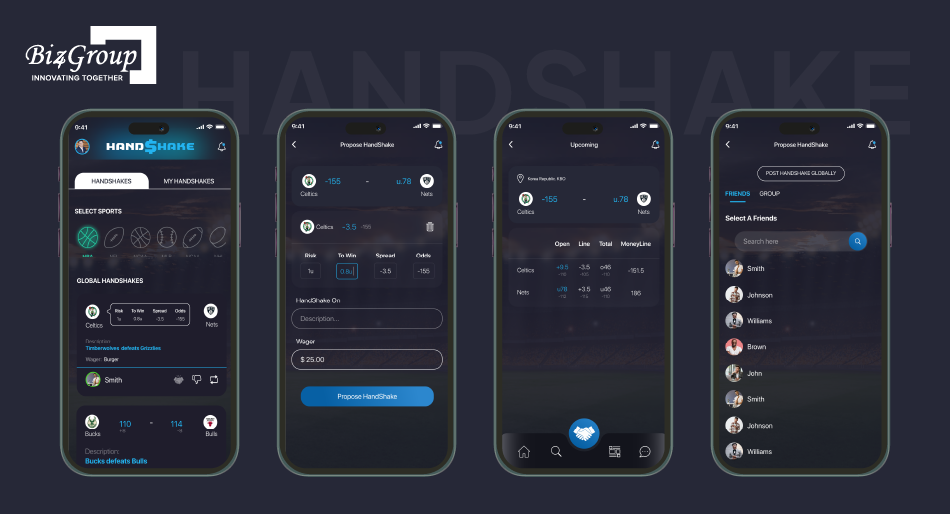
To see how these features translate into a working product, consider an ingenious betting app for sports enthusiasts built with a strong focus on interaction and usability.
This platform was designed to go beyond traditional betting and create a flexible, community-driven experience.
Key Capabilities Delivered
- Real-time live game scores and updates across major leagues
- Friendly betting options allowing users to wager on custom terms
- One-on-one and group chat features for direct interaction
- AI-recommended betting suggestions based on user behavior
- Push notifications for live updates and betting alerts
What Made It Stand Out
- Users could challenge friends or community members directly
- Betting was not restricted to money, which increased participation
- Social interaction remained central to the experience
- The interface was simple enough for quick onboarding
Business Impact
- Increased engagement due to peer-to-peer interaction
- Higher retention driven by personalized betting experiences
- Flexible betting models opened new user segments
This example highlights an important point. If you want to develop a social sports betting community app, features alone are not enough. The way those features are connected and experienced by users defines success.
Strong platforms start with strong fundamentals.
If you are evaluating your roadmap and wondering, “we want end-to-end development of a Pikkit-like betting app with community features, who should we choose?” The right answer lies in choosing a team that understands both feature design and user behavior.
The next section builds on this foundation by exploring advanced features that help your platform stand out in a competitive market.
What Advanced Features and AI Capabilities Improve Social Sports Betting Apps Like Pikkit?
Once the core features are in place, the next layer determines whether your platform competes or leads. Founders often ask how to add AI predictions to a sports betting app or can AI improve user engagement in a betting app?
The answer lies in combining intelligence with real-time interaction.
If you are serious about developing sports betting community application like Pikkit, these advanced capabilities define the difference between a basic product and a high-growth platform.
1. AI Powered Betting Predictions
AI models analyze historical data, player performance, and match conditions to generate predictive insights. This helps users make informed decisions instead of relying on guesswork.
Many businesses now work with an experienced AI app development company to build these predictive systems at scale.
2. Personalized Content Feeds
AI curates betting feeds based on user behavior, interests, and past activity. Each user sees tailored picks, trends, and recommendations.
This directly improves engagement and answers a common query on how apps keep users active daily without overwhelming them.
3. Risk Scoring and Bet Evaluation
Advanced systems assign risk scores to bets using probability models. Users can quickly evaluate whether a bet aligns with their strategy.
This feature becomes even more powerful when combined with enterprise grade analytics through enterprise AI solutions.
4. Copy Betting with Intelligence Layer
Instead of blindly copying bets, AI evaluates top-performing users and suggests optimized bets. This reduces risk and improves outcomes.
It also strengthens trust across the platform.
5. Real Time Trend Analysis
AI continuously monitors betting patterns across users and markets. It identifies trending bets, hot streaks, and shifting odds.
This keeps the platform dynamic and highly engaging.
6. Conversational AI and Smart Assistants
AI chat assistants guide users with suggestions, stats, and insights in real time. These systems act like personal betting advisors.
With advanced AI integration services, these assistants can be embedded directly into the platform experience.
7. Automated Notifications and Engagement Loops
AI driven notifications alert users about relevant bets, odds changes, and performance updates. Timing is optimized to increase engagement without spamming users.
This is where AI automation plays a key role in scaling engagement.
8. Generative AI for Content and Insights
Generative AI can create summaries, betting insights, and even explain predictions in simple language. This makes the platform accessible to both beginners and experienced bettors.
Project Spotlight: Quick Start Bets
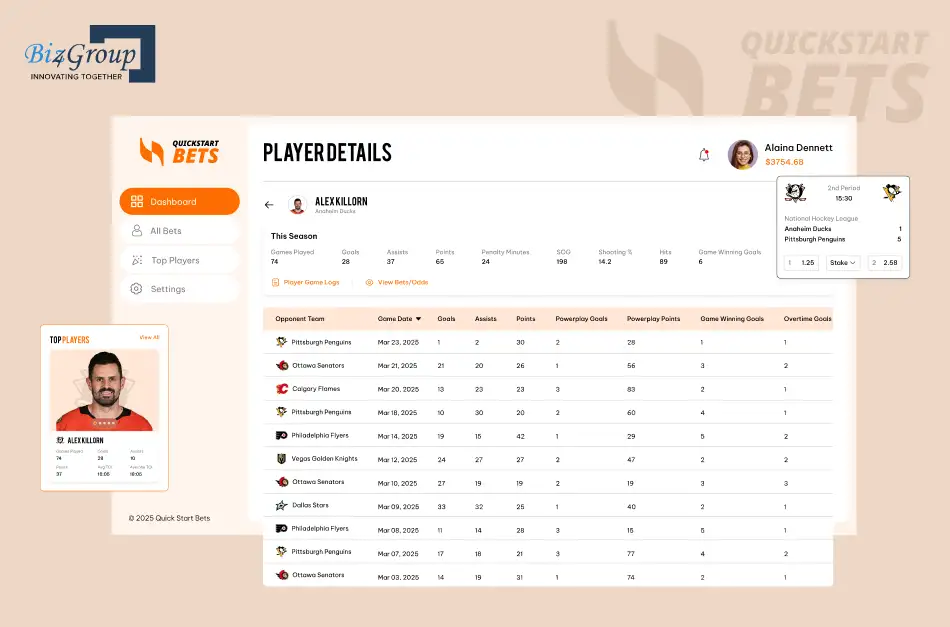
To see how advanced features and AI come together, let’s look at Quick Start Bets, a high-performance sports analytics platform.
This platform was designed to simplify complex sports data and make it actionable for users.
Key Highlights
- Real-time odds tracking with low latency updates
- Detailed player and team analytics for deeper insights
- Centralized dashboard for tracking bets, performance, and activity
- Historical data analysis for better decision making
What Made It Effective
- Combined real-time data with meaningful insights
- Delivered a clean and intuitive user experience
- Focused on speed and accuracy for live betting scenarios
Technical Strength
- WebSocket-based architecture ensured instant updates
- Data normalization allowed multiple sources to work seamlessly
- Optimized backend reduced latency and improved performance
If you plan to create social sports betting community platform like Pikkit, adding AI becomes a requirement.
The next section will take this further by breaking down the technology stack and architecture needed to support these capabilities at scale.
Ready to Turn Features into Revenue?
AI-driven betting platforms can increase user engagement by over 40%, directly impacting retention and ROI.
Calculate Your ROI PotentialWhat Technology Is Used to Develop a Social Sports Betting Community App Like Pikkit?
Once features and AI capabilities are clear, the next big question is what technology is used to build a sports betting app?
If you plan to build a sports betting app with social feed and community engagement features, your tech decisions will directly impact scalability, latency, and user experience. A strong foundation ensures your platform handles real-time updates, social interactions, and high traffic without breaking.
Recommended Tech Stack for Social Betting Apps
Below is a practical tech stack used to develop a social sports betting community app that performs reliably at scale.
|
Layer |
Tools and Frameworks |
What It Does |
|---|---|---|
|
Frontend |
React Native, Flutter, Next.js |
Builds responsive and cross-platform user interfaces |
|
Backend |
Node.js, Python, Go, .NET |
Handles business logic, APIs, and real-time processing |
|
Database |
PostgreSQL, MongoDB, Redis |
Stores user data, bets, and caching for fast access |
|
Real-Time Communication |
WebSockets, Socket.IO, Kafka |
Enables instant updates for odds, scores, and feeds |
|
Cloud Infrastructure |
AWS, Google Cloud, Azure |
Provides scalable hosting and load balancing |
|
Data Integration |
Sportradar, Genius Sports, Sports.io APIs |
Supplies live odds, scores, and sports data |
|
Authentication |
OAuth 2.0, Firebase Auth, JWT |
Secures user login and identity management |
|
Analytics and AI |
TensorFlow, PyTorch, BigQuery |
Powers predictions, personalization, and insights |
|
DevOps |
Docker, Kubernetes, CI/CD pipelines |
Automates deployment and ensures scalability |
Now, if you want to know how to integrate live odds APIs into a betting app? The key lies in combining multiple data providers with real-time processing layers.
Architecture for a Scalable Social Betting Platform
Choosing the right stack is only half the job. Architecture determines how well your system performs under pressure.
If you want to make a social betting community app like Pikkit with real-time sports data integration, your architecture must support speed, accuracy, and scale.
Core Architectural Components
- Microservices Architecture
Breaks the system into independent services such as user management, betting engine, and social feed. This improves scalability and flexibility. - Real-Time Data Pipeline
Uses WebSockets and event streaming tools to push live updates instantly to users. - API Gateway Layer
Manages communication between frontend and backend services while ensuring security and performance. - Load Balancing and Auto Scaling
Distributes traffic efficiently during peak events like live matches. - Data Normalization Layer
Standardizes data from multiple providers like Sportradar or Genius Sports to maintain consistency. - Caching Layer
Uses Redis or in-memory caching to reduce latency and improve response times. - AI Processing Layer
Handles predictions, personalization, and analytics in real time. - Security Layer
Includes encryption, fraud detection, and compliance controls.
Many founders ask, “I want to create a sports betting community app with real-time updates and social features, who can develop this?”
The answer depends on whether the development team understands:
- Real-time data synchronization
- Multi-provider API handling
- High concurrency systems
- AI-driven personalization
Without these, even a well-designed app struggles to scale.
In the next section, we will walk through the step-by-step development process to bring this architecture to life.
What Is the Process to Build Social Sports Betting App Development Like Pikkit?
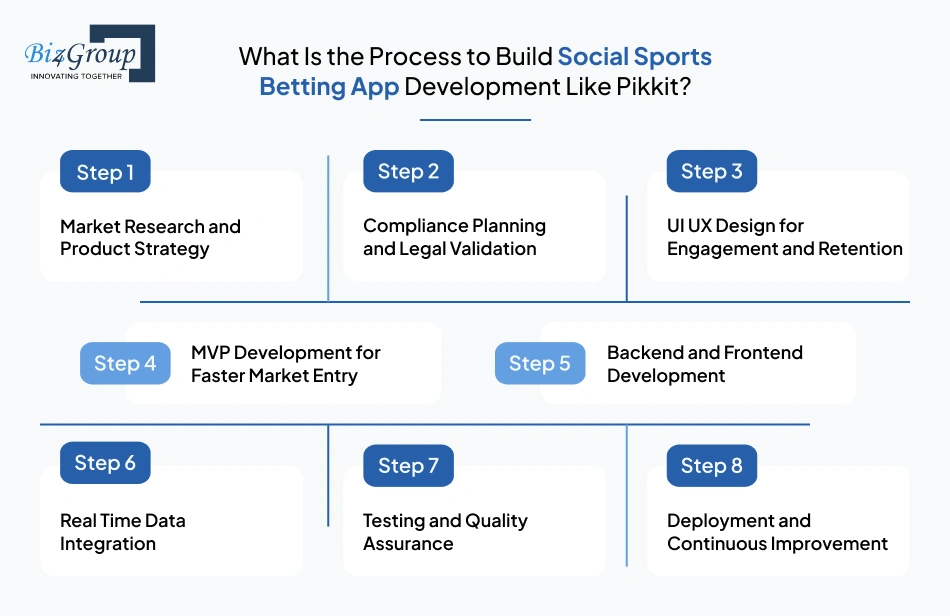
Once the tech stack is clear, the next logical question is execution. So, what are the exact steps to develop a social sports betting community app?
If you plan to build social sports betting app development like Pikkit, following a structured process reduces risk, controls cost, and improves time to market.
Here is a practical 8-step roadmap used by leading teams.
Step 1. Market Research and Product Strategy
Every successful product starts with clarity.
- Define your target audience and betting niche
- Analyze competitors and user expectations
- Identify your unique value proposition
This step should answer what should be the core idea behind creating a social sports betting app.
Step 2. Compliance Planning and Legal Validation
Before development begins, regulatory alignment is critical.
- Identify regions where betting is allowed
- Understand licensing requirements
- Plan data protection and KYC processes
Skipping this step can delay or even block your launch.
Step 3. UI UX Design for Engagement and Retention
Design determines how users experience your platform.
- Create intuitive navigation for betting and social features
- Design engaging feeds, profiles, and dashboards
- Optimize flows for quick decision-making
Working with a specialized UI/UX design company ensures your product remains user-friendly and scalable.
Also read: Top 15 UI/UX design companies in USA
Step 4. MVP Development for Faster Market Entry
Instead of building everything at once, start with a focused version of your product.
- Include essential features like profiles, feed, and bet tracking
- Launch early to gather user feedback
- Iterate based on real usage
So, is it better to launch a full product or start small? A structured MVP development approach helps validate your idea while controlling cost.
Also read: Top 12+ MVP development companies in USA
Step 5. Backend and Frontend Development
This is where your platform comes to life.
- Build scalable backend systems for real-time processing
- Develop responsive frontend interfaces
- Integrate social and betting functionalities
At this stage, performance and architecture decisions matter the most.
Step 6. Real Time Data Integration
Live data is the backbone of betting apps.
- Integrate sports data APIs for odds and scores
- Implement WebSockets for instant updates
- Ensure synchronization across users
If you’re wondering how to integrate live odds APIs into a betting app, the answer lies in combining reliable data providers with efficient real-time systems.
Step 7. Testing and Quality Assurance
Before launch, thorough testing is essential.
- Functional testing for all features
- Performance testing under high traffic
- Security testing for user data protection
This step ensures stability and reliability.
Step 8. Deployment and Continuous Improvement
Launching the app is only the beginning.
- Deploy on cloud infrastructure
- Monitor performance and user behavior
- Continuously improve features based on feedback
For those asking, “We want end-to-end development of a Pikkit-like betting app with community features, who should we choose?”
Select a partner who supports not only development but also long-term scaling and optimization.
Building a successful platform requires strategy, design, and execution working together. If you are planning to develop a social sports betting community app, following this structured approach ensures:
- Faster time to market
- Better product-market fit
- Scalable architecture from day one
In the next section, we will cover compliance and regulatory considerations that every betting platform must address before launch.
You Have the Roadmap. What’s Stopping You?
Most founders delay execution by months. The ones who move fast capture the market early. Where do you stand?
Call Us NowWhat Legal and Compliance Requirements Are Needed to Develop a Social Sports Betting Community App?
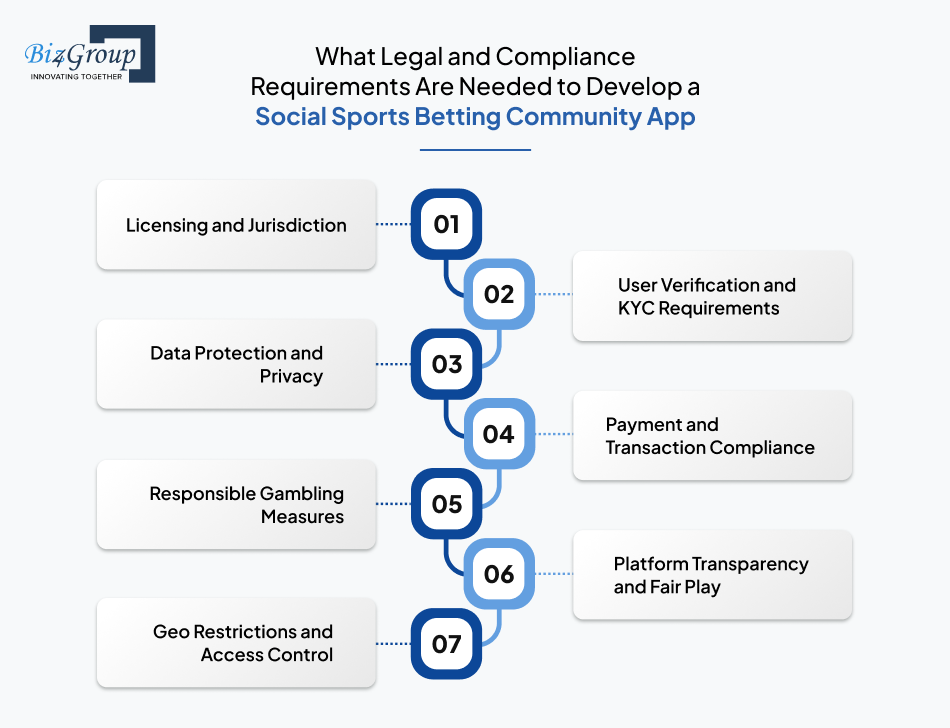
Before launching your platform, there is one area that cannot be overlooked. Compliance.
Founders often wonder what licenses do you need to launch a betting app? If you plan to make a social betting community app like Pikkit with real-time sports data integration, your legal foundation must be as strong as your technology.
Below are the key compliance areas every platform must address.
Licensing and Jurisdiction
- Sports betting laws vary by region, especially across the United States
- You must obtain licenses specific to each state or operate in regulated markets only
- Some regions allow online betting, while others restrict it entirely
- Understanding state-level differences is critical for expansion
A detailed breakdown of sports betting regulations across US states helps clarify where and how you can legally operate.
User Verification and KYC Requirements
- Platforms must verify user identity before allowing betting
- Age verification is mandatory to prevent underage participation
- KYC processes help reduce fraud and ensure regulatory compliance
Data Protection and Privacy
- User data must be stored securely and encrypted
- Compliance with regulations like GDPR or CCPA may be required depending on your audience
- Transparent privacy policies build trust and protect your business
Payment and Transaction Compliance
- Secure payment gateways must be integrated
- Anti-money laundering checks are required in many jurisdictions
- Transaction monitoring helps detect suspicious activity
Responsible Gambling Measures
- Platforms must include tools to promote safe betting behavior
- Features such as deposit limits, self-exclusion, and activity tracking are often required
- These measures are essential for both compliance and user trust
Platform Transparency and Fair Play
- Odds and results must be accurate and verifiable
- Users should have access to their betting history
- Clear terms and conditions must be provided
Geo Restrictions and Access Control
- Platforms must restrict access based on user location
- Geo-fencing ensures compliance with regional laws
- This is especially important for apps operating across multiple states or countries
Compliance is not only about avoiding legal issues. It directly impacts credibility and long-term growth.
Many founders ask, “I want to create a sports betting community app with real-time updates and social features, who can develop this while ensuring compliance?”
Teams that understand both regulations and technology.
Next, let’s break down the cost involved in building such a platform and what factors influence your investment.
How Much Does It Cost to Build Social Sports Betting App Development Like Pikkit?
Let’s address the question almost every founder asks early on... How much does it cost to build a sports betting app like Pikkit?
The answer depends on scope, features, and complexity. On average, the cost to develop a social sports betting community app ranges between $25,000 - $200,000+.
Here is a quick breakdown based on development stages.
|
Stage |
What You Get |
Estimated Range |
|---|---|---|
|
MVP |
Core features like profiles, feed, bet tracking |
$25,000 - $60,000 |
|
Advanced Platform |
Social features, real-time data, basic AI |
$60,000 - $120,000 |
|
Enterprise Level |
Full AI, scalability, multi-region support |
$120,000 - $200,000+ |
CEOs wondering what’s the budget needed to build an AI sports betting community app?
The final number depends on several cost drivers, which we will break down next.
Also read: How to build a sports betting app MVP?
Key Cost Drivers That Shape Your Budget
Before planning your investment, it is important to understand what actually drives cost. Each component contributes differently depending on your product goals.
|
Cost Factor |
What It Includes |
Estimated Impact |
|---|---|---|
|
Feature Complexity |
Social feeds, leaderboards, AI, analytics |
$10,000 - $50,000 |
|
UI UX Design |
User flows, dashboards, engagement design |
$5,000 - $20,000 |
|
Real Time Data Integration |
APIs, WebSockets, live updates |
$10,000 - $40,000 |
|
Backend Development |
Server logic, database, scalability |
$15,000 - $60,000 |
|
AI Development |
Predictions, personalization, automation |
$15,000 - $50,000 |
|
Compliance and Security |
KYC, encryption, fraud prevention |
$5,000 - $25,000 |
|
Third Party Integrations |
Payment gateways, sportsbook APIs |
$5,000 - $20,000 |
Each of these elements adds depth to your platform. For example, adding AI-driven predictions or real-time synchronization increases both development effort and cost.
Hidden Costs You Should Plan For
Many founders underestimate the additional costs that appear after initial development. These are not always visible at the start but play a major role in long-term success.
First, infrastructure costs can grow quickly. Hosting, cloud services, and scaling requirements often add $1,000 - $5,000 per month depending on traffic.
Second, data provider subscriptions are recurring expenses. Premium sports data APIs can cost $2,000 - $10,000 per month based on coverage and usage.
Third, maintenance and updates require continuous investment. Expect to allocate 15% - 25% of the initial development cost annually for updates, bug fixes, and performance improvements.
Another commonly overlooked factor is user acquisition. Marketing, onboarding flows, and retention strategies can significantly impact your total budget.
So, is it expensive to develop a social betting platform when considering long-term costs?
The answer depends on how well these hidden factors are planned early.
Cost Optimization Strategies
By now, if you’re thinking how can we reduce the cost of developing a sports betting community app without affecting performance, here are some strategies:
- Start with an MVP to validate your idea before scaling
- Prioritize core features and delay advanced capabilities
- Use scalable cloud infrastructure to manage usage-based costs
- Choose modular architecture to avoid rebuilding systems later
- Integrate only essential APIs in the initial phase
- Automate processes where possible to reduce operational costs
While building a powerful platform requires investment, there are smart ways to control costs without compromising quality.
Also read: Sports betting website MVP development guide
The cost to build social sports betting app development like Pikkit depends on your vision and execution strategy. A well-planned approach ensures:
- Better budget control
- Faster time to market
- Scalable growth
If you are planning to create social sports betting community platform like Pikkit, understanding these cost factors early helps you make informed decisions and avoid unnecessary expenses.
Next, let’s explore how these platforms generate revenue and sustain long-term growth.
Also read: How much does it cost to develop an AI sports betting app like Rithmm?
How Do Social Sports Betting Apps Make Money and Scale Revenue Like Pikkit?
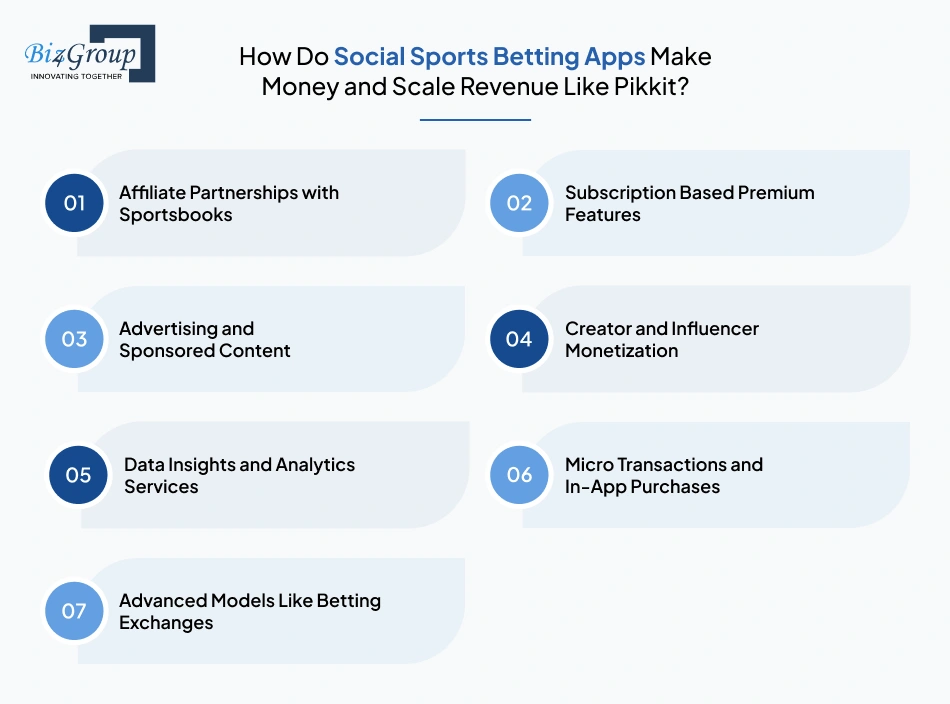
Once the product is built, the next question comes, how do social sports betting apps make money?
If you plan to build social sports betting app development like Pikkit, monetization should be part of your strategy from day one. The most successful platforms combine multiple revenue streams rather than relying on a single model.
1. Affiliate Partnerships with Sportsbooks
One of the most common models involves earning commissions through sportsbook referrals. When users sign up or place bets through your platform, you receive a share of the revenue.
This model scales well because it aligns with user activity. Many founders exploring monetization strategies also look into building a sports betting affiliate website to expand acquisition channels.
2. Subscription Based Premium Features
Platforms offer advanced analytics, AI-powered predictions, and exclusive insights under paid plans. Users who want deeper data or better betting strategies are willing to pay for premium access. This creates a predictable and recurring revenue stream.
3. Advertising and Sponsored Content
Brands and sportsbooks pay to promote their services within the app. Sponsored picks, featured placements, and native ads generate consistent income without disrupting user experience when implemented carefully.
4. Creator and Influencer Monetization
Top bettors can monetize their audience by offering paid picks, subscriptions, or exclusive content. This creates a creator economy within the platform and encourages high-quality content generation.
5. Data Insights and Analytics Services
Aggregated and anonymized user data can be valuable for sportsbooks and analysts. Platforms can monetize insights related to betting trends, user behavior, and performance metrics.
6. Micro Transactions and In-App Purchases
Users can purchase features such as boosted visibility for their picks, premium badges, or access to exclusive competitions. This model works well when combined with gamification elements.
7. Advanced Models Like Betting Exchanges
Some platforms evolve into exchange-based systems where users bet against each other instead of sportsbooks. This opens up new revenue streams through transaction fees and commissions.
If you are planning to create social sports betting community platform like Pikkit, monetization should not feel forced. It should align with how users interact with your platform.
A common concern founders raise is, “We want to develop a sports betting app with social and community features, which companies can help us build it and also guide monetization?”
The right approach is to design revenue models around engagement, trust, and user value.
Next, let’s look at the challenges, risks, and common mistakes involved in building a social sports betting platform and how to avoid them.
Also read: How do AI sports betting apps like FanDuel make money?
Great Idea. But Will It Actually Make Money?
From subscriptions to affiliate revenue, top platforms don’t rely on one stream. They stack them. Are you thinking big enough?
Talk to Biz4Group’s ExpertsWhat Are the Risks in Developing Sports Betting Community Application Like Pikkit?
Building a feature-rich platform is one thing. Making it scalable, reliable, and engaging is another.
Founders often ask, what are the biggest challenges in modern sports betting app development? If you plan to develop a social sports betting community app, understanding these challenges early can save time, cost, and rework.
1. Real Time Data Accuracy and Latency
Real-time betting depends on instant updates. Even a few seconds of delay in odds or scores can impact user trust and decisions.
Handling multiple data feeds while maintaining accuracy becomes complex as user volume grows. This is one of the most discussed challenges in modern sports betting app development.
Solutions
- Use multiple data providers instead of relying on a single source
- Implement WebSockets for instant data delivery
- Add caching layers to reduce load and latency
- Continuously monitor data synchronization
2. Scalability During Peak Traffic
Traffic spikes during major games can overwhelm systems if architecture is not prepared. Without proper scaling, users may face slow performance or downtime.
Solutions
- Build microservices-based architecture
- Use cloud auto-scaling and load balancing
- Optimize database queries and caching
- Conduct stress testing before major events
3. Maintaining User Trust and Transparency
Users rely on accurate data and visible performance metrics. Lack of transparency reduces engagement. Platforms must ensure that betting history, odds, and results remain verifiable.
Solutions
- Display public betting history and performance stats
- Ensure accurate and timely data updates
- Implement clear audit trails for bets
- Maintain consistent UI for data visibility
4. Balancing Social Features with Performance
Adding feeds, chats, and interactions increases system complexity. Too many features without optimization can slow down the platform.
Solutions
- Prioritize core features before scaling
- Optimize APIs for faster response times
- Use asynchronous processing for social interactions
- Regularly test performance across devices
5. Choosing the Right Development Partner
This is one of the most critical decisions founders face. Choosing the wrong partner can lead to delays, cost overruns, and poor product quality.
Solutions
- Choose a company with proven experience in betting platforms
- Evaluate expertise in real-time systems and AI integration
- Review case studies and past projects
- Ensure long-term support and scalability planning
Also read: Top 14 sports betting software development companies in the USA
Every platform faces challenges. The difference lies in how early you identify and address them. If you are planning to create social sports betting community platform like Pikkit, being aware of these risks helps you:
- Build a more stable product
- Reduce development delays
- Improve user trust and retention
Up next, let’s look at why choosing the right development partner can make all the difference in your success.
Why Is Biz4Group LLC One of the Best Companies That Develop Social Sports Betting Apps Like Pikkit in USA?
Biz4Group LLC is a USA-based technology company specializing in AI-driven and real-time software solutions. Over the years, we have helped startups, enterprises, and funded ventures build complex platforms that handle high concurrency, real-time data, and user-centric engagement.
Social sports betting platforms demand precision. They require real-time synchronization, multi-source data handling, AI-powered insights, and seamless user interaction. These are not isolated features. They must work together without failure. As a trusted sports betting app development company, we have built platforms that handle live sports data, predictive analytics, and high user volumes without compromising performance.
Our expertise extends beyond development. We specialize in building intelligent systems through advanced AI models. As an experienced AI development company, we integrate predictive engines, personalization layers, and automation into betting platforms to enhance engagement and retention.
We also understand the backbone of betting platforms. Data.
Accurate, real-time, and scalable data integration is critical. With deep expertise in sports betting API integration services, we ensure your platform delivers instant updates, consistent performance, and reliable user experience.
Why Businesses Choose Biz4Group LLC
Businesses choose Biz4Group because we go beyond execution. We bring clarity, strategy, and long-term vision.
- Proven experience in building real-time sports betting platforms
- Strong expertise in AI-powered personalization and analytics
- Scalable architecture designed for high traffic and performance
- End-to-end development from concept to deployment
- Deep understanding of compliance and security requirements
- Dedicated teams focused on long-term product success
When founders ask, “we want to develop a sports betting app with social and community features, which companies can help us build it?” They are not only looking for developers. They are looking for a partner who can guide them through complexity.
We understand what it takes to develop a social sports betting community app that performs under pressure, scales with demand, and keeps users engaged.
If you are serious about launching a platform that stands out in a competitive market, the right partner makes all the difference.
We are that partner for you.
Let's build something exciting together. Let’s talk!
To Summarize...
Building a successful platform in this space goes far beyond basic betting functionality. To develop a social sports betting community app, you need the right combination of real-time data, social engagement, and intelligent features. From core functionalities like bet tracking and social feeds to advanced capabilities powered by AI, every layer plays a role in shaping user experience and retention.
At the same time, factors like tech stack, compliance, scalability, and cost planning determine how well your platform performs in the long run. Founders exploring build social sports betting app development like Pikkit are no longer focusing only on launching fast. The focus is now on building systems that are reliable, engaging, and ready to scale as user demand grows.
This is where working with an experienced partner makes a measurable difference. Biz4Group LLC, a US-based software development company, brings deep expertise in real-time systems, AI-driven platforms, and scalable architecture. We help businesses turn complex ideas into high-performing products that stand out in competitive markets.
If you are ready to build something users trust and return to every day, let’s make it happen. Connect with Biz4Group and take the first step toward launching your social sports betting platform.
FAQs
1. Can a social sports betting app work without real money betting?
Yes. Many platforms start with prediction-based or free-to-play models to build user engagement first. This approach helps validate the concept, grow a community, and avoid heavy regulatory barriers in early stages.
2. What is the biggest factor that decides success in a social betting app?
User trust is the most important factor. When users can see verified betting history and performance metrics, they are more likely to follow others and stay engaged on the platform.
3. Do I need partnerships with sportsbooks before launching the app?
Not necessarily. You can begin with data-driven predictions and simulated betting. Partnerships can be added later once the platform gains traction and user base.
4. How do social betting platforms acquire their first users?
Most platforms start by targeting niche communities such as fantasy sports users or sports forums. Early traction often comes from influencers or experienced bettors who bring their audience with them.
5. How long does it take to develop a social sports betting app like Pikkit?
Most platforms take around 3-6 months to build and launch depending on complexity. Biz4Group, however, can deliver a functional MVP in 2-4 weeks by using reusable components that reduce both development time and cost.
6. Can I launch globally or should I focus on one region first?
It is usually better to start with one region. This allows you to manage compliance, understand user behavior, and refine your product before expanding to other markets.
7. How do I make my app different from existing platforms like Pikkit?
Differentiation comes from deeper insights, better personalization, and stronger community engagement. Adding AI-driven recommendations, unique gamification elements, and faster real-time updates can help your platform stand out.