 Location :
Orlando, FL, USA
Location :
Orlando, FL, USA +1 (407) 714-1616
 info@biz4group.com

- The top AI voice agents for real estate are used to handle inbound calls, qualify leads, schedule appointments, and follow up at scale.
- Not all voice AI tools are equal, differences in integration depth, automation control, and call logic significantly affect real-world performance.
- AI voice agents for real estate business work best for structured, repeatable calls, while humans remain critical for negotiations, trust-building, and edge cases.
- Cost-effectiveness increases with higher call volumes, after-hours inquiries, and large follow-up backlogs rather than low, sporadic usage.
- The best AI voice agents for real estate sales improve response speed and consistency but require clear rules for handoffs, compliance, and escalation.
- Long-term success depends on matching the level of automation to actual sales workflows instead of adopting AI broadly without clear boundaries.
In 2026, the top AI voice agents for real estate are being used to answer calls, qualify leads, schedule showings, and route serious buyers to human agents. These systems handle both inbound and outbound conversations using natural language. This guide compares the leading tools, their core use cases, costs, and real limitations so decision makers can evaluate them clearly.
Most AI voice agents for real estate business are built to solve 3 core operational problems: missed calls, slow follow-ups, and inconsistent lead qualifications. They can ask structured questions, capture budget and timeline, sync with CRM systems, and book appointments on their own. The underlying technology includes AI speech recognition, intent detection, and workflow integrations. However, the actual performance depends heavily on implementation quality and the maturity of the AI development company behind the system.
This comparison focuses on practical factors like qualification accuracy, scheduling reliability, integration depth, multilingual support, and compliance handling. It also considers how differences in real estate AI software development approaches affect scalability and maintenance. Some tools are optimized for high volume inbound calls. Others are designed for outbound follow up or lead nurturing.
By the end, you will have a clear evaluation framework to assess the best AI voice agents for real estate sales based on fit, cost, and operational tradeoffs instead of generic marketing claims.
Understanding AI Voice Agents for Real Estate Business
The top AI voice agents for real estate are software systems that can speak with callers on the phone using natural conversation. They answer inbound calls, make outbound calls, ask questions, and record responses on their own. In real estate, these tools are used to qualify leads, book appointments, and make sure no call goes unanswered.
At a basic level, real estate AI voice assistant agents focus on 3 core capabilities:
- First, they handle natural language phone calls instead of menu-based options.
- Second, they automate lead qualification by asking structured questions about budget, timeline, and intent. Many teams rely on AI voice agents for real estate lead qualification to filter serious prospects before passing them to human agents.
- Third, they provide 24/7 coverage, which reduces missed calls and captures leads outside business hours.
How Do AI Voice Agents for Real Estate Work?
AI voice agents follow a simple process: listen, understand, decide, and respond. While the technology is complex, the workflow is easy to understand for non technical teams.
Key components include:
- Speech recognition: Converts a caller’s voice into text so the system can process what was said.
- Natural language processing (NLP): Interprets the meaning of the words and identifies what the caller wants to do.
- Intent handling and decision logic: Applies rules to decide the next action, such as qualifying the lead or routing the call.
- System integrations: Connects with CRM tools, calendars, and dialers to support AI voice agents for real estate appointment scheduling.
- Conversation management: Keeps track of the discussion so the call feels continuous and logical.
Companies that build real estate AI software typically focus on making these components reliable and easy to manage before full rollout.
AI Voice Agents in Real Estate vs Traditional Phone Systems
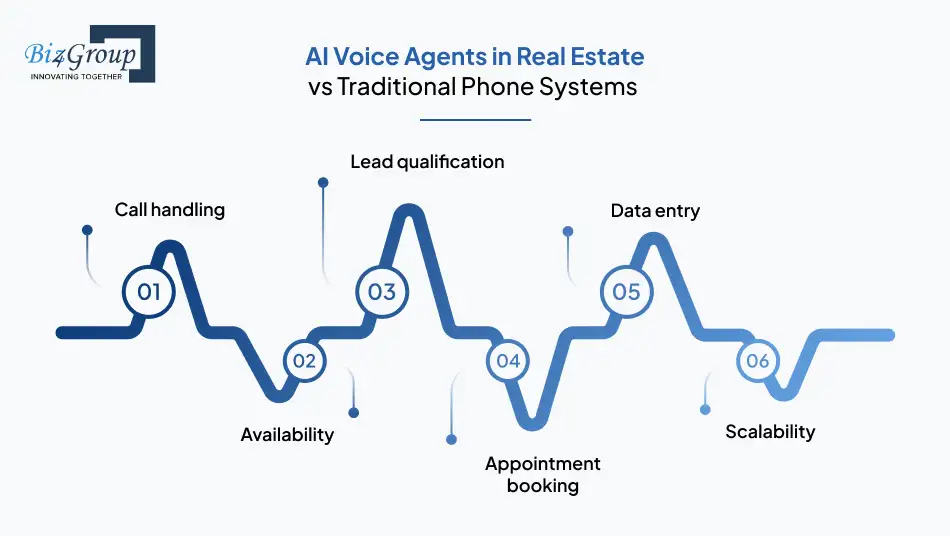
Traditional phone systems in real estate depend on IVR menus, voicemail, or manual callbacks. Voice AI replaces these with direct conversations.
|
Area |
Traditional Phone Systems |
AI Voice Agents |
|---|---|---|
|
Call handling |
Menu options or voicemail |
Natural conversation |
|
Availability |
Limited to office hours |
24/7 coverage |
|
Lead qualification |
Manual and inconsistent |
Automated and standardized |
|
Appointment booking |
Handled by staff |
Automated scheduling |
|
Data entry |
Manual updates |
Automatic CRM logging |
|
Scalability |
Requires more staff |
Scales without hiring |
Traditional systems are simple but limited. They route calls but do not qualify or schedule leads. Voice AI adds automation and structure to the call process, reducing a lot of manual work.
With more and more teams eyeing long term efficiency, AI voice agents for real estate business are becoming a standard layer in sales and operations.
Automate Your Real Estate Call Flow
Explore how the top AI voice agents for real estate can fit into your current sales process without disrupting your team.
Plan My Voice AI StrategyWhy Real Estate Businesses Are Adopting AI Voice Agents in 2026?
In 2026, the top AI voice agents for real estate are being adopted for a simple reason: they reduce lost opportunities caused by missed calls and slow responses. Real estate sales are all about speed and availability, and voice AI systems now deliver both without increasing staffing expenses.
Lead Capture Challenges in Real Estate
Most real estate businesses face the same set of core challenges:
1. Missed calls
Brokerages commonly miss 20 to 40 percent of inbound calls, especially outside office hours or during high lead volume periods.
2. Slow follow ups
When responses are delayed beyond the first few minutes, contact rates and conversion probability drop sharply.
3. High cost of human callers
Hiring and retaining call staff adds fixed costs and limits the ability to scale during demand spikes.
To address these gaps, many firms use voice AI agents for real estate companies as the first point of contact. These systems answer every call, qualify leads, and record outcomes automatically. When combined with AI integration services, they create a consistent and reliable lead intake process across teams.
ROI Drivers for AI Voice Agents in Real Estate
The return on investment from voice AI agents in most cases, comes from three areas:
1. Reduced staffing costs
AI agents can handle large call volumes without the ongoing expense of additional hires.
2. Faster engagement
Calls are answered immediately, which improves lead contact rates and overall responsiveness.
3. Improved conversion efficiency
Sales agents receive pre-qualified leads, which allows them to focus on high intent conversations.
For many teams, this also brings clarity around the cost to develop an AI voice agent compared to long term labor expenses. As adoption grows, AI powered voice agents for property businesses are being considered as core sales infrastructure rather than optional tools.
Business Benefits of AI Voice Agents for Real Estate Companies
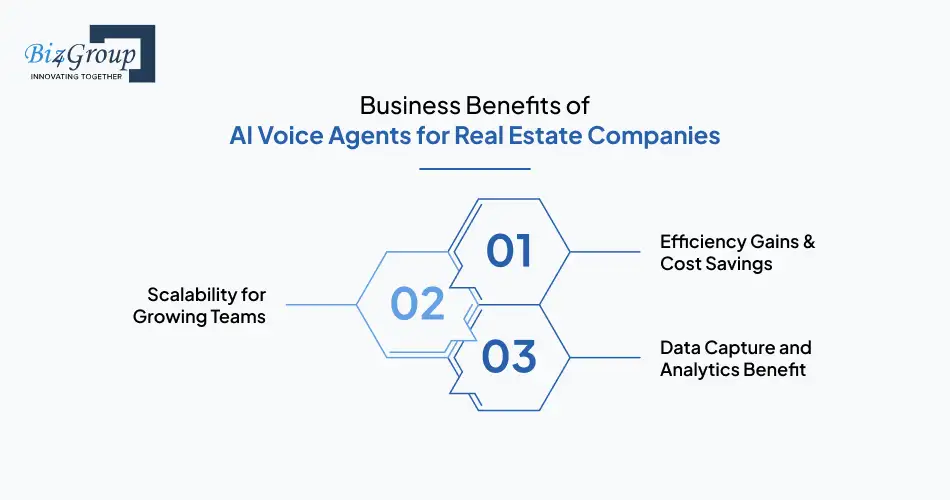
Real estate companies use AI voice agents to answer calls, follow up with leads, and schedule appointments when agents are unavailable. These systems help capture more leads and reduce delays in response. The top AI voice agents for real estate are mainly adopted to lower call handling costs and improve lead conversion.
Here’s how they benefit real estate business:
1. Efficiency Gains & Cost Savings
AI voice agents can handle hundreds of calls per day, while a human caller typically manages 30 to 50. This reduces the cost per call and lowers expenses related to hiring, training, and turnover. Many teams use AI voice agents for real estate business to offload repetitive calls so agents can focus on closing deals.
2. Scalability for Growing Teams
Real estate lead volume often spikes during new listings or marketing campaigns. AI voice agents scale instantly with demand without requiring additional staff or schedule changes. This makes them suitable for growing organizations that are planning long-term enterprise AI solutions.
3. Data Capture and Analytics Benefit
Every AI-handled call is automatically transcribed and stored in a structured format. Intent signals such as budget, timeline, and urgency are captured perfectly each time, across conversations. These insights support reporting, script improvement, and bigger initiatives related to AI in real estate development.
When used correctly, voice AI improves speed, cost control, and data visibility at the same time. The best AI voice agents for real estate businesses are those that fit existing workflows while improving consistency across sales operations.
Scale Lead Handling Without Hiring
See how AI voice agents for real estate business can manage inbound calls, follow-ups, and scheduling at scale.
Evaluate My Automation OptionsKey Use Cases of AI Voice Agents for Real Estate
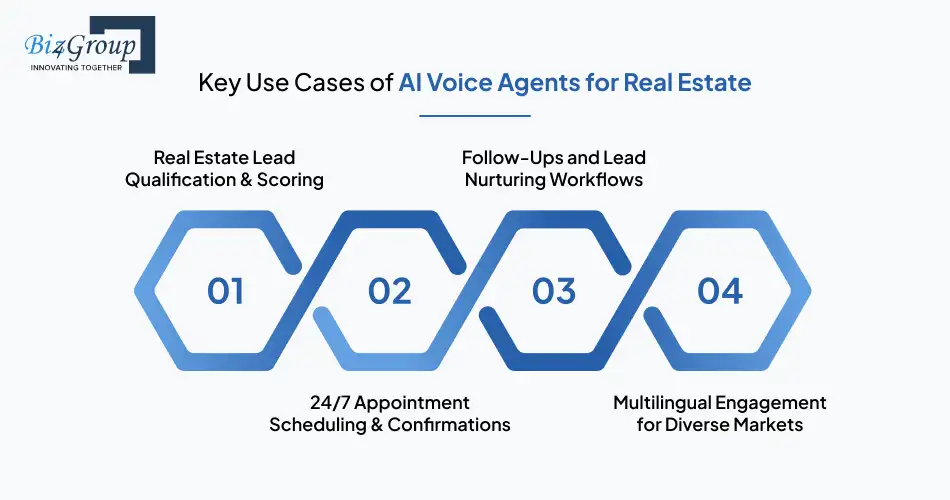
In real estate, AI voice agents are used in situations where phone calls create friction for sales teams. The top AI voice agents for real estate are used to qualify inbound leads, schedule appointments outside business hours, follow up at scale, and handle multilingual calls that teams cannot staff efficiently.
These use cases are practical, repeatable, and tied directly to revenue operations:
1. Real Estate Lead Qualification & Scoring
AI voice agents ask preset questions and score leads during the call itself. Details like budget, buying timeline, and intent are captured in a structured manner every time. This allows teams to prioritize leads automatically instead of reviewing calls manually.
- Operational Impact: High intent leads are routed faster, while low intent leads are filtered out early. This is a core use case for AI voice agents for real estate lead qualification in high-volume pipelines.
2. 24/7 Appointment Scheduling & Confirmations
Voice agents can book appointments as soon as a caller shows interest. They check calendar availability, confirm time slots, and send reminders without human involvement. This reduces delays that often cause missed or dropped showings.
- Operational Impact: Fewer calls are lost after business hours, and no-shows are reduced through automated confirmations. Many real estate AI voice assistant agents are deployed mainly for scheduling.
3. Follow-Ups and Lead Nurturing Workflows
AI voice agents can also handle follow-up calls for new, unresponsive, or cold leads. They re-engage prospects based on timing rules and update lead status after each interaction. This keeps leads active without constant human agent effort, thus also saving a lot of time.
- Operational Impact: Follow-ups happen on time even when human teams are busy. Some companies use this flow using an AI conversation app for coordinated voice and message outreach.
4. Multilingual Engagement for Diverse Markets
Voice agents can speak multiple languages using predefined conversation flows. Calls are handled in the caller’s preferred language without transferring to bilingual human staff. This makes it easier to serve a variety of markets consistently.
- Operational Impact: Businesses are able to expand reach without hiring additional agents or translators. This approach is often part of plans to implement generative AI in real estate
|
Use Case |
Primary Outcome |
Business Impact |
|---|---|---|
|
Lead qualification |
Faster lead scoring |
Better agent focus |
|
Appointment scheduling |
Fewer missed showings |
Higher conversion |
|
Follow-up automation |
Consistent outreach |
Lower manual effort |
|
Multilingual calling |
Broader reach |
Reduced staffing cost |
These use cases show where voice AI fits naturally into real estate sales workflows. The best AI voice agents for real estate sales are those that handle routine calls reliably, allowing teams to focus on conversations that actually close deals.
Top AI Voice Agents for Real Estate in 2026
In 2026, the market for AI voice agents in real estate has become very dynamic. The tools below represent the most widely adopted platforms used by real estate teams to handle live calls at scale. They vary in autonomy, pricing models, and workflow fit, but each is used to support lead intake, follow-up, and appointment scheduling across real estate operations.
|
Platform |
Primary Strength |
Best For |
Autonomy Level |
Pricing Range |
|---|---|---|---|---|
|
Structurely |
End-to-end lead qualification |
Mid-sized teams with high inbound volume |
High (inbound + outbound) |
$500–$1,200/month |
|
Ylopo AI Voice |
Outbound lead reactivation |
Teams with large dormant databases |
High (outbound-focused) |
$800–$2,000/month |
|
Verse.ai |
Hybrid AI + human model |
Brokerages handling high-value deals |
Medium (AI + human escalation) |
$5–$15 per lead |
|
Call Porter |
Inbound seller intake |
Investor-focused operations |
High (inbound-focused) |
$297–$997/month |
|
Roof AI Voice |
Multilingual engagement |
Diverse, high-volume markets |
High (voice + chat) |
$300–$1,000/month |
|
Smith.ai Voice Assistant |
Reliable inbound coverage |
Solo agents & small teams |
Medium (AI + optional human) |
$285–$2,400+/month |
|
Bland AI |
High-volume outbound scaling |
Outbound-heavy workflows |
High (fully autonomous outbound) |
$0.08–$0.15/minute |
|
Air.ai |
Long-form autonomous calls |
Teams testing deep automation |
High (long-duration outbound) |
$1,000+/month |
|
Respond.io Voice AI |
Workflow-integrated automation |
Teams with complex sales stacks |
High (multi-channel integration) |
$300–$1,000/month |
|
Tidio Voice AI |
Affordable inbound automation |
Entry-level automation users |
Medium–High (inbound-focused) |
$29–$299/month |
1. Structurely
Structurely is built specifically for real estate lead engagement. Its voice agents conduct full conversations, ask qualification questions, and write structured results directly into CRM systems. It is commonly used by teams that have outgrown manual screening and want to move toward real estate voice automation AI agents at scale.
Key Features
- Autonomous inbound and outbound voice conversations
- Buyer and seller qualification logic
- Deep CRM integrations
- Call transcripts with intent tagging
- Automated follow-up workflows
Pricing
Sources report $500 to $1,200 per month, depending on volume.
Why Use It
Best for teams that want consistent lead qualification without hiring more sales staff. It is often adopted as a part of broader AI automation services initiatives.
2. Ylopo AI Voice
Ylopo’s voice AI focuses on outbound engagement. It calls new and aged leads, qualifies interest, and books appointments automatically. Because of this design, it is frequently grouped among AI calling agents for real estate instead of general answering tools.
Key Features
- Automated outbound campaigns
- Calendar-based appointment scheduling
- CRM and marketing integrations
- Lead re-engagement workflows
- Campaign reporting
Pricing
Typically $800 to $2,000 per month.
Why Use It
Well suited for teams that plan to reactivate large lead databases and evaluate outbound-focused enterprise AI solutions.
3. Verse.ai
Verse uses a hybrid model where AI handles first contact and humans step in whenever a complex situation comes up. The AI captures intent and context before escalation. This structure often comes up in discussions around AI voice agents vs human callers in real estate.
Key Features
- AI-led initial outreach
- Human escalation for qualified leads
- Structured qualification flows
- Appointment setting CRM synchronization
Pricing
Usually $5 to $15 per lead.
Why Use It
A good fit for brokerages that want automation with human involvement in high-value conversations.
4. Call Porter
Call Porter focuses on inbound calls, especially seller and investor inquiries. Its AI agents capture caller information and trigger follow-ups automatically. It is commonly deployed as AI voice agents to automate real estate lead calls where inbound phone traffic drives deals.
Key Features
- 24/7 inbound answering
- Seller intake workflows
- SMS follow-up automation
- Call recordings and summaries
- CRM export
Pricing
Typically $297 to $997 per month.
Why Use It
Best for investor-focused teams. Some organizations later choose to integrate AI into an app for a centralized lead management system.
5. Roof AI Voice
Roof AI combines voice and chat automation for real estate lead engagement. Its system qualifies prospects, schedules appointments, and supports multilingual conversations. The platform is a great option for those seeking conversational AI voice agents for real estate in high-volume markets.
Key Features
- Automated buyer and renter qualification
- Appointment scheduling and reminders
- Multilingual support CRM integrations
- Reporting dashboards
Pricing
Estimated $300 to $1,000 per month.
Why Use It
Useful for teams operating across diverse markets and languages.
Upgrade From Missed Calls to Managed Pipelines
Discover how AI calling agents for real estate can turn unreturned calls into qualified opportunities.
Optimize My Lead Intake6. Smith.ai Voice Assistant
Smith.ai offers AI-based call answering with optional human backup. It captures lead details, books appointments, and provides structured summaries for recorded conversations. It is often mentioned when teams ask what are the best AI voice agents for real estate for smaller operations.
Key Features
- AI-first inbound answering
- Optional human escalation
- Appointment scheduling
- CRM integrations
- Call summaries
Pricing
Starts around $285 per month, scaling beyond $2,400 per month.
Why Use It
Ideal for solo agents and small teams that need reliability without a complex setup.
7. Bland AI
Bland AI is designed for business that are planning to scale. Its AI voice agents place large volumes of outbound calls for follow-ups, reminders, and basic qualification.
Key Features
- High-volume outbound calling
- Scripted and semi-dynamic conversations
- Call outcome tracking
- API-based integrations
- Scalable infrastructure
Pricing
Usage-based, roughly $0.08 to $0.15 per call minute.
Why Use It
Best for outbound-heavy workflows where speed matters more than depth.
8. Air.ai
Air.ai focuses on long-form outbound conversations. Its agents can handle objections and maintain context over calls that get stretched beyond the usual time limits.
Key Features
- Long outbound conversations
- Dynamic objection handling
- Natural voice delivery
- Call recordings and transcripts
- CRM handoff
Pricing
Reported deployments start around $1,000 per month.
Why Use It
Often used by teams experimenting with deeper autonomy before they hire AI developers for custom systems.
9. Respond.io Voice AI
Respond.io integrates voice automation directly into broader workflow systems. Its agents handle inbound and outbound calls and trigger actions based on intent.
Key Features
- Autonomous voice calling
- Lead qualification logic
- CRM and workflow integrations
- Call transcripts with tagging
- Multi-channel coordination
Pricing
Typically $300 to $1,000 per month.
Why Use It
A strong option for teams that want voice tightly connected to the rest of their sales stack.
10. Tidio Voice AI
Tidio provides AI-driven voice agents for inbound lead handling and after-hours coverage. Its agents qualify intent and trigger scheduling or follow-ups.
Key Features
- Autonomous inbound calls
- Lead qualification flows
- Scheduling triggers CRM and calendar integrations
- Call summaries
Pricing
Ranges from $29 to $299 per month.
Why Use It
An accessible entry point for teams starting with voice automation.
Overall, these tools show that there is no single default choice in this category. The top AI voice agents for real estate in 2026 differ meaningfully in how much autonomy they offer, how deeply they integrate into sales workflows, and how well they handle real-world call complexity.
The right option depends on the preferences of businesses. Evaluating these platforms through that lens makes it easier to choose a solution that fits current operations without creating friction as the business grows.
Move Beyond Basic Call Answering
Compare the best AI voice agents for real estate sales and identify which model fits your workflow.
Shortlist the Right ToolRisks and Trade Offs of AI Voice Agents vs Human Callers in Real Estate
AI voice agents are useful, but they are not suited for every call. The top AI voice agents for real estate perform best in clear, repeatable situations and less well when conversations become complex or emotional. Understanding these limits helps teams decide where automation adds value and where humans are still needed.
1. Where AI Still Falls Short
AI voice agents struggle with complex negotiations and emotional situations. Price objections, distressed sellers, or sensitive buyer concerns often require empathy and flexible judgment. Even with advances in AI model development, these conversations are still handled better by humans.
2. Quality & Trust Risks
Too much automation can hurt trust if callers feel disconnected or misled. This risk increases when AI handles late-stage or high-value conversations. Many teams limit automation to early tasks like AI voice agents for real estate appointment scheduling to keep human involvement where trust matters most.
3. Compliance and Privacy Constraints
Real estate calls must follow strict call recording and disclosure laws that vary by state. AI systems must clearly inform callers when calls are recorded or automated. For voice AI agents for real estate companies, compliance issues often come from rushed setup or poor oversight, not the technology itself.
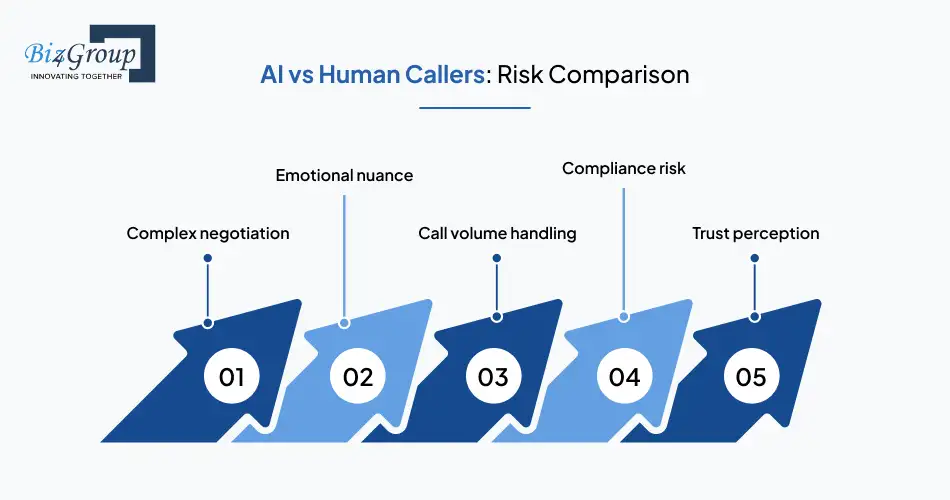
AI vs Human Callers: Risk Comparison
|
Area |
AI Voice Agents |
Human Callers |
|---|---|---|
|
Complex negotiation |
Limited capability |
Strong judgment |
|
Emotional nuance |
Inconsistent |
High empathy |
|
Call volume handling |
Highly scalable |
Staff dependent |
|
Compliance risk |
Setup dependent |
Training dependent |
|
Trust perception |
Can feel impersonal |
More personal |
AI voice agents bring speed and scale, but they also bring real trade-offs. Teams that succeed use automation for structured calls and keep humans involved in sensitive moments. This balanced approach is central to how to use AI for real estate without harming trust or compliance.
Build vs Buy: AI Voice Agents for Real Estate
Most teams reach a point where off-the-shelf tools no longer fit their workflows or scale needs. The top AI voice agents for real estate work well for standard use cases, but gaps appear when call logic, compliance, or integrations become more complex. This is where the decision to build or buy becomes important.
|
Criteria |
Buy (Off-the-Shelf Tools) |
Build (Custom Development) |
|---|---|---|
|
Setup Time |
Fast (days to weeks) |
Longer (6+ weeks) |
|
Upfront Cost |
Low to moderate subscription |
Higher initial investment |
|
Ongoing Cost |
Monthly recurring fees |
Maintenance + infrastructure costs |
|
Customization |
Limited to vendor features |
Fully tailored to workflows |
|
CRM & Integration |
Prebuilt integrations |
Custom integrations with full control |
|
Scalability |
Scales within platform limits |
Scales based on architecture |
|
Compliance Control |
Vendor-dependent |
Full control over rules and disclosures |
|
Use Case Fit |
Best for standard workflows |
Best for complex or unique operations |
|
Ownership of Data & Logic |
Platform-controlled |
Fully owned by business |
Buying works well when your needs match what existing tools offer. Building becomes relevant when your call flows, integrations, or compliance requirements go beyond standard capabilities. For teams planning long-term growth, real estate voice automation AI agents often shift from tools to infrastructure, which is where custom development starts to make more sense.
How to Choose AI Voice Agents for Real Estate Business?
Choosing the right tools means knowing what would fit your business needs the best. The top AI voice agents for real estate vary widely in coverage, integration depth, and control, which affects cost and outcomes. Use the criteria below to narrow options based on how your sales operation actually runs.
1. Decision Criteria Checklist
Start with non-negotiables that affect daily performance and risk. Most buying mistakes happen when teams overlook operational details rather than core capabilities.
- Coverage: Confirm 24/7 inbound handling and peak-hour capacity for outbound calls.
- CRM Integration: Require real-time sync for contacts, call notes, and appointment updates to avoid manual work.
- Multilingual Support: Validate language accuracy and routing rules for diverse markets.
- Governance and Controls: Ensure call recording disclosures, consent handling, role-based access, and audit logs.
- Customization Path: Some teams later choose to build AI software when off-the-shelf logic cannot support complex workflows for AI for real estate agents.
2. Fit by Business Type
Different team sizes benefit from different automation levels. What works for a solo agent may fail at brokerage scale.
|
Business Type |
Typical Call Volume |
Best-Fit Approach |
|---|---|---|
|
Solo Agent |
Low to moderate |
Inbound coverage and basic scheduling |
|
Small Team |
Moderate |
Qualification plus appointment booking |
|
Brokerage |
High |
Centralized intake with routing rules |
|
Enterprise |
Very high |
Advanced governance and customization |
Larger organizations often deploy real estate voice automation AI agents as shared infrastructure. Some extend this ahead via business app development using AI to unify voice, CRM, and reporting.
3. Implementation Timeline and Costs
Most AI voice agent deployments follow a phased rollout, with costs driven by call volume, integrations, and customization level.
- Planning and Setup (1–2 weeks | $1,000–$5,000)
This includes call flow design, qualification logic, and compliance setup.
- Integration and Configuration (2–4 weeks | $2,000–$10,000)
CRM, calendar, and telephony integrations are configured and tested.
- Testing, Optimization, and Go-Live (2–3 weeks | $1,000–$5,000)
Call transcripts are reviewed, prompts refined, and routing rules adjusted.
Ongoing platform costs typically range from $300 to $2,000 per month, depending on usage. Teams exploring how to build AI real estate app MVP or custom systems may exceed these ranges.
Build a Smarter Appointment System
Use AI voice agents for real estate appointment scheduling to reduce no-shows and improve response time.
Improve My Scheduling FlowWhat Is Next for Real Estate AI Voice Assistant Agents?
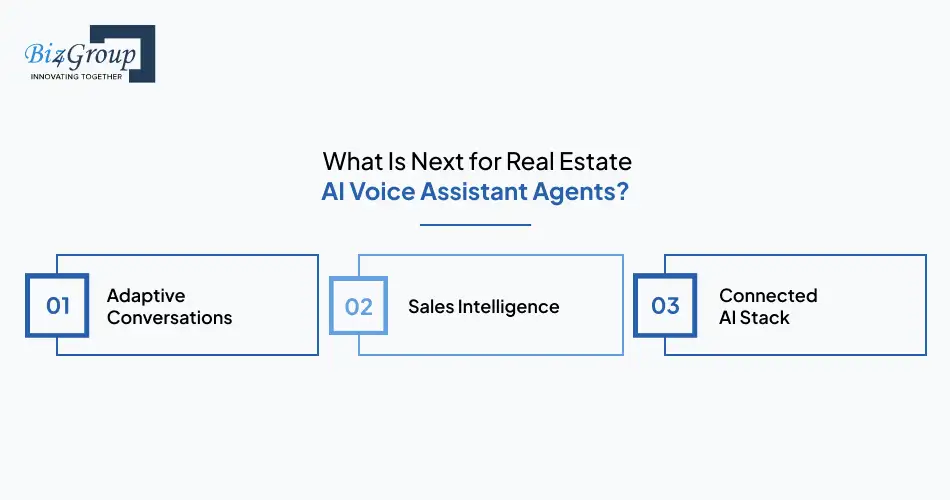
Over the next few years, the top AI voice agents for real estate will move beyond basic call automation and support more decision-heavy sales workflows. The next phase focuses on adaptability, intelligence, and tighter system coordination.
1. Adaptive Conversations
Future voice agents will work on live context from past interactions or real-time conversations. They will adjust questions, tone, and pacing based on how callers respond in real time. This change will improve early-stage conversations without attempting to replace human judgment, moving conversational AI voice agents for real estate closer to natural dialogue.
2. Sales Intelligence
Next-generation AI voice agents will analyze thousands of calls to detect patterns tied to conversion and drop-off. These insights will influence lead scoring models, outreach timing, and pricing discussions. Businesses will also have the option to build AI software to turn voice data into inputs for sales planning.
3. Connected AI Stack
Voice agents will no longer work in isolation from other systems. Calls will trigger updates and actions across CRM, marketing, and transaction platforms instead of ending at summaries. This will allow AI calling agents for real estate to coordinate workflows instead of just making calls.
The next stage of voice AI is all about better decisions. As adoption matures, AI for real estate agents will focus on improving timing, context, and coordination while keeping humans in control of critical conversations.
Why Choose Biz4Group LLC to Develop AI Voice Agents for Real Estate Business?
If you are reviewing the top AI voice agents for real estate and finding that most tools feel rigid or hard to customize, that is where Biz4Group LLC becomes relevant. Many real estate teams reach a point where off-the-shelf platforms no longer fit their workflows, compliance needs, or growth plans.
Biz4Group focuses on building AI voice agents around how real estate businesses actually operate. The goal is to decide clearly what AI should handle and where human agents should stay involved. This balance is critical when comparing AI voice agents vs human callers in real estate, especially in high-value or trust-sensitive conversations.
What Makes Biz4Group Different?
We take a custom-first approach instead of forcing predefined scripts or workflows. Our key focus areas include:
- Call flows aligned with real sales conversations
- CRM and lead source–specific integrations
- Clear escalation rules from AI to human agents
- Built-in compliance and disclosure handling
Most engagements start with AI consulting services to define scope, feasibility, and ROI before development begins. This helps teams avoid overbuilding or misusing automation.
Portfolio Highlight: AI Wizard
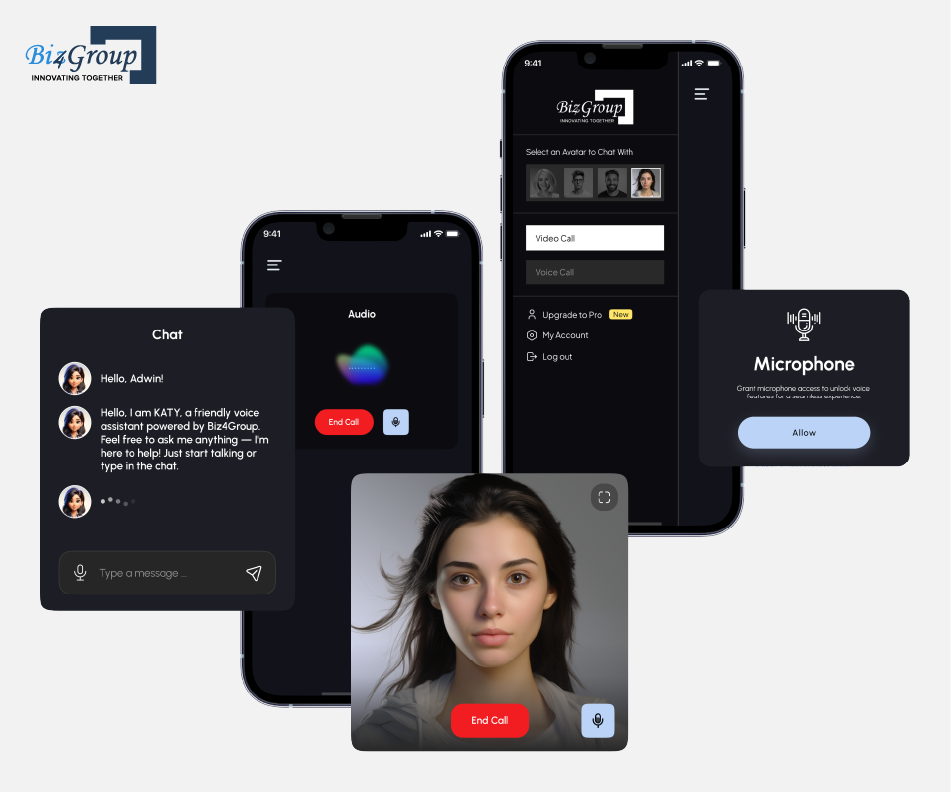
AI Wizard is an AI-powered real estate platform developed by Biz4Group to improve how users search for and interact with property listings. It uses conversational logic and intelligent automation to guide users through the conversation. The same conversational foundation is directly applicable when designing AI voice agents that assist buyers and sellers through phone-based interactions.
Ongoing Optimization After Launch
Voice agents are not set-and-forget systems. We continue to support clients after deployment by:
- Reviewing real call data
- Refining prompts and scripts
- Adjusting routing and escalation logic
This matters in real estate, where lead quality, pricing, and buyer behavior change frequently.
For teams that need more control than standard platforms allow, Biz4Group LLC offers a practical path to custom voice automation. The focus is on building systems that work alongside human agents, supported by structured guidance instead of a one-time delivery.
Design Voice AI That Matches Your Sales Logic
Align automation with your CRM, compliance needs, and growth plans using the top AI voice agents for real estate.
Design My Custom SolutionConclusion
AI voice agents in real estate are not a trend to try, they are a system that businesses choose to adopt deliberately. The top AI voice agents for real estate succeed when they are applied to the right calls, kept out of the wrong ones, and measured against real sales outcomes. Lead intake, scheduling, and follow-ups benefit from automation, while negotiation and tricky cases still belong to humans.
The real decision is to know how much control you need. Off-the-shelf tools work for simple workflows, while custom systems make sense when call logic, compliance, or scale become constraints. When approached with the right product development services, AI voice agents for real estate business stop being tools and start becoming infrastructure.
Start small with a focused use case like lead qualification or appointment scheduling. Speak to our AI experts today!
FAQs
1. Can AI voice agents work with real estate lead sources like Zillow, Realtor.com, or Facebook ads?
Yes. AI voice agents typically connect to lead sources through CRM or webhook integrations. Once a lead is received, the agent can automatically call, qualify, and route the prospect without manual intervention.
2. How accurate are AI voice agents when understanding different accents or speaking styles?
Accuracy varies by provider and language model, but most modern systems handle common accents reliably. Performance can drop with heavy background noise, strong regional accents, or very informal speech, which is why testing is critical before scaling.
3. Do AI voice agents negatively impact customer experience in real estate?
They can if overused or poorly configured. AI voice agents work best for early-stage and administrative calls. When used in sensitive or high-stakes conversations, human handoff is still important to maintain trust.
4. What call volume makes AI voice agents cost-effective for a real estate business?
AI voice agents usually become cost-effective when handling dozens of calls per day or more. Businesses with high inbound lead volume, after-hours inquiries, or large follow-up backlogs see the fastest return.
5. How long does it take for an AI voice agent to sound natural on real calls?
Most systems require a training and tuning period of several weeks. Call quality improves as prompts, routing rules, and escalation logic are refined using real call data rather than test scripts.
6. Are AI voice agents suitable for luxury or high-value real estate markets?
They can be, but usually in a limited role. In luxury markets, AI voice agents are best used for initial intake, scheduling, and follow-ups, while relationship-driven conversations remain human-led.
