 Location :
Orlando, FL, USA
Location :
Orlando, FL, USA +1 (407) 714-1616
 info@biz4group.com

- AI automotive eCommerce platform development enables smarter online sales of vehicles, parts, and services by reducing friction and improving conversions.
- Core features and use cases include intelligent search, personalization, dynamic pricing, and inventory automation that drive real business impact.
- A structured build approach with UI/UX, MVP development, and AI model development ensures scalable execution.
- Cost ranges from $20,000 to $150,000+, depending on features, AI complexity, and integrations.
- The future of AI automotive ecommerce platforms includes AR and VR, predictive maintenance, marketplaces, and connected vehicle commerce powered by Biz4Group LLC.
Here is a question worth asking before you invest another dollar into your automotive ecommerce platform.
Why do customers browse your vehicles or auto parts online, yet still hesitate at checkout or call your sales team for answers that should have been obvious on the screen?
Most automotive businesses assume the problem is pricing or traffic. In reality, it is decision friction. Buyers struggle to find the right fit, compare options confidently, or trust that what they are seeing is truly relevant to them.
This friction is showing up clearly in market behavior.
In 2025, the global automotive aftermarket ecommerce market is projected to reach $113.3 billion, fueled by buyers shifting online for parts, accessories, and vehicle-related services. North America remains one of the fastest-growing regions as dealerships and OEMs push deeper into digital sales.
But growth alone does not guarantee success.
Another 2025 insight explains why some platforms convert better than others. 77% of ecommerce professionals now use AI technologies daily to personalize experiences, automate operations, and reduce manual decision making across their platforms.
So here is the real question you should be asking yourself.
- Is your platform helping buyers decide, or forcing them to think harder?
- Is it reacting after customers leave, or guiding them before they do?
- And can your current system realistically develop AI powered automotive ecommerce platforms that scale as expectations rise?
This is where AI automotive eCommerce platform development starts to matter. Businesses that build AI automotive ecommerce solutions are no longer guessing what customers want. They are shaping the buying journey in real time.
If you are planning to modernize your existing setup or start an eCommerce business using AI, this guide will help you connect the dots between strategy, technology, and measurable growth.
What Is AI Automotive eCommerce Platform and How It Beats Traditional Online Auto Sales?
Before you think about features or vendors, pause for a moment and look at your current platform.
Does it help customers decide, or does it simply show inventory?
That distinction defines AI automotive eCommerce platform development. Instead of acting like a static storefront, the platform actively supports buyers as they compare options, check compatibility, and move toward a confident purchase.
Traditional automotive ecommerce platforms stop at display. AI driven automotive ecommerce systems go further. They learn from behavior, respond in real time, and reduce hesitation at key moments in the buying journey.
This shift becomes especially clear when ecommerce connects with operations. Many teams building AI automotive eCommerce solutions for dealerships and OEMs align sales, inventory, and customer data into one intelligent flow. The same thinking applies when ecommerce works alongside AI automotive dealership management to reduce manual effort and guesswork.
AI Automotive eCommerce vs Traditional Online Auto Sales Platforms
| Area | Traditional Online Auto Sales Platforms | AI Automotive eCommerce Platforms |
|---|---|---|
|
Buyer journey |
Same experience for every visitor |
Personalized journeys based on behavior and intent |
|
Product discovery |
Basic search and filters |
Intelligent search with compatibility awareness |
|
Pricing |
Static or rule based |
Dynamic pricing driven by demand signals |
|
Inventory |
Reactive restocking |
Predictive planning with automation |
|
Buyer confidence |
Customers must figure things out |
Platform guides decisions in real time |
|
Scalability |
Growth increases complexity |
Intelligence absorbs complexity as scale increases |
If your goal is to build AI automotive ecommerce solutions, this comparison explains why adding more filters or plugins rarely fixes conversion problems.
Traditional platforms show products. AI automotive ecommerce platforms help buyers choose. That difference sets the stage for where AI delivers the most value in real business scenarios.
Next, let us look at practical use cases where this intelligence makes an immediate impact.
Are buyers thinking too hard on your platform?
If customers hesitate, your platform is doing too little. Let's fix that with AI automotive eCommerce platform development that guides decisions, not confusion.
Fix My PlatformReal World Use Cases of AI Automotive eCommerce Platforms That Drive Results

The real impact of AI automotive eCommerce platform development shows up when intelligence is applied to everyday selling and operational challenges. These use cases highlight where businesses see immediate gains after they build AI automotive ecommerce solutions instead of relying on static systems.
1. Personalized Vehicle and Parts Discovery
One of the biggest friction points in automotive ecommerce is buyer uncertainty around fitment and compatibility. When customers are unsure, they hesitate or leave. AI automotive ecommerce platforms solve this by tailoring product discovery based on vehicle data, behavior, and intent. Instead of browsing endless catalogs, buyers see only what is relevant to them, which improves confidence and reduces returns.
Example:
A customer enters their vehicle details while shopping online. The platform automatically filters out incompatible parts and highlights only matching accessories. This approach is common across use cases of AI in eCommerce, but it becomes critical in automotive where wrong purchases are costly.
2. Intelligent Pricing and Promotion Optimization
Pricing in automotive ecommerce changes frequently due to demand shifts and inventory movement. Static pricing rules often fail to respond in time. AI driven automotive ecommerce systems continuously analyze demand, competitor pricing, and buyer behavior to adjust prices automatically. This allows you to protect margins while keeping offers competitive.
Example:
An auto parts retailer sees rising demand for a specific component in one region. The platform increases prices slightly while offering discounts on slow-moving items elsewhere, balancing revenue and inventory without manual intervention.
3. Smarter Inventory Forecasting and Availability Management
Inventory misalignment leads to lost sales or tied-up capital. Automotive catalogs are complex, and manual forecasting rarely scales. When businesses develop scalable AI automotive ecommerce platforms, inventory decisions become predictive instead of reactive. The platform anticipates demand before it peaks and adjusts stock levels automatically.
Example:
A dealership selling accessories online prepares inventory ahead of seasonal demand. Customers see accurate availability, fulfillment stays smooth, and stockouts drop significantly.
4. Guided Buying with Conversational Intelligence
Many buyers do not abandon carts because of price. They leave because they are unsure. AI powered conversational flows guide buyers by answering questions, suggesting alternatives, and confirming compatibility at the right time. This reduces hesitation and improves conversions without pressure.
Example:
An AI eCommerce agent helps a customer compare brake components, confirms compatibility, and suggests related services, all while the buyer remains on the product page.
5. Automotive Marketplaces and Multi Seller Platforms
As businesses grow, many move toward AI automotive online marketplace development to support multiple sellers. Without intelligence, marketplaces overwhelm buyers with similar listings. AI automotive ecommerce platforms rank offers based on relevance, delivery speed, availability, and buyer preferences.
Example:
A multi-seller auto parts marketplace automatically shows the best supplier for a buyer’s location and vehicle, reducing comparison fatigue and speeding up purchase decisions.
6. Post Purchase Intelligence and Customer Retention
Automotive ecommerce does not end at checkout. Buyers often need replacements, services, or follow-up products later. AI automotive ecommerce platforms analyze post-purchase behavior to trigger timely and relevant engagement. This keeps customers coming back without relying on generic reminders.
Example:
After a parts purchase, the platform recommends maintenance services or replacement items based on expected wear cycles, helping convert one-time buyers into repeat customers.
Features That Make AI Automotive eCommerce Platforms Actually Work at Scale
When you plan AI automotive eCommerce platform development, features are not a checklist. They are the difference between a platform that looks good in demos and one that performs in real-world automotive selling.
The table below covers must-have and core features businesses need when they build AI automotive ecommerce solutions that scale across vehicles, parts, services, and marketplaces.
| Core Feature | What It Solves for Your Business |
|---|---|
|
Intelligent Vehicle and Parts Fitment |
Ensures customers only see compatible vehicles, parts, or accessories based on VIN, model, year, and usage. This reduces wrong orders, returns, and buyer hesitation at checkout. |
|
AI-Powered Product Search |
Moves beyond keyword matching to intent-based discovery. Buyers find the right products faster even when they are unsure what to search for. |
|
Uses browsing behavior, vehicle data, and purchase history to suggest relevant parts, upgrades, or services, increasing conversion rates and average order value. |
|
|
Dynamic Pricing Engine |
Adjusts pricing in real time based on demand, inventory levels, regional trends, and competitor signals to protect margins while staying competitive. |
|
Inventory Forecasting and Demand Planning |
Predicts future demand using historical sales, seasonality, and behavior patterns so you stock what sells and avoid overstock or stockouts. |
|
Conversational Buying Assistance |
Guides buyers during browsing with real-time answers, compatibility checks, and product comparisons using AI-powered conversations built with help from an AI chatbot development company. |
|
Automated Order Processing |
Streamlines order routing, fulfillment prioritization, and delivery timelines using intelligent workflows supported by AI automation services. |
|
Multi-Seller Marketplace Logic |
Ranks sellers and offers based on relevance, availability, pricing, delivery speed, and buyer preferences in AI automotive online marketplace development scenarios. |
|
Post-Purchase Intelligence |
Triggers follow-ups, replacements, service reminders, and upsell opportunities based on usage patterns and expected wear cycles. |
|
Analytics and Decision Dashboards |
Converts raw data into actionable insights for sales, marketing, and operations teams, helping you spot trends and fix bottlenecks quickly. |
|
Seamless System Integrations |
Connects ecommerce with DMS, ERP, CRM, payment gateways, logistics, and OEM systems using secure pipelines powered by AI integration services. |
|
Security, Compliance, and Data Governance |
Protects customer data, transaction records, and AI models while meeting industry and regional compliance requirements. |
These features work best when designed together, not added one by one. Fragmented implementations often lead to inconsistent experiences and operational gaps.
When you develop AI powered automotive ecommerce platforms, the focus should be on how these features support each other. Search improves discovery. Personalization boosts confidence. Automation reduces workload. Intelligence keeps everything aligned as your business grows.
With features covered, the next step is execution.
Up next, we will break down how to build AI automotive ecommerce platforms, starting with planning, architecture, and development steps that help you avoid costly rework later.
Nice features on paper. But do they actually work together?
AI only delivers value when features are designed to sell, not just exist.
Build It the Right WayHow to Build AI Automotive eCommerce Platforms Without Costly Rework?
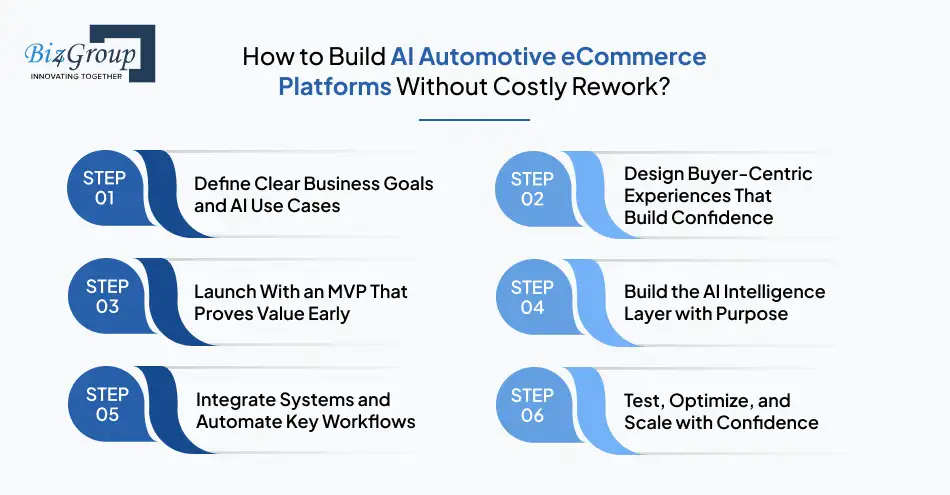
Building AI automotive eCommerce platform development the right way is not about rushing into code. It is about aligning business goals, data, and technology from day one. This is how we, at Biz4Group LLC, help companies build AI automotive ecommerce solutions that scale without repeated rework.
Below is a practical, step-by-step approach you can apply right away.
Step 1: Define Clear Business Goals and AI Use Cases
Before development starts, you need clarity on what success looks like. Are you aiming to improve conversions, reduce returns, automate inventory, or support marketplace growth? Clear goals determine how you develop AI-powered automotive ecommerce platforms. When goals are unclear, platforms grow in the wrong direction.
Key actions:
- Identify revenue and operational bottlenecks
- Map buyer journeys for vehicles, parts, and services
- Prioritize use cases tied directly to growth
Step 2: Design Buyer-Centric Experiences That Build Confidence
Automotive ecommerce often fails when buyers feel unsure. That is why experience design must focus on confidence and clarity. Strong UI/UX design ensures buyers can compare, verify, and decide without friction. This step plays a major role when you build online automotive sales platforms using AI.
Key actions:
- Design fitment-first discovery flows
- Simplify comparisons and checkout journeys
- Validate designs using real buyer scenarios
Step 3: Launch With an MVP That Proves Value Early
Trying to ship everything at once increases risk. A smarter approach is to start with MVP development that validates your assumptions quickly. Many teams use MVPs to test how AI impacts discovery, pricing, or recommendations before scaling.
Key actions:
- Launch core ecommerce functionality first
- Add AI to one high-impact feature
- Use real user data to guide expansion
Step 4: Build the AI Intelligence Layer with Purpose
AI only works when models are trained with the right data and goals. This step focuses on AI model development aligned with your specific automotive ecommerce use cases. Strong models help you develop intelligent automotive ecommerce applications that buyers trust.
Key actions:
- Prepare clean, relevant datasets
- Choose models aligned with discovery, pricing, or forecasting
- Monitor accuracy and performance continuously
Step 5: Integrate Systems and Automate Key Workflows
An AI automotive ecommerce platform must connect seamlessly with inventory, payments, logistics, and analytics. Integration ensures data flows smoothly and decisions stay consistent. Our team often combines integrations with automation to reduce manual work.
Key actions:
- Connect DMS, ERP, CRM, and payment systems
- Automate inventory updates and order routing
- Maintain secure, reliable data pipelines
Step 6: Test, Optimize, and Scale with Confidence
Launch is only the starting point. Long-term success depends on continuous optimization based on real behavior and performance metrics. At Biz4Group LLC, we treat optimization as an ongoing partnership while helping clients develop scalable AI automotive ecommerce platforms.
Key actions:
- Track conversion and engagement metrics
- Refine AI logic based on real usage
- Scale features without disrupting buyers
Following these steps helps you create AI driven automotive ecommerce systems that grow alongside your business instead of holding it back.
Tech Stack That Powers Scalable AI Automotive eCommerce Platform Development
Once you know how to build the platform, the next decision is to choose the right technology stack. This is where many projects either stay flexible or get locked into limitations.
When we design platforms, our focus is simple. Pick technologies that scale with traffic, support AI workloads, and integrate cleanly with automotive systems. Below is a practical view of the tech stack commonly used to build AI automotive ecommerce solutions.
| Platform Layer | Tools and Technologies | What This Layer Does |
|---|---|---|
|
Frontend Experience |
Powers fast, responsive user interfaces that support complex catalogs, comparisons, and personalized journeys across devices. |
|
|
Mobile Applications |
React Native, Flutter |
Enables consistent mobile experiences for buyers browsing vehicles, parts, or services on iOS and Android. |
|
Backend Services |
Handles business logic, order processing, pricing rules, inventory logic, and API orchestration at scale. |
|
|
AI and Machine Learning |
TensorFlow, PyTorch, Scikit-learn |
Supports recommendation engines, pricing models, demand forecasting, and personalization for AI automotive ecommerce platforms. |
|
Search and Discovery |
Elasticsearch, OpenSearch |
Delivers fast, intelligent search with relevance ranking, fitment logic, and real-time filtering. |
|
Data Processing |
Apache Kafka, Apache Spark |
Manages real-time data streams and batch processing for behavior analysis and AI training pipelines. |
|
Databases |
PostgreSQL, MongoDB, Redis |
Stores structured data like orders and users, unstructured catalog data, and cached sessions for performance. |
|
Cloud Infrastructure |
AWS, Azure, Google Cloud |
Provides scalable computing, storage, and AI services required to develop scalable AI automotive ecommerce platforms. |
|
Integrations |
REST APIs, GraphQL, Webhooks |
Connects ecommerce with DMS, ERP, CRM, payment gateways, logistics, and OEM systems. |
|
Security and Compliance |
OAuth, JWT, SSL, IAM |
Protects customer data, transactions, and system access while meeting regulatory and industry standards. |
|
Analytics and Monitoring |
Google Analytics, Power BI, Prometheus |
Tracks performance, buyer behavior, conversions, and system health for continuous optimization. |
This stack is not fixed. The right choices depend on your scale, use cases, and growth plans. What matters is how well each layer works together to support intelligence, automation, and performance.
Our team typically tailors this stack based on whether you are building a marketplace, a dealership platform, or an auto parts ecommerce system. Flexibility early on saves significant time and cost later.
Cost of AI Automotive eCommerce Platform Development and What Really Drives the Budget
When founders and tech leaders ask us about AI automotive eCommerce platform development cost, the first thing we clarify is this. There is no single fixed price.
Most projects typically fall in the range of $20,000 to $150,000+, depending on scope, features, data complexity, and long-term scale. A basic platform with limited AI capabilities sits on the lower end, while enterprise-grade systems with advanced intelligence, automation, and integrations move toward the higher range.
The key is understanding where the money goes and how to plan it smartly.
Feature-Wise Cost Breakdown for AI Automotive eCommerce Platform Development
The table below gives you a realistic view of how costs are distributed when businesses build AI automotive ecommerce solutions.
| Feature Area | Estimated Cost Range | What You Are Paying For |
|---|---|---|
|
Core Ecommerce Platform |
$10,000 – $30,000 |
Product catalog, checkout, payments, user accounts, order management, and basic admin controls. |
|
UI/UX Design for Automotive Ecommerce |
$5,000 – $15,000 |
Buyer journeys, fitment-first discovery, mobile responsiveness, and conversion-focused flows. |
|
AI-Powered Search and Fitment |
$8,000 – $20,000 |
Intelligent search, vehicle compatibility logic, relevance ranking, and filtering accuracy. |
|
Personalization and Recommendations |
$7,000 – $18,000 |
Behavioral tracking, product recommendations, cross-sell and upsell intelligence. |
|
Dynamic Pricing and Promotions |
$6,000 – $15,000 |
Demand-based pricing, inventory-driven discounts, and rule automation. |
|
Inventory Forecasting and Automation |
$7,000 – $20,000 |
Predictive demand planning, stock optimization, and automated restocking logic. |
|
Conversational AI and Guided Buying |
$5,000 – $12,000 |
AI-driven chat flows, buyer guidance, and decision support during browsing. |
|
System Integrations |
$5,000 – $20,000 |
DMS, ERP, CRM, payment gateways, logistics, and OEM data connections. |
|
Analytics and Reporting |
$3,000 – $8,000 |
Dashboards, performance insights, and operational visibility. |
This is why AI automotive ecommerce software development budgets vary widely. Every added layer of intelligence increases value, but also impacts cost.
Key Factors That Affect AI Automotive eCommerce Platform Development Cost
Several variables directly influence how much you will invest when you develop AI powered automotive ecommerce platforms.
- Platform scope and number of features
- Complexity of AI models and data availability
- Size of product catalog and inventory rules
- Number of third-party integrations
- Marketplace versus single-seller architecture
- Security, compliance, and scalability requirements
The more customized your platform is, the higher the initial investment. However, customization often leads to better long-term ROI.
Hidden Costs Businesses Often Overlook
Many teams budget for development but underestimate ongoing expenses. These hidden costs can quietly impact total ownership cost if not planned early.
Common overlooked areas include:
- Data preparation and cleaning for AI models
- Continuous AI model tuning and monitoring
- Cloud infrastructure and usage spikes
- Ongoing integrations and API maintenance
- Security updates and compliance audits
Understanding these early helps you avoid surprises later.
Cost Optimization Strategies for AI Automotive eCommerce Platforms
You do not need to build everything at once to succeed. At Biz4Group LLC, we often help clients optimize costs by prioritizing features that deliver immediate impact and expanding gradually. This approach works especially well when combined with automation.
Practical ways to optimize cost:
- Start with high-impact AI features first
- Use modular architecture to scale gradually
- Leverage automation where possible instead of manual workflows
- Plan infrastructure based on actual usage, not assumptions
- Review AI eCommerce automation software cost early to align budget expectations
Smart planning allows you to develop scalable AI automotive ecommerce platforms without overspending upfront.
Also Read: How to Monetize Your AI App Effectively
Trying to guess the cost or plan it smartly?
Get clarity on what to build now, what to delay, and where AI delivers the fastest ROI.
See My Realistic CostChallenges in AI Automotive eCommerce Platform Development and How to Solve Them
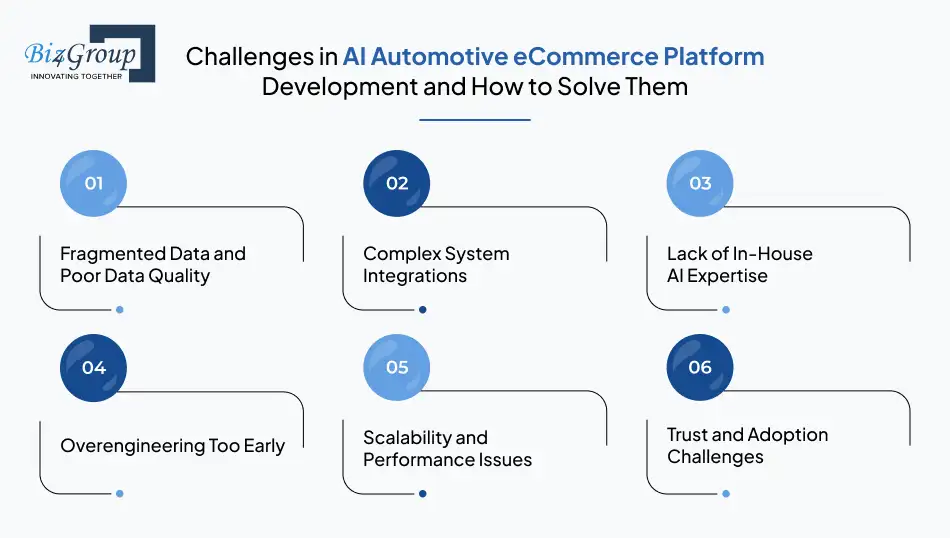
Even the best plans face real-world obstacles. When businesses move toward AI automotive eCommerce platform development, challenges usually appear around data, integration, scalability, and execution speed.
The good news is this. These challenges are predictable, and with the right approach, they are solvable. Below is a clear breakdown of the most common issues and how teams overcome them when they build AI automotive ecommerce solutions.
| Challenge Area | What Goes Wrong | How Businesses Solve It |
|---|---|---|
|
Fragmented Data and Poor Data Quality |
Automotive data often lives across multiple systems like DMS, ERP, supplier feeds, and spreadsheets. Inconsistent or incomplete data weakens personalization, pricing, and forecasting models. |
Centralize data early and define ownership. Many teams adopt structured pipelines and governance models similar to those used in enterprise AI solutions to keep data clean, consistent, and usable. |
|
Complex System Integrations |
Ecommerce platforms must connect with inventory, payments, logistics, and OEM systems. Poor integration planning leads to delays and brittle workflows. |
Use modular APIs and phased rollouts. Treat integration as a core build step, not an afterthought, especially when scaling AI-driven features across systems. |
|
Lack of In-House AI Expertise |
AI projects stall when teams lack experience in model training, tuning, and monitoring. This often results in underperforming features or missed deadlines. |
Many businesses choose to hire AI developers with automotive and ecommerce experience to accelerate delivery and reduce trial-and-error costs. |
|
Overengineering Too Early |
Trying to build every AI feature at once increases cost and risk. Platforms become complex before proving value. |
Start with a focused roadmap. Validate one or two high-impact AI features first, then expand based on real usage and ROI. |
|
Scalability and Performance Issues |
As traffic and catalogs grow, platforms slow down or fail during demand spikes. |
Design for scale from day one using cloud-native architecture, load balancing, and automation. Many teams rely on AI eCommerce automation software to keep operations stable under load. |
|
Trust and Adoption Challenges |
Buyers and internal teams may not trust AI-driven recommendations or pricing at first. |
Maintain transparency. Combine AI decisions with explainable logic and continuous monitoring so teams understand why the system behaves a certain way. |
These challenges do not mean AI automotive ecommerce platforms are risky. They simply require deliberate planning and the right partners.
When addressed early, these hurdles become competitive advantages. Platforms run smoother, teams move faster, and customers experience less friction at every step.
The Future of AI Automotive eCommerce Platform Development and What You Should Prepare For

AI automotive eCommerce platform development is moving beyond smarter catalogs and recommendations. The next phase is about immersive experiences, proactive operations, and platforms that act before problems or opportunities surface. If you are planning for long-term scale, these future directions matter now.
1. Autonomous Buying Journeys Powered by AI Agents
Future platforms will guide buyers instead of waiting for clicks. AI agents will understand intent, budget, vehicle context, and timing, then recommend products, bundles, or services automatically. This reduces friction in complex automotive purchases where buyers often hesitate or drop off.
Over time, these journeys will feel less like browsing and more like assisted decision-making built directly into your platform.
2. Hyper-Personalization Across Vehicles, Parts, and Services
Personalization will go far beyond showing related products. AI automotive ecommerce platforms will tailor layouts, financing options, service bundles, and even content based on how each buyer behaves and what they value most.
Businesses that build AI automotive ecommerce systems with personalization will create experiences that feel relevant from the first interaction, not generic or overwhelming.
3. AR and VR Powered Automotive Shopping Experiences
Visual confidence will become a major conversion driver. AR and VR w ill allow buyers to view vehicles, accessories, and parts in realistic environments before purchasing. Customers will preview upgrades, interiors, or accessories in context instead of guessing from images.
As AR and VR mature, they will reduce returns and increase buyer confidence, especially for high-value purchases and customization-heavy automotive products.
4. Predictive Operations and Maintenance Driven by AI
Future platforms will not wait for breakdowns or shortages. AI automotive ecommerce systems will anticipate needs using usage data, purchase history, and behavior patterns. This includes smarter inventory planning and service recommendations.
A strong example is AI predictive maintenance, where platforms recommend parts, services, or replacements before failures occur. This creates recurring revenue while improving customer trust.
5. Marketplace-First and Ecosystem-Based Commerce
More automotive brands will shift toward AI automotive online marketplace development instead of operating alone. These platforms will connect dealers, suppliers, service providers, and logistics partners into one ecosystem.
AI will decide which seller, offer, or service appears first based on relevance, availability, delivery speed, and buyer context, simplifying decisions while expanding reach.
6. Connected Vehicles and Real-Time Commerce
As vehicles become more connected, ecommerce platforms will tap into real-time data such as mileage, usage patterns, and diagnostics. AI automotive ecommerce platforms will trigger recommendations based on actual vehicle conditions, not assumptions.
This unlocks new revenue streams tied directly to ownership and lifecycle events rather than one-time purchases.
7. Trust, Transparency, and Explainable AI
As AI influences pricing, recommendations, and availability, trust will become a differentiator. Buyers and internal teams will want to know why a price changed or a product was suggested.
Platforms that invest in explainable AI and transparent decision logic will see higher adoption and fewer resistance points as AI becomes more central to commerce.
Why Businesses Choose Biz4Group LLC for AI Automotive eCommerce Platform Development?
When you are investing in AI automotive eCommerce platform development, the partner you choose matters as much as the technology itself. You need a team that understands automotive complexity, ecommerce scale, and AI execution, not just in theory but in real delivery.
At Biz4Group LLC, we work closely with founders, CTOs, and product leaders to turn ambitious ideas into platforms that actually perform in the market. Our focus is always on outcomes, not experiments.
Here is what sets our team at Biz4Group LLC apart.
- Proven experience as a full-cycle AI development company with hands-on delivery across ecommerce, automotive, and enterprise systems
- Strong capability to build AI automotive ecommerce solutions that combine personalization, automation, and scalability from day one
- Deep understanding of automotive use cases including parts compatibility, inventory forecasting, pricing logic, and marketplace models
- Expertise in designing conversion-focused buyer journeys that reduce friction and increase confidence at every step
- Dedicated AI engineers, product strategists, and architects who work as an extension of your internal team
- End-to-end ownership from strategy and design to deployment, optimization, and long-term support
- Experience delivering complex platforms through our role as an AI app development company trusted by US-based businesses
We do not believe in one-size-fits-all solutions. Every automotive ecommerce platform we build is tailored around your business goals, data maturity, and growth plans.
If your goal is to develop scalable AI automotive ecommerce platforms that drive measurable revenue and operational efficiency, Biz4Group LLC brings the experience and execution discipline to make it happen.
Want a vendor… or a team that actually thinks with you?
Biz4Group LLC partners with you to build AI automotive ecommerce platforms that perform beyond launch day.
Talk to Biz4GroupWhat This Really Adds Up To!
AI automotive eCommerce platform development is no longer a forward-looking idea. It is quickly becoming the standard for how vehicles, parts, and services are bought and sold online. Businesses that continue to rely on static platforms will find it harder to compete as buyer expectations rise.
Throughout this guide, we have broken down what makes AI automotive ecommerce platforms different, how they deliver value through real use cases, the features that matter, and what it takes to build and scale them successfully. The common theme is clear. Intelligence reduces friction, automation improves efficiency, and personalization builds trust.
At Biz4Group LLC, we bring more than technical capability to the table. We bring experience earned by delivering complex AI-powered ecommerce and enterprise platforms for US-based businesses. Our team understands how to align AI strategy with business outcomes, not experiments.
When you work with Biz4Group LLC, you are not just hiring developers. You are partnering with a team that knows how to design, build, and scale AI automotive ecommerce platforms that perform in the real world.
If you are planning your next phase of growth, now is the right time to rethink how your automotive ecommerce platform works. With the right approach and the right partner, AI becomes a practical advantage, not a buzzword.
When you are ready, Biz4Group LLC is prepared to help you move from idea to execution with confidence.
FAQ
1. What is AI automotive eCommerce platform development and why is it important?
AI automotive eCommerce platform development involves building intelligent online systems that help sell vehicles, auto parts, and services using personalization, automation, and predictive insights. It is important because traditional ecommerce platforms struggle with fitment accuracy, pricing complexity, and buyer decision friction. AI helps platforms guide buyers, reduce returns, and improve conversions at scale.
2. How does AI automotive eCommerce differ from traditional online auto sales platforms?
Traditional platforms focus on listing products and basic filtering. AI automotive ecommerce platforms actively support buyer decisions using intelligent search, dynamic pricing, personalized recommendations, and automated inventory planning. This reduces hesitation, improves buyer confidence, and lowers dependency on manual support teams.
3. What are the key features of AI automotive eCommerce platforms?
Core features include intelligent vehicle and parts fitment, AI-powered product search, personalized recommendations, dynamic pricing, inventory forecasting, conversational buying assistance, and analytics dashboards. Businesses that build AI automotive ecommerce solutions typically prioritize features that directly improve conversions and operational efficiency.
4. How much does AI automotive eCommerce platform development cost?
The cost of AI automotive eCommerce platform development generally ranges from $20,000 to $150,000+, depending on platform scope, AI complexity, integrations, and scalability needs. A basic platform with limited AI features costs less, while enterprise-grade platforms with automation, personalization, and marketplaces require higher investment.
5. How long does it take to build an AI automotive eCommerce platform?
Timelines vary based on features and complexity. A basic MVP can take 8 to 12 weeks, while a full-scale platform may take 4 to 6 months or more. Teams that start with MVP development often reach market faster and refine features based on real user data.
6. What challenges should businesses expect when building AI automotive ecommerce solutions?
Common challenges include fragmented data, complex integrations, lack of AI expertise, scalability issues, and trust in AI-driven decisions. These challenges are manageable with clear use case prioritization, strong architecture, and experienced teams that develop scalable AI automotive ecommerce platforms using phased execution.
7. How do I choose the best company to develop AI automotive eCommerce platforms?
Look for proven experience in ecommerce and AI, understanding of automotive use cases, strong integration capability, and a focus on business outcomes. The best company to develop AI automotive eCommerce platforms will guide you from strategy and design through development, optimization, and long-term scalability, not just deliver code.
