Location :
Orlando, FL, USA
Location :
Orlando, FL, USA +1 (407) 714-1616
 info@biz4group.com

















Imagine a digital system that doesn’t wait for instructions but instead, understands your business goals, learns from real-time feedback, and takes independent actions to get the job done.
Read More

The automotive retail world is entering a new era where efficiency, automation, and customer experience determine the winners in a highly competitive market. Dealerships today are not only selling vehicles. They are handling massive volumes of customer data, online leads, digital financing requests, service appointments, and complex inventory cycles. This is exactly where AI Automotive DMS becomes a game changer.
In 2026, dealerships are shifting from traditional dealership management tools to fully intelligent platforms powered by AI. Businesses want systems that can respond instantly to leads, recommend accurate pricing, predict inventory needs, automate service processes, and help sales teams work faster. This rising demand has pushed companies to explore AI Automotive Dealership Management System Development as a strategic investment rather than a software upgrade.
If you are a dealership owner, a decision maker at an OEM, a digital transformation consultant, or a business planning to enter the automotive technology space, understanding how to make an AI Automotive Dealership Management Software will be essential. Developing an AI Automotive Dealership Management platform requires the right mix of predictive analytics, automation workflows, generative AI capabilities, CRM intelligence, and smart integrations.
This guide simplifies the entire journey from what AI DMS means to how to develop an AI Automotive Dealership Management solution tailored for 2026 business needs. Whether you want to build your own platform or understand the development of AI Automotive Dealership Management Software for investment or transformation, this complete guide will give you clarity, direction, and actionable insights.
AI Automotive Dealership Management Software is a next generation intelligent platform designed to automate, optimize, and enhance every operational function inside a modern dealership. It transforms the traditional DMS framework by integrating AI powered intelligence into daily workflows such as CRM, sales, service management, parts administration, accounting, after sales communication, and inventory control.
This advanced system uses artificial intelligence, predictive analytics, natural language processing, and machine learning to analyze customer behavior, forecast vehicle demand, automate lead engagement, streamline service processes, and provide real time decision support. Instead of relying on manual data entry or slow operational processes, the system acts as an always active digital assistant that helps dealership teams work faster and more accurately.
Compared to traditional dealership software, AI DMS reduces human effort, minimizes errors, enhances sales performance, and improves overall dealership profitability. It also supports omnichannel customer journeys, giving a seamless experience whether the buyer interacts through online platforms or visits a physical showroom.
As we move into 2026, AI powered DMS platforms are becoming the operational backbone for dealerships of all sizes. They play a critical role in enabling faster decisions, improving customer satisfaction, and helping automotive businesses stay competitive in a fast-changing marketplace.
When planning to develop an AI Automotive Dealership Management Software, businesses should focus on the following core components:
These components serve as the foundation for building a high-performance AI Automotive DMS tailored for 2026 dealership needs.
The automotive retail industry is more competitive and unpredictable than ever. Customer expectations are rising. Lead volumes keep increasing. Operational costs continue to climb. Dealers who do not invest in the development of smarter AI enabled dealership systems to struggle to maintain visibility, conversion, and profitability. This is why dealerships are now actively investing in the development of AI Automotive Dealership Management Software to create a more efficient and revenue driven business model.
Before understanding the value of AI, it is important to look at the real problems dealerships face every day.
Most customer inquiries come in during evenings or weekends. When no one responds, the lead goes cold, and another dealership wins the sale.
A study found that 78 percent of buyers choose the dealership that responds first, which shows how expensive delayed responses can be.
How AI solves it:
To build an AI Automotive DMS that works nonstop, dealerships use AI powered chat, scheduling, lead qualification, and auto follow-ups. This keeps the sales pipeline alive even when the team is offline.
Most dealership websites attract high traffic but 95 to 98 percent of visitors leave without sharing their details.
How AI solves it:
With the development of AI visitor identification, behavioral tracking, and hyper personalized pop-ups, your AI Automotive Dealership Management Software can convert silent visitors into qualified leads.
Sales and service departments often miss calls or forget to log them manually. Over 40 percent of customer calls never enter the CRM.
How AI solves it:
AI voice agents, automated call transcription, and instant CRM logging help dealerships create error free, fast response systems that increase appointments and reduce lost opportunities.
The average cost per automotive lead ranges between 250 and 295 dollars depending on the channel.
How AI solves it:
By building predictive scoring, automated nurturing, and AI powered channel optimization, dealerships reduce cost per sale and improve return on ad spend.
Dealers often struggle with slow moving models while fast selling vehicles remain out of stock. The AI automotive market is growing rapidly with a forecasted CAGR above 20 percent, which shows that AI powered forecasting is becoming a major competitive tool.
How AI solves it:
Developing AI-driven demand forecasting inside your DMS helps dealers optimize pricing, reduce capital lock, and turn inventory faster.
Customers want instant answers. Teams need automation. Management requires real-time intelligence. Traditional dealership software can no longer meet these demands. Investing in the development of an AI Automotive Dealership Management System helps dealerships create smarter workflows, reduce operational pressure, and increase revenue without expanding their workforce.
AI is now the difference between dealerships that survive and dealerships that scale.
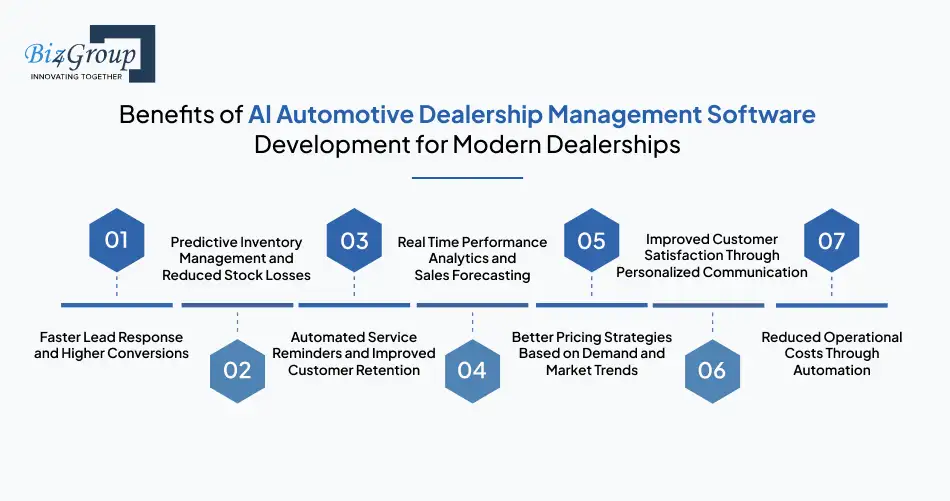
Modern dealerships operate in an environment where customer expectations are rising, and operational efficiency is critical. By investing in AI Automotive DMS Development, businesses can automate complex workflows, enhance decision making, and create a more profitable and customer driven ecosystem.
Below are the major advantages of building and developing an AI Automotive Dealership Management Software for long term success.
Speed is one of the biggest factors that determine whether a dealership secures or loses a sale. Customers expect replies within minutes, not hours.
AI powered DMS platforms reply instantly to inquiries through chat, email, SMS, and voice AI. These intelligent systems qualify for leads, understand customer intent, and automatically schedule test drives or showroom visits.
By developing an AI Automotive Dealership Management Software with automated lead handling, dealerships can significantly reduce response time and boost conversion rates.
Inventory decisions affect both profitability and customer satisfaction. Without accurate forecasting, dealerships either overstock slow performing vehicles or run out of high demand models.
Creating an AI Automotive Dealership Management System allows dealers to use predictive analytics to understand market trends, customer preferences, and seasonal patterns.
This ensures that inventory decisions are based on real data instead of guesswork, reducing losses, and improving vehicle turnover.
Service revenue plays a major role in dealership profitability, yet many customers miss appointments or forget routine maintenance.
AI powered reminder systems automatically send personalized service alerts, follow-ups, and maintenance recommendations. These messages are tailored to customer history, driving habits, and vehicle conditions.
By integrating automated retention tools during AI Automotive DMS Development, dealerships increase workshop visits and extend long term customer loyalty.
Dealerships often struggle to extract value from large volumes of operational data. Manual reporting is slow and rarely accurate.
AI transforms this data into real-time insights, giving managers visibility into sales performance, lead quality, staff efficiency, and service output.
When you build AI Automotive Dealership Management Software with smart analytics, you gain forecasting tools that help plan promotions, adjust pricing, and optimize sales strategies.
Pricing plays a major role in customer decision making. Incorrect prices lead to low margins or lost sales.
AI algorithms analyze competitor pricing, real time demand, market fluctuations, and historical performance to suggest optimal price points.
By integrating AI based pricing modules during the development of AI Automotive Dealership Management Software, dealerships can maintain a competitive edge and improve profitability.
Customers no longer respond to generic emails, or one size fits all marketing messages. They expect timely, relevant, and personalized interactions.
AI powered DMS platforms study customer behavior, preferences, purchase history, and communication patterns to deliver tailored recommendations and offers.
This level of personalization strengthens customer relationships and enhances overall satisfaction throughout the ownership journey.
Dealerships spend countless hours on repetitive tasks such as data entry, appointment management, documentation, and manual follow-ups.
Developing an AI Automotive Dealership Management Software automates these tasks, reduces manpower requirements, and eliminates operational mistakes.
This improves productivity across departments and significantly lowers long-term operational costs.
These are the best advantages of AI Automotive DMS to empower dealerships to operate smarter, improve customer experiences, and achieve higher profitability with less manual effort.
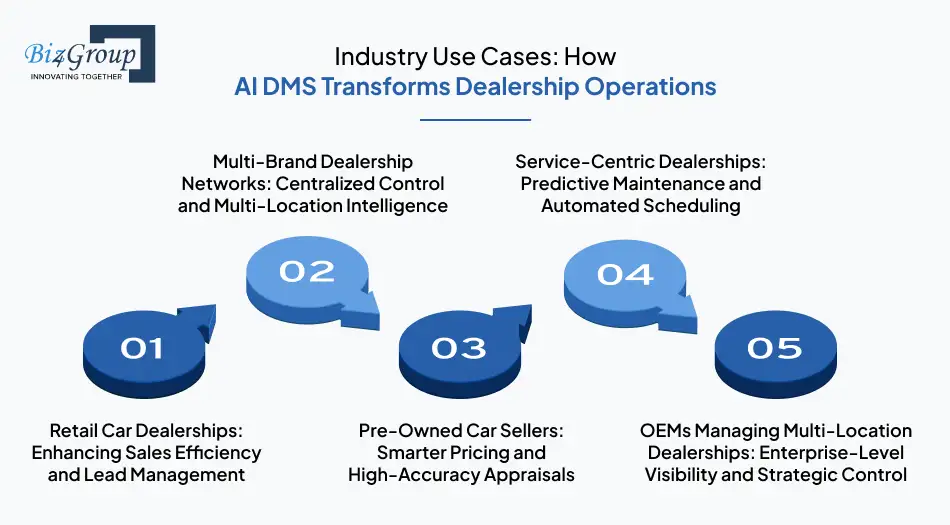
AI-driven Dealership Management Systems are not limited to one type of automotive business. Their impact is visible across retail, service, and enterprise-level dealership environments. Below is a revised, use-case–based format that explains how different industry segments actually use AI DMS paired with real software examples.
Retail car dealerships often face challenges like delayed lead responses, scattered customer data, and inconsistent sales performance. With AI car dealership management software development, platforms such as Dealertrack DMS and CDK Global Drive help overcome these limitations by automating lead workflows, centralizing customer insights, and enabling smarter decision making.
Example scenario: A retail dealership receives hundreds of online leads daily. AI DMS scores the leads, predicts customer buying intent, and recommends personalized follow-up messages. It even suggests which models to highlight based on browsing behavior, improving conversions and sales velocity.
Large dealership groups handling multiple brands and outlets require unified reporting, coordinated inventory, and consistent customer experiences. Platforms such as Reynolds and Reynolds ERA and Auto/Mate are designed to support enterprise-wide visibility.
Example scenario: A multi-location dealer group uses AI to monitor stock levels across all outlets in real time. If one store has excess SUVs and another is running low, the system suggests inter-branch transfers, reducing supply gaps while increasing sales opportunities.
Used-car businesses depend on precise pricing, risk assessment, and real-time market comparisons. AI systems like vAuto Provision, VinSolutions, and Dealer Inspire analyze thousands of market signals to help sellers determine the right buying and selling price.
Example scenario: When a customer brings a used vehicle for trade-in, the AI DMS evaluates condition, mileage, historical selling patterns, and regional demand. It then recommends an optimal offer value, helping dealers avoid overpayment and improving margins.
Dealerships focused on servicing rather than selling vehicles benefit greatly from predictive analytics and automated communication. Tools like Tekmetric and Shop-Ware help optimize technician allocation, service reminders, and repair forecasting.
Example scenario: The system reviews telematics or past service data and predicts which customers are due for brake checks or battery replacements. It immediately triggers personalized reminders, increasing service bookings while improving customer retention.
Vehicle manufacturers overseeing nationwide dealership networks rely on AI DMS solutions like Microsoft Dynamics 365 Automotive Accelerator and SAP Automotive Retail to unify processes and maintain brand alignment.
Example scenario: An OEM analyzes performance across hundreds of dealerships using AI dashboards. It identifies regions with higher SUV demand, shifts production accordingly, and ensures each dealership receives the right amount of stock at the right time.
These are the top use cases where AI powered Automotive Dealership Management Software delivers the most impact, helping every type of dealership operate with greater intelligence, accuracy, and profitability.
Modern dealerships need a powerful AI Automotive DMS that simplifies operations, personalizes customer engagement, and strengthens decision making. While developing an AI Automotive Dealership Management Software, the right set of foundational features ensures that sales, service, inventory, accounting, and customer experience run effortlessly.
These must have features form the core structure required to build a high performing automotive dealership system.
|
Feature |
Description |
|---|---|
|
AI Lead Management System |
An AI driven lead engine automatically captures leads from websites, marketplaces, ads, calls, and walk ins. It scores each lead based on buying intent and assigns them to the right salesperson. This ensures faster response times and prevents leakage across touchpoints. |
|
Smart CRM for Customer Lifecycle Tracking |
Tracks every customer interaction from inquiry to service history in one unified dashboard. AI identifies purchase signals, preferred engagement channels, and communication timing. This enables more personalized follow ups and higher conversion rates. |
|
Vehicle Inventory Management |
Helps dealerships track vehicle availability, performance, aging stock, and ideal reorder levels in real time. AI predicts which models will sell faster and which should be discounted or promoted. This improves stock turnover and reduces unnecessary holding costs. |
|
Digital Sales and Deal Management |
Centralizes quoting, pricing, negotiation history, and sales documents in a structured platform. AI suggests best pricing strategies based on market trends and competitor insights. This increases salesperson efficiency and speeds up deal closures. |
|
Service Scheduling and Workshop Management |
Allows customers to book service appointments online and helps workshops allocate technicians and bays efficiently. AI predicts repair times and optimizes workflow to reduce bottlenecks. This increases throughput and customer satisfaction. |
|
Parts and Accessories Management |
Tracks availability, demand cycles, vendor information, and reorder levels for parts. AI recommends stock replenishment based on historical data and upcoming service bookings. This prevents delays and improves workshop efficiency. |
|
Accounting and Finance Automation |
Integrates billing, invoices, vendor payments, and tax calculations into the DMS. AI flags unusual transactions and improves accuracy in financial reporting. This eliminates manual errors and reduces administrative workload. |
|
Integrated Communication System |
Centralizes SMS, WhatsApp, email, and phone communications inside one platform. AI determines the ideal communication channel and timing to improve engagement rates. This streamlines customer outreach across all departments. |
|
Customer Self Service Portal |
Provides customers access to service updates, vehicle documents, payments, offers, and communication history. AI personalizes recommendations based on behavior and ownership data. This improves transparency and customer loyalty. |
|
Automated Marketing Campaigns |
Manages targeted marketing campaigns for new vehicles, services, reminders, and promotions. AI segments audiences automatically and delivers highly relevant offers. This reduces marketing costs and increases campaign ROI. |
|
Predictive Sales Forecasting |
Uses historical data and market trends to predict which vehicles customers will prefer in the coming weeks. The system helps dealerships plan inventory and identify potential sales opportunities. This improves decision making and reduces risk. |
|
Test Drive Management |
Manages test drive scheduling, vehicle availability, and feedback collection. AI identifies customers most likely to book and convert after a test drive. This ensures organized operations and better customer experiences. |
|
Document and Compliance Management |
Stores customer IDs, contracts, agreements, insurance, and regulatory documents securely. AI checks for missing data and suggests compliance improvements. This minimizes legal risks and speeds up deal closures. |
|
Reporting and Analytics Dashboard |
Offers real-time insights into sales, service performance, profitability, and customer engagement. AI helps identify performance gaps and opportunities for optimization. This improves operational transparency and management efficiency. |
|
Multi Location Management |
Provides centralized control for large dealership groups managing multiple outlets. AI ensures consistent pricing, unified inventory visibility, and standardized reporting. This improves governance and network wide performance. |
These essential features create a strong foundation for developing an AI Automotive Dealership Management Software that delivers long-term operational excellence and customer value.
As dealerships evolve into digital first businesses, advanced AI capabilities help them move beyond automation and gain true intelligence in their operations.
When creating an AI enabled Automotive DMS, these advanced modules provide deeper insights, predictive accuracy, and smarter workflows that strengthen competitiveness.
|
Advanced Feature |
Description |
|---|---|
|
Predictive Lead Conversion Engine |
Uses machine learning to determine which leads are most likely to convert based on past patterns and customer behavior. It prioritizes them for sales teams automatically. This increases conversions without raising workload. |
|
AI Driven Dynamic Pricing Engine |
Continuously evaluates market demand, competitor prices, dealership inventory aging, and customer profiles. It suggests ideal selling prices instantly. This improves profitability and reduces discounting losses. |
|
Automated Negotiation Assistants |
AI chat and voice assistants respond to customer questions, explain pricing, and provide finance options. They handle negotiations until a salesperson takes over. This improves engagement during peak hours and after hours. |
|
Virtual Car Buying Assistants |
These AI agents guide online customers with vehicle recommendations, comparisons, and feature explanations. They analyze customer preferences in real time. This builds trust and improve online sales conversions. |
|
Workshop Automation with AI Diagnostics |
Integrates with OBD scanners, telematics data, and vehicle health systems to predict potential issues. AI recommends repair actions and technician assignments. This reduces errors and increases workshop efficiency. |
|
Voice Enabled Operations |
Lets salespeople and service agents perform tasks like updating CRM, checking inventory, or scheduling service through voice commands. AI improves accuracy and speeds up field operations. |
|
AI flags suspicious transactions, manipulated documents, fake IDs, and inconsistent customer profiles. It protects dealerships from financial risks and compliance issues. |
|
|
Autonomous Inventory Reordering |
The system predicts future stock shortages and automatically sends purchasing requests to vendors. It ensures availability without overstocking. |
|
AI Based Customer Intent Prediction |
Monitors digital interactions, website journeys, and chat behavior to identify strong buying signals. AI alerts sales teams with next best actions. This improves conversion probability. |
|
Digital Twin for Dealership Operations |
Creates a virtual replica of dealership processes such as workshop flow, inventory movement, and customer traffic. AI runs simulations to optimize resource allocation. This improves planning and operational efficiency. |
These advanced features elevate the value of AI Automotive DMS Development by transforming traditional dealership operations into intelligent, future-ready ecosystems.
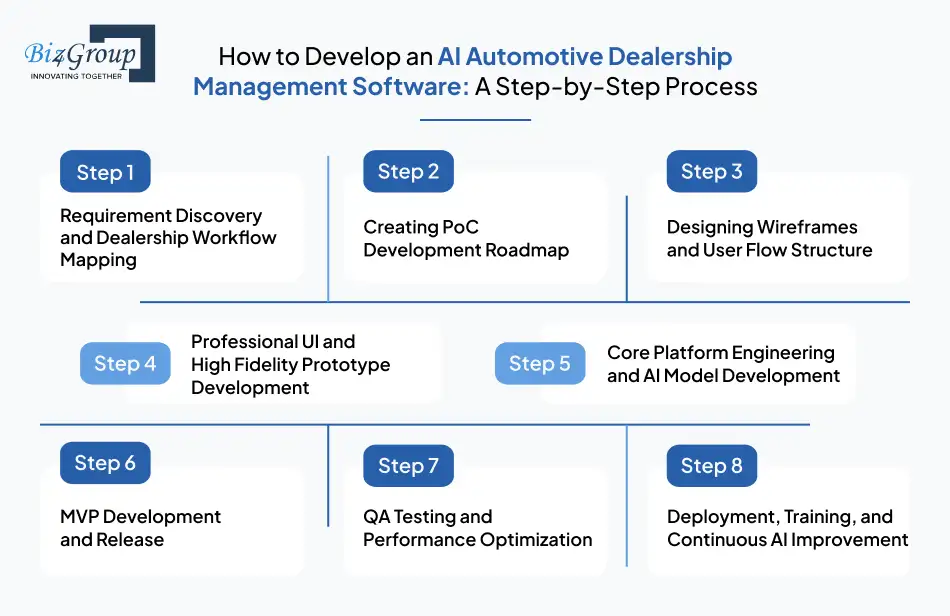
Developing an AI-powered Automotive Dealership Management System requires a structured and strategic approach. Businesses must align user needs, dealership workflows, and AI capabilities to build a scalable, intelligent, and high performing solution.
This step-by-step process explains what is the process of building an AI Automotive Dealership Management System while ensuring a smooth development journey.
Aim: To understand dealership processes, user expectations, and operational challenges.
The development journey begins with deep research into dealership operations, including sales, service, parts, customer interactions, inventory flow, and digital touchpoints. Teams analyze the Power of DMS in the Auto Industry to identify automation opportunities and AI usage areas. Workshops are conducted with sales teams, service advisors, and management to gather real-world insights. This step sets the foundation for defining the platform’s modules, features, and AI intelligence layers.
Aim: To validate the core AI concepts with minimal investment.
A Proof of Concept is created to test the feasibility of AI applications such as predictive lead scoring, automated communication, and AI powered dealership inventory management software capabilities. This helps stakeholders evaluate the accuracy of AI models, identify limitations, and visualize outcomes before full scale development. PoC Development minimizes risk, shortens development cycles, and ensures the final software delivers measurable business value.
Also Read: Top 12+ PoC Software Development Companies in the USA
Aim: To structure a user-friendly and intuitive interface for all dealership roles.
Before building the product, wireframes and flowcharts are designed to map how users move across modules such as CRM, inventory, workshop management, finance, and analytics. As a UI/UX design company would ensure, the goal is to deliver a clean, simple, and task driven experience for sales teams, service advisors, managers, and customers. Every screen is evaluated for usability, clarity, responsiveness, and accessibility.
Also Read: Top 15 UI/UX Design Companies in USA
Aim: To visualize the complete platform before coding begins.
A high-fidelity interactive prototype is created to demonstrate the final UI, navigation structure, dashboard components, and AI interactions. The prototype helps stakeholders test real user journeys like booking a test drive, generating quotes, assigning service tasks, and managing inventory. This stage reduces design revisions later and ensures a unified vision between designers, developers, and dealership stakeholders.
Also Read: The Ultimate Guide to Rapid Prototyping in Software Development
Aim: To build the complete system architecture with integrated AI capabilities.
This stage involves AI Software Development Companies in USA or expert engineering teams building the backend, frontend, database, and AI engines. AI models are trained using historical dealership data to enable features like predictive demand forecasting, automated lead qualification, and service time optimization. APIs are integrated for CRM, accounting tools, OEM platforms, marketing systems, and telematics devices. This is where the DMS transforms into a true AI-powered ecosystem.
Aim: To launch a functional Minimum Viable Product for real world validation.
An MVP Development phase focuses on releasing the essential modules including CRM, inventory, service scheduling, analytics, and communication tools. AI features are added gradually based on user feedback and dealership requirements. The MVP helps dealerships test workflows, identify usability gaps, and measure the impact on sales, service, and customer experience. Real usage insights guide the next round of improvements.
Also Read: Top 12+ MVP Development Companies in USA
Aim: To ensure reliability, accuracy, speed, and security across all modules.
Software testing companies perform end to end testing including functionality tests, AI accuracy tests, API testing, performance validation, and security auditing. The goal is to eliminate bugs, prevent data leaks, stabilize system response time, and ensure all AI recommendations are reliable. This step guarantees that the platform is ready for practical, high volume dealership operations without failures.
Aim: To deliver a smooth launch and long-term operational efficiency.
Once the system is deployed, dealership teams are trained to use each module effectively. AI learning pipelines are connected to ensure the platform keeps improving based on real user behavior and operational data. Regular updates add new features, improve predictions, and strengthen security. This step ensures dealerships maximize the benefits of AI in Dealership Management System operations.
Following this development process helps businesses successfully develop AI DMS platforms that deliver measurable value, intelligent automation, and modern dealership excellence.
Businesses planning their digital transformation often ask how much will it cost to build an AI Automotive Dealership Management Software and what influences the total investment. The development budget of an Automotive Dealership Management System integrating AI depends on the complexity of features, AI capabilities, integrations, scalability needs, and deployment environments.
On average, the AI Automotive Dealership Management Software Development Cost ranges from $ 40,000 - $300,000+, depending on the scope.
Below is a clear breakdown of the estimated AI DMS Platform development cost based on three project tiers.
|
Software Type |
Cost Range |
What You Get |
|---|---|---|
|
Basic AI Automotive Dealership Management Software (MVP Version) |
$40,000-$80,000 |
Includes essential CRM, vehicle inventory management, basic lead management, user roles, appointment booking, simple reporting, and limited AI features such as automated responses and basic lead scoring. Ideal for early validation, smaller dealerships, or businesses building their first PoC or MVP to test the market. |
|
Medium AI Automotive Dealership Management Software |
$80,000-$180,000 |
Includes all core modules such as CRM, inventory, service management, accounting integration, communication hub, advanced analytics, and stronger AI features like predictive sales, demand forecasting, auto assignment, and personalized recommendations. Suitable for growing dealerships and multi-location networks. |
|
Advanced AI Automotive Dealership Management Software |
$180,000-$300,000 |
Full scale enterprise grade solution with advanced AI models, automated workflows, dynamic pricing, AI powered service diagnostics, digital twin modules, fraud detection, multi-location management, cloud scalability, third party API integrations, and complete customization. Ideal for large dealership groups, OEMs, and nationwide networks. |
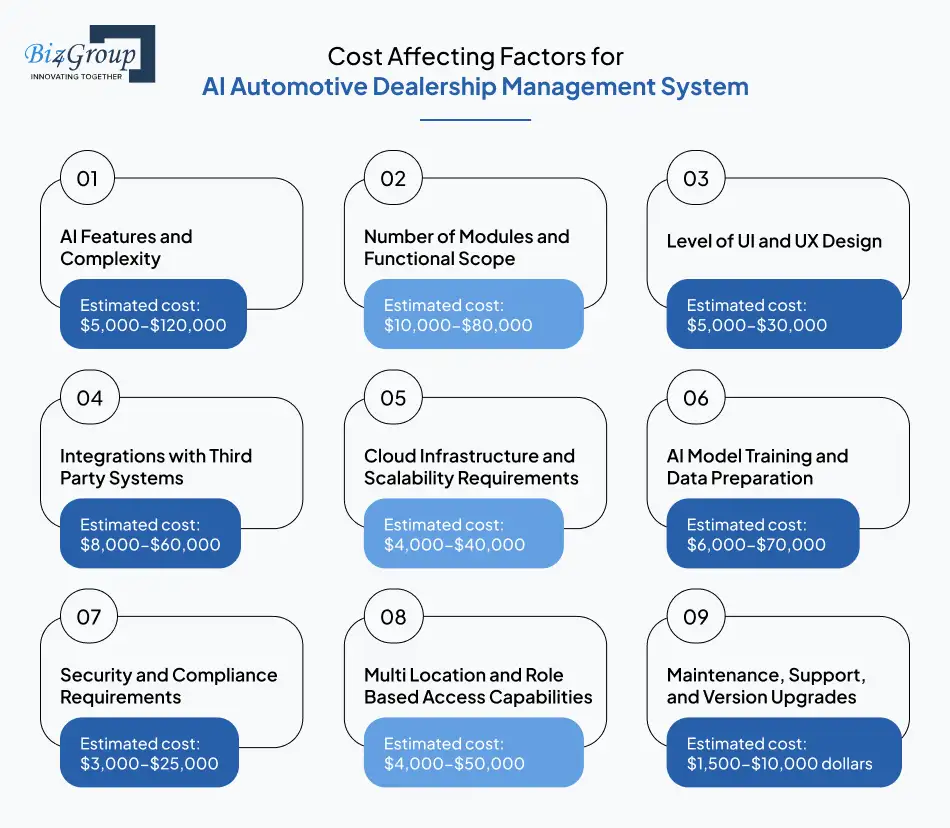
The cost of developing AI Automotive Dealership Management Software for the auto industry varies based on multiple business and technical factors. Each factor adds its own cost implication, as detailed below.
Cost Impact: $5,000-$120,000
The more advanced the AI modules, the higher the development cost. Basic AI tools like lead scoring cost less, while complex features like dynamic pricing engines, digital twin models, or autonomous inventory optimization increase the budget significantly.
Cost Impact: $10,000-$80,000
Platforms with CRM only are cheaper, while solutions with sales, service, accounting, marketing automation, telematics integration, and workshop management require more engineering time.
Cost Impact: $5,000-$30,000
Simple interfaces cost less, but advanced dashboards, custom user journeys, branded designs, and role-based screens increase the development effort.
Cost Impact: $8,000-$60,000
Integrations with OEM systems, marketplace listings, accounting software, finance tools, payment gateways, and telematics platforms require advanced backend engineering and API handling.
Cost Impact: $4,000-$40,000
Hosting the AI DMS on scalable cloud environments like AWS, Google Cloud, or Azure adds cost depending on storage, bandwidth, microservices, and server load.
Cost Impact: $6,000-$70,000
Preparing dealership data, cleaning it, training models, evaluating accuracy, and fine-tuning predictions contributes to a considerable part of AI DMS Platform development cost.
Cost Impact: $3,000-$25,000
Dealership systems handle customer data, documents, IDs, and payment information. Meeting security standards like SOC 2, GDPR, CCPA, and implementing multi layer protection adds cost.
Cost Impact: $4,000-$50,000
Dealership groups with multiple outlets require centralized control, synced inventory views, and complex permission systems which increase development time.
Cost Impact: $1,500-$10,000 dollars
Continuous updates, new AI improvements, bug fixes, feature upgrades, and monitoring ensure the system runs smoothly after launch.
Understanding these cost components helps businesses plan the most efficient investment strategy for AI DMS development and ensures the software aligns with long term dealership growth goals.
Building a high performing AI Automotive Dealership Management Software requires the right combination of technologies that support AI workloads, large data processing, and seamless multi module operations. A well-planned tech stack not only ensures system reliability but also enables smooth integrations across CRM, inventory, sales, service, finance, and customer experience platforms.
The following technology stack outlines the essential tools needed to develop a scalable, secure, and future ready AI DMS.
|
Category |
Technologies |
Explanation |
|---|---|---|
|
Frontend Development |
React, Angular, Vue.js, TypeScript |
These frameworks ensure fast, responsive, and intuitive user interfaces for both showroom teams and customers. They allow seamless navigation and support large scale dashboards required for dealership operations. TypeScript ensures type safety and reduces UI bugs during development. |
|
Backend Development |
These backend technologies support complex workflows like inventory syncing, lead allocation, service scheduling, and financial calculations. Python is also used when integrating AI models directly. Java and .NET Core are preferred for highly secure enterprise dealership environments. |
|
|
Databases |
PostgreSQL, MySQL, MongoDB, Firebase |
Relational databases like PostgreSQL and MySQL store structured dealership data such as sales, invoices, parts, and customer details. MongoDB supports flexible data structures needed for AI insights. Firebase enables real-time data sync for dealership operations. |
|
AI and ML Frameworks |
TensorFlow, PyTorch, Scikit-learn, OpenAI API |
These tools help develop intelligence features such as demand forecasting, automated lead scoring, pricing optimization, and predictive maintenance. They enable training and deploying machine learning models used across the DMS. |
|
Cloud Platforms |
AWS, Google Cloud, Microsoft Azure |
Cloud solutions offer scalable storage, fast compute resources, and ready AI services. They support multi location dealerships and ensure that data is synchronized across all departments securely and efficiently. |
|
DevOps Tools |
Docker, Kubernetes, Jenkins, GitHub Actions |
These tools manage continuous integration and deployment pipelines. They ensure stable updates, faster feature releases, and minimize downtime for dealership operations. Kubernetes supports auto scaling during peak workloads. |
|
APIs and Integrations |
REST APIs, GraphQL, Automotive OEM APIs, Payment Gateway APIs |
These tools connect the DMS with CRM systems, automotive inventory sources, OEM data feeds, payment processors, marketing platforms, and dealership websites. Proper integration improves automation and reduce manual operations. |
|
Security Tools |
JWT Authentication, OAuth 2.0, SSL certificates, Cloud Firewalls |
Security solutions protect sensitive dealership data such as customer records, pricing strategies, and financial information. These tools ensure compliance with industry standards and prevent unauthorized access. |
|
Real Time Services |
WebSockets, MQTT, Pub/Sub messaging |
These services support instant updates for inventory status, lead notifications, service progress tracking, and internal communication. Real-time systems are essential for high-performance AI DMS. |
|
Analytics and BI Tools |
Power BI, Tableau, Google Looker, Elastic Stack |
These tools visualize sales performance, customer trends, pricing insights, and AI predictions. They provide leadership with actionable dashboards that improve strategic decision making. |
|
Testing Tools |
Selenium, Postman, JMeter, Cypress |
Testing tools ensure consistent system performance, reliable API communication, and error-free user experiences. They help maintain high quality standards during development and post deployment. |
A well designed technology stack is the foundation for creating a secure, scalable, and intelligent AI Automotive Dealership Management Software that supports long-term business growth.
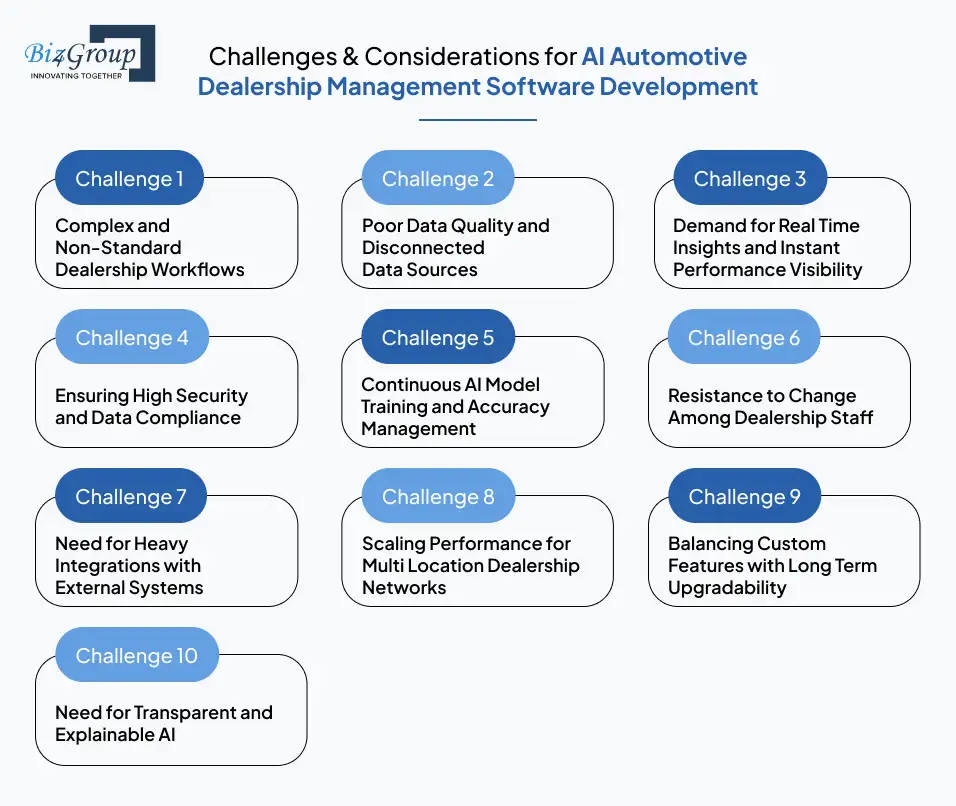
Creating an AI powered Automotive Dealership Management Software involves far more than building traditional DMS modules. Dealerships operate through complex workflows, rely heavily on accurate data, and expect real time insights across every department. Addressing these challenges with the right strategies ensures the AI DMS becomes a long-term asset rather than an operational burden.
Below are a detailed breakdown of the major challenges and the solutions that make successful development possible.
Dealerships rarely operate under a uniform process. Sales negotiations, test drive flows, service inspections, finance approvals, and parts ordering each differ across teams and locations. This creates significant complexity during software architecture planning and makes it difficult to design workflows that align with day-to-day dealership realities.
Adopt a modular and configurable system design that allows processes to be tailored without rebuilding the entire platform. Conduct interviews and process mapping workshops with sales, service, parts, and finance teams to capture real operational patterns. This ensures the software reflects actual dealership workflows instead of forcing teams to change their methods.
Dealership data often lives in outdated DMS platforms, spreadsheets, offline files, and multiple unconnected CRM systems. Duplicate records, missing data, and inconsistent fields can severely limit AI accuracy and make automation unreliable.
Implement automated ETL workflows that extract, clean, and transform all data into a unified format before feeding it into the AI engine. Use validation rules, deduplication scripts, and structured data models to ensure long-term cleanliness. This foundation enables accurate predictions, cleaner reports, and stronger insights.
Dealership teams need real-time information on leads, vehicle availability, service updates, and pricing trends to make quick decisions. If the system processes data slowly, this affects customer engagement and business performance.
Use distributed cloud infrastructure, memory processing, and event driven pipelines to deliver instant updates in dashboards and notifications. Real-time syncing ensures sales teams respond faster; managers get immediate visibility, and customers experience faster service.
Dealerships manage personal data, driver license information, financing details, and transactional records. This makes security breaches extremely risky and can lead to legal and financial consequences.
Implement strong encryption, secure password protocols, role-based access controls, multi-factor authentication, and detailed activity logs. Follow global data protection guidelines such as CCPA and GDPR. Regular security audits ensure that the AI DMS remains compliant at all times.
AI models lose accuracy when data patterns change, such as shifts in market demand, seasonal inventory trends, or new vehicle launches. Unmaintained models can generate incorrect predictions and reduce trust among users.
Set up a consistent AI lifecycle management system that retrains models using updated dealership data. Use monitoring dashboards to track prediction accuracy, outlier behavior, and model drift. This ensures recommendations remain relevant and trustworthy.
Dealership teams often rely on familiar manual processes or legacy systems. Introducing an AI powered platform may feel overwhelming, which can reduce adoption and lead to wasted investment.
Design simple and intuitive user interfaces supported by guided workflows, tool tips, and onboarding videos. Offer training sessions and phased rollouts to help staff adapt gradually. Role-based dashboards improve adoption by showing only relevant features to each team.
A modern AI DMS must integrate with accounting software, OEM inventory feeds, CRM tools, service equipment, marketing platforms, and payment gateways. Poor integration planning leads to sync delays and operational errors.
Use standardized APIs, integration middleware, and modular connectors to ensure smooth communication between systems. Establish a clear integration roadmap during the architecture phase to avoid unexpected delays later.
Large dealership groups require unified visibility into all locations while maintaining smooth operations at each store. High transaction volume and multi-store data syncing can slow performance if not designed properly.
Use cloud environments with horizontal scaling capabilities, distributed databases, and microservice architecture. These technologies support fast data processing even when multiple branches operate simultaneously.
Dealerships often request highly customized workflows, which can make future enhancements more difficult and costly.
Separate core system logic from customizable modules. Use configuration panels that allow personalized workflows without impacting system stability. This approach preserves flexibility while ensuring long-term maintainability.
Dealership managers want clarity behind AI suggestions such as pricing recommendations, lead scoring, or inventory forecasting. Black box predictions reduce trust and limit adoption.
Integrate explainable AI methods that show the reasoning behind each recommendation. Provide breakdowns of key influencing factors and historical patterns so managers can make informed decisions with confidence.
When these challenges are addressed with the right strategies, businesses can successfully build an AI Automotive Dealership Management Software that delivers consistent performance, high adoption, and long-lasting value.
Choosing the right technology partner is essential when investing in AI Automotive Dealership Management System Development. Biz4Group stands out as a trusted industry leader with deep expertise in AI driven business platforms, enterprise system architecture, and automotive workflow automation. As an experienced AI Development Company, Biz4Group helps dealerships transform traditional operations into intelligent, data powered ecosystems that improve sales performance, service efficiency, and operational profitability.
Biz4Group has been building AI-enabled solutions for more than a decade and offers end-to-end support for building an AI Automotive Dealership Management Software tailored to real business needs. The team understands dealership challenges such as fragmented data, manual processes, inconsistent lead handling, and slow service coordination. Their development framework ensures that each module from CRM to inventory to service to reporting works seamlessly through advanced AI automation.
Biz4Group has developed platforms for sales operations, marketplace systems, mobility products, and equipment management. This experience helps them design systems that fit the real workflow of automotive dealerships.
Biz4Group specializes in developing an AI Automotive Dealership Management System using AI capabilities such as predictive analytics, automated lead scoring, demand forecasting, and service automation. Their solutions improve decision making and operational speed.
From ideation to UI design to development to launch, Biz4Group manages the full journey. Their team handles integrations, AI model training, quality assurance, and deployment to ensure complete reliability.
Our team has delivered intelligent platforms across multiple industries. A notable example is their Innovative Social Platform for Gemstone Trading, designed to connect buyers, sellers, and traders in a secure real-time marketplace. This demonstrates their capability to build complex, multi-workflow systems with advanced features.
Every dealership operates differently. Biz4Group follows a flexible architecture approach that allows customization while maintaining long term system scalability. As a custom software development provider, they ensure the AI DMS grows alongside the dealership.
Biz4Group designs systems that integrate with OEM data feeds, accounting tools, CRM platforms, marketing tools, and payment systems. Their cloud expertise ensures consistent performance even across multi-locate dealership networks.
The team provides ongoing monitoring, model tuning, enhancements, and updates to keep the AI DMS aligned with evolving market trends and dealership needs.
With the right expertise, strong AI capabilities, and a proven development approach, Biz4Group is an ideal partner for AI DMS development and for businesses planning to build a modern, intelligent, and scalable Automotive Dealership Management System.
Well, AI is rapidly transforming how modern dealerships operate, enabling businesses to streamline workflows, make smarter decisions, and deliver personalized customer experiences. From predictive inventory planning to automated sales assistance and real-time analytics, AI Automotive Dealership Management Software is becoming a growth engine for future-ready dealerships.
As automotive retail becomes more competitive, adopting AI-powered systems helps dealerships reduce operational bottlenecks, enhance customer engagement, and increase overall profitability. With the right AI-driven DMS in place, businesses can unlock higher efficiency, better transparency, and stronger long-term scalability.
If you’re looking to modernize your dealership operations, improve accuracy, and gain a competitive edge, now is the best time to invest in intelligent automation.
Book an appointment today to explore how AI can elevate your dealership’s digital transformation journey.
AI tools use predictive analytics, chatbots, recommendation engines, and automated follow-ups to deliver personalized experiences. This helps dealerships convert more leads, reduce response times, and offer tailored vehicle suggestions based on customer behavior and preferences.
The cost varies based on features, complexity, tech stack, customization, and the depth of AI automation involved. Typically, an AI-powered Dealership Management System ranges from $40,000 to $300,000+. Startups can opt for mid-budget solutions with essential automation, while large enterprises often invest in high-end platforms with predictive AI, advanced analytics, and deep integrations.
Yes, modern AI systems can integrate with existing CRMs, accounting tools, lead management solutions, and inventory platforms. API-based architectures allow smooth data flow, ensuring minimal disruptions to your current operations.
The development timeline depends on platform complexity, custom workflow requirements, AI model training, and third-party system integrations. On average, an MVP version takes around 3 to 5 weeks, offering essential modules and basic AI capabilities. A fully advanced and highly customized AI-driven DMS may take 6 to 10 weeks or more, especially when scalability, multi-location support, and predictive AI features are included.
Yes, when built with proper encryption, access controls, and compliance standards, an AI Automotive DMS provides strong security for financial records, customer data, service histories, and transactional information. Regular audits and secure cloud infrastructure further strengthen protection.
Not necessarily. Most AI-driven systems are designed with user-friendly dashboards, automated workflows, and guided insights. Teams can operate the platform easily with minimal training, and automation reduces the need for deep technical involvement.
Absolutely. AI optimizes staffing, automates repetitive tasks, reduces errors, streamlines inventory, and improves demand forecasting. These enhancements help dealerships cut unnecessary costs and increase revenue efficiency across departments.

with Biz4Group today!
Our website require some cookies to function properly. Read our privacy policy to know more.