Location :
Orlando, FL, USA
Location :
Orlando, FL, USA +1 (407) 714-1616
 info@biz4group.com

















Imagine a digital system that doesn’t wait for instructions but instead, understands your business goals, learns from real-time feedback, and takes independent actions to get the job done.
Read More

What if your business could welcome every visitor, answer every query, and schedule every appointment without human limitations or operating hours?
This is no longer a future concept. AI Receptionist Avatars are rapidly transforming how modern businesses manage customer interactions at the front desk. From corporate offices and hospitals to hotels and real estate firms, organizations are increasingly adopting AI digital human development as a receptionist to improve efficiency, consistency, and customer experience.
AI Receptionist Avatar Development enables businesses to deploy intelligent virtual receptionists that can communicate naturally through voice or text, understand user intent, and respond in real time. These avatars are not simple chatbots. They are visually engaging, brand aligned digital humans designed to act as the first point of contact for customers, clients, and visitors.
For decision makers, founders, operations managers, and enterprise leaders, understanding how to create an AI Receptionist Avatar is becoming a strategic necessity. Whether you are exploring building AI Receptionist Avatar solutions for your website, kiosk, or virtual office, or looking to create virtual receptionist avatar solutions that integrate with your existing systems, the opportunities are significant.
As competition intensifies and customer expectations continue to rise, businesses are seeking smarter ways to scale interactions without scaling costs. Many are now partnering with top AI avatar development companies to develop AI receptionist avatars for businesses that deliver both automation and personalization.
This complete guide is designed for business owners, CTOs, product leaders, and innovation teams who want a clear, practical understanding of AI Receptionist Avatar Development from concept to deployment.
An AI Receptionist Avatar is a virtual, human-like digital assistant designed to perform traditional receptionist tasks using artificial intelligence. Unlike basic chatbots, these avatars often include a visual representation such as a digital human face, body, or animated character that interacts naturally with users.
AI receptionist avatars can greet visitors, answer questions, schedule appointments, direct inquiries, and provide information across multiple platforms such as websites, mobile apps, kiosks, and virtual offices. They combine conversational AI with visual engagement to create a more human and trustworthy interaction.
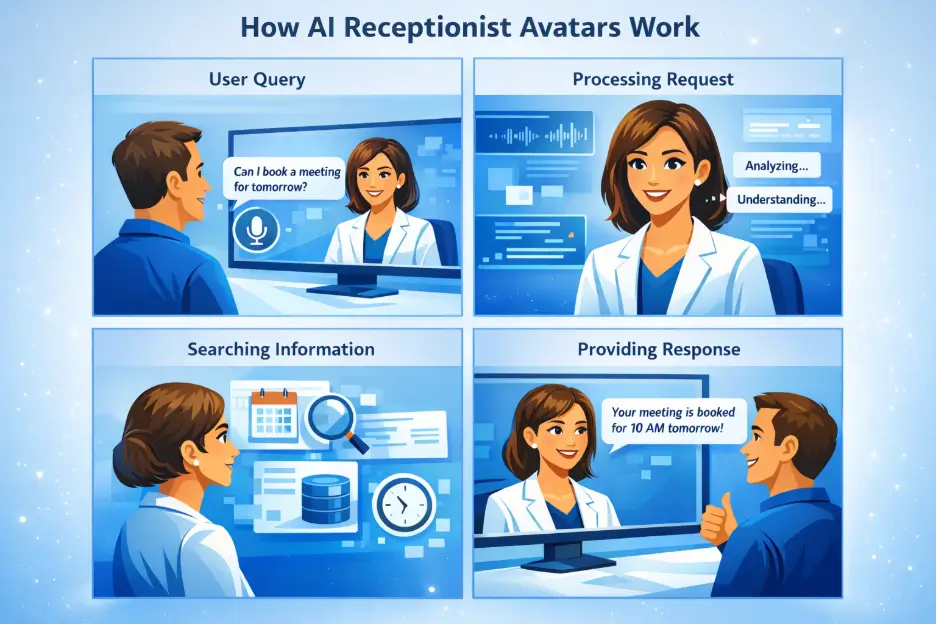
AI receptionist avatars function through a coordinated set of advanced technologies that enable natural, real-time interactions with users. The process begins when a visitor speaks or types a question through a website, kiosk, or application. Voice inputs are processed using speech recognition technology, while text inputs are analyzed directly by language processing systems.
Once the input is captured, natural language processing analyzes the message to understand the user’s intent, context, and urgency. This allows the AI receptionist avatar to recognize whether the request is about booking an appointment, asking for information, checking availability, or routing the conversation to the correct department.
The AI engine then generates an appropriate response using trained conversational models and business specific knowledge bases. If required, the avatar accesses connected systems such as calendars, customer relationship management platforms, visitor management software, or internal databases to complete tasks accurately.
Finally, the response is delivered through realistic voice output, facial expressions, and synchronized lip movement, creating a human-like interaction. Over time, the system continuously improves by learning from interactions, ensuring higher accuracy, faster responses, and more personalized communication for every visitor.
Modern businesses are operating in an environment where customers expect instant responses, consistent communication, and personalized experiences across every channel. Traditional reception models often fall short due to limited working hours, rising labor costs, and the inability to scale efficiently during peak demand. This gap is driving organizations to rethink how front desk and first contact interactions are managed.
Investing in AI Receptionist Avatar Development helps businesses overcome these limitations by enabling smarter, always available customer engagement. Companies that build AI powered receptionist avatars gain the ability to automate routine interactions while maintaining a professional and human-like brand presence.

Source: Mckinsey report
For forward thinking leaders, AI receptionist avatar development for businesses represents a strategic move rather than a technological experiment. By choosing to develop AI driven receptionist avatar solutions, organizations position themselves to meet evolving customer expectations, improve operational efficiency, and remain competitive in a rapidly digitizing market.
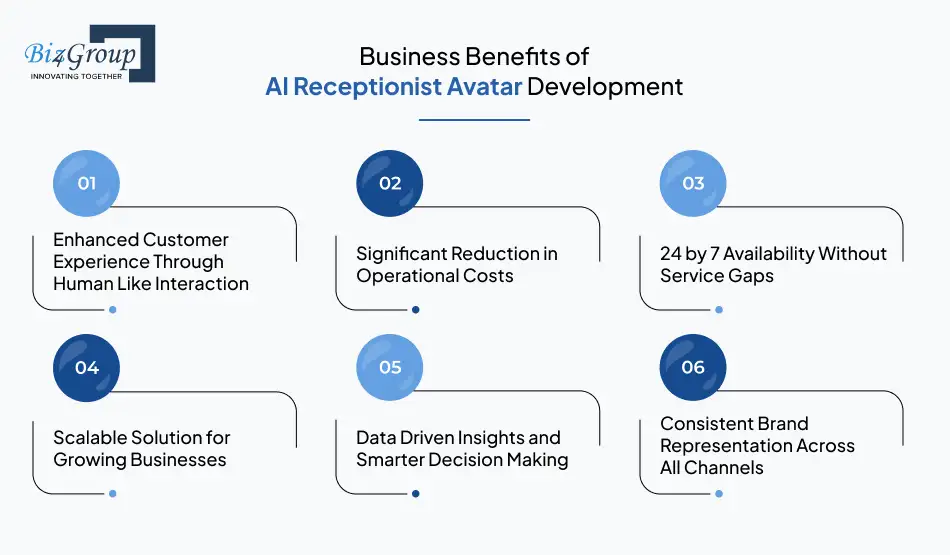
AI receptionist avatars are transforming how businesses manage customer interactions by blending intelligence, automation, and visual engagement. These solutions do more than replace traditional reception tasks. They create scalable, consistent, and high-quality experiences across all customer touchpoints. Below are the key advantages of AI Receptionist Avatar Development explained in detail.
When businesses build AI-powered receptionist avatars with voice and visuals, they significantly improve how customers perceive and interact with the brand. Unlike text-based AI chatbots, AI receptionist avatars use natural speech, facial expressions, and visual cues to communicate in a more human and relatable way. This helps customers feel welcomed rather than processed by a system.
Human interaction reduces friction during conversations and makes users more comfortable sharing information or completing actions. Customers are more likely to stay engaged when interactions feel intuitive and personal. Over time, this improved experience leads to higher satisfaction rates, stronger trust, and increased brand loyalty, especially for customers facing industries where first impressions matter most.
One of the most impactful advantages of AI Receptionist Avatar Development is its ability to reduce ongoing operational expenses. Businesses that deploy avatar-based solutions can minimize reliance on large reception or support teams while still maintaining consistent service quality. AI receptionist avatars do not require salaries, training cycles, or shift management.
Once implemented, these avatars can manage thousands of interactions simultaneously without additional cost. This efficiency allows organizations to redirect human resources toward strategic roles that require creativity, problem solving, or relationship building. Over time, the cost savings generated by AI receptionist avatars contribute directly to improved profitability and operational sustainability.
Modern customers expect immediate responses regardless of time or location. When companies create AI avatar receptionist platforms, they eliminate service interruptions caused by business hours, holidays, or time zone differences. AI receptionist avatars remain available at all times, ensuring that inquiries are addressed promptly.
This constant availability is particularly valuable for global businesses and digital platforms where customer engagement happens around the clock. By responding instantly to queries, AI receptionist avatars reduce wait times and prevent missed opportunities. Continuous service not only enhances customer satisfaction but also increases lead capture, appointment bookings, and overall engagement across all channels.
As businesses expand, managing increasing volumes of customer interactions becomes a challenge. Avatar based AI receptionist development offers a highly scalable solution that grows alongside the organization. Unlike human teams, AI avatars can handle sudden spikes in demand without delays or quality degradation.
Whether a business is opening new locations, launching new services, or experiencing seasonal traffic surges, AI receptionist avatars adapt instantly. This scalability ensures consistent customer experience without the need for constant hiring or training. As a result, businesses maintain operational efficiency while supporting growth in a predictable and cost-effective manner.
AI receptionist avatars generate valuable data from every interaction, including customer preferences, frequently asked questions, and behavioral patterns. This data helps businesses gain deeper insights into customer needs and service gaps. Over time, these insights can be used to improve service workflows, optimize messaging, and enhance product offerings.
By analyzing interaction data, businesses can make informed decisions rather than relying on assumptions. AI driven insights support better marketing alignment, improved customer journeys, and proactive service enhancements. This continuous learning loop ensures that AI receptionist avatars become smarter and more effective with ongoing use.
Maintaining a consistent brand voice across multiple customer touchpoints can be difficult, especially as businesses scale. AI receptionist avatars are programmed to follow specific brand guidelines in tone, language, and visual identity. This ensures uniform communication regardless of interaction volume or platform.
Consistent brand representation builds credibility and trust with customers. Every greeting, response, and interaction reinforces the same professional image. Over time, this reliability strengthens brand recognition and helps businesses establish a strong, memorable presence across digital and physical environments.
By leveraging Avatar based AI receptionist development, businesses unlock measurable efficiency, improved customer engagement, and long-term scalability that drives sustainable digital growth.
Transform your front desk experience with a smart AI receptionist avatar tailored to your business needs.
Book a Free Consultation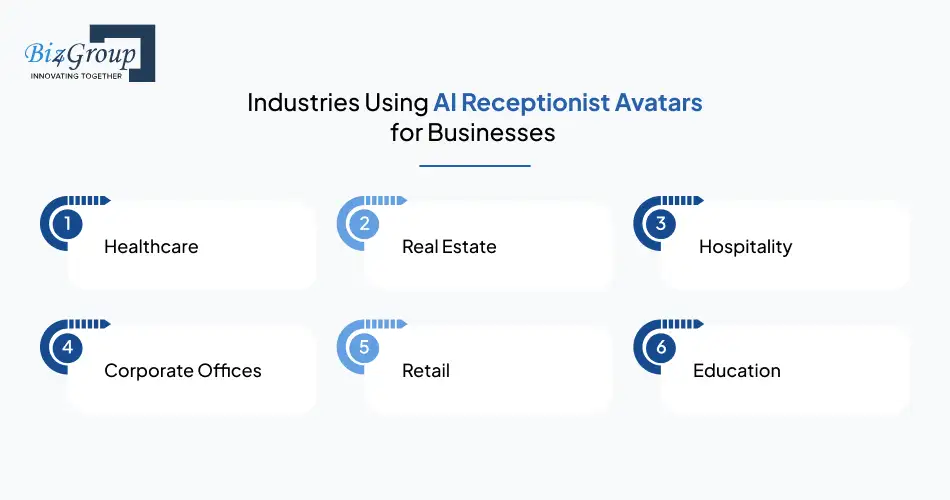
AI receptionist avatars are quickly becoming a practical solution for businesses that manage high volumes of customer interactions every day. As organizations seek smarter ways to engage users, streamline front desk operations, and control costs, AI powered reception solutions are moving from optional innovation to operational necessity.
Across industries, companies are choosing to make AI receptionist avatar to reduce staffing costs while still delivering responsive, personalized service. Whether it is welcoming visitors, answering inquiries, or scheduling appointments, businesses are beginning to build AI receptionist avatars for customer engagement that work around the clock.
Below are key industries already adopting these solutions, along with real world examples that show how organizations are successfully implementing AI receptionist avatars today.
Use Case: Patient check-in, appointment scheduling, information desk
Real World Example: Boston Children’s Hospital implemented an AI powered virtual assistant that handles routine patient questions, appointment reminders, and check-in assistance. This automation reduced call volume to staff and helped patients access timely information without waiting for human receptionists.
By choosing to develop interactive receptionist avatars, healthcare providers are able to deliver consistent support in busy environments while allowing clinical staff to prioritize medical care.
Also Read: Custom AI Healthcare Software Development - A Complete Guide
Use Case: Lead qualification, property information, scheduling tours
Real World Example: Real estate firms like Keller Williams and RE/MAX partner with AI solution providers to deploy bots on property listings pages and kiosks at open houses. These systems engage visitors immediately, answer basic questions about properties, and schedule follow-up tours.
When agencies build AI receptionist avatars for customer engagement, they ensure potential buyers receive instant responses 24 by 7, increasing lead conversion rates and reducing missed opportunities.
Use Case: Guest check-in, concierge services, local recommendations
Real World Example: Accor Hotels piloted virtual concierge AI that assists guests with room check-in, local attractions, dining recommendations, and service requests via in-room tablets and mobile apps.
By using AI receptionists, hotels create AI avatar receptionist platforms that enhance guest experiences while freeing staff to focus on high value, personalized service moments.
Also Read: Hospitality AI Agents: Transforming Guest Engagement and Hotel Operations
Use Case: Visitor registration, employee notifications, meeting support
Real World Example: Siemens Office Locations have deployed digital reception solutions that greet visitors, capture visitor information, notify hosts, and provide wayfinding guidance.
These AI systems help enterprises make AI receptionist avatar to reduce staffing costs associated with full time front desk personnel, while ensuring security and efficiency in welcoming guests.
Use Case: Customer assistance, product lookup, promotions
Real World Example: Lowe’s Innovation Labs introduced an AI powered retail assistant capable of answering customer questions about products, availability, and directions inside stores. Although not a human face avatar in every case, the same principles apply to avatar-enhanced versions used by fashion and electronics retailers worldwide.
When retailers build AI receptionist avatars for customer engagement, customers receive self-service support that improves the in-store experience and reduces dependency on floor staff.
Also Read: Retail AI Agent Development: Automate Sales, Inventory & Customer Service
Use Case: Admissions support, student queries, event information
Real World Example: Arizona State University uses AI-based conversational assistants to answer student questions about enrollment, schedules, financial aid, and campus resources.
By choosing to develop interactive receptionist avatars, schools and universities can provide 24 by 7 support, reduce administrative burden, and ensure that prospective and current students receive accurate information without waiting in line or sending emails.
The above industry use cases highlight how businesses are successfully using AI receptionist avatars to improve engagement, efficiency, and front desk scalability.
To successfully develop AI digital human as receptionist, businesses must focus on core features that ensure reliability, usability, and consistent customer experience. These foundational capabilities form the backbone of any effective receptionist avatar and determine how well it performs across real world business scenarios.
When you develop AI-driven receptionist avatar solutions, these features are essential rather than optional.
|
Feature |
Description |
|---|---|
|
Voice Interaction |
Enables natural spoken conversations with users, allowing the avatar to receive and respond to voice-based queries smoothly. This improves accessibility and creates a more human-like experience at the front desk. |
|
Text Based Communication |
Allows users to interact via chat when voice is not preferred or feasible. This ensures flexibility across websites, kiosks, and mobile platforms. |
|
Natural Language Understanding |
Helps the avatar understand intent, context, and variations in user queries. This reduces misunderstandings and improves response accuracy over time. |
|
Appointment Scheduling |
Allows users to book, reschedule, or cancel meetings directly through the avatar. Integration with calendars ensures real time availability and accuracy. |
|
Visitor Registration |
Captures visitor details during check-in and store them securely. This streamlines front desk operations and improves visitor management efficiency. |
|
CRM Integration |
Connects the avatar with customer databases to retrieve or update customer information. This enables personalized interactions and better lead management. |
|
Multilingual Support |
Allows communication in multiple languages to serve diverse audiences. This feature is crucial for global and customer facing businesses. |
|
Custom Avatar Appearance |
Enables businesses to design avatars that match brand identity. Visual consistency helps strengthen brand recognition and trust. |
|
Security and Data Privacy |
Protect sensitive user data through encryption and secure access controls. This ensures compliance with data protection regulations. |
|
Allows the avatar to access FAQs, documents, and business information. This ensures accurate and up to date responses. |
|
|
Call and Query Routing |
Directs complex or high priority requests to the right department or human agent. This ensures smooth escalation when needed. |
|
Analytics and Reporting |
Tracks interactions, user behavior, and performance metrics. These insights help improve service quality and decision making. |
|
Platform Compatibility |
Supports deployment across web, mobile, and physical kiosks. This ensures a unified receptionist experience across channels. |
|
Easy Content Management |
Allows businesses to update responses and workflows without heavy technical effort. This ensures adaptability as business needs to evolve. |
|
Continuous Learning Capability |
Enables the avatar to improve responses using interaction data. This leads to better accuracy and personalization over time. |
These must have features to ensure that AI receptionist avatars deliver reliable performance, consistent service quality, and scalable front desk automation for businesses.
Looking to automate customer interactions with a branded, intelligent digital receptionist solution?
Talk to Our AI ExpertsAs organizations focus on building an AI Receptionist Avatar for modern businesses, advanced features play a critical role in differentiation and long-term value.
These capabilities help businesses move beyond basic automation and make scalable AI receptionist avatar solutions that deliver highly engaging and intelligent experiences.
|
Advanced Feature |
Description |
|---|---|
|
Emotion Detection |
Analyzes tone of voice or text sentiment to understand user emotions. This allows the avatar to respond more empathetically. |
|
Personalized Interaction Engine |
Uses past interactions and customer data to tailor responses. This creates a more individualized and relevant experience. |
|
Facial Expression Synchronization |
Matches facial movements with speech output for realistic communication. This enhances trust and visual engagement. |
|
Voice Customization |
Allows selection of voice tone, speed, and style aligned with brand personality. This improves brand consistency. |
|
Context Aware Conversations |
Maintains conversation history to deliver relevant follow up responses. This avoids repetitive or disconnected interactions. |
|
Predictive Assistance |
Anticipates user needs based on behavior patterns. This enables proactive suggestions and faster resolution. |
|
Omnichannel Experience |
Ensures seamless interaction across devices and platforms. Users can continue conversations without losing context. |
|
Smart Escalation Logic |
Automatically identify when human intervention is required. This ensures smooth handoff without customer frustration. |
|
Advanced Analytics Dashboard |
Provides deeper insights into engagement trends and performance metrics. This supports continuous optimization. |
|
Scalability and Load Management |
Handles high traffic volumes without performance issues. This ensures consistent service during peak demand. |
By incorporating these advanced capabilities, businesses can build future ready AI receptionist avatars that scale effortlessly while delivering intelligent, engaging customer interactions.
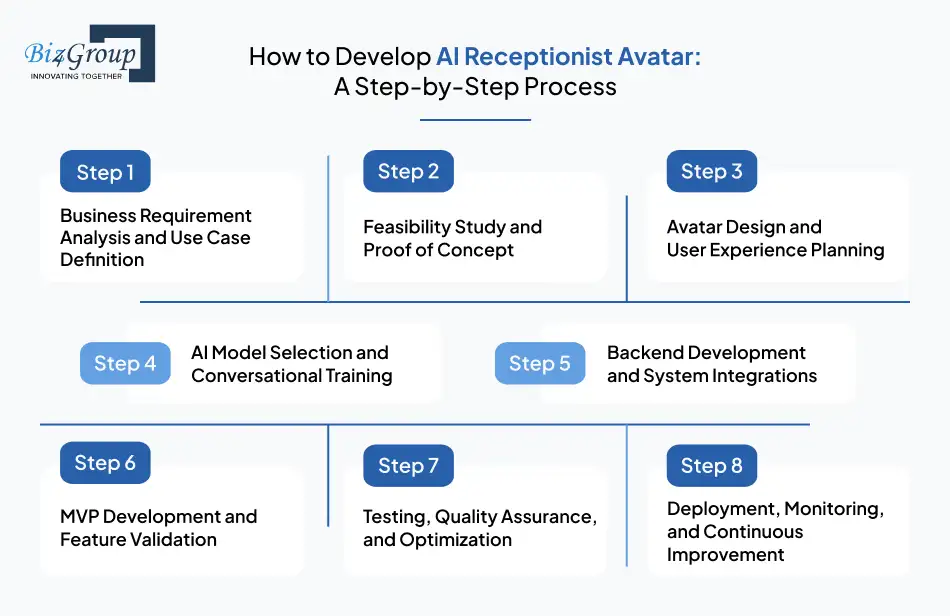
Creating an AI-powered receptionist avatar requires a structured and well-planned approach that balances technology, user experience, and business goals. The development process of AI Receptionist Avatar involves multiple stages, each contributing to accuracy, scalability, and real-world usability.
Below is a detailed breakdown explaining how businesses can successfully move from idea to deployment.
The first step in creating an AI Receptionist Avatar is understanding the business objectives and defining clear use cases. This includes identifying the type of interactions the avatar will handle, such as visitor greetings, appointment scheduling, or customer support queries. Stakeholders from operations, customer service, and IT should collaborate to outline expectations.
The goal of this step is to align the AI receptionist with real business needs rather than building a generic solution. Clear requirements help determine functional scope, integration needs, and success metrics. This foundation ensures the project remains focused and avoids unnecessary complexity during later stages.
Before full scale development, businesses often validate ideas through PoC development to test technical feasibility and user acceptance. This step involves building a limited version of the avatar to evaluate speech accuracy, response quality, and system compatibility.
The aim here is risk. A proof of concept helps teams assess whether the selected technologies can support voice, facial animation, and real time interactions effectively. Early feedback from internal users ensures the concept is viable before moving forward with higher investment and resource allocation.
Also Read: Top 12+ PoC Software Development Companies in the USA
Visual presence plays a critical role when learning how to build AI receptionist avatar with voice and face. This stage focuses on avatar appearance, personality, tone, and interaction flow. Businesses often collaborate with a professional UI/UX design company to ensure the avatar aligns with brand identity and user expectations.
The goal of this step is to create an intuitive and engaging experience that feels natural rather than mechanical. A well-designed avatar increases trust, encourages interaction, and improves overall customer engagement from the very first touchpoint.
Also Read: Top 15 UI/UX Design Companies in USA
At this stage, conversational AI models are selected and trained using business specific data, FAQs, and workflows. This enables the system to understand varied user inputs and respond accurately across different scenarios. Natural language understanding and speech recognition models are fine tuned to match the intended use cases.
The objective of this step is to ensure that the AI avatar can communicate effectively and handle real conversations. Strong training directly impacts accuracy, response relevance, and the overall effectiveness of the AI avatar development as a receptionist.
To develop AI receptionist avatars for customer service, backend systems must be integrated seamlessly. This includes calendar systems, visitor management tools, and customer databases. Many businesses also require an AI avatar receptionist with CRM integration to personalize responses and manage leads.
The goal of this step is operational efficiency. Proper integrations allow the avatar to perform actions rather than just answer questions. This transforms the AI receptionist into a functional business tool that supports workflows and automates routine tasks.
Once core components are ready, teams move toward MVP development to launch a functional version with essential features. This version is deployed in a controlled environment to gather real user feedback and performance data.
The aim of this step is to learn and optimize. An MVP helps validate assumptions, identify gaps, and refine features before full scale rollout. It ensures the solution delivers value early while remaining flexible for future enhancements.
Also Read: Top 12+ MVP Development Companies to Launch Your Startup
Thorough testing is essential to ensure reliability and accuracy. This includes functional testing, voice accuracy testing, security validation, and performance testing under load. Many organizations collaborate with experienced software testing companies to ensure high quality standards.
The goal of this step is to prevent risk. Comprehensive testing helps eliminate errors, improve response consistency, and ensure smooth interactions across platforms. This stage is critical to delivering a stable and trustworthy AI receptionist experience.
The final step to build an AI Receptionist Avatar involves deployment across chosen platforms such as websites, kiosks, or mobile applications. Post deployment monitoring tracks performance, user engagement, and system accuracy. Businesses often rely on top AI development companies for long term support and optimization.
The objective here is sustainability. Continuous learning and updates ensure the avatar remains accurate, scalable, and aligned with evolving business needs. This step ensures long term success beyond initial launch.
By following this structured approach, businesses can confidently move from concept to deployment and successfully make AI Receptionist Avatar solutions that deliver real customer service value.
The cost of building an AI receptionist avatar can vary significantly based on functionality, level of realism, integration, and long-term scalability. While some businesses start small to validate the concept, others invest in advanced solutions designed to handle complex customer interactions at scale.
On average, the cost to create AI Receptionist Avatar solutions ranges between $20,000 to $200,000+, depending on business requirements and technical complexity.
Average Cost Breakdown by Solution Type
|
AI Receptionist Avatar Type |
Estimated Cost Range |
Description |
|---|---|---|
|
Basic AI Receptionist Avatar (MVP) |
$20,000 to $40,000 |
Covers essential functionality with limited customization, ideal for validating the concept and initial deployment. |
|
Medium AI Receptionist Avatar |
$50,000 to $100,000 |
Includes enhanced interaction, better visuals, and deeper system integrations for growing businesses. |
|
Advanced AI Receptionist Avatar |
$120,000 to $200,000+ |
Fully customized, enterprise grade solution with advanced AI, analytics, and scalability. |
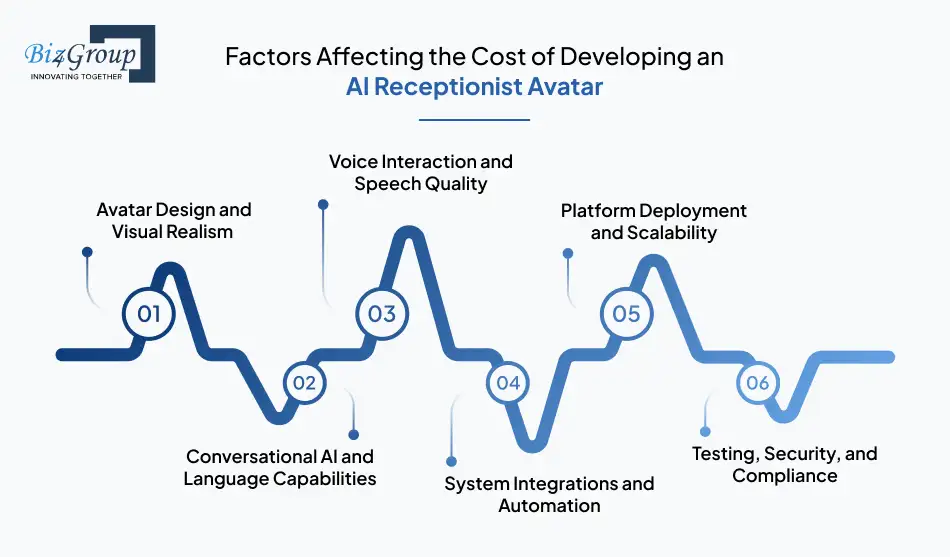
The visual quality of the avatar plays a major role in the AI Receptionist Avatar development cost. A basic 2D or semi realistic avatar may cost between $3,000 to $8,000, while highly realistic digital humans with facial expressions and lip synchronization can range from $15,000 to $40,000. Higher realism increases user trust but also increases design and rendering effort.
The complexity of natural language understanding directly affects the price of building an AI Receptionist Avatar. Basic conversational flows with predefined responses may cost $5,000 to $10,000. Advanced models trained on business specific data, capable of handling complex conversations, can increase costs to $25,000 or more depending on training and optimization requirements.
Adding voice input and natural sounding speech output increases the development budget of AI Receptionist Avatar solutions. Simple voice integration may cost around $3,000 to $6,000, while high quality voice synthesis with accent options and emotional tone control can push this to $10,000 to $20,000.
Integrations with calendars, CRM systems, visitor management tools, and internal software significantly impact the cost of creating AI Receptionist Avatar solutions. Basic integrations typically cost $5,000 to $10,000, while advanced CRM driven automation and workflow support can range from $15,000 to $30,000.
Deploying the avatar across multiple platforms such as websites, kiosks, and mobile applications increases the AI Receptionist Avatar development cost. Single platform deployment may add $4,000 to $8,000, while multi-platform and scalable cloud deployment can cost $12,000 to $25,000 depending on traffic and performance requirements.
Ensuring accuracy, security, and compliance are critical cost component. Testing and quality assurance may cost between $3,000 to $7,000, while enhanced security, encryption, and compliance features can raise this to $10,000 or more for regulated industries.
Understanding the cost of developing an AI receptionist avatar helps businesses plan the right investment level and build a solution that balances budget, functionality, and long-term value.
Also Read: How Much Does It Cost to Develop a Custom AI Avatar?
Building a reliable and scalable AI receptionist avatar requires the right combination of AI tools, frameworks, and infrastructure. Each layer of the technology stack plays a specific role in ensuring natural communication, smooth system integration, and consistent performance.
Below is a clear overview of the essential tools and technologies commonly used in the development of AI receptionist avatar solutions.
|
Technology Layer |
Tools and Technologies |
Explanation |
|---|---|---|
|
Natural Language Processing |
OpenAI, Google Dialogflow, Rasa, IBM Watson |
These tools enable the avatar to understand user's intent, context, and conversational flow. They form the core of intelligent communication and improve response accuracy over time. |
|
Speech Recognition |
Google Speech to Text, Amazon Transcribe, Microsoft Azure Speech |
Converts spoken input into text so the avatar can process voice-based queries accurately. This is essential for hands-free and voice-enabled interactions. |
|
Text to Speech |
Amazon Polly, Google Text to Speech, Microsoft Azure TTS |
Generates natural sounding voice responses. High quality speech output improves realism and user engagement. |
|
Avatar Design and Animation |
Unity, Unreal Engine, Blender, Adobe Character Animator |
Used to design and animate the digital human avatar. These tools handle facial expressions, lip synchronization, and visual realism. |
|
Computer Vision |
OpenCV, MediaPipe |
Enable facial tracking, gesture recognition, and visual feedback where required. This enhances realism and interactivity. |
|
Backend Development |
Node.js, Python, Java, .NET |
Supports business logic, data handling, and communication between AI components and external systems. |
|
API and System Integration |
REST APIs, GraphQL, Webhooks |
Allows the AI receptionist avatar to connect with calendars, CRM systems, visitor management tools, and internal databases. |
|
CRM and Business Tools |
Salesforce, HubSpot, Zoho CRM |
Enables personalized interactions, lead capture, and customer data management through seamless integration. |
|
Cloud Infrastructure |
AWS, Microsoft Azure, Google Cloud |
Provides scalable hosting, data storage, and computing power to support high interaction volumes. |
|
Analytics and Monitoring |
Google Analytics, Power BI, Kibana |
Tracks usage patterns, performance metrics, and interaction outcomes to support continuous improvement. |
|
Security and Compliance |
OAuth, JWT, SSL Encryption |
Ensures secure authentication, data protection, and compliance with privacy regulations. |
|
Content Management |
Custom CMS, Headless CMS |
Allows businesses to update scripts, workflows, and responses without technical complexity. |
Selecting the appropriate tools is not just a technical decision; it directly impacts the performance, user experience, and long-term success of your AI receptionist's avatar.
Discover how AI powered receptionist avatars can improve customer engagement and reduce operational costs.
Request a Live DemoWhen businesses decide to adopt AI receptionist avatars, one of the most important choices they face is whether to build a custom solution or use an off-the-shelf product. Both approaches have their place, but the right option depends on business goals, scale, branding needs, and long-term growth plans. Understanding the differences helps organizations invest wisely and avoid limitations later.
Custom AI receptionist avatar development involves designing and building a solution specifically tailored to a business’s workflows, brand identity, and customer engagement strategy. Every aspect, from avatar appearance and conversational flow to integrations and analytics, is developed to match exact requirements.
This approach is ideal for businesses that need deeper personalization, complex workflows, or industry-specific functionality. Custom solutions allow companies to build AI receptionist avatars with voice, face, and behavior aligned to their brand personality. They also support advanced features such as AI avatar receptionist with CRM integration, multilingual conversations, and scalable cloud deployment.
While the upfront investment is higher, custom development offers flexibility. Businesses maintain full ownership, can evolve features over time, and avoid vendor lock in. This option is commonly chosen by enterprises, growing startups, and customer experience focused organizations.
Off the shelf AI receptionist solutions are prebuilt platforms that can be quickly deployed with minimal customization. These tools typically offer standard features such as basic chat, limited voice interaction, and predefined workflows.
This option is suitable for small businesses or teams looking for a fast, low-cost entry into AI powered reception. Off the shelf solutions require less technical effort and can be live within days or weeks. However, they often come with limitations in branding, customization, and scalability.
As business needs evolve, organizations may face constraints related to integrations, advanced analytics, or personalization. Subscription based pricing models can also increase long term costs without providing full control over functionality or data.
Custom development prioritizes long term value, flexibility, and brand alignment, while off the shelf solutions emphasize speed and affordability. Businesses planning to scale, automate complex processes, or differentiate customer experience often benefit more from custom AI receptionist avatar development. Those with short term needs or limited budgets may find off-the-shelf tools sufficient initially.
|
Criteria |
Custom AI Receptionist Avatar Development |
Off the Shelf AI Receptionist Solutions |
|---|---|---|
|
Customization |
Fully tailored to business needs, branding, and workflows |
Limited customization options |
|
Brand Identity |
Complete control over avatar design and personality |
Generic avatar and interaction style |
|
Feature Flexibility |
Supports advanced and industry specific features |
Restricted to predefined features |
|
Integrations |
Seamless integration with CRM, calendars, and internal tools |
Limited or fixed integrations |
|
Scalability |
Easily scalable as business grows |
May face limitations at higher volumes |
|
Time to Market |
Longer development timeline |
Faster deployment |
|
Cost Structure |
Higher upfront investment, better long-term ROI |
Lower initial cost, recurring subscription fees |
|
Ownership and Control |
Full ownership of data and solution |
Vendor controlled platform |
|
Long Term Value |
High, with continuous evolution |
Moderate, dependent on provider roadmap |
Choosing between custom and off the shelf AI receptionist solutions ultimately depends on whether a business prioritizes speed and simplicity or long-term flexibility, scalability, and brand differentiation.

Selecting the right partner is a critical step in the successful development of AI Receptionist Avatar solutions. The capabilities, experience, and approach of your development partner directly influence the performance, scalability, and long-term value of the solution. Whether you plan to work with an AI Receptionist Avatar Development Company in USA or a global provider, careful evaluation helps reduce risk and ensures better outcomes.
Look for a partner with demonstrated experience in the development of AI Receptionist Avatar solutions rather than general software development. Review case studies, live demos, and portfolios to understand their expertise in conversational AI, voice interaction, and digital human design. A partner with relevant experience can anticipate challenges and deliver faster, more reliable results.
What to look for:
The right partner should have deep expertise in AI technologies such as natural language processing, speech recognition, and avatar animation. When you hire top AI Receptionist Avatar developers, ensure they understand both AI modeling and system integration. This balance is essential for building avatars that can communicate naturally while performing real business actions.
What to look for:
A strong partner focuses on tailored solutions rather than one size fits all platforms. The best AI Receptionist Avatar Development Partner will design solutions aligned with your brand, workflows, and future growth plans. Ask how they handle scalability, feature expansion, and performance under high user volumes.
What to look for:
AI receptionist avatars often require integration with CRM systems, calendars, visitor management tools, and internal databases. Ensure the partner has proven experience handling secure integrations and managing sensitive data. This is especially important when working with regulated industries or enterprise environments.
What to look for:
The success of an AI receptionist avatar depends heavily on user experience. A reliable partner prioritizes intuitive interaction design, natural conversation flow, and visually appealing avatars. This ensures higher adoption rates and better customer engagement from day one.
What to look for:
Data security and compliance should never be an afterthought. The right partner follows industry best practices for encryption, authentication, and privacy compliance. This reduces legal risks and protects customer trust throughout the lifecycle of the solution.
What to look for:
AI receptionist avatars require continuous monitoring and improvement. Ask about post launch support, performance optimization, and model updates. A partner committed to long term collaboration will help your solution evolve alongside changing business needs.
What to look for:
The hiring of right AI Receptionist Avatar Development Partner ensures not only successful deployment but also long-term scalability, performance, and return on investment for your AI powered receptionist initiative.
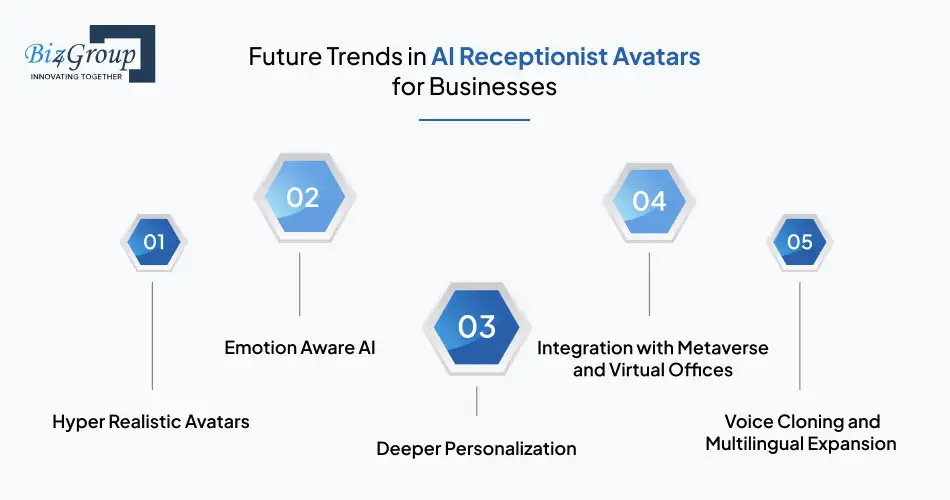
AI receptionist avatars are evolving rapidly as advances in artificial intelligence, graphics, and human computer interaction continue to accelerate. What started as basic automation is now moving toward highly intelligent, visually rich digital humans capable of meaningful engagement. The following trends highlight how AI receptionist avatars will shape the future of business interactions.
Future AI receptionist avatars will closely resemble real humans in appearance, movement, and expression. Improvements in facial animation, skin rendering, and lip synchronization will make interactions feel more natural and trustworthy. These hyper realistic avatars will help businesses create stronger emotional connections with customers, especially in industries where first impressions and professionalism are critical.
Emotion aware AI will allow receptionist avatars to detect user sentiment through voice tone, facial cues, or text patterns. By understanding emotions such as frustration, confusion, or urgency, the avatar can adjust its responses accordingly. This capability will improve customer satisfaction by delivering more empathetic and context sensitive interactions instead of scripted replies.
AI receptionist avatars will increasingly personalize conversations using customer history, preferences, and behavioral data. This goes beyond addressing users by name and extends to recommending services, prioritizing requests, and adapting communication style. Deeper personalization will help businesses create more relevant and engaging experiences while improving conversion and retention rates.
As virtual offices and immersive digital environments gain adoption, AI receptionist avatars will become standard entry points in these spaces. Businesses will deploy avatars to welcome visitors, guide meetings, and manage interactions inside virtual environments. This integration will redefine how organizations present themselves in digital first workplaces and customer experiences.
Voice cloning technology will enable businesses to create unique brand voices for their AI receptionist avatars, enhancing identity and recognition. At the same time, multilingual capabilities will expand to support more languages and accents with higher accuracy. This will allow businesses to serve global audiences seamlessly without increasing operational complexity.
These emerging trends indicate that AI receptionist avatars will continue to evolve into intelligent, human-like digital representatives that redefine how businesses interact with customers in the years ahead.
Also Read: AI Voice Cloning App Development
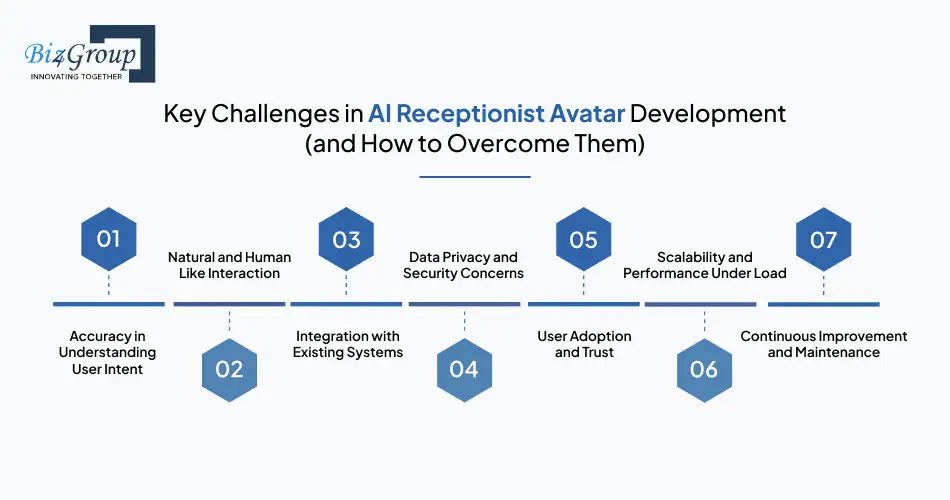
While AI receptionist avatars offer significant advantages, developing and deploying them comes with its own set of challenges. Understanding these obstacles early helps businesses plan effectively and implement solutions that deliver long term value. Below are the most common challenges in AI receptionist avatar development and practical ways to overcome them.
One of the biggest challenges is ensuring the avatar correctly understands diverse user queries, accents, and phrasing. Misinterpretation can lead to poor user experience and frustration.
How to overcome it:
Train the AI model using industry-specific data, real customer queries, and continuous feedback loops. Regular model tuning and updates help improve intent recognition and conversational accuracy over time.
Many AI avatars struggle to sound or behave naturally, making interactions feel robotic or scripted. This can reduce user trust and engagement.
How to overcome it:
Focus on conversational design, natural language flow, and realistic voice modulation. Combining well designed dialogue scripts with expressive avatar animations helps create more human-like interactions.
Connecting the AI receptionist avatar with CRM systems, calendars, and internal tools can be technically complex. Poor integration limits the avatar’s ability to perform real actions.
How to overcome it:
Plan integration early in the development process and use scalable APIs. Working with experienced developers ensures smooth data flow, secure connections, and reliable automation across systems.
AI receptionist avatars often handle sensitive customer and visitor information. Any security lapse can lead to compliance issues and loss of trust.
How to overcome it:
Implement strong encryption, access controls, and compliance with aligned data handling practices. Regular security audits and adherence to industry regulations help protect sensitive data.
Some users may hesitate to interact with an AI receptionist, especially in industries where human interaction is traditionally expected.
How to overcome it:
Design the avatar to clearly communicate its purpose and benefits. Offering seamless escalation to human agents when needed helps build confidence and encourages adoption.
As usage grows, AI receptionist avatars must handle increased interaction volumes without delays or system failures.
How to overcome it:
Use cloud-based infrastructure with load balancing and performance monitoring. Scalable architecture ensures consistent response times even during peak usage.
AI systems require ongoing updates to stay accurate and relevant. Neglecting maintenance can lead to outdated responses and reduced effectiveness.
How to overcome it:
Establish a long-term optimization strategy that includes monitoring, retraining models, and updating content regularly. Continuous improvement keeps the AI receptionist aligned with evolving business needs.
By proactively addressing these challenges with the right strategy and technology, businesses can build AI receptionist avatars that are reliable, secure, and capable of delivering consistent customer value at scale.
Developing an AI receptionist avatar is a strategic decision that impacts customer experience, operations, and brand perception. Biz4Group approaches this journey with a clear business mindset, focusing on practical outcomes rather than experimental technology. As an experienced AI Avatar development company, Biz4Group helps organizations move from concept to deployment with clarity, control, and confidence.
The team delivers tailored AI development solutions designed around real business workflows. Instead of offering generic tools, Biz4Group works closely with stakeholders to understand front desk challenges, customer interaction patterns, and scalability goals. This ensures the solution fits naturally into daily operations rather than forcing teams to adapt to the technology.
A critical part of this journey is seamless AI integration. Biz4Group ensures the receptionist avatar connects smoothly with existing systems such as CRM platforms, calendars, visitor management software, and internal databases. This allows the avatar to go beyond conversation and actively support business processes. For agencies and enterprises looking to scale offerings quickly, Biz4Group also provides White label AI receptionist avatar development, enabling faster go to market with fully branded solutions.
Here’s a real world avatar based solutions delivered by Biz4Group LLC, demonstrating hands on expertise in intelligent digital humans.
Avatar-based AI Companion: AI Wizard
AI Wizard is an avatar based AI companion developed by the Biz4Group team to support users during moments of boredom, stress, or information seeking. The solution was designed using D-ID for avatar rendering, which helped optimize development costs without compromising user experience. Conversational intelligence was powered by ChatGPT and Whisper AI, enabling natural voice-driven interactions.
This project reflects the practical foundation required for the creation of AI Receptionist Avatar for business use cases, where conversational accuracy, visual engagement, and system efficiency must work together.
Biz4Group emphasizes outcomes that matter, including adoption, performance, and measurable impact. Every solution is designed with scalability and optimization in mind, helping businesses improve the ROI of AI receptionist avatar solutions through reduced staffing dependency and better customer engagement.
With a structured and transparent approach to AI Receptionist Avatar Development, Biz4Group supports organizations at every stage, from planning and design to launch and continuous improvement. The goal is simple: to build an AI Receptionist Avatar that works reliably in real business environments and evolves as needs grow.
That’s why Biz4Group combines proven avatar expertise with a business focused approach to help organizations deploy AI receptionist avatars that deliver long term value, not just innovation.
Upgrade your customer experience strategy using scalable AI receptionist avatar solutions built for growth.
Get Started TodayFrom this above discussion, it is clear that AI receptionist avatars are no longer a futuristic concept but a practical solution for modern businesses aiming to improve efficiency, engagement, and scalability. From understanding how AI receptionist avatars work to exploring features, costs, industries, challenges, and future trends, this guide highlights why investing in AI driven front desk automation is a strategic move.
AI Receptionist Avatar Development enables businesses to deliver consistent customer experiences, reduce operational overhead, and stay competitive in an increasingly digital landscape.
Whether your goal is automation, better customer service, or long-term growth, an AI receptionist avatar can become a valuable digital asset when built with the right strategy and partner. As technology continues to evolve, early adoption positions businesses ahead of the curve rather than struggling to catch up later.
Ready to get started? Book an appointment today to discuss how an AI receptionist avatar can transform your business operations.
AI receptionist avatars can handle most routine and high-volume tasks such as greetings, scheduling, and basic inquiries. However, many businesses use them alongside human staff to manage complex or sensitive interactions.
Development timelines vary based on complexity, but most projects take between 4 to 6 weeks from planning to deployment, including testing and optimization.
Yes, avatars can be fully customized in appearance, voice, language, and communication style to align with a company’s brand and customer experience goals.
AI receptionist avatars are increasingly accessible for small and mid-sized businesses, especially when starting with a basic or scalable version that can grow over time.
Modern AI receptionist avatars use encryption, access controls, and compliance aligned practices to protect customer and visitor data securely.
Most AI receptionist avatars can integrate with tools like CRM systems, calendars, and internal databases, enabling them to perform real business actions beyond conversation.

with Biz4Group today!
Our website require some cookies to function properly. Read our privacy policy to know more.