 Location :
Orlando, FL, USA
Location :
Orlando, FL, USA +1 (407) 714-1616
 info@biz4group.com
- Proof of concept (PoC) development of an AI chatbot helps teams validate real use cases early, test assumptions, and make confident go or no-go decisions before scaling.
- A focused approach to AI chatbot PoC development reduces delivery risk by keeping scope tight, intent accurate, and validated conversation flow with real users.
- Businesses use PoCs to build AI chatbot PoC initiatives for customer support, internal workflows, and product discovery without committing to full scale builds.
- Industry data shows that a large share of AI initiatives fail to reach production, which is why early validation through a PoC is considered a standard decision-making step.
- The typical AI chatbot PoC development cost and timeline stays within USD 5,000 to USD 15,000, depending on scope, data readiness, and iteration cycles.
- A well-executed PoC sets the foundation to move forward with clarity, whether the next step is refinement, expansion, or a deliberate stop.
You have an AI chatbot idea that sounds solid in meetings, looks promising on slides, and even gets budget approval. But a quiet question keeps popping up. Will it actually work with real users, real data, and real expectations? That uncertainty is exactly where proof of concept (PoC) development of an AI chatbot fits in. It gives decision makers a controlled way to test assumptions before momentum turns into sunk cost. That naturally leads to a few key questions.
Market signals explain why this step matters:
- Gartner reports claim that around 50% of AI projects fail to make it from pilot stage to production.
Most teams at this stage are not debating whether AI chatbots work in theory. They are weighing internal pressure, limited timelines, and the risk of committing engineering hours to something that may stall later. Leaders want proof they can defend in boardrooms, not assumptions. This is where AI chatbot PoC development helps teams build AI PoC environments that replace opinions with measurable outcomes and early signals.
For founders, CTOs, and product leaders, this phase is less about experimentation and more about decision clarity. It shows whether the data is usable, the conversations make sense, and the business case holds up. Any experienced AI chatbot development company will confirm that this is where uncertainty becomes measurable. Teams that confidently develop AI chatbot proof of concept initiatives gain a clear go or no go signal before full rollout.
With that context in place, it is time to move into how this process actually works.
Understanding AI Chatbot Proof of Concept Development
AI chatbot PoC development is a short, focused effort to check whether a chatbot idea can work in real conditions. It helps teams test assumptions early, using realistic conversations and data, before committing serious time, budget, or engineering resources.
- Tests whether the chatbot can handle real user intent and queries
- Evaluates data quality and conversation flow at an early stage
- Surfaces technical and operational gaps before scale
- Aligns product, technology, and business teams on clear outcomes
- Creates evidence to support confident decision making
- Uses generative AI in a controlled scope to observe real behavior
At its simplest, this phase exists to replace assumptions with proof, and that is exactly what proof of concept (PoC) development of an AI chatbot is designed to deliver before moving forward.
How Proof of Concept (PoC) Development of an AI Chatbot Works
At a high level, proof of concept (PoC) development of an AI chatbot follows a structured validation flow. It starts small, stays focused, and answers one question at a time. Here is how that process unfolds in practice.
1. Problem Framing and Success Definition
The process begins by narrowing the chatbot’s purpose to one or two clear scenarios. Teams define what success looks like in measurable terms rather than broad outcomes. This clarity keeps scope under control and avoids building features that do not matter.
2. Data, Conversations, and Model Setup
Once the scope is clear, teams prepare conversation data and define how the chatbot should respond. This phase focuses on intent mapping, sample dialogues, and early AI model development. The goal is to see how the chatbot behaves with realistic inputs, not perfect data.
3. Testing, Feedback, and Validation
The chatbot is then tested with internal users or a limited audience. Feedback highlights where conversations break, answers drift, or logic fails. This is where teams create AI chatbot PoC solutions that reveal what works and what needs refinement.
|
PoC Stage |
What Happens |
Outcome |
|---|---|---|
|
Scope Definition |
Define use case and success metrics |
Clear validation goal |
|
Build and Configure |
Prepare data and conversation logic |
Working chatbot flow |
|
Test and Review |
Run real interactions and gather feedback |
Evidence for decisions |
Once teams see how the chatbot performs in real conditions, they can confidently build AI chatbot PoC outcomes into broader planning. That naturally opens the door to understanding why businesses choose to invest further and what success truly looks like next.
Not Sure If Your Chatbot Idea Is Even Viable?
Use proof of concept (PoC) development of an AI chatbot to validate assumptions before real money and teams are involved.
Validate My AI Chatbot PoCWhy Businesses Invest in Proof of Concept (PoC) Development of an AI Chatbot?
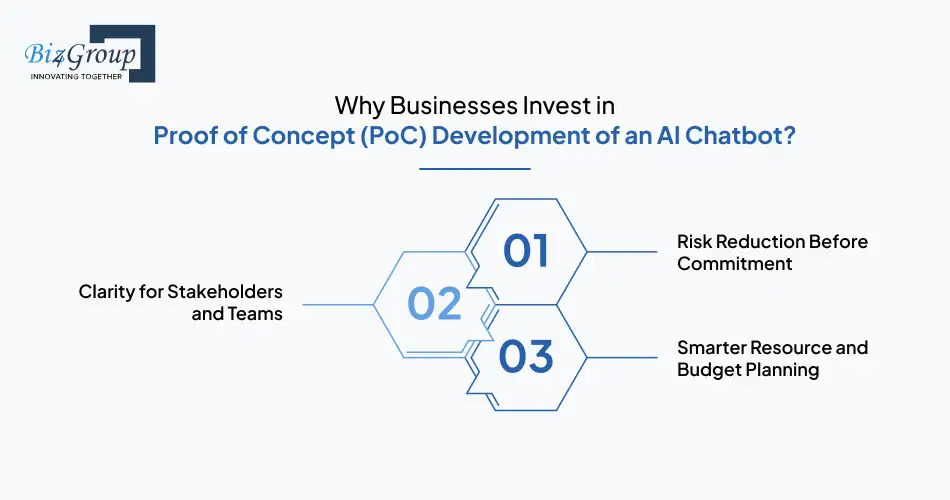
For most leadership teams, the decision is not about curiosity. Proof of concept (PoC) development of an AI chatbot is about reducing uncertainty before real money, people, and credibility are on the line. That motivation shows up in a few very practical ways.
1. Risk Reduction Before Commitment
AI chatbot initiatives fail most often due to unclear scope or unrealistic expectations. A PoC exposes weak assumptions early, when changes are still cheap. This is why many teams pair PoCs with selective AI consulting services to pressure test decisions before scaling.
2. Clarity for Stakeholders and Teams
A working PoC turns abstract ideas into something tangible. Product, engineering, and leadership can align faster when they see real conversations instead of slide decks. This clarity becomes essential when chatbot efforts connect with broader enterprise AI solutions across teams.
3. Smarter Resource and Budget Planning
PoCs help teams understand where effort actually goes, whether in data preparation, integrations, or conversation design. That insight informs staffing, timelines, and tooling choices. It also makes later AI chatbot Proof of Concept development discussions far more grounded.
Ultimately, businesses invest in this phase to replace opinions with evidence and momentum with direction. Once teams see how validation plays out, the next question naturally becomes what separates a good PoC from a successful one.
What Makes Proof of Concept (PoC) Development of an AI Chatbot Successful?
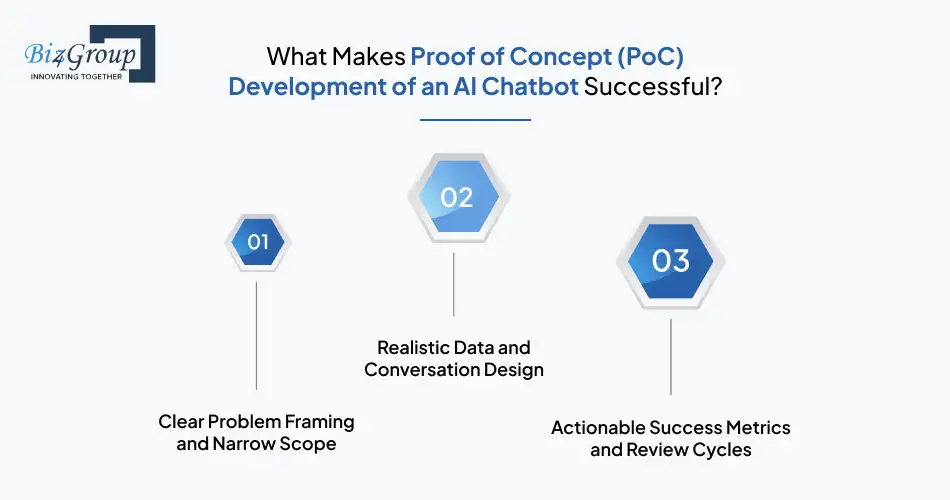
A successful proof of concept (PoC) development of an AI chatbot is not about building more. It is about proving the right things early. When done well, a PoC answers business critical questions with clarity, not assumptions.
1. Clear Problem Framing and Narrow Scope
Successful PoCs focus on one core problem instead of multiple vague goals. Teams agree upfront on what the chatbot must prove and what can wait. This discipline is essential in custom AI chatbot PoC development, where unfocused scope quietly weakens outcomes.
- Example: Validating intent accuracy for a single customer support flow
2. Realistic Data and Conversation Design
A PoC succeeds when it reflects how users actually communicate, not idealized scripts. Conversation flows and edge cases are shaped using proven AI assistant app design principles. This keeps feedback grounded in real behavior, not assumptions.
- Example: Testing the chatbot with incomplete or ambiguous user queries
3. Actionable Success Metrics and Review Cycles
Strong PoCs rely on measurable signals rather than intuition. Teams define thresholds for accuracy, fallback behavior, and response relevance. This approach aligns well with broader AI integration services when leaders decide to develop AI chatbot MVP and PoC initiatives further.
- Example: Reviewing weekly intent accuracy against an agreed benchmark
When these elements come together, PoCs stop being experiments and start guiding decisions. That clarity naturally leads into understanding the specific components that make this validation phase work end to end.
Before You Build, Test the Conversation
A focused AI chatbot PoC development effort helps uncover gaps in data, intent handling, and user flow early.
Test My AI Chatbot IdeaWhat Are the Components of AI Chatbot Proof of Concept Development?
At its core, proof of concept (PoC) development of an AI chatbot is built from a small set of focused components. Each one exists to validate a specific assumption. Together, they show whether the chatbot can work in real conditions.
|
Component |
What It Covers |
Why It Matters |
|---|---|---|
|
Use Case Definition |
Clear problem statement and user scenario |
Prevents vague goals and keeps validation focused |
|
Conversation Design |
Intents, sample dialogues, fallback logic |
Reveals how users actually interact with the chatbot |
|
Data Inputs |
Training data, FAQs, knowledge sources |
Determines response quality and accuracy |
|
Model Logic |
NLP or intent handling setup |
Shows whether understanding is reliable enough |
|
Integration Touchpoints |
APIs or internal systems |
Confirms chatbot behavior within existing workflows |
|
Testing Framework |
User testing and feedback loops |
Provides evidence for decision making |
In practice, these components are often aligned alongside existing systems through AI chatbot integration, allowing teams to create AI powered chatbot proof of concept outcomes that reflect real operating environments. Now, let’s get to the part where these PoCs deliver the most immediate business value.
Top Use Cases of AI Chatbot PoC Development
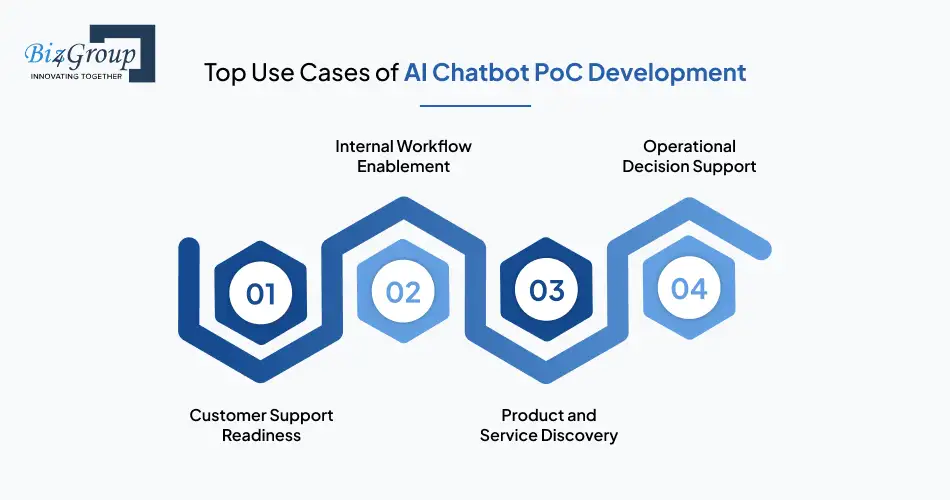
Businesses turn to proof of concept (PoC) development of an AI chatbot when the stakes are real and assumptions are risky. A PoC helps leaders see where chatbots fit, where they struggle, and where value actually shows up. The most common use cases make that clear.
1. Customer Support Readiness
Teams use a PoC to test how a chatbot handles real questions, tone shifts, and incomplete inputs. This phase focuses on response accuracy and escalation logic under realistic conditions. It is a core part of AI chatbot validation development for teams working with an AI app development company.
- Example: Testing resolution rates for top ten support queries using real chat transcripts
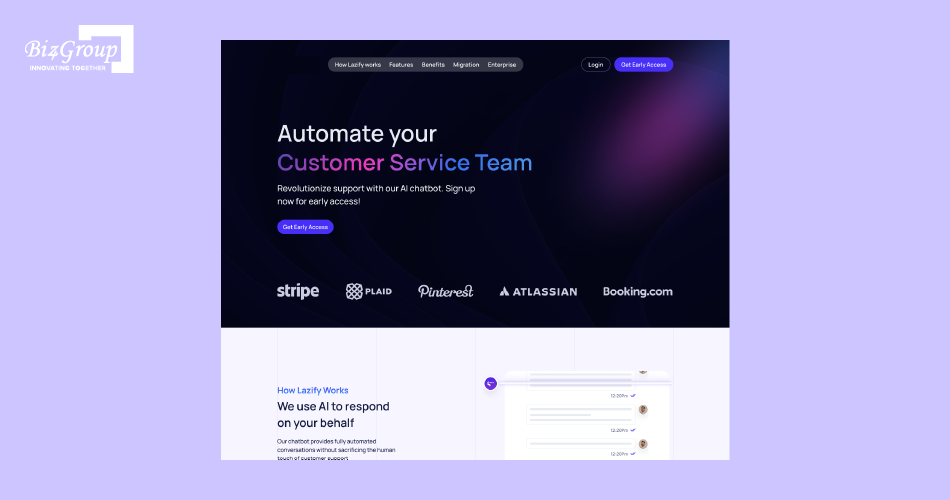
Biz4Group built an AI-powered chatbot was designed to deliver human-like customer conversations while maintaining consistency and control. The project highlights how early chatbot validation can surface response quality, tone accuracy, and fallback behavior. It aligns closely with PoC thinking by proving conversational effectiveness before committing to large scale deployment.
2. Internal Workflow Enablement
Organizations often test chatbots for employee facing workflows such as HR or IT support. A PoC reveals whether answers are reliable and fast enough for daily use. It also clarifies AI chatbot PoC development cost and timeline expectations early when teams build an AI app.
- Example: Validating an HR chatbot for leave balance and policy queries
3. Product and Service Discovery
Chatbots are commonly tested as guided discovery tools for products or services. A PoC checks whether conversations reduce friction or create confusion. This is a frequent step when teams build an AI chatbot proof of concept before full launch.
- Example: Helping users narrow choices through conversational prompts
4. Operational Decision Support
Some teams test chatbots for quick access to internal summaries and updates. A PoC shows whether conversational access improves speed without sacrificing accuracy.
- Example: Requesting daily operational summaries through a chatbot interface
|
Use Case Area |
What the PoC Validates |
Key Outcome |
|---|---|---|
|
Customer Support |
Accuracy and fallback handling |
Reliable first responses |
|
Internal Teams |
Speed and consistency |
Reduced manual queries |
|
Product Discovery |
Conversation flow clarity |
Better user guidance |
|
Operations |
Trust in responses |
Faster access to information |
Together, these examples show how to develop an AI chatbot PoC for businesses with focus rather than guesswork. Once the use case is locked, it’s time to decide which features actually matter during validation.
Reduce Risk Before Scaling AI Chatbots
Teams that develop AI chatbot proof of concept gain clarity on what works and what should never reach production.
Plan My AI Chatbot PoCEssential Features for AI Chatbot PoC Development Success
A focused feature set is what keeps a PoC honest. Proof of concept (PoC) development of an AI chatbot is not about completeness, it is about learning fast. The features below exist to validate assumptions, not to impress anyone:
|
Core Feature |
What It Covers in a PoC |
Why It Matters at This Stage |
|---|---|---|
|
Intent Recognition |
Identifying what users are trying to achieve |
Confirms whether the chatbot understands real queries |
|
Basic Conversation Flow |
Guided question and response paths |
Shows if interactions feel usable and logical |
|
Fallback Handling |
Responses when intent is unclear |
Reveals failure points early |
|
Limited Knowledge Source |
Small, curated dataset or FAQs |
Tests answer accuracy without overengineering |
|
Simple Analytics |
Conversation logs and basic metrics |
Provides evidence for validation decisions |
|
Integration Touchpoint |
One internal or external system |
Helps teams safely integrate AI into an app during testing |
These core features help teams create AI chatbot PoC to validate business use case assumptions with clarity.
Step by Step Process to Develop AI Chatbot Proof of Concept
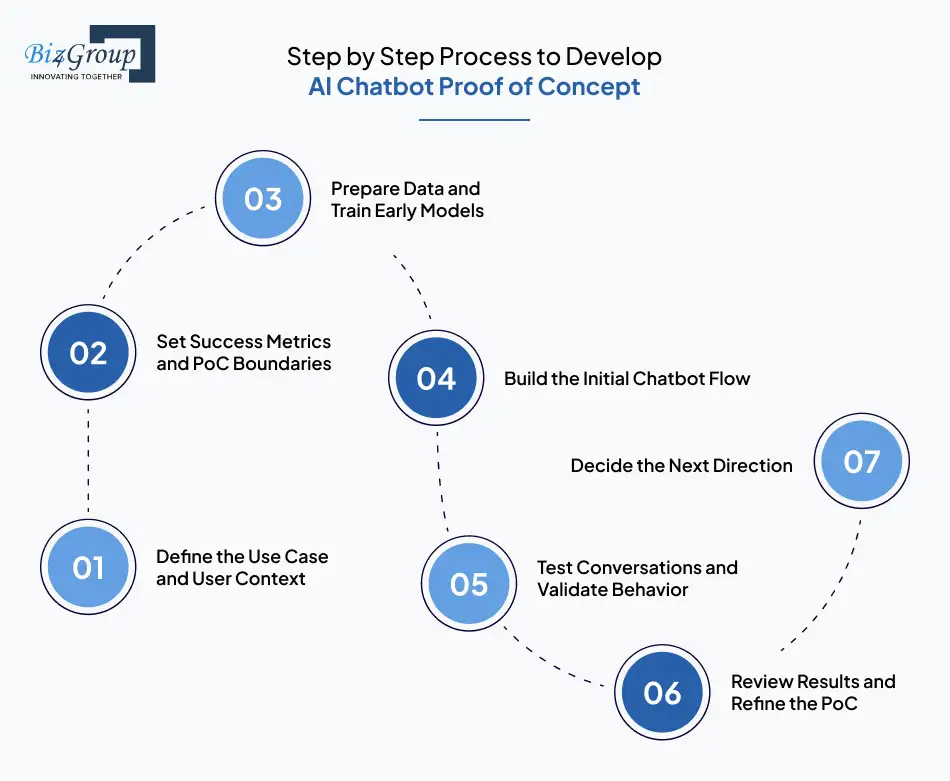
Execution is where ideas meet reality. Proof of concept (PoC) development of an AI chatbot succeeds when it follows a disciplined, stepwise approach that limits exposure while maximizing learning. Each step below validates one critical assumption before teams move forward.
1. Define the Use Case and User Context
This step narrows the chatbot’s purpose to a single, high value scenario. Teams identify who the user is, what problem needs solving, and where the chatbot fits into existing workflows. Partnering early with a UI/UX design company helps ensure conversations feel clear and intuitive, even at PoC stage.
- Select one primary user group
- Focus on one repeatable problem
- Avoid multi department scope
- Document assumptions clearly
Also Read: Top 15 UI/UX Design Companies in USA: 2026 Guide
2. Set Success Metrics and PoC Boundaries
A PoC needs a clear definition of success to be meaningful. Teams agree on measurable indicators and equally important exclusions. This alignment prevents subjective evaluations and keeps expectations grounded.
- Define intent accuracy targets
- Set acceptable fallback rates
- Clarify what the chatbot will not handle
- Align decision makers early
3. Prepare Data and Train Early Models
At this stage, teams gather realistic conversation data and begin to train AI models in a limited way. The objective is to observe behavior, not optimize performance. Real language quickly exposes gaps in understanding.
- Collect representative user queries
- Structure intents and sample responses
- Review data quality issues
- Keep training scope minimal
4. Build the Initial Chatbot Flow
With data in place, teams create a basic conversational structure. This is often where teams build AI chatbot PoC for internal process automation or early external validation, depending on the use case.
- Design simple question response paths
- Add basic fallback handling
- Limit knowledge sources
- Keep logic easy to adjust
5. Test Conversations and Validate Behavior
Testing focuses on learning patterns rather than passing benchmarks. Conversations are reviewed systematically, following a validation mindset similar to that used by software testing companies in USA, but adapted for PoC speed.
- Run scripted conversation tests
- Observe unscripted user behavior
- Track breakdown points
- Log recurring issues
6. Review Results and Refine the PoC
Teams analyze metrics, logs, and feedback to understand what works and what does not. This step forms the backbone of AI chatbot validation development and determines whether the idea deserves further investment.
- Compare results against KPIs
- Identify common failure scenarios
- Adjust intents or flows
- Re-test selectively
7. Decide the Next Direction
Every PoC must end with a decision. Based on evidence, teams either move forward, refine further, or stop. Strong results often lead teams to develop scalable AI chatbot PoC for enterprises with greater confidence.
- Approve expansion or scale
- Plan next phase scope
- Pause low value initiatives
- Document learnings
Following this structure helps teams understand how to build an AI chatbot PoC step by step without overengineering too early. With execution clarified, it’s time to explore the technology stack that supports this validation journey.
Not Sure If Your Chatbot Idea Is Even Viable?
Use proof of concept (PoC) development of an AI chatbot to validate assumptions before real money and teams are involved.
Validate My AI Chatbot PoCChoosing the Right Tech Stack for AI Chatbot PoC Development
For proof of concept (PoC) development of an AI chatbot, the tech stack should exist purely to validate conversations, intent handling, and feasibility. Every choice below supports fast learning and iteration, not long term scale, optimization, or production readiness:
|
Label |
Preferred Technologies |
Why It Matters |
|---|---|---|
|
Conversational Interface |
Enables quick testing of chatbot interactions with real users |
|
|
Backend Orchestration |
Handles API calls, logic flow, and fast iteration during validation |
|
|
NLP and Logic Layer |
Supports intent handling and early language behavior testing |
|
|
Language Model Access |
API-development based LLMs |
Allows validation without building models from scratch |
|
Data Source |
FAQs, documents, small datasets |
Tests answer relevance without complex pipelines |
|
Session Context |
In memory or lightweight storage |
Checks whether conversations remain coherent |
|
Analytics and Logs |
Conversation logs, basic metrics |
Reveals where users succeed or drop off |
|
Integration Point |
Single internal API |
Confirms feasibility without expanding scope |
This PoC focused stack keeps experimentation fast and reversible. With technical feasibility validated, teams can move forward into cost planning and prioritization with far more confidence.
Cost Breakdown for AI Chatbot PoC Development
For proof of concept (PoC) development of an AI chatbot, costs are intentionally capped to keep learning affordable. Most teams operate within a USD 5,000 to USD 15,000 ballpark, depending on scope, depth of validation, and iteration cycles. Below is how that budget typically gets allocated:
|
Cost Area |
What It Covers in a PoC |
Estimated Cost Range (USD) |
|---|---|---|
|
Use Case Definition |
Scoping, success metrics, PoC boundaries |
500 to 1,000 |
|
Conversation Design |
Intents, sample dialogues, fallback flows |
1,000 to 2,500 |
|
Data Preparation |
Cleaning and structuring limited datasets |
800 to 2,000 |
|
Model Setup |
Basic intent handling and response logic |
1,200 to 3,000 |
|
Development Effort |
Building minimal chatbot flows and logic |
1,500 to 4,000 |
|
Testing and Validation |
Internal testing and feedback cycles |
700 to 1,500 |
|
Project Oversight |
Coordination and progress tracking |
300 to 1,000 |
At this stage, the spend is about clarity, not completeness. Teams often partner with a focused AI development company to create AI chatbot PoC for product validation, then use real cost and performance insights to shape monetization and next phase decisions with confidence.
Best Practices for AI Chatbot Proof of Concept Development
Strong outcomes come from discipline, not ambition. Proof of concept (PoC) development of an AI chatbot works best when teams optimize for learning speed and decision clarity. These practices help teams stay focused while validating what truly matters.
1. Keep Scope Ruthlessly Narrow
Successful PoCs test one problem, one audience, and one conversation path. This prevents overengineering and helps teams develop AI chatbot PoC to reduce project risk by exposing gaps early. Most failures start with trying to validate too much at once.
2. Design for Real Conversations
PoCs should reflect how users actually speak, interrupt, and change intent mid conversation. Treat the chatbot like an early AI conversation app, where ambiguity is expected and valuable. Real language reveals weaknesses faster than scripted inputs.
3. Define Success Before You Build
Teams should agree on what success looks like before development begins. Clear metrics remove subjectivity and protect against shifting expectations. This discipline strengthens AI chatbot PoC development by keeping evaluation grounded and consistent.
4. Iterate Fast and Review Often
Short build and test cycles surface insights sooner. Regular reviews help teams adjust without sunk cost pressure and support a practical path to develop AI chatbot proof of concept outcomes that leadership can trust.
5. Document All Learnings
A PoC is as valuable as what it teaches. Capturing failures, edge cases, and user behavior patterns ensures insights are reusable. This approach is common in any experienced custom software development company running early-stage validation.
When these practices are followed, PoCs become decision engines rather than experiments. That clarity sets the stage for addressing the challenges that tend to appear once validation meets operational reality.
Is Your Use Case Worth the Investment?
Use AI chatbot PoC development cost and timeline insights to decide if your idea deserves the next phase.
Estimate My AI Chatbot PoCChallenges in AI Chatbot PoC Development and How to Overcome Them
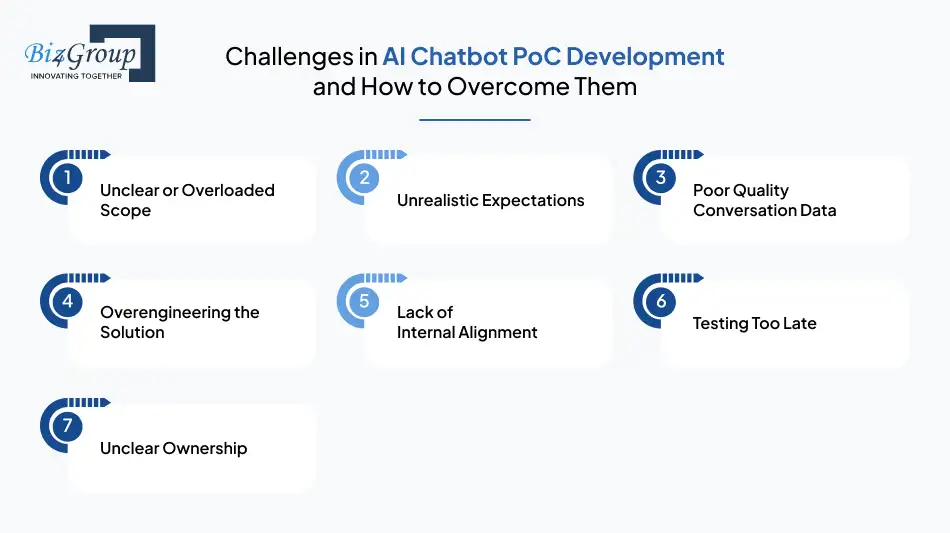
Even well planned PoCs hit friction. Proof of concept (PoC) development of an AI chatbot often exposes gaps in data, expectations, or execution. The value lies not in avoiding these challenges, but in addressing them early and deliberately:
|
Top Challenges |
How to Solve Them |
|---|---|
|
Unclear or Overloaded Scope |
Limit the PoC to one use case and one success goal to develop AI chatbot PoC to reduce project risk |
|
Unrealistic Expectations |
Align stakeholders on what a PoC can and cannot prove |
|
Poor Quality Conversation Data |
Use real or representative queries, even if imperfect |
|
Overengineering the Solution |
Keep features minimal and reversible |
|
Lack of Internal Alignment |
Schedule regular reviews to keep teams aligned |
|
Testing Too Late |
Test early and often to spot issues quickly |
|
Unclear Ownership |
Assign a clear owner or hire AI developers with PoC experience |
When teams approach these challenges with intent, they can build AI chatbot PoC efforts that surface issues while they are still inexpensive to fix. Now, we’ll learn about what happens once validation is complete.
What Comes After AI Chatbot PoC Development?
Once validation is complete, teams need to decide how far the idea deserves to go. Proof of concept (PoC) development of an AI chatbot is meant to end with clarity, not momentum for its own sake. The paths forward are usually very specific.
1. Proceed to Focused Expansion
When results are strong, teams extend the validated use case slightly. This might mean adding more intents or users while keeping scope controlled. Many organizations evolve early learnings into create AI chatbot PoC solutions that are still lightweight but more representative.
2. Refine and Revalidate
Some PoCs show promise but expose gaps in data or flow. In these cases, teams iterate on the same scope rather than expanding it. This refinement phase strengthens AI chatbot Proof of Concept development outcomes without increasing risk or cost.
3. Pause or Redirect Efforts
Not every PoC earns the right to continue. When results fall short, teams document learnings and move on. This discipline is often supported by structured AI automation services that prioritize evidence over enthusiasm.
|
Post PoC Path |
What It Means |
Typical Outcome |
|---|---|---|
|
Expand |
Broaden scope carefully |
Stronger validation |
|
Refine |
Improve within same scope |
Clearer feasibility |
|
Pause |
Stop and document learnings |
Avoid sunk cost |
At this stage, teams also start thinking about ownership, delivery models, and long term alignment. That often leads to conversations about who should take the next step and why some teams choose a software development company in Florida to build AI conversational chatbot PoC initiatives into something more durable.
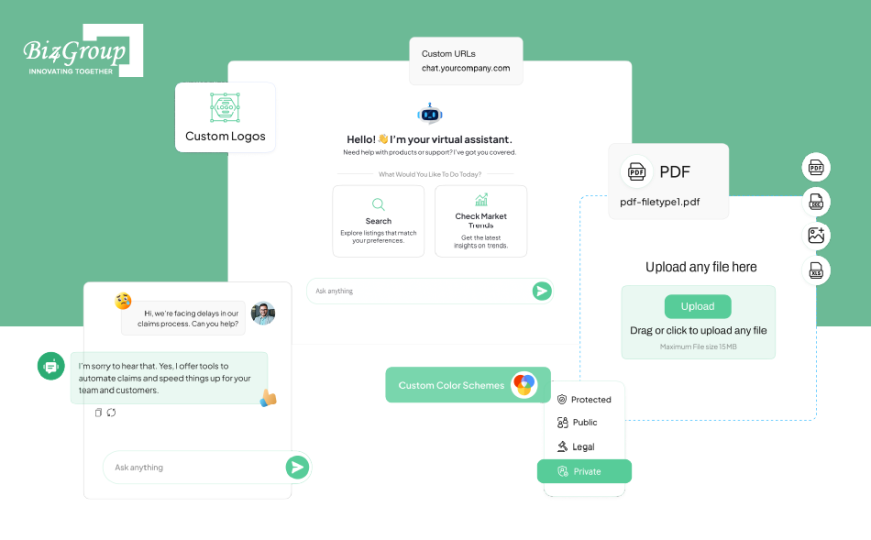
The custom enterprise AI agent developed by Biz4Group showcases how structured chatbot logic can be validated before scale. Built to support internal teams and customer facing workflows, the platform demonstrates how conversational automation, intent handling, and controlled responses can be tested early. It reflects how PoC driven validation helps enterprises confirm feasibility before broader rollout.
Why Businesses Trust Biz4Group to Build AI Chatbot PoC?
AI chatbot PoCs fail when teams rush to build before validating the right assumptions. Biz4Group treats a PoC as a decision checkpoint, not a showcase. Every engagement is structured to surface clear answers, fast, and without overbuilding.
Our work spans both internal and customer facing chatbot platforms, including a custom enterprise AI agent designed for controlled operational workflows and an AI powered chatbot for human like customer support focused on conversational quality. These projects demonstrate how early validation translates into systems that perform reliably beyond the PoC stage.
What sets Biz4Group apart:
- Business first PoC scoping tied to real outcomes
- Conversational validation based on actual user behavior
- Early visibility into data, logic, and integration risks
- Clear go or no-go recommendations backed by evidence
This practical, validation led approach is why Biz4Group is ranked among the top POC software development companies when businesses need clarity before committing to scale.
Turn Curiosity Into Evidence
Teams that create AI chatbot PoC solutions make decisions backed by data, not optimism.
Talk About My AI Chatbot PoCTurning AI Chatbot PoC Validation into Scalable Success
AI chatbots are exciting, but excitement alone is expensive. What keeps teams sane is knowing when an idea is worth pushing forward and when it deserves a polite pause. That is exactly what a well-run PoC delivers. It replaces opinions with evidence and curiosity with clarity.
If your goal is to build AI software that actually survives real users, real data, and real expectations, a chatbot PoC is not optional. It is the filter that saves time, money, and credibility. And when done right, it sets a clean foundation for everything that follows.
That is why working with an experienced AI product development company matters. Not to build faster, but to decide smarter.
A short PoC can save months of engineering guesswork. Let’s see what your chatbot can actually do.
FAQs on Proof of Concept (PoC) Development of an AI Chatbot
1. What is the typical cost of developing an AI chatbot PoC?
Most businesses plan a PoC budget between USD 5,000 and USD 15,000, depending on scope and validation depth. This range usually covers limited conversation flows, testing, and evaluation aligned with AI chatbot PoC development cost and timeline expectations.
2. How long does it take to develop an AI chatbot PoC?
A focused PoC typically takes a few weeks, not months. Timelines depend on data readiness, clarity of use case, and feedback cycles. Teams exploring how to develop an AI chatbot PoC for businesses often prioritize speed over completeness.
3. Can an AI chatbot PoC be used for product validation?
Yes, many teams use PoCs specifically to test whether a chatbot improves user experience or solves a real problem. This approach helps teams create AI chatbot PoC for product validation before committing to full scale development.
4. Is an AI chatbot PoC suitable for enterprise environments?
PoCs are commonly used by enterprises to validate feasibility without operational risk. A well scoped effort can develop scalable AI chatbot PoC for enterprises by testing governance, data flow, and conversational reliability early.
5. Can an AI chatbot PoC support internal operations?
Absolutely. Many PoCs focus on internal workflows such as HR, IT, or knowledge access. Teams often build AI chatbot PoC for internal process automation to measure efficiency gains before wider adoption.
6. Should customer support teams start with a chatbot PoC?
Yes, customer support is one of the most common starting points. Running a PoC allows teams to test response accuracy and escalation logic. This helps organizations make an AI chatbot PoC for customer support automation without risking live operations.
