Location :
Orlando, FL, USA
Location :
Orlando, FL, USA +1 (407) 714-1616
 info@biz4group.com


















Imagine a digital system that doesn’t wait for instructions but instead, understands your business goals, learns from real-time feedback, and takes independent actions to get the job done.
Read More

Have you ever wondered how artificial intelligence is transforming golf into a smarter, data-driven sport for players, coaches, and sports businesses alike?
Golf is rapidly evolving through intelligent digital experiences that combine performance tracking, real-time analytics, and personalized coaching into a single mobile platform. From swing analysis and GPS-based course mapping to predictive shot recommendations, modern golf applications are changing how players train and compete. As a result, AI golf app development is becoming a strategic investment for startups, golf academies, sports brands, and enterprises looking to build next-generation sports technology solutions.
According to a recent industry report, the global golf course software market is projected to grow from USD 548 million in 2026 to USD 885 million by 2034 at a CAGR of 8.4%, driven by rising demand for AI-enabled golf experiences, mobile engagement, and performance analytics.
Today, businesses are actively exploring questions like we are exploring sports tech solutions and want to develop an AI golf app that supports both amateur and professional players. This growing demand is also increasing interest in custom golf app development with AI and how to make AI golf app for sports coaching and training solutions that deliver measurable performance improvement.
Whether your goal is developing AI golf app products for coaching, gameplay optimization, fantasy golf, or club management, partnering with experienced companies that develop AI golf apps in USA can help accelerate innovation and scalability. As a trusted AI app development company, Biz4Group helps businesses build intelligent golf solutions tailored for modern player expectations.
In this blog, you can explore AI golf app features, development steps, AI technologies, costs, monetization strategies, and future-ready trends shaping the golf tech industry.
An AI golf app works by combining artificial intelligence, computer vision, machine learning, GPS tracking, and sensor-based analytics to deliver real-time performance insights for golfers. These applications analyze player behavior, swing mechanics, gameplay patterns, and on-course conditions to provide smarter coaching, strategic recommendations, and personalized training experiences.
Unlike traditional golf apps that only track scores or distances, AI-powered golf applications continuously learn from player activity and adapt recommendations based on performance trends, playing style, and environmental conditions. This creates a highly interactive and data-driven golfing experience for both amateur and professional players.
Core Technologies Behind an AI Golf App
Modern AI golf platforms operate through multiple integrated technologies that work together in real time.
Using smartphone cameras, wearable devices, or motion sensors, the app records and analyzes a golfer’s swing mechanics. Computer vision technology evaluates posture, swing path, club angle, balance, and follow-through movement with remarkable accuracy.
The AI engine compares swing data against professional benchmarks and instantly identifies technical flaws while recommending corrective actions.
Key capabilities include:
AI golf apps collect live data from GPS systems, gyroscopes, accelerometers, and smart golf sensors to measure critical performance metrics.
This includes:
These insights help golfers make more informed decisions during practice sessions and live gameplay.
The AI system evaluates player history, weather conditions, terrain, wind direction, and course difficulty to recommend the ideal club and shot strategy for every situation.
This intelligent recommendation engine helps players improve consistency and reduce on-course errors.
Integrated GPS and AI mapping technologies provide accurate course layouts, hazard detection, distance calculations, and optimal shot paths. The app guides golfers through each hole while helping them avoid bunkers, water hazards, and rough terrain.
As users continue playing, the AI model learns from historical gameplay data and builds personalized coaching plans tailored to individual strengths, weaknesses, and goals.
This adaptive feedback system creates a virtual golf coach experience that evolves with every round, making training more accurate, engaging, and performance-focused.
With the right AI architecture and real-time analytics, an AI golf app transforms raw gameplay data into actionable insights that help golfers train smarter, play better, and improve consistently.
The golf industry is rapidly shifting toward intelligent digital experiences, creating massive opportunities for sports technology brands, startups, golf clubs, and fitness platforms. From AI-powered coaching to real-time gameplay analytics, businesses are increasingly investing in smarter golf solutions that improve player engagement, performance tracking, and operational efficiency.
One of the biggest reasons behind this shift is the rising demand for personalized and data-driven sports experiences. According to a recent market report, the global golf management software market was valued at approximately $1.8 billion in 2025 and is projected to reach $4.1 billion by 2034, growing at a CAGR of 9.6% during the forecast period. The market growth is being fueled by increasing golf participation, digital transformation across golf clubs, and rising adoption of AI-powered mobile technologies.
For businesses evaluating long-term opportunities in sports innovation, this creates the perfect moment to invest in intelligent golf platforms rather than conventional mobile applications.
Today, golfers expect more than simple score tracking or booking systems. They want:
This is exactly why are sports technology companies and golf platforms increasingly investing in AI golf app development instead of traditional mobile app solutions. AI-driven applications continuously learn from user behavior, making them significantly more engaging, adaptive, and valuable over time compared to static mobile experiences.
Businesses that enter this market early can unlock multiple growth opportunities, including:
As AI adoption continues accelerating across sports technology, investing in advanced golf applications today positions businesses to lead the future of connected, intelligent, and performance-focused golfing experiences.
Turn your golf tech idea into a game-changing AI-powered solution with expert guidance.
Book a Free Consultation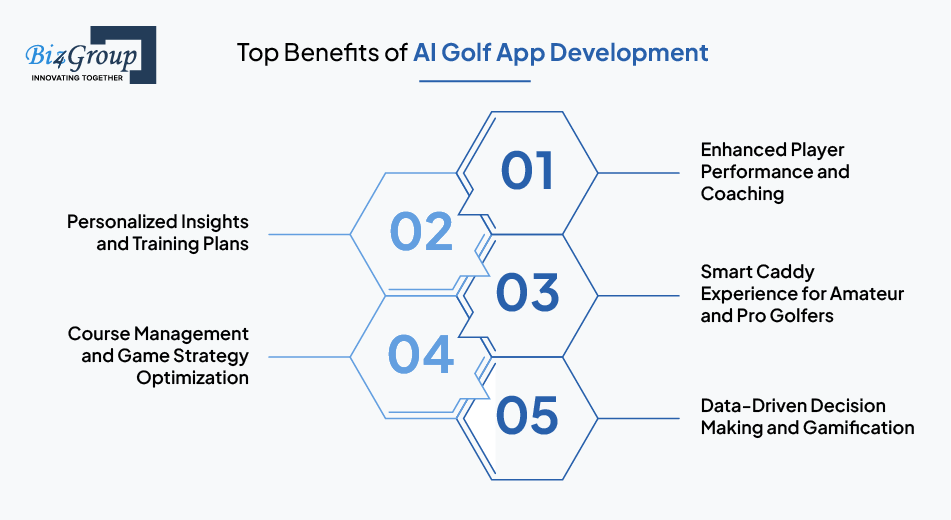
As the demand for smart sports technology grows, AI golf mobile app development is emerging as a game-changer for both players and businesses. From improving performance to delivering deeper data insights, the benefits of building AI golf app solutions extend far beyond basic score tracking.
AI-powered apps act like personal golf coaches, analyzing swing mechanics, posture, and timing. With instant feedback and video-based comparisons, players can correct flaws faster and improve more efficiently. This makes developing an AI golf app ideal for both serious and casual golfers.
Unlike one-size-fits-all training, AI adapts to the individual golfer. By tracking user behavior and progress over time, the app can create personalized practice routines and skill-building exercises tailored to each player’s strengths and weaknesses.
With real-time club suggestions, wind condition analysis, and shot predictions, AI apps serve as intelligent caddies. They help golfers make informed decisions on the course—without needing a physical coach or assistant.
By using GPS mapping and AI pathfinding, players can plan better routes across each hole. The app can suggest strategies to avoid hazards, maximize efficiency, and reduce strokes, turning beginners into more strategic golfers.
AI collects and processes vast amounts of gameplay data. This empowers players to make smarter decisions while gamified features—like progress badges, leaderboards, and challenges—boost engagement and motivation.
These powerful advantages make AI golf mobile app development a winning investment for businesses and an essential tool for today’s tech-savvy golfers—especially when powered by innovative AI solutions that adapt to every swing and strategy.
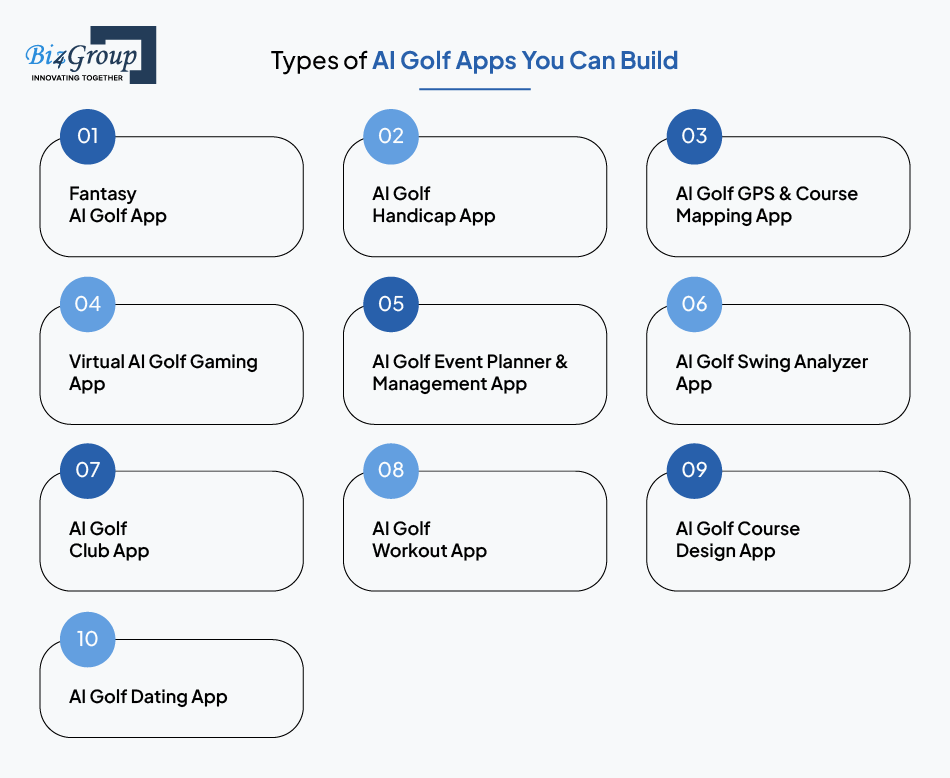
As the golf industry embraces digital innovation, businesses and startups are exploring new opportunities in the development of golf app using AI. Whether it's enhancing performance, improving fan engagement, or simplifying event logistics, there's a wide range of AI-powered app types to choose from.
Here’s a look at some of the most promising categories in AI Golf mobile app development, each tailored to a unique user experience or business objective.
If you're looking to build a Fantasy AI Golf App, this type of platform allows users to create dream teams and compete in simulated golf tournaments driven by real-world data. It enhances fan engagement and opens new monetization avenues for fantasy sports businesses. Partnering with fantasy sports software development company can ensure your app is equipped with cutting-edge features, seamless user experience, and scalable infrastructure tailored to the unique dynamics of fantasy golf.
How it works:
AI uses player stats, course data, and tournament history to simulate outcomes and offer predictive suggestions. It evaluates performance potential for each player and helps users make informed fantasy picks. These simulations improve in accuracy over time using machine learning.
Key Features:
Create an AI Golf Handicap App to give golfers a smarter, more accurate way to calculate their handicap using real-time performance metrics and course difficulty adjustments. It's perfect for casual players and tournament organizers alike.
How it works:
AI processes player scores across various courses and formats while factoring in slope rating and historical consistency. It automatically adjusts handicaps after each round to reflect current performance more precisely than traditional methods.
Key Features:
If your goal is to develop an AI Golf GPS & Course Mapping App, this type of app helps players navigate the course with AI-powered routing, shot distance calculations, and hazard warnings—all in real time.
How it works:
Using satellite imagery and GPS data, the app overlays real-time maps of golf courses. AI enhances it by recommending optimal paths, analyzing terrain, and even learning from player behavior to fine-tune its routing recommendations.
Key Features:
A great option for digital golf experiences is to make a Virtual AI Golf Gaming App that allows users to compete in hyper-realistic golf tournaments using AI-generated gameplay environments and player behavior modeling.
How it works:
AI powers physics engines and simulates conditions like wind, ball spin, and swing velocity. It can also adjust difficulty and suggest in-game strategies, offering a more immersive and competitive experience for gamers.
Key Features:
For clubs and organizers, you can create an AI Golf Event Planner App that automates tasks like scheduling, scorekeeping, and pairing participants, saving time and streamlining logistics.
How it works:
The app uses AI to analyze player availability, skill levels, and event type to automate match setups and scoring systems. It reduces human error while improving the experience for both hosts and players.
Key Features:
If you’re looking to improve individual performance, build an AI Golf Swing Analyzer App that offers real-time feedback using advanced video analysis and motion tracking.
How it works:
The app captures swings using a smartphone or wearable sensor, then uses computer vision to analyze body posture, swing path, and follow-through. AI compares this data to optimal swing models and gives actionable tips.
Key Features:
You can develop an AI Golf Club App to help golfers choose the best clubs for their swing style, conditions, and performance history—an excellent value-add for equipment manufacturers or retailers.
How it works:
AI analyzes the user's swing speed, shot accuracy, and course data to recommend ideal clubs for each round. It can also suggest club changes based on playing history or conditions.
Key Features:
Make an AI Golf Workout App focused on physical conditioning, with routines personalized for swing power, flexibility, and endurance. A great fit for fitness startups or sports medicine brands.
How it works:
The app collects physical data, swing stats, and fitness goals to generate personalized training routines. AI adjusts plans in real-time based on progress, injuries, or changes in play style.
Key Features:
Create an AI Golf Course Design App for architects and golf clubs to visualize and plan smarter, more playable golf course layouts using environmental data and design patterns.
How it works:
AI simulates terrain, water flow, and user behavior to recommend course elements that balance challenge with playability. It considers sustainability, aesthetics, and maintenance costs.
Key Features:
Finally, you can develop an AI Golf Dating App that connects golf lovers based on mutual interests, skills, and lifestyle. A unique niche with strong community potential.
Also Read: AI Flirting Platform Development
How it works:
AI analyzes user behavior, preferences, and playing styles to suggest compatible matches. It also integrates location and availability to encourage golf-based meetups.
Key Features:
With so many innovative options, the development of golf app using AI empowers businesses to tailor unique solutions that elevate the golfing experience for every kind of user.
Wondering how much your AI golf app will cost? Let’s break it down for you—no guesswork.
Request a QuoteSuccessful AI Golf App Development Solutions rely on delivering intelligent, user-friendly features that serve real needs on and off the course. If you're in the planning of developing golf app utilizing AI, selecting the right features is crucial to building a product that stands out, engages users, and delivers measurable performance value.
Below is a curated list of 20 must-have features every AI-powered golf app should include, with a brief explanation of each:
|
Feature |
Purpose & Description |
|---|---|
|
Real-Time Swing Analysis |
Uses computer vision to capture swing movements and provide instant visual feedback on form and motion. |
|
AI Club Recommendation |
Suggests the best club for each shot based on user behavior, distance, and environmental data. |
|
GPS-Based Course Mapping |
Offers real-time GPS and smart course overlays to help players plan the most efficient routes. |
|
Personalized Coaching Feedback |
Delivers AI-generated feedback based on playing style and progress to improve technique. |
|
Performance Analytics Dashboard |
Displays performance trends, scoring averages, and skill graphs to help track long-term growth. |
|
Smart Scorecard System |
Digitally records strokes, putts, and penalties with AI-powered scoring accuracy and analysis. |
|
Wearable Device Integration |
Syncs with smartwatches and motion sensors to track swing speed, heart rate, and more. |
|
AI-Powered Shot Prediction |
Forecasts likely shot outcomes using historical data, swing metrics, and real-time conditions. |
|
Gamification and Challenges |
Adds fun through leaderboards, badges, and challenges to keep users engaged and coming back. |
|
Voice Command & Assistant |
Enables hands-free navigation and access to features through voice input or chatbot support. |
|
Video Playback & Pro Comparison |
Allows users to compare their swings with pro-level footage side-by-side to improve technique. |
|
Weather & Wind Impact Forecast |
Predicts how current weather and wind conditions will affect play to aid in smarter shot planning. |
|
Multiplayer & Tournament Mode |
Lets users create or join events, play rounds together, and compete in AI-ranked matches. |
|
Real-Time Hazard Alerts |
Detects and alerts players about nearby hazards like water, bunkers, and slopes using AI pathfinding. |
|
Shot Distance Measurement |
Automatically calculates the distance of each shot from impact to landing for performance tracking. |
|
Post-Round Review Summary |
Offers a full round analysis including strokes gained, missed opportunities, and improvement tips. |
|
A conversational AI that answers questions, offers tips, and gives reminders during or after play. |
|
|
Skill-Level Based Mode Adjustments |
Dynamically adjusts coaching and challenge difficulty based on user proficiency. |
|
Personalized Training Planner |
Builds daily or weekly routines using AI to focus on specific areas like short game, accuracy, or stamina. |
|
Social Sharing & Highlights Export |
Lets users export highlights, scores, or swing videos and share them across social platforms or with coaches. |
Including these smart, user-centric features ensures your AI Golf App Development Solutions deliver real value, setting the foundation for a powerful, next-gen golfing experience.
As AI golf mobile application development evolves, going beyond the essentials can set your product apart in a competitive sports tech market. Adding advanced, intelligent capabilities not only enhances the player experience but also ensures long-term engagement, scalability, and differentiation.
These innovations give businesses the edge they need to create AI golf app solutions that stand out.
AR overlays real-time course visuals with shot paths, distances, and hazards, offering golfers immersive navigation. This adds a futuristic layer to golf mobile app development using AI while improving on-course strategy.
It not only enhances gameplay but also creates strong appeal for younger, tech-savvy golfers.
Integrating biometric sensors helps track heart rate, fatigue, and stress during rounds. AI interprets this data to suggest rest, pacing, or training modifications for optimal performance.
This bridges sports, health, and wellness, turning the app into a holistic performance companion.
By analyzing swing mechanics, strain patterns, and play frequency, AI can flag early signs of potential injuries. This proactive feature reduces downtime and promotes safer play.
It builds trust among players and professionals who value longevity in their sport.
Instead of only visual analysis, advanced AI enables real-time voice feedback, guiding golfers shot-by-shot like an actual coach. It enhances convenience for players practicing without constant screen interaction.
This feature mimics a true on-course coaching experience, increasing user retention.
Allowing seamless sync across wearables, VR simulators, and smartphones builds a unified ecosystem. Users can track and improve their game consistently, both on and off the course.
The multi-device ecosystem strengthens brand presence and maximizes user engagement.
AI-driven matchmaking connects golfers with similar skill levels or interests. Gamified tournaments, challenges, and social leaderboards deepen engagement beyond individual play.
It transforms the app into a social hub, building loyal communities around the sport.
The app can dynamically adjust gameplay simulations and practice drills to match progress or difficulty. This makes practice sessions engaging, helping players push boundaries without losing motivation.
Adaptive modes ensure the app remains useful for both beginners and professionals over time.
By factoring in live data like wind gusts, humidity, or even time of day, AI provides hyper-accurate predictions and strategies for real-world course conditions.
This creates a more realistic, competitive edge that players can directly apply to real matches.
Integrating advanced features is the key to delivering exceptional value when planning to create AI golf app experiences that redefine the modern golfing journey.
Also Read: How to Build an AI Sports App from Scratch?
Building an intelligent golf application requires more than just coding an idea into a mobile platform. Successful smart golf app development solutions depend on strategic planning, AI architecture, user-centric design, scalable infrastructure, and continuous optimization. Whether you are a startup, sports technology company, golf academy, or enterprise brand, following a structured development roadmap helps reduce risk, accelerate launch timelines, and improve long-term product scalability.
Today, businesses are actively evaluating custom golf app development with AI to create immersive and performance-focused golf experiences that combine coaching, analytics, GPS intelligence, and machine learning capabilities into a single ecosystem.
If we are comparing companies that develop AI golf app and want to find the best vendors in USA for sports tech development, it becomes essential to choose a development process that prioritizes innovation, scalability, and AI-driven personalization from the beginning.
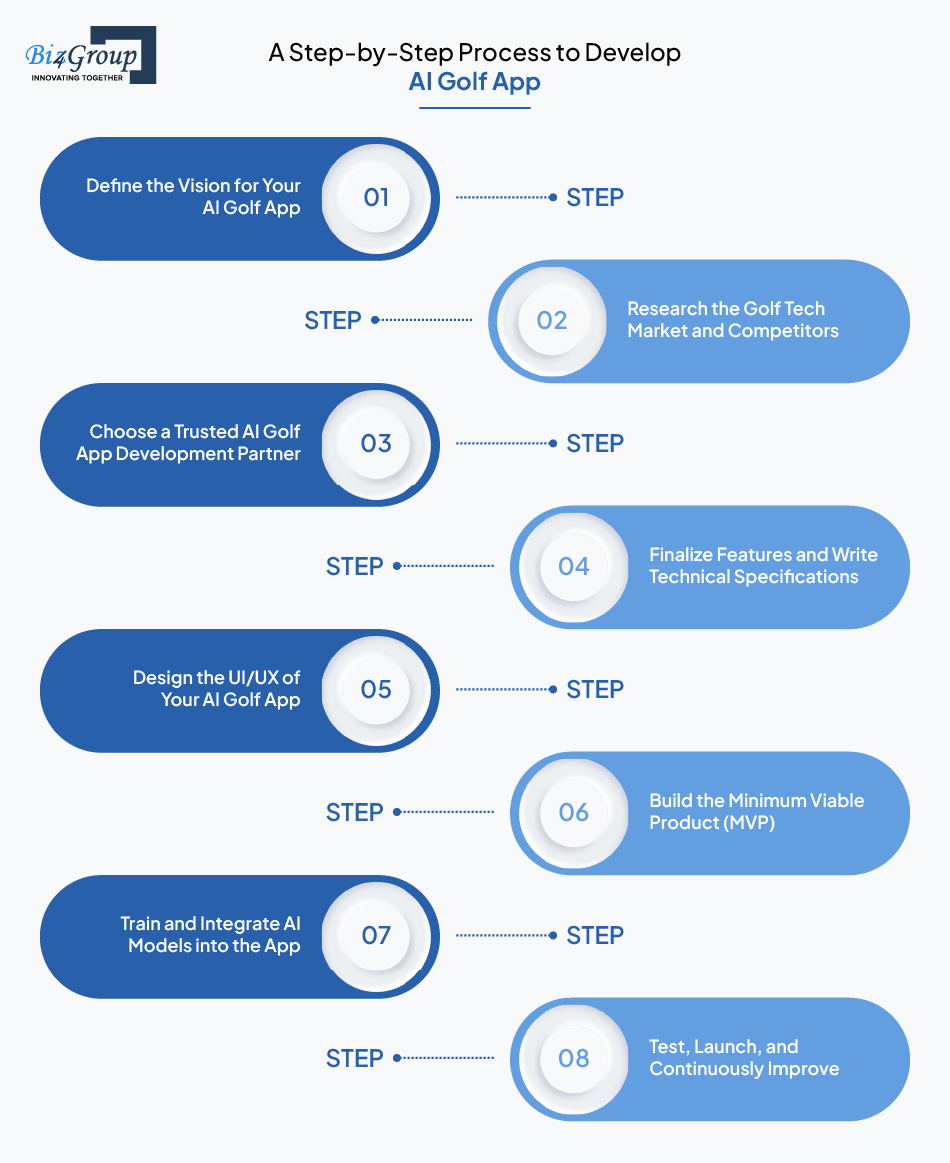
Below is a proven 8-step framework used by top AI app development companies in USA for developing advanced golf applications.
Every successful product starts with a clear objective. Identify the core problem your app solves and define your ideal target audience, whether it includes amateur golfers, professional players, coaches, golf clubs, or sports academies.
At this stage, businesses should:
A strong product vision creates the foundation for scalable AI integration solutions later in development.
Before development begins, research the golf technology market to understand user expectations, trending features, and competitor limitations.
This process helps teams:
Market research helps businesses build differentiated experiences instead of replicating existing solutions.
Before investing heavily in full-scale production, businesses should validate technical feasibility through PoC develpment. A Proof of Concept helps confirm whether AI models, swing analysis systems, wearable connectivity, and predictive algorithms can function accurately within real-world golf scenarios.
This phase reduces development risk while testing:
A successful PoC provides confidence before moving into larger product investments.
Also Read: Top 12+ PoC Software Development Companies in the USA
Once feasibility is confirmed, the next step involves documenting technical specifications, user journeys, workflows, and system architecture.
Teams should finalize:
Common API integration components include:
This stage ensures alignment between business objectives and technical execution.
An intelligent app still fails if the user experience feels confusing or overloaded. Collaborating with an experienced UI/UX design company helps create interfaces optimized for real-time gameplay, outdoor visibility, and smooth navigation.
Golf-focused UI/UX should prioritize:
Strong design significantly improves retention and overall engagement.
Once designs and architecture are finalized, businesses should launch with core features through MVP development services. An MVP allows brands to validate user interest, collect real-world feedback, and optimize functionality before scaling.
A golf app MVP typically includes:
Launching lean helps businesses reduce costs while improving product-market fit faster.
Alos Read: 12+ MVP Development Companies in USA to Launch Your Startup
Want proof? Explore our AI-driven mobile apps built for performance, precision, and scale.
View PortfolioThis is where the application becomes intelligent. AI models are trained using swing videos, gameplay patterns, player history, sensor data, and environmental conditions to deliver personalized recommendations and predictive insights.
This phase includes:
Advanced AI integration solutions allow the app to continuously learn and improve based on user behavior and performance history.
Before launch, the application should undergo extensive QA testing across devices, operating systems, and gameplay scenarios to ensure smooth performance and AI accuracy.
Testing should include:
After deployment, continuous monitoring helps improve:
Regular updates and data-driven optimization ensure your AI golf app remains competitive in the evolving sports technology market.
Following a strategic and AI-focused development roadmap enables businesses to launch scalable, intelligent, and high-performing golf applications that deliver exceptional user experiences while creating long-term growth opportunities in sports technology.
The cost to develop an AI golf app generally ranges between $25,000 to $150,000+, depending on app complexity, AI capabilities, platform compatibility, integrations, and development approach. A simple MVP with basic GPS and scoring features costs significantly less than an enterprise-grade platform powered by real-time swing analytics, predictive AI, AR experiences, and wearable integrations.
Several technical and business factors directly influence the overall development budget. Understanding these cost components helps businesses plan investments more strategically while avoiding unnecessary development expenses.
|
App Type |
Estimated Cost |
Key Features |
|---|---|---|
|
Basic AI Golf App |
$25,000 – $40,000 |
Score tracking, GPS mapping, user profiles, basic AI coaching |
|
Mid-Level AI Golf App |
$40,000 – $80,000 |
Swing analysis, performance dashboards, wearable integration, smart recommendations |
|
Advanced AI Golf App |
$80,000 – $150,000+ |
Computer vision, AR experiences, multiplayer systems, predictive analytics, real-time AI feedback |
Several technical and business factors directly impact the overall project budget.
|
Cost Factor |
Estimated Impact |
Description |
|---|---|---|
|
UI/UX Design |
$5,000 – $15,000 |
Golfer-focused wireframes, dashboards, responsive layouts, and usability optimization |
|
AI Model Development |
$10,000 – $40,000+ |
Machine learning models, swing analysis systems, predictive analytics, and AI optimization |
|
API Integrations |
$3,000 – $15,000 |
GPS, weather APIs, payment gateways, wearable integrations, and golf databases |
|
Cross-Platform Development |
Medium Cost |
React Native or Flutter development for iOS and Android |
|
Native App Development |
Higher Cost |
Separate iOS and Android development for enhanced performance |
|
Wearable & IoT Integration |
$5,000 – $20,000 |
Smartwatch syncing, golf sensors, accelerometers, and fitness trackers |
|
Backend & Cloud Infrastructure |
$5,000 – $25,000 |
Hosting, databases, storage, scalability, and real-time processing |
|
Testing & QA |
$5,000 – $15,000 |
Functional testing, AI validation, security checks, and performance optimization |
|
Maintenance & Updates |
$1,000 – $5,000/month |
Bug fixes, AI model tuning, feature enhancements, and server maintenance |
Starting with an MVP helps businesses validate their idea faster while reducing initial investment risk.
|
Development Stage |
Estimated Cost |
Includes |
|---|---|---|
|
MVP Development |
$25,000 – $40,000 |
GPS tracking, scoring system, basic AI coaching, user onboarding |
|
Full-Scale Product |
$50,000 – $150,000+ |
Real-time swing analysis, AI recommendations, AR, multiplayer, wearable integrations, analytics |
The most efficient strategy is to launch with essential features, gather real user feedback, and gradually scale the platform with advanced AI capabilities and premium functionality.
Strategic planning, phased development, and the right AI technology stack can help businesses control development costs while building scalable and revenue-generating golf technology platforms.
Also Read: AI App Development Cost
Building a high-performance AI-powered golf application requires a carefully planned technology stack that supports scalability, real-time analytics, intelligent automation, and seamless cross-platform experiences. From AI-driven swing analysis and GPS course mapping to wearable integrations and predictive coaching, every component of the app depends on selecting the right frontend, backend, cloud, and machine learning technologies.
A strong technology foundation not only improves app performance and security but also ensures long-term scalability as user engagement and AI processing demands grow over time.
Below is a recommended technology stack for developing a modern AI golf application.
|
Technology Layer |
Recommended Tools & Technologies |
Purpose & Benefits |
|---|---|---|
|
Frontend Development |
React Native, Flutter |
Cross-platform app development with a single codebase for iOS and Android |
|
Swift (iOS), Kotlin (Android) |
Native mobile development for maximum performance and platform-specific optimization |
|
|
Backend Development |
Node.js |
Real-time data processing and scalable event-driven architecture |
|
Python (Django, Flask) |
AI workflows, backend APIs, machine learning operations, and analytics processing |
|
|
Firebase |
Authentication, cloud messaging, push notifications, and real-time database management |
|
|
AI & Machine Learning Frameworks |
TensorFlow, PyTorch |
AI model training for swing analysis, predictive gameplay, and personalized coaching |
|
OpenCV |
Computer vision for posture detection, motion tracking, and swing analysis |
|
|
Scikit-learn |
Predictive analytics, user behavior analysis, and recommendation systems |
|
|
Cloud Platforms & Infrastructure |
AWS, Google Cloud, Microsoft Azure |
AI model hosting, cloud storage, scalability, and real-time data management |
|
Docker, Kubernetes |
Containerization, orchestration, and scalable microservices deployment |
|
|
Databases & Storage |
PostgreSQL, MySQL |
Structured data storage for scores, profiles, statistics, and gameplay history |
|
MongoDB |
Unstructured data storage for videos, swing recordings, and AI logs |
|
|
Redis |
Real-time caching, session management, and faster data retrieval |
|
|
Wearable & IoT Integration |
Apple HealthKit, Google Fit APIs |
Health tracking, activity monitoring, and wearable synchronization |
|
Custom IoT SDKs |
Integration with golf sensors, smart devices, and motion trackers |
|
|
API & Third-Party Integrations |
Google Maps API, Mapbox |
GPS-based course mapping, navigation, and distance calculations |
|
Weather APIs |
Real-time weather forecasting and wind condition analysis |
|
|
Payment Gateway APIs |
Subscription management, in-app purchases, and payment processing |
|
|
DevOps & Testing Tools |
Jenkins, GitHub Actions |
CI/CD automation and deployment pipelines |
|
Appium, Selenium |
Mobile app testing, automation testing, and QA validation |
|
|
Sentry, New Relic |
Error tracking, app monitoring, and performance optimization |
|
|
Analytics & User Engagement |
Google Analytics, Mixpanel |
User behavior tracking, engagement analysis, and retention monitoring |
|
Amplitude |
Feature adoption tracking and in-app interaction analytics |
|
|
Security & Authentication |
OAuth 2.0, JWT Authentication |
Secure login systems and protected user authentication |
|
SSL Encryption, Firebase Security |
Data protection, secure communication, and privacy compliance |
That’s why choosing the right AI tools and technology stack enables businesses to build scalable, intelligent, and future-ready golf applications that deliver real-time performance insights, seamless user experiences, and long-term competitive advantages in the sports technology market.
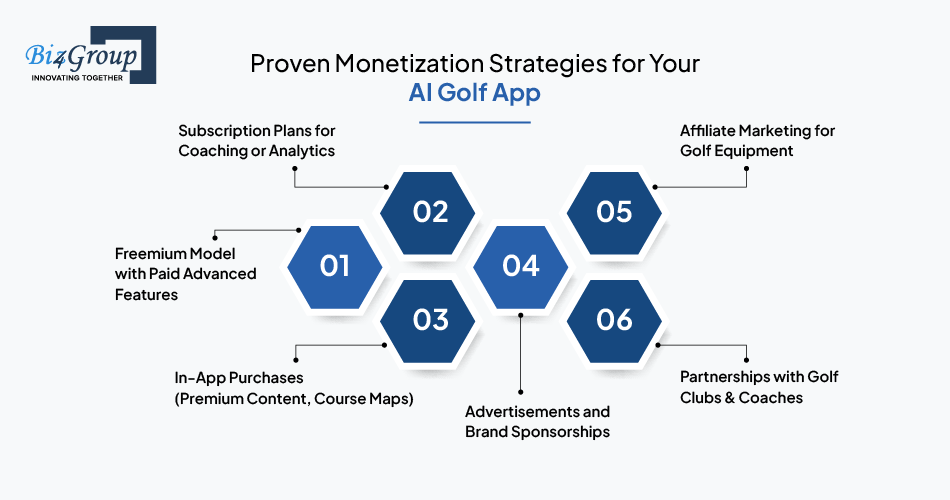
After the development of AI golf app, the next goal is turning your product into a profitable venture. Today’s golf tech users are willing to pay for tools that help them improve their game, stay connected, and get value from every round. With the right monetization strategies for AI golf app, you can maximize revenue while enhancing the user experience.
Here are the most effective and scalable monetization models you can implement:
The freemium model allows users to download and use the basic version of your app for free, which builds a large user base quickly. You can then unlock high-value features—like detailed AI-driven swing analysis, AR course previews, or pro feedback—through in-app purchases or upgrades.
This strategy helps build trust and gives users a reason to upgrade once they see the app’s core value. It’s one of the most widely adopted monetization strategies of AI golf app businesses because it balances user acquisition with revenue growth.
Offer monthly or annual subscription plans for exclusive AI coaching, data-backed performance reports, or virtual golf training. Subscriptions create consistent, recurring revenue and are especially attractive to players who are serious about improving their performance.
Different tiers (e.g., Beginner, Pro, Elite) can cater to various skill levels, each offering deeper insights, exclusive videos, and tailored practice plans. After the development of AI golf app, this model supports long-term user retention and scalability.
Let users buy specialized content such as pro-player swing comparisons, 3D hole flyovers, interactive drills, or course databases. This model allows you to monetize specific features without committing users to subscriptions.
It's ideal for golfers who only want to enhance certain areas of their game or access premium content on demand. You can also introduce seasonal packages (e.g., “Winter Indoor Drills”) or sell course maps for global golf travel.
Running targeted ads within the app—especially for golf equipment, apparel, or travel packages—can be a lucrative revenue stream. Partnering with brands for exclusive sponsorships (e.g., "Powered by Titleist") helps monetize without charging the user directly.
To preserve a premium user experience, limit ads to non-intrusive placements (like between holes or in free feature screens). This strategy works best with a large free-user base and can complement other monetization models.
By promoting golf gear, training aids, smart sensors, or apparel through affiliate links, you can earn a commission for every purchase made through your app. For example, after an AI club recommendation, link directly to an e-commerce partner.
This adds value to the user’s journey while generating passive income. It’s a great fit for apps with AI product suggestions or in-depth gear analysis.
Partnering with golf clubs, training centers, or individual coaches creates unique win-win opportunities. Your app can offer exclusive discounts, local coaching packages, or tournament invitations to users.
These partnerships increase app usage and bring real-world value to digital tools. Clubs also benefit from exposure, making it an attractive collaboration after launching your AI golf app.
By implementing the right monetization strategies, your AI Golf App can become both a powerful tool for users and a profitable, scalable business for you.
If you plan to build a high-performance, scalable, and intelligent golf application, partnering with the right technology expert is crucial. Biz4Group, a trusted AI development company in USA, is uniquely positioned to transform your vision into a cutting-edge solution.
From ideation to post-launch support, we specialize in AI Golf App development and deliver full-cycle enterprise AI solutions tailored for sports, fitness, and performance-driven applications.
Here’s how Biz4Group stands out when it comes to golf mobile app development utilizing AI:
We’ve worked on advanced AI projects across fitness, IoT, and mobility—giving us the perfect foundation to develop intelligent golf apps tailored to player behavior and performance.
Our team has successfully delivered 300+ custom apps, many of them built to handle real-time data, predictive analytics, and wearable integrations.
From user research to post-launch optimization, we manage every step of the process—strategy, design, development, AI integration, testing, and ongoing support.
We create tailored AI models using real golf data—perfect for swing analysis, shot predictions, smart coaching, or even virtual competitions.
We offer the best of both worlds: onshore leadership with offshore development support to deliver quality at speed and scale.

Tally Tumbler: eCommerce Platform For The Branding And Sale Of Golf Tumblers
An innovative interactive prototype developed for a golf-focused brand, Tally Tumbler showcases our expertise in building seamless digital solutions. This project highlights how Biz4Group blends design thinking with functional precision—skills that translate directly into crafting intuitive, user-friendly, and AI-driven golf mobile applications.
If you're serious about launching a competitive golf app, Biz4Group is your strategic partner in building AI-powered experiences that make a real impact. Whether you're looking to launch an MVP or a full-fledged product, we’re ready to help you lead the next wave of golf mobile app development utilizing AI.
Talk to our experts to validate your idea, define your roadmap, and explore your best options.
Schedule a Strategy CallThe integration of AI and golf presents a powerful opportunity for innovation and growth. Whether you’re targeting performance enhancement, smart coaching, or immersive gameplay, building an AI golf app can transform how users engage with the sport. This guide has outlined what is the process to develop AI golf app, covering everything from idea validation and feature planning to development, monetization, and ongoing improvements.
With the right strategy and development approach, your app can deliver real-time insights, personalized experiences, and measurable value to players of all levels. As interest in AI-powered sports tools continues to rise, now is the perfect time to begin your journey in AI golf app development.
👉 Book an appointment with our experts today and take the first step toward launching your intelligent golf app.
The timeline depends on features and complexity. A basic MVP with AI swing analysis may take 8–12 weeks, while a full-featured app with GPS, AR, and analytics can take 4–6 months.
Common technologies include computer vision for swing analysis, machine learning for personalized coaching, and predictive analytics for shot recommendations. OpenCV, TensorFlow, and custom AI models are widely used.
With the right training data and algorithms, AI can analyze swings with 85–95% accuracy and suggest clubs based on player history, distance, and terrain. Continuous model training improves accuracy over time.
Yes. While real-time AI needs internet access, offline features like score tracking, saved drills, and GPS maps can be built in. Hybrid modes are often included for outdoor play flexibility.
Ongoing maintenance typically ranges from $1,000 to $5,000 per month. This covers bug fixes, AI model updates, server costs, and user support to keep the app optimized.
Yes. A complete AI golf app development package often includes App Store & Play Store submission, ASO (App Store Optimization), and marketing consultation to help you reach the right audience.

with Biz4Group today!
Our website require some cookies to function properly. Read our privacy policy to know more.