 Location :
Orlando, FL, USA
Location :
Orlando, FL, USA +1 (407) 714-1616
 info@biz4group.com
 AI Summary Powered by Biz4AI
- AI is already transforming healthcare, from diagnosis and patient monitoring to workflow automation and decision support across hospitals and clinics.
- The biggest impact of AI in healthcare comes from practical use cases like automation, imaging, predictive analytics, and patient engagement.
- Successful adoption depends less on technology and more on execution, data quality, integration, and alignment with clinical workflows.
- This guide covers AI in healthcare questions and answers across tools, costs, implementation, risks, and real-world applications to help you make informed decisions.
- Working with an experienced AI healthcare development partner in USA, like Biz4Group LLC can accelerate implementation, reduce risk, and help translate AI strategies into real, scalable healthcare solutions.
- If you're exploring adoption, these common questions about AI in healthcare highlight what to prioritize, what to avoid, and how to move from strategy to execution.
AI in healthcare is everywhere right now - in headlines, vendor pitches, and product demos. But for most healthcare providers and decision-makers, the real questions are much more practical:
- Where do we actually start with AI?
- What use cases make sense for our setup?
- Is this worth the investment right now, or should we wait?
- Which tools or companies should we even trust?
Most content doesn’t answer these questions clearly. It either stays too high-level or dives too deep into technical detail without addressing real-world decisions.
This guide takes a different approach.
A Complete AI in Healthcare FAQ - Built Around Real Questions
This is a comprehensive AI in healthcare FAQ, built as a structured collection of AI in healthcare questions and answers based on how people actually search, ask, and evaluate solutions today.
From healthcare AI basics questions and answers to advanced implementation and vendor selection, this guide brings together:
- Common questions about AI in healthcare
- Frequently asked questions on healthcare AI
- Real-world AI healthcare use cases explained through practical scenarios
Everything is designed to help you move from understanding to decision-making without jumping between multiple resources.
What You’ll Find in This Guide
This guide functions as both a beginner guide to AI in healthcare with questions and answers and a detailed FAQ on artificial intelligence in the healthcare industry.
You’ll find answers to:
- How AI is used in hospitals and healthcare systems today
- What technologies actually deliver value in real-world settings
- How much AI costs and what ROI you can expect
- Which companies and tools are worth considering
- How to implement AI without disrupting existing workflows
If you’ve been searching for AI in healthcare explained with real-world questions or looking for medical AI questions explained simply, this guide is designed to give you clear, connected answers.
Who This Guide Is For?
This guide is built for:
- Healthcare providers and administrators
- Clinics and hospital decision-makers
- Founders building AI healthcare products
- Businesses exploring healthcare automation and AI solutions
Whether you’re just starting or actively evaluating solutions, this resource acts as a central hub of healthcare AI explained questions and answers tailored to real-world needs.
How to Use This Guide?
You don’t need to read everything in order.
- Start with the basics if you’re new
- Jump to implementation or cost sections if you’re evaluating solutions
- Use it as a reference while making decisions
Each section is structured as a set of AI healthcare guide questions, so you can quickly find what matters most to you.
Why Biz4Group LLC Created This Guide?
There’s no shortage of content on artificial intelligence in healthcare. What’s missing is clarity. This guide brings together:
- AI in hospitals FAQs
- Healthcare automation AI FAQs
- Practical AI healthcare implementation questions
All in one place - explained clearly, without hype, and focused on real-world application.
Let’s start with the fundamentals.
AI in Healthcare Basics
AI in healthcare sounds straightforward on the surface, but most people searching for it are not looking for definitions alone. They are trying to understand what it actually means in practice, how it differs from traditional systems, and whether it’s something they should take seriously right now.
This section answers those foundational questions.
If you’ve been looking for healthcare AI basics questions and answers, or trying to make sense of AI healthcare concepts explained simply, this is where you start. These are the kinds of medical AI questions explained clearly that help you build a solid understanding before moving into real-world use cases and implementation.
1. What Is AI in Healthcare?
AI in healthcare refers to the use of technologies such as machine learning, natural language processing, and computer vision to analyze medical data, assist in diagnosis, automate workflows, and improve patient outcomes.
Unlike traditional systems that follow fixed rules, these technologies learn from data and improve over time. This allows them to detect patterns in patient histories, interpret imaging data, and extract insights from clinical documentation with increasing accuracy.
In practice, artificial intelligence is embedded into tools healthcare providers already use, such as EHR systems, radiology software, and patient management platforms, rather than being introduced as a completely separate system.
2. How Is AI Used in Healthcare Today?
Across hospitals and clinics, AI is already being applied in both clinical and operational areas, from diagnosis to administrative workflows.
Common applications include:
- Medical imaging:Identifying abnormalities in X-rays, MRIs, and CT scans
- Predictive analytics:Flagging patients at risk of complications like sepsis or readmission
- Workflow automation:Reducing manual work in scheduling, billing, and documentation
- Drug discovery:Accelerating research by identifying promising compounds faster
- Remote monitoring:Tracking patient health using wearable data and AI models
Most organizations start with operational use cases such as documentation or scheduling, since they are easier to implement and deliver quick efficiency gains.
3. Why Is AI Important in Healthcare?
The importance of artificial intelligence in healthcare comes from its ability to address structural challenges such as increasing patient demand, limited staff, and rising costs.
AI helps improve diagnostic accuracy, reduce time spent on administrative work, and enable earlier intervention by identifying risks before they become critical. This shifts healthcare delivery from reactive treatment to more proactive care.
For organizations, this is less about adopting a new technology and more about improving how existing systems use data to support better decisions.
4. What Are Real Examples of AI in Healthcare?
Real-world AI applications can be seen across both patient care and hospital operations.
Some widely adopted examples include:
- Cancer detection:AI models analyzing radiology scans to identify tumors at early stages
- Virtual assistants:Handling appointment booking, reminders, and basic patient queries
- Risk prediction:Identifying patients likely to deteriorate or be readmitted
- Drug discovery:Reducing the time needed to identify viable treatment candidates
For example, many hospitals use predictive systems to detect early signs of sepsis, allowing intervention hours earlier than traditional methods.
5. What Problems Can AI Solve in Healthcare?
AI helps solve several key challenges in healthcare, including delayed diagnosis, administrative inefficiencies, rising costs, and the underuse of medical data.
Some of the most important problems it addresses include:
- Delayed diagnosis:Identifying patterns that may not be immediately visible
- Administrative overload:Automating repetitive tasks like documentation and billing
- Rising costs:Improving efficiency across workflows
- Data underutilization:Converting large volumes of data into actionable insights
- Limited personalization:Supporting more tailored treatment approaches
This is why adoption often begins with workflow optimization before expanding into clinical decision support.
6. How Can AI Help in Healthcare Overall?
At a system level, AI improves how decisions are made, how resources are used, and how early interventions happen.
It enables healthcare providers to identify risks sooner, reduce inefficiencies in operations, and allocate time more effectively. Instead of reacting to issues after they occur, organizations can anticipate and prevent them.
The biggest impact is seen when multiple applications, such as predictive analytics and automation, are used together rather than in isolation.
7. What Are the Main Types of AI Applications in Healthcare?
The main types of AI applications in healthcare can be grouped into predictive, diagnostic, generative, and automation-focused systems.
In practice, these include:
- Predictive systems:Estimating risks like disease progression or hospital readmission
- Diagnostic systems:Supporting detection through imaging and clinical data analysis
- Generative tools:Creating clinical notes, summaries, and patient communication
- Automation tools:Streamlining administrative and operational processes
Healthcare organizations typically evaluate these as solutions tied to outcomes rather than underlying technologies.
8. What Is Machine Learning in Healthcare?
Machine learning enables systems to learn from medical data and improve predictions over time.
It is widely used to identify risk patterns, recommend treatment options, and optimize workflows. As models are exposed to more data, their ability to detect meaningful patterns improves.
For example, hospitals use machine learning to identify patients at high risk of readmission, allowing earlier and more targeted intervention.
9. What Is Deep Learning in Healthcare?
Deep learning is an advanced approach designed to handle complex data such as medical images and large datasets.
It plays a major role in imaging-based diagnosis, where it can detect subtle abnormalities that might not be obvious to the human eye. It is also used in genomics and advanced research.
This makes it particularly valuable in areas where early and accurate detection is critical.
10. What Is the Difference Between AI and Traditional Healthcare Software?
The difference lies in how systems use data.
Traditional software follows predefined rules and is mainly used for storing and retrieving information. AI-driven systems analyze data, identify patterns, and generate insights that support decision-making.
For example, instead of simply flagging abnormal lab results, AI can assess multiple variables together to predict potential health risks.
11. Is AI Replacing Doctors?
AI is not replacing doctors but is being used to support them by improving efficiency, accuracy, and decision-making.
While these systems can analyze data and assist in diagnosis, they cannot replace human judgment, empathy, and clinical experience. Doctors remain essential for interpreting results and providing care.
In practice, this leads to better efficiency rather than reduced human involvement.
12. Can AI Diagnose Diseases?
AI can assist in diagnosing diseases by analyzing medical data, but it is typically used alongside healthcare professionals.
It can process imaging data, lab results, and patient histories to identify patterns associated with specific conditions. In some cases, it has shown high accuracy in detecting diseases.
However, diagnosis requires context and judgment, which is why these systems are used as decision-support tools.
13. How Accurate Is AI in Healthcare?
AI can be highly accurate, especially in areas like medical imaging and pattern recognition, but its performance depends on data quality and implementation.
Some systems have demonstrated accuracy comparable to human experts in controlled settings. However, real-world performance can vary.
Healthcare organizations must validate these systems carefully to ensure reliability and safety.
14. What Are the Benefits of AI in Healthcare?
AI offers several benefits across both clinical outcomes and operational efficiency. Key advantages include:
- Improved diagnostic accuracy
- Reduced administrative workload
- Lower operational costs
- Better patient outcomes through earlier intervention
- More effective use of healthcare data
These benefits are driving adoption across healthcare systems.
15. What Are the Risks of AI in Healthcare?
AI also comes with risks that organizations need to consider. Some key risks include:
- Data privacy and security concerns
- Bias in training data affecting outcomes
- Limited transparency in decision-making
- Over-reliance on automated systems
Managing these risks requires strong governance, compliance, and human oversight.
AI in Healthcare Basics: Takeaway
At its core, AI in healthcare is about improving how data is used to support better decisions, reduce inefficiencies, and enable earlier intervention.
With the fundamentals in place, the next step is to explore how these capabilities translate into real-world healthcare use cases.
Turn AI Knowledge Into Real Healthcare Impact
Explore practical solutions built around AI in healthcare questions and answers to move from learning to implementation.
Start Your AI Healthcare JourneyReal-World Use Cases of AI in Healthcare
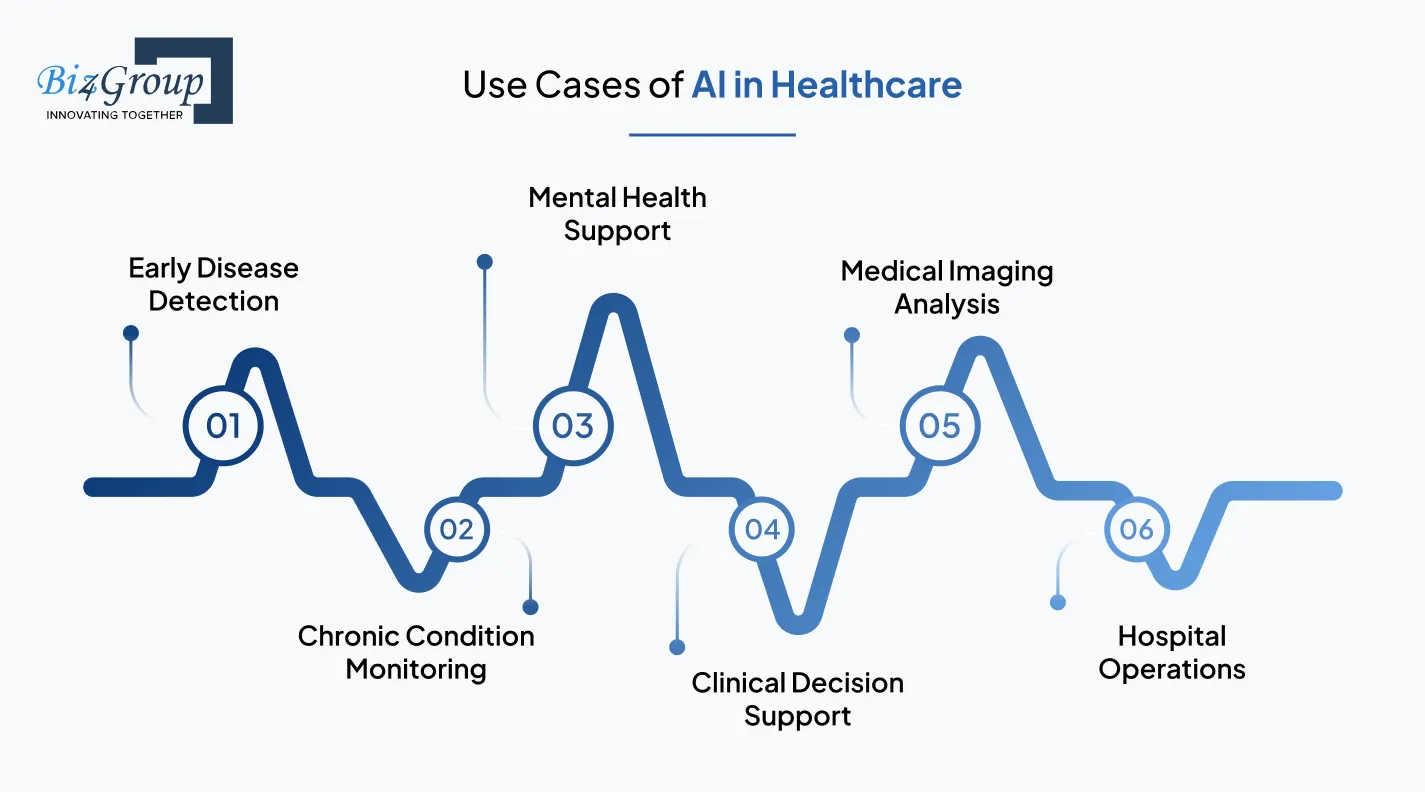
Understanding the fundamentals is important, but most healthcare providers and decision-makers are really trying to answer one thing: where does this actually work in practice, and what should we prioritize first?
This section breaks down AI healthcare use cases explained in real-world terms, focusing on where AI is already delivering value across hospitals, clinics, and healthcare organizations. If you’re evaluating adoption, these are the applications that matter most.
16. How Is AI Used in Medical Diagnosis?
AI is used in medical diagnosis to analyze patient data and detect patterns that enable earlier and more accurate disease identification. It is commonly applied in imaging, lab analysis, and risk prediction, where early detection directly improves outcomes.
By processing large datasets quickly, AI helps clinicians identify conditions that might otherwise be missed or detected later. In practice, it acts as a decision-support layer that enhances diagnostic confidence and speed.
17. How Does AI Help in Radiology?
AI helps in radiology by analyzing medical images to detect abnormalities and prioritize critical cases. It is widely used in interpreting X-rays, CT scans, and MRIs, where speed and accuracy are essential.
In high-volume environments, AI reduces reporting delays by flagging urgent findings first. This allows radiologists to focus on complex cases, improving both efficiency and consistency in diagnosis.
18. Can AI Detect Cancer Early?
AI can detect certain cancers early by identifying subtle patterns in imaging and clinical data that may not be immediately visible. It is especially effective in screening workflows, such as breast and lung cancer detection.
Early identification allows for faster intervention, which significantly improves survival rates. However, AI is used alongside clinical validation to confirm diagnosis and guide treatment decisions.
19. How Is AI Used in Drug Discovery and Medical Research?
AI is used in drug discovery to analyze biological and chemical data, helping identify viable treatment candidates faster. It reduces reliance on trial-and-error by predicting how compounds will behave.
This shortens early research cycles and lowers development costs. It is particularly valuable in complex areas like genomics and rare diseases, where traditional methods are time-intensive.
20. How Does AI Enable Personalized Medicine?
AI enables personalized medicine by tailoring treatments based on individual patient data, including genetics, medical history, and lifestyle factors.
This allows healthcare providers to move away from one-size-fits-all approaches and deliver more targeted therapies. The impact is most visible in areas like oncology, where treatment response varies significantly between patients.
21. How Is AI Used in Surgery?
AI is used in surgery to improve planning, precision, and intraoperative support. It helps analyze patient data before procedures and, in some cases, guides robotic-assisted systems.
This leads to greater accuracy and reduced risk of complications. In practice, AI enhances surgical capabilities while leaving decision-making fully in the hands of clinicians.
22. What Is AI in Remote Patient Monitoring?
AI in remote patient monitoring refers to analyzing real-time patient data from wearable devices and sensors to detect health risks early.
It is commonly used for chronic disease management, where continuous monitoring can identify subtle changes before they escalate. This reduces hospital visits and enables more proactive care.
23. How Does AI Improve Hospital Operations?
AI improves hospital operations by optimizing workflows, resource allocation, and patient flow. It is often used to predict demand, manage bed availability, and streamline scheduling.
These improvements reduce bottlenecks and increase efficiency, allowing hospitals to handle more patients without compromising care quality.
24. How Do Hospitals Use AI to Improve Patient Care and Operations?
Hospitals use AI across clinical and operational functions to improve outcomes and efficiency simultaneously. On the clinical side, it supports diagnosis and monitoring; on the operational side, it automates workflows and optimizes resources.
This combined approach allows healthcare systems to deliver better care while controlling costs and improving overall performance.
25. How Is AI Used in Mental Healthcare?
AI is used in mental healthcare to support early detection, monitoring, and patient engagement. It can analyze speech, behavior, and patient inputs to identify patterns associated with conditions like depression or anxiety.
Digital tools also provide continuous support between clinical visits, improving access to care. However, treatment decisions still rely heavily on human professionals.
26. Can AI Predict Diseases Before Symptoms Appear?
AI can predict the likelihood of certain diseases by analyzing patterns in patient data before symptoms develop. It uses historical records, biomarkers, and behavioral data to identify risk factors.
This enables earlier intervention, which can prevent or delay disease progression. Predictive capabilities are one of the most valuable aspects of AI in long-term care management.
27. How Is AI Used in Pathology?
AI is used in pathology to analyze tissue samples and detect disease-related patterns with high precision. It is particularly effective in identifying cancerous cells in digital pathology slides.
By reducing manual review time, AI allows pathologists to focus on complex cases while improving diagnostic consistency.
28. How Does AI Support Clinical Decision-Making?
AI supports clinical decision-making by analyzing patient data and providing recommendations based on patterns and clinical knowledge.
It can highlight risks, suggest treatment options, and flag inconsistencies. This is especially useful in complex cases where multiple variables must be considered quickly.
29. What Is AI in Medical Imaging?
AI in medical imaging refers to the use of algorithms to analyze visual data and assist in diagnosis. It improves accuracy, reduces interpretation time, and helps detect abnormalities earlier.
Because it integrates directly into existing workflows, it is one of the most widely adopted applications in modern healthcare systems.
30. How Is AI Used in Emergency Care?
AI is used in emergency care to identify high-risk patients quickly and support triage decisions. It analyzes incoming data in real time to prioritize cases based on severity.
This improves response time and ensures that critical patients receive immediate attention, which can be life-saving in urgent situations.
From Strategy to Execution in AI in Healthcare
Get expert support to solve real AI healthcare implementation questions and deploy solutions that actually work in clinical environments.
Build Your AI Healthcare Solution31. How Does AI Reduce Hospital Readmissions?
AI reduces hospital readmissions by identifying patients at high risk before discharge. It analyzes medical history, treatment plans, and recovery trends to predict complications.
This allows healthcare providers to intervene early through follow-ups or care adjustments, improving outcomes and reducing costs.
32. How Is AI Used in Healthcare Administration?
AI is used in healthcare administration to automate repetitive processes and improve operational efficiency.
Common applications include scheduling, billing, claims processing, and documentation. These improvements reduce manual workload and allow staff to focus more on patient care.
33. How Does AI Automate Healthcare Workflows?
AI automates workflows by handling routine tasks that would otherwise require manual effort.
For example, it can generate clinical documentation, process insurance claims, and manage scheduling. This reduces administrative burden and improves overall efficiency across departments.
34. What Are Applications of Computer Vision in Healthcare?
Computer vision is used to analyze medical images and detect patterns that support diagnosis and treatment. Key applications include:
- Radiology imaging analysis
- Pathology slide evaluation
- Surgical guidance systems
These applications improve both speed and accuracy, particularly in data-intensive clinical areas.
35. How Is NLP Used in Healthcare?
Natural language processing (NLP) is used to extract insights from unstructured clinical text such as doctor’s notes and reports.
It converts this data into structured information that can support decision-making and analytics. This is critical because a large portion of healthcare data is not stored in structured formats.
36. How Can AI Improve Patient Engagement and Communication?
AI improves patient engagement by making communication more timely, accessible, and personalized.
Tools like chatbots, automated reminders, and digital assistants help patients stay informed and adhere to treatment plans. This leads to better outcomes and fewer missed appointments.
37. How Is AI Used for Predictive Analytics in Patient Care?
AI is used for predictive analytics to identify risks and trends in patient data, enabling earlier intervention.
It helps forecast disease progression, detect complications, and support preventive care strategies. This shifts healthcare from reactive treatment to proactive management.
38. How Can AI Help Scale Healthcare Services Without Reducing Quality?
AI helps scale healthcare services by improving efficiency and enabling better use of resources.
By automating processes and supporting decision-making, healthcare providers can manage higher patient volumes without compromising care quality. This is essential as demand continues to grow.
Real-World Use Cases: Takeaway
Real-world adoption of AI in healthcare is driven by practical applications that deliver measurable outcomes across diagnosis, operations, and patient care.
This section reflects some of the most important AI in healthcare FAQs, helping connect real-world use cases with actionable understanding.
AI Tools, Software and Technologies Used for AI in Healthcare
Once use cases are clear, the next step is understanding what tools actually power them. This section addresses key AI healthcare guide questions, helping healthcare providers evaluate the technologies behind AI in healthcare and how they are used in practice.
39. What Are the Most Popular AI Tools in Healthcare?
The most popular AI tools in healthcare are those that directly support diagnosis, automation, and patient interaction.
These typically include:
- Imaging analysis tools for detecting abnormalities
- Clinical decision support systems for treatment guidance
- Predictive analytics platforms for risk identification
- Administrative automationtools for documentation and scheduling
These tools are widely adopted because they integrate easily into existing workflows and deliver measurable results quickly.
40. What Are the Best AI Tools for Healthcare Providers?
The best AI tools for healthcare providers are those that solve specific problems while fitting seamlessly into existing systems.
In practice, providers tend to prioritize tools that reduce administrative burden, improve diagnostic accuracy, or enhance patient engagement. The right choice depends less on features and more on how well the tool aligns with daily workflows and clinical needs.
41. What Is Generative AI in Healthcare?
Generative AI in healthcare refers to systems that create content such as clinical notes, summaries, and patient communication.
It is primarily used to automate documentation and reduce time spent on repetitive writing tasks. For example, clinicians can generate structured notes directly from conversations or patient data.
This is one of the fastest-growing areas because it delivers immediate efficiency gains without major workflow changes.
42. How Is ChatGPT Used in Healthcare Workflows?
ChatGPT is used in healthcare workflows mainly for documentation, communication, and internal knowledge support.
Common use cases include:
- Generating clinical summaries and reports
- Drafting patient communication
- Assisting with internal queries and knowledge retrieval
Its value comes from reducing time spent on text-heavy tasks while improving consistency in communication.
43. What Are Clinical Decision Support Systems (CDSS)?
Clinical decision support systems are tools that analyze patient data and provide recommendations to assist clinicians.
They compare patient information with clinical guidelines and historical data to highlight risks or suggest next steps. These systems are especially useful in complex cases where multiple variables need to be evaluated quickly.
44. What Is Natural Language Processing (NLP) in Healthcare?
Natural language processing (NLP) is used to analyze unstructured clinical text and convert it into usable data.
It processes sources such as doctor’s notes, discharge summaries, and reports, making this information accessible for analytics and decision-making. This is critical because much of healthcare data exists in text form.
45. How Is Computer Vision Used in Healthcare?
Computer vision is used to analyze visual data such as medical images and identify patterns relevant to diagnosis and treatment. It is most commonly applied in:
- Radiology for interpreting scans
- Pathology for analyzing tissue samples
- Surgical systems for guidance and precision
This improves both diagnostic accuracy and speed, especially in data-intensive clinical areas.
46. What Are AI-Powered EHR Systems?
AI-powered EHR systems enhance traditional records by adding intelligence and automation.
They can summarize patient histories, highlight critical information, and provide contextual insights during clinical workflows. This allows healthcare providers to make faster, more informed decisions without replacing existing systems.
47. What Is Predictive Analytics in Healthcare?
Predictive analytics uses AI to analyze historical and real-time data to forecast future outcomes.
It is commonly used to identify high-risk patients, predict disease progression, and anticipate resource needs. This enables earlier intervention and helps shift healthcare from reactive to proactive care.
48. What Are AI Medical Chatbots?
AI medical chatbots are tools that interact with patients to handle routine communication and support tasks.
They are typically used for:
- Answering common patient questions
- Scheduling appointments
- Providing basic guidance based on symptoms
These tools improve accessibility while reducing the workload on administrative teams.
49. What AI Tools Assist Doctors in Diagnosis and Treatment Recommendations?
AI tools that assist doctors focus on analyzing patient data and providing actionable insights.
These include clinical decision support systems, imaging analysis tools, and predictive models. Together, they help clinicians make faster, more accurate decisions, especially in complex or high-risk cases.
50. What Is Ambient Clinical Intelligence?
Ambient clinical intelligence refers to AI systems that capture and process clinical interactions automatically in the background.
For example, these systems can listen to doctor-patient conversations and generate structured notes without manual input. This reduces documentation burden and allows clinicians to focus more on patient care.
Reduce Costs and Improve Efficiency by Up to 40%
Leverage proven AI in healthcare solutions to automate workflows, optimize operations, and enhance patient outcomes at scale.
See What AI Can Do for Your Organization51. What Are AI Scribes and How Do They Work?
AI scribes are tools that automatically generate clinical documentation from conversations.
They use speech recognition and language processing to capture interactions in real time and convert them into structured notes. This significantly reduces time spent on documentation and improves workflow efficiency.
52. What Is AI-Powered Triage in Healthcare?
AI-powered triage systems assess patient symptoms and determine the level of urgency for care.
They are commonly used in emergency settings and digital health platforms to guide patients toward the appropriate level of care. This helps prioritize critical cases and improves overall efficiency.
53. What Are FDA-Approved AI Healthcare Tools?
FDA-approved AI tools are systems that have been validated for safety and effectiveness in clinical use.
They are most commonly found in areas such as imaging and diagnostics, where regulatory approval is required. This ensures that the tools meet specific standards before being used in patient care.
54. What Are Healthcare SaaS Solutions Powered by AI?
Healthcare SaaS solutions powered by AI are cloud-based platforms that deliver AI capabilities without requiring on-site infrastructure.
They typically offer:
- Data analytics and insights
- Workflow automation
- Patient engagement tools
These solutions are preferred because they are scalable, easier to deploy, and more cost-effective than traditional systems.
AI Tools, Software and Technologies: Takeaway
Understanding the tools behind AI in healthcare is essential for moving from exploration to execution.
This section addresses some of the most common questions about AI in healthcare, helping organizations evaluate which technologies to prioritize and how to approach adoption in a practical, results-driven way.
AI Chatbots and Automation for AI in Healthcare
As organizations move from understanding to execution, automation becomes one of the first practical entry points. This section addresses frequently asked questions on healthcare AI, focusing on how conversational tools and automation systems are applied in real-world settings using AI in healthcare.
55. What Are AI Chatbots in Healthcare?
AI chatbots in healthcare are software applications that interact with patients and users through text or voice to provide information, support, and basic assistance.
They are commonly used to handle routine tasks such as answering questions, scheduling appointments, and guiding patients. Their main value lies in improving accessibility while reducing the workload on healthcare staff.
56. How Do Healthcare Chatbots Work?
Healthcare chatbots work by using natural language processing and predefined workflows to understand user input and generate relevant responses.
They analyze patient queries, match them with trained data or logic, and provide responses in real time. More advanced systems can learn from interactions and improve over time.
In practice, they are often integrated with existing systems like EHRs or patient portals.
57. What Are the Main Use Cases of Chatbots in Healthcare?
Chatbots are used across multiple areas in healthcare, especially where repetitive communication is involved.
Common use cases include:
- Appointment scheduling and reminders
- Answering frequently asked patient questions
- Symptom checking and basic triage guidance
- Patient onboarding and form collection
These use cases are popular because they are easy to implement and deliver immediate efficiency gains.
58. How Do Chatbots Improve Patient Engagement?
Chatbots improve patient engagement by making communication faster, more consistent, and available at any time.
They provide instant responses, send reminders, and offer guidance without requiring patients to wait for human interaction. This improves accessibility and helps patients stay connected with their care plans.
As a result, adherence to treatment and appointment attendance often improve.
59. Are Healthcare Chatbots HIPAA Compliant?
Healthcare chatbots can be HIPAA compliant, but compliance depends on how they are designed and deployed.
To meet requirements, they must ensure secure data handling, encryption, and controlled access to patient information. They also need to follow strict guidelines around storing and transmitting sensitive data.
Organizations must evaluate vendors carefully to ensure compliance standards are met.
60. What Are the Best Healthcare Chatbot Solutions?
The best healthcare chatbot solutions are those that integrate seamlessly with existing systems and meet compliance requirements.
Rather than focusing on brand names, organizations typically evaluate solutions based on:
- Ease of integration with EHRs and systems
- Compliance with healthcare regulations
- Customization capabilities
- Scalability and support
The right solution depends on the specific use case and organizational needs.
61. How Much Does It Cost to Build a Healthcare Chatbot?
The cost of building a healthcare chatbot varies depending on complexity, features, and whether it is custom-built or based on existing platforms.
Basic chatbots with limited functionality are relatively affordable, while advanced systems with integrations, AI capabilities, and compliance features require higher investment.
In most cases, cost is influenced more by AI integration services and compliance requirements than by the chatbot itself.
62. What Is Conversational AI in Healthcare?
Conversational AI in healthcare refers to advanced systems that enable natural, human-like interactions between users and digital tools.
Unlike basic chatbots, conversational AI can understand context, manage multi-step conversations, and provide more personalized responses. It is used in patient support, virtual assistants, and automated communication systems.
63. How Are Virtual Healthcare Assistants Used?
Virtual healthcare assistants are AI-powered tools that support both patients and healthcare providers.
They are used to:
- Guide patients through processes such as booking or onboarding
- Provide health-related information and reminders
- Assist clinicians with administrative or documentation tasks
These assistants improve efficiency while enhancing the overall user experience.
64. What AI Solutions Automate Administrative Tasks in Healthcare?
AI is widely used to automate administrative tasks that consume time and resources.
Common solutions include tools for scheduling, billing, claims processing, and documentation. These systems reduce manual effort and improve accuracy across operations.
Automation is often the first step organizations take when adopting AI because it delivers quick and measurable results.
65. How Do AI Chatbots Reduce Operational Costs in Healthcare?
AI chatbots reduce operational costs by automating repetitive communication and reducing the need for manual intervention.
They handle large volumes of patient interactions without requiring additional staff, which lowers administrative expenses. They also reduce errors and improve efficiency in processes like scheduling and support.
Over time, these savings can be significant, especially in high-volume healthcare environments.
AI Chatbots and Automation: Takeaway
AI chatbots and automation tools represent some of the most accessible and high-impact entry points into AI in healthcare.
This section builds on core healthcare AI basics questions and answers, showing how organizations can improve efficiency, reduce costs, and enhance patient experience through practical, scalable solutions.
AI Development, Companies and Vendors for AI in Healthcare
As organizations move from exploration to execution, choosing the right partner becomes one of the most critical decisions. This section addresses key medical AI questions explained, focusing on how to evaluate vendors, development companies, and solution providers involved in AI in healthcare.
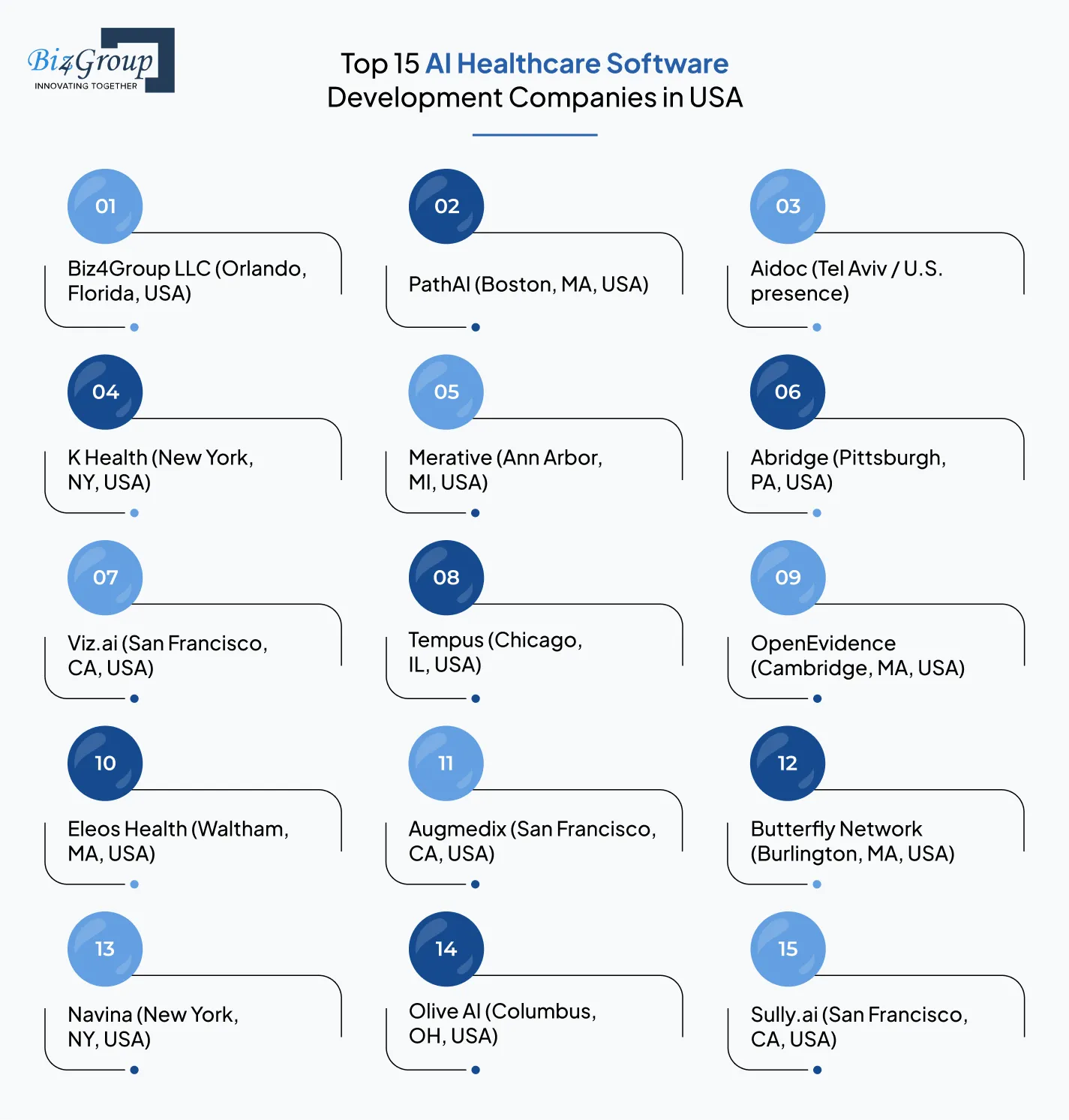
66. What Are the Top Healthcare Software Development Companies in the US?
Top AI healthcare software development companies in the USA are those with proven experience in regulated environments, strong integration capabilities, and successful deployments in hospitals or clinics.
Rather than relying on generic rankings, organizations should prioritize companies that have worked on similar use cases and can demonstrate measurable outcomes. In healthcare, domain expertise and compliance knowledge matter more than brand visibility.
67. What Are the Best AI Healthcare Software Companies?
The best AI healthcare software companies are those that deliver production-ready solutions, not just prototypes or demos.
They typically specialize in areas like diagnostics, predictive analytics, or automation, and have validated their solutions in real clinical settings. The key differentiator is their ability to move from concept to deployment while meeting regulatory and integration requirements.
68. What Do Healthcare Software Development Companies Actually Do?
Healthcare software development companies design, build, and maintain systems that support clinical and operational workflows.
This includes developing applications, integrating with EHR systems, ensuring compliance, and supporting deployment. More advanced firms also build AI-driven solutions such as analytics platforms and automation tools.
The real value lies in connecting these systems into a cohesive, usable workflow.
69. How Do You Choose a Healthcare AI Development Company?
Choosing the right AI healthcare development company is less about features and more about fit.
You should evaluate:
- Experience with similar healthcare use cases
- Understanding of compliance and data privacy
- Ability to integrate with existing systems
- Evidence of successful real-world deployments
A technically strong company without healthcare context often struggles, while a domain-focused partner can significantly reduce implementation risk.
70. What Are the Top AI Healthcare Startups?
Top AI healthcare startups are usually focused on solving one specific problem exceptionally well.
They often lead innovation in areas like diagnostics, remote monitoring, or automation. However, they may lack the maturity or scalability of larger vendors.
They are best suited for targeted use cases rather than large, system-wide implementations.
71. What Are Examples of Successful AI Healthcare Companies?
Successful AI healthcare companies are defined by real-world impact, not just technology.
They typically have:
- Deployed solutions in clinical environments
- Measurable improvements in outcomes or efficiency
- Strong regulatory and compliance alignment
Success in healthcare is less about innovation alone and more about reliable execution.
72. What Services Do AI Healthcare Development Companies Offer?
AI healthcare development companies offer services across the full lifecycle of implementation. These usually include:
- Strategy and consulting
- Custom solution development
- System integration
- Deployment and scaling
- Ongoing support and optimization
- End-to-end providers are often preferred when internal expertise is limited.
73. Should You Outsource Healthcare Software Development?
Outsourcing is often the most practical option for organizations without in-house AI or development expertise.
It allows faster execution and access to specialized skills. However, it introduces dependency on external partners, which makes vendor selection critical.
The decision should balance speed, control, and long-term strategy.
74. What Are the Benefits of Outsourcing Healthcare Software Development?
Outsourcing provides clear advantages when done correctly.
- Access to experienced talent
- Faster development timelines
- Lower operational overhead
- Flexibility to scale resources
However, these benefits only materialize when working with a partner that understands healthcare-specific requirements.
75. How Do You Hire Healthcare Software Developers?
Hiring healthcare software developers requires a mix of technical and domain expertise.
Developers should understand healthcare workflows, compliance requirements, and integration challenges. In many cases, organizations rely on specialized firms or vendors to hire AI developers rather than building large in-house teams from scratch.
76. What Should You Look for in a Healthcare Software Vendor?
A strong vendor should demonstrate reliability, compliance knowledge, and the ability to integrate into existing systems.
Look for evidence of past success, clear communication, and long-term support capabilities. Vendors should also understand how their solutions will be used in real workflows, not just how they are built.
77. What Are Healthcare Automation Companies?
Healthcare automation companies focus on streamlining administrative and operational processes.
They build tools for scheduling, billing, documentation, and workflow management. These solutions are often the easiest entry point into AI adoption because they deliver quick efficiency gains.
78. What Are Healthcare IT Software Companies?
Healthcare IT software companies provide the foundational systems used across healthcare organizations.
This includes EHR systems, hospital management platforms, analytics tools, and AI-enabled solutions. These companies are essential for maintaining digital infrastructure and enabling integration.
79. What Are the Best Healthcare Software Providers?
The best providers are those that consistently deliver reliable, scalable, and compliant solutions.
Rather than focusing on brand names, organizations should evaluate providers based on performance, integration capability, and long-term support. The best provider is one that fits your specific operational needs.
80. Which Companies Develop Custom AI Healthcare Solutions?
Companies that build custom solutions focus on tailoring AI systems to specific organizational requirements.
This is often necessary when off-the-shelf tools do not fit workflows or data structures. Custom software development companies offer flexibility but require more time, investment, and ongoing support.
81. Which AI Healthcare Companies Offer End-to-End Implementation Services?
End-to-end providers manage the full lifecycle of AI projects, from strategy to deployment.
They reduce complexity by handling consulting, development, integration, and scaling within a single engagement. This is particularly valuable for organizations with limited internal resources.
82. Which Vendors Provide Scalable and Compliant AI Healthcare Software?
Vendors in this category focus on building solutions that meet regulatory standards while supporting long-term growth.
They ensure secure data handling, interoperability, and the ability to scale across systems. These factors are critical for organizations planning large-scale adoption.
83. Which Companies Build AI Tools for Diagnosis and Patient Monitoring?
Companies specializing in diagnostics and monitoring build AI software that directly impact patient outcomes.
These include imaging systems, predictive models, and remote monitoring platforms. Organizations should prioritize accuracy, validation, and clinical usability when evaluating these vendors.
84. Which AI Vendors Are Best for Healthcare Data Analysis and Decision Support?
Vendors focused on analytics provide tools that turn large datasets into actionable insights.
They help identify trends, predict risks, and support clinical decisions. The best vendors combine strong analytics capabilities with seamless integration into existing systems.
85. Which Companies Offer AI-Powered Healthcare Chatbots and Automation Tools?
These companies specialize in AI conversation apps and workflow automation.
They build chatbots, virtual assistants, and automation tools that improve communication and reduce administrative workload. These solutions are often used as entry points into AI adoption.
86. How Do You Evaluate AI Healthcare Companies Based on Case Studies?
Case studies should be evaluated based on relevance, not just results.
Look for:
- Similar use cases or environments
- Clear metrics and outcomes
- Evidence of real-world deployment
A strong case study demonstrates both capability and practical impact.
Bring Your AI Healthcare Idea to Life
Work with experts who understand AI in healthcare explained for providers with practical questions and can turn concepts into deployable systems.
Talk to Our AI Experts87. Which Companies Specialize in AI Integration With Healthcare Systems?
Integration-focused companies ensure that AI tools work with existing systems such as EHRs and hospital software.
This is often one of the most critical aspects of implementation, as poor integration can limit the value of even the best AI tools.
88. What Are the Most Trusted AI Healthcare Solution Providers?
Trusted providers are those with a consistent track record of successful deployments and strong client relationships.
They demonstrate reliability through long-term partnerships, compliance adherence, and consistent performance across projects.
89. Which Companies Offer AI Consulting and Development for Healthcare?
Some companies provide both strategic guidance and technical execution.
They help organizations identify use cases, plan implementation, and build solutions tailored to their needs. This combination of AI consulting services is especially useful for organizations early in their AI journey.
90. How Do You Shortlist the Best AI Healthcare Development Partner?
Shortlisting should focus on alignment rather than quantity.
Organizations typically narrow down options based on experience, expertise, and proven results. A focused shortlist allows for deeper evaluation and better decision-making.
91. How Do You Compare AI Healthcare Vendors and Choose the Best Partner?
Comparing vendors requires evaluating both technical and practical factors.
- Technical capability
- Integration readiness
- Compliance and security
- Cost and scalability
The best partner is one that aligns with your long-term goals, not just immediate needs.
92. Which Companies Offer End-to-End AI Healthcare Solutions From Strategy to Deployment?
These companies manage the entire AI lifecycle, from planning to implementation and scaling.
They are particularly valuable for complex projects where coordination across multiple stages is required. Working with a single partner reduces fragmentation and improves overall execution.
AI Development, Companies and Vendors: Takeaway
Selecting the right partner is a strategic decision that directly impacts the success of AI in healthcare initiatives.
This section simplifies AI healthcare concepts explained simply, helping organizations move from exploration to confident vendor selection based on real-world considerations.
Implementation and Adoption for AI in Healthcare
Understanding tools and vendors is only part of the journey. The real challenge lies in execution, where most AI initiatives either succeed or fail. This section addresses practical AI healthcare implementation questions, focusing on how organizations can realistically adopt and scale AI in healthcare without overcomplicating the process.
93. How Do Hospitals Implement AI Systems?
Hospitals implement AI systems through phased rollouts rather than large-scale deployments.
In practice, most start with a single use case, such as documentation or imaging, run a controlled pilot, and validate results before expanding. What often slows implementation is not the technology itself, but integration with existing systems and staff adoption.
The most successful hospitals treat AI as a gradual capability build, not a one-time deployment.
94. What Are the Steps to Adopt AI in Healthcare?
AI adoption follows a structured path, but execution often breaks down when steps are rushed or skipped.
A realistic sequence includes:
- Identifying a clear, high-impact use case
- Assessing data quality and availability
- Selecting tools or partners based on integration fit
- Running a pilot with defined success metrics
- Expanding only after measurable results
The biggest mistake is jumping directly to scaling without validating the initial use case.
95. Should Healthcare Organizations Invest in AI Now or Wait?
Waiting rarely reduces complexity; it only delays learning.
Most organizations benefit from starting now with focused use cases where AI is already proven, such as automation or imaging. The real advantage of early adoption is not just ROI, but building internal experience and readiness.
Organizations that wait often struggle later because they lack both data maturity and operational familiarity.
96. How Do You Implement AI Without Disrupting Workflows?
AI fails when it forces clinicians to change how they work instead of fitting into existing processes.
Successful implementations prioritize:
- Tools that integrate with current systems
- Minimal additional steps for end users
- Gradual introduction rather than abrupt changes
If a solution adds friction, adoption drops regardless of its technical quality.
97. Where Should a Hospital or Clinic Start With AI Adoption?
The best starting point is where value is obvious and resistance is low. Most organizations begin with:
- Administrative automation (documentation, scheduling)
- Imaging or diagnostic support
- Patient communication tools
These areas deliver quick wins and help build trust before moving into more complex use cases.
98. What Are the Most Practical AI Use Cases for Healthcare Organizations?
Practical use cases are those that balance impact with ease of implementation.
Automation, predictive analytics, and imaging support are commonly prioritized because they require less structural change while delivering measurable outcomes. The goal is not to start with the most advanced use case, but the most executable one.
99. How Do You Plan and Execute AI Implementation Successfully?
Successful execution depends more on alignment than technology. Organizations need to align:
- Business goals
- Clinical workflows
- Data readiness
- Vendor capabilities
Implementation typically fails when one of these is overlooked, especially data quality or workflow integration.
100. How Can Clinics With Limited Technical Expertise Adopt AI?
Clinics without technical teams should avoid building from scratch. Instead, they can adopt:
- SaaS-based tools
- Vendor-supported solutions
- Pre-built automation platforms
These options reduce complexity and allow clinics to focus on usage rather than development.
101. What Is the Easiest Way to Get Started With AI in Healthcare?
The easiest way to start is with a single, clearly defined problem that affects daily operations.
In most cases, this is documentation or scheduling. These use cases require minimal integration, show quick results, and help organizations understand how AI fits into their workflows.
102. What Infrastructure Is Required for Healthcare AI?
AI does not always require heavy infrastructure, especially with modern cloud-based solutions.
At a minimum, organizations need secure data storage, access to relevant datasets, and integration capabilities. In practice, infrastructure becomes a challenge only when scaling, not during initial adoption.
103. What Data Is Needed to Train AI in Healthcare?
AI systems rely on clean, structured, and relevant data to function effectively.
This typically includes patient records, imaging data, lab results, and clinical notes. However, the real challenge is not data availability, but data quality and consistency.
Poor data leads to poor outcomes, regardless of how advanced the model is.
104. How Do You Integrate AI With EHR Systems?
Integration is one of the most critical and difficult parts of implementation.
AI tools need to connect with EHR systems so that insights are available within existing workflows. This is usually done through APIs, but real challenges often include data formatting, system compatibility, and workflow alignment.
Many projects fail not because of AI, but because integration is underestimated.
105. What Are the Biggest Challenges in AI Implementation?
The biggest challenges are rarely technical in isolation. They typically include:
- Data quality and accessibility issues
- Integration with existing systems
- Resistance from staff
- Regulatory and compliance constraints
Among these, adoption and workflow fit are often the hardest to solve.
106. What Are Common Mistakes in AI Adoption?
Most failures come from strategic missteps rather than technical ones. Common mistakes include:
- Starting without a clear use case
- Expecting immediate large-scale impact
- Ignoring data preparation
- Not involving end users early
AI adoption works best when treated as an iterative process, not a one-time rollout.
107. How Scalable Is AI in Healthcare?
AI is highly scalable, but only after the initial foundation is stable.
Once data pipelines, integrations, and workflows are established, organizations can expand use cases across departments. Scaling too early, however, often leads to inconsistent results and operational friction.
108. Do Small Clinics Need AI Solutions?
Small clinics do not need complex AI systems, but they can benefit significantly from targeted solutions.
Even simple tools for automation or communication can improve efficiency and patient experience. The key is to match the solution to the scale of the organization.
109. What Skills Are Needed to Implement AI in Healthcare?
AI implementation requires a mix of technical, clinical, and operational expertise.
This includes data handling, system integration, and understanding healthcare workflows. Most organizations rely on external partners to complement internal capabilities.
110. How Do You Use Patient Data and Medical Records With AI Effectively?
Effective use of patient data depends on structure, quality, and governance.
AI systems analyze this data to identify patterns, predict risks, and support decisions. However, without proper data preparation and compliance controls, even the best tools fail to deliver value.
111. What Technologies Should Healthcare Organizations Prioritize First?
Organizations should prioritize technologies that are easy to implement and deliver immediate value.
These include automation tools, predictive analytics, and imaging support. Starting here builds momentum and creates a foundation for more advanced use cases.
112. How Can We Implement AI in Our Hospital Without Disrupting Existing Workflows?
The key is to integrate AI into existing systems rather than layering it on top.
This involves choosing tools that align with current workflows, introducing them gradually, and ensuring that they reduce effort rather than add to it.
Adoption improves when users barely notice the transition.
113. We Have a Healthcare Clinic and Want to Use AI for Diagnosis and Patient Management, Where Should We Start?
Start with one clearly defined use case, not a full system overhaul.
For example, begin with diagnostic support or patient management automation, validate results, and then expand. Trying to implement multiple solutions at once usually leads to complexity and slower progress.
114. How Do You Use Healthcare Data and Medical Records to Generate AI-Driven Insights?
AI generates insights by identifying patterns across large datasets.
This requires structured data, proper integration, and tools designed for analytics. Insights can then be used to predict risks, improve decision-making, and optimize operations.
The quality of insights depends entirely on the quality of data.
115. How Do You Choose the Right AI Platform or Solution for Your Healthcare Organization?
Choosing the right platform depends on how well it fits your existing systems and long-term goals. Organizations should evaluate:
- Integration compatibility
- Ease of use for staff
- Compliance and security standards
- Scalability and vendor support
The best solution is not the most advanced, but the one that fits your environment and can be adopted successfully.
Implementation and Adoption: Takeaway
Implementing AI in healthcare is less about technology and more about execution discipline.
This section reflects the most common questions about AI in healthcare explained, showing that success comes from starting small, integrating carefully, and scaling based on real results rather than assumptions.
Costs, Pricing and ROI for AI in Healthcare
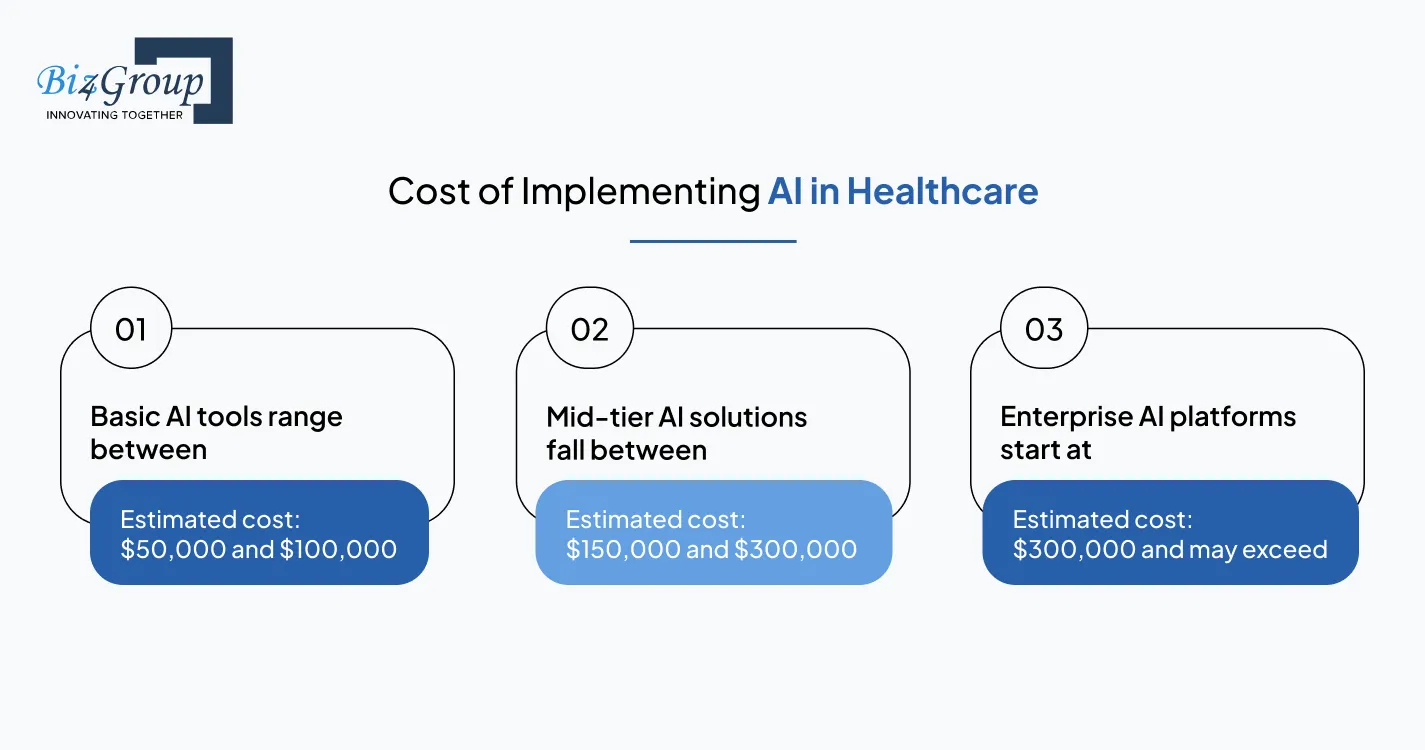
At some point, every organization evaluating AI moves past curiosity and into financial reality: what will this cost, where will the money go, and when will it pay back? This section acts as a beginner guide to AI in healthcare with questions and answers, helping decision-makers understand the real economics of adopting AI in healthcare beyond surface-level estimates.
116. What Is the Cost of AI in Healthcare?
The cost of AI in healthcare is not a single number but a combination of multiple cost layers that vary by use case. In practice, organizations spend on:
- software or platform access
- integration with existing systems
- data preparation and structuring
- training and change management
The biggest misconception is that AI itself is expensive. In reality, most cost comes from making AI usable within existing healthcare environments.
117. How Much Does It Cost to Implement AI in Healthcare?
Implementation costs are typically higher than the cost of the tool itself.
Most of the budget goes into integration, data readiness, and workflow alignment rather than the AI model. This is why two organizations using the same tool can have very different total costs.
The more complex your existing systems, the higher the implementation effort.
118. How Much Does It Cost to Build a Healthcare App?
The cost of building a healthcare app depends heavily on compliance, integrations, and data handling requirements.
Apps that require EHR integration, real-time processing, and regulatory compliance are significantly more expensive than standalone applications. Adding AI capabilities increases complexity further, especially when custom models are involved.
The real cost driver is not features, but how deeply the app connects with healthcare systems.
119. What Factors Affect Healthcare AI Development Costs?
AI development costs are primarily driven by complexity and data. The most important cost drivers include:
- Quality and availability of data
- Level of customization required
- Integration with existing systems
- Compliance and security requirements
Among these, data preparation is often the most underestimated and time-consuming component.
120. What Is the Cost of AI Chatbot Development in Healthcare?
Chatbot costs vary widely based on how advanced and integrated the solution is. Basic chatbots that handle FAQs or scheduling are relatively low-cost. However, once you add:
- conversational AI capabilities
- EHR integration
- compliance requirements
The cost increases significantly.
Most of the cost comes from integration and ensuring secure handling of patient data.
121. What ROI Can Healthcare Organizations Expect From AI Systems?
ROI from AI in healthcare typically shows up in three areas: cost reduction, efficiency gains, and improved outcomes.
However, not all use cases deliver ROI equally. In practice:
- AI Automation services→ fastest ROI
- Imaging/diagnostics → strong clinical + financial impact
- Predictive analytics → longer-term value
The key is to start with use cases where ROI is both measurable and achievable within a short timeframe.
122. How Long Does It Take to See ROI From AI in Healthcare?
ROI timelines depend more on implementation complexity than on the AI itself.
Simple automation tools can deliver results within months because they require minimal integration. More complex systems, especially those involving predictive models or custom development, take longer due to validation and workflow alignment.
Organizations that start small tend to see faster and more reliable returns.
123. How Does AI Reduce Healthcare Costs?
AI reduces costs by eliminating inefficiencies that are built into healthcare operations. This includes:
- reducing manual administrative work
- minimizing errors and rework
- preventing complications through early detection
Cost reduction is rarely immediate, but it compounds over time as workflows become more efficient.
124. What Are Hidden Costs of AI in Healthcare?
Hidden costs are one of the biggest reasons AI projects exceed budgets. The most common ones include:
- data cleaning and preparation
- integration challenges with legacy systems
- ongoing maintenance and model updates
- staff training and adoption delays
Organizations that plan only for software costs often underestimate total investment significantly.
125. How Do You Calculate ROI for AI Projects?
ROI calculation requires looking beyond direct cost savings. Organizations typically measure:
- reduction in operational costs
- increase in patient throughput
- improvement in outcomes (e.g., fewer readmissions)
- efficiency gains in workflows
The challenge is that some benefits are indirect, which is why defining clear metrics early is critical.
Build Smarter Systems With AI in Healthcare
Discover how real-world use cases from common questions about AI in healthcare can guide your next digital transformation initiative.
Explore AI Use Cases126. Is AI Cost-Effective for Small Practices?
AI can be highly cost-effective for small practices when applied selectively. Instead of large-scale systems, small practices benefit most from:
- automation tools
- patient communication solutions
- scheduling optimization
These use cases require low investment but deliver immediate operational improvements.
127. What Should You Consider Before Investing in AI to Improve Outcomes and Reduce Costs?
Before investing, organizations should evaluate both financial and operational readiness. This includes:
- clarity of the problem being solved
- availability of usable data
- integration complexity
- expected ROI timeline
- internal readiness for adoption
The most successful investments are those tied to specific, measurable outcomes rather than broad experimentation.
Costs, Pricing and ROI: Takeaway
The economics of AI in healthcare are less about upfront cost and more about where and how the investment is applied.
This section reflects a detailed FAQ on artificial intelligence in healthcare industry, helping organizations move beyond cost concerns and make informed decisions based on real-world financial impact.
Regulations, Compliance and Security for AI in Healthcare
As organizations move closer to deployment, regulatory and security concerns become one of the biggest decision barriers. This section addresses the top questions healthcare providers ask about AI adoption, focusing on how compliance, data protection, and risk are handled in real-world implementations of AI in healthcare.
128. Is AI in Healthcare Regulated in the US?
Yes, AI in healthcare is regulated in the US, but regulation is fragmented and depends on how the system is used.
There is no single “AI law” for healthcare. Instead, different aspects are governed by different frameworks:
- Clinical use → regulated by the FDA
- Patient data → governed by HIPAA
- Software systems → subject to broader healthcare IT standards
In practice, this means organizations must evaluate compliance based on the specific use case, not AI as a whole.
129. What Is FDA Approval for AI Healthcare Tools?
FDA approval means that an AI tool has been evaluated for safety, accuracy, and clinical reliability before being used in patient care.
This applies mainly to AI systems involved in diagnosis, imaging, or treatment recommendations. However, not all AI tools require FDA approval. Many administrative or workflow tools fall outside this category.
A common mistake is assuming all AI must be FDA-approved, when in reality it depends on whether the tool directly impacts clinical decisions.
130. What Are HIPAA Requirements for AI Systems?
AI systems that process patient data must meet HIPAA requirements for privacy, security, and accountability. In practice, this includes:
- Encrypting data during storage and transmission
- Restricting access based on roles
- Maintaining logs of data usage
- Ensuring third-party vendors are compliant
Most compliance issues arise not from the AI model itself, but from how data flows between systems and vendors.
131. How Does AI Ensure Patient Data Privacy?
AI does not “ensure” privacy on its own - privacy depends on how the system is designed and governed. Organizations typically use:
- Data anonymization or de-identification
- Strict access controls
- Secure infrastructure (often cloud-based)
However, the biggest risk comes from integration points, where data moves between systems. This is where privacy controls must be strongest.
132. How Does AI Handle Sensitive Healthcare Data and Compliance?
AI systems handle sensitive data by operating within defined regulatory and governance frameworks. This means:
- Using only necessary data for specific tasks
- Ensuring traceability of how data is used
- Maintaining compliance across all connected systems
In reality, compliance is not a one-time setup. It requires continuous monitoring, especially as models evolve and new data is introduced.
133. Is AI in Healthcare Secure?
AI in healthcare can be highly secure, but only when security is treated as a core design requirement. Most security risks come from:
- weak system integrations
- misconfigured access controls
- third-party vendor vulnerabilities
The AI itself is rarely the weak point. Instead, security depends on the surrounding infrastructure and how systems are implemented and managed.
Organizations that follow best practices can achieve security levels comparable to or better than traditional healthcare systems.
Regulations, Compliance and Security: Takeaway
Regulation and security are not barriers to adopting AI in healthcare, but they do require careful execution and awareness of where risks actually occur.
This section reflects AI healthcare use cases explained through FAQs, helping organizations move forward with confidence by understanding how compliance and security work in real-world scenarios.
Risks and Limitations
As adoption grows, it’s just as important to understand where AI falls short as it is to understand its benefits. This section addresses important questions about AI in healthcare for hospitals and clinics, focusing on the real risks, limitations, and failure points organizations encounter when implementing AI in healthcare.
134. What Are the Biggest Risks of AI in Healthcare?
The biggest risks of AI in healthcare come from poor implementation, not the technology itself. In practice, the most common risks include:
- Incorrect or biased outputs due to poor-quality training data
- Over-reliance on AI recommendations without clinical validation
- Integration failures that prevent AI from fitting into workflows
- Compliance and data privacy issues, especially with third-party tools
The key point is that AI amplifies both strengths and weaknesses in a system. If data and processes are flawed, AI can scale those problems.
135. What Are Limitations of AI in Medical Diagnosis?
AI in medical diagnosis is powerful, but it has clear limitations.
It relies heavily on the data it has been trained on, which means it may struggle with rare conditions, incomplete data, or cases that fall outside its training patterns. It also lacks contextual understanding that human clinicians bring, such as patient history nuances or atypical presentations.
This is why AI is used as a support tool rather than a replacement for clinical judgment.
136. Can AI Make Mistakes in Healthcare?
Yes, AI can and does make mistakes in healthcare, just like any system or human. Errors usually occur due to:
- Incomplete or biased data
- Incorrect model assumptions
- Misinterpretation of outputs by users
What makes AI different is that mistakes can scale quickly if not monitored properly. This is why human oversight and validation are critical in any AI-driven system.
137. Why Do AI Healthcare Projects Fail?
Most AI healthcare projects fail not because the technology doesn’t work, but because implementation is misaligned with reality. The most common reasons include:
- Lack of a clearly defined use case
- Poor data quality or availability
- Weak integration with existing systems
- Resistance from staff and low adoption
- Unrealistic expectations about ROI and timelines
Successful projects treat AI as part of a broader system change, not a standalone solution.
Risks and Limitations: Takeaway
Understanding the risks and limitations of AI in healthcare is essential for making informed decisions and avoiding costly mistakes.
This section is part of everything you need to know about AI in healthcare Q&A guide, helping organizations approach AI adoption with realistic expectations, proper safeguards, and a clear understanding of where it works best, and where it doesn’t.
Ready to Move Forward With AI in Healthcare?
Use insights from this detailed FAQ on artificial intelligence in healthcare industry to choose the right tools, partners, and strategy.
Start Your AI Transformation TodayCustom Development for AI in Healthcare
For organizations that want full control, flexibility, and long-term differentiation, custom development becomes a serious consideration. This section answers AI in healthcare explained for providers with practical questions, focusing on how custom systems are actually built and deployed in real-world implementations of AI in healthcare.
138. How Do You Build Custom AI Healthcare Software for Diagnosis and Analytics?
Building custom AI healthcare software for diagnosis and analytics is a structured process that combines clinical understanding, data engineering, and system integration. It is not just about creating a model - it is about building a reliable, usable system that fits into real clinical workflows.
The process begins with defining a clear and narrow use case. Without this, projects quickly lose direction.
Common starting points include:
- Diagnostic support (e.g., imaging analysis)
- Risk prediction (e.g., readmission or disease progression)
- Clinical decision support
A well-defined problem ensures that both technical and clinical teams stay aligned.
The next phase is data preparation, which is often the most time-consuming part. Healthcare data is:
- fragmented across systems
- inconsistent in format
- often unstructured
To make it usable, it must be:
- cleaned
- labeled
- standardized
- validated for accuracy
In most real-world projects, this step takes more effort than AI model development itself. Once data is ready, teams move into model development and training. Depending on the use case, this may involve:
- machine learning models for prediction
- deep learning for imaging or complex data
- hybrid approaches for better accuracy
However, performance is not just about accuracy. The model must also handle edge cases and different patient populations reliably. After development, clinical validation becomes critical. This step ensures that:
- outputs are medically safe
- recommendations are interpretable
- results align with clinical standards
Without proper validation, even accurate models cannot be trusted in practice. The next challenge is integration into existing systems. This is where many projects fail. The AI system must:
- connect with EHRs or hospital systems
- deliver insights within existing workflows
- avoid adding extra steps for clinicians
If the system creates friction, adoption drops immediately.
Finally, deployment and continuous improvement determine long-term success. AI systems require:
- ongoing monitoring
- periodic retraining
- performance evaluation with new data
Without this, accuracy and reliability degrade over time.
In practice, successful custom AI development is less about building advanced models and more about aligning data, workflows, and clinical needs into a system that actually gets used.
From Strategy to Deployment - Working with an Experienced AI Healthcare Development Partner
By this stage, most organizations are no longer asking what AI can do. The real question is how to make it work inside an actual healthcare environment.
On paper, implementation looks linear. Define a use case, pick a solution, deploy it. In reality, execution is where things get complicated. Data is fragmented, systems don’t always integrate cleanly, and even well-built solutions struggle if they disrupt how clinicians already work.
This gap between idea and execution is where many AI initiatives stall. Experience changes how this problem is approached.
Instead of starting with the model, experienced teams focus on the environment in which that model will operate. That means thinking early about:
- how data moves across systems
- where integration friction will appear
- how clinicians will interact with outputs
- what compliance constraints shape the solution
This shift often determines whether a system gets adopted or quietly ignored.
Companies like Biz4Group LLC , which is one of the top AI development companies in Florida, operate with this execution-first mindset.
The focus is not just on building AI systems, but on making sure those systems:
- integrate with existing workflows
- meet regulatory requirements
- scale beyond initial pilots
- deliver measurable outcomes
That difference between building and operationalizing is what separates working solutions from stalled projects.
You can see this more clearly through real implementations.
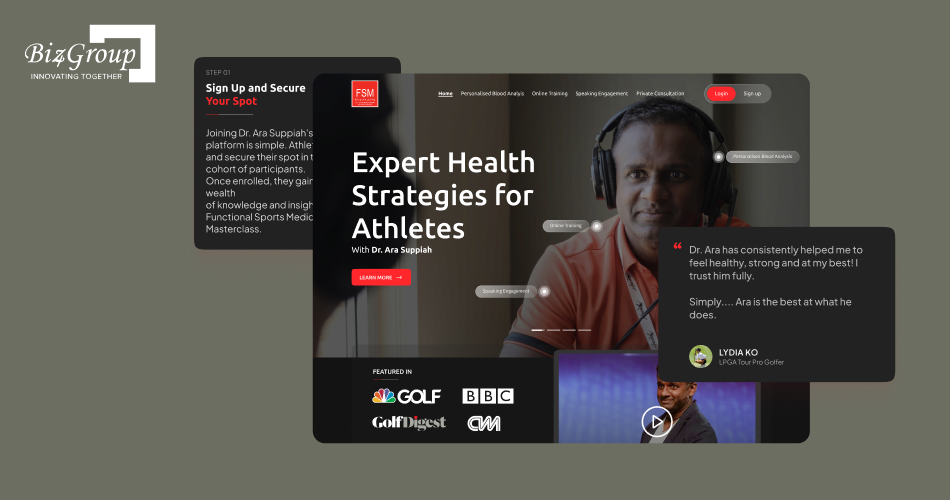
Solutions like Dr Ara extend AI beyond traditional clinical settings by combining performance and health data into actionable insights. The real challenge there was not just analysis, but presenting insights in a way users could actually use.
In a different context, CogniHelp focuses on supporting dementia patients in daily life. Here, simplicity and reliability mattered more than complexity, because adoption depends on how comfortably patients and caregivers can interact with the system.
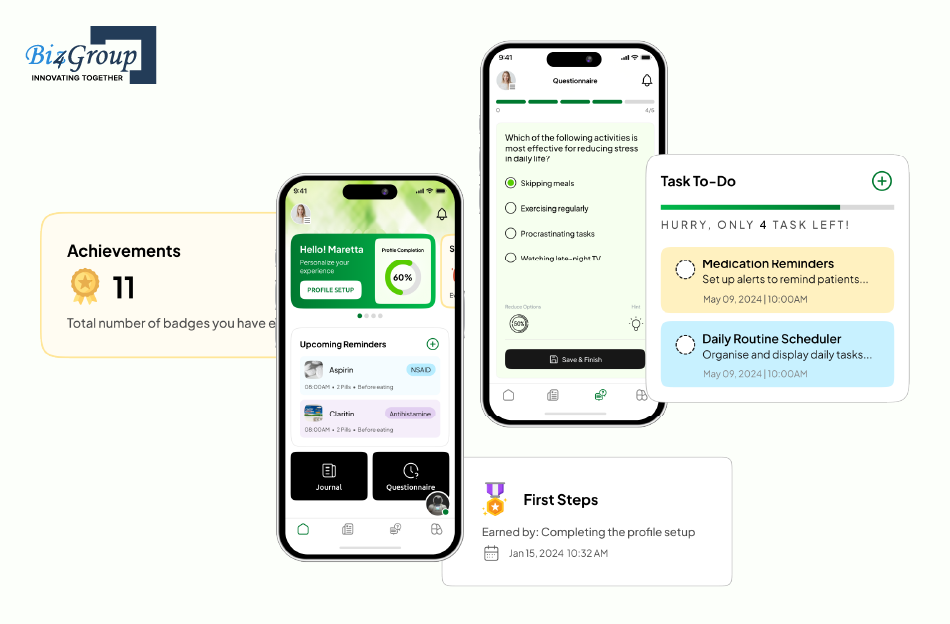
At a broader system level, Truman demonstrates how AI can improve both patient interaction and operational efficiency, which requires balancing intelligence with usability and integration.
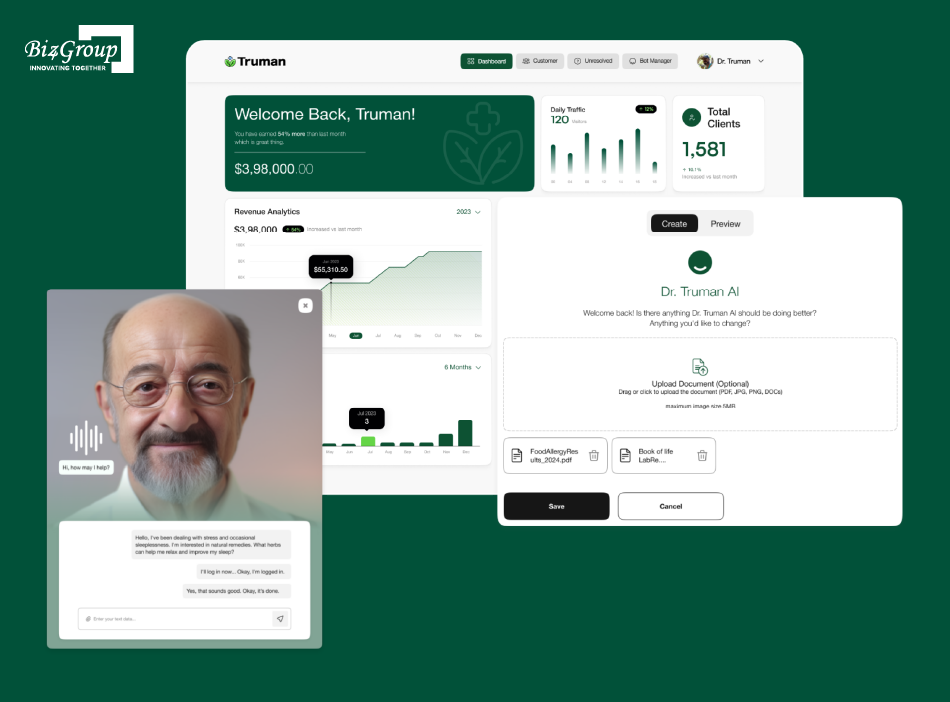
Across these examples, a consistent pattern shows up.
It’s not the sophistication of the AI that determines success. It’s how well the system fits into its environment. That usually comes down to a few things:
- seamless integration with existing systems
- clean, usable data pipelines
- minimal disruption to workflows
- outputs that users actually trust
This is why many organizations move from experimentation to collaboration. Not because they lack capability, but because the cost of getting it wrong is high. Delays, rework, and failed adoption often outweigh the initial savings of trying to do everything internally.
Working with experienced teams doesn’t remove complexity. It changes how that complexity is handled, making execution more predictable and less risky.
Understanding AI is only the starting point. The real value comes from execution, and execution in healthcare depends on how well systems align with data, workflows, and real-world constraints.
That’s where experience makes the difference between a promising idea and an enterprise AI solution that actually works.
Final Words about AI in Healthcare
This guide brought together answers to 130+ real questions people ask when exploring AI in healthcare, covering everything from basics and use cases to tools, costs, implementation, risks, and choosing the right partners.
Across all of this, the issue isn’t really about understanding AI anymore. It’s about deciding where to start and how to make it work in a practical way. The organizations that move forward successfully usually keep things simple. They pick one clear problem, test a solution, and then build on what works instead of trying to do too much at once.
AI in healthcare works best when it’s approached step by step. Focus on what will create real impact in your setup, make sure it fits into your existing workflows, and then expand from there.
At this point, you already have the clarity most teams spend months trying to get. What matters now is taking that first step and doing it right.
Ready to turn insights into action? Book a consultation with our experts and start building your AI healthcare solution today.
