Location :
Orlando, FL, USA
Location :
Orlando, FL, USA +1 (407) 714-1616
 info@biz4group.com
 AI Summary Powered by Biz4AI
- AI in mental health delivers measurable diagnostic accuracy, with clinical studies showing sensitivity above 95% when AI screening is combined with self-report scales, though it works best as decision support alongside a clinician, not a replacement for one.
- Real-world AI mental health support use cases already in production include clinical assessment, mood tracking, personalized therapy, and crisis intervention, each requiring HIPAA, 42 CFR Part 2, and state-level compliance built in from the start.
- Products like Wysa, Ash, Youper, and Biz4Group's AI Wizard, Quantum Fit, and Cultiv8 demonstrate what responsible AI-powered mental health tools look like, each built with clearly defined limits on what the AI can and cannot do.
- The right way to measure success is clinical outcomes like PHQ-9 and GAD-7 score improvement and reduced clinician administrative time, not engagement metrics like session count or daily opens.
- The next phase of AI in mental health care is shifting from standalone consumer apps toward embedded clinical infrastructure and predictive care, an area Biz4Group is actively building in through hands-on work on real mental health and wellness platforms.
Ever sat with a panic attack building in your chest, called three therapists, and heard the same thing every time? "We're not accepting new clients until next month." That wait is exactly why AI in mental health exists today, and it's already helping close that gap for millions of people who couldn't get help fast enough otherwise.
Here's a number worth sitting with. Over 61.5 million American adults experienced a mental illness in the past year, and nearly 48% of them received no treatment at all. That's not a technology failure. That's a capacity failure. And it's exactly the gap AI-driven mental health solutions were built to close.
Now here's the real question worth asking before any of this matters to you: is AI in mental health actually reliable, or is it just hype dressed up in clinical language? The honest answer is both, depending on what you're using it for. Diagnostic support tools have shown sensitivity rates as high as 95.9%, outperforming standard self-report screening in controlled studies. But hand that same tool a severe crisis and ask it to manage things alone, and the results get a lot less comforting. Later in this guide, we'll show you exactly where that line sits, use case by use case.
That gap is also why so many people, CTOs included, keep asking us whether will AI replace therapists entirely. It won't, and anyone telling you otherwise is selling you something. What it does well is extend a clinician's reach, catch warning signs earlier, and take administrative weight off the people doing the actual clinical work, a distinction we unpack fully later in this piece.
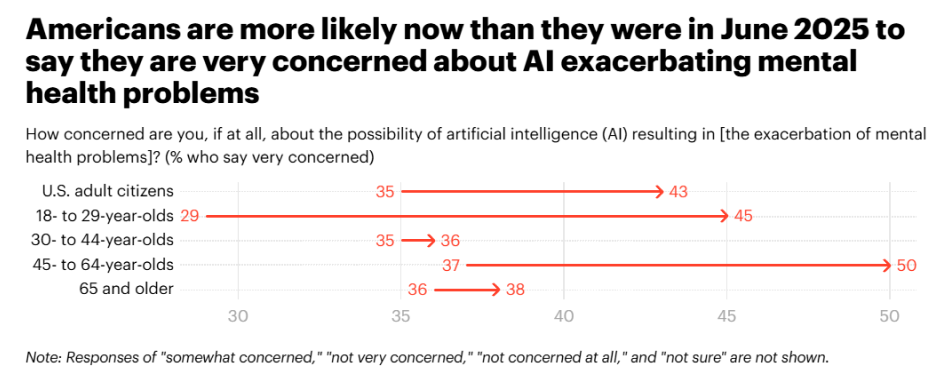
Public trust hasn't caught up with the adoption curve, and that gap matters for anyone building in this space. A May 2026 survey found 43% of Americans are genuinely worried AI could make mental health problems worse, up from 35% the year before. Trust has to be earned, not assumed, and that shapes everything we're about to walk you through.
We're not writing this from the sidelines either. We've spent real time building AI-powered mental health tools, sitting inside the tradeoffs this blog is about: how much to automate, where a human absolutely has to stay in the loop, and how to build something a licensing board won't flag six months later. A little further into this guide, we'll walk you through what that's actually looked like in practice. Everything here is shaped by it.
Let's get into it.
What Is AI in Mental Health, and How Does It Actually Work?
AI in mental health refers to software systems trained to process clinical, behavioral, and biometric data in order to support diagnosis, track symptoms over time, and assist with therapy delivery. It's not one piece of technology. It's a stack of several, each handling a different part of the job, and together they form what the industry now calls AI-driven mental health solutions.
Here's how that stack actually functions, layer by layer.
1. Data Ingestion
The system pulls in raw signals from multiple sources: session transcripts, voice recordings, facial video, wearable data like heart rate variability and sleep patterns, and in clinical settings, structured EHR fields such as prior diagnoses, medication history, and PHQ-9 or GAD-7 scores. This is the raw material every downstream layer depends on, and it's also why data quality problems at this stage quietly break everything built on top of it.
2. Feature Extraction
Before any prediction happens, the system converts raw data into measurable features. Speech gets broken into acoustic markers like pitch variability, pause frequency, and speech rate. Facial video gets reduced to action units, the same coding system used in emotion research, tracking micro-movements around the eyes and mouth. Text gets parsed for linguistic markers tied to rumination, hopelessness, or cognitive distortion.
3. Model Scoring
A trained model, usually a fine-tuned transformer for language or a convolutional network for facial and vocal signals, runs these features against patterns learned from labeled clinical data. The output isn't a diagnosis. It's a probability score: this session shows an 82% pattern match to moderate depressive symptoms, for example. This scoring layer is the core of most AI-powered mental health tools on the market today.
4. Clinical Validation Layer
This is the step most consumer-facing coverage of artificial intelligence in mental health skips entirely, and it's the one that actually matters for clinical use. Before a score reaches a clinician, it gets checked against validated diagnostic frameworks like DSM-5 or ICD-11 criteria, and in FDA-reviewed tools, against a structured clinical interview used as the ground truth during the tool's original validation study. One published study using this exact process measured 95.9% sensitivity for depression risk screening against a psychiatrist-administered DSM-5 interview, compared to 83.6% for a standard self-report scale alone.
5. Human Review and Action
The score reaches a clinician, care coordinator, or in consumer tools, a triage workflow that decides the next step: routine monitoring, a scheduled follow-up, or immediate escalation. A properly built system never lets step 3 skip straight to step 5. If it does, that's not a clinical tool. That's a liability. This is also the layer that separates a genuine use of artificial intelligence in mental healthcare from a system that's just automating guesswork.
AI Mental Health Tools vs. Wellness App vs. Traditional Clinical Assessment
|
Aspect |
Wellness App |
AI Mental Health Tools |
Traditional Clinical Assessment |
|---|---|---|---|
|
Purpose |
Mood tracking, coping tips, general self-help |
Diagnostic support, risk screening, symptom monitoring |
Diagnosis, treatment planning, clinical judgment |
|
Data foundation |
User-entered mood logs, no clinical grounding |
Multimodal biometric and linguistic data, trained on labeled clinical datasets |
Structured interview, clinical history, standardized rating scales |
|
Validation method |
None required |
Benchmarked against DSM-5/ICD-11 criteria in published studies |
DSM-5/ICD-11 applied directly by a licensed clinician |
|
Regulatory oversight |
None |
FDA review pathways for some tools, including Breakthrough Device Designation |
Governed by clinical licensing boards, not FDA |
|
Speed |
Instant, always available |
Seconds to minutes per assessment |
Days to weeks, limited by clinician availability |
|
Where it fails |
Cannot detect clinical-grade symptoms or crisis risk |
Accuracy narrows for comorbid conditions and severe cases |
Subject to clinician fatigue, bias, and limited session time |
This is exactly why companies looking to enhance mental health with artificial intelligence need to be precise about which row of that table their product actually belongs in, since marketing a wellness app with clinical-tool language is where most compliance trouble starts.
Knowing how the mechanics work is one thing. Knowing whether the output is actually worth trusting is a separate question entirely, and it's the one that determines whether a tool belongs in AI mental health care workflows or nowhere near one. That's exactly where AI mental health diagnosis earns or loses its credibility, and it's where we're headed next.
Ready to Build Something Smarter Than a Wellness App
If you're serious about AI in mental health, the difference between a real product and a glorified mood journal comes down to who builds it. Let's talk about what you're actually trying to solve.
Talk to an AI Mental Health ExpertWhat Are the Real Benefits of AI in Mental Health?
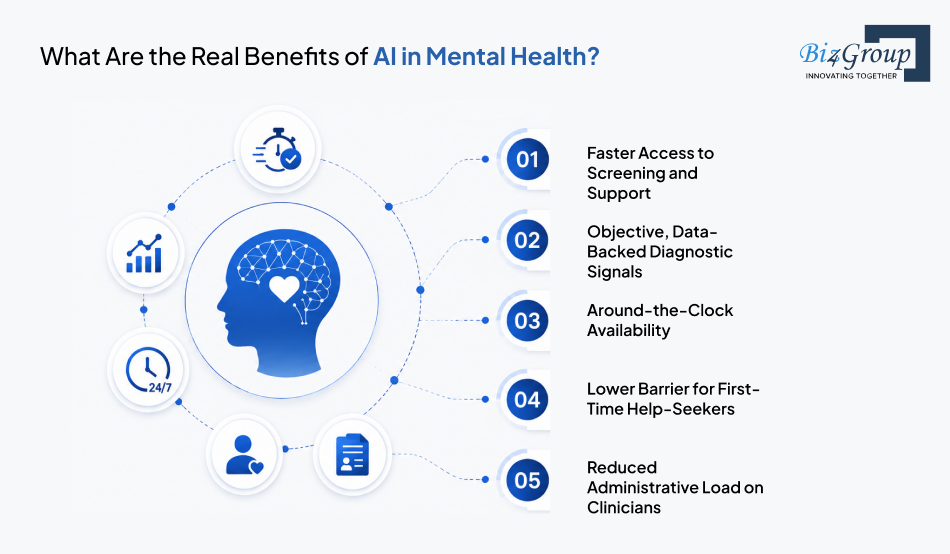
The benefits of AI in mental health go well beyond convenience. Real deployment data now shows measurable effects on access, diagnostic accuracy, and clinician workload, and the impact of AI on mental health care is strongest exactly where the traditional system struggles most.
1. Faster Access to Screening and Support
Response times for AI-based screening tools average under five seconds, compared to days or weeks for a standard clinical appointment. That speed matters most for people who'd otherwise wait until a crisis forces the issue.
2. Objective, Data-Backed Diagnostic Signals
Self-report scales rely on a person accurately naming their own symptoms, which isn't always reliable. This is exactly the question we hear from psychiatrists weighing whether these tools belong in a real practice: "I am a psychiatrist and I want to understand how AI diagnostic tools for mental health conditions like depression and anxiety actually compare to clinical assessment in terms of accuracy because I want to know if there are tools worth integrating into my practice rather than just dismissing them as consumer wellness apps."
The honest answer: a separate umbrella review of AI mental health monitoring tools found diagnostic precision exceeding 85% when analyzing combined text and audio input, with facial expression and vocal feature analysis pushing accuracy above 90% for identifying mood and anxiety disorders, and a range of 78% to 92% across the reviewed studies overall. That's a real signal worth integrating, not a wellness gimmick, and it's the reasoning behind most serious AI app for early mental health diagnosis projects being built today.
3. Around-the-Clock Availability
Roughly 60% of users access AI mental health tools outside standard office hours. Therapists don't work at 2 a.m. AI tools do, and that availability alone is closing a real gap for people who'd otherwise wait until their next appointment slot.
4. Lower Barrier for First-Time Help-Seekers
Nearly 85% of first-time users of AI mental health tools report they had never previously spoken to a mental health professional at all. For a lot of people, the anonymity and low stakes of typing into an app is what gets them to engage with mental health support in the first place, something a waiting room never managed to do.
5. Reduced Administrative Load on Clinicians
One behavioral health center using AI-assisted documentation reported symptom improvement tracking 3 to 4 times greater than their prior baseline, alongside a cancellation rate that dropped from 21% to 17.9% over six months Less time on notes generally means more time with actual patients, and a falling cancellation rate suggests patients were staying more engaged in their own care.
Where the Benefit Narrows at Higher Severity
None of this holds up the same way once symptoms get severe. Research found that across studies comparing chatbots to human therapists for moderate-to-severe anxiety or depression, human therapists produced significantly better outcomes, with the gap widening as severity increases. The AI impact on mental health is real, but it's strongest at the mild-to-moderate end and weakest exactly where the stakes are highest.
None of these benefits mean much in the abstract, though. What actually matters is how they show up in a real product, whether that's a screening feature, a mood-tracking dashboard, or a crisis alert system built into a live platform. That's exactly where we're headed next.
What Are the Top Use Cases of AI in Mental Health Care Today?
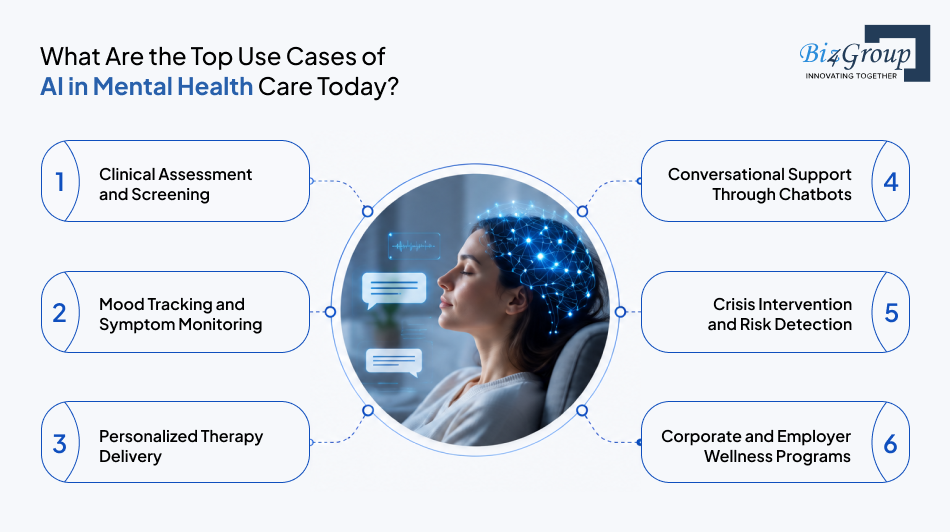
Every AI mental health app worth building falls into one of a handful of core use cases, and knowing them upfront saves a lot of wasted development time. This is also the exact question we get from teams building their first product in this space: "We are building a mental health platform and want to learn how AI can improve clinical assessments, mood tracking, personalized therapy, and crisis intervention while staying compliant with HIPAA and other healthcare regulations."
The short answer: each of those four areas works differently, uses different data, and carries a different level of clinical risk. We'll walk through each one here, and we cover the HIPAA and regulatory side in full in the next section.
1. Clinical Assessment and Screening
This is the entry point for most serious AI-driven mental health solutions. AI analyzes intake responses, speech patterns, or behavioral data to flag risk before a clinician ever reviews the case. It's meant to inform a clinical decision, not replace one.
- Structured intake questionnaires scored against validated clinical frameworks
- Speech and text analysis flagging early signs of depression or anxiety
- Risk scores routed directly into a clinician's dashboard for review
2. Mood Tracking and Symptom Monitoring
Between sessions is where most relapse and worsening symptoms actually happen, and it's also where clinicians historically have the least visibility. AI-based mood tracking closes that gap by turning daily check-ins into a continuous data stream instead of a single data point every few weeks. Many platforms package this as a virtual mental health coach with AI that nudges users toward daily reflection.
- Daily mood logging correlated against sleep, activity, and journaling data
- Trend alerts sent to a care team when symptoms escalate
- Patient-facing dashboards that make progress visible over time
3. Personalized Therapy Delivery
No two patients respond to the same intervention the same way, and AI is increasingly used to adjust content, pacing, and tone based on how a specific patient is engaging. This is where a mental health AI assistant earns its place, tailoring CBT exercises or coping content to what's actually working for that person.
- Adaptive CBT and DBT modules based on user progress
- Content recommendations tuned to individual triggers and history
- Some platforms deliver this through a mental health AI avatar for a more human-feeling interaction
4. Conversational Support Through Chatbots
For a lot of users, especially first-timers, a conversational interface is simply less intimidating than a form or a phone call. A well-built AI mental health chatbot handles routine emotional check-ins and coping guidance, while escalating anything serious to a human immediately. This is one of the fastest-growing forms of AI mental health support in the US market right now.
- Always-available conversational support for mild-to-moderate concerns
- Built-in escalation triggers for crisis language
- Session summaries passed to clinicians for continuity of care
5. Crisis Intervention and Risk Detection
This is the highest-stakes use case on this list, and the one where the human handoff has to be instant and non-negotiable. AI monitors passive signals, like sleep disruption, sudden changes in communication patterns, or explicit crisis language, and triggers an immediate alert rather than attempting to manage the situation itself. A well-designed mental health AI agent handles this routing automatically, so no crisis message sits unread.
- Real-time crisis language detection across chat and voice
- Automatic routing to a human counselor or emergency contact
- Audit trails documenting every escalation for compliance review
6. Corporate and Employer Wellness Programs
Employers are now one of the biggest buyers of mental health technology, often folding it into broader benefits packages. An AI mental health app for corporate wellness programs typically blends screening, coaching, and manager-level reporting, without exposing individual employee data. This is one of the clearest examples of how companies enhance mental health with artificial intelligence at scale, well beyond individual therapy replacement.
- Confidential screening tools integrated into employee benefits platforms
- Aggregate, anonymized reporting for HR and leadership
- Coaching and resilience content tied to workplace-specific stressors
Building any one of these use cases well takes more than good intentions. It takes a clear answer to HIPAA, 42 CFR Part 2, and the growing list of state AI therapy laws before a single line of product copy gets written. Since a compliance misstep here isn't a bug fix later, it's a lawsuit. That's exactly what we're covering next.
Which of These Use Cases Is Sitting on Your Roadmap
Screening, mood tracking, crisis alerts, or all three, every one of them needs to be built right the first time. Bring us the use case, and we'll bring the architecture.
Discuss Your Use CaseIs AI in Mental Health Care Actually Compliant and Safe to Deploy?
Compliance in AI mental health care is not a formality that gets handled after the product works. It's the layer that decides whether a diagnostic score, a crisis alert, or a therapy session transcript can legally exist inside your system at all. Get this wrong, and the most accurate model in the world still gets shut down.
1. HIPAA and the 2026 Security Rule Overhaul
Every AI mental health app handling protected health information needs a signed Business Associate Agreement with its AI vendor, full stop. HIPAA's first major Security Rule update since 2013 is expected to finalize in mid-2026 with a 180-day compliance window, and it directly tightens how encryption, access logging, and breach notification apply to AI systems processing therapy notes or diagnostic scores.
Consumer versions of common chat and video tools almost never qualify here, since most vendors won't sign a BAA on a free or standard account, which is exactly why teams building anything HIPAA-sensitive tend to work with a partner experienced in AI mental health app development rather than retrofitting compliance onto a generic chatbot later.
2. 42 CFR Part 2 and Substance Use Data
This is the regulation most mental health platforms miss because they assume HIPAA already covers it. It doesn't. 42 CFR Part 2's modernized substance use disorder confidentiality framework hit its enforcement date on February 16, 2026, and it applies specifically to any AI tool processing SUD-related conversations or assessments, a common feature inside crisis intervention workflows. Consent language now needs explicit revocation rights, and every vendor touching that data has to flow the same obligations downstream.
3. State-Level AI Therapy Laws
Eleven states have now passed or proposed AI therapy regulation, and the definitions of what counts as "AI therapy" differ from state to state. A workflow that's compliant in Illinois can be a violation in Utah. For any AI mental health app built to operate nationally, this means legal review is an ongoing line item, not a one-time launch checklist.
4. AI Ethics and Responsible Governance in Mental Health
Beyond the legal minimums, the WHO's Collaborating Centre on AI for health governance and the 2026 COA Accreditation standards both now expect documented human oversight, clear escalation accountability, and patient wellbeing prioritized in the system's actual architecture, not just its privacy policy. Getting this specific set of tradeoffs right is exactly what AI ethics in mental health app development is built around, and a platform that treats governance as an afterthought tends to discover that the hard way during its first regulatory audit.
None of this groundwork means much until you see how real companies are handling it inside live products right now, not in a compliance PDF, but in tools people are actually using today. That's exactly where we're headed next.
What Does Real-World AI in Mental Health Platform Look Like Right Now?
Every stat and framework covered so far means little without seeing how it plays out in an actual product people use every day. Here's a look at what's live right now, from consumer-facing apps to platforms built specifically to solve a narrower, harder problem.
1. Wysa
Wysa is one of the most clinically documented names in AI mental health support, built around structured CBT and DBT exercises delivered through a conversational chatbot. It earned FDA Breakthrough Device Designation following a peer-reviewed clinical trial that found it effective for managing chronic pain alongside associated depression and anxiety, with results comparable to in-person psychological counseling. Wysa also partners with the NHS in the UK and has expanded into a hybrid model that pairs its AI with human coaches, a good example of artificial intelligence in mental health working alongside a clinician instead of trying to replace one.
2. Ash
Ash, built by Slingshot AI, takes a different approach: rather than adapting a general-purpose AI model for therapy, its makers trained a foundation model specifically for therapeutic conversation using real human therapy session data. It launched publicly after 18 months of development and 50,000 beta users, and it's explicit about its own limits, stating clearly it isn't designed for crisis situations and pointing users to a crisis line instead. That kind of upfront honesty about scope is exactly what separates a serious AI mental health app from one that oversells itself.
3. Youper
Youper takes a more structured, clinical-scale approach, built around CBT, ACT, and DBT techniques and pairing conversational check-ins with validated tools like PHQ-9 and GAD-7 mood tracking. It has grown to over 3 million users, with more than 80% reporting improved mood after use, and it integrates with health data from devices like Fitbit to connect emotional patterns with physical signals. Like Ash, it's upfront about being a supplement to clinical care, not a substitute for one, directing users in real distress to emergency resources instead of trying to handle it internally.
4. AI Wizard
AI Wizard is an avatar-based AI companion, built by Biz4Group using ChatGPT and Whisper AI for conversation, paired with real-time facial expression and gesture animation. It's a clear example of AI companions for mental wellness, designed to give someone a genuinely responsive presence to talk to rather than a static chatbot interface, something that matters more than people expect when the goal is making a user feel heard, not just answered.
5. Quantum Fit
Quantum Fit is a hybrid wellness platform, developed by Biz4Group, that combines physical fitness programming with guided mental health coaching, including CBT-based mindset modules built directly into the user's workout journey. It's a strong example of why mental and physical wellbeing rarely improve in isolation, since a platform treating them as one continuous experience tends to hold a user's attention longer than one that treats them as separate features bolted together. It's one of the clearer benefits of AI in mental health work done right: quiet, consistent, and built around a real daily habit instead of a one-time interaction.
6. Cultiv8
Cultiv8 is a meditation and spirituality app, built by Biz4Group with AI-driven personalization at its core, recommending guided sessions and content based on how a user actually engages rather than a generic content calendar. It's one of the clearer examples of what AI-powered mental health tools look like when the goal is daily engagement and consistency rather than clinical intervention, and it's part of a broader landscape worth exploring if you're evaluating best mental health apps to explore before deciding what kind of product to build.
Seeing these tools side by side makes one thing obvious: the ones that last are the ones built around a clearly defined outcome, not just a clever conversation engine. That's exactly the discipline behind measuring what these tools actually deliver, which is where we're headed next.
Impressed by Wysa and Quantum Fit, Curious What Your Version Could Look Like
You've seen what's already working in the market. The next name on that list could be yours, built with the same clinical care and none of the guesswork.
Start Building Your ProductHow Is Artificial Intelligence Improving Mental Healthcare Outcomes That Actually Matter? (What Behavioral Health Leaders Should Measure?)
Most organizations deploying AI mental health support tools track the wrong numbers first. Daily active users and session counts look good on a dashboard, but they don't tell you whether anyone's actually getting better. This is exactly the gap behavioral health leaders keep running into once a tool is already live: "I am running a behavioral health company and we have already deployed an AI mental health support tool across our platform and I want to know what outcome metrics other organizations are using to evaluate whether their AI tools are genuinely improving patient wellbeing and not just engagement numbers."
Here's what that actually looks like in practice, broken down by what's worth measuring and why, and it's the clearest picture available right now of how artificial intelligence is improving mental healthcare outcomes when it's measured correctly.
1. ROI vs. VOI in Behavioral Health
Return on investment captures the hard numbers: documentation time saved, cancellation rates, staff turnover. Value on investment captures something ROI misses entirely, like clinician trust in the tool and whether patients stay engaged in care longer. An independent study of one behavioral health provider's services found a 507% ROI, or $6.07 returned for every dollar invested, based on pre- and post-treatment PHQ-9 and GAD-7 scores rather than usage data alone. That's the kind of number that holds up under scrutiny because it's tied to validated clinical instruments, not app opens.
2. Clinical Outcome Measures That Actually Prove Value
The metrics worth reporting to a board or an investor are the ones grounded in standardized, validated scales, not proprietary engagement scores a vendor invented to make their own AI-driven mental health solutions look good. PHQ-9 score changes for depression, GAD-7 changes for anxiety, and symptom improvement tracked against a documented baseline are the three that hold up regardless of which vendor built the tool.
3. The Engagement Trap
Session length, streaks, and daily opens feel like progress because they're easy to visualize, but none of them confirm a patient is actually improving. A user can open an app every day for a month and still be getting worse. Behavioral health leaders serious about AI mental health care now treat engagement as a leading indicator worth watching, never as the outcome itself.
4. Workforce and Retention Metrics Worth Tracking
Clinician burnout is one of the biggest threats to any behavioral health organization right now, and it's measurable. National data shows roughly a third of the behavioral health workforce spends the majority of their time on administrative tasks rather than direct patient care, with more than two-thirds of professionals saying that burden pulls them away from time with clients. A drop in that administrative load, tracked over time, is a legitimate outcome metric for AI in mental health programs even though it never shows up on a patient's chart.
Knowing what to measure only protects you if the tool itself is built and deployed responsibly in the first place. That's the conversation nobody wants to have until something goes wrong, and it's exactly where we're headed next.
What Are the Risks of AI in Mental Health, and Who's Actually Solving Them?
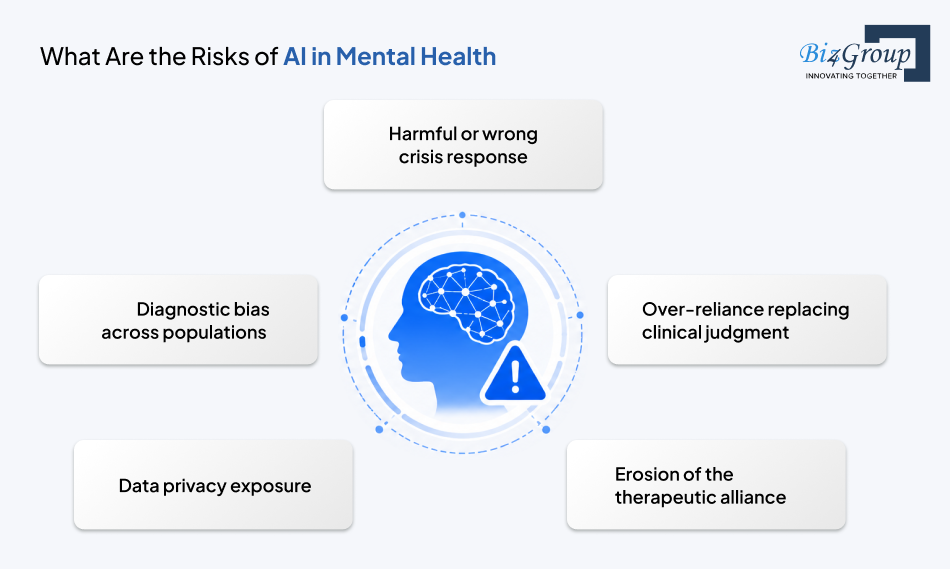
No serious conversation about AI in mental health is complete without naming what can actually go wrong. These aren't hypothetical concerns raised by skeptics. They're documented failure patterns, and each one has a real mitigation approach already in use.
|
Risk |
Why It Happens |
How It's Being Solved |
|---|---|---|
|
Harmful or wrong crisis response |
Models trained on general conversation data lack the clinical grounding to recognize escalating crisis language reliably, and reports of harmful chatbot responses in high-stakes situations are already documented in published reviews |
Dedicated crisis-detection layers trained specifically on risk language, paired with mandatory human handoff the moment crisis indicators appear, no exceptions |
|
Diagnostic bias across populations |
Most training datasets skew Western-centric, meaning accuracy for underrepresented populations is often unverified or measurably lower |
Bias audits before deployment, diverse validation cohorts, and published accuracy breakdowns by demographic group rather than a single blended score |
|
Over-reliance replacing clinical judgment |
A tool that performs well on mild cases can tempt understaffed teams to lean on it for decisions it was never validated to make |
Clear scope boundaries built into the product itself, positioning every score as decision support rather than a standalone diagnosis |
|
Data privacy exposure |
Mental health data is uniquely sensitive, and a breach carries reputational weight far beyond a typical data leak |
Signed BAAs, encryption at rest and in transit, and architecture reviewed against HIPAA and 42 CFR Part 2 before launch, not after |
|
Erosion of the therapeutic alliance |
Heavy automation between sessions can start replacing the human connection therapy depends on, rather than supporting it |
Designing AI mental health support tools as a bridge between sessions, not a substitute for the relationship itself, with usage patterns monitored for signs of over-substitution |
The pattern across every row here is the same: none of these risks disqualify AI-driven mental health solutions from being useful. They disqualify the version of these tools built without a clinician, a compliance officer, and a genuine escalation plan in the room from day one. A tool that skips straight from a model's output to a user-facing response, with no human checkpoint anywhere in between, isn't a shortcut. It's the exact failure mode every incident report above traces back to.
Once the risks are named and the mitigations are clear, the last real question is where all of this is headed next, and whether the platforms being built today will still hold up in two years.
What Does the Future of AI in Mental Health Care Look Like?
Everything covered so far describes where AI in mental health care stands today. What comes next looks different in a few specific ways, and it's worth understanding before building anything meant to last more than a year or two.
1. From Standalone Apps to Embedded Clinical Infrastructure
The next wave of investment and adoption isn't going toward another wellness app competing for attention on a crowded app store. It's going toward AI built directly into the clinical systems providers already use, documentation, care coordination, and triage, where the value is structural rather than novel. Standalone consumer apps will still exist, but the real growth is happening underneath the surface, inside the plumbing of how care actually gets delivered, which is exactly why founders exploring this space benefit from a clear AI implementation roadmap before committing to a build.
2. Predictive Care Before Symptoms Escalate
Right now, most tools react to signals a person is already showing. The next generation is shifting toward predicting a decline before it's visible in a session, using passive data like sleep, activity, and communication patterns to flag risk days or weeks earlier than a scheduled appointment would catch it. This moves AI mental health diagnosis from a reactive screening tool into something closer to an early warning system, which changes how care teams plan outreach entirely.
3. Regulator-Facing Systems, Not Just Patient-Facing Ones
Compliance today mostly means preparing documentation for an audit that happens after the fact. The next phase points toward systems built to interact with regulators directly, generating continuous evidence of safe operation rather than a report assembled only when someone asks for one. This shifts compliance from a periodic scramble into something closer to an always-on certification.
4. Personalization That Adapts in Real Time, Not Just Per Session
Most AI-powered mental health tools today personalize based on what a user said in their last few interactions. The next step is adapting mid-conversation, adjusting tone, pacing, and technique based on how someone is responding in that exact moment, the same way a skilled clinician reads a room and shifts approach without the client ever noticing the adjustment happening.
5. Tighter Integration Between Mental and Physical Health Data
Mental health platforms and physical health platforms have largely evolved on separate tracks, even though sleep, activity, and heart rate variability are deeply tied to mood and anxiety. The direction ahead points toward these two data streams merging into a single picture of a person's wellbeing, a meaningful way to enhance mental health with artificial intelligence rather than treating the two as separate apps that never talk to each other.
None of these shifts happen by accident, and none of them happen without a development partner who understands exactly where the technical, clinical, and regulatory pieces have to meet. That's exactly the conversation worth having next.
Why Should Biz4Group Build Your AI-Powered Mental Health Solution?
Everything in this guide, the diagnostic accuracy data, the compliance requirements, the outcome metrics, the risks, comes from ground we've actually worked on, not just researched. Building AI-powered mental health products like AI Wizard, Quantum Fit, Cultiv8, and an avatar-based eLearning platform for psychotherapy students at NextLPC meant our team sitting inside the exact tradeoffs this blog walks through: how much to automate, where a human has to stay in the loop, and how to keep a licensing board or a HIPAA auditor from flagging something six months after launch.
That combination, technical depth plus real clinical-adjacent product experience, is rarer than it should be in this space. A lot of development shops can ship a chatbot. We can tell you why a crisis-detection layer needs a mandatory human handoff, or why a BAA has to be signed before a single line of our code ever touches PHI. Knowing how to choose top mental health app development company in USA usually comes down to exactly this kind of distinction, technical fluency paired with genuine clinical and compliance judgment, rather than a polished pitch deck.
Dr. Tiffinee Yancey, CEO of NextLPC, put it plainly after working with our team on that psychotherapy eLearning platform: we were "the best developers we have ever worked with," reliable enough that she'd "trust no other developers to manage our future projects." That's not a line we wrote for marketing copy.
It's what happens when a clinical-adjacent product actually holds up after launch.
AI in mental health rewards a builder who treats compliance, clinical nuance, and user trust as part of the architecture, not features added at the end. That's the standard we build our AI-driven mental health solutions.
Still Comparing Development Partners
Most teams can write code. Fewer can tell you why a crisis alert needs a human on the other end of it. Let's find out which one you're actually hiring.
Book a Free ConsultationWrapping Up!
AI in mental health has stopped being a debate about hype versus skepticism. It's now a question of precision: knowing exactly where AI for mental health genuinely earns its place, screening, mood tracking, documentation, crisis triage, and knowing exactly where a human has to stay firmly in charge. Get that line right, and you build something people trust with the most sensitive part of their lives. Get it wrong, and the most accurate model in the world still gets shut down.
That line is the real work behind every serious AI mental health care platform being built right now, and it's the same line Biz4Group has spent real time drawing, project after project, with the tradeoffs and accountability to show for it.
The tools are ready. The question left is whether the people building with them are ready to build them right.
Let's build the kind of AI people actually trust with their mind.
FAQ
1. Is AI in mental health actually reliable, or is it just hype?
AI in mental health is reliable for specific tasks, like screening, mood tracking, and administrative support, where studies show sensitivity rates matching or exceeding traditional self-report scales. It's far less reliable for severe cases, crisis intervention, or anything requiring clinical judgment, where human therapists still consistently outperform it.
2. Will AI replace therapists?
No. Research from the American Psychiatric Association found human therapists significantly outperform AI on core therapeutic skills like agenda-setting and applying CBT techniques with nuance. AI mental health support is built to extend a therapist's reach between sessions, not to replace the clinical relationship itself.
3. Is AI mental health care HIPAA compliant?
It depends entirely on the tool. General-purpose AI chatbots like ChatGPT or Gemini are not HIPAA compliant, since your conversations aren't protected the way a therapist's records are. Purpose-built clinical tools can be compliant, but only if the vendor signs a Business Associate Agreement and the platform is specifically designed to handle protected health information.
4. How can I use AI in my therapy practice?
Most therapists start with AI mental health support tools built for documentation and note-taking, since that's the lowest-risk, highest-time-saving use case. From there, tools can extend into between-session client check-ins and mood tracking, always with a clear boundary around what stays in the therapist's hands.
5. Is AI mental health diagnosis accurate enough to trust?
Studies show diagnostic accuracy ranging from 78% to 92% depending on the condition and data quality, with some multimodal tools reaching sensitivity above 95% against a clinical interview. That's meaningful, but AI mental health diagnosis still works best as decision support for a clinician, not a standalone diagnostic answer.
6. How much does AI therapy cost compared to traditional therapy?
Most AI-powered mental health apps are priced well below traditional therapy, often free or under $15 a month, which is exactly why cost-conscious users turn to them first. Traditional in-person therapy typically runs higher, commonly cited in the $100 to $200-plus per session range, with insurance coverage often narrowing that gap significantly depending on your plan.
7. What are the risks of using AI for mental health support?
The biggest risks are over-reliance during a crisis, data privacy exposure on non-compliant platforms, and diagnostic bias in tools trained on limited datasets. None of these risks rule out AI-driven mental health solutions entirely, but they do mean a tool needs a clear human handoff point built in from day one, not added after something goes wrong.