 Location :
Orlando, FL, USA
Location :
Orlando, FL, USA +1 (407) 714-1616
 info@biz4group.com

- AI print broker software development helps businesses centralize vendors, pricing, quotes, customer orders, and tracking inside one scalable platform.
- Core platform features include customer portals, vendor dashboards, billing controls, approvals, analytics, and real-time order visibility tools.
- Modern systems use AI vendor matching, smart pricing suggestions, demand forecasting, and delay alerts to improve profit margins.
- The cost to build AI print broker software ranges between $30,000-$200,000+, depending on scope, integrations, automation depth, user roles, and rollout scale.
- Successful AI print broker platform development need phased planning, MVP focus, testing cycles designed for future growth.
- Biz4Group LLC helps founders and enterprises turn brokerage ideas into reliable platforms through custom strategy and execution.
Why do growing print brokerage businesses still struggle to scale when demand is already there? Many teams reach a stage where more orders should mean more revenue, yet daily operations become harder to control.
- Vendor pricing changes from one job to another
- Quote requests wait in inboxes
- Orders get assigned manually
- Customers keep asking for updates
When multiple print vendors are involved, even a simple request can turn into delays, confusion, and lost margin. Not only this, but security also adds another layer of pressure, especially when 43% of organizations have reported at least one print-related data incident.
This is where AI print broker software development becomes a practical business move. Instead of managing jobs across calls, spreadsheets, and scattered tools, businesses can bring vendor management, pricing logic, customer orders, and tracking into one connected platform.
If you are thinking, we are looking to develop a print broker marketplace platform to connect customers with multiple printing vendors efficiently. Then, the right solution starts with building a centralized AI software that manages vendor onboarding, smart order routing, automated pricing, customer dashboards, and live job tracking while keeping full operational control in your hands.
The shift is already visible, with 85% of print providers engaged in AI adoption initiatives. If you are running a printing aggregation business and want to build a print broker software with automation and pricing features, the next step is understanding what it takes to build it the right way with an experienced custom software development company.
What Is AI Print Broker Software and Which Core Problems Does It Solve?
AI print broker software is a digital platform built to help print brokerage businesses manage customers, vendors, pricing, orders, and communication from one place. It is designed for companies that connect buyers with multiple printing vendors and need a faster, more organized way to run daily operations. Instead of handling every request manually, the software uses automation and smart decision rules to streamline routine tasks and improve control across the business.
For companies planning AI print broker software development, the real value comes from combining marketplace operations with intelligent automation. It supports growth without increasing manual workload and creates a more reliable experience for both customers and vendors. Many businesses investing in print broker platform development with AI also use targeted AI integration services to improve quoting speed, vendor allocation, and operational visibility.
It typically helps businesses:
- Manage multiple print vendors through one centralized dashboard
- Receive and organize customer quote requests efficiently
- Apply pricing rules for faster and more accurate estimates
- Route orders to suitable vendors based on business logic
- Track orders, approvals, dispatch, and delivery updates
- Maintain customer communication in one system
- Generate reports for margins, order volume, and vendor performance
- Control user access, files, and operational permissions
Which Core Problems Does AI Print Broker Software Solves?
As print brokerage operations grow, manual processes often create delays, confusion, and missed revenue opportunities. This software is built to remove those common friction points and create a smoother operating model.
- Scattered Vendor Management: Managing several printing partners through calls, emails, and spreadsheets becomes difficult. The platform centralizes vendor data, pricing, capacity, and job history.
- Slow Quote Turnaround: Manual quote preparation delays customer responses. Automated pricing workflows help teams respond faster and win more orders.
- Inconsistent Pricing Control: Different team members may price jobs differently. Standardized pricing logic improves consistency and protects margins.
- Order Assignment Delays: Choosing the right vendor manually slows fulfillment. Smart routing rules speed up job allocation.
- Limited Order Visibility: Customers and internal teams often lack status clarity. Shared dashboards improve transparency.
- Operational Overload: As order volume rises, admin work increases quickly. AI automation tools reduce repetitive coordination tasks.
AI print broker software gives growing brokerage businesses a structured way to manage vendors, customers, pricing, and orders at scale. Once the business problems are clear, the next step is understanding how the right system architecture supports these workflows.
What System Architecture Supports AI Print Broker Software Workflows?
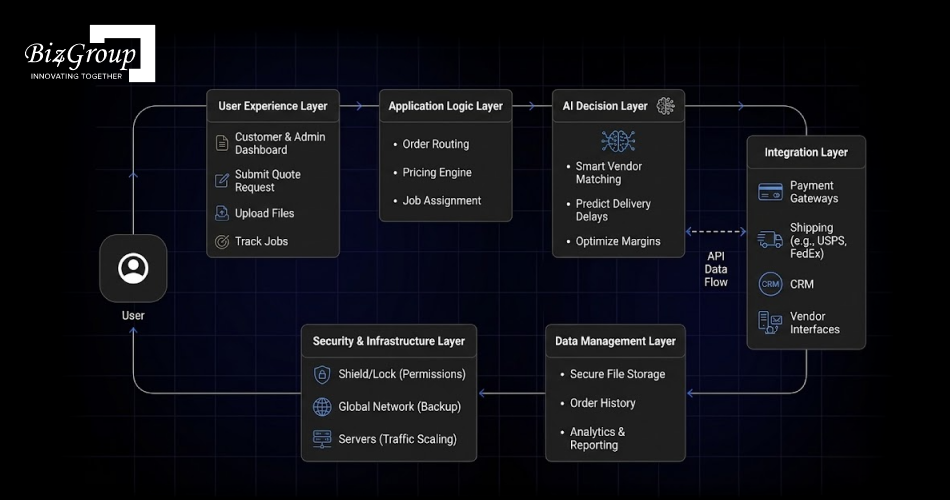
When teams say, we are struggling to manage print orders across vendors and want to build a print broker system with real-time tracking, the real issue usually starts at the backend. Before moving into AI print broker software development, it helps to understand how the right architecture keeps every workflow connected and scalable.
1. User Experience Layer
This is the front-end layer used by customers, vendors, and internal teams. It gives each user a dedicated dashboard to place orders, upload files, approve quotes, track jobs, and manage communication.
It usually handles:
- Customer quote requests and repeat orders
- Vendor job acceptance and status updates
- Admin approval actions and issue handling
- Live order visibility across users
2. Application Logic Layer
This layer manages the core business rules behind daily operations. It receives user actions and converts them into structured workflows across pricing, routing, approvals, and order movement.
It usually handles:
- Quote generation based on pricing rules
- Order creation after approval
- Job assignment to suitable vendors
- Status changes across order stages
3. AI Decision Layer
This is where automation becomes smarter through AI models and data-driven recommendations. It helps reduce manual decisions in pricing, allocation, and service management.
It usually handles:
- Smart vendor matching by cost or capacity
- Delivery delay prediction alerts
- Margin optimization suggestions
- Recommendations using trained AI models
4. Integration Layer
This layer connects the platform with external systems used in operations. It keeps business data moving without duplicate manual entry.
It usually handles:
- Payment gateway confirmations
- Shipping label and tracking sync
- CRM and accounting updates
- Email and SMS notifications
Also Read: Artificial Intelligence in CRM
5. Data Management Layer
This layer stores and organizes orders, files, pricing history, customer records, and reports. It supports clean data access for every connected function.
It usually handles:
- Secure file storage
- Order history retrieval
- Vendor performance reporting
- Search and dashboard analytics
6. Security and Infrastructure Layer
This foundation layer keeps the platform stable, secure, and scalable as order volume grows. It protects access while maintaining smooth uptime.
It usually handles:
- User login and permission control
- Data backup and recovery
- Traffic scaling during peak demand
- Activity logs and monitoring
Strong architecture keeps every order, vendor, customer, and workflow moving through one reliable system. Once these layers are clear, the next step is understanding why more businesses are investing in AI print broker software right now.
Is Your Architecture Ready to Scale?
Turn disconnected workflows into one growth-ready print platform today
Plan My Platform ArchitectureWhy Businesses Are Investing in AI Print Broker Software Development?
Revenue growth means little when margins stay under pressure, and customer acquisition costs keep rising. That is why more companies are evaluating print broker software development integrating AI as a direct investment decision. They want stronger profits, predictable returns, and better business control in a market projected to grow from USD 2.75 billion in 2026 to USD 5.13 billion by 2034.
1. Stronger Profit Margins Per Order
Manual pricing often leaves money on the table. AI print broker workflow automation software helps apply smarter pricing rules based on job type, urgency, vendor cost, and target margin.
It can improve returns through:
- Better quote accuracy
- Controlled discounting
- Margin-based pricing decisions
2. Lower Cost of Revenue Operations
Many enterprises invest to reduce avoidable spending. In fact, 68% of enterprises cite cost reduction as the primary reason for adopting AI print management solutions.
This usually comes from:
- Fewer pricing errors
- Lower rework costs
- Reduced admin overhead tied to revenue teams
Also Read: How to Build AI Powered Printing MIS Automation Software
3. Faster Revenue Capture
Slow quote cycles often delay or lose deals. Faster responses help convert demand into booked revenue while customers are still ready to buy.
It supports growth through:
- Quicker approvals
- Faster payment collection cycles
- Higher quote-to-order conversion rates
4. Better Vendor Cost Negotiation
Clear cost visibility strengthens purchasing power. When AI is transforming printing industry economics, businesses with live vendor data negotiate from a stronger position.
It can create value through:
- Bulk rate leverage
- Smarter vendor mix decisions
- Reduced dependency on high-cost suppliers
5. Higher Customer Lifetime Value
Reliable service and transparent pricing encourage repeat business. That is a real-world use of AI in printing industry where retention directly improves profitability.
It often leads to:
- More repeat orders
- Larger account expansion
- Lower churn rates
6. Scalable Growth Without Matching Cost Growth
Many firms adopt enterprise AI solutions because growth should not require equal cost expansion. With 52% of enterprises targeting at least 10% savings, scalable economics matter.
It supports:
- Expansion into new regions
- Higher order volume capacity
- Better EBITDA performance
Businesses are investing because returns can be measured in margins, savings, retention, and growth capacity. The development of AI print broker software becomes more compelling when revenue goals are tied to long-term business value.
Which Industries Need AI Print Broker Software?
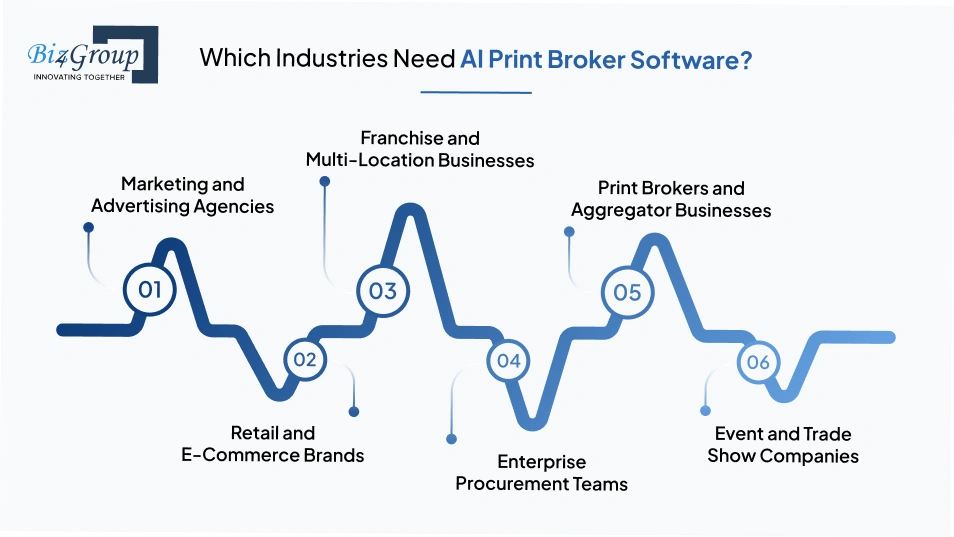
Not every business needs advanced print brokerage technology. The strongest demand usually comes from industries where print buying is frequent, vendor coordination is complex, and delays directly affect revenue, brand delivery, or customer experience. That is where AI print broker software development creates measurable business value.
1. Marketing and Advertising Agencies
Agencies often manage campaign materials across tight launch dates and multiple vendors. Delayed quotes or missed timelines can affect client trust and recurring revenue.
They use these platforms to:
- Speed up campaign print sourcing
- Manage urgent multi-vendor jobs
- Protect margins on outsourced production
2. Retail and E-Commerce Brands
Retailers need packaging, inserts, labels, POS displays, and seasonal promotional materials at scale. Supplier delays can impact launches and store readiness.
They benefit through:
- Faster repeat ordering cycles
- Regional vendor allocation
- Better control over print spend
3. Franchise and Multi-Location Businesses
Franchise networks need consistent branded materials across many locations. Manual ordering often creates quality gaps and unnecessary delays.
They rely on systems for:
- Location-based ordering portals
- Brand-approved templates
- Centralized approval workflows
4. Enterprise Procurement Teams
Large organizations regularly source printed assets for operations, events, onboarding, and marketing. Without structure, spending becomes difficult to control.
This makes AI print broker platform development valuable for:
- Supplier consolidation
- Quote transparency
- Budget tracking across departments
5. Print Brokers and Aggregator Businesses
Companies already connecting customers with multiple vendors gain the highest direct value. Growth depends on speed, pricing accuracy, and reliable vendor allocation.
They use it to:
- Increase order capacity
- Automate vendor matching
- Improve customer response times
6. Event and Trade Show Companies
Events depend on signage, branded kits, banners, badges, and last-minute production requests. One delay can disrupt an entire launch day.
They need platforms for:
- Rush vendor coordination
- Real-time order visibility
- Backup supplier routing
Industries with recurring print demand, supplier complexity, and revenue tied to execution gain the most from automation. Once the right business fit is clear, the next step is identifying which features make AI print broker software worth the investment.
Still Unsure Your Industry Fits?
See how your business model can profit from print platform automation
Check My Use CaseWhich Key Features Are Required to Build AI Print Broker Software?
When print brokerage operations start handling more customers, vendors, quotes, and orders, feature planning becomes a business decision. Teams investing in custom AI print broker software development usually need a platform that improves control, speed, and customer experience from day one.
|
Feature |
What Each Feature Does |
|---|---|
|
Customer Portal |
Lets customers request quotes, upload files, approve estimates, place repeat orders, and track job progress from one dashboard. |
|
Vendor Management Panel |
Stores vendor profiles, pricing terms, service categories, production capacity, and performance records in one place. |
|
RFQ and Quote Management |
Captures quote requests, organizes job details, and helps teams send accurate estimates quickly. |
|
Order Management System |
Converts approved quotes into active orders and tracks every stage from production to delivery. |
|
Pricing Rules Engine |
Applies preset pricing logic based on quantity, material, turnaround time, shipping, or vendor rates. |
|
Real-Time Tracking Dashboard |
Gives internal teams and customers visibility into order status, dispatch progress, and delivery milestones. |
|
File Upload and Proof Approval |
Allows secure artwork uploads, version sharing, proof review, and customer approvals before production starts. |
|
Billing and Invoice Management |
Generates invoices, tracks payments, manages taxes, and stores billing history for each customer. |
|
Notifications and Alerts |
Sends automated updates for quotes, approvals, delays, dispatch events, and payment reminders. |
|
Reports and Analytics Dashboard |
Shows sales trends, vendor performance, order volume, margins, repeat business, and operational insights. |
|
Role-Based Access Control |
Limits system access by user role so admins, sales teams, vendors, and customers only see relevant data. |
|
Multi-Location Support |
Helps businesses manage orders, users, and deliveries across multiple branches or service regions. |
Also Read: Building an AI Invoicing Platform: A Complete Guide
The right feature set turns a print broker platform into a scalable revenue system instead of a basic order tool. Once these essentials are defined, the next step is understanding how AI print broker software development adds a stronger competitive edge.
AI Features That Differentiate Modern Print Broker Software
A platform can manage orders and vendors, but real market advantage comes from intelligence built into the workflow. Businesses that want to create AI print broker software with pricing and order automation features usually focus on tools that improve decisions, margins, and scale.
Before going deeper, many founders ask, we are starting a print brokerage business and need a scalable platform with AI-based vendor matching, well the features below are what make that growth practical.
1. AI-Based Vendor Matching
This feature reviews job type, delivery timeline, location, vendor capacity, historical quality, and cost signals to recommend the most suitable supplier. It reduces slow manual allocation and supports faster order movement.
2. Smart Quote Prediction
AI can estimate pricing based on previous jobs, material trends, quantity ranges, and urgency. This helps teams respond faster while protecting margins on every quote.
3. Automated Margin Optimization
Instead of using flat markups, the system can recommend profitable pricing ranges based on order value, vendor cost, and customer behavior. This creates stronger revenue control.
4. Demand Forecasting
Using past order patterns, seasonal demand, and repeat customer activity, the platform can predict future volume. That helps with capacity planning and vendor readiness through practical predictive analysis.
5. Delay Risk Alerts
AI can detect patterns that usually lead to missed deadlines, such as overloaded vendors or recurring dispatch delays. Teams get early warnings before customers are affected.
6. Intelligent File Checks
Uploaded artwork can be reviewed automatically for missing fonts, low resolution, wrong dimensions, or unsupported formats before production starts.
7. AI Support Assistant
An embedded assistant can answer quote questions, order status requests, reorder needs, and basic customer queries without waiting for staff response.
8. Customer Recommendation Engine
The platform can suggest repeat products, upgraded finishes, or bulk ordering opportunities based on purchase history and buying habits.
These features turn a standard platform into a growth-ready business system focused on speed, pricing intelligence, and better decisions. That is where AI print broker software development creates lasting value while integrating AI in printing workflow operations.
How to Develop AI Print Broker System Step-by-Step: From Real-Time Order Tracking to Vendor Allocation
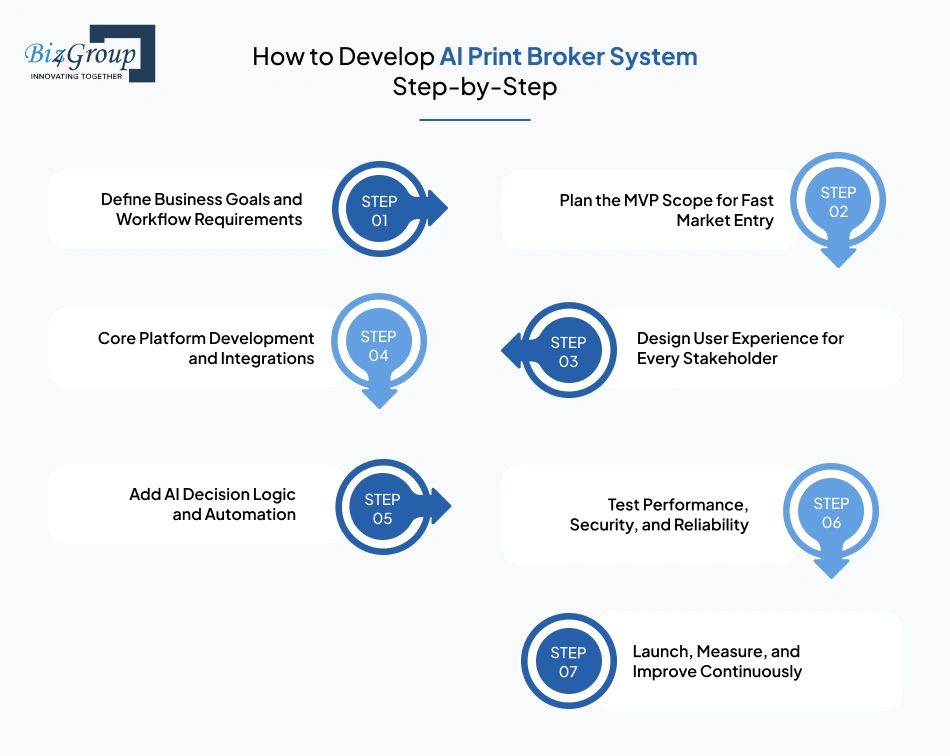
Growth becomes difficult when pricing, vendors, customer requests, and order updates depend on scattered manual work. That is why businesses developing print broker system with AI-driven pricing and optimization need a clear execution roadmap. These seven steps show how to move from concept to a scalable launch.
Step 1: Define Business Goals and Workflow Requirements
The project starts with understanding how your brokerage model earns revenue and where current gaps slow growth. This stage converts business needs into clear software requirements.
Key activities in this stage include:
- Mapping inquiry, quote, order, and delivery flow
- Defining vendor onboarding and allocation logic
- Identifying pricing, approval, and reporting needs
- Setting launch goals, budget, and success metrics
Step 2: Plan the MVP Scope for Fast Market Entry
The first version should solve the most valuable problems quickly. Many companies use focused MVP development services to validate demand before expanding features.
Key activities in this stage include:
- Selecting essential launch features
- Prioritizing quotes, orders, and tracking tools
- Removing low-priority items from phase one
- Creating phased rollout roadmap
Also Read: Top MVP Development Companies in USA
Step 3: Design User Experience for Every Stakeholder
The platform should feel simple for every user group. A skilled UI/UX design company helps convert complex workflows into clear screens and easy actions.
Key activities in this stage include:
- Designing customer quote and ordering screens
- Creating vendor dashboards for job handling
- Building admin panels for control tasks
- Testing flows for speed and clarity
Also Read: Top UI/UX Design Companies in USA
Step 4: Core Platform Development and Integrations
This step builds the main software engine that powers daily operations. It includes dashboards, workflows, databases, and required third-party connections.
Key activities in this stage include:
- Develop customer and vendor portals
- Build pricing engine and order workflows
- Add notifications and live status updates
- Connect billing, shipping, and reporting tools
Step 5: Add AI Decision Logic and Automation
Once the platform foundation is stable, intelligent features are introduced. This often includes AI model development for pricing, routing, and forecasting decisions.
Key activities in this stage include:
- Integrating AI models for vendor matching
- Adding smart pricing recommendations
- Enabling demand and delay alerts
- Using AI automation services for repetitive tasks
Step 6: Test Performance, Security, and Reliability
Before release, every workflow should be validated under real operating conditions. Trusted software testing companies help reduce post-launch risk.
Key activities in this stage include:
- Testing quotes, orders, and permissions
- Validating speed across devices and browsers
- Reviewing data security controls
- Fixing bugs and usability issues
Step 7: Launch, Measure, and Improve Continuously
Go-live starts the growth cycle. Real usage data shows what should be refined, expanded, or automated next.
Key activities in this stage include:
- Launching with pilot customers or region
- Tracking adoption and user behavior
- Resolving early feedback quickly
- Planning future releases and scale upgrades
Successful products are built through disciplined execution, not rushed coding. These seven steps help businesses develop print broker system with real-time order tracking and vendor allocation while reducing launch risk and preparing for long-term growth.
Ready to Build It Right?
Get a roadmap that avoids delays waste and costly rebuilds
Get My Build RoadmapRecommended Tech Stack for AI Print Broker Platform Development
Technology choices directly affect speed, stability, integrations, and future growth. Businesses creating print broker software for commercial printing and packaging industry usually need a stack that supports multi-vendor workflows, secure file handling, live tracking, and AI-ready expansion.
The table below outlines a realistic production-grade setup
|
Architecture Layer |
Recommended Tools |
Purpose |
|---|---|---|
|
Frontend Experience Layer |
Creates fast customer, vendor, and admin dashboards with responsive web development for daily operations. |
|
|
Mobile Access Layer |
React Native, Flutter |
Supports mobile approvals, order tracking, notifications, and vendor access on the move. |
|
Backend Services Layer |
Node.js, NestJS, Python FastAPI |
Runs pricing logic, order workflows, user roles, vendor actions, and full stack development requirements. |
|
Primary Database Layer |
PostgreSQL, MySQL |
Stores customers, vendors, quotes, orders, invoices, and business records securely. |
|
Cache and Queue Layer |
Redis, RabbitMQ |
Speeds up repeated requests and manages background tasks such as alerts or file processing. |
|
Real-Time Tracking Layer |
Socket.IO, WebSockets, Firebase Realtime Database |
Powers live order status, dispatch updates, and dashboard refresh events. |
|
AI Intelligence Layer |
Python, Scikit-learn, TensorFlow, OpenAI API |
Supports vendor matching, pricing insights, forecasting, chat support, and recommendation workflows. |
|
Search and Filtering Layer |
Elasticsearch, OpenSearch |
Enables quick search across orders, SKUs, vendors, customers, and past jobs. |
|
File Proofing Layer |
AWS S3, Cloudinary, Adobe PDF SDK |
Manages artwork uploads, previews, proof approvals, and secure file storage. |
|
Integration Layer |
REST APIs, GraphQL, Stripe API, Shippo API, QuickBooks API |
Connects payments, shipping, accounting, CRM tools, and reliable API development needs. |
|
Security and Access Layer |
OAuth 2.0, JWT, AWS IAM, Cloudflare |
Protects login sessions, permissions, encrypted access, and traffic security. |
|
Cloud and DevOps Layer |
AWS, Azure, Docker, Kubernetes, GitHub Actions |
Supports scalable hosting, automated deployments, backups, monitoring, and release management. |
|
Analytics Layer |
Power BI, Metabase, Google Looker Studio |
Tracks sales, vendor performance, margins, repeat orders, and growth insights. |
The best platforms are supported by technology that fits real brokerage workflows, not trend-driven tool choices. Strong AI print broker software development depends on secure architecture, flexible integrations, and reliable full stack development built for long-term scale.
Also Read: Why to Choose the Full Stack Development for Modern Business
What is the Cost to Build AI Print Broker Software?
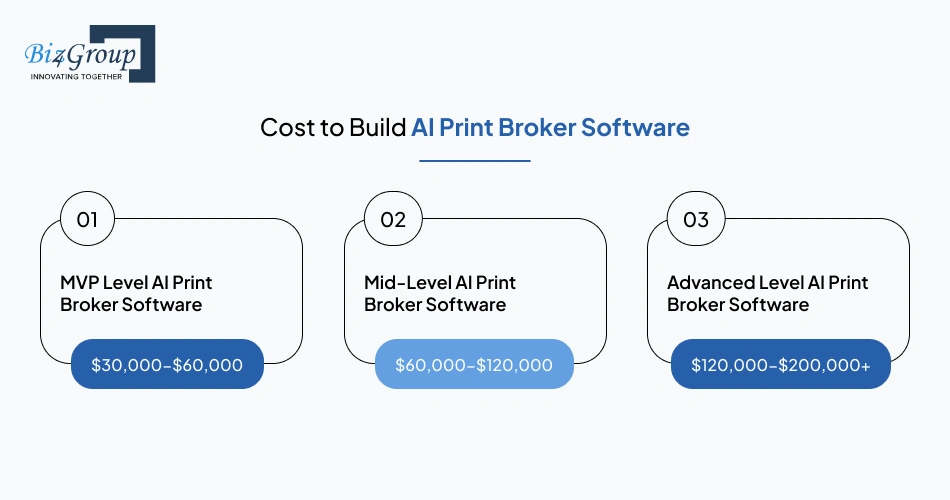
Budget planning becomes easier when the investment range is clear before development starts. Teams looking to build AI print broker software usually spend between $30,000-$200,000+ depending on workflow depth, vendor network size, integrations, automation scope, and rollout scale.
Some businesses begin with a focused first version to validate demand and refine operations. Others move directly toward a larger commercial platform with multi-region support, deeper controls, and broader automation.
Cost Breakdown by Development Level
|
Development Level |
Estimated Cost Range |
Scope |
|---|---|---|
|
MVP Level AI Print Broker Software |
$30,000-$60,000 |
Core customer portal, vendor panel, quote requests, order tracking, limited integrations, pilot-ready launch. |
|
Mid-Level AI Print Broker Software |
$60,000-$120,000 |
Multi-vendor workflows, billing tools, reporting, stronger dashboards, advanced tracking, process automation. |
|
Advanced Level AI Print Broker Software |
$120,000-$200,000+ |
Enterprise rollout, custom workflows, large vendor network, deep integrations, advanced security, and scalable infrastructure. |
This gives you a realistic starting range. The next step is understanding what actually drives these numbers during development.
Primary Cost Drivers When You Build AI Print Broker Software
Project budgets usually increase or decrease based on a few core areas. These directly affect engineering effort, delivery timelines, and long-term platform readiness.
|
Cost Driver |
Why It Matters |
Estimated Cost Impact |
|---|---|---|
|
Workflow Complexity |
Pricing logic, approvals, routing rules, and custom order journeys require added development time. |
Adds $8,000-$35,000 |
|
Better dashboards improve customer ordering, vendor actions, and internal adoption. |
Adds $5,000-$20,000 |
|
|
Third-Party Integrations |
Shipping, payments, CRM, ERP, and accounting systems increase build effort. |
Adds $7,000-$30,000 |
|
Vendor matching, pricing logic, forecasting, and automation tools need extra setup. |
Adds $10,000-$40,000 |
|
|
Security Setup |
Access controls, backups, audit logs, and secure file handling are essential. |
Adds $5,000-$20,000 |
|
QA and Testing |
Stable releases need structured testing across workflows and devices. |
Adds $4,000-$15,000 |
This explains why two projects with similar goals can still have different final budgets.
Hidden Costs You Should Plan for When Building AI Print Broker Software
Visible development cost is only one part of the investment. Many businesses underestimate post-launch expenses that affect long-term growth and platform stability.
1. Cloud Hosting and Usage Growth
As customer orders, vendor users, and file uploads increase, monthly hosting costs usually rise with traffic and storage demand.
Typical impact: $500-$5,000+ monthly
- Higher order volume increases server usage
- Large artwork files raise storage costs
2. Future AI Improvements
Automation logic often needs refinement after launch. Businesses may update pricing models or improve vendor recommendations over time.
Typical impact: $3,000-$20,000 periodically
- Ongoing cost to integrate AI in print workflow updates
- New data may require retraining rules or models
3. Additional Integrations
Many teams launch first, then request more payment tools, shipping carriers, or ERP connections later.
Typical impact: $5,000-$25,000+
- New vendors may need custom connections
- Legacy systems often require extra effort
4. Support and Maintenance
Every live platform needs monitoring, bug fixes, updates, and security patches after launching.
Typical impact: 15%-25% of yearly development cost
- Routine updates keep systems stable
- Security maintenance protects operations
5. Team Training and Change Management
Internal staff, sales teams, and vendors may need onboarding support before full adoption.
Typical impact: $1,000-$10,000
- Larger teams need structured training
- Multi-location rollout increases effort
Development Cost Optimization Techniques for AI Print Broker Software
A smart budget plan can reduce waste without reducing product quality. These methods are commonly used to control spend while keeping momentum strong.
|
Optimization Method |
How It Helps |
Saving Potential |
|---|---|---|
|
Start with MVP Software Development |
Launches core workflows first, then expands in later phases. |
Saves $15,000-$40,000 early |
|
Prioritize High-Value Integrations |
Delays non-essential tools until growth justifies them. |
Saves $5,000-$20,000 |
|
Use Modular Architecture |
Makes future upgrades easier without rebuilding the platform. |
Reduces future cost by 15%-30% |
|
Reuse UI Components |
Speeds dashboard delivery and lowers repeated design effort. |
Saves 5%-15% frontend cost |
|
Automate QA Testing |
Reduces manual testing cycles over time. |
Cuts QA cost by 15%-30% |
|
Use Scalable Cloud Plans |
Aligns infrastructure spend with actual traffic growth. |
Saves 10%-25% in early stages |
Clear budgeting leads to better timelines, stronger priorities, and smarter rollout decisions. Successful AI print broker software development starts with realistic scope, phased investment, and enough flexibility to support future growth without unnecessary overspending.
Want Clear Numbers First?
Get realistic budget ranges based on your exact platform goals
Estimate My Project CostWhich Monetization Models Work Best for AI Print Broker Platforms?
Many founders focus on product launch, but revenue planning should begin much earlier. Teams preparing to build an AI print broker platform need monetization models that match buyer behavior, recurring platform usage, transaction volume, and long-term expansion potential.
1. Monthly Subscription Plans
This is one of the strongest recurring revenue models for software-led print brokerage businesses. Customers pay monthly or yearly to access ordering tools, vendor networks, dashboards, and account management features. Pricing can scale based on users, order volume, or business size.
Revenue can be generated through:
- Starter plans for small agencies or local businesses
- Growth plans for multi-user teams
- Premium plans for enterprise buyers
- Annual billing with discounted rates
Example: 30 small businesses subscribe to a $299 monthly plan, while 12 larger teams choose a $799 growth plan. That creates $18,558 in monthly recurring revenue, or $222,696 yearly before renewals and upgrades.
2. Commission Per Order
The platform earns a percentage whenever a print job is placed through connected vendors. This works well when you operate as a marketplace and handle active order flow.
Revenue can be generated through:
- Percentage fee on every completed job
- Higher commission for premium vendors
- Minimum fee for low-value orders
- Shared commission on repeat accounts
Example: A platform processes $180,000 in monthly print orders with a 10% commission model. That creates $18,000 monthly revenue from transaction volume.
3. Vendor Membership Fees
Print vendors may pay to join the network and access qualified customer demand. This model works well once your platform has strong buyer traffic.
Revenue can be generated through:
- Monthly vendor listing fees
- Premium placement plans
- Category-based listing upgrades
- Regional exclusivity packages
Example: 40 vendors pay $149 monthly to stay listed, while 10 premium vendors pay $399 for priority visibility. That generates $9,950 monthly.
4. Setup and Onboarding Fees
Many business customers need help before going live. Charging one-time setup fees covers configuration, catalog setup, branding, and training time.
Revenue can be generated through:
- Account setup and portal branding
- Product catalog upload
- Workflow configuration
- Staff onboarding sessions
Example: 8 new customers purchase a $4,000 onboarding package. That brings $32,000 in one-time revenue.
5. Premium AI Add-Ons
Advanced automation can be sold separately from the base subscription. This keeps entry pricing attractive while creating higher-value expansion revenue.
Revenue can be generated through:
- Smart pricing recommendations
- AI vendor matching tools
- Demand forecasting dashboards
- Automated quote assistants
Example: 25 customers add an AI pricing module at $199 monthly. That creates $4,975 in extra monthly recurring revenue.
6. White-Label Licensing
Large print groups, agencies, or regional brokers may want the platform under their own brand. Licensing creates higher contract value and longer retention.
Revenue can be generated through:
- Monthly platform license fee
- Custom branding charges
- Dedicated support retainers
- Multi-year contracts
Example: 3 partners license the platform at $5,000 monthly each. That generates $15,000 monthly recurring revenue, plus setup fees.
The strongest platforms rarely depend on one income stream. Businesses that build AI print broker software usually combine subscriptions, onboarding fees, commissions, AI upgrades, and licensing models to create stronger profits with lower revenue risk.
What Challenges Arise in AI Print Broker Software Development and How to Overcome Them?
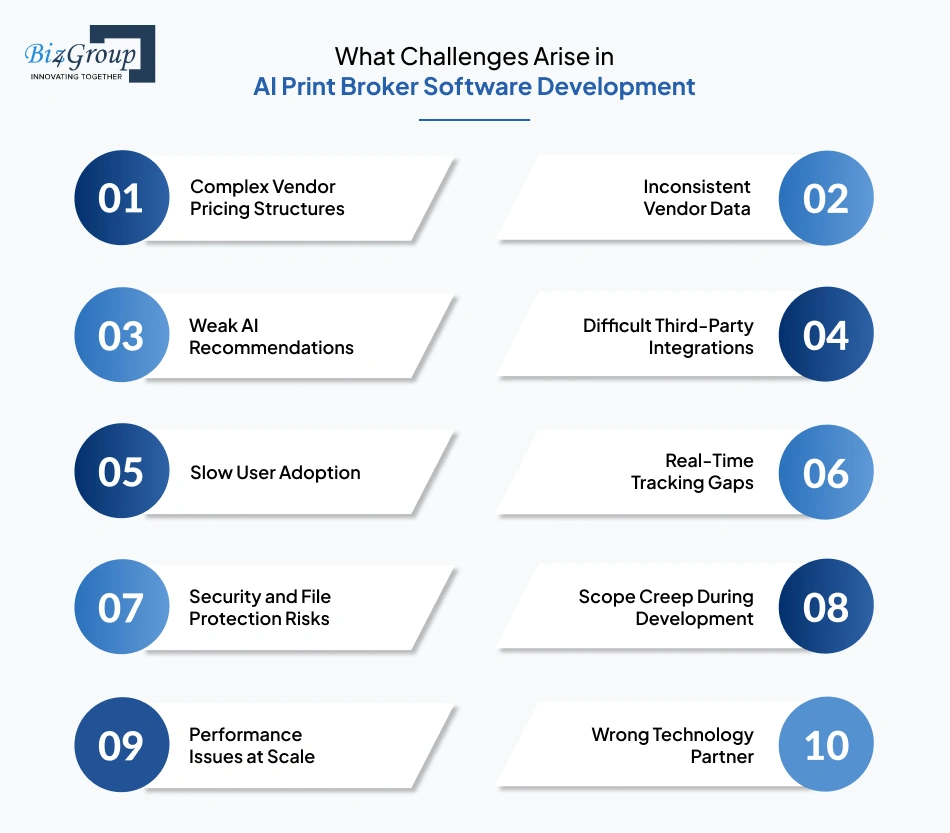
Strong ideas often fail during execution when real delivery challenges are underestimated. Teams planning print broker software development integrating AI usually face issues around data quality, workflows, integrations, and adoption. Knowing these early helps you build with fewer delays and smarter decisions.
|
Challenge |
Why It Happens |
How to Overcome It |
|---|---|---|
|
Complex Vendor Pricing Structures |
Different vendors use different pricing methods based on quantity, material, turnaround time, and finishing options. |
Create a flexible pricing engine with custom rules, formulas, and admin controls from the start. |
|
Inconsistent Vendor Data |
Vendor rates, capacity, service areas, and turnaround times are often stored in different formats. |
Standardize onboarding templates and maintain one central vendor data model. |
|
Weak AI Recommendations |
AI decisions perform poorly when historical order data is limited or inaccurate. |
Start with rules-based automation first, then hire AI developers to improve models using clean data over time. |
|
Difficult Third-Party Integrations |
Payment tools, shipping systems, CRM platforms, and accounting software may use different APIs. |
Use modular connectors, staged rollouts, and early API testing during development. |
|
Slow User Adoption |
Internal teams or vendors may resist changing familiar manual workflows. |
Keep interfaces simple, provide onboarding support, and use practical AI consulting services during rollout planning. |
|
Real-Time Tracking Gaps |
Shipping or production updates may not sync quickly across systems. |
Use event-based notifications and scheduled sync checks for live visibility. |
|
Security and File Protection Risks |
Print jobs often include artwork files, billing data, and customer information. |
Apply role-based access, encryption, secure storage, and activity logs. |
|
Scope Creep During Development |
New feature requests often appear after work has started. |
Lock MVP scope first, then move extra requests into future phases. |
|
Performance Issues at Scale |
Higher order volume can slow dashboards, reports, and workflows. |
Use scalable cloud infrastructure and performance testing before expansion. |
|
Wrong Technology Partner |
General vendors may miss print workflow details and AI priorities. |
Work with experienced AI printing software development companies that understand marketplace operations. |
Most challenges can be managed when they are identified early and planned properly. Successful AI print broker software development depends on realistic scoping, strong execution, and solving technical risks before they slow growth.
Why You Should Choose Biz4Group LLC for AI Print Broker Software Development?
Many founders and operations leaders reach the same decision stage once internal planning starts. They begin comparing companies that develop print broker software in USA and ask practical questions such as:
- we are planning to launch a print broker platform and need a company to develop an AI-powered system for vendor and order management
- we are struggling to manually manage print vendors and want to automate order distribution through a print broker platform
- I need a company that can build a print broker system with vendor matching and workflow automation
If those questions sound familiar, Biz4Group LLC is the answer you’re looking for.
We are an experienced AI development company known for building custom business platforms that combine strategy, strong engineering, and long-term product scalability. Our team works across marketplaces, automation systems, enterprise SaaS products, and AI printing software solutions where performance, workflow clarity, and reliable execution matter from day one. Well, here’s the proof:
1. Udder Color: High-Volume Custom Artwork Printing Platform
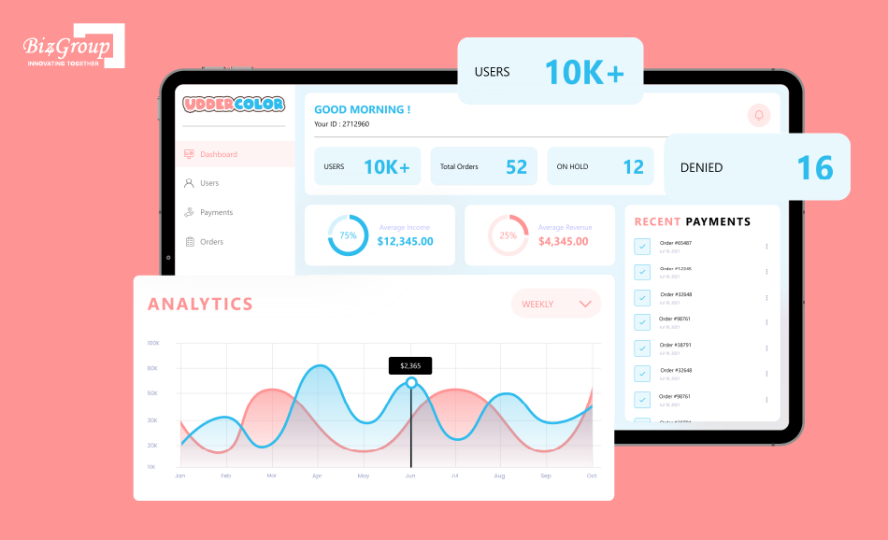
Udder Color is a digital printing solution created for a major U.S. print company to streamline large daily order volumes through a modern online platform. Customers can submit orders for custom heat transfer prints, choose required sizes and quantities, upload artwork files, and receive completed orders within a 1 to 2 day turnaround window.
2. Post Heritage: Custom Print eCommerce Platform
Post Heritage is a digital ecommerce platform designed for online ordering of personalized business cards, stationery, branded accessories, and marketing print materials. Users can configure products by choosing size, shape, layout, graphics, and quantity before purchase. The system also supports reusable templates for repeat orders and manages bulk purchases through connected payment and shipping services.
Why Businesses Partner with Biz4Group LLC
- Strong AI portfolio across custom platforms and workflow automation products
- Experience with scalable marketplace and multi-user software systems
- Practical use of generative AI where it creates business value
- Clear communication with accountable delivery teams
- Reliable backend architecture built for growth
- Product-first planning tied to revenue goals and user adoption
- Long-term support after launch and expansion phases
Printing businesses need more than coding support. They need a partner that can turn operational bottlenecks into software that teams actually use and customers value. That is where we continue to earn trust.
If your goal is a scalable, market-ready print broker platform with intelligent automation, we’re ready to help turn that vision into a working product. So, Let’s talk.
Final Thoughts
The real opportunity is not simply digitizing print brokerage tasks. It is creating a business model that runs with better control, stronger margins, and room to scale as demand grows. When planned carefully, AI print broker software development can turn vendor coordination, pricing decisions, and customer order flow into a structured growth engine. That is where experienced AI product development services create long-term value beyond the first launch.
Success usually comes from clear priorities, practical execution, and a platform built around real business workflows. The companies that move early often gain stronger operational leverage and better customer retention over time. With the right partner, that transition becomes faster and more predictable. Biz4Group LLC works with businesses that want to turn complex ideas into scalable products built for long-term growth.
When you are ready to move from planning to execution, contact us.
FAQ’s
1. Can AI print broker software development support a marketplace model between customers and multiple print vendors?
Yes. A well-built platform can support a marketplace structure where customers place quote requests or orders, while vendors receive jobs based on pricing rules, service type, location, or availability. This model works well for startups and aggregators that want to scale supplier networks efficiently.
2. How much does AI print broker software development typically cost for a startup or growing business?
Most projects fall between $30,000-$200,000+ depending on feature scope, vendor workflows, integrations, automation depth, and rollout scale. Startups often begin with an MVP, while established businesses invest in broader multi-vendor platforms.
3. How long does AI print broker platform development usually take from planning to launch?
A focused MVP can take 3-6 weeks, while a mid-level commercial platform may take 6-9 weeks. More advanced systems with custom workflows, deeper integrations, and larger vendor networks can take 9-14+ weeks.
4. Can custom AI print broker software development connect with existing ERP, CRM, or accounting systems?
Yes. Custom platforms are commonly built to connect with ERP tools, CRM systems, payment gateways, shipping providers, and accounting software. This helps businesses avoid duplicate data entry and maintain smoother operational control.
5. Is AI print broker workflow automation software suitable for packaging and commercial printing businesses?
Yes. Businesses handling packaging, labels, signage, promotional materials, or commercial print jobs often use these systems to manage multiple vendors, urgent timelines, pricing complexity, and repeat order demand more efficiently.
6. What should founders look for in companies that develop print broker software in USA?
Look for a team with marketplace experience, workflow automation capability, AI integration knowledge, strong backend architecture, and a proven delivery process. The right partner should understand both software execution and print brokerage business logic.
