Location :
Orlando, FL, USA
Location :
Orlando, FL, USA +1 (407) 714-1616
 info@biz4group.com


















Imagine a digital system that doesn’t wait for instructions but instead, understands your business goals, learns from real-time feedback, and takes independent actions to get the job done.
Read More
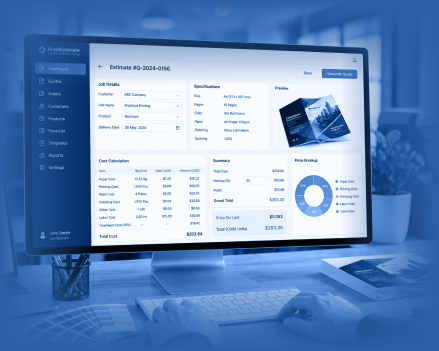
Why does a single quote still take hours in a business that runs on tight deadlines and thin margins?
In many print shops, estimating quietly eats into the day. It pulls focus away from production, delays client responses, and limits how many opportunities you can actually pursue. When one estimator handles everything, growth slows down without anyone noticing.
This is where AI print estimating software development starts to change how quoting works at a practical level. Instead of manual calculations and repeated inputs, the system learns from past jobs, automates quotes and generates pricing in seconds. Around 87% of print providers report better productivity and fewer errors after introducing automation into their workflows. In many cases, quotes are prepared in less than a minute when the process is structured correctly.
You might already be thinking:
Many print businesses are now thinking along the same line and asking, “we are looking to automate print job costing and estimating process in our print shop using AI-based software solutions. Well, the shift is not just about faster quotes. It is about building a system that supports scale without increasing operational pressure.
At the same time, adoption is still early. Only 7% of print providers have a formal AI roadmap, which means most businesses are still operating with manual systems despite rising demand. The market itself reflects this shift as global print estimating software market was valued at $1.2 billion in 2025 and is projected to reach $2.5 billion by 2033, growing at an 8.5% CAGR.
With this on table, for printing companies facing delays in quote generation and want to develop an AI-based estimating solution for faster pricing, this blog will walk you through how to approach it step by step. But before we ‘ll take a look at how manual print estimating is becoming a growth bottleneck.
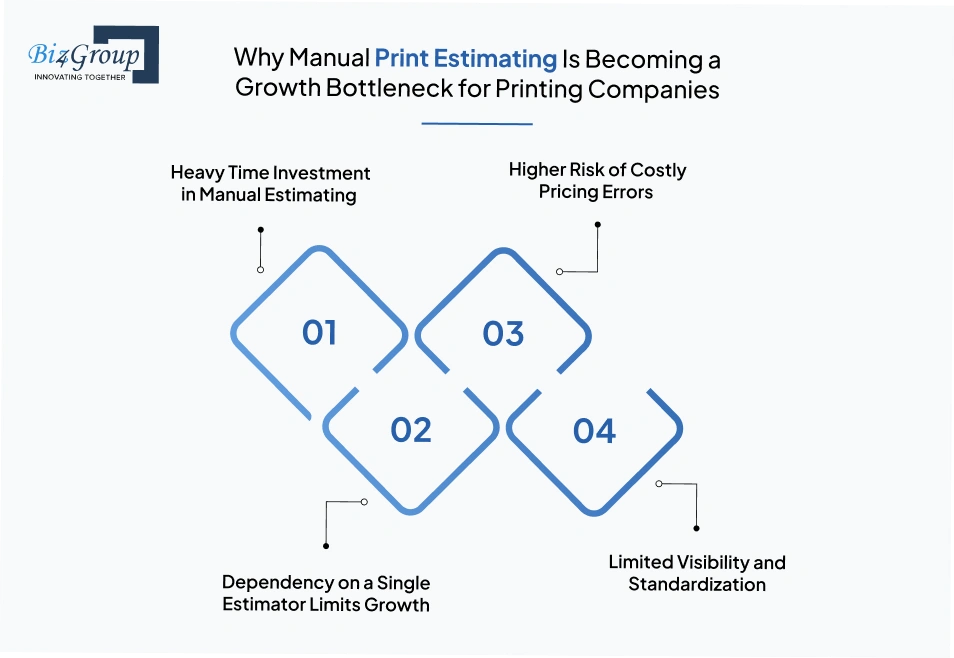
Quoting looks like a routine task until it starts slowing everything else down. Most print businesses do not realize how much time estimating quietly consumes until orders begin to stack up and response time slips.
In many shops, estimating takes up 20–40% of an estimator’s day. That time comes directly from production planning, client communication, and business development. When quoting depends on one person, every new request adds pressure and delays decision-making.
To understand where the bottleneck forms, it helps to break down what is happening inside the workflow.
Manual estimating involves multiple steps. Each job requires reviewing specifications, calculating material costs, checking machine time, and validating pricing. These steps repeat for every quote. This creates a situation where:
Over time, the business starts losing opportunities simply because it cannot respond fast enough.
Small and mid-sized print shops often rely on one experienced estimator. This person becomes the central point for all pricing decisions. When everything depends on one individual:
This dependency makes scaling difficult, even when demand is high.
Manual calculations leave room for mistakes, especially with complex jobs. A small error in material cost or production time can impact the entire quote.
One incorrect estimate on a large job can offset earnings from multiple smaller orders.
Manual processes often lack consistency. Pricing decisions vary based on experience, assumptions, or past habits. This results in:
As operations grow, these gaps become harder to manage.
Manual estimating does not break operations overnight. It slows them down gradually. Time loss, dependency, and errors build pressure across the business. Addressing this bottleneck becomes essential before it starts limiting growth, bringing AI print estimating software development into picture for businesses.
See where your quoting process is slowing down opportunities and affecting daily operations
Talk To Our AI ExpertsAI print estimating software is a system that calculates the cost of a print job automatically using data, rules, and past job history.
Instead of manually reviewing every detail, the software takes your job inputs and processes them instantly. It looks at factors like size, quantity, material, finishing, and production steps, then generates a quote based on structured logic. The goal is to make estimating faster, more consistent, and less dependent on individual judgment.
In a typical print shop, estimating involves multiple calculations done step by step. This software replaces that manual effort with a system that can handle all variables at once.
The system takes the same inputs your estimator works with and processes them instantly.
Instead of calculating these manually each time, the software applies logic across all variables and generates a quote based on structured costing models.
Once the system is set up, the workflow becomes much simpler.
This removes repeated calculations and reduces dependency on manual effort and brings structure to a process that was previously dependent on time and individual experience.
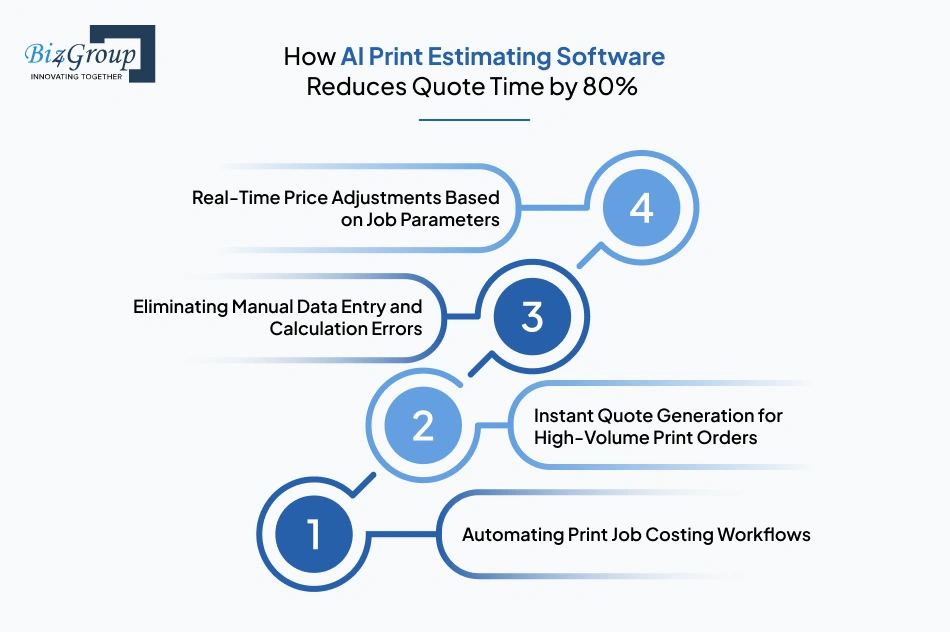
When estimating shifts from manual effort to a structured system, the entire workflow becomes shorter and more predictable, especially with AI transforming printing industry.
For a commercial printing business struggling with slow manual quoting, developing AI print estimating software helps reduce quote time while improving pricing accuracy across jobs. The change comes from restructuring the estimating workflow, not just speeding up calculations.
Let’s look at how that change actually happens inside the estimating process.
In a manual setup, every quote follows the same pattern. You review job specs, calculate material usage, estimate machine time, and then finalize pricing. This repeats for every request. With AI print estimating software, this flow is already defined inside the system. The moment job details are entered, costing logic runs automatically.
The workflow becomes consistent, which is where time reduction begins.
Handling multiple quote requests at once often creates delays. Each job waits its turn, especially during peak hours. When the system processes inputs instantly, quotes are generated within seconds, even for high volumes.
This directly increases how many opportunities your team can handle in a day.
Manual estimating involves entering the same type of data repeatedly. This not only takes time but also increases the chance of errors. AI automation solutions reduces both effort and correction cycles.
Removing these small delays across multiple jobs creates a significant overall time saving.
In manual workflows, even a small change in job details requires recalculating the entire estimate. This slows down discussions with clients. With AI-based systems, pricing adjusts instantly when inputs change.
This keeps the quoting process smooth and avoids back-and-forth delays.
When these improvements work together, the impact becomes clear. The time spent on each quote drops significantly with AI print estimating software development as it removes the effort that used to slow everything down.
Understand how faster quoting can change response time and improve deal flow across your print operations
Request A DemoManual estimating depends heavily on assumptions:
These small gaps create pricing inconsistencies across jobs. Over time, they directly affect profitability.
This is where AI print estimating software development changes the role of estimating. It introduces a structured system where every cost component is calculated using defined rules and real data instead of individual judgment.
To understand how this improves accuracy, let’s look at how each layer of pricing gets corrected.
Material cost is one of the most sensitive parts of any estimate. In manual workflows, it is often selected based on past experience or quick assumptions. This creates a gap between estimated and actual usage.
Building AI software removes that uncertainty by mapping job specifications directly to material requirements. When a job is defined, the system calculates paper type, quantity, and ink usage using predefined costing logic. This ensures that every estimate reflects actual material consumption instead of approximations. As a result, both underpricing and overpricing caused by incorrect material selection are reduced.
Machine time is another area where manual estimation introduces risk. Estimators often rely on rough calculations, especially for complex or custom jobs. This leads to inconsistent costing across similar jobs.
AI print estimating software calculates machine time based on structured production logic. They factor in setup time, run time, and job complexity using predefined rules. Instead of estimating time manually for each job, the system applies consistent logic every time. This brings uniformity to production costing and ensures that time-based expenses are accurately included in the final quote.
One of the biggest challenges in manual estimating is inconsistency. The same type of job may be priced differently depending on who is preparing the quote or how the calculation is approached.
AI resolves this by using historical job data and pattern recognition. It compares new job inputs with past completed jobs and aligns pricing accordingly. Predictive analysis reduces variation across estimates and helps maintain consistent pricing logic. It also minimizes the chances of overquoting, which affects competitiveness, and underquoting, which impacts margins.
In manual workflows, even small changes in job specifications require recalculating the entire estimate. This increases the chance of missing updated costs or using outdated values.
AI-based systems update pricing instantly when inputs change. Whether it is quantity, material, or finishing, the system recalculates all cost components in real time. This ensures that the final quote always reflects the latest job requirements. It also reduces dependency on manual recalculations, which are a common source of pricing errors.
As print operations become more data-driven, AI integration services connect estimating systems directly with production workflows, ensuring every quote is based on actual material usage, machine time, and real job outcomes rather than assumptions.
When pricing becomes structured and data-driven, the improvements are visible:
In commercial printing estimation software development integrating AI, accuracy goes beyond correct numbers. It stabilizes margins and enables confident pricing by removing errors at the source, transforming estimating into a controlled, reliable, and data-driven process instead of a risk-prone operation.
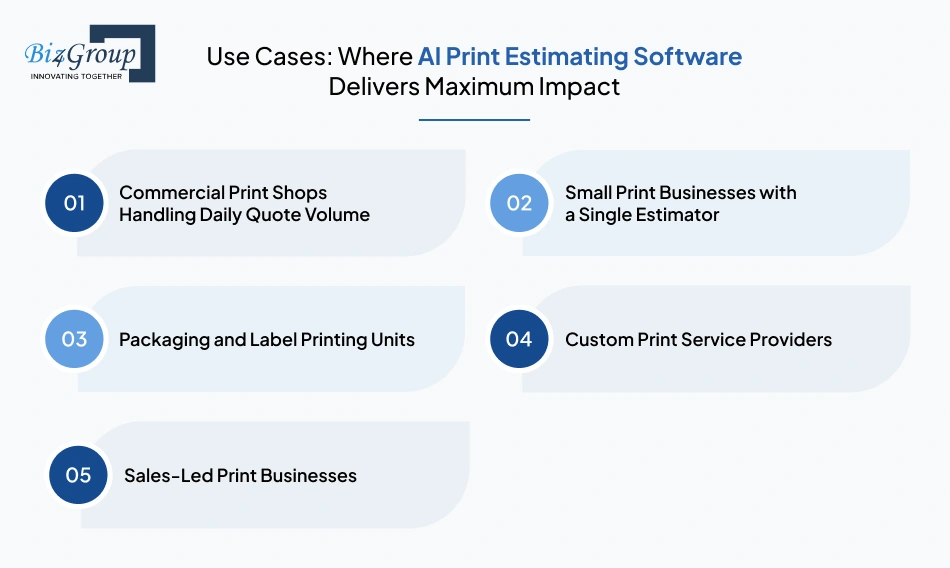
Not every print business experiences estimating pressure in the same way. The need becomes clearer when you look at who is handling quotes, when delays start appearing, and where estimating fits into daily operations.
Many teams begin evaluating print estimating software development with AI for printing businesses at the point where quoting starts interfering with routine work. The following real world AI use cases show where this shift typically begins.
Each of these use cases highlights a different operating condition. The pattern is not about technology adoption. It is about where estimating sits in your workflow and how often it becomes part of daily decision-making.
Most print businesses do not plan this shift early. The need shows up through daily delays, slower quotes, and rising follow-ups. If you’re someone struggling with slow quote generation in your printing business and want to build an automated estimating system, this is when you should start paying attention.
When estimating begins to limit response time, create dependency, or introduce frequent errors, it becomes the right stage to consider AI print estimating software development as a way to bring consistency and control into the quoting process.
Identify whether your current estimating process is ready for a structured system upgrade today
Schedule A ConsultationThe effectiveness of an estimating system depends on how well its features are structured. Each capability should support a specific part of the quoting workflow without adding complexity. When planning scalable AI print estimating software development for small and mid-sized print shops, it helps to group features into clear layers so nothing critical is missed.
|
Feature |
What It Should Do |
|---|---|
|
Job Input Management |
Capture all job details like size, quantity, paper type, and finishing in one place |
|
Cost Calculation Engine |
Automatically calculate material, machine time, and labor cost for each job |
|
Pricing Rule Setup |
Apply consistent pricing logic across different job types and quantities |
|
Multi-Product Handling |
Support different print categories such as commercial, packaging, and labels |
|
Quote Generation |
Generate structured quotes ready to share with clients |
|
Feature |
What It Should Do |
|---|---|
|
Historical Data Learning |
Use past job data to guide pricing for new estimates |
|
Pattern Recognition |
Identify similarities between jobs to improve pricing consistency |
|
Smart Cost Prediction |
Adjust cost calculations based on job type and past outcomes |
|
Continuous Learning |
Improve accuracy over time as more jobs are processed |
|
Anomaly Detection |
Highlight unusual pricing that may need review |
|
Feature |
What It Should Do |
|---|---|
|
Print MIS Connectivity |
Sync estimating with production planning and job tracking systems |
|
Link client data and previous quotes for better context |
|
|
Inventory Integration |
Pull material availability and current cost into estimates |
|
Production System Sync |
Align estimates with actual machine and workflow data |
|
API Support |
Connect with external systems used in daily operations |
Also Read: Artificial Intelligence in CRM
|
Feature |
What It Should Do |
|---|---|
|
Simple Input Interface |
Allow quick and clear entry of job specifications |
|
Central Dashboard |
Provide visibility into all quotes and their status |
|
Real-Time Updates |
Reflect any job changes instantly in pricing |
|
Role-Based Access |
Control who can create, edit, or approve estimates |
|
Quote Tracking |
Monitor quotes from creation to final approval |
When these features are structured correctly, estimating becomes predictable and easier to manage across different job types and team setups. This is where print shop estimation automation software development starts making sense as a practical step toward building a system that supports consistent and scalable estimating without increasing manual workload.
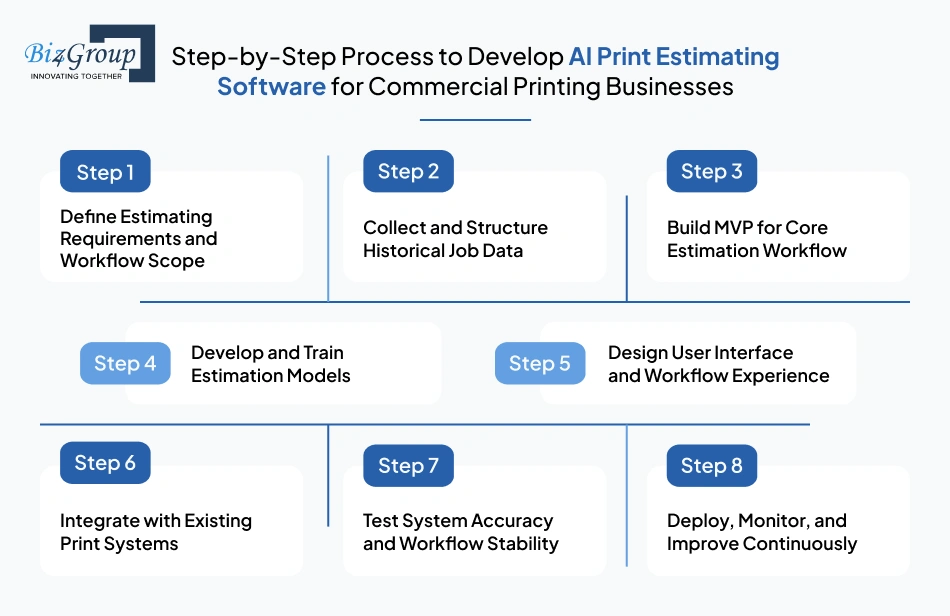
Once the features are clear, the focus shifts to execution. The process is not about coding everything at once. It is about following a structured path where each stage builds on the previous one.
Many business owners looking to develop AI-based print job costing software for their printing company start by understanding how each step connects to real workflow needs. This is where the development journey becomes more practical and easier to manage.
Start by mapping how estimating currently works in your print shop. Identify what inputs are used, how pricing is calculated, and where delays or inconsistencies appear.
Once the workflow is clear, the next step is gathering past job data. This data becomes the foundation for how the system will calculate costs. Raw data from previous jobs is often unstructured. It needs to be cleaned and organized so it can be used consistently.
Instead of building a full system at once, start with a basic version that handles core estimating. This allows you to test whether the workflow works before expanding it. This is where MVP development services help create a usable version that estimators can interact with.
Also Read: Top MVP Development Companies in USA
After validating the basic workflow, the system can be enhanced with learning capabilities. This step focuses on improving how costs are calculated using past data. AI model development defines how the system calculates costs, while improving accuracy using historical data.
The system should feel natural to use. This step focuses on making the system usable in daily operations. A UI/UX design company helps structure how users interact with the system.
Also Read: Top UI/UX Design Companies in USA
Estimating is not a standalone activity. It connects with production, inventory, and job tracking systems. This step ensures everything works together.
Also Read: A Complete Guide to OpenAI API Integration for AI Applications
Before full rollout, the system must be tested under real conditions. This step ensures that estimates are accurate and workflows are stable. Working with software testing companies helps validate both performance and reliability.
Once the system is stable, it is introduced into daily operations. From here, the focus shifts to improvement. The system should evolve based on usage, feedback, and new data.
When you think about how to create print job costing software for packaging and commercial printing, this process gives you a clear path from understanding your current estimating setup to building a system that works in real conditions and improves over time.
Once the development steps are clear, the next decision is selecting the right tools to support each layer of the system. For teams focused on AI print estimating software development to eliminate estimator bottlenecks, this structure helps map tools directly to system responsibilities.
|
Architecture Layer |
Recommended Tools |
Purpose |
|---|---|---|
|
Frontend Interface |
React.js, Angular |
Capture job inputs, display quotes, and allow estimators to interact with the system through a structured interface |
|
Backend Framework |
Node.js, Django |
Process job data, apply pricing logic, and handle quote generation requests from the frontend |
|
Database Layer |
PostgreSQL, MongoDB |
Store job specifications, pricing rules, historical estimates, and user activity data |
|
AI Model Layer |
TensorFlow, PyTorch |
Run cost prediction models that calculate pricing based on job inputs and past data |
|
Data Processing Layer |
Pandas, NumPy |
Clean raw job data, structure it, and prepare it for use in estimation models |
|
API Layer |
REST APIs, GraphQL |
Send and receive data between frontend, backend, and external systems in real time |
|
Integration Layer |
Middleware, Webhooks |
Syncs estimating system with MIS, inventory, and production systems without manual data transfer |
|
Authentication Layer |
OAuth, JWT |
Control user access, manage login sessions, and protect sensitive pricing data |
|
Cloud Infrastructure |
AWS, Azure, Google Cloud |
Host the system, manage storage, and support scaling as usage increases |
|
Real-Time Processing |
Kafka, RabbitMQ |
Handle instant updates when job inputs change and ensure pricing updates without delay |
|
Monitoring & Logging |
ELK Stack, Prometheus |
Track system activity, detect errors, and monitor performance across estimating workflows |
|
Testing & QA Layer |
Selenium, JUnit |
Test system functions, validate estimation accuracy, and ensure stability before deployment |
When each layer is supported by the right tools, the system becomes easier to manage and scale. This is how building AI-powered print estimating system to reduce manual quoting workload turns into a practical implementation backed by full stack development.
Also Read: Why to Choose the Full Stack Development for Modern Business
Get clarity on the right tools and architecture for your specific print estimating requirements
Get Technical Guidance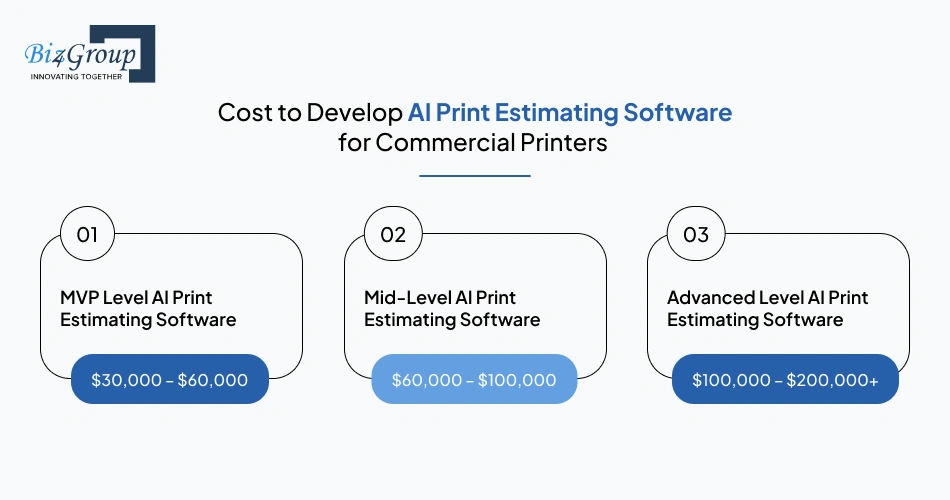
|
Development Level |
Estimated Cost Range |
Scope |
|---|---|---|
|
MVP Level AI Print Estimating Software |
$30,000 – $60,000 |
Basic estimating workflow, limited job types, core costing logic, minimal integrations |
|
Mid-Level AI Print Estimating Software |
$60,000 – $100,000 |
Expanded job handling, improved UI, AI-based estimation logic, system integrations |
|
Advanced Level AI Print Estimating Software |
$100,000 – $200,000+ |
Full automation, real-time pricing updates, advanced AI models, multi-system integration |
|
Hidden Costs |
Estimated Cost Impact |
|---|---|
|
Data cleaning and preparation |
$5,000 – $15,000 |
|
System maintenance and updates |
$3,000 – $10,000 annually |
|
Model retraining over time |
$5,000 – $20,000 |
|
Integration adjustments post-deployment |
$5,000 – $15,000 |
Cost becomes easier to manage when it aligns with your workflow needs instead of feature assumptions. A structured approach helps you invest in the right areas while controlling complexity, especially when planning AI print quoting software development for long-term scalability.
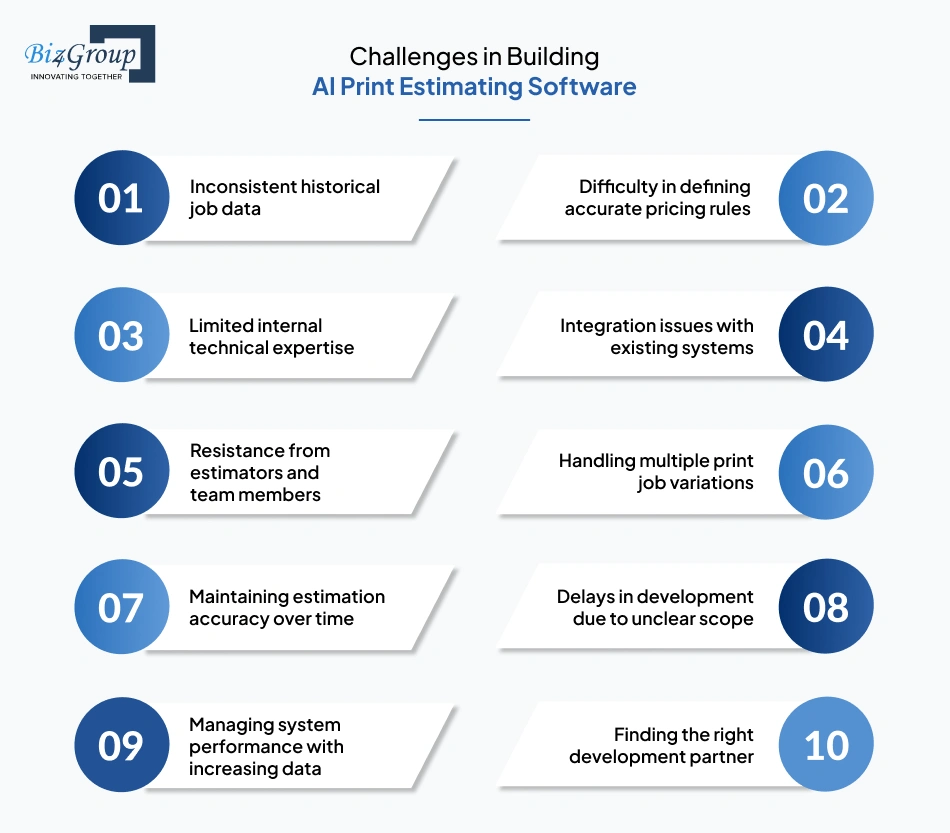
Every system looks straightforward at a high level, but challenges start appearing during actual execution. These are not theoretical issues. They come up when you try to align estimating with real workflows, data, and team usage.
While working through AI print estimating software development, these are the common roadblocks teams face and how they can be handled early to avoid delays later.
|
Challenge |
How to Overcome It |
|---|---|
|
Inconsistent historical job data |
Standardize data formats before development and clean existing records to ensure consistent inputs for estimation logic |
|
Difficulty in defining accurate pricing rules |
Document current pricing decisions with estimators and convert them into structured rules before system implementation |
|
Limited internal technical expertise |
Work with an experienced AI development company that understands both AI and print workflows |
|
Integration issues with existing systems |
Plan integrations early and use structured API connections to align systems without disrupting current operations |
|
Resistance from estimators and team members |
Hire AI developers and involve estimators during early stages to test the system with real workflows to improve adoption |
|
Handling multiple print job variations |
Start with a limited set of job types and expand gradually once the system stabilizes |
|
Maintaining estimation accuracy over time |
Continuously update models with new job data and monitor output regularly for consistency |
|
Delays in development due to unclear scope |
Define clear requirements and prioritize features before starting development to avoid scope changes |
|
Managing system performance with increasing data |
Use scalable cloud infrastructure to handle growing data and workload efficiently |
|
Finding the right development partner |
Evaluate AI printing software development companies based on experience with similar systems and workflows |
Challenges are part of the process, but they become manageable when addressed early with the right approach. The development of AI print estimating software becomes smoother when decisions are structured, expectations are clear, and execution is aligned with actual workflow needs.
Finding the right development partner is not about comparing features on paper. It comes down to who understands your workflow and can translate it into a system that works in real conditions.
For businesses comparing companies that develop AI print estimating software for commercial printers and want the best solution provider, the focus should be on execution capability, not just technical claims. This is exactly where Biz4Group LLC stands out.
As a custom AI software development company, we work closely with your team to understand how estimating actually happens inside print operations. Our focus stays on building practical AI printing software solutions that align with your workflow instead of forcing you to adapt to the system.
To give you a clearer picture of how this works in real scenarios, here are a couple of platforms we’ve built that reflect structured, AI-driven print workflows.
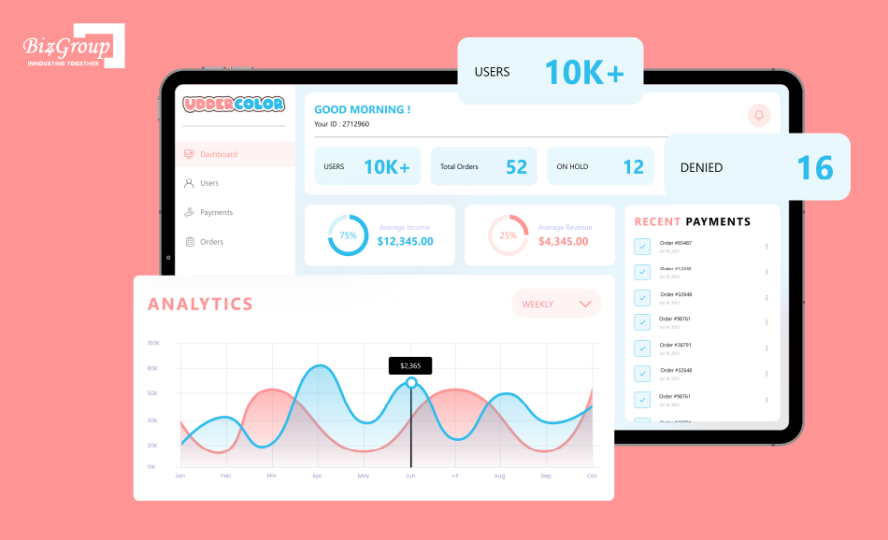
It is an AI-enabled custom artwork printing platform that allows users to upload designs, configure sizes and quantities, and order printable heat transfers for direct delivery. It includes automated and manual artwork validation, order tracking, and approval workflows to ensure accuracy and faster processing.
Such intelligent workflow automation aligns closely with how AI systems bring consistency and speed into modern print estimating and production processes.
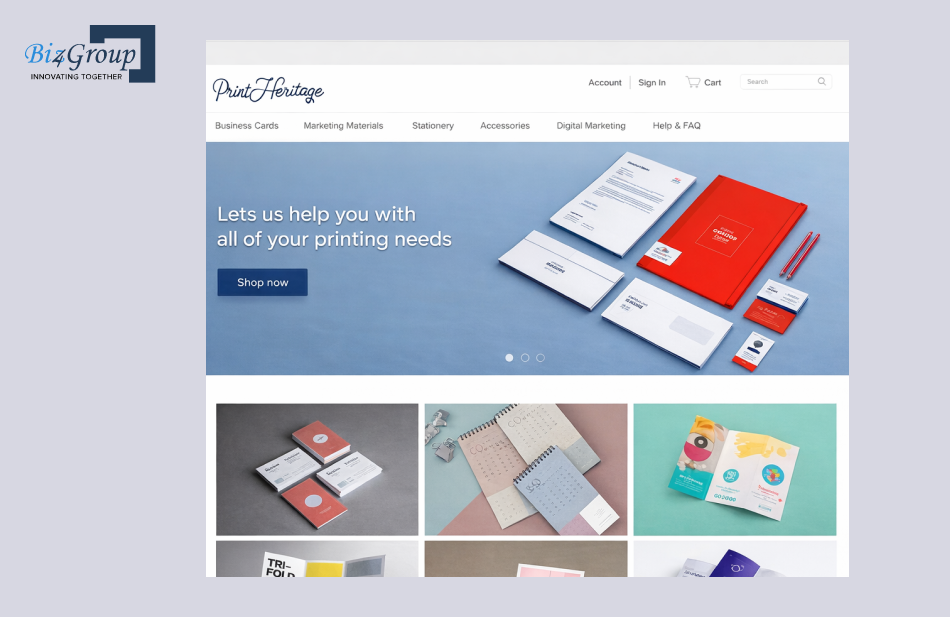
This is an AI-powered eCommerce platform designed for customizing business cards, stationery, and printed marketing materials. It allows users to select size, design, and quantity, personalize graphics, and place bulk orders through an integrated system with secure payments and shipping APIs.
This kind of structured customization and ordering flow reflects how AI-driven systems streamline print decision-making and support scalable estimating environments.
The right partner helps you move from idea to execution without unnecessary complexity. With Biz4Group LLC, AI print estimating software development becomes a structured process where your workflow, accuracy, and scalability stay at the center of every decision.
Discuss your estimating workflow and see how it can be structured into a working system
Connect With Our TeamThe role of estimating will shift from calculation to prediction. Instead of reacting to inputs, systems will start anticipating pricing decisions before a request is fully defined. This is where AI print estimating software development moves toward a more proactive role in print operations.
As AI print estimating and quoting systems continue evolving, the focus will move toward prediction, automation, and minimal human intervention across the entire estimating lifecycle.
The future of estimating will move beyond assistance into decision-making. AI print estimating software to reduce manual quoting workload will evolve into systems that predict, adapt, and guide pricing strategies, making estimating a forward-looking function instead of a reactive task.
At some point, estimating stops being a routine task and starts influencing how your business performs. It affects how quickly you respond, how confidently you price, and how consistently you operate. That is where shifts become important.
The real impact comes when estimating becomes reliable. When pricing decisions feel clear and consistent, and when your team is not spending time correcting avoidable errors. This is where AI reduces print quote errors and improves pricing accuracy in printing industry in a practical way.
Moving toward AI print estimating software development is about creating a system that supports your growth without adding pressure. With the right approach and AI product development services, estimating can become a controlled and dependable part of your workflow.
If you’re considering this step, you can schedule a strategy call with Biz4Group LLC to explore what fits your business.
AI-based systems process multiple variables such as size, material, finishing, and quantity together instead of separately. This allows packaging and label printers to generate accurate estimates even when job specifications vary significantly across orders.
The timeline usually ranges from 5 to 14+ weeks depending on scope. An MVP can be ready in 3–5 weeks, while a fully scaled system with integrations and advanced estimation logic may take upto 14+ weeks.
Most systems fall between $30,000 and $200,000+. The final cost depends on workflow complexity, number of integrations, and how advanced the estimation logic needs to be for your print operations.
AI systems adjust pricing dynamically by factoring in updated material costs, job parameters, and past job trends. This helps maintain consistency even when input variables change frequently.
The focus should be on experience with print workflows, ability to handle custom job variations, and understanding of estimating logic. Domain knowledge matters more than generic software development experience in this space.
The system is designed to scale with workload. As quote volume increases, it processes more requests without adding manual effort, making it suitable for print shops planning to grow without expanding their estimating team.

with Biz4Group today!
Our website require some cookies to function properly. Read our privacy policy to know more.