Location :
Orlando, FL, USA
Location :
Orlando, FL, USA +1 (407) 714-1616
 info@biz4group.com


















Imagine a digital system that doesn’t wait for instructions but instead, understands your business goals, learns from real-time feedback, and takes independent actions to get the job done.
Read More
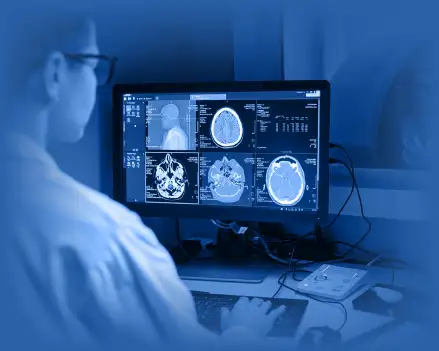
If you work in healthcare, you already know how fast radiology is evolving. Imaging volumes are skyrocketing, and radiologists are under constant pressure to deliver accurate interpretations faster than ever. You might have asked yourself; how can radiology departments keep up while still meeting HIPAA compliance and protecting patient data?
That question lies at the heart of AI radiology software development. By combining medical imaging expertise with intelligent automation, healthcare organizations can unlock faster diagnostics, improved accuracy, and safer patient data management.
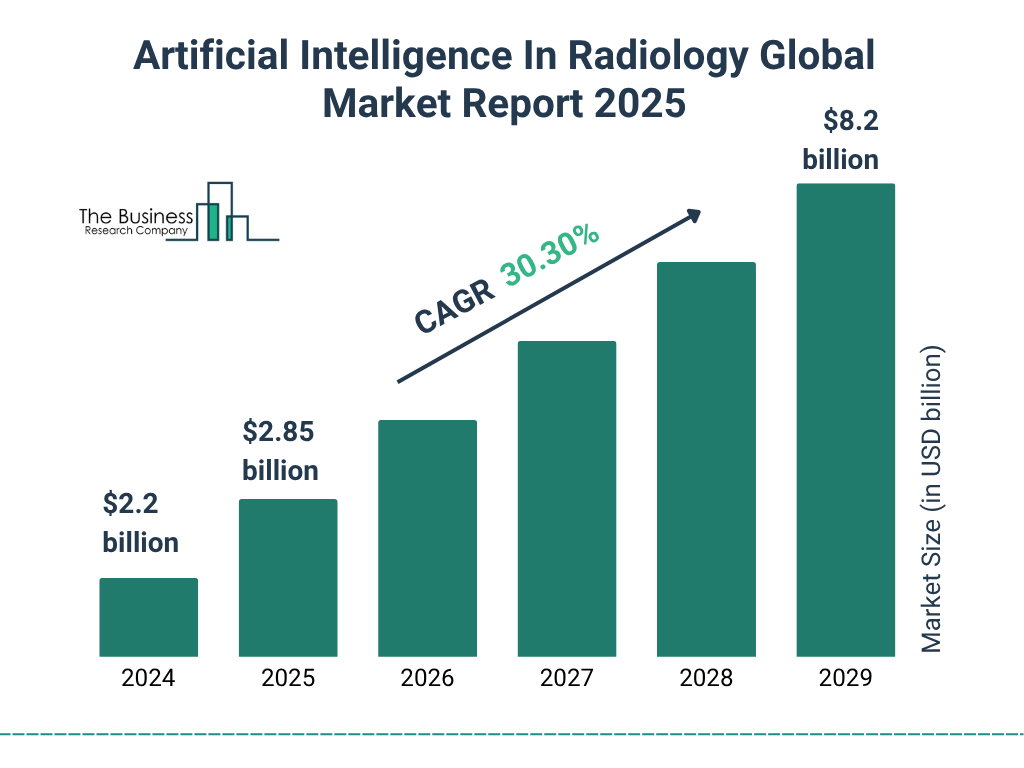
The numbers tell the story. A report from The Business Research Company estimates the AI in radiology sector alone will expand from $2.2 billion in 2024 to $2.85 billion in 2025, showing just how quickly adoption is accelerating across hospitals and diagnostic centers.
Still, with innovation comes responsibility. Every image, report, and dataset in radiology involves Protected Health Information (PHI). One small oversight in compliance can cause major security breaches or regulatory penalties. That’s why organizations must focus on how to build HIPAA-compliant AI radiology systems that enhance diagnostic accuracy while safeguarding patient privacy.
In this guide, we’ll walk you through the entire process of AI radiology software development, from use cases and compliance essentials to features, technology stacks, costs, and challenges. You’ll learn exactly how to build AI software that strengthens your radiology department, keeps your data secure, and meets HIPAA standards without compromising innovation.
If your goal is to make AI-powered radiology tools that deliver smarter, faster, and safer diagnostics, this is the roadmap you need to start strong and scale confidently.
Radiology teams across the U.S. are under growing pressure to manage an increasing number of imaging studies while maintaining precision and HIPAA compliance. That’s where AI radiology software development starts to make a measurable difference.
When you make AI-powered radiology tools, you give your department the ability to process images faster, improve diagnostic accuracy, and enhance workflow efficiency without compromising patient privacy. Instead of spending hours on repetitive tasks, radiologists can focus on complex interpretations and better patient outcomes.
Here’s what the right AI radiology system can help you achieve:
Hospitals and imaging centers that build AI radiology systems to enhance diagnostic accuracy and security are already seeing faster turnaround times, improved collaboration, and fewer reporting errors. For instance, combining AI algorithms with clinical workflows can shorten diagnosis times by up to 30%, according to AI healthcare solutions.
If your organization plans to implement advanced imaging automation, consider starting with a partner experienced in AI automation services. It helps ensure that every process (from data ingestion to image reporting) remains compliant, efficient, and ready to scale.
With thoughtful planning and expert guidance, AI radiology software development can transform your radiology department into a model of precision, speed, and trust.
Let's turn your vision for AI radiology software development into a compliant, scalable healthcare solution.
Contact Us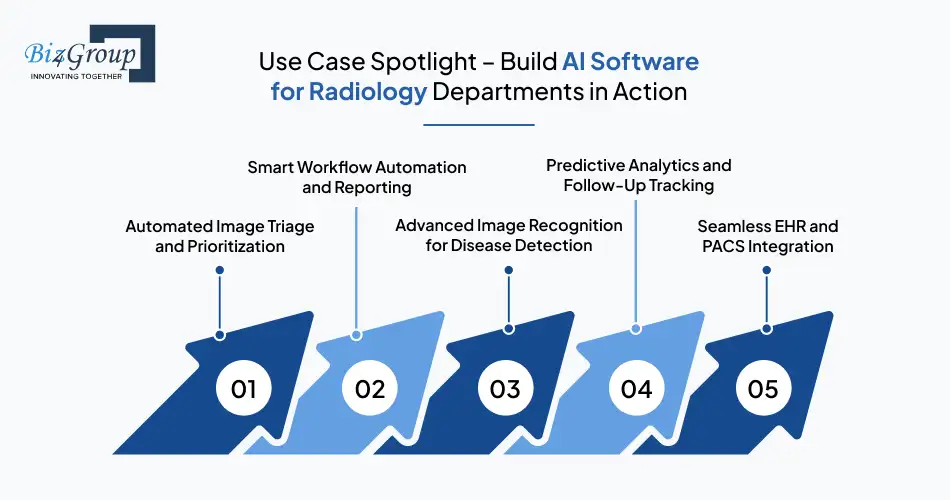
Radiology departments across the U.S. are facing an unprecedented challenge: rapidly rising imaging volumes, tight turnaround times, and the constant pressure to stay HIPAA compliant. That’s why many healthcare organizations are investing in AI radiology software development to transform routine imaging workflows into efficient, secure, and intelligent systems.
When you build AI software for radiology departments, the results go beyond automation. These solutions enhance diagnostic accuracy, improve collaboration, and make compliance with HIPAA a built-in part of your radiology ecosystem.
Here’s how leading hospitals, imaging centers, and healthcare startups are putting AI-powered radiology tools to work.
Time is critical when diagnosing acute conditions. AI models built for radiology can automatically analyze scans, detect anomalies, and route urgent cases to specialists first.
Example:
A trauma hospital in Texas implemented an intelligent triage model that flagged possible hemorrhages within seconds. The system, integrated into their AI radiology information system, reduced reporting time by 35% while maintaining HIPAA and PHI compliance.
Why it matters:
Manual reporting slows down radiology departments and increases error risk. Using AI-based radiology workflow automation tools, healthcare providers can streamline reporting, automatically transcribe findings, and securely store reports.
Example:
A diagnostic imaging center adopted a HIPAA-compliant AI medical transcription software to automate reporting workflows. It cut documentation time in half, standardized report quality, and strengthened data protection protocols.
Why it matters:
Detecting subtle findings in large imaging datasets can overwhelm even seasoned radiologists. AI image recognition software helps identify abnormalities early and supports clinical decisions with precision.
Example:
A healthcare startup built an advanced lung cancer detection model using AI image recognition software. It achieved over 95% accuracy in identifying nodules from chest X-rays, helping clinicians confirm early-stage cases faster while staying fully HIPAA compliant.
Why it matters:
With the right AI radiology software development strategy, predictive analytics can identify which patients need repeat scans or further evaluations. These proactive systems improve care continuity and operational efficiency.
Example:
A diagnostic network embedded predictive models into its radiology software to track follow-up requirements. The system automatically flagged patients for re-imaging and improved adherence rates by 22%.
Why it matters:
Many healthcare enterprises struggle with fragmented imaging data. A HIPAA-compliant approach to AI radiology software development ensures that imaging systems, reports, and EHRs connect seamlessly through secure integrations.
Example:
A hospital network deployed an integrated radiology platform that synchronized reports and imaging data with its EHR system in real time. This eliminated duplicate entries, improved diagnostic turnaround, and ensured every exchange met HIPAA encryption standards.
Why it matters:
Each of these use cases proves that when you create AI-based radiology workflow automation tools with compliance built in, you don’t just keep up, you lead. Hospitals, diagnostic centers, and telemedicine providers that invest in building HIPAA-compliant AI radiology systems are paving the way for faster diagnostics, safer patient data, and a more intelligent future for medical imaging.
In the world of AI radiology software development, compliance is not just a technical checkbox. It is the foundation that safeguards trust between patients and providers. HIPAA compliance ensures every image, report, and dataset containing Protected Health Information (PHI) remains secure throughout your AI lifecycle.
If you are planning to build HIPAA-compliant AI radiology systems, understanding how HIPAA applies to imaging and automation is essential before you begin development.
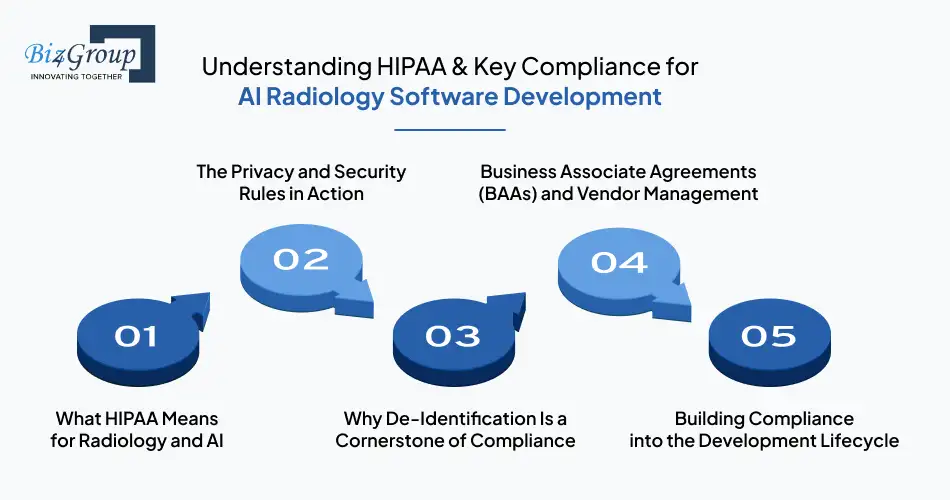
HIPAA regulates how sensitive patient data must be collected, processed, and shared. In radiology, every DICOM file and imaging report often contains PHI. For any organization focused on AI radiology software development, these data elements must be handled with privacy in mind.
When you make AI-powered radiology tools, compliance ensures patient confidentiality while improving diagnostic accuracy and workflow efficiency.
HIPAA’s Privacy Rule defines who can access patient data, while the Security Rule focuses on how systems must protect that data. For AI-based radiology workflow automation tools, this means applying encryption, identity verification, and continuous risk assessment.
Teams that build AI radiology software ensuring HIPAA and PHI compliance should document every safeguard, from user permissions to breach response protocols.
De-identification removes any patient identifiers from imaging data before it is used for model training or analysis. Both pixel data and metadata must be sanitized to protect PHI. This step is critical when you build AI radiology systems to enhance diagnostic accuracy and security because it allows safe use of imaging data for innovation while maintaining full compliance.
Most organizations automate de-identification as part of their data pipeline to avoid manual errors and regulatory risks.
Whenever you work with third-party platforms or data services, those vendors become Business Associates under HIPAA. You must have a signed Business Associate Agreement (BAA) with each partner handling PHI.
For healthcare providers, collaborating with experts in HIPAA-compliant AI app development for healthcare providers simplifies this step. They help establish secure integrations, compliance audits, and vendor accountability from day one.
The smartest way to manage regulatory risk is to embed it into your workflow. When you follow steps to create HIPAA-compliant AI software for radiology centers, security and privacy become part of every build phase, from data ingestion to deployment.
Designing with privacy-by-design and security-by-design principles ensures your AI platform remains compliant even as regulations evolve.
When you align your AI radiology software development strategy with HIPAA from the start, you not only meet legal requirements but also earn long-term trust. Hospitals, diagnostic centers, and telemedicine providers that treat compliance as a built-in function set themselves apart as leaders in ethical and secure healthcare innovation.
We've mastered the art of building HIPAA-compliant AI radiology systems that keep your patient data locked tight.
Talk to Our Compliance Experts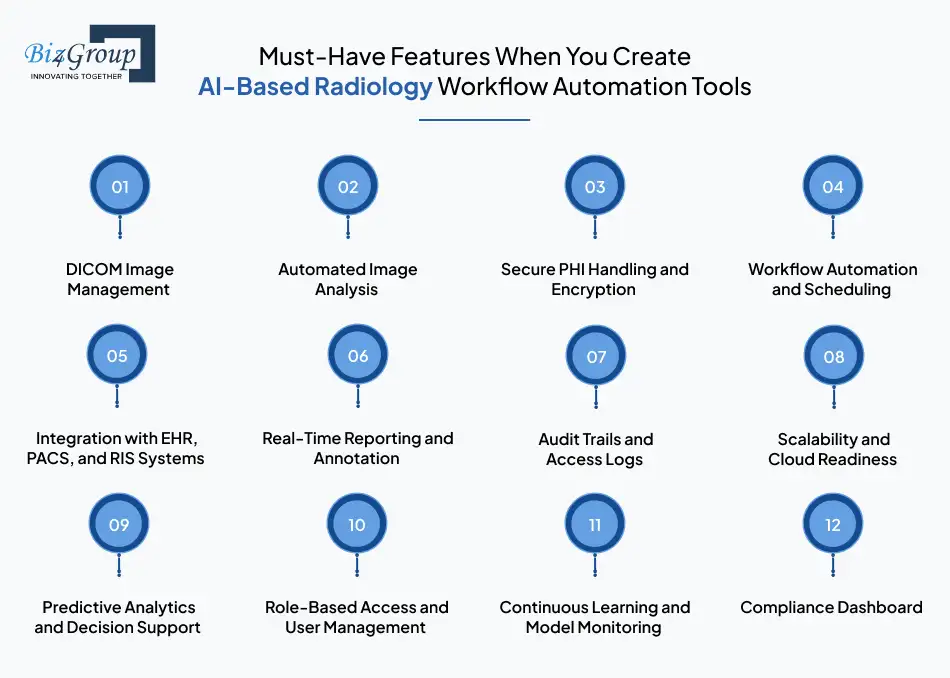
When planning your AI radiology software development, every feature must serve a real purpose, improving diagnostic precision, operational efficiency, and data security. The goal is to build HIPAA-compliant AI radiology systems that fit naturally into existing workflows while keeping PHI protected at every step.
Here are the key features your AI radiology platform should include:
| Feature | Description & Importance |
|---|---|
|
DICOM Image Management |
Managing and processing DICOM files is essential for any radiology system. Your AI-based radiology workflow automation tools should support importing, viewing, and tagging DICOM images while maintaining full metadata integrity to ensure interoperability across devices and platforms. |
|
Automated Image Analysis |
The core of AI radiology software development lies in advanced image analysis. Using intelligent AI image recognition software, the system can detect lesions, tumors, or fractures in seconds, improving accuracy and reducing human workload. |
|
Secure PHI Handling and Encryption |
Every image and report contains sensitive data. To build AI radiology software ensuring HIPAA and PHI compliance, your system must use end-to-end encryption, secure authentication, and access logs to protect patient information throughout the workflow. |
|
Workflow Automation and Scheduling |
When you create AI-based radiology workflow automation tools, automated case routing, prioritization, and scheduling keep your radiology department efficient. This ensures that urgent studies are reviewed faster and resources are optimized. |
|
Integration with EHR, PACS, and RIS Systems |
Interoperability is a must for modern radiology. Through seamless integration using AI integration services, your software can connect securely with hospital systems, providing a unified and HIPAA-compliant data ecosystem. |
|
Real-Time Reporting and Annotation |
Radiologists can generate structured reports, annotate images, and validate results quickly. Partnering with experts in AI medical web development ensures these tools are built for usability, compliance, and performance. |
|
Audit Trails and Access Logs |
Every user activity should be recorded, from uploads to report edits. This feature is critical to track accountability and maintain compliance during AI radiology software development. |
|
Scalability and Cloud Readiness |
Modern systems must handle growing datasets effortlessly. Cloud-based infrastructure lets you build AI radiology systems to enhance diagnostic accuracy and security across multiple facilities without compromising compliance. |
|
Predictive Analytics and Decision Support |
Predictive analytics allows radiologists to identify risks earlier and make data-driven decisions. Integrating this feature strengthens diagnostic precision and improves patient outcomes. |
|
Role-Based Access and User Management |
Controlling access by user roles ensures that only authorized professionals view or edit patient data. This safeguards PHI and helps maintain HIPAA compliance throughout your AI radiology software development cycle. |
|
Continuous Learning and Model Monitoring |
AI models in radiology improve with experience. By collecting performance feedback and retraining models periodically, you ensure that your development of AI radiology software remains accurate, ethical, and compliant. |
|
Compliance Dashboard |
A centralized dashboard can track encryption, audits, and risk alerts in real time. It provides administrators a clear view of the system’s overall compliance posture. |
Building these features into your radiology platform ensures you make AI-powered radiology tools that are not only fast and accurate but also fully aligned with healthcare regulations. In the end, successful AI radiology software development is as much about compliance and trust as it is about technology and innovation.
Developing successful and secure AI radiology software requires a structured approach that balances compliance, scalability, and performance. Each stage should reinforce your commitment to innovation while meeting the strict standards of HIPAA-compliant AI radiology systems.
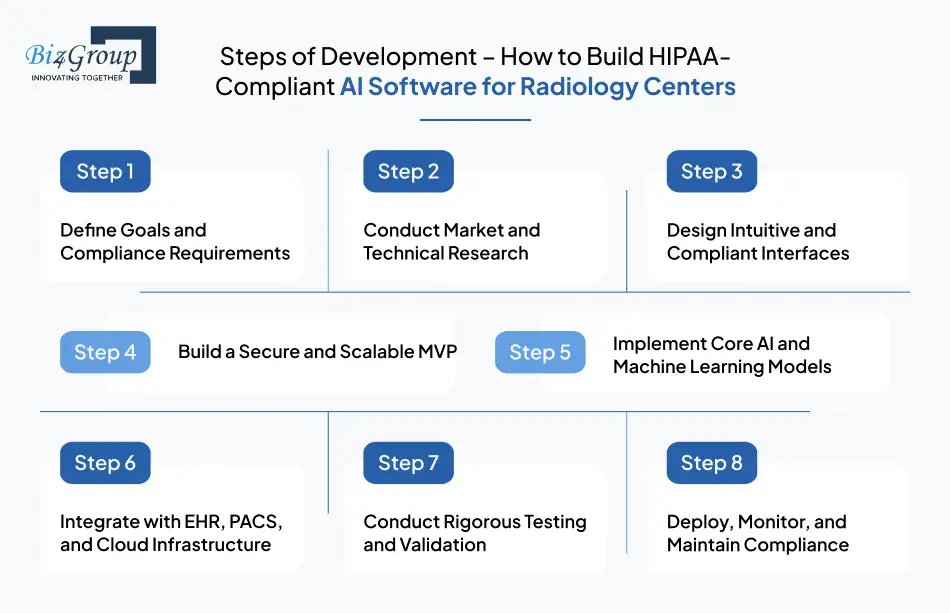
Here’s how to plan your AI radiology software development step by step.
Every great project begins with clarity. Start by outlining what your AI-powered radiology tools are meant to achieve and how they align with HIPAA’s privacy and security regulations. Setting compliance benchmarks from day one reduces risk later in the build phase.
Research defines the difference between innovation and imitation. Before you build AI radiology systems to enhance diagnostic accuracy and security, analyze competitors, available datasets, and technical challenges.
A strong user experience ensures adoption by radiologists and technicians. Every interface must be simple, efficient, and secure. Partnering with a trusted UI/UX design team helps ensure that your dashboards, reporting tools, and imaging viewers remain easy to use while meeting HIPAA standards.
Creating a Minimum Viable Product (MVP) helps validate both functionality and compliance before scaling. A small but complete prototype allows you to collect feedback from clinicians and refine your AI radiology software development process efficiently. You can accelerate this stage by working with experts in MVP development who understand regulatory constraints in healthcare.
At this stage, your system begins to think intelligently. Training AI models on de-identified imaging datasets ensures compliance while enhancing diagnostic precision. The development of AI radiology software should always prioritize accuracy, bias reduction, and explainability.
Integration connects your software with the rest of the healthcare ecosystem. When you build AI radiology software ensuring HIPAA and PHI compliance, each connection between systems must use secure APIs, encryption, and audit tracking.
Testing isn’t just about performance, it’s about safety, accuracy, and compliance. A properly tested AI-based radiology workflow automation tool reduces errors and builds clinician trust.
Deployment is only the beginning of your journey. Continuous monitoring ensures your AI radiology software development remains compliant and performs efficiently over time. Keep your AI models updated and your system aligned with evolving healthcare standards.
Following these steps allows your organization to make AI-powered radiology tools that are reliable, secure, and compliant. A structured roadmap not only accelerates delivery but also guarantees that every aspect of your AI radiology software development meets HIPAA expectations while driving innovation in medical imaging.
Let our team transform your concept into a fully functional, compliant AI radiology software that works across departments.
Start Your ProjectA robust and compliant tech stack is the foundation of every successful AI radiology software development project. The right combination of tools ensures scalability, diagnostic precision, and HIPAA-compliant data handling throughout your radiology workflow.
Here’s the ideal technology stack for building efficient, secure, and scalable AI-powered radiology tools:
| Category | Technologies / Tools | Purpose & Benefits |
|---|---|---|
|
Programming Languages |
Python, C++, Java |
Python is ideal for AI model training, C++ offers high-speed image processing, and Java ensures backend stability for AI radiology software development. |
|
AI & Machine Learning Frameworks |
TensorFlow, PyTorch, Keras |
Enable the creation of deep learning models for AI-based radiology workflow automation tools that identify patterns, anomalies, and diagnostic markers in imaging data. |
|
Data Management & Storage |
PostgreSQL, MongoDB, AWS RDS |
Manage structured and unstructured medical data securely while maintaining HIPAA compliance and PHI encryption. |
|
Cloud Infrastructure |
AWS, Google Cloud, Microsoft Azure |
Provides secure hosting, elastic storage, and compliance-ready services for HIPAA-compliant AI radiology systems. Partnering with enterprise AI solutions ensures reliability and scalability. |
|
Frontend Technologies |
React.js, Angular |
Used to create dynamic and intuitive user interfaces where radiologists can view and annotate images. Strong UI/UX design principles enhance usability and compliance. |
|
Backend Frameworks |
Flask, Django, Node.js |
Handle image uploads, user management, and report generation. These frameworks make your AI radiology software secure and efficient with proper access control. |
|
DevOps & Deployment |
Docker, Kubernetes, Jenkins |
Simplify deployment and scaling while maintaining HIPAA compliance. CI/CD pipelines automate monitoring and updates for the development of AI radiology software. |
|
Image Processing Libraries |
OpenCV, SimpleITK |
Support DICOM processing, segmentation, and real-time visualization in AI radiology software development workflows. |
|
Security & Compliance Tools |
SSL/TLS, AWS KMS, OAuth 2.0 |
Protect Protected Health Information (PHI) using strong encryption and access control. Helps in building HIPAA-compliant AI radiology systems. |
|
Testing Frameworks |
PyTest, Selenium, Postman |
Ensure performance, reliability, and data security across integrations before deployment. Critical for quality assurance in AI radiology software development. |
|
Integration & APIs |
HL7, FHIR, REST APIs |
Ensure interoperability between hospital systems, PACS, and EHR. Using AI integration services simplifies secure data exchange. |
|
Prototype & MVP Tools |
Figma, InVision |
Used for design prototyping and early validation. Collaborating with MVP development experts accelerates testing and iteration while ensuring regulatory alignment. |
Selecting the right tech stack isn’t only about building functionality; it’s about creating a resilient, future-proof platform. When you build AI radiology software ensuring HIPAA and PHI compliance, every technology choice should align with patient safety, scalability, and innovation.
The total cost of AI radiology software development typically ranges between $30,000 and $250,000+, depending on the scope, complexity, and compliance requirements. This variation reflects the size of the radiology department, integration depth, and security level needed for HIPAA compliance.
These estimates can differ significantly based on whether you’re building a minimal product prototype or a fully integrated enterprise solution. To better understand the investment, here’s a detailed breakdown of AI radiology software development costs feature by feature.
| Feature / Module | Estimated Cost Range (USD) | Purpose & Benefits |
|---|---|---|
|
DICOM Image Management |
$5,000 – $20,000 |
Core feature for managing medical imaging data. Enables secure upload, storage, and retrieval in compliance with HIPAA standards. |
|
AI-Powered Image Analysis |
$10,000 – $45,000 |
Uses deep learning models to detect anomalies and patterns in scans, improving diagnostic accuracy and reducing human workload. |
|
Automated Workflow & Reporting |
$7,000 – $25,000 |
Streamlines report generation, triage, and scheduling. Essential for AI-based radiology workflow automation tools that improve turnaround times. |
|
EHR/PACS Integration |
$8,000 – $30,000 |
Ensures seamless communication between hospital systems. Secure APIs and AI integration services maintain compliance and efficiency. |
|
Predictive Analytics Module |
$6,000 – $20,000 |
Provides future insights and patient risk predictions based on imaging data, helping radiologists prioritize critical cases. |
|
Compliance & Security Layer |
$8,000 – $35,000 |
Implements encryption, access control, and monitoring to build HIPAA-compliant AI radiology systems that protect PHI. |
|
Cloud Infrastructure Setup |
$5,000 – $25,000 |
Includes hosting, scaling, and maintenance for your AI system using secure, compliant cloud providers. |
|
User Interface & Dashboard |
$4,000 – $15,000 |
Designing intuitive, HIPAA-safe user dashboards using strong UI/UX design principles to simplify workflows. |
|
Testing & Quality Assurance |
$3,000 – $10,000 |
Includes functional, compliance, and performance testing to ensure software reliability and regulatory safety. |
|
MVP Development & Deployment |
$10,000 – $40,000 |
Creating an early version for validation. Partnering with experts in MVP development helps identify gaps before full rollout. |
Several elements determine how much it will cost to build AI radiology software ensuring HIPAA and PHI compliance. The biggest cost drivers include:
For more insights on budgeting, see the detailed guide on the cost of implementing AI in healthcare.
Some expenses are not immediately visible but are crucial to factor in early.
Ignoring these can inflate project costs later and disrupt scaling plans.
Controlling cost without compromising quality is possible when you plan strategically. To optimize your AI radiology software development budget:
A well-planned budget ensures that your AI radiology software development project stays efficient and financially sustainable. By balancing innovation, compliance, and scalability, you can achieve top-tier diagnostic performance without overspending, creating a future-ready solution that adds measurable clinical and financial value.
We'll help you design smart, scalable solutions that fit your goals and your budget.
Get a Free Quote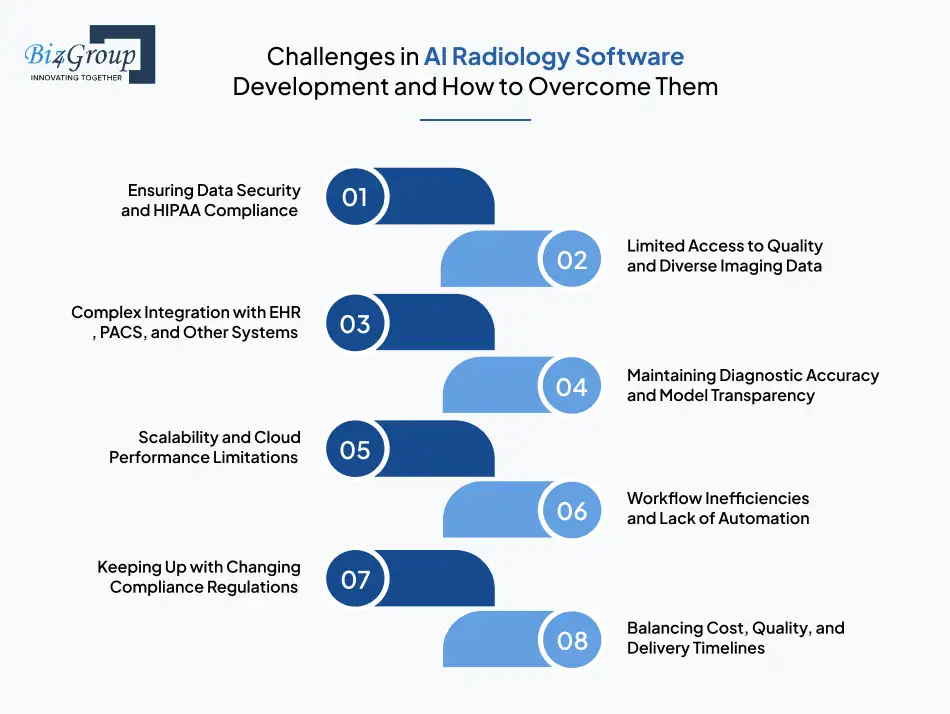
Developing and maintaining AI radiology software that meets HIPAA compliance and clinical reliability standards is a demanding task. From data security to interoperability, each challenge can directly affect diagnostic accuracy and patient safety. The table below highlights key obstacles in AI radiology software development, their impacts, and proven solutions that ensure compliance and performance.
| Challenge | Impact on AI Radiology Software Development | Solution & Best Practices |
|---|---|---|
|
Ensuring Data Security and HIPAA Compliance |
Protecting PHI while maintaining performance is one of the biggest challenges in AI radiology software development. Non-compliance can lead to legal penalties and reputational damage. |
Enforce data encryption, secure APIs, and continuous compliance monitoring. Partnering with experts in AI healthcare solutions helps organizations build HIPAA-compliant AI radiology systems that meet privacy and trust standards. |
|
Limited Access to Quality and Diverse Imaging Data |
AI models depend heavily on large, diverse, and high-quality datasets. Incomplete or biased data reduces the accuracy of AI-powered radiology tools and diagnostic outcomes. |
Use anonymized and synthetic datasets that comply with HIPAA. Establish medical data-sharing partnerships and leverage transfer learning to accelerate the development of AI radiology software. |
|
Complex Integration with EHR, PACS, and Other Systems |
Radiology departments often struggle to connect new tools with existing infrastructure. Without proper integration, workflows remain fragmented. |
Build scalable APIs based on FHIR and HL7 standards. Integrate AI EMR/EHR software for unified data exchange, ensuring smooth interoperability and AI-based radiology workflow automation tools that enhance productivity. |
|
Maintaining Diagnostic Accuracy and Model Transparency |
Deep learning algorithms can lack explainability, making it difficult for clinicians to trust AI-driven results. |
Focus on explainable AI (XAI) frameworks and validation with real-world imaging data. Regular model retraining ensures consistent diagnostic precision in AI radiology software development. |
|
Scalability and Cloud Performance Limitations |
As imaging data increases, inefficient scaling can slow analysis and increase operational costs. |
Adopt cloud-native architecture with automatic scaling and HIPAA-compliant storage to build AI radiology systems to enhance diagnostic accuracy and security. |
|
Workflow Inefficiencies and Lack of Automation |
Manual data processing, labeling, and report generation lead to delays and human errors. |
Automate routine operations with intelligent tools. Introducing an AI agent helps streamline scheduling, reporting, and triaging for faster outcomes. |
|
Keeping Up with Changing Compliance Regulations |
HIPAA, GDPR, and FDA rules evolve frequently, and outdated compliance frameworks risk software rejection. |
Create a dedicated compliance management dashboard to monitor rule updates. Involve compliance officers during every phase of AI radiology software development. |
|
Balancing Cost, Quality, and Delivery Timelines |
Projects often exceed budgets due to scope changes, integration complexity, or hidden costs. |
Begin with MVP validation, plan realistic milestones, and collaborate with a custom software development company familiar with healthcare regulations to control costs while maintaining compliance. |
While challenges like integration, data bias, and compliance are common, each one can be mitigated through thoughtful planning and advanced technologies. Organizations that invest in secure infrastructure, ethical data use, and continuous monitoring can successfully make AI-powered radiology tools that improve diagnostic accuracy, accelerate workflows, and ensure long-term HIPAA compliance.
When it comes to AI radiology software development, you need more than just technical expertise; you need a partner who understands compliance, scalability, and patient data security. Biz4Group helps you build HIPAA-compliant AI radiology systems that combine diagnostic accuracy with operational efficiency.
As a trusted AI product development company, we create end-to-end healthcare solutions that meet both innovation and regulatory standards. Our expertise in agentic AI development allows us to design intelligent, adaptive systems that streamline radiology workflows while staying fully compliant.
Our proven portfolio spans healthcare automation, diagnostic imaging, and data-driven applications that have helped U.S. healthcare providers deliver faster, more reliable results. With Biz4Group, you get a partner committed to building smarter, secure, and future-ready AI solutions for radiology.
Our portfolio speaks louder than words. Let's build your next AI-powered radiology tool together.
Connect with Biz4GroupThe future of diagnostic imaging depends on innovation rooted in compliance, precision, and trust. Successful AI radiology software development isn’t just about building algorithms; it’s about creating systems that protect patient data, empower radiologists, and redefine healthcare efficiency.
Biz4Group stands among the top AI healthcare software development companies in USA for its proven expertise in delivering HIPAA-compliant, high-performance solutions. With years of experience in healthcare AI, we’ve helped hospitals, diagnostic centers, and healthtech startups build AI radiology systems to enhance diagnostic accuracy and security while maintaining complete regulatory compliance.
Whether you’re planning to make AI-powered radiology tools or scale an existing diagnostic platform, our dedicated experts can guide you from concept to deployment. You can also hire AI developers who specialize in healthcare software, ensuring that every feature aligns with industry standards and patient safety expectations.
Biz4Group combines innovation with integrity, helping you stay ahead in a rapidly evolving medical technology landscape.
AI radiology software development involves creating intelligent imaging platforms that can analyze medical scans, detect abnormalities, and automate radiology workflows. Investing in this technology helps hospitals and diagnostic centers improve accuracy, speed up diagnosis, and reduce operational costs while maintaining full HIPAA compliance. It’s a crucial step for healthcare providers looking to modernize their diagnostic infrastructure and deliver better patient care.
To build HIPAA-compliant AI radiology systems, healthcare organizations must integrate data encryption, role-based access, and detailed audit trails from the start. PHI should always be anonymized or encrypted during training and deployment. Compliance also involves ensuring your AI models and APIs adhere to HIPAA Security and Privacy Rules. This proactive approach ensures your AI-powered radiology tools remain secure, reliable, and legally compliant.
The cost of AI radiology software development generally ranges between $30,000 and $250,000+, depending on project scope, complexity, data sources, and compliance requirements. Factors like AI model development, integration with EHR/PACS, and cloud deployment influence the budget. Ongoing monitoring, HIPAA audits, and model updates may add hidden costs, but the long-term ROI from automation and diagnostic precision far outweighs the investment.
Yes. With the right approach, you can build AI radiology software ensuring HIPAA and PHI compliance that integrates seamlessly into existing systems. Using standardized APIs such as HL7 and FHIR allows your AI-based radiology workflow automation tools to communicate with PACS, RIS, and EHR platforms securely. This ensures that your AI solution improves efficiency rather than disrupting clinical operations.
When you create AI-based radiology workflow automation tools, focus on features that enhance accuracy, efficiency, and compliance. These include DICOM image handling, automated image recognition, real-time reporting, predictive analytics, secure PHI storage, and role-based access controls. Building these into your AI radiology software development plan ensures your system delivers clinical and operational value while staying HIPAA-compliant.
Common challenges in AI radiology software development include limited high-quality datasets, interoperability issues, and maintaining model transparency. Overcome these by using de-identified imaging data, building explainable AI models, and implementing compliance dashboards. This ensures your system can adapt, scale, and continue improving diagnostic accuracy while staying secure and compliant.
Biz4Group stands out among the top AI healthcare software development companies in USA for its expertise in HIPAA-compliant healthcare systems. With years of experience in AI radiology software development, we help clients build scalable, compliant, and intelligent imaging solutions. Our proven track record includes deploying secure, cloud-ready AI tools that enhance diagnostic accuracy and automate radiology workflows.

with Biz4Group today!
Our website require some cookies to function properly. Read our privacy policy to know more.