Location :
Orlando, FL, USA
Location :
Orlando, FL, USA +1 (407) 714-1616
 info@biz4group.com


















Imagine a digital system that doesn’t wait for instructions but instead, understands your business goals, learns from real-time feedback, and takes independent actions to get the job done.
Read More

The front desk used to be predictable. Phones rang during office hours, calendars stayed manageable, and someone handled both in real time. That reality no longer holds. Missed calls now translate directly into lost revenue, delayed responses chip away at trust, and staffing gaps surface quickly. This is why AI receptionist software development has shifted from a nice-to-have into a practical business priority. It also raises the questions decision makers want answered clearly:
The market signals are clear. The global virtual receptionist market is projected to reach nearly USD 9 billion by 2033, driven by organizations automating call handling and appointment scheduling to reduce operational strain.
This acceleration is tied closely to customer expectations. Around 43 percent of companies are already investing in AI, chatbots, and automation to improve customer service responsiveness, which places immediate pressure on reception workflows to scale without adding headcount.
For founders, CTOs, and operations leaders, the frustration is familiar. Phones peak at the worst times. Front desk staff repeat the same information instead of handling exceptions. Growth feels risky because every uptick seems to require more people. That gap between demand and control is where reception automation starts to make practical sense, and where conversations around AI receptionist software development services often begin with an AI development company.
When teams aim to develop AI receptionist software for businesses, they are looking for consistency, availability, and predictability across customer interactions. This guide is designed to support those decisions and help teams move forward with confidence, including when execution calls for a custom software development company.
AI receptionist software is an intelligent system that manages front desk interactions without human intervention. It handles calls, schedules appointments, and responds to routine inquiries while fitting neatly into existing business workflows.
At its core, most AI front-desk systems are voice-first. They are designed to answer live phone calls, understand spoken language, respond naturally, and take action in real time. While chat support is often included, voice interaction remains the primary channel where businesses feel the greatest operational pressure and where automation delivers the fastest ROI. This allows businesses to automate real phone interactions rather than redirect callers to menus or voicemail.
At its core, this approach lets organizations rethink how reception works. With the right AI receptionist software development services, businesses gain consistency, availability, and control without overloading front desk teams.
At its core, AI receptionist software development is about making sure every call or message gets handled properly, even when no one is available at the front desk. The system works in simple steps that mirror how a real receptionist operates.
Calls and messages come in through the phone or chat and are picked up instantly. The system converts what the caller says into usable input, so nothing gets missed. This layer is often supported by AI chatbot integration to keep conversations consistent.
In voice-driven receptionist systems, this step relies on AI speech recognition to convert live calls into structured data instantly. Accuracy here is critical, since background noise, accents, and call interruptions are common in real front desk environments.
Once the message is captured, the software figures out what the caller needs, such as booking an appointment or asking a common question. Clear rules and learning models guide the response, so answers stay accurate. This is where teams build AI receptionist solutions that behave predictably.
After understanding the request, the system takes action by scheduling appointments or routing calls. Connected tools update automatically to avoid double bookings or errors. This approach fits naturally within broader enterprise AI solutions.
|
Step |
What happens |
Why it matters |
|---|---|---|
|
Intake |
Call or message is received |
Prevents missed inquiries |
|
Understanding |
Request is identified |
Improves response quality |
|
Action |
Booking or routing occurs |
Saves time for staff |
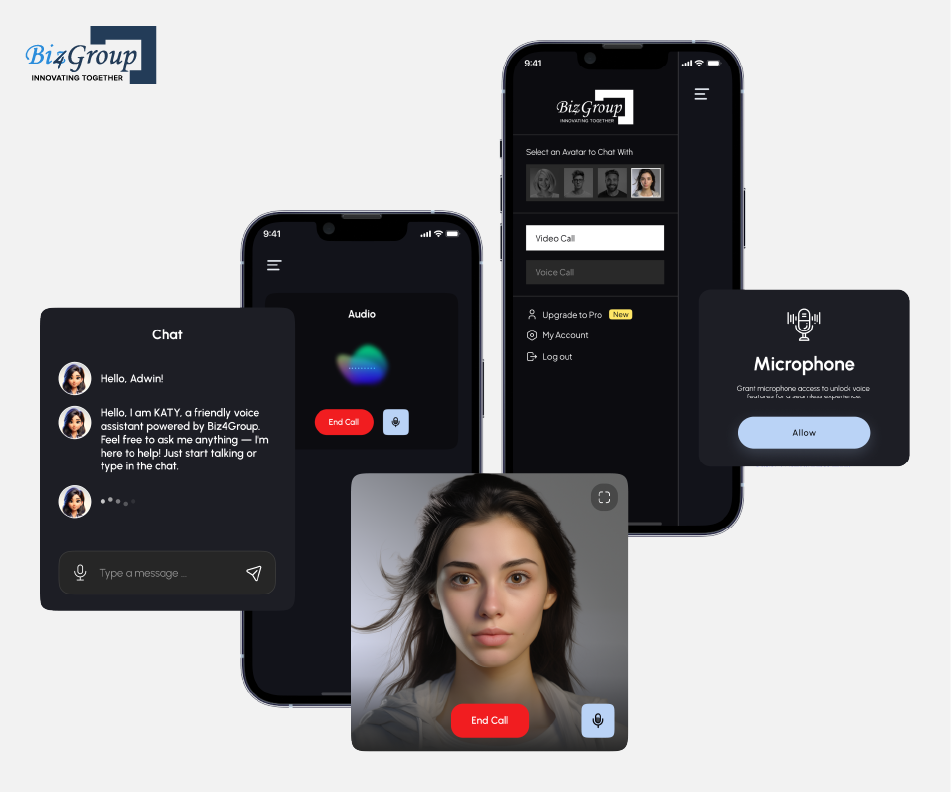
Voice systems like AI Wizard, built by Biz4Group, demonstrate how conversational flow improves when responses are not treated as isolated commands. By maintaining context across exchanges, voice-driven software can feel more like a dialogue than a transaction, which is increasingly important in front-desk environments where callers rarely phrase requests perfectly.
All in all, an AI powered receptionist software supports growing teams and quietly leads into the question of why more businesses are choosing to invest in it.
Explore how AI receptionist software development helps businesses answer calls, manage appointments, and stay responsive without scaling staff.
Learn about AI Receptionist Software DevelopmentGrowth exposes cracks fast, especially at the front desk. That is where AI receptionist software development stops being an experiment and starts looking like infrastructure, the kind that quietly protects revenue and customer experience as demand increases.
Missed calls are rarely tracked, but they compound quickly over time. Automated reception ensures every inquiry is acknowledged and handled consistently. This is a common driver behind investments in virtual receptionist software development, often backed by dependable AI automation services.
Customer demand does not scale neatly, but software can. Systems absorb spikes in call volume without forcing rushed hiring decisions. Many organizations choose to build AI receptionist systems for customer service to keep operations steady as they grow.
Front desk teams spend less time repeating the same answers and more time handling real exceptions. That shift improves both morale and service quality. Clear UI/UX design plays a big role in keeping interactions smooth on both sides.
Hiring ahead of demand locks businesses into fixed costs. Automated systems scale with usage instead. This makes planning easier and reduces financial risk without sacrificing responsiveness.
Once these advantages are in place, attention naturally turns to how tailored the solution needs to be. That is where conversations around custom AI receptionist software development begin, setting up the practical use cases that follow next.
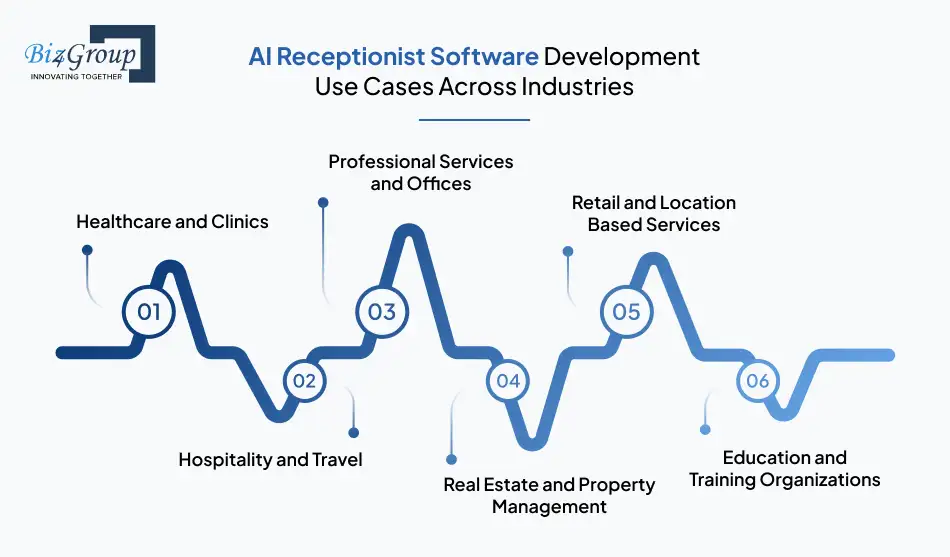
As demand grows and response windows shrink, AI receptionist software development becomes visible where operations feel the most strain. Its value shows up differently by industry, which is best understood by looking at how it fits real workflows.
In voice-heavy environments like clinics, hotels, and service desks, callers still prefer speaking to a system rather than navigating touch-tone menus. Voice-enabled AI reception reduces hold times while keeping interactions conversational instead of mechanical.
Here are the top use cases for you to consider:
Patient calls rarely follow office hours, and staff capacity is limited. Many clinics choose to develop intelligent receptionist applications so scheduling, confirmations, and basic inquiries happen without manual intervention. Planning often starts with AI consulting services to align automation with clinical processes.
Hotels and travel services face constant questions about availability, timing, and policies. Many teams build AI receptionist software to automate calls and appointments for businesses to keep phones answered around the clock. These systems scale without sacrificing consistency.
Law firms, accounting practices, and consultancies depend on first impressions. Instead of scripted responses, teams often create automated receptionist software that prioritizes calls and captures context before routing – an experience which benefits from thoughtful AI assistant app design.
Inbound calls range from leasing questions to maintenance issues. Automated reception helps filter urgency and capture details consistently. This approach reduces manual triage without disrupting existing workflows.
High call volume during peak hours can overwhelm small teams. Businesses often focus on AI receptionist application development to handle availability checks and booking changes instantly, usually supported by an AI app development company.
Schools and training centers handle repetitive enrollment and scheduling inquiries. Automation helps reduce administrative overload while keeping responses consistent across departments.
|
Industry |
Primary Focus |
Operational Outcome |
|---|---|---|
|
Healthcare |
Scheduling and intake |
Fewer missed appointments |
|
Professional Services |
Call prioritization |
Faster client response |
|
Retail and Services |
Booking management |
Reduced wait times |
|
Hospitality |
Reservation handling |
24x7 availability |
|
Real Estate |
Inquiry filtering |
Better response routing |
|
Education |
Enrollment queries |
Lower admin workload |
Across industries, the pattern stays consistent. When reception workflows are clearly defined, automation delivers predictable results instead of reactive fixes. That naturally sets the stage for examining the core features that make these systems dependable in everyday operations.
See how teams build AI receptionist systems for customer service that fit real workflows across healthcare, services, and multi-location businesses.
View AI Receptionist Use CasesAI receptionist software development is all about handling front desk work reliably before adding intelligence on top. These core features define whether the system can replace basic reception tasks without creating friction:
|
Core Feature |
What It Does |
Why It Is Core |
|---|---|---|
|
Automated call answering |
Answers every inbound call instantly |
Prevents missed opportunities |
|
Intelligent greeting |
Welcomes callers with context-aware prompts |
Sets a consistent first impression |
|
Appointment booking |
Schedules, reschedules, and cancels slots |
Removes manual coordination |
|
Call routing |
Directs callers to the correct team or queue |
Reduces internal handoffs |
|
Basic intent recognition |
Identifies common caller needs |
Keeps conversations efficient |
|
Business hours handling |
Adjusts behavior by time and availability |
Maintains predictable responses |
|
Call escalation to humans |
Transfers complex cases to staff |
Preserves service quality |
|
Calendar synchronization |
Updates schedules in real time |
Avoids double bookings |
|
Call logging |
Records basic interaction details |
Creates operational visibility |
|
Speech recognition |
Converts live caller speech into structured input |
Enables real-time call understanding |
|
Produces natural spoken replies via AI response generation
|
Keeps phone interactions conversational |
With these fundamentals in place, the system behaves like a dependable receptionist. This solid base is what allows teams to later integrate AI into an app and confidently create AI receptionist platforms for customer experience improvement as needs evolve into more advanced capabilities.
After the basics are locked in, AI receptionist software development shifts toward adaptability and judgment. This is where the receptionist stops following scripts and starts responding to patterns, context, and change.
The system recognizes returning callers and adjusts responses accordingly. Conversations feel continuous rather than transactional. This level of interaction reflects how generative AI is being applied to real business communication. In voice scenarios, this means the system adjusts tone, pacing, and phrasing based on how the caller speaks.
Also Read: How to Build AI Chatbot Voice Assistant?
Instead of waiting for the phone to ring, the system sends reminders and confirmations automatically. This reduces missed appointments and follow up gaps. Teams that develop AI-driven receptionist software for modern organizations often treat this as a priority.
Each completed call adds signal that improves future responses. Over time, the receptionist becomes better at routing and resolution. Achieving this requires deliberate AI model development based on live data.
Beyond simple call logs, advanced systems reveal trends and friction points. Leaders can see what slows interactions and where callers drop off. These insights typically emerge through custom AI receptionist software development services.
Reception logic adapts by department, time, or customer type without disrupting operations. This flexibility becomes critical as businesses scale. It is also what separates quick builds from long term platforms.
As these capabilities mature, the receptionist becomes a strategic layer rather than a support tool. That shift naturally raises questions about execution, ownership, and selecting the best company to develop AI receptionist software before moving deeper into the development process.
Building a reliable receptionist is less about flashy automation and more about disciplined execution. In AI front-desk software development, success comes from understanding real front desk pressure and translating it into systems that work consistently across calls, schedules, and customer expectations.
This stage clarifies where reception breaks down and what the system must handle independently. Teams assess missed calls, booking delays, and inconsistent responses to shape solutions that support AI receptionist software for startups and enterprises with very different operational realities.
A receptionist must sound natural and feel easy to manage, which can be achieved by collaborating with an seasoned UI/UX development company. Conversation flow and internal dashboards are designed to reflect how staff actually work, which is essential when planning to develop AI receptionist software with voice and chat across multiple touchpoints.
For voice-based reception, UX is largely conversational. This includes how long the system pauses, when it interrupts, and how it confirms understanding without frustrating the caller.
Also read: Top UI/UX design companies in USA
Launching with focus reduces risk. MVP development services concentrate on answering calls and booking appointments reliably before layering complexity, a common approach in white label AI front-desk software development where flexibility matters.
Also read: Top 12+ MVP Development Companies to Launch Your Startup in 2026
Intelligence grows from real usage, not assumptions. This step refines how the system interprets intent and improves accuracy as more conversations flow through it.
Reception systems handle sensitive customer interactions. Stability, privacy, and compliance are essential when organizations develop AI receptionist software for businesses operating in regulated or customer sensitive environments.
Also Read: Software Testing Companies in USA
As call volumes fluctuate, systems must scale smoothly without disrupting live interactions. Infrastructure choices here determine whether updates feel invisible or painful during peak usage.
An AI receptionist improves through real usage and iteration. Long term value depends on how teams evolve the system after launch.
Following this process keeps software development grounded in operational reality. With execution clear, teams are better positioned to build AI receptionist solutions that scale without overwhelming front desk operations.
Follow a proven approach to develop AI receptionist software for businesses using the right tech stack, voice architecture, and deployment strategy.
Get a Custom AI Receptionist RoadmapIn AI receptionist software development, the tech stack directly affects call reliability, response speed, and system stability. Because reception workloads spike unpredictably, every layer must work together without latency or fragile dependencies.
Here's all you need to know about choosing the right tech stack:
|
Label |
Preferred Technologies |
Why It Matters |
|---|---|---|
|
Frontend Framework |
ReactJS, Vue.js |
Internal dashboards need fast updates during live calls, and ReactJS development supports well for monitoring, overrides, and scheduling views. |
|
Server-Side Rendering & SEO |
Next.js, Nuxt.js |
Reporting and admin interfaces stay responsive and predictable as usage grows, making NextJS development valuable for scalable receptionist platforms. |
|
Backend Framework |
Node.js, Python |
Core logic for call handling, workflows, and orchestration sits here, where NodeJS development manages concurrency and Python development supports AI workflows. |
|
REST, GraphQL |
APIs connect telephony, calendars, CRMs, and analytics into one flow, making this layer critical for extensibility and long term maintainability. |
|
|
AI & Data Processing |
TensorFlow, spaCy |
Intent detection and conversation control rely on structured language processing rather than generic automation. |
|
Voice & Telephony |
Twilio, WebRTC |
Real time voice handling is the heart of receptionist software and must remain stable under peak call loads. |
|
Chat & Messaging |
Web chat, SMS APIs |
Voice and chat need shared context so conversations do not reset across channels. |
|
Authentication & Access Control |
OAuth, JWT |
Staff access, overrides, and logs must stay secure without slowing down operations. |
|
Data Storage |
PostgreSQL, Redis |
Appointments, call states, and session data require fast reads and reliable writes. |
|
Integrations |
CRM and calendar APIs |
Tight syncing avoids double bookings and keeps staff aligned with automated actions. |
|
Cloud Infrastructure |
AWS, Azure, GCP |
Auto scaling ensures reception workflows remain available during unpredictable spikes. |
|
Monitoring & Logs |
CloudWatch, Datadog |
Early visibility into dropped calls or failed bookings prevents silent revenue loss. |
With these layers clearly defined, teams can now make informed decisions about ownership and flexibility. Now that brings us to the next discussion around custom AI receptionist software development vs off the shelf solutions, where tradeoffs become more visible.
Reception workflows are rarely uniform. Call volume spikes, appointment rules change, and staff handle edge cases constantly. In AI receptionist software development, choosing between custom and off-the-shelf is really about whether the software adapts to your front desk or your front desk adapts to the software.
Here's a clear comparison between the two:
|
Decision Area |
Custom AI Receptionist Software |
Off-the-Shelf Receptionist Software |
|---|---|---|
|
Call handling logic |
Mirrors how your team prioritizes, escalates, and routes calls |
Follows fixed scripts designed for broad use |
|
Appointment rules |
Matches your scheduling constraints and availability logic |
Limited to generic booking flows |
|
Conversation tone |
Reflects your brand and service expectations |
Standardized responses shared across users |
|
Integration depth |
Aligns closely with existing CRM and calendar systems |
Restricted to preset connectors |
|
Handling edge cases |
Built to manage exceptions and unusual requests |
Often falls back to voicemail or manual follow up |
|
Long term flexibility |
Evolves as services, locations, or policies change |
Changes depend on vendor updates |
Off-the-shelf tools can work when call volume is low and workflows are simple. Once reception becomes a revenue touchpoint, teams often lean toward custom builds to develop AI receptionist software with voice and chat that fits real operations.
When leaders ask about pricing, the honest answer is that AI receptionist software development does not come with a fixed price tag. Most builds fall in the $20,000 to $100,000+ range, and that number is a ballpark figure shaped by scope, integrations, and long term goals.
|
Build Level |
Typical Cost Range |
What Is Included |
Best Fit For |
|---|---|---|---|
|
MVP AI Receptionist Software |
$20,000 to $40,000 |
Call answering, basic intent handling, appointment booking, limited integrations |
Early validation and pilot use |
|
Mid-Level AI Receptionist Software |
$40,000 to $70,000 |
Voice plus chat support, smarter routing, CRM and calendar sync, basic analytics |
Growing teams refining reception workflows |
|
Enterprise-Grade AI Receptionist Software |
$70,000 to $100,000+ |
Advanced conversational logic, multi location support, deep integrations, scalability and security layers |
Large operations with high call volume |
Cost tends to increase as reception moves from simple call handling to a core operational system. Integrations with existing tools, support for multiple locations, and higher reliability expectations all add to effort. This is why budgeting looks different for AI receptionist software for startups and enterprises, even when the underlying idea sounds similar.
Voice capabilities also significantly influence cost. Real-time speech recognition, call concurrency, and voice synthesis require more infrastructure than text-only systems, which is why voice-first reception platforms sit at the higher end of most estimates.
Understanding cost is only one part of the equation. Once budgets are clearer, teams naturally start asking how this investment can generate returns rather than just reduce overhead, which opens the door to exploring revenue and monetization opportunities next.
Also Read: AI App Development Cost in 2026 – Know How Much Your App Will Cost
Understand what it takes to build AI receptionist solutions that balance cost, scalability, and long-term revenue potential.
Estimate AI Receptionist Development CostOnce the system is live, the conversation shifts from cost to return. In AI receptionist software development, revenue models tend to work best when they align with how businesses already pay for communication, volume, and outcomes.
Many teams package the front-desk as a recurring service tied to usage tiers. Pricing scales with call volume, features, or locations rather than flat licensing. This approach fits well with ongoing AI receptionist software development services that evolve over time.
Some companies license the receptionist to resell under their own brand. This model works especially well for platforms or agencies partnering with an AI chatbot development company to extend their offerings.
Instead of fixed plans, revenue is tied directly to how often the receptionist is used. This model appeals to organizations with seasonal or unpredictable call traffic. It is often chosen when teams develop AI receptionist software for businesses with fluctuating demand.
Voice-driven pricing often correlates with minutes handled, calls completed, or concurrent conversations, making telephony usage a direct revenue lever rather than a flat cost.
Larger organizations often pay for tailored workflows, integrations, and analytics beyond the base system. These projects frequently sit alongside broader enterprise AI solutions rather than standalone tools.
As these models show, revenue is not limited to one path. Teams that build AI receptionist solutions often mix approaches based on customer type and scale. With monetization clearer, the next focus naturally turns to best practices that keep development sustainable and systems reliable over time.
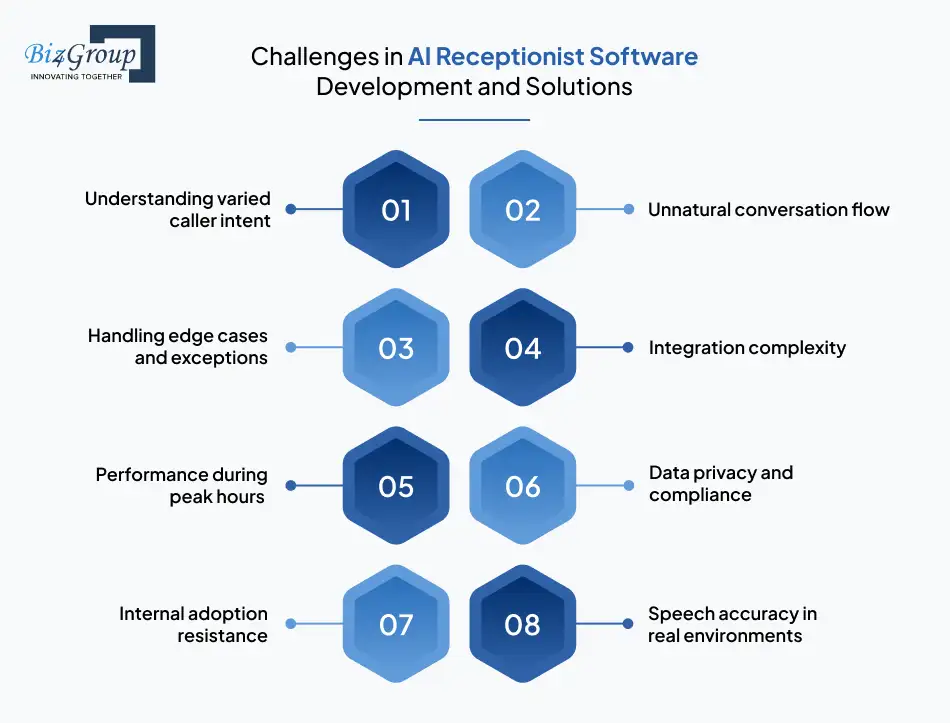
Even the best ideas run into friction once they meet real call traffic and real customers. In AI receptionist software development, these hurdles are common, predictable, and solvable when addressed early rather than patched later:
|
Top Challenges |
How to Solve Them |
|---|---|
|
Understanding varied caller intent |
Train models on real call transcripts and continuously refine intent logic based on outcomes |
|
Unnatural conversation flow |
Design conversation paths around how human receptionists actually speak and pause |
|
Handling edge cases and exceptions |
Define clear escalation rules so complex calls reach humans without frustration |
|
Integration complexity |
Prioritize stable APIs for calendars, CRMs, and telephony before adding advanced features |
|
Performance during peak hours |
Use scalable infrastructure and load testing to prevent dropped or delayed calls |
|
Data privacy and compliance |
Apply encryption, access controls, and regular audits from the start |
|
Internal adoption resistance |
Involve front desk staff early so the system supports, not replaces, their workflows |
|
Speech accuracy in real environments |
Train models on noisy, real-world call data and continuously refine |
Many teams underestimate how nuanced reception really is. This is where working with a software development company in Florida that understands production scale systems can reduce trial and error significantly.
When these challenges are handled deliberately, automation becomes dependable instead of risky. That reliability is essential when teams aim to build AI receptionist software to automate calls and appointments for businesses. Now that the challenges are covered, let's dive into the best development practices that help you stay out of trouble in the first place.
Learn how modern teams use AI receptionist software development services to stay flexible as call volumes, expectations, and channels evolve.
Plan Your AI Receptionist StrategyTeams that succeed with reception automation rarely do anything flashy. In AI receptionist software development, best practices are mostly about respecting how calls really happen and making disciplined decisions that hold up on busy days.
Spend time reviewing real call recordings and shadowing front desk staff. Patterns show up fast when you listen without assumptions. That insight shapes how you create AI powered receptionist software that reflects reality, not theory.
Design for stress, not average usage. Call spikes, overlapping bookings, and interruptions reveal weak spots quickly. This mindset separates stable virtual front-desk software development from systems that only work in demos.
Reception problems are operational before they are technical. Developers who understand the front desk context make better decisions. This alignment is far easier when organizations hire AI developers who collaborate beyond tickets and specs.
Some conversations demand empathy or judgment. Defining those boundaries early avoids frustration later. It also leads to cleaner logic when teams build AI receptionist systems for customer service that know when to step aside.
Call behavior changes as businesses grow, add services, or shift hours. Systems that cannot adapt quietly become liabilities. Many lessons from business app development using AI apply directly here.
When these habits guide development, the receptionist evolves without constant rework. That steadiness opens the door to thinking less about survival and more about what the next generation of AI reception will look like.
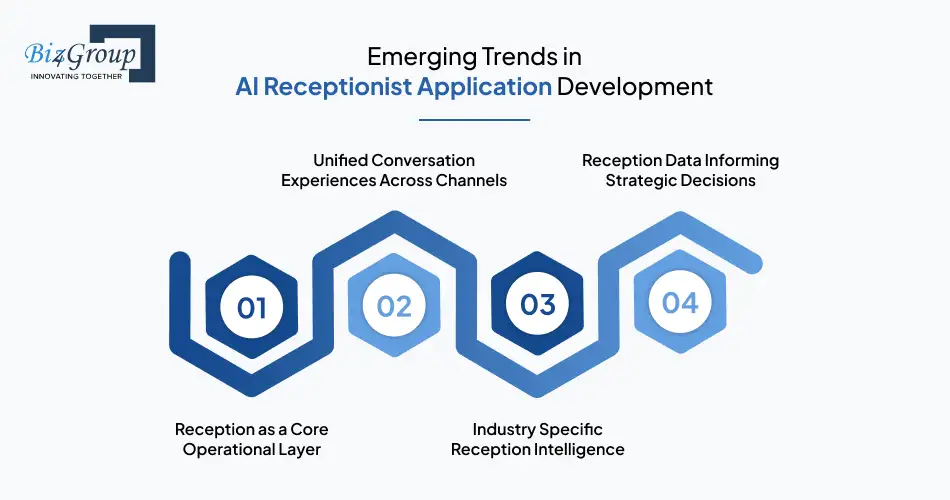
Reception technology is moving past experimentation and into long term planning. In AI receptionist software development, the future is being shaped by how organizations want reception to behave as they grow, not by how much automation they can add.
AI reception is starting to sit alongside scheduling and staffing in operational planning. Leaders are beginning to factor automated reception into capacity decisions instead of treating it as a side tool. This changes expectations around reliability and ownership.
Reception will increasingly feel continuous regardless of how someone reaches out. Voice, chat, and internal follow ups will blend into a single flow. The result resembles an AI conversation app more than a traditional front desk system.
Different industries handle calls very differently, and that gap is becoming harder to ignore. Future systems will reflect sector rules, language, and urgency rather than generic logic. This shift is already influencing how teams develop AI front-desk software for businesses.
Call activity reveals more than missed calls or bookings. Over time, it highlights demand patterns, service gaps, and operational strain. That insight is pushing AI receptionist software development services into planning conversations, not just IT discussions.
As these changes take hold, organizations face new choices about control and direction. Some will decide to build an AI app internally, while others will look toward the top AI development companies in Florida to help shape their reception.
Building a voice-first front-desk system requires an understanding of real conversations, real call pressure, and real operational constraints. That is where Biz4Group's approach to build AI software stays grounded in production reality rather than demos.
Our work on conversational platforms like AI Wizard reflects how we design voice systems that listen, respond, and adapt over time. Those same principles carry directly into AI receptionist software, where continuity, tone, and decision logic matter as much as accuracy.
Here's what sets Biz4Group apart:
As an AI product development company, Biz4Group approaches receptionist software as long-term infrastructure, not a one-off build. The goal is simple: create systems that quietly handle calls, support staff, and scale with the business without becoming another tool teams have to manage.
See how AI receptionist software development can quietly handle calls, bookings, and follow-ups while your team focuses on what matters.
Start Building an AI ReceptionistFront desks have changed, and pretending otherwise usually shows up as missed calls, frustrated staff, and lost opportunities. AI receptionist software development is no longer about replacing people, it is about giving businesses a way to stay responsive without stretching teams thin.
When built thoughtfully, voice-first systems handle the routine, respect real conversations, and scale quietly in the background. The real win is not automation itself, but consistency, control, and the freedom to grow without constantly playing catch-up.
Talk through your front-desk challenges with our AI team.
Yes, but only to a defined extent. Well-designed systems rely on structured intent handling and escalation rules so unusual or sensitive calls move to humans at the right moment. This balance is central to AI receptionist application development that works in real environments.
Timelines vary based on scope, but most projects take between 8 to 16 weeks from discovery to launch. Factors include integrations, voice complexity, and testing cycles. Teams that build AI receptionist systems for customer service often start with a focused rollout before expanding.
Yes, modern systems are often designed as multi-channel by default. Voice usually leads, with chat added for continuity across touchpoints. Many businesses choose to develop AI receptionist software with voice and chat so conversations stay connected rather than fragmented.
It works for both, but the goals differ. Smaller teams focus on coverage and missed calls, while larger organizations prioritize consistency and scale. This flexibility is why AI receptionist software for startups and enterprises is built with modular features.
Most implementations fall in the $20,000 to $100,000+ range, depending on voice complexity, integrations, and scale. This is a ballpark figure rather than a fixed price. Costs rise as teams invest in custom AI receptionist software development for production use.
Yes, and this is where real value shows up. Industry rules, urgency levels, and terminology can be built into conversation logic. Organizations often choose develop AI driven receptionist software for modern organizations to avoid one-size-fits-all behavior.

with Biz4Group today!
Our website require some cookies to function properly. Read our privacy policy to know more.