Location :
Orlando, FL, USA
Location :
Orlando, FL, USA +1 (407) 714-1616
 info@biz4group.com

- AI sports betting exchange software development enables startups to build peer-to-peer betting marketplaces powered by predictive analytics, automated risk controls, and scalable exchange architecture.
- AI sports betting exchange platform development shifts the revenue model from operator risk to commission-based earnings, creating transparent and capital-efficient ecosystems.
- To develop AI sports betting exchange software successfully, founders must prioritize liquidity strategy, user experience, and phased execution from MVP to enterprise scale.
- The AI sports betting exchange software development cost for startups typically ranges from $45,000-$250,000+, depending on scope, intelligence depth, and scalability goals.
- To create secure AI driven betting exchange systems, platforms must integrate strong KYC controls, fraud monitoring, geolocation enforcement, and AI governance frameworks.
- Biz4Group LLC is a USA-based technology partner specializing in custom AI sports betting exchange development, delivering scalable, secure, and revenue-focused exchange platforms for ambitious startups.
Have you ever wondered why some sports betting platforms attract millions of users while others struggle to gain traction? In a world where the global sports betting market is projected to reach USD 187.39 billion by 2030, entrepreneurs and startups are increasingly turning to AI sports betting exchange software development to capture market share and redefine user experience.
Today, this growth shows no signs of slowing. The online sports betting segment alone is projected to be worth nearly USD 50 billion in 2026 before almost doubling by 2031 as mobile adoption and legal access expand across regions.
At the same time, software solutions that leverage advanced algorithms and real-time analytics are reshaping how platforms operate. Forward-thinking founders now focus on building AI powered betting exchange platform strategies to offer superior odds, better liquidity, and more engaging user journeys.
Analysts report that nearly half of all bets placed in 2025 were priced using intelligent models, a clear indicator of where the industry is headed.
For startups looking to emerge as leaders, the key question is how to develop AI sports betting exchange software that scales securely and delivers measurable growth. In this guide we break down what that truly means, helping you make informed decisions.
Let’s begin with the basics.
Understanding AI Sports Betting Exchange Software Development
Before you invest capital, hire engineers, or pitch to investors, you need clarity on one fundamental question. What exactly are you building?
AI sports betting exchange software development revolves around a peer-to-peer wagering model. Unlike traditional sportsbooks that set odds and take the opposite side of a bet, an exchange allows users to bet against each other.
The platform acts as a marketplace.
It matches bets.
It earns a commission.
That structural difference changes everything from revenue mechanics to risk exposure.
Traditional Sportsbook vs Betting Exchange
Let’s simplify the difference.
|
Feature |
Traditional Sportsbook |
Betting Exchange Platform |
|---|---|---|
|
Who sets odds |
Operator |
Market participants |
|
Risk ownership |
Platform bears risk |
Users bear risk |
|
Revenue model |
Margin on odds |
Commission on winnings |
|
Liquidity source |
Internal |
User-driven |
|
Scalability |
Capital intensive |
Market dependent |
For startups exploring sports betting exchange platform development with AI, this model offers a leaner risk structure and higher scalability potential.
However, exchanges demand precision in real-time matching, liquidity management, and data accuracy. That is where intelligent systems come into play.
How AI Elevates the Exchange Model
When you develop sports betting exchange software using AI, you are not simply automating odds. You are optimizing a marketplace.
Here is what changes:
- Order books update in milliseconds
- Market imbalances are detected instantly
- Liquidity gaps are forecasted
- Fraud patterns are flagged early
- Pricing anomalies are corrected dynamically
Without robust AI integration, exchanges struggle with latency and mismatched pricing. If you have ever read about why most betting apps fail at real-time match accuracy, you know how devastating data lag can be for user trust.
Accurate, low-latency architecture becomes the backbone of sustainable exchange platforms.
Why Startups Prefer the Exchange Model
For founders looking to build AI powered betting exchange platform solutions, the exchange structure offers strategic advantages:
- Lower exposure to betting losses
- Higher transparency for users
- Commission-based predictable revenue
- Easier expansion into global markets
- Stronger investor appeal due to scalable mechanics
Yet success depends heavily on product experience. Sophisticated systems need clean interfaces.
Clarity drives engagement. Engagement drives liquidity. And liquidity drives revenue.
Key Components of a Betting Exchange System
At its core, a modern exchange platform includes:
- Matching engine
- Real-time odds engine
- Wallet and payment gateway
- User risk profiling
- Admin monitoring dashboard
- AI analytics module
- Multi-sport data integration
Each of these components must work in sync.
If you plan to create AI driven sports betting exchange systems for competitive markets, you cannot afford architectural gaps. Exchanges are transactional platforms. Even minor delays can cost millions in high-volume events.
The Bigger Picture
Understanding what a betting exchange platform marks the starting line. Understanding how AI sports betting exchange software development transforms that model into a scalable, revenue-generating ecosystem sets you apart from competitors.
In the next section, we will explore why AI has become the decisive factor separating average exchange platforms from market leaders.
How AI Sports Betting Exchange Software Development Is Reshaping the Global Betting Economy
If betting exchanges are marketplaces, then AI is the engine that keeps those marketplaces efficient, competitive, and profitable.
A 2025 Deloitte technology outlook highlights that AI adoption in gaming platforms has accelerated due to demand for personalization, automated risk control, and operational efficiency.
This is where AI sports betting exchange software development becomes a competitive requirement.
The Operational Gaps AI Closes
Running an exchange without advanced intelligence leads to friction. Markets move fast. User behavior shifts quickly. Data volumes spike during major sporting events.
Here are some core pain points AI addresses:
- Price volatility during live betting
- Liquidity imbalances between popular and niche markets
- Arbitrage exploitation
- Suspicious betting patterns
- Delayed settlement processes
When startups develop sports betting exchange software using AI, they introduce automated decision layers that react in milliseconds. That speed protects margins and improves trust.
Market Data Is the Real Battlefield
One overlooked factor in exchange performance is data quality.
Odds, injury updates, match events, and player stats must sync across thousands of concurrent users. A single delay can distort market pricing.
That is why top platforms invest heavily in multi-source integrations. If you want a deeper understanding of why top US betting apps rely on multiple sports data providers, the technical reasoning becomes clear. Redundancy prevents downtime. Latency gaps shrink. Market confidence increases.
For founders aiming to build scalable AI betting exchange platforms, data partnerships are not optional. They are structural.
AI as a Revenue Multiplier
AI does more than reduce risk. It increases earnings.
Here is how revenue expands when you build AI powered betting exchange platform ecosystems:
- Smarter commission optimization based on user tiers
- Dynamic market creation during trending events
- Personalized betting suggestions that increase engagement
- Automated risk-based bet limits
- Reduced operational overhead through AI automation
Revenue growth does not happen randomly. It comes from intentional architecture.
Startups that treat AI as a core infrastructure layer, rather than an add-on feature, position themselves for stronger investor conversations and faster expansion.
If your goal is to develop enterprise ready AI sports betting exchange software, AI must operate across trading engines, fraud detection modules, reporting dashboards, and customer support layers.
Competitive Differentiation in 2026 and Beyond
The next generation of exchanges will integrate:
- Real-time behavioral analytics
- Predictive liquidity forecasting
- Autonomous pricing algorithms
- Conversational support tools powered by AI chatbot development
- Automated back-office reconciliation via enterprise AI solutions
This evolution separates modern platforms from legacy operators.
Founders who invest early in intelligent architecture gain long-term leverage. Those who delay struggle to compete on speed and transparency.
AI sports betting exchange software development now sits at the center of scalable exchange strategy.
In the next section, we will move from theory to application and explore real-world use cases that turn intelligent infrastructure into tangible business impact.
The Market Is Expanding. Are You?
Online sports betting revenue is crossing $100B+, and AI-led platforms are taking the largest share. The question is whether you will lead it or watch it unfold.
Build Smart with Biz4GroupReal-World Use Cases of AI Sports Betting Exchange Software Development
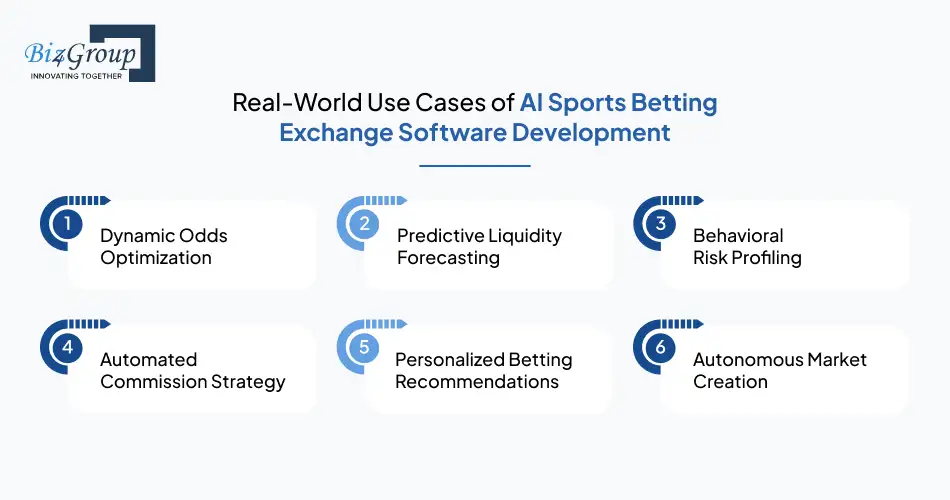
Understanding the theory behind AI sports betting exchange software development is important. Seeing how it works in real-world scenarios makes the opportunity tangible.
Below are practical applications that directly influence revenue, scalability, and operational efficiency.
1. Dynamic Odds Optimization
In an exchange, prices fluctuate based on demand and supply. AI models analyze historical data, live match feeds, and betting volume in real time to detect pricing inefficiencies.
When startups develop scalable AI sports betting exchange software, these systems automatically adjust suggested odds ranges, helping maintain competitive markets without manual intervention.
This improves pricing confidence and increases trading activity across both high-volume and niche events.
2. Predictive Liquidity Forecasting
Liquidity determines whether users can enter and exit positions quickly. AI evaluates user activity patterns, event popularity, and historical trading volumes to forecast liquidity gaps before they occur.
For founders looking to build high performance AI betting exchange platforms, predictive liquidity engines reduce the risk of inactive markets and enhance user retention.
3. Behavioral Risk Profiling
Not every user interacts with a platform in the same way. Some display patterns associated with arbitrage or coordinated betting.
When you create intelligent sports betting exchange solutions, AI-driven behavioral profiling identifies anomalies in wagering behavior. This protects platform integrity without slowing down legitimate users.
It also supports regulatory audits and compliance reporting.
4. Automated Commission Strategy
Traditional commission structures are static. AI introduces dynamic commission modeling based on user activity, loyalty tiers, and market participation.
Startups that build AI powered betting exchange platform ecosystems can use automated pricing logic to optimize profitability while maintaining competitive positioning.
This strategy increases lifetime value without aggressive fee structures.
5. Personalized Betting Recommendations
Personalization drives engagement. AI analyzes previous wagers, favorite leagues, and interaction history to surface relevant markets.
If you plan to use AI for sports betting as a growth strategy, recommendation engines create targeted experiences that improve session time and repeat usage.
6. Autonomous Market Creation
Trending events often create sudden betting interest. AI can detect spikes in search behavior and social media engagement to auto-generate new markets.
This capability gives startups an edge over platforms that rely solely on manual event configuration.
Entrepreneurs researching how to create a sports betting app often underestimate the power of automated market generation. In an exchange model, speed translates directly into liquidity capture.
To Summarize...
|
Use Case |
Business Impact |
Revenue Effect |
|---|---|---|
|
Dynamic Odds Optimization |
Improves pricing accuracy |
Increases trading volume |
|
Predictive Liquidity Forecasting |
Reduces inactive markets |
Enhances commission stability |
|
Behavioral Risk Profiling |
Detects fraud early |
Protects platform margins |
|
Automated Commission Strategy |
Optimizes fee structures |
Boosts lifetime value |
|
Personalized Recommendations |
Improves engagement |
Increases repeat betting |
|
Autonomous Market Creation |
Captures trending demand |
Expands betting opportunities |
Each of these use cases reinforces why AI sports betting exchange software development is becoming foundational rather than optional.
Portfolio Spotlight: Quick Start Bets
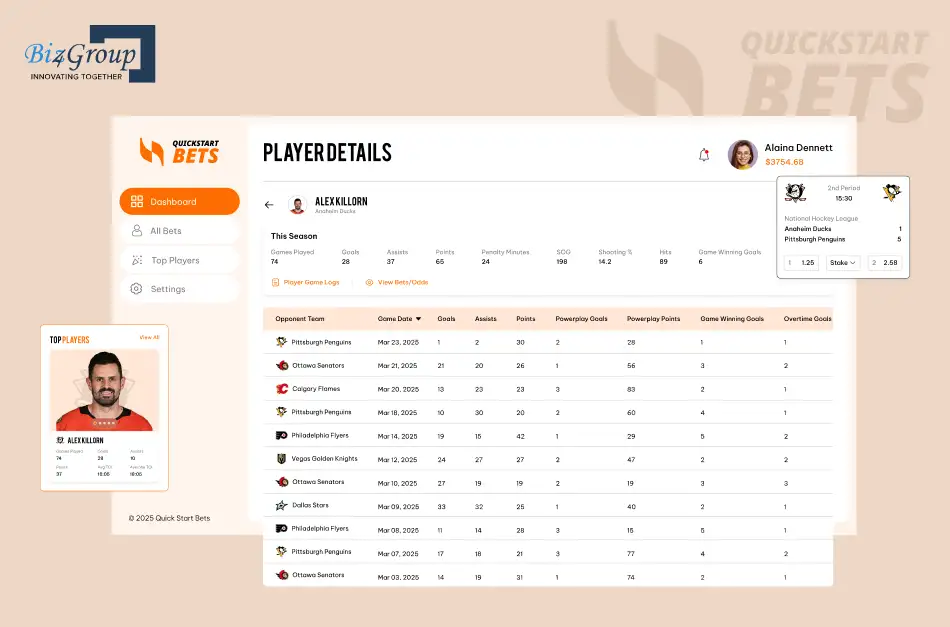
To illustrate practical implementation, consider our work on Quick Start Bets. This platform was built as a real-time sports analytics ecosystem focused on NHL markets.
Key highlights:
- Live odds integration with low-latency updates
- Player and team statistical analysis modules
- Centralized dashboard for bet tracking and performance insights
- Historical data modeling for trend evaluation
- Real-time analytics processing architecture
Quick Start Bets demonstrates how AI sports betting exchange software development principles can enhance performance, data clarity, and user engagement within a competitive sports environment.
When applied to exchange platforms, similar analytics engines support liquidity prediction, dynamic pricing, and intelligent user profiling.
In the next section, we will shift from applications to core functionality and break down the essential features required to create AI driven sports betting exchange systems that compete at scale.
Must-Have Features in AI Sports Betting Exchange Software Development
Features define how your exchange performs under pressure.
When founders approach AI sports betting exchange software development, they often focus on odds engines and dashboards. In reality, a competitive exchange requires three synchronized ecosystems:
- User-facing interface
- Administrative control layer
- AI intelligence modules
Below is a structured breakdown of essential components required to develop enterprise ready AI sports betting exchange software.
User Panel Features in AI Sports Betting Exchange Software Development
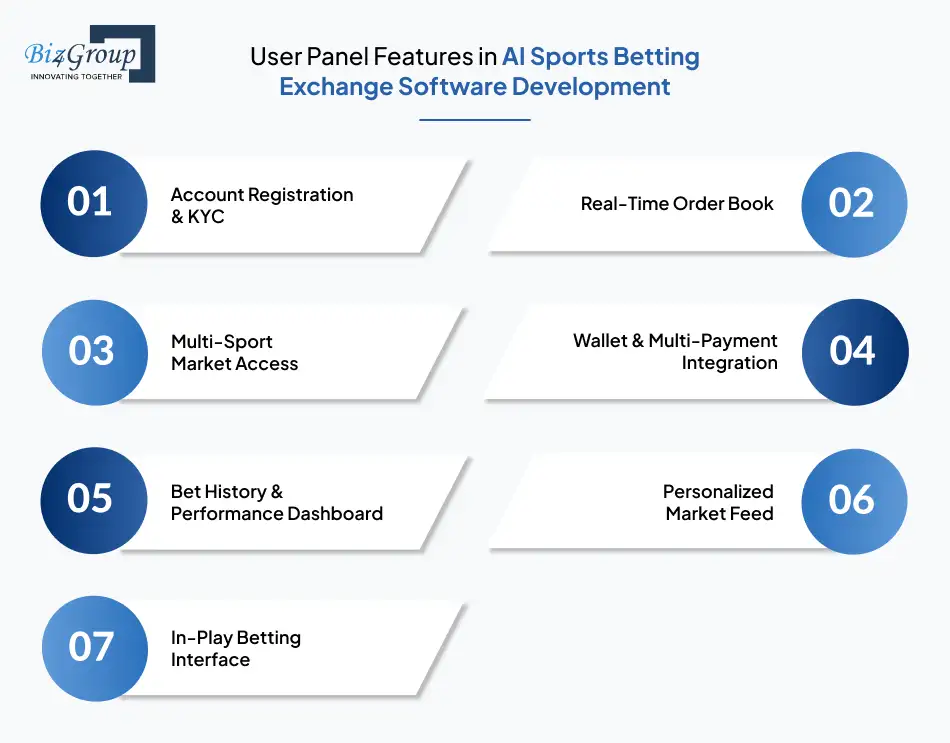
These features directly influence user acquisition, retention, and trading volume.
|
Feature |
What It Is |
What It Does |
|---|---|---|
|
Account Registration & KYC |
Secure onboarding system with identity verification |
Ensures regulatory compliance and prevents fraudulent access |
|
Real-Time Order Book |
Live display of back and lay offers |
Enables transparent peer-to-peer betting |
|
Multi-Sport Market Access |
Access to various leagues and competitions |
Expands betting opportunities and liquidity pools |
|
Wallet & Multi-Payment Integration |
Secure transaction management system |
Supports deposits, withdrawals, and seamless settlements |
|
Bet History & Performance Dashboard |
User activity tracking panel |
Improves transparency and trust |
|
Personalized Market Feed |
AI-curated betting suggestions |
Increases engagement and session time |
|
In-Play Betting Interface |
Live wagering dashboard |
Captures high-volume real-time betting activity |
If you plan to build high performance AI betting exchange platforms, the front-end experience must be intuitive even when the backend logic is complex. This is where strong web development capabilities play a crucial role in performance and scalability.
Admin Panel Features in AI Sports Betting Exchange Software Development
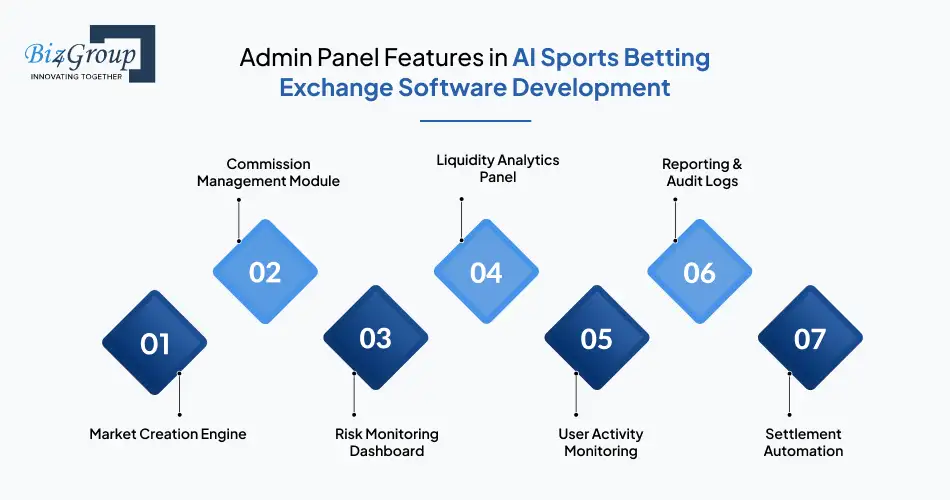
Exchange platforms require precise monitoring and control. The admin layer governs stability and compliance.
|
Feature |
What It Is |
What It Does |
|---|---|---|
|
Market Creation Engine |
Tool for creating and managing betting markets |
Enables rapid market deployment during trending events |
|
Commission Management Module |
Adjustable fee configuration system |
Optimizes revenue generation |
|
Risk Monitoring Dashboard |
Real-time exposure tracking interface |
Protects against market imbalances |
|
Liquidity Analytics Panel |
Market depth visualization tool |
Identifies inactive or low-volume markets |
|
User Activity Monitoring |
Behavioral tracking system |
Detects suspicious or irregular betting patterns |
|
Reporting & Audit Logs |
Regulatory reporting infrastructure |
Supports licensing requirements and audits |
|
Settlement Automation |
Automated payout engine |
Reduces operational workload and errors |
Startups aiming for custom AI sports betting exchange development must treat admin infrastructure as mission-critical, not an afterthought.
AI Modules in AI Sports Betting Exchange Software Development
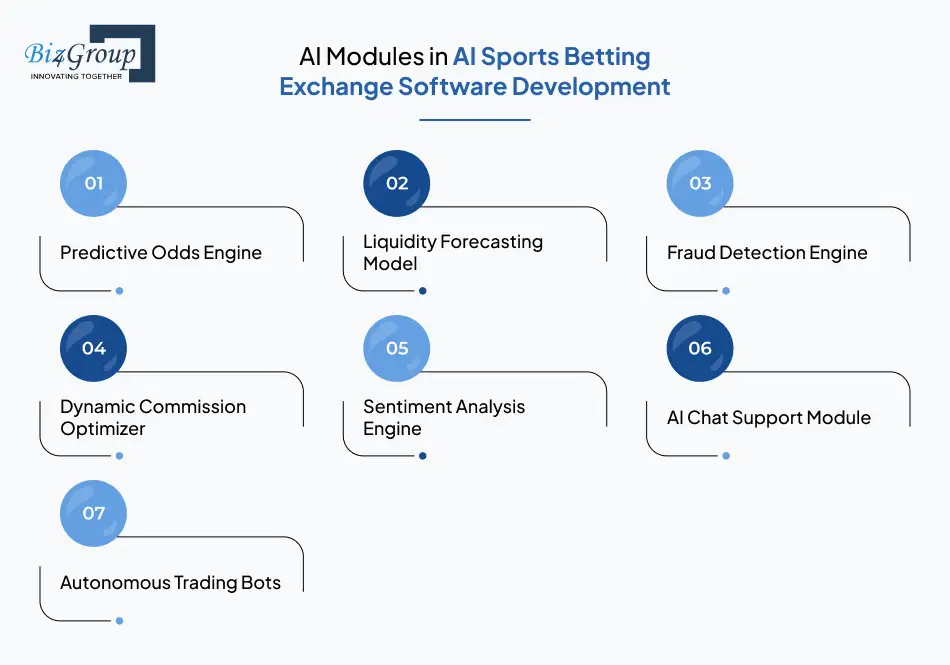
Intelligence modules transform a functional exchange into a competitive one.
|
Feature |
What It Is |
What It Does |
|---|---|---|
|
Predictive Odds Engine |
Machine learning pricing model |
Suggests optimal odds ranges based on market activity |
|
Liquidity Forecasting Model |
Demand prediction system |
Prevents inactive markets and improves matching efficiency |
|
Fraud Detection Engine |
Behavioral anomaly detection model |
Identifies arbitrage abuse and coordinated betting |
|
Dynamic Commission Optimizer |
AI pricing logic module |
Adjusts commission structures to maximize profitability |
|
Sentiment Analysis Engine |
Data analysis from external signals |
Anticipates trending events and betting spikes |
|
AI Chat Support Module |
Intelligent user assistance system |
Reduces support workload and improves response speed |
|
Autonomous Trading Bots |
Automated market balancing system |
Maintains order book depth during low activity periods |
For platforms exploring sports betting AI agent development, autonomous trading modules and intelligent assistance systems can significantly improve exchange responsiveness.
Advanced platforms may also integrate generative AI for automated content summaries, betting insights, or dynamic reporting dashboards.
Strategic Perspective
Feature depth determines how well you can:
- Develop scalable AI sports betting exchange software
- Create secure AI driven betting exchange systems
- Compete against established operators
- Maintain operational resilience during high-traffic events
For startups building a sports betting platform like BetDEX, feature completeness often separates sustainable exchanges from short-lived products.
The next section will move beyond functionality and dive into the underlying technology architecture required to support these features at scale.
Features Decide Who Wins!
In high-volume betting markets, milliseconds and intelligent automation determine who captures liquidity.
Book a Strategy Call NowTechnology Architecture Behind AI Sports Betting Exchange Platform Development
A powerful idea without strong architecture collapses under load.
AI sports betting exchange software development demands infrastructure that handles real-time trades, predictive modeling, high concurrency, and strict compliance standards. The right tech stack determines whether your exchange can handle championship-level traffic or crash at peak moments.
This section breaks down the foundational layers required to develop scalable AI sports betting exchange software for competitive global markets.
Core Technology Stack for AI Sports Betting Exchange Software Development
The tech stack must balance speed, scalability, and maintainability. Below is a structured overview of recommended frameworks and tools.
Frontend Technologies
A responsive and real-time interface drives trading confidence.
|
Layer |
Frameworks and Tools |
Purpose |
|---|---|---|
|
Web Frontend |
Next.js, React.js, Vue.js |
Fast rendering and dynamic UI updates |
|
Mobile App |
Flutter, React Native |
Cross-platform betting applications |
|
State Management |
Redux, Zustand |
Synchronizes real-time betting data |
|
UI Libraries |
Tailwind CSS, Material UI |
Consistent design system |
A strong frontend layer ensures low-latency interaction across devices, especially during live events.
Backend Technologies
The backend supports matching engines, wallet systems, and AI orchestration.
|
Layer |
Frameworks and Tools |
Purpose |
|---|---|---|
|
Core Backend |
Node.js, Go, .NET Core |
High-performance API services |
|
Matching Engine |
Custom Go or C++ services |
Executes peer-to-peer bet matching |
|
Real-Time Communication |
WebSockets, gRPC |
Instant market updates |
|
Authentication |
OAuth 2.0, JWT |
Secure user sessions |
|
Database |
PostgreSQL, MongoDB |
Transaction and user data storage |
|
Caching |
Redis |
Low-latency data retrieval |
For founders evaluating sports betting website development options, backend stability often defines platform reliability more than visible features.
AI and Data Engineering Stack
AI sports betting exchange platform development requires a robust analytics layer.
|
Layer |
Frameworks and Tools |
Purpose |
|---|---|---|
|
Machine Learning |
TensorFlow, PyTorch |
Predictive modeling and risk scoring |
|
Data Processing |
Apache Kafka, Apache Spark |
Real-time event streaming |
|
Model Deployment |
Docker, Kubernetes |
Scalable AI model serving |
|
Monitoring |
Prometheus, Grafana |
Performance tracking |
|
Cloud Providers |
AWS, Azure, GCP |
Elastic infrastructure scaling |
Startups planning to build high performance AI betting exchange platforms must design AI as an infrastructure layer, not an isolated feature.
For entrepreneurs exploring how to build a sports prediction platform like Dimers, similar predictive stacks power intelligent pricing and analytics engines.
System Architecture Overview
The architecture of AI sports betting exchange software development must support both transactional precision and predictive intelligence.
Below are core architectural principles:
- Microservices-based backend to isolate matching, payments, and analytics
- Event-driven architecture for real-time bet updates
- Load-balanced API gateways for traffic distribution
- Containerized AI model deployment
- Horizontal auto-scaling during peak sporting events
- Distributed caching for order book responsiveness
- Redundant data ingestion pipelines for reliability
- Isolated compliance layer for audit and reporting
Each layer operates independently but communicates through secure APIs.
This approach allows startups to develop enterprise ready AI sports betting exchange software without rebuilding systems when scaling internationally.
For operators comparing options such as a white-label sports betting platform, custom architecture provides long-term flexibility and ownership advantages.
Data Infrastructure Considerations
Reliable sports data feeds determine exchange accuracy.
When you create AI sports betting exchange system for global markets, consider:
- Multi-source data redundancy
- Low-latency event streaming
- Automated reconciliation systems
- Data normalization pipelines
- High-availability failover strategies
If you want to understand why enterprise sports data APIs like SportRadar matter more than features, the answer lies in consistency, uptime, and accuracy.
Portfolio Spotlight: Real-Time Sports Betting Platform for Major Global League Games
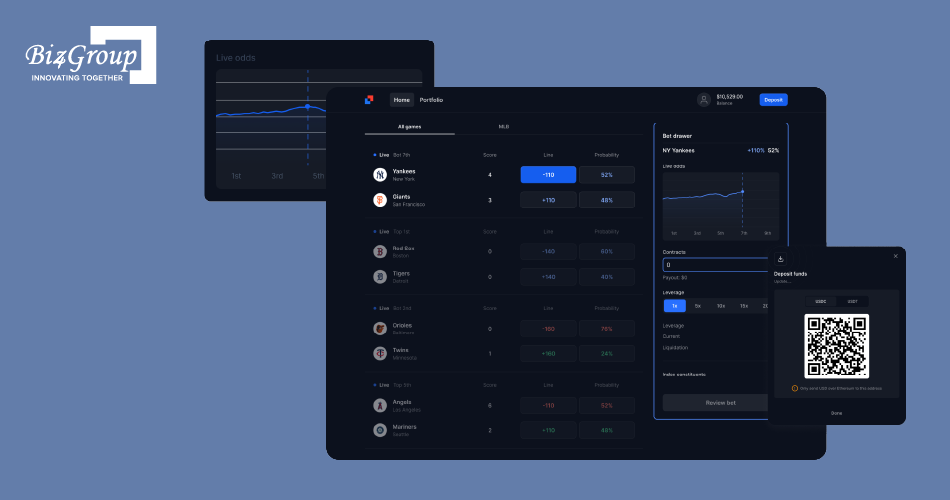
The platform was designed to support real-time betting across major leagues including MLB, CFB, and NFL. It stands as a practical implementation of scalable exchange architecture principles. Its architecture focused heavily on synchronization and reliability.
Key technical highlights:
- js frontend optimized for rapid UI updates
- Multi-language backend stack including Node.js, C#, Go, and Python
- Socket-based real-time data ingestion
- Eight-layer architecture for separation of concerns
- Centralized admin system built in C#
- Real-time chart rendering for betting analytics
- Distributed state management using Zustand
The primary challenge was managing high-volume live data without latency spikes.
The solution involved layered services and isolated data pipelines to maintain system responsiveness even during peak events.
This project demonstrates how AI sports betting exchange software development must combine real-time engineering with scalable backend orchestration.
In the next section, we will walk through a step-by-step development roadmap that turns architectural planning into execution.
How to Develop Enterprise Ready AI Sports Betting Exchange Software in 7 Steps
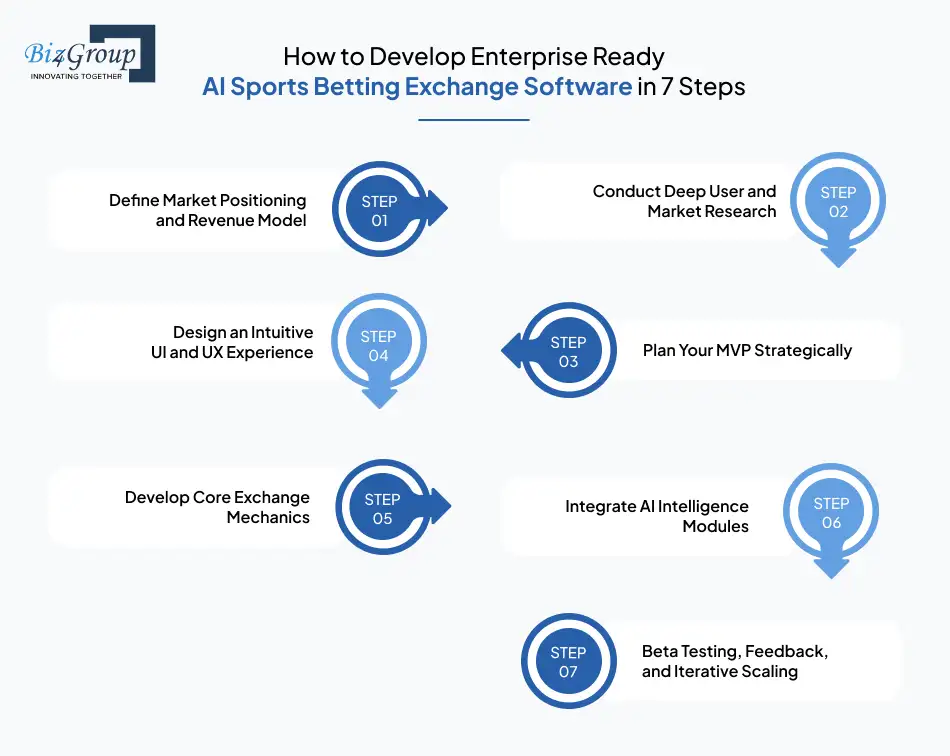
Execution separates ambitious ideas from profitable platforms.
AI sports betting exchange software development requires structured planning. Many startups rush into coding without validating liquidity strategy, user behavior assumptions, or product-market fit. That approach often leads to expensive pivots.
Below is a practical 7-step roadmap designed for founders who want to develop scalable AI sports betting exchange software with long-term revenue potential.
Step 1. Define Market Positioning and Revenue Model
Every successful exchange starts with clarity.
Before writing a single line of code, define:
- Target geography
- Sports focus
- Commission model
- Liquidity acquisition strategy
- Competitive differentiation
Are you building a niche-focused exchange or a multi-sport global platform? The answer shapes every strategic decision moving forward.
End this phase with a validated revenue hypothesis.
Step 2. Conduct Deep User and Market Research
To create intelligent sports betting exchange solutions, you must understand bettor psychology.
Research should uncover:
- Betting frequency patterns
- Preferred sports categories
- Friction points in existing exchanges
- Expectations around transparency and payouts
- Mobile versus desktop usage trends
The goal is to identify gaps that your AI sports betting exchange platform development can address directly.
This stage minimizes guesswork later.
Step 3. Plan Your MVP Strategically
Launching full-scale functionality from day one increases cost and risk.
An effective MVP for AI sports betting exchange software development should include:
- Core matching engine
- Wallet system
- Limited sports markets
- Basic AI risk monitoring
- Admin controls
Working with experienced MVP development teams ensures focused delivery without unnecessary complexity.
The outcome of this step should be a testable platform ready for early adopters.
Also read: Top 12+ MVP development companies in USA
Step 4. Design an Intuitive UI and UX Experience
Exchange platforms can appear complex to new users. Clarity drives liquidity.
Investing in professional UI/UX design ensures that:
- Back and lay betting flows are easy to understand
- Order books are visually clear
- Wallet balances are transparent
- Market switching feels seamless
- Real-time updates do not overwhelm users
A well-designed interface increases trust, and trust accelerates growth.
Also read: Top 15 UI/UX design companies in USA
Step 5. Develop Core Exchange Mechanics
Once validation and design are complete, development moves into full execution mode.
This stage focuses on:
- Order matching workflows
- Commission calculation logic
- Market creation processes
- User transaction flows
- Reporting dashboards
The objective is to build AI-powered betting exchange platform foundations that can handle real trading volume.
At this stage, user testing should begin in parallel.
Step 6. Integrate AI Intelligence Modules
AI sports betting exchange software development becomes transformative during this phase.
Key AI integrations include:
- Behavioral analytics
- Risk scoring models
- Liquidity forecasting
- Dynamic pricing algorithms
- Personalized recommendation engines
Startups that delay AI integration often struggle to retrofit intelligence later. Embedding predictive logic early improves scalability and investor confidence.
Step 7. Beta Testing, Feedback, and Iterative Scaling
No platform launches perfectly.
Controlled beta releases allow startups to:
- Test liquidity under real conditions
- Monitor user interaction patterns
- Refine commission structures
- Identify UI friction
- Adjust AI thresholds
After beta validation, scaling decisions should be data-driven.
Expansion may include new sports categories, additional geographies, or strategic partnerships such as launching a complementary sports betting affiliate website to drive targeted traffic.
Continuous iteration keeps the platform competitive in evolving markets.
Project Spotlight: Ingenious Betting App for Sports Enthusiasts
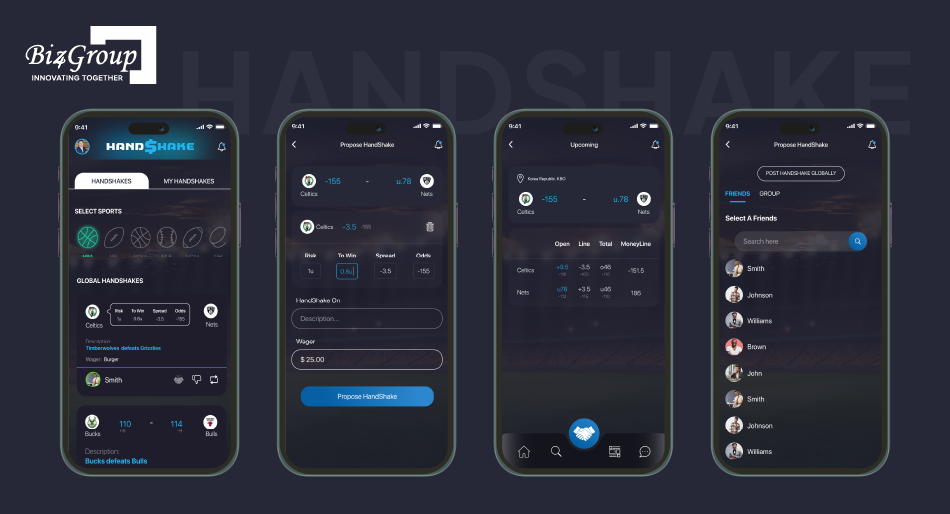
Using exceptional AI app development services, Biz4Group designed a betting app for sports enthusiasts to blend wagering with peer engagement. The app represents an innovative take on social betting ecosystems.
Key highlights include:
- Real-time live game score integration
- Multi-league support including NFL, NBA, NHL, PGA
- AI-recommended betting suggestions
- One-on-one and group betting challenges
- Push notifications for live updates
- Admin to-do management panel
The challenge centered around real-time synchronization and user interaction.
The solution involved streamlined onboarding flows, instant wager proposal mechanisms, settlement rating systems, and group-based betting features.
This project demonstrates how AI sports betting exchange software development can extend beyond traditional exchange mechanics and introduce social engagement layers that increase participation and retention.
Execution discipline determines whether a startup can successfully develop AI sports betting exchange software that survives beyond launch.
Structured validation.
User-centered design.
Incremental intelligence integration.
These principles reduce risk and increase the probability of sustainable revenue growth.
Next, we will examine how to secure and protect AI sports betting exchange software development while navigating regulatory landscapes responsibly.
Also read: Top 14 sports betting software development companies in the USA
Execution Beats Ideas Every Time!
A structured roadmap turns vision into revenue. Are you ready to move from planning to launch?
Contact Biz4Group TodayHow to Create Secure AI Driven Betting Exchange Systems with Regulatory Alignment
Security builds credibility. Compliance sustains operations.
AI sports betting exchange software development operates in one of the most tightly regulated digital industries. Startups that overlook legal structure or data protection standards often face operational shutdowns, fines, or license denials.
Below is a structured breakdown of security and compliance pillars required to develop enterprise ready AI sports betting exchange software.
Regulatory Compliance Foundations
When you develop scalable AI sports betting exchange software, legal alignment must be embedded from day one.
Key regulatory considerations include:
- State-level licensing requirements in the US
- Jurisdiction-specific gambling permissions
- Mandatory age verification processes
- Responsible gambling safeguards
- Real-time reporting to regulatory bodies
If you are planning US expansion, reviewing sports betting regulations across US states provides clarity on licensing scope and operational limits.
For founders seeking to create AI sports betting exchange system for global markets, understanding regional differences between US, UK, and offshore jurisdictions prevents costly restructuring later.
KYC and AML Controls
Know Your Customer and Anti-Money Laundering systems are mandatory for regulated betting exchanges.
Essential compliance components:
- Identity verification at onboarding
- Biometric authentication for high-value accounts
- Automated transaction monitoring
- Suspicious activity detection models
- Real-time fraud flagging and review queues
When startups build AI powered betting exchange platform ecosystems, AI-driven risk scoring strengthens AML monitoring without slowing user onboarding.
Data Protection and Encryption Standards
User trust depends on secure infrastructure.
Security layers should include:
- End-to-end encryption of financial transactions
- Encrypted storage of user credentials
- Role-based access controls for admin panels
- Secure API gateways
- Regular penetration testing
Platforms that aim to develop a sports betting app like Stake or compete at enterprise level must prioritize advanced security certifications and continuous monitoring systems.
AI Governance and Model Transparency
AI introduces another layer of compliance responsibility.
To create secure AI driven betting exchange systems, platforms must ensure:
- Transparent AI decision logic
- Bias monitoring in risk models
- Audit logs for AI-driven actions
- Model retraining documentation
- Clear user disclosure of automated processes
If you are building AI product ecosystems within betting exchanges, governance frameworks protect both the platform and its users.
Geolocation and Access Control
Geofencing technology ensures that users access the platform only in approved jurisdictions.
Core geolocation safeguards include:
- IP address validation
- GPS verification for mobile users
- VPN detection systems
- Region-based market restrictions
This is especially critical for startups exploring how to develop a sports betting platform like Outlier.Bet, where multi-state operations require precise access control mechanisms.
Responsible Gambling Features
Regulators increasingly mandate proactive player protection tools.
Essential safeguards:
- Deposit limits
- Betting caps
- Self-exclusion options
- Time-based session reminders
- Behavioral risk alerts
AI agent development can enhance responsible gambling systems by detecting harmful betting patterns early and triggering intervention workflows automatically.
Incident Response and Monitoring
Even the most secure systems require preparedness.
Best practices include:
- 24/7 system monitoring
- Automated breach detection alerts
- Defined escalation protocols
- Data recovery and backup systems
- Compliance audit readiness
Startups that invest early in structured agentic AI development can automate parts of monitoring and anomaly detection, reducing response times and operational risk.
To summarize, AI sports betting exchange software development must integrate legal alignment, risk control, and user protection at every stage of growth.
In the next section, we will examine liquidity strategies and cost dynamics that determine whether your exchange becomes profitable or struggles to gain traction.
Liquidity Framework to Develop Sports Betting Exchange Software Using AI
Liquidity determines survival in an exchange marketplace.
You can develop AI sports betting exchange software with impressive features and clean design, but without active participation on both sides of the order book, the system stalls. For startups, liquidity strategy must be intentional from the earliest planning phase.
Below is a structured framework that helps founders build scalable AI betting exchange platforms capable of sustaining consistent market depth and transactional flow.
|
Liquidity Strategy |
What It Involves |
Business Impact |
|---|---|---|
|
Seed Market Funding |
Allocating internal capital to populate early order books |
Encourages initial user participation and builds trading confidence |
|
Tiered Incentive Programs |
Offering reduced commissions or rewards for early high-volume traders |
Attracts professional bettors and accelerates activity |
|
AI-Based Market Gap Detection |
Using predictive models to identify thin markets before inactivity spreads |
Maintains healthy trading levels across events |
|
Cross-Market Liquidity Routing |
Redirecting user interest between related markets |
Improves capital efficiency and reduces idle pools |
|
Smart Order Matching Prioritization |
Optimizing match sequencing based on price and timing behavior |
Enhances user satisfaction and order execution speed |
|
Strategic Niche Launching |
Starting with specific leagues or regions before scaling broadly |
Builds concentrated liquidity rather than diluted activity |
|
Institutional Market Maker Partnerships |
Collaborating with professional trading entities |
Stabilizes order books during peak and low-demand cycles |
|
Real-Time Liquidity Heat Mapping |
Monitoring active vs inactive markets visually in dashboards |
Enables faster administrative intervention |
|
Adaptive Commission Adjustments |
Adjusting fees based on market participation trends |
Encourages balanced trading activity |
|
Behavioral Retention Modeling |
Predicting churn among high-value traders |
Protects long-term liquidity contributors |
To create AI driven sports betting exchange systems that compete globally, liquidity must be engineered, not hoped for. Exchanges thrive on activity. Activity thrives on confidence. Confidence comes from visible, consistent market depth.
How Much Does It Cost to Create Intelligent Sports Betting Exchange Solutions
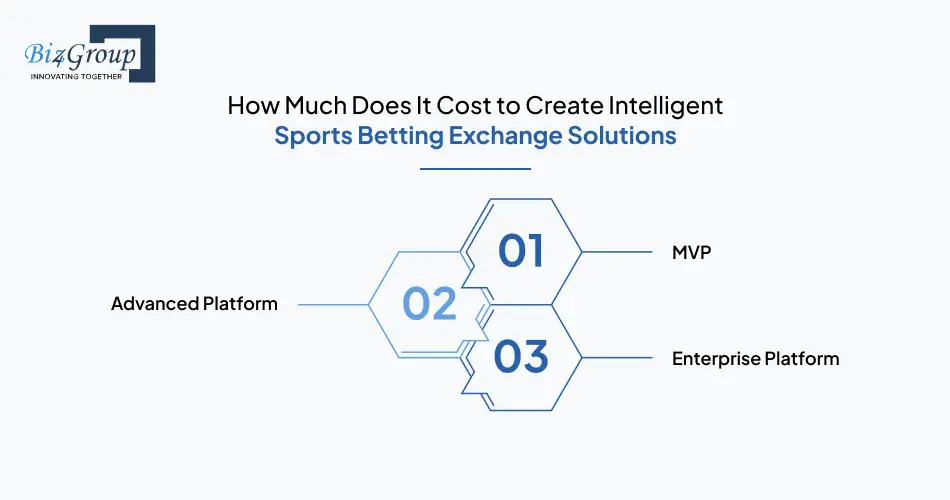
Budget planning shapes execution speed, investor confidence, and long-term scalability.
On average, AI sports betting exchange software development cost for startups ranges between $45,000-$250,000+, depending on scope, AI depth, regulatory needs, and infrastructure scale.
Below is a quick snapshot of investment tiers before we break down cost drivers in detail.
|
Level |
What It Includes |
Estimated Range |
|---|---|---|
|
MVP |
Core exchange engine, limited sports markets, wallet integration, basic AI risk scoring |
$45,000-$80,000 |
|
Advanced Platform |
Multi-sport support, predictive analytics, dynamic commission engine, enhanced dashboards |
$80,000-$150,000 |
|
Enterprise Platform |
High-concurrency architecture, advanced liquidity automation, autonomous AI modules, global readiness |
$150,000-$250,000+ |
Each tier represents a different growth ambition. Startups often begin with MVP validation and scale strategically.
Also read: Sports betting website MVP development guide
Now let’s examine what influences these numbers.
Core Development Cost Drivers
The overall cost of AI sports betting exchange software development depends on several structural variables.
|
Cost Driver |
What It Covers |
Estimated Impact |
|---|---|---|
|
Exchange Engine Logic |
Matching workflows, pricing logic, transaction management |
$15,000-$40,000 |
|
Predictive pricing, risk scoring, behavioral analytics |
$20,000-$60,000 |
|
|
Frontend User Experience |
Trading interface, dashboards, wallet flows |
$10,000-$30,000 |
|
Admin Management System |
Commission settings, reporting, user controls |
$8,000-$20,000 |
|
Real-Time Data Infrastructure |
Live event integration, synchronization systems |
$12,000-$35,000 |
|
Scalability Engineering |
Load balancing, performance tuning |
$10,000-$30,000 |
|
Testing and Quality Assurance |
Functional, performance, and security testing |
$5,000-$15,000 |
Each component contributes differently depending on whether you plan to develop scalable AI sports betting exchange software for a niche region or global expansion.
Complex AI modeling and high-concurrency architecture typically push budgets toward the higher end.
Hidden Costs Startups Often Overlook
Beyond core engineering, several secondary expenses influence total investment.
- Licensing and legal preparation can cost between $10,000-$50,000 depending on jurisdiction and advisory support.
- Third-party sports data feed subscriptions may range from $2,000-$15,000 per month depending on coverage depth and API volume.
- Cloud hosting and scaling expenses typically begin around $1,500-$5,000 per month during early stages, increasing significantly during peak sporting seasons.
- Payment gateway transaction fees usually account for 1%-3% of transaction value plus fixed processing charges.
- Ongoing AI retraining and optimization may require an additional $5,000-$20,000 annually depending on model complexity.
Startups that underestimate these operational costs often face budget overruns during scaling.
Cost Optimization Strategies
Reducing expenses does not mean reducing quality. Strategic planning allows founders to control burn rate while preparing for growth.
Key cost optimization tactics include:
- Launching with a focused MVP before expanding feature scope
- Prioritizing one or two sports markets initially
- Using modular AI integration instead of full automation from day one
- Implementing phased scalability upgrades
- Leveraging cloud auto-scaling instead of fixed infrastructure
- Structuring commission models early to fund expansion
- Building internal analytics dashboards to reduce third-party dependency
These strategies help startups build high performance AI betting exchange platforms without exhausting capital prematurely.
Also read: Sports betting app MVP development guide
Final Perspective on Investment
AI sports betting exchange software development is a serious investment, but it is also a high-revenue opportunity when structured correctly.
The difference between a $60,000 experiment and a $250,000 enterprise system lies in ambition, geographic scope, and AI sophistication.
Founders who plan budgets carefully, anticipate hidden expenses, and phase development strategically position themselves for long-term profitability.
Also read: How much does it cost to develop an AI sports betting app like Rithmm?
Invest Smart. Scale Faster.
A $60K MVP can validate your model. A $200K+ platform can dominate markets. The real cost is delaying entry!
Let's Talk NumbersRevenue Strategies for AI Sports Betting Exchange Software Development
Monetization defines sustainability.
When startups invest in AI sports betting exchange software development, the ultimate goal is predictable, scalable revenue. Unlike traditional sportsbooks that rely heavily on margin spreads, exchange platforms operate through diversified monetization layers.
Below is a structured breakdown of revenue models commonly used when founders develop scalable AI sports betting exchange software for competitive markets.
|
Monetization Model |
How It Works |
Revenue Potential and Impact |
|---|---|---|
|
Commission on Net Winnings |
Platform charges 2%-7% on profitable trades |
Most stable revenue stream with predictable margins tied to user volume |
|
Tiered Commission Structure |
Lower fees for high-volume traders |
Encourages liquidity concentration and increases overall trading volume by 15%-30% |
|
In-Play Premium Fees |
Slightly higher commission during live events |
Captures high-engagement periods where betting activity can increase 40%-60% |
|
Subscription Plans |
Monthly premium access at $29-$199 per user |
Generates recurring income and increases retention among professional bettors |
|
API Access Licensing |
External platforms pay for exchange data access |
B2B revenue stream with enterprise contracts ranging $10,000-$100,000 annually |
|
Data Analytics Services |
Selling aggregated betting insights |
Additional monetization layer for investors and affiliate platforms |
|
White-Label Partnerships |
Licensing exchange infrastructure to third parties |
Revenue share agreements typically range 10%-30% of partner earnings |
|
Advertising and Sponsorship |
Display placements during major sporting events |
Can contribute 5%-15% of total revenue depending on traffic volume |
|
Loyalty and VIP Programs |
Incentivized activity tiers with dynamic pricing |
Increases lifetime value by 20%-35% |
|
AI-Based Dynamic Commission Optimization |
Adjusting commission rates using predictive models |
Improves profit margins by identifying price elasticity patterns |
Startups that create AI driven sports betting exchange systems often combine multiple monetization layers instead of relying on a single revenue stream. For example, commission income may cover operational expenses, while subscription tiers and API licensing accelerate profit expansion.
When founders aim to build scalable AI betting exchange platforms, diversification reduces dependency risk and stabilizes cash flow across seasonal betting cycles.
In the next section, we will examine challenges, risks, and common mistakes that can undermine even well-funded exchange platforms.
Also read: How do AI sports betting apps like FanDuel make money?
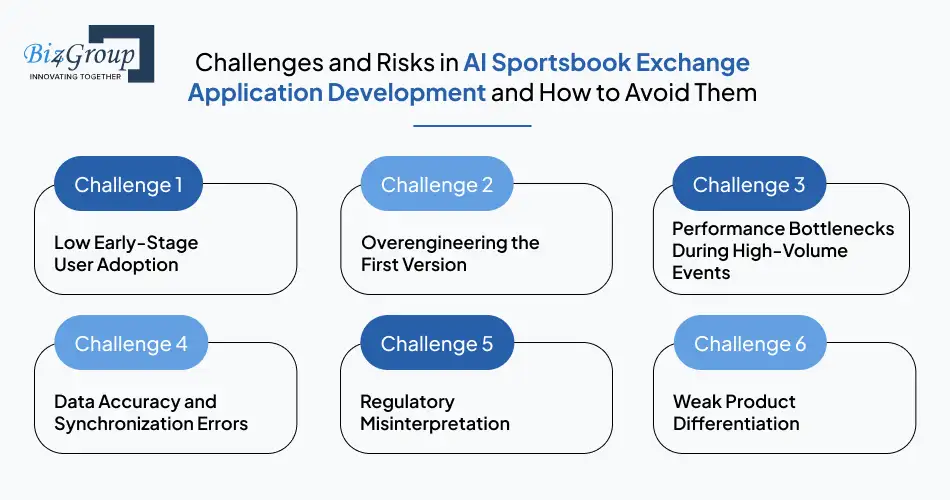
Challenges and Risks in AI Sportsbook Exchange Application Development and How to Avoid Them
Every high-reward industry comes with structural risks.
AI sports betting exchange software development presents technical, operational, and business challenges that many startups underestimate. Understanding these risks early helps founders protect capital and accelerate sustainable growth.
Below are the most critical challenges along with practical mitigation strategies.
Challenge 1. Low Early-Stage User Adoption
Even well-built exchange platforms can struggle to attract initial users. Without consistent participation, trading activity remains thin, and growth slows down.
Solutions
- Launch with targeted niche communities rather than broad markets
- Offer early adopter incentives such as reduced commission rates
- Partner with influencers and betting analysts to drive traffic
- Introduce referral and loyalty programs
- Run controlled beta access to build anticipation
Challenge 2. Overengineering the First Version
Some startups attempt to launch full-scale enterprise systems immediately. This leads to longer timelines and inflated budgets. AI sports betting exchange software development should evolve strategically.
Solutions
- Begin with a lean MVP focused on core exchange mechanics
- Validate revenue assumptions before scaling features
- Avoid unnecessary multi-sport expansion in early stages
- Allocate budget to revenue-generating modules first
- Treat the platform as a growing AI product rather than a one-time release
Challenge 3. Performance Bottlenecks During High-Volume Events
Traffic surges during championship games or major tournaments can overwhelm underprepared platforms. Scalability issues damage reputation instantly.
Solutions
- Conduct load simulation testing before major events
- Implement auto-scaling infrastructure
- Use distributed system architecture
- Establish real-time performance monitoring dashboards
- Hire AI developers experienced in high-traffic applications
Challenge 4. Data Accuracy and Synchronization Errors
Even minor inconsistencies in sports data feeds can cause pricing disputes and settlement delays. This risk increases for startups planning to develop scalable AI sports betting exchange software across multiple leagues.
Solutions
- Integrate multi-source data verification layers
- Implement automated reconciliation workflows
- Monitor feed latency continuously
- Validate results against independent sources
Challenge 5. Regulatory Misinterpretation
Expanding into new regions without full legal clarity exposes startups to penalties or shutdowns. Many entrepreneurs discover these risks only after launch.
Solutions
- Conduct jurisdiction-specific legal reviews
- Maintain structured documentation for audits
- Build compliance checkpoints into operational workflows
- Stay informed about evolving policies and industry updates
Challenge 6. Weak Product Differentiation
The exchange market is competitive. Without clear value propositions, user acquisition costs increase significantly. AI sports betting exchange software development must deliver visible advantages.
Solutions
- Focus on intelligent personalization features
- Offer transparent commission structures
- Prioritize usability and simplicity
- Integrate advanced analytics dashboards
- Develop niche-focused exchange offerings before expanding
Challenges are not roadblocks. They are signals for better planning.
AI sports betting exchange software development demands strategic discipline, technical depth, and market awareness. Startups that proactively address adoption risks, AI model governance, scalability, and compliance build resilient platforms positioned for long-term revenue growth.
Also read: Challenges in modern sports betting app development
Avoid Expensive Mistakes Before They Happen!
Liquidity gaps, model errors, and scalability failures can drain capital fast. The smartest founders eliminate risk before launch.
Talk to Biz4Group's ExpertsWhy Startups Across the USA Trust Biz4Group LLC for AI Sports Betting Exchange Software Development
When you invest six figures into a betting exchange platform, you are not buying code. You are choosing a long-term technology partner.
Biz4Group LLC is a USA-based technology company specializing in AI sports betting exchange software development for startups, operators, and enterprise gaming leaders.
Our teams have built real-time sports betting platforms, predictive analytics systems, social wagering ecosystems, and enterprise-grade AI modules that handle high concurrency and live event volatility. From exchange engines to AI-powered behavioral analytics, our experience spans the entire lifecycle of AI sports betting exchange platform development.
We understand how to:
- Develop scalable AI sports betting exchange software for global markets
- Architect systems that sustain peak event traffic
- Integrate advanced intelligence modules without compromising performance
- Align platform strategy with revenue growth objectives
As a trusted sports betting app development company, we design platforms that blend performance, compliance awareness, and user engagement.
Our expertise in sports betting API integration services ensures that real-time data ingestion, synchronization, and redundancy are engineered for reliability, not left to chance.
Why Businesses Choose Biz4Group LLC
- USA-based leadership with global delivery capabilities
- Proven portfolio across real-time sports betting platforms
- Strong command of AI modeling and predictive analytics systems
- Experience building custom exchange architectures, not template-based solutions
- Transparent development process with milestone-driven execution
- Scalable infrastructure planning aligned with long-term growth
- Dedicated teams for AI optimization and post-launch enhancements
- Deep understanding of betting market mechanics and user psychology
The difference between launching an exchange and leading a market often comes down to execution depth.
At Biz4Group LLC, we provide strategic clarity, engineering excellence, and intelligent architecture that empowers startups to compete with confidence in the USA and beyond.
Build your AI sports betting exchange platform the right way. Build with Biz4Group.
Final Thoughts
AI sports betting exchange software development represents a powerful opportunity for startups ready to build intelligent, scalable, and revenue-focused platforms. The exchange model shifts risk away from operators and creates a dynamic marketplace where users drive pricing and liquidity. When combined with predictive analytics, behavioral intelligence, and automated optimization systems, this model becomes a high-performance ecosystem capable of competing in regulated global markets.
From strategic planning and MVP execution to liquidity engineering and monetization frameworks, success depends on disciplined execution. Startups that approach AI sports betting exchange platform development with clarity, structured investment, and long-term scalability in mind position themselves for sustainable growth rather than short-term experimentation.
That is where Biz4Group LLC steps in. As a USA-based AI development company with hands-on experience in real-time betting systems, AI modules, and scalable exchange architecture, we help founders transform complex ideas into enterprise-ready platforms. Our focus remains on performance, intelligence, and measurable revenue impact.
If you are ready to build scalable AI betting exchange platforms that attract users, generate liquidity, and drive serious revenue, let’s start the conversation. The market is moving fast. Your platform should too.
FAQs
What is the difference between a betting exchange and a prediction platform?
A betting exchange facilitates peer-to-peer wagering where users trade positions against each other. A prediction platform primarily provides analytics, forecasts, or probability insights without directly operating a trading marketplace. Exchanges generate revenue from commissions, while prediction platforms often monetize through subscriptions or analytics services.
Can a startup compete with established betting exchanges?
Yes, provided it identifies a niche, optimizes liquidity early, and leverages intelligent automation. Competing directly with global giants on every sport at launch is difficult. However, focusing on specific leagues, regions, or specialized user segments can create strong traction and defensible positioning.
What kind of team is required to develop an AI sports betting exchange system?
A well-rounded team typically includes backend engineers, frontend developers, AI specialists, QA analysts, DevOps engineers, and product strategists. Early-stage startups often partner with experienced development firms to access cross-functional expertise without building large in-house teams immediately.
How does an exchange handle dispute resolution between users?
Modern exchange platforms implement automated settlement rules based on verified event data. Disputes are typically resolved using predefined arbitration logic supported by real-time event feeds and audit logs. Clear terms of service and transparent transaction records reduce ambiguity.
Is it possible to integrate cryptocurrency payments into a betting exchange?
Yes. Many exchange platforms integrate crypto wallets alongside traditional payment gateways. Cryptocurrency support can enhance cross-border accessibility, reduce transaction fees, and appeal to tech-savvy audiences. However, regulatory alignment must be evaluated carefully before implementation.
How can AI improve user retention in betting exchanges?
AI enhances retention through personalized market suggestions, behavioral engagement analysis, and dynamic user segmentation. By analyzing betting frequency and preferences, platforms can present tailored opportunities that align with individual user behavior, increasing long-term engagement.
What metrics should founders track after launching a betting exchange?
Key performance indicators include active traders per event, order book depth, average commission per user, liquidity concentration ratios, churn rate, and average session duration. Monitoring these metrics helps founders optimize growth strategy and identify operational bottlenecks early.