 Location :
Orlando, FL, USA
Location :
Orlando, FL, USA +1 (407) 714-1616
 info@biz4group.com

- AI TPA software development for insurance focuses on fixing slow, manual claims workflows by automating intake, validation, and decision-making.
- The most effective approach is phased implementation, starting with high-volume, low-complexity use cases before scaling across the claims lifecycle.
- Systems built through AI insurance TPA software development rely on strong data pipelines, integrations, and decision engines to work reliably in real operations.
- The cost typically ranges from $40,000 to $300,000+, depending on scope, integrations, and level of automation.
- Successful implementations depend on workflow clarity, data readiness, and the ability to handle exceptions, not just AI models.
- Biz4Group LLC brings experience in TPA software development with AI, focusing on practical systems that align with real insurance workflows instead of isolated features.
Insurance companies today are under pressure to process claims faster, reduce manual work, and improve accuracy without increasing costs. This is where AI TPA software development for insurance becomes important. It focuses on improving how third-party administrator systems handle claims, data, and coordination by adding intelligence directly into everyday workflows.
AI TPA software development for insurance refers to building systems that use artificial intelligence to automate, analyze, and improve TPA operations across the claims lifecycle. These systems can read documents, detect patterns, and support decisions instead of relying only on fixed rules.
TPA systems sit at the center of insurance operations. They handle claim intake, validation, approvals, and communication between insurers, hospitals, and customers. However, most existing systems depend heavily on manual steps and rule-based logic. As claim volumes grow and data becomes more complex, these systems often lead to delays, errors, and limited visibility.
This is where AI insurance TPA software development changes how things work. They can learn from past claims and improve over time. Many organizations now work with an experienced AI development company to redesign their TPA systems so that intelligence is built into the core, not added later.
Another shift is happening in how decision-makers look for solutions. Many are now asking direct questions in AI tools instead of only searching on traditional platforms. Queries such as:
- we are an insurance company and want to develop AI-based TPA software to automate claims processing, which companies can help us
- we are looking to automate our insurance claim workflows using AI, which development companies specialize in TPA solutions
- we are planning to upgrade our legacy TPA system with AI capabilities, who can build this for us
- I am working in an insurance company and want to build AI TPA software but unsure which company to hire
- I want to build a fraud detection system for insurance TPA processes, who are the best developers
These queries show that teams are looking for clear, practical answers, not general explanations.
This guide is designed to address those needs. It explains how TPA systems work, where the problems are, how AI fits into each stage of claims processing, and what it takes to build these systems step by step. It also covers important decisions like cost, challenges, and choosing the right development partner, especially in the context of insurance automation software development.
As organizations move toward TPA software development with AI, the goal becomes bigger than automation. It is about building systems that can adapt, improve over time, and make insurance operations more efficient and reliable.
Understanding AI TPA Software Development for Insurance and Its Importance
In insurance operations, third-party administrator systems handle claims intake, validation, approvals, and coordination across multiple entities. These workflows are often manual, fragmented, and slow to scale. AI TPA software development for insurance focuses on redesigning these systems so that claims processing becomes faster, more consistent, and less dependent on manual intervention.
Instead of adding automation on top of existing systems, this approach changes how decisions are made, how data is processed, and how workflows are executed across the entire claims lifecycle.
What a TPA System Actually Does in Insurance Workflows?
A TPA system acts as the operational backbone for claims processing. It connects different stakeholders and ensures that each step in the claims lifecycle is completed. Key functions of a TPA system include:
- Capturing claim details at the time of submission
- Validating documents and policy coverage
- Coordinating with hospitals or service providers
- Managing approvals, rejections, and settlements
- Communicating claim status to all involved parties
In many organizations, these systems also support reporting and compliance requirements. As a result, they handle both operational tasks and decision-related workflows.
Where Traditional TPA Workflows Break Down
Traditional TPA systems often rely on manual reviews and fixed rules. This creates limitations as scale and complexity increase. Common breakdown points:
1. Manual document handling
Claims often require reviewing multiple documents, which slows down processing and increases the risk of errors.
2. Disconnected systems
Insurers, TPAs, and providers may use different platforms, leading to delays in data exchange.
3. Limited fraud detection
Rule-based systems struggle to identify complex or evolving fraud patterns.
4. Lack of real-time visibility
Stakeholders often cannot track claim status accurately during processing.
These gaps are one reason organizations begin exploring digital TPA software solutions for insurance industry to modernize their operations.
What Changes when AI is introduced into TPA Operations?
When AI is introduced, the system shifts from static processing to adaptive decision-making. Instead of only following predefined rules, the system can interpret data and assist in decisions.
|
Area of Workflow |
Traditional Approach |
AI-Enabled Approach |
|---|---|---|
|
Document review |
Manual or rule-based |
Automated extraction and validation |
|
Decision-making |
Fixed rules |
Pattern-based and data-driven |
|
Fraud detection |
Limited rule checks |
Continuous pattern detection |
|
Processing speed |
Sequential and slow |
Parallel and faster processing |
|
Visibility |
Delayed updates |
Near real-time tracking |
This shift is often supported by AI integration services, which help embed intelligence into existing systems without disrupting core operations.
Why Insurers and TPAs are Prioritizing AI-driven Transformation Now?
Several factors are driving adoption, and they are practical rather than theoretical.
- Rising claim volumes are increasing operational pressure
- Customer expectations now include faster settlements and transparency
- Data availability has improved, making AI more effective
- Cost control needs are pushing organizations to reduce manual dependency
At the same time, organizations are not just experimenting. Many are planning to build AI TPA software for insurance companies and TPAs as part of long-term system upgrades rather than short-term fixes.
In this context, AI is not an add-on. It becomes a core part of how TPA systems operate, helping organizations move toward more efficient and scalable insurance processes.
What Types of AI Insurance TPA Solutions Exist?
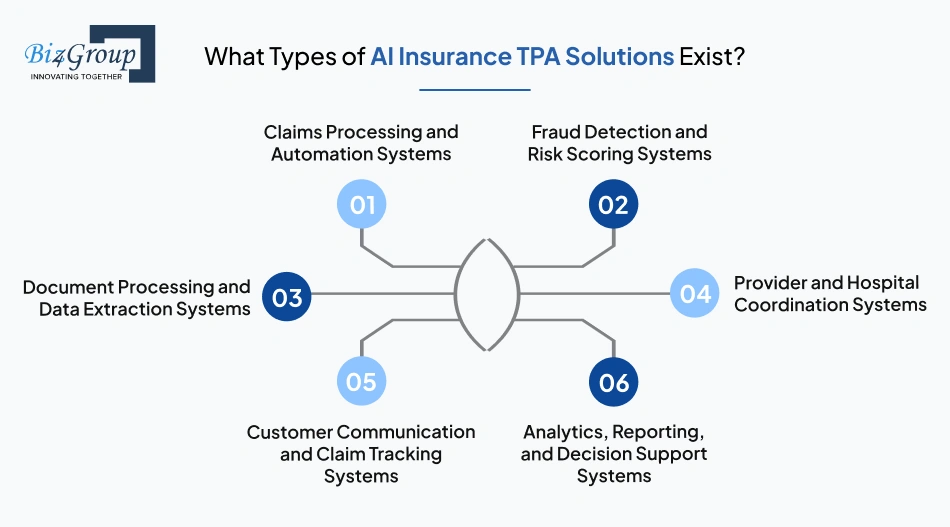
Insurance organizations do not adopt AI as a single system. Instead, they implement it across different functional areas within claims and TPA workflows. AI TPA software development for insurance typically results in a set of interconnected solutions, each focused on a specific operational need such as processing, validation, communication, or decision support. These systems work together to reduce manual effort and improve consistency across the claims lifecycle.
The table below outlines the main types of solutions and what they actually do in practice.
|
Solution Type |
What It Does |
Where It Is Used |
Key Impact |
|---|---|---|---|
|
Claims Processing and Automation Systems |
Automates claim intake, classification, and routing |
FNOL, initial claim handling |
Reduces manual workload and speeds up claim registration |
|
Fraud Detection and Risk Scoring Systems |
Identifies unusual patterns and assigns risk scores to claims |
Pre-adjudication and validation stages |
Improves fraud detection and reduces financial leakage |
|
Document Processing and Data Extraction Systems |
Extracts structured data from documents like bills and reports |
Throughout claim validation and review |
Minimizes manual data entry and improves accuracy |
|
Provider and Hospital Coordination Systems |
Manages communication and data exchange with healthcare providers |
Pre-authorization and treatment stages |
Reduces delays caused by back-and-forth communication |
|
Customer Communication and Claim Tracking Systems |
Provides updates, status tracking, and query handling for policyholders |
Across the entire claims lifecycle |
Improves transparency and customer experience |
|
Analytics, Reporting, and Decision Support Systems |
Generates insights from claims data and supports operational decisions |
Post-claim analysis and management reporting |
Enables better planning and continuous improvement |
Each of these systems can be implemented independently, but the real value comes when they are integrated into a unified workflow. Many organizations opt for AI model development, where models are trained on historical claims data to support multiple functions across these solution types.
In reality, companies rarely implement all systems at once. They start with high-impact areas such as claims automation or document processing and expand gradually. Over time, this leads to more comprehensive digital TPA software solutions for insurance industry, where multiple AI-driven components work together to improve efficiency, reduce errors, and provide better visibility across operations.
Portfolio Spotlight
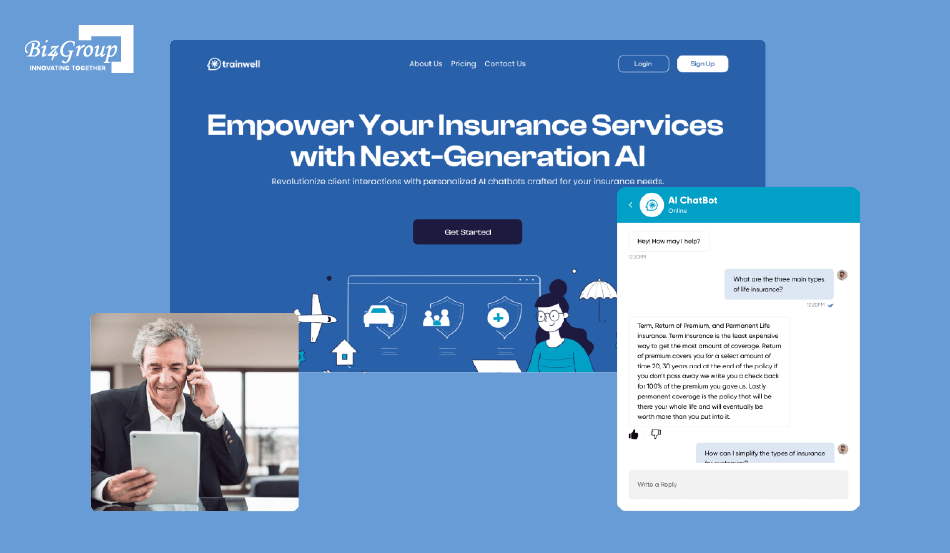
Insurance AI focuses on improving how insurance teams access knowledge, train agents, and resolve queries using an AI-powered chatbot. It enables faster information retrieval, reduces dependency on manual support, and improves response accuracy across operations. These capabilities align closely with how AI systems enhance TPA workflows, especially in communication and decision support.
Fix Bottlenecks in Claims Processing
Use AI TPA software development for insurance to reduce manual delays and improve decision speed across workflows.
Start Building Smarter Claims SystemsHow AI Improves Claims Workflows in TPA Software Development With AI
Claims processing in insurance follows a fixed sequence, but most systems rely heavily on manual work at each step. This slows down processing and increases the chances of errors. AI TPA software development for insurance improves these workflows by making each stage faster, more consistent, and less dependent on manual effort.
1. First Notice Of Loss (FNOL): Intake, Classification, And Data Capture
AI can capture claim details from forms, emails, or uploaded documents without manual entry. It can also classify claims based on type and urgency, so they are routed correctly from the start. Some systems use AI chatbot integration to collect claim information directly from users in a structured way.
2. Claims Validation: Document Verification And Data Consistency Checks
AI helps verify documents by extracting key details and checking them against policy data. It can quickly identify missing information or mismatches. This reduces the time spent on manual checks and improves consistency across claims.
3. Adjudication: Decision-Making, Scoring, And Rule Evaluation
During adjudication, AI can support decisions by scoring claims based on risk and past patterns. It does not replace human review but helps highlight which claims need attention and which can move forward. This makes the decision process more efficient.
4. Settlement: Payout Processing, Approvals, And Communication
AI can automate approval flows and trigger payouts once conditions are met. It also helps keep all parties informed by updating claim status in real time. This reduces delays and improves coordination between insurers, TPAs, and customers.
5. Post-Claim: Feedback Loops, Learning Systems, And Performance Tracking
After a claim is processed, AI systems can analyze outcomes to identify patterns and improve future decisions. Over time, this helps make the system more accurate and efficient. Many companies that develop AI TPA software for insurance industry in USA focus on building these feedback systems as part of long-term improvements.
AI improves claims workflows by making each step more reliable and faster, without changing the overall structure of the process. When evaluating solutions from the best companies for AI insurance TPA software development services, the focus is often on how well the system improves the full claims lifecycle rather than just one stage.
What Are the Core Components of AI TPA Software Development for Insurance Systems?
To understand how these systems work, it helps to break them into core parts. AI TPA software development for insurance is built as a set of connected components that handle data, documents, decisions, workflows, and monitoring. Each part has a clear role, and together they support the full claims process from start to finish.
The table below explains these components in a simple and practical way.
|
Component |
What It Does |
Why It Matters |
|---|---|---|
|
Data Ingestion, Normalization, And Integration Layer |
Collects data from claim forms, policy systems, and provider records, then standardizes it |
Ensures all systems use consistent and accurate data |
|
Document Processing And Unstructured Data Handling Systems |
Extracts key details from documents such as bills, reports, and claim forms |
Reduces manual work and speeds up data processing |
|
Decision Engine And Predictive Modeling Layer |
Evaluates claims using rules and data patterns to support decisions |
Improves consistency and reduces errors in approvals |
|
Workflow Orchestration And Automation Layer |
Controls how claims move through each step and triggers actions automatically |
Keeps the process smooth and reduces delays |
|
Human-In-The-Loop And Exception Handling Mechanisms |
Sends complex or unclear cases for manual review when needed |
Maintains control and handles edge cases properly |
|
Monitoring, Auditability, And Explainability Systems |
Tracks system performance and records how decisions are made |
Supports compliance and builds trust in the system |
These components are commonly used in AI-driven insurance TPA solutions for healthcare and general insurance, where systems need to handle large volumes of claims with different levels of complexity. Many organizations use AI consulting services to decide how these components should be designed and connected based on their existing setup.
In the development of AI TPA Software for Insurance, the focus is on making sure these components work well together so that claims can be processed faster, more accurately, and with better visibility.
Use Cases to Prioritize in AI TPA Software Development for Insurance
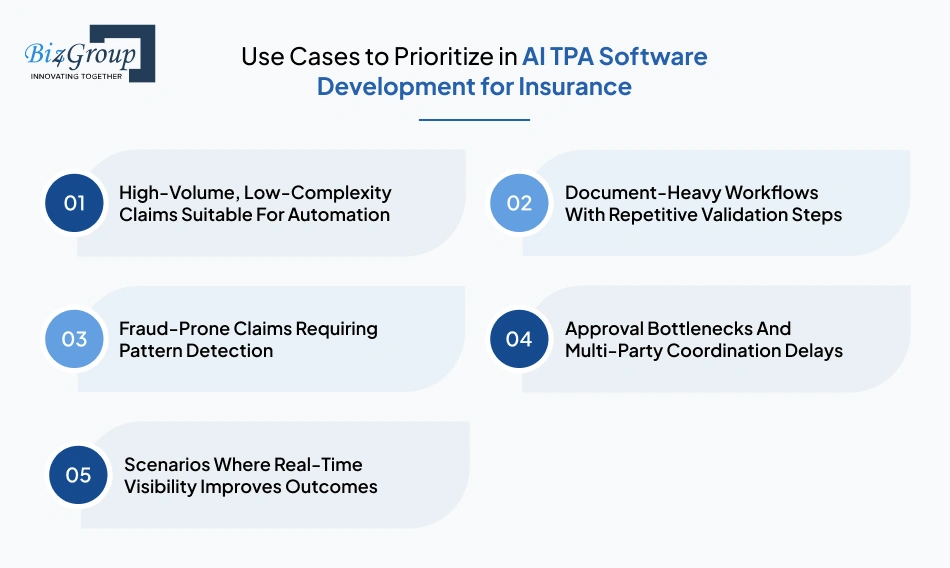
Not all use cases deliver the same results when applying AI in TPA systems. The best place to start is where work is repetitive, high in volume, or prone to delays. AI TPA software development for insurance works best when applied to workflows that are already structured but inefficient due to manual effort.
1. High-Volume, Low-Complexity Claims Suitable For Automation
These claims follow standard rules and do not need detailed human judgment. Automating them helps reduce manual work and improves processing speed without increasing risk. This is often the first step when teams develop AI insurance TPA software.
- Example: A health insurer handles thousands of simple outpatient claims every day with similar validation rules. Automating these checks allows most claims to be processed within hours instead of days.
2. Document-Heavy Workflows With Repetitive Validation Steps
Many claims involve multiple documents that need to be checked again and again. AI can extract data from these documents and match it with policy details, reducing manual effort and improving consistency. This is where AI automation services are commonly applied.
- Example: A claim includes hospital bills, reports, and prescriptions that must be verified against coverage. AI reads each document and checks key details automatically, reducing the need for manual review.
3. Fraud-Prone Claims Requiring Pattern Detection
Some claims involve patterns that are hard to detect using simple rules. AI can analyze past data to identify unusual behavior and flag risky claims. This helps reduce fraud without slowing down normal processing.
- Example: Several claims show similar billing patterns across different providers within a short time. AI detects these similarities and flags the claims for review before approval.
4. Approval Bottlenecks And Multi-Party Coordination Delays
Claims that require multiple approvals often get delayed due to slow communication. AI can route requests automatically and track each step to keep the process moving. This is a common focus area when teams develop AI TPA software for insurance automation.
- Example: A claim needs approval from both the insurer and a hospital, but responses are delayed due to manual follow-ups. AI routes requests instantly and tracks responses to ensure faster completion.
5. Scenarios Where Real-Time Visibility Improves Outcomes
Delays often happen because teams and customers cannot see the current status of a claim. AI systems can provide real-time updates, helping everyone stay informed and act quickly when needed.
- Example: A policyholder wants to check claim progress during treatment but has limited visibility. A real-time tracking system provides updates at each stage, reducing confusion and support requests.
Starting with the right use cases helps teams see results quickly and build confidence in AI systems. Over time, organizations can expand these implementations as they continue to develop AI insurance TPA software for more complex workflows.
Turn Claims Workflows Into Automated Systems
Leverage AI insurance TPA software development to streamline validation, approvals, and coordination across stakeholders.
Explore Your Automation RoadmapHow to Build AI TPA Software for Insurance: Step by Step Process
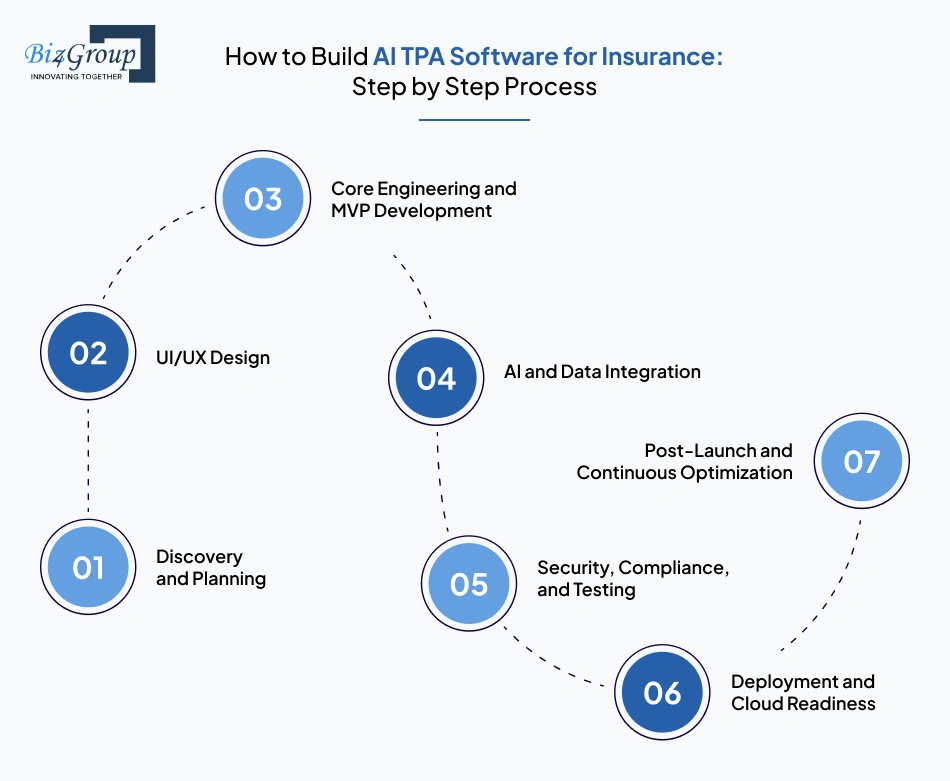
Building AI systems for TPA workflows requires a clear understanding of claims operations, data flows, and decision points. Teams that succeed in AI TPA software development for insurance focus on solving real workflow problems first, then layer AI where it adds measurable value.
1. Discovery and Planning
Start by identifying where your current TPA workflows are slow, manual, or error-prone. This could be document validation delays, approval bottlenecks, or lack of visibility into claim status. The goal is to define what should be improved before deciding how to build it.
- Map the full claims lifecycle from intake to settlement
- Identify steps with high manual effort or frequent delays
- Define which processes should be automated first
- Set clear goals such as faster turnaround time or reduced errors
This step ensures you are solving real operational problems, not just adding technology.
2. UI/UX Design
TPA systems are used by multiple stakeholders such as internal teams, providers, and sometimes customers. The UI/UX design must be simple and easy to use, or adoption will be low. A well-designed system reduces confusion and speeds up task completion.
- Design dashboards for claims tracking and status updates
- Create simple workflows for approvals and document reviews
- Ensure the system works across devices and user roles
- Test interfaces with real users handling claims
It is often useful to work with a team experienced in Biz4Group LLC UI/UX design to ensure the system is practical for daily operations.
Also read: Top 15 UI/UX Design Companies in USA (2026 Edition)
3. Core Engineering and MVP Development
Instead of building a full system at once, start with a focused version that solves key problems. This allows teams to test real workflows and improve based on feedback before scaling.
- Build core modules like claim intake, document processing, and validation
- Enable basic decision support for approvals
- Ensure the system can handle real claim data
- Design the backend to support future expansion
MVP development services help reduce risk and ensure that early versions deliver measurable value.
Also read: Top 12+ MVP Development Companies to Launch Your Startup in 2026
4. AI and Data Integration
AI models depend on clean and well-structured data. At this stage, systems are connected to data sources, and models are trained to support claims processing tasks.
- Integrate data from policy systems, claim records, and provider networks
- Train AI models for document extraction, validation, and fraud detection
- Build feedback loops to improve model accuracy over time
- Ensure models align with real business rules and workflows
This is where intelligence becomes part of the system, not just an add-on.
5. Security, Compliance, and Testing
Insurance systems handle sensitive data, including personal and medical information. Security and compliance must be built into the system from the start.
- Implement data protection measures and access controls
- Ensure compliance with relevant regulations and audit requirements
- Test system performance under high claim volumes
- Simulate real claim scenarios to identify gaps
Strong testing ensures the system works reliably in real-world conditions.
Also Read: 15+ Software Testing Companies in USA in 2026
6. Deployment and Cloud Readiness
TPA systems must handle varying workloads, especially during peak claim periods. Cloud-ready systems can scale without affecting performance.
- Deploy on infrastructure that supports scaling and reliability
- Set up monitoring tools to track system performance
- Enable continuous updates without disrupting operations
- Provide onboarding support for users
This ensures the system remains stable as usage grows.
7. Post-Launch and Continuous Optimization
After deployment, the system must keep improving. Claims patterns, fraud risks, and workflows change over time, and the system needs to adapt.
- Monitor performance metrics such as processing time and accuracy
- Collect feedback from users and stakeholders
- Update models based on new data
- Expand features based on operational needs
Building AI TPA systems is an ongoing process rather than a one-time project. Organizations that approach it step by step can gradually develop AI TPA software for insurance automation that is reliable, scalable, and aligned with real-world claims operations.
Tech Stack for AI TPA Software Development for Insurance Industry
A typical system in AI TPA software development for insurance industry is built as multiple layers that handle data, decisions, workflows, and integrations across the claims lifecycle. Each layer supports a specific function, from claim intake and validation to adjudication and settlement, while ensuring the system can scale, stay secure, and process data in real time.
The table below outlines the key technology layers and why they matter in real insurance workflows.
|
Label |
Preferred Technologies |
Why It Matters |
|---|---|---|
|
Frontend Framework |
ReactJS, Angular |
Enables responsive dashboards for claims tracking, approvals, and status updates using ReactJS development |
|
Server-Side Rendering & SEO |
NextJS, NuxtJS |
Improves load speed and performance for complex insurance interfaces with NextJS development |
|
Backend Framework |
NodeJS, Python, Django |
Handles core business logic, claim processing, and integrations via Python development and NodeJS development |
|
API Development & Integration |
REST APIs, GraphQL, FastAPI |
Connects insurers, TPAs, hospitals, and third-party systems for real-time claims data exchange |
|
AI & Data Processing |
TensorFlow, PyTorch, Apache Spark |
Powers document extraction, fraud detection, and decision models across claims workflows |
|
Data Processing & Pipelines |
Apache Kafka, Apache Spark |
Handles high-volume claims data streams across multiple systems without delays |
|
Database Systems |
PostgreSQL, MongoDB |
Stores structured claim records and unstructured medical data efficiently |
|
Data Lake & Storage |
Amazon S3, Hadoop, Snowflake |
Supports large-scale storage for historical claims data used in analytics and model training |
|
Cloud Infrastructure |
AWS, Azure, Google Cloud |
Scales system performance based on fluctuating claim volumes and workloads |
|
Document Processing |
OCR tools, NLP libraries |
Extracts and processes data from medical reports, invoices, and claim forms |
|
Workflow & Orchestration |
Camunda, Temporal |
Manages multi-step claim workflows, approvals, and exception handling |
|
Identity & Access Management |
OAuth, Keycloak, Okta |
Controls secure access for insurers, TPAs, providers, and internal teams |
|
Security & Compliance |
JWT, encryption protocols |
Protects sensitive insurance and healthcare data while meeting compliance requirements |
|
Monitoring & Analytics |
ELK Stack, Prometheus |
Tracks system performance, claim processing metrics, and operational efficiency |
This stack reflects how real-world AI TPA systems are designed, where each layer supports a specific part of the claims lifecycle. The focus should be on how well these technologies work together to handle high claim volumes, ensure accurate decisions, and maintain system reliability.
When implemented correctly, this foundation enables organizations to move from manual workflows to fully integrated, data-driven claims processing systems that are faster, more consistent, and easier to scale.
Cut Claims Processing Time by Up to 60%
With TPA software development with AI, reduce turnaround time, improve accuracy, and lower operational overhead.
See How Your Workflow Can ImproveWhat is the Cost of AI TPA Software Development for Insurance Systems?
The cost depends on how much of the claims process you want to automate and how complex your system needs to be. In most cases, AI TPA software development for insurance falls in the range of $40,000 to $300,000+. This is a ballpark figure, and the final cost will vary based on features, integrations, and data readiness.
The table below shows how costs typically scale based on system complexity.
|
Level |
Typical Cost Range |
What’s Included |
Best Suited For |
|---|---|---|---|
|
MVP-Level AI TPA Software |
$40,000 – $80,000 |
Basic claim intake, document processing, and simple validation workflows |
Teams testing initial use cases or starting small |
|
Advanced AI TPA Software |
$80,000 – $180,000 |
End-to-end claims workflows, multiple integrations, and improved automation |
Organizations looking to automate core operations |
|
Enterprise-Grade AI TPA Software |
$180,000 – $300,000+ |
Full claims lifecycle automation, advanced AI models, real-time processing, and compliance features |
Large insurers and TPAs handling high claim volumes |
At the MVP level, the goal is to solve a specific problem, such as document processing or claim validation. As the system grows, more workflows, integrations, and automation layers are added. This is often where teams start to integrate AI into an app that connects insurers, TPAs, and providers in one system.
What Factors Influence the Cost of AI Insurance TPA Software Development?
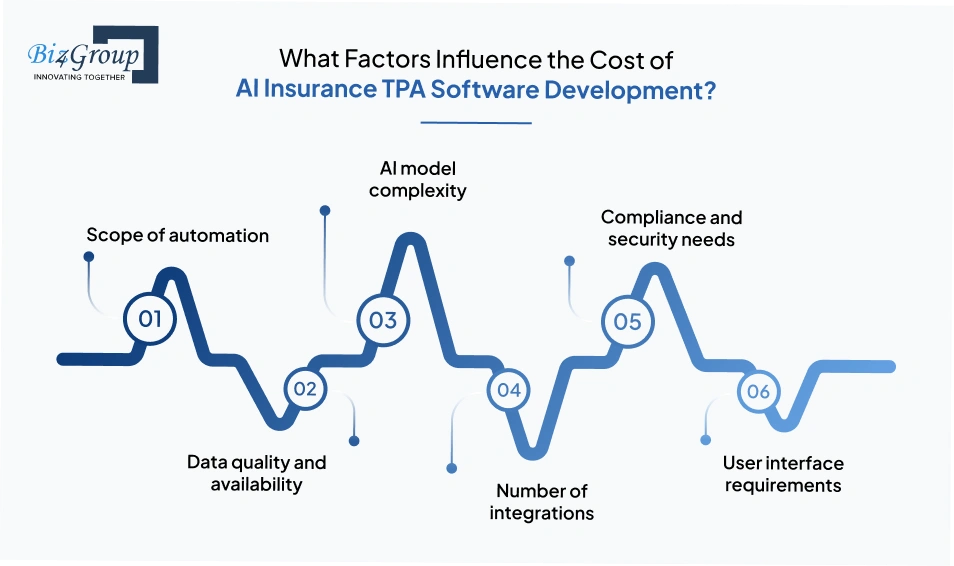
The final cost is not fixed. It depends on several practical factors related to your system and workflows.
1. Scope of automation
Automating only claim intake costs less than automating the full claims lifecycle.
2. Data quality and availability
Poor or unstructured data increases effort for cleaning, labeling, and preparation.
3. AI model complexity
Basic automation is cheaper than building models for fraud detection or decision scoring.
4. Number of integrations
Connecting with policy systems, hospitals, and third-party services increases development effort.
5. Compliance and security needs
Systems handling sensitive data require stronger controls, which adds to cost.
6. User interface requirements
More dashboards, roles, and workflows increase design and development effort.
The development of AI TPA software for insurance is usually done in phases. Starting small helps control cost and risk, while later stages focus on scaling the system based on business needs and data availability.
Plan Your AI-Driven TPA System With Clarity
Build scalable solutions using AI TPA software development for insurance that align with real claims workflows.
Talk to Our AI ExpertsChallenges in AI TPA Software Development for Insurance Systems
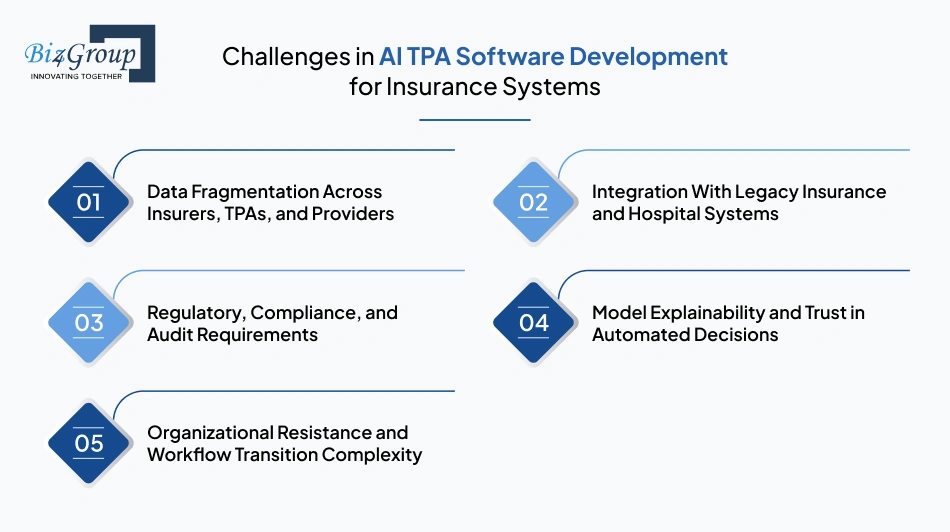
TPA systems involve multiple stakeholders, systems, and data sources. This makes them difficult to modernize. AI TPA software development for insurance improves how claims are processed, but it also introduces challenges that affect speed, accuracy, and system reliability across the claims lifecycle.
The table below explains the key challenges and their practical impact.
|
Challenge |
What It Means |
Why It Matters |
|---|---|---|
|
Data Fragmentation Across Insurers, TPAs, and Providers |
Data is stored in different systems and formats |
Slows claim validation and reduces data accuracy |
|
Integration With Legacy Insurance and Hospital Systems |
Older systems are not built for modern integrations |
Limits real-time processing and increases delays |
|
Regulatory, Compliance, and Audit Requirements |
Systems must follow strict data and decision rules |
Requires detailed tracking and increases development effort |
|
Model Explainability and Trust in Automated Decisions |
AI decisions must be clear and easy to understand |
Needed for audits and to build trust with users |
|
Organizational Resistance and Workflow Transition Complexity |
Teams need to move from manual to AI-supported workflows |
Slows adoption and requires training and process changes |
This is why many organizations work with a custom software development company to handle both new AI capabilities and existing systems.
Understanding these challenges early helps teams build systems that are practical and easier to use. Over time, solving these issues is what enables organizations to fully realize how AI improves TPA operations in insurance claims management, including faster claims processing, better accuracy, and improved coordination.
How to Choose the Right Team for AI Insurance TPA Software Development
Choosing the right team is a critical decision because it directly affects how well your system works in real claims workflows. AI TPA software development for insurance requires more than technical skills. It needs an understanding of claims processing, data flow, and system integration across insurers, TPAs, and providers.
A strong team focuses on solving workflow problems, not just building features.
Capabilities Required for AI Insurance TPA Software Development
The team should be able to design systems and AI models together, not treat them as separate pieces. Key capabilities include:
- Understanding of claims lifecycle and TPA workflows
- Ability to design scalable system architecture
- Experience with data processing and model development
- Strong integration capabilities across multiple systems
- Awareness of compliance and audit requirements
Teams delivering reliable enterprise AI solutions usually combine domain knowledge with technical depth, which becomes important as systems scale.
Upgrade Legacy TPA Systems Without Disruption
Adopt AI insurance TPA software development to modernize workflows while keeping existing systems functional.
Start Your System UpgradeHow to Evaluate Technical Depth Beyond Surface-Level Claims
Most teams can list technologies. The real difference is in how they handle real-world complexity. A simple way to evaluate this is to check how they explain their approach:
|
Area |
What to Look For |
|---|---|
|
Data Handling |
Can they work with incomplete or inconsistent data? |
|
Model Design |
Do they explain how decisions are made, not just outputs? |
|
Integration |
Can they connect multiple systems without delays? |
|
Edge Cases |
Do they account for exceptions and manual overrides? |
If answers are vague, the team may not have production-level experience. Teams working with generative AI should still be able to explain how those models fit into real claims workflows.
Questions to Ask Before Selecting a Development Partner
- Instead of generic questions, focus on real operational scenarios:
- How will the system handle data from different sources and formats?
- What happens when the AI model is not confident about a decision?
- How will manual review and approvals be built into the workflow?
- How will the system improve over time with new data?
These questions help assess practical capability in AI insurance TPA software development.
Red Flags in AI Insurance TPA Software Development Services
Some warning signs are easy to miss but important to catch early:
- Focus only on AI models without discussing workflows
- No clear plan for integrating with existing systems
- Promises of full automation without exception handling
- Lack of clarity around data preparation and usage
How to Compare Companies That Develop AI TPA Software for Insurance Industry in USA
Comparison should be based on fit, not just features or pricing. Focus on:
- Experience in building AI TPA software for insurance companies
- Ability to handle both system design and AI implementation
- Approach to scaling and long-term support
In some cases, organizations choose to hire AI developers when they want more control over development and long-term system evolution.
The right team is one that understands your workflows, handles system complexity, and can scale with your needs as you continue building AI TPA software for insurance companies over time.
Build Scalable TPA Platforms That Actually Work
Use TPA software development with AI to handle high claim volumes, real-time decisions, and multi-system integration.
Design Your AI TPA SolutionWhy Choose Biz4Group LLC to Build AI TPA Software for Insurance Companies and TPAs?
AI TPA software development for insurance requires a team that understands claims workflows, system integration, and how AI fits into real operations, not just isolated features.
Biz4Group LLC works as an AI product development company with experience in building practical insurance-focused systems, including AI-driven platforms for training, support, and operational efficiency. The portfolio examples included earlier reflect how these systems are designed to solve real workflow gaps, not just add surface-level automation.
What sets the approach apart:
- Focus on end-to-end workflows, not just AI models
- Strong experience with system integration across insurers, TPAs, and providers
- Clear approach to handling data, decisions, and exceptions
- Emphasis on scalable architecture for long-term use
- Practical implementation of AI in real insurance environments
Instead of overbuilding from the start, Biz4Group LLC focuses on solving high-impact problems first, then expanding the system based on actual usage and data. This ensures the solution remains usable, maintainable, and aligned with business goals.
Conclusion
Most TPA systems don’t break all at once. They slow down in small ways, manual checks pile up, approvals take longer, and visibility drops as volumes grow.
AI helps, but only when it’s applied with a clear understanding of how claims actually move. The real value comes from fixing specific gaps like document handling, validation, or coordination, not from trying to automate everything in one go.
If you’re planning to build AI software in this space, the focus should stay on what needs to work better today, not what sounds impressive on paper.
Have a use case in mind? Let’s map it into a working AI system.
FAQs
1. What is the difference between a TPA system and an AI-powered TPA system?
A traditional TPA system manages claims, approvals, and coordination using predefined rules and manual workflows. An AI-powered TPA system adds capabilities like document understanding, automated validation, and decision support, which reduce manual effort and improve processing speed.
2. How long does it take to build AI TPA software for insurance?
The timeline depends on scope. A basic system can take 3–5 months, while a more advanced or enterprise-level system may take 6–12 months. Timelines increase with the number of integrations, workflows, and AI models involved.
3. What kind of data is required to develop AI TPA software?
AI systems typically require historical claims data, policy details, document samples (like invoices and reports), and decision outcomes. Clean and well-structured data improves model accuracy, while fragmented data increases development time.
4. Can AI TPA software work with existing insurance systems?
Yes, most AI TPA systems are built to integrate with existing platforms using APIs. However, the effort required depends on how modern or outdated the current systems are.
5. What are the risks of implementing AI in TPA workflows?
Common risks include poor data quality, integration challenges, lack of model transparency, and resistance from teams used to manual workflows. These risks can be managed with phased implementation and proper system design.
6. How much does AI TPA software development for insurance cost?
The cost typically ranges between $40,000 and $300,000+, depending on system complexity, number of workflows, integrations, and AI capabilities. Smaller MVP-level systems cost less, while enterprise-grade platforms require higher investment.
