 Location :
Orlando, FL, USA
Location :
Orlando, FL, USA +1 (407) 714-1616
 info@biz4group.com
- Building an avatar based AI education app creates more engaging, personalized, and interactive learning across schools, enterprises, and therapist training.
- AI avatars boost retention, offer adaptive instruction, and support scalable teaching flows that outperform traditional eLearning.
- Real world use cases range from K12 learning, therapy training simulations, and corporate onboarding to exam prep powered by an AI avatar learning system.
- Core features include AI avatar tutors, assessments, analytics, CMS, multilingual support, and advanced tools like scenario simulations and adaptive learning engines.
- Total cost ranges from $30,000 to $150,000+ depending on features, tech stack, and scope, with Biz4Group helping teams develop avatar based AI education apps faster and smarter.
You know how many online courses and digital classes still feel flat, with lifeless videos, long slides, or chatbots that do not truly teach. This kind of one size fits all learning often leads to bored students, low completion rates, and training programs that never deliver the results you expect.
You deserve something better. Your learners deserve something better. That is why more organizations are choosing to build an avatar-based AI education app that brings instruction to life with human like interaction, adaptive responses, and a level of engagement that traditional eLearning cannot match.
The numbers show why this shift is happening so quickly. The global elearning industry is projected to reach USD 352.6 billion in 2025.
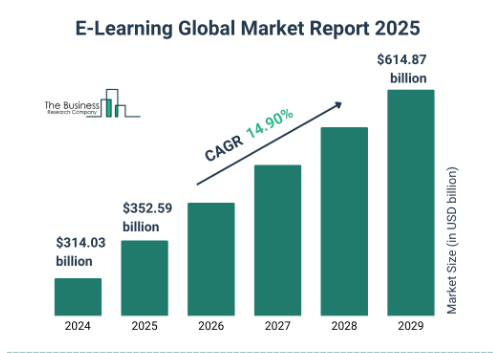
At the same time, the AI in education market is expected to hit USD 6.9 billion in 2025.
If you plan to develop an avatar-based AI education app or build a more advanced AI avatar learning system, the timing could not be better. The demand for flexible digital learning continues to rise, and the gap between what learners want and what most platforms deliver keeps widening. Building an avatar powered platform now positions your organization ahead of competitors while giving you a scalable way to personalize lessons for schools, enterprises, and therapist training programs.
In this guide, we walk you through everything you need to know. You will see why avatar-based learning is gaining momentum, what features matter most, how development actually works, and what kind of investment to plan for. Think of this as your step by step roadmap to create a future ready platform, supported by insights from our work building a educational AI app for organizations that need more interactive and effective learning experiences.
Whenever you are ready, let us dive in together.
Why It Is the Perfect Time to Build an Avatar-Based AI Education App
If you have felt frustrated with outdated digital learning tools, you are not the only one. Many education leaders tell us their current platforms are not keeping up with modern expectations. Engagement dips fast; instructors feel stretched, and training programs struggle to scale without losing quality.
This is exactly why now is the perfect time to build an avatar-based AI education app. You have the chance to shift from generic lessons to a more interactive, human-like experience that keeps learners involved. Organizations across K12, universities, therapist training programs, and corporate learning are already moving toward avatar-based AI education app development because it offers personalization that traditional eLearning cannot match.
AI avatars act as responsive digital instructors. When you develop an avatar-based AI education app, you combine adaptive teaching, real-time conversation, and consistent guidance in one system. This approach is becoming the new standard for anyone looking to create AI powered lessons or build a scalable AI avatar learning system.
You also benefit from a stronger technological landscape. Avatar engines, LLM performance, and voice systems have advanced enough to handle realistic interactions. Many growing EdTech teams now work with an AI development company to build stable architectures or rely on integrating AI to their app with learning systems, analytics tools, or content pipelines. Others choose to partner with a custom software development company to accelerate development and reduce risk.
Here are a few reasons why this moment is ideal for avatar-based AI education app development:
- Learners want more interaction and prefer platforms that include avatars, voice-based support, and conversation-driven lessons.
- Institutions are shifting to smarter tools and adopting solutions that make training more adaptive and scalable.
- Technology for AI avatar-based teaching is mature, from natural speech to intelligent responses and animated avatars.
- The cost to make avatar-based AI learning apps is more achievable, even for mid-sized teams.
- You can launch faster, especially when supported by experts who know how to build and optimize AI-driven education platforms.
The timing is right. Technology is stable. And the opportunity to lead in next generation learning has never been stronger.
If you have been waiting for a clear signal to move forward, this is it.
Ready to turn your learning ideas into an avatar powered reality
Great things start with one smart step. If your learners deserve more than slides and quizzes, let’s build something they actually enjoy.
Start Your AI Avatar JourneyBenefits That Matter When You Develop an Avatar-Based AI Education App
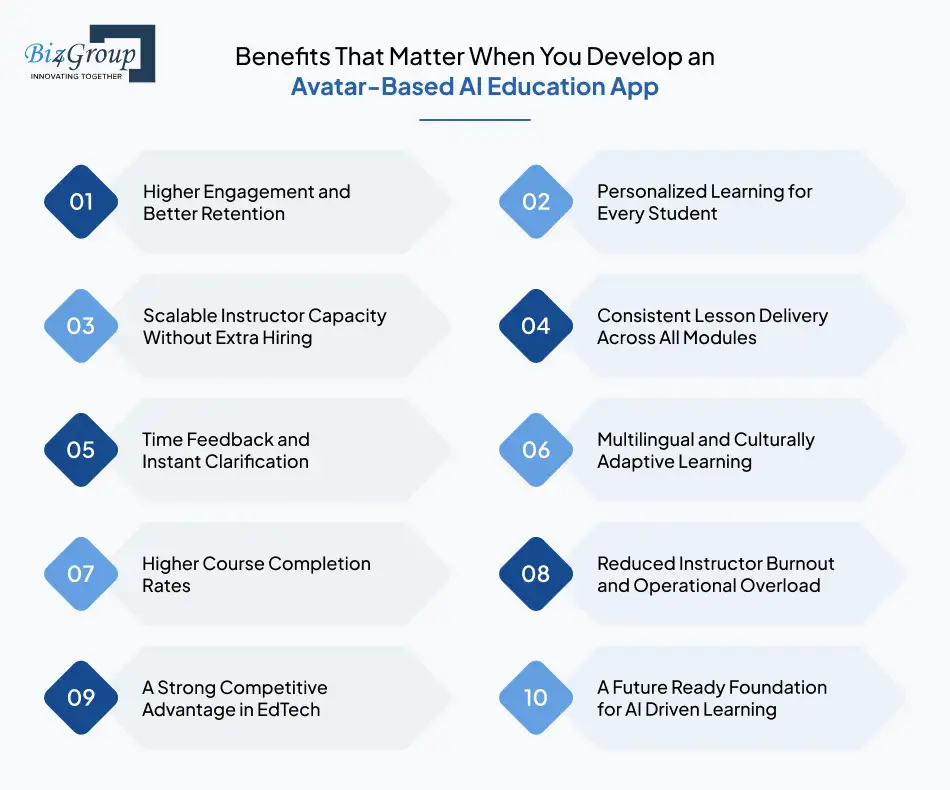
When you choose to develop an avatar-based AI education app, you move beyond traditional online learning and into a more interactive, human-centered experience. Schools, universities, therapist training institutes, and corporate L and D teams rely on these systems because they create better outcomes, require less manual effort, and scale much faster than instructor led sessions.
Below are the top benefits that matter most when you build an AI avatar learning system for any educational environment.
1. Higher Engagement and Better Retention
Learners stay involved when the experience feels alive. AI avatars speak, react, guide, and encourage, which keeps attention high throughout the lesson. This makes a major difference when you create AI avatar education platforms for subjects where students traditionally lose interest quickly.
2. Personalized Learning for Every Student
No two learners absorb information the same way. When you make avatar-based AI learning apps, your avatar can adjust explanations, difficulty levels, and pacing based on each student’s needs. If your strategy includes deeper adaptive learning, integrating an AI agent helps personalize instruction even further.
3. Scalable Instructor Capacity Without Extra Hiring
AI avatars support thousands of learners at the same time without needing more staff. This is one of the strongest reasons organizations build AI powered avatar tutoring apps and reduce repetitive teaching tasks. Instructors can focus on higher value interactions while the avatar handles foundational guidance.
4. Consistent Lesson Delivery Across All Modules
Human instructors vary in teaching styles. An avatar delivers lessons consistently every time. This is especially valuable when you create an avatar-based AI app for therapy training and counseling education, where accuracy and consistency are essential for skill development.
5. Time Feedback and Instant Clarification
Learners often get stuck simply because they cannot ask questions in the moment. AI avatars solve this by offering real-time responses, additional explanations, and repeat demonstrations. This is a key advantage when teams develop AI avatar-based teaching platforms for structured learning paths.
6. Multilingual and Culturally Adaptive Learning
When your learner base spans regions and languages, avatars help you reach them all. They can switch languages, modify tones, and simplify explanations to support global or diverse audiences. This makes avatar-based digital learning systems ideal for inclusive education.
7. Higher Course Completion Rates
Avatars guide learners through each step, give encouragement, and help them get past confusing concepts. This leads to higher completion rates and better outcomes, especially when your platform functions like an AI-driven study companion.
8. Reduced Instructor Burnout and Operational Overload
Educators often repeat the same instructions day after day. AI avatars reduce this burden by taking over repetitive teaching tasks. This frees your team to focus on mentoring, supervision, and advanced topics, improving overall learning quality.
9. A Strong Competitive Advantage in EdTech
When you invest in avatar-based AI education app development, your platform becomes more engaging, modern, and differentiated. Institutions prefer tools that offer meaningful interaction, which helps your product stand out in a competitive EdTech landscape. Many organizations pair this with enterprise AI solutions to support large scale deployments.
10. A Future Ready Foundation for AI Driven Learning
Once you build AI avatar classrooms for online training programs, you can layer on simulation-based practice, branching scenarios, or immersive modules. Your platform becomes ready for the next generation of learning innovations.
High Impact Use Cases for Avatar-Based AI Education Apps
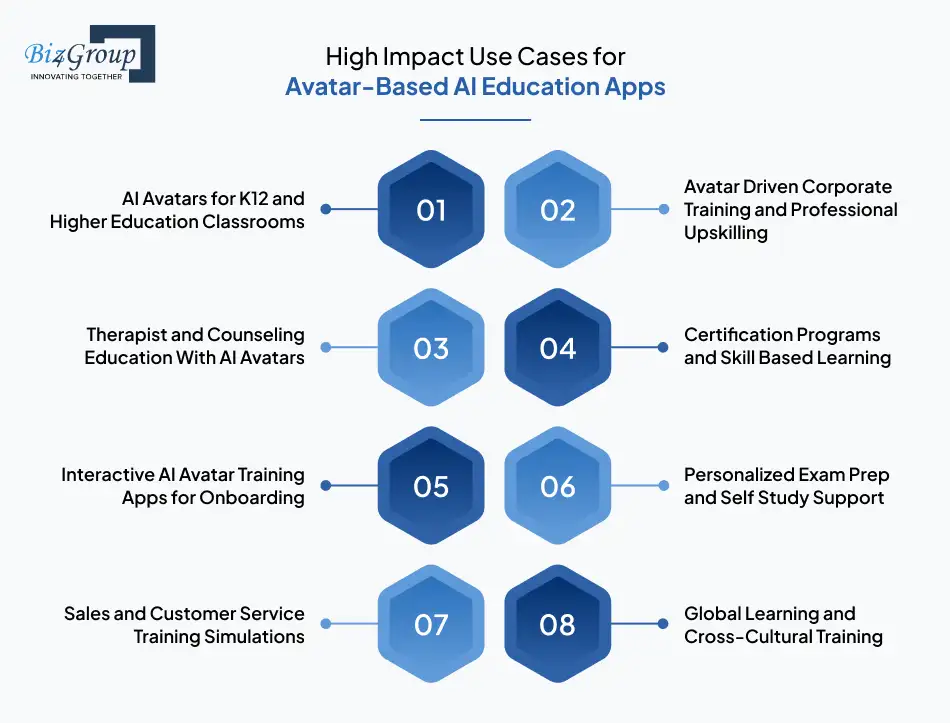
When you build an avatar-based AI education app, you give learners a smarter and more interactive way to understand complex topics. These platforms fit naturally into K12 classrooms, universities, therapist training programs, certification courses, and corporate learning environments. Each use case below shows how organizations benefit when they develop an avatar-based AI education app or scale into a full AI avatar learning system built for modern digital learning.
1. AI Avatars for K12 and Higher Education Classrooms
Schools and universities want to personalize learning but often lack the resources to do it consistently. When you create AI avatar education platforms, every student gets a responsive digital instructor who explains lessons, answers questions, and reinforces concepts in real time.
Example:
A middle school science class uses an avatar to guide students through each experiment. Learners ask questions, review steps, and get simplified explanations when needed. The teacher can focus on hands on activities while the avatar manages foundational instruction.
These platforms often evolve into a complete AI classroom app that supports lessons, homework, assessments, and student progress tracking.
This is one of the strongest use cases when you make avatar-based AI learning apps for academic institutions.
2. Avatar Driven Corporate Training and Professional Upskilling
Enterprises need scalable, repeatable training for global teams. When you build AI powered avatar tutoring apps, your organization gets consistent training without scheduling conflicts or instructor overload.
Example:
A logistics company uses an avatar to train new employees on workplace safety. The avatar demonstrates tasks, asks questions, and helps staff correct mistakes. Managers track employee performance through built-in analytics.
Many organizations reinforce this onboarding and training model using connected AI automation services to streamline operations.
This is an ideal use case when you develop AI avatar-based teaching platforms for large teams.
3. Therapist and Counseling Education With AI Avatars
Therapists and counselors need practice, not theory. When you create an avatar-based AI app for therapy training and counseling education, your learners can practice complex emotional scenarios without pressure.
Example:
A counseling student interacts with an avatar that simulates a stressed or anxious client. The avatar reacts with realistic emotion, adjusts tone, and responds based on the student’s choices. After the conversation, the learner receives feedback on empathy, clarity, and pacing.
Biz4Group built a real-world version of this through NextLPC. Designed for aspiring licensed professional counselors, this platform helps students prepare for LPC board exams using AI driven scenarios and adaptive guidance.
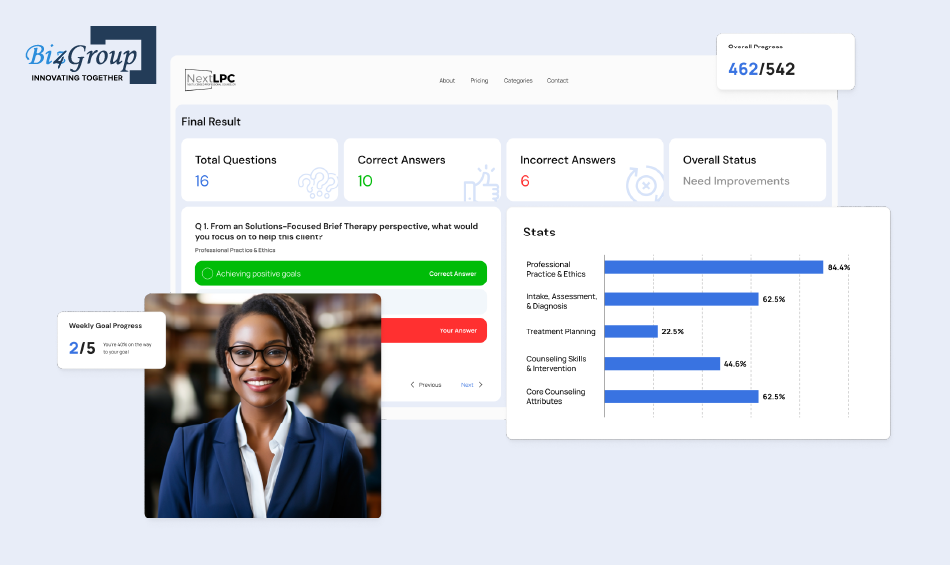
Key elements of the NextLPC project include:
- Guided AI powered coaching modules designed for exam readiness
- Realistic role play situations powered by scenario-based training
- Continuous feedback loops for performance improvement
- Adaptive study paths that adjust to learner strengths
- Consistent, structured lesson delivery across all topics
This is one of the strongest examples of how organizations develop AI avatar-based teaching platforms for real world skills.
4. Certification Programs and Skill Based Learning
Certification courses require accuracy and structure. When you build an AI avatar learning system for certification paths, your learners receive the same high-quality instruction every time.
Example:
A healthcare certification program uses an avatar tutor to teach patient communication, emergency basics, and exam preparation. The avatar adjusts difficulty as learners improve, offering targeted feedback after every session.
Large scale programs often integrate this training model with enterprise AI solutions to support thousands of learners across different departments and regions.
5. Interactive AI Avatar Training Apps for Onboarding
Employee onboarding often involves repetitive instructions and tool walkthroughs. When you make AI avatar education software for therapists, teachers, or corporate teams, you eliminate this repetitive burden.
Example:
A SaaS company introduces an avatar to guide new hires through internal tools, documentation, and workflows. Employees can ask questions freely without waiting for a manager, improving confidence and ramp up time.
This is a natural use case when teams develop an avatar-based AI education app for workforce readiness.
6. Personalized Exam Prep and Self Study Support
Self-study can feel isolating. When you build AI powered avatar tutoring apps, the avatar becomes a study coach that adapts to student strengths and weaknesses.
Example:
A student preparing for a math exam uses an avatar that explains problems step by step, highlights weak areas, and builds a personalized practice plan. The learner gets ongoing support without needing a human tutor.
This model aligns closely with the structure of an AI study companion app for exam preparation.
7. Sales and Customer Service Training Simulations
Customer-faced roles require practice with real interactions. AI avatars simulate buyers, clients, or unhappy customers so learners can practice safely.
Example:
A retail chain uses an avatar to act as a frustrated customer. Trainees practice communication, empathy, and problem solving in a controlled environment. The avatar gives instant feedback on tone, clarity, and approach.
This is an excellent use case when you develop customized AI avatar instructors for professional skill training.
8. Global Learning and Cross-Cultural Training
If your learners span countries and cultures, avatars help you scale your learning system without recreating content from scratch.
Example:
A multinational HR team uses an avatar instructor that switches languages and tailors examples to match local norms. The content remains consistent, but the learning experience feels local and relatable.
This use case is ideal for organizations that create AI avatar driven digital lessons for aspiring therapists, students, or global teams.
Must Have Features When You Build an Avatar-Based AI Education App
When you build an avatar-based AI education app, you need strong foundational features that support interaction, personalization, and smooth delivery. These features create the core learning experience and prepare your system for any advanced capabilities you plan to add later.
Below are the essential features every avatar-driven learning platform requires.
1. AI Driven Avatar Tutor for Real Time Interaction
Your avatar tutor is the center of your platform. It should respond instantly, guide learners' step by step, and adapt explanations based on user behavior. When you make avatar-based AI learning apps, this feature creates a live teaching presence inside your software.
Key elements:
- Natural conversation through text or voice
- Responsive explanations
- Emotion aware tone adjustments
- Personalized learning flow
2. Avatar Customization Options for Different Personas
Learners connect better when the avatar feels relatable. Customizable avatars allow your platform to serve different age groups, industries, or learning environments. This is crucial when you create AI avatar education platforms for diverse populations.
Key elements:
- 2D or 3D avatar options
- Voice and accent customization
- Persona and personality selection
- Inclusive and culturally relevant designs
3. Structured Lesson and Module Delivery
Clear content delivery keeps learners on track. When you develop an avatar-based AI education app, your system should support structured modules that the avatar guides users through with clarity and repetition.
Key elements:
- Lesson sequencing
- Step based content delivery
- Visual or multimedia support
- Auto save progress
4. Interactive Assessments and Skill Checks
Built in assessments help measure understanding in real time. This is essential when creating AI powered avatar tutoring apps or professional training tools that rely on competency-based progress.
Key elements:
- Auto graded quizzes
- Branching scenarios
- Adaptive difficulty
- Immediate feedback
5. Real Time Feedback and Guidance
Learners often need immediate help. Your avatar should offer guidance whenever a student feels stuck. This is one of the biggest advantages of building AI avatar learning systems over static eLearning.
Key elements:
- Step by step corrections
- Helpful hints and prompts
- Encouragement and motivation
- Extra practice suggestions
6. Learner Progress Tracking and Analytics
Administrators and instructors need clear insights into learner performance. Analytics help you refine content and support users more effectively.
Key elements:
- Progress dashboards
- Skill tracking
- Completion data
- Reporting tools
7. Content Management System for Easy Updates
A flexible CMS reduces development time and allows you to update lessons instantly. When you develop AI avatar-based teaching platforms, a strong CMS becomes the backbone of content operations.
Key elements:
- Editable lessons and modules
- Drag and drop interface
- Multimedia support
- Version control
8. Multilingual Support and Localization Tools
If your platform supports global learners, multilingual capabilities are essential. Avatar-based digital learning systems must adapt to different languages and cultural nuances to feel personalized.
Key elements:
- Multiple language packs
- Region specific examples
- Tone adjustments per culture
- Localized terminology
9. Secure User Profiles and Role Based Access
Protecting learner information should be a priority. Role based access ensures safe data handling for students, instructors, and administrators.
Key elements:
- Role permissions
- Secure authentication
- Encrypted data
- Privacy controls
10. Seamless UI and Easy Navigation
Your platform should feel effortless to use. A clean interface helps students focus on learning rather than figuring out the system.
Key elements:
- Simple layout
- Mobile friendly interface
- Smooth lesson navigation
- Accessibility support
11. Integration Capabilities With Existing Systems
Many organizations already use LMS platforms, HR tools, or internal training systems. Your app should integrate smoothly into these environments.
Key elements:
- API support
- LMS integration
- Data syncing
- Single sign on options
Thinking these features would look good in your own AI avatar app
They absolutely would. Let’s bring them to life in a way your learners will remember, not just click through.
Build Your Feature Rich AppAdvanced Features That Elevate Your Avatar-Based AI Education App
Once you include the core features, the next step is adding advanced AI capabilities that make your platform more immersive, intelligent, and scalable. These enhancements are essential when you build an avatar-based AI education app or develop an avatar-based AI education app for universities, therapist training programs, EdTech companies, and enterprise learning divisions.
The features below help you create a future ready AI avatar learning system that adapts to different teaching styles, diverse learners, and real time training demands.
|
Advanced Feature |
Explanation |
Why It Matters |
|
Emotion Aware AI Avatars |
The avatar detects tone, sentiment, and learner frustration to respond with empathy or clarity. |
Helps you build AI avatar learning systems that feel human and supportive. |
|
Adaptive Learning Engine |
Lessons adjust automatically based on skill level, behavior, and performance patterns. |
A core component when you create AI avatar education platforms for personalized learning. |
|
Scenario Based Simulations |
Real-time conversation simulations for therapy, counseling, sales, and customer service training. |
Essential for anyone creating an avatar-based AI app for therapy training and counseling education. |
|
The avatar understands natural human speech for smooth back and forth dialogue. |
Increases immersion in avatar-based digital learning systems and interactive training environments. |
|
|
Generative AI for Lesson and Quiz Creation |
Auto creates quizzes, flashcards, scenarios, and sample dialogues from your content. |
Saves time for teams that build AI-powered avatar tutoring apps or large course libraries. |
|
3D and Hyper Realistic Avatars |
High fidelity avatars with facial expressions, gestures, and natural movements. |
Makes avatar-based AI education app development more engaging and memorable. |
|
Branching Dialogue and Decision Trees |
Learners explore multiple outcomes based on their choices. |
Ideal for teams that develop customized AI avatar instructors for professional skill training. |
|
AI Powered Coaching and Skill Insight |
Evaluates communication, empathy, reasoning, and accuracy during training. |
Supports deeper skill development when you create interactive AI avatar training apps. |
|
Knowledge Graph Integration |
Connects the avatar to structured datasets for context aware explanations. |
Enhance accuracy when you develop AI avatar-based teaching platforms for technical subjects. |
|
Reinforcement Learning Engine |
The avatar improves over time based on learner interactions. |
Creates more effective long-term learning in any avatar-based AI education app. |
|
Instructor and Content Assist Tools |
AI suggests lesson flows, quiz ideas, and content fixes. |
Helps you make AI avatar education software that reduces teacher workload. |
|
Enterprise LMS and Workflow Integration |
Connect your app with enterprise tools, LMS systems, and L&D workflows. |
Ideal for organizations scaling through advanced AI integration services. |
|
A 24/7 conversational agent that answers questions and guides learners. |
Perfect for apps created with the support of an expert AI chatbot development company. |
Step by Step Roadmap to Develop an Avatar-Based AI Education App
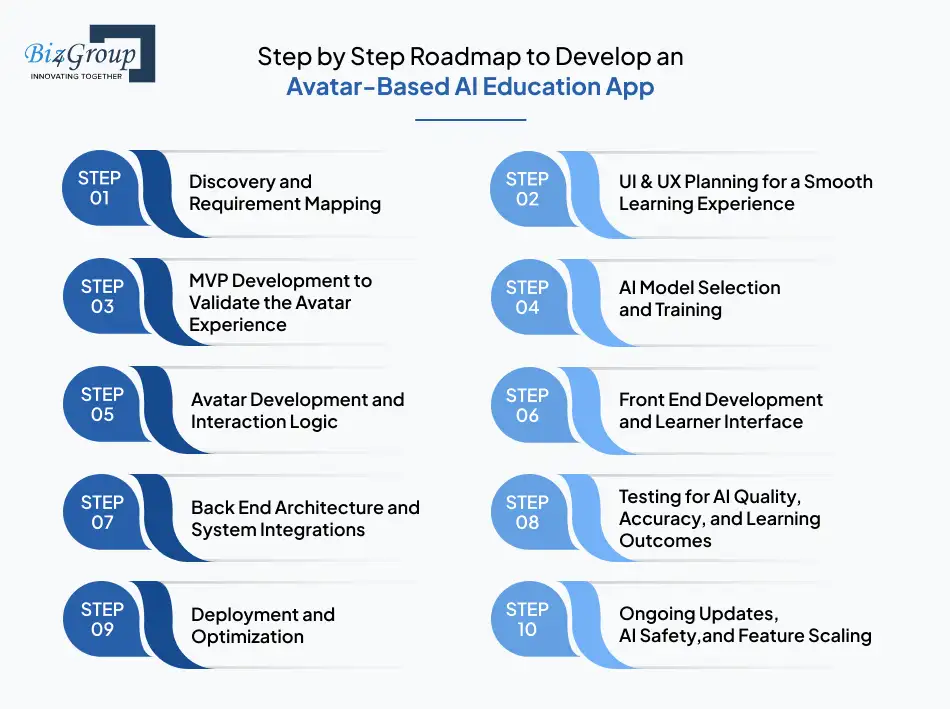
Building a successful learning platform requires a clear, structured process. Whether you want to build an avatar-based AI education app, create AI avatar education platforms for universities, or make avatar-based AI learning apps for therapist training, following these steps ensures your product is scalable, reliable, and ready for long term growth.
Below is the complete development roadmap used in top tier avatar-based AI education app development projects.
Step 1: Discovery and Requirement Mapping
This is where you define the purpose and core value of your platform. You outline the learning problems you want to solve and determine the role your avatar will play. This step is essential whether you aim to develop AI avatar-based teaching platforms or build AI avatar classrooms for training programs.
Key tasks:
- Identify your target learners
- Define core outcomes for students or trainees
- Prioritize must have AI avatar behaviors
- Establish success metrics and KPIs
Step 2: UI & UX Planning for a Smooth Learning Experience
A clean, intuitive interface is essential when you develop an avatar-based AI education app. The right design helps learners focus on lessons instead of figuring out the platform. Working with skilled UI UX design experts ensures your app feels simple, warm, and highly engaging.
Key tasks:
- Create user journeys for different learner groups
- Build wireframes and prototypes
- Design accessible, mobile friendly interfaces
- Plan smooth lesson navigation flows
Step 3: MVP Development to Validate the Avatar Experience
Instead of building the entire system at once, teams start with an MVP. This allows you to validate your AI avatar, test user reactions, and refine core interactions. MVPs are especially useful when you create interactive AI avatar training apps or develop customized AI avatar instructors.
Use MVP development to avoid unnecessary costs and validate early.
Key tasks:
- Select essential features for launch
- Build a working prototype
- Test avatar interaction quality
- Collect early user feedback
Step 4: AI Model Selection and Training
Your avatar’s intelligence depends on the AI model behind it. You train the system with domain specific data, especially if you want to create AI avatar driven digital lessons for aspiring therapists or build AI avatar learning systems for professional certification.
Key tasks:
- Choose the right LLM
- Train AI model on course content or domain material
- Add conversation rules and safety layers
- Fine tune LLM for accuracy and relevance
Step 5: Avatar Development and Interaction Logic
This is where your avatar gains personality and teaching ability. You define how it speaks, gestures, reacts, and teaches. This step is critical when you create an avatar-based AI app for therapy training, soft skills learning, or corporate coaching.
Key tasks:
- Build 2D or 3D avatar models
- Assign voice, tone, and persona traits
- Map decision trees and learning flows
- Create gestures and micro expressions
Step 6: Front End Development and Learner Interface
Front end development brings your UI to life with smooth interactions. A strong interface is essential whether you build AI powered avatar tutoring apps or simple avatar based digital learning systems.
Key tasks:
- Implement lesson screens and menus
- Add interaction controls and buttons
- Integrate multimedia and assessments
- Optimize for web and mobile access
Also Read: React JS Development Services
Step 7: Back End Architecture and System Integrations
Your back end is responsible for performance, security, and scalability. This stage is crucial when you make AI avatar education software for therapists, enterprise L&D teams, or global education programs.
Key tasks:
- Build secure databases
- Connect LMS or HR systems
- Set up APIs and cloud servers
- Sync learner progress and analytics
Step 8: Testing for AI Quality, Accuracy, and Learning Outcomes
Testing ensures the avatar teaches correctly, responds accurately, and guides learners effectively. This matters for all types of apps, from avatar-based digital learning systems to AI avatar learning systems for professional skill development.
Key tasks:
- Functional testing
- AI accuracy validation
- User experience testing
- Performance and load checks
Step 9: Deployment and Optimization
Once everything is tested, you deploy your platform. After launch, you monitor learner behavior to refine avatar interactions and improve lesson paths.
Key tasks:
- Deploy on cloud or app stores
- Track early user activity
- Analyze retention and learning flow
- Improve logic and content based on insights
Step 10: Ongoing Updates, AI Safety, and Feature Scaling
Learning needs evolve. Your platform should evolve with them. This stage focuses on adding advanced capabilities to support long term growth when you build an avatar-based AI education app or expand into a full AI avatar learning system.
Key tasks:
- Update lessons and modules
- Enhance avatar intelligence
- Add new training paths
- Maintain strict AI safety protocols
Tech Stack Required to Build an Avatar-Based AI Education App
Choosing the right tech stack is one of the most important steps when you build an avatar-based AI education app or develop an avatar-based AI education app that needs to scale reliably. The right tools help you create lifelike AI avatars, fast interactions, smooth content delivery, and a secure learning environment. Below is a complete breakdown of the technologies used in modern avatar-based AI education app development.
|
Category |
Technologies / Tools |
Why It Matters |
|
Programming Languages |
Python, TypeScript, JavaScript |
Ideal for building AI logic, front end interactions, and scalable back-end services. |
|
Front End Frameworks |
React, Next.js, Vue.js |
Ensure smooth UI rendering and responsive interaction when you make avatar-based AI learning apps. |
|
Back End Frameworks |
Node.js, Django, FastAPI |
Handle authentication, APIs, learning modules, and system logic efficiently. |
|
AI / ML Models |
LLMs like GPT, Llama, Mistral, custom fine-tuned models |
Power natural conversation, personalization, and adaptive learning in your AI avatar learning system. |
|
Avatar Rendering Engines |
Unity, Unreal Engine, WebGL, Ready Player Me |
Create 2D, 3D, or hyper realistic avatars with smooth gestures and animations. Ideal for teams using an AI avatar development company. |
|
Speech Processing |
Whisper, Azure Speech Services, Amazon Polly |
Enable real-time speech recognition and natural voice responses for interactive AI avatar training apps. |
|
Generative AI Tools |
OpenAI, AWS Bedrock, Hugging Face |
Generate scenarios, quizzes, summaries, or explanations automatically. |
|
Database Systems |
PostgreSQL, MongoDB, Firebase |
Store user profiles, lesson progress, assessments, and avatar interaction data securely. |
|
Cloud Hosting |
AWS, Google Cloud, Azure |
Provide scalability and reliability when you grow your avatar-based digital learning system. |
|
Real Time Communication |
WebRTC, Socket.io |
Required for real-time avatar reactions, voice chat, and dynamic lesson flow. |
|
Learning Management Integrations |
SCORM, xAPI, LTI connectors |
Essential when you integrate with existing LMS platforms inside organizations. |
|
Analytics & Monitoring |
Mixpanel, Google Analytics, Elastic Stack |
Track learner behavior, avatar performance, and training outcomes. |
|
Security & Compliance |
JWT, OAuth2, SSL/TLS encryption |
Protect learner data and ensure safe interaction across your platform. |
|
DevOps & CI/CD |
Docker, Kubernetes, GitHub Actions |
Maintain continuous updates and stable releases for your avatar-powered learning platform. |
|
Third Party APIs |
Payment gateways, video libraries, SSO providers |
Add monetization, content delivery, and seamless login capabilities. |
|
Development Partner |
It helps accelerate development, optimize architecture, and ensure smooth integration of all AI components. |
Cost Breakdown to Build an Avatar-Based AI Education App
If you are planning to build an avatar-based AI education app, it helps to understand the budget required. Most projects fall between $30,000 and $150,000+, depending on your features, level of AI complexity, and whether you want a simple MVP or a full-scale AI avatar learning system. Your exact investment may vary, but this guide gives you a realistic starting point based on common EdTech and training use cases.
For deeper financial planning, you can also review a complete guide on the cost to develop AI solutions for EdTech.
Below is a detailed breakdown of what impacts the cost when you develop an avatar-based AI education app.
Feature Wise Cost Breakdown for Avatar-Based AI Education App Development
The table below outlines core features, advanced AI capabilities, and their typical cost range.
|
Feature / Module |
Description |
Estimated Cost |
|
AI Driven Avatar Tutor |
Real time conversation, adaptive responses, basic gestures |
$8,000 to $25,000 |
|
3D or Hyper Realistic Avatar |
High fidelity animation, facial expressions, motion sync |
$12,000 to $40,000 |
|
Avatar Customization System |
Multiple personas, voices, accents, appearance settings |
$6,000 to $20,000 |
|
Adaptive Learning Engine |
Personalized lesson paths, skill based adjustments |
$10,000 to $35,000 |
|
Interactive Lessons & Modules |
Structured content, videos, step by step explanations |
$4,000 to $12,000 |
|
Gamified Assessments |
Quizzes, skill checks, branching scenarios |
$5,000 to $15,000 |
|
Scenario Based AI Simulations |
Therapy training, soft skill practice, role play modules |
$15,000 to $45,000 |
|
Speech to Text & Voice AI |
Voice input, avatar speech response, real time processing |
$6,000 to $18,000 |
|
Analytics & Progress Tracking |
Dashboards, skill insights, engagement stats |
$5,000 to $15,000 |
|
LMS or System Integrations |
SCORM, xAPI, LTI, HRMS integration |
$6,000 to $20,000 |
|
Admin Panel & CMS |
Content management, course builder, role access |
$5,000 to $18,000 |
|
$10,000 to $40,000 |
||
|
Advanced AI Coaching |
AI powered feedback on tone, empathy, pacing, skill mastery |
$10,000 to $30,000 |
|
Reinforcement Learning Engine |
Avatar improvement based on learner interactions |
$8,000 to $25,000 |
Building advanced or enterprise ready avatar-based AI education app development solutions typically pushes total cost toward the higher end of the range.
Factors Affecting the Cost to Develop an Avatar-Based AI Education App
Many elements shape the final investment when you create AI avatar education platforms or make avatar-based AI learning apps:
1. Complexity of the AI Avatar
More realistic avatars with advanced expressions and gestures cost more due to modeling, voice training, and animation work.
2. Depth of Learning Logic
Platforms with adaptive or skill based AI require advanced development and model tuning.
3. Number of Features and Modules
Adding LMS integrations, scenario training, or advanced analytics increases cost.
4. Level of Personalization
The more personalized your AI powered avatar tutoring apps become, the more data training and model refinement are required.
5. Platform Type
Web only apps cost less; mobile plus web apps increase development time.
6. Integration Requirements
Connecting your avatar based digital learning system to HR tools, LMS platforms, or enterprise workflows affects cost.
7. Backend Architecture
A scalable cloud backend is essential if you want to build AI avatar classrooms for online training programs with high daily activity.
Hidden Costs You Should Consider Before You Build an Avatar-Based AI Education App
These are often overlooked but influence long term budget:
- AI model training fees
- API usage costs for speech, vision, or avatar rendering
- Ongoing cloud hosting for real time learning
- Data storage for progress tracking
- Content creation for modules and scenarios
- Compliance and security maintenance
- Testing across multiple devices and browsers
Failing to plan for these can cause cost overruns later.
Cost Optimization Tips for Avatar-Based AI Education App Development
If you want to develop an avatar-based AI education app while staying within budget, consider these strategies:
Start With an MVP
Use a focused feature set, test your avatar interactions early, and expand based on real user feedback.
Reuse Templates and Components
Avoid building every module from scratch.
Use Prebuilt AI Features Where Possible
Speech recognition, text generation, and avatar rendering engines reduce cost.
Focus on High Impact Learning Features First
Build core training modules before adding complex scenarios.
Optimize Content Creation
Let AI assist with quiz creation, summaries, and lesson formatting.
Choose Scalable Cloud Services
Helps reduce costs as your AI avatar learning system grows.
Want a clearer idea of what your AI avatar app will cost
A smart budget makes a smart build. Let’s map out your numbers before you start writing checks.
Get a Custom Cost EstimateChallenges and Solutions When You Build an Avatar-Based AI Education App
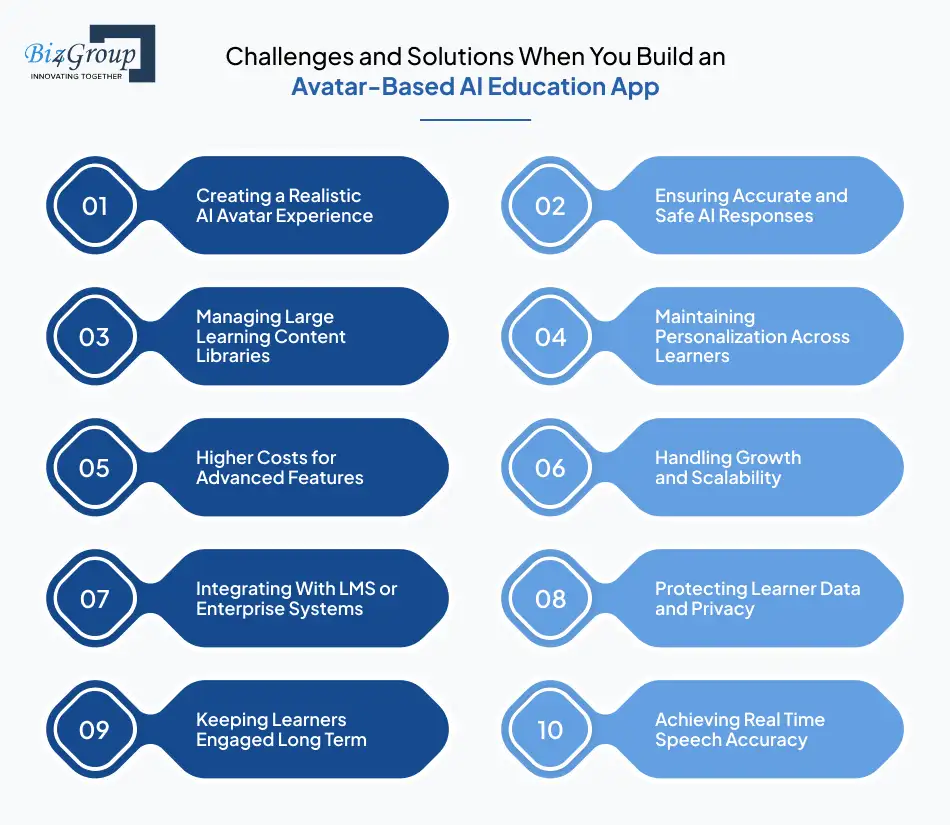
Every team faces obstacles when they start to build an avatar-based AI education app, whether it supports schools, therapist training, certification programs, or corporate L&D teams. The good news is each challenge can be managed with the right strategy, tools, and planning. Having expert guidance from an experienced AI development companies in USA makes the development process smoother and reduces the risk of costly mistakes.
Below is a complete table outlining the most common challenges in avatar-based AI education app development and how to solve them effectively.
|
Challenge |
Why It Happens |
How to Solve It |
|
Creating a Realistic AI Avatar Experience |
High fidelity avatars require modeling, voice, gestures, and teaching logic, especially when you make avatar-based AI learning apps. |
Start with lightweight avatar versions and upgrade after user validation; refine expressions and conversational flows over time. |
|
Ensuring Accurate and Safe AI Responses |
AI may produce off-topic or incomplete answers in complex learning scenarios. |
Train the model with domain specific datasets; add guardrails, context windows, and validation layers for a reliable AI avatar learning system. |
|
Managing Large Learning Content Libraries |
Education platforms often require hundreds of lessons, modules, and assessments. |
Use a strong CMS and rely on AI to generate quizzes, practice questions, and summaries to support scalable avatar-based digital learning systems. |
|
Maintaining Personalization Across Learners |
Personalized learning paths require continuous adaptive tuning in advanced systems. |
Monitor learner performance and periodically retrain your AI engine to improve personalization in your AI avatar-based teaching platform. |
|
Higher Costs for Advanced Features |
Scenario simulations, realistic avatars, and adaptive engines increase investment. |
Launch an MVP first, then scale; reuse templates and adopt proven frameworks to reduce the cost of developing an avatar-based AI education app. |
|
Handling Growth and Scalability |
Real-time speech, avatar rendering, and large user loads can strain systems. |
Use scalable cloud hosting, efficient APIs, and optimized architecture to support thousands of learners. |
|
Integrating With LMS or Enterprise Systems |
Enterprises often use existing HR, LMS, or L&D tools that require seamless integration. |
Use SCORM, LTI, and xAPI standards; plan integrations early when you build AI avatar classrooms for online training programs. |
|
Protecting Learner Data and Privacy |
Sensitive student or therapist training data requires strict compliance. |
Add encryption, secure role-based access, and compliance aligned workflows from day one. |
|
Keeping Learners Engaged Long Term |
Learners may lose interest if the avatar becomes predictable or repetitive. |
Add new modules, branching paths, and periodic avatar behavior updates to refresh the experience. |
|
Achieving Real Time Speech Accuracy |
Voice recognition may struggle with noise, accents, or fast speech. |
Use high quality speech engines and allow learners to switch between voice and text input to keep your interactive AI avatar training app smooth. |
Advanced Learning Contexts Where These Solutions Matter Most
The solutions above apply directly to:
- Developing customized AI avatar instructors for professional training
- Making avatar-based AI learning apps for K12 and universities
- Creating interactive AI avatar training apps for therapists
- Building AI avatar classrooms for online learning
- Designing avatar-based AI education apps for global training teams
For a deeper look into the future of learning, you can also explore how AI is transforming digital education on AI in eLearning.
Embark on Your AI Avatar Learning App Journey With Biz4Group
If you are ready to build an avatar-based AI education app that feels human, adaptive, and truly personalized, Biz4Group is the partner that helps you turn ideas into real outcomes. Whether your goal is to develop an avatar-based AI education app for schools, create AI avatar education platforms for therapist certification, or make avatar-based AI learning apps for enterprise training, our team brings the technical and strategic experience required to deliver results.
We have already proven this through platforms like NextLPC, a real-world example of advanced avatar-based AI education app development. The solution supports aspiring counselors with AI-driven scenarios, practice modules, and avatar-guided learning paths. It demonstrates what is possible when a training platform combines intelligent tutoring; realistic interaction, and adaptive study flows into a single, user-friendly experience.
Biz4Group specializes in helping organizations build AI powered avatar tutoring apps, develop AI avatar-based teaching platforms, and design engaging interactive AI avatar training apps that align with real learner needs. Whether you need an early MVP or a full-scale AI avatar learning system, our approach focuses on clarity, quality, and long-term scalability.
If your project requires a dedicated technical team to accelerate timelines or expand capabilities, you can directly hire AI developers experience in LLMs, avatar systems, generative AI, and adaptive learning engines. This gives you access to the exact skill set needed to build world class avatar-driven learning experiences.
Biz4Group also supports institutions and EdTech brands looking to create smarter, more intuitive learning environments. Our work in AI EdTech software ensures your platform is built on strong architecture, seamless user journeys, scalable AI models, and reliable classroom ready performance.
If you want to create AI avatar driven digital lessons, build AI avatar classrooms for online programs, or develop customized AI avatar instructors for professional skill training, our team is ready to help you move from concept to launch with confidence.
Biz4Group is here to help you shape the next generation of learning experiences.
Ready to create the AI avatar experience your learners will rave about
You have the vision. We have the team. Together, we can build something genuinely impressive.
Partner With Biz4GroupConclusion: Building the Future of Learning With AI Avatars
The way people learn is changing, and now is the perfect time to build an avatar-based AI education app that delivers personalized, human-like learning at scale. AI avatars make education more engaging, more accessible, and more effective for schools, universities, therapist training programs, and enterprise teams. Whether you want to develop an avatar-based AI education app, create AI avatar driven digital lessons, or make avatar-based AI learning apps for hands on professional training, this technology opens the door to learning experiences that feel natural and truly interactive.
As you step into this space, choosing the right partner matters. Biz4Group brings years of experience building intelligent digital platforms, immersive avatars, and scalable learning systems. Our work with advanced solutions like NextLPC shows how thoughtful design, strong engineering, and deep understanding of learner needs can come together to create meaningful outcomes. We support organizations at every stage, from early strategy and MVP development to full-scale avatar-based AI education app development.
If you are ready to create your own AI avatar learning system or elevate your existing EdTech platform, Biz4Group is here to help you move forward with clarity and confidence.
Let’s build something remarkable together.
FAQ
1. What does it mean to build an avatar based AI education app and how is it different from a traditional eLearning app
When you build an avatar-based AI education app, you create a platform where an AI avatar teaches, guides, and interacts with learners in real time. This is very different from traditional eLearning that relies mostly on videos, slides, and static quizzes. An avatar powered system delivers two-way conversation, adaptive learning, and personalized instruction, which makes your training or classroom experience feel more human and more engaging. This is why more institutions are choosing avatar based AI education app development for future ready learning.
2. What are the essential features I should include if I want to launch a quick MVP version
A strong MVP should include the core elements of your avatar experience. This includes an AI avatar tutor, structured lessons, basic assessments, progress tracking, and simple content management tools. These features allow you to develop an avatar-based AI education app that is functional, testable, and able to generate early feedback. After validation, you can add advanced capabilities such as scenario based simulations, adaptive learning engines, or multilingual avatar support.
3. How much does it cost to develop an avatar-based AI education app from MVP to full scale
Most projects fall within $30,000 to $150,000+, depending on the complexity of your avatar, the number of features, the type of learning content, and whether you want voice, 3D avatars, or adaptive learning. Simpler versions cost less and full-scale AI avatar learning systems fall on the higher end. The budget also depends on your requirement to make avatar based AI learning apps that work across mobile, web, and LMS platforms.
4. How long does it take to build an avatar based AI education app from idea to launch
A focused MVP typically takes 3 to 6 months. A full avatar based AI education app with advanced features like scenario simulations, speech recognition, and adaptive learning can take 9 to 18 months. Timelines also depend on your content volume, your technical integrations, and the level of customization your AI avatar teaching platform requires.
5. What are the biggest technical or ethical risks in avatar based AI education app development
The main risks involve inaccurate responses, inconsistent avatar behavior, and potential data privacy issues. This is especially important when you create an avatar based AI app for therapy training and counseling education. Ethical risks include sensitive user content, bias in AI responses, and compliance with education or mental health regulations. The solution is strong data security, ethical AI design, and continuous monitoring of your AI avatar’s behavior.
6. Can an avatar based AI learning system scale for large institutions or enterprise training programs
Yes, avatar based digital learning systems are designed to scale, as long as they are built on a strong cloud architecture and optimized backend. With proper infrastructure, your platform can support thousands of learners at the same time. This is why many organizations choose to build AI powered avatar tutoring apps and AI avatar classrooms as part of their long-term digital learning strategy.
7. Should I use an off the shelf AI tool or develop a customized avatar based AI education app for my institution
Off the shelf tools are helpful for basic needs, but they limit your content, avatar personality, teaching style, and learning paths. When you develop a customized AI avatar-based teaching platform, you gain full control over your avatar interactions, scenario design, assessment style, and learner experience. This is especially valuable for therapist training programs, certification courses, and corporate learning environments that require specialized instruction or compliance with aligned training.
