 Location :
Orlando, FL, USA
Location :
Orlando, FL, USA +1 (407) 714-1616
 info@biz4group.com
- Companies now build AI avatars for employee onboarding and training to simplify workflows, reduce HR load and deliver consistent guidance for every new hire.
- Organizations using AI avatars development for employee onboarding and training gain higher engagement and improved knowledge retention through structured, role based content.
- Teams looking to create AI onboarding avatar assistant can expect adaptive guidance, smoother orientation and stronger early productivity.
- AI avatar adoption is rising fast, with market growth projections showing major expansion in AI driven employee learning over the next three years.
- Development costs typically range from USD 8,000 to 50,000 plus, depending on features, intelligence depth and integrations.
- The future points to sentiment aware onboarding, evolving role support and enterprise wide training ecosystems connected through intelligent avatars.
Picture this: it’s Monday morning and a new batch of hires is logging in from every time zone while you’re juggling kickoff meetings, training decks and the usual onboarding chaos. You’re wondering if there’s a smarter way to streamline everything with AI avatars for employee onboarding and training. That usually leads to a few very real questions.
- how do i build ai avatars for employee onboarding training?
- can ai avatars replace live trainers for onboarding?
- what do i need to make an interactive training avatar for new hires?
- are ai onboarding avatars actually effective or just hype?
- cost to add ai avatar training into my company’s onboarding system?
If these questions sound familiar, the bigger market picture is moving in your direction:
- According to a recent industry report, the global AI Avatars market is expected to reach USD 39.3 billion by 2030 (CAGR ~ 29.6%).
You’ve probably felt the onboarding gap more than once. Training decks get updated, managers onboard differently and remote teams never get the same experience. It’s the inconsistency that wears everyone down, which is why AI avatars development for employee onboarding and training starts sounding like the practical solution.
And then there’s the time drain. Your team keeps repeating tool overviews, policy explanations and answers to the same first-week questions. It slows everything down, and makes leaders develop AI avatars for employee training as a way to give new hires clarity without piling extra work on their managers.
Teams exploring how to build AI avatars for employee onboarding and training often find partnering with an HR software development company as an ideal solution. This guide breaks down what these training avatars are, how they work and why you should collaborate with the top AI avatar development companies in USA to reduce unnecessary friction.
What are AI Avatars for Employee Onboarding and Training?
AI avatars for employee onboarding and training are digital guides that help new hires get oriented quickly, giving teams a straightforward way to build AI avatars for employee onboarding and training without adding extra strain on managers.
- They introduce new hires to the steps they need to follow.
- They guide employees through day-one tasks in a conversational format.
- They adapt the learning pace to each role and responsibility.
- They operate in environments that already use AI automation services.
- They keep onboarding predictable by structuring information clearly.
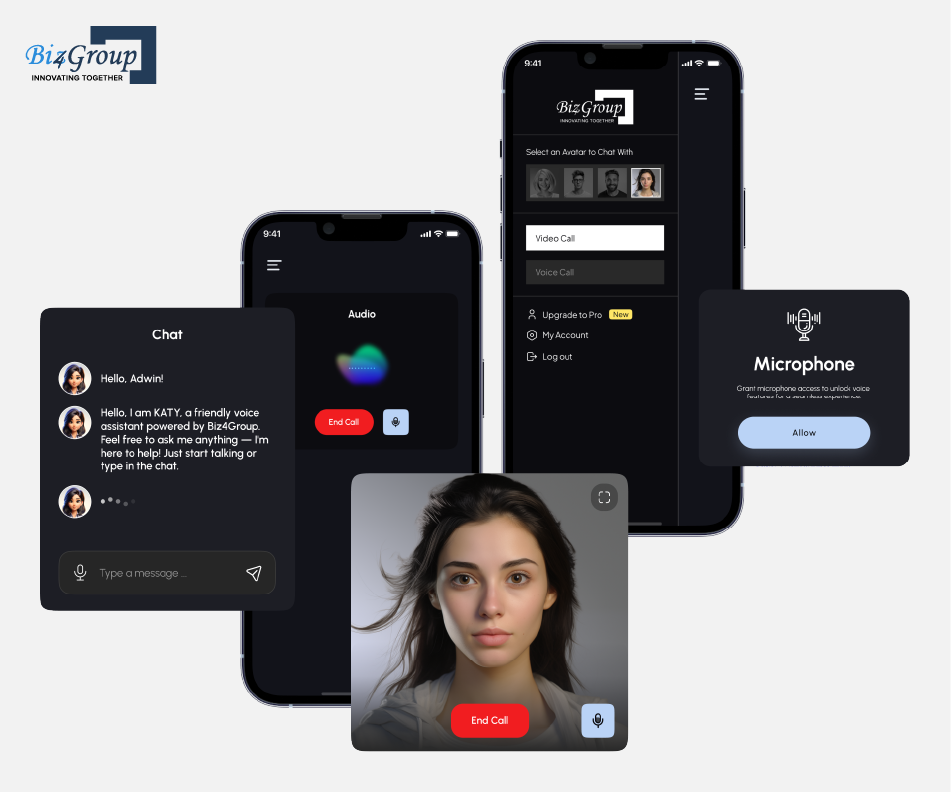
AI Wizard, is an avatar-based AI companion built by Biz4Group, with real-time video and voice interactions, expressive facial mimicry, and personalized conversational support. While designed for empathy and everyday guidance, its humanlike presence maps naturally to how onboarding avatars can deliver comfort, clarity, and consistent support to new hires.
These AI avatars simply act as steady digital guides that make onboarding feel easier to deliver and easier to absorb.
Build Onboarding That Actually Guides People
Create clarity and confidence from day one with systems that build AI avatars for employee onboarding and training built around real organizational needs.
Start My AI Onboarding AvatarHow do AI Avatars for Employee Onboarding and Training Work?
AI avatars for employee onboarding and training take everything your company already communicates and turn it into guided, interactive conversations, making it easier to build AI avatars for employee onboarding and training that feel natural for new hires. To see how that actually happens, it helps to break down the mechanics behind it:
1. Turning static content into guided flows
You start with policies, process docs and tool walkthroughs that are usually buried in slides or wikis. AI avatars development for employee onboarding and training restructures this content into small, sequenced steps. The avatar then presents those steps in a natural, conversational way.
2. Teaching the avatar how to respond
The system is trained on common onboarding questions, role-specific FAQs and the language your company actually uses. This helps you develop AI avatars for employee training that can handle routine questions confidently. Many teams also build a personal avatar chatbot in their broader roadmap when they think about extending these experiences.
3. Personalizing the onboarding journey
The avatar tracks what each hire has already seen, what they struggled with and what comes next. That makes it easier to build AI avatar-based onboarding system flows that adapt to role, location or seniority. New hires move forward at a pace that feels manageable instead of overwhelming.
|
Stage |
What Happens |
Why It Matters |
|
Content structuring |
Existing material is broken into guided steps |
New hires see clear, logical sequences |
|
Conversation training |
Avatar learns typical questions and responses |
Reduces repetitive trainer interventions |
|
Personalization |
Journeys adapt to each role and learner pace |
Improves understanding and confidence |
|
Continuous updates |
Content is refreshed as policies and tools change |
Keeps onboarding accurate and trustworthy |
When these moving parts work together, the onboarding experience feels smoother for everyone and creates a natural lead into how teams choose to create AI onboarding avatar assistant in the first place.
Why Shall Business Invest in Personalized Onboarding Assistant Using AI Avatars?
AI avatars for employee onboarding and training give companies a scalable way to remove onboarding bottlenecks, protect productivity and control training costs. When you choose to build AI avatars for employee onboarding and training, the financial and operational upside becomes hard to ignore.
1. Predictable onboarding with measurable efficiency gains
Every new hire receives the same high-quality onboarding, which eliminates the inconsistencies that quietly drain productivity. Investors value anything that turns tribal knowledge into a repeatable, dependable process that scales without adding headcount.
2. Lower onboarding labor costs for managers and trainers
A significant amount of onboarding time is spent repeating the same explanations. Reducing that workload makes far more sense when internal systems already involve AI consulting services, which helps teams keep their focus on higher-value work.
3. Faster time-to-productivity for new hires
Slow onboarding is expensive. Every extra week a new hire spends figuring things out impacts the bottom line. When you make AI avatar for corporate training, it shortens that ramp-up and reduces the financial drag of extended transitions.
4. Better visibility into performance, comprehension and onboarding gaps
Traditional onboarding hides inefficiencies because no one tracks what people actually absorb. The data coming from avatar interactions fits naturally into ecosystems that also use AI integration services, making weak spots much easier to identify and fix.
When these gains compound, avatar-led onboarding stops feeling like a convenience and starts functioning as a scalable performance advantage, setting the stage for the practical use cases ahead.
Practical Use Cases for Employee Onboarding Automation with AI Avatars
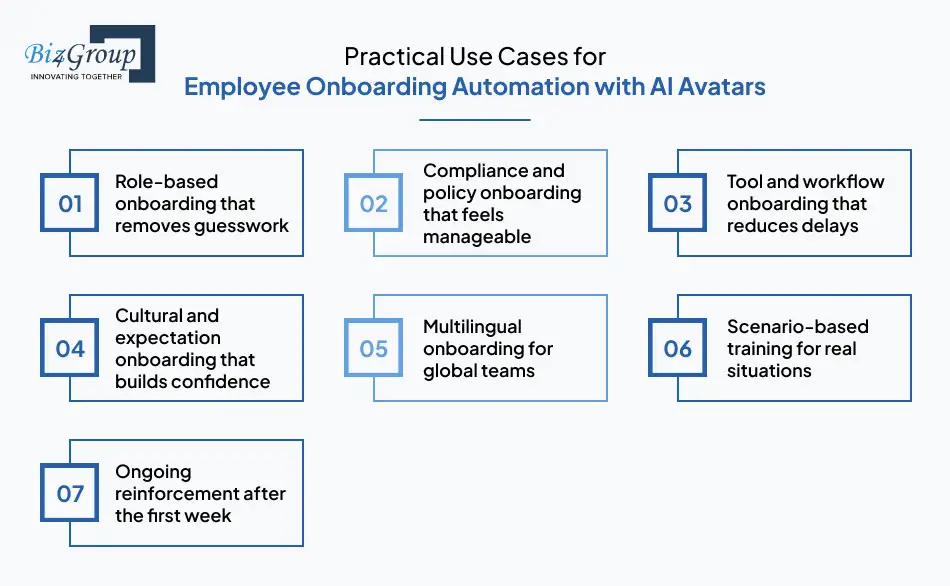
AI avatars for employee onboarding and training help companies simplify early learning and reduce repetitive tasks for managers. Many teams exploring this shift already leverage enterprise AI solutions, and the advantages become clearer as companies choose to build AI avatars for employee onboarding and training.
1. Role-based onboarding that removes guesswork
Different teams follow different processes, and avatars bring predictable structure without adding more work to a manager’s plate. This becomes especially helpful when companies plan long-term strategies for AI avatars development for employee onboarding and training.
- Example: A marketing hire receives a structured onboarding path that covers tools, responsibilities and workflow priorities.
2. Compliance and policy onboarding that feels manageable
Policy-heavy content overwhelms most new hires on day one. Avatars break policies into short conversational steps that help people absorb information without feeling buried.
- Example: A compliance walkthrough becomes a simple series of clear explanations employees can access anytime.
3. Tool and workflow onboarding that reduces delays
Learning company tools usually slows down onboarding because new hires wait for someone to walk them through the basics. AI avatars solve this by guiding employees step-by-step in a consistent flow using AI model development, which also helps in scaling.
- Example: A developer sets up their environment through a self-paced guided conversation instead of waiting for help.
4. Cultural and expectation onboarding that builds confidence
Understanding tone, communication style and cultural norms is one of the toughest parts of onboarding. Avatars introduce these topics in a conversational way that makes the early transition feel smoother.
- Example: A culture module helps employees understand how teams collaborate and make decisions.
5. Multilingual onboarding for global teams
Distributed teams deal with language gaps that slow early momentum. Avatars help eliminate that friction by offering multilingual onboarding paths and improving consistency in AI employee training avatar development.
- Example: A new hire completes onboarding in their preferred language without relying on translated documents.
6. Scenario-based training for real situations
Some roles require practicing conversations or responses before they face real customers or internal scenarios. Avatars simulate these situations in a low-pressure environment.
- Example: A support agent practices customer responses through repeated scenario simulations.
7. Ongoing reinforcement after the first week
Onboarding does not end when week one is over. Avatars offer refreshers that help employees revisit key concepts easily, which works well in companies building long-term plans around develop AI avatars for employee training using AI automation services.
- Example: Quarterly updates turn into short conversational check-ins instead of lengthy presentations.
|
Use Case |
What the Avatar Supports |
Why It Helps |
|
Role-based onboarding |
Department-focused learning paths |
Reduces repetitive manager-led instructions |
|
Policy and compliance |
Conversational rule breakdowns |
Minimizes confusion and misunderstandings |
|
Tools and workflows |
Step-by-step guidance |
Speeds early productivity |
|
Culture and values |
Clear introduction to communication styles |
Helps new hires integrate smoothly |
|
Multilingual onboarding |
Language-flexible guidance |
Supports distributed and global teams |
|
Scenario-based training |
Practice for real-world situations |
Builds confidence before live work |
|
Ongoing reinforcement |
Quick conversational refreshers |
Keeps employees aligned over time |
Teams planning these use cases often work with the top AI development companies in Florida to get the best results. This leads us to the features that matter the most when building AI onboarding avatars.
Make Training Feel Effortless for Every New Hire
Use intelligent workflows that support your goals with AI avatars development for employee onboarding and training without overwhelming HR teams.
Plan My AI HR Training AvatarCore Features Required in the Development of AI Avatar for Employee Onboarding and Training
Building AI avatars for employee onboarding and training means giving new hires a clear, guided experience without overwhelming your team. When companies choose to build AI avatars for employee onboarding and training, these core features shape how effective the final system becomes.
|
Core Feature |
What It Does |
Why It Matters |
|
Natural conversation engine |
Enables smooth, helpful interactions with employees |
Makes onboarding feel friendly instead of robotic |
|
Structured content mapping |
Breaks complex onboarding material into clear sequences |
Keeps training organized and supports AI employee training avatar development |
|
Role-based learning paths |
Matches content to each job function |
Prevents irrelevant or confusing onboarding moments |
|
Adaptive pacing |
Adjusts speed based on each hire’s progress |
Strengthens efforts to develop AI avatars for employee training |
|
Guided tool walkthroughs |
Provides step-by-step help with internal tools |
Reduces dependency on managers for basic setup |
|
Real-time Q&A handling |
Answers common questions instantly |
Removes bottlenecks and improves onboarding flow |
|
Multimedia content delivery |
Supports text, audio and short video explanations |
Helps different learning styles absorb information faster |
|
Progress and completion tracking |
Monitors what each hire has finished |
Helps teams practicing AI avatars development for employee onboarding and training stay aligned |
|
Feedback collection |
Captures insights from new hires about their experience |
Improves future onboarding cycles using real input |
|
Integration-ready structure |
Works within existing systems via product development services |
Ensures smooth adoption without workflow friction |
A strong foundation of these core features makes onboarding predictable, repeatable and far easier to manage, creating a natural transition into the more advanced capabilities that take the experience to the next level.
Next-Level Features in AI Avatars Development for Employee Onboarding and Training
Once the basics are solid, advanced features help your AI avatars for employee onboarding and training feel more intuitive, accurate and tailored. These capabilities make a difference when companies plan to build AI avatars for employee onboarding and training at scale.
1. Context-aware Conversation Memory
The avatar remembers what a new hire has already asked, what they struggled with and where they left off. This strengthens AI avatars development for employee onboarding and training by creating smoother, more personalized conversations with the help of an AI chatbot development company.
2. Dynamic Scenario Simulation
Instead of static modules, the avatar can simulate workplace scenarios to help employees practice real interactions. This helps teams develop AI avatars for employee training that build confidence early and support roles that rely heavily on communication.
3. Emotionally Adaptive Responses
Some avatars adjust their tone and pacing based on user sentiment. While subtle, it helps reduce onboarding anxiety and makes each session feel more human, especially in environments that work with generative AI capabilities.
4. Automated Workflow Triggers
Advanced avatars can notify managers, schedule training checkpoints or unlock new modules automatically. This creates reliable onboarding momentum without constant human oversight and supports organizations that integrate AI into an app in other areas of their workflow.
5. Learning Recommendations Engine
Avatars can suggest additional training sessions based on employee performance and progress. This works particularly well for companies planning to develop AI avatars for L&D programs, giving new hires a structured path long after week one.
Advanced capabilities like these help training avatars feel more natural and future-ready, which makes the development process easier to map out in the next stage.
How to Create an AI Avatar for Employee Onboarding and Training: Complete Development Process
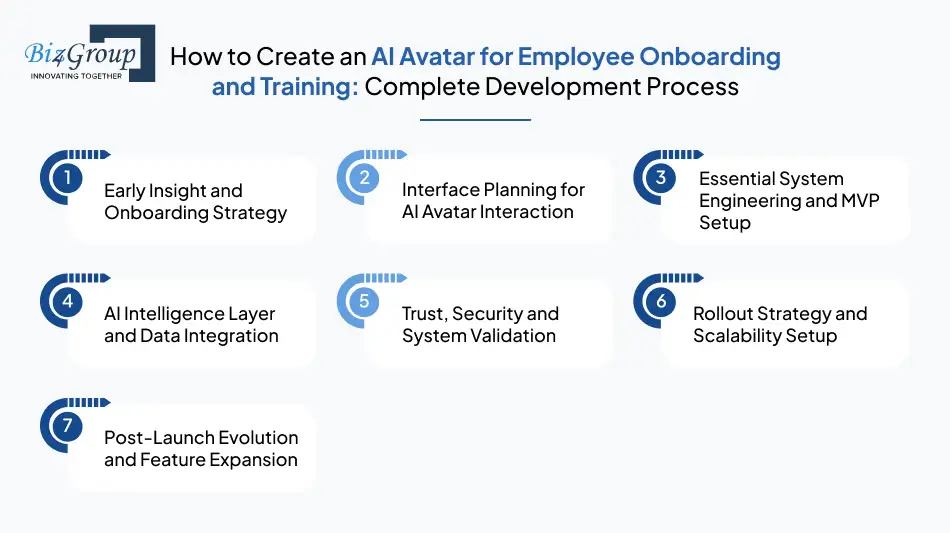
AI avatars for employee onboarding and training aren’t built in a single sprint. They come together through a structured development process that blends strategy, design, engineering and continuous refinement. Below is the complete, personalized roadmap for teams planning to build AI avatars for employee onboarding and training that genuinely work:
1. Early Insight and Onboarding Strategy
Building an avatar that trains people effectively starts by understanding what your employees struggle with during onboarding. Maybe they feel overwhelmed by scattered documentation, unclear role expectations or inconsistent handoffs between teams. This stage helps you shape an onboarding avatar that solves real friction instead of adding another layer of complexity.
- Identify where new hires lose time or clarity during onboarding
- Map which onboarding tasks the avatar should guide first, such as tool setup or policy awareness
- Validate compliance requirements, especially for workflows that involve sensitive HR data
- Define KPIs like reduced onboarding time or improved first-week confidence scores
This step ensures you focus on problems that truly matter before writing a single line of code.
2. Interface Planning for AI Avatar Interaction
Your avatar is going to be the new hire’s very first touchpoint, so you need to build a personalized onboarding assistant using AI avatars that feel comfortable, intuitive and supportive. A clear interface helps employees ask questions freely, revisit modules without confusion and trust the avatar as a reliable guide. This is where teaming up with a strong UI/UX design company becomes critical.
- Build prototypes that replicate real onboarding flows from day one to week three
- Test interfaces with employees from different roles and seniority levels
- Add essentials such as guided paths, visual indicators and simplified progress tracking
- Create consistent UI patterns so the experience feels the same across all devices
Also read: Top UI/UX design companies in USA
3. Essential System Engineering and MVP Setup
You don’t need a fully loaded avatar from day one. You need something functional that proves value immediately. That’s where strategic MVP development services come in. Start with a version that handles essential workflows like basic onboarding guidance, FAQs and process walkthroughs. Once employees feel the impact of avatar-based corporate training app development, scale up.
- Build the basic modules like role-based introductions and Q&A responses
- Enable guided support for early tasks like workspace setup or compliance basics
- Add adaptive logic so the avatar adjusts pacing based on employee progress
- Design the backend to expand easily as you add advanced capabilities later
Also read: Top 12+ MVP Development Companies in USA
4. AI Intelligence Layer and Data Integration
This is where you make AI avatars for workforce skill development. Training your models well determines whether the avatar feels helpful or frustrating. Clean knowledge inputs and well-labeled HR data help your AI interpret onboarding content correctly and respond meaningfully to employee questions.
- Train AI models on internal onboarding materials, role guides and historical Q&A patterns
- Build recommendation logic that guides new hires toward the next best module
- Create continuous learning loops based on employee interactions and feedback
- Combine custom-trained models with pre-trained foundations to balance performance and cost
5. Trust, Security and System Validation
Onboarding often involves personal information, role-based permissions and internal workflows. That makes trust non-negotiable. Every component needs to be tested for reliability, stability and compliance so the avatar feels dependable from day one.
- Conduct compliance audits based on your HR policies and regional regulations
- Run stress tests simulating multiple new hires onboarding simultaneously
- Test complete onboarding journeys to identify friction points or unclear steps
- Maintain activity logs and permission controls to keep access safe and transparent
Also Read: Software Testing Companies in USA
6. Rollout Strategy and Scalability Setup
Your onboarding avatar will be used by teams across locations, devices and time zones. That means it must scale without slowing down or failing during busy hiring cycles. Cloud readiness ensures that you’re able to build AI avatar-based onboarding system that’s reliable even when employee onboarding spikes unexpectedly.
- Use scalable cloud infrastructure that adapts to hiring surges
- Establish CI/CD pipelines to roll out improvements smoothly
- Monitor onboarding analytics through dashboards that show user progress and engagement
- Prepare in-app guides so new hires know how to start with minimal instructions
7. Post-Launch Evolution and Feature Expansion
Your AI onboarding avatar improves as your company evolves. New tools, new policies, new workflows and new roles all require ongoing updates. Continuous optimization ensures new hires always receive the most accurate and current guidance.
- Collect employee feedback to decide which areas need refinement
- Add advanced features like scenario-based training or interactive simulations
- Retrain models regularly using fresh onboarding data
- Track metrics like completion rates, employee satisfaction and long-term retention
A well-built onboarding avatar becomes smarter with time, turning every interaction into a chance to enhance the experience. Up next, let’s explore the tech stack that can support scalable growth in your AI onboarding ecosystem.
Turn Complex HR Workflows into Simple Avatar Experiences
Transform your processes with systems that help you develop AI avatars for employee training that scale cleanly across teams.
Build My AI Training SystemThe Ideal Tech Stack to Build AI Avatars for Employee Onboarding and Training
To build AI avatars for employee onboarding and training that feel stable, smart and reliable, you need a tech stack that supports flexible interfaces, strong AI processing, clean integrations and smooth scaling. Here's all you need to know:
|
Label |
Preferred Technologies |
Why It Matters |
|
Frontend Framework |
ReactJS, NextJS, Vue.js |
ReactJS development helps deliver smooth onboarding screens and interactive flows. |
|
Server-Side Rendering & SEO |
NextJS, Nuxt.js, SvelteKit |
NextJS development improves loading and performance for distributed teams. |
|
Backend Framework |
NodeJS, Express.js, Python |
Python development and NodeJS development manage avatar logic, secure workflows and data handling. |
|
AI & Data Processing |
TensorFlow, PyTorch, LangChain |
Supports adaptive conversations and onboarding intelligence, benefiting from pipelines often shaped through . |
|
API Development Layer |
REST APIs, GraphQL, gRPC |
Ensures the avatar connects cleanly with HR systems, knowledge bases and learning tools without friction. |
|
Database |
PostgreSQL, MongoDB |
Stores onboarding progress, session data, feedback logs and avatar training content. |
|
Authentication |
OAuth, JWT |
Protects new-hire data and keeps access controls clean across departments. |
|
Cloud Hosting |
AWS, GCP, Azure |
Helps the avatar scale reliably during hiring surges and peak onboarding windows. |
|
Video/Avatar Rendering |
WebRTC, Three.js |
Enables smooth avatar motion, gestures and visual learning cues. |
|
Content Management Layer |
Headless CMS, Strapi, Contentful |
Keeps onboarding modules, training paths and role-specific scripts easy to update. |
|
Monitoring & DevOps |
Docker, Kubernetes, CI/CD tools |
Ensures smooth deployments, stable performance and fast iteration cycles during onboarding updates. |
|
Analytics |
Mixpanel, GA4, custom dashboards |
Tracks training progress, avatar engagement and new-hire learning behavior. |
A complete tech stack like this gives your AI onboarding avatar the structural strength it needs, setting up the next step where we break down development costs across MVP, mid-level and enterprise builds.
Cost Breakdown for Avatar-Based Corporate Training App Development
The cost of building AI avatars for employee onboarding and training typically falls between USD 8,000 and 50,000 plus, depending on depth, integrations and the level of intelligence you want the avatar to deliver. This is a ballpark figure, but it gives you a realistic starting point before planning enhancements or scaling. Let’s break it down further for more clarity from a business POV:
|
Build Level |
What You Get |
Estimated Cost |
|
MVP Build |
Basic conversational flows, essential onboarding modules, limited Q&A, simple UI and foundational role-based logic |
USD 8,000 to 15,000 |
|
Mid Level Build |
Smarter interactions, structured workflows, adaptive pacing logic, stronger role customization and deeper integrations |
USD 15,000 to 30,000 |
|
Enterprise Build |
Full conversational intelligence, multi-role pathways, multimedia onboarding, advanced analytics and scalable deployment |
USD 30,000 to 50,000+ |
These ranges shift based on complexity, team structure and the intelligence layer you choose, especially for leaders who understand the importance of AI in HR. Understanding these cost levels helps you plan the next step more clearly as we move into best practices for building your AI onboarding avatar.
Common Obstacles in Building an AI Avatar for Employee Onboarding and Training
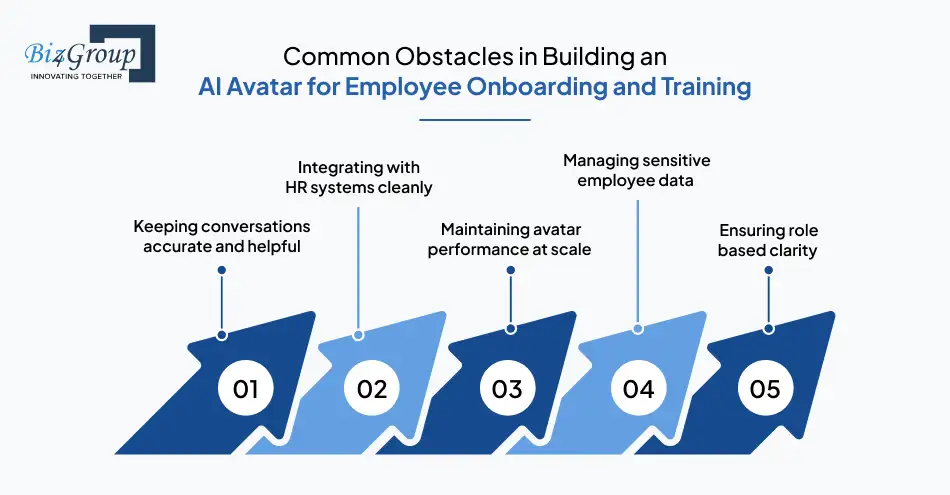
Even with a strong plan, building AI avatars for employee onboarding and training comes with its share of friction points. Most challenges show up during development, scaling or integration, which is why it helps to understand them before you start.
|
Top Challenges |
How to Solve Them |
|
Keeping conversations accurate and helpful |
Train AI models with high quality onboarding data and refine them using structured interaction logs to support AI avatars development for employee onboarding and training. |
|
Integrating with HR systems cleanly |
Use flexible API layers and tested integration patterns often found in environments shaped by business app development using AI. |
|
Maintaining avatar performance at scale |
Optimize backend infrastructure and caching while leveraging best capabilities of generative AI agents for your avatar. |
|
Managing sensitive employee data |
Implement strict permissions, encrypted storage and compliance audits to protect all onboarding information. |
|
Ensuring role based clarity |
Build separate content paths for each job function and test them with real teams to maintain clarity when you develop AI avatars for employee training. |
Removing these roadblocks upfront keeps the development of AI avatar for employee onboarding and training steady and predictable. That being said, it also opens the door for a deeper look at the best practices that shape how employees learn.
Start Small or Go Big with Your AI Onboarding Vision
Whether you launch an MVP or a full platform, your avatar can evolve with your workforce.
Begin My AI Avatar RoadmapBest Practices to Build AI Avatars for Employee Onboarding and Training
When you build AI avatars for employee onboarding and training, it works the best when the process feels grounded in real user behavior instead of technical assumptions. These practices help you create an avatar that genuinely supports new hires from their first login onward.
1. Start by Mapping Real Onboarding Friction
Talk to teams, review past feedback and outline the exact places where new hires slow down. This ensures your avatar supports meaningful moments in AI employee training avatar development instead of generic workflows.
2. Keep Training Modules Flexible for Different Roles
Different departments learn differently, so design content that adapts without forcing a one size fits all structure. This becomes easier to manage when your system includes components like automate recruitment process.
3. Train your AI with Diverse Internal Knowledge Sources
Use policy documents, real questions, tool guides and past onboarding transcripts so the avatar delivers accurate guidance. This approach supports your goal to develop AI avatars for employee training with more depth and relevance.
4. Maintain Clarity in Every Interaction
Write instructions and responses that feel natural, simple to understand and free of heavy HR jargon. Teams already using technologies such as generative AI in HR will find this consistency especially helpful.
5. Refine the Avatar through Ongoing Performance Reviews
Review interaction logs to understand where new hires hesitate or repeat questions. Consistent updates help maintain quality, especially in environments where top AI development companies in Florida are part of the broader tech ecosystem.
When these best practices become part of your AI employee training avatar development rhythm, it naturally starts to feel more intuitive for new hires. Now, let’s dive into what the future holds for employee onboarding automation with AI avatars.
Build an Onboarding Avatar That Learns as Your Company Grows
Create an intelligent assistant that adapts to new roles, new hires and new organizational rhythms.
Create My Adaptive AvatarFuture Trends in Developing AI Avatars for Employee Training
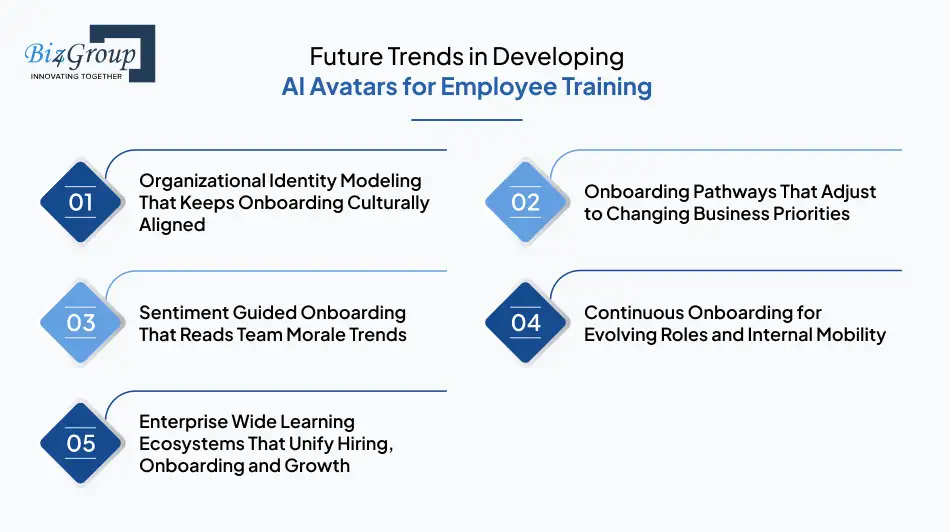
The next wave of AI avatars for employee onboarding and training will focus less on features and more on how organizations learn, adapt and scale. The shift ahead is about making onboarding smarter at a company level rather than just at a technology level.
1. Organizational Identity Modeling That Keeps Onboarding Culturally Aligned
Future onboarding avatars will learn how each company communicates, makes decisions and collaborates so new hires absorb culture faster. This supports evolving needs within AI avatars development for employee onboarding and training, especially in fast growing organizations.
2. Onboarding Pathways That Adjust to Changing Business Priorities
As companies shift direction, AI avatars will reorganize onboarding content based on new goals or initiatives. Workflows like these fit naturally into ecosystems depending upon the amount of investment one is willing with respect to custom HR software development cost
3. Sentiment Guided Onboarding That Reads Team Morale Trends
Avatars will help HR understand how new hires are feeling during their first few weeks, letting teams refine internal communication patterns. This makes it easier to develop AI avatars for employee training that respond to emotional climate rather than only procedural needs.
4. Continuous Onboarding for Evolving Roles and Internal Mobility
Onboarding will move beyond the first week and support employees as they shift to new teams or responsibilities. This becomes especially seamless in environments where conversational AI agent already plays a supporting role.
5. Enterprise Wide Learning Ecosystems That Unify Hiring, Onboarding and Growth
AI onboarding avatars will become part of larger learning ecosystems that track progress across an employee’s long term development. Organizations that hire AI developers will find this shift increasingly accessible and profitable.
These emerging directions show how onboarding avatars will evolve from simple guides into long term contributors to workforce growth, setting the stage for choosing a development partner who can help bring that vision to life.
Why Choose Biz4Group to Develop Your AI Onboarding Avatar?
When you decide to build AI avatars for employee onboarding and training, you need a team that has already built humanlike systems that think, respond and guide with clarity. Biz4Group fits that need because our work in avatars goes beyond prototypes and into real world use, including projects like AI Wizard that prove how naturally these capabilities extend into workforce training environments.
Here’s what sets us apart:
1. Deep Expertise in Functional Avatar Behavior
We understand the technical patterns and user expectations that shape AI avatars development for employee onboarding and training, which helps ensure accuracy and smooth interaction from the first release.
2. A Full Stack Approach to Intelligent Systems
Our team blends architecture, UI, conversational logic and deployment into one cohesive build, supporting organizations that want to build AI software without compromising long term adaptability.
3. Industry Agnostic Delivery Strength
We build AI avatar for HR onboarding workflows that handle high volume, real time usage across multiple sectors, giving your training avatar the reliability it needs from day one to the day that you need to to scale.
4. Research-led Development Discipline
As an established AI development company, we combine engineering discipline with user centric design to create AI avatars that feel natural for new hires and feel super-natural to interact with.
5. Integration that Keeps your Workflows Intact
Your avatar should enhance how teams learn, not interrupt it. Our builds connect cleanly with LMS platforms, HR tools and internal systems so you can develop AI avatars for employee training without restructuring operations.
Biz4Group brings together the technical depth, product thinking and avatar experience needed to build an onboarding assistant that feels helpful, consistent and genuinely aligned with how your organization works.
Let your training ecosystem work smarter with an avatar designed to guide, explain and support new hires with ease. Start My AI Onboarding Build
Final Thoughts on Building AI Avatars for Employee Onboarding and Training
AI avatars for employee onboarding and training are quickly becoming the smarter, calmer and far more patient teammates every company wishes they had. The real advantage appears when technology and workplace behavior finally meet, something we see often in discussions around AI in HR.
Whether you are planning a small pilot or a full scale rollout, the foundation is the same: clarity, good data, thoughtful design and a development partner who knows what it takes. That’s where teams often lean on a trusted custom software development company, because good onboarding deserves more than a generic chatbot pretending to be helpful.
In the end, the companies that get ahead will be the ones that build onboarding experiences that feel human, reliable and repeatable, all powered quietly behind the scenes by the right AI avatar.
FAQs About How to Create an AI Avatar for Employee Onboarding and Training
1. How realistic can onboarding avatars actually become for training new hires?
Modern onboarding avatars can look and behave surprisingly human thanks to improved facial modeling, voice synthesis and contextual learning. They can hold conversations, guide workflows and adapt to employee responses, making them feel more like a patient digital mentor than a scripted bot.
2. Can AI onboarding avatars handle compliance or policy training accurately?
Yes, as long as the content is well structured. AI onboarding avatars can walk employees through compliance modules, explain policies in plain language and verify understanding with scenario checks or knowledge quizzes.
3. How long does it take to develop an AI avatar for onboarding from scratch?
To build AI avatars for employee onboarding and training on a basic level, it may take a few weeks, while a fully customized system with deeper logic, integrations and interactive sessions may take several months. Timeline depends on content complexity, training data availability and the level of avatar behavior required.
4. What does it cost to build an AI avatar for employee onboarding and training?
Most build cycles fall between USD 8,000 and 50,000 plus, depending on features, integrations, intelligence level and scalability needs. The cost increases as you add adaptive learning, multimedia paths or deeply customized role based onboarding flows.
5. Do AI onboarding avatars work well for remote or distributed teams?
They’re especially effective for distributed workforces because they deliver onboarding consistently regardless of location or time zone. New hires get the same guidance, resources and clarity whether they are in office or joining entirely remotely.
6. Can an AI onboarding avatar personalize training for different job roles or seniority levels?
Yes. Role based personalization is one of the strongest advantages of AI driven onboarding. The avatar can adjust content, pacing and examples based on the employee’s function, department or seniority, making training more relevant from day one.
