 Location :
Orlando, FL, USA
Location :
Orlando, FL, USA +1 (407) 714-1616
 info@biz4group.com

- Learn how to build an AI character that becomes a fully owned digital identity for your brand.
- The step-by-step process to develop an AI character for your brand, from personality design to UI and MVP launch, is imperative in today’s world.
- Essential and advanced features help you create a brand-specific AI character for videos, campaigns, and onboarding.
- See the full cost breakdown for AI character development with a typical range of $15,000-$100,000+.
- Make AI characters for social media content, interactive guides, and customer-facing experiences that increase conversions.
- Stay ahead with future trends that shape AI character development for businesses and long-term digital branding.
- Build with confidence by partnering with Biz4Group LLC, a proven leader in AI characters, digital humans, and enterprise ready solutions.
The global market for AI avatars just hit USD 10.4 billion. Analysts expect it to soar to USD 110.9 billion by 2034.
If your brand still relies on static logos, stock photos, or stock voices, you may already be behind. Companies everywhere are racing to build an AI character because the path ahead belongs to those who own the interaction layer.
With AI character creation platform development, you get a living, breathing digital identity. A virtual brand ambassador who can appear in videos, answer customer queries, deliver tutorials, or host training modules. You get consistency, scalability, and a way to connect emotionally, at eight in the morning or midnight, on your website or social media.
As AI adoption spreads, the difference between a brand that flirts with AI and a brand that owns an AI-powered character becomes a matter of long-term advantage. In this guide, we will walk you through how to develop an AI character for your brand, step-by-step. You will see how to turn a concept into a fully owned digital persona ready for marketing, support, learning, or creative content.
Welcome to the world of building AI digital human for brand identity.
Short On Time?
Jump straight to the complete breakdown of AI characters without reading the full guide.
Get in TouchUnderstanding AI Character and Its Working
An AI character is a digital personality that can speak, react, move, and carry conversations that feel natural. Unlike a traditional mascot that sits quietly on a website, an AI character interacts with customers and becomes a familiar presence across every touchpoint.
To understand what makes an AI character functional and memorable, it helps to break down the components.
Core Elements That Help You Build an AI Character
A strong AI character is built on a set of layers that work together. These layers create the appearance, the voice, the personality, and the intelligence. Here is a quick breakdown in a table for clarity.
|
Layer |
What it includes |
Why it matters |
|
Visual identity |
2D or 3D avatar, facial features, styling |
Sets brand tone and helps audiences remember the character |
|
Voice system |
TTS engines, custom voice models |
Builds trust with familiar tone and stable speech quality |
|
Personality model |
Traits, tone, boundaries |
Keeps all interactions aligned with your brand voice |
|
Knowledge system |
Product data, FAQs, training content |
Allows the character to give reliable answers |
|
Interaction modes |
Chat, voice, video, animation |
Makes the character usable across platforms |
When you develop an AI character for your brand with this structure in place, you set a foundation for marketing, customer engagement, training, and content creation that can scale without heavy manual work.
How It Works Behind the Scenes
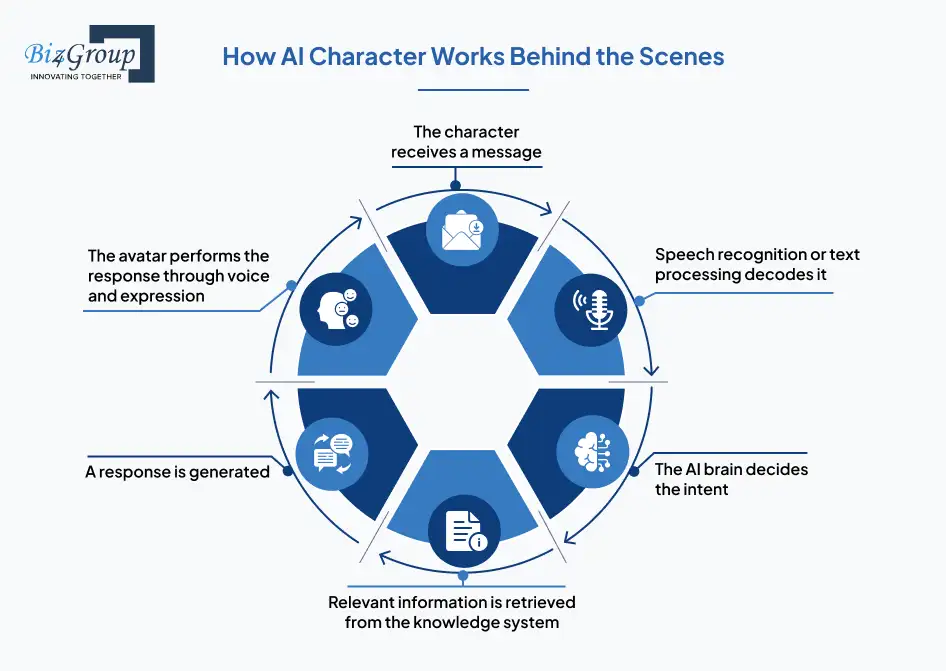
Every AI character is powered by a simple rhythm. Here is a simple walkthrough of that flow.
- The character receives a message
- Speech recognition or text processing decodes it
- The AI brain decides the intent
- Relevant information is retrieved from the knowledge system
- A response is generated
- The avatar performs the response through voice and expression
This chain helps you build an AI character that behaves consistently across all interactions. You can teach it how to speak, what to avoid, which tone matches your brand identity, and how to guide customers through journeys.
Before you explore the process of how to develop an AI character that your brand fully owns, it helps to understand what role an AI character will play in your organization. Some brands want a full-time virtual influencer. Others want a companion who can act as a consistent brand voice across platforms.
When you match your character type with your business goals, the development process becomes smoother and outcomes become stronger.
Why Build an AI Character Today?
More companies now rely on AI for real work rather than experiments. A recent market review revealed that roughly 69% of large enterprises now use AI in at least one department.
This level of adoption shows that AI is not a trend. It is a core part of how businesses plan their growth. The takeaway is simple. The market is warm and ready, and early adopters who create brand specific AI characters for marketing or engagement can establish deeper presence across platforms.
Why Companies Prefer AI Character Development Today
Brands across sectors face common challenges. They need more content, more consistency, and more personalized engagement. AI characters fill these gaps in a natural and cost-effective way.
|
Business Priority |
What an AI Character Supports |
How It Helps Your Brand |
|
Higher content volume |
Automated and repeatable video and voice production |
Faster delivery of campaigns and tutorials |
|
Global availability |
A character that responds any time of day |
Convenient for customers in every time zone |
|
Personal connection |
Interactive persona with tone and behavior |
Stronger customer trust and satisfaction |
|
Consistent messaging |
Controlled personality and voice model |
No mixed communication across channels |
|
Lower cost operations |
Reduced filming and talent expenses |
More value from the same marketing budget |
These advantages explain why many decision makers choose to develop an AI character for customer engagement. They add a face and a voice that customers start to recognize across platforms.
Practical Use Cases for Businesses That Make AI Characters for Digital Content
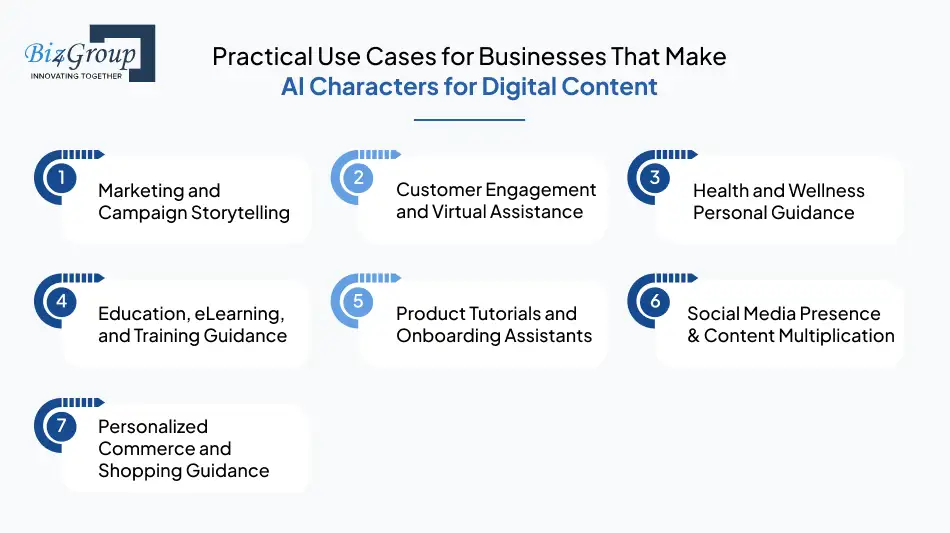
Every business has a different set of goals. Some need stronger customer engagement. Others want an always available representative who fits their brand identity. The following use cases highlight how companies benefit when they build an AI character and integrate it into their workflows.
1. Marketing and Campaign Storytelling
Marketing teams use AI characters to host videos, speak on behalf of the brand, and appear in product explainers. This approach works well for brands that want a recognizable face without repeated production costs. These characters deliver consistent tone, faster turnarounds, and easy content scaling.
2. Customer Engagement and Virtual Assistance
More companies want to develop an AI character for customer engagement because it improves response time and creates a friendly experience. These characters virtually assist users through questions, provide product suggestions, and bridge the gap between automation and human familiarity.
Project Spotlight: Avatar-based AI Companion
We built an AI avatar companion that supports users through video call, voice call, and chat. It reacts with natural expressions and gives real-time information.
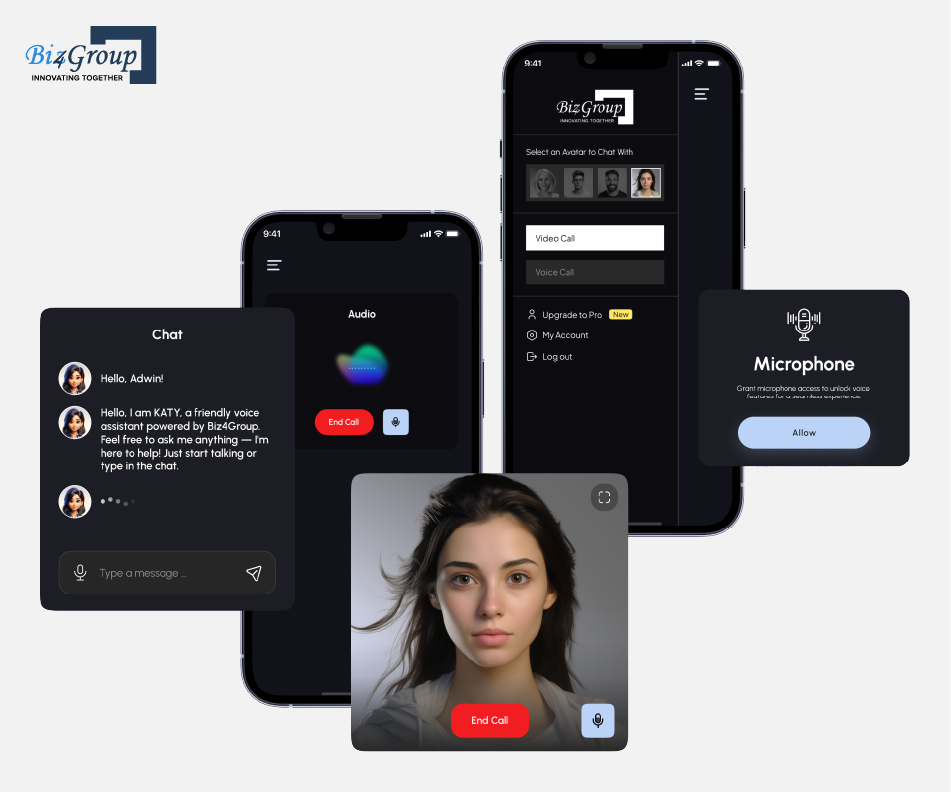
Key Highlights
- Multiple avatar choices
- Video and voice interactions
- Cross-platform compatibility
- End-to-end encryption
This project shows how an AI character can build emotional connection and assist users in ways traditional chatbots cannot.
Also read: Insights on AI companion app development
3. Health and Wellness Personal Guidance
Wellness brands and practitioners often need a digital representative who can communicate with clients and explain processes in easy human language. When they build an AI digital human for brand identity, they create a character that delivers consistent advice and reliable support.
Project Spotlight: AI Avatar for Personalized Wellness Guidance
We created an AI avatar of Dr. Truman that offers condition-specific guidance and product recommendations. It blends wellness education with a complete shopping journey.
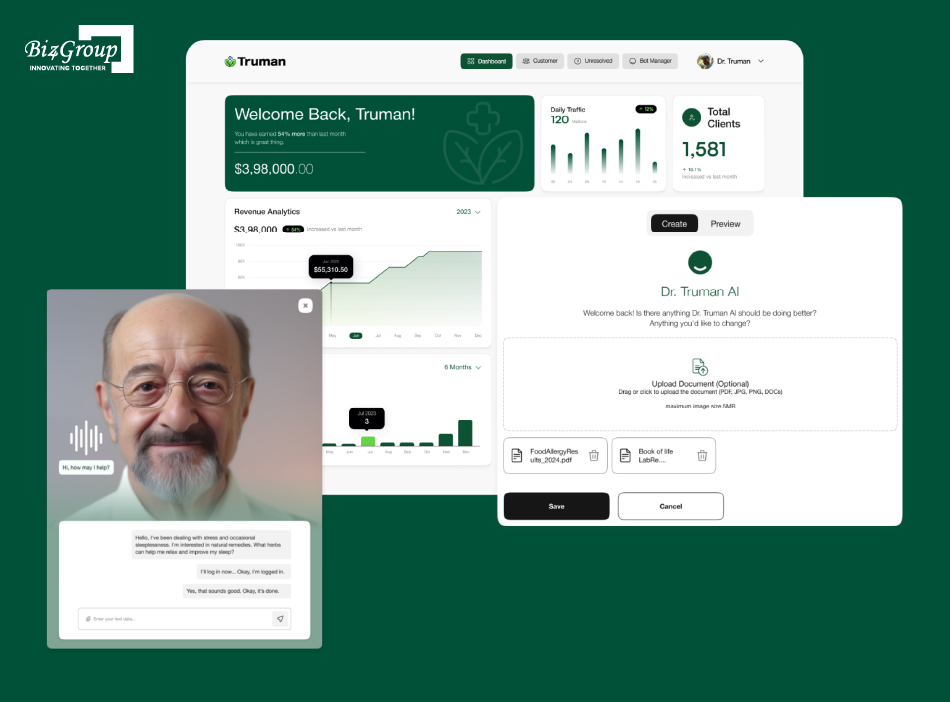
Key Highlights
- Personalized supplement suggestions
- AI-powered avatar consultations
- eCommerce integration
- Membership and user records
This project demonstrates how an AI character can lead customers from information to purchase within the same experience.
Also read: How to develop an AI avatar for clinical management?
4. Education, eLearning, and Training Guidance
Educational institutions and corporate training teams rely on characters that can teach, guide, and assess. Many companies now make AI characters for digital content because these characters speak directly to learners and help them understand complex ideas.
Portfolio Spotlight: AI Avatar-Based Therapy Tutor Platform
We built AI avatars of certified therapists who guide students through case studies and evaluate their progress. These characters create a lifelike learning environment that keeps students engaged.
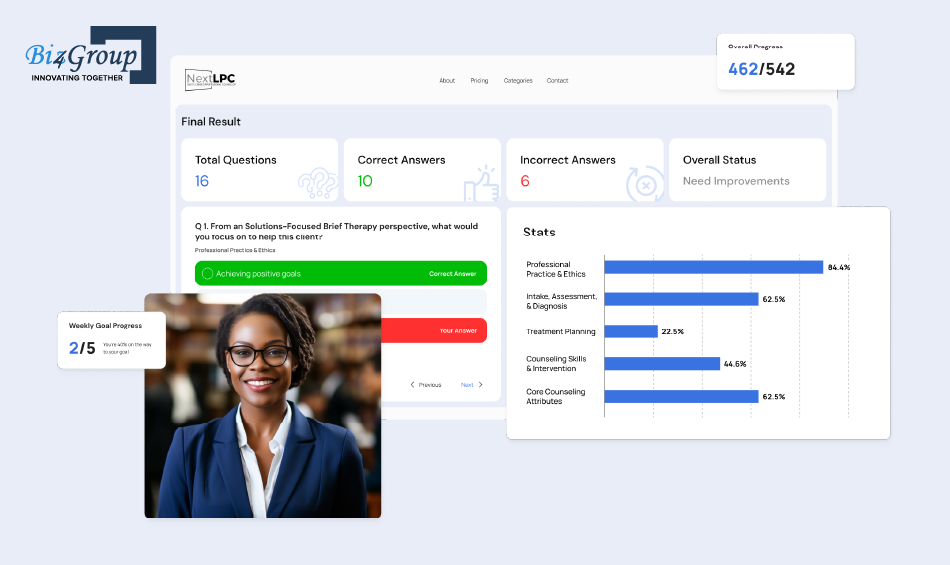
Key Highlights
- Natural facial expressions and gestures
- Real time guidance and tutoring
- Goal tracking dashboard
- Voice assistance for accessibility
This project shows how AI tutors can replace static lessons with dynamic, interactive learning.
Also read: How to build an eLearning software?
5. Product Tutorials and Onboarding Assistants
When a brand wants to make AI generated characters for product tutorials and onboarding, it gains a reliable presenter who can walk users through every step. These characters reduce confusion, shorten the learning curve, and remove the need for repetitive manual training sessions.
6. Social Media Presence and Content Multiplication
Many brands need a high volume of videos to stay visible. AI characters help them maintain a recognizable presence without filming or editing delays. When companies make AI characters for social media content, they create posts that look and sound consistent across platforms.
7. Personalized Commerce and Shopping Guidance
Retail and eCommerce brands use AI characters and personalization to help customers choose products, compare options, or understand benefits. This increases conversions and reduces drop offs. A familiar digital persona can simplify the shopping process for new and returning buyers.
Each use case plays a different role, but the purpose stays the same. Brands gain a character that works at scale, improves customer experience, and creates an identity customers remember.
Why Settle For Static Branding?
Brands using interactive personas see higher engagement across channels.
Book a Strategy Call NowEssential Features Required to Develop AI Character for Customer Engagement
A strong AI character begins with a few essential features that shape its identity and performance. These features define how it looks, how it behaves, how it speaks, and how it connects with users across channels.
In this section you will see the must have elements that allow you to build an AI character that feels natural, stays consistent, and supports real business outcomes.
|
Feature |
What It Is |
What It Does |
|
Consistent Visual Identity |
A unified avatar style that matches your brand colors, personality, and tone |
Helps audiences instantly recognize your digital persona across platforms |
|
Natural Voice System |
A stable voice engine or custom voice model trained to reflect your character’s tone |
Builds trust and improves clarity in videos, chat, and interactive sessions |
|
Character Personality Model |
A structured profile of traits, tone, mannerisms, and boundaries |
Keeps all responses aligned with brand values and prevents off brand communication |
|
Brand Trained Knowledge Base |
A curated set of documents, FAQs, product details, and content |
Allows your character to give accurate information in real time |
|
Multi Mode Interaction Support |
Ability to communicate through chat, voice, or video |
Expands how and where your audience can engage with your brand |
|
Lip Sync and Expression Control |
Realistic facial syncing and micro expressions |
Makes conversations feel smoother and more lifelike |
|
System Integration Layer |
Connections with CRM, CMS, eCommerce tools, LMS, or support systems |
Turns the character into a working part of your business workflow |
|
Analytics and Insights Panel |
Tracking system for performance, queries, and user behavior |
Helps your team refine responses, improve content, and increase conversions |
These are the essentials every business should have before exploring advanced capabilities. With this base in place, your character becomes reliable, familiar, and ready to represent your brand in marketing, support, or content creation.
Advanced Capabilities That Help You Create a Brand Specific AI Character for Videos and Campaigns
Advanced features elevate an AI character from a helpful tool to a fully capable digital persona. These capabilities improve quality, increase realism, strengthen engagement, and support content production at scale.
1. Emotional Speech Modulation
An AI character with emotional speech modulation speaks in a way that feels natural. Its voice can shift gently based on context, such as excitement for product launches or calm guidance for onboarding sessions. This helps your audience connect with the character and stay engaged during longer videos.
2. Real-Time Facial Micro Movements
Facial micro movements give your character control over subtle expressions. These include small eye shifts, soft smiles, attentive blinks, and natural pauses. These details make the character feel more lifelike during tutorials or campaign videos.
3. Context-Aware Memory Handling
Context-aware memory helps the character recognize past interactions within a session and maintain smooth conversation flow. This creates a personal touch during customer chats and helps your audience feel understood.
4. Multi Language Speech and Behavior Alignment
This feature allows your AI character to speak multiple languages while maintaining the same personality. The tone, pacing, and mannerisms stay consistent, so your brand voice remains recognizable for global audiences.
5. Character Specific Script Generation
This capability allows the AI to generate scripts that match your character’s personality. Whether it is a video intro, a product explanation, or a training segment, the script aligns with your tone and message.
6. Automated Multi-Platform Output Generation
This feature allows the character to produce content that fits various platforms without manual adjustments. It adapts pacing, length, framing, and tone based on where the video will be posted. This reduces post-production time and helps brands maintain a steady flow of social media content.
7. Behavioral Guardrails for Brand Safety
Behavioral guardrails help the character avoid statements or actions that do not fit your brand guidelines. These rules shape tone, phrasing, and limitations. This is essential when the character appears in marketing or public facing content.
These advanced capabilities set the stage for a more intelligent, expressive, and reliable digital persona. They support business needs across marketing, onboarding, support, and content creation.
Imagine these features working for you
If your character can talk, emote, adapt, and scale content, what can your brand become!
Unlock the Feature-Power with Biz4GroupTech Stack You Need to Build an AI Character for Your Brand
Building a dependable AI character requires a full stack foundation that supports visuals, voice, intelligence, and interaction. This section gives you a clear look at the essential layers and the tools that power them.
|
Layer |
Tools or Frameworks |
Purpose |
|
Visual Creation and Rendering |
Blender, Unreal Engine, Unity, D-ID, custom 2D or 3D pipelines |
Helps produce the avatar’s movements, expressions, and overall appearance |
|
Speech Processing and Voice Output |
Whisper, custom TTS engines, audio enhancement APIs |
Converts text to clear speech and supports natural voice delivery |
|
Language and Reasoning Models |
GPT based models, domain tuned LLMs, RAG pipelines |
Guides the character’s responses, reasoning, and tone |
|
Behavior and Expression Logic |
Facial animation libraries, motion capture tools, gesture mapping frameworks |
Controls micro expressions and body language during videos or interactions |
|
Data and Knowledge Management |
Vector databases, PostgreSQL, MongoDB, content retrieval systems |
Stores company knowledge and supports fast information access |
|
Application Backend |
Powers logic, API routing, and character interactions |
|
|
Frontend and User Interface |
React.js, React Native, Vue.js, WebGL |
Helps users interact with the AI character across devices |
|
Multimedia Generation |
Video rendering APIs, audio processing frameworks, animation engines |
Supports the creation of tutorials, campaigns, and short form content |
|
Integration Layer |
CRM connectors, CMS hooks, eCommerce APIs, LMS bridges |
Connects the AI character with business systems and workflows |
|
Hosting and Performance Infrastructure |
AWS, GCP, Azure, containerized deployments |
Maintains uptime, handles scaling, and ensures smooth performance |
This tech stack gives your AI character the structure it needs to handle branding demands, video creation, customer interaction, and content delivery. With these layers in place, your digital persona will feel stable, expressive, and ready for practical use.
Step-by-Step Process to Develop an AI Character for Your Brand
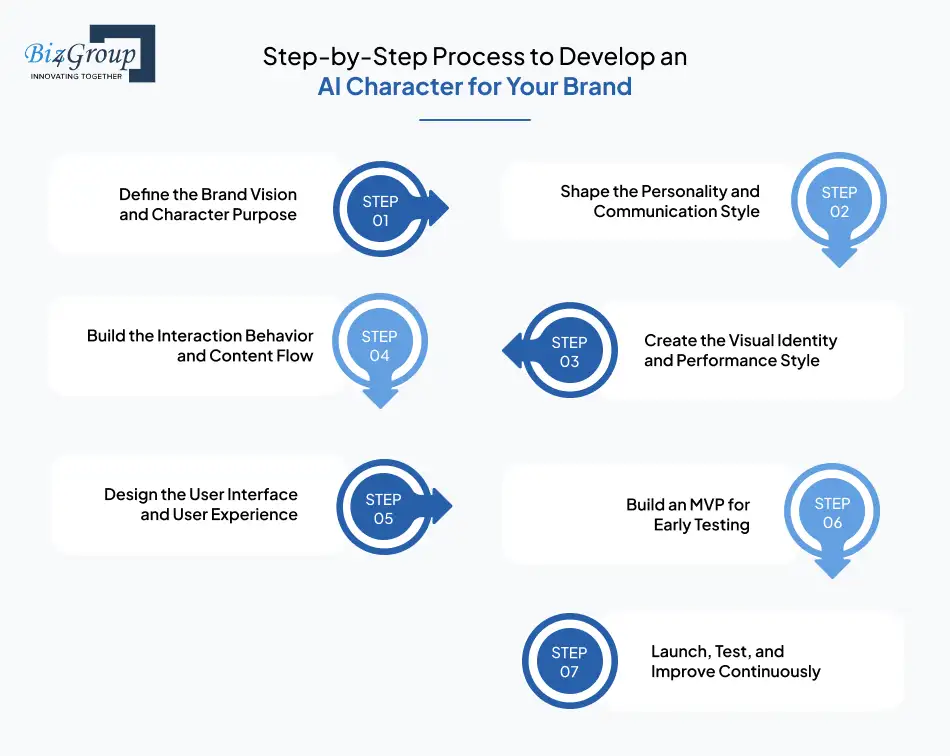
Creating an AI character is a structured journey. Each step plays a part in shaping the personality, the performance, and the overall usefulness of your digital persona.
Step 1. Define the Brand Vision and Character Purpose
A successful AI character begins with a clear purpose. Before visuals or voice come into the picture, your team needs to answer a few questions.
- Who will this character speak to
- What tone fits your brand identity
- What problems should it solve
- What type of presence do you want across marketing or customer touchpoints
This step acts as your north star. When your vision is aligned, every decision that follows becomes easier and more consistent.
Step 2. Shape the Personality and Communication Style
Once the purpose is clear, your next move is to build the character’s personality. This is where you choose traits, mannerisms, and behavior styles that match your goals.
- Warm and friendly
- Calm and professional
- Playful and lighthearted
- Confident and informative
- Supportive and patient
A well-defined personality helps you develop an AI character for your brand that stays consistent whether it appears in videos, tutorials, or customer interactions.
Step 3. Create the Visual Identity and Performance Style
Visual identity brings your character to life. You can choose a 2D style, a 3D digital human, a stylized figure, or a realistic brand ambassador. This depends on how you want customers to perceive your brand.
- Clarify face shape and visual tone
- Match brand colors and style guidelines
- Plan variations for expressions and emotional cues
- Prepare multiple formats for campaigns and tutorials
This step sets the foundation for a character that audiences will recognize and trust.
Step 4. Build the Interaction Behavior and Content Flow
At this stage, your character should learn how to speak, act, and guide your audience. Mapping behavior patterns helps create smoother interactions.
- Define conversation flows
- Build greeting, guidance, and transition styles
- Add role-based behaviors for marketing or training
- Map common user goals and expected reactions
This makes sure your character behaves in a way that feels natural and predictable.
Step 5. Design the User Interface and User Experience
UI and UX decide how users actually experience your character. This step helps you present the character in a way that feels simple, intuitive, and enjoyable.
- Plan the interface where users will interact
- Build layouts that highlight the character
- Keep steps clear and easy to follow
- Ensure navigation feels smooth across devices
A good UI/UX design company can elevate your character and create a pleasant experience from the first interaction.
Also read: Top 15 UI/UX design companies in USA
Step 6. Build an MVP for Early Testing
Before rolling out a full version, you need a working model that can perform the basics. Developing an MVP helps you test real user reactions and uncover improvements.
- Launch a simple version of the character
- Test key actions like greeting, answering, and guiding
- Gather user feedback on tone and personality
- Observe performance on different platforms
An MVP gives your team a clear sense of what to refine before public release.
Also read: Top 12+ MVP development companies in USA
Step 7. Launch, Test, and Improve Continuously
Once the MVP is validated, you can release the full character into your real workflows. The launch is only the starting point. Ongoing improvements help the character stay sharp and aligned with your evolving brand needs.
- Track user behavior
- Adjust communication style
- Improve engagement patterns
- Add new responses and content formats
This step keeps your AI character fresh and effective in long term business use.
These seven steps form a practical roadmap that helps brands create custom AI characters for marketing, support, training, and video content. Each step builds on the previous one and helps shape a digital persona that feels natural, performs well, and delivers value.
Also read: How to create an AI avatar for business?
You Know the Steps, We Know How to Execute Them
We turn ideas into fully functioning AI personalities without the overwhelm.
Build with Biz4GroupGuidelines for Safe and Ethical AI Character Development for Businesses
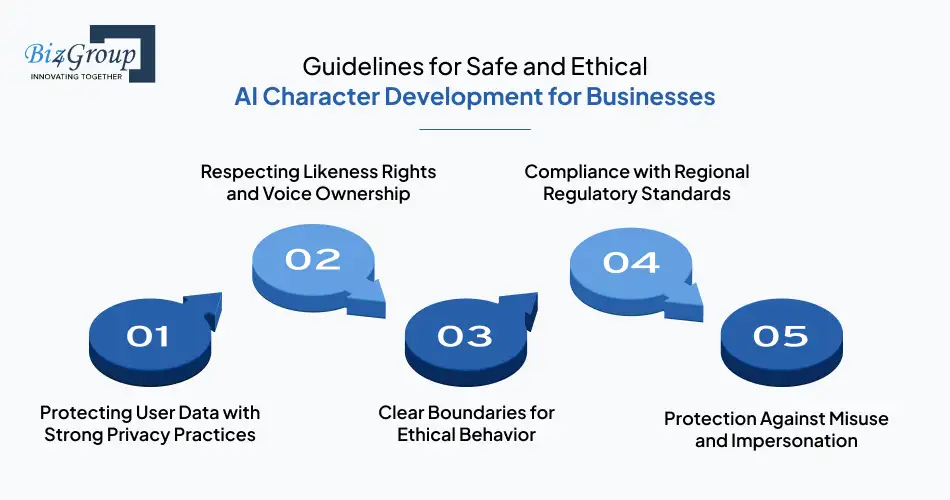
Security and compliance shape the trust your audience places in your AI character. This section highlights the ethical and regulatory expectations every business should follow. These practices protect your users, your data, and your brand reputation.
Protecting User Data with Strong Privacy Practices
Your AI character handles messages, voice inputs, and interactions that may include personal information. This makes data protection a priority.
- Store customer information securely with proper access controls
- Follow regional privacy laws that apply to your users
- Use transparent data handling practices to build trust
- Provide clear options to delete or review user data
Strong privacy practices show customers that their information is safe and handled with care.
Respecting Likeness Rights and Voice Ownership
Many brands want lifelike visuals or custom voice models. This requires proper rights and permissions.
- Secure written consent for likeness or voice use
- Avoid using any real person’s style without permission
- Ensure your character’s assets remain fully owned by your brand
- Verify that third party tools comply with likeness protection laws
When these rights are respected, your brand avoids legal conflict and maintains a professional reputation.
Clear Boundaries for Ethical Behavior
An AI character must behave in a way that reflects your brand values. Ethical guidelines help steer its tone and responses.
- Set limitations on sensitive topics
- Avoid harmful, biased, or misleading responses
- Train the character with balanced, factual content
- Monitor outputs regularly to avoid drifting behavior
Ethical boundaries keep your character helpful, respectful, and safe for all audiences.
Compliance with Regional Regulatory Standards
Depending on where your business operates, you may be required to follow specific regulatory frameworks.
- Follow GDPR for European audiences
- Follow CCPA for California based audiences
- Meet accessibility guidelines where applicable
- Provide compliant data request options
Meeting regional regulations builds confidence among international users and reduces exposure to penalties.
Protection Against Misuse and Impersonation
Your character must remain protected from unauthorized replication or manipulation. Safeguards help preserve brand integrity.
- Limit access to internal models and assets
- Restrict API keys and internal credentials
- Track unusual usage patterns
- Watermark or secure unique assets when possible
Effective protection ensures that your AI character remains authentic and tied to your brand alone.
Security and ethical compliance form the backbone of responsible AI character development. These measures create a safe environment for your customers and protect your brand from operational, reputational, and legal complications.
Also read: How to build an AI avatar generator app like Lensa AI?
Full Cost Breakdown to Build an AI Digital Human for Brand Identity
Budget planning helps businesses understand how far their investment can go. When you build an AI character for your brand, the average cost usually ranges between $15,000-$100,000+. The exact amount depends on complexity, style, and AI integration services. Here's a quick starting point.
|
Level |
What It Includes |
Estimated Range |
|
MVP |
Basic avatar, simple personality, standard voice, limited interactions |
$15,000-$30,000+ |
|
Advanced Level |
Enhanced visuals, emotional speech, stronger personality model, multiple interaction modes |
$30,000-$65,000+ |
|
Enterprise Level |
Fully branded digital human, advanced behavior logic, integrations, multi-language, analytics |
$65,000-$100,000+ |
This table sets the foundation. Now let us look at what affects these numbers and how brands can plan wisely.
Key Cost Drivers
Cost drivers shape the base investment. Each one plays a direct role in the final budget.
|
Cost Driver |
What It Means |
How It Affects Cost |
|
Visual Complexity |
2D or 3D look, realism level, animation detail |
More detail increases cost by $3,000-$25,000+ |
|
Voice Quality |
Generic voice or custom voice model |
Custom voices add about $2,000-$10,000+ |
|
Personality Depth |
Simple or advanced behavior scripting |
Advanced scripting adds $2,000-$12,000+ |
|
Interaction Modes |
Chat only or chat, voice, and video |
Multi-mode adds $5,000-$20,000+ |
|
Knowledge Scope |
Small or large brand knowledge base |
Larger scope adds $1,000-$8,000+ |
|
Integrations |
CRM, CMS, eCommerce, LMS connections |
Each integration adds $2,500-$15,000+ |
|
Content Output Features |
Video generation or multi-platform output |
Adds $3,000-$18,000+ |
|
Maintenance Needs |
Updates, improvements, new scripts |
Annual costs of $3,000-$20,000+ |
These drivers shape the base investment. Understanding them helps your team choose the features that matter most for your goals.
Hidden Costs to Consider
Every AI character project includes a few quiet expenses that teams should prepare for. These are not always visible at the start, yet they influence overall cost and performance.
- Additional character poses for campaigns often require $500-$3,000+
- New voice scripts and tone adjustments can add $300-$2,000+ per cycle
- Continuous improvements in behavior or expressions may add $1,000-$5,000+
- Extra storage for content creation can add $100-$500+ monthly
- Upgrading the character to new formats or languages may require $2,000-$10,000+
These hidden layers help your character stay relevant, expressive, and aligned with your brand identity.
Understanding cost drivers helps brands make clear decisions. You can choose what matters today and plan upgrades for tomorrow. In the next section, we will explore how to maximize ROI, lower spending, and unlock monetization opportunities from your AI character.
Smart Brands Start Small and Scale Fast
Get an MVP in weeks, not months, and grow only when you are ready.
Request a Custom QuoteCost Optimization and Monetization Strategies for Brands That Build an AI Character
Investing in an AI character becomes far more valuable when you actively manage costs and unlock revenue or savings. Here’s how.
Cost Optimization Strategies
Here is a table summarizing practical ways to save money while developing or operating an AI character. These steps help control the budget throughout the lifecycle and reduce total cost of ownership.
|
Optimization Strategy |
What It Means |
Typical Savings or Impact |
|
Modular Build with MVP-first approach |
Build a minimal viable product first, then expand features incrementally |
Saves up to 30-50% of full build cost |
|
Reuse Assets and Templates |
Use existing avatars, voice models, content templates instead of custom each time |
Reduces visual/voice design cost by 40-60% |
|
Leverage Automation for Content Generation |
Automate content/video generation, script drafting, and updates |
Cuts down manual work cost by 20-30% per month |
|
Use Standard Tools Instead of Custom Tools |
Use off-the-shelf AI frameworks and platforms rather than building from scratch |
Lowers backend development cost by 25-35% |
|
Merge Roles |
One character handles marketing, tutorials, customer queries, onboarding |
Reduces duplication by 30% |
|
Cloud Orchestration and Efficient Hosting |
Use scalable cloud hosting and resource-efficient deployment |
15-30% savings in IT services |
Each of these strategies helps keep your project lean and scalable. When you apply several together, savings compound and reduce long-term cost burden.
Monetization and ROI Strategies
Once your AI character is deployed, you have opportunities to generate revenue, save operational cost, and create measurable return on investment. The following strategies are among the most effective for companies building AI-powered virtual brand ambassadors or digital personas:
- Use the AI character as a customer support and sales assistant. Automating interactions reduces support staff cost. Industry data shows AI and automation solutions can reduce operational costs by 20-30% and improve efficiency over 40%.
- Drive conversions by having the character recommend products or services. Studies have shown that companies using AI automation services report uplift in marketing and sales effectiveness, leading to higher conversion and revenue.
- Use the character to produce scalable content. This reduces recurring production cost and enables rapid content generation without repeated filming or voice-talent, saving time and money on creative production.
- Offer premium interactive services or subscriptions via the AI character (for eLearning, wellness, coaching, consultations). This opens new revenue streams with lower cost per user.
- Reduce customer support overhead. With AI handling routine questions, human agents can focus on complex cases. According to industry reports, AI agents cost around $0.25-$0.50 per interaction versus $3.00-$6.00 for human agents, representing 85-90% cost reductions in many cases.
- Increase productivity and efficiency across departments. Firms adopting AI report gains in productivity and throughput that translate into lower operating expense over time.
These monetization paths mean your investment may pay off quickly (sometimes within months), especially if your character serves high-volume interactions or content needs.
What To Track to Measure ROI
To make the most of monetization, track these metrics closely:
- Interaction cost per user compared with human support cost
- Conversion rate uplift after deploying AI character recommendations
- Content production time and cost saved per video/tutorial
- Customer engagement metrics: retention, feedback, usage frequency
- Revenue generated from subscriptions or premium features
Optimizing cost and monetizing your AI character transforms it from a cost center into a strategic asset. By applying smart design, reuse, and automation, you reduce build and maintenance costs. By adopting monetization strategies, you open new revenue streams and lift efficiency.
Also read: How much does it cost to develop a custom AI avatar?
Challenges Risks and Mistakes When You Build an AI Character for Your Brand
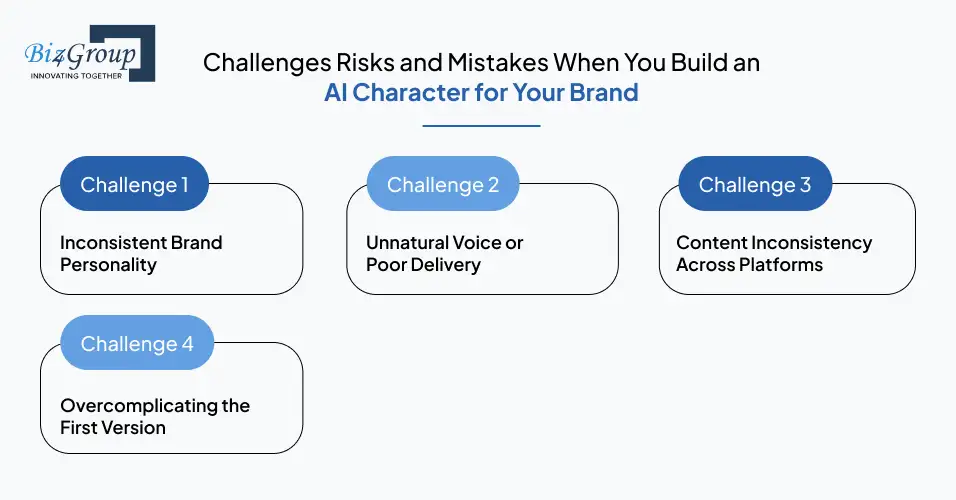
Every innovation comes with challenges. When companies build an AI character for their brand, the process involves creative alignment, technical decisions, and concrete planning. This section outlines the most common issues brands face and provides clear, practical solutions in bullet form.
Challenge 1: Inconsistent Brand Personality
When the character’s tone or behavior shifts unpredictably, customers sense a lack of polish. This happens when personality rules are not well defined at the start.
Solutions
- List tone preferences and banned phrases
- Set rules for emotional range and style
- Test personality across sample scripts
- Review outputs frequently to correct drift
A strong personality framework keeps your AI character stable and trustworthy.
Challenge 2: Unnatural Voice or Poor Delivery
A character that speaks without emotion or clarity can lose user engagement. Voice quality shapes the entire experience, especially for marketing videos and tutorials.
Solutions
- Choose a voice engine that supports emotional variation
- Train custom voice models with clean, high-quality samples
- Match tone with target audience preferences
- Review user feedback and refine delivery
A polished voice encourages users to listen longer and interact more.
Challenge 3: Content Inconsistency Across Platforms
When your AI character appears differently on social media, websites, or tutorials, it confuses the audience. Consistency builds recognition.
Solutions
- Maintain a single style guide for all content
- Create uniform templates for output formats
- Match tone across every platform
- Test content distribution across devices
A unified content strategy ensures your character becomes an identifiable part of your brand.
Challenge 4: Overcomplicating the First Version
Some brands try to add every feature in the first build. This increases cost and slows progress. A simpler start offers better clarity.
Solutions
- Begin with an MVP
- Add advanced features based on real user feedback
- Avoid unnecessary design elements
- Focus on one key use case before expanding
A phased approach helps you learn what works without overspending.
Challenges are part of the creative journey, but they should not stop progress. With clear planning and early safeguards, you can avoid costly mistakes and build an AI character that feels natural, consistent, and ready for daily use.
You Do Not Have to Learn Everything the Hard Way
Our team has already solved the problems you are trying to avoid.
Talk to Our ExpertsEmerging Trends That Influence AI Character Development for Businesses
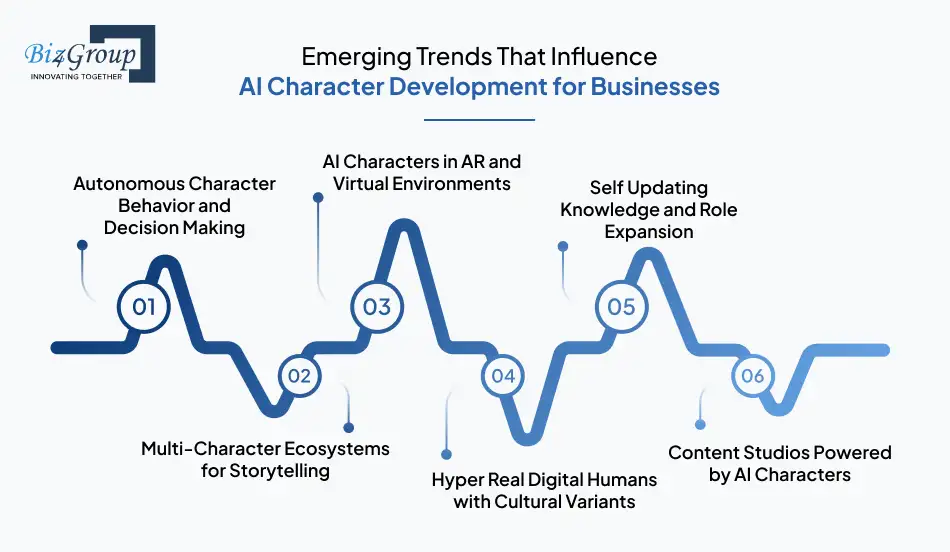
The world of AI characters continues to evolve. What feels advanced today will become the new baseline tomorrow. This section looks ahead at the trends that will guide how brands create, refine, and elevate their digital personas.
1. Autonomous Character Behavior and Decision Making
Future AI characters will act with more independence. They will guide users, manage conversations, and take actions based on brand guidelines without needing continuous human input. This level of autonomy helps brands create richer interactions and reduces time spent on manual content planning.
2. Multi-Character Ecosystems for Storytelling
Brands will move beyond single characters and build ecosystems of interconnected personas. These multi-character setups will appear in social content, product education, and customer journeys. Each character will play a specific role while maintaining a shared brand identity.
3. AI Characters in AR and Virtual Environments
As augmented and virtual environments expand, AI characters will appear in virtual stores, immersive classrooms, onboarding simulations, and virtual brand experiences. This shift transforms flat interactions into spatial interactions that feel more engaging and memorable.
Also read: How AI and Augmented Reality Transform the Online Shopping Experience
4. Hyper Real Digital Humans with Cultural Variants
Brands will begin creating culturally adapted versions of the same AI character. These variants can match tone, gestures, expressions, and conversational patterns that resonate with specific regions. This helps global brands localize without recreating new characters from scratch.
5. Self Updating Knowledge and Role Expansion
AI characters will gain the ability to update their knowledge safely and reliably without manual intervention. This will help them learn new product lines, new policies, or new marketing angles at a rapid pace. They will also take on new roles inside an organization as their capability grows.
6. Content Studios Powered by AI Characters
Brands will increasingly use AI characters to run entire content studios. They will produce webinars, product launches, social clips, onboarding lessons, and internal updates. This transformation turns the AI character into the foundation for high volume content that feels cohesive.
These future shifts show that AI characters will grow far beyond scripted behavior and predesigned visuals. They will become adaptable, intelligent, and culturally aware digital partners for modern brands. Each trend pushes businesses toward richer interactions and stronger identity building.
Also read: Top AI avatar development companies in USA
Why Biz4Group LLC Leads the Future of AI Character Development in the USA
Biz4Group LLC has spent years building intelligent digital solutions for enterprises, mid-size brands, and fast-growing startups. Our work as a software development company blends strategy, innovation, and precision. We specialize in developing AI characters, virtual brand ambassadors, and entire AI powered ecosystems that fit directly into real business workflows.
We study a business carefully, identify its strengths, and craft AI characters that reflect real brand identity. Our expertise spans user interaction psychology, advanced personalization, behavioral design, and enterprise grade AI solutions. This approach helps businesses get a fully functional representative that can engage and guide customers, support teams, and elevate a brand’s online presence.
As a trusted AI avatar development company, over the years we have built branded digital personas that now power real user journeys. These solutions were built with accuracy, empathy, and futuristic scalability. Our portfolio shows what happens when the right strategy meets the right innovation, and companies across the USA trust us because they see the impact of our solutions in their growth metrics.
Why Businesses Choose Us
Companies choose Biz4Group because our process is thoughtful, our execution is reliable, and our results make a measurable difference. Here is what sets us apart.
- We build AI characters that feel natural, consistent, and aligned with your brand vision
- We deliver polished work through a team of senior designers, engineers, and AI developers
- We have hands-on experience creating expressive avatars used in high traffic environments
- We offer strategic guidance while delivering modern, stable, and scalable AI solutions
- We work with clarity, transparency, and strong communication throughout every phase
- We bring proven experience through live projects that include AI companions, AI wellness guides, AI education tutors, and digital spokespeople
This mix of creative strength and technical maturity helps brands feel confident about the character they are launching. When companies aim to compete at a higher level, they want a partner who can think ahead, adapt fast, and deliver results they can measure. Biz4Group LLC has earned that trust through repeated success.
Every project we take on is shaped with a clear goal to help brands grow in an evolving digital world. If your business wants to create a compelling AI character that reflects your vision and delivers value, Biz4Group LLC is the right partner for you.
Let’s talk.
Final Thoughts
Building an AI character is a chance for brands to build a digital identity that can speak, guide, teach, and represent them anytime and anywhere. Through the journey of concept, personality design, visual identity, and continuous optimization, companies gain a scalable digital asset that strengthens customer experience and amplifies content production.
The demand for human-like digital personas is rising across industries. Companies are using them for marketing, sales, learning, and product storytelling. If your goal is to develop an AI character for your brand, the opportunity is wide open. Investing early gives brands a voice and presence that feels memorable, modern, and distinctly theirs.
As a bespoke AI app development company, Biz4Group LLC has been helping brands move into this future with clarity and confidence with our exceptional AI development services. Our work includes AI companions, wellness avatars, training tutors, and full-scale digital humans built for real business workflows. We focus on creating reliable characters that help companies reduce cost, increase engagement, and grow their digital footprint with consistency.
If your brand is ready to create a character that works for you around the clock, this is your moment. Reach out to Biz4Group LLC and build an AI character with us.
FAQs
How long does it usually take to build an AI character from scratch?
Most timelines fall between four to twelve weeks. Biz4Group delivers an MVP in about two to three weeks because we use reusable components that reduce development time and cost. This helps brands see results sooner and refine the character with real user insights.
Will an AI character work if my brand has multiple audience segments?
It can. You can configure different response modes or communication styles so the character adapts based on who it is speaking with. This flexibility helps brands maintain consistency while still supporting varied user groups.
Can an AI character represent a real person from my company?
Many brands use AI versions of founders, trainers, or subject matter experts. You only need the right permissions and clear guidelines for likeness and tone. This helps the character deliver information with authority and familiarity.
What platforms can an AI character appear on?
A well-built AI character can appear on websites, mobile apps, learning platforms, eCommerce flows, social media videos, onboarding experiences, and virtual events. The placement depends on your business goals.
Can I use an AI character in languages other than English?
Yes. Many AI characters support multilingual delivery through language packs and speech models that maintain tone across languages. Brands can use this to strengthen global reach without creating separate personas.
