 Location :
Orlando, FL, USA
Location :
Orlando, FL, USA +1 (407) 714-1616
 info@biz4group.com

- Modern teams want faster, clearer medical-legal insights, making it essential to build an AI medical-legal expert platform that supports reliable case analysis.
- Core workflows improve significantly when organizations develop an AI medical-legal expert platform with secure ingestion, structured reasoning, and human validation.
- Advanced automation gains momentum as teams create AI medical-legal case analysis software that scales with complex evidence and compliance needs.
- Industry momentum is growing, with the international legal-AI market forecasted to cross USD 3.90 billion mark by 2030.
- Costs range from USD 30,000 to 250,000+, depending on features, integrations, and AI sophistication.
- The right tech stack and partner help ensure scalable performance, defensible outputs, and a future ready medical-legal solution.
You are trying to build an AI medical-legal expert platform while juggling mountains of patient records and legal files, and suddenly the project feels like a riddle wrapped in another riddle. That moment usually sparks a set of questions that every decision maker quietly wrestles with:
- How do I build an AI platform that can handle both medical and legal questions safely?
- Can an AI medical–legal system review cases and point out risk or liability issues?
- What data do I need to train an AI medical–legal expert without violating HIPAA?
- Is it even legal for an AI to give medical–legal guidance or does it need strict human oversight?
- How accurate can an AI medical–legal platform get when analyzing patient records and legal documents together?
These questions are becoming urgent as the market shifts:
- According to Grand View Research, the global legal-AI market is projected to reach USD 3.90 billion by 2030.
- Many legal professionals expect AI to free up significant time - up to 240 hours per year per legal professional.

You may already be exploring how to develop an AI medical-legal expert platform, especially if your current workflows rely on scattered tools that do not talk to each other. Many teams are discovering that partnering with an AI development company becomes less about chasing trends and more about finally getting control of unpredictable medical-legal workloads.
At the same time, you have likely seen how quickly off-the-shelf AI solutions hit their limits. One unusual diagnosis, a missing timestamp, or a nuanced liability question and the entire system starts guessing. That is usually the moment when leaders realise they need a solution built for real medical-legal complexity, not general-purpose automation.
If you are planning to create AI medical-legal case analysis software, this blog will feel like the conversation you wish you had with a knowledgeable friend at a legal software development company, someone who understands both the tech and the pressure behind getting these decisions right.
So, let’s get started!
What Is an AI Medical-Legal Expert Platform?
An AI Medical-Legal Expert Platform is a software layer that connects clinical data with legal reasoning to help teams evaluate cases, surface risks, and document decisions. When you build an AI medical-legal expert platform, you are essentially codifying a very cautious, data hungry expert.
- A central hub for patient records, legal files, and case materials
- A structured knowledge layer that expresses medical facts in legal terms
- A shared repository of precedents, rules, and risk indicators
- A secure environment for collaboration around sensitive medical-legal information
- An interface that behaves like an AI conversation app tuned for medical-legal work
Think of it as the product vision behind every serious AI medical-legal expert platform development effort, giving your team a shared definition before you argue about models, vendors, or timelines.
How an AI Medical-Legal Expert Platform Works
An AI Medical-Legal Expert Platform works by pulling medical data and legal context into a single structured workflow. When you build an AI medical-legal expert platform, you are really creating a system that makes messy, inconsistent case information feel navigable.
Here’s a quick look into how it works:
|
Component |
What It Does |
Why It Matters |
|
Data Ingestion |
Centralises medical and legal inputs |
Produces clean, usable case information |
|
Reasoning Layer |
Interprets medical facts through legal context |
Creates insights that hold up under scrutiny |
|
Risk Engine |
Flags contradictions and risk indicators |
Supports stronger strategy and preparation |
|
Expert Review |
Adds human judgement and nuance |
Builds trust and accuracy over time |
|
Output Module |
Generates timelines and reports |
Reduces manual review and speeds progress |
1. Ingestion and Structuring
The platform brings together medical files, legal documents, records, and statements so everything lives in one organised environment. Once collected, the system cleans and standardises the information so downstream reasoning stays reliable. Teams often lean on AI integration services at this stage to keep the data foundation consistent.
2. Medical-Legal Reasoning Layer
With clean inputs, the platform starts interpreting medical facts, patient timelines, procedures, and clinical context through a legal lens. It identifies what is relevant, what is missing, and what may influence liability. This stage grows more dependable as organisations strengthen it through ongoing AI model development.
3. Risk and Insight Generation
Next, the system highlights contradictions, incomplete evidence, or patterns that could affect a case outcome. These insights often support broader planning inside teams working on long term medical-legal expert platform development with AI, especially when the goal is more consistent evaluation across cases.
4. Collaborative Review and Validation
Human reviewers step in to validate conclusions, adjust interpretations, and clarify nuance that AI cannot see on its own. Over time, this collaboration helps organisations naturally make an AI system for medical-legal consulting that adapts to their style and case patterns.
5. Secure Output Delivery
Finally, the platform presents case summaries, medical timelines, risk indicators, and structured reports in clean formats that legal and clinical teams can work with. These outputs often become a foundation for larger AI medical-legal expert software development goals across an organisation.
Understanding this workflow makes it easier to see the real value behind investing in a platform built for medical-legal clarity.
Transform Case Complexity Into Clarity
Build smart workflows and faster reviews when you build an AI medical-legal expert platform tailored for real-world legal and clinical demands.
Start My Platform BuildWhy Invest in AI Medical-Legal Expert Software Development?
Investing in an AI Medical-Legal Expert Platform means backing a category with rising demand and strong economic upside. When you build an AI medical-legal expert platform, you fund technology that replaces slow, expensive case review with scalable intelligence.
1. A Fast Growing Market With Real Spending Power
Medical-legal work drains budgets across healthcare, insurance, and legal sectors, creating strong demand for automated help. This trend pushes teams to build AI software for medical-legal case review that delivers immediate cost relief.
2. Scalable Automation With Expanding Margins
Once the platform is running, processing additional cases becomes dramatically cheaper. Many organisations pursuing enterprise AI solutions see margin expansion as volume grows.
3. Clear Operational Risks the Platform Can Eliminate
Slow reviews, inconsistent findings, and error prone manual work translate into financial exposure. Platforms built to create AI-driven medical-legal decision support software reduce these vulnerabilities.
4. High Defensibility Through Specialised Data and Logic
Medical-legal reasoning requires structured clinical patterns and legal interpretation that generic AI tools cannot mimic. Teams often use AI consulting services to embed hard to replicate expertise.
5. A Foundation for Long Term Product Expansion
Once structured evaluations are established, additional capabilities become easy to layer in. This scalable foundation is ideal for organisations aiming to make automated medical-legal review and evaluation software that grows with demand.
With the investment case clear, the next step is exploring where these platforms create the most practical value across real-world scenarios.
Real-World Use Cases for AI Medical-Legal Expert Platform Development
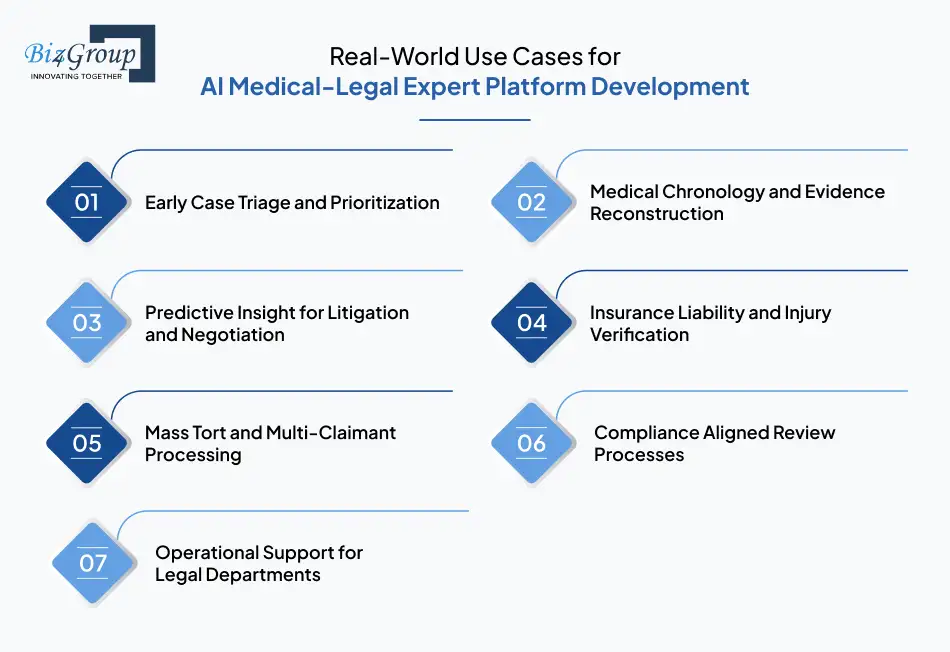
Medical-legal work becomes unmanageable long before anyone admits it, which is why organisations adopt platforms that bring structure back into overloaded teams. When you build an AI medical-legal expert platform, the everyday applications start showing faster than expected.
1. Early Case Triage and Prioritization
Legal and claims teams use the platform to sort strong cases from unstable ones before investing time, experts, or budget. The system highlights inconsistencies early enough to change strategy while it still matters. Many internal teams eventually fold this into their own tools after working with AI partners.
- Example: Weak claims drop off the radar in minutes instead of days.
2. Medical Chronology and Evidence Reconstruction
Instead of flipping through hundreds of pages, teams get a clean, consolidated timeline that aligns medical reality with legal relevance. This transforms case prep for attorneys who previously patched together fragmented notes. Some firms even integrate AI into an app they already use for document review.
- Example: A single visual timeline reveals a treatment gap that changes evaluation strategy.
3. Predictive Insight for Litigation and Negotiation
Patterns drawn from structured medical and legal data help teams anticipate likely outcomes early in the process. These insights influence negotiation strategies and expected settlement ranges. Over time, some organisations branch into make a predictive AI platform for medical-legal risk scoring to deepen strategic planning.
- Example: A probability estimate for likely outcomes guides both settlement and deposition prep.
4. Insurance Liability and Injury Verification
Evaluating injury severity, treatment validity, and documentation quality becomes far more consistent across adjusters. The platform detects contradictions that would normally appear only after lengthy review. This is often where insurers first choose to build AI software tailored to medical-legal evidence.
- Example: A flagged mismatch between treatment dates and reported injuries shifts a claim’s direction immediately.
5. Mass Tort and Multi-Claimant Processing
Large batches of medical files are processed using consistent logic, something that is almost impossible without automation. The platform levels the playing field so every file is evaluated with the same criteria. Companies managing enterprise litigation often pair this with a medical-legal AI automation platform for bulk operations.
- Example: Hundreds of claimant files get sorted into severity categories in a few minutes.
6. Compliance Aligned Review Processes
The platform maintains privacy and evidentiary standards while speeding up review, giving teams a reliable way to avoid accidental missteps. Consistent workflows reduce exposure in regulated environments. This becomes a significant upgrade for groups that previously relied on manual checks before adopting AI automation services.
- Example: A missing patient authorization is flagged before the file is shared externally.
7. Operational Support for Legal Departments
Routine filtering, sorting, and classification tasks become automated, letting reviewers focus on judgement rather than repetitive admin work. The platform adapts to whatever systems the team already depends on. Some departments eventually build a medical-legal risk assessment platform using AI as their core workflow backbone.
- Example: Documents arrive pre-grouped by relevance so analysts start from insight, not chaos.
|
Use Case |
What It Solves |
Who Benefits |
|---|---|---|
|
Case Triage |
Quick spotting of viable cases |
Firms, insurers |
|
Liability Review |
Early detection of contradictions |
Claims teams |
|
Chronology |
Structured and usable timelines |
Attorneys, analysts |
|
Compliance |
Reduced privacy & evidentiary risk |
Compliance teams |
|
Predictive Modelling |
Better planning and negotiation |
Legal groups |
|
Mass Tort |
Scalable, consistent processing |
Enterprise litigation teams |
|
Workflow Automation |
Less manual review effort |
Legal departments |
With these applications understood, the next logical step is identifying which features make a platform capable of handling work at this level.
Level Up Medical-Legal Decision Making
Give your teams AI that highlights risks, patterns, and insights the moment a file hits the system.
Begin My AI Medical-Legal Case Analysis Software ProjectMust-Have Features When You Build an AI Medical-Legal Expert Platform
An AI Medical-Legal Expert Platform needs more than automation to be useful. For those of you who are planning to build an AI medical-legal expert platform, you are creating a system that blends precision, compliance, and clarity, which starts with a strong set of core features.
Here’s a quick look at everything that you need to know:
|
Core Feature |
What It Does |
Why It Matters |
|---|---|---|
|
Centralised Evidence Ingestion |
Collects medical records, legal documents, transcripts, and supporting files in one place |
Prevents fragmentation and provides reviewers complete, consolidated information |
|
OCR system and Text Normalisation |
Converts scans, handwritten notes, and variable document formats into searchable text |
Makes noisy medical records usable and removes inconsistent formatting |
|
Medical-Legal Timeline Creation |
Builds a unified timeline of events from clinical and legal data |
Gives reviewers a shared understanding of case flow without manual efforts |
|
Entity and Diagnosis Extraction |
Identifies diagnoses, procedures, medications, dates, and legal references |
Reduces manual parsing and lowers the risk of missing critical details |
|
Smart Search and Retrieval |
Allows fast lookup of symptoms, events, treatments, or terms across large case files |
Saves hours otherwise lost in document hunting |
|
Role-Based Access and Permissions |
Ensures each user interacts with data at the correct access level |
Protects patient data and supports compliant handling in regulated environments |
|
Audit Trails and Activity Logging |
Tracks every action across documents, users, and workflows |
Provides defensibility to agencies that develop an AI medical-legal expert platform with strong governance |
|
Case Summaries and Document Briefs |
Generates digestible overviews of clinical and legal findings |
Helps teams ramp up quickly without combing through every record |
|
Integrated Document Storage |
Stores sensitive medical-legal evidence securely within the platform |
Maintains reliable organisation for teams using tools like AI legal document management software |
Solidifying these essentials creates the groundwork that more sophisticated capabilities can build on, shaping the platform into something far stronger as the next layer of features enters the picture.
Advanced Features for AI Medical-Legal Expert Software Development
Once the foundation is in place, an AI Medical-Legal Expert Platform becomes far more capable with intelligence that feels closer to real professional reasoning. For anyone who’s trying to build an AI medical-legal expert platform, the advanced layer adds depth that teams immediately notice.
Here are some advanced features that you can consider:
1. Predictive Legal-Medical Insight Engines
These models learn from prior outcomes and medical trajectories to anticipate how certain fact patterns may influence a case. They help teams prepare before issues surface. In several organisations, this is the point where they begin to create AI medical-legal case analysis software that supports long term strategic planning.
2. Automated Causation Interpretation
The platform can evaluate whether clinical events reasonably align with reported injuries, procedures, or timelines. This gives reviewers a clearer direction without digging through dense records. Some legal groups even fold this into existing tools built through on-demand app development solutions.
3. Intelligent Evidence Prioritisation
Instead of forcing reviewers to sift through endless files, the system highlights sections that carry the highest medical-legal relevance. The prioritisation adapts as new information arrives. Teams focusing on AI medical-legal expert platform development often consider this the feature that cuts the most review fatigue.
4. Adaptive Risk Mapping Models
Risk indicators shift as the platform processes more cases, making the system sharper with each round of data. This refinement is especially useful when caseloads grow. Larger firms sometimes bring in partners who can build legal AI agent components to support these dynamic models.
5. Multi-Case Pattern Intelligence
Working across many files allows the platform to identify broader trends, recurring inconsistencies, or systemic treatment anomalies. These insights give leadership a higher-level view of risk distribution. Some enterprises strengthen this capability with attorney billing software integrations so case economics pair with evidence patterns.
These advanced capabilities build on the earlier core features and naturally invite deeper thinking about how the entire development lifecycle should be approached next.
What Is the Process of Creating an AI Medical–Legal Expert Software?
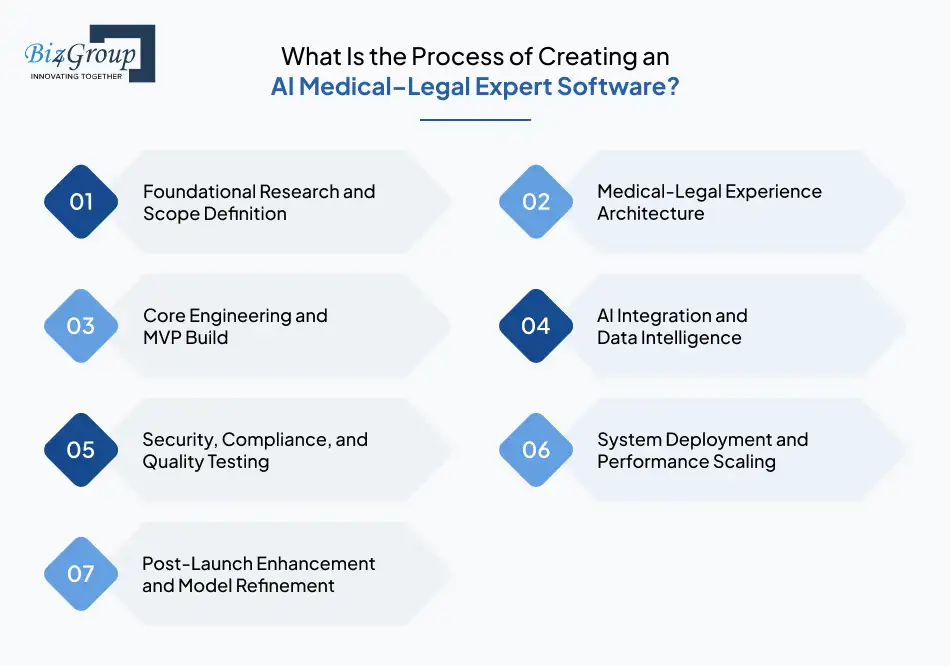
Building an AI Medical–Legal Expert Platform means designing technology that can keep up with the speed, volume, and risk of real-world casework. When you build an AI medical-legal expert platform, you are building a system that must earn trust from attorneys, clinicians, analysts, and compliance teams from day one. This step-by-step journey shows how organizations bring these platforms to life.
1. Foundational Research and Scope Definition
Medical-legal teams rarely suffer from a lack of expertise. They suffer from chaotic evidence flows, incompatible formats, and review processes that collapse under pressure. Discovery is where you identify precisely which gaps cause the most friction. For some teams, it is timeline confusion. For others, it is inconsistent liability reasoning or documentation that shows up half complete.
During this phase you:
- Interview clinicians, attorneys, adjusters, and compliance teams to pinpoint where medical-legal evaluations break down
- Identify which workflows are ideal candidates for early automation, such as chronology building or document classification
- Validate the privacy landscape early to avoid redesigning secure workflows later
- Lock in measurable KPIs such as reduced review time, cleaner triage decisions, or fewer information gaps
Strong planning always sets the tone for teams preparing to develop an AI medical-legal expert platform.
2. Medical-Legal Experience Architecture
Attorneys do not tolerate confusing software, clinicians do not tolerate inefficient navigation, and insurers do not tolerate workflows that slow down settlements. Good design is what makes an AI Medical–Legal Expert Platform feel usable, even when the underlying logic is very complex.
This is where you:
- Prototype entire medical-legal journeys from intake to final summary
- Test the interface with users who think differently: litigators, medical experts, claims staff, and compliance professionals
- Add dashboards for timelines, diagnoses, treatments, and key evidence clusters
- Standardize layout choices so the platform feels consistent everywhere it is used
Teams pursuing crisp usability are recommended a collaboration with an experienced UI/UX design company.
Also read: Top UI/UX design companies in USA
3. Core Engineering and MVP Build
Engineering begins by building only the features that deliver immediate value. In medical-legal environments, MVP development services typically focus on creating clarity in documentation rather than performing advanced legal reasoning. This phase transforms the concept into something real that teams can evaluate.
Core deliverables often include:
- Evidence ingestion engines able to handle PDFs, scanned files, and EHR data
- AI components that identify diagnoses, procedures, and medical events
- Timeline builders that unify scattered medical and legal information
- Infrastructure designed for future expansion into analytics, or deeper reasoning
This stage is where organisations decide how to create AI medical-legal case analysis software that evolves in stages with minimal waste.
Also read: Top 12+ MVP Development Companies in USA
4. AI Integration and Data Intelligence
This is where the platform transforms from a structured record organizer into something that feels intelligent. Medical and legal reasoning require different cognitive patterns, so your AI must be trained with nuance in mind rather than general natural language models.
Key steps include:
- Training AI models on medical records, legal standards, and evidentiary patterns
- Mapping medical events to legal frameworks for consistent interpretation
- Building active learning loops with reviewer corrections to improve accuracy
- Balance pre-trained and custom-trained elements to maintain specificity
This stage is foundational for long-term AI medical-legal expert platform development.
5. Security, Compliance, and Quality Testing
If there is any domain where security can never be compromised, this is it. Medical data is sensitive. Legal data is privileged. A breach or mishandling event could cause reputational and financial harm. The testing phase ensures the platform stays airtight.
This stage includes:
- Privacy audits for HIPAA-compliance and region-specific requirements tied to medical-legal handling
- Stress testing ingestion pipelines with extremely heavy case files
- Simulating user journeys to eliminate hidden slowdowns or risky interactions
- Strengthening access controls, logs, and encryption to reinforce trust
Robustness in this phase often influences long-term AI medical-legal expert software development decisions.
Also Read: Software Testing Companies in USA
6. System Deployment and Performance Scaling
Medical-legal caseloads spike unpredictably. One litigation wave, one insurance audit cycle, or one regulatory shift can introduce massive volume instantly. Deployment strategy ensures the platform scales without friction.
Key components include:
- Cloud environments that respond automatically to case surges
- CI/CD pipelines for smooth delivery of new capabilities
- Monitoring tools that track processing speed, reviewer activity, and resource demands
- Onboarding guides that shorten the learning curve for busy professionals
A well-executed deployment makes the platform feel invisible, which is exactly what medical-legal users expect.
7. Post-Launch Enhancement and Model Refinement
Medical-legal work evolves constantly. Regulations change. Evidence formats shift. Case types diversify. Post-launch refinement is where your platform stays relevant and competitive.
Optimization efforts typically include:
- Collecting feedback from attorneys, clinicians, and analysts to refine workflows
- Introducing advanced capabilities like risk scoring, automated reasoning, or cross-case pattern analysis
- Retraining models using new case datasets to maintain accuracy and reduce drift
- Tracking ROI indicators such as time saved per case, improved decision consistency, or fewer errors
These improvements shape long-term medical-legal expert platform development with AI and help the platform mature gracefully.
Each of these stages shapes a platform that can handle the realities of medical-legal work with precision and trust. And by following a structured development path, you create the clarity needed to build an AI medical-legal expert platform that performs reliably in high-pressure environments.
Boost Accuracy in Every Review
Modernize evidence handling with intelligent automation and structured reasoning that evolves as your practice grows.
Develop My AI Medical-Legal Expert PlatformIdeal Tech Stack to Build an AI Medical-Legal Expert Platform
The tech stack determines how well your AI platform handles clinical documents, legal evidence, and AI-driven reasoning under real pressure. Designing this foundation with the right tools is what allows you to build an AI medical-legal expert platform that feels reliable even at high caseloads.
|
Label |
Preferred Technologies |
Why It Matters |
|---|---|---|
|
Frontend Framework |
ReactJS, Vue.js |
Helps in building responsive interfaces that align naturally with the interface performance supported through ReactJS development. |
|
Server-Side Rendering & SEO |
NextJS, Remix |
Complex dashboards load quickly and stay stable, reinforced by principles in NextJS development. |
|
Backend Framework |
NodeJS, Python |
NodeJS development manages concurrent ingestion while Python development executes clinical-legal logic. |
|
REST, GraphQL |
Enables smooth data exchange with EHR systems, insurer portals, and legal case-management tools without bottlenecks. |
|
|
AI & Data Processing |
PyTorch, TensorFlow, spaCy |
Powers extraction, reasoning, and pattern detection central to medical-legal analysis. |
|
Document Parsing & OCR |
Tesseract, AWS Textract |
Converts scanned medical notes, hospital records, and legal PDFs into structured data ready for automated review. |
|
Search & Retrieval Layer |
Elasticsearch, Meilisearch |
Supports fast searches across diagnoses, events, timelines, and legal references in large case files. |
|
Vector Database |
Pinecone, Weaviate |
Enables semantic retrieval of past medical-legal cases, treatment similarities, and evidence clusters. |
|
Database Layer |
PostgreSQL, MongoDB |
Stores structured timelines, case rules, and unstructured medical notes efficiently. |
|
Cloud Infrastructure |
AWS, Azure |
Offers scalable performance, encrypted storage, and compute flexibility for unpredictable caseloads. |
|
Authentication & Access Control |
OAuth, JWT, SSO |
Ensures role-specific access for clinicians, attorneys, insurers, and reviewers handling sensitive evidence. |
|
Monitoring & Logging |
ELK Stack, Grafana |
Maintains audit trails required for secure and defensible medical-legal workflows. |
With this stack in place, teams can confidently architect a platform that handles the realities of medical-legal evaluation, paving the way for well-structured AI medical-legal expert software development.
Cost to Build an AI Medical-Legal Expert Platform: MVP to Enterprise
The cost to build an AI medical-legal expert platform typically ranges from 30,000 to 250,000 plus, depending on depth, features, compliance needs, and data complexity. This is a ballpark figure, but it gives you a realistic frame before exploring what each investment tier delivers for medical-legal operations:
|
Build Level |
Estimated Cost |
What You Get |
|---|---|---|
|
MVP AI Platform |
30,000 to 60,000 |
Covers ingestion, basic extraction, and a simple timeline builder. Ideal for teams validating workflows before they make an AI system for medical–legal consulting. |
|
Mid-Level AI Platform |
70,000 to 150,000 |
Adds deeper reasoning, risk flags, advanced search, and role-based access. Many organisations expand here by integrating tools like AI legal document management software to anchor reliable evidence handling. |
|
Enterprise AI Platform |
180,000 to 250,000+ |
Includes large scale ingestion, predictive modelling, cross-case intelligence, compliance automation, and cloud scaling. This tier suits firms that work with partners known for accuracy such as the top AI legal software development companies in USA. |
Cost varies because each organisation handles medical-legal work differently, and the platform adapts to those needs. Once you know which tier aligns with your goals, the next question becomes how to turn that investment into a sustainable revenue engine that keeps the platform growing.
Also Read: What is the Cost to Develop Legal AI Agent?
Automate the Work That Slows You Down
Create predictable, compliant, and efficient workflows using AI that understands both medicine and law.
Build My Medical-Legal AI Automation PlatformRevenue Models for Building a Medical-Legal AI Automation Platform
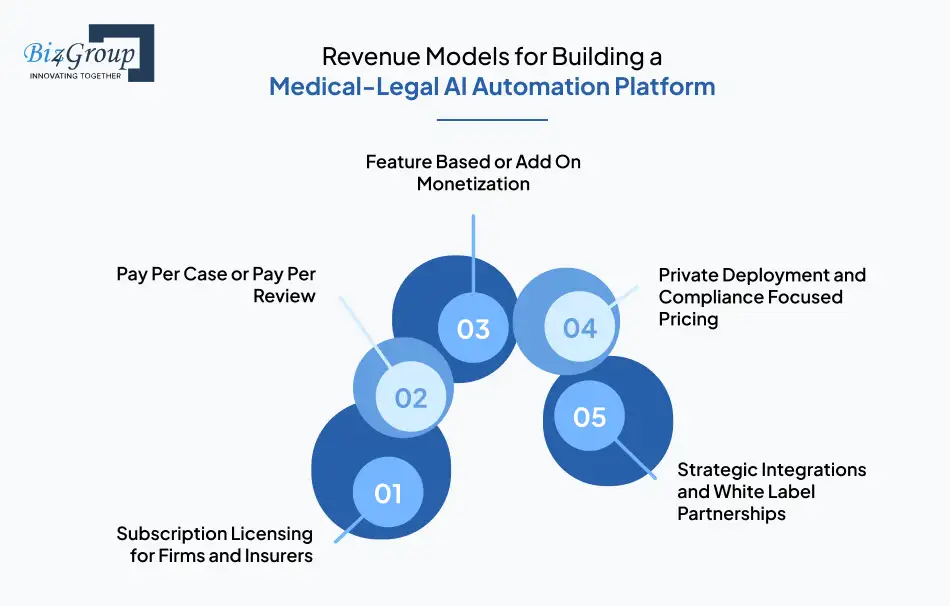
Once you build an AI medical-legal expert platform, the next question is how to turn capability into recurring, predictable revenue. Medical-legal teams pay for clarity, speed, and defensibility, which gives you several practical monetization levers to work with.
1. Subscription Licensing for Firms and Insurers
Subscriptions work well when law firms, insurers, and medical-legal consultants use the platform daily. You can tier pricing by feature depth, number of active matters, or user seats so smaller teams are not locked out while larger ones help fund long-term growth.
- Example: A regional firm might start with a low tier, then upgrade after they hire AI developers to integrate the platform into their internal case dashboard.
2. Pay Per Case or Pay Per Review
This model fits organizations with fluctuating caseloads or those still testing the platform. Each uploaded file or case triggers a fee, which keeps costs tightly aligned with usage. It is especially attractive for teams that are not ready for a full subscription.
- Example: A claims team might pay per file during a spike in injury cases, using the platform heavily for three months and then scaling down once backlog pressure is gone.
3. Feature Based or Add On Monetization
Some clients need only ingestion and timelines, while others want cross-case analytics, pattern detection, or conversational guidance. Selling advanced features as add ons lets you match pricing to value without bloating the base product. Companies exploring legal AI chatbot development often treat conversational review tools as a premium layer.
- Example: A litigation group might stay on the core plan but unlock an add on that surfaces causation anomalies only in high-stakes cases.
4. Private Deployment and Compliance Focused Pricing
Enterprise legal teams, insurers, and health systems often require private cloud or dedicated environments. These projects demand more customization, documentation, and ongoing assurance, so pricing reflects the added effort and reduced risk. This is very similar to how legal workflow automation transforms legal operations.
- Example: A hospital’s in-house counsel may pay more for an instance that runs entirely within their own VPC while benefiting from automated analysis.
5. Strategic Integrations and White Label Partnerships
Some organizations prefer to embed your platform behind their own brand rather than build from scratch. White labeling and deep integrations make sense for consultancies and tech vendors that create AI-driven medical-legal decision support software but want to move faster to market.
- Example: A legal-tech provider might integrate your engine inside their existing interface, offering clients a “new module” powered quietly by your platform.
Choosing the right mix of these models helps the platform fund itself long term, and once the commercial side is clear, the focus naturally shifts to the best practices that keep everything stable, compliant, and trustworthy in daily use.
Best Practices to Build AI Medical-Legal Software with Compliance-Driven Workflows
Strong medical-legal platforms succeed because they combine precision, security, and thoughtful design. When you build an AI medical-legal expert platform, following the right practices keeps your system dependable even when case volume and complexity spike.
1. Prioritise Data Quality Before Intelligence
Clean medical records and structured legal documents significantly improve reasoning accuracy. Poor inputs guarantee poor outputs, regardless of model size. Many teams refine ingestion pipelines early, especially before they build AI software for medical-legal case review that depends on reliable signals.
2. Design Workflows Around Real Reviewer Behavior
Attorneys and analysts do not work in perfect sequences, so your platform should not assume they will. Build for how cases are actually reviewed rather than how process diagrams look. Some organisations opt for business app development using AI to model realistic reviewer habits.
3. Implement Human Validation Loops From Day One
AI should surface insights, not operate unchecked. Reviewers must be able to confirm, reject, or refine outputs so the platform matures under real human judgment. This foundation becomes essential when teams later make a predictive AI platform for medical-legal risk scoring that requires precision.
4. Secure Absolutely Everything, Then Secure It Again
Medical-legal data is among the most sensitive information an organisation will ever handle. Encryption, access control, and traceable logs are non negotiable to maintain trust. Many teams partner with the top AI legal software development companies in USA to ensure compliance standards never slip.
5. Build With Future Automation in Mind
The platform should be flexible enough to support deeper automation as workloads grow. Designing modular components early makes expansion easier as teams scale into a full medical-legal AI automation platform over time.
Following these practices sets a strong foundation for a platform that supports accurate, confident decision making, and it naturally leads into understanding the core challenges teams face while building systems at this level.
Upgrade Case Reviews With Predictive Insight
Accelerate evaluations and identify red flags early by integrating AI built for high-stakes legal and clinical review.
Make My AI System for Medical-Legal ConsultingChallenges in AI Medical-Legal Expert Platform Development and How to Solve Them
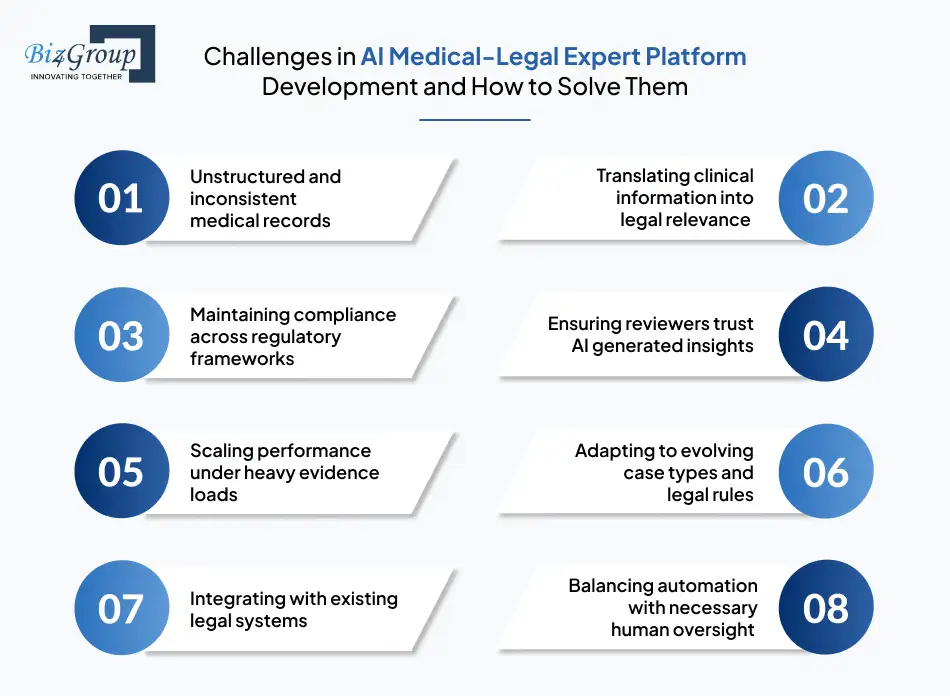
If you have ever tried to build an AI medical-legal expert platform, you already know it is not the models that cause trouble but the messy data and compliance landmines. Those realities set the context for the challenges that truly matter.
|
Top Challenges |
How to Solve Them |
|---|---|
|
Unstructured and inconsistent medical records |
Standardize ingestion pipelines and apply preprocessing modules that clean and normalize data before analysis. |
|
Translating clinical information into legal relevance |
Use domain specific models trained on medical events aligned with legal definitions and causation patterns. |
|
Maintaining compliance across regulatory frameworks |
Build privacy controls, encrypted storage, and audit trails into the core architecture rather than as afterthoughts. |
|
Ensuring reviewers trust AI generated insights |
Add human validation loops and transparent explainability features that show how conclusions were produced. |
|
Scaling performance under heavy evidence loads |
Use cloud scaling, asynchronous processing, and efficient indexing strategies that keep large case reviews responsive. |
|
Adapting to evolving case types and legal rules |
Implement modular AI components and incorporate emerging tech like generative AI to refresh reasoning workflows. |
|
Integrating with existing legal systems |
Design flexible APIs and front-end compatibility, often made easier for teams that also develop AI websites for law firms. |
|
Balancing automation with necessary human oversight |
Maintain human authority in final decisions while letting automation handle repetitive medical-legal tasks. |
Solving these challenges early creates a smoother path as you develop an AI medical–legal expert platform. Having said that, now let’s check out where the technology is headed in the years that follow.
The Future of AI Medical-Legal Expert Platform Development
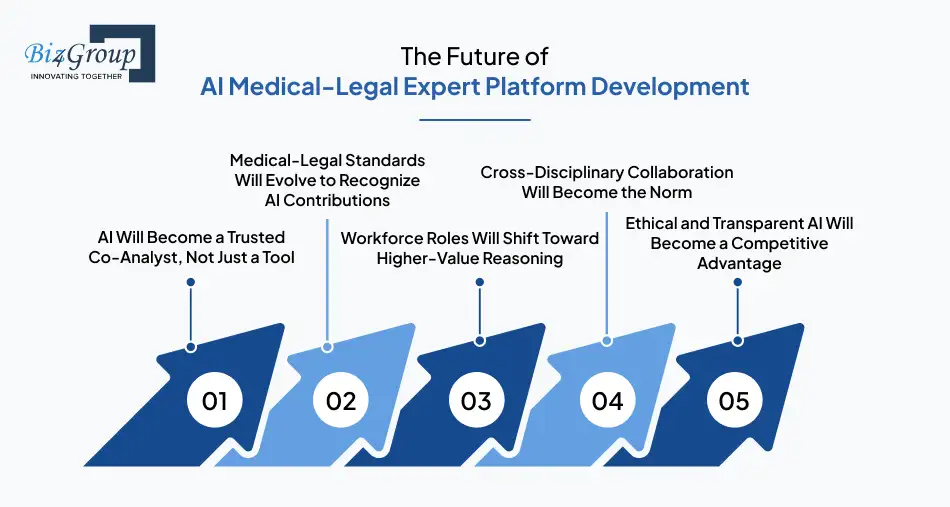
Medical-legal work is entering a new era where accuracy, defensibility, and operational speed are shaped by rapid shifts in AI maturity. As you build an AI medical-legal expert platform, it helps to understand the forces that will define how these systems evolve next.
1. AI Will Become a Trusted Co-Analyst, Not Just a Tool
Medical-legal teams will increasingly treat AI as a collaborative partner that strengthens human judgment rather than just software that automates routines. The platform becomes a consistent analytical companion that helps reviewers think faster and more reliably. This evolution fuels deeper medical–legal expert platform development with AI as expectations rise.
2. Medical-Legal Standards Will Evolve to Recognize AI Contributions
Regulators, insurers, and courts will introduce clearer guidance on how AI-generated insights can be used, cited, and defended in medical-legal proceedings. These emerging frameworks will reduce ambiguity and make AI supported reviews easier to justify in formal contexts, much like how structured outputs from AI lawyer app development gained acceptance in legal workflows.
3. Workforce Roles Will Shift Toward Higher-Value Reasoning
As repetitive evidence sorting fades, professionals will move toward interpretation, challenge testing, and scenario analysis. This elevates their contribution while reducing burnout, creating a healthier balance between automation and expertise.
4. Cross-Disciplinary Collaboration Will Become the Norm
Platforms will act as shared environments where clinicians, attorneys, and claims specialists work from the same evidence foundation in real time. This dissolves communication gaps and builds a unified understanding of cases, similar to what agencies experience when they develop AI website for law firms to centralise operations.
5. Ethical and Transparent AI Will Become a Competitive Advantage
Platforms that can clearly show how and why they reached a conclusion will be chosen over systems that operate like black boxes. Organisations will prioritise auditability, bias control, and interpretability to protect both reviewers and case outcomes.
These shifts signal a future where technology becomes a partner in complex reasoning rather than a background utility, setting the stage for choosing a development partner who understands this evolving landscape.
Why Choose Biz4Group to Build an AI Medical-Legal Expert Platform?
When you build an AI medical-legal expert platform, you need a partner that understands the legal mind, the clinical world, and the AI engineering beneath both. Biz4Group brings all three together with real-world experience and solutions built for teams who cannot afford guesswork.
Interface That Connects Lawyers and Medical Experts

Biz4Group built a platform designed to streamline collaboration between attorneys and medical specialists, enabling rapid access to expert insights, case details, and supporting documentation. This helped firms shorten review cycles and strengthen evaluation accuracy, making it a natural foundation for teams planning to develop an AI medical–legal expert platform with modern, connected workflows at its core.
Why Teams Trust Biz4Group
- We are a custom software development company with deep experience in legal, healthcare, and AI solution engineering.
- We design platforms that match real reviewer behavior instead of idealized workflows.
- Our engineering approach prioritises compliance, security, and accuracy, ensuring safe handling of sensitive clinical and legal data.
- We build modular systems that grow with your needs rather than forcing costly rebuilds later.
- Our cross-functional teams understand how AI supports, not replaces, expert judgment in medical-legal decision making.
Biz4Group blends industry understanding with practical execution, giving you a partner capable of turning complex requirements into dependable systems. With the right foundation in place, it becomes easier to wrap the entire journey into a clear conclusion for decision makers ready to move forward.
Scale Smarter With the Right Tech Partner
Bring intelligence, speed, and reliability to your case operations using a platform engineered for both sides of the medical-legal world.
Create My AI Medical-Legal Decision Support SystemConclusion: The Path to Build an AI Medical-Legal Expert Platform
If you have ever stared at a stack of medical records sitting beside a stack of legal documents and wondered who decided this should all live in the same universe, you already understand why AI is finally stepping in. Building an AI Medical-Legal Expert Platform is not about replacing professionals or chasing shiny tech. It is about giving teams a system that refuses to get tired, confused, or overwhelmed by impossible timelines.
With the right architecture, smart workflows, and dependable engineering behind it, your platform becomes the quiet but brilliant teammate who keeps the case moving while everyone else works on the big judgment calls. And yes, having strong product development services behind you helps that brilliance show up on time and in one piece. Pair that with an experienced AI app development company, and you are future proofing an entire workflow that has stayed messy for far too long.
If you are building this, it is because you know there is a smarter, calmer, more defensible way to do medical-legal work. And now, you finally have the tools to make it real.
Let’s Craft a Medical-Legal Platform That Actually Makes Sense
FAQs About Building an AI Medical-Legal Expert Platform
1. What skills do I need in my team to build an AI medical-legal expert platform?
You will need specialists in machine learning, legal workflows, medical data accuracy, and compliance engineering. These capabilities make it easier to develop an AI medical-legal expert platform that performs reliably under real case pressures.
2. How do I ensure the AI platform reduces liability instead of creating new risks?
Establish strict human oversight, use transparent reasoning features, and maintain defensible audit trails. These safeguards help create AI medical-legal case analysis software that strengthens decisions rather than creating exposure.
3. What type of data is ideal for training a medical-legal AI model?
Structured medical histories, annotated case files, treatment timelines, and expert summaries are most effective. Clean datasets help build AI software for medical-legal case review that produces stable and trustworthy insights.
4. How long does it take to build a functional AI medical-legal platform?
An initial version often takes three to five months, while advanced builds may require six to twelve. Timelines depend on data complexity, integrations, and compliance standards involved in AI medical-legal expert platform development.
5. How much does it cost to build an AI medical-legal expert platform?
Most projects fall between USD 30,000 and 250,000+, depending on features, scale, and AI depth. Predictive and analytics heavy platforms often cost more, especially when teams make automated medical-legal review and evaluation software that handles high volumes.
6. Can an AI medical-legal platform integrate with existing systems like EHRs or legal case tools?
Yes. Most platforms support secure APIs that connect to EHR systems, insurer databases, and legal case management tools, allowing you to make a predictive AI platform for medical-legal risk scoring that fits into existing workflows without disruption.
