 Location :
Orlando, FL, USA
Location :
Orlando, FL, USA +1 (407) 714-1616
 info@biz4group.com

- Build an AI renovation cost estimator tool to replace manual estimating with data-driven accuracy across homes and commercial properties.
- A reliable AI renovation cost estimator for home and commercial use analyzes historical data, market pricing, and project scope to deliver faster and more accurate estimates.
- Core and advanced features like predictive forecasting, automation, and AI agents help develop scalable AI renovation cost estimation platforms that grow with your business.
- Development costs typically range from $15,000 to $150,000+, depending on features, data quality, integrations, and commercial-grade scalability.
- Partnering with an experienced team like Biz4Group ensures successful AI renovation cost estimator development for homes and commercial properties with real ROI.
How to Build an AI Powered Renovation Cost Estimator Tool for Homes and Commercial Properties?
You have probably been in this situation before.
A renovation project looks straightforward at first. Then costs creep up. Deadlines stretch. Margins shrink. And clients start asking hard questions.
This happens far too often. Recent data shows that 96 percent of construction projects go over budget, with many exceeding planned costs by more than 10 percent.
You feel like you are reacting instead of leading. You want better control. You want certainty.
That is why more businesses are thinking about how to build an AI renovation cost estimator tool that helps them plan better and price with confidence.
A smart AI renovation cost estimator for home and commercial use can bring clarity to messy data. It looks at historical records, current material prices, labor trends, and other factors that matter in real world budgeting.
When you develop AI renovation cost estimation tool for homes and commercial Properties, you move estimating from guesswork into a predictable, repeatable process. That change alone can transform how you schedule work and communicate with clients.
As of 2025, 78 percent of organizations now use AI in core business operations, not just experimentation.
We see this shift every day while working alongside teams that partner with an experienced AI development company to modernize their decision-making systems. And when those teams want to turn an idea into a scalable platform, collaborating with a seasoned AI product development company helps align technology with real business outcomes.
In this guide, we will walk you through:
- What an AI renovation cost estimator tool really is
- Why it matters for both residential and commercial projects
- Core and advanced features that deliver real value
- How to build an AI renovation cost estimator tool step by step
- Common challenges and how to solve them before they impact your margins
This is a practical guide built for you if you are responsible for budgets, timelines, or growth. Whether you manage properties, lead construction teams, or make technology decisions, this guide shows how smarter estimating can become a competitive advantage instead of a constant risk.
What Is an AI Renovation Cost Estimator Tool and Why the Market Is Actively Demanding It?
At a practical level, an AI renovation cost estimator tool is a system that predicts renovation costs using data rather than assumptions.
But when you build an AI renovation cost estimator tool, you are really creating a decision-making layer for your renovation business.
A modern AI renovation cost estimator for home and commercial use analyzes historical renovation data, current labor rates, material pricing, location-based variables, and project scope. It then produces estimates that improve as more data flows into the system.
This is very different from traditional estimating software.
Those tools rely on static formulas. AI powered estimators learn from outcomes. Every completed project feeds back into the model, making future estimates more reliable.
This learning capability is why more companies are prioritizing AI renovation cost estimator development for homes and commercial properties.
Why the Market Is Demanding AI Renovation Cost Estimation Tools
You are not seeing this demand by accident. Several forces are pushing the market in this direction.
- Cost volatility is increasing
Material prices and labor availability change faster than manual systems can track. Businesses want tools that adjust estimates in near real time. - Speed now affects revenue
Faster and more accurate quotes help you win bids. Delays in estimating often mean lost opportunities. - Residential and commercial projects require different logic
Homes involve faster decisions and tighter budgets. Commercial properties bring regulatory complexity and higher financial risk. Companies need systems built for both. - Clients expect transparency
Clear cost breakdowns build trust. Black box estimates no longer work. - Scaling operations demands consistency
When you expand into new regions or manage multiple projects, manual estimating breaks down. AI driven systems scale without sacrificing accuracy.
These pressures explain the surge in AI renovation cost estimator for home and commercial use across construction, real estate, and property management firms.
From a technology standpoint, this shift aligns with broader adoption of enterprise AI solutions that support core operational decisions, not just marketing or analytics.
You can see the same trend across the ecosystem of real estate AI software, where AI is now used to evaluate costs, risks, and returns earlier in the project lifecycle.
Cost estimation also plays a direct role in valuation.
If renovation budgets are inaccurate, post-renovation value projections fall apart. That is why many teams connect estimation platforms with AI real estate valuation models to create a more realistic picture of asset performance.
For decision-makers like you, the message is clear.
The market is no longer asking whether AI belongs in renovation estimating. It is asking how fast you can develop AI renovation cost estimation tool for homes and commercial properties that delivers reliable numbers and scales with your growth.
Tired of renovation estimates going wrong?
With 96 percent of projects exceeding budgets, AI-driven estimation is no longer optional. Start planning with accuracy instead of assumptions.
Talk to Our AI ExpertsHow an AI Renovation Cost Estimator Tool Actually Works Behind the Scenes?
If you have ever wondered what really happens after someone enters project details into an estimator, this section is for you.
When you build an AI renovation cost estimator tool, the goal is not magic. The goal is structured intelligence that turns raw inputs into reliable cost predictions.
Here is how a typical AI renovation cost estimator for home and commercial use works in practice.
Step 1: Collecting the Right Inputs
Everything starts with data.
The system gathers inputs such as:
- Property type and size
- Renovation scope like kitchen remodel, office fit-out, or full property upgrade
- Location and regional pricing factors
- Materials, finishes, and design preferences
- Labor requirements and timelines
This is where many traditional tools stop. AI goes further.
Through strong AI integration services, the estimator can also pull data from existing systems like CRMs, ERPs, supplier databases, and historical project records. That means you are not starting from scratch every time.
Step 2: Cleaning and Preparing the Data
Raw data is rarely usable as-is. An effective AI renovation cost estimator development for homes and commercial properties pipeline cleans, normalizes, and structures this information. In simple terms, it removes inconsistencies and aligns everything into a format AI models can understand.
For example, labor rates from different regions are standardized. Material costs are adjusted for time and supplier variations. Incomplete inputs are flagged or estimated using patterns from similar projects.
Step 3: AI Models Analyze Cost Patterns
This is where intelligence comes in. Machine learning models analyze thousands of past renovation scenarios. They learn how variables like square footage, building age, material quality, and labor availability impact total cost.
For commercial projects, models also account for compliance requirements, multi-phase execution, and higher risk buffers. This is a core reason companies choose to develop AI renovation cost estimation tool for homes and commercial properties instead of relying on fixed formulas.
Step 4: Automated Estimation and Continuous Updates
Once trained, the system generates a detailed cost estimate in seconds. Behind the scenes, AI automation services ensure estimates stay current. When material prices change or labor availability shifts, the system updates projections automatically instead of waiting for manual revisions.
This automation reduces errors and keeps your estimates aligned with real market conditions.
Step 5: Decision Logic Powered by AI Agents
Advanced platforms often use an AI agent to manage decision logic. Think of this agent as a coordinator.
It evaluates multiple estimation scenarios, compares trade-offs like cost versus timeline, and recommends the most practical option based on your business rules. For example, it may suggest alternative materials to stay within budget or flag high-risk cost assumptions early.
Step 6: Feedback Loop That Improves Accuracy Over Time
The system does not stop learning after deployment. As projects are completed, actual costs are fed back into the platform. This feedback loop refines predictions and improves future estimates. Over time, your AI renovation cost estimator for home and commercial use becomes more accurate, more context-aware, and more aligned with how your business actually operates.
In short, this is not about replacing human judgments. It is about supporting your teams with better data, faster insights, and fewer surprises.
Core Features That Make an AI Renovation Cost Estimator Tool Useful from Day One
When you build an AI renovation cost estimator tool, features are not about checking boxes. They decide whether your teams adopt the platform or abandon it after a few uses. These core features form the foundation of a reliable AI renovation cost estimator for home and commercial use.
1. Smart Project Input and Scope Definition
A strong estimator starts with intuitive project inputs that guide users through property type, renovation scope, materials, timelines, and regional factors without confusion. Smart input logic reduces missing information and ensures consistency across estimates, which is critical when you develop AI renovation cost estimation tool for homes and commercial properties used by multiple teams.
2. Automated Cost Breakdown by Category
This feature delivers a clear breakdown of costs across labor, materials, permits, equipment, and contingencies. Instead of presenting a single number, the system shows where money is going, helping stakeholders understand trade-offs and approve budgets faster in both residential and commercial renovation scenarios.
3. Location and Market-Aware Pricing Engine
Renovation costs vary by region, labor availability, and supplier pricing. A location-aware engine adjusts estimates automatically based on geography and market conditions, making renovation cost estimation software development for home and commercial projects practical across cities, states, or nationwide operations.
4. Residential and Commercial Logic Separation
Homes and commercial buildings follow different rules, timelines, and risk profiles. This feature applies distinct estimation logic based on project type, ensuring accuracy whether you are quoting a kitchen remodel or a multi-floor office renovation. It is essential when you develop smart renovation cost estimation systems for houses and commercial buildings.
5. Scenario Comparison and Budget Sensitivity Analysis
Users need to test different options before committing. Scenario analysis lets them compare materials, timelines, or scope changes and instantly see cost impact. This feature helps teams make informed decisions without reworking estimates from scratch.
6. User-Friendly Interface and Visual Clarity
Even the best AI fails if users struggle to interact with it. Clean dashboards, logical workflows, and clear visual breakdowns drive adoption and reduce training time. This is where strong UI/UX design directly impacts product success and daily usability.
7. Conversational Assistance for Faster Estimation
Built-in conversational support allows users to ask questions, clarify assumptions, or adjust scope using natural language. Partnering with an experienced AI chatbot development company helps bring this capability to life and makes estimation faster for non-technical users.
8. Estimate Versioning and Audit Trail
Every estimate change should be traceable. Version control allows teams to track revisions, compare estimates over time, and understand why numbers change. This feature supports accountability and builds confidence with clients and internal stakeholders.
These core features ensure your platform is usable, trustworthy, and scalable from the start. Without them, even the most advanced AI model will struggle to deliver real business value.
Advanced Features That Turn a Basic Estimator into a Scalable Revenue Engine
Core features make your platform usable. Advanced features are what help you scale, differentiate, and monetize when you build an AI renovation cost estimator tool for serious residential and commercial adoption.
|
Advanced Feature |
What It Does and Why It Matters |
|---|---|
|
Predictive Cost Forecasting |
Use historical trends and market signals to predict future renovation costs instead of relying only on current prices. This helps businesses plan long-term projects and protect margins when material or labor costs fluctuate, a key requirement for AI renovation cost estimator for home and commercial use. |
|
Autonomous Decision Logic |
Systems built with agentic AI development can evaluate multiple estimation paths on their own and recommend the best option based on cost, timeline, and risk. This reduces manual analysis and speeds up approvals for large renovation portfolios. |
|
AI-Powered Design Interpretation |
Advanced estimators can read floor plans, renovation drawings, or structured design inputs to extract scope details automatically. Capabilities inspired by AI architecture generators reduce manual data entry and improve accuracy early in the estimation process. |
|
Design-to-Cost Intelligence |
By understanding how architectural and layout choices impact budget, the system aligns design decisions with cost outcomes. This approach reflects how AI architecture design generator work connects creative intent with practical execution. |
|
AI Design Assistance for Scope Optimization |
Built-in AI design assistants suggest alternative materials, layouts, or finishes that maintain design intent while reducing cost. This feature is especially valuable when budgets are tight or value engineering is required. |
|
Portfolio-Level Cost Intelligence |
Instead of estimating projects one by one, advanced platforms analyze trends across multiple properties. This supports smarter planning when you develop scalable AI renovation cost estimation platform for house and commercial properties operating across regions or asset classes. |
|
Dynamic Risk and Contingency Modeling |
AI evaluates uncertainty factors such as supply delays or labor shortages and adjusts contingency buffers dynamically. This feature helps decision-makers avoid underestimating risk in high-value commercial renovation projects. |
|
Learning Models That Improve Over Time |
With every completed project, the system updates its predictions using real outcomes. This continuous learning loop strengthens accuracy and supports custom AI renovation estimator development that adapts to how your business actually operates. |
These advanced capabilities are what separates a functional estimator from a strategic platform. They allow you to move beyond quoting costs and start guiding smarter renovation decisions at scale.
Ready to move beyond basic cost calculators?
Advanced AI features turn estimates into insights that protect margins and speed decisions.
Build My AI EstimatorStep-by-Step Process to Build an AI Renovation Cost Estimator Tool That Scales
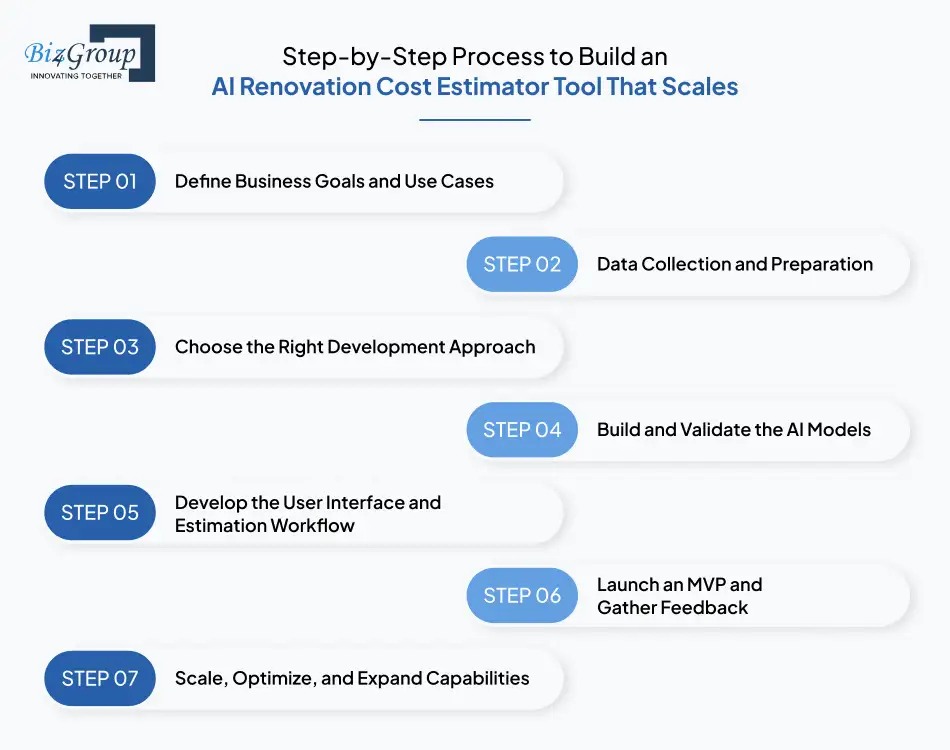
Building a reliable estimator is not about jumping straight into coding. When you build an AI renovation cost estimator tool, each phase lays the groundwork for accuracy, adoption, and long-term scalability across residential and commercial projects.
Step 1: Define Business Goals and Use Cases
Start by clearly defining what problems the estimator should solve and who will use it. Residential estimations, commercial renovations, and portfolio-level planning all require different logic, so alignment at this stage prevents costly rework later. This clarity is essential when planning AI renovation cost estimator development for homes and commercial properties.
- Identify target users and decision-makers
- Define residential vs commercial estimation needs
- Set success metrics like accuracy and turnaround time
Step 2: Data Collection and Preparation
AI models are only as good as the data behind them. This step focuses on gathering historical renovation costs, labor rates, material pricing, and regional factors, then cleaning and structuring that data for training. Strong data preparation is what enables teams to develop AI renovation cost estimation tool for homes and commercial properties with confidence.
- Collect past project and vendor data
- Normalize pricing across regions and timelines
- Handle missing or inconsistent records
Step 3: Choose the Right Development Approach
At this stage, you decide whether to build in-house or partner externally. Many companies work with a trusted custom software development company to balance speed, cost, and technical depth, especially when AI expertise is limited internally.
- Decide on in-house vs external development
- Define project timelines and milestones
- Align technical scope with business goals
Step 4: Build and Validate the AI Models
This phase involves training machine learning models to recognize cost patterns across different renovation scenarios. AI models are tested against real projects to ensure predictions are reliable before wider rollout. Validation is critical for any AI renovation cost estimator for home and commercial use.
- Train AI models using historical renovation data
- Test accuracy against known outcomes
- Adjust features and weightings based on results
Step 5: Develop the User Interface and Estimation Workflow
Even the smartest AI fails if users struggle to interact with it. This step focuses on building intuitive workflows that guide users from input to estimate minimal friction. Clear workflows are especially important when you develop smart renovation cost estimation systems for houses and commercial buildings.
- Design input forms and dashboards
- Create clear cost breakdown views
- Ensure usability for non-technical users
Also Read: Next JS Development Company
Step 6: Launch an MVP and Gather Feedback
Rather than launching everything at once, teams often start with a focused version of the platform. Structured MVP development allows you to test assumptions, collect feedback, and refine features before scaling further.
Step 7: Scale, Optimize, and Expand Capabilities
Once the system proves its value, the focus shifts to scaling performance, adding advanced features, and expanding coverage. Many organizations choose to hire AI developers at this stage to accelerate innovation and ongoing optimization.
- Improve model accuracy over time
- Add advanced and automation features
- Scale infrastructure for higher usage
Following these steps helps ensure your estimator is not just functional at launch but reliable, adaptable, and ready to grow with your business.
Choosing the Right Tech Stack for AI Renovation Cost Estimator Development
When you build an AI renovation cost estimator tool, your tech stack must support accuracy, performance, and growth from day one. The right combination of tools ensures your AI renovation cost estimator for home and commercial use can scale without constant rework.
|
Layer |
Tools / Tech Name |
Description |
|---|---|---|
|
Frontend Layer |
React, Vue.js, TypeScript |
Used to build fast, responsive user interfaces for inputting renovation details and visualizing cost breakdowns. A strong frontend improves adoption when delivering AI renovation cost estimation software development for home and commercial projects to non-technical users. |
|
Backend Application Layer |
Handles business logic, estimation workflows, and API orchestration. This layer supports complex rules required to develop AI renovation cost estimation tool for homes and commercial Properties. |
|
|
Machine Learning Layer |
TensorFlow, PyTorch, Scikit-learn |
Powers predictive cost models that analyze historical data and project variables. These frameworks enable continuous learning for AI renovation cost estimator development for homes and commercial properties. |
|
Data Engineering Layer |
Apache Airflow, Pandas, Spark |
Manages data ingestion, cleaning, transformation, and scheduled model updates. Reliable pipelines are essential for maintaining accuracy at scale. |
|
Database Layer |
PostgreSQL, MongoDB |
Stores structured project data, user inputs, and estimation outputs. This layer ensures consistency across residential and commercial renovation workflows. |
|
Cloud Infrastructure Layer |
AWS, Azure, Google Cloud |
Provides scalability, security, and high availability. Cloud infrastructure is key when you develop scalable AI renovation cost estimation platform for house and commercial properties. |
|
Integration Layer |
REST APIs, GraphQL, Webhooks |
Enables connectivity with CRMs, ERPs, supplier pricing systems, and analytics platforms. Integration readiness supports enterprise-level adoption. |
|
Security Layer |
OAuth, JWT, Encryption |
Protects sensitive financial and project data through authentication, authorization, and encryption. Security is critical for commercial and enterprise use cases. |
|
Monitoring and DevOps Layer |
CI/CD pipelines, CloudWatch, Prometheus |
Supports automated deployments, performance monitoring, and system health tracking to ensure long-term reliability. |
Many teams accelerate this setup by working with an experienced AI app development company that understands both AI complexity and construction domain workflows.
Also Read: React JS Development Services
Cost Breakdown: What It Really Takes to Build an AI Renovation Cost Estimator Tool
When you plan to build an AI renovation cost estimator tool, cost is one of the first questions that comes up. Based on scope, data complexity, and feature depth, the estimated development cost typically ranges between $15,000 to $150,000+.
This range varies widely because not all platforms are built the same. A basic estimator for residential use costs far less than a fully scalable AI renovation cost estimator for home and commercial use designed for enterprise adoption.
Let's break this down clearly.
|
Feature Area |
Estimated Cost Range |
What Drives the Cost |
|---|---|---|
|
Core Estimation Engine |
$8,000 to $30,000 |
Covers data processing, baseline ML models, and cost calculation logic required for AI renovation cost estimator development for homes and commercial properties. |
|
Advanced AI Models |
$15,000 to $45,000 |
Includes predictive forecasting, learning models, and scenario analysis used in custom AI renovation estimator development. |
|
User Interface and Dashboards |
$5,000 to $20,000 |
Depends on complexity of workflows, visualizations, and user roles for residential and commercial users. |
|
Integrations and APIs |
$5,000 to $25,000 |
Costs vary based on the number of systems integrated. Understanding AI integration costs early helps avoid surprises. |
|
Automation and AI Agents |
$10,000 to $35,000 |
Supports automated updates, decision logic, and intelligent recommendations in platforms that develop AI renovation cost estimation tool for homes and commercial Properties. |
|
Testing, Deployment, and Security |
$5,000 to $15,000 |
Includes performance testing, data protection, and production readiness for commercial environments. |
Key Factors That Affect the Cost of AI Renovation Cost Estimator Development
Several variables directly influence how much you will invest when you build an AI renovation cost estimator tool.
- Residential vs commercial focus
Commercial estimators require more complex logic, compliance handling, and scalability. - Data availability and quality
Clean historical data reduces development time. Poor data increases preprocessing and model training costs. - Feature depth and intelligence level
Basic calculators cost less than systems with forecasting, optimization, and autonomous decision-making. - Integration requirements
Connecting CRMs, ERPs, supplier pricing feeds, or valuation systems adds both development and maintenance costs. - Deployment scale
Single-region tools are cheaper than nationwide or multi-portfolio platforms.
Hidden Costs You Should Plan for Early
Many teams underestimate long-term expenses when budgeting for renovation cost estimation software development for home and commercial projects.
- Ongoing model retraining: AI models require periodic updates to stay accurate as market conditions change.
- Cloud infrastructure growth: Usage-based cloud costs rise as more users and projects are added.
- Data acquisition and licensing: Third-party pricing feeds and datasets often come with recurring fees.
- Post-launch enhancements: User feedback usually drives feature expansion after launch.
Cost visibility improves when teams benchmark against related builds like AI real estate website development cost or AI real estate app development cost, which follow similar patterns.
Smart Ways to Optimize Development Cost Without Cutting Corners
You do not need to overspend to build a reliable estimator. Cost optimization is about strategy, not shortcuts.
- Start with an MVP: Focus on core estimation logic first, then expand based on real usage.
- Reuse proven AI components: Leverage existing models where possible instead of building everything from scratch.
- Prioritize integrations carefully: Only integrate systems that directly improve estimation accuracy or workflow efficiency.
- Phase advanced features: Roll out forecasting, automation, and AI agents in stages.
Many teams also compare costs with adjacent solutions such as AI real estate assistant development cost to understand how conversational and decision-support features impact budgets.
If you want a lightweight estimator, you can stay closer to the lower end of the $15,000 to $150,000+ range. If your goal is a scalable, intelligent platform that supports both residential and commercial renovation at scale, expect investment toward the higher end.
Either way, the real value comes from accuracy, speed, and trust built with every estimate you deliver.
Not sure where your project fits in the $15,000 to $150,000+ range?
A quick discussion can clarify scope, cost, and ROI before you commit.
Get a Cost EstimateCommon Challenges in AI Renovation Cost Estimator Development and How to Solve Them
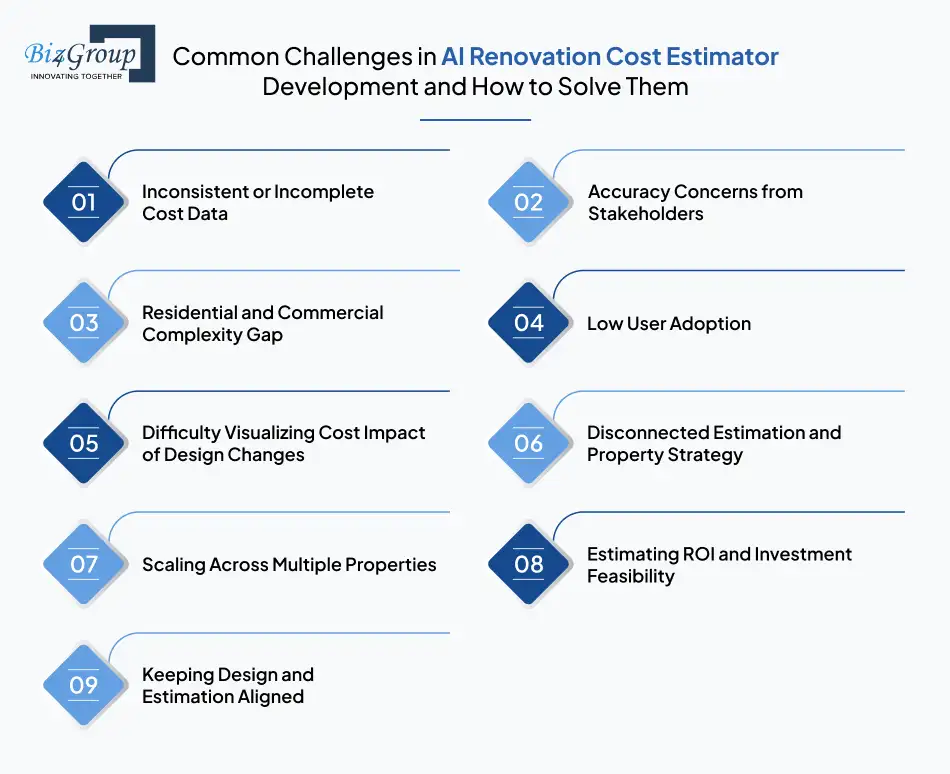
When you build an AI renovation cost estimator tool, challenges are expected. What matters is identifying them early and designing solutions that keep your AI renovation cost estimator for home and commercial use accurate, trusted, and scalable
|
Challenge |
Why It Happens |
How to Solve It Effectively |
|---|---|---|
|
Inconsistent or Incomplete Cost Data |
Renovation data often comes from multiple sources with different formats, missing values, or outdated pricing. This directly impacts prediction accuracy in AI renovation cost estimator development for homes and commercial properties. |
Establish structured data pipelines and validation rules. Use historical pattern matching to fill gaps and continuously improve data quality as more projects are completed. |
|
Accuracy Concerns from Stakeholders |
Decision-makers hesitate to trust AI estimates without understanding how numbers are generated. This is common in early stages of renovation cost estimation software development for home and commercial projects. |
Provide transparent cost breakdowns, confidence ranges, and clear explanations behind estimates to build trust and adoption. |
|
Residential and Commercial Complexity Gap |
Applying the same logic to homes and commercial buildings leads to inaccurate estimates due to regulatory and scale differences. |
Design separate estimation rules and risk models when you develop smart renovation cost estimation systems for houses and commercial buildings. |
|
Low User Adoption |
Teams resist new tools if workflows feel complicated or disconnected from daily operations. |
Invest in intuitive experiences and contextual assistance inspired by platforms like an AI interior design app where simplicity drives adoption. |
|
Difficulty Visualizing Cost Impact of Design Changes |
Users struggle to understand how layout or material changes affect budget, especially in early planning stages. |
Combine estimation with visualization techniques similar to an AI & AR home visualization mobile app to show real-time cost impact. |
|
Disconnected Estimation and Property Strategy |
Cost estimates are often isolated from investment, asset management, or recommendation systems. |
Integrate estimation workflows with tools like an AI property recommendation app to support smarter decisions across the property lifecycle. |
|
Scaling Across Multiple Properties |
Managing costs across portfolios becomes complex as projects increase in number and geography. |
Use portfolio analytics approaches inspired by AI property asset management to centralize insights and trends. |
|
Estimating ROI and Investment Feasibility |
Renovation cost alone does not explain financial viability for investors or developers. |
Pair estimation platforms with tools like an AI real estate investment calculator app to connect cost, value, and returns. |
|
Keeping Design and Estimation Aligned |
Design decisions often evolve faster than estimates can be updated. |
Integrate design intelligence and visualization concepts used to integrate AR with AI in home renovation design so estimates stay aligned with design changes. |
Every challenge in AI renovation cost estimator tool development has a proven solution when approached with the right strategy, data discipline, and user-first design.
The teams that succeed are not the ones avoiding complexity. They are the ones planning for it from day one.
Why Biz4Group Is the Best Partner in the USA to Build Your AI Renovation Cost Estimator Tool?
When you decide to build an AI renovation cost estimator tool, choosing the right partner is as important as choosing the right technology. Biz4Group combines deep AI expertise, real estate domain experience, and a proven track record of delivering intelligent solutions that solve real business problems.
Here are some real projects that show how Biz4Group delivers value and innovation in the AI real estate space.
1. Homer AI: Intelligent Property Management and Buyer Engagement Platform
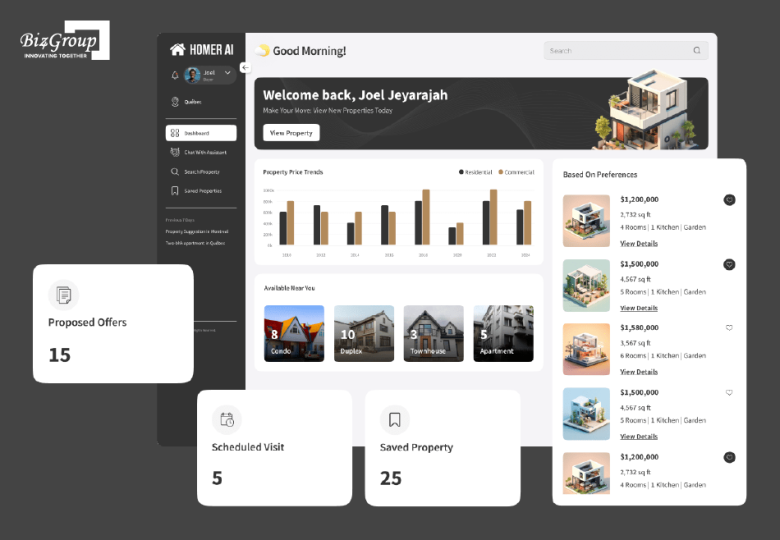
Biz4Group developed Homer AI, a modern real estate solution that connects buyers and sellers through conversational intelligence, intuitive dashboards, and smart property discovery features. The platform uses advanced data filtering and interactive chat features to match buyers with ideal properties.
Key Highlights:
- Conversational AI guides buyers based on preferences like budget and location.
- Integrated scheduling function lets users book property visits with ease.
- Dynamic filtering and map views help users discover properties efficiently.
This project shows Biz4Group’s ability to combine user preferences, data interpretation, and dynamic recommendation logic, core capabilities that also drive accurate AI renovation cost estimator development for homes and commercial properties.
2. Facilitor: AI-Driven Real Estate Buying Assistant and Transaction Platform
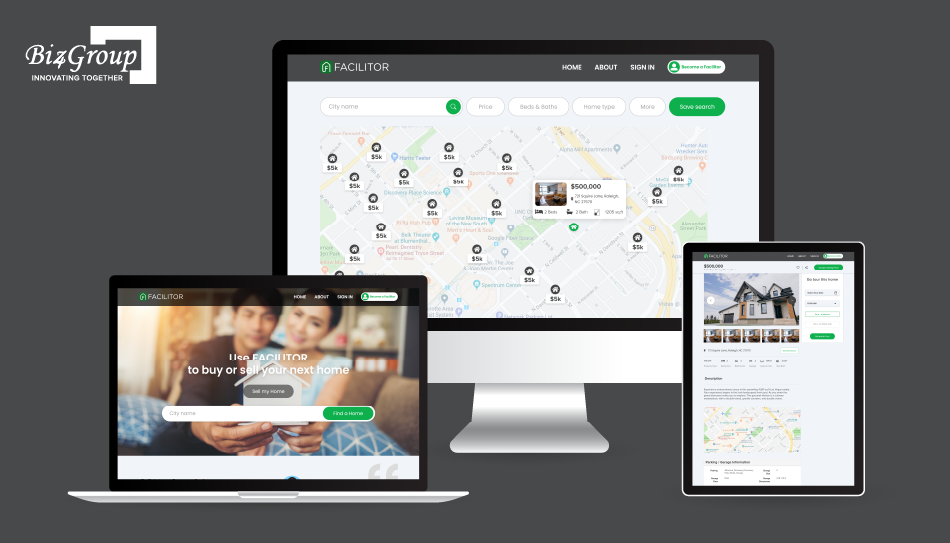
Facilitor is a full-scale real estate platform that guides buyers through the property search and purchase journey without traditional agents. It uses AI to personalize search, handle member onboarding, and ease the buying process step by step.
Key Highlights:
- AI-powered property search based on budget, location, and user preferences.
- Membership-based workflow helps users get pre-approved and tour properties.
- Helps first-time buyers navigate complex real estate processes with guided resources.
Facilitor demonstrates how Biz4Group builds systems that handle complex workflows, user segmentation, and guided decision logic, all essential for developing reliable AI renovation cost estimator tools that deliver consistent results for varied user groups.
3. Renters Book: Verified Rental Review and Rating Platform

Renters Book is a transparent review and rating platform developed by Biz4Group that empowers tenants and landlords to assess each other based on real rental experiences. It compiles verified reviews to help users make informed leasing decisions.
Key Highlights:
- Verified tenants and landlords can view trusted reviews.
- Helps users research rental reliability before signing agreements.
- Introduces accountability and trust into rental decisions.
This project highlights Biz4Group’s experience building platforms that aggregate and leverage user data to support better decision-making. That capability is directly relevant to structuring and evaluating data inputs when you build an AI renovation cost estimator tool based on real project histories and reviews.
4. Contracks: AI-Powered Contract Management System for Real Estate Workflows
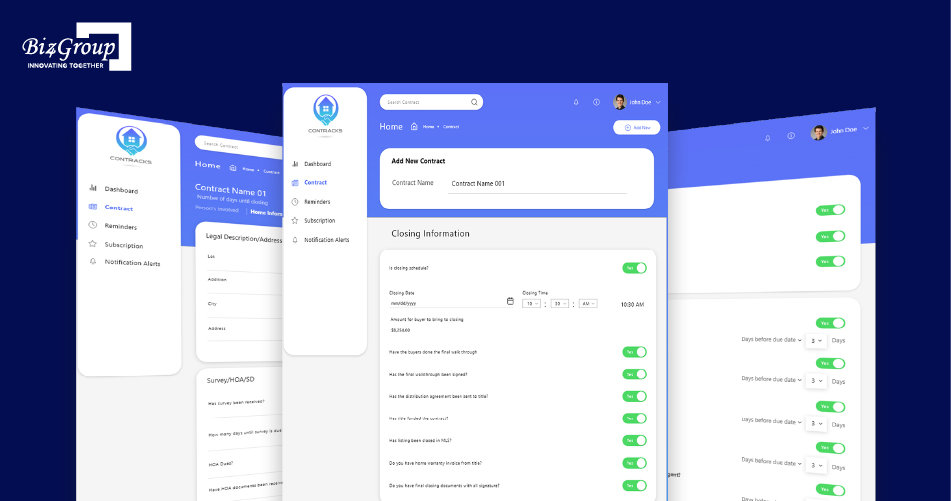
Contracks is a smart contract platform that streamlines legal and administrative workflows in real estate, from contract creation to compliance tracking. It automates key tasks to reduce risk and save time on documentation.
Key Highlights:
- Automates contract creation, review, and compliance tracking.
- Structured workflows reduce legal bottlenecks and human error.
- Improves transparency and auditability across transactions.
Building an AI renovation cost estimator tool involves complex logic, workflow orchestration, and document handling, areas where Contracks shines. Biz4Group’s experience with automation and structured data flows directly supports the architectural discipline required for your project.
Why These Projects Matter for Your AI Renovation Cost Estimator
When you choose Biz4Group as your partner, you are selecting a team that:
- Understands the real estate domain deeply
- Can weave intelligent automation into complex business logic
- Builds solutions that are both user-friendly and data-driven
- Has a proven record delivering enterprise-grade real estate AI projects
Whether you are planning AI renovation cost estimator development for homes and commercial properties or expanding into related areas like predictive analytics and market guidance, Biz4Group has the expertise to bring your vision to life with lasting impact.
Want a partner who has built real AI real estate products?
Biz4Group brings proven AI and real estate expertise to every build.
Start Your AI ProjectWrapping Up!
By now, it should be clear that choosing to build an AI renovation cost estimator tool is not just a technical upgrade. It is a strategic move that directly impacts margins, timelines, and client confidence across residential and commercial projects.
When you invest in the right data, the right architecture, and the right features, an AI renovation cost estimator for home and commercial use helps you replace guesswork with clarity. You quote faster. You plan better. You reduce surprises that eat into profitability. Most importantly, you make decisions backed by intelligence, not assumptions.
This is where experience matters.
Biz4Group has spent years building complex, production-ready AI platforms across the real estate ecosystem. From intelligent property platforms to workflow automation and decision-support systems, our work reflects a deep understanding of how AI must operate in real business environments, not just in theory. That same discipline, data-first thinking, and product mindset is what we bring to AI renovation cost estimator development for homes and commercial properties.
We do not just help you build software. We help you build confidence in every estimate you share. If you are serious about accuracy, scale, and long-term value, now is the time to move forward.
Because the next renovation bid you win should be based on intelligence, not instinct. Let’s build it right.
FAQ
1. What is an AI renovation cost estimator tool and how does it work for homes and commercial properties?
An AI renovation cost estimator tool is a software system that uses machine learning models and historical project data to predict renovation costs accurately. Unlike manual spreadsheets, an AI renovation cost estimator for home and commercial use analyzes multiple variables such as labor rates, material pricing, property type, and scope of work to generate data-driven estimates that improve over time.
2. Why should construction and real estate companies build an AI renovation cost estimator tool instead of using traditional software?
Traditional estimating tools rely on fixed formulas and static price lists, which struggle to adapt to changing market conditions. When you build an AI renovation cost estimator tool, you gain dynamic pricing intelligence, faster turnaround, and consistent accuracy. This makes AI renovation cost estimation tool development for construction and real estate companies a strategic investment rather than a simple software upgrade.
3. How much does it cost to build an AI renovation cost estimator tool for homes and commercial projects?
The cost to build an AI renovation cost estimator tool typically ranges from $15,000 to $150,000+, depending on features, data complexity, and scale. A basic solution for residential use costs less, while a full AI renovation cost estimator development for homes and commercial properties platform with predictive analytics, integrations, and automation sits at the higher end of the range.
4. What data is required to develop an AI renovation cost estimation tool for homes and commercial Properties?
To develop AI renovation cost estimation tool for homes and commercial Properties, you need historical renovation costs, labor rates by region, material pricing data, and detailed project scope inputs. High-quality and well-structured data is critical for renovation cost estimation software development for home and commercial projects to deliver reliable and repeatable results.
5. Can a single AI renovation cost estimator tool handle both residential and commercial renovations accurately?
Yes, but only if it is designed correctly. A reliable AI renovation cost estimator for home and commercial use applies separate estimation logic for houses and commercial buildings. This distinction is essential when you develop smart renovation cost estimation systems for houses and commercial buildings, as commercial projects involve regulatory requirements, phased execution, and higher financial risk.
6. How does AI improve accuracy in renovation cost estimation compared to manual methods?
AI improves accuracy by learning from thousands of past projects and identifying cost patterns humans often miss. When you build an AI renovation cost estimator tool, machine learning models continuously refine predictions based on real outcomes. This makes developing an AI renovation cost estimation platform for residential and commercial buildings far more reliable than manual or rule-based systems.
7. Who should build a custom AI renovation cost estimator tool for commercial construction companies?
Building a scalable estimator requires expertise in machine learning, data engineering, and enterprise software architecture. Partnering with the best company to build AI renovation cost estimator software ensures your solution is accurate, secure, and future-ready. Experienced teams know how to develop AI renovation cost estimator tools for commercial construction companies that scale across regions and portfolios.
