 Location :
Orlando, FL, USA
Location :
Orlando, FL, USA +1 (407) 714-1616
 info@biz4group.com

- Developing a product recommendation AI chatbot helps businesses guide shoppers through large catalogs while reducing decision friction during the buying journey.
- Building such a chatbot requires clear recommendation goals, reliable product and behavior data, and system design aligned with real ecommerce workflows.
- The right AI capabilities allow businesses to respond to shopper intent in real time instead of relying on static or rule-based recommendations.
- Understanding development challenges and integration risks help teams avoid ineffective personalization, data mismatches, and scalability issues.
- Product recommendation AI chatbot development typically ranges from $15,000 to $150,000+, depending on recommendation complexity, personalization depth, and system integrations.
- Working with Biz4Group LLC ensures disciplined execution from planning to deployment, keeping product recommendation chatbots practical, reliable, and scalable.
Online shoppers don’t struggle with choices anymore. They struggle with too many choices. When a customer lands on an ecommerce site today, the expectation is simple:
“Show me what fits me; fast.” If that doesn’t happen within seconds, they leave.
That shift is exactly why AI conversational systems are becoming a core revenue tool, not just a support feature. Recent market data makes this clear:
- The global chatbot market is projected to grow from under USD 8 billion to nearly USD 27.29 billion by 2030, driven largely by commerce, retail, and customer engagement use cases.
- The broader conversational AI market is expected to cross USD 41.39 billion by 2030, reflecting how businesses are embedding AI directly into buying journeys, not just customer service.
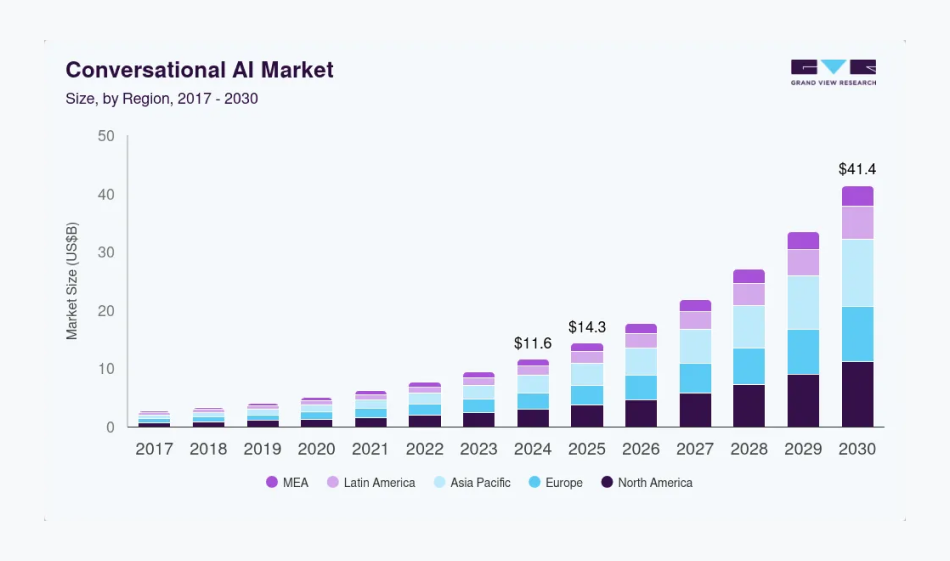
This is where businesses start building a product recommendation AI chatbot as a practical tool that guides discovery, reduces decision friction, and lifts average order value.
For ecommerce and digital commerce leaders, this growth signals a clear direction:
- Static recommendation widgets are no longer enough
- Manual personalization does not scale
- Sales teams cannot guide every buyer in real time
Modern product recommendation AI chatbot development combines conversational design, behavioral data, and catalog intelligence to deliver suggestions that feel helpful rather than sales driven. Many companies approach this by working with an experienced AI chatbot development company that understands how to align recommendations with real buying intent instead of generic automation.
This guide will take a practical approach to what that journey really looks like, helping you think through the right decisions step by step, so the AI chatbot you build works for your business, not against it.
What Is a Product Recommendation AI Chatbot?
A product recommendation AI chatbot acts as a real-time guide during the shopping journey. Instead of forcing users to scroll through filters and categories, it understands intent through conversation and responds with relevant product suggestions.
When businesses build a product recommendation AI chatbot, they introduce a scalable way to replicate how an in-store associate asks questions and narrows down choices.
In practice, custom product recommendation chatbot development enables users to:
- Ask intent-driven questions based on needs
- Analyze browsing behavior and past interactions
- Recommend products dynamically as preferences change
- Guide users toward confident purchase decisions
This experience is powered through seamless AI chatbot integration, ensuring conversations stay connected to real-time product and customer data rather than operating in isolation.
How Does a Product Recommendation AI Chatbot Work?
A product recommendation AI chatbot works by translating shopper intent into relevant product suggestions in real time. It does not guess randomly or rely only on best-seller logic. Every recommendation is driven by how users interact, respond, and behave during the conversation.
When teams build a product recommendation AI chatbot, the workflow typically follows a clear sequence:
- Intent is captured through structured conversation: The AI chatbot asks simple questions based on buying context, such as use case, limits, or preferences. These inputs quickly narrow choices instead of depending only on passive browsing.
- Session behavior is evaluated alongside conversation inputs: The AI chatbot tracks actions like viewed products, time spent, and comparison behavior. Teams developing AI product recommendation chatbots use this data to adjust suggestions in real time during the session.
- Recommendation logic ranks products against intent signals: Products are ranked using relevance factors like feature fit, pricing, popularity, and availability. Decisions remain logic-driven, prioritizing best-fit options based on defined rules and learned behavior patterns.
- Live system data keeps recommendations accurate: Inventory, pricing, and catalog updates flow through AI integration services, ensuring product suggestions stay current and never include unavailable or outdated items.
A product recommendation AI chatbot succeeds by turning real-time intent, behavior, and system data into focused product choices that simplify decisions and support confident purchases.
Why Should Businesses Invest in Product Recommendation AI Chatbot Development?
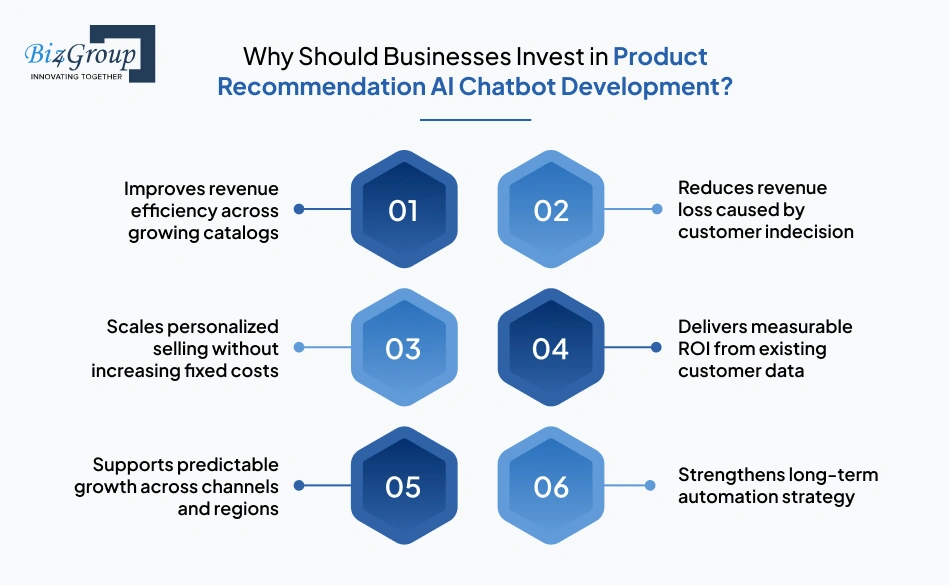
As ecommerce competition intensifies, businesses are under pressure to improve conversion efficiency without increasing operational costs. Investing in intelligent product recommendation AI chatbots is increasingly viewed as a revenue and scalability decision, not a technology experiment.
1. Improves revenue efficiency across growing catalogs
As product catalogs expand, guiding customers manually becomes impractical. When businesses build a product recommendation AI chatbot, it functions much like an AI virtual assistant that helps shoppers reach relevant products faster, improving conversions without additional merchandising effort.
2. Reduces revenue loss caused by customer indecision
Many customers abandon sessions due to uncertainty, not lack of intent. Product recommendation AI chatbots address hesitation in real time by narrowing options, helping users make confident purchase decisions instead of leaving.
3. Scales personalized selling without increasing fixed costs
Hiring and training sales or support teams increases ongoing costs. AI-driven recommendations let businesses scale personalized guidance during peak traffic without adding headcount or compromising consistency.
4. Delivers measurable ROI from existing customer data
Recommendation chatbots convert browsing, purchase, and interaction data into revenue insights. This makes the investment valuable even before adding new customers or launching additional campaigns.
5. Supports predictable growth across channels and regions
As businesses expand across platforms and markets, maintaining consistent recommendations becomes complex. Approaches aligned with enterprise AI solutions help ensure recommendation logic remain stable and scalable as operations grow.
6. Strengthens long-term automation strategy
Product recommendation AI chatbots often become part of broader AI automation services, allowing businesses to automate sales guidance, discovery, and decision support through a single scalable investment.
Investing in product recommendation chatbots allows businesses to improve revenue performance, scale personalization, and control operational costs while supporting long-term growth across digital commerce channels.
Top Use Cases of Product Recommendation AI Chatbots
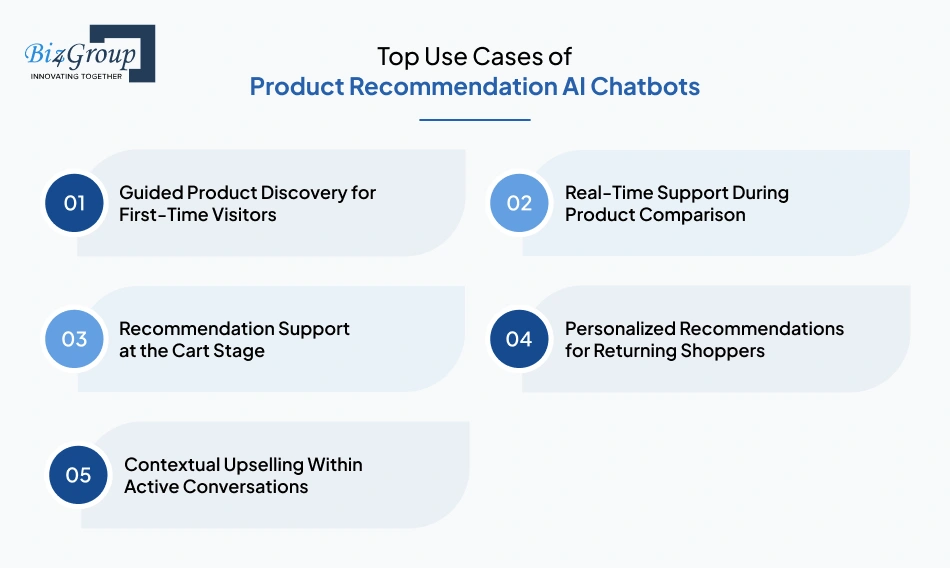
Product recommendation AI chatbots create value only when they are applied at the right moments in the buying journey. These use cases focus on situations where conversational guidance directly influences what customers choose, compare, and purchase.
1. Guided Product Discovery for First-Time Visitors
First-time visitors often leave because they don’t know where to start. When businesses build a product recommendation AI chatbot, it helps new users articulate needs quickly and reduces choice overload. The experience feels like how an AI conversation app guides users through structured, intent-driven interactions.
- Asks intent-focused questions instead of forcing category navigation
- Filters large catalogs into a small, relevant product set
- Helps users reach suitable products within seconds
2. Real-Time Support During Product Comparison
Comparison is where uncertainty peaks. Product recommendation AI chatbots assist users who are stuck between similar products by guiding decisions inside the conversation.
- Responds when users hesitate between alternatives
- Aligns product differences with stated preferences
- Keeps users engaged instead of switching tabs or exiting
3. Recommendation Support at the Cart Stage
Many carts are abandoned due to last-minute doubt. Product recommendation AI chatbots step in before checkout to resolve uncertainty without disrupting the flow.
- Validates whether selected products match stated intent
- Suggests better-fit alternatives when hesitation appears
- Reduces silent exits at the final decision stage
4. Personalized Recommendations for Returning Shoppers
Returning customers expect relevance immediately. AI chatbots for product recommendations recognize patterns across sessions and continue conversations naturally.
- Uses past interactions to resume context
- Reduces time spent rediscovering suitable products
- Creates continuity that static recommendations cannot
5. Contextual Upselling Within Active Conversations
Upselling works when it feels timely and relevant. Product recommendation AI chatbots introduce upgrades or add-ons as part of an ongoing dialogue, supported by thoughtful AI assistant app design rather than intrusive prompts.
- Introduces complementary products during intent-driven moments
- Keeps suggestions aligned with the primary purchase goal
- Increases order value without interrupting the journey
These use cases show how product recommendation AI chatbots influence real purchase decisions by guiding customers through discovery, comparison, and commitment with clarity and relevance.
Design Product Recommendation Flows for Real Buying Behavior
Build product recommendation AI chatbots that guide discovery, comparison, and checkout using actual shopper intent and catalog logic.
Explore Recommendation StrategyMust-Have Features in Product Recommendation AI Chatbot Development
When businesses build a product recommendation AI chatbot, feature selection directly shapes how recommendations are generated, updated, and presented during live shopping interactions. These capabilities define how reliably the chatbot responds to real customer intent across different buying scenarios.
|
Feature |
Why It Matters for Product Recommendations |
|---|---|
|
Intent-Driven Conversation Logic |
The AI chatbot must ask focused questions tied to use case, budget, or preferences, so recommendations are narrowed early instead of overwhelming users. |
|
Real-Time Product Catalog Sync |
Recommendations must reflect live pricing, availability, and variants to avoid suggesting unavailable or outdated products during decision moments. |
|
Behavior-Aware Recommendation Engine |
The AI chatbot should adjust suggestions based on browsing patterns, hesitation, and comparisons using insights from predictive analytics software enabling more accurate recommendations over static rules. |
|
Context Persistence Across Sessions |
An AI chatbot should remember preferences and past interactions to avoid restarting the discovery process. |
|
Explainable Recommendation Responses |
Customers trust suggestions more when the AI chatbot can briefly explain why a product fits their needs instead of presenting opaque results. |
|
Scalable AI Decision Models |
As catalogs grow, the chatbot must rely on structured AI model development to ensure recommendations remain accurate, fast, and consistent under higher traffic loads. |
|
Seamless Ecommerce Platform Integration |
Product recommendations should move smoothly from chat to product pages, cart, and checkout, especially when building custom AI chatbots for ecommerce websites with complex catalogs and storefront logic. |
These features collectively define what it means to develop intelligent product recommendation chatbot systems that influence purchase outcomes rather than acting as passive assistants.
Advanced Capabilities in AI-Powered Product Recommendation Chatbots
Once businesses build a product recommendation AI chatbot with core features in place, advanced capabilities determine how far the system can evolve. These capabilities help recommendation chatbots move beyond basic guidance and adapt to complex buying behavior at scale.
|
Advanced Capability |
Why It Differentiates Product Recommendation AI Chatbots |
|---|---|
|
Predictive Buying Intent Modeling |
Advanced AI chatbots anticipate what a shopper is likely to need next based on behavior patterns, enabling proactive recommendations instead of reactive suggestions. |
|
Dynamic Recommendation Re-Ranking |
Recommendations are re-ordered continuously as new signals appear during a conversation, including spoken inputs, which becomes important in setups that support voice-enabled chatbots alongside text-based interactions. |
|
Generative Product Explanation |
Using generative AI, the chatbot can create concise, personalized explanations that clarify why a product fits specific needs rather than repeating static descriptions. |
|
Cross-Session Learning at Scale |
Advanced systems learn across thousands of sessions to refine recommendation strategies, a key requirement when teams develop scalable product recommendation AI chatbot platforms for large catalogs. |
|
Multi-Objective Recommendation Optimization |
The chatbot balances multiple goals such as relevance, margin, availability, and user preference instead of optimizing for a single metric. |
|
Context-Aware Promotion and Pricing Logic |
Recommendation responses adapt based on timing, inventory levels, promotional rules, and conversation context. This allows the system to adjust guidance as user intent and business conditions change in real time. |
Advanced capabilities enable product recommendation chatbots to anticipate intent, adapt in real time, and scale intelligently as catalogs, traffic, and business complexity grow.
Let’s look at a real-world implementation to understand how conversational AI chatbot capabilities work in practice.
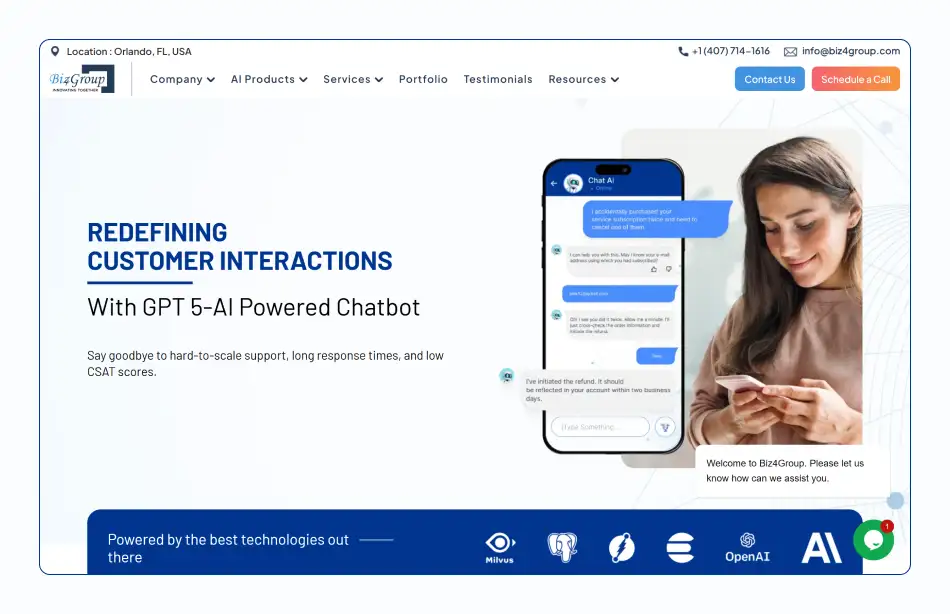
Customer Service AI Chatbot: This conversational AI chatbot handles real customer interactions such as order questions, payments, and scheduling through guided conversations. It understands intent, keeps context across messages, and improves responses over time. That same conversational foundation is what makes product recommendation AI chatbots effective, where understanding what a shopper means matters as much as what they click.
These AI capabilities deliver value when they are designed and implemented correctly, which brings us to the build process.
How to Build a Product Recommendation AI Chatbot: Step-by-Step Process
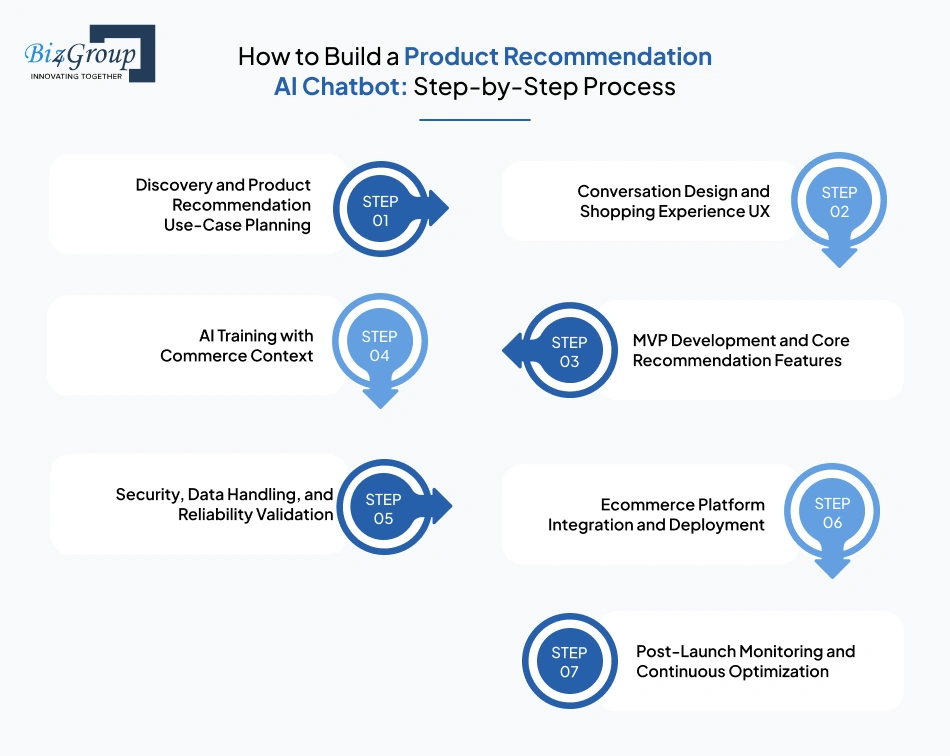
Building a product recommendation AI chatbot requires aligning buying behavior, product data, and conversational flows into a single system. When businesses build a product recommendation AI chatbot, each phase must be approached methodically to ensure recommendations feel relevant, timely, and scalable across digital commerce environments.
1. Discovery and Product Recommendation Use-Case Planning
The first step is identifying where conversational recommendations genuinely influence purchase decisions, rather than attempting to automate every interaction.
- Identify buying stages where recommendations add value, such as discovery, comparison, or cart-level guidance
- Define how the chatbot should narrow product choices based on intent signals
- Align merchandising, product, and operations teams on recommendation boundaries
- Set measurable goals such as improved conversion rates or reduced drop-offs
2. Conversation Design and Shopping Experience UX
For ecommerce, the AI chatbot often becomes the entry point to product discovery. AI conversation design must feel natural and frictionless, so users can move toward decisions without confusion.
- Design conversational flows that mirror how customers ask product-related questions
- Work with an experienced UI/UX design company to ensure consistency across web and mobile shopping experiences
- Keep language simple, concise, and focused on decision support
- Account for accessibility needs such as voice interactions or simplified prompts
Also read: Top UI/UX Design Companies in USA
3. MVP Development and Core Recommendation Features
Instead of building a full recommendation system upfront, start with a focused version that validates recommendation logic in real shopping scenarios. This reduces risk while enabling faster learning.
- Prioritize one or two high-impact recommendation flows, such as guided discovery or comparison
- Build modular components that allow future recommendation expansion
- Use MVP development services to validate assumptions without overengineering
- Test early versions with real users before introducing advanced capabilities
Also read: Top 12+ MVP Development Companies in USA
4. AI Training with Commerce Context
AI models must reflect how shoppers browse, hesitate, and decide. Training should focus on understanding buying intent, preferences, and decision patterns within ecommerce conversations.
- Train AI models using real product queries and shopping scenarios
- Incorporate feedback from merchandising and sales teams to refine relevance
- Teach the chatbot to adapt when users change preferences mid-conversation
- Continuously improve AI models using interaction and outcome data
Also Read: How to Select the Best AI Model for Your Use Case?
5. Security, Data Handling, and Reliability Validation
Even in ecommerce environments, recommendation AI chatbots handle sensitive user data and behavioral signals. This phase ensures data is processed securely, and systems remain reliable under load.
- Implement secure authentication and encrypted data handling
- Validate data flows between chatbot, catalog, and analytics systems
- Test recommendation logic under peak traffic conditions
- Conduct functional testing and simulated user journeys
Also Read: 15+ Software Testing Companies in USA
6. Ecommerce Platform Integration and Deployment
A product recommendation chatbot must work seamlessly within the ecommerce ecosystem to influence purchasing outcomes.
- Integrate the AI chatbot with product catalogs, pricing, and inventory systems
- Ensure recommendations sync smoothly with cart and checkout flows
- Deploy on scalable infrastructure to support traffic spikes
- Test performance across devices and browsers
7. Post-Launch Monitoring and Continuous Optimization
Launching the chatbot is only the beginning. Ongoing monitoring ensures recommendations remain accurate as products, customer behavior, and demand patterns change.
- Track recommendation engagement and conversion impact
- Review conversations to identify friction or drop-off points
- Update AI model's integrations into workflows as catalogs and strategies evolveflows as catalogs and strategies evolve
- Measure impact on revenue efficiency and operational workload
This step-by-step approach reflects how successful ecommerce platforms move from experimentation to dependable recommendation systems. Each phase reduces risk and ensures the chatbot becomes a meaningful part of the buying journey rather than a disconnected interface.
Turn Recommendation Logic into a Production-Ready System
Translate intent signals, product data, and conversational flows into a chatbot that performs reliably under real ecommerce traffic.
Discuss Your Build ApproachChoosing the Right Tech Stack to Develop an AI Product Recommendation Chatbot
When teams build a product recommendation AI chatbot, the technology stack plays a direct role in how recommendations are generated, updated, and delivered during live shopping interactions. The right stack ensures the chatbot can process intent signals, behavioral data, and catalog changes in real time without slowing down the buying journey.
|
Layer |
Technologies used |
Why This Matters for Product Recommendations |
|---|---|---|
|
Frontend (Chat Interface) |
React.js, Next.js |
Supports responsive, real-time chat interfaces through ReactJS development, while NextJS development ensures fast rendering of recommendation flows during product discovery and comparison. |
|
Backend & APIs |
Node.js, Python (FastAPI) |
NodeJS development manages real-time conversation orchestration and integrations, while Python development powers recommendation logic, ranking models, and behavioral analysis. |
|
Recommendation Engine |
Python, TensorFlow / PyTorch |
Enables intent scoring, product ranking, and adaptive recommendation logic that goes beyond static or rule-based suggestions. |
|
Natural Language Processing |
spaCy, Hugging Face Transformers |
Interprets buying intent, constraints, and preference shifts expressed during conversational interactions. |
|
Product & Behavior Data Store |
PostgreSQL, MongoDB |
Stores product metadata, session behavior, and preference data required to personalize recommendations consistently. |
|
Real-Time Data Processing |
Redis, Apache Kafka |
Processes live behavioral signals such as clicks, dwell time, and comparisons to update recommendations instantly. |
|
Search & Filtering |
Elasticsearch / OpenSearch |
Enables fast product filtering and relevance-based ranking across large and complex catalogs. |
|
Ecommerce Platform Integration |
REST APIs, GraphQL, Webhooks |
Enables seamless API development to connect the chatbot with product catalogs, pricing, inventory, cart, and checkout systems. |
|
Cloud & Infrastructure |
AWS, Google Cloud, Azure |
Ensures scalability and performance consistency as recommendation traffic and catalog size grow. |
|
Monitoring & Analytics |
Prometheus, Grafana |
Tracks product recommendation accuracy, response latency, and system health in production environments. |
This technology stack supports teams looking to develop AI chatbot platform for product recommendations that operate reliably under real ecommerce traffic and catalog complexity.
Build on a Stack That Scales with Catalog and Traffic Growth
Select technologies that support real-time recommendations without slowing down the buying journey.
Review Architecture OptionsProduct Recommendation AI Chatbot Development Cost Overview
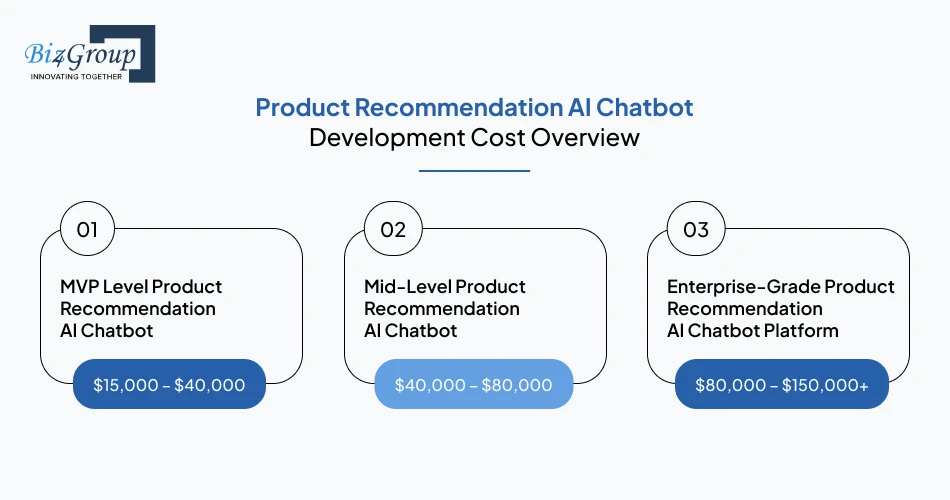
When businesses plan to build a product recommendation AI chatbot, development costs typically range between $15,000 and $150,000+, depending on recommendation complexity, personalization depth, and the level of AI integration services required across ecommerce systems.
To help teams plan realistically, product recommendation AI chatbot development costs can be grouped into three common implementation levels.
|
Version |
Key Capabilities |
Estimated Cost Range (USD) |
|---|---|---|
|
MVP Level Product Recommendation AI Chatbot |
Guided product discovery, basic intent capture, rule-based recommendations, catalog integration, and admin controls focused on validating recommendation flows |
$15,000 – $40,000 |
|
Mid-Level Product Recommendation AI Chatbot |
Behavior-aware recommendations, session-based personalization, real-time catalog sync, analytics dashboard, and modular architecture built through custom AI chatbot development for product recommendations |
$40,000 – $80,000 |
|
Enterprise-Grade Product Recommendation AI Chatbot Platform |
Advanced recommendation models, cross-session learning, dynamic ranking logic, multi-channel support, deep ecommerce integrations, and cloud scalability |
$80,000 – $150,000+ |
The planning becomes predictable when recommendation scope, personalization depth, and AI integration costs requirements are defined early. A well-structured product recommendation AI chatbot development cost estimate helps businesses scale personalization without unexpected complexity or rework later.
Get Clarity on AI Product's Scope and Investment
Understand how personalization depth, integrations, and catalog complexity impact chatbot development cost and timelines.
Request a Cost BreakdownExpert Tips for Successful Product Recommendation AI Chatbot Development
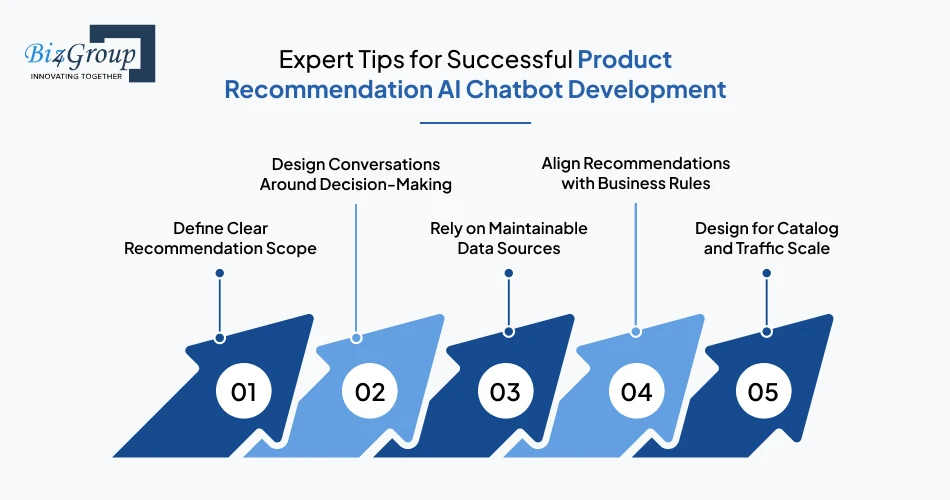
When teams build a product recommendation AI chatbot, long-term success depends less on the model itself and more on the decisions made around scope, data, and execution. These expert tips focus on what actually works when businesses aim to create recommendation chatbots that influence buying decisions in real retail environments.
1. Define Clear Recommendation Scope
One of the most common mistakes is trying to recommend everything to everyone. Successful teams define early what the AI chatbot should recommend, when it should stay silent, and when it should guide users toward narrowing choices instead of pushing products.
2. Design Conversations Around Decision-Making
Shoppers think in terms of problems, use cases, and constraints. When teams create AI product recommendation chatbots for online stores, conversations should mirror how customers decide, helping them move forward instead of explaining product specifications in isolation.
3. Rely on Maintainable Data Sources
Accurate recommendations rely on clean, reliable product and behavior data. It is better to start with fewer signals that stay updated than to depend on complex data sources that quickly fall out of sync and reduce trust in recommendations.
4. Align Recommendations with Business Rules
Recommendation logic must respect pricing, availability, and merchandising priorities from day one. Teams that align AI models with business rules early often rely on AI consulting services to avoid rework as catalogs and strategies evolve.
5. Design for Catalog and Traffic Scale
What works for a small catalog may fail at scale. When businesses create AI driven product recommendation bots for retail, they plan for growth by designing systems that handle larger catalogs, higher traffic, and changing buying patterns without constant redesign.
AI chatbots for product recommendation succeed when strategy, data, and conversation design stay aligned, allowing businesses to scale personalized recommendations without adding unnecessary complexity.
Also Read: Top 10 Mistakes to Avoid While Developing AI Chatbot for Your Business
Common Challenges in Developing AI Product Recommendation Chatbots
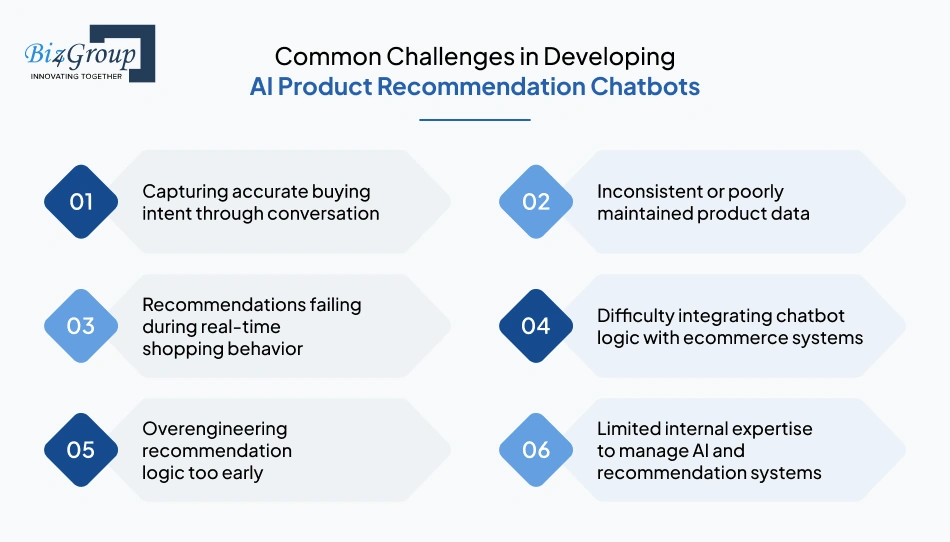
When teams build a product recommendation AI chatbot, the biggest challenges rarely come from the chatbot interface itself. Most issues surface while aligning recommendation logic, data, and ecommerce workflows into a system that works reliably under real shopping behavior.
|
Challenge |
How to Solve It |
|---|---|
|
Capturing accurate buying intent through conversation |
Design structured, decision-focused questions that reflect how shoppers choose products, rather than open-ended chats that dilute intent and weaken recommendations. |
|
Inconsistent or poorly maintained product data |
Standardize product attributes early and limit recommendations to data fields that stay consistently updated, ensuring suggestions remain relevant and trustworthy. |
|
Recommendations failing during real-time shopping behavior |
Combine AI conversational inputs with session behavior signals such as product views and comparisons, so that product recommendations adapt dynamically during the same visit. |
|
Difficulty integrating chatbot logic with ecommerce systems |
Plan integrations early using proven approaches to integrate AI into an app so catalog, pricing, inventory, and cart data stay synchronized. |
|
Overengineering recommendation logic too early |
Start with focused recommendation flows that validate value before expanding, especially during ecommerce AI chatbot development for recommendations where complexity grows quickly. |
|
Limited internal expertise to manage AI and recommendation systems |
Work with teams that understand both ecommerce and AI, or hire AI developers with experience in recommendation systems to avoid costly rework and stalled implementations. |
Most challenges in product recommendation AI chatbot development come from data alignment, integration complexity, and execution decisions, not AI capability itself. Addressing these early helps teams build AI recommendation chatbot solutions that scale without unnecessary friction.
Why Choose Biz4Group LLC for Product Recommendation AI Chatbot Development
When teams set out to build a product recommendation AI chatbot, the challenge is rarely just about building conversations and finding chatbot development company in USA. It involves aligning recommendation logic, data pipelines, and deployment workflows so that the AI chatbot fits naturally into real ecommerce environments. Biz4Group LLC works at this intersection, helping teams design AI chatbots that operate as part of broader product systems shaped by eCommerce store development realities.
Our workflow for AI chatbot development follows structured engineering practices with a strong emphasis on recommendation accuracy, system reliability, and long-term maintainability. What sets us apart:
- Product-focused AI development: As an AI product development company, we treat recommendation AI chatbots as evolving products rather than isolated features. This helps teams build AI recommendation chatbot solutions that adapt to catalogs, pricing, and user behavior change.
- Experience across conversational and generative AI systems: The team’s work on conversational architectures and generative AI chatbot, supports recommendation flows that remain controlled, relevant, and context aware.
- Delivery across multiple industries and platforms: We have delivered AI chatbots across multiple industries. This experience gives us hands-on insight into recommendation logic, system integrations, and real production deployment challenges.
Portfolio spotlight: Here’s an example that shows how this execution approach works in practice.
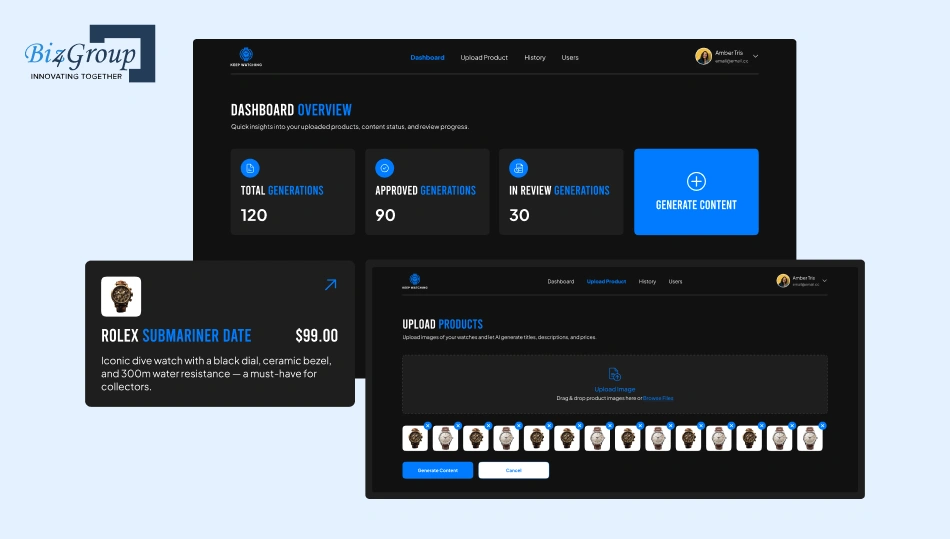
Keep Watching: It is an AI-enabled eCommerce automation solution that streamlines watch product listings on eBay by generating titles, descriptions, and structured content from images and metadata. It cuts manual workloads and improves accuracy for large catalogs. This practical example shows how intelligent systems can manage real product data and logic, inspiring similar approaches in product recommendation chatbot development.
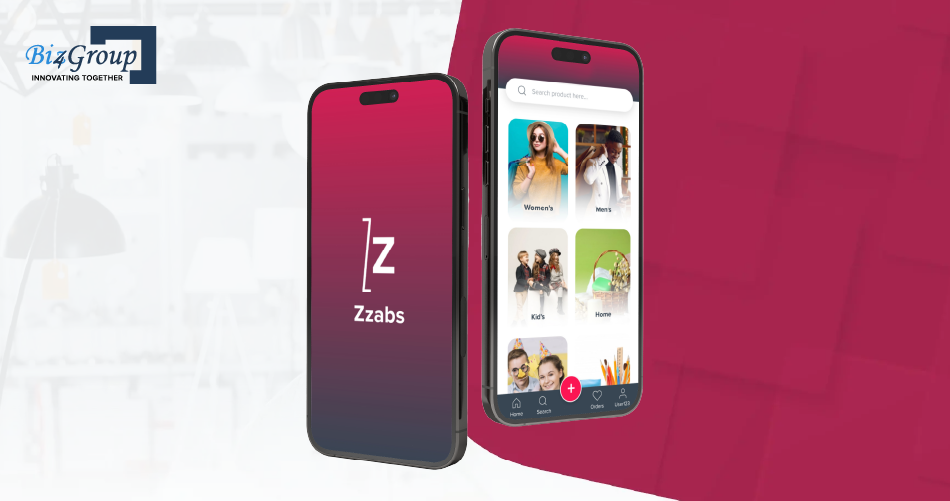
ZZABS Interactive Prototype: It is an eCommerce marketplace app where buyers and sellers connect, browse categories, and share products to boost visibility. It focuses on intuitive browsing and structured product interactions that help users find items quickly. This experience highlights the importance of thoughtful product presentation and behavior-driven flows, which are essential when designing effective product recommendation AI chatbots.
By grounding AI chatbot development in real system design and operational constraints, Biz4Group LLC reflects the execution standards seen across AI development companies in Florida, delivering product recommendation chatbots built for stability, scalability, and real commerce use.
Conclusion
Building smarter shopping experiences today is less about adding more features and more about removing friction at the right moments. When businesses build a product recommendation AI chatbot, the real goal is not automation for its own sake, but clearer decisions for customers navigating growing catalogs and faster buying journeys.
What works in practice is a disciplined approach one that treats recommendations as part of broader business app development using AI, not as an isolated chatbot layer. Teams that take time to align data, conversation flows, and system integrations early find it easier to build AI powered product recommendation bots that stay relevant as products, pricing, and customer behavior evolve.
For leaders evaluating how to develop a product recommendation AI chatbot, the path forward starts with understanding real buying intent and designing systems that scale without complexity. Connect with our AI consultants today, and start building your competitive edge.
Frequently Asked Questions (FAQs)
1. What does it actually take to build a product recommendation AI chatbot for an ecommerce business?
To build a product recommendation AI chatbot, businesses need clean product data, defined buying journeys, recommendation logic, and tight integration with catalogs, pricing, and inventory. Success depends more on data alignment and workflow design than on AI models alone.
2. How is product recommendation AI chatbot development different from regular chatbot development?
Product recommendation AI chatbot development focuses on guiding buying decisions, not just answering questions. It requires intent detection, behavior tracking, real-time product ranking, and continuous updates based on catalog and shopper signals.
3. How do teams develop an AI product recommendation chatbot that adapts to changing user behavior?
Teams develop AI product recommendation chatbots by combining conversational inputs with session behavior, past interactions, and real-time system data. This allows recommendations to update dynamically as users compare, hesitate, or change preferences mid-conversation.
4. What factors influence a product recommendation AI chatbot development cost estimate?
A product recommendation AI chatbot development cost estimate depends on catalog size, personalization depth, real-time integrations, AI model complexity, and scalability requirements. MVP builds cost less, while enterprise-grade systems require higher investment.
5. Can ecommerce brands build scalable product recommendation AI chatbots for large catalogs?
Yes. To develop scalable product recommendation AI chatbots, teams design modular recommendation logic, efficient data pipelines, and cloud-ready architectures that handle growing catalogs, traffic spikes, and evolving merchandising strategies.
6. How should businesses choose the best company to develop a product recommendation AI chatbot?
The best company to develop product recommendation AI chatbots understands ecommerce workflows, recommendation systems, and production deployment. Look for experience with real catalogs, integrations, and long-term system maintenance, not just chatbot demos.
