Location :
Orlando, FL, USA
Location :
Orlando, FL, USA +1 (407) 714-1616
 info@biz4group.com


















Imagine a digital system that doesn’t wait for instructions but instead, understands your business goals, learns from real-time feedback, and takes independent actions to get the job done.
Read More
When a chatbot works well, you’re least bothered about the technology behind it.
You just expect it to respond fast and make that too with zero friction.
That ease is exactly why apps like Ask AI are gaining attention. They sit quietly in daily workflows, answering questions, summarizing information, or helping users move faster. What often gets overlooked is that delivering this “simple” experience comes with real development and ongoing costs.
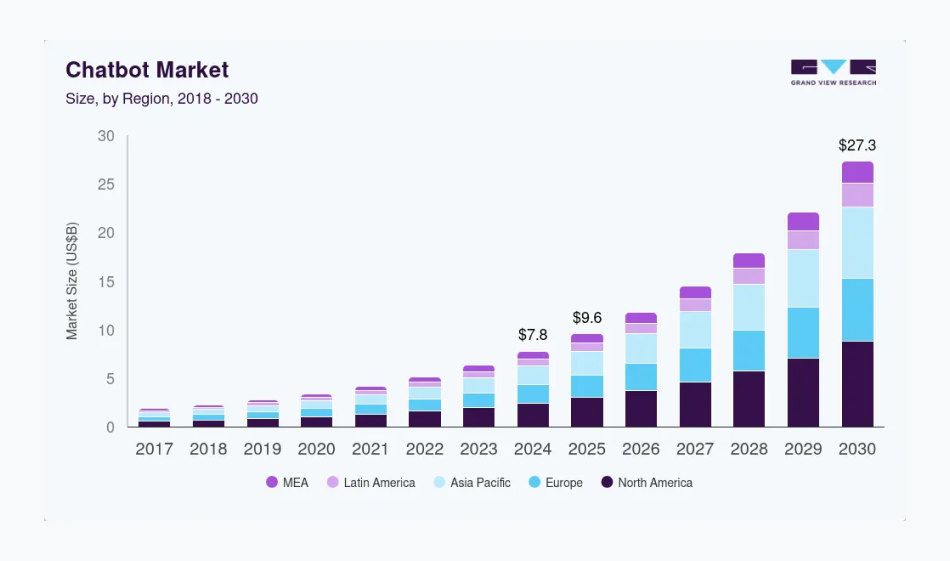
Market growth explains why so many teams are considering this space now. Industry reports show that the global chatbot market is projected to reach USD 27.29 billion by 2030, growing at a CAGR of 23.3%, while the broader global conversational AI market is anticipated to reach USD 41 billion by 2030.
Statistics prove AI Adoption is rising fast, but so is the cost of building and maintaining these products correctly. Before budgeting for an AI chatbot app like Ask AI, it is important to be clear on a few practical points:
The cost to develop an AI chatbot app like Ask AI typically ranges from $20,000 and $150,000. It includes development effort, usage-based expenses, and continuous improvement over time. In this article, we walk through those cost drivers step by step, informed by how an AI chatbot development company approaches planning so you can understand what you’re paying for and make confident decisions before moving ahead.
Estimating the cost to develop an AI chatbot app like Ask AI is all about understanding where effort turns into ongoing expense. Chatbots appear simple on the surface, but conversation handling, response accuracy, and usage scale quietly shape budgets once planning becomes concrete. Founders and product teams often underestimate how quickly costs change as real users interact with the system.
Unlike traditional apps, chatbot products incur expenses every time a conversation happens. This is why early clarity matters, especially when evaluating AI chatbot app development cost like Ask AI for long-term sustainability rather than just launch readiness.
Total Cost = (Development Hours × Hourly Rate) + AI Model Fees + Integration Costs + Testing + Post-Launch Support
This formula captures both build effort and ownership realities.
Before putting numbers on it, let’s walk through what each part of this formula actually represents in real development work.
Sample Calculation (Illustrative):
Estimated Initial Build Cost = (700 × 40) + 3,000 + 4,000 + 3,000 = $38,000
Post-launch support is calculated separately because it covers ongoing work after release, such as updates, performance tuning, and fixes. These costs repeat over time and depend on usage growth, not just initial development.
Looking at the formula this way helps teams think beyond just the build phase. Instead of seeing chatbot development as a one-time cost, it becomes easier to understand how effort, usage, and upkeep connect over time. When these pieces are brought together through thoughtful AI integration services and early involvement from a custom software development company, cost planning becomes clearer, and surprises are easier to avoid as the product grows.
Also Read: How Much Does It Cost to Build an AI Chatbot Like ChatGPT?
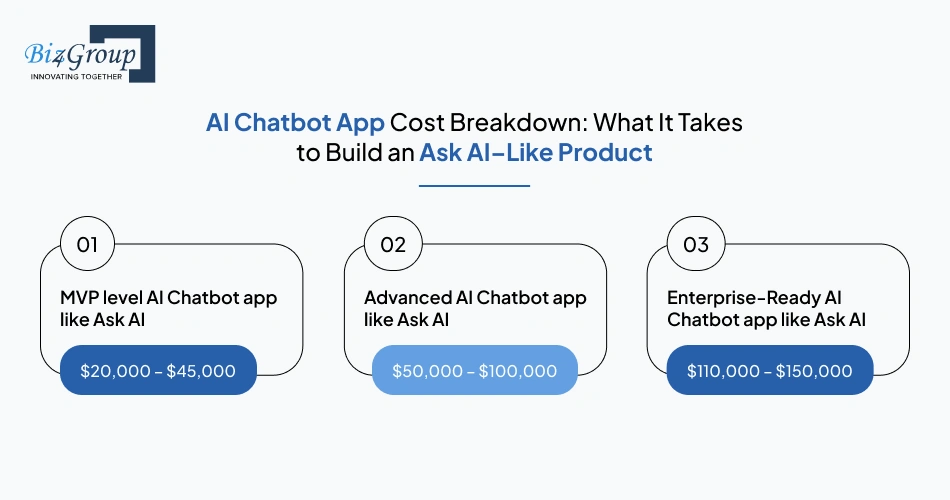
When teams start breaking down numbers, the cost to develop an AI chatbot app like Ask AI rarely fits into a single estimate. In practice, budgets usually fall between $20,000 and $150,000, shaped by conversation complexity, usage volume, and how much scalability is planned from the start. Two chatbot apps can look similar on the surface, yet differ significantly in cost because expectations around accuracy, response speed, and long-term usage are rarely the same.
At the lower end, products focus on limited conversation scope, basic response handling, and controlled usage. As requirements to include broader knowledge coverage and more advanced dialogue handling expand, complexity increases quickly. This is common in AI conversation app development, where teams begin asking how much does it cost to build an AI chatbot app like Ask AI that can grow without becoming expensive to operate.
Below is a high-level view of how costs typically align with build maturity:
|
Build Level |
Scope |
Estimated Cost Range |
|---|---|---|
|
MVP level AI Chatbot app like Ask AI |
Core Q&A flows, limited usage, basic UI |
$20,000 – $45,000 |
|
Advanced AI Chatbot app like Ask AI |
Expanded conversations, optimization, scale planning |
$50,000 – $100,000 |
|
Enterprise-Ready AI Chatbot app like Ask AI |
High concurrency, monitoring, reliability controls |
$110,000 – $150,000 |
But what often gets underestimated is how early architectural decisions affect long-term spending. As the usage for the app grows, choices around conversation handling and model usage directly influence AI chatbot software development cost like Ask AI. This is similar to how broader planning impacts budget when teams evaluate the cost to develop an AI app beyond the initial release.
To see how costs add up, the budget needs to be broken down across different stages of development.
|
Development Stage |
Typical Range |
Cost Focus |
|---|---|---|
|
Discovery and Planning |
$2,000 – $6,000 |
Scope definition and early cost alignment |
|
Conversation & UX Design |
$4,000 – $10,000 |
Conversation structure and interaction design |
|
Frontend Development |
$5,000 – $20,000 |
User-facing interface across web or app |
|
Backend & Logic |
$8,000 – $35,000 |
Core chatbot processing and system logic |
|
Integrations |
$3,000 – $12,000 |
External systems, tools, and data connections |
|
Testing & QA |
$3,000 – $10,000 |
Stability, accuracy, and performance validation |
|
Post-Launch Support |
10–20% annually |
Ongoing upkeep and optimization |
Seen together, these layers explain why teams planning to create an AI chatbot app like Ask AI need to look beyond surface features. Cost differences usually come from assumptions about scale, reliability, and long-term usage rather than what users see on day one.
Compare your expected scope and usage assumptions against real-world cost patterns seen in Ask AI–style chatbot builds.
Validate my Budget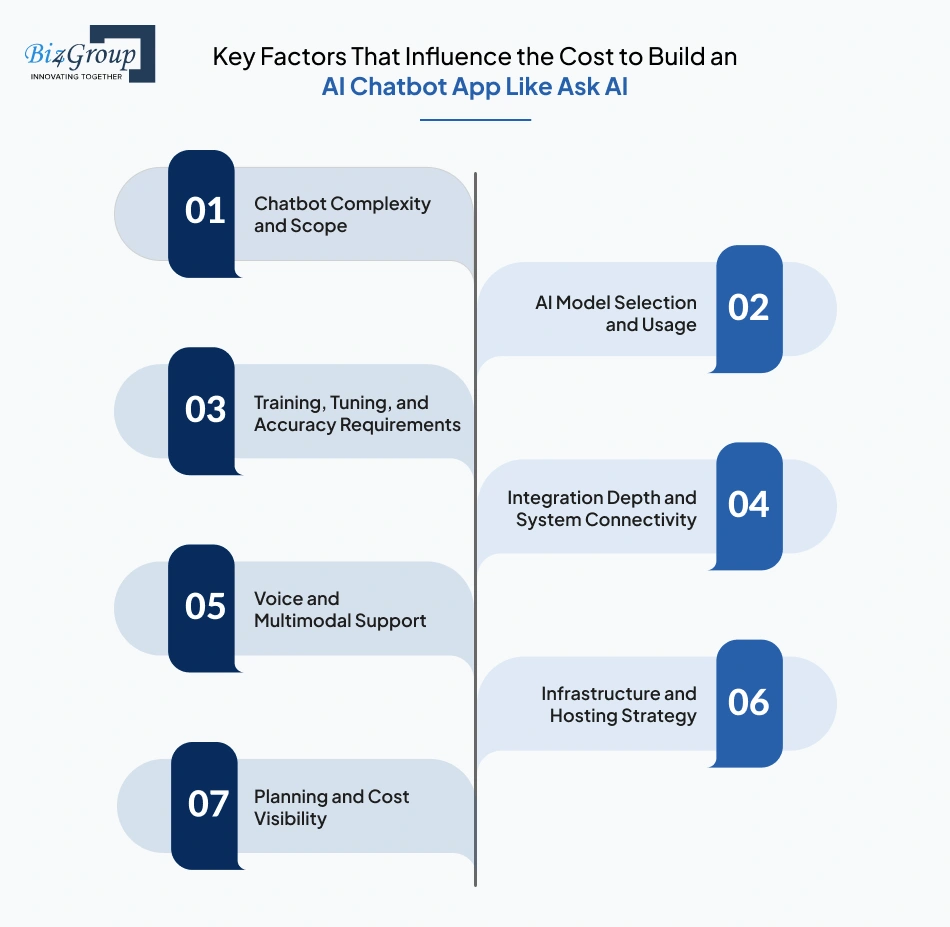
The cost to develop an AI chatbot app like Ask AI is shaped by several interconnected decisions. Each one affects development effort, operating expenses, and how costs evolve as real usage increases.
The level of intelligence you expect from the chatbot sets out the baseline cost, because broader conversation handling increases both development hours and long-term maintenance effort.
Estimated Cost Impact: $5,000 – $30,000
Scope decisions made early heavily influence AI chatbot app development cost like Ask AI for startups, especially when budgets are limited. This factor typically adds $5,000 – $30,000 to the overall build cost
AI model choices influence cost continuously, not just during development, especially when teams plan how they will integrate AI into an app at scale.
AI Model decisions directly shape ongoing operating expenses, not just the initial build budget. This factor typically adds $3,000 – $20,000 initially plus usage based monthly costs to the overall build cost.
Improving response quality increases cost because tuning and validation require additional effort after launch, especially as user queries become more diverse.
Accuracy expectations determine how much post-launch effort is required to keep responses reliable. This factor typically adds $4,000 – $15,000 to the overall build cost.
Each system that the chatbot connects to increases cost by adding development time, testing effort, and long-term support responsibility, particularly with AI chatbot integration with CRM systems.
Integration depth is a key driver when estimating the Cost to build an AI chatbot app similar to Ask AI across different business environments. This factor typically adds $3,000 – $18,000 to the overall build cost.
When teams decide to build AI chatbot voice assistant capabilities, costs rise due to additional processing, infrastructure usage, and testing complexity.
Voice features add recurring infrastructure and testing costs beyond text-based chat. This factor typically adds $6,000 – $25,000 to the overall build cost.
Also Read: A Complete Guide on AI Voice Chatbot Development
Infrastructure choices directly affect monthly costs, since chatbot usage drives compute, storage, and response latency requirements.
Hosting decisions determine how predictably costs scale as usage grows. This factor typically adds $1,000 – $5,000 annually at an early scale and increases with the app usage.
Early cost clarity reduces budget overruns because realistic scoping helps teams avoid unnecessary build and optimization expenses, often supported through AI consulting services.
Planning costs are small compared to the overruns they help prevent later. This factor typically adds $2,000 – $8,000 to the overall build cost.
When these factors are considered together, cost planning becomes practical instead of reactive. Teams that account for usage, accuracy, and integration early gain tighter control over AI chatbot budgets as real-world demand grows.
See how conversation depth, usage volume, and AI model behavior shape your real chatbot budget.
Review Cost Drivers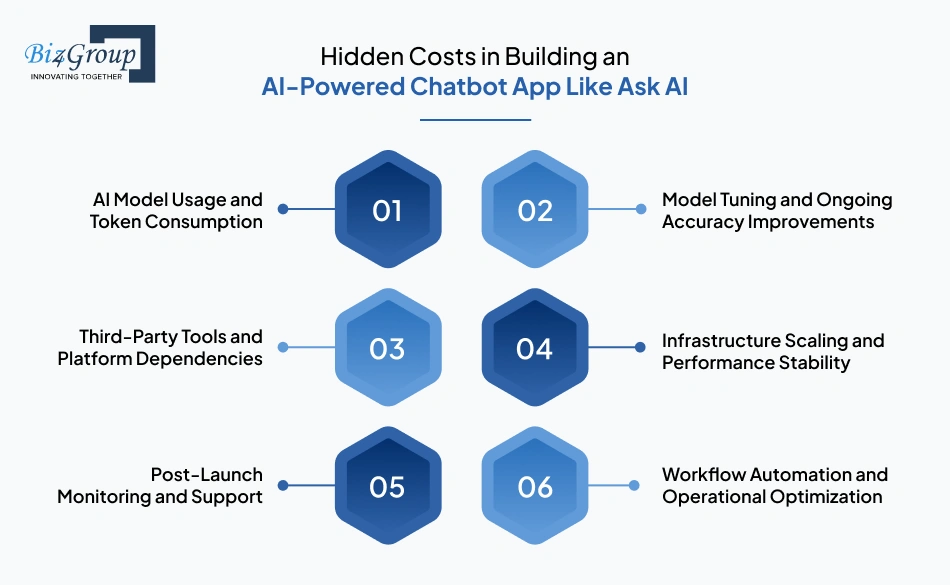
When teams estimate the cost to develop an AI chatbot app like Ask AI, most budgets focus on development and launch. What often gets missed are the expenses that appear once users start interacting with the chatbot at scale. These hidden costs shape long-term ownership and directly affect sustainability.
Below are the most common hidden cost areas that teams encounter.
Every chatbot interaction triggers model usage. As conversations increase, so do token and inference costs. Teams planning to build AI powered chatbot app like Ask AI often underestimate how quickly these fees grow with longer responses and higher daily usage.
Estimated cost: $500–$3,000 per month, depending on volume and response length.
Chatbots rarely perform perfectly after launch. Real user questions expose gaps that require tuning, prompt adjustments, or retraining. This ongoing refinement becomes a recurring expense rather than a one-time task for teams calculating Ask AI like chatbot app development cost.
Estimated cost: $2,000–$8,000 per tuning cycle.
Analytics tools, monitoring systems, moderation services or automation layers are often added post-launch. Without accounting for subscriptions and usage-based pricing, these tools quietly increase operational spending cost to develop AI chatbot app like Ask AI.
Estimated cost: $1,000–$5,000 annually, depending on integrations.
As usage grows, hosting, bandwidth, and response latency requirements increase. Even lightweight chatbots need scaling to maintain reliability. This cost becomes visible once teams move beyond early testing into real usage scenarios.
Estimated cost: $800–$4,000 per month as traffic increases.
Live usage reveals issues that testing cannot catch. Monitoring conversations, fixing edge cases, and improving response quality require ongoing effort. For teams estimating Ask AI style AI chatbot software development cost, support often becomes a recurring operational line item.
Estimated cost: $1,500–$6,000 annually, based on traffic and complexity.
As chatbots handle more interactions, teams often introduce automation to manage responses, routing, and fallback logic. This layer reduces manual effort but adds configuration and optimization costs, especially when scaling support or internal workflows through AI automation services.
Estimated cost: $3,000–$10,000 annually, depending on automation depth.
Accounting for these hidden costs for AI chatbot development early helps teams avoid budget surprises later. When these costs are planned alongside development, the budget required to create an AI chatbot application like Ask AI becomes far more predictable and easier to manage over time.
Also Read: A Complete Guide to AI Chatbot Development
Spot hidden expenses and planning gaps that typically cause AI chatbot budgets to drift after launch.
Find Cost Risks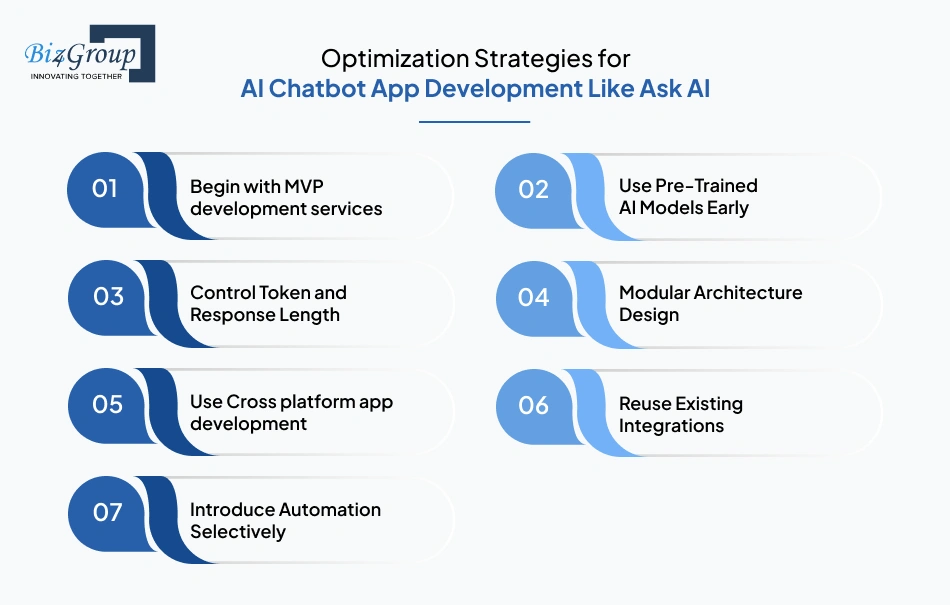
When teams evaluate the cost to develop an AI chatbot app like Ask AI, the control rarely comes from cutting features. It comes from building in the right sequence and avoiding complexity before usage justifies it. Products built on generative AI amplify this effect because usage directly drives operating expenses. The strategies below focus on keeping costs predictable while allowing the chatbot to scale responsibly.
|
Strategy |
How It Controls Cost |
Practical Savings Impact |
|---|---|---|
|
Begin with MVP development services |
Limits early scope to essential conversations and avoids building unvalidated logic |
Reduces initial development cost by 20–30% |
|
Use Pre-Trained AI Models Early |
Avoids expensive custom AI model training before real usage data exists |
Saves 25–40% on early integration of AI models into development workflows |
|
Control Token and Response Length |
Reduces per-interaction costs by limiting unnecessary verbosity |
Cuts ongoing AI usage costs by 15–25% |
|
Modular Architecture Design |
Allows features to be added without rewriting core systems |
Avoids 20–30% rework during expansion |
|
Maintains a shared codebase across web and mobile interfaces |
Lowers build and maintenance effort by 20–30% |
|
|
Reuse Existing Integrations |
Leverages existing APIs and workflows instead of rebuilding |
Saves 15–20% on integration effort |
|
Introduce Automation Selectively |
Applies automation only to high-volume workflows |
Reduces long-term operational costs by 15–25% |
Looking ahead, integration choices made early have a lasting impact on cost efficiency. Thoughtful AI chatbot integration decisions play a major role in preventing operating expenses from scaling faster than adoption.
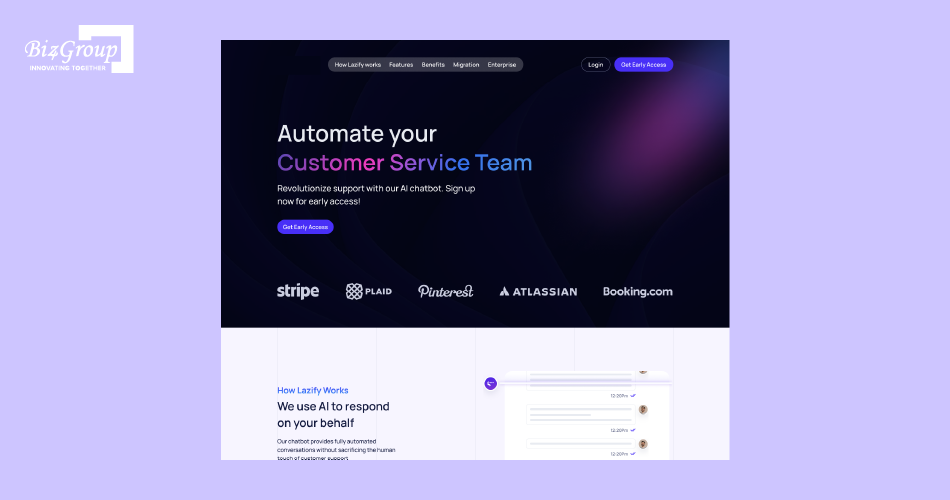
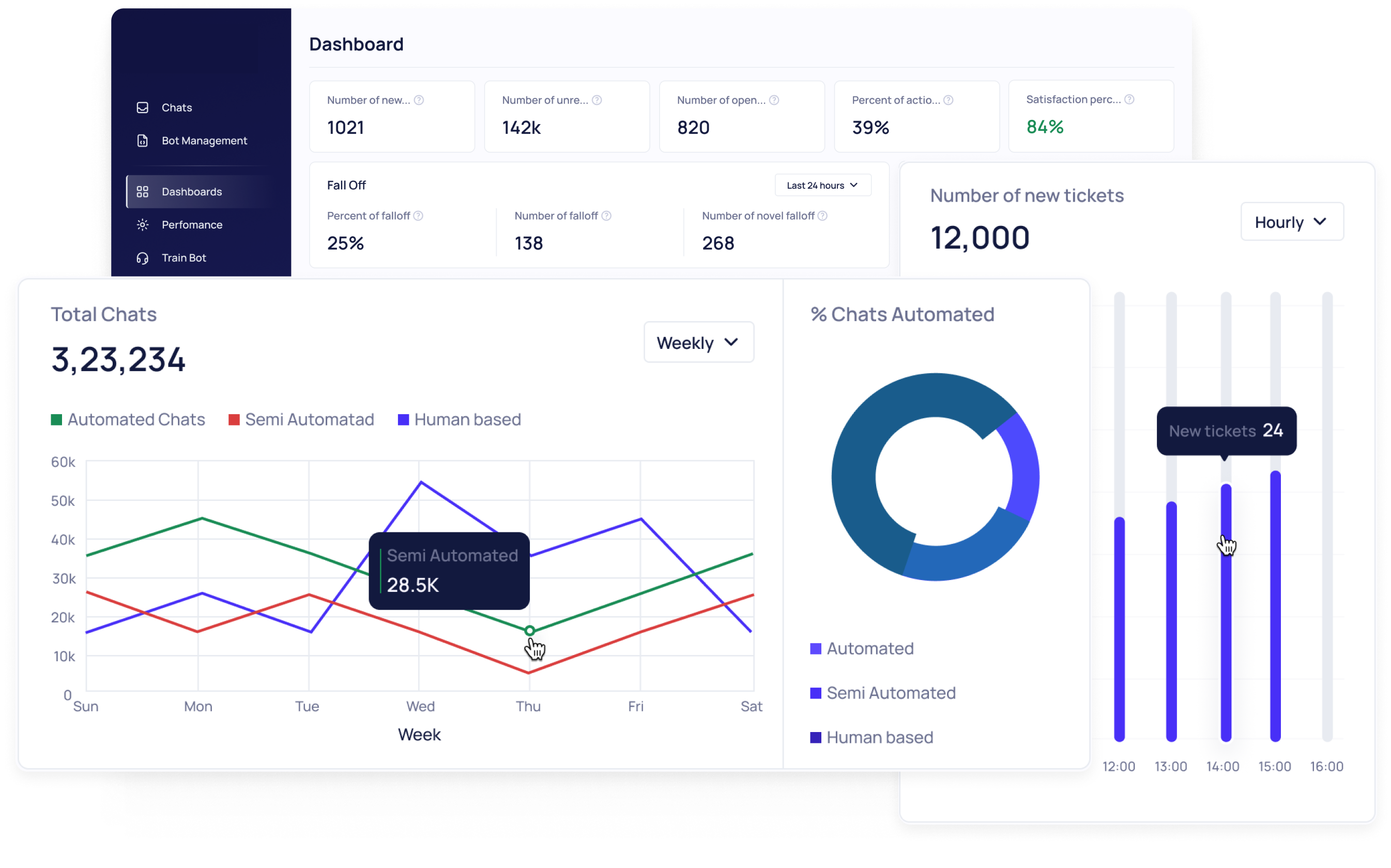
Portfolio spotlight: A recent Biz4Group LLC’s portfolio highlights an AI-driven chatbot built to facilitate human-like communication by learning from past agent interactions and generating dynamic, context-aware responses, which significantly lifts engagement and support quality. This real-world example underscores how strategic training and NLP optimization are essential when estimating the cost to develop an AI chatbot app like Ask AI.
Also read: Top 10 mistakes to avoid while developing AI chatbot for your business
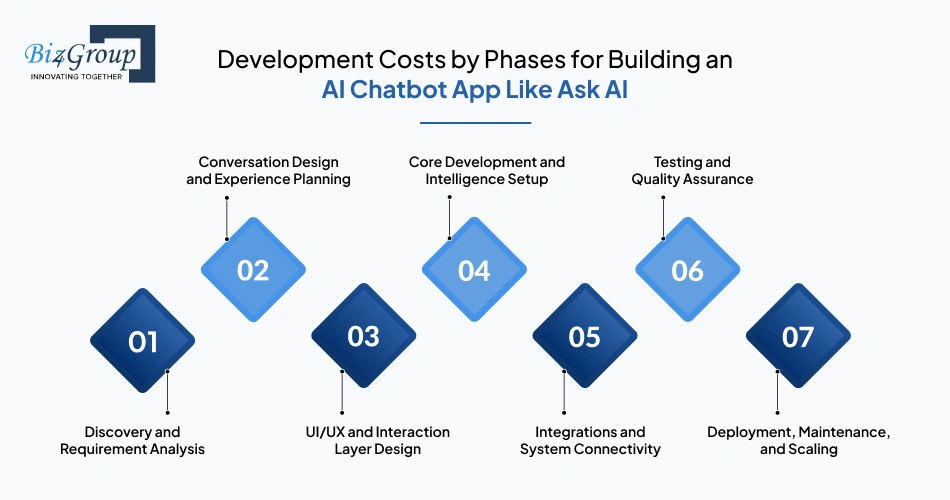
Looking at development through cost phases explains why the cost to develop an AI chatbot app like Ask AI evolves over time. Each phase adds expense for a specific financial reason which includes reducing risk, improving reliability, or supporting long-term usage rather than simply adding features.
Costs in this phase exist to prevent incorrect assumptions that inflate budgets later. Teams spend here to define realistic scope, usage expectations, and boundaries that directly affect development and operating expenses.
Estimated cost range: $2,000–$6,000
This phase drives cost based on how many conversation paths must be supported. Deeper conversational logic increases upfront effort but reduces ongoing fixes once users interact with the chatbot.
Estimated cost range: $3,000–$8,000
Costs here focus on preventing usability friction that leads to repeated revisions. Even chatbot-centric products require interface clarity to avoid costly iteration cycles after launch.
Estimated cost range: $3,000–$7,000
Also read: Top 15 UI/UX design companies in USA
This phase absorbs the largest share of the budget. Costs reflect the engineering effort needed to build stable logic, scalable systems, and reliable response handling.
Estimated cost range: $8,000–$40,000
Integration costs grow with dependency depth. Each connected system adds both build effort and future maintenance overhead that must be accounted for early.
Estimated cost range: $4,000–$12,000
Testing costs exist to protect reliability once real users engage with the chatbot. Higher accuracy and performance expectations increase validation effort.
Estimated cost range: $4,000–$10,000
Post-launch costs reflect ownership rather than build effort. This phase ensures the chatbot remains stable as usage patterns evolve.
Estimated cost range: 10–20% of annual build cost
Viewing costs by phase replaces guesswork with clarity. It shows where spending is necessary, where it is flexible, and how early decisions influence long-term ownership. This approach helps teams budget realistically instead of underestimating what it takes to keep an AI chatbot reliable after launch.
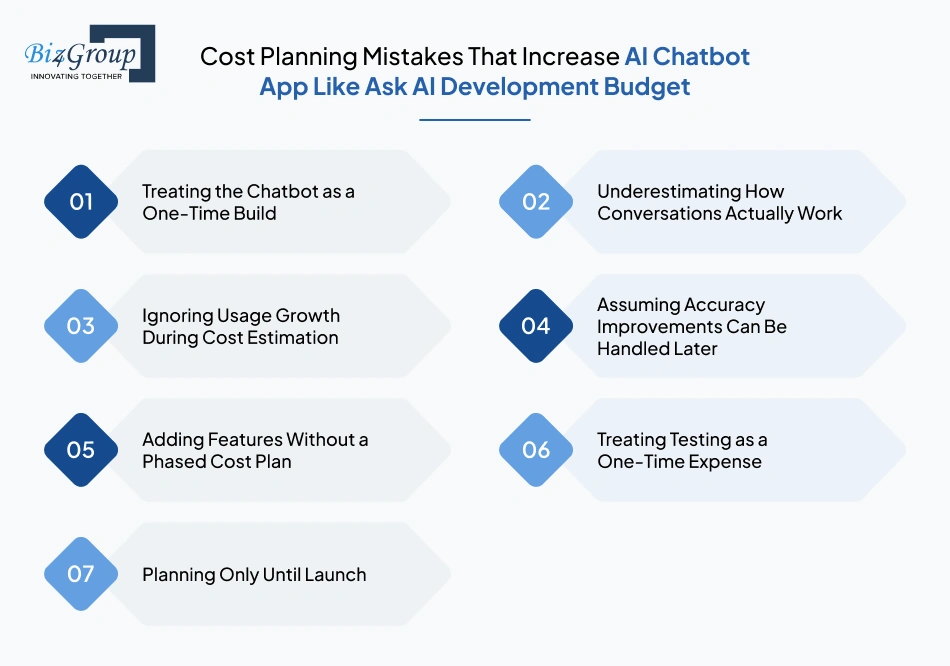
When teams estimate the cost to develop an AI chatbot app like Ask AI, budgets rarely grow because of careless spending. They grow because AI chatbot complexity hides in places that feel small during planning but become expensive once real conversations begin. These mistakes usually stem from misunderstanding how chatbot costs behave over time, not from poor execution.
Below are the cost planning mistakes that most often inflate Ask AI like Chatbot App Development cost:
Many teams plan costs as if the chatbot ends at launch, but in reality, every conversation creates ongoing expenses. Ignoring this during planning leads to budgets that look fine initially but fall apart once users start interacting regularly.
Solution: Plan the chatbot as a product with ongoing costs. Include monthly usage, optimization, and support expenses in your budget instead of stopping calculations at launch.
Chatbots rarely stop at single questions as follow-ups, clarifications, and context handling add effort and cost. When conversation depth is not defined early, teams underestimate development hours and future optimization work.
Solution: Define how deep conversations should go before estimating costs. Set limits on context memory and follow-ups so development effort and future tuning stay predictable.
Early estimates often assume low, steady usage but as adoption grows, AI usage fees rise with it. Planning only for launch traffic leads to monthly costs that feel unexpected but were entirely predictable.
Solution: Estimate costs using low, medium, and high usage scenarios. Planning for growth early helps prevent sudden budget pressure as adoption increases.
Teams often delay budgeting for response improvements and tuning. Fixing accuracy issues after launch usually costs more because problems compound with real usage and user expectations.
Solution: Allocate a fixed budget for regular tuning and improvements. Treat accuracy work as ongoing maintenance, not an optional future task.
When features are added reactively, costs rise without control. Without phased planning, every enhancement feels urgent and expensive instead of being a planned investment.
Solution: Break development into clear phases with cost checkpoints. Release features only when their impact on usage and expenses is understood.
Testing is often budgeted only before launch, but real users introduce unexpected inputs that require ongoing validation. Missing this in planning causes repeated unplanned expenses later.
Solution: Instead of budgeting testing only before launch, assign a recurring testing budget tied to usage milestones. This prevents unplanned spending when real user queries expose gaps after release.
Many budgets stop at release, but support, fixes, and monitoring continue afterward. When post-launch costs are ignored early, teams underestimate the true ownership cost of the AI chatbot app like Ask AI.
Solution: Split the budget into build cost and ownership cost during planning. By pricing support, monitoring, and updates upfront, teams avoid underestimating the true cost of running the chatbot.
Teams that plan around how conversations scale, usage grows, and ownership costs accumulate gain a clearer handle on AI chatbot app development cost like Ask AI for startups. When budgets are shaped by real operating behavior instead of optimistic assumptions, cost planning becomes a control tool rather than a recurring problem.
Also read: How much does it cost to develop enterprise AI chatbot?
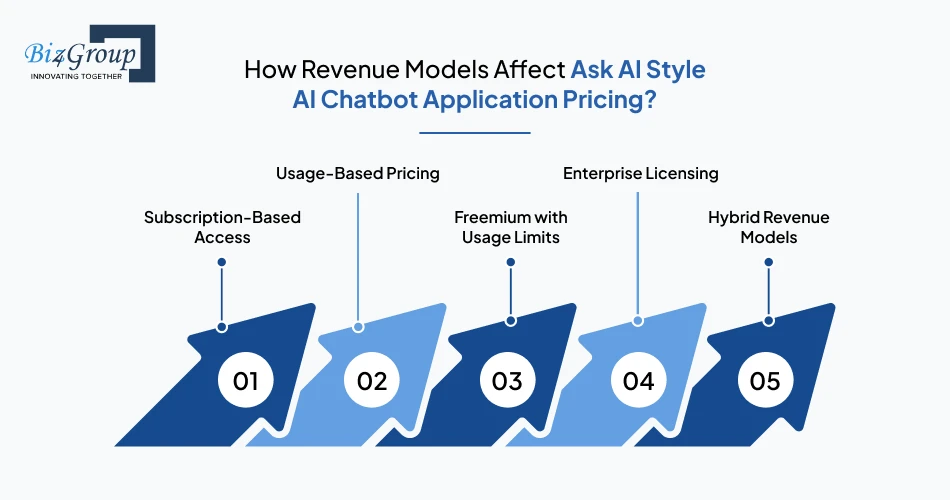
Revenue models quietly influence how an AI chatbot app is engineered. They determine how conversations are tracked, how limits are enforced, and how accurately usage must be measured. These requirements shape development efforts early and directly influence the cost to develop an AI chatbot app like Ask AI.
Let us now look at how revenue models affect the pricing of Ask AI style AI chatbot app:
|
Revenue Model |
How It Changes Development Work |
Development Cost Impact |
|---|---|---|
|
Subscription-Based Access |
Requires plan management, usage limits, and account-level controls |
Adds $6,000–$15,000 for billing logic and permission handling |
|
Usage-Based Pricing |
Demands precise tracking of conversations and responses |
Adds $8,000–$20,000 driven by metering, reporting, and validation |
|
Freemium with Usage Limits |
Introduces feature gating and upgrade flows |
Adds $5,000–$12,000 tied to access control and usage thresholds |
|
Enterprise Licensing |
Requires isolation between organizations and detailed reporting |
Adds $15,000–$35,000 due to multi-tenant architecture and audits |
|
Hybrid Revenue Models |
Combines subscriptions with usage tracking |
Adds $18,000–$40,000 because of overlapping billing and analytics logic |
Each model shifts development effort in a different direction. Usage-based pricing increases tracking and testing work, while enterprise licensing pushes complexity into architecture and data isolation. These decisions directly influence AI chatbot app development cost like Ask AI, even when the chatbot’s visible behavior looks similar.
When revenue logic is planned early, these costs are built into the system deliberately. When it’s added later, the same requirements often trigger rework that inflates timelines and budgets unnecessarily.
Translate generic cost ranges into a clearer estimate based on your chatbot's scope, usage expectations, and growth plans.
Get Cost ViewThe honest answer is yes; it is a profitable investment, but not by default. An Ask AI–style chatbot becomes profitable only when it is built to solve a problem people come back to regularly and when its running costs are planned from day one. The cost to develop an AI chatbot app like Ask AI pays off when usage creates value faster than it creates expense.
Here’s what actually makes the difference:
So, building an Ask AI–like chatbot can absolutely be a profitable investment. It just stops being profitable when it’s built for attention instead of repeated, meaningful use. Teams that plan ownership costs upfront often with support from an AI product development company are better positioned to protect margins as usage grows.
At Biz4Group LLC, managing the cost to develop an AI chatbot app like Ask AI starts with removing guesswork early. Before code is written, we focus on how the chatbot will actually be used by evaluating conversation volume, response depth, and growth pace because those decisions quietly control long-term cost. Owing to this pursuit we are among the top chatbot development companies in USA.
Unlike many builds that focus only on launch readiness, we plan chatbot economics around real usage. AI chatbot costs don’t rise because teams overspend; they rise when usage patterns, model behavior, and post-launch effort aren’t accounted for upfront. Our role as a software development company is to surface those cost drivers before they turn into surprises.
Over time, this approach has helped our teams manage AI chatbot app development cost like Ask AI across industries where usage can scale quickly, including e-commerce, healthcare, real estate, HR, education, and finance. In each case, the goal is the same: keep intelligence high while keeping operating costs predictable.
Why Teams Choose Biz4Group for Cost-Optimized Ask AI–Like Chatbots
Teams working with Biz4Group typically want strong conversational performance without runaway expenses. Here’s how we control costs in practice:
Portfolio Spotlight:
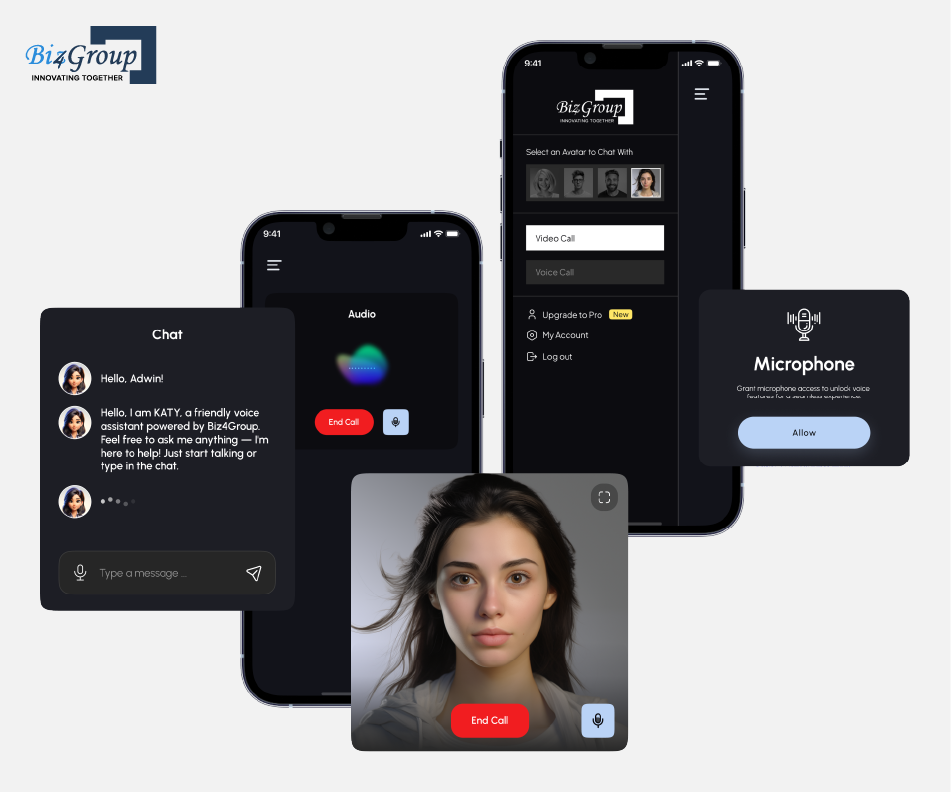
Our AI portfolio reflects this philosophy of AI chatbot products designed to stay financially sustainable as adoption increases, not just impressive on day one. By grounding decisions in usage, scale, and ownership cost, we help teams build Ask AI–style chatbots that remain viable long after launch.
By now, it should be clear that the cost to develop an AI chatbot app like Ask AI is shaped by far more than initial development. Conversation depth, usage patterns, AI model behavior, integrations, and long-term support all influence what you ultimately invest and what you get back in return. Building a chatbot is not just about answering questions; it’s about creating interactions that consistently support real user needs.
The real advantage comes from planning with intent. Whether you start with a focused MVP or grow into a broader conversational platform, understanding your AI chatbot app development cost like Ask AI upfront helps you avoid guesswork later. When costs are planned around real usage and ownership, building an Ask AI–style chatbot stops feeling uncertain and starts feeling deliberate. The result is a product that grows at a pace your business can sustain and trust over time.
This is where working with experienced teams makes a difference. At Biz4Group, cost optimization is treated as part of the product thinking from day one, helping teams move forward with confidence, clarity, and a realistic understanding of what it takes to build an AI chatbot that lasts.
So why wait, let’s connect today and turn your AI chatbot app vision into a scalable reality that fits your budget and drives measurable growth.
The cost to develop an AI chatbot app like Ask AI typically ranges from USD 20,000 to USD 150,000, depending on conversation complexity, AI model usage, integrations, and long-term maintenance requirements.
Building an Ask AI–like chatbot usually takes 8 to 16 weeks. Timelines vary based on conversation depth, data integrations, testing cycles, and whether the chatbot is launched as an MVP or a full product.
The biggest cost drivers include AI model usage, conversation depth, expected traffic volume, integrations with business systems, and post-launch optimization. These factors directly affect both development and ongoing operating costs.
Yes. Startups can manage the cost to develop an AI chatbot app like Ask AI by starting with a focused MVP. Limiting conversation scope and usage initially helps validate demand before committing to higher operating expenses.
AI chatbot development costs like Ask AI typically include conversation design, backend logic, AI model integration, testing, deployment, and ongoing refinement to maintain accuracy as real user interactions grow.
After launching, costs shift toward AI usage fees, infrastructure, monitoring, and improvements. As usage increases, planning these recurring expenses becomes critical for controlling long-term ownership costs.

with Biz4Group today!
Our website require some cookies to function properly. Read our privacy policy to know more.