 Location :
Orlando, FL, USA
Location :
Orlando, FL, USA +1 (407) 714-1616
 info@biz4group.com

- The cost to develop an AI EHR software typically ranges between $30,000 and $300,000, depending on features, AI complexity, integrations, and compliance requirements.
- The AI EHR software development cost is mainly driven by data quality, system integrations, AI model complexity, and regulatory requirements.
- A clear cost breakdown to create AI electronic health record software shows that data preparation and integrations can take up 40% to 60% of the total budget.
- Most projects recover investment within 6 to 24 months, depending on the use case, with automation delivering faster returns than predictive systems.
- Building in phases (starting with an MVP) helps control the cost to build AI EHR system and reduces risk while allowing gradual scaling.
- Biz4Group LLC helps optimize cost by using structured planning, phased development, and the right AI approach to avoid unnecessary spending and improve long-term scalability.
The cost to develop an AI EHR software usually ranges between $30,000 and $300,000. The final cost depends on how complex the system is, how much AI is included, and how easily it connects with existing systems. A basic solution stays on the lower end, while a more advanced system with automation and multiple integrations costs more.
An AI EHR system is not just for storing patient records. It also helps automate tasks, organize data, and support decision-making. As more features are added, the AI EHR software development cost increases because the system becomes more complex to build and manage.
One major factor that affects cost is how ready your current systems are. If your data is already structured and your systems can connect easily, development is simpler. If not, extra work is needed to clean data and build integrations, which increases the cost to build AI EHR system. This is why two similar projects can have very different budgets.
AI scope and compliance requirements also affect cost. Systems with more AI features need more development and testing. Healthcare systems also need strong security and data protection, which adds to the effort. Many businesses work with a custom software development company to plan the project properly and control costs. Teams with experience in regulated environments, including some of the top AI development companies in Florida, usually handle these requirements more efficiently.
This guide explains everything step by step. It shows what affects the cost, how the budget is divided, and how to plan your project properly. By the end, you will clearly understand AI EHR software development cost and how to manage it.
What Is the Cost to Develop an AI EHR Software?
The cost to develop an AI EHR software typically ranges between $30,000 and $300,000, depending on system complexity, AI scope, and integration requirements. A simple system focused on record management stays on the lower end, while a more advanced system with automation and analytics moves toward the higher end.
In most cases, cost increases step by step. First comes basic features like patient records and scheduling. Then comes automation and integrations. Finally, AI features add more complexity, which increases both development and long-term costs.
Typical Cost Range for AI EHR Software Development
AI EHR systems can be grouped into three levels based on what they include:
|
System Type |
Cost Range |
What It Includes |
Cost Behavior |
|---|---|---|---|
|
Basic System |
$30,000 – $70,000 |
Record management, basic workflows |
Lower complexity, fewer integrations |
|
Mid-Level System |
$70,000 – $150,000 |
Automation, structured data, 2–4 integrations |
More effort in data and integrations |
|
Advanced System |
$150,000 – $300,000 |
Analytics, decision support, real-time processing |
Higher complexity and AI usage |
At the mid and advanced levels, the AI EHR system development pricing increases mainly because of data handling and integration work.
What Determines the Cost to Develop AI EHR Software?
The total cost depends on a few key factors. Each one can increase or reduce the final budget.
Feature scope is one of the main drivers. A system with fewer features may cost around $40,000 to $80,000, while a system with more features and workflows can go beyond $150,000.
AI capability also affects cost. Basic automation is cheaper, while more advanced AI requires more time and resources.
|
AI Capability Level |
Estimated Cost Addition |
Complexity |
|---|---|---|
|
Basic Automation |
$5,000 – $15,000 |
Low |
|
Machine Learning |
$15,000 – $50,000 |
Moderate |
|
Advanced AI Systems |
$50,000+ |
High |
Projects that involve deeper AI model development usually take more time because they require testing and adjustments.
Data readiness is another major factor. Clean data reduces effort, while poor data increases cost.
|
Data Condition |
Cost Impact |
Effect on Project |
|---|---|---|
|
Clean and Structured |
Minimal |
Faster development |
|
Partially Structured |
+$10,000 – $30,000 |
Moderate effort |
|
Unstructured / Scattered |
+$30,000 – $60,000 |
High effort |
In many cases, data preparation alone can take 20% to 40% of the total budget.
Integration requirements also add to the cost. Each external system can cost between $3,000 and $15,000, depending on how complex the connection is.
Compliance and security are required for healthcare systems. These usually add $10,000 to $40,000 to the total cost.
Why AI EHR Software Development Cost Varies Across Projects?
The cost can vary a lot, even for similar projects. This is mainly because every organization starts at a different point.
Infrastructure makes a difference. Modern systems are easier to work with, while older systems need more effort to connect and update.
Data condition also affects cost. Clean and organized data helps speed up development, while messy data increases time and effort.
AI scope is another factor. For example:
|
AI Use Case |
Typical Cost Impact |
|---|---|
|
Documentation Automation |
$10,000 – $25,000 |
|
Workflow Automation |
$15,000 – $35,000 |
|
Predictive Analytics |
$30,000 – $80,000 |
Customization also increases cost. More customization means more development and testing.
Because of all these factors, the cost to create AI electronic health record software can vary by more than $100,000 between projects, even if they look similar at a high level.
What’s Included in AI EHR Software Development Cost?
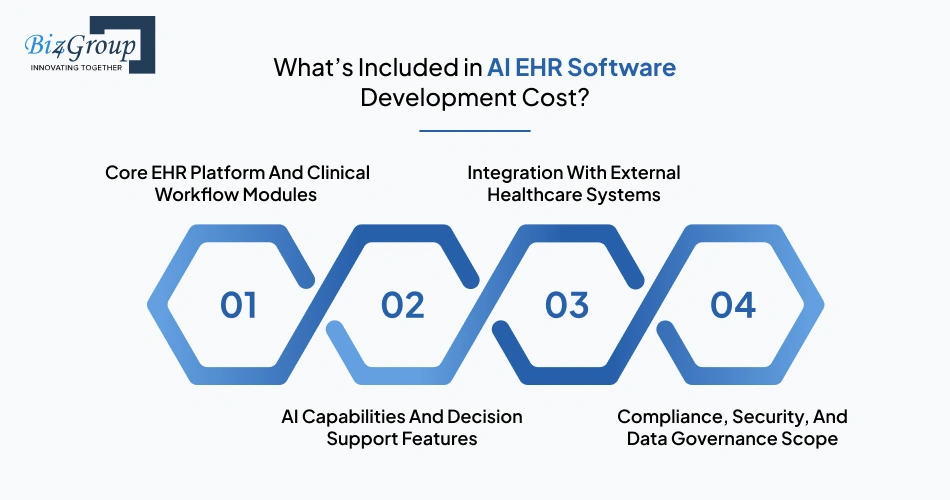
The cost to develop an AI EHR software is made up of several parts, not just one fixed expense. These parts include the core system, AI features, integrations, and compliance requirements. Each part adds to the total cost in a different way. Understanding these components makes it easier to see why the cost can range from $30,000 to $300,000.
1. Core EHR Platform And Clinical Workflow Modules
This is the base of the system. It includes patient records, scheduling, billing, and clinical workflows. These features are required in every EHR system and define how daily operations are handled. The cost increases when workflows are more detailed or customized.
- Example: A simple system with basic patient records and scheduling may cost around $20,000–$50,000. If the system includes multiple workflows across departments, the cost can go above $80,000.
2. AI Capabilities And Decision Support Features
AI features help automate tasks and support decisions. This can include documentation assistance, alerts, or simple predictions. More advanced features need more data, testing, and setup. Systems using generative AI or similar capabilities require additional effort, which increases cost.
- Example: Adding basic AI features may cost $10,000–$25,000. More advanced AI, such as prediction or decision support, can increase the build AI EHR software cost by $30,000–$80,000.
3. Integration With External Healthcare Systems
EHR systems need to connect with other systems like labs, billing platforms, and pharmacies. Each connection takes time to build and test. More integrations mean more work and higher cost.
- Example: Connecting 2–3 systems may add $10,000–$30,000. If the system needs multiple real-time integrations, the cost can go beyond $50,000.
4. Compliance, Security, And Data Governance Scope
Healthcare systems must follow strict rules for data security and privacy. This includes encryption, user access control, and audit tracking. These are required features and always add to the total cost. Teams offering AI integration services usually plan for these requirements early to avoid delays.
- Example: Compliance and security setup usually adds $10,000–$40,000, depending on system size and requirements.
Each of these components adds to the total cost in a different way. Some systems spend more on AI, while others spend more on integrations or compliance. Understanding this breakdown helps in planning the cost to create AI medical record software more clearly and avoiding unexpected expenses later.
Why AI EHR Software Development Cost Is High Compared to Standard Systems?
The cost to develop an AI EHR software is higher than standard software because it includes more layers of work. These systems must handle complex healthcare workflows, manage different types of data, and meet strict compliance requirements. Each of these adds time, effort, and cost to the project.
1. Complexity Of Clinical Workflows And Healthcare Data Structures
Healthcare workflows are complex and vary across departments, roles, and patient conditions. The system must handle both structured data like lab reports and unstructured data like clinical notes. Designing and managing these workflows takes more time and increases development effort.
2. Cost Of Interoperability Across Healthcare Systems
EHR systems need to connect with labs, pharmacies, billing systems, and insurance providers. Each system uses different formats and standards, which makes integration more difficult. This increases the cost to develop AI hospital management software, especially when multiple real-time connections are required.
3. Impact Of AI Model Lifecycle On Total Development Cost
AI features require more than just initial setup. They need data preparation, model training, testing, and regular updates to stay accurate. Projects that include AI in healthcare administration automation often require continuous improvements, which increases both initial and long-term cost.
4. Compliance And Regulatory Overhead In Healthcare Software
Healthcare systems must follow strict rules for data privacy, security, and audits. This includes encryption, user access control, and detailed logging of system activity. These requirements are mandatory and add a fixed cost to the overall development process.
These factors explain why AI EHR systems cost more than standard software. The added complexity, integration needs, AI lifecycle, and compliance requirements all increase effort and budget. Understanding this helps in planning the AI EHR platform development cost more clearly and avoiding underestimation.
Plan Your AI EHR Budget with Confidence
Understand the cost to develop an AI EHR software and make informed decisions from day one.
Get My Cost BreakdownHow Data and Infrastructure Influence AI EHR System Development Cost
The cost to develop an AI EHR software is strongly affected by how data is stored, prepared, and shared across systems. Even if two systems have similar features, their cost can be very different based on data quality and infrastructure. In many cases, data and infrastructure together can take up 40% to 60% of the total project cost.
1. Integration Requirements For FHIR And HL7 Standards
Healthcare systems use standards like FHIR and HL7 to exchange data. Supporting these standards requires proper data mapping, validation, and testing. The more systems involved, the more effort is needed.
Typical cost impact ranges between $5,000 and $20,000, depending on how many systems need to be connected and how complex the data is.
2. API Availability And Real-Time Data Exchange Constraints
Some systems provide well-documented APIs, while others do not. If APIs are available, integration is faster and may cost around $3,000 to $7,000 per system. If APIs are limited or missing, custom connectors may be required, increasing the cost to $8,000 to $15,000 per system.
Real-time data exchange adds more complexity because the system must handle continuous updates. This can increase infrastructure and testing effort by 10% to 25% of the total project cost. This is one of the reasons the develop AI EHR system cost increases when real-time processing is required.
3. Handling Structured Versus Unstructured Clinical Data
AI EHR systems work with both structured and unstructured data. Structured data, like lab results, is easier to manage. Unstructured data, like doctor notes, needs extra processing before it can be used.
Systems that depend more on unstructured data usually cost more to build. This is one of the reasons the AI healthcare software development cost increases as AI features become more advanced.
4. Cost Of Data Cleaning And Its Impact On AI EHR Development Cost
Data cleaning is a necessary step before using data in AI systems. It includes fixing errors, removing duplicates, and organizing data into a usable format.
- Clean data adds little extra cost
- Partially clean data can add $10,000 to $30,000
- Poor data quality can add $30,000 to $60,000
In many projects, this step alone takes 20% to 40% of the total budget. Many teams use AI consulting services early to assess data and reduce this effort.
5. Infrastructure Choices And Their Impact On AI EHR System Development Cost
Infrastructure decisions affect both cost and performance. Cloud systems are easier to scale and usually cost less upfront. On-premise systems require higher setup cost but offer more control.
Infrastructure setup can range from $10,000 to $50,000, depending on storage, processing needs, and system scale. These choices directly affect the cost to build AI patient record management system.
6. Middleware Requirements For Legacy System Compatibility
Older systems often cannot connect directly with modern AI tools. Middleware is used to connect these systems and allow data to flow between them. This adds extra development work.
Simple middleware may cost $5,000 to $15,000, while more complex setups can go up to $15,000 to $40,000. In such cases, teams may choose to hire AI developers with experience in legacy systems to reduce risks.
Summary Of Data And Infrastructure Cost Impact
|
Component |
Typical Cost Impact |
Effect on Total Cost |
|---|---|---|
|
FHIR / HL7 Integration |
$5,000 – $20,000 |
Increases with number of systems |
|
API & Real-Time Integration |
$3,000 – $15,000 per system + 10–25% project cost |
Higher with real-time data needs |
|
Data Cleaning & Preparation |
$10,000 – $60,000 |
20–40% of total budget |
|
Infrastructure Setup |
$10,000 – $50,000 |
Depends on scale and performance |
|
Middleware for Legacy Systems |
$5,000 – $40,000 |
Higher for complex legacy setups |
Data and infrastructure play a major role in overall cost. Clean data and modern systems help reduce development effort, while poor data and legacy systems increase it. Understanding these factors helps estimate the AI healthcare software development cost more clearly and avoid unexpected increases later.
AI EHR Software Development Cost Breakdown by Components
The cost to develop an AI EHR software is divided into a few main parts. Each part adds to the total budget in a different way. These include data work, system development, AI features, integrations, infrastructure, and compliance. Understanding this breakdown helps explain how the total cost reaches anywhere between $30,000 and $300,000.
How AI EHR Software Development Cost Is Distributed Across Components
The total cost is not spread evenly across all parts. Some areas take more budget than others, especially data preparation and system integration.
In most projects, data and integration together can take 40% to 60% of the total cost. The rest is divided between core development, AI features, infrastructure, and compliance. This makes it easier to understand how much does it cost to develop AI EHR software in real terms.
1. Data Preparation, Structuring, And Governance Costs
This includes cleaning, organizing, and preparing data before it is used in the system. It also includes setting rules for how data is stored and accessed.
This part usually takes 20% to 40% of the total budget, which can be around $10,000 to $120,000, depending on how clean and organized the data is.
2. Application Development For Core EHR Functionality
This covers building the main features like patient records, scheduling, billing, and workflows. These are required for any EHR system.
This part usually takes 20% to 30% of the total cost, which can range from $15,000 to $90,000, based on how many features are included.
3. AI Model Development, Training, And Integration Costs
This includes adding AI features like automation, predictions, or decision support. It involves building, testing, and improving AI models. Systems that include AI agent implementation often need more time and effort.
This part usually takes 15% to 30% of the total budget, which can be around $10,000 to $90,000, depending on how advanced the AI is.
4. API Development And Third-Party System Integration Costs
This includes connecting the system with other platforms like labs, billing systems, and pharmacies. Each connection requires development and testing.
This part usually takes 15% to 25% of the total cost, which can range from $10,000 to $75,000, depending on how many systems need to be connected.
5. Infrastructure, Hosting, And Storage Cost Components
This covers servers, cloud services, and storage needed to run the system. It also includes setup for performance and scalability.
This part usually takes 10% to 20% of the total budget, which can range from $5,000 to $50,000, depending on system size.
6. Compliance, Security, And Audit Readiness Costs
This includes security features like encryption and access control, as well as meeting healthcare regulations and audit requirements.
This part usually takes 10% to 15% of the total cost, adding around $5,000 to $40,000, depending on system needs.
Summary Of Cost Distribution Across Components
|
Component |
% of Total Cost |
Estimated Cost Range |
|---|---|---|
|
Data Preparation & Governance |
20% – 40% |
$10,000 – $120,000 |
|
Core EHR Development |
20% – 30% |
$15,000 – $90,000 |
|
AI Development & Integration |
15% – 30% |
$10,000 – $90,000 |
|
API & Integrations |
15% – 25% |
$10,000 – $75,000 |
|
Infrastructure & Hosting |
10% – 20% |
$5,000 – $50,000 |
|
Compliance & Security |
10% – 15% |
$5,000 – $40,000 |
Each of these components adds to the total cost in a different way. Some projects spend more on data and integration, while others focus more on AI or infrastructure. Understanding this breakdown helps estimate the detailed cost to build AI EHR system for hospitals more clearly and plan budgets with fewer surprises.
Build Smarter Healthcare Systems with Controlled Cost
Optimize your AI EHR software development cost with the right architecture, data strategy, and phased approach.
Start My AI EHR ProjectHow Does the Cost to Develop AI EHR Software Break Down by Development Phase?
The cost to develop an AI EHR software is spread across different development phases. Each phase focuses on a specific part of the system, from planning to launch and ongoing support. This step-by-step approach explains how the total cost of $30,000 to $300,000 is used over time.
Phase 1: Clinical Requirement Analysis And Planning
This phase defines what the system will do and how it will be used. It includes understanding clinical workflows, setting goals, and deciding what to include in the first version (MVP). Good planning helps avoid changes later.
- Typical cost: $5,000 – $15,000
- Covers: requirement gathering, workflow mapping, MVP development services
Also Read: Top 12+ MVP Development Companies to Launch Your Startup in 2026
Phase 2: Data Preparation And Infrastructure Setup
This phase focuses on preparing data and setting up the system environment. Data must be cleaned and organized before it can be used. Infrastructure, such as cloud or servers, is also set up here.
- Typical cost: $10,000 – $50,000
- Covers: data cleaning, data structuring, infrastructure setup
Phase 3: Core System Development
This is where the main system is built. It includes UI/UX design and core features like patient records, scheduling, and workflows. The MVP is usually developed in this phase.
- Typical cost: $20,000 – $100,000
- Covers: UI/UX design, feature development, MVP build
Also Read: Top 15 UI/UX Design Companies in USA (2026 Edition)
Phase 4: AI Integration Into Clinical Workflows
This phase adds AI features into the system. It includes training AI models and connecting them with system workflows. The complexity depends on how advanced the AI features are.
- Typical cost: $15,000 – $80,000
- Covers: AI model training, testing, workflow integration
This phase has a strong impact on the overall budget required to build AI patient management software, especially when advanced AI is used.
Phase 5: System Integration And Testing
In this phase, the system is connected with external platforms such as labs and billing systems. It also includes testing the system to make sure everything works correctly.
- Typical cost: $10,000 – $40,000
- Covers: API integration, testing, bug fixing
Also Read: 15+ Software Testing Companies in USA in 2026
Phase 6: Deployment And User Training
This phase includes launching the system and training users. Proper training helps users adopt the system smoothly and reduces errors.
- Typical cost: $5,000 – $20,000
- Covers: deployment, user training, onboarding
Phase 7: Maintenance And Continuous Optimization
After launch, the system needs regular updates and monitoring. AI models also need to be improved over time to maintain accuracy.
- Typical cost: $5,000 – $30,000 per year
- Covers: updates, monitoring, AI improvements
How Cost Distribution Changes Across Development Phases
The cost is not evenly spread across all phases. Most of the budget is used during development and AI integration.
- Planning and setup → 10% – 20% of total cost
- Development and AI → 50% – 70% of total cost
- Deployment and maintenance → 20% – 30% of total cost
This helps explain the cost breakdown to create AI electronic health record software in a clear way.
Which Development Phases Contribute Most To AI EHR Software Development Cost?
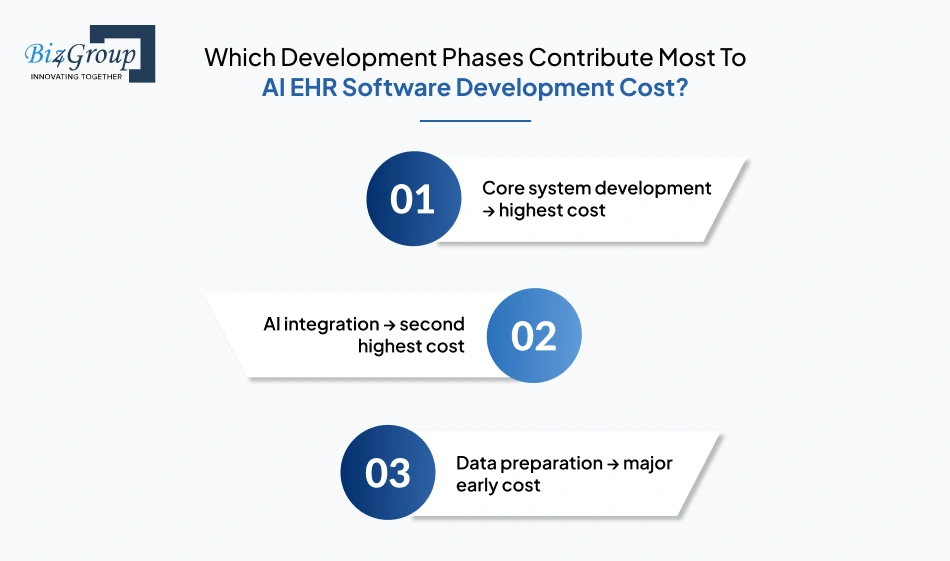
Some phases take more budget than others. Development and AI integration are usually the most expensive parts.
- Core system development → highest cost
- AI integration → second highest cost
- Data preparation → major early cost
These phases play a key role in deciding the cost to develop AI healthcare record system for clinics, especially when systems are customized.
Breaking the cost into phases makes it easier to plan both budget and timeline. It shows where most of the money is spent and where costs can be controlled. This phased view also works as a simple pricing guide to develop AI EHR software in 2026, helping businesses plan step by step.
Reduce Administrative Work by Up to 40% with AI EHR Systems
Use the right approach to lower the cost to build AI EHR system while improving operational efficiency.
See How It WorksAI EHR System Development Pricing Based on AI Approach
The cost to develop an AI EHR software depends heavily on the type of AI approach used. Not all AI systems are built the same way, and each approach comes with a different level of complexity, data requirement, and cost. Choosing the right approach is one of the biggest factors in deciding the final budget.
Cost Differences Between Rule-Based, Machine Learning, and Generative AI Systems
Different AI approaches lead to very different cost ranges.
|
AI Approach |
Typical Cost Addition |
Complexity |
Use Case Fit |
|---|---|---|---|
|
Rule-Based Systems |
$5,000 – $15,000 |
Low |
Simple automation, alerts |
|
Machine Learning |
$15,000 – $50,000 |
Medium |
Predictions, pattern analysis |
|
Generative AI |
$30,000 – $100,000+ |
High |
Documentation, conversational systems |
Rule-based systems are the cheapest because they follow fixed logic. Machine learning systems require data and training. Generative AI systems are the most expensive due to higher compute and model requirements.
Training vs Fine-Tuning vs API-Based AI Cost Structure
AI systems can be built in different ways, and each method affects cost.
1. Training from scratch
- Cost: $30,000 – $100,000+
- Requires large datasets and more time
2. Fine-tuning existing models
- Cost: $10,000 – $40,000
- Uses pre-trained models with custom data
3. API-based AI integration
- Cost: $5,000 – $20,000
- Faster to implement but has ongoing usage costs
API-based approaches are often used when teams want to integrate AI into an app quickly without building everything from scratch.
How AI Model Development Impacts AI EHR Software Development Cost
AI model development includes data preparation, training, testing, and improvement. Each step adds time and cost to the project. More complex models require more iterations and validation.
In most cases, AI model work alone can take 15% to 30% of the total project cost. This is one of the reasons the pricing of building AI hospital record management system increases as AI features become more advanced.
Data Requirements and Their Impact on AI EHR Software Development Cost
AI systems depend on data. The amount and quality of data directly affect cost.
- Small datasets → lower cost but limited accuracy
- Medium datasets → balanced cost and performance
- Large datasets → higher cost but better results
Data preparation and labeling can add $10,000 to $60,000, depending on how much data needs to be processed. This is a key factor when estimating how much budget is needed to build AI patient record system?
Infrastructure and Compute Cost for AI Systems
AI systems require computing power for training and running models. More advanced AI needs more processing and storage.
|
AI Level |
Monthly Infrastructure Cost |
Notes |
|---|---|---|
|
Basic AI |
$500 – $2,000 |
Low compute usage |
|
Moderate AI |
$2,000 – $8,000 |
Regular processing |
|
Advanced AI |
$8,000 – $20,000+ |
High compute and real-time processing |
These costs continue after deployment, especially for systems that process data in real time.
How to Choose the Right AI Approach Based on Cost and Use Case?
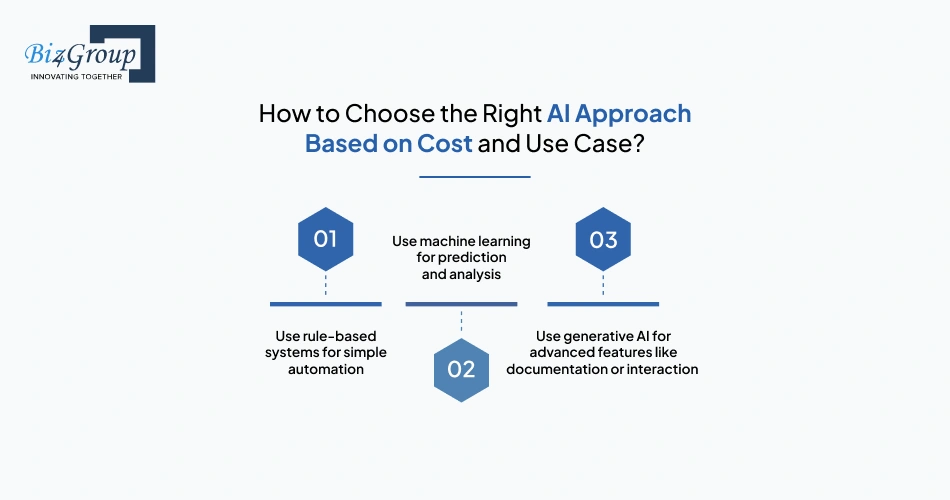
Choosing the right AI approach depends on both budget and system goals.
- Use rule-based systems for simple automation
- Use machine learning for prediction and analysis
- Use generative AI for advanced features like documentation or interaction
For most projects, starting with a simpler approach and scaling later helps control cost. This is a practical way to answer whether is it expensive to create AI-powered EHR software.
AI approach is one of the biggest factors in total cost. Simpler approaches reduce upfront investment, while advanced AI increases both development and ongoing costs. Choosing the right approach based on actual needs is key to how to create AI EHR software within budget and avoid unnecessary spending.
Cost to Create AI Medical Record Software by Use Case
The cost to develop an AI EHR software depends on what the system is designed to do. Different use cases need different levels of data, AI features, and integrations. Because of this, the total cost can vary a lot within the $30,000 to $300,000 range.
1. Clinical Documentation Automation Cost In AI EHR Software
This use case focuses on creating and managing clinical notes automatically. It works with text or voice data and reduces manual documentation work. The system needs to process unstructured data, which adds some complexity.
- Typical cost impact: $10,000 – $25,000 depending on data type and accuracy needs
2. Clinical Decision Support System Cost In AI EHR Software
This helps doctors by analyzing patient data and giving recommendations. It needs structured data and reliable outputs, so more testing and validation are required. This increases development effort.
- Typical cost impact: $20,000 – $60,000 due to higher accuracy and validation needs
3. Patient Risk Prediction Cost In AI EHR Software
This use case predicts risks like readmission or disease progression. It requires historical data and model training. It also needs regular updates to stay accurate.
- Typical cost impact: $30,000 – $80,000, making it one of the higher-cost features
4. Scheduling And Workflow Optimization Cost In AI EHR Software
This improves scheduling and resource use. It is less complex than prediction systems and focuses more on automation and efficiency.
- Typical cost impact: $10,000 – $30,000 depending on workflow complexity
5. Variation In Data Volume And Quality Requirements
Different use cases need different amounts of data. Some work with smaller datasets, while others need large and clean data to perform well. Poor data increases preparation effort.
- Typical cost impact: Data-related effort can increase the AI EHR software development cost by 20% to 40%
6. Differences In Processing And Model Complexity
Some use cases need simple logic, while others require advanced AI models. More complex models take longer to build, test, and maintain.
- Typical cost impact: Advanced models can add $20,000 – $70,000 to the total cost to build AI EHR system
7. Integration Depth Across Clinical Systems
Some use cases need to connect with multiple systems like labs, billing, and insurance platforms. More integrations mean more development and testing work.
- Typical cost impact: Deep integrations can increase the cost to create AI electronic health record software by $15,000 – $50,000
Choosing The Right Use Case Based On Budget And Complexity
Choosing the right use case helps control cost and reduce risk. It is often better to start with a smaller use case and expand later.
- Simple use cases → lower cost and faster setup
- Advanced use cases → higher cost but more long-term value
Some organizations scale gradually using enterprise AI solutions to manage cost and expand over time.
Each use case affects cost in a different way based on data, complexity, and integration needs. Understanding these differences helps plan better and avoid extra spending. It also makes it easier to estimate the cost to create AI electronic health record software based on actual requirements.
Turn Complexity into a Clear Cost Plan
Get a structured view of the cost to create AI electronic health record software without hidden surprises.
Request My Cost EstimatePrimary Cost Drivers in AI EHR Software Development
The cost to develop an AI EHR software depends on a few key factors that directly affect effort, time, and resources. These factors define how complex the system is and how much work is needed. Even small changes in these areas can increase or reduce the total cost by 10% to 40%.
1. Feature Scope And Its Impact On AI EHR Software Development Cost
The number of features in the system directly affects cost because more features require more development, testing, and maintenance effort. A basic system is faster to build, while a system with multiple workflows takes more time. In most cases, expanding feature scope can add $10,000 to $50,000+ to the AI EHR system development pricing.
2. Interoperability And Integration Impact On AI EHR System Development Cost
EHR systems need to connect with other systems like labs, billing platforms, and insurance providers, which requires development and testing effort. Each integration adds time because data must be mapped and validated properly. Typically, each integration can add $3,000 to $15,000, increasing the cost to develop AI healthcare EHR software.
3. AI Model Complexity And Its Impact On Development Cost
Simple AI features are easier to build, while advanced models require more data, training, and testing. More complex AI systems also need regular updates to maintain accuracy. In practical terms, advanced AI features can increase costs by $15,000 to $80,000.
4. Compliance Scope And Its Impact On AI Healthcare Software Development Cost
Healthcare systems must follow strict rules for data security and privacy, including encryption, access control, and audit tracking. These requirements are mandatory and add extra development effort. Compliance typically adds $10,000 to $40,000, which directly impacts the AI EHR system development pricing.
5. Scalability Requirements And Their Impact On Cost
Scalability defines how well the system can handle growth in users, data, and system activity over time. Systems built for larger organizations need stronger infrastructure and better performance handling. Higher scalability requirements can increase overall project cost by 15% to 30%, especially for real-time systems.
6. Team Structure And Its Impact On AI EHR Software Development Cost
The type of team working on the project affects both cost and speed of development. In-house teams, outsourced teams, or hybrid models all have different cost structures and efficiency levels. Working with a software development company in Florida can improve execution, but total cost still depends on team size and project duration.
These cost drivers explain why budgets can vary across projects even with similar goals. Feature scope, integration needs, AI complexity, and compliance all influence the final cost. Understanding these factors helps estimate the cost to develop AI healthcare EHR software more clearly and plan better.
Hidden Costs in AI EHR Software Development
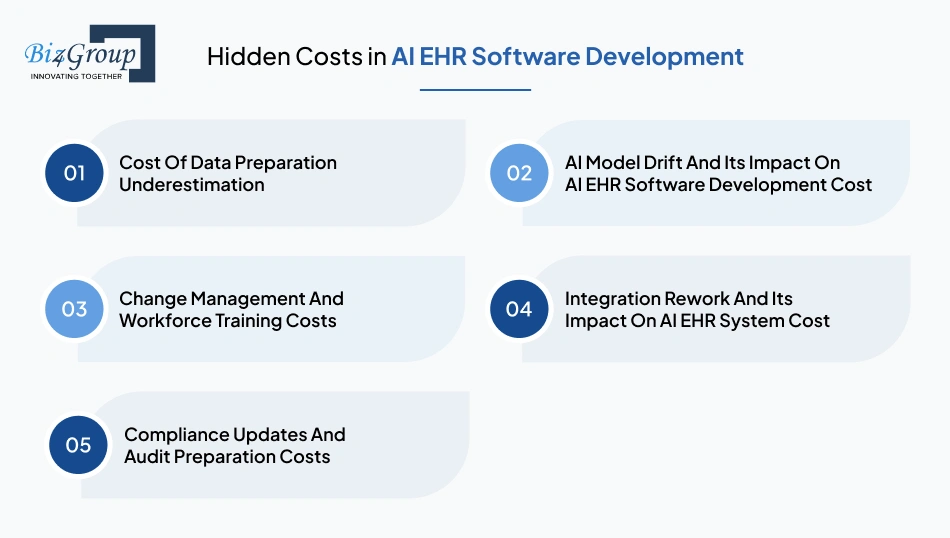
The cost to develop an AI EHR software can increase due to factors that are not always planned at the start. These hidden costs usually appear during development or after the system is launched. In many cases, they can increase the total budget by 10% to 30%.
1. Cost Of Data Preparation Underestimation
Data is often not ready to use as expected. It may need cleaning, fixing errors, and organizing before it can be used in the system. This extra work takes time and adds cost.
- Can add $10,000 to $50,000 depending on data quality
- May increase effort by 20% to 40%
2. AI Model Drift And Its Impact On AI EHR Software Development Cost
AI models need updates over time because data changes. If models are not updated, their accuracy drops. This creates a need for regular monitoring and retraining.
- Model is trained on existing data
- Data changes over time
- Model needs retraining
- Ongoing cost: $5,000 to $25,000 per year
- Impacts long-term AI EHR platform development cost
3. Change Management And Workforce Training Costs
When a new system is introduced, teams need time to learn it. Training and support are needed to help users adjust to new workflows. This also affects productivity in the beginning.
- Training cost: $5,000 to $20,000
- Temporary drop in productivity can increase the build AI EHR software cost
4. Integration Rework And Its Impact On AI EHR System Cost
Sometimes integrations do not work as planned. Systems may need changes due to API issues or data mismatches. This leads to extra development work.
- Rework can add $5,000 to $30,000
- Common reasons include unclear requirements and system limitations
Projects with complex features like chatbot development for healthcare industry may need more rework due to higher integration effort.
5. Compliance Updates And Audit Preparation Costs
Healthcare systems must stay updated with changing rules. This includes security updates and audit preparation. These costs continue even after the system is launched.
- Annual cost: $5,000 to $25,000
- Required to keep the system compliant
Summary Of Hidden Cost Impact
|
Hidden Cost Area |
Typical Cost Impact |
When It Occurs |
|---|---|---|
|
Data Preparation Gaps |
$10,000 – $50,000 |
Early development phase |
|
AI Model Drift |
$5,000 – $25,000/year |
Post-deployment |
|
Training & Change Management |
$5,000 – $20,000 |
Deployment phase |
|
Integration Rework |
$5,000 – $30,000 |
During integration/testing |
|
Compliance & Audits |
$5,000 – $25,000/year |
Ongoing |
Hidden costs can increase the total budget if they are not planned early. Data work, model updates, training, and compliance changes all add to the final cost. Understanding these factors helps estimate the cost to create AI medical record software more clearly and avoid surprises.
Make the Right AI EHR Investment Decision
Get clarity on the cost to develop AI healthcare EHR software and avoid costly mistakes early.
Talk to Our AI ExpertsCost to Maintain AI EHR Software After Development
The cost to develop an AI EHR software does not stop after the system is launched. The system needs regular updates, fixes, and monitoring to keep working properly. In most cases, maintenance costs are around 15% to 25% of the initial development cost per year.
1. Annual Maintenance Cost Distribution Across Components
Maintenance includes fixing bugs, updating features, and keeping the system secure. These tasks are needed to keep the system stable and usable over time. This usually costs $5,000 to $50,000 per year, depending on system size and usage, and adds to the overall AI healthcare software development cost.
2. AI Model Monitoring And Retraining Cost In AI EHR Software
AI models need to be checked regularly because data changes over time. If not updated, the model may give wrong results. Monitoring and retraining usually cost $5,000 to $25,000 per year, especially in systems with features like AI chatbot development for medical diagnosis.
3. Cloud Infrastructure Cost For AI EHR Software Over Time
Cloud systems are used to store and process data. These costs continue every month and increase as usage grows. Most systems spend around $500 to $5,000 per month, which affects the long-term cost to develop AI hospital management software.
Maintenance is a regular cost that should be planned early. Updates, monitoring, and infrastructure all add to the total cost over time. Understanding this helps estimate the cost to develop AI hospital management software more clearly.
Is the Cost to Develop AI EHR Software Worth It?
The cost to develop an AI EHR software is worth it when the system reduces operational effort and improves efficiency over time. Most organizations do not evaluate cost alone, they compare it with measurable savings. In many cases, systems built within the $30,000 to $300,000 range recover their cost through automation and workflow improvements.
Comparing AI EHR Software Development Cost Against Operational Savings
AI EHR systems reduce manual work, improve accuracy, and speed up workflows. These improvements lead to direct and indirect cost savings across operations. The value depends on how well the system fits actual workflows.
Common areas of savings:
- Reduced administrative work → saves $10,000 to $40,000 per year
- Fewer errors and rework → saves $5,000 to $20,000 per year
- Faster processing and scheduling → improves overall efficiency
These savings help balance the develop AI EHR system cost over time.
ROI Calculation Based On AI EHR Software Development Cost
ROI helps measure whether the investment is financially beneficial. It compares annual savings with the total cost of the system.
Basic ROI formula: ROI = (Annual Savings ÷ Total Cost) × 100
Example:
- Total cost: $100,000
- Annual savings: $30,000
- ROI: 30% per year
This simple method helps estimate the value of the cost to build AI patient record management system in practical terms.
Typical Payback Period Based On Use Case
The payback period shows how long it takes to recover the initial cost. This depends on the type of use case and how quickly it generates savings.
|
Use Case |
Payback Period |
Reason |
|---|---|---|
|
Workflow Automation |
6 – 12 months |
Quick reduction in manual work |
|
Documentation Automation |
12 – 18 months |
Gradual efficiency gains |
|
Decision Support Systems |
18 – 24 months |
Value builds over time |
|
Risk Prediction |
18 – 30 months |
Requires data maturity |
Some organizations also expand into areas like AI medical web development after early success, increasing long-term returns.
The value of AI EHR systems depends on how well they reduce cost and improve operations. When savings are clear and measurable, the investment becomes easier to justify. Understanding ROI and payback helps evaluate the cost to build AI patient record management system in a practical and realistic way.
Build vs Buy: AI EHR Software Development Cost Comparison
The cost to develop an AI EHR software depends on whether you build a system from scratch or buy an existing one. Building takes more time and money but gives full control. Buying is faster and cheaper at the start but comes with limitations.
Build vs Buy Cost Comparison for AI EHR Software Development
|
Factor |
Build (Custom Development) |
Buy (Prebuilt Solution) |
|---|---|---|
|
Upfront Cost |
$50,000 – $300,000 |
$10,000 – $50,000 (setup + licensing) |
|
Time to Deploy |
4 – 12 months |
1 – 3 months |
|
Customization |
Full control over features |
Limited options |
|
Integration |
Can connect with any system |
Depends on vendor support |
|
Long-Term Cost |
Higher maintenance, no license fees |
Ongoing subscription costs |
|
Scalability |
Can scale as needed |
Limited by platform |
|
Data Control |
Full control |
Managed by vendor |
|
AI Features |
Can build as needed |
Limited or predefined |
Some businesses choose to build when they need more control or specific workflows. This is common when working on business app development using AI.
Both options have their own benefits. Building gives more control but costs more upfront, while buying is quicker but less flexible. The right choice depends on your needs and budget, and helps answer how much does it cost to develop AI EHR software in your case.
How to Plan and Control the Cost to Develop AI EHR Software?
Planning is not just about estimating a number, it is about controlling how money is spent at each step. The cost to develop an AI EHR software becomes predictable when scope, data, systems, and outcomes are defined early. Without this, projects can exceed budgets by 15% to 40% due to rework and delays.
1. Budget Allocation In AI EHR Software Development Cost Planning
Budget should be split across data, development, AI features, integration, and maintenance. In most projects, data and integration together can take 40% to 60% of the total cost, so ignoring this can lead to overspending. Clear allocation helps manage the cost breakdown to create AI electronic health record software more effectively.
2. Capital Vs Operating Cost In AI EHR Software Development
AI EHR systems include both one-time and ongoing costs. Development and setup may cost $30,000 to $300,000, while maintenance and cloud usage can add 15% to 25% per year. Planning for both avoids underestimating long-term expenses.
3. Defining Scope To Prevent Cost Overruns
A clear scope helps avoid adding extra features during development. Even small scope changes can increase cost by 10% to 25% due to additional work and testing. Starting with a focused scope keeps the project within budget.
4. Assessing Data Readiness Before Development
Data quality has a direct impact on cost. If data is not clean, preparation can add $10,000 to $50,000 to the project. Early data checks help reduce this extra effort and prevent delays.
5. Evaluating System Compatibility And Integration Effort
Existing systems should be checked before development starts. Each integration can add $3,000 to $15,000, depending on complexity and API availability. Early evaluation helps avoid rework and keeps costs under control.
6. Estimating ROI Before Budget Commitment
ROI helps decide if the project is financially practical. For example, a system costing $100,000 with annual savings of $30,000 gives a 30% return per year. Teams offering AI automation services often use this step to guide budget decisions.
Controlling cost depends on early decisions, not late adjustments. Planning around scope, data, integration, and ROI keeps spending within limits. This approach helps define the detailed cost to build AI EHR system for hospitals in a clear and controlled way.
Timeline and Cost to Develop AI EHR Software
The cost to develop an AI EHR software depends on how long the project takes. More time usually means higher cost because of longer development and testing. Most projects take between 3 to 12 months, depending on features and complexity.
MVP Timeline And Its Impact On AI EHR Software Development Cost
An MVP includes only the basic features needed to launch the system. It helps reduce time and cost while allowing early testing and feedback.
- Timeline: 3 to 6 months
- Cost: $30,000 to $100,000
- Covers: core features, simple UI/UX, basic AI
This approach helps control the budget required to build AI patient management software in the early stage.
Full System Timeline And Cost Scaling In AI EHR Software Development
A full system includes more features, deeper integrations, and advanced AI. This takes more time and increases the total cost.
- Timeline: 6 to 12 months
- Cost: $100,000 to $300,000
- Covers: full workflows, advanced AI, multiple integrations
Projects that include features like an AI conversation app may take longer due to added complexity.
Factors That Delay Delivery And Increase Cost
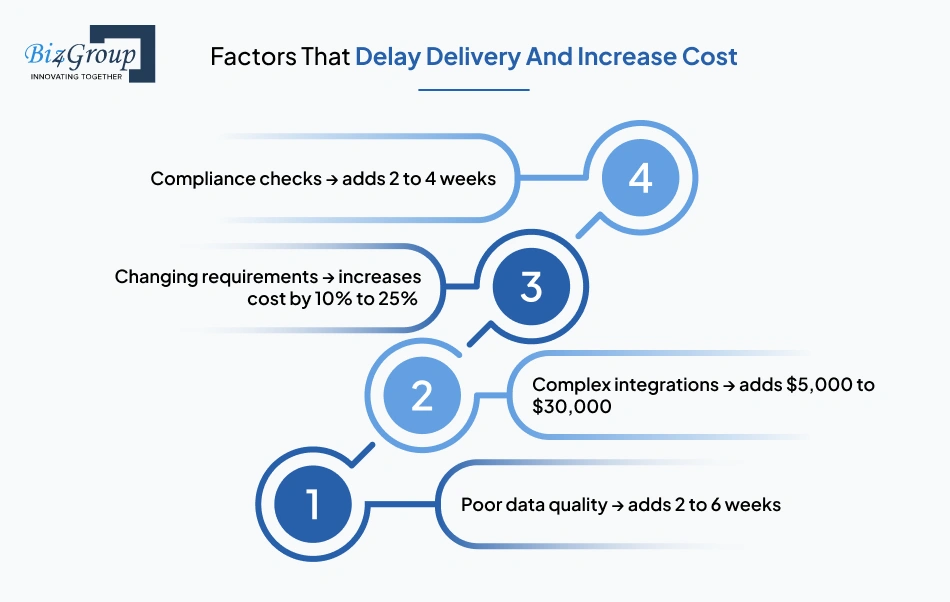
Some issues can slow down the project and increase cost if not planned early.
- Poor data quality → adds 2 to 6 weeks
- Complex integrations → adds $5,000 to $30,000
- Changing requirements → increases cost by 10% to 25%
- Compliance checks → adds 2 to 4 weeks
Time and cost are closely connected. Delays increase cost, while clear planning helps control both. This works as a simple pricing guide to develop AI EHR software in 2026, helping teams plan better.
Trade-Offs That Affect AI EHR Software Development Cost
The cost to develop an AI EHR software depends on the choices made during planning. Each decision affects cost, speed, and system performance. Understanding these trade-offs helps control spending and avoid unnecessary complexity.
1. Cost Vs Accuracy In AI Model Performance
Better accuracy needs more data, more training, and more testing, which increases cost and time. In many cases, improving accuracy from 80% to 90% can increase cost by 20% to 40%, especially in systems like those in a healthcare conversational AI guide. Higher accuracy improves outcomes, but it should only be chosen when the use case truly needs it.
2. Speed Vs Customization In System Development
Faster development usually means using prebuilt components and limiting customization. Custom systems take more time because they are built for specific workflows and needs. Choosing speed can reduce cost by 15% to 30%, but reduces flexibility, which affects how to create AI EHR software within budget.
3. Scalability Vs Simplicity In Architecture Decisions
Simple systems are easier and cheaper to build but may not support future growth. Scalable systems require better planning and infrastructure, which increases initial cost by 15% to 25%. Investing in scalability early increases cost now but reduces major changes later.
These trade-offs help in making practical decisions instead of just focusing on cost. Choosing the right balance between accuracy, speed, and scalability keeps the system efficient and within budget. This makes it easier to plan how to create AI EHR software within budget without overbuilding or overspending.
Control Cost While Scaling Your AI EHR System
Plan the right budget and approach for your cost to build AI patient record management system without overbuilding.
Build My AI EHR SolutionTrends Influencing Cost to Develop AI Healthcare Record System
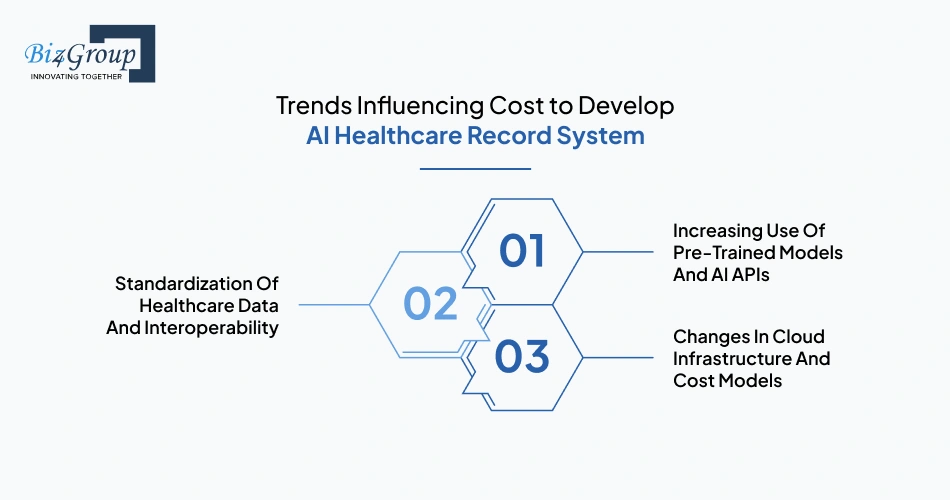
The cost to develop an AI EHR software is changing as new technologies and tools become more common. These trends are helping reduce effort in some areas while increasing efficiency in others. Understanding them helps plan budgets more accurately over time.
1. Increasing Use Of Pre-Trained Models And AI APIs
Pre-trained models and AI APIs reduce the need to build AI systems from scratch. This lowers development time and makes it easier to add AI features quickly. Many teams, including an AI chatbot development company, use this approach to speed up delivery and reduce initial effort.
2. Standardization Of Healthcare Data And Interoperability
Healthcare data standards like FHIR and HL7 are making it easier to connect systems. This reduces the need for custom integrations and lowers development effort. As a result, integration becomes faster and more predictable.
3. Changes In Cloud Infrastructure And Cost Models
Cloud platforms now offer flexible pricing, which reduces upfront infrastructure cost. Systems can scale based on usage instead of requiring large initial investment. This makes it easier to manage costs over time.
- Pre-trained models and APIs can reduce initial development cost by $10,000 to $50,000, helping answer how much budget is needed to build AI patient record system
- Standardized data reduces integration effort by 10% to 30%, improving the pricing of building AI hospital record management system
- Cloud cost models shift spending to $500 to $5,000+ per month, reducing upfront investment but adding ongoing cost
These trends are changing how AI EHR systems are built and how costs are structured. Some reduce upfront cost, while others move cost to ongoing usage. Understanding this helps estimate the pricing of building AI hospital record management system more clearly and plan for future needs.
How Biz4Group LLC Helps Optimize AI EHR Development Cost?
Managing the cost to develop an AI EHR software requires clear planning and disciplined execution. Biz4Group LLC focuses on reducing unnecessary work while keeping the system scalable and aligned with business goals.
Clear Scope And Phased Development
Biz4Group begins with a well-defined scope and follows a phased development approach. Starting with a focused version helps avoid building unnecessary features early. This keeps the project controlled and easier to expand later.
Early Data And Integration Assessment
Data quality and system compatibility are reviewed before development starts. This helps identify potential issues early and reduces the need for rework. As a result, the overall development process stays smoother and more predictable.
Right AI Approach Selection
Not every system needs advanced AI from the beginning. As an experienced AI development company, We select the right approach based on actual use case needs. This ensures resources are used efficiently without adding unnecessary complexity.
Cost optimization comes from making the right decisions early and following a structured approach. Biz4Group helps keep development focused, controlled, and aligned with long-term goals.
Final Thoughts on Cost to Develop AI EHR Software
The cost to develop an AI EHR software is a lot more than a number or figure, it is a result of many decisions made along the way. From data and integrations to AI choices and scalability, every step shapes the final budget. The goal is not to spend less, but to spend right.
Start small, stay clear on scope, and scale based on results. That is how businesses successfully build AI software without running into unnecessary cost or complexity. A well-planned system does not just work, it grows with your needs.
In the end, the real value comes from balance. Not too basic, not overbuilt, just right for your use case.
Get guidance on architecture, AI approach, and budget planning before making key decisions. Talk to our AI experts and build AI EHR systems with confidence.
FAQs: Cost to Develop AI EHR Software
1. How much does it cost to develop an AI EHR software?
The cost usually ranges between $30,000 and $300,000, depending on system complexity, AI features, integrations, and compliance requirements. Smaller systems with basic functionality fall on the lower end, while enterprise-level platforms with advanced AI and multiple integrations fall on the higher end.
2. What is the biggest factor that increases AI EHR development cost?
Data readiness is often the biggest cost factor. If data is unstructured, incomplete, or spread across systems, it requires significant effort to clean and prepare. This can increase both development time and budget more than expected.
3. Can AI EHR software be built in phases instead of all at once?
Yes, many systems are built in phases starting with a basic version (MVP). This allows businesses to control cost, test functionality early, and expand the system based on real usage and results.
4. How does compliance affect the cost of AI EHR systems?
Compliance requirements such as data security, audit logs, and access control add to development effort. These are mandatory in healthcare systems and can increase both initial cost and ongoing maintenance expenses.
5. Is it possible to reduce AI EHR development cost without reducing quality?
Yes, cost can be controlled by limiting initial scope, using pre-trained AI models, and planning integrations early. Focusing on essential features first helps avoid unnecessary spending while maintaining system quality.
6. How long does it take to see value from an AI EHR system?
Most systems start showing measurable value within 6 to 18 months, depending on the use case. Automation and workflow improvements usually deliver faster results, while predictive systems may take longer to show impact.
