 Location :
Orlando, FL, USA
Location :
Orlando, FL, USA +1 (407) 714-1616
 info@biz4group.com

- Cost to develop an AI research intelligence platform typically ranges from $30,000 to $250,000+, depending on scope, data complexity, AI depth, and scalability needs.
- Key cost drivers include data sources, AI research analytics capabilities, infrastructure, and long-term optimization requirements.
- Hidden expenses such as data licensing, model retraining, and cloud scaling significantly impact the cost of AI research intelligence software development over time.
- Smart architectural choices and modular development reduce the cost to make scalable AI research intelligence software without limiting growth.
- Strong monetization models and ROI tracking support cost justification for AI powered market research platforms.
- Biz4Group LLC, a USA-based software development company, helps businesses optimize costs and build scalable, high-impact AI research intelligence platforms designed for long-term success.
What really goes into the cost to develop an AI research intelligence platform, and why do estimates vary so widely?
Many founders and enterprise leaders ask this early. Most pause soon after. The answers online feel scattered, and real clarity feels rare. That pause is reasonable. Building a research intelligence platform requires careful financial planning from day one.
Businesses across industries are leaning on intelligent research tools to work faster and smarter. Nearly 78% of organizations already use artificial intelligence for business research. Many report measurable gains through quicker insights and reduced manual analysis time. Understanding the AI research intelligence platform development cost early helps leaders avoid missteps and build with confidence.
For startups, product teams, and enterprises alike, clarity around the cost of AI research intelligence software development matters deeply. The cost of development typically ranges from $30,000-$250,000+.
Knowing what truly drives this cost helps teams set priorities, align stakeholders, and plan for growth without painful rebuilds later.
At its core, building such a platform is a strategic investment. Careful planning around the budget required to build an AI research intelligence platform can reduce risk, control spending, and shorten timelines.
This guide breaks down every cost factor step by step, so your decisions feel informed, practical, and aligned with long-term value. So, without further ado, let’s begin.
Why Understanding the Cost to Develop an AI Research Intelligence Platform Matters Before You Build?
Many AI platforms fail before they ever reach users. The reason, often, is unclear cost planning.
When teams rush into development without understanding the cost to develop an AI research intelligence platform, budgets spiral. Timelines stretch. Features get cut. Confidence drops.
This usually happens because early decisions feel small but carry long-term weight.
What Often Goes Wrong Without Cost Clarity
- Overbuilding features before validating demand
- Choosing data sources without understanding scaling costs
- Ignoring infrastructure and model optimization expenses
- Treating AI as an add-on rather than a core capability
Each mistake adds friction. Each one increases spend later.
Cost Is Not One Number, But a System of Decisions
An AI research intelligence platform blends multiple moving parts. Each part affects cost differently.
Here is a simple way to think about it:
|
Cost Area |
Why It Matters |
|---|---|
|
Data sources |
More sources increase ingestion, cleaning, and storage costs |
|
AI models |
Advanced models require tuning, monitoring, and compute |
|
Platform features |
Personalization, ranking, and analytics raise complexity |
|
Scalability |
Systems built for growth reduce rebuild expenses |
|
Security |
Enterprise adoption depends on compliance readiness |
Ignoring even one area often leads to rework.
Early Cost Planning Protects Long-Term ROI
Teams that map costs early gain clear advantages.
- Faster development cycles
- Fewer mid-project scope changes
- Better alignment between AI product and business goals
- Higher confidence when pitching to stakeholders or investors
This is why leaders now treat the AI research intelligence platform development cost as part of strategy, not procurement.
According to McKinsey, organizations that align AI investments with business strategy are far more likely to see sustained value from AI initiatives.
Cost Clarity Changes How You Build
When teams understand the cost of AI research intelligence software development, priorities shift. They ask better questions.
- What features drive real insight?
- Which data sources matter now versus later?
- Where automation saves time and money?
- How to scale without rebuilding?
Those questions shape platforms that last.
This is why cost planning belongs at the start. Not after development begins.
One Cost Decision Can Add $50,000 Later!
A 2-week cost review can prevent months of rework and budget leaks.
Talk to Biz4Group's ExpertsHow to Calculate the Budget Required to Build an AI Research Intelligence Platform
Estimating the cost upfront feels difficult because AI platforms are not built from a fixed template. Still, realistic estimation is possible. It works best when you break the platform into cost blocks instead of chasing a single number.
The AI research intelligence platform development cost depends on five core variables. Every serious build uses them, whether teams acknowledge it or not.
The Cost Estimation Formula That Works in Practice
A practical estimation looks like this:
Total Cost = (Data Complexity + AI Intelligence Depth + Feature Scope + User Scale + Infrastructure Needs) × Build Stage
Each variable answers a simple question.
- Data Complexity
How many sources? How large? How structured? - AI Intelligence Depth
Basic search. Ranking. Summarization. Predictive insights. - Feature Scope
Feeds, dashboards, exports, collaboration, analytics. - User Scale
Internal teams or thousands of concurrent users. - Infrastructure Needs
Compute, storage, security, and compliance readiness.
The build stage determines how far these variables go.
A Realistic Example
Assume a company wants to build an MVP research platform.
Scenario
- 5 structured and semi-structured data sources
- AI features limited to summarization and relevance ranking
- Personalized feeds and basic dashboards
- Up to 1,000 monthly users
- Cloud infrastructure with standard security
In this case, the budget required to build an AI research intelligence platform falls into a defined MVP range. The cost reflects limited automation, controlled data ingestion, and future-ready architecture without enterprise overhead.
Now compare that with an advanced platform.
- 20+ data sources including unstructured content
- Multi-layer ranking models
- Real-time updates
- Role-based access
- Higher availability requirements
The cost rises not because of features alone, but because every variable scales together.
This approach avoids vague estimates and prevents repetition later. Instead of guessing the cost of AI research intelligence software development, teams tie spending to decisions. That clarity helps founders control scope before development begins.
Next, we will break down what actually influences these variables and how MVP, advanced, and enterprise platforms differ in cost.
Also read: How much does it cost to develop AI solutions for edtech businesses?
Factors Influencing the Cost of AI Research Intelligence Software Development
Before diving into line items and phases, it helps to zoom out. Every AI research platform fits into one of three cost bands. These bands exist because scope, scale, and intelligence depth change how systems are designed and maintained.
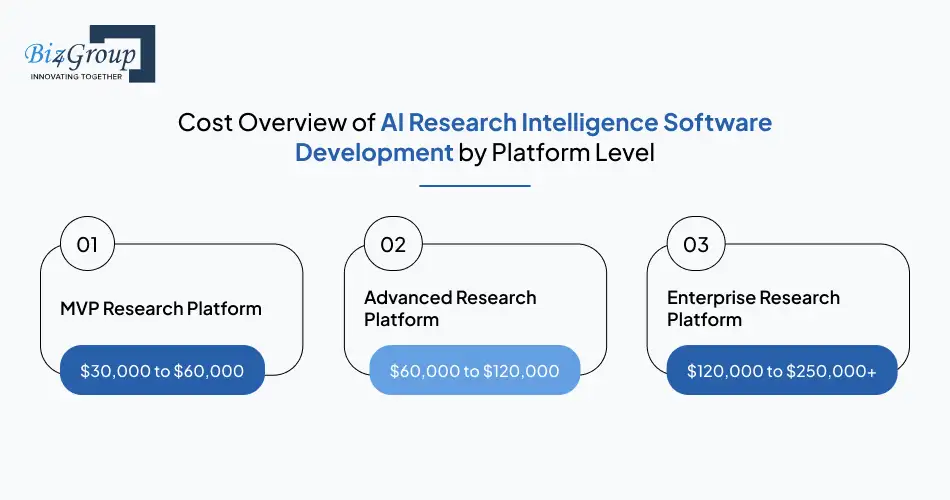
Here is a clear cost overview to anchor expectations.
Cost Overview of AI Research Intelligence Software Development by Platform Level
|
Platform Level |
What It Covers |
Typical Cost Range |
|---|---|---|
|
MVP Research Platform |
Core research workflows, limited AI features, controlled data sources |
$30,000 to $60,000 |
|
Advanced Research Platform |
Deeper AI intelligence, multiple data sources, personalization, analytics |
$60,000 to $120,000 |
|
Enterprise Research Platform |
Large-scale data pipelines, custom models, security and compliance |
$120,000 to $250,000+ |
These ranges reflect real-world builds. The difference between them is driven by specific factors, not arbitrary pricing.
The Core Factors That Influence Cost
Each factor below contributes directly to the AI research intelligence platform development cost. Increasing one almost always impacts others.
- Data Sources and Volume
Data defines complexity.
- Number of sources
- Structured versus unstructured content
- Update frequency
- API limits and reliability
More data increases ingestion, processing, and storage costs.
- AI Intelligence Depth
AI capabilities scale cost quickly.
|
Intelligence Level |
Cost Impact |
|---|---|
|
Basic search and filters |
Low |
|
Relevance ranking and summaries |
Medium |
|
Predictive insights and trend analysis |
High |
The deeper the intelligence, the more compute, tuning, and monitoring required.
- Feature Scope and User Experience
Features shape engineering effort.
- Personalized feeds
- Dashboards and reports
- Collaboration tools
- Export and AI integration services
A broader feature set increases both development and testing time.
- Scalability and Performance Expectations
Scalability is a cost multiplier.
- Concurrent users
- Real-time updates
- High availability requirements
Platforms built for growth cost more upfront but reduce rebuild expenses later.
- Security and Compliance Requirements
This factor becomes critical at advanced and enterprise levels.
- Role-based access
- Data privacy controls
- Audit logs and monitoring
Security work adds cost but enables enterprise adoption.
The AI research intelligence software cost rises when teams treat these factors in isolation. A small increase in data volume combined with advanced AI and high concurrency changes architecture choices completely.
This is why early planning matters. It keeps scope intentional and budgets realistic.
Next, we will break down AI research intelligence platform development cost by phases, showing where budgets are actually spent and how each phase contributes to the total.
Also read: How much does AI app development cost in 2026?
Three Features Can Push Your Cost From $60k to $120k!
Data volume, AI depth, and scalability choices quietly double the cost if left unchecked.
Book a Strategy Call TodayUnderstanding AI Research Intelligence Platform Development Cost Across Build Phases
Once cost ranges are defined, the next logical question is simple.
Where does the money actually go?
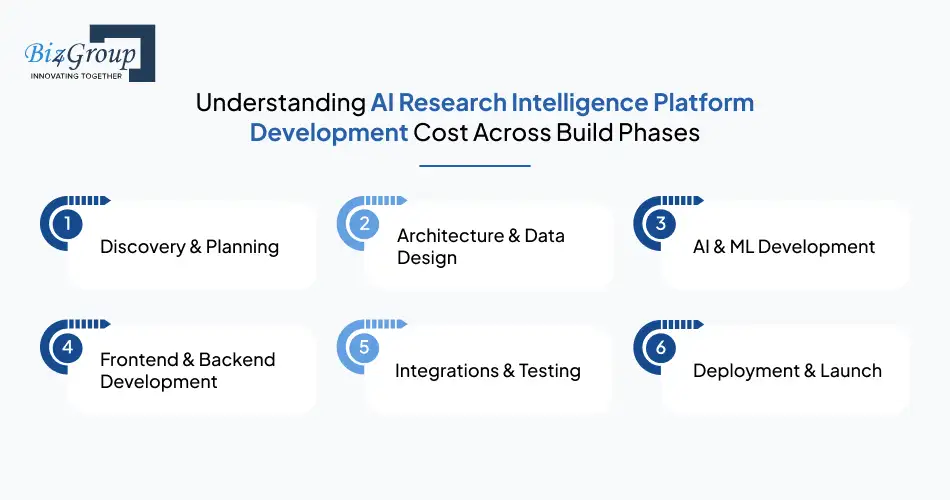
The AI research intelligence platform development cost breakdown becomes clearer when viewed phase-by-phase. Each stage carries a different level of effort, risk, and investment. Skipping or underfunding any phase often leads to delays or rework later.
Below is a realistic breakdown of the total range of $30,000 to $250,000+, aligned with industry builds.
Development Cost Breakdown by Phase
|
Development Phase |
What Happens in This Phase |
MVP Cost Range |
Advanced Cost Range |
Enterprise Cost Range |
|---|---|---|---|---|
|
Discovery & Planning |
Requirements, use cases, data mapping, roadmap |
$3,000 – $6,000 |
$6,000 – $10,000 |
$10,000 – $18,000 |
|
Architecture & Data Design |
System design, data pipelines, scalability planning |
$5,000 – $10,000 |
$10,000 – $18,000 |
$18,000 – $30,000 |
|
AI & ML Development |
Ranking models, summaries, intelligence logic |
$7,000 – $12,000 |
$15,000 – $30,000 |
$30,000 – $60,000 |
|
Frontend & Backend Development |
UI/UX, APIs, feeds, dashboards, workflows |
$10,000 – $18,000 |
$18,000 – $35,000 |
$35,000 – $70,000 |
|
Integrations & Testing |
Data sources, exports, QA, performance testing |
$3,000 – $6,000 |
$6,000 – $12,000 |
$12,000 – $25,000 |
|
Deployment & Launch |
Cloud setup, monitoring, release support |
$2,000 – $4,000 |
$4,000 – $7,000 |
$7,000 – $15,000 |
Also read: Top 15 UI/UX design companies in USA
The AI research intelligence platform development cost increases across phases because complexity compounds.
- Developing an MVP focuses on speed and validation
- Advanced platforms emphasize intelligence depth and reliability
- Enterprise platforms prioritize scale, security, and performance
Costs rise when decisions in one phase demand stronger architecture in the next.
Treating development as a single lump sum hides risk. Viewing the AI research intelligence platform development cost and timeline by phase gives leaders control.
It allows teams to:
- Validate value early
- Pause or pivot without waste
- Invest deeper only when results justify it
Every dollar spent has a purpose. Understanding this breakdown helps teams spend intentionally instead of reactively.
Next, we will uncover hidden and long-term costs that often sit outside development budgets but strongly influence the true cost of ownership.
Also read: Top 12+ MVP development companies in USA
Hidden and Long-Term Costs in AI Research Intelligence Platform Development
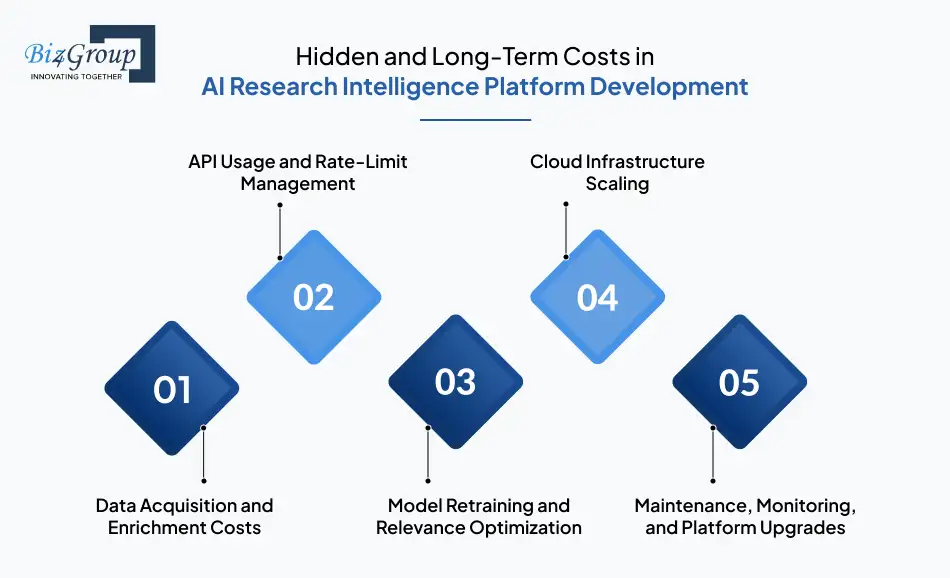
Initial development budgets often look complete on paper. In practice, the AI research intelligence platform development cost grows after launch due to ongoing technical and operational needs.
These costs rarely appear in early estimates, yet they shape the true cost of ownership.
1. Data Acquisition and Enrichment Costs
Most platforms rely on third-party APIs, licensed datasets, or premium research sources. These costs typically add 10%-25% annually to the overall cost of AI research intelligence software development, depending on data volume and refresh frequency.
As platforms scale, licensing expenses often rise faster than infrastructure costs.
2. API Usage and Rate-Limit Management
High-quality research platforms consume large volumes of external data. Handling rate limits, retries, and parallel requests requires additional engineering and compute resources.
This typically adds $5,000-$20,000 per year to the custom AI research intelligence platform development cost, especially for platforms ingesting real-time or near-real-time data.
3. Model Retraining and Relevance Optimization
AI models lose accuracy as data patterns change. To maintain relevance, platforms require periodic retraining and tuning of AI models.
This ongoing effort usually accounts for 15%-30% of the original AI development cost annually. Ignoring this leads to declining output quality and user trust.
4. Cloud Infrastructure Scaling
As user activity increases, storage, compute, and networking costs scale with it. For MVP platforms, infrastructure may stay under $500 per month.
Advanced and enterprise platforms often see cloud expenses grow to $3,000-$10,000 per month, directly affecting the AI data intelligence platform development pricing over time.
5. Maintenance, Monitoring, and Platform Upgrades
Post-launch maintenance covers bug fixes, performance tuning, and feature updates. This typically costs 15%-20% of the initial AI research intelligence platform development cost per year.
Platforms that skip structured maintenance often face higher rework costs later.
Hidden costs do not signal poor planning. They signal growth. The key lies in anticipating them early. When these expenses are planned upfront, teams protect ROI and avoid surprise budget overruns.
Next, we will explore how to optimize the AI research analytics platform development cost without compromising performance, scalability, or future expansion.
Year 2 Is Where Most Budgets Break!
Cloud scaling, data licensing, and model retraining can add 30% to the original development cost.
Get in Touch to Avoid Reworking LaterHow to Optimize AI Research Analytics Platform Development Cost Without Overspending
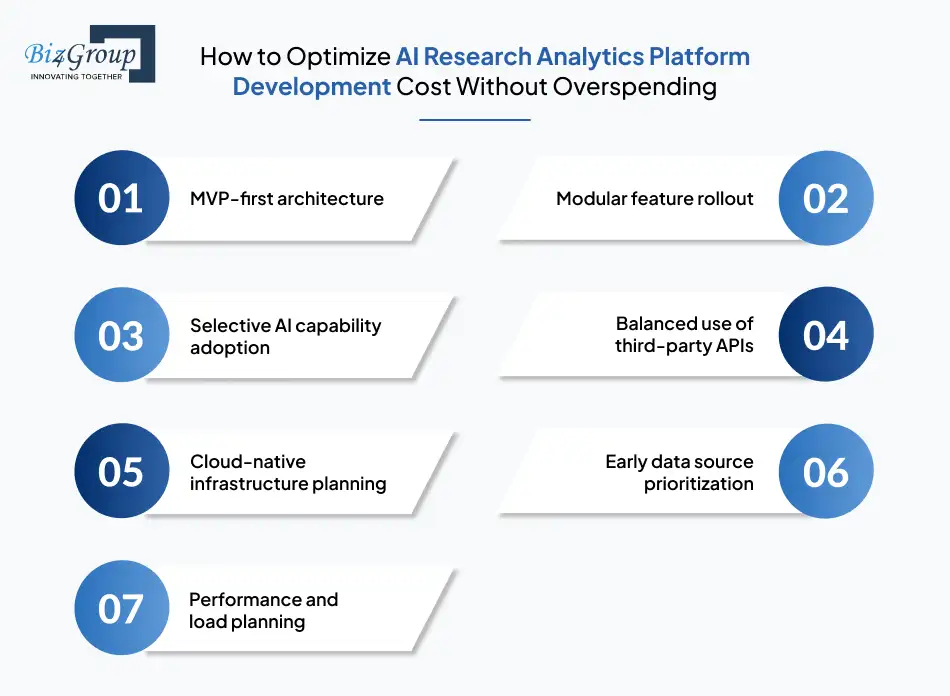
Cost optimization does not mean cutting corners. It means making decisions that reduce waste while protecting long-term scalability. When planned early, optimization can lower the AI research analytics platform development cost significantly.
The table below outlines proven optimization levers, where they apply, and how much they realistically save.
|
Optimization Area |
What Changes in the Build |
Estimated Cost Impact or Savings |
|---|---|---|
|
MVP-first architecture |
Core features built with scale-ready backend |
Reduces rework costs by 15%–25% in later phases |
|
Modular feature rollout |
Features released in phases instead of all at once |
Cuts upfront development spend by $10,000–$30,000 |
|
Selective AI capability adoption |
Start with ranking and summaries before advanced intelligence |
Lowers initial AI build cost by 20%–30% |
|
Balanced use of third-party APIs |
Use APIs early, replace with custom models later |
Saves $8,000–$20,000 in early AI development |
|
Cloud-native infrastructure planning |
Right-sized compute and storage from day one |
Reduces infrastructure overspend by 10%–20% annually |
|
Early data source prioritization |
Limit sources to high-value datasets initially |
Prevents 15%–25% unnecessary ingestion costs |
|
Performance and load planning |
Avoid over-engineering for peak scale |
Saves $5,000–$15,000 in early infrastructure spend |
Optimizing early decisions shapes everything that follows. Teams that plan for efficiency reduce risk, control the AI research intelligence platform development cost, and create room to invest where intelligence truly matters.
How Biz4Group LLC Optimized the Cost to Develop an AI Research Intelligence Platform at Scale

Forefront is a strong example of how thoughtful planning keeps the cost to develop an AI research intelligence platform under control without limiting ambition. The platform aggregates insights from over 250 million research papers and trusted academic sources while delivering a personalized research experience to users.
From the start, Biz4Group focused on cost-aware decisions.
Instead of building everything at once, the platform was structured around a modular architecture. This allowed core discovery, personalization, and AI research tools to launch first, keeping early development within a controlled budget range aligned with advanced platform costs.
Key cost optimization decisions included:
- Prioritizing high-value data sources early to reduce ingestion and processing expenses
- Designing a relevance-ranking system that balanced accuracy with compute efficiency
- Managing strict API rate limits through intelligent request distribution, which avoided expensive infrastructure spikes
- Using scalable cloud components that supported growth without upfront overinvestment
AI features such as PDF chat, summaries, and content generation were layered thoughtfully. This approach prevented unnecessary AI spend while maintaining strong research capabilities.
As usage grew, the platform scaled smoothly without major rework. This directly reduced the long-term AI research intelligence platform development cost and protected ROI.
Forefront demonstrates how Biz4Group approaches every build. Cost clarity, scalable design, and measurable business value remain central from day one.
Monetization Models That Offset AI Research Intelligence Platform Development Cost
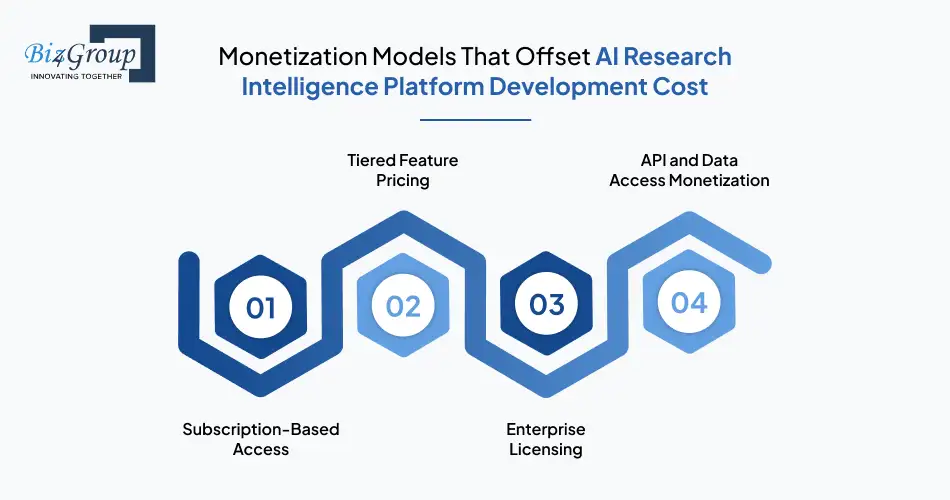
Monetization planning changes how leaders view platform costs. When designed correctly, revenue streams begin offsetting the AI research intelligence platform development cost within the first year of adoption.
1. Subscription-Based Access
Most research platforms rely on recurring subscriptions.
Entry-level plans typically range from $29 to $99 per user per month for individual professionals.
Advanced plans for teams often range from $199 to $499 per month.
With just 200 paying users at an average of $49 per month, annual revenue can exceed $115,000, covering a large portion of the AI market research platform development cost.
2. Tiered Feature Pricing
Feature-based tiers allow platforms to monetize intelligence depth. Advanced AI features such as predictive analytics are commonly priced 30%-60% higher than base plans.
This model increases average revenue per user without increasing acquisition costs, improving recovery of the cost of AI research intelligence software development.
3. Enterprise Licensing
Organizations prefer flat annual licenses. These contracts often range from $25,000-$100,000 per year, depending on user volume and data access.
A small number of enterprise deals can fully offset the enterprise AI research intelligence platform development cost within 12-18 months.
4. API and Data Access Monetization
Platforms that expose research data or analytics through APIs charge usage-based fees. Monthly API revenue typically adds 10%-25% incremental earnings on top of subscriptions, improving long-term ROI.
Monetization reframes development spend as an investment. When revenue models align with user value, the cost to develop an AI research intelligence platform becomes a scalable growth lever rather than a fixed expense.
Next, we will explore how to measure ROI and validate cost justification using practical performance indicators.
What If 200 Users Covered Your Entire Build Cost?
With the right pricing model, many platforms recover the development cost within 12-18 months!
Build Smart with Biz4GroupIs It Worth Building an AI Research Intelligence Platform? Measuring Real ROI
Once monetization paths are clear, the next step is proving value. Leaders evaluating the AI research intelligence platform development cost want evidence that the investment improves speed, quality, and outcomes.
ROI measurement works best when tied to operational gains and strategic impact rather than abstract metrics.
Core ROI Metrics to Track
The table below maps cost drivers to measurable returns.
|
ROI Area |
What to Measure |
Typical Impact Range |
|---|---|---|
|
Research efficiency |
Time saved per research cycle |
30%–60% reduction |
|
Analyst productivity |
Output per analyst |
1.5×–2× increase |
|
Insight discovery speed |
Time to actionable insight |
40%–70% faster |
|
Decision accuracy |
Fewer missed signals |
20%–35% improvement |
|
Tool consolidation |
Reduced software licenses |
$5,000–$25,000 annual savings |
These gains directly justify the cost of AI research intelligence software development when tracked consistently.
How ROI Evolves Across Platform Maturity
ROI does not appear all at once. It compounds.
- Early-Stage ROI
In the first 3-6 months, teams see time savings from AI automation services and centralized research. This often offsets 20%-30% of the AI research intelligence platform development cost. - Mid-Stage ROI
As personalization and AI ranking mature, productivity gains accelerate. Many organizations recover 50%-70% of their investment within the first year. - Long-Term ROI
At scale, platforms support strategic planning, competitive analysis, and market foresight. This level of value supports strong cost justification for AI powered market research platforms, especially at enterprise scale.
Turning ROI Into a Business Case
To justify the AI research intelligence platform development cost, teams should align metrics with business goals.
- Reduced research hours translate into lower operational costs
- Faster insights support quicker market moves
- Better decisions reduce risk and missed opportunities
ROI validates strategy. When measured correctly, the return on an AI research intelligence platform grows well beyond initial development spend.
How Biz4Group LLC Helps Reduce the Cost to Develop an AI Research Intelligence Platform?
Biz4Group LLC is a USA-based software development company that builds intelligent platforms for entrepreneurs, enterprises, and data-driven organizations. We specialize in custom AI systems where cost control, scalability, and long-term value matter as much as innovation. Our focus has always been clear. Build platforms that work in the real world and stay financially sustainable as they grow.
When companies approach us to develop an AI research intelligence platform, they are often past the idea stage. They want clarity, not hype. They want systems designed around business outcomes.
That is where our strength lies. We translate complex research workflows into enterprise AI solutions that deliver insights without inflating budgets.
Our teams bring deep experience across data engineering, AI modeling, cloud architecture, and product design. From defining the right MVP scope to engineering platforms ready for enterprise scale, we help businesses avoid rework, unnecessary spend, and delayed ROI.
We also understand the expectations of the US market. Security, performance, compliance readiness, and long-term maintainability are never afterthoughts. They are built into the foundation.
Why Businesses Choose Biz4Group LLC
- Proven experience building large-scale AI research and intelligence platforms
- Strong focus on cost optimization without compromising future scalability
- Clear communication and transparent pricing throughout the project lifecycle
- Deep expertise in AI development, data pipelines, and cloud infrastructure
- USA-based leadership with a global delivery model for efficiency
Businesses choose Biz4Group because we think beyond development. We think in terms of ownership cost, growth paths, and measurable outcomes. Every architectural choice we make is tied back to how it impacts the cost of AI research intelligence software development over time.
Most importantly, we work as long-term partners. Our goal is not to deliver software and step away. It is to help businesses build research intelligence platforms that evolve, monetize, and continue delivering value year after year.
If you are evaluating AI research analytics platform development cost and want answers grounded in real execution, this is where the conversation should begin.
Wrapping Up
Understanding the cost to develop an AI research intelligence platform starts with clarity. From data complexity and AI depth to long-term ownership and ROI, every decision influences the final investment. Businesses that plan costs early build platforms that scale smoothly, adapt to growth, and deliver consistent insights over time.
A well-structured approach to the AI research intelligence platform development cost helps teams avoid surprises. Clear estimation, phased development, and smart optimization turn a complex build into a controlled, strategic initiative. When cost aligns with value, research intelligence becomes a competitive advantage rather than a financial risk.
This is where Biz4Group stands out. As an AI app and web development company, we help businesses design and build AI research intelligence platforms with cost efficiency at the core. Our experience across advanced and enterprise-grade systems allows us to guide teams from early planning to scalable execution, without unnecessary spend or rework.
If you are exploring the right AI developers to hire or want a partner who understands both technology and business impact, get in touch with Biz4group today.
FAQs
Can the cost of AI research intelligence software development change after the project starts?
Yes, but changes usually happen due to scope expansion, new data sources, or higher performance expectations. A well-defined roadmap reduces these risks and keeps the AI research intelligence platform development cost predictable.
What part of the platform has the highest impact on long-term cost?
Data strategy. Poor data selection or unplanned scaling increases storage, compute, and optimization costs over time. Strong data architecture decisions early help control the cost to make scalable AI research intelligence software.
Is custom development always better than buying off-the-shelf tools?
Not always. Custom platforms make sense when businesses need proprietary data handling, advanced competitive analysis, or differentiated insights. For generic use cases, off-the-shelf tools may work but offer limited flexibility and control.
How early should monetization be planned during development?
Monetization planning should start before development begins. Pricing models influence feature prioritization, user access rules, and infrastructure design, all of which affect the build AI research intelligence platform cost.
Does AI model choice affect compliance and governance costs?
Yes. Some models require additional monitoring, audit trails, or data controls. These considerations can influence AI data intelligence platform development pricing, especially for regulated industries.
Can AI research intelligence platforms support competitive analysis without increasing cost significantly?
They can, if competitive analysis features are planned early. Retrofitting these capabilities later often raises the AI research intelligence platform for competitive analysis cost due to rework and new data pipelines.
When should businesses reassess their AI research intelligence platform investment?
A reassessment every 6-12 months helps ensure the platform continues to align with goals, usage patterns, and ROI expectations. This also helps justify future enhancements without inflating costs.
