 Location :
Orlando, FL, USA
Location :
Orlando, FL, USA +1 (407) 714-1616
 info@biz4group.com

- The cost to develop an AI wealth management software typically ranges from $30,000 to $300,000+, depending on advisory depth, reporting complexity, and platform scale.
- The final investment is mainly shaped by financial data readiness, personalization logic, integrations, compliance, and long-term ownership planning.
- A realistic cost breakdown of AI wealth management software development includes discovery, workflow design, advisory engine setup, integrations, testing, and post-launch scaling.
- Long-term spend grows beyond launch as reporting expansion, model updates, infrastructure, and support layers increase platform ownership costs.
- Revenue strategy directly affects billing workflows, access controls, reporting logic, and the long-term financial sustainability of the platform.
- At Biz4Group LLC, cost control stays predictable during AI wealth management development. It emphasizes scope discipline, phased rollout, modular reporting workflows, and usage-aligned infrastructure planning.
How much should you actually budget before committing to the cost to develop an AI wealth management software?
Well, wealth management is not limited to advisory conversations and manual portfolio reviews only. Firms are now actively investing in AI-driven systems that can automate decisions, personalize investment strategies, and respond to market changes in real time. This shift has made cost planning the first serious step before any product decision.
This momentum is reflected in the market itself. The wealth management industry is projected to grow from $2.23 trillion in 2026 to $2.91 trillion by 2030, pushing firms to build scalable and intelligent platforms.
At this stage, a practical concern comes up: Is it expensive to create AI-powered wealth management software? The answer depends on how clearly the platform is defined before development begins.
The cost to develop an AI wealth management software typically ranges between $30,000 and $300,000+, depending on platform complexity, AI capabilities, integrations, and compliance requirements. Many teams connect with a custom software development company when they realize that these systems require structured planning rather than isolated feature decisions.
Before estimating budgets, it is important to understand what actually drives the investment:
- Data quality and availability for portfolio intelligence
- Depth of AI-driven personalization and automation
- Integration with financial systems and market data
- Compliance requirements and security expectations
Now the real question is, how do you plan this investment without overestimating or missing critical cost factors? Early planning with the right AI integration services helps you avoid cost surprises and build a system that grows with your business goals.
This guide will walk you through the key cost drivers, planning decisions, and budgeting approach so you can move forward with clarity and confidence.
What is the Practical Formula to Estimate AI Wealth Management Software Development Cost?
Budgeting becomes clearer when you break the cost into structured components instead of relying on rough estimates. Many teams struggle because financial platforms involve advisory logic, data handling, and multiple integrations working together.
General Cost Estimation Formula for AI Wealth Management Software Development
Total Cost = (Development Hours × Hourly Rate) + AI Model Costs + AI Integration Costs + Security + Testing + Post-Launch Support
This formula reflects how real projects are budgeted in practice. Development effort sets the base, while AI model development, integration layers, and system readiness gradually shape the final investment. It gives you a structured way to think about the cost to build an AI wealth management software without relying on guesswork.
How to Use the Formula to Estimate AI Wealth Management Software Development Cost
- Estimate total development hours based on platform features like portfolio tracking, advisory workflows, and reporting needs.
- Multiply the estimated hours by the hourly rate to calculate your base development cost.
- Add costs for AI model development, including data preparation, training cycles, and early optimization.
- Include AI integration costs required to connect with market data, financial systems, and third-party tools.
- Allocate budget for security, testing, and post-launch support to ensure stability and long-term performance.
Sample Calculation (Illustrative)
- Development Hours: 1,000
- Hourly Rate: $60
- AI Model Costs: $20,000
- Integration Costs: $15,000
- Security: $6,000
- Testing: $4,000
Estimated Initial Cost = (1,000 × 60) + 20,000 + 15,000 + 6,000 + 4,000 = $105,000
Post-launch support is calculated separately because it depends on usage growth and ongoing system improvements after deployment.
This approach helps you move from assumptions to structured planning. Once you break down each component, it becomes easier to align your budget with actual business goals and avoid unexpected cost escalations later.
AI Wealth Management Software Development Cost Breakdown by Complexity Level
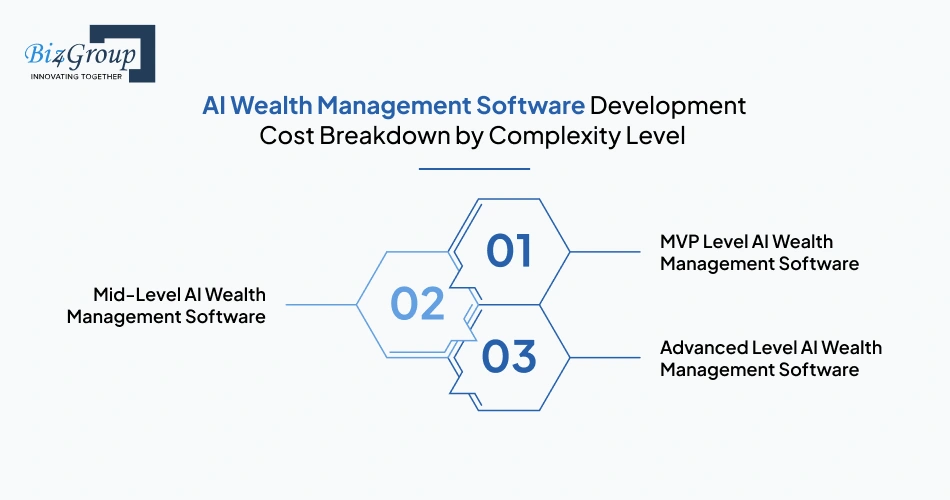
Budget clarity usually comes when you connect platform maturity with actual investment levels. The cost to develop an AI wealth management software typically ranges between $35,000 and $300,000+, but the real difference comes from how advanced your platform needs to be and how much intelligence you want to embed from the start.
Cost breakdown of AI wealth management software development
| Development Level | Scope | Estimated Cost Range |
|---|---|---|
| MVP Level AI Wealth Management Software | Focused on a single use case such as portfolio tracking or basic advisory logic. Includes limited data handling, simple dashboards, and early validation workflows. | $30,000 – $70,000 |
| Mid-Level AI Wealth Management Software | Supports personalized investment recommendations, improved analytics, and integration with financial systems. Designed to handle multiple advisory workflows with better scalability. | $70,000 – $150,000 |
| Advanced Level AI Wealth Management Software | Built for large-scale operations with real-time insights, automated decision-making, continuous model improvement, and deep system integrations across financial platforms. | $150,000 – $300,000+ |
Early investment decisions often become easier when you align platform complexity with actual business needs. This is where many teams working in finance in wealth management validate their approach before committing to higher infrastructure and integration costs.
Now that the overall investment is clear, it becomes important to understand how this cost is distributed across different development stages.
Know Your Real Wealth Platform Budget Yet?
Let’s align your advisory workflows, reporting scope, and growth roadmap with a realistic investment range before costs start drifting.
Map My Platform BudgetAI Wealth Management Software Development Cost by Phases
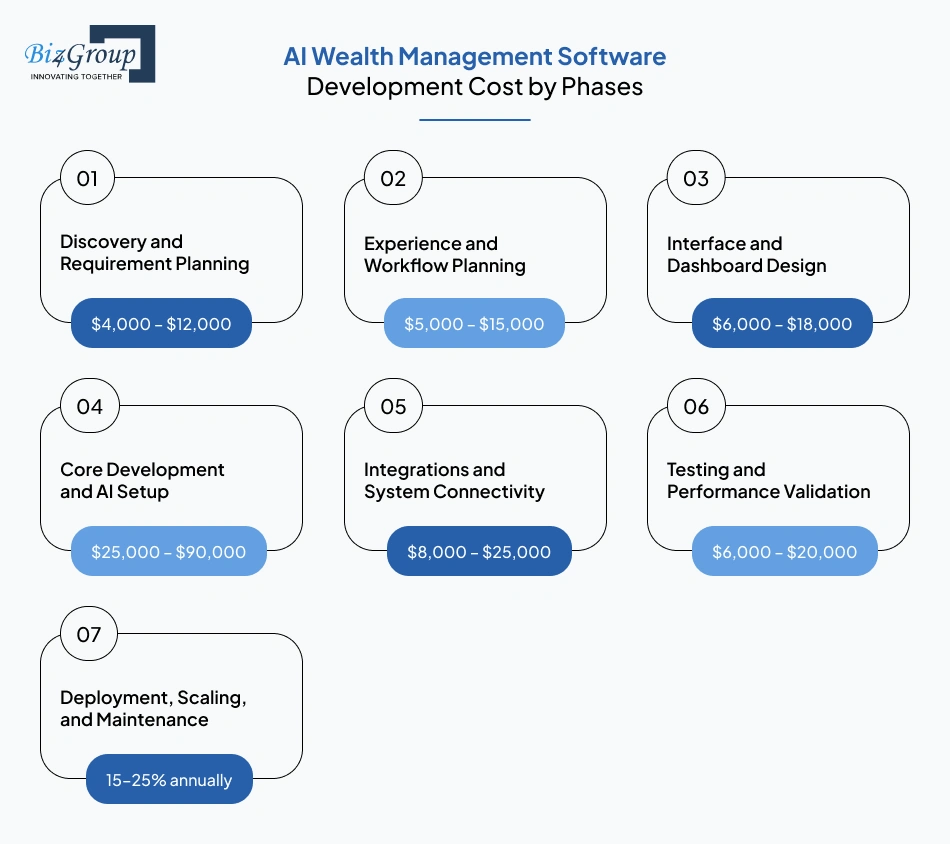
Cost builds step by step as your platform moves from planning to real usage. Each phase adds a specific layer of investment based on effort, tools, and system complexity. Understanding this progression helps you estimate the cost to develop an AI wealth management software with more control and fewer unexpected expenses.
1. Discovery and Requirement Planning
This phase defines how much you will spend later. Clear planning prevents scope expansion and avoids costly changes during development. Investment here focuses on aligning business goals with system capabilities before any technical work begins.
- Define portfolio management workflows, advisory logic, and system scope clearly
- Estimate financial data sources, volume, and access requirements early
- Identify feature boundaries to avoid unnecessary development effort later
Estimated Cost Range: $4,000 – $12,000
2. Experience and Workflow Planning
User interaction planning directly impacts cost because poorly defined workflows lead to redesign and rework. Even automated systems require structured user journeys for portfolio tracking and decision-making.
- Map how users interact with dashboards and advisory recommendations
- Design workflows for alerts, reporting, and financial actions
- Reduce redesign cost by validating flows before development begins
Estimated Cost Range: $5,000 – $15,000
3. Interface and Dashboard Design
Clear and simple interfaces reduce long-term cost by minimizing usability issues and redesign cycles. This phase ensures that users can easily understand financial insights without confusion.
- Design dashboards for portfolio performance, asset allocation, and reporting
- Maintain consistency across devices through structured web development
- Work with an experienced UI/UX design company to reduce usability-driven changes
Estimated Cost Range: $6,000 – $18,000
Also Read: Top UI/UX Design Companies in USA
4. Core Development and AI Setup
This phase accounts for the largest share of investment because the actual system is built here. Cost increases as backend systems, AI logic, and infrastructure are implemented together. This stage typically aligns with MVP software development where the first working version is created
- Develop backend systems handling transactions, analytics, and data processing
- Implement AI models for portfolio recommendations and risk evaluation
- Set up infrastructure to support scaling and performance requirements
Estimated Cost Range: $25,000 – $90,000
Also Read: Top MVP Development Companies in USA
5. Integrations and System Connectivity
Integration cost depends on how many external systems your platform connects with. Deeper integrations increase both development and long-term maintenance effort.
- Connect with financial APIs, market data providers, and AI CRM systems
- Enable smooth data flow between internal and external platforms
- Ensure system reliability across multiple integration points
Estimated Cost Range: $8,000 – $25,000
Also Read: A Complete Guide to OpenAI API Integration for AI Applications
6. Testing and Performance Validation
Testing ensures that the platform performs reliably under real conditions. Cost increases based on system complexity and accuracy expectations. This phase often involves coordination with a software testing company to maintain quality standards.
- Validate portfolio outputs and advisory recommendations across scenarios
- Perform load testing to handle multiple users and data inputs
- Identify and fix system issues before production deployment
Estimated Cost Range: $6,000 – $20,000
7. Deployment, Scaling, and Maintenance
Once the platform is live, cost shifts toward maintaining performance and handling growth. This phase continues throughout the system lifecycle.
- Deploy production infrastructure and monitoring systems
- Scale resources as user base and financial data increase
- Maintain updates, performance tuning, and system improvements
This stage becomes critical when estimating the detailed cost to build AI wealth management platform for startups planning long-term operations.
Estimated Cost Range: 15–25% of initial development cost annually
Quick Summary Table for Development Phases Cost Breakdown
| Development Stage | Typical Range | Cost Focus |
|---|---|---|
| Discovery and Planning | $4,000 – $12,000 | Defining advisory workflows, user journeys, and aligning system scope with business goals. |
| Experience and Workflow Planning | $5,000 – $15,000 | Collecting and organizing financial data required for meaningful insights and recommendations. |
| Interface and Dashboard Design | $6,000 – $18,000 | Building dashboards for investors and advisors to track and manage portfolios. |
| Core Development and AI Setup | $25,000 – $90,000 | Handling transactions, workflows, and system performance across the platform. |
| Integrations and System Connectivity | $8,000 – $25,000 | Connecting with market data providers, CRMs, and financial systems. |
| Testing & QA | $6,000 – $20,000 | Ensuring system accuracy, stability, and performance before launch. |
| Post-Launch Support | 15–25% annually | Continuous updates, monitoring, and improvements as usage grows. |
Understanding cost across these phases helps you plan investment more accurately. Instead of treating development as a one-time expense, you can align spending with actual system growth and avoid unexpected budget increases over time.
Development Cost of AI Wealth Management Software by Platform Type
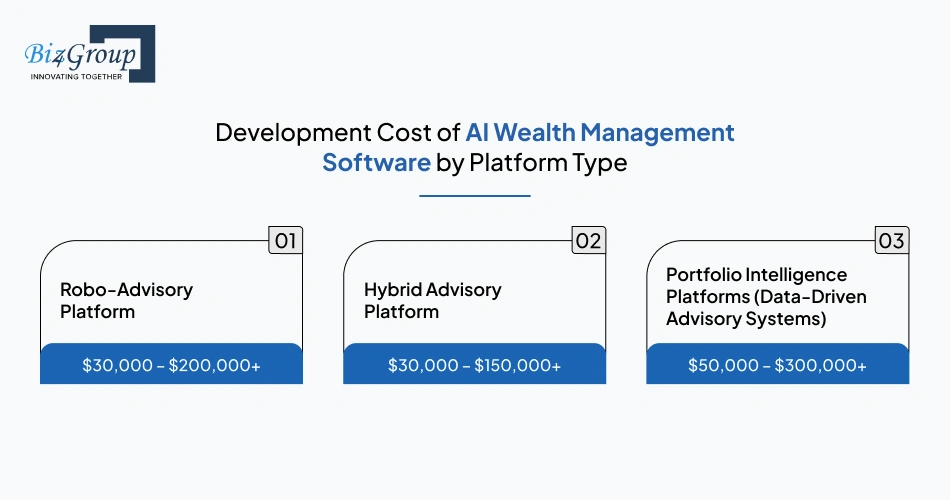
Cost planning becomes more practical when you align your platform type with how the product will actually be used. Different platform structures require different levels of AI automation, data handling, and advisory depth. This is what directly shapes the cost to develop an AI wealth management software in real scenarios.
1. Robo-Advisory Platform
This type focuses on fully automated portfolio management with minimal human involvement. It is commonly used by startups and digital-first investment platforms.
- Estimated Cost: $30,000 – $200,000+
- Rule-based or basic AI-driven portfolio allocation
- Limited personalization using user financial inputs
- Simple dashboards for tracking investments and performance
- Lower integration requirements with external financial systems
2. Hybrid Advisory Platform
This platform blends AI-driven insights with human advisor involvement. It is widely used by wealth firms that want to scale services without removing expert oversight.
- Estimated Cost: $30,000 – $150,000+
- Personalized investment recommendations supported by AI
- Advisor dashboards for managing client portfolios
- Integration with CRMs, financial data providers, and reporting systems
- More structured workflows for client engagement
3. Portfolio Intelligence Platforms (Data-Driven Advisory Systems)
These platforms focus on deeper portfolio analysis, risk management, and continuous optimization based on financial data. They are used by firms handling larger and more complex portfolios.
- Estimated Cost: $50,000 – $300,000+
- Advanced portfolio analysis and dynamic asset allocation using predictive analysis
- Continuous model improvement using generative AI
- Real-time data processing for investment insights
- Strong integration across financial systems and market data sources
Once you define which platform aligns with your business model, cost planning becomes much more predictable. This clarity helps you invest in the right capabilities without overbuilding features that do not contribute to actual growth.
Key Factors That Influence AI Wealth Management Software Development Cost
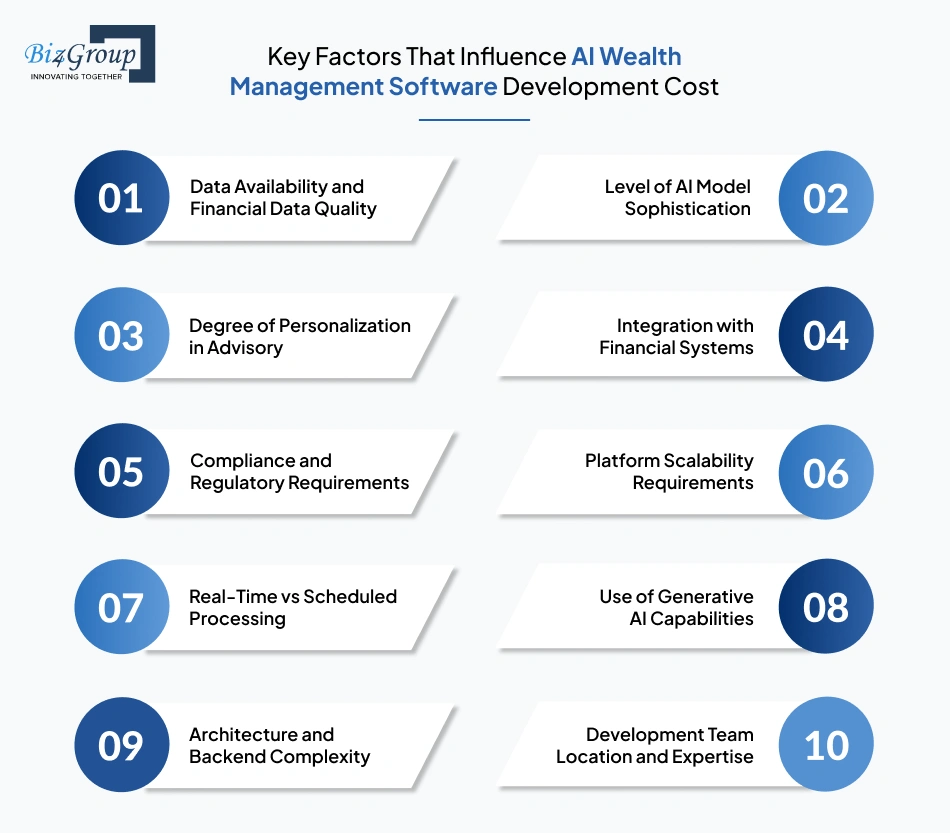
Cost planning becomes clearer when you evaluate the decisions that directly shape investment. The cost to develop an AI wealth management software depends on multiple practical variables, and each one can significantly increase or control your total budget if not planned early.
1. Data Availability and Financial Data Quality
Financial platforms depend heavily on structured and reliable data inputs. If your data is inconsistent or incomplete, development effort increases because additional validation, sourcing, and preparation work becomes necessary before any meaningful output can be generated.
- Data cleaning and structuring require dedicated effort and time
- Missing historical data leads to external data acquisition costs
- Inconsistent datasets increase testing and correction cycles
Estimated Cost Impact: +15% to +30% depending on data readiness
2. Level of AI Model Sophistication
The level of intelligence expected from the system directly affects how much effort goes into AI model selection, creation, and tuning. Simple logic requires less investment, while deeper intelligence demands more time and resources.
- Basic models require limited training and validation
- Refined AI models require multiple training and tuning cycles
- Advanced advisory systems increase computation and development effort
Estimated Cost Impact: +20% to +50% based on model complexity
3. Degree of Personalization in Advisory
Personalization increases system complexity because each user may receive different outputs based on their financial profile. This requires more logic, data processing, and testing effort.
- Standard recommendations reduce development effort
- Personalized portfolios require deeper data processing
- Dynamic allocation increases system workload
Estimated Cost Impact: +15% to +40% depending on personalization depth
4. Integration with Financial Systems
System integrations play a major role in shaping overall development cost. The more systems your platform connects with, the more effort is required to ensure smooth data flow and reliability.
- Limited integrations keep development scope controlled
- Enterprise AI integration increases engineering effort
- Real-time data syncing adds infrastructure and maintenance cost
Estimated Cost Impact: +20% to +45% based on integration scope
5. Compliance and Regulatory Requirements
Financial platforms must follow strict compliance standards. These requirements add additional layers of validation, documentation, and security implementation during development.
- Compliance frameworks require secure data handling systems
- Additional testing cycles ensure regulatory adherence
- Documentation and validation increase project timelines
Estimated Cost Impact: +10% to +30% depending on compliance scope
6. Platform Scalability Requirements
Scalability planning determines how well your system can handle growth. Systems designed for expansion require additional architecture planning and infrastructure setup.
- Small-scale platforms require minimal infrastructure
- Scalable systems require advanced backend planning
- Early scalability reduces future redevelopment costs
Estimated Cost Impact: +15% to +40% for scalability readiness
7. Real-Time vs Scheduled Processing
Processing requirements directly influence system design and cost. Real-time systems require higher computing power and continuous data handling compared to scheduled processing systems.
- Scheduled updates reduce infrastructure demand
- Real-time updates increase processing and optimization effort
- Continuous monitoring systems raise operational cost
Estimated Cost Impact: +20% to +50% based on processing needs
8. Use of Generative AI Capabilities
Advanced AI features increase development scope depending on how they are used within the platform. Systems that generate insights or explanations require additional training and validation.
- Basic analytics require minimal AI effort
- Generative AI in wealth management increases development layers
- Integration into a financial forecasting platform expands system scope
Estimated Cost Impact: +20% to +45% depending on AI usage
9. Architecture and Backend Complexity
System architecture determines how efficiently your platform handles operations and scale. More complex architectures require additional planning, development, and long-term maintenance effort.
- Simple systems require limited backend logic
- Complex workflows increase engineering time
- The development cost of AI wealth management software architecture grows with system depth
Estimated Cost Impact: +15% to +40% based on architecture complexity
10. Development Team Location and Expertise
The team you choose directly impacts the overall budget. Differences in hourly rates and expertise levels can significantly change the total project cost.
- Higher hourly rates increase total development cost
- Specialized expertise and AI developers add premium pricing
- Distributed teams may reduce cost but require coordination
Estimated Cost Impact: ±20% to ±50% based on team structure
Also Read: How to Hire an AI App Developer in USA for Your Business?
Understanding these factors gives you a clearer view of the pricing of building AI financial advisory software. Once you evaluate each variable early, you can align your investment with actual requirements and avoid unnecessary cost escalation during development.
Hidden Costs to Look Out for in AI Wealth Management Software Development
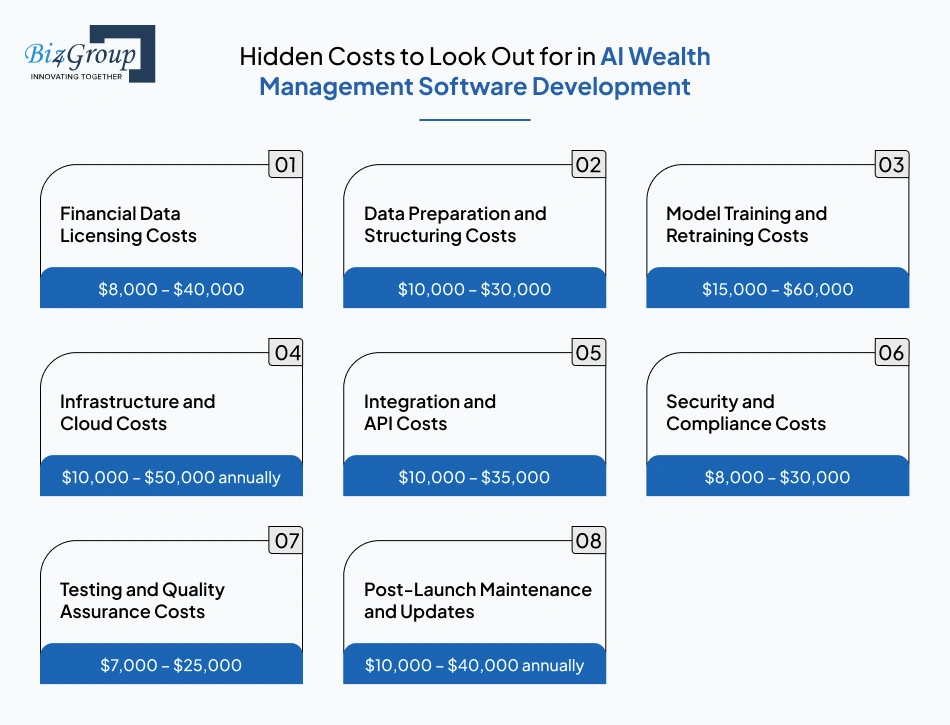
Hidden costs are the difference between an estimated budget and actual spend. These are the expenses that expand once real data, users, and financial workflows come into play, directly affecting how you calculate the cost to develop an AI wealth management software.
1. Financial Data Licensing Costs
- Market Data Subscriptions: Real-time asset pricing feeds typically range from $5,000 to $25,000 annually depending on data coverage, frequency, and API usage limits.
- Historical Dataset Access: Clean financial datasets for model training usually fall between $3,000 and $15,000 based on asset classes and time range required.
- Live Data Streaming Costs: Continuous data pipelines scale between $2,000 and $12,000 annually as user activity and system usage increase.
Estimated Cost: $8,000 – $40,000
Also Read: Adopt An API-First Architecture For Business Agility
2. Data Preparation and Structuring Costs
- Data Cleaning Effort: Structuring inconsistent financial data typically ranges from $5,000 to $20,000 depending on format diversity and source reliability.
- Data Mapping Across Sources: Aligning brokerage, user, and market datasets usually accounts for $3,000 to $12,000 in additional engineering effort.
- Validation and Accuracy Checks: Repeated validation cycles often fall between $2,000 and $10,000 to ensure reliable portfolio outputs.
Estimated Cost: $10,000 – $30,000
3. Model Training and Retraining Costs
- Initial Model Training: Portfolio recommendation and risk models typically range from $10,000 to $40,000 based on dataset size and logic depth.
- Retraining Cycles: Market-driven updates usually cost $5,000 to $20,000 per cycle depending on frequency and model complexity.
- Model Optimization Runs: Accuracy tuning and performance improvements account for $3,000 to $15,000 in compute and engineering time.
Estimated Cost: $15,000 – $60,000
4. Infrastructure and Cloud Costs
- Cloud Hosting Usage: Backend systems and AI workloads typically fall between $2,000 and $10,000 per month based on traffic and processing demand.
- Compute Resource Allocation: High-performance processing environments range from $1,500 to $8,000 monthly depending on workload intensity.
- Scaling Infrastructure Costs: Expanding system capacity often adds $5,000 to $25,000 annually, shaping overall AI portfolio management software development cost.
Estimated Cost: $10,000 – $50,000 annually
5. Integration and API Costs
- Financial API Subscriptions: Trading and analytics APIs usually range from $3,000 to $15,000 annually depending on usage tiers and access levels.
- Integration Development Effort: Connecting external systems typically accounts for $5,000 to $20,000 based on complexity and number of integrations.
- API Maintenance Costs: Updates and compatibility adjustments generally fall between $2,000 and $10,000 annually.
Estimated Cost: $10,000 – $35,000
6. Security and Compliance Costs
- Security Implementation: Encryption and access control systems typically range from $5,000 to $20,000 depending on platform sensitivity and user volume.
- Compliance Validation: Regulatory audits and testing usually fall between $3,000 and $15,000 based on jurisdiction requirements.
- Ongoing Compliance Updates: Policy updates and regulatory changes account for $2,000 to $8,000 annually.
Estimated Cost: $8,000 – $30,000
7. Testing and Quality Assurance Costs
- Functional Testing Costs: Validating workflows and advisory logic typically ranges from $3,000 to $12,000 depending on feature depth.
- Performance Testing Costs: Load and stress testing generally falls between $2,000 and $10,000 based on usage scenarios.
- Bug Fixing Cycles: Issue resolution and refinements account for $2,000 to $8,000 across testing phases.
Estimated Cost: $7,000 – $25,000
8. Post-Launch Maintenance and Updates
- System Monitoring Costs: Continuous monitoring and uptime tracking usually range from $2,000 to $10,000 annually.
- Feature Enhancement Budget: Ongoing updates and improvements typically fall between $5,000 and $20,000 yearly depending on roadmap scope.
- Support and Issue Resolution: Maintenance cycles generally account for $3,000 to $15,000 annually when teams build AI software for long-term use.
Estimated Cost: $10,000 – $40,000 annually
These cost layers directly shape the cost to build AI wealth management platform in real conditions. Once you account for them early, budgeting becomes more controlled and aligned with actual system usage and long-term operational demands.
Want to Catch Hidden Wealth Platform Costs Early?
Identify data, reporting, integration, and post-launch expenses before they quietly affect your investment plan.
Discuss My Cost RoadmapBuild vs Buy AI Wealth Management Software: Which Is Right for Your Business?
Budget decisions are not only about upfront spending but how costs behave over time. The cost to develop an AI wealth management software differs significantly from subscription-based platforms, especially as usage, integrations, and advisory complexity increase.
Here is how both approaches compare when you break them down by actual cost impact.
| Factor | Custom Build | SaaS Platform |
|---|---|---|
| Initial Cost | Higher upfront investment, typically ranging between $50,000–$250,000+, covering design, development, integrations, and system setup based on business needs. | Lower entry cost with subscription pricing, usually $500–$5,000 per month, plus setup fees of $2,000–$15,000 for onboarding. |
| Control Cost Impact | Full control reduces dependency costs over time, avoiding recurring licensing fees and allowing cost optimization based on usage. | Limited control increases dependency on vendor pricing tiers, which may scale from $1,000–$10,000 per month as feature usage grows. |
| Scalability Cost | Scaling requires planned upgrades, usually costing $10,000–$50,000 per expansion phase depending on infrastructure and user growth. | Scaling depends on pricing tiers, with enterprise usage often increasing costs to $8,000–$20,000+ per month. |
| Maintenance Cost | Ongoing updates and improvements typically cost 15–25% of initial development annually, depending on system complexity and usage. | Maintenance is included in subscription, but premium support and customizations can cost $1,000–$3,000 monthly. |
| Long-Term Cost Impact | Higher initial spend but more controlled long-term cost, especially when the platform becomes a core part of operations over time. | Lower upfront cost but recurring fees can reach $200,000–$400,000+ over 4–5 years at scale. |
Cost decisions here depend on how long you plan to use the system and how central it is to your business. Evaluating both options helps you understand how the custom AI Wealth management software development cost compares with ongoing subscription commitments as your platform scales.
Also Read: SaaS MVP Development: Build, Validate, and Scale Smarter
Still Unsure Whether to Build or Buy Your AI Wealth Platform?
Get clarity on ownership cost, platform control, and scale economics before committing to the wrong path.
Get Cost ClarityCost Optimization Strategies for AI Wealth Management Software Development
Cost control becomes practical when you make structured decisions early instead of reacting to budget overruns later. The cost to develop an AI wealth management software is directly influenced by how you approach scope, data, and system design from the beginning.
1. Start with MVP Development Approach
Initial investment should focus on solving one clear problem instead of covering every feature at once. This approach helps reduce unnecessary spending and gives clarity on what actually delivers value before scaling further. It also prevents overinvestment in features that may not be used.
- Focus on essential features like portfolio tracking and basic advisory logic
- Avoid full-scale infrastructure setup during early validation stages
- Use MVP development services to validate product-market fit before expansion
Estimated Cost Savings: 15%–30% reduction in initial development investment
Also Read: Much Does It Cost to Build an MVP for AI Application?
2. Use Pre-Trained AI Models Where Possible
Model development is one of the most expensive parts of the system. Using pre-trained models reduces both time and cost because you are not starting from zero. You only adjust the model based on your specific financial use case.
- Reduce data collection and training effort significantly
- Limit infrastructure usage during early model experimentation
- Allocate engineering effort toward business workflows instead of core AI creation
Estimated Cost Savings: 20%–40% reduction in model development expenses
3. Adopt Modular System Architecture
A modular system helps control cost over time by allowing you to update or scale specific components instead of rebuilding the entire platform. This approach is especially useful as your platform grows, and new features are added.
- Separate modules for advisory, analytics, and reporting
- Reduce redevelopment when adding new capabilities
- Lower maintenance effort through independent system components
Estimated Cost Savings: 10%–25% reduction in long-term development costs
4. Optimize Cloud and Infrastructure Usage
Infrastructure cost increases as your platform grows. Controlled usage ensures you are not paying for resources that are not being used effectively. This directly impacts long-term spending.
- Schedule workloads instead of running systems continuously
- Use lower-cost storage for historical financial data
- Monitor usage to prevent unnecessary compute expenses
Estimated Cost Savings: 15%–35% reduction in infrastructure costs
5. Reduce Data Collection Costs with Smart Planning
Data collection can become expensive if not planned properly. Focusing only on relevant financial data reduces both cost and processing effort. This helps control the AI portfolio management software development cost effectively.
- Use existing datasets instead of collecting everything from scratch
- Avoid duplication of financial data across systems
- Limit data collection to features that directly impact advisory logic
Estimated Cost Savings: 20%–40% reduction in data preparation costs
6. Automate Repetitive Processes
Manual operations increase cost over time. Automation helps reduce effort and ensures consistency across system operations. This becomes important as your platform handles more users and data.
- Use AI automation tools for data processing and reporting
- Reduce manual effort in portfolio updates and analytics
- Improve efficiency in recurring operational workflows
Estimated Cost Savings: 20%–45% reduction in operational expenses
7. Plan Integrations Carefully
Integrations add cost quickly if not controlled. Planning integrations based on actual business needs helps reduce both development and maintenance effort.
- Integrate only essential systems during early stages
- Avoid unnecessary third-party dependencies
- Reduce long-term maintenance cost through controlled integrations
Estimated Cost Savings: 10%–25% reduction in integration and maintenance costs
8. Work with Experienced AI Teams
Experienced teams reduce cost through their AI consulting services and help avoid mistakes and rework. They help you make better decisions early, which directly impacts overall investment.
- Reduce trial-and-error during system development
- Improve planning accuracy and execution speed
- Work with an AI development company to build AI wealth management software efficiently
Estimated Cost Savings: 20%–40% reduction in rework and development inefficiencies
Cost optimization works best when applied early in the process. These strategies help you manage the wealth management software development cost integrating AI while keeping your platform efficient, scalable, and aligned with real business needs.
Want Lower Costs Without Limiting Platform Growth?
Align smarter cost optimization strategies with your advisory workflows, user volume, and long-term fintech roadmap.
Optimize My Platform BudgetHow Revenue Models Impact AI Wealth Management Software Development Cost?
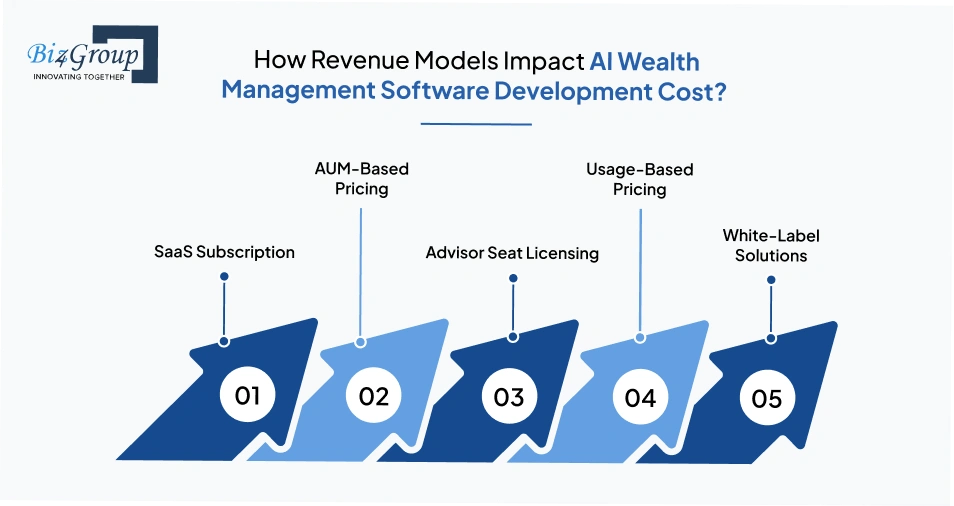
Revenue strategy affects development cost much earlier than monetization begins. The model you choose shapes billing logic, user access, reporting workflows, and system controls from day one, which directly influences the development budget of AI wealth management software.
Here's how each revenue model changes development effort and cost allocation across the platform.
| Revenue Model | How It Changes Development Work | Development Cost Impact |
|---|---|---|
| SaaS Subscription | Requires subscription plans, recurring billing, user account tiers, payment workflows, and uptime monitoring across multiple customers. | Adds $10,000–$30,000 for billing systems, subscription management, and customer account infrastructure. Break-even often comes within 18–24 months with steady client onboarding. |
| AUM-Based Pricing | Requires portfolio value tracking, fee calculation logic, reporting dashboards, and automated percentage-based billing tied to assets under management. | Adds $12,000–$35,000 for valuation engines, reporting workflows, and billing validation systems. Revenue scales naturally with client portfolio growth. |
| Advisor Seat Licensing | Requires user seat controls, advisor-based permissions, role management, and license activation workflows for firms with multiple advisors. | Adds $8,000–$20,000 for seat-based controls and admin management systems. Recovery often happens within 12–18 months through enterprise contracts. |
| Usage-Based Pricing | Demands tracking of portfolio simulations, advisory reports, AI-generated insights, and client activity-based usage reports. | Adds $15,000–$35,000 due to metering systems, reporting dashboards, and billing logic complexity. |
| White-Label Solutions | Requires configurable branding, custom client dashboards, reseller controls, and deployment flexibility for multiple wealth firms. | Adds $12,000–$30,000 for branding frameworks and isolated deployment logic. Strong margins possible through partner-led expansion. |
Every revenue model changes where development effort goes. Subscription systems increase billing complexity, AUM models expand reporting logic, and white-label platforms require deeper customization layers. These decisions directly influence the cost to develop an AI wealth management software, even when client-facing workflows look similar.
Cost Planning Mistakes That Increase AI Wealth Management Software Development Budget
Budget overruns usually come from delayed cost decisions rather than visible features. The AI wealth management software development cost rises when hidden cost layers like data readiness, retraining, integrations, and post-launch support are not planned from the beginning.
Following are the exact cost mistakes that quietly increase your budget during development:
1. Underestimating Financial Data Preparation Costs
Mistake: Teams often assume brokerage; CRM, and market feeds are ready to use. In reality cleaning, mapping, and validating portfolio history and transaction data requires significant effort. Missing this cost early increases engineering hours, vendor support charges, and testing delays that directly inflate the development budget.
Solution: Treat financial data preparation as a recurring budget item across discovery, core development, and testing. Allocate separate cost buffers for data cleaning, normalization, validation cycles, and vendor-side corrections, so this expense does not unexpectedly shift into later development phases.
2. Ignoring Model Retraining and Tuning Costs
Mistake: Many budgets only include initial AI model setup. Once live market conditions shift, portfolio recommendations and risk logic require retraining. Missing these recurring updates increases compute usage, validation effort, and engineering time, causing the cost to rise well beyond the originally approved investment.
Solution: Reserve a fixed retraining budget every three to six months. This should include compute cost, validation effort, AI model tuning, and deployment checks, so recurring AI updates remain a planned operational expense instead of a sudden cost spike.
3. Overloading the First Release Scope
Mistake: Initial releases often include too many features such as tax planning, advisor dashboards, automated reports, and deep analytics. This expands development hours, increases testing layers, and creates redesign costs when early workflows are not yet validated with real users.
Solution: Limit the first release to core portfolio tracking, risk scoring, and recommendation workflows. A phased rollout keeps spending aligned with actual validation outcomes and reduces rework, helping teams control early budgets when they build AI software for wealth use cases.
4. Not Planning for Scalability Early
Mistake: Budgets designed for limited users often fail when adoption increases. More users, portfolio simulations, and live data feeds. They demand backend restructuring, database optimization, and infrastructure migration, all of which create expensive redevelopment costs after launch.
Solution: Allocate scalability cost during initial architecture planning. Budget early for database flexibility, infrastructure expansion, and workflow capacity so system growth does not force high-cost redevelopment once the product starts gaining real traction.
5. Ignoring Integration Expansion Costs
Mistake: Teams often budget for one or two financial APIs but later need brokerage systems, tax engines, CRMs, and reporting tools. Each additional integration adds development effort, maintenance overhead, and vendor pricing increases that quickly expand the total project budget.
Solution: Keep a dedicated integration reserve in the budget for future APIs, version changes, and vendor pricing shifts. This keeps additional connectivity costs controlled instead of forcing repeated budget approvals during later development stages.
6. Missing DevOps and Post-Launch Cost Allocation
Mistake: Many budgets stop at deployment and ignore monitoring, release workflows, issue resolution, and performance tuning. Once live, these missing cost layers lead to reactive support hiring and emergency operational spending that significantly increases long-term platform cost.
Solution: Add DevOps, monitoring, and support as a fixed annual budget layer from the start. This keeps uptime, issue resolution, and release management predictable while helping you control the cost to develop an AI wealth management software over its full lifecycle.
Cost overruns are rarely caused by technology itself. They come from decisions made too late or not planned at all. Avoiding these mistakes helps you control the cost to develop an AI wealth management software and keeps your budget stable as the system grows.
Want to Prevent Budget Drift Before Development Starts?
Review your roadmap early and remove the planning gaps that silently increase wealth platform costs later.
Request My Cost ReviewHow Biz4Group LLC Approaches Cost Optimization in AI Wealth Management Software Development
At Biz4Group LLC, we approach cost optimization by first identifying where wealth platforms usually overspend. In most cases, the extra spend comes from unclear advisory scope, over planned integrations, unstructured financial data, and support costs added too late.
We address these cost drivers before engineering begins so the cost of developing an AI wealth management software stay aligned with actual platform usage and long-term ownership. Here's how we keep development costs predictable in practice:
1. Scope Discipline Before Engineering Expands
We start by defining one production-ready workflow instead of multiple speculative modules. Through our AI wealth management software development services, we help you prioritize portfolio tracking, rebalancing, or advisory reporting first, so the first release stays financially controlled.
2. Infrastructure Designed Around Real Usage
We estimate portfolio volume, reporting frequency, and API traffic before backend setup. This keeps the cost to build AI fintech wealth management platform stable by preventing overprovisioned infrastructure and unnecessary scaling layers in early phases.
3. Ownership Costs Planned Early
We include monitoring, optimization, support, and model updates within the delivery roadmap. This helps prevent long-term spending surprises and keeps post-launch costs tied to actual system growth.
Therefore, by aligning scope, infrastructure, and ownership early, we help you move forward with a realistic investment plan that stays sustainable as your wealth platform scales over time.
Still not convinced? Here's the proof.
Worth Advisors: Financial Planning and Client Management Platform
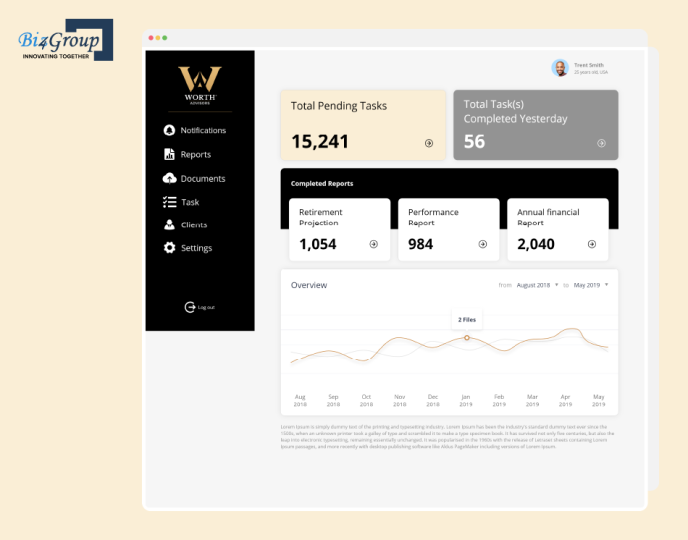
Worth Advisors, is a financial planning and client management platform designed for advisors to manage end-to-end client journeys from a single system. The platform brings together structured financial questionnaires, document collection, advisor workflows, portfolio planning inputs, and modular reporting. This allows financial teams to manage planning, recommendations, and client communication without scattered tools.
The delivery was planned around practical workflow boundaries, phased integrations, and reusable reporting structures, which helped keep engineering effort focused and prevented unnecessary cost expansion as the platform matured.
- Reusable report modules reduced repeated engineering effort across multiple financial planning workflows
- Structured questionnaire flows minimized rework in data handling and validation stages
- Integrations were introduced in controlled phases to avoid early infrastructure and API cost inflation
- Advisor dashboards and client management workflows were scoped around actual usage patterns
- Long-term support, reporting expansion, and workflow updates remained easier to manage as the platform scaled
This is the kind of real-world implementation that helps us keep investment practical, system growth predictable, and cost decisions aligned with actual wealth platform usage instead of speculative feature expansion.
Conclusion
The real challenge in AI wealth management software development is rarely the first estimate. It is understanding how the cost to develop an AI wealth management software changes as portfolio data grows, advisory workflows expand, and reporting demands become more advanced over time. This is where early decisions around scope, integrations, modular reporting, and long-term support quietly decide whether your budget stays controlled or starts drifting.
If you are still asking, what is the cost of creating an AI wealth management software? The answer depends on how realistically your roadmap matches actual business usage. Platforms stay financially sustainable when validation happens before scale, integrations are introduced in phases, and ownership costs are planned alongside the initial build instead of after launch.
At Biz4Group LLC, our work across fintech and advisory platforms has shown that disciplined planning keeps investment predictable long after launch. With the right AI product development services, you can move forward with a clearer budget, lower risk, and a platform that scales without unnecessary cost surprises. Let's Talk.
FAQ's
1. What Is the Overall Cost Range for AI Wealth Management Software in 2026?
The overall investment usually starts from $30,000 for a focused MVP and can go beyond $300,000+ for enterprise-grade advisory ecosystems. The final budget depends on personalization depth, data integrations, reporting automation, compliance, and how much of the advisory workflow needs intelligence-driven automation.
2. How Long Does It Take to Launch AI Wealth Management Software?
A focused MVP usually takes 2–4 weeks, while a mid-scale platform with advisor workflows, client dashboards, and portfolio intelligence can take 4–9 weeks. Enterprise ecosystems with compliance, multi-role access, and deep reporting layers may extend to 9–12+ weeks.
3. How Much Does Compliance Add to Wealth Management Software Budgets?
Compliance-related implementation for audit trails, secure document workflows, data retention, and advisor activity logging typically adds $8,000–$40,000+ depending on jurisdiction, reporting depth, and internal governance requirements.
4. How Much Does Third-Party Market Data Increase Platform Costs?
Live market feeds, historical datasets, portfolio benchmarks, and research APIs can add $5,000–$25,000 annually. For firms using multiple custodians, asset classes, and advanced reporting engines, this recurring cost can grow much faster.
5. How Much Budget Is Needed to Add AI-Powered Client Personalization?
Client-specific recommendations, automated rebalancing suggestions, and personalized financial reports typically require an additional $15,000–$60,000 depending on logic complexity, data depth, and reporting workflows.
6. What Post-Launch Budget Should Firms Reserve for Wealth Platform Growth?
A practical post-launch reserve is 15–25% of the initial annual build cost. This covers model tuning, reporting updates, advisor workflow expansion, integrations, and infrastructure scaling as client portfolios and usage grow.
