 Location :
Orlando, FL, USA
Location :
Orlando, FL, USA +1 (407) 714-1616
 info@biz4group.com

- SaaS MVP development helps businesses validate ideas quickly, reduce risk, and move from concept to a working product using real user feedback.
- Develop a SaaS MVP by focusing on one core problem, essential features, and a clear user journey instead of building everything upfront.
- Build SaaS MVP products with the right tech stack, basic security readiness, and analytics to support early adoption and learning.
- SaaS MVP development cost estimate typically ranges from $15,000-$100,000+, depending on scope, complexity, and scaling goals.
- Develop scalable SaaS MVP solutions by using MVP insights to guide feature expansion, pricing, and long-term product strategy.
- Biz4Group LLC is a trusted USA-based partner for SaaS MVP development, helping startups and enterprises launch, validate, and scale with confidence.
Have you ever wondered why so many promising SaaS ideas sound great in pitch decks but never make it to real customers? The gap between an idea and a working product is where most businesses lose time, money, and momentum. According to CB Insights, 35% of startups fail because there is no market need for what they build.
This is exactly why SaaS MVP development has become a critical first step for founders and product teams who want real validation before heavy investment.
For many businesses, the challenge is not ambition. It is uncertainty. Founders want proof that users care, that the problem is real, and that people will pay. When you develop a SaaS MVP, you create a focused product that answers these questions fast. Instead of guessing, you observe real behavior. Instead of planning endlessly, you launch something usable and learn directly from the market.
Speed also matters more than ever. Competitive pressure, rising development costs, and short attention spans make long build cycles risky. With the right SaaS MVP development services, teams can test assumptions, refine features, and reach early adopters while budgets stay under control.
This approach turns feedback into direction and direction into confidence.
At its core, the goal is clarity. To make a SaaS MVP for startups and entrepreneurs means building only what proves value, nothing more. When done right, an MVP becomes the foundation for smarter decisions and stronger traction.
To know how you can do it right, read on...
Understanding SaaS MVP Product Development for Modern Businesses
Before features, funding, or fanfare, every successful SaaS product answers one question clearly... Does this solve a real problem for real users?
SaaS MVP development focuses on building the smallest version of a software product that delivers clear value to users. The goal is learning through usage.
An MVP helps teams validate demand, test workflows, and understand buying behavior without committing to a full-scale build.
It is not a rough demo. It is not a half-working tool. A SaaS MVP is a usable product designed to collect insight.
When businesses build minimum viable product for SaaS, they prioritize clarity over complexity. Every feature has a reason. Every workflow ties back to a real user outcome.
What a SaaS MVP Includes and What It Avoids
To keep expectations grounded, here is what a well-planned MVP focuses on and what it intentionally leaves out.
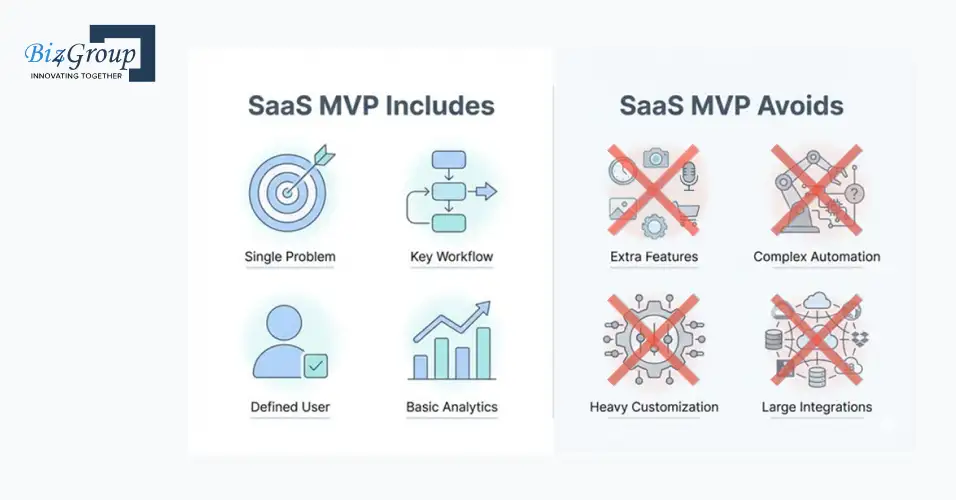
Core Focus Areas
- A single primary problem worth solving
- A defined user persona
- One or two workflows that deliver measurable value
- Basic analytics to observe usage patterns
What Stays Out at This Stage
- Nice-to-have features
- Advanced customization
- Large scale automation
- Deep integrations that can wait
This restraint is what makes SaaS MVP product development effective. It prevents overbuilding and keeps teams aligned on outcomes rather than opinions.
SaaS MVP vs. Prototype vs. Full Product
Confusion around these terms leads to wasted effort. The table below clears it up quickly.
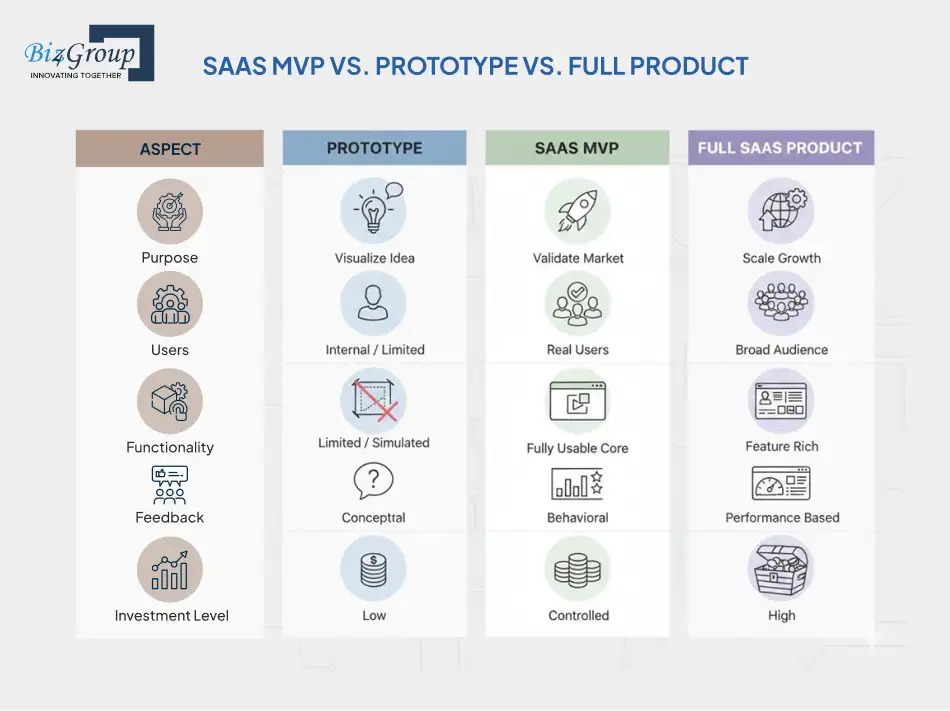
|
Aspect |
Prototype |
SaaS MVP |
Full SaaS Product |
|
Purpose |
Visualize idea |
Validate market |
Scale growth |
|
Users |
Internal or limited |
Real users |
Broad audience |
|
Functionality |
Limited or simulated |
Fully usable core |
Feature rich |
|
Feedback |
Conceptual |
Behavioral |
Performance based |
|
Investment level |
Low |
Controlled |
High |
A prototype helps people imagine. An MVP helps people decide. A full product helps people scale.
This distinction matters when teams develop SaaS MVP platforms with business goals in mind rather than technical milestones.
When SaaS MVP Development Makes the Most Sense
This approach works best when teams face uncertainty and want answers quickly.
Common scenarios include:
- A startup testing a new SaaS idea
- A business launching a new digital product line
- An enterprise validating a new workflow or market segment
- Founders preparing for investor conversations
In all cases, the MVP acts as proof. Proof of demand. Proof of usability. Proof of direction.
SaaS MVP development is about disciplined progress. By starting lean and learning fast, businesses position themselves to build products that users want, funders trust, and markets reward.
Up next, we will explore why building a SaaS MVP now has become a strategic advantage.
Also read: How to build an AI SaaS product?
Got an Idea or Just a Gut Feeling?
35% of startups fail because there’s no real market need. A SaaS MVP helps you validate before the risk becomes expensive.
Validate Your SaaS Idea TodayWhy SaaS MVP Development Is Essential to Build Products in Today’s Market
Markets move fast and customer patience moves faster. This is the reason more founders and product leaders are turning to SaaS MVP development as a strategic starting point.
The SaaS market continues to expand, but so does the cost of getting it wrong. Reports state that the global SaaS market is expected to reach over 1.13 trillion dollars by 2032, driven by demand across industries.
Growth brings opportunity, but it also brings noise. New products launch daily. Users compare options instantly. In this environment, companies that create SaaS MVPs for faster go to market gain a real edge by learning early instead of reacting late.
Key Business Pain Points SaaS MVPs Help Solve
Before diving into benefits, it helps to look at the problems businesses face without an MVP.
Common challenges include:
- Spending months building features users never adopt
- Struggling to validate pricing and packaging
- Delayed feedback due to long development cycles
- High upfront investment without proof of demand
SaaS MVP development addresses these challenges by narrowing focus and shortening the distance between idea and insight.
Benefits of Developing a SaaS MVP Today
When teams develop a SaaS MVP, they unlock several advantages that impact both speed and confidence.
Strategic Benefits
- Faster validation of product market fit
- Early traction data for investors and stakeholders
- Clearer roadmap driven by real usage
Operational Benefits
- Controlled development costs
- Shorter release cycles
- Reduced rework and pivots
Market Benefits
- Early user relationships
- Competitive positioning
- Stronger launch readiness
This balanced impact explains why SaaS MVP development services are now part of many product playbooks.
SaaS MVP development fits the reality of today's market. By starting lean and learning fast, businesses position themselves to build products that users want, funders trust, and markets reward.
SaaS MVP Development Use Cases That Drive Real Business Value
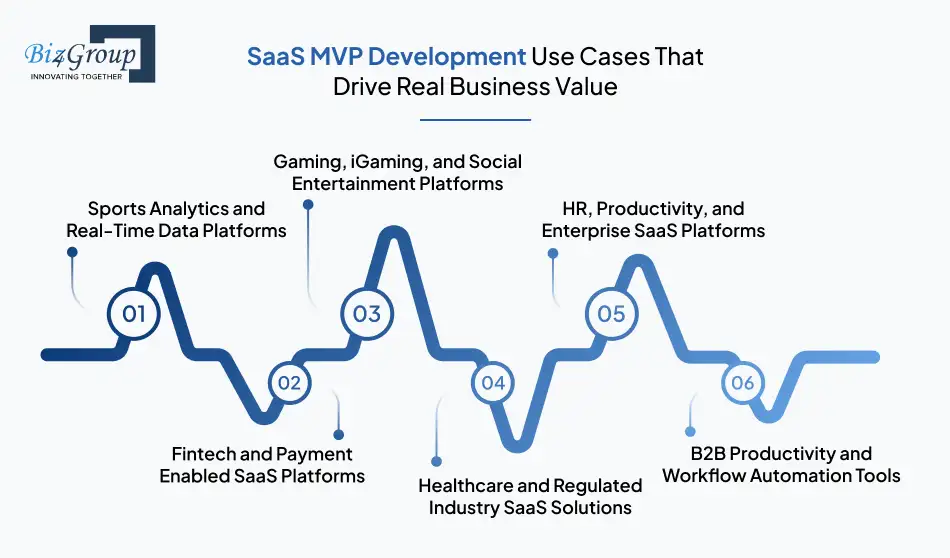
SaaS MVP development looks different across industries, but the goal stays the same. Validate demand, reduce risk, and reach users faster. Below are real world use cases where companies create SaaS MVPs for faster go to market and gain measurable traction before scaling.
1. Sports Analytics and Real-Time Data Platforms
Sports and analytics platforms operate in environments where speed and accuracy define user trust. Teams that develop SaaS MVP platforms in this space focus first on live data access, dashboards, and performance tracking to validate daily usage.
Project Spotlight: Next Level Sports Analytics Platform
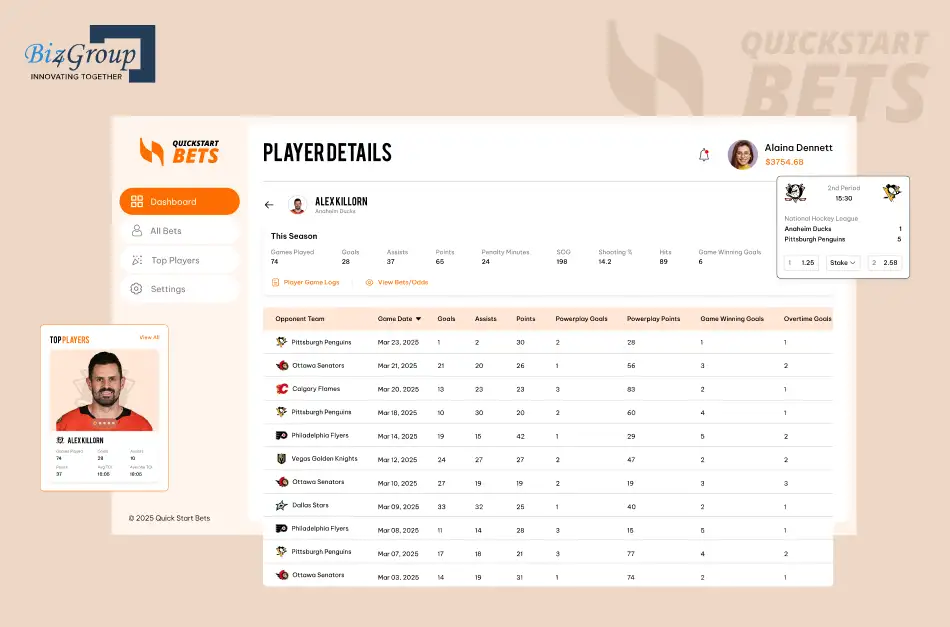
A real-time sports analytics platform built for NHL fans who need fast, reliable insights on games, players, and betting activity. The MVP focused on delivering clarity and speed without overwhelming users with unnecessary complexity.
Key MVP Strengths
- Real-time odds and low latency updates
- Centralized dashboard for bets and performance tracking
- Detailed player and team statistics
- Optimized data integrations for fast refresh cycles
By building only the most valuable features first, the platform validated strong engagement early and created a clear path for future expansion.
2. Fintech and Payment Enabled SaaS Platforms
Fintech SaaS products require trust, compliance, and seamless transactions. MVPs here focus on secure workflows, clear user journeys, and limited but reliable financial operations. Teams create SaaS MVP applications to validate user confidence before expanding features.
3. Gaming, iGaming, and Social Entertainment Platforms
Gaming platforms demand engagement, personalization, and regulatory awareness from day one. A focused MVP helps teams test retention loops, payment behavior, and game discovery without taking on unnecessary risk.
Project Spotlight: AI Social Casino Platform
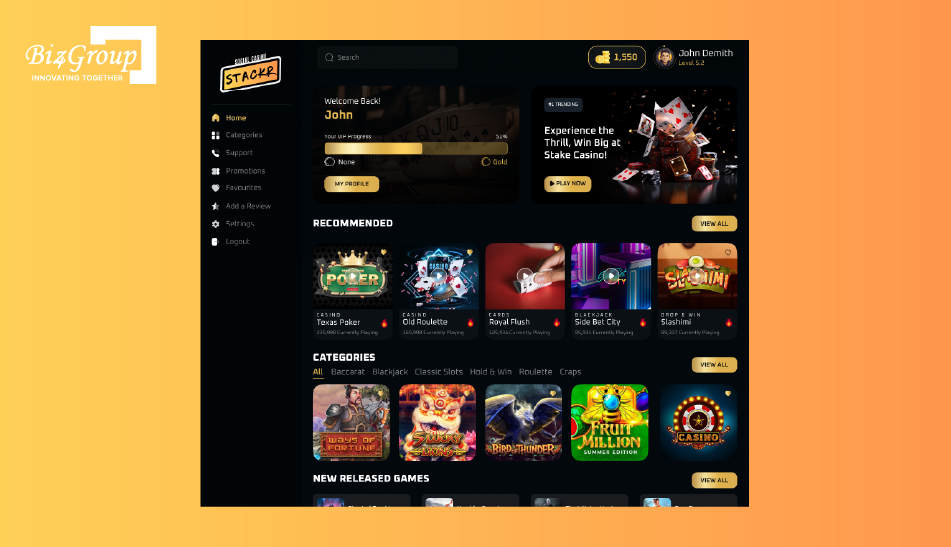
An AI-powered social casino platform offering hundreds of games through a personalized and gamified experience. The MVP was designed to validate engagement, rewards, and payment workflows while navigating strict platform requirements.
Key MVP Strengths
- Personalized game recommendations
- Third-party game integrations
- Dual wallet system for real and fun currency
- Secure payment and redemption flows
- Gamified rewards and user progression
This approach helped confirm strong user retention and monetization signals before scaling further.
4. Healthcare and Regulated Industry SaaS Solutions
Healthcare SaaS MVPs prioritize data privacy, usability, and compliance. Early validation often centers on one use case such as scheduling, reporting, or communication. This allows businesses to test adoption while staying within regulatory boundaries.
Also read: How to build an MVP for AI healthcare software?
5. HR, Productivity, and Enterprise SaaS Platforms
Enterprise SaaS buyers expect immediate value and reliability. Teams that make a SaaS MVP for startups and entrepreneurs in the enterprise space often prioritize one workflow that clearly reduces operational friction.
Project Spotlight: AI-Powered HRMS
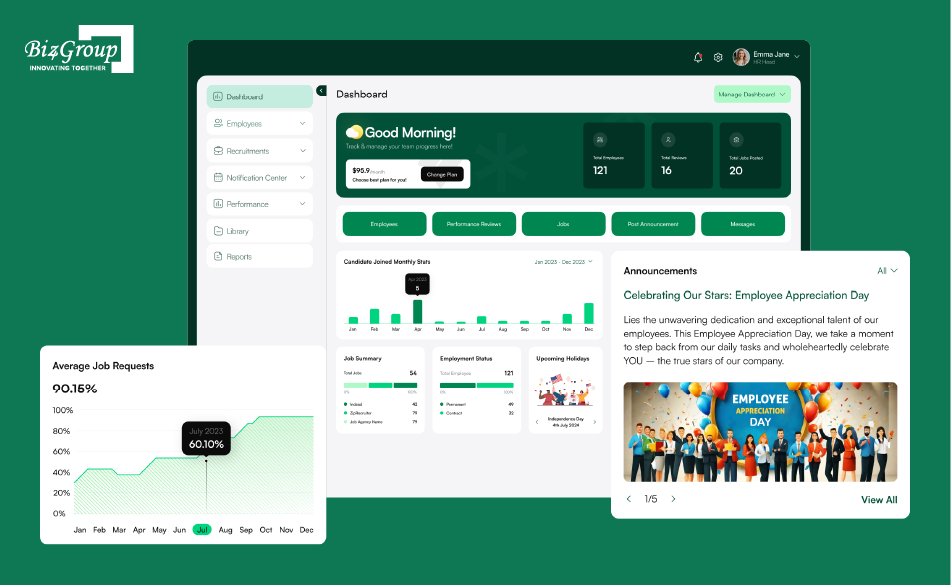
An AI-powered HRMS platform designed to simplify hiring, onboarding, performance management, and compliance. The MVP emphasized automation and intelligent assistance to reduce manual HR workloads.
Key MVP Strengths
- AI HR assistant for real-time employee queries
- Resume parsing and candidate screening
- Automated onboarding with e-signatures
- Performance review and goal tracking tools
- Integrations with Slack, Zoom, and DocuSign
The MVP validated adoption across organizations of varying sizes and laid the foundation for a scalable enterprise SaaS product.
6. B2B Productivity and Workflow Automation Tools
B2B SaaS MVPs succeed when they remove friction from daily operations. Founders often develop scalable SaaS MVP solutions that automate repetitive tasks using AI automation services, integrate with existing tools, and deliver clear ROI within weeks.
Across industries, SaaS MVP development gives teams a practical way to test value before scaling complexity. Next, we will break down the most important features every SaaS MVP should include to drive adoption and meaningful feedback.
Also read: 20 profitable SaaS app ideas to launch in 2026
See Yourself in These Use Cases?
Sports, HR, gaming, or enterprise SaaS. If others validated demand early, why build blindly?
Book a Strategy Call NowImportant Features to Build SaaS MVP Products That Users Adopt
Choosing the right features decides whether a product gains traction or gets ignored. In SaaS MVP development, features exist for one reason only... To validate value through real usage.
This section outlines the essential features teams should prioritize when they build SaaS MVP products, without drifting into overengineering.
|
Feature Area |
Why It Matters in SaaS MVP Development |
What to Include at MVP Stage |
|
User Authentication |
Establishes trust and access control |
Email or social login, role-based access |
|
Core Workflow |
Defines the product’s value |
One primary use case users return for |
|
User Onboarding |
Reduces drop offs early |
Simple walkthrough or tooltips |
|
Analytics and Tracking |
Enables learning from real usage |
Basic dashboards, event tracking |
|
Feedback Collection |
Drives iteration and improvement |
In-app feedback or short surveys |
|
Notifications |
Encourages engagement |
Email or in-app alerts for key actions |
|
Monetization Logic |
Tests willingness to pay |
Basic pricing tiers or usage limits |
|
Performance Stability |
Builds credibility |
Reliable load times and uptime |
Strong SaaS MVP development focuses on clarity over volume. By limiting features to those that directly support validation, teams gain actionable insight while preserving speed and flexibility. This disciplined approach helps founders develop scalable SaaS MVP solutions that grow based on evidence rather than assumptions.
Also read: How to build an MVP for your AI agent?
Choosing the Right Tech Stack for SaaS MVP Software Development
Technology choices made during SaaS MVP development often decide how smoothly a product grows later. A good tech stack supports fast development today while keeping future scaling practical and cost effective.
This section breaks down the core components teams should evaluate when they develop SaaS MVP platforms with long term goals in mind.
Frontend Technologies
The frontend shapes the first impression and user experience. At the MVP stage, the goal is responsiveness, clarity, and speed rather than visual complexity.
|
Aspect |
Recommended Approach |
Why It Works for SaaS MVPs |
|
Frameworks |
Fast development and reusable components |
|
|
UI Strategy |
Component based design |
Consistent UX with minimal effort |
|
Performance |
Server side rendering |
Faster load times and better engagement |
A clean and responsive interface increases trust and reduces early user friction.
Backend Technologies
The backend handles logic, data, and integrations. For SaaS MVP software development, simplicity and scalability must work together.
|
Aspect |
Recommended Approach |
Why It Works |
|
Runtime |
Rapid development and strong ecosystems |
|
|
Architecture |
Modular services |
Easier iteration and updates |
|
APIs |
REST or GraphQL |
Flexible data access for MVP needs |
A modular backend supports learning and growth while keeping operational overhead manageable.
Database and Data Storage
Data storage decisions affect performance, reporting, and future analytics. MVPs benefit from flexibility and reliability.
|
Aspect |
Recommended Approach |
Use Case |
|
Relational DB |
PostgreSQL, MySQL |
Structured product and user data |
|
NoSQL |
MongoDB |
Flexible schemas and fast iteration |
|
Caching |
Redis |
Improved performance and reduced load |
Choosing adaptable data storage prevents painful migrations as user activity grows.
Cloud Infrastructure and Hosting
Cloud infrastructure determines uptime, scalability, and cost control. SaaS MVPs benefit from managed services that reduce maintenance.
|
Aspect |
Recommended Approach |
Benefit |
|
Cloud Providers |
AWS, Google Cloud, Azure |
Global availability and scalability |
|
Deployment |
Container based or serverless |
Faster releases and easier scaling |
|
Monitoring |
Basic logging and alerts |
Early issue detection |
Reliable infrastructure builds trust and ensures users experience consistency from day one.
Third-Party Integrations and Tools
Integrations speed up development and reduce custom build effort. MVPs should integrate only what is essential.
|
Tool Type |
Examples |
Purpose |
|
Authentication |
OAuth providers |
Secure user access |
|
Payments |
Stripe, PayPal |
Validate monetization |
|
Analytics |
Google Analytics, Mixpanel |
Track user behavior |
The right AI integration services should support learning or revenue. Anything else can wait.
Thoughtful decisions during SaaS MVP development reduce rework, control costs, and support growth. When businesses align technology with purpose, they set the stage for a smooth transition from MVP to scalable SaaS product.
Step by Step Process to Create SaaS MVP Application Successfully
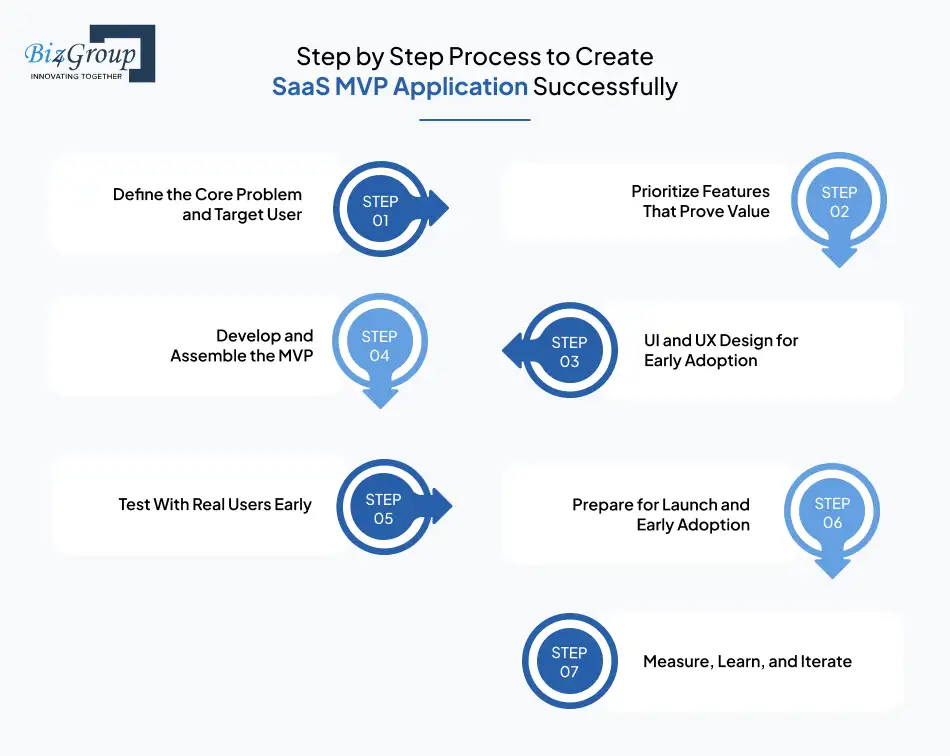
A clear process keeps SaaS MVP development focused and outcome driven. Without structure, teams drift into feature overload or endless revisions.
Below is a practical step by step approach businesses use to create SaaS MVP applications that deliver insight, traction, and direction without unnecessary complexity.
Step 1: Define the Core Problem and Target User
Every successful MVP begins with clarity. Teams identify a single problem worth solving and a specific user who feels it most.
Key actions
- Define the problem in one sentence
- Identify the primary user persona
- Validate urgency through interviews or research
Clear problem definition prevents feature sprawl and sets measurable success criteria.
Step 2: Prioritize Features That Prove Value
Once the problem is clear, the focus shifts to deciding what to build first. MVPs succeed when features support learning, not completeness.
Key actions
- List all possible features
- Rank them by impact and effort
- Select one core workflow
Feature discipline reduces cost and accelerates feedback loops.
Step 3: UI and UX Design for Early Adoption
Design plays a crucial role in user trust and usability. At the MVP stage, a good UI/UX design company removes friction and guides users to value quickly.
Key actions
- Map simple user journeys
- Design low friction onboarding
- Focus on clarity over decoration
Users judge value within minutes. A confusing interface hides even the best ideas.
Also read: Top 15 UI/UX design companies in USA
Step 4: Develop and Assemble the MVP
With scope and design defined, developing minimum viable product begins. This phase focuses on speed, iteration, and functional completeness of the core workflow.
Key actions
- Build core functionality first
- Test workflows during development
- Review progress against MVP goals
Frequent checkpoints reduce rework and keep teams aligned with outcomes.
Also read: Top 12+ MVP development companies in USA
Step 5: Test With Real Users Early
Testing is not reserved for the end. MVPs benefit from early exposure to real users who interact naturally with the product.
Key actions
- Release to a limited user group
- Observe usage patterns
- Collect qualitative feedback
Real usage reveals gaps that internal testing misses.
Step 6: Prepare for Launch and Early Adoption
Launch readiness ensures users can onboard smoothly and understand the product’s value without assistance.
Key actions
- Finalize onboarding flows
- Set up basic support channels
- Define success metrics
A smooth first experience increases retention and meaningful feedback.
Step 7: Measure, Learn, and Iterate
An MVP launch is the start, not the finish. Continuous learning guides what to improve, expand, or remove.
Key actions
- Track engagement and retention
- Identify feature usage trends
- Adjust roadmap based on insights
Iteration turns an MVP into a growth-ready product.
A structured process helps SaaS MVP development stay focused, efficient, and insight driven. By moving step by step with intention, teams reduce risk while building products grounded in real user behavior.
Also read: AI SaaS website platform development guide
What If Your SaaS MVP Was Live in Weeks, Not Months?
Clear steps, real users, fast feedback. That’s how winning SaaS products get built today.
Build with Biz4GroupSecurity and Regulatory Readiness in SaaS MVP Development
Security and compliance often get pushed aside during early builds. That decision can quietly damage trust and slow growth later. In SaaS MVP development, the goal is not enterprise grade security from day one. The goal is responsible readiness that protects users, data, and your product’s credibility.
Below are the security and regulatory essentials every team should address when they build SaaS MVP products.
Core Security Practices to Include in a SaaS MVP
- Secure User Authentication: Use proven authentication methods to protect user access and prevent unauthorized entry when you develop a SaaS MVP.
- Data Encryption Basics: Encrypt sensitive data in transit and at rest to reduce exposure risks during SaaS MVP software development.
- Role Based Access Control: Limit what users can see and modify based on roles. This supports safer workflows as you build minimum viable product for SaaS platforms.
- Secure API Access: Protect APIs with tokens or keys to avoid misuse as integrations grow.
- Basic Monitoring and Logging: Track unusual activity early so issues are caught before they escalate.
Regulatory Considerations Based on Industry
- Healthcare SaaS: Plan for HIPAA aligned data handling when teams create SaaS MVP applications in healthcare or wellness.
- Financial and Payment Based SaaS: Follow PCI related practices when MVPs handle payments or transactions.
- HR and Employee Data Platforms: Protect personal and payroll data to maintain compliance and trust.
- Global SaaS Products: Account for GDPR basics when users are based in multiple regions.
These steps help teams develop scalable SaaS MVP solutions without introducing regulatory debt.
Common Compliance Mistakes to Avoid Early
- Storing sensitive data without encryption
- Granting excessive user permissions
- Ignoring consent and data usage transparency
- Delaying compliance planning until scale
Security and compliance do not slow SaaS MVP development when handled thoughtfully. They protect momentum. By addressing core safeguards early, teams build trust with users, partners, and investors while keeping future expansion clean and manageable.
How Much Does It Cost to Develop a SaaS MVP?
Cost is often the first serious question founders ask, and for good reason. In SaaS MVP development, budgets shape scope, timelines, and long-term flexibility. On average, businesses can expect a SaaS MVP development cost estimate to fall between $15,000-$100,000+, depending on complexity, feature depth, and growth intent.
Core Cost Drivers in SaaS MVP Development
Understanding what drives cost helps founders make smarter tradeoffs early. The table below breaks down the main contributors when teams build SaaS MVP products.
|
Cost Driver |
Why It Impacts Cost |
Typical Cost Range |
|
Feature Scope |
More workflows increase build effort |
$5,000-$25,000 |
|
UI and UX Design |
Impacts adoption and usability |
$3,000-$12,000 |
|
Product Complexity |
Logic, rules, and interactions |
$4,000-$20,000 |
|
Integrations |
External tools and APIs |
$2,000-$15,000 |
|
Testing and QA |
Stability and reliability |
$2,000-$10,000 |
|
Project Management |
Coordination and delivery |
$1,500-$8,000 |
Clear scope control at this stage can reduce overall MVP spend by 20%-30% without affecting learning outcomes.
Hidden Costs That Often Surprise Founders
Even with careful planning, some costs surface after development begins. These are not mistakes, but they need early awareness when teams make a SaaS MVP for startups and entrepreneurs.
1. Iteration and Change Requests
User feedback leads to changes, and changes take time.
- Minor refinements often add $2,000-$6,000
- Feature adjustments can push costs higher if scope is unclear
This is why MVPs should plan room for iteration.
2. Maintenance and Early Support
Once users start interacting with the product, ongoing care becomes necessary.
- Bug fixes and minor improvements can cost $1,000-$4,000 monthly
- Performance tuning may add $2,000-$6,000 during growth phases
Maintenance ensures MVP insights remain reliable.
3. Third Party Services and Licenses
External tools often charge usage-based fees.
- Analytics and monitoring tools may cost $200-$1,500 per month
- Payment and communication services add variable transaction fees
These expenses scale with adoption.
4. Scaling Preparation Costs
As traction grows, infrastructure and architecture updates follow.
- Early scaling adjustments often cost $5,000-$15,000
- Preparation for enterprise readiness can add $20,000+ later
Teams that develop scalable SaaS MVP solutions plan for this transition early.
Hidden costs are manageable when anticipated. Surprises happen only when they are ignored during planning.
How MVP First Strategy Controls Long-Term Costs
Building everything upfront feels safe but often costs more in the long run. SaaS MVP development spreads investment across learning milestones.
Benefits include:
- Lower upfront financial risk
- Clear signals before expanding scope
- Smarter budgeting for advanced features
Teams that create SaaS MVPs for faster go to market typically reduce wasted development spend by 30%-40% compared to full build first approaches.
Next, we will explore the challenges, risks, and common mistakes in SaaS MVP development and how teams can avoid them early.
Also read: AI SaaS product development cost guide
Still Guessing the Cost of Your SaaS MVP?
Most MVPs land between $15,000-$100,000+. The real risk is overspending without proof.
Get an MVP Cost EstimateOperational and Business Challenges in SaaS MVP Product Development
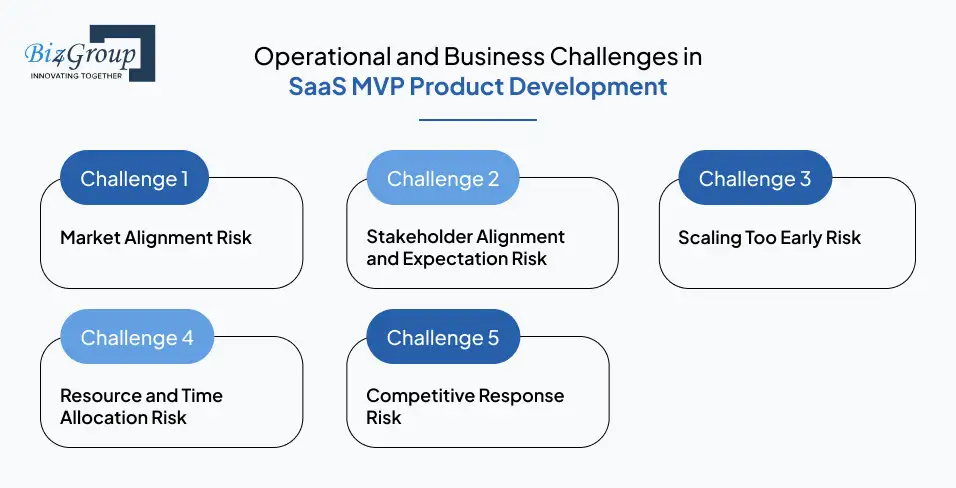
Even with a strong plan, SaaS MVP development comes with challenges that extend beyond features and budgets. These risks are less about what to build and more about how decisions, timing, and alignment affect outcomes. Addressing them early helps teams develop scalable SaaS MVP solutions without losing momentum or confidence.
Challenge 1: Market Alignment Risk
One of the most common risks appears after launch. Users sign up, explore briefly, then disengage. This usually points to a gap between perceived value and actual daily usefulness.
Where the risk shows up
- Low repeat usage
- Weak engagement after onboarding
- Feature usage concentrated in one area
How teams manage it
- Monitor behavior patterns, not survey responses
- Refine workflows based on observed friction
- Adjust positioning to match how users actually use the product
Usage data reveals truth faster than feedback alone. MVPs that listen closely adapt quicker.
Challenge 2: Stakeholder Alignment and Expectation Risk
Misalignment between founders, product teams, and business stakeholders can quietly derail progress. Different expectations about speed, scope, or outcomes create tension during SaaS MVP product development.
Where the risk shows up
- Conflicting priorities during iteration
- Delays caused by approval loops
- Unclear success benchmarks
How teams manage it
- Define MVP success metrics upfront
- Align stakeholders around learning goals
- Use data from the MVP to guide decisions
Alignment keeps teams focused on progress rather than debate.
Challenge 3: Scaling Too Early Risk
Early traction feels exciting, but scaling prematurely often introduces instability. Teams sometimes expand features or user access before validating core workflows.
Where the risk shows up
- Performance issues during early growth
- Increased support burden
- Rising costs without proportional returns
How teams manage it
- Validate core use cases before expansion
- Scale users in controlled phases
- Align feature growth with retention signals
Sustainable scale follows proven value, not early excitement.
Challenge 4: Resource and Time Allocation Risk
Time pressure and limited resources force tradeoffs. Without careful prioritization, teams spread effort thin across too many initiatives.
Where the risk shows up
- Incomplete features
- Missed feedback cycles
- Burnout within teams
How teams manage it
- Focus on one primary workflow
- Set short, realistic delivery milestones
- Pause secondary initiatives until validation is clear
Focus protects both timelines and team energy.
Challenge 5: Competitive Response Risk
Launching early also means competitors notice. Larger players may move faster once they see traction.
Where the risk shows up
- Feature imitation
- Pricing pressure
- Market noise
How teams manage it
- Deepen understanding of niche users
- Strengthen onboarding and experience
- Build loyalty through responsiveness
Speed and customer closeness often outperform size.
Challenges in SaaS MVP development are inevitable, but they are manageable. Teams that anticipate risks related to alignment, timing, and focus build resilience into their process. By treating the MVP as a learning system, businesses gain control over uncertainty instead of reacting to it.
Turning SaaS MVP Development into a Scalable SaaS Product
Reaching MVP validation is a milestone, not the destination. The real value of SaaS MVP development shows up in what teams do next. This phase focuses on turning early signals into a structured path for growth, without losing the speed and clarity that made the MVP successful.
Reading MVP Signals the Right Way
Before scaling, teams must understand what the MVP is truly telling them. Data should guide decisions, not excitement or pressure.
Key signals to evaluate:
- Consistent repeat usage across core workflows
- Clear user drop-off points during onboarding
- Features that drive the longest engagement time
- Early willingness to pay or upgrade
Teams that develop scalable SaaS MVP solutions use these signals to decide what to expand, refine, or remove.
What Changes When You Move Beyond MVP
Scaling does not mean adding everything users ask for. It means strengthening what already works.
|
Area |
MVP Focus |
Scalable SaaS Focus |
|
Features |
Core workflow |
Depth and reliability |
|
Users |
Early adopters |
Broader segments |
|
Feedback |
Qualitative |
Data driven |
|
Operations |
Manual support |
Repeatable processes |
This shift helps teams build SaaS MVP products into stable platforms without bloating scope.
Expanding Features with Purpose
Feature expansion should follow a simple rule. Every addition must support retention, revenue, or efficiency.
Smart expansion areas include:
- Enhancements to the most used workflows
- Improvements that reduce support dependency
- Features that unlock new pricing tiers
- Integrations requested by active users
Quick check before adding a feature
- Does this solve a recurring problem?
- Will it be used weekly or daily?
- Can it support monetization or retention?
If the answer is unclear, the feature can wait.
Preparing the Product and Team for Growth
Growth affects more than the product. It changes how teams operate and support users.
Common preparation steps:
- Standardizing onboarding flows
- Defining support and escalation processes
- Improving documentation and self service
- Aligning roadmap planning with usage data
These steps allow businesses to make a SaaS MVP for startups and entrepreneurs that transitions smoothly into a dependable SaaS product.
When to Commit to Full Scale SaaS Development
Scaling too early increases cost and complexity. Waiting too long can stall momentum. Timing matters.
Strong indicators it is time to scale:
- Stable usage patterns over multiple weeks
- Clear demand for advanced features
- Predictable acquisition and retention metrics
- Operational readiness to support more users
Moving from MVP to scalable SaaS requires discipline and patience. The goal is growth with intent, not speed for its own sake. By expanding only what proves value, businesses protect their product vision, budgets, and long-term market position.
Your MVP Worked. Now What?
The difference between a good idea and a scalable SaaS business is how you grow next.
Scale with Biz4Group’s ExpertsWhy Businesses Across the USA Trust Biz4Group LLC for SaaS MVP Development
Biz4Group LLC is a USA-based software development company built for founders and businesses that value clarity, speed, and outcomes.
We specialize in SaaS MVP development that turns early ideas into working products users can trust and investors can believe in.
What sets us apart is how we approach MVPs. We do not treat them as disposable experiments. We treat them as the foundation of a scalable business. From startups shaping their first product to enterprises validating new SaaS offerings, we help teams develop a SaaS MVP that proves value quickly while staying ready for growth. Our experience spans consumer platforms, enterprise AI solutions, AI applications, and AI-powered SaaS products built for demanding markets.
Our teams understand the pressure founders face. Timelines are tight. Budgets matter. Expectations are high. We work with that reality, not against it, by focusing on what truly moves the product forward.
Why Businesses Choose Biz4Group LLC
Businesses across the USA choose Biz4Group LLC because we bring discipline to innovation and structure to speed.
- We lead with business thinking, not code first assumptions
- We help clients create SaaS MVP applications aligned with real user behavior
- We balance rapid delivery with long-term scalability
- We communicate clearly and involve stakeholders at every stage
- We have proven experience across startups and enterprises
Clients also value our ability to guide decisions. Whether it is feature prioritization, roadmap planning, or cost control, we act as a product partner rather than a task executor. This approach helps companies develop scalable SaaS MVP solutions that survive beyond the launch phase.
Our portfolio reflects this depth. The result is confidence. Confidence to launch. Confidence to iterate. Confidence to scale.
SaaS MVP development demands more than speed. It demands judgment, experience, and accountability. Biz4Group LLC brings all three to the table. When businesses work with us, they gain a partner that understands the stakes and delivers with intent.
If you are planning to validate an idea, enter a new market, or launch a SaaS product that needs to perform from day one, the right partner can make all the difference.
We are that right partner for you. Let’s talkFinal Thoughts
Building a successful SaaS product starts long before scale, funding, or market buzz. SaaS MVP development gives businesses a practical way to test ideas, understand users, and make decisions based on evidence rather than assumptions. By focusing on core value, controlled investment, and real-world feedback, teams reduce risk while increasing their chances of building something people truly want.
From defining the problem to validating demand and preparing for growth, a well-planned MVP creates direction. It helps founders prioritize what matters, respond quickly to user behavior, and move forward with confidence. In a competitive SaaS landscape, this approach turns uncertainty into clarity and ideas into momentum.
Biz4Group LLC helps businesses take this path with purpose. As a trusted AI development company, we bring experience, structure, and strategic thinking to every SaaS MVP we build. Our teams work closely with founders and organizations to deliver products that validate quickly and scale smoothly, without unnecessary complexity or wasted effort.
If you are ready to turn your SaaS idea into a product users trust and investors respect, now is the time to act. Build smart, move fast, and partner with Biz4Group LLC to launch your SaaS MVP with confidence.
FAQs
How long should a SaaS MVP stay in the market before scaling decisions are made?
A SaaS MVP should typically stay live for 6–12 weeks with consistent user activity before scaling decisions are taken. This window allows enough time to observe behavior patterns, retention signals, and feature relevance without rushing conclusions. Shorter timelines often lead to decisions based on noise rather than insight.
Can a SaaS MVP be built for internal business use, not public launch?
Yes. Many companies use SaaS MVP development for startups and enterprises to validate internal tools before rolling them out company-wide. Internal MVPs help test workflows, reduce operational friction, and confirm ROI before larger adoption or external commercialization.
What metrics matter most immediately after launching a SaaS MVP?
Early SaaS MVP success is measured through activation rate, repeat usage, time to first value, and feature engagement. Revenue metrics can come later, but these early indicators help teams decide whether to iterate, reposition, or expand the product.
Should pricing be tested during SaaS MVP development?
Yes, pricing experiments are valuable at the MVP stage. Even simple signals such as upgrade intent, willingness to pay, or feature gated access help teams understand value perception. This insight shapes smarter pricing models before a full-scale launch.
Is it better to target a niche or a broad audience with a SaaS MVP?
A focused niche almost always performs better for MVP validation. Narrow audiences provide clearer feedback, stronger engagement, and faster learning cycles. Once traction is proven, the product can be expanded to adjacent segments with confidence.
What makes a SaaS MVP development partner truly reliable?
A reliable partner goes beyond delivery. They help challenge assumptions, prioritize outcomes, and guide decisions using real product experience. Strong communication, business understanding, and the ability to support growth after launch are key indicators of a dependable SaaS MVP development partner.
