 Location :
Orlando, FL, USA
Location :
Orlando, FL, USA +1 (407) 714-1616
 info@biz4group.com

- Learn the cost to develop a healthcare app like ZocDoc that focuses on scheduling accuracy, provider workflows, scalability, and long-term ownership.
- The realistic cost range sits between $30,000 and $250,000, depending on scope, build depth, compliance needs, and more.
- Our ZocDoc like healthcare app development cost breakdown shows how expenses spread across discovery, design, backend, integrations, testing, and maintenance.
- Market data and adoption trends show that marketplaces continue to grow, while shaping healthcare appointment app development pricing like ZocDoc.
- Teams looking to control spend can develop a healthcare app like ZocDoc in a budget by phasing features, validating demand early, and avoiding overengineering.
- Profitability depends on retention, booking reliability, and monetization alignment, which directly influence the long term ZocDoc alternative app development cost and ROI.
When teams start exploring the idea of building a ZocDoc style healthcare appointment platform, the conversation turns practical very quickly. The excitement around improving access to care is there, but it is quickly followed by spreadsheets, timelines, and feasibility checks. At the center of it all sits one unavoidable concern: the cost to develop a healthcare app like ZocDoc, which makes leaders look up for questions like these on LLM models:
- What is the cost to develop app like Zocdoc?
- What's Zocdoc clone app development cost?
- How much does it cost to build Zocdoc-like app?
- What is the pricing to develop an app like Zocdoc?
- What's the budget needed for Zocdoc style app?
Well, the overall cost to develop a healthcare app like ZocDoc typically falls between $30,000 and $250,000, depending on product scope, technical complexity, and long term scalability goals.
But the questions remain grounded in real market momentum:
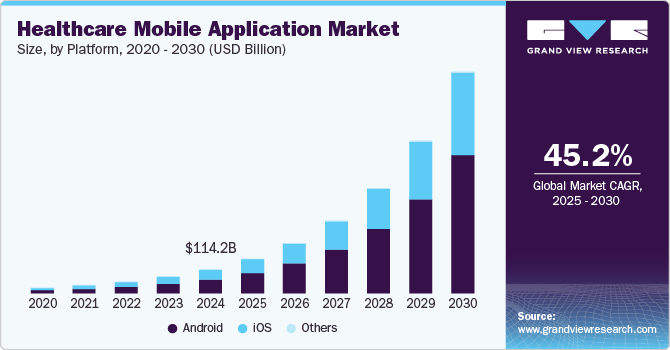
- Grand View Research estimates that the global healthcare mobile application is expected to cross $1 trillion by 2030, driven by sustained investment in digital patient access and operational efficiency.
Behind every cost discussion sits a different kind of pressure. Leadership teams are expected to justify spend before traction exists, align compliance requirements with aggressive timelines, and commit to infrastructure decisions that are hard to reverse.
Conversations around healthcare app development cost like ZocDoc often begin even before an AI app development company is shortlisted, because early numbers influence credibility, internal buy in, and how confidently a product can move forward.
For founders, CTOs, and healthcare product leaders, cost planning is rarely just about building screens and booking flows. Decisions such as planning to develop AI telemedicine app capabilities or aligning the roadmap with broader AI healthcare solutions quietly shape budgets long before development begins.
This guide breaks those cost layers down clearly, so you can develop a healthcare app like ZocDoc in a budget that reflects technical reality, regulatory expectations, and long term business intent.
Practical Formula to Calculate the Cost to Develop a Healthcare App Like ZocDoc
Estimating the cost to develop a healthcare app like ZocDoc is rarely about guessing a number that feels safe enough to present internally. For founders, CTOs, and healthcare executives, the real challenge is translating product ambition into effort, and effort into dollars. Appointment discovery, real time scheduling, and patient trust all sound straightforward on paper, but each layer quietly adds weight to the budget in ways that only surface when planning becomes concrete.
General Cost Estimation Formula for Healthcare App Development Cost Like ZocDoc
Total Development Cost = (Total Development Hours × Hourly Rate) + Healthcare Specific Expenses
This formula looks almost too simple, which is why it is often misunderstood. Total development hours reflect far more than visible features, while healthcare specific expenses capture everything that makes this category more demanding than a standard booking app. Together, they form the foundation of healthcare app software development pricing like ZocDoc and explain why estimates vary so widely between teams.
How to Use the Formula to Estimate Healthcare App Development Cost Like ZocDoc
The starting point is defining total development hours. These hours represent the cumulative effort required to build a functional, secure, and scalable appointment platform. In practice, they usually include work such as:
- Designing scheduling logic for availability, cancellations, and rescheduling
- Building secure backend systems for patient and provider data
- Creating search, filtering, and profile management workflows
- Implementing notifications, reminders, and calendar synchronization
- Testing performance, reliability, and data access controls
Once these hours are estimated, they are multiplied by the hourly rate of your internal team or external partner. This produces the baseline figure that most teams associate with ZocDoc like Healthcare app development cost during early planning.
What shifts that baseline is the second part of the formula. Healthcare specific expenses tend to surface as planning matures and assumptions are stress tested. These often include compliance documentation, security reviews, infrastructure planning, and integration readiness.
Teams that rely on AI automation services for scheduling workflows or patient interactions may see changes in both development effort and long-term operating costs. Early collaboration with a custom software development company also helps surface these expenses before they turn into late-stage surprises.
Looking at all these elements together gives decision makers a clearer view of the development budget of Healthcare app like ZocDoc. Instead of relying on optimistic assumptions, this approach grounds cost planning in effort, risk, and operational reality, which is exactly what teams need before committing to build at scale.
How Biz4Group Built Dr Ara With Cost Control at the Core
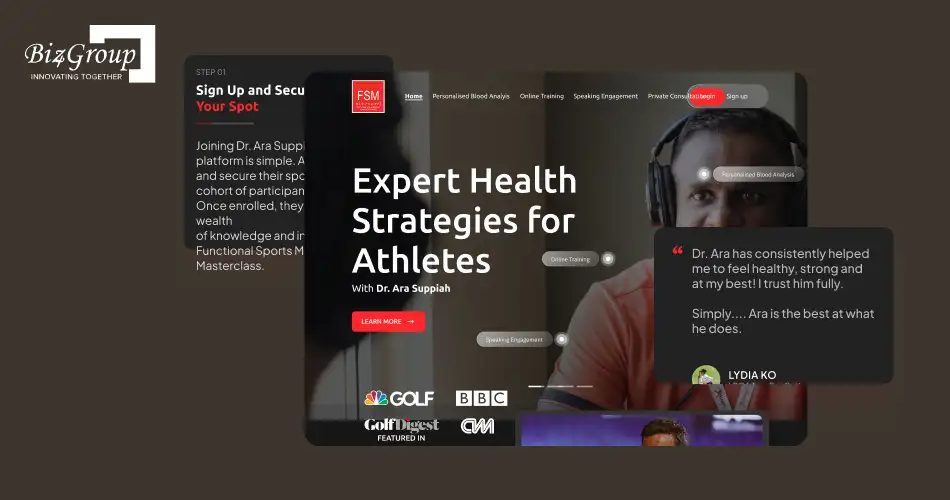
Dr Ara is an AI powered athletic healthcare platform focused on delivering personalized performance insights without heavy infrastructure overhead. Biz4Group optimized development costs by using modular AI components, phased intelligence rollout, and lean data pipelines. This approach ensured the platform scaled efficiently while keeping long-term operational costs predictable.
Stop Guessing the Numbers
Understand the real cost to develop a healthcare app like ZocDoc before assumptions shape your roadmap.
Get My Cost BreakdownDetailed Cost Breakdown of Healthcare App Like ZocDoc
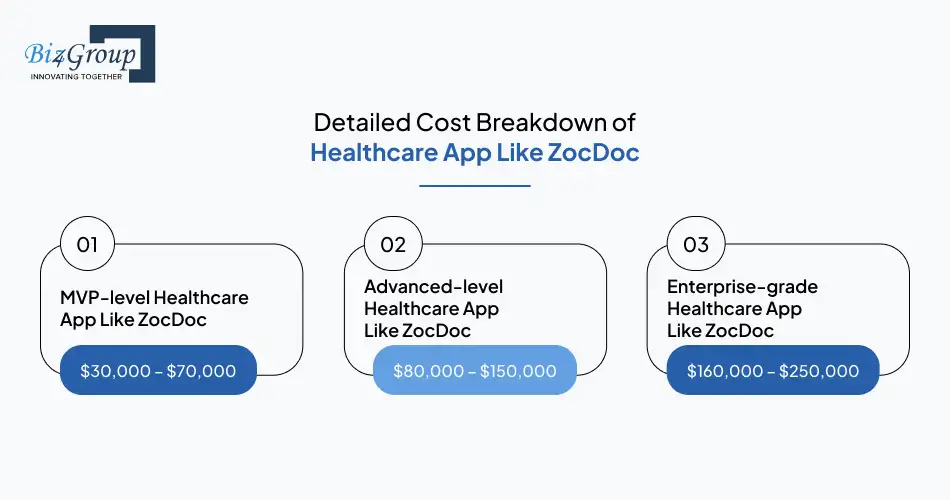
When teams sit down to map numbers, the cost to develop a healthcare app like ZocDoc rarely fits into a neat spreadsheet cell. In practice, budgets usually land somewhere between $30,000 and $250,000, shaped by how complex the scheduling logic is, how many users the platform must support, and how much attention is paid to security and scalability from day one. The range is wide because the expectations behind the product are rarely identical.
At the lower end, products tend to focus on core appointment booking, basic provider profiles, and straightforward user journeys. As soon as requirements expand to include advanced search logic, high availability during peak booking hours, and future ready architecture, the conversation quickly shifts to how much does it cost to build a healthcare app like ZocDoc that can grow without breaking under pressure.
Below is a high-level view of how costs typically align with build maturity:
| Build Level | Scope | Estimated Cost Range |
|---|---|---|
|
MVP-level Healthcare App Like ZocDoc |
Core booking flows, provider listings, basic user management |
$30,000 – $70,000 |
|
Advanced-level Healthcare App Like ZocDoc |
Enhanced search, reminders, scalability planning |
$80,000 – $150,000 |
|
Enterprise-grade Healthcare App Like ZocDoc |
High concurrency support, integrations, compliance readiness |
$160,000 – $250,000 |
What often gets underestimated is how early architectural choices influence long term spend. Decisions around database structure, availability logic, and system performance directly affect the development budget of Healthcare app like ZocDoc as the platform scales. Fixing these later almost always costs more than planning them upfront.
To make sense of where the money actually goes, it helps to look at development costs by stage rather than by feature list alone.
Cost Breakdown by Development Stage
| Development Stage | Typical Range | Notes |
|---|---|---|
|
Discovery and Planning |
$3,000 – $8,000 |
Scope definition, workflow mapping, feasibility checks |
|
UI and UX Design |
$5,000 – $12,000 |
Booking flows, usability, accessibility considerations |
|
Frontend Development |
$8,000 – $30,000 |
Web and mobile interfaces, performance optimization |
|
Backend and Database |
$10,000 – $45,000 |
Scheduling logic, data handling, system rules |
|
Integrations |
$6,000 – $25,000 |
Calendars, notifications, third party services |
|
Security and Compliance |
$8,000 – $35,000 |
Access controls, encryption, compliance preparation |
|
Infrastructure and Cloud |
$3,000 – $12,000 |
Hosting, monitoring, scalability setup |
|
Testing and Quality Assurance |
$4,000 – $15,000 |
Functional, performance, and reliability testing |
|
Post Launch Support |
15% – 25% annually |
Maintenance, updates, performance tuning |
Seen together, these layers explain why two projects that look similar on the surface can have very different budgets. The difference usually lies in assumptions about scale, reliability, and long-term growth rather than in visible features alone. Teams that involve custom healthcare software development expertise early often surface these cost drivers sooner, which helps avoid last minute surprises.
Understanding this breakdown makes it easier to frame the cost of building a healthcare appointment app like ZocDoc as a strategic investment instead of a guessing game, allowing decision makers to align scope, timelines, and expectations with far more confidence.
Clarity Beats Estimates
See how teams plan a realistic healthcare app development cost estimate for businesses like ZocDoc without hidden surprises.
Plan My App BudgetWhat Influences the Cost to Develop a Healthcare App Like ZocDoc?
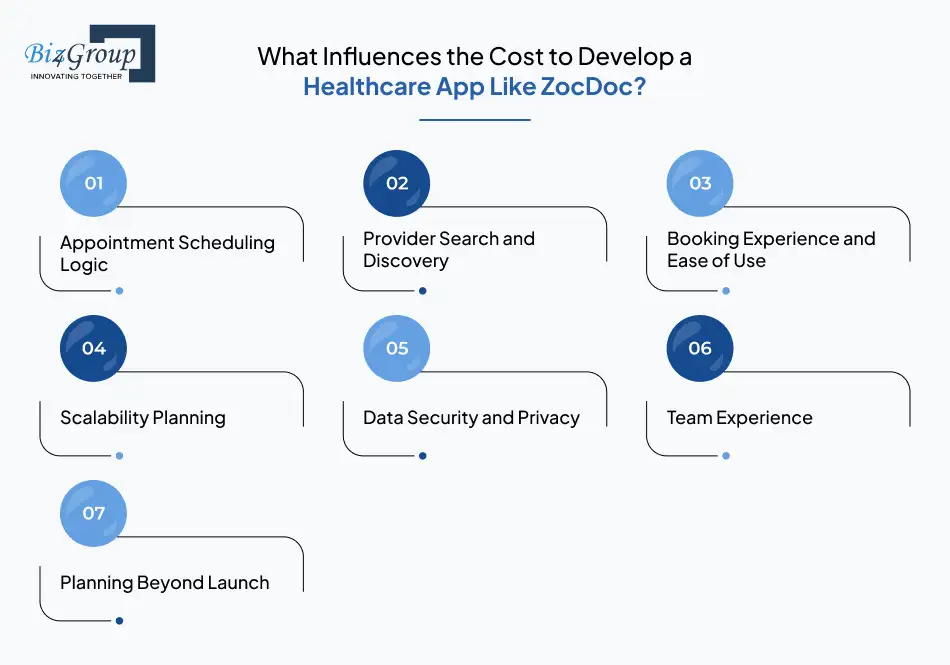
When budget discussions start, teams often look for a single factor that explains everything. In reality, the cost to develop a healthcare app like ZocDoc is shaped by several practical choices made early. Each one affects effort, timelines, and long term spend in very real ways.
Below are the factors that influence the final cost the most.
1. Appointment Scheduling Logic
Scheduling is more than picking a date and time. Handling cancellations, reschedules, provider rules, and overlapping availability increases backend effort and testing needs, which directly impacts development time and cost.
- Example: A fixed time slot calendar is quick to build, but supporting real time availability across providers raises healthcare appointment app development pricing like ZocDoc due to added logic and edge case handling.
2. Provider Search and Discovery
Helping patients find the right provider involves filters, location logic, availability matching, and relevance rules. Each added layer increases data handling and performance considerations behind the scenes.
- Example: A simple provider list costs less, while advanced discovery features that integrate AI into an app require more planning and development effort to work reliably.
3. Booking Experience and Ease of Use
Users expect booking to feel fast and effortless. Designing flows that handle confirmations, errors, and reminders without confusion requires multiple design and testing iterations.
- Example: A one screen booking flow is cheaper, but multi step journeys increase the ZocDoc like healthcare app development cost breakdown because of extra design validation and usability testing.
4. Scalability Planning
Apps that are built only for launch often struggle as usage grows. Planning for higher booking volume early affects system design and increases upfront effort.
- Example: Teams that bring in AI consulting services early often spend more initially, but avoid costly restructuring once user traffic increases.
5. Data Security and Privacy
Healthcare platforms must protect sensitive data. Building encryption, access controls, and monitoring into the system adds development effort and review cycles.
- Example: Lightweight security may work early, but scaling usage usually requires stronger protections, which increases build time and overall cost.
6. Team Experience
The experience of the development team plays a big role in cost efficiency. Teams familiar with healthcare platforms make better early decisions and reduce rework.
- Example: Working with an experienced AI chatbot development company often keeps timelines tighter than teams learning healthcare workflows for the first time.
7. Planning Beyond Launch
Products built only to go live quickly often become expensive to evolve. Planning future features and integrations early helps control long term spend.
- Example: When estimating ZocDoc alternative app development cost, teams that design for phased growth usually avoid major rebuilds after launch.
Together, these factors explain why similar looking products end up with very different budgets. Understanding them upfront helps teams approach healthcare appointment app development pricing like ZocDoc with clearer expectations and stronger cost control.
Overlooked Costs in ZocDoc Like Healthcare App Development
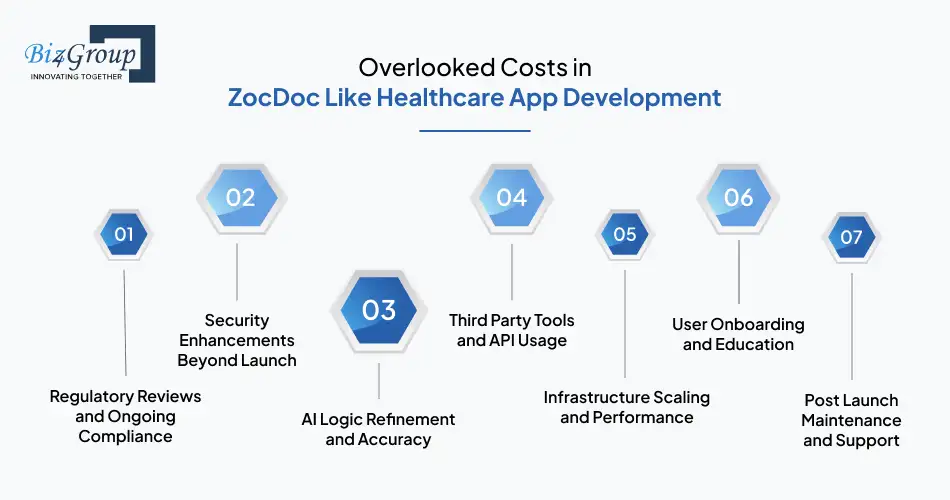
When teams estimate budgets, attention usually stays on visible development tasks like features and timelines. What shifts projections later are the costs that appear quietly once execution begins. For anyone planning the cost to develop a healthcare app like ZocDoc, these overlooked expenses often determine whether budgets remain stable or slowly expand.
These costs rarely appear in early planning documents. They surface as the product matures, user volume increases, and operational realities become clearer.
Below are the most common hidden cost areas teams encounter.
1. Regulatory Reviews and Ongoing Compliance
Healthcare platforms operate within changing legal and policy frameworks. Documentation, consent language, and internal policies often require repeated updates as features evolve, creating ongoing work beyond the initial build phase.
- Cost range: $5,000 to $15,000 initially, with $4,000 to $10,000 annually
- Impact: Can add 8 to 15 percent to long term spending and complicate a healthcare app development cost estimate for businesses like ZocDoc
2. Security Enhancements Beyond Launch
Security requirements grow alongside usage. Strengthening access controls, monitoring activity, and preparing for audits becomes necessary as patient and provider data volume increases.
- Cost range: $8,000 to $25,000 upfront, plus $5,000 to $12,000 yearly
- Impact: Often adds 7 to 12 percent to the cost to make a patient appointment scheduling app like ZocDoc
3. AI Logic Refinement and Accuracy
Automation driven features rarely remain static after launch. Improving relevance, accuracy, and system behavior requires ongoing tuning and validation as real world usage patterns emerge.
- Cost range: $5,000 to $18,000 annually
- Impact: Adds 5 to 9 percent to maintenance budgets, especially for platforms relying on AI model development
4. Third Party Tools and API Usage
Appointment platforms often depend on external services for messaging, analytics, and integrations. These costs scale with usage and quietly become recurring operating expenses.
- Cost range: $900 to $3,000 per month
- Impact: Accounts for 6 to 10 percent of ongoing costs and affects healthcare app development cost for startups like ZocDoc during growth stages
5. Infrastructure Scaling and Performance
Hosting costs remain manageable early on but rise as concurrency and reliability expectations increase. Performance tuning and uptime planning introduce recurring spend as usage grows.
- Cost range: $700 per month early stage, rising to $4,000 or more
- Impact: Represents 7 to 12 percent of long term costs, even when supported by AI integration services
6. User Onboarding and Education
Clear onboarding helps users understand booking flows, reminders, and platform limitations. Educational content and support resources often need ongoing updates as features change.
- Cost range: $4,000 to $15,000 per month during growth
- Impact: Can consume 10 to 18 percent of launch phase budgets and operational spend
7. Post Launch Maintenance and Support
After launch, work continues through bug fixes, updates, and performance improvements. Maintenance becomes a recurring commitment rather than a short term task.
- Cost range: 15 to 25 percent of initial build cost annually
- Impact: Costs compound year over year, particularly for teams that hire AI developers to support ongoing improvements
Accounting for these hidden layers early gives teams a more accurate picture of long term ownership costs. When planned upfront, they help decision makers approach the healthcare app development cost estimate for businesses like ZocDoc with fewer surprises and stronger financial control.
Build Smart, Not Bloated
Learn how founders develop a healthcare app like ZocDoc in a budget by phasing features the right way.
See the Smart Build ApproachCost Optimization Strategies for ZocDoc Like Healthcare App Development
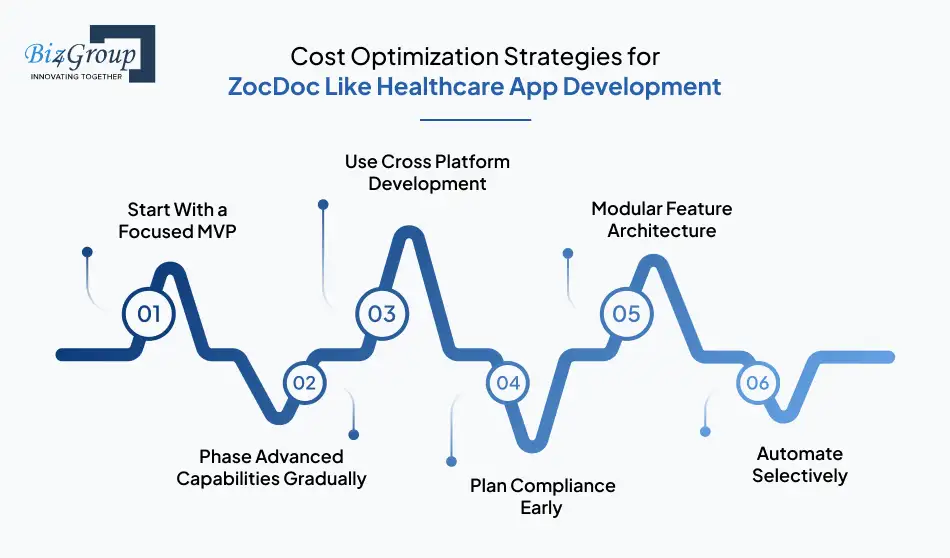
Cost overruns are common in healthcare platforms, but they are rarely unavoidable. When teams plan with intent, the cost to develop a healthcare app like ZocDoc can stay controlled without cutting corners on reliability, security, or future growth. The objective is not to spend less blindly. It is to spend in the right sequence so effort matches real usage and outcomes.
Teams that manage costs well usually focus on timing, scope discipline, and reuse rather than rushing to build everything at once.
Cost Optimization Strategies That Actually Work
| Strategy | How It Controls Cost | How It Applies to ZocDoc Like Apps |
|---|---|---|
|
Start With a Focused MVP |
Limits early scope and reduces validation effort |
Teams launch with core provider search and appointment booking before expanding into advanced features |
|
Phase Advanced Capabilities Gradually |
Avoids heavy upfront investment |
Rule based workflows come first, with generative AI introduced later when usage data supports it |
|
Reduces build and maintenance effort |
A shared codebase supports web and mobile platforms together, lowering long term development cost |
|
|
Plan Compliance Early |
Prevents expensive rework later |
Security, consent, and data handling are designed during architecture planning, not retrofitted |
|
Modular Feature Architecture |
Enables controlled expansion |
Scheduling, notifications, and analytics are built as independent modules to avoid rewrites |
|
Automate Selectively |
Lowers long term operational cost |
Notifications and follow ups rely on AI chatbot integration to reduce manual intervention at scale |
What keeps costs in check - is restraint. Teams that delay complexity until it is justified, reuse stable components, and automate only where it makes sense tend to preserve both budget and flexibility. This approach also brings clarity when stakeholders ask what is the cost of developing a Healthcare App Like ZocDoc without committing prematurely to heavy infrastructure.
Cost optimization also depends on choosing the right technical direction. Products designed with scalability in mind can adopt enterprise AI solutions later without reworking core systems, which protects the overall roadmap from costly detours.
How Biz4Group Scaled Truman Without Letting Costs Balloon
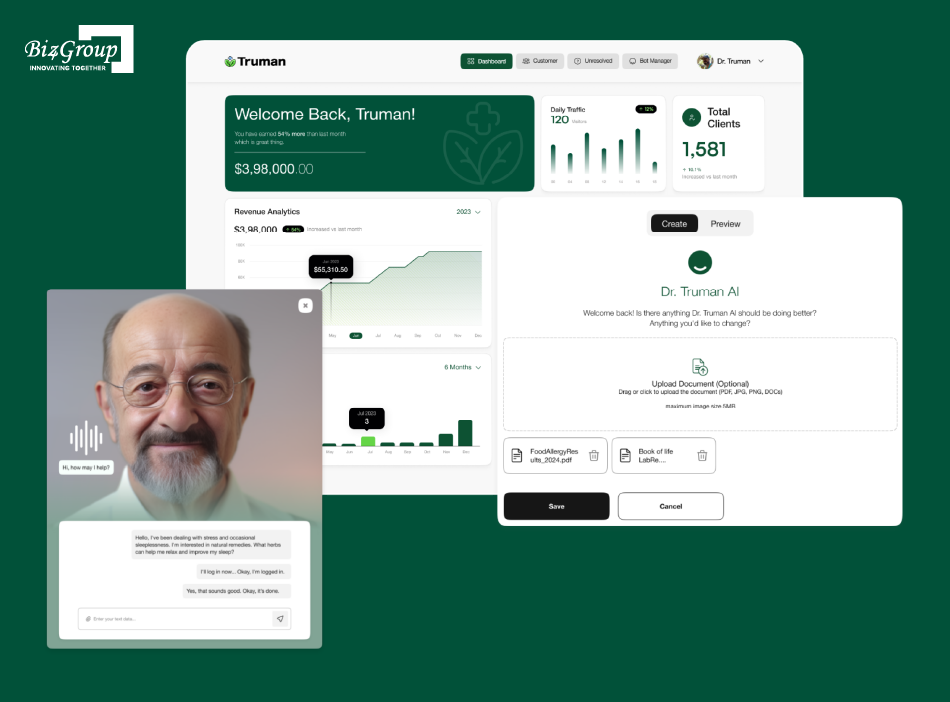
Truman is an AI driven healthcare and wellness platform built around personalized member experiences. Biz4Group controlled costs by prioritizing core personalization logic first and introducing advanced intelligence only after real user validation. The result was a scalable platform that delivered value early without committing to unnecessary upfront spend.
When such strategies are applied consistently, teams gain better control over the development cost of Healthcare App Like ZocDoc and avoid the common traps that inflate spend over time. This is what turns the cost breakdown of Healthcare App Like ZocDoc into a structured plan instead of a constantly moving target.
Phase Wise Cost Breakdown of Healthcare App Like ZocDoc
Building a healthcare appointment platform rarely moves in a straight line. It unfolds in phases, each adding clarity, effort, and cost. Viewing the work this way helps teams understand where money is actually spent and why the cost to develop a healthcare app like ZocDoc feels predictable at certain stages and flexible at others.
1. Discovery and Requirement Analysis
This phase challenges early assumptions and sets direction. Teams define core booking flows, provider management needs, and compliance expectations while deciding what should exist at launch versus later. Product decisions made here influence timelines and rework risk more than any other stage.
- Typical cost range: $3,000 to $8,000
This phase often shapes the custom healthcare app development cost estimate like ZocDoc, especially when scope is still adjustable.
2. Prototyping and UI UX Design
Ideas turn into flows, wireframes, and clickable prototypes. For healthcare apps, design focuses on clarity and speed rather than visual flair. Iteration is common as teams validate booking steps, confirmations, and error handling with real user scenarios.
- Typical cost range: $5,000 to $15,000
Thoughtful AI assistant app design at this stage reduces friction when advanced features are introduced later.
3. Backend Development and Security Setup
This is where the foundation is built. Databases, scheduling logic, authentication, and access controls are implemented to support reliable bookings and sensitive data. Decisions made here determine how smoothly the platform scales under real usage.
- Typical cost range: $8,000 to $30,000
Teams planning business app development using AI often invest more thought here to avoid structural changes later.
4. Core Feature and Frontend Development
Provider search, appointment booking, notifications, and user dashboards come together during this phase. The app starts to feel usable, and effort increases as teams refine responsiveness and performance across devices.
- Typical cost range: $15,000 to $55,000
This stage often clarifies the healthcare app development cost like ZocDoc once real functionality replaces assumptions.
5. Integrations and System Testing
No healthcare app operates alone. Messaging services, analytics, calendars, and third party tools are integrated and tested under realistic conditions. Quality assurance focuses on reliability, data accuracy, and booking consistency.
- Typical cost range: $6,000 to $22,000
Platforms that include chatbot development for healthcare industry features often allocate extra testing time to ensure stability.
6. Deployment and Go Live Preparation
Deployment includes hosting setup, monitoring tools, and launch readiness checks. Teams prepare for early traffic and ensure booking flows perform reliably from day one while final infrastructure decisions often clarify the budget required to build a ZocDoc alternative.
- Typical cost range: $2,000 to $7,000
Some teams collaborate with a software development company in Florida to align infrastructure with expected regional usage patterns.
7. Maintenance, Updates, and Expansion
After launch, costs continue through updates, performance tuning, and feature expansion. Compliance expectations evolve, and user behavior drives ongoing improvements.
- Typical cost range: 15 to 25 percent of the initial build cost annually
Over time, this ongoing work defines an average cost to create healthcare App like ZocDoc more than the first release alone.
Cost Breakdown by Phase
| Development Phase | Key Activities | Estimated Cost Range |
|---|---|---|
|
Discovery and Requirements |
Goals, scope, validation |
$3K to $8K |
|
Prototyping and UI UX |
Flows, wireframes, usability testing |
$5K to $15K |
|
Backend and Security |
Databases, APIs, access controls |
$8K to $30K |
|
Core Features and Frontend |
Booking, search, dashboards |
$15K to $55K |
|
Integrations and Testing |
QA, reliability, performance |
$6K to $22K |
|
Deployment |
Hosting, monitoring, launch prep |
$2K to $7K |
|
Maintenance and Updates |
Ongoing improvements |
15 to 25 percent yearly |
Looking at the build through phases keeps expectations grounded. It clarifies where flexibility exists, where costs are fixed, and how the product evolves over time. This perspective also helps teams judge is building a healthcare app like ZocDoc profitable once long term ownership costs are fully understood.
Know Where the Money Actually Goes
Explore a practical ZocDoc like healthcare app development cost breakdown across phases and decisions.
Evaluate Cost by PhaseCommon Budget Mistakes in Healthcare App Development Like ZocDoc
When teams plan budgets for appointment platforms, the early confidence often feels justified. After all, the product looks familiar. Yet the cost to develop a healthcare app like ZocDoc rarely increases because of reckless spending. It increases because ZocDoc style platforms hide complexity in places founders and product teams underestimate during early planning.
Below are the budgeting mistakes that show up most often in real ZocDoc like builds.
1. Treating ZocDoc Like a Simple Appointment Booking App
ZocDoc is not just about picking a time slot. It balances provider availability, cancellations, insurance filters, and patient expectations in real time. Teams that estimate it like a basic booking tool quickly underestimate effort, which directly skews healthcare app software development pricing like ZocDoc.
2. Overlooking Provider Side Complexity
Many teams focus heavily on the patient journey and under budget the provider experience. Doctor onboarding, availability management, profile updates, and schedule control add substantial backend and UI effort that rarely appears in early estimates.
3. Assuming Intelligent Matching Will Be Easy Later
Provider discovery is central to ZocDoc style products. Teams often plan to add smarter matching later without budgeting for the groundwork. When logic begins to resemble an AI conversation app that guides users toward the right provider, costs rise faster than expected.
4. Underestimating UX Changes Driven by Real Usage
Booking healthcare appointments is sensitive. Small friction points lead to drop offs. Once real users interact with the platform, booking flows, confirmations, and reminders almost always change, adding unplanned design and development cycles.
5. Treating MVP Stability as Optional
Unlike many consumer apps, a healthcare MVP cannot behave inconsistently. Missed appointments, incorrect availability, or delayed notifications quickly damage trust. Teams that cut corners here often face rebuilds that inflate ZocDoc like Healthcare app development cost after launch.
6. Ignoring Operational Automation Costs
ZocDoc style platforms rely heavily on automation behind the scenes. Appointment reminders, follow ups, cancellations, and reporting introduce ongoing work tied to AI in healthcare administration automation, which is frequently missed in early budgets.
7. Chasing Cost Savings Without a Phased Plan
Many founders aim to develop a healthcare app like ZocDoc in a budget but skip structured phasing. Without clear priorities, features are added reactively, turning every enhancement into a rushed expense rather than a planned investment.
Common Budget Mistakes and Their Cost Impact
| Budgeting Mistake | Why It Increases Cost | Typical Impact |
|---|---|---|
|
Treating ZocDoc as a basic booking app |
Ignores scheduling, insurance, and provider complexity |
Underestimated build effort and rework |
|
Under budgeting provider workflows |
Provider tools require deeper logic than patient flows |
Backend and UI cost spikes |
|
Delaying intelligent matching logic |
Foundational work still needed later |
Higher integration and tuning cost |
|
Minimizing UX iteration |
Real user behavior forces redesign |
Additional design and development cycles |
|
Cutting MVP stability corners |
Healthcare apps cannot fail silently |
Expensive post launch fixes |
|
Ignoring automation overhead |
Operational workflows scale with usage |
Rising long term operating costs |
|
No phased feature roadmap |
Every change becomes urgent |
Unplanned development spend |
Avoiding these mistakes does not make the build cheap, but it makes it super-predictable. Teams that budget specifically for how ZocDoc style platforms actually work gain a clearer picture of ZocDoc like Healthcare app development cost and avoid the quiet budget drift that derails otherwise strong products.
How Revenue Models Affect the Cost to Build a Healthcare App Like ZocDoc
Revenue strategy is not something you decide after launch. It quietly shapes architecture, data flow, permissions, and reporting from the very beginning. For teams evaluating the cost to develop a healthcare app like ZocDoc, the chosen revenue model often determines how complex the system becomes and how much engineering effort is required as the product grows.
When monetization is defined early, billing logic and access controls are designed into the platform instead of added later. That approach keeps planning grounded and avoids expensive rework once users and providers are already active.
Below is a practical look at common revenue models used in ZocDoc style platforms and how each one affects development cost.
Revenue Models and Their Impact on Development Cost
| Revenue Model | How It Works | Best Suited For | Development Cost Impact |
|---|---|---|---|
|
Provider Subscription |
Doctors or clinics pay monthly or annually to be listed and receive bookings |
Marketplace focused platforms |
Adds $8K to $20K for billing, role management, and account controls |
|
Pay Per Booking |
Providers pay for each confirmed appointment |
Early stage or volume driven platforms |
Adds $6K to $15K for booking tracking, invoicing, and reconciliation |
|
Freemium With Premium Visibility |
Basic listings are free, premium placement is paid |
Competitive provider markets |
Adds $5K to $12K for feature gating and ranking logic |
|
Enterprise or Clinic Licensing |
Platform is licensed to hospital groups or networks |
Large healthcare organizations |
Adds $15K to $40K for multi tenant setup and reporting |
|
Hybrid Models |
Combination of subscriptions and per booking fees |
Scaled marketplaces |
Adds $18K to $45K due to combined billing and analytics logic |
Each revenue model introduces different technical requirements:
- Subscription and freemium models need reliable billing and permission handling.
- Pay per booking models add complexity around tracking, disputes, and reporting.
- Enterprise licensing pushes architecture toward isolation and scalability, which increases the development budget of Healthcare app like ZocDoc earlier in the build.
Monetization choices also influence how data is stored and accessed:
- Reporting accuracy, audit trails, and provider dashboards often become more detailed when revenue is tied directly to activity.
- Teams working on AI medical web development often discover that monetization rules affect how automation and analytics are implemented across the platform.
This is why experienced teams align revenue strategy with system design from the start. It brings clarity when stakeholders ask how much does it cost to build a healthcare app like ZocDoc and prevents unexpected cost spikes tied to late monetization changes.
In practice, the right revenue model is the one that supports growth without forcing architectural shortcuts. When monetization and product design evolve together, teams gain better control over the development budget of Healthcare app like ZocDoc and make more confident investment decisions.
Avoid Costly Detours Early
Discover what silently inflates healthcare appointment app development pricing like ZocDoc if left unchecked.
Identify Budget RisksIs It Profitable to Build a Healthcare App Like ZocDoc?
If you are evaluating a ZocDoc style platform, profitability usually becomes the real concern right after the first cost estimates surface. The cost to develop a healthcare app like ZocDoc can feel heavy upfront, especially when you factor in scheduling accuracy, provider onboarding, and long-term operations. The real question is whether those costs translate into repeatable value once the marketplace is live.
Profitability in this space does comes from how efficiently the platform connects patient demand with provider supply.
1. Provider Retention Is the Real Revenue Engine
Unlike many consumer apps, patients are not the primary revenue source here. Providers are. Clinics pay because empty appointment slots cost them money every single day. When bookings are consistent and reliable, providers stay, renew, and expand their presence on the platform.
This is why the cost of building a healthcare appointment app like ZocDoc often makes sense over time, as long as the platform solves a real operational problem for providers rather than acting as a passive directory.
2. Booking Accuracy Protects Revenue More Than Growth Hacks
In a healthcare marketplace, one bad booking does more damage than ten missed signups. Incorrect availability, double bookings, or delayed confirmations quickly erode trust. Once trust slips, provider churn follows.
That is why teams who understand this space accept higher healthcare appointment app development pricing like ZocDoc early on. They know reliability is not a technical nice to have. It is directly tied to revenue stability.
3. Monetization Only Works When It Mirrors Provider Value
ZocDoc did not monetize arbitrarily. Fees were tied to outcomes providers cared about, such as confirmed appointments and patient visibility. When revenue aligns this closely with value, pricing friction stays low.
This alignment is where the ZocDoc like healthcare app development cost breakdown starts to feel justified. The platform earns because it consistently delivers something providers would otherwise spend staff time or marketing dollars to achieve.
4. Automation Is What Turns Revenue Into Margin
Scheduling marketplaces look simple on the surface, but operational overhead can quietly eat profits. Reminders, cancellations, reschedules, and follow ups must run without manual intervention at scale.
Teams that intentionally build AI software into these workflows reduce the need for support teams as usage grows, which is where margins begin to expand instead of flatten.
5. Scaling Works Only If the Core Does Not Crack
Adding new specialties or regions sounds like growth, but it only becomes profitable if the underlying system does not need to be reworked each time. Platforms that scale cleanly protect their early investment.
This is why teams experienced in AI chatbot development for medical diagnosis often prioritize architecture decisions that feel expensive early but prevent margin erosion later.
6. Focused Alternatives Can Reach Profitability Faster Than Broad Platforms
Many successful founders are not trying to replicate ZocDoc feature for feature. They are building narrower marketplaces for specific regions, specialties, or care types. In those cases, the ZocDoc alternative app development cost can still be meaningful, but the path to breakeven is often shorter because acquisition and operations are more controlled.
Founders often validate these tradeoffs by learning from peers and advisors, including insights shared by top AI development companies in Florida, who see firsthand where marketplace margins are won or lost.
In short, a ZocDoc style platform can be profitable, but only when it is treated as a healthcare marketplace, not just a scheduling app. When provider value is clear, bookings are dependable, and automation absorbs operational load, the upfront investment has a realistic path to long term returns instead of becoming a perpetual cost center.
How Biz4Group LLC Helps Manage the Cost to Build a Healthcare App Like ZocDoc
Most cost overruns in appointment platforms come from small early decisions that quietly compound. Biz4Group LLC focuses on controlling those moments so the cost to develop a healthcare app like ZocDoc stays predictable as the platform grows.
Here is how we help teams keep budgets under control.
1. Identifying Real Cost Drivers Early
We separate features that directly impact bookings and provider adoption from those that only add surface level polish. This prevents early overspending on areas that do not move results. This approach creates a clearer healthcare app development cost estimate for businesses like ZocDoc before development begins.
2. Phasing the Build, Not Overloading the First Release
We prioritize core booking, provider onboarding, and availability logic first. Enhancements follow only after real usage data supports them. This helps manage the cost to make a patient appointment scheduling app like ZocDoc without committing the full budget upfront.
3. Designing for Change Without Rework
We use modular structures so new specialties, regions, or rules can be added without touching the foundation. That flexibility is critical for founders managing healthcare app development cost for startups like ZocDoc.
4. Treating Compliance as a Cost Control Tool
Privacy, consent, and data handling are built in early, not patched later. This avoids late stage fixes that often inflate budgets.
5. Making Tradeoffs With Marketplace Context
We guide teams through decisions using real experience from appointment driven platforms. That perspective has helped Biz4Group establish itself as a top AI development company for healthcare products.
By keeping scope focused, phasing development, and planning for change, Biz4Group helps teams move forward with confidence and control. The result is a realistic view of healthcare app development cost for startups like ZocDoc without surprise overruns later.
Turn Cost Into a Business Decision
Evaluate whether your idea justifies the ZocDoc alternative app development cost before committing to build.
Validate My App IdeaFinal Thoughts on the Cost to Develop a Healthcare App Like ZocDoc
The cost to develop a healthcare app like ZocDoc is all about understanding where complexity lives and deciding, upfront, how much of it you actually want to take on. Scheduling accuracy, provider trust, failed bookings, no shows, and scale do not politely wait until version two. They show up immediately.
The teams that stay in control are usually the ones that stop asking “how cheap can this be” and start asking “what do we need to get right first.” Once that shift happens, budgets feel less stressful and more strategic. You stop reacting to cost and start directing it.
This is also where having the right thinking partner matters. An experienced AI product development company helps you avoid building things out of order, overspending where it does not matter, and underinvesting where it absolutely does. That difference alone can decide whether your ZocDoc style idea becomes a real platform or a very expensive lesson.
So, building a ZocDoc like app is not cheap, but it does not have to be chaotic either. When the cost is planned with intent, the product stops feeling risky and starts feeling buildable.
Still wondering what your ZocDoc style app should actually cost?
Let’s talk through the real numbers, not guesses.
Frequently Asked Questions About Healthcare App Development Cost Like ZocDoc
1. How long does it usually take to build a healthcare app like ZocDoc?
Most teams underestimate timelines because appointment platforms involve more than basic booking. Between discovery, design, development, testing, and launch readiness, timelines vary widely based on scope and integrations. This directly impacts the development budget of Healthcare app like ZocDoc, especially when phases are compressed without validation.
2. What is the realistic cost range to build a ZocDoc like healthcare app?
For most use cases, the overall investment typically falls between $30,000 and $250,000, depending on feature depth, scalability, and compliance needs. This range reflects an average cost to create Healthcare App Like ZocDoc across MVP, advanced, and enterprise level builds.
3. Can a ZocDoc like app be built with a smaller budget initially?
Yes, many teams start lean by focusing only on core booking and provider onboarding. This approach helps develop a healthcare app like ZocDoc in a budget, while leaving room to expand features once real usage data validates the idea.
4. What makes healthcare appointment apps more expensive than regular booking apps?
Healthcare platforms must handle provider availability accuracy, sensitive data, cancellations, and trust at scale. These requirements increase backend logic and testing effort, which influences the cost of building a healthcare appointment app like ZocDoc compared to simpler scheduling tools.
5. How accurate are early cost estimates for ZocDoc like apps?
Early estimates are directional, not final. Costs often shift once real workflows, edge cases, and scale expectations are defined. That is why teams rely on a detailed healthcare app development cost estimate for businesses like ZocDoc rather than a single upfront number.
6. Is it cheaper to build a ZocDoc alternative for a specific region or specialty?
Focusing on a niche can reduce complexity and speed up validation. While the core architecture remains similar, limiting scope often lowers the ZocDoc alternative app development cost by reducing integrations, provider diversity, and operational overhead.
